
Editor’s note: This article is intended to provide a general overview of the ETF for educational purposes only and, unlike other articles on Seeking Alpha, does not offer an investment opinion about the ETF.
Business
PICK: Diversified Industrial And Base Metals Producers For Commodities Exposure (PICK)



Nicolae Popescu/iStock via Getty Images
The iShares MSCI Global Metals & Mining Producers ETF (PICK) is a passively managed exchange-traded fund designed to track companies that participate in mining, extraction, or the production of industrial and base metals, excluding precious metals exposure. The strategy is regionally diversified and provides exposure across a number of different metals, including copper, iron & steel, and aluminum, amongst other materials. The strategy can be utilized by investors seeking diversified exposure to commodity producers and their respective cash flows in relation to the price of the commodities produced.
About iShares MSCI Global Metals & Mining Producers ETF
PICK was launched by iShares on January 31, 2012 on the Cboe BZX Exchange. PICK has a net expense ratio of 39bps, a relatively low cost strategy when compared to most peer ETFs.
Seeking Alpha
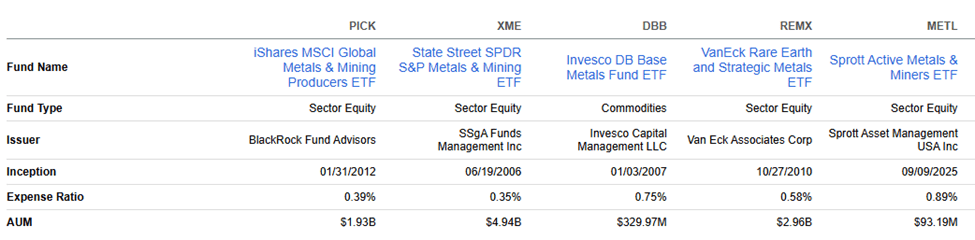
PICK exhibits substantial depth, though thin liquidity with $1.9b in net assets and a 30-day average trading volume of 538k shares. As a result of the lower liquidity, PICK exhibits a relatively wide 30-day median bid/ask spread of 0.18%, potentially adding additional fees when actively traded.
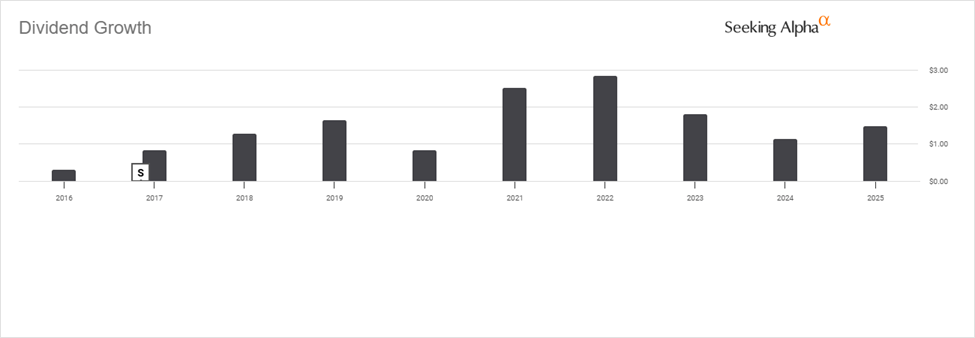
PICK pays out a semiannual distribution at an annualized rate of $1.28/share over the last twelve months, yielding 2.04%. Distributions can vary widely from period to period, making this strategy most appropriate for capital appreciation rather than income.
Seeking Alpha
PICK was designed to track the MSCI ACWI Select Metals & Mining ex Gold ex Silver Investable Market Index, which tracks the performance of companies that participate in industrial and the rare earth metals market. The Index consists of 234 constituents with exposure to small- through large-cap producers; the Index has a median constituent market capitalization of $1.21b with the largest constituent having a market capitalization of $175b. The Index is reviewed on a quarterly basis.
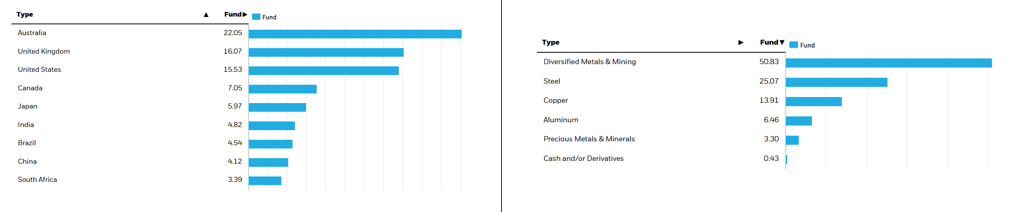
PICK currently invests across 244 holdings, which consist of equities as well as some exposure using futures derivatives. The ETF primarily invests in diversified metals & mining companies, making up 51% of the total portfolio weight, followed by steel at 25%, and copper at 14%. The strategy is regionally diversified with Australia accounting for 22% of regional exposure. Other regions include the UK at 16%, the US at 15.53%, and Canada at 7%.
Corporate Filings
The top 10 holdings within PICK account for 46% of the total portfolio’s assets. In contrast, the bottom 10 holdings account for roughly 0.12%. Top holdings within the ETF include BHP Group (BHP) at 12.30%, Rio Tinto PLC (RIO) at 6.80%, Freeport-McMoran (FCX) at 5.93%, and Glencore PLC (GLEN) at 4.55%.
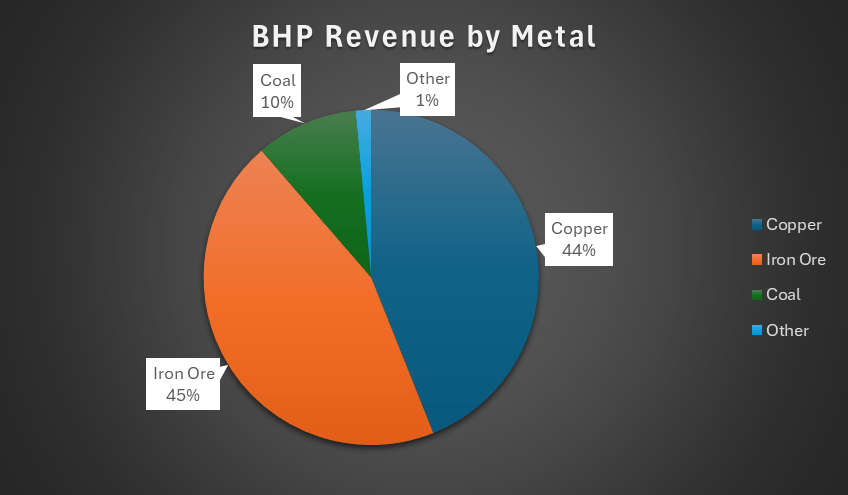
BHP is an Australia-based diversified mining enterprise, primarily producing copper and iron ore at the global scale.
Corporate Filings
Freeport-McMoran is a US-based copper producer, operating globally in mining and refining.
Thematically, the metals & mining sector can be viewed through a variety of lenses. For copper, a major theme to consider is the increasing investments in power infrastructure and data centers, each requiring vast amounts of copper to operate. Iron exhibits broadly diversified themes, including automobile production, industrial manufacturing, power, and construction, amongst others. Sector demand can vary by region; the US may exhibit a larger focus in the automotive industry whereas China may exhibit more steel utilization in construction. Being mindful of macroeconomic trends like annual vehicle production, trucking, and construction starts may be useful indicators for assessing this component of the portfolio.
Some other factors investors may consider when investing in the strategy include international trade. For example, China has historically been a major counterparty to BHP’s iron ore mining operations. For example, Chinese imports accounted for roughly 63% of BHP’s sales in FY25. Trade disputes between the two countries could significantly impact operations and must be taken into consideration when evaluating PICK as an investment, particularly given the portfolio concentration in BHP.
Another factor to consider is trade tariffs. For example, Alcoa’s (AA) business has been impacted in the last year resulting from the 50% duty on imported aluminum and steel. Alcoa has historically imported aluminum into the US through Canada, resulting in mismatched economics throughout FY25 before the Midwest Spread created a marketable opportunity. Alcoa holds a much lower weight in the strategy at 1.10% of net assets, though I believe the theme can apply to all constituents if import duties were to persist.
Overall, PICK can be considered as both a microeconomic and macroeconomic investment strategy given the ETF’s global footprint and general demand across regions and industries. At the microeconomic level, more efficient mining practices and ESG policies can influence the cost of production, or the all-in cash cost.
Investor Suitability
PICK can be utilized by investors seeking a diversified equity strategy tied to the global metals & mining industry. PICK may be best utilized as a buy-and-hold ETF given its relatively light trading volumes. PICK may also be utilized as part of an industry rotation or a macroeconomic strategy given the diverse portfolio of commodity producers. In terms of growth expectations in the fund, a benefit of owning the commodity producers over the commodities outright is that commodity producers gain exposure to stronger commodity prices, cost management, and cash flow generation; owning a portfolio of commodities is limited to the aggregate increase in commodity prices with no additional economic upside potential.
Risks Related to PICK
PICK may expose investors to a variety of risks that should be considered prior to making an investment decision, particularly when considering its global exposure. International trade, geopolitical risk, war, ESG policies, inflation rates, commodity prices, fuel costs, transportation costs, and interest rates can all influence the performance of the underlying companies within the portfolio.
Final Thoughts
PICK can be utilized as a diversified metals & mining investment strategy for investors seeking to participate in the cash flows earned by companies with direct exposure to industrial and base metals. I believe PICK offers investors greater value over investing in a commodity-based portfolio given that the producers provide more economic upside beyond the commodity price. Given the international footprint of the portfolio, investors must consider international trade risk when evaluating whether a broad strategy is appropriate for their investment needs.
This article answers three main questions about PICK:
- What type of investor is PICK most suitable for?
- Does PICK offer diversification to foreign companies?
- Is PICK considered an income ETF or is it focused more on capital appreciation?

Continue Reading

Morningstar CEO Kunal Kapoor shares ETFs worthy of long-term investment on ‘The Claman Countdown.’
Most investors have heard that investing in the S&P 500 is one of the best ways to create long-term wealth. It’s probably the default option in their workplace retirement plan. Even a lot of self-directed investors will put their money in the Vanguard S&P 500 ETF or the iShares Core S&P 500 ETF and call it a day. There’s a reason, after all, that these are the two largest ETFs in the world, with more than $1.6 trillion in assets combined.
The S&P 500 is many people’s only investment. That can create some problems because it leaves a whole slew of asset classes unrepresented. Including them can enhance growth opportunities, mitigate downside risk, or create a regular income stream. Without any of that to complement it, the high-tech concentration or the growth tilt of the index could mean too much volatility.

The S&P 500 is many people’s only investment. (iStock)
Key takeaways
- The S&P 500 has delivered a roughly 10% average annual return over the long term, making it a more than adequate core retirement holding.
- The top 10 holdings account for around 38% of the index. That makes it concentrated and heavily exposed to a handful of tech stocks.
- Holding just the S&P 500 means you’re excluding small caps, international stocks, fixed income, gold, and crypto. These asset classes offer important diversification benefits.
- An S&P 500 ETF is sufficient as a core portfolio holding, but retirement portfolios should have more balance.
US ETF ASSETS UNDER MANAGEMENT TO MORE THAN DOUBLE TO $25T BY 2030, CITIGROUP SAYS
| Ticker | Security | Last | Change | Change % |
|---|---|---|---|---|
| GSPC | NO DATA AVAILABLE | – | – | – |
| VOO | VANGUARD S&P 500 ETF – USD DIS | 652.78 | +7.92 | +1.23% |
| IVVV | NO DATA AVAILABLE | – | – | – |
The case for owning only the S&P 500
It would be easy to look at the returns of the S&P 500 over the past 10 to 15 years and come to the conclusion that it’s the only investment you need. Thanks to its heavy concentration in the “Magnificent Seven” stocks, it has outperformed most sectors, styles, and themes over that time.

The S&P 500 includes many of the best companies the U.S. economy has to offer. (Spencer Platt/Getty Images)
But setting aside the performance numbers, the S&P 500 includes many of the best companies the U.S. economy has to offer. It owns companies such as Apple, Microsoft, Amazon, Walmart, JPMorgan Chase, ExxonMobil, Johnson & Johnson, and Visa. These companies produce billions of dollars in cash flow, generate huge revenues, and have been around for decades. They’re the cornerstones of the economy and will likely be around for many more decades.
GOLDMAN SACHS COMPLETES INNOVATOR CAPITAL ACQUISITION, LIFTING ETF ASSETS TO $90B
These are exactly the kinds of high-quality companies that can make a great portfolio.
| Ticker | Security | Last | Change | Change % |
|---|---|---|---|---|
| AAPL | APPLE INC. | 270.23 | +6.83 | +2.59% |
| MSFT | MICROSOFT CORP. | 422.79 | +2.53 | +0.60% |
| AMZN | AMAZON.COM INC. | 250.56 | +0.86 | +0.34% |
| WMT | WALMART INC. | 127.50 | +2.68 | +2.15% |
| JPM | JPMORGAN CHASE & CO. | 310.29 | +0.34 | +0.11% |
| XOM | EXXON MOBIL CORP. | 146.44 | -5.54 | -3.65% |
| JNJ | JOHNSON & JOHNSON | 234.18 | -0.36 | -0.15% |
| V | VISA INC. | 317.02 | +1.92 | +0.61% |
The case for owning more than the S&P 500
While the S&P 500 is unquestionably a great index to invest in, it’s also incomplete.
VANGUARD FUND STRIPS OUT CHINA IN EMERGING MARKETS INVESTMENT PLAY
Here’s what investors are missing out on by investing only in the S&P 500:
- Small- and mid-caps: The Vanguard Total Stock Market ETF (NYSEMKT: VTI), which invests in the entire U.S. equity market, holds about 3,500 stocks. The 3,000 stocks not held by the S&P 500 represent about 25% of the entire U.S. equity market capitalization. Small and mid caps have an entirely different sector allocation and cyclical exposure. Omitting them means missing out on a big chunk of the U.S. economy.
- International stocks: As we’ve seen over the past year, foreign stocks can perform very well when U.S. stocks stall. They, too, have a different economic composition and are sensitive to different factors than U.S. companies.
- Fixed income: Bonds may be boring, but they can balance out portfolio risk and provide an important income component. As workers get closer to retirement, relying more on fixed income for safety and income becomes more important.
- Gold: Precious metals typically perform well during inflationary periods and geopolitical disturbances. They traditionally have a very low correlation to stocks, which makes them a great risk reducer.
- Crypto: Bitcoin and other stablecoins have become a legitimate asset class. Adding crypto as even a small piece of a broader asset allocation makes some sense.
| Ticker | Security | Last | Change | Change % |
|---|---|---|---|---|
| VTI | VANGUARD TOTAL STOCK MARKET ETF – USD DIS | 349.86 | -0.66 | -0.19% |
Holding more than just U.S. large-cap stocks lets you participate in different market cycles, helps smooth out overall portfolio volatility, and can help build a portfolio more suited to your goals and risk tolerance.
Investors should own more than just the S&P 500
The S&P 500 is a great core investment, but you need more.
GET FOX BUSINESS ON THE GO BY CLICKING HERE
I’m a big advocate of diversification and looking for ways to mitigate risk exposure. Adding different asset classes helps accomplish this. In most cases, it’s not about trying to pick winners. Simply buy the global economy and let the long-term power of compounding do the work for you.
JPMorgan Chase is an advertising partner of Motley Fool Money. David Dierking has positions in Apple and Vanguard Total Stock Market ETF. The Motley Fool has positions in and recommends Amazon, Apple, JPMorgan Chase, Microsoft, Vanguard S&P 500 ETF, Vanguard Total Stock Market ETF, Visa, and Walmart and is short shares of Apple. The Motley Fool recommends Johnson & Johnson. The Motley Fool has a disclosure policy.

There is a fine balance between the benefits of improved infrastructure, versus the cost of disruption. Does the country have it right?

Blue Origin faces FAA probe after New Glenn satellite deployment fails

Wall Street Horizon provides institutional traders and investors with the most accurate and comprehensive forward-looking event data including earnings calendars, dividend dates, option expiration dates, splits, investor conferences and more. Covering 9,500 companies worldwide, we offer more than 40 corporate event types via a range of delivery options. By keeping clients apprised of critical market-moving events and event revisions, our data empowers financial professionals to take advantage of or avoid the ensuing volatility.

Form 144 FIFTH THIRD BANCORP For: 20 April
Form 144 Dakota Gold Corp. For: 20 April

Guwahati: Chief Minister Himanta Biswa Sarma on Sunday said the seat-sharing arrangement within the NDA for the Assam assembly elections was a “done deal”.
Among the NDA constituents in the state, the BJP, Asom Gana Parishad (AGP), United People’s Party Liberal (UPPL) and Bodoland People’s Front (BPF) have members in the assembly. Rabha Hasong Joutha Sangram Samiti (RHJSS) and Janashakti Party (JP) are also part of the NDA, but they do not have any MLAs.
“Our NDA alliance is complete. We know who will contest where; it is a done deal. There is no issue in stitching the alliance,” Sarma told reporters at the state BJP headquarters.
“After every process is complete, the state leadership will meet Union Home Minister Amit Shah with the list of probable candidates,” he added.
On January 7, Sarma had said the BJP was likely to formalise its seat-sharing agreement with its allies by February 15.

On December 5 last year, he had said the finalisation was expected to be over by January 15.
The elections for the 126-member assembly are expected to take place in March-April. This will be the first election after the delimitation exercise, done in 2023.Post delimitation, many seats and their geographical boundaries have been changed, while some non-reserved seats were reserved and vice versa. This has led to complications within the ruling and opposition coalitions.
At present, the BJP has 64 members in the assembly, while AGP has nine, UPPL has seven, and the BPF has three.
In the opposition camp, the Congress has 26 MLAs, AIUDF has 15, and CPI(M) has one. There is one Independent legislator as well.

Financial influencer Taylor Price joins ‘Varney & Co.’ to break down how shifting your mindset can help Americans grow wealth and achieve the American Dream.
California’s housing market is seeing an increase in inventory while the state’s population growth slows, but strong demand stemming from longstanding scarcity has kept the market tight.
An analysis by the Public Policy Institute of California (PPIC) found that the state added 677,000 housing units over a six-year period in which California’s population grew by only 39,000 residents.
Despite the relative growth in the number of housing units available, vacancy rates showed the market remained tight, with PPIC finding that owner vacancy declined from 1.2% to 0.8% while the rental vacancy rate was 4.3% in 2024, well below the national rate of 5.9%.
“Even though the state is adding more housing units than people, it was in such a deep hole that the recent successes in homebuilding are not enough to truly move the needle,” said Joel Berner, senior economist at Realtor.com.
AVERAGE MONTHLY MORTGAGE PAYMENT HITS NEW HIGH, TOPPING $2K FOR FIRST TIME EVER

California’s population growth slowed, but a longstanding housing shortage has kept the market tight. (Mario Tama/Getty Images)
The state’s longstanding shortage of housing units will require more construction to get inventory levels closer to the market’s equilibrium, as the state will need 2.5 million additional homes, according to a 2022 estimate by the state’s housing agency.
PPIC’s analysis also noted a demographic trend that’s affecting California’s housing market, with average household sizes declining in recent years.
It found that California lost 82,000 households with children and gained 722,000 households without them from 2019 to 2024.
“Fewer people living under the same roof means more roofs are required for the same number of people,” Berner said.
THESE 8 US HOUSING MARKETS FAVOR BUYERS

California has eased rules to boost construction of accessory dwelling units (ADUs), such as this one in Concord, California. (Smith Collection/Gado/Getty Images)
The aging of California’s population is a key factor in the trend, as PPIC found that about 16.5% of the state’s population is 65 or older today and projects that number will rise to 24.9% by 2050.
Homebuilding has picked up in the state of California in the last five years, including through promoting the construction of accessory dwelling units (ADUs), which are secondary living units that are on the same lot as a primary home but are typically detached or otherwise self-contained.
“The state has made significant progress from a policy perspective on encouraging ADU construction in recent years, for which it should be commended,” Berner added. “The state has made efforts to lift local restrictions on ADUs, which is helping it to deliver more and more of them where they are needed the most.”
WHITE HOUSE LAYS OUT FIXES FOR HOUSING AFFORDABILITY PROBLEM

California’s shortage of housing has persisted despite an uptick in construction. ( Kevin Carter/Getty Images)
Both PPIC and Berner suggested that while California is making progress, it hasn’t achieved a breakthrough in resolving its housing shortage as new homes are being snapped up quickly and vacancy rates remain low.
Berner noted that while 11.5% of the U.S. population lives in California, the state accounted for only 7.3% of newly permitted housing units last year, adding that the “pace just isn’t fast enough.”
PPIC noted that household formation rates among young adults in California have trended up, suggesting that younger residents are forming households – though the state will need sufficient lower-cost housing at entry-level prices for them to afford to take those next steps in California.
GET FOX BUSINESS ON THE GO BY CLICKING HERE
That pipeline could prove problematic, as Realtor.com noted that of the more than 1.2 million housing units that are planned statewide, just 712,000 are designated for moderate-income households or lower – about half of what California believes it needs.

Advocates attend a news conference about the “impact of incarcerating those charged with marijuana-related offenses,” and policy reform ideas, outside the U.S. Capitol on Monday, April 20, 2026.
Tom Williams | CQ-Roll Call, Inc. | Getty Images
A White House executive order on psychedelics, signed by President Donald Trump on Saturday, aims to speed up research on drugs like psilocybin, MDMA and ibogaine, helping to legitimize an industry that’s long lived largely underground.
But it also raises a broader question: Will psychedelics fall victim, like cannabis has, to a slow-moving federal process?
The latest executive order comes roughly four months after an effort by President Donald Trump to reschedule cannabis, opening the door to greater research and investment opportunities. But since that directive, progress to reclassify cannabis has largely stalled, with the Drug Enforcement Administration review still ongoing and no final decision on moving marijuana from Schedule I to the lesser Schedule III.
The delay reflects how drug policy often slows once it enters interagency review, where scientific evaluation, legal standards and politics meet.
“The process has certainly been slow and frustrating for stakeholders when you consider they have spent decades fighting marijuana’s outrageous 1970s-era misclassification,” said Shawn Hauser, partner at cannabis law firm Vicente LLP.
Vicente LLP also serves as legal counsel for the National Compassionate Care Council (NCCC), a coalition of healthcare stakeholders focused on evidence-based cannabis policy.
The psychedelics order, however, focuses on research acceleration rather than legalization. It directs agencies like the U.S. Food and Drug Administration to expand clinical trials and “Right to Try” access for patients with serious mental health conditions, while leaving drug scheduling unchanged.
AtaiBeckley is among a number of psychedelic-focused drug developers that’s rallying since the order was signed over the weekend, up roughly 25% Monday. Several smaller-market cap stocks also jumped, including Compass Pathways, Definium Therapeutics and U.S.-listed shares of Cybin.
Hauser said the recent psychedelics order reflects a broader shift in Washington toward a medical-first framework, and could mark a path forward for cannabis rescheduling.
“The science-, patient-, health care-first approach is winning in Washington right now,” she said.
“The psychedelic pathway — built on physical-led protocols, clinical research and compassionate use frameworks — is actually a model cannabis advocates should be studying and adopting more aggressively,” Hauser said.
Safety first
Trump’s psychedelics measure has drawn particular attention for its inclusion of ibogaine, a powerful, naturally occurring psychoactive compound with longstanding safety concerns.
The drug is being studied for its applications with post-traumatic stress disorder, depression and addiction, but cardiac risks flagged by Nora Volkow of the National Institute on Drug Abuse remain a major barrier.
That tension is heightened by the expansion of “Right to Try” access, a federal law allowing patients diagnosed with life-threatening diseases or conditions to try experimental drugs when no other treatments work. This distinction typically applies only after Phase I trials are successful.
Ibogaine has struggled to meet that criteria, since most of the research into the drug has been conducted outside the U.S.
Psychedelic industry leaders say the order is meaningful, but the full impacts are still unknown until implementation catches up to prove scientific value.
“The opportunity now is not hype, it’s execution: rigorous science, disciplined safety standards, physician-led protocols and real-world outcome data,” said Tom Feegel, CEO of clinical neurohealth center Beond.
Beond, based in Cancun, Mexico, specializes in ibogaine therapy.
Feegel added that while the executive order signals legitimacy at the highest level of government, the next phase is critical.
Psychedelics still lack a commercial market, though clinical-stage developers, like AtaiBeckley, Compass and GH Research, are emerging. Many prioritize research around less controversial psychedelics like psilocybin and MDMA derivatives for mental health treatment.
U.S. states have been weighing the space, too. Colorado advanced regulated psychedelic access for its residents in 2022, while a Massachusetts ballot measure failed in 2024 with 56% of voters rejecting the access.
Cannabis, by contract, already has a multibillion-dollar adult-use industry across dozens of states, giving it a significant head start even as federal rescheduling remains unresolved.
Hauser argued the two industries are ultimately reinforcing one another.
“The two regulatory tracks aren’t in conflict,” she said. “Both are advancing the broader legitimacy of plant-based alternative medicines, and the infrastructure being built for one will inevitably support the other.”

Although on Tuesday Reeves, in contrast, stressed that the red lines set out in Labour’s manifesto still stand, the chancellor has now clearly signalled a shift. She indicated in her Mais lecture that, wherever it was in Britain’s interest to do so, the government wants to align the UK’s regulatory regime with that of the EU in more areas.

Crypto World53 seconds ago
Paul Atkins Marks One Year as SEC Chair, Changing Crypto Regulation

Politics2 minutes ago
Powerful Mothin Ali speech highlights political neglect of North East England

Sports4 minutes ago
Year 1 coach progress reports: Where is Will Wade’s roster? LSU has no players as portal closure nears

NewsBeat4 weeks ago
Manchester United reach agreement with Casemiro over contract clause amid transfer speculation

NewsBeat3 weeks ago
Steven Gerrard disagrees with Gary Neville over ‘shock’ Chelsea and Arsenal claim | Football

Politics1 week ago
US brings back mandatory military draft registration

News Videos19 minutes ago
Financial Education Video – How to Raise Capital: The #1 Skill of an Entrepreneur

News Videos39 minutes ago
‘Financial Crisis’ Zone; Trader’s Warning For Gold, Stocks, Bitcoin | Gareth Soloway

News Videos53 minutes ago
Live Crypto And Gold Scalping Trading | 19 April 2026 #cryptoscalping #xauusdlive
-

 NewsBeat6 days ago
Trump and Pope Leo: Behind their disagreement over Iran war
-

 Fashion3 days ago
Weekend Open Thread: Theodora Dress
-

 Crypto World7 days ago
SEC Signals Exemption for Crypto Interfaces From Broker Registration
-

 News Videos5 days ago
Secure crypto trading starts with an FIU-registered
-

 Sports3 days ago
NWFL Suspends Two Players Over Post-Match Clash in Ado-Ekiti
-

 Crypto World7 days ago
SEC Proposes Certain Crypto Interfaces Don’t Need to Register as Brokers
-

 Business1 day ago
Powerball Result April 18, 2026: No Jackpot Winner in Powerball Draw: $75 Million Rolls Over
-

 Crypto World3 days ago
Russia Pushes Bill to Criminalize Unregistered Crypto Services
-

 Politics3 days ago
Palestine barred from entering Canada for FIFA Congress
-
 Business4 days ago
Creo Medical agree sale of its manufacturing operation
-

 Politics1 day ago
Zack Polanski demands ‘council homes not luxury flats for foreign investors’
-
 Entertainment7 days ago
Brand New Day’ Footage Reveals the Devastating Impact of ‘Now Way Home’
-

 Crypto World3 days ago
Russia Introduces Bill To Criminalize Unregistered Crypto Services
-

 Tech6 days ago
Microsoft adds Windows protections for malicious Remote Desktop files
-
 Entertainment7 days ago
Karol G’s ‘Ultra Raunchy’ Coachella Set Gave ‘Satanic Vibes’
-

 Entertainment7 days ago
How Babylon 5 Turned Brief Side Story Into Emotional Masterpiece
-

 Tech5 days ago
‘Avatar: Aang, The Last Airbender’ Leaked Online. Some Fans Say Paramount Deserves the Fallout
-

 Tech2 days ago
Auto Enthusiast Scores Running Tesla Model 3 for Two Grand and Turns It Into Bare-Bones Go-Kart
-

 Tech7 days ago
What was the first ransomware attack to demand payment in Bitcoin?
-

 Business7 days ago
Intuitive Machines Stock Climbs 2.4% as $180M NASA Lunar Contract and $900M Revenue Outlook Fuel Momentum
You must be logged in to post a comment Login