

Crypto World
Can SOL break past $130 as WisdomTree expands tokenised funds to Solana?



- WisdomTree’s tokenised funds strengthen Solana’s institutional adoption narrative.
- SOL faces key resistance at $130 after forming support near $117.
- Rising on-chain activity boosts usage despite ongoing meme coin risks.
SOL is currently trading around the mid-$120 range, having recently struggled to reclaim the psychologically important $130 level.
Despite short-term weakness, broader developments within the Solana ecosystem suggest growing structural support beneath the price.
At the centre of this renewed narrative is WisdomTree’s decision to expand its tokenised fund offerings onto the Solana blockchain.
BREAKING: WisdomTree expands tokenized fund access to Solana
Enabling retail and institutional users to transfer, and hold @WisdomTreePrime’s full suite of regulated tokenized funds on Solana pic.twitter.com/HXxtSbKjns
— Solana (@solana) January 28, 2026
This move places Solana firmly within the accelerating real-world asset tokenisation trend led by traditional financial institutions.
WisdomTree’s expansion of its tokenised funds to Solana
WisdomTree manages more than $150 billion in assets, making its presence on Solana a significant validation signal.
By enabling tokenised money market, equity, fixed income, and allocation funds on Solana, WisdomTree is deepening institutional use cases for the network.
The integration allows both institutional and retail participants to mint, trade, and hold regulated tokenised funds natively on-chain.
Solana’s fast settlement speeds and low transaction costs appear to be key reasons behind WisdomTree’s expansion choice.
This development strengthens Solana’s positioning as a blockchain capable of supporting regulated financial products at scale.
Institutional adoption often acts as a slow-burning catalyst rather than an immediate price trigger.
However, it can materially alter long-term demand dynamics for SOL as the network utility expands.
Technical structure and speculative activity shape short-term outlook
At the same time, market participants are watching SOL’s technical structure closely.
Recent price action has shown signs of a potential double-bottom formation around the $117 area.
This pattern is often interpreted as a stabilisation phase following extended downside pressure.
If SOL can maintain support above this region, technical traders see room for a move toward higher resistance zones.
The $130 level represents a critical short-term barrier that has capped upside momentum.
A clean break above $130 could shift market sentiment decisively toward a bullish continuation.
Beyond technicals, on-chain activity across Solana continues to show mixed but notable signals.
Meme token activity on Solana has experienced a surprising revival after months of reduced engagement.
Platforms like Pump.fun have driven a surge in new token creation, approaching an eleven-month high.
Hundreds of thousands of addresses have re-engaged with Solana’s meme economy in recent weeks.
This activity has translated into rising decentralised exchange volumes and fee generation.
While much of this participation is short-term and speculative, it still contributes to network usage.
Higher transaction counts and fee flows indirectly reinforce SOL’s role as the network’s economic backbone.
However, the meme token sector has also highlighted ongoing risks within Solana’s ecosystem.
The rapid collapse of the LICK memecoin underscored persistent issues around insider concentration and token launch practices.
Events like this can weigh on sentiment, particularly among more risk-averse investors.
Nevertheless, speculative excess has historically coexisted with meaningful innovation during growth phases.



The DEX is one of the first dApps to launch on the new Layer 2 and offers on-chain spot and perps trading, as well as lending.
Decentralized crypto exchange World Markets (WM) launched today, Feb. 17, becoming one of the first decentralized applications (dApps) on the MegaETH network. WM bundles spot, perps and lending under one on-chain account.
In commentary to The Defiant, World Markets co-founder Kevin Coons framed the launch as an effort to fix broken incentives, arguing that traders often get punished even when their positions are properly hedged. Coons explained:
“On other platforms, a profitable hedged position can still get liquidated on a price swing. Even worse, winners are often forcibly closed out to cover losses from reckless traders. That’s not risk management; it’s a tax on the responsible! WM’s risk engine understands net market exposure. If you’re delta neutral, you’re protected.
No ADL [auto-deleveraging]. No unfair liquidations. Just a unified trading layer where your entire portfolio becomes your power.”
Auto-deleveraging, or forced liquidation, of leveraged crypto positions came into focus more broadly across the industry after the Oct. 10 market crash, which resulted in an ADL cascade, bringing total daily liquidations to a record high near $20 billion.
On its plans after protocol launch, the World Markets team suggested that a token remains a long-term possibility but without a set timeline, citing a desire to stay flexible as new products roll out. Nearer-term protocol featuers include vaults, expected within one to two months, covering automated leveraged basis trades.
For now, World Markets is prioritizing asset listings over fundraising and has no venture capital backers, Coons told The Defiant. Liquidity support is instead coming from MegaETH, with plans for a mobile app later this year as the platform gauges which markets gain the most traction.
The launch comes as MegaETH itself has seen early capital inflows since its Feb. 9 mainnet launch, with total value locked rising about 65% in the past week to roughly $66.5 million, driven largely by stablecoins.
World Markets is currently the third largest protocol on MegaETH by TVL, with about $6.3 million. The largest protocol, Kumbaya, leads by far with $51.37 million.
As The Defiant reported earlier, the L2 network has yet to meet the on-chain usage and revenue thresholds tied to a future MEGA token launch, leaving its token generation event conditions unmet for now.
Crypto World
65% of CEX Stablecoins Sit on Binance as Exchange Reserves Hit $47.5B, CryptoQuant Reports

TLDR:
- Binance holds $47.5B in USDT and USDC reserves, a 31% year-over-year increase from $35.9B in 2024.
- CryptoQuant confirms Binance commands 65% of total stablecoin liquidity across all centralized exchanges globally.
- OKX, Coinbase, and Bybit trail with 13%, 8%, and 6% shares of total CEX stablecoin reserves respectively.
- Bear market outflows have slowed to $2B in the past month, down sharply from $8.4B recorded by December 23.
65% of all stablecoin reserves across centralized exchanges now sit on Binance, according to data from CryptoQuant.
The exchange holds $47.5 billion in combined USDT and USDC, far ahead of every competing platform. That figure marks a 31% year-over-year increase from $35.9 billion.
As the broader crypto market navigates a bear phase, capital does not appear to be leaving the space. Instead, it is consolidating at one address.
Binance Pulls Ahead as the Central Hub for CEX Stablecoins
CryptoQuant shared the data in a recent post, stating that “$47.5B in stablecoins now sits on one exchange.” The firm noted that Binance holds 65% of all exchange stablecoin liquidity. Competitors, it added, remain far behind by comparison.
OKX is the next largest holder with $9.5 billion, giving it a 13% share. Coinbase follows with $5.9 billion, representing 8% of total CEX stablecoin reserves. Bybit holds $4 billion, accounting for a 6% share across the Ethereum and TRON networks.
The gap between Binance and its closest rivals is considerable. OKX, in second place, holds roughly one-fifth of what Binance carries in stablecoin reserves. That distance reflects how dominant Binance has become within centralized exchange liquidity.
USDT makes up the overwhelming portion of Binance’s stablecoin position. The exchange holds $42.3 billion in USDT, up 36% from $31.0 billion recorded a year ago. USDC holdings have stayed relatively flat at $5.2 billion over the same period.
Outflows Tied to Bear Market Begin to Ease
Stablecoin reserves across exchanges climbed sharply ahead of the late-2025 market downturn. In the 30 days leading up to November 5, reserves grew by $11.4 billion across centralized platforms. That build-up came just before crypto prices entered a sharp correction.
Once the bear market took hold, those reserves began falling. By December 23, exchange stablecoin holdings had dropped by $8.4 billion from their peak. The decline tracked closely with falling crypto prices during that same window.
The rate of those outflows has since slowed. Over the past month, reserves fell by only $2 billion, a much smaller drop than in prior weeks.
CryptoQuant noted that “the pace of outflows has recently moderated,” pointing to a stabilization in exchange-held capital.
Binance’s year-over-year growth in stablecoin reserves tells a longer story. Its total holdings rose 31% despite the broader bear market pressure on the space.
As CryptoQuant put it, capital is not exiting crypto — it is concentrating. And by the numbers, it is concentrating primarily on Binance, reinforcing its position as the dominant liquidity center among all centralized exchanges globally.


Italian banking giant Intesa Sanpaolo has disclosed significant exposure to bitcoin exchange-traded funds (ETFs) and crypto-linked assets in its latest U.S. Securities and Exchange Commission (SEC) Form 13F filing for the quarter ending December 31, 2025.
Summary
- Intesa Sanpaolo disclosed nearly $100 million in Bitcoin ETF holdings in its latest Form 13F filing with the U.S. Securities and Exchange Commission for Q4 2025.
- The bulk of the exposure comes from positions in U.S.-listed spot Bitcoin ETFs, signaling growing institutional adoption among major European banks.
- The filing highlights continued integration of regulated crypto investment products into traditional banking portfolios amid rising institutional demand.
Italy’s Intesa Sanpaolo joins institutional Bitcoin ETF rush
According to the SEC filing, the lender held approximately $96 million in spot bitcoin ETF positions at the end of last year, marking a notable step by a major European financial institution into regulated crypto markets.
The largest individual stake was in the ARK 21Shares Bitcoin (BTC) ETF, valued at roughly $72.6 million, followed by about $23.4 million in iShares Bitcoin Trust.
In addition to these core bitcoin ETF positions, Intesa Sanpaolo also listed a smaller $4.3 million holding in the Bitwise Solana Staking ETF, broadening its exposure to digital assets beyond bitcoin.
Beyond ETF holdings, the filing revealed a sizable put option position tied to MicroStrategy, a corporation known for holding large quantities of bitcoin, suggesting a hedge strategy that could benefit if that company’s stock trades down toward the value of its bitcoin assets.
Intesa Sanpaolo’s 13F filing also included minor equity stakes in several crypto-linked companies, such as Coinbase and Circle, reflecting a diversified digital asset strategy that extends past passive ETF index exposures.
Investment analysts see the disclosure as part of a broader institutional trend of regulated financial firms incorporating digital asset products into client offerings and treasury strategies, even amid volatility in the cryptocurrency markets.
The news shows the evolving interface between traditional banking giants and crypto-linked financial instruments.
TLDR:
- ETFs and DATs held 12% of Bitcoin supply by end of 2025, exceeding new supply absorption.
- Sovereign holdings now include 325,437 BTC in the U.S. Strategic Bitcoin Reserve.
- Bitcoin drawdowns remain below 50% in the current cycle, reflecting deeper market liquidity.
- ETFs reached adoption levels in under two years that gold ETFs took over 15 years to achieve.
Bitcoin is increasingly viewed as a strategic asset for institutional investors.
Spot ETFs, corporate treasuries, and sovereign holdings absorbed more supply than miners produced in 2025. The U.S. Federal Reserve’s early rate cuts and monetary easing have increased demand for scarce digital assets.
Regulatory clarity, including the U.S. CLARITY Act, supports broader adoption across traditional financial platforms.
Structural Demand and ETF Expansion
Spot Bitcoin ETFs reshaped the supply-demand balance, absorbing 1.2 times the newly mined supply and recirculated coins in 2025, according to ARK Invest data.
By year-end, ETFs and digital asset treasuries (DATs) controlled over 12% of bitcoin’s total supply. Morgan Stanley and Vanguard expanded access to regulated Bitcoin products, including ETFs, creating a bridge to traditional capital pools.
Even amid a major October liquidation and market volatility, ETF growth outpaced supply expansion, reflecting stronger structural demand.
Corporate adoption also expanded, with S&P 500 and Nasdaq 100 indices including bitcoin-exposed companies like Coinbase and Block. Digital asset treasury firms now hold over 1.1 million BTC, representing 5.7% of total supply, mostly long-term holdings.
Strategy, formerly MicroStrategy, maintains 3.5% of bitcoin’s total supply as a treasury reserve. Sovereign involvement increased, highlighted by the U.S. Strategic Bitcoin Reserve holding approximately 325,437 BTC, or 1.6% of supply.
The expansion of regulated vehicles and institutional demand coincides with regulatory progress. The CLARITY Act aims to define the lifecycle of digital assets and streamline oversight between the SEC and CFTC.
Texas and other states continued state-level Bitcoin adoption, further signaling government acceptance. Clear guidelines support allocation by institutional investors, strengthening bitcoin’s role as a macro instrument.
Bitcoin’s Relationship to Gold and Market Maturity
Historically, Bitcoin has followed gold’s lead during macro shocks. In 2025, gold surged 64.7% amid inflation concerns, while Bitcoin declined 6.2%, echoing patterns seen in 2016 and 2019.
ETFs indicate growing confidence in Bitcoin as a store-of-value, achieving in two years what gold ETFs required 15 years to reach. Weekly correlation data show low alignment between Bitcoin and gold, suggesting Bitcoin can diversify portfolios independently of traditional assets.
Market volatility is declining, with drawdowns from record highs under 50% since 2022, compared to 70–80% in prior cycles.
Time-in-market strategies continue to outperform timing-focused approaches, with hypothetical investors from 2020–2025 gaining 29–61% despite corrections. These trends suggest Bitcoin is maturing from a speculative asset into a liquid macro instrument with robust trading infrastructure.
Long-term holders, including ETFs, corporations, and sovereigns, now absorb a meaningful portion of new supply. With regulatory clarity and growing institutional access, Bitcoin is increasingly recognized as a strategic allocation rather than an optional investment.
Low correlations with traditional assets and diminished volatility reinforce its potential to improve portfolio risk-adjusted returns.
TLDR:
- BRCA ensures crypto developers cannot face prosecution solely for publishing neutral blockchain software.
- Criminal statutes still apply to custodial operators or those with intent to launder funds.
- Section 301 distinguishes decentralized protocols from centralized platforms to clarify obligations.
- Bipartisan support highlights consistent recognition of lawful developer activity in U.S. law.
Crypto developers in the United States may face heightened legal risks if key protections in the Blockchain Regulatory Certainty Act are weakened. Coin Center, a leading blockchain advocacy group, urged Senate Banking Committee members to preserve safeguards for neutral software developers.
The organization emphasized that the BRCA ensures coders cannot be prosecuted as money transmitters simply for creating or maintaining blockchain software. Without these protections, innovation in decentralized systems could slow as legal ambiguity increases.
BRCA Aims to Shield Neutral Blockchain Software
The BRCA narrowly defines lawful activity, covering code writing, software publishing, and running neutral systems.
Coin Center compared these roles to internet service providers and cloud operators, noting they face no prosecution for criminal misuse by third parties. The legislation clarifies that developers enabling peer-to-peer value exchange do not automatically assume liability for user actions.
The bill also distinguishes between custodial intermediaries and neutral infrastructure. Developers who control customer funds remain subject to existing money transmission statutes.
Coin Center stressed that the BRCA does not create gaps in enforcement or shield illicit activity. Criminal statutes, including 18 U.S.C. §§ 1956 and 1957, still apply when intent to launder or mismanage funds is proven.
Section 301 of the Senate Banking draft already attempts to separate genuinely decentralized protocols from centralized platforms.
Only non-decentralized protocols, where authority can alter functionality or restrict use, may trigger regulatory obligations. Coin Center emphasized that the BRCA complements this distinction, protecting developers who do not exercise control over user funds.
The legislation ensures innovators like Vitalik Buterin or Hayden Adams can operate without fear of arbitrary prosecution. The act aims to maintain the neutrality and public availability of blockchain tools.
Removing these protections could deter responsible development while leaving criminal actors unaffected.
Bipartisan Support Reinforces Developer Safeguards
The BRCA has consistently drawn bipartisan support in both the Senate and House.
Senators Ron Wyden and Cynthia Lummis introduced the Senate version, while Representatives Tom Emmer and Juan Vargas have championed the House counterpart. Versions of the act have passed Congress multiple times, most recently through the Clarity Act.
Coin Center highlighted that statutory ambiguity should not criminalize constitutionally protected conduct. Writing, publishing, and maintaining software without custody over funds remains a lawful activity.
The organization argued that weakening the BRCA would inject instability into U.S. blockchain regulation. Developers would face unclear liability, risking their willingness to build within the country.
The act does not exempt bad actors. It preserves all prosecutorial tools to target unlicensed custodial services or those knowingly facilitating criminal transactions.
Neutral software development remains protected while law enforcement retains authority over illicit operations. This distinction draws a clear line between innovation and criminal exposure.
By codifying these rules, the BRCA seeks to maintain a stable environment for blockchain innovation. Coin Center’s advocacy reinforces the importance of preserving protections amid ongoing market structure legislation.
Without it, developers risk legal uncertainty while centralized intermediaries remain fully accountable.

Decentralized finance is no longer in its experimental phase. It’s in its refinement era.
The conversation around DeFi today isn’t about flashy APYs or overnight token pumps. It’s about sustainability, automation, and real-world integration. The market is shifting from speculative excess toward structural resilience — and that shift is defining the latest trend in crypto.
Let’s break down what’s really happening.
The Shakeout: When Weak Protocols Collapse
Every cycle needs a cleansing moment.
The recent collapse of ZeroLend, which saw roughly 98% of its total value locked evaporate, reminded everyone that unsustainable yield models don’t survive market pressure.
TVL crashes are painful, but they serve a purpose. They expose:
-
Fragile lending structures
-
Over-leveraged positions
-
Emission-driven “fake yield.”
-
Governance without proper risk oversight
Capital in DeFi is becoming more selective. Investors are no longer blindly chasing APY. They’re evaluating fundamentals — revenue models, security architecture, liquidity depth, and real use cases.
In many ways, this is a sign of maturity.
The Rise of Real-World Assets (RWAs)
If one sector is dominating serious conversations, it’s real-world asset tokenization.
Treasury bills, private credit, real estate, and bonds are increasingly being brought on-chain. Unlike traditional yield farming, RWAs introduce external cash flows into DeFi ecosystems.
This changes everything.
Instead of circular crypto-native incentives, protocols can generate yield backed by real-world income streams. That’s a massive leap toward financial legitimacy.
Institutional players are paying attention. Firms like Grayscale Investments continue rebalancing crypto exposure as blockchain-based financial infrastructure evolves. While adoption may not always make headlines, integration is steadily progressing behind the scenes.
RWAs represent a bridge between traditional finance and decentralized networks — and that bridge is getting stronger.
AI Meets DeFi: Automation Becomes the Edge
Another defining trend is the integration of artificial intelligence into DeFi operations.
We’re moving from manual yield farming to AI-driven capital allocation.
Today’s DeFi tools increasingly offer:
-
Automated yield optimization
-
Risk-scoring engines
-
Cross-chain arbitrage execution
-
Smart portfolio rebalancing
Instead of users jumping between dashboards and chains, intelligent agents can autonomously execute complex strategies.
The impact is significant:
-
Reduced emotional decision-making
-
More efficient liquidity deployment
-
Lower inefficiencies in fragmented markets
Automation isn’t just convenience — it’s becoming a competitive advantage.
Cross-Chain Liquidity Is Becoming Standard
Liquidity fragmentation once slowed DeFi’s growth. Now interoperability is becoming a default expectation.
Users don’t want to think about which chain offers the best yield. They want seamless access.
Cross-chain bridges, aggregators, and modular infrastructure are making capital more fluid across ecosystems. As a result:
-
Slippage decreases
-
Arbitrage gaps tighten
-
User experience improves
The focus is shifting from individual chain dominance to ecosystem-wide liquidity efficiency.
Despite market volatility and protocol failures, foundational networks remain central to DeFi’s evolution.
Ethereum continues to serve as the backbone of decentralized finance, with Layer 2 scaling solutions, staking upgrades, and institutional integrations strengthening its position.
Infrastructure improvements may not create viral headlines, but they create long-term stability.
And stability is what sustainable finance requires.
The Bigger Shift: DeFi Is Growing Up
The DeFi landscape in 2026 looks very different from the frenzy of 2020–2021.
The market is transitioning:
-
From emissions-based yield to revenue-backed returns
-
From manual trading to AI-managed automation
-
From isolated chains to interconnected ecosystems
-
From speculation-driven hype to infrastructure-driven value
This doesn’t mean volatility disappears. Crypto will always be volatile. But beneath the surface, the architecture is becoming more robust.
The reckless experiments are being filtered out. The protocols with sustainable models are absorbing liquidity. Institutional interest is deepening. Automation is improving efficiency.
DeFi isn’t fading — it’s evolving.
And this phase may be the most important yet.
Because for the first time, decentralized finance is starting to look less like an experiment… and more like the foundation of a parallel financial system.
REQUEST AN ARTICLE
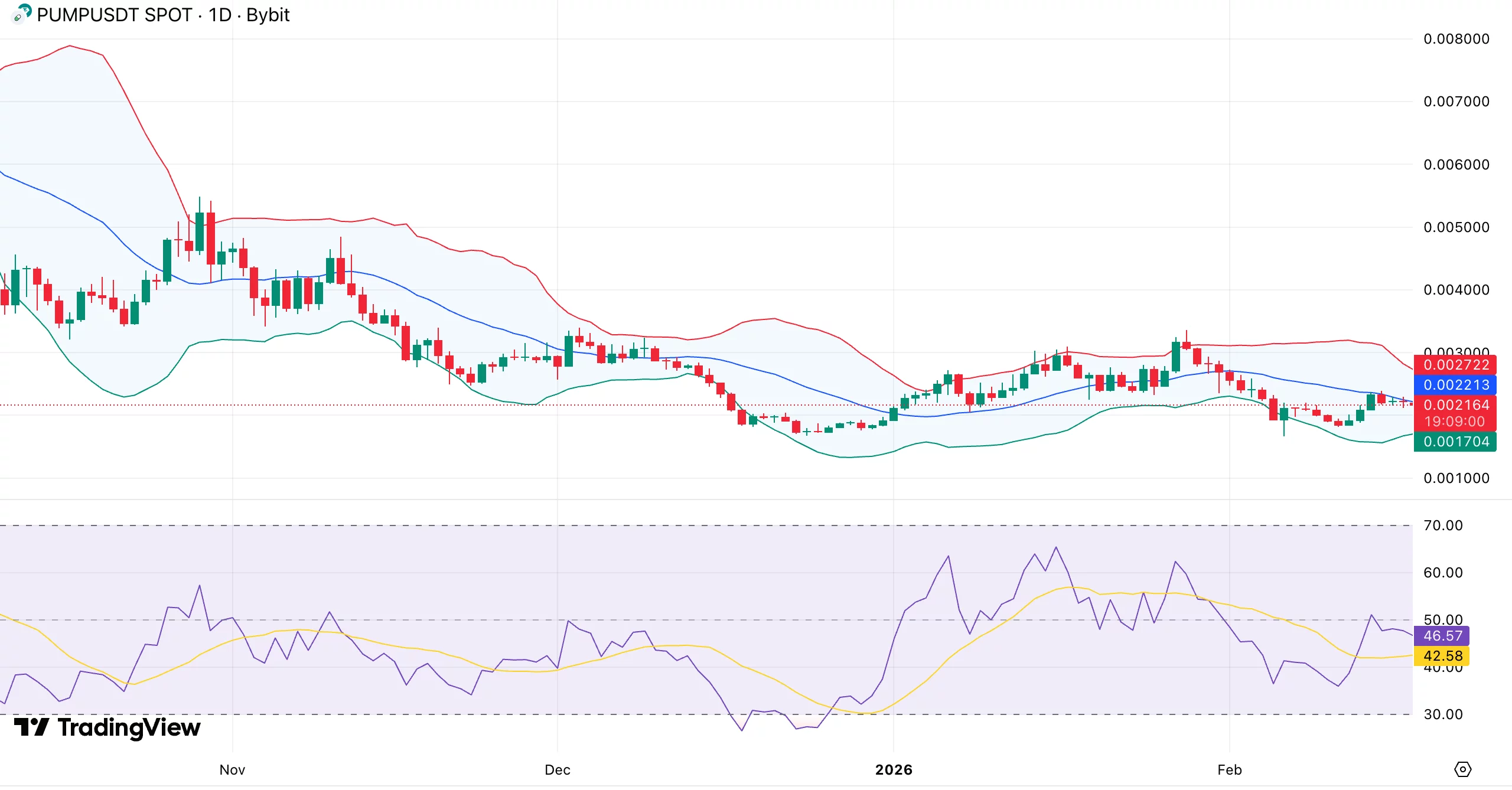
PUMP price is tightening below a descending trendline as a new cashback model reshapes trader incentives.
Summary
- PUMP is compressing beneath a descending trendline after a recent recovery.
- Pump.fun’s new Cashback Coins shift fee rewards from creators to traders.
- A decisive breakout could trigger expansion, while rejection keeps downside risk in play.
Pump.fun’s native token PUMP was trading at $0.002162 at press time, down 3.2% in the past 24 hours. Over the last seven days, it has moved between $0.001843 and $0.002355, placing the current price close to the upper end of that range.
The token is up 13% on the week, but still down around 15% over the past month. Trading activity has accelerated. Spot volume reached $110 million in the last 24 hours, a 56% increase from the previous day.
Derivatives show a similar pickup in activity. According to CoinGlass data, futures volume climbed 38% to $234 million, while open interest rose 1.08% to $174 million.
Rising volume alongside a slight increase in open interest suggests that new positions are being opened, though leverage growth remains limited.
Cashback Coins introduce new incentive model
The recent compression in price comes as Pump.fun (PUMP) rolls out a structural change to its launch model.
On Feb. 17, the platform announced Cashback Coins, a feature that lets creators choose between traditional Creator Fees or redirecting those fees entirely to traders and holders. The decision must be made before launch, and once a token goes live, it cannot be changed.
Under the Cashback model, market participants, not the deployer, receive all creator fees. The goal is to address criticism that some token deployers collect fees without contributing long-term value.
This change could have an impact on short-term trading behavior. Rewards are tied to trading activity as opposed to passive holding. If volume increases, more fees are generated and redistributed.
That structure may encourage higher turnover and short bursts of speculation. At the same time, it can amplify volatility if traders rotate quickly in and out of positions to maximize rewards.
PUMP price technical analysis
On the daily chart, PUMP is trading below a clear descending trendline drawn from a prior swing high. The pattern shows lower highs, while lows have begun to stabilize near $0.0021. Price is compressing between $0.0021 support and $0.0023 resistance.
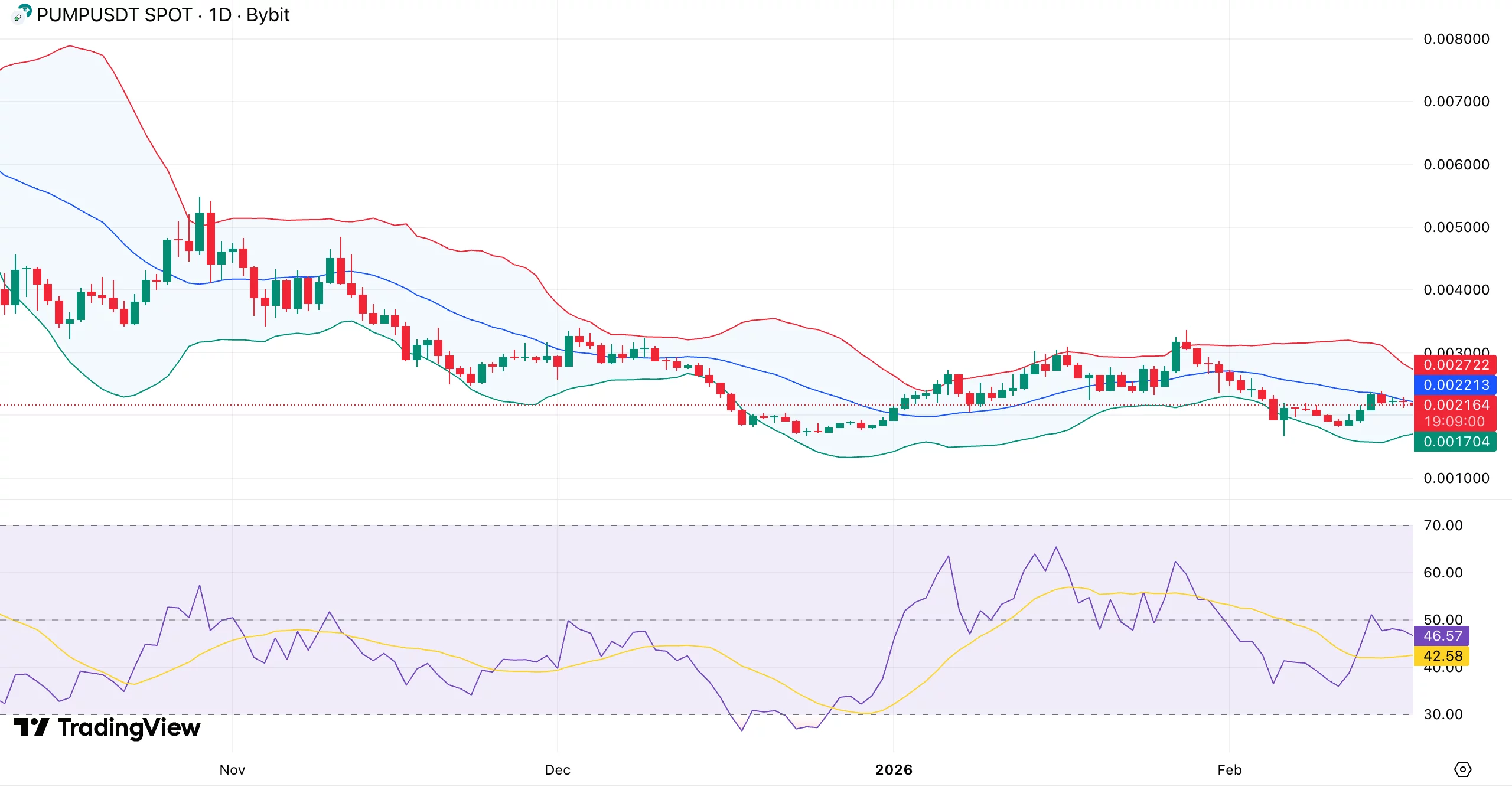
Bollinger Bands are tightening, indicating volatility contraction. When ranges narrow this way, expansion usually follows. Direction will depend on which level breaks first.
Momentum has improved but has not flipped bullish. The relative strength index is near 45, after bouncing from lower levels earlier in the month. It remains below 50, meaning buyers have not taken control.
A sustained move above 50 would strengthen upside momentum. To regain traction, bulls must close above the descending trendline and the 20-day moving average, ideally with a strong volume increase.
The immediate resistance lies around $0.0023. A breakout above that level might signal the start of a move toward the most recent high at $0.002355. A decisive decline below $0.0021 would reveal a lower liquidity pocket and shift momentum back toward sellers.


Bitcoin exchange-traded funds (ETFs) continue to hold billions in assets despite bitcoin’s brutal price crash, but that staying power isn’t necessarily the bullish signal that many have come to believe.
According to one analyst, the resilience stems from market makers and arbitrageurs who trade in and out rather than die-hard long-term holders betting on price appreciation.
Bitcoin’s price peaked above $126,000 in early October and recently crashed to nearly $60,000. Despite the price halving, the 11 spot bitcoin ETFs listed in the U.S. have cumulatively registered just $8.5 billion in net outflows. These funds still hold $85 billion in assets under management, which equates to over 6% of bitcoin’s supply.
Several analysts, including those CoinDesk spoke with at Consensus Hong Kong last week, cited the same data as evidence of bullish positioning.
Markus Thielen, founder of 10x Research, says the resilience comes not just from long-term hodlers, but from market makers and arbitrageurs with hedged, non-directional positions.
“This reflects the structural nature of ETF ownership, which is dominated by market makers and arbitrage-focused hedge funds holding largely hedged positions, as well as long-term institutional investors with low turnover and longer investment horizons,” Thielen said in a note to clients on Wednesday.
Thielen pointed to reports from institutions (called 13F filings) for late 2025. They show that 55% to 75% of BlackRock’s IBIT ETF, which holds $61 billion, is owned by market makers and arbitrage-focused hedge funds who keep their bets hedged or neutral, not truly bullish on bitcoin.
Market makers are entities that create liquidity in an exchange’s order book, facilitating the seamless execution of large buy and sell orders at stable prices. They profit from the bid-ask spread and therefore strive to maintain market-neutral exposure to bypass price volatility risks. Similarly, arbitrage hedge funds take opposing positions in two markets, such as spot ETFs and futures, to profit from the price differential between the two.
Both entities, therefore, do not inject directional pressures (bullish/bearish) into the market.
Thielen added that market makers trimmed exposure by around $1.6 billion to $2.4 billion during the fourth quarter, as bitcoin traded near $88,000, reflecting “declining speculative demand and reduced arbitrage inventory requirements.”
Bridge, a stablecoin platform acquired by Stripe in 2024, has received conditional approval from the Office of the Comptroller of the Currency to become a federally chartered national trust bank, the company announced.
Summary
- Stablecoins are digital currencies designed to maintain stable value, typically backed by reserve holdings such as U.S. dollars.
- Bridge stated that the federal charter would create “the regulatory backbone” companies need to deploy stablecoins securely and at scale.
- Ripple, Circle, BitGo, Fidelity Digital Assets, and Paxos reportedly received conditional approvals in December.
The national trust bank charter would enable Bridge to store digital assets for customers, issue stablecoins, and monitor reserve funds backing those digital currencies, according to the company. Stablecoins are digital currencies designed to maintain stable value, typically backed by reserve holdings such as U.S. dollars.
Bridge stated that the federal charter would create “the regulatory backbone” companies need to deploy stablecoins securely and at scale. The charter would allow the platform to serve financial institutions, fintech companies, cryptocurrency firms, and enterprises seeking digital payment options.
Bridge joins several major cryptocurrency companies seeking federal charters from the OCC. Ripple, Circle, BitGo, Fidelity Digital Assets, and Paxos reportedly received conditional approvals in December, according to industry reports. Anchorage Digital Bank remains the only company to have completed the process and secured a national trust bank charter, which it obtained in 2021.
The conditional approval positions Bridge to operate under the Guiding and Establishing National Innovation for U.S. Stablecoins Act, known as the GENIUS Act. The legislation, signed in 2024, establishes a legal framework for stablecoin issuance and oversight in the United States. The law includes provisions for increased transparency, strengthened reserve requirements, and federal regulatory oversight of firms involved in stablecoin issuance and custody.
The OCC’s recent conditional approvals indicate federal regulators are increasingly willing to integrate cryptocurrency companies into the regulated financial system. However, the approvals remain conditional as regulators proceed cautiously amid concerns about potential risks cryptocurrency companies could pose to the financial system.
For Stripe, Bridge’s approval could strengthen the payment processor’s position in digital payments. Stablecoins are emerging as alternatives to traditional cross-border payment systems, offering faster transaction speeds and lower costs, according to industry analysts.
TLDR:
- BitMine acquired 45,759 ETH in one week, bringing total holdings to 4,371,497 ETH worth $8.7 billion.
- Tom Lee compares current crypto sentiment to 2018 and 2022 lows, calling the pullback a buying opportunity.
- BitMine’s staked ETH of 3.04 million tokens generates $176M annually at a 7-day yield of 2.89%.
- MAVAN, BitMine’s proprietary staking validator network, is set to launch in early 2026 with three partners.
Tom Lee’s Bitmine Immersion Technologies (NYSE AMERICAN: BMNR) purchased 45,759 ETH in a single week, pushing total holdings to 4,371,497 tokens.
The move comes as Lee publicly identifies what he calls bottom-like sentiment across crypto markets. Combined with cash and other investments, Bitmine’s total holdings now stand at $9.6 billion, reinforcing its position as the world’s largest Ethereum treasury.
Lee Calls Market Sentiment a Buy Signal
Tom Lee drew a direct comparison between today’s crypto market and the lows of 2018 and 2022. He described current investor mood as carrying the same weight as previous cycle bottoms. Unlike past downturns, however, no major institutional failures have triggered the current weakness.
Lee pointed to a specific turning point, stating that “crypto has remained weak since the ‘price shock’ and massive deleveraging seen on October 10th.”
He noted that 2025 and 2026 have not produced the large-scale debacles seen in prior cycles, such as the FTX collapse or Three Arrows Capital in 2022. The current softness, in his view, is a sentiment-driven correction rather than a structural breakdown.
At Consensus Hong Kong, Lee outlined three long-term growth drivers for Ethereum, covering Wall Street tokenization, AI agent payment infrastructure, and creator-focused Layer 2 standards.
He argued that “Ethereum is well positioned to garner significant share, given its neutrality and 100% uptime and reliability.” These themes dominated panel discussions throughout the conference, reinforcing his conviction.
On the company’s buying strategy, Lee was direct: “We cannot control the price of Ethereum, and the company is acquiring ETH regardless of price trend, as the long-term outlook for Ethereum remains outstanding.”
He added that Bitmine continues to “buy ETH even as crypto moves through this ‘mini-winter,’” framing the pullback as an accumulation window rather than a warning sign.
Staking Machine Running as MAVAN Nears Launch
Beyond accumulation, Bitmine is generating meaningful revenue from its existing ETH stack. Total staked ETH now stands at 3,040,483 tokens, valued at roughly $6.1 billion at current prices. Annualized staking revenues have climbed to $176 million, based on a 7-day yield of 2.89%.
Lee noted that “at scale, when Bitmine’s ETH is fully staked by MAVAN and its staking partners, the ETH staking rewards is $252 million annually.”
The company is currently working with three staking providers as it prepares to deploy MAVAN, its proprietary Made in America Validator Network. The solution is expected to launch in early 2026 as a best-in-class staking infrastructure platform.
Bitmine’s total holdings also include 193 Bitcoin, $670 million in cash, a $200 million stake in Beast Industries, and a $17 million position in Eightco Holdings.
The company ranks 158th among all US-listed stocks by average daily dollar volume, trading approximately $0.9 billion per day. Institutional backers include ARK’s Cathie Wood, Founders Fund, Pantera, Galaxy Digital, and Kraken.

Is AI Coming for Financial Analysts?

How to have the perfect weekend in Austin: what to do and where to eat, drink and stay

Dilip Buildcon shares rally 4% as lowest bidder for Rs 702 crore Gujarat flood control project


-

 Sports6 days ago
Big Tech enters cricket ecosystem as ICC partners Google ahead of T20 WC | T20 World Cup 2026
-

 Video2 days ago
Bitcoin: We’re Entering The Most Dangerous Phase
-

 Tech3 days ago
Luxman Enters Its Second Century with the D-100 SACD Player and L-100 Integrated Amplifier
-

 Video5 days ago
The Final Warning: XRP Is Entering The Chaos Zone
-
 Tech1 day ago
The Music Industry Enters Its Less-Is-More Era
-

 Business7 hours ago
Infosys Limited (INFY) Discusses Tech Transitions and the Unique Aspects of the AI Era Transcript
-

 Video22 hours ago
Financial Statement Analysis | Complete Chapter Revision in 10 Minutes | Class 12 Board exam 2026
-

 Sports1 day ago
GB's semi-final hopes hang by thread after loss to Switzerland
-

 Crypto World21 hours ago
Can XRP Price Successfully Register a 33% Breakout Past $2?
-

 Crypto World4 days ago
Bhutan’s Bitcoin sales enter third straight week with $6.7M BTC offload
-
 Crypto World6 days ago
Pippin (PIPPIN) Enters Crypto’s Top 100 Club After Soaring 30% in a Day: More Room for Growth?
-

 Video6 days ago
Prepare: We Are Entering Phase 3 Of The Investing Cycle
-
 NewsBeat3 days ago
The strange Cambridgeshire cemetery that forbade church rectors from entering
-

 Business6 days ago
Barbeques Galore Enters Voluntary Administration
-
 Crypto World6 days ago
Ethereum Price Struggles Below $2,000 Despite Entering Buy Zone
-
 NewsBeat3 days ago
Man dies after entering floodwater during police pursuit
-

 Crypto World5 days ago
Kalshi enters $9B sports insurance market with new brokerage deal
-

 NewsBeat4 days ago
UK construction company enters administration, records show
-
 Crypto World4 days ago
BlackRock Enters DeFi Via UniSwap, Bitcoin Stages Modest Recovery
-
 Business6 days ago
An Activist Investor Enters Wall Street Banks’ Cozy Club