Connect with us
DAPA Banner

Business

UnitedHealth Group (UNH) earnings Q1 2026

Published

on

UnitedHealth Group (UNH) earnings Q1 2026

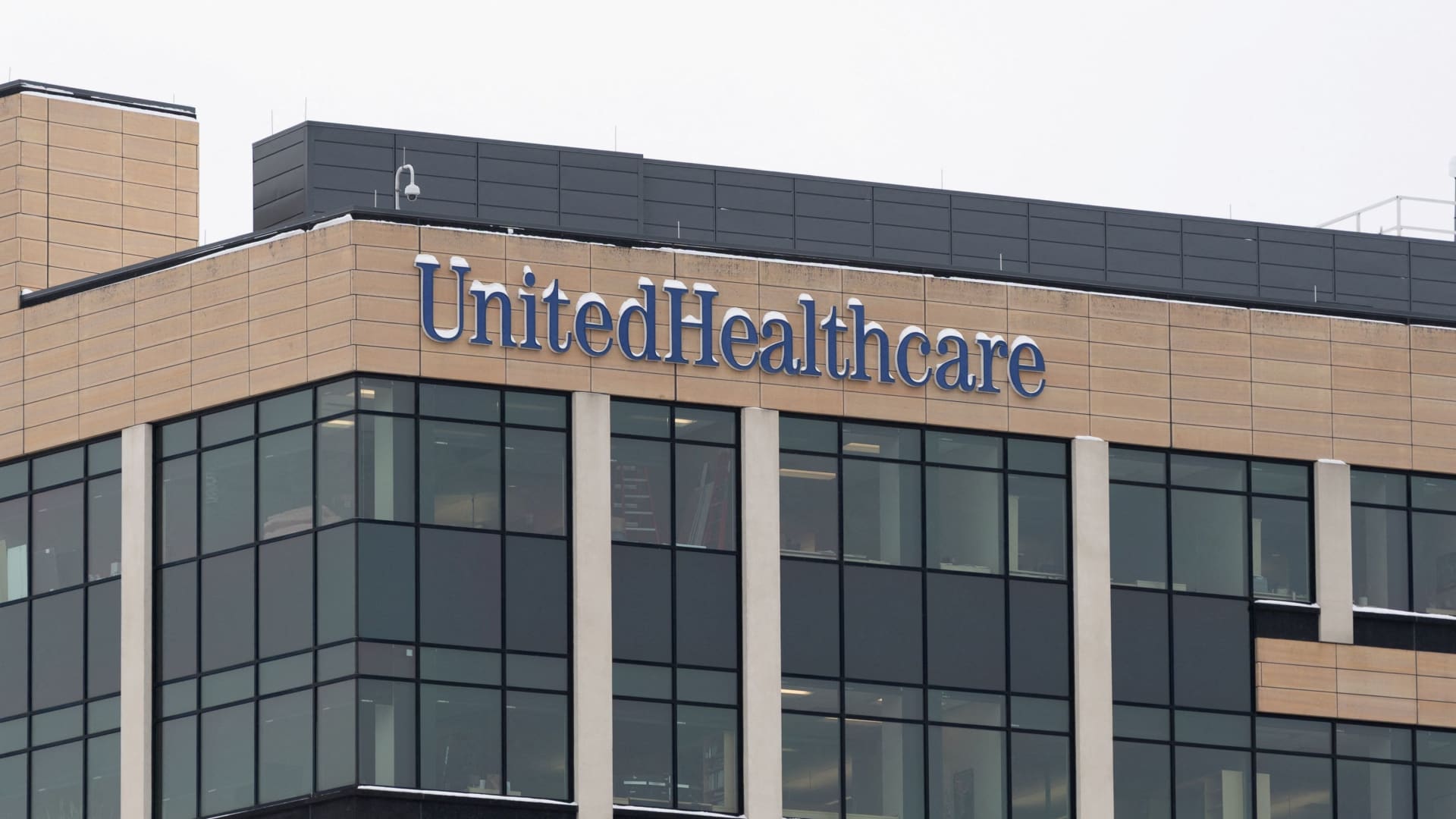
UnitedHealthcare sign is displayed at its office building in Minnetonka, Minnesota, U.S., Dec. 11, 2025.

Tim Evans | Reuters

UnitedHealth Group on Tuesday posted first-quarter earnings that topped estimates and hiked its 2026 profit outlook, as the company better manages high medical costs and streamlines its operations. 

Advertisement

The nation’s largest private insurer said it expects 2026 adjusted earnings of more than $18.25 per share, up from a previous outlook of more than $17.75 per share. UnitedHealth is maintaining its full-year revenue guidance of greater than $439 billion, which the company said in January reflects “right-sizing across the enterprise.”

Here’s what the company reported for the first quarter compared with what Wall Street was expecting, based on a survey of analysts by LSEG:

  • Earnings per share: $7.23 adjusted vs. $6.57 expected
  • Revenue: $111.72 billion vs. $109.57 billion expected

UnitedHealth is banking on a new leadership team to carry out a turnaround plan. The strategy involves shrinking membership, selling the U.K. business of its Optum health-care unit, heavily investing in artificial intelligence, streamlining access to care and increasing transparency to restore profitability — along with the company’s reputation — after a series of hurdles over the last two years.

The company posted first-quarter net income of $6.28 billion, or $6.90 per share, compared with $6.29 billion, or $6.85 per share, in the same period a year ago. Excluding items like business divestitures, restructuring and the expected reduction of reserves for unprofitable contracts, UnitedHealth earned $7.23 per share.

Revenue climbed to $111.72 billion from $109.58 billion in the prior-year quarter. The company’s insurer, UnitedHealthcare, and Optum both topped analysts’ sales estimates for the quarter, according to StreetAccount. 

Advertisement

Notably, UnitedHealth appears to have a better handle on higher medical costs – an issue that has dogged the broader insurance industry for more than two years. Insurers, particularly those that privately run Medicare plans, have been pinched by an influx of people seeking care they delayed post-pandemic and high-cost specialty drugs like GLP-1s, among other factors. 

More CNBC health coverage

UnitedHealth’s medical benefit ratio — a measure of total medical expenses paid relative to premiums collected — came in at 83.9% for the first quarter. That’s an improvement from the 84.8% reported in the year-earlier period. A lower ratio typically indicates that the company collected more in premiums than it paid out in benefits, resulting in higher profitability.

Analysts were expecting a ratio of 85.5% for the quarter, according to StreetAccount. 

In a release, UnitedHealth said the first-quarter ratio reflects its strong management of medical costs and the release of previously set-aside funds for unprofitable Optum contracts. But that improvement was partially offset by “consistently elevated” medical costs, the company noted. 

Advertisement

“We are continuing to help simplify and modernize health care for the people and care providers we serve, bringing greater value, affordability, transparency and connectivity,” UnitedHealth CEO Stephen Hemsley said in the release. 

The results come just weeks after the Trump administration finalized a 2027 payment rate increase to Medicare Advantage plans that was far bigger than initially proposed, in a boost to UnitedHealth and other health insurer stocks. 

Choose CNBC as your preferred source on Google and never miss a moment from the most trusted name in business news.
Continue Reading
Click to comment

You must be logged in to post a comment Login

Leave a Reply

Business

Middle East war has pushed up air fares 24%, research shows

Published

on

Middle East war has pushed up air fares 24%, research shows

The consultancy Teneo says airspace restrictions caused by the conflict have forced airlines to reroute many flights.

Continue Reading

Business

CEO explores opportunities as flour demand wanes

Published

on

CEO explores opportunities as flour demand wanes

Ardent Mills’ Wallace confident the industry can rise to the occasion.

Continue Reading

Business

McValue Pressure Makes Restaurant Brands International's Valuation Hard To Swallow

Published

on

Advertising poster of the American multinational fast food company, Burger King. Palma de Mallorca, Spain

McValue Pressure Makes Restaurant Brands International's Valuation Hard To Swallow

Continue Reading

Business

‘A-commerce’ on the rise

Published

on

‘A-commerce’ on the rise

Agentic artificial intelligence is emerging as a powerful marketing tool.

Continue Reading

Business

Mitsubishi Heavy Industries: Big Deal, Expensive Stock (OTCMKTS:MHVYF)

Published

on

Modern factory and global communication concept.

This article was written by

I focus on producing objective, data-driven research, mostly about small- to mid-cap companies, as these tend to be overlooked by many investors. From time to time, though, I also look at large-cap names, just to give a fuller sense of the broader equity markets.

Analyst’s Disclosure: I/we have a beneficial long position in the shares of MHVYF either through stock ownership, options, or other derivatives. I wrote this article myself, and it expresses my own opinions. I am not receiving compensation for it (other than from Seeking Alpha). I have no business relationship with any company whose stock is mentioned in this article.

Seeking Alpha’s Disclosure: Past performance is no guarantee of future results. No recommendation or advice is being given as to whether any investment is suitable for a particular investor. Any views or opinions expressed above may not reflect those of Seeking Alpha as a whole. Seeking Alpha is not a licensed securities dealer, broker or US investment adviser or investment bank. Our analysts are third party authors that include both professional investors and individual investors who may not be licensed or certified by any institute or regulatory body.

Advertisement
Continue Reading

Business

Jeff Bezos Project Prometheus: $10bn Raise at $38bn Valuation

Published

on

Jeff Bezos could save $600m in taxes after moving to Florida

Jeff Bezos is on the cusp of sealing one of the most eye-watering early-stage fundraisings the artificial intelligence sector has yet produced, with his nascent physical AI laboratory, Project Prometheus, reportedly closing in on a $10bn (£7.9bn) round that would value the venture at $38bn.

The Financial Times, citing people familiar with the matter, reported on Monday that BlackRock and JPMorgan are among the institutional heavyweights that have signed up to the round, though the transaction has yet to be finalised. BlackRock declined to comment. The fundraising, if completed at the mooted terms, would place Prometheus among the most richly valued early-stage AI businesses on the planet, less than six months after it emerged from stealth.

Launched quietly in November 2025 with $6.2bn of initial backing, Prometheus is chasing a very different thesis to the generative AI giants that have dominated the investment cycle since ChatGPT arrived in late 2022. Rather than training ever-larger language models on the internet’s text and imagery, it is building systems that can reason about the physical world itself, materials, tolerances, processes and the immutable laws of physics. The stated target markets are engineering, manufacturing, aerospace, robotics, drug discovery and logistics automation, sectors where large language models have, so far, made only glancing contact.

Running the show on a day-to-day basis is chief executive Vikram Bajaj, a former Google X scientist and co-founder of Foresite Labs. The lab has swelled to more than 120 staff, poached from the likes of OpenAI, xAI, Meta and DeepMind. Bezos, described as one of the initial backers, has been leading the fundraising alongside Bajaj, and, notably, has taken an operational role in the business. It is the first time the Amazon founder has rolled up his sleeves at a technology company since stepping down from the chief executive’s chair at the group he built in 2021.

The timing is striking. Prometheus’s raise is landing only days after Amazon itself committed up to $25bn of fresh investment in Anthropic, securing in return a $100bn cloud-spending pledge from the Claude-maker, a transaction that underlined quite how dramatically the scale of AI infrastructure deals has shifted. A $10bn round for a six-month-old laboratory would, for perspective, exceed the lifetime fundraising of most AI companies in existence.

Advertisement

Why are institutions the size of BlackRock and JPMorgan prepared to write cheques of that magnitude into an unproven venture? The answer lies in the peculiar economics of physical AI. Unlike the vast quantities of cheap, publicly available text and code that power today’s language models, the data needed to teach a machine how steel fatigues, how a drug molecule binds or how a robotic arm should pick a part is proprietary, scarce and devilishly expensive to gather at scale. That scarcity is itself a moat, and accumulating it early may confer a durable advantage on whichever laboratories manage it first.

For Britain’s small and mid-sized manufacturers, aerospace suppliers and life sciences specialists, many of whom already sit on decades of unique operational data, the emergence of a well-capitalised Bezos-backed laboratory is a development worth watching. If Prometheus delivers on its ambitions, the model for applying AI to the industrial economy will not be built on the back of scraped web pages but on partnerships with the firms that actually make, mend and move things.

That, of course, is a sizeable “if”. Prometheus has yet to publicly demonstrate a product, let alone a commercial deployment, and the lab remains firmly in its early phase. Plenty of sceptics will also point out that the broader AI market is wearing increasingly frothy valuations. Peter Fedoročko, chief technology officer at analytics firm GoodData, takes a measured view. “Yes, AI has a bubble, but the technology is real,” he argues. “When dot-com crashed, the internet didn’t disappear, it became infrastructure. The same thing happens here. The dot-com crash took a decade to recover financially, but the internet reshaped everything during that time. It didn’t wipe out jobs; it transformed them. AI follows the same pattern. Once the hype burns off, the real builders get back to work.”

For Bezos, the calculation is simpler. Having built the world’s largest logistics and cloud empire on the back of an earlier technological wave, he is now betting, in person and in size, that the next one will be written not in pixels and prose, but in physics.

Advertisement

Jamie Young

Jamie Young

Jamie is Senior Reporter at Business Matters, bringing over a decade of experience in UK SME business reporting.
Jamie holds a degree in Business Administration and regularly participates in industry conferences and workshops.

When not reporting on the latest business developments, Jamie is passionate about mentoring up-and-coming journalists and entrepreneurs to inspire the next generation of business leaders.

Advertisement
Continue Reading

Business

Frozen pasta startup heating up market presence

Published

on

Frozen pasta startup heating up market presence

Ripi raises $2.4 million in seed funding. 

Continue Reading

Business

‘An unusual form of development’: Accommodation for Buddhist monks planned at former golf clubhouse

Published

on

Business Live

Project will be formed from three metal steel storage containers

Temporary blocks have been installed at the site to house visiting monks

Temporary blocks have been installed at the site to house visiting monks

Plans have been submitted for blocks to house monks at a Thai Buddhist temple on the outskirts of Bolton. The Wat Sriratanaram temple and monastery, Moss Lane, Kearsley, was created in 2016 at the former clubhouse of Manor Golf Club.

Advertisement

Recently submitted, retrospective plans published by Bolton council, seek to formalise the erection of ‘temporary monk accommodation, including people visiting from Thailand’.

A design and access statement, published in support of the plans, said: “The proposal will provide temporary overnight accommodation for up to 12 monks at any one time.

“The accommodation has been formed from the conversion of three metal steel storage containers which have been linked together in a u-shape to form basic overnight accommodation for visiting monks including showers and toilets.

“The buildings are situated on a raised plinth with doors and windows cut out of the steel to form openings.”

Advertisement

The supporting documents said the building is single storey formed from metal storage containers with a central communal area.

Five separate sleeping areas and six separate toilets and five shower units are provided in the building.

In 2016, permission was granted to use the golf club as a Buddhist temple with four monks residing at the property on a full time basis.

The plans also included an indoor meditation and ceremony area.

Advertisement

The application states that the development use is consistent with the land being in the green belt.

The Bolton monastery was created in 2016

The Bolton monastery was created in 2016

The supporting statement, produced by Ashall Town Planning said: “The proposal which is to provide basic overnight monk accommodation including people visiting from Thailand, ancillary to the existing Wat Sriratanaram temple is considered to conform with relevant planning policies.

“While an unusual form of development, no material harm is caused to the general surrounding area.”

Bolton council will make a decision on the plans in the coming weeks.

Advertisement

To find all the planning applications, traffic diversions, road layout changes, alcohol licence applications and more in your community, visit the Public Notices Portal.

Continue Reading

Business

Form 6K Eupraxia Pharmaceuticals Inc For: 21 April

Published

on


Form 6K Eupraxia Pharmaceuticals Inc For: 21 April

Continue Reading

Business

Windfall Tax UK 2026: Reeves Raises Electricity Generator Levy to 55%

Published

on

Windfall Tax UK 2026: Reeves Raises Electricity Generator Levy to 55%

Rachel Reeves has tightened the squeeze on renewable energy generators, raising the windfall tax on wind and solar producers from 45 per cent to 55 per cent in a move the Chancellor insists will stop the sector “cashing in” on the latest Middle East oil and gas shock.

The increase to the electricity generators levy (EGL), announced on Tuesday, has been timed to land alongside a sweeping set of power market reforms from Ed Miliband, the Energy Secretary, designed to “break the link” between volatile gas prices and the cost of electricity paid by households and businesses.

For Britain’s small and medium-sized employers, still nursing the scars of the 2022 energy crisis, the stakes could scarcely be higher. Industry figures, however, have been quick to brand the package a “sham”, warning it risks locking consumers and businesses into higher bills for decades and chilling the investment climate for renewables just as ministers are trying to court record capital inflows.

Under the existing system, many wind and solar farms still sell power on the wholesale market while drawing a top-up subsidy through the legacy renewables obligation (RO) scheme. The Treasury’s new design offers a carrot alongside the stick: generators who voluntarily switch to fixed-price contracts for difference (CfDs) will be exempt from the higher levy.

Ministers argue this will decouple renewables revenues from wholesale electricity prices, which are still set by the most expensive marginal plant on the system — almost invariably gas. Under the current merit-order pricing, even when the vast majority of power is coming from wind or solar, all generators are paid the gas-set price whenever a gas plant is called on.

Advertisement

“Hardworking British families and businesses should not bear the brunt of global gas price shocks while electricity generators are making exceptional profits,” Ms Reeves said. She added that moving generators onto CfDs, combined with the 55 per cent levy, would “offer households and businesses stronger protection against future energy shocks”.

But the numbers lay bare why the voluntary switch may prove a hard sell. An RO certificate is currently worth £69.34. An onshore wind farm under the RO receives one certificate per megawatt hour (MWh) generated, on top of the wholesale price. At 5pm on Monday, with wholesale prices at £99 per MWh, that produced a total return of £168.43 per MWh. Offshore wind, which earns up to 1.9 certificates per MWh, could have banked as much as £230.75 per MWh at the same moment.

One senior energy industry source warned that handing such generators fresh 20-year CfDs on top of their existing RO entitlements amounted to a “double subsidy”, and could keep consumer bills elevated well beyond the RO’s planned 2027-to-2037 phase-out.

Dale Vince, the green energy entrepreneur and Labour donor, went further. “The Government are not breaking the link. I’m very disappointed with that,” he said. “Something real has to be done because we’re in the second energy crisis of this decade.”

Advertisement

Kathryn Porter, the independent energy analyst, cautioned that the levy could also hasten the retirement of Britain’s ageing nuclear fleet, which falls within the windfall tax’s scope. “The whole thing is a mess. This entire plan might end up smoothing costs at a higher level than they are now,” she said.

Tara Singh, chief executive of RenewableUK, struck a more diplomatic note, saying the industry supported weakening the gas-electricity link and would “work constructively” with officials. But she warned that investor confidence was on the line. “At a time when ministers are hoping to attract record levels of investment into renewables, uncertainty over changes to taxation needs to be clarified immediately so it does not drive up the cost of investment.”

Ministers also signalled they would tackle the rising sums paid to wind farms to switch off when grid capacity is constrained, a cost ultimately borne by bill-payers, including the nation’s 5.5 million SMEs.

For Mr Miliband, the wider message is a political one. “As we face the second fossil fuel shock in less than five years, the lesson for our country is clear,” he said. “The era of fossil fuel security is over, and the era of clean energy security must come of age.”

Advertisement

The Government will now consult on the detail of the market overhaul. For British business owners watching their energy bills with nervous eyes, the question is no longer whether reform is needed, but whether Ms Reeves and Mr Miliband have hit on the right formula, or merely swapped one distortion for another.


Jamie Young

Jamie Young

Jamie is Senior Reporter at Business Matters, bringing over a decade of experience in UK SME business reporting.
Jamie holds a degree in Business Administration and regularly participates in industry conferences and workshops.

When not reporting on the latest business developments, Jamie is passionate about mentoring up-and-coming journalists and entrepreneurs to inspire the next generation of business leaders.
Advertisement
Continue Reading

Trending

Copyright © 2025