
Crypto World
39 Firms Urge EU to Fast-Track DLT Rules, Warn EU Lagging the US

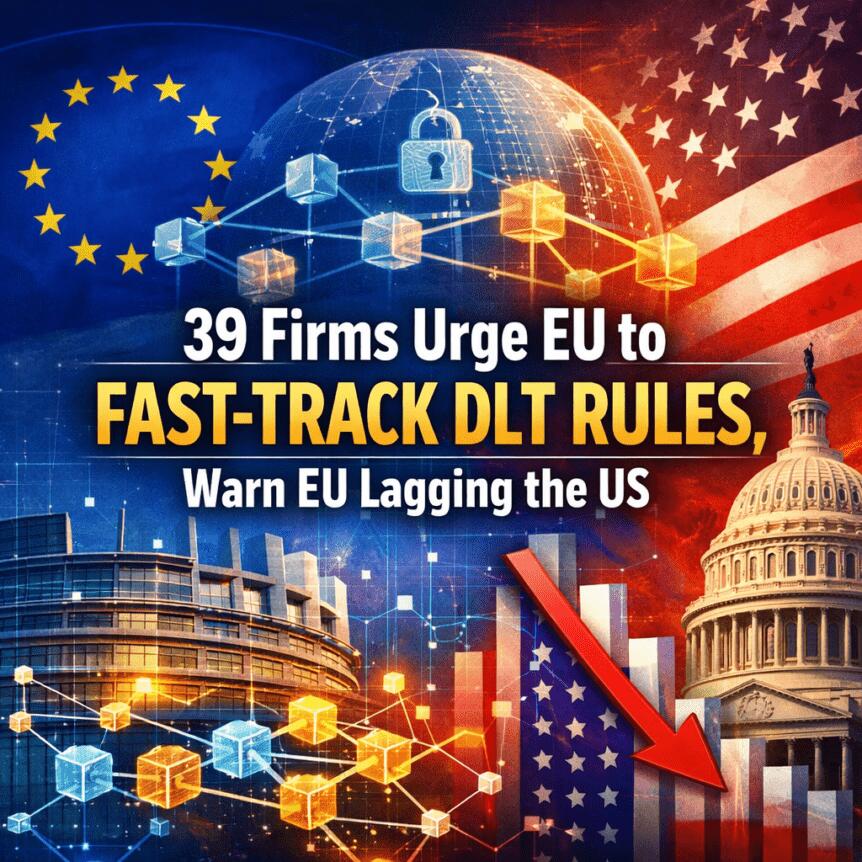
A coalition of European financial institutions and industry bodies is urging EU lawmakers to accelerate reform of blockchain rules by treating the DLT Pilot Regime as a standalone law rather than folding it into a broader legislative package. The letter, signed by 39 entities including Nasdaq and Boerse Stuttgart, calls for a quick carve‑out to keep Europe at pace with global developments in tokenized finance. According to Cointelegraph, the missive was addressed to the European Commission and Parliament, highlighting the risk that delaying action could slow Europe’s adoption of distributed ledger technology in financial markets.
The DLT Pilot Regime, launched in 2023, serves as a regulatory sandbox for testing blockchain-based trading and settlement of assets such as stocks and bonds under real-market conditions. It provides temporary exemptions from certain rules to allow firms to experiment with tokenized finance in a controlled environment. The signatories contend that integrating the regime into a wider Market Integration and Supervision Package would push reforms into a protracted negotiations cycle, potentially undermining Europe’s competitiveness as the United States advances its own tokenized-finance initiatives. “Negotiations are likely to be lengthy,” the letter states, adding that delays “risk dampening Europe’s momentum in DLT adoption.”
Key takeaways
- EU industry groups press for treating the DLT Pilot Regime as a standalone legislative act rather than including it in a broader digital finance package.
- Proposals call for expanding the regime’s scope, increasing the asset universe, and raising the overall testing cap to 150 billion euros.
- Efforts include removing time limits on licenses, enabling longer or permanent permission to operate pilot projects.
- Context is shaped by a U.S. regulatory shift: the SEC has clarified custody rules for tokenized securities and signaled support for tokenization services via a DTCC subsidiary under an no-action posture.
- The developments bear on Europe’s cross-border capital markets, licensing regimes, and competitiveness relative to the United States and other jurisdictions.
EU regulators and industry: decoupling the DLT Pilot from broader reform
The joint letter contends that a standalone DLT Pilot Regime would yield faster regulatory clarity and more predictable pathways for firms testing blockchain-enabled trading and settlement. With the European Union pursuing a broader digital-finance reform agenda, the authors warn that binding the pilot to the multi‑year negotiation timeline of other measures could slow practical progress on tokenized markets. The signatories emphasize broad industry support for pragmatic adjustments that could accelerate implementation without compromising safety or investor protection. The letter was directed to Financial Services Commissioner Maria Luis Albuquerque, underscoring a sense of urgency among market participants who fear lagging policy momentum.
Scope expansion and licensing: what changes are proposed
Under the current regime, the pilot allows limited testing of certain asset classes and issuance scales. Specifically, it covers relatively small market-test cases, with thresholds such as shares of companies valued under roughly $588 million, bonds with issuances under about $1.17 billion, and investment funds with assets under $588 million. The industry coalition is pushing for a broader menu of eligible assets and a substantial uplift in the testing ceiling to 150 billion euros ($176 billion). Besides widening eligibility, the proponents call for the removal of time limits on licenses, effectively enabling longer or ongoing pilot activity to support scale‑up and learning by doing. They argue these are practical, widely supported adjustments that would foster regulated on‑chain markets across Europe.
US momentum and cross-border regulatory context
The United States has been moving to integrate tokenized securities into the existing financial infrastructure, creating a contrasting backdrop to Europe’s stalled pace. The Securities and Exchange Commission has clarified that broker‑dealers can custody tokenized securities under current investor-protection rules. In another development, the SEC issued a no‑action letter enabling a Depository Trust & Clearing Corporation (DTCC) subsidiary to launch a service that tokenizes real-world assets held in custody. These steps reflect a broader U.S. policy trajectory toward practical, regulated tokenization as part of the mainstream financial system. While these actions are not EU decisions, they influence the regulatory discourse in Europe and shape expectations for how quickly EU rules must adapt to technological and market developments. Cointelegraph has reported on these developments and notes the contrast with Europe’s cautious, negotiations-heavy approach.
Industry calls and the push for a timely fix
Separate but related to the current push, a February letter from a group of nine European tokenization and market-infrastructure firms similarly urged EU policymakers to urgently update the DLT Pilot Regime. The signatories—among them Securitize, 21X, and Boerse Stuttgart Group—warned that strict asset limits, low issuance caps, and time-bound licenses risk constraining the growth of regulated on‑chain markets and could drive liquidity away from Europe toward the United States. This earlier appeal underscores a broader concern that the continent’s financial ecosystem could lose competitive momentum if policy changes are not enacted promptly. The situation is being watched closely by exchanges, custodians, and asset managers seeking regulatory clarity and a scalable path to tokenized capital markets.
These developments sit at the intersection of European harmonization efforts and the need for robust, enforceable frameworks that support institutional adoption. They also touch on MiCA (Markets in Crypto-Assets Regulation) and the EU’s broader strategy for digital finance, raising questions about licensing, cross‑border supervision, and alignment with traditional banking and custody infrastructures. As regulators weigh changes, market participants are looking for predictable rules, clear oversight standards, and scalable pilot programs that can translate into real-market activity without compromising investor protection or market integrity.
Cointelegraph’s reporting indicates a broad desire among European incumbents and new entrants to reduce the frictions that typically accompany regulatory pilots when they are embedded in larger reform packages. The outcome will influence how quickly regulated, tokenized products can be tested and, ultimately, how seamlessly Europe integrates tokenized finance into its existing financial system.
What happens next remains contingent on negotiations among EU institutions, member‑state interests, and the regulatory oversight community. A standalone DLT Pilot Regime could accelerate practical outcomes, but it will need to be carefully calibrated to maintain high standards of investor protection and market integrity while enabling prompt, scalable experimentation.
Closing perspective: As EU policymakers consider next steps, observers should monitor how changes to the DLT Pilot Regime align with MiCA timelines, licensing processes, and cross‑border supervision frameworks. The balance between speed, safety, and systemically important oversight will shape Europe’s role in global tokenized markets and determine whether the continent keeps pace with U.S. innovations in digital finance.



A 50 page quantum computing crypto risk assessment published Tuesday by Coinbase’s independent advisory board concludes that while today’s blockchains remain secure, a fault-tolerant quantum computer capable of breaking widely used encryption is increasingly plausible and that preparation must begin now, warning that “waiting for it to be urgent is not a good idea.”
Summary
- The 50 page paper, authored by an independent board including Stanford cryptographer Dan Boneh, Ethereum Foundation researcher Justin Drake, and EigenLayer founder Sreeram Kannan.
- Replacing today’s signatures with quantum-resistant alternatives could expand blockchain data sizes by up to 38 times, according to one estimate in the report, meaning the transition carries significant engineering costs and performance tradeoffs.
- Bitcoin wallets that have already revealed their public keys are identified as the most immediately vulnerable category of holdings in any future quantum attack scenario.
Quantum computing crypto risk has its most authoritative industry assessment yet. The Coinbase advisory board, a group of world-class cryptographers and blockchain researchers convened by Coinbase in January 2026, released its first major position paper Tuesday: a 50 page analysis of how future quantum computers could affect blockchain security and what the industry must do before that threat becomes real.
“Waiting for it to be urgent is not a good idea,” the paper states, emphasizing that transitions across blockchains, wallets, and exchanges could take years to execute safely even after all the technical standards are in place.
The board members who authored the paper include Dan Boneh, the director of the Stanford Center for Blockchain Research; Justin Drake of the Ethereum Foundation; Sreeram Kannan, the founder of EigenLayer; Yehuda Lindell, Coinbase’s head of cryptography; and Dahlia Malkhi, an expert in resilient distributed systems. Their institutional breadth gives the paper a credibility that no single-company security assessment would carry.
What the Report Found and What Makes It Credible
The paper’s core conclusion is carefully calibrated: quantum computers today cannot crack the cryptography underpinning Bitcoin, Ethereum, or any major blockchain. Breaking standard encryption would require fault-tolerant quantum machines with vastly more error-corrected qubits than current hardware provides, and achieving that is still considered a major engineering challenge. The report does not predict when that will happen. It argues that the timeline uncertainty itself is the problem.
The threat the paper focuses on most is the harvest now, decrypt later attack: adversaries can collect encrypted blockchain data today and store it, waiting for quantum hardware to mature enough to crack it retroactively. For long-held assets, this is a material risk that begins now rather than when the quantum threat becomes practical. Bitcoin addresses that have already revealed their public keys on-chain are specifically identified as the most immediately exposed category of holdings.
Why the Transition Will Be Harder Than It Sounds
The technical solution to quantum vulnerability already exists: NIST has standardized post-quantum cryptographic algorithms that are mathematically resistant to quantum attacks. The problem is implementation at blockchain scale. Post-quantum digital signatures can be tens to hundreds of times larger than the signatures in use today. One estimate in the Coinbase report suggests that replacing current signatures with quantum-proof alternatives could expand block sizes by up to 38 times.
For a network like Bitcoin, which processes blocks under a strict size limit and where any upgrade requires consensus among a decentralized set of stakeholders with no central authority, a 38-times expansion of signature data is not a parameter adjustment. It is a fundamental architectural change that touches every node, wallet, exchange, and application in the ecosystem. The debate among Bitcoin developers, already underway, reflects exactly this tension between urgency and the cost of change.
What Crypto Networks Are Already Doing
The Coinbase report arrives alongside parallel actions across the ecosystem. Ripple published a four phase XRPL post-quantum roadmap targeting completion by 2028. The Ethereum Foundation has elevated post-quantum security to a top strategic priority with a dedicated research team. Bitcoin developers are actively debating BIP 361, a proposal for a structured migration away from legacy address types that expose public keys.
For the Bitcoin quantum risk assessment specifically, researchers estimate approximately 4.5 million Bitcoin held in early or reused addresses may be exposed to future quantum attacks. The quantum threat debate in Bitcoin has become one of the most contested governance questions in the community, precisely because the solutions require either forcing coin migration or accepting that some portion of the supply may eventually be at risk.


DefiLlama logs 518 crypto hacks and over $17b in losses in 10 years, with attackers shifting from smart contracts to keys, bridges and wallets, as rsETH loses ~$290m.
Summary
- DefiLlama has logged 518 crypto hacking incidents over the past 10 years, with total losses above $17 billion.
- A growing share of that damage comes from private key leaks, phishing and credential theft rather than pure smart contract bugs.
- The latest example is Kelp DAO’s rsETH bridge exploit, which drained about 116,500 rsETH worth roughly $290–$293 million — 2026’s largest DeFi hack so far.
Crypto’s security bill over the past decade has quietly climbed past $17 billion, according to DefiLlama data cited by Cointelegraph, with at least 518 documented hacks and exploits hitting exchanges, DeFi protocols, bridges and wallets since 2014. That figure captures everything from early exchange blow‑ups to today’s sophisticated cross‑chain attacks, and it comes even as the overall pace of large on‑chain exploits has slowed from peak‑mania years like 2021–2022.
A decade of $17b in crypto losses
Under the surface, however, the composition of those losses is shifting. Where early DeFi hacks often hinged on smart contract bugs and unchecked flash‑loan logic, recent incidents show attackers increasingly targeting the soft tissue around crypto — private keys, signing infrastructure and user devices — with credential theft, social engineering and SIM‑swap‑style attacks. Security firms told Cointelegraph that they expect 2026 to bring more advanced phishing and AI‑assisted scams capable of tricking even technically savvy users into signing malicious transactions or revealing seed phrases.
Bridge infrastructure has been a particular weak point. DefiLlama’s hacks dashboard shows that bridges account for almost $3 billion of the roughly $11.8 billion it categorises as “total value hacked,” with large single incidents like the Ronin, Wormhole and Multichain exploits setting the tone for cross‑chain risk. The latest addition to that list is Kelp DAO’s rsETH cross‑chain bridge, which was hit on April 18 after an attacker forged a cross‑chain message on a LayerZero‑based link and minted or released 116,500 rsETH to an attacker‑controlled address.
Those tokens — representing “restaked” Ether — were worth about $290–$293 million at the time, or roughly 18% of rsETH’s total supply, and have been called the largest DeFi exploit of 2026 so far by outlets including Bloomberg. The incident forced Kelp DAO to pause the bridge, coordinate emergency responses with exchanges and protocols, and sparked a blame game over LayerZero’s default single‑validator configuration, which critics argue left the system effectively one‑key‑away from catastrophic minting.
Even away from headline‑grabbing exploits, everyday credential compromises continue to rack up damage. DefiLlama data cited by Cointelegraph shows that in the first quarter of 2026 alone, hackers stole about $168.6 million from 34 DeFi protocols, with the largest single hit — a $40 million Step Finance theft — traced back to a private key compromise rather than a pure code bug. That trend suggests DeFi’s smart contract security is slowly hardening, while attackers respond by moving upstream into the tools and human processes that sit between wallets and protocols.
For users and teams, the lesson is brutal but clear: audits and formal verification are necessary, but not sufficient. Hardware keys, multi‑sig schemes, segregated signing devices, strict key‑management policies, and relentless phishing hygiene are now as critical to safeguarding crypto as gas optimisations and bug bounties ever were — because it only takes one compromised credential to turn another line in DefiLlama’s hacks database into a nine‑figure loss.

A senior US military commander has lauded Bitcoin as a “valuable computer science tool,” arguing its usefulness extends beyond monetary applications and can support US national security interests.
“It is a valuable computer science tool, as a power projection,” Admiral Samuel Paparo said at a Senate Armed Services Committee hearing on Tuesday, adding that Bitcoin’s proof-of-work technology “imposes more cost” on attackers attempting to compromise the network:
“Outside of the economic formulation of it, it has got really important computer science applications for cybersecurity.”
The Senate hearing looked into the strategic posture of US forces in Indo-Pacific, including ongoing conflicts in Ukraine and the Middle East, China’s military expansion and coordination with foreign adversaries, and threats from North Korea.

Paparo’s remarks echo similar comments from US Space Force member Jason Lowery in December 2023, who said Bitcoin and other proof-of-work blockchains could protect the US in cyberwarfare.
At the time, he said that while Bitcoin is mostly seen as a “monetary system” to secure funds, few know that Bitcoin can be used to secure “all forms of data, messages or command signals.”
“As a result, this misconception underplays the technology’s broad strategic significance for cybersecurity, and consequently, national security.”
Research into Bitcoin’s use as a cybersecurity tool comes as many adversaries — including state-linked actors — have turned to cyberattacks such as phishing, ransomware and distributed denial-of-service to sabotage infrastructure and secure economic advantages.
North Korea’s notorious Lazarus Group is one of the most notable examples of this, having stolen billions of dollars in crypto over the past decade to support its nuclear program.
Paparo’s comments came in response to a question from US Senator Tommy Tuberville, who asked how the US and Congress can lead on Bitcoin competition, noting that China’s top monetary think tank now also views Bitcoin as a strategic asset.
Paparo didn’t address the question directly but added, “Bitcoin is a reality. It is a peer-to-peer zero-trust transfer of value. Anything that supports all instruments of national power for the United States of America is to the good.”
Senators introduce national security-focused Bitcoin bill
The US holds the largest Bitcoin reserves among nation-states and holds the largest share of Bitcoin hashrate. However, it remains reliant on foreign-manufactured mining equipment, an issue that has raised national security concerns related to supply chain risks.
Related: Quantum threat to Bitcoin still years away, says Borderless Capital partner
Last month, US Senators Bill Cassidy and Cynthia Lummis introduced the Mined in America Act to resolve that issue by bringing more Bitcoin mining manufacturing back to the US.
It also seeks to codify Trump’s executive order establishing the Strategic Bitcoin Reserve.
Magazine: Adam Back says current demand is ‘almost’ enough to send Bitcoin to $1M
Coinbase CEO Brian Armstrong announced Monday the launch of Agentic.market, a marketplace platform for Coinbase AI agents that allows autonomous software agents to discover, compare, and purchase services from other agents without API keys, paying in USDC through the x402 payment protocol, which has already settled approximately 165 million transactions across more than 480,000 transacting agents.
Summary
- The platform organizes services into seven categories: Inference, Data, Media, Search, Social, Infrastructure, and Trading, with launch providers including OpenAI and Venice for inference, Bloomberg and CoinGecko for data, and AWS Lambda and Alchemy for infrastructure.
- Armstrong described the platform as the “discovery layer” for the agentic economy, saying “for the agentic economy to overtake the human economy, agents need a way to discover services.”
- The x402 protocol received backing from Google, Microsoft, Amazon Web Services, American Express, Mastercard, Visa, Cloudflare, Shopify, Stripe, and others earlier this month, giving the payment standard broad institutional infrastructure support.
Coinbase AI agents have a dedicated marketplace for the first time. Agentic.market, launched Monday by Coinbase’s x402 protocol team and publicly backed by CEO Brian Armstrong, is designed to function as what Coinbase engineer Erik Reppel, who created the x402 protocol, described as “an app store for agents.” It gives autonomous AI systems a structured way to find services, evaluate them, and pay for them at machine speed using USDC without any human in the loop.
“For the agentic economy to overtake the human economy, agents need a way to discover services,” Armstrong wrote on X in backing the launch. He has previously predicted that “there will be more AI agents transacting online than humans very soon.”
The platform has two distinct interfaces: a web interface for humans to browse and evaluate available services, and a programmatic layer that allows AI agents to search, filter, and integrate new capabilities at runtime without human intervention. An agent on the platform receives both “skills,” code libraries for using a service, and a wallet that enables it to buy and sell autonomously.
How Agentic.market Works and What Is Available at Launch
The marketplace requires no approval process for providers to join. Any service compatible with the x402 standard can be listed. The seven categories at launch cover the full range of capabilities an AI agent might need: inference services for running AI models, data services for market and financial information, media, search, social network access, infrastructure including cloud compute, and trading services for executing financial transactions.
Named services available at launch include OpenAI and Venice in inference, Bloomberg and CoinGecko for financial data, LinkedIn and X for social, and AWS Lambda and Alchemy for infrastructure. The marketplace builds on a backend index called Bazaar, which tracks x402 enabled services and their usage metrics, and turns that raw data into searchable listings with live pricing, performance metrics, and integration guides.
Coinbase reported that 85% of the 165 million x402 transactions already settled have occurred on Base, Coinbase’s Layer 2 network built on Ethereum, indicating that the agentic payment economy is already substantially operational rather than hypothetical.
The x402 Protocol and Who Backs It
The x402 protocol, named after the rarely used HTTP status code 402 Payment Required, was first launched by Coinbase in May 2025. It is designed for machine-to-machine payments: fast, low-cost, requiring no identity verification because the agents themselves hold wallets rather than needing to satisfy Know Your Customer requirements tied to human account holders.
Earlier this month, the x402 Foundation was formed to govern the protocol with support from Google, Microsoft, Amazon Web Services, American Express, Mastercard, Visa, Cloudflare, Shopify, Stripe, Circle, Base, Polygon Labs, the Solana Foundation, and others. That institutional backing converts x402 from a Coinbase product into a broadly supported open standard, which significantly increases its probability of becoming the default payment layer for agentic commerce.
What This Means for Crypto Markets and USDC
Agentic.market is a direct use case expansion for USDC. Every transaction on the platform settles in USDC. As agent-to-agent commerce scales, it creates a structural demand layer for stablecoins that does not depend on speculation, market cycles, or geopolitical events. Circle CEO Jeremy Allaire has projected that “literally billions of AI agents” will be transacting on blockchains within three to five years.
For AI tokens and the infrastructure layer of the crypto AI sector, a Coinbase-backed, institutionally supported marketplace with 480,000 active agents already transacting is a concrete commercial proof point rather than a thesis. For observers tracking the AI bubble debate, the distinction matters: whether AI generates durable revenue through actual transaction volume is the core question, and Agentic.market provides a new data source for that answer.
Crypto World
Bitcoin (BTC) price holds above a make-or-break level before Warsh confirmation hearing
Bitcoin is trading with a positive bias above the $75,000 level, which CoinDesk recently highlighted as a critical threshold for bulls to maintain control.
Still, some observers are urging caution, noting that prices need to hold above that level through Wednesday, when the U.S.–Iran ceasefire is set to end.
“The ceasefire is set to expire Wednesday evening Washington time, and the market has to price two paths, extension and de-escalation versus renewed escalation and oil stress. That is why even with BTC strong, the tape can still gap fast. It is headline risk with a timer,” analysts at Marex said in an email to CoinDesk.
An escalation could take oil prices well above the March high of $119, potentially sending Asian and global equity markets into a tailspin. The question remains whether bitcoin, which held relatively steady around $70,000 during the March conflict, will remain resilient or come under pressure along with the broader market.
As of the time of writing, no delegation from Iran had departed for the talks in Pakistan. On Monday, President Donald Trump warned of a major escalation in the conflict if the ceasefire ends without a deal.
Also on analysts’ radar is Kevin Warsh’s nomination hearing for Federal Reserve chair, scheduled for Tuesday. Warsh has a reputation as an “inflation hawk” who opposed interest-rate cuts and quantitative easing following the 2008 crash.
So what he says during the session could move markets. “His remarks could act as a near-term catalyst, particularly if they reinforce expectations of policy easing,” digital assets trading firm QCP Capital said in a note.
Speaking of the broader market, major cryptocurrencies such as ether (ETH), solana (SOL), and XRP (XRP) have risen by less than 2% over the past 24 hours, underperforming bitcoin. Smaller tokens such as XLM and TON have risen by more than 5% each. The CoinDesk Memecoin Index is up over 3%.
Notably, the DeFi Select Index added 2%, which is surprising given the industry-wide fallout from the weekend hack of KelpDAO. That saw the attacker drain rsETH, a liquid restaking token widely used as collateral on several DeFi platforms.
Decentralized lender Aave has taken the biggest hit, with the total value of crypto assets locked on its platform falling to $16 billion, down nearly $10 billion since before the hack.
Aave’s native token, AAVE, has declined 18% to $93 since the hack. At the same time, open interest in futures tied to the token hit a record high of 3.59 million tokens. Increased demand for leveraged bets points to potential for more volatility ahead. Stay alert!
Read more: For analysis of today’s activity in altcoins and derivatives, see Crypto Markets Today . For a comprehensive list of events this week, see CoinDesk’s “Crypto Week Ahead.”
What’s trending
Today’s signal

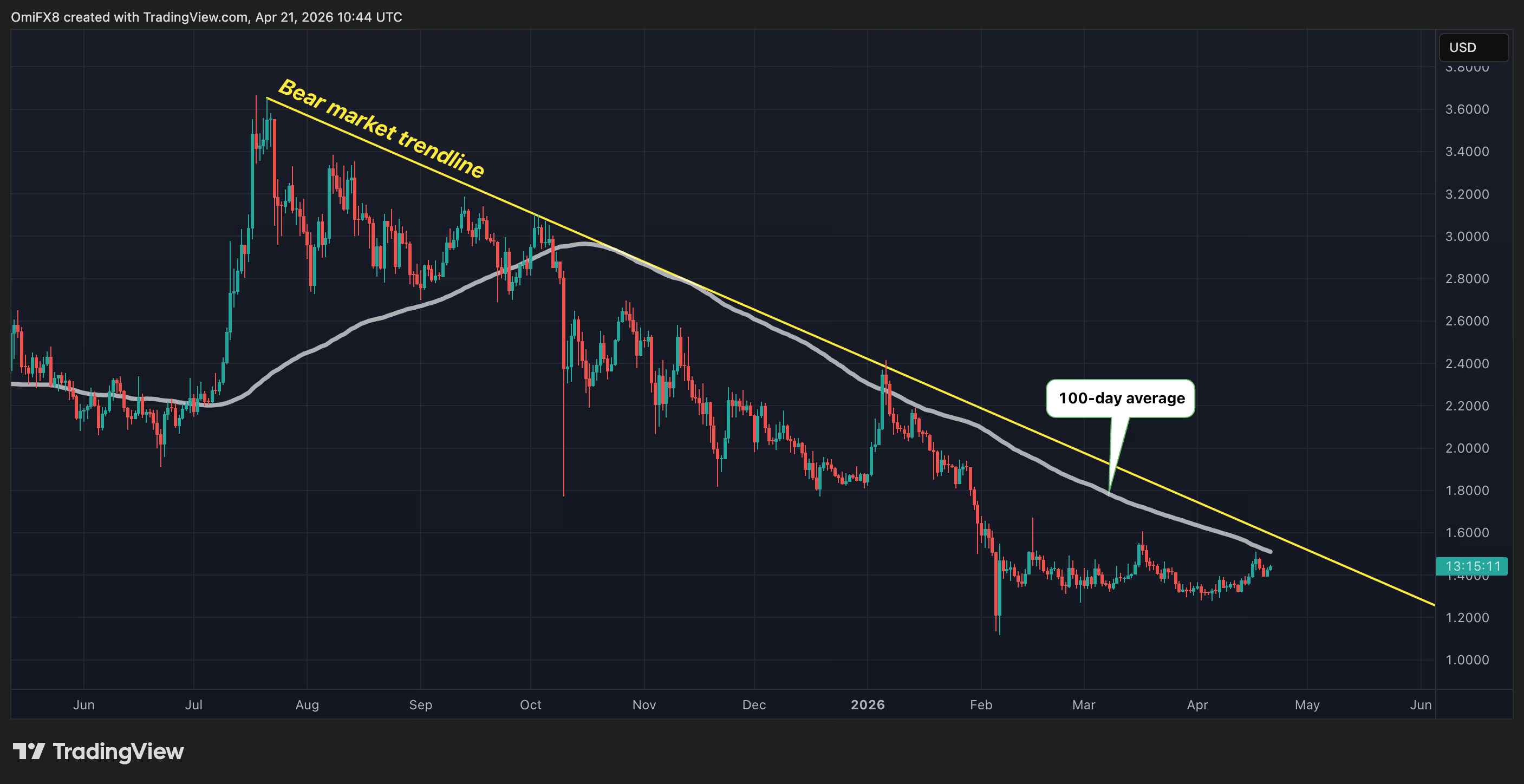
The chart shows XRP’s daily price swings in candlestick format. The white line represents the average price over 100 days and the yellow line represents the prolonged bear market.
XRP remains below both the average and the trendline even as market leaders bitcoin and ether (ETH) have topped these levels on their respective price charts.
Until the price reclaims both the 100-day average and the downtrend line, momentum remains comparatively weak versus BTC and ETH, which have already established firmer bullish structures.


TLDR
- UK officials invited Bybit leadership to London to discuss expansion and crypto regulation.
- CEO Ben Zhou confirmed meetings with the Financial Conduct Authority and the House of Lords.
- Bybit ranks as the second-largest crypto exchange by CoinGecko.
- Zhou said the UK wants major crypto firms to establish bases and create jobs.
- The outreach coincides with UK Fintech Week and Treasury plans for stablecoins and tokenization.
UK officials have invited crypto exchange Bybit to London to explore expansion and regulatory talks. The outreach targets job creation and renewed digital asset activity. CEO Ben Zhou confirmed meetings with regulators and lawmakers this week.
Bybit Signals Potential UK Engagement
Economic development officials linked to the UK government invited Bybit executives to London this week. They aim to attract large crypto firms and rebuild domestic innovation activity. Zhou said officials want major businesses to establish bases and create jobs.
He confirmed meetings with the Financial Conduct Authority and House of Lords representatives. He said discussions will cover forthcoming pro-crypto regulations and payment reforms. “They are very eager to invite big business,” Zhou said during Paris Blockchain Week.
Bybit ranks as the second-largest crypto exchange by CoinGecko. The exchange trails only Binance in global trading volumes. Zhou founded Bybit in 2018 and later shifted the headquarters to Dubai.
He moved the company from Singapore to Dubai in 2022. Binance also established operations in the UAE in 2025. Large exchanges helped attract smaller crypto firms to the region.
UK Targets Momentum Built by Bybit and Binance in UAE
Zhou said major exchanges created momentum in the UAE market. He explained that smaller firms followed after Bybit and Binance announced regional plans. “Once we announced we’re going to be there, smaller players followed,” Zhou said.
He said the UK has yet to build similar traction. He added that policymakers want to replicate the UAE model. “There hasn’t been any momentum built in the UK,” Zhou said.
The invitation coincides with UK Fintech Week events in London. The Treasury plans to revamp payment systems using stablecoins and tokenization. Officials have not disclosed the specific department behind the invitation.
Zhou said an economic development board extended the offer directly. He said the board promised a direct line to the prime minister. “There is an agenda to push for innovation, especially in crypto,” Zhou said.
The Treasury and Economic Secretary, Lucy Rigby, has not issued any comments. The Department for Science, Innovation and Technology also declined to respond. The Financial Conduct Authority had not replied at press time.
The outreach follows recent geopolitical tensions affecting the UAE. Iran launched direct attacks during the U.S.-Israel war that began on Feb. 28. Thousands of residents and tourists have left the country.
The Financial Times reported that one in eight British residents departed the UAE. Zhou said UK officials observed capital and company outflows to the Gulf region. He stated that London sees this period as an opportunity.
“The UK government has seen the outflow of money and companies going to the UAE,” Zhou said. He added that officials want to regain that activity. Zhou said the current timing aligns with that objective.

Crypto World
Almost 80% of Japanese institutional investors are eyeing crypto for their portfolios by 2029


Attitudes to crypto investment in Japan are shifting from cautious interest to active portfolio planning, according to a survey by Nomura and its digital asset arm, Laser Digital, with almost 80% of the country’s institutional investors saying they plan to add crypto in the next three years.
The shift reflects a growing view of crypto as a diversification tool. Many of the respondents cited low correlation with traditional asset classes as a key reason for adding exposure. Allocations, though, remain restrained, with more than half targeting between 2% and 5% of their portfolios.
It also reflects improving sentiment: 31% percent of respondents described their outlook on crypto as positive, compared with 25% in 2024, while negative sentiment declined to 18%.
The findings come as Japan refines one of the more established regulatory frameworks for digital assets among major economies. The country was an early mover in regulating crypto exchanges following the Mt. Gox collapse in 2014. Recent efforts have focused on integrating digital assets into existing financial laws, including updates tied to the Financial Instruments and Exchange Act.
That clarity has helped foster a domestic crypto ecosystem anchored by major companies such as SBI Holdings, the financial conglomerate that operates one of Japan’s largest crypto businesses, and bitFlyer, a long-standing exchange. Traditional financial institutions have also entered the industry.
Nomura, one of the world’s largest financial services companies, founded Laser Digital in 2022 to expand into trading, asset management and venture investing, while firms like Mitsubishi UFJ Financial Group have explored tokenized deposits and stablecoins.
Interest is expanding beyond simple price exposure. More than 60% of respondents expressed interest in income-generating strategies such as staking and lending, as well as derivatives and tokenized assets. That suggests investors are beginning to treat crypto less as a speculative trade and more as a broader financial toolkit.
Stablecoins are another area of focus. Sixty-three percent of respondents identified potential use cases, including treasury management, cross-border payments and foreign exchange transactions. Trust appears to be highest for stablecoins issued by major financial institutions, highlighting the importance of familiar counterparties.
Still, barriers remain. Investors pointed to challenges including the lack of established valuation frameworks, counterparty risks such as fraud or asset loss, and regulatory uncertainty. High volatility also continues to weigh on adoption.
Even so, those concerns are shifting. Rather than debating whether to invest, institutions are now focused on how to do it.
The survey was conducted in December and January and gathered responses from 518 investment professionals, including institutional investors, family offices and public-interest organizations.


The most urgent crypto scam news on Capitol Hill arrived Tuesday as the House Homeland Security Committee held a joint subcommittee hearing on how transnational criminal organizations use crypto fraud, online scams, and digital extortion to steal from Americans.
Summary
- The FBI’s 2024 Internet Crime Complaint Center report documented $16.6 billion in total scam losses, with crypto investment fraud alone accounting for $5.8 billion.
- The Huione Group, a Cambodia-based conglomerate designated by FinCEN as a primary money laundering concern, received over $39.6 billion in 2025, functioning as core financial infrastructure for scam networks.
- US authorities seized more than $15 billion in illicit proceeds tied to scam activity in 2025 and sanctioned 146 Prince Group targets in October, marking some of the largest enforcement actions in crypto history.
Crypto scam news reached Congress Tuesday morning as the Subcommittees on Border Security and Enforcement and Cybersecurity and Infrastructure Protection convened in Room 310 of the Cannon House Office Building for a joint hearing titled “Online Scams, Crypto Fraud, and Digital Extortion: An Examination of How Transnational Criminal Networks Target Americans.”
Cynthia Kaiser, senior vice president of the Halcyon Ransomware Research Center, testified as a witness, providing technical context on how criminal networks use digital extortion tools alongside crypto investment fraud schemes to maximize victim losses and minimize traceability.
The hearing draws on a documented surge in transnational criminal activity. The FBI’s IC3 report recorded 859,532 scam complaints in 2024 with $16.6 billion in losses. Investment fraud, predominantly pig butchering schemes operated from Southeast Asia, caused $5.8 billion of that total. Victims aged 60 and older bore the highest losses of any age group.
The Scale of the Criminal Infrastructure Being Examined
The networks at the center of the hearing are not loosely organized. They are industrial operations with real estate, corporate structures, and international banking relationships. The Chainalysis 2026 Crypto Crime Report documented that the Huione Group received $39.6 billion in transactions in 2025 alone after FinCEN designated it a primary money laundering concern under the USA PATRIOT Act. Prince Group, a Cambodia-based transnational criminal organization operating forced labor scam compounds, was sanctioned by OFAC in October 2025 with 146 targets designated across the network.
The pig butchering model is the dominant scheme: scammers build trust with victims over weeks or months through fake relationships before directing them to fraudulent crypto investment platforms. Once funds are deposited, the platforms close. Proceeds move through shell companies, crypto wallets, and professional money laundering networks based in Southeast Asia before being converted or consolidated. TRM Labs found that these networks have become more professionalized each year, with AI tools now reducing the time required to build trust with victims.
What Enforcement Has Achieved and What Remains
US authorities have escalated enforcement significantly. They crypto seized over $61 million in Tether tied to pig butchering in North Carolina alone, and the October 2025 Prince Group seizure involving approximately 127,271 Bitcoin was described as the largest financial forfeiture in American history at the time. Total illicit proceeds seized or forfeited in 2025 linked to scam activity exceeded $15 billion according to Chainalysis.
The persistent structural challenge is jurisdiction. The criminal networks operate from countries with weak law enforcement cooperation agreements. Victims move funds through US-based crypto exchanges before the money reaches overseas wallets, making the domestic on-ramp the most accessible intervention point. Congress is considering legislation including the Dismantle Foreign Scam Syndicates Act, which would establish an interagency task force and authorize targeted sanctions against compound operators and their financial intermediaries.
What the Hearing Signals for Crypto Regulation
The hearing is notable for what it does not do: it does not frame crypto itself as the problem. The focus is on transnational criminal organizations exploiting the technology. That framing matters for the regulatory environment around the CLARITY Act and stablecoin legislation, where the industry has argued that clear rules reduce illicit use by creating regulated on-ramps with strong compliance requirements. A Congress that treats crypto as a tool of crime will write different legislation than one that treats it as infrastructure being exploited by criminals who would otherwise use other payment rails.

Jeśli szukasz najlepszego online casino, które oferuje automaty do gry, to vavada jest idealnym wyborem. Ta popularna platforma gry online oferuje wiele korzyści, w tym szeroki wybór automatów do gry, które mogą zaspokoić gusta każdego gracza.
W Vavada online casino możesz znaleźć wiele automatów do gry, w tym klasyki, takie jak Book of Ra, Sizzling Hot i Lucky Lady’s Charm, a także nowe, innowacyjne gry, które oferują wiele emocji i szans na wygraną.
Automaty do gry w Vavada online casino są dostępne w różnych wariantach, w tym w wersjach demo, które pozwalają na darmowe gry, a także w wersjach realnych, które oferują szansę na wygraną pieniędzy.
Jeśli szukasz online casino, które oferuje najlepsze warunki gry, to Vavada jest idealnym wyborem. Ta platforma gry online oferuje wiele korzyści, w tym bezpieczne i szybkie wypłaty, a także profesjonalny obsługę klienta.
W Vavada online casino możesz znaleźć wiele innych korzyści, w tym wiele bonusów i promocji, które mogą pomóc Ci zwiększyć Twoje szanse na wygraną. Dlatego, jeśli szukasz online casino, które oferuje najlepsze warunki gry, to Vavada jest idealnym wyborem.
Wreszcie, jeśli szukasz online casino, które oferuje najlepsze automaty do gry, to Vavada jest idealnym wyborem. Ta platforma gry online oferuje wiele korzyści, w tym szeroki wybór automatów do gry, które mogą zaspokoić gusta każdego gracza.
Zarejestruj się teraz w Vavada online casino i zacznij gry!
Wspomnij, że Vavada online casino oferuje wiele korzyści, w tym bezpieczne i szybkie wypłaty, a także profesjonalny obsługę klienta. Dlatego, jeśli szukasz online casino, które oferuje najlepsze warunki gry, to Vavada jest idealnym wyborem.
Wybór najlepszych automatów do gry
Jeśli szukasz najlepszych automatów do gry w Vavada online casino w Polsce, to jesteś w odpowiednim miejscu. W tym artykule przedstawimy Ci kilka najlepszych automatów do gry, które warto sprawdzić.
Wśród wielu automatów do gry, które są dostępne w Vavada online casino, warto wyróżnić kilka najlepszych. Na przykład, “Book of Dead” jest jednym z najpopularniejszych automatów do gry, które oferuje Vavada. To 5-rolowe gry, które oferuje wiele bonusów i możliwości wygrania. Inny popularny automat do gry, który warto sprawdzić, to “Starburst”. To 5-rolowe gry, które oferuje wiele możliwości wygrania i jest dostępne w wersji demo.
Co warto sprawdzić przed wyborem automatów do gry?
Przed wyborem automatów do gry, warto sprawdzić kilka rzeczy. Na przykład, warto sprawdzić, czy automat do gry jest dostępny w wersji demo, aby móc zagrać w nim bezpłatnie. Warto również sprawdzić, czy automat do gry oferuje bonusy i możliwości wygrania. Ponadto, warto sprawdzić, czy automat do gry jest dostępny w różnych wersjach, aby móc wybrać tę, która najlepiej pasuje do Twoich potrzeb.
Warto również sprawdzić, czy automat do gry jest dostępny w różnych walutach, aby móc grać w nim w walucie, którą preferujesz.
Warto również sprawdzić, czy automat do gry oferuje możliwość wygrania, aby móc zyskać pieniądze. Warto również sprawdzić, czy automat do gry jest dostępny w różnych wersjach, aby móc wybrać tę, która najlepiej pasuje do Twoich potrzeb.
Warto również sprawdzić, czy automat do gry jest dostępny w różnych walutach, aby móc grać w nim w walucie, którą preferujesz.
Warto również sprawdzić, czy automat do gry oferuje możliwość wygrania, aby móc zyskać pieniądze. Warto również sprawdzić, czy automat do gry jest dostępny w różnych wersjach, aby móc wybrać tę, która najlepiej pasuje do Twoich potrzeb.
Wady i zalety gry w Vavada
Gry w Vavada online casino to coraz to bardziej popularne, a przyczyna tego jest prosta: Vavada casino oferuje wiele korzyści, które sprawiają, że gry w nim są niezwykle atrakcyjne. Jednak, aby zrozumieć, czym jest Vavada online casino, a jakie korzyści oferuje, musimy poznać jego wady i zalety.
Wady gry w Vavada:
W Vavada online casino nie ma możliwości gry w kasynie na żywo, co może być problemem dla niektórych graczy.
Wady gry w Vavada:
W Vavada online casino nie ma możliwości gry w kasynie na żywo, co może być problemem dla niektórych graczy.
Wady gry w Vavada: korzyści
W Vavada online casino istnieje wiele korzyści, które sprawiają, że gry w nim są niezwykle atrakcyjne. Jednak, aby zrozumieć, czym jest Vavada online casino, a jakie korzyści oferuje, musimy poznać jego wady i zalety.
W Vavada online casino istnieje wiele korzyści, które sprawiają, że gry w nim są niezwykle atrakcyjne. Jednak, aby zrozumieć, czym jest Vavada online casino, a jakie korzyści oferuje, musimy poznać jego wady i zalety.
W Vavada online casino istnieje wiele korzyści, które sprawiają, że gry w nim są niezwykle atrakcyjne. Jednak, aby zrozumieć, czym jest Vavada online casino, a jakie korzyści oferuje, musimy poznać jego wady i zalety.
Rejestracja i wypłata w Vavada
W Vavada online casino, rejestracja i wypłata są procesami prostymi i szybkimi, które umożliwiają naszym klientom korzystanie z naszych automatów do gry. Aby zarejestrować się w Vavada, należy wykonać następujące kroki:
1. Kliknij na przycisk “Zarejestruj się” na stronie głównej Vavada.
2. Wprowadź swoje dane, w tym imię, nazwisko, adres e-mail i hasło.
3. Wypełnij formularz rejestracyjny, podając swoje dane kontaktowe, takie jak numer telefonu i adres.
4. Kliknij na przycisk “Zarejestruj się” aby zakończyć proces rejestracji.
Wypłata
W Vavada, wypłata jest procesem prostym i szybkim, który umożliwia naszym klientom otrzymywać swoje wygrane. Aby wypłacić swoje wygrane, należy wykonać następujące kroki:
1. Kliknij na przycisk “Wypłata” w swoim koncie użytkownika.
2. Wybierz metodę wypłaty, taką jak bankowość elektroniczna lub kartą kredytową.
3. Wprowadź kwotę wypłaty, którą chcesz otrzymać.
4. Kliknij na przycisk “Wypłata” aby zakończyć proces wypłaty.
W Vavada, wypłata jest dostępna 24/7, a naszym klientom nie jest wymagane wypełnienie żadnych dodatkowych formularzy. Nasze systemy wypłaty są zabezpieczone, aby zapewnić bezpieczeństwo i poufność transakcji.
Jeśli masz jakiekolwiek pytania lub problem z wypłatą, prosimy o kontakt z naszymi operatorami, którzy będą gotowi pomóc.
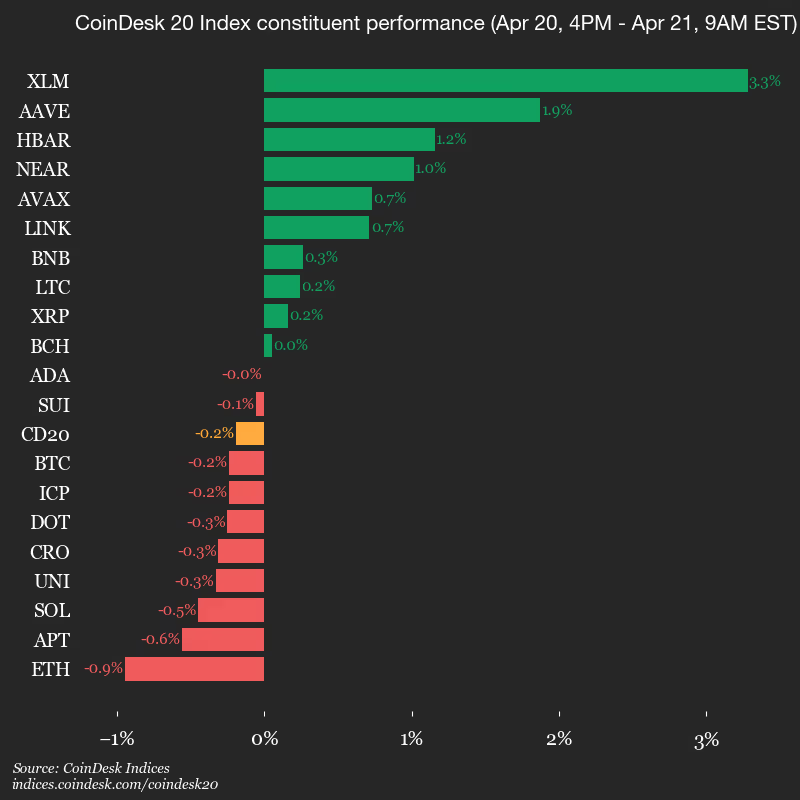
CoinDesk Indices presents its daily market update, highlighting the performance of leaders and laggards in the CoinDesk 20 Index.
The CoinDesk 20 is currently trading at 2101.48, down 0.2% (-4.06) since 4 p.m. ET on Monday.
Ten of 20 assets are trading higher.

Leaders: XLM (+3.3%) and AAVE (+1.9%).
Laggards: ETH (-0.9%) and APT (-0.6%).
The CoinDesk 20 is a broad-based index traded on multiple platforms in several regions globally.

Aboriginal enterprises gain foothold in WA's farming industry

Quantum Computing Crypto: Act Now, Coinbase Warns
Kylie Jenner's former housekeeper files discrimination lawsuit, claims she was treated by staff with 'hostility and exclusion'

Manchester United reach agreement with Casemiro over contract clause amid transfer speculation

Steven Gerrard disagrees with Gary Neville over ‘shock’ Chelsea and Arsenal claim | Football

US brings back mandatory military draft registration

Ini cara terbaik kalian investasiin Rp500.000 ke crypto #bitcoin #ethereum #crypto #investasi

Crypto in India: Can Indians Trade Legally or Is Cryptocurrency Banned? Full Explanation Ankit Sir

financial literacy Noise made less scary #financialgoals #goals #sidegigs #noise #financialliteracy
-

 News Videos7 days ago
Secure crypto trading starts with an FIU-registered
-

 Fashion4 days ago
Weekend Open Thread: Theodora Dress
-

 Politics4 days ago
Palestine barred from entering Canada for FIFA Congress
-

 Sports5 days ago
NWFL Suspends Two Players Over Post-Match Clash in Ado-Ekiti
-
Entertainment2 days ago
NBA Analyst Charles Barkley Chimes in on Ice Spice McDonald’s Fiasco
-

 Business3 days ago
Powerball Result April 18, 2026: No Jackpot Winner in Powerball Draw: $75 Million Rolls Over
-

 Crypto World4 days ago
Russia Pushes Bill to Criminalize Unregistered Crypto Services
-

 Politics1 day ago
Gary Stevenson delivers timely reminder to register to vote as deadline TODAY
-

 Politics3 days ago
Zack Polanski demands ‘council homes not luxury flats for foreign investors’
-

 Tech3 days ago
Auto Enthusiast Scores Running Tesla Model 3 for Two Grand and Turns It Into Bare-Bones Go-Kart
-

 Tech6 days ago
‘Avatar: Aang, The Last Airbender’ Leaked Online. Some Fans Say Paramount Deserves the Fallout
-
 Business5 days ago
Creo Medical agree sale of its manufacturing operation
-

 Crypto World4 days ago
Russia Introduces Bill To Criminalize Unregistered Crypto Services
-
 Entertainment7 days ago
Dave Portnoy Slams Dianna Russini: ‘Makes Zero Sense’
-

 Sports6 days ago
British climbers complete new route in Swiss Alps
-

 Sports6 days ago
“Felt Much Better Today”: Josh Hazlewood Opens Up On His Recovery Win Over LSG
-
Crypto World3 days ago
Kelp DAO rsETH Bridge Hack Drains $292M as DeFi Losses Top $600M in Two Weeks
-

 Tech6 days ago
Ford EV and tech chief leaving automaker
-

 Entertainment6 days ago
Ruby Rose Accuses Katy Perry Of Sexual Assault, Police React
-

 Business6 days ago
Cheaper Doritos and Lays helps PepsiCo win back struggling snackers
You must be logged in to post a comment Login