
Crypto World
Bitcoin price climbs to $77,500 on Trump ceasefire extension, Strategy’s $2.5 billion buy



Bitcoin is breaking out of the Iran-headline chop.
Bitcoin traded at $77,541 on Wednesday morning, up 2.2% over 24 hours and 4.3% on the week, after Trump said he would extend the Iran ceasefire indefinitely and Strategy disclosed the purchase of 34,164 BTC for $2.54 billion. Ether rose 2.1% to $2,366, BNB climbed 1.3% to $640, and Solana gained 1.8% to $87. The only red in the top 10 was a trickle of 0.1% declines in stablecoins and Tron.
S&P 500 futures rose 0.5% and Nasdaq 100 futures gained 0.6% after Trump’s extension, though the underlying benchmarks closed lower Tuesday as talks briefly wobbled. Brent crude hovered near $98 a barrel. The MSCI Asia Pacific Index slipped 0.7% as investors weighed how long the Middle East conflict runs.
Trump blamed negotiation collapses on what he called a “seriously fractured” leadership structure in Tehran, and said the US would hold off on fresh attacks while keeping its Strait of Hormuz blockade in place.
Strategy’s buy is the largest bitcoin purchase by the company since November 2024. The 34,164 BTC acquisition at an average $74,395 per coin brings the firm’s holdings to 815,061 BTC, bought for $61.6 billion at an average cost basis of $75,527. With bitcoin at $77,541, the position is now modestly in profit for the first time in months.
Spot flows back the move. Global crypto funds pulled in $1.4 billion last week according to CoinShares, the strongest week of inflows since mid-January. Bitcoin took $1.12 billion, Ethereum $328 million, Chainlink $5 million, and Sui $2 million. XRP saw $56 million in outflows and Solana $2 million, despite both trading higher on price.
Two structural signals point the same direction. Bitcoin is now holding above the realized price of short-term holders at around $69,400 per analyst Darkfost, the level at which recent buyers are sitting on gains rather than losses, which historically reduces the odds of a cascade liquidation if sentiment reverses.
Separately, a Nomura survey found 65% of Japanese institutional investors now hold bitcoin for portfolio diversification, with 31% viewing the market outlook positively and most planning 2% to 5% allocations over the next three years.
Whether bitcoin can hold $77,000 through the European session depends on how markets price the ceasefire extension against continued Strait of Hormuz disruption.
A clean break above $80,000 would confirm the 46-day funding rate compression is flipping into a short squeeze. A reversal below $75,000 would mean the extension already priced in and the rally needs a fresh catalyst.

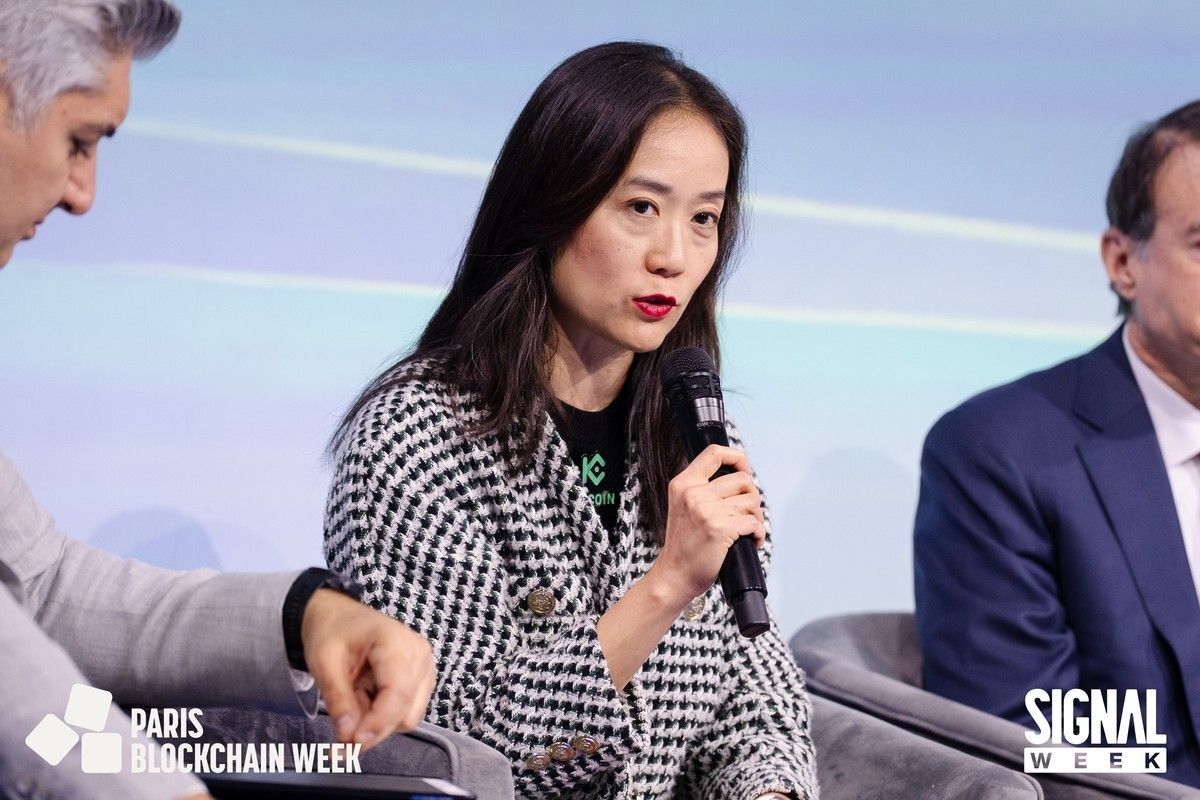
Paris Blockchain Week showed us how the digital asset market is developing in 2026. Discussion across the event focused on regulation, investor demand, tokenization, and the conditions needed for growth.
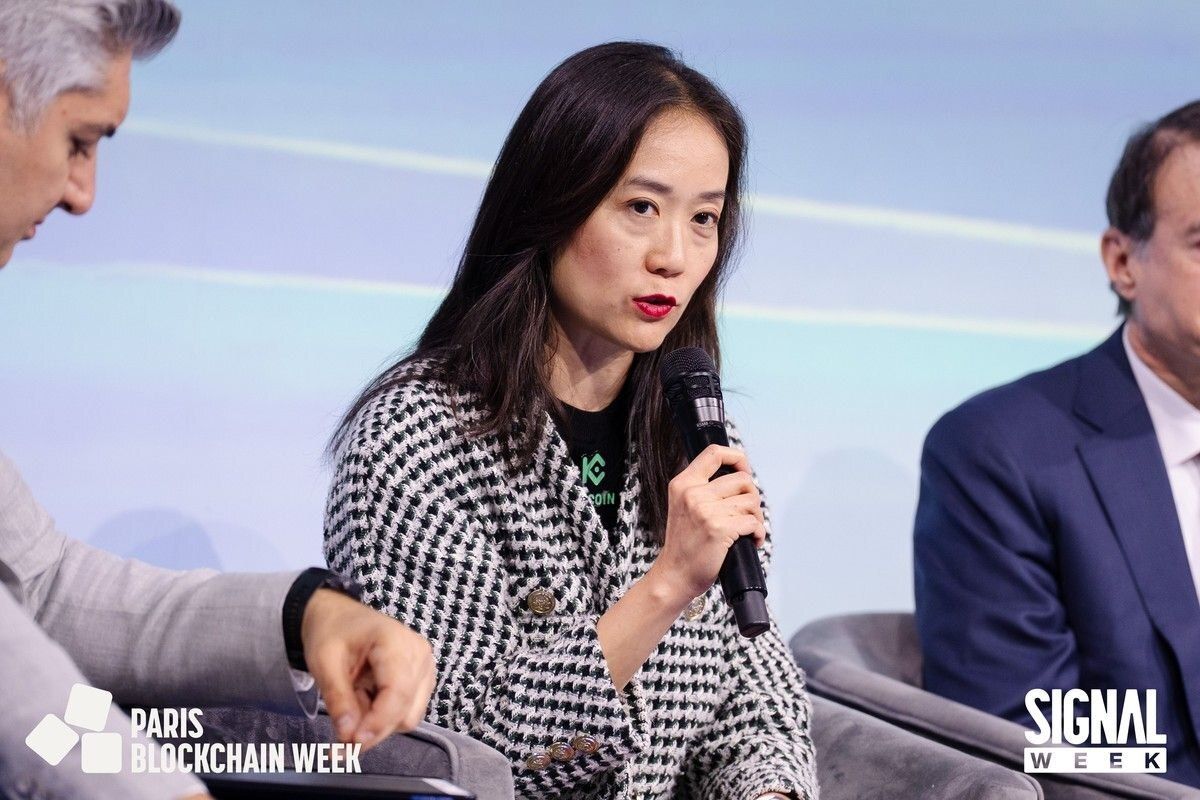
In an exclusive interview with BeInCrypto, Sabina Liu, Managing Director EU at KuCoin, shares her view on the current cycle, the rise of institutional participation, and the areas attracting the most attention in Europe.
The interview also covers macro liquidity, the outlook for tokenized real-world assets, Europe’s role in regulated digital asset growth, and the market assumptions Sabina Liu believes deserve a second look.
Q1. Your panel looks at the digital asset forecast for 2026. From where you sit, what feels genuinely different about this cycle?
This cycle feels different because activity is becoming less momentum-driven and more rooted in long-term market development. We’re seeing stronger institutional participation alongside continued retail engagement, with increasing convergence between TradFi and DeFi. That is influencing market flows, but also the way products are being designed and distributed across the ecosystem.
At the same time, areas like tokenization, particularly RWAs, are progressing from experimentation into adoption, especially on the demand side. This is being supported by greater regulatory clarity, participation from TradFi players, and the growth of on-chain infrastructure.
Overall, the focus is turning toward distribution and a more compliant, sustainable framework for long-term growth.
Q2. A lot of discussion this year links crypto more closely to macro liquidity. How much do you think broader liquidity conditions will shape digital asset growth in 2026?
Macro liquidity remains an important backdrop for digital asset markets, as it does across most asset classes. It can influence risk appetite, capital flows, and short-term market activity.
What also stands out in this cycle is how the market is developing beyond liquidity conditions alone. We’re seeing continued progress in infrastructure, growing institutional participation, and early traction in areas like tokenization and RWAs.
Liquidity may influence the pace of growth, but the durability of that growth will depend on structural factors such as regulatory clarity, product maturity, and the depth of market infrastructure.
Q3. RWA keeps coming up as one of the major opportunities ahead. What do you see as the main challenge in distribution today, especially in Europe?
Tokenization of RWAs is gaining momentum, but distribution remains one of the key challenges.
There is progress on the infrastructure and supply side, yet distribution still depends on the strength of the use case and the ability of participants or investors to access these products within a clear and consistent regulatory framework.
Scalable distribution will require alignment across infrastructure, regulation, and user access so RWAs can develop into more accessible investment products.
Q4. Do you think Europe is in a strong position to lead the next phase of regulated digital asset growth?
Europe is well positioned to play a leading role in the next phase of regulated digital asset growth. The region has taken meaningful steps to establish a clear and structured regulatory framework, which gives the market a strong base for trust across the ecosystem.
That clarity becomes increasingly important as the market matures and institutional participation grows. It allows platforms, counterparties, and investors to operate with greater predictability and confidence, which is essential for long-term capital formation.

Q5. Which types of institutions do you think are most likely to drive meaningful market growth in 2026?
Firms established under MiCAR in Europe are likely to play an important part in bringing further adoption among retail and institutional investors who have not previously participated in digital assets.
The rising issuance of stablecoins is also likely to drive innovation and payment use cases, which will require further tokenization of HQLAs.
At the same time, more institutional investors are allocating capital into the digital asset space. Overall, the market is developing into a more mature ecosystem.
Q6. There is a growing view that the real test for this market is not how much short-term capital it can attract, but how well it can support long-term capital. Do you agree?
To a degree, yes. Long-term capital supports market depth, resilience, and sustainable growth, while short-term capital can still drive activity. Both have a place in the ecosystem, and both serve different investment intentions.
For the market to support long-term capital effectively, it needs to demonstrate trust through compliance, governance, and reliable infrastructure. The platforms and markets able to meet those standards will be in the strongest position to support the next stage of growth.
Q7. Looking ahead through the rest of 2026, what is one market assumption you think people should stop repeating?
One common assumption is that the market will continue to behave mainly as a momentum-driven, retail-led cycle.
What we are seeing instead is a transition toward a more institutional and infrastructure-led phase, where capital allocation decisions are becoming more long-term and supported by clearer frameworks.
The post KuCoin’s Sabina Liu on Where Crypto Growth Is Coming From in 2026 appeared first on BeInCrypto.


Crypto teams are seeing a rise in bug bounty submissions as artificial intelligence tools make it easier to scan code and draft reports.
Summary
- Crypto teams say AI has sharply increased bug bounty submissions while false positives are rising too.
- Cosmos Labs reported a 900% jump in submissions, forcing stricter review and triage processes.
- Developers say defensive AI may help teams filter weak bug reports and find real threats.
At the same time, many protocols say the growing volume includes more low-quality or inaccurate findings, which is making review work harder.
Bug bounty programs reward security researchers for reporting software flaws before attackers exploit them. In crypto, these programs have become a common part of security efforts because protocols often manage large amounts of user funds and operate through open-source code.
Barry Plunkett, co-CEO of Cosmos Labs, said AI is changing how bug bounty programs work. He said the company’s program saw a sharp rise in volume over the past year.
“Our program has seen a 900% increase in submission volume from last year, on the order of 20-50 per day,” Plunkett noted.
He added that the rise included both valid and invalid reports, creating more work for teams trying to separate real issues from weak claims.
Kadan Stadelmann, chief technology officer at Komodo Platform, also said he has seen growth in bug bounty submissions and payouts across organizations. He said some recent reports appeared to be low quality and in some cases may have been false positives.
”There has definitely been an increase in low-quality bug bounty submissions, some of which have been false positives, potentially suggesting AI sourcing,” Stadelmann told Cointelegraph.
He added that AI may have lowered the cost and effort required to produce a report, leading to more submissions.
AI helps researchers but adds more noise
AI tools can help researchers review large amounts of code and point to possible vulnerabilities more quickly. That has made it easier for security researchers to join bounty programs and send findings to protocols.
However, AI systems can also generate inaccurate results. In bug bounty work, that can mean teams receive reports that sound technical but do not describe real flaws. This adds pressure on developers and security staff who must review each claim.
The wider trend is visible beyond crypto. In January, Daniel Stenberg, creator of the open-source tool curl, said he was ending his bug bounty program after dealing with what he described as an influx of ”AI slop in vulnerability reports.”
HackerOne, one of the largest bug bounty platforms, reported in January that it recorded 85,000 valid bounty submissions in 2025. That figure was up 7% from the previous year.
Platforms tighten review standards
As submission volumes rise, some crypto teams are changing how they run bounty programs. Plunkett said Cosmos Labs has tightened how it scores incoming reports and now gives more weight to trusted researchers with a strong record.
He also said the company is working with bug bounty providers that offer more advanced triage support. That step is meant to help reduce the time spent reviewing weak or duplicate submissions.
These changes show that teams are trying to keep bounty programs useful while managing the extra load created by AI-assisted reporting. Programs still need outside researchers, but they also need stronger filters.
Security teams may turn to AI for defense
Stadelmann said AI may also become part of the answer. He said smaller teams may struggle most because they have fewer engineers available to review large numbers of submissions.
”Blockchain teams will have to create AI deterrents to sift through incoming bug bounties,” He said.
He added that defensive AI systems could help sort reports and reduce the burden on internal teams.
Stadelmann also said protocols may need stricter standards for submissions to lower the number of weak reports. As AI tools spread, bug bounty programs are likely to stay active, but teams may need new processes to manage the growing flow.
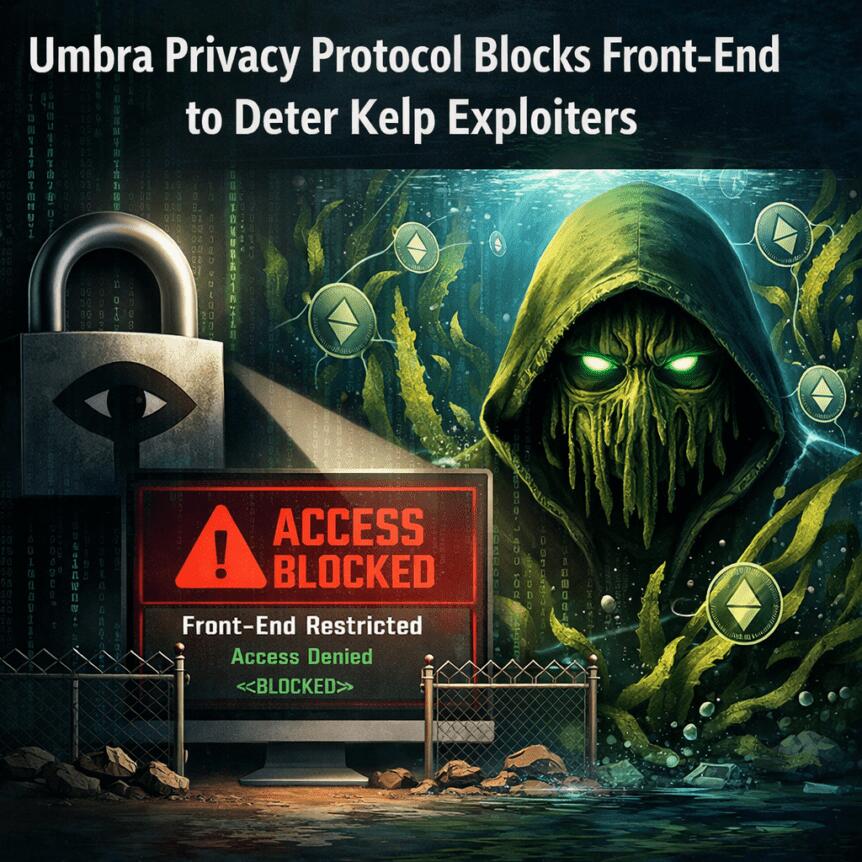
Privacy-preserving crypto protocol Umbra has pulled its front-end hosting offline in a bid to complicate misuse by hackers who have been moving funds from recent high-profile breaches. The move comes as Umbra disclosed that roughly $800,000 worth of stolen funds were routed through its protocol, a signal that attackers continue to exploit cross-chain bridges and related services despite ongoing security efforts.
In a post on X, Umbra said it had transitioned the hosted front end into maintenance mode and would bring it back online only when it can be done without disrupting recovery efforts. The team stressed that the decision was a precaution aimed at safeguarding the recovery process while acknowledging that the open-source nature of its front end means other implementations could still be used by malicious actors.
Key takeaways
- Umbra paused its hosted front end to hinder attacker use, citing approximately $800,000 in stolen funds moved through its protocol.
- The development follows a high-profile sequence of exploits, including the Kelp protocol breach that netted around $280 million, with investigators suspecting North Korean actors were involved.
- Despite the suspension, Umbra emphasized that on-chain activity and self-hosted or locally deployed interfaces remain possible, underscoring the limits of front-end restrictions.
- Analysts and commentators warn that front-end freezes alone may not satisfy regulators or prosecutors who view interface changes as indicative of broader control over a protocol.
- Ambiguity persists about how to balance privacy objectives with anti-fraud and sanctions enforcement in decentralized systems.
Umbra’s action in a shifting security landscape
Umbra’s decision to take its front end offline highlights a growing debate about defensible responses when breaches spill over into the tooling that users rely on most. The targeted move aims to reduce the surface area hackers can exploit for money movement tied to the latest breaches, according to Umbra’s statement. The project noted that the protocol “protects the identity of the receiver, not the sender,” a distinction it says does not assist hackers trying to conceal fund trails. It also stressed that every stolen fund routed through its contracts can be identified, and that it has been collaborating with security researchers involved in the investigation.
In parallel, security researchers and industry observers have repeatedly warned that the tokenized services bridging assets across networks remain a common vector for theft. The Kelp breach, which saw illicit gains reach hundreds of millions of dollars, has intensified scrutiny of cross-chain activity and the ways in which attackers pivot across networks to move funds. PeckShield and other monitoring outfits have flagged Umbra as a target of interest for opportunistic attackers attempting to bridge stolen Ether into Bitcoin and other assets, underscoring the ongoing liquidity risk within the bridge ecosystem.
The front end debate: is a UI pause enough?
Roman Storm, a co-founder of the crypto mixer Tornado Cash, has argued that a temporary freeze on the front end may not be sufficient to placate authorities or deter illicit use. Storm’s comments reference his own legal battles over sanctions-related charges, where prosecutors characterized control over a protocol as equivalent to controlling its operations. He has argued that limiting user interfaces may be read as exerting influence over a broader system, raising questions about what constitutes meaningful control in decentralized architectures.
Umbra’s own note touched on this tension, noting that the protocol’s core remains usable through smart contracts and, in many cases, through self-hosted front ends. The company asserted that even if the hosted front end goes offline, attackers could still access the open-source components if they choose to deploy their own interfaces or use local deployments. The broader implication is that while operators can reduce risk through UI changes, the core protocol’s code and governance remain the ultimate locus of control—and the primary determinant of how funds move once a user interacts with the protocol on-chain.
Privacy versus enforcement: what changes for users and investigators?
Umbra’s framing of its front-end pause as a protective measure for recovery efforts reflects a nuanced approach to privacy-preserving design. The project reiterated that its technology is intended to protect recipient anonymity, rather than to obscure the sender’s trail. In practice, this means that investigators and security researchers can, with cooperation and the right tools, trace flows of stolen funds even when they pass through privacy-centric constructs. Umbra’s statement that all stolen funds can be identified when appropriate signals and data are available is consistent with ongoing industry norms that seek a balance between user privacy and fraud prevention.
For investors and builders, the incident reinforces a persistent theme in crypto: even advanced privacy protocols operate within a broader ecosystem where law enforcement, sanctions regimes, and compliance expectations shape what is feasible in practice. The ongoing sanctions regime targeting North Korean cyber actors adds a layer of regulatory risk to the activity around cross-chain platforms and mixers, as authorities increasingly couple enforcement actions with industry-wide stances against funding networks linked to sanctioned entities.
What to watch next
As recovery efforts continue, observers will be watching for updates on when and how Umbra will restore front-end access without compromising investigators’ ability to trace and recover funds. The episode also raises questions about the durability of privacy-first designs in the face of coordinated enforcement and incident response. Other protocols with similar privacy-centric aims may reassess their own front-end exposure, governance processes, and incident-response playbooks in light of Umbra’s experience.
In the near term, market participants should monitor whether other bridges and privacy-focused contracts adjust their public interfaces or deploy additional mitigations to reduce exploit risk. Regulators and prosecutors will likely keep a close eye on how developers balance user privacy with the need to curb illicit finance, particularly as high-profile attacks continue to test the resilience of cross-chain ecosystems.
Ultimately, the event underscores a core dynamic in the crypto security landscape: improvements in on-chain privacy and usability must be matched by robust off-chain collaboration, transparent communications, and adaptable incident response plans if communities are to navigate the evolving threat environment without stifling innovation.
readers should stay tuned for further disclosures from Umbra and for subsequent analyses from security researchers detailing how such vulnerabilities are being addressed and what this portends for the broader privacy-centric segment of DeFi.


Another day, another exploit. The security crisis in blockchain-based decentralized finance (DeFi), once touted as a challenger to legacy infrastructure, is only getting worse.
The latest victim is Volo Protocol, a platform built on the Sui blockchain, where users deposit assets into yield-generating “vaults,” which function as pooled investments. Deposited tokens such as bitcoin, stablecoins and tokenized assets are deployed using various onchain strategies to generate returns.
Early Wednesday, the protocol confirmed a security breach that drained a total of roughly $3.5 million in digital assets from three of the vaults. Assets locked in other vaults were not affected, it said in a post on X.
“The ~$28M in TVL across all other Volo vaults is safe. The exploit was isolated to 3 specific vaults, and we have confirmed no shared attack vector exists with the remaining vaults,” the protocol said, adding that it is “prepared to absorb” the financial loss rather than pass it on to users.
The attack hit vaults holding wrapped bitcoin (WBTC), Matridock’s tokenized gold token, XAUm, and the dollar-pegged stablecoin USDC. In response, the protocol froze all vaults and began working with the Sui Foundation and onchain investigators to contain the damage and trace funds.
Since the incident, Volo has “frozen” $500,000 in assets through coordination with ecosystem partners, meaning those funds have been immobilized onchain to prevent any movement or withdrawal. Still, the majority of the stolen funds remain under investigation.
Growing unease
The breach adds to growing unease across decentralized finance, where a string of exploits has raised questions about smart contract security and protocol oversight. The timing is particularly sensitive, coming just days after the weekend’s KelpDAO exploit, in which an attacker drained millions by artificially minting unbacked liquid restaking tokens, rsETH.
The aftermath has rippled across the DeFi, triggering collateral damage in multiple protocols, including leading lending platform Aave, where users rushed to withdraw funds because of the heightened uncertainty.
To date, decentralized finance has suffered roughly $7.78 billion in hacks, according to data from DeFiLlama. Bridge protocols — which enable the transfer of assets across blockchains — account for another $2.90 billion in losses. Combined, the figure exceeds $10 billion, roughly equivalent to the market capitalization of cryptocurrencies ranked between 10th and 15th globally.
Volo says it will publish a full post-mortem once its investigation is complete and remediation steps are finalized.
But for DeFi users and investors, a broader pattern is becoming harder to ignore: while institutional adoption is accelerating, relatively little of that capital appears to be flowing into improving security, with exploits continuing to arrive in clusters.
Read more: The $13 billion DeFi wipeout in two days, and it started with KelpDAO attack
Crypto World
Justin Sun Takes Legal Action Against World Liberty Financial Over Frozen Crypto Holdings

TLDR
- Justin Sun, founder of Tron, initiated legal proceedings against World Liberty Financial in California’s federal court system
- The lawsuit alleges WLFI improperly froze Sun’s token holdings, stripped voting privileges, and issued threats to destroy his assets
- Sun attempted private resolution before pursuing litigation
- A new governance measure would permanently lock tokens of holders who don’t consent to new terms
- Sun maintains his support for President Trump’s cryptocurrency initiatives despite the legal conflict
Justin Sun, the blockchain entrepreneur behind Tron, has initiated legal proceedings against World Liberty Financial—a cryptocurrency venture supported by the Trump family—in California’s federal court.
According to Sun’s complaint, the World Liberty Financial team improperly locked his token holdings, eliminated his governance voting capabilities, and issued threats to permanently destroy his investment without providing adequate justification.
Sun maintains he pursued private negotiation channels before resorting to legal action. When the WLFI management refused to restore access to his frozen assets, he determined that litigation was his only remaining recourse.
Previously recognized as World Liberty Financial’s most significant external investor, Sun has now emerged as the project’s most outspoken detractor.
On April 12th, Sun made public allegations that WLFI developers had secretly incorporated a blacklist mechanism within the project’s smart contract infrastructure. This hidden functionality, he asserts, grants the development team authority to freeze, limit, and essentially seize investor assets.
World Liberty Financial addressed these accusations on their social channels, dismissing them as “baseless allegations” and portraying Sun as someone “playing the victim.” The organization suggested imminent legal proceedings with the statement: “See you in court pal.”
The Governance Dispute
The situation intensified following World Liberty‘s April 15th release of a governance resolution. This measure proposes converting more than 62 billion WLFI tokens from unlimited lockup periods into predetermined vesting timelines.
The resolution establishes that founders, development personnel, and advisors would face a two-year token freeze, followed by incremental distribution across three additional years. Additionally, a 10% token destruction would occur upon proposal approval.
Investors declining to accept these revised conditions would see their holdings locked permanently under the current framework.
Sun characterized the resolution as “one of the most absurd governance scams” he’s encountered. He contends it masquerades as a governance initiative while actually functioning as an investor trap for those who don’t actively participate.
Due to his frozen token status, Sun reports he’s completely unable to participate in the voting process—neither in support nor opposition.
Sun Still Backs Trump Despite Legal Fight
Sun emphasized through his public statements that this legal action doesn’t represent opposition to President Trump or his administration’s initiatives.
“Unfortunately, certain individuals on the World Liberty project team have been operating the project in a manner that goes against President Trump’s values,” Sun wrote.
Sun reportedly ranks among the top holders of the TRUMP memecoin. This substantial investment secured him access to an exclusive cryptocurrency gala dinner in May 2025, where he received a commemorative watch during the event.
Analytical data from CoinCarp reveals 642,882 holders of the TRUMP memecoin currently exist. More than 91% of total supply concentration resides within the top 10 wallet addresses.
World Liberty Financial has not issued any official statement regarding the lawsuit when approached by journalists.

Crypto World
Mastercard Joins Blockchain Security Standards Council Alongside Coinbase and Fireblocks
Mastercard has joined the Blockchain Security Standards Council (BSSC) as a Charter-level member. The payments company will help shape security frameworks for blockchain networks and tokenized assets.
The announcement arrived on April 21, 2026, from Wakefield, Massachusetts. Mastercard will also join working groups that focus on security and privacy guidelines.
A Payments Giant Deepens Its Blockchain Commitment
The BSSC operates as a nonprofit consortium. It builds audit frameworks and security standards for digital asset ecosystems.
Mastercard joins a roster that already includes Coinbase, Fireblocks, and Anchorage Digital. BitGo, Figment, and Ribbit Capital also sit on the council.
Meanwhile, Claire Le Gal will represent Mastercard on the BSSC board. She leads Integrity and Standards at the firm’s Security Solutions unit.
Her team handles fraud prevention, cyber resilience, disputes, and threat intelligence. Therefore, her input should carry weight inside the council’s working groups.
Adam Rak serves as the council’s Executive Director. He called Mastercard’s payments experience valuable for setting strong blockchain security rules.
“Part of my job is to make life difficult for criminals,” Claire Le Gal, Mastercard Senior Vice President, said.
Why the Move Matters for Institutional Adoption
Mastercard already runs the Multi-Token Network and Crypto Credential products. Both aim to embed trust into blockchain and tokenized infrastructure.
The company launched Crypto Credential in 2023 to replace complex wallet addresses with simple aliases. In addition, the BSSC publishes its General Security and Privacy standard for blockchain operators.
However, fragmented security practices remain a hurdle for institutional capital. Unified standards could therefore speed up TradFi participation across digital asset markets.
The move signals that traditional finance now treats blockchain as critical infrastructure. Consequently, shared security rules look less optional and more essential.
Mastercard’s security team will feed guidance into BSSC working groups. Moreover, the company plans to share operational insights from decades of payments risk management.
The coming months will show whether the council’s standards gain traction beyond member firms. For now, blockchain governance has gained a major institutional voice. The BSSC can also point to Mastercard as proof that legacy finance wants to help write the rules.
The post Mastercard Joins Blockchain Security Standards Council Alongside Coinbase and Fireblocks appeared first on BeInCrypto.


A senior U.S. military commander has described Bitcoin as a cybersecurity tool with potential use in national defense.
Summary
- A U.S. military commander said Bitcoin can function as a cybersecurity tool, noting its proof-of-work design raises the cost for potential attackers.
- Lawmakers examined Bitcoin’s role in national security during a Senate hearing focused on Indo-Pacific threats and cyber risks from state-linked actors.
At a Senate Armed Services Committee hearing on Tuesday, Samuel Paparo said Bitcoin’s role goes beyond financial use cases and can support security systems tied to U.S. strategic interests.
“It is a valuable computer science tool, as a power projection,” Paparo said, adding that the network’s proof of work design “imposes more cost” on attackers attempting to interfere with it.
“Outside of the economic formulation of it, it has got really important computer science applications for cybersecurity.”
The hearing focused on the U.S. military’s posture in the Indo-Pacific, with discussions spanning ongoing conflicts in Ukraine and the Middle East, China’s military activity, and threats linked to North Korea.
Paparo’s remarks follow earlier comments from Jason Lowery, who has argued that proof-of-work networks can be used to secure digital systems in a cyber conflict. He said Bitcoin is often seen only as a monetary system, while its design can also secure “all forms of data, messages, or command signals.”
State-linked cyber operations have increased in recent years, with attacks such as ransomware, phishing, and denial of service targeting infrastructure and financial systems. The Lazarus Group remains one of the most prominent examples, having stolen billions in crypto over the past decade, funds that U.S. officials say have supported North Korea’s nuclear program.
Paparo’s comments came after Tommy Tuberville asked how the U.S. could lead in Bitcoin-related competition, noting that Chinese policy groups are also examining the asset as a strategic tool. Paparo did not directly address policy steps but pointed to Bitcoin’s underlying structure.
“Bitcoin is a reality. It is a peer to peer zero trust transfer of value. Anything that supports all instruments of national power for the United States of America is to the good,” he said.
Concern over reliance on foreign-made mining hardware has also drawn attention in Washington, even as the U.S. holds the largest Bitcoin reserves among nation states and a significant share of global hashrate.
Last month, Bill Cassidy and Cynthia Lummis introduced the Mined in America Act, aimed at expanding domestic production of Bitcoin mining equipment. The proposal also seeks to formalize the Strategic Bitcoin Reserve established under an executive order signed by Donald Trump.
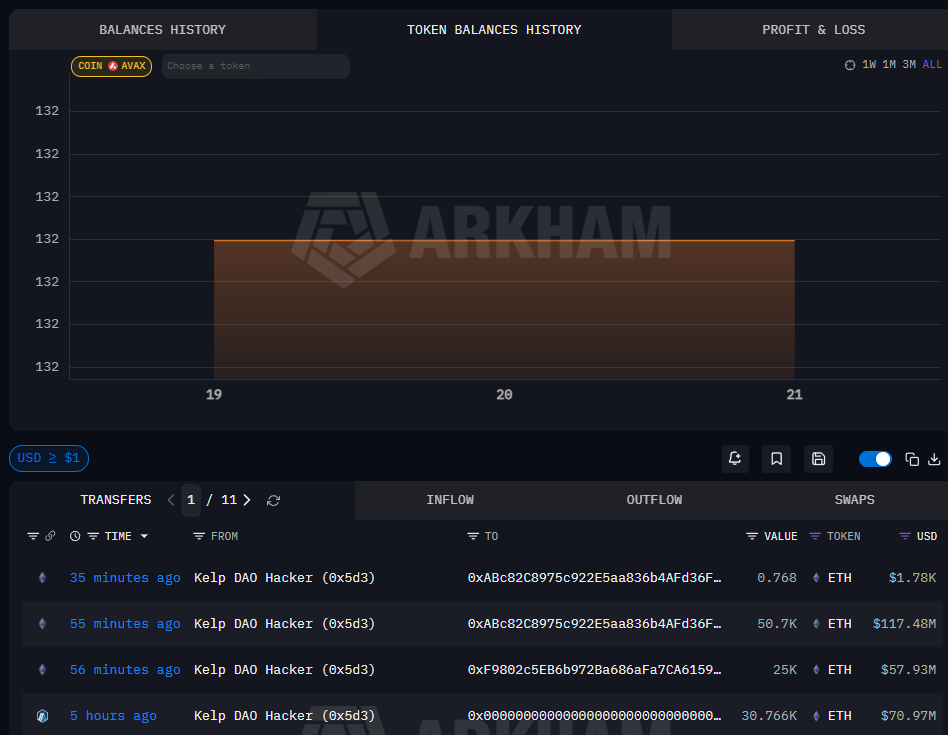
The attacker behind the roughly $290 million Kelp DAO exploit began moving tens of thousands of Ether to newly created blockchain addresses on Tuesday, in what appears to be an effort to start laundering the stolen funds.
The wallet tagged by Arkham as linked to the Kelp DAO exploit moved about 75,700 Ether (ETH) worth roughly $175 million across three transactions on Tuesday, including a 25,000 ETH transfer to one newly created address and transfers of 50,700 ETH and 0.7 ETH to another.
Blockchain investigator ZachXBT wrote in a Tuesday Telegram post that addresses tied to the exploit had begun moving funds through THORChain and Umbra. He flagged three THORChain transactions totaling about $1.5 million and a separate $78,000 transfer through Umbra.
On Saturday, an attacker drained about 116,500 restaked Ether (rsETH), worth roughly $290 million to $293 million at the time, from Kelp DAO’s LayerZero-powered rsETH bridge.
LayerZero said Kelp DAO’s 1/1 decentralized verifier network (DVN) setup created a single point of failure by relying on a single verifier path for cross-chain messages. LayerZero said it had previously advised against that configuration.
Fallout spreads across DeFi
The transfers came hours after Arbitrum said its 12-member security council had taken emergency action to freeze 30,766 ETH tied to the exploit and move the funds into an “intermediary frozen wallet” accessible only through Arbitrum governance.

The exploit also hit other DeFi protocols, including Aave, where the attacker used the stolen funds as collateral to borrow against the protocol. Early estimates put the hole at about $195 million, but Aave’s Monday incident report later outlined two potential outcomes: roughly $123.7 million in bad debt under one scenario and about $230.1 million under another.
The transfers suggest the attackers had begun moving funds through non-custodial protocols that can complicate tracing and recovery. THORChain does not require traditional Know Your Customer checks.
During the $1.4 billion Bybit hack in 2025, attackers converted about 83% of the stolen Ether into Bitcoin (BTC), with 72% of the funds moving through THORChain, according to Bybit CEO Ben Zhou. Zhou said at the time that 77% of the stolen funds were still traceable.
Related: ZachXBT asks MemeCore to explain valuation and token supply
Aave unfreezes Ethereum V3 market as borrow rates spike
On Tuesday, Aave said it had unfrozen Wrapped Ether (WETH) reserves on the Ethereum Core V3 market, enabling users to supply WETH to the V3 lending protocol once again. However, WETH reserves across Ethereum Prime, Arbitrum, Base, Mantle and Linea remain frozen.

Meanwhile, the thinning liquidity saw Aave’s borrowing rates for USDt (USDT) rise from 3% to 14%, marking the highest figures since December 2024, wrote Julio Moreno, the head of research at analytics platform CryptoQuant, in a Monday X post.
Fears over a potential contagion caused significant outflows from Aave, as its total value locked (TVL) fell by about $10 billion since the exploit to $16.4 billion as of Tuesday, DefiLlama data shows.
Magazine: 53 DeFi projects infiltrated, 50M NEO tokens could be ‘given back’: Asia Express
Banks are moving onchain through competing models that take different approaches to how financial rules are enforced.
On the one hand are blockchain-native builders like Matter Labs co-founder Alex Gluchowski, who argue that financial systems require rules to be enforced across all participants. On the other are networks built for institutions like Canton, which prioritize privacy, control and interoperability over global state.
Gluchowski is among the most vocal critics of the latter approach, arguing it reproduces the limitations of traditional finance in a new form. The core of the critique is whether rules can be enforced across an entire network. That’s not possible in systems like Canton, he claimed.
“But they are possible with blockchains — specifically with zero-knowledge systems anchored to public blockchains like Ethereum, which is an environment all parties can trust because it cannot be captured by any single corporate interest,” Gluchowski told Cointelegraph.
Crypto’s institutional adoption is bringing banks and financial institutions onchain, but it’s also splitting the industry along a deeper fault line than geography or regulation.

What counts as a blockchain?
Canton has gained traction by targeting privacy and regulatory requirements, connecting banks and asset managers through a network where transactions are shared only with relevant counterparties rather than broadcast system-wide. The network includes institutional participants such as JPMorgan and Goldman Sachs.
Whether Canton counts as a blockchain depends on how the term is defined and what properties it is expected to guarantee.
For Gluchowski, a blockchain’s core feature is a single shared ledger that allows rules to be enforced across all participants at once. He claimed Canton does not qualify. The network connects institutions through bilateral or trilateral relationships, where each party sees and verifies the transactions it is directly involved in.
“Before blockchains, banks had to enter bilateral relationships and define how they handle edge cases through contracts and API interactions,” Gluchowski said. “It’s just taking these existing relationships and workflows and putting them into a tokenized form.”
Gluchowski said Canton’s model limits what the system can guarantee. While participants can verify the transactions they are directly involved in, they cannot independently verify system-wide properties such as total asset supply or other rules that apply across all users. He added that those kinds of guarantees require a shared state that everyone can check.

Related: Privacy tools are rising behind institutional adoption, says ZKsync dev
“[Gluchowski] is correct that Canton does not have a global shared state, but he is incorrect in implying that this negatively affects Canton’s trust model,” Shaul Kfir, co-founder of Digital Asset, responded through a statement shared with Cointelegraph.
“In Canton, as in all other blockchains, I only trust my own validator and assume anyone else can be malicious. This ‘don’t trust, verify’ approach is very different from a distributed API system,” Kfir added.
In Canton’s model, trust does not come from a single system-wide view, but from each party independently checking the transactions it is involved in.
Network rules clash with issuer control
Following the conversation with Cointelegraph, Gluchowski took part in a live debate with another Digital Asset co-founder, Yuval Rooz. He reiterated his argument that financial rules must be enforced across an entire network in a blockchain network.
Rooz countered that system-wide enforcement doesn’t eliminate reliance on trusted parties, as public blockchain users still depend on token issuers. Rooz pointed to hacks that involved assets like USDC to argue that issuers remain the key enforcement mechanism.

Related: Instant settlement strains crypto’s capital efficiency: Ethan Buchman
“Actually, we would have been happier — as we’ve seen a lot of the crypto space saying if the centralized issuer were to intervene sooner rather than allowing these assets being traded and swapped into permissionless assets where then they can no longer interfere,” Rooz said.
“On Canton, no different than any other public chain, the issuer is centralized in real world assets, and they have different properties or similar properties to what they would have on public permissionless chains,” he added.
Gluchowski argued that issuance limits can be embedded directly into smart contracts. He said that on networks like Ethereum, activity beyond a certain threshold can be restricted or require additional approval, rather than relying solely on the issuer’s infrastructure.
“On Canton, you rely solely on the multisig. On Ethereum, you rely on smart contracts that are enforced by the network,” Gluchowski said.
“It’s just absolutely not true,” Rooz replied.
Kfir, whose statement was shared with Cointelegraph after the live debate, said that Gluchowski is “confusing the capabilities of Canton” with how it is used by centralized RWA issuers.
“When there’s a centralized RWA issuer, e.g. a stablecoin issuer, you’re already trusting them with the ‘mint’ function, and you’re trusting them and their auditors that the amount onchain is backed by reserves off-chain,” Kfir said.
Competing visions for bringing banks onchain
Canton and Matter Labs are competing to solve the same problem of how institutional finance moves onchain. Matter Labs, the developer of ZKsync, is targeting institutional use cases with Prividium, a model that keeps transactions private while anchoring verification to Ethereum through zero-knowledge proofs.
Kfir argued that systems like Prividium risk concentrating trust in a different place. In his view, users are no longer independently validating the relevant state, forcing them to reconcile their own records against what an operator reports happened onchain.
“ZKsync relies on Prividium operators who create ZKPs, but ZKsync’s own open source client doesn’t verify these proofs,” he said. “And even if a user does verify, it doesn’t verify which smart contract logic is running. The user is completely at the mercy of the Prividium operator.”

Rooz did concede one point during the debate, which is that Canton does not have public verifiability, while adding that there are plans to introduce it in the future.
For now, the divide remains unresolved. Canton is built around privacy and institutional control, while ZKsync’s Prividium attempts to preserve those features while anchoring verification to a public network. Both claim to offer a viable path for bringing banks onchain, but they are built on fundamentally different assumptions about how financial systems should work.
Magazine: Adam Back says current demand is ‘almost’ enough to send Bitcoin to $1M
Key Takeaways
- Kalshi is preparing to introduce perpetual futures contracts for cryptocurrency trading in the U.S. market
- The initial rollout will feature perpetuals linked to digital assets including Bitcoin
- The platform operates under CFTC regulatory oversight and secured recent authorization for margin trading capabilities
- This expansion creates intensified rivalry with established players like Coinbase, Crypto.com, and Gemini
- Competing prediction platform Polymarket has similarly disclosed intentions to enter the perpetual futures arena
Kalshi, primarily recognized for its prediction market operations, is gearing up to introduce perpetual futures trading for cryptocurrencies within U.S. borders. According to a report from The Information, sources with knowledge of the initiative have confirmed the development.
https://twitter.com/CoinMarketCap/status/2046633854945902850?s=20
The platform intends to begin its offering with perpetual futures contracts connected to major cryptocurrencies such as Bitcoin. These derivative instruments enable market participants to take positions on price movements without directly purchasing the underlying digital assets, and they feature no set expiration timeline.
Differing from conventional futures contracts, perpetual futures can remain open indefinitely provided the trader maintains adequate collateral backing. The mechanism keeps contract prices aligned with spot market values through periodic transfers between long and short position holders, commonly referred to as funding rate mechanisms.
Perpetual futures contracts have dominated trading activity on international crypto platforms for numerous years. BitMEX pioneered the widespread adoption of this contract structure within cryptocurrency markets. Currently, U.S.-based trading venues are working aggressively to establish domestic alternatives.
[[LINK_START_0]]Kalshi[[LINK_END_0]] operates under Commodity Futures Trading Commission supervision. The company maintains several CFTC licenses and just obtained clearance to provide margin trading services, establishing the regulatory foundation necessary for lawful derivatives operations.
CFTC Chair Michael Selig has indicated these financial products may soon become accessible to U.S. traders, as regulatory bodies work to redirect transaction volume from unregulated international platforms.
Intensifying Rivalry in Derivatives Markets
This strategic pivot places Kalshi in heightened competition with Coinbase. Coinbase has been broadening its derivatives portfolio and has unveiled products resembling perpetuals through extended-expiration futures contracts available to international clients. The exchange has yet to launch authentic perpetual contracts for U.S. customers.
Kraken has similarly deployed tokenized equity perpetual futures for its international user base. Meanwhile, Crypto.com and Gemini have rolled out prediction market offerings, demonstrating the growing convergence between these two financial sectors.
Earlier this week, Polymarket, another prediction market operator and Kalshi’s direct competitor, announced via X that it intends to launch perpetual futures products. Additional specifics were not disclosed.
Daily trading volumes for perpetual futures across cryptocurrency markets currently sit at approximately half their historical peaks but still reached close to $20 billion on Tuesday, based on DeFiLlama analytics.
The Convergence of Prediction Markets and Cryptocurrency Trading
Cryptocurrency trading activity has contracted in recent months amid broader market weakness. Simultaneously, prediction market engagement has experienced substantial growth, attracting both participants and investment funding.
This dynamic has prompted crypto exchanges to explore prediction market features while prediction platforms venture into crypto derivatives territory. Both sectors are now pursuing the same trader demographics.
Kalshi’s strategic expansion may ultimately reach beyond cryptocurrency assets. According to a source briefed on the plans, the company could eventually adapt the perpetual futures framework to additional asset categories.
The organization has not issued formal confirmation regarding launch schedules or specified which digital tokens beyond Bitcoin will receive initial support.

Stock selection key as mid & smallcaps offer alpha opportunities: Pankaj Murarka

KuCoin’s Sabina Liu on Where Crypto Growth Is Coming From in 2026

Farmer Wants a Wife Couples Status Check: Who Is Still Together?

Manchester United reach agreement with Casemiro over contract clause amid transfer speculation

Steven Gerrard disagrees with Gary Neville over ‘shock’ Chelsea and Arsenal claim | Football

US brings back mandatory military draft registration


-

 Fashion5 days ago
Weekend Open Thread: Theodora Dress
-

 Politics4 days ago
Palestine barred from entering Canada for FIFA Congress
-

 Sports5 days ago
NWFL Suspends Two Players Over Post-Match Clash in Ado-Ekiti
-
Entertainment2 days ago
NBA Analyst Charles Barkley Chimes in on Ice Spice McDonald’s Fiasco
-

 Business3 days ago
Powerball Result April 18, 2026: No Jackpot Winner in Powerball Draw: $75 Million Rolls Over
-

 Politics3 days ago
Zack Polanski demands ‘council homes not luxury flats for foreign investors’
-

 Crypto World4 days ago
Russia Pushes Bill to Criminalize Unregistered Crypto Services
-

 Politics1 day ago
Gary Stevenson delivers timely reminder to register to vote as deadline TODAY
-

 Tech3 days ago
Auto Enthusiast Scores Running Tesla Model 3 for Two Grand and Turns It Into Bare-Bones Go-Kart
-

 Tech6 days ago
‘Avatar: Aang, The Last Airbender’ Leaked Online. Some Fans Say Paramount Deserves the Fallout
-
 Business5 days ago
Creo Medical agree sale of its manufacturing operation
-

 Crypto World4 days ago
Russia Introduces Bill To Criminalize Unregistered Crypto Services
-
Crypto World3 days ago
Kelp DAO rsETH Bridge Hack Drains $292M as DeFi Losses Top $600M in Two Weeks
-

 Sports6 days ago
British climbers complete new route in Swiss Alps
-

 Sports6 days ago
“Felt Much Better Today”: Josh Hazlewood Opens Up On His Recovery Win Over LSG
-

 Tech6 days ago
Ford EV and tech chief leaving automaker
-

 Business6 days ago
Cheaper Doritos and Lays helps PepsiCo win back struggling snackers
-
 Entertainment6 days ago
Clavicular Says Streaming May Not Work Without Substances
-

 Entertainment7 days ago
Ruby Rose Accuses Katy Perry Of Sexual Assault, Police React
-

 Sports6 days ago
NFL Players from Saguaro H.S. (Scottsdale, AZ)
You must be logged in to post a comment Login