
Business
IT takes D-St on a tumble, AI fears pop up on HCL Q4 miss


The Nifty IT index dropped 3.9%, against the 0.8% decline in the benchmark Nifty. Persistent Systems, Coforge, Infosys, LTM (erstwhile LTIMindtree) and MphasiS fell between 3% and 5%.
“The sell-off was triggered by HCL Technologies’ weak Q4 performance and subdued guidance, but the broader driver remains poor demand visibility across the sector,” said Harsh Thakkar, research analyst at Samco Securities. “Slower discretionary spending, delayed deal conversions, and limited near-term AI monetisation are weighing on growth expectations.”
HCL’s share slump is the sharpest among peers in the fourth quarter results season as the earnings of TCS, Wipro and Tech Mahindra have been resilient so far. The earnings miss at HCL was largely because of client-specific challenges, particularly in telecom, said Sushovon Nayak, research analyst at Anand Rathi Institutional Equities.
“Tech Mahindra, which derives nearly a third of its revenues from telecom, reported a relatively strong performance,” he said. “The focus now shifts to Infosys’ earnings for further cues.”

 Agencies
focus shifts to infosys While HCL Tech had a weak quarter, TechM did relatively well; Sector weakness offers a chance to buy some beaten-down stocks, say analysts
Infosys is set to announce its fourth quarter number on Thursday.
HCL’s investor popularity compared to its peers went against its shares on Wednesday.”HCL Technologies was trading at a valuation premium to larger peers Tata Consultancy Services and Infosys, but has delivered weaker growth relative to them,” said Sumit Pokharna, vice-president, Fundamental Research, at Kotak Securities.
“Management highlighted slower deal activity amid geopolitical uncertainty, alongside price deflation or reduced deal sizes, as clients prioritise efficiency and cost optimisation, driven by AI adoption. The extent to which these trends impact the broader industry remains to be seen.”
IT stocks have been under pressure since the beginning of 2026 as worries about AI replacing traditional software products, especially after Anthropic announced advanced tools, sparked a sell-off in the sector worldwide.
So far this year, the Nifty IT index is down 19.5%, with all its components down 8-26%, except for Oracle Financial Services Software, which gained 5.7%. The Nifty shed 6.8% in this period.
Buy on Dips?
The weakness may be an opportunity to buy some of the beaten-down stocks in the sector.
“For medium to long-term investors, the sector is offering accumulation opportunities on dips,” said Dhanshree Jadhav, analyst – Technology at Choice Institutional Equities. She prefers midcap IT companies over large caps.
Nayak prefers LTM and Infosys in large caps, and Persistent Systems and Mphasis in midcaps.
“While the industry may continue to face revenue pressures over the next year, selective opportunities and new revenue streams could offer some support,” he said.
Pokharna prefers Infosys, TCS, and Tech Mahindra over HCL.
Investors bullish on IT stocks must, however, brace for sharp swings.
“Volatility is likely to persist over the next few quarters as earnings remain range-bound and sentiment stays guidance-driven,” said Thakkar of Samco.
“Investors should avoid aggressive buying and instead adopt a staggered approach, focusing on quality companies, while remaining cautious on those with limited earnings visibility until a clearer demand recovery emerges.”


If they are anything like most Oscar winners, the team behind The Artist will have spent the first day of the rest of their lives conforming to the grandest, and most lucrative, of Hollywood traditions.
Having woken up, pinched themselves, and made sure that -oui! – it really was a gold statuette on their bedside table, France’s newly minted movie stars are likely to have devoted their waking hours to pondering two pressing questions: how to shift that throbbing hangover, and which of the myriad career choices suddenly on their horizon should they pursue next?
Breaking the silence
The first will not have been easily answered. Having sought refreshment at the Governor’s Ball, the team who won five of Sunday’s Academy Awards – including Best Picture, Best Director, and Best Actor – adjourned to a packed party hosted by their film’s distributor, Harvey Weinstein, at the Mondrian Hotel in Hollywood.
Then they swept through Vanity Fair’s bash, before continuing to the Chateau Marmont hotel, where at around four in the morning, several boisterous members of their entourage leapt into the swimming pool, fully clothed.
The second post-Oscar question requires even more careful consideration. Like any winners of the biggest accolade in show business, The Artist’s leading man Jean Dujardin, director Michel Hazanavicius, and producer Thomas Langmann will, for the time being, be inundated with potential job offers. But, as any Hollywood agent will tell you, an overabundance of choice doesn’t always make for easy decisions. Leverage the success
On a purely pragmatic level, history suggests that all three can, if they so desire, leverage The Artist’s success into financial security. The film has already made $76 million worldwide and is now being widened into more than 2,000 cinemas in the US, with a view to further capitalise on its Best Picture status.
As well as “back end” earnings from that pot – which must also be dipped into by the voracious Weinstein – they are entitled to use their modish status to secure significant paydays.

VanEck is a global asset management firm offering ETFs, mutual funds, private funds, model portfolios, institutional strategies, separately managed accounts, as well as UCITS funds. Since our founding in 1955, putting our clients’ interests first, in all market environments, has been at the heart of the firm’s mission. VanEck has a long history of looking beyond financial markets to spot trends that create meaningful investment opportunities. We were one of the first U.S. asset managers to give investors access to international markets, which set the tone for identifying asset classes and themes such as gold investing in 1968, emerging markets in 1993, and exchange traded funds in 2006 that later helped shape the investment industry. The firm oversees $161.7 billion in assets as of September 30, 2025. Disclosures: http://ow.ly/SZ9450N5qTJ.

VANDENBERG SPACE FORCE BASE, Calif. — SpaceX successfully launched a Falcon 9 rocket carrying 24 Starlink satellites into low-Earth orbit from Vandenberg Space Force Base on Wednesday night, marking another routine addition to the company’s rapidly expanding global internet constellation.

The Falcon 9 lifted off from Space Launch Complex 4 East at 8:23 p.m. PDT on April 22, 2026, arcing southward over the Pacific Ocean in a spectacular nighttime display visible across much of Southern California. All 24 satellites were deployed approximately one hour after liftoff, bringing the total number of Starlink spacecraft in orbit closer to 9,000.
The booster, making its fifth flight, performed flawlessly and landed on the droneship “Of Course I Still Love You” positioned in the Pacific, achieving SpaceX’s 600th successful booster landing earlier in the week on a separate mission. The rapid reuse of Falcon 9 first stages continues to drive down launch costs and enable the high launch cadence that has become SpaceX’s hallmark.
This mission, designated Starlink Group 17-14, adds more capacity to the constellation’s coverage over the Americas and Pacific regions. Starlink now provides high-speed, low-latency internet to users in remote and underserved areas worldwide, including rural communities, maritime operations, aviation and disaster response zones. The service has grown dramatically since its initial beta phase, with hundreds of thousands of active terminals in use across dozens of countries.
SpaceX has maintained an aggressive launch schedule in 2026, with Vandenberg serving as the primary West Coast site for Starlink missions heading into polar or sun-synchronous orbits. These trajectories allow the satellites to provide coverage at higher latitudes that equatorial launches from Florida cannot efficiently reach. Wednesday’s launch was the latest in a string of Starlink missions from California, following similar flights earlier in April.
The payload consisted of the latest generation of Starlink satellites, equipped with improved laser inter-satellite links that enable faster data routing across the constellation without relying solely on ground stations. These upgrades have helped reduce latency and increase overall network performance, making Starlink more competitive with traditional fiber and terrestrial broadband services.
Elon Musk, SpaceX’s founder and chief executive, has repeatedly emphasized the importance of Starlink as a bridge to global connectivity and a key revenue driver for the company. The service supports SpaceX’s broader ambitions, including future Mars colonization efforts, by generating cash flow that funds development of the Starship vehicle. Starlink also serves as a critical communications backbone for Starship test flights and other SpaceX missions.
Wednesday’s launch occurred without incident, with live webcasts on X and the SpaceX website drawing hundreds of thousands of viewers. Spectators along the California coast shared videos of the bright exhaust plume lighting up the evening sky, a common sight for residents near Vandenberg but one that never fails to captivate.
The U.S. Space Force, which operates Vandenberg, continues to support SpaceX’s frequent operations while balancing national security launches. The base remains one of the most important spaceports in the world, handling both commercial and government missions.
Starlink’s growth has not been without controversy. Some astronomers have raised concerns about the brightness of the satellites interfering with ground-based observations, though SpaceX has worked to mitigate the issue through darker coatings and operational adjustments. Regulatory bodies in multiple countries continue to monitor the constellation’s impact on orbital debris and radio frequency interference.
Despite those challenges, demand for Starlink remains strong. The service has proven particularly valuable in Ukraine, where it has maintained connectivity during conflict, and in remote parts of Africa, South America and the Pacific islands where traditional infrastructure is limited or nonexistent. Maritime and aviation versions of the terminal have also expanded the addressable market significantly.
SpaceX plans dozens more Starlink launches in 2026, with both Florida and California sites contributing to the cadence. The company aims to maintain or exceed its record-setting pace from previous years as it works toward a constellation ultimately numbering in the tens of thousands of satellites.
For Vandenberg, Wednesday’s mission added another successful notch to its long history of space launches dating back to the early days of the U.S. missile and space programs. The base’s coastal location provides an ideal trajectory for polar orbits while minimizing risk to populated areas.
As the Falcon 9 first stage touched down on the droneship hours after liftoff, SpaceX teams prepared for the next mission already on the calendar. The company’s ability to reuse boosters dozens of times has transformed the economics of space access, making frequent Starlink deployments financially viable.
The addition of 24 new satellites will incrementally improve coverage density and redundancy within the network. Users in marginal coverage areas may notice better performance as the constellation fills out, while new customers continue to sign up for the service at a steady pace.
Wednesday’s launch underscores SpaceX’s dominant position in the commercial launch industry and the central role Starlink plays in its business model. With Falcon 9 now a mature and highly reliable vehicle, the company is shifting increasing focus toward Starship development while keeping the Starlink machine running at full speed.
As night fell over Southern California, the glow of the Falcon 9’s engines briefly turned darkness into day, a vivid reminder of the rapid progress in commercial spaceflight. For SpaceX, it was another successful step in building the world’s largest satellite constellation. For the growing number of Starlink users, it represented expanded access to high-speed internet from orbit.
The mission’s success further cements Vandenberg Space Force Base as a vital hub for America’s space ambitions, both commercial and national security-related. With more Starlink flights scheduled in the coming weeks, the California coastline is likely to see many more nighttime rocket launches lighting up the sky in the months ahead.
Rupee#CAD#Economic crisis#Food Bill
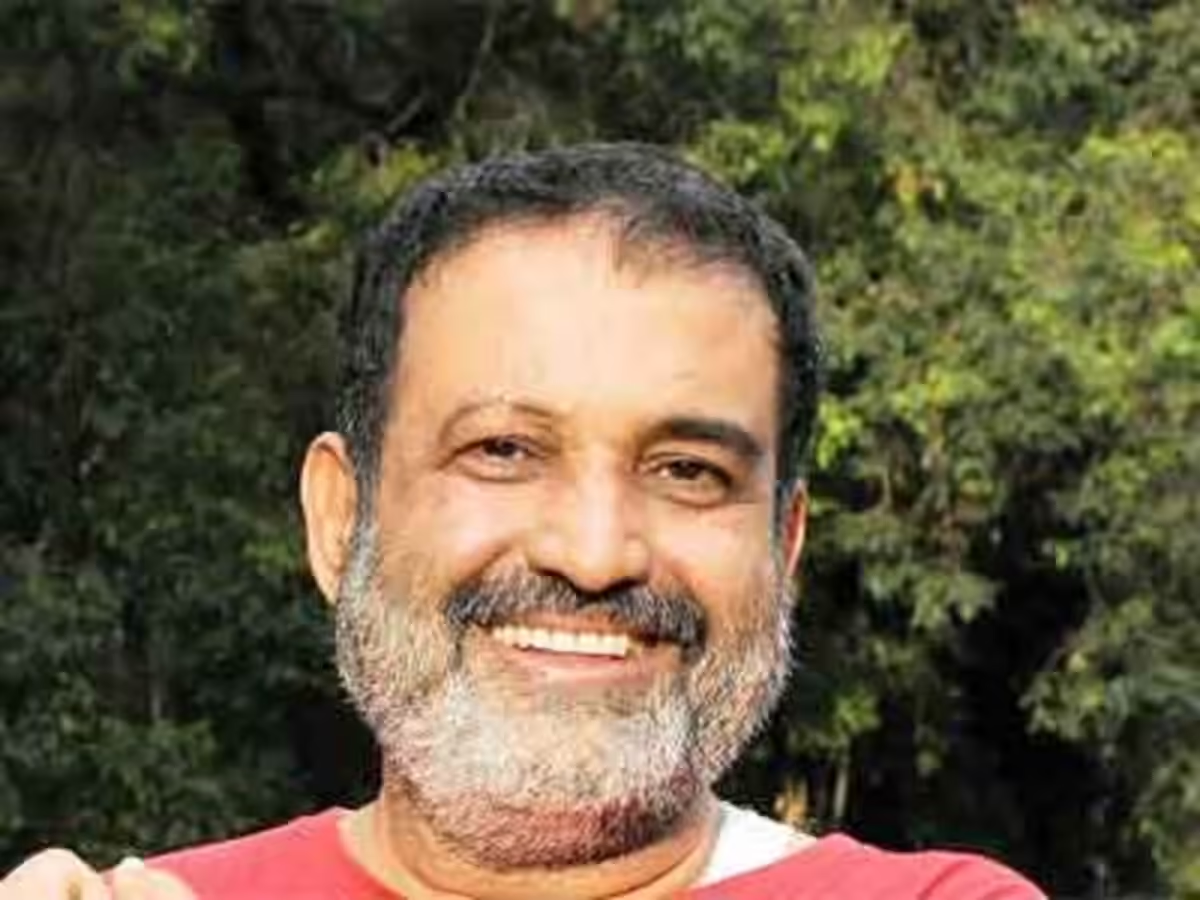
ET Now: There are two ways of looking at it the top level exits in Infosys. On the one hand, a lot of people say that there was a team that was probably not performing well and now they are exiting and that will probably be a positive for the stock over the long run. The sceptics, on the other hand, would argue that there are a lot of people who have been manning the company for the last many years and it is not a pint-sized company, but a Rs 1 lakh 70 thousand crore behemoth. Why have there been so many high profile exits in the company?
Mohandas Pai: There is a leadership vacuum in the company, because they made the wrong choice of CEO three years ago and that is playing out right now. The company has not performed and in June 2011, they had appointed three members on the board and all three of them have gone now and all three have been extraordinary individuals.
Ashok Vemuri is now the CEO of another company, V Balakrishnan had left and has started his own fund and BG Srinivas, I am told, would now be joining some other company as CEO.
So obviously, all three have been CEO materials. It is obvious that the chemistry did not work, or they were not fully empowered. There is a need for the board to sit down and work out a good succession plan and put a new team in place because the entire layer of people below the executive board are now gone and many of them were outstanding performers.
Yes, a few of them possibly were not pulling the weight, but it is not possible that all of them were not doing so. They were extraordinary people and they are performing at other places.
So there is a need for teamwork and need for people to come together. They need to forget the past and focus on the future, they need to realign the company based upon what the market needs.
The market has changed and so its model needs to change, its management structure needs to change and the set of people who have ruled the company for 30 years have to step down and hand over reins, because they have stayed on for too long. Therefore, I hope that in the next one or two months, the board will come together along with NRN and once and for all close this issue.
ET Now: Where can the breakthrough come from at this point, because you have already stated in the past that the board and Mr Murthy need to take responsibility for the exits. It just seems that the series of exits is not ending. Does this mean that the company may have to also consider forming a completely new team from outside and hiring some expensive resources from outside?
Mohandas Pai: My view is that the layer below BG Srinivas, V Balakrishnan and Ashok Vemuri is an extraordinary layer. You have many good people who have run units. But they have run units and they require one or two years to come up with enterprise.
Enterprise position is very different from a unit position. You could be an extraordinary unit person, but to run an entire enterprise in a very competitive environment, you require some mentoring and some experience.
Now the entire generation of leaders who could have handled enterprise has gone. The next layer of people have done very well and there is great management there, but they need to connect between themselves and NRN who is the executive chairman and will stay for the next three years. That connect has to be fixed and it is up to NRN to do it.
Now it can be done by somebody stepping up to the plate as CEO. He will be inexperienced, he would not have handled enterprise, but being very efficient, in three to six months, he can pick it up.
However, that requires a different style of functioning by NRN. It also means that some amount of bloodletting will happen. In fact, it has to happen when the next generation comes up, because obviously people who are much senior will not stay on and there has to be a cleanup. So in the next two or three months, we have to see a radical change.
It is very difficult to speculate whether we will have an external team of people coming in, because such a team does not exist in any other company, let us remember. It is a very large company, with 160000 people, and $25 billion or $30 billion of market value.
So it requires a certain level of expertise and the board and the chairman have to work with them very carefully. So they have their task cut out and it will help if Nandan Nilekani is asked to come back, because he could provide the link between the chairman and the next layer of people and help to mentor them for the next couple of years, because he had an extraordinarily connect with people, his style is very inclusive and he is a person who empowers his team and gives them full strength to go ahead and stands by them. So getting Nilekani back would be a great strategy.

Almost $30 million has been set aside to digitise driver’s licences in the upcoming state budget, as the government moves to modernise services in line with other states.
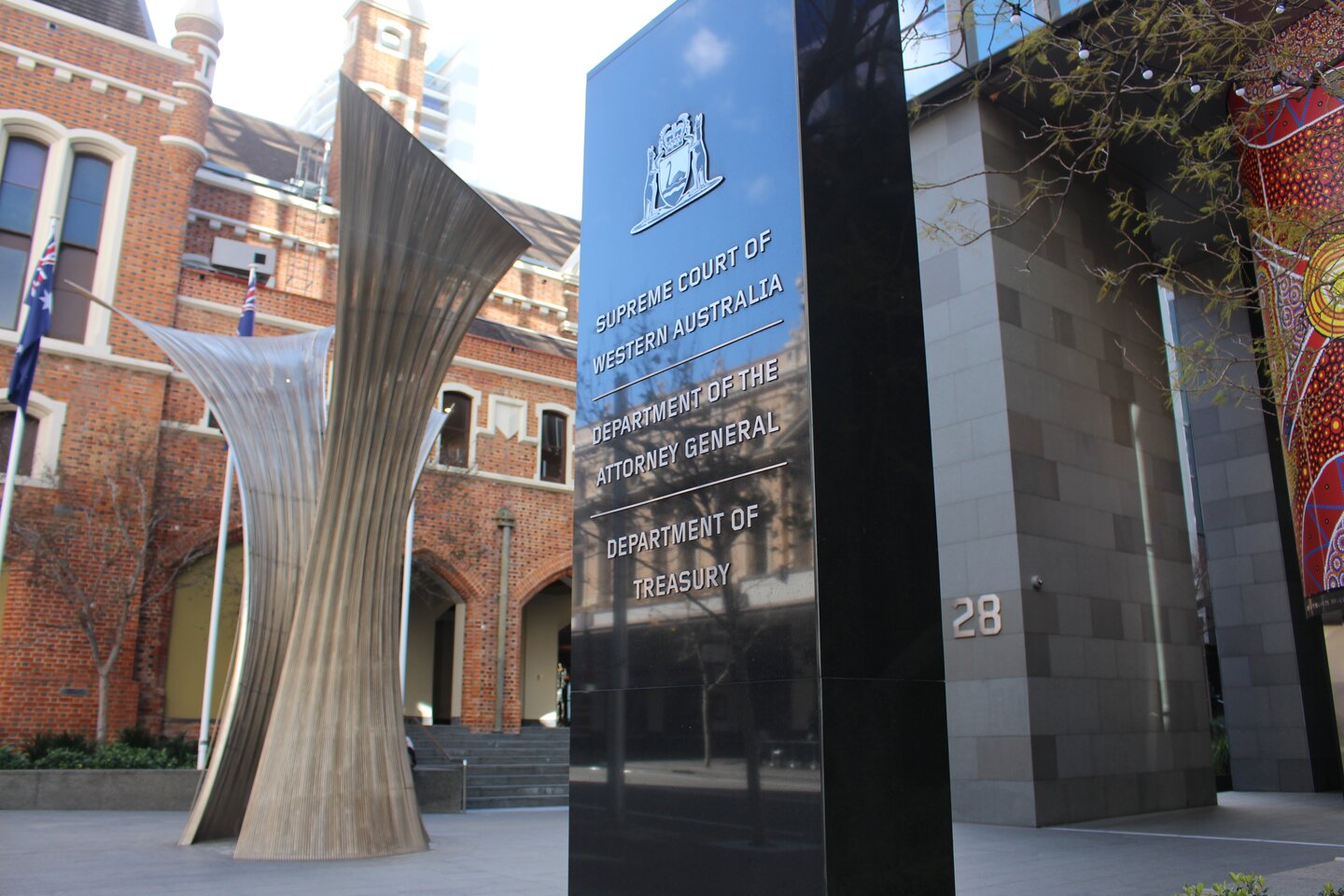
Former Eagle turned businessman Andrew Donnelly is at risk of losing his Cottesloe home after being accused of failing to pay back almost $4 million.

JPMorgan downgrades Lucky Strike stock on traffic concerns
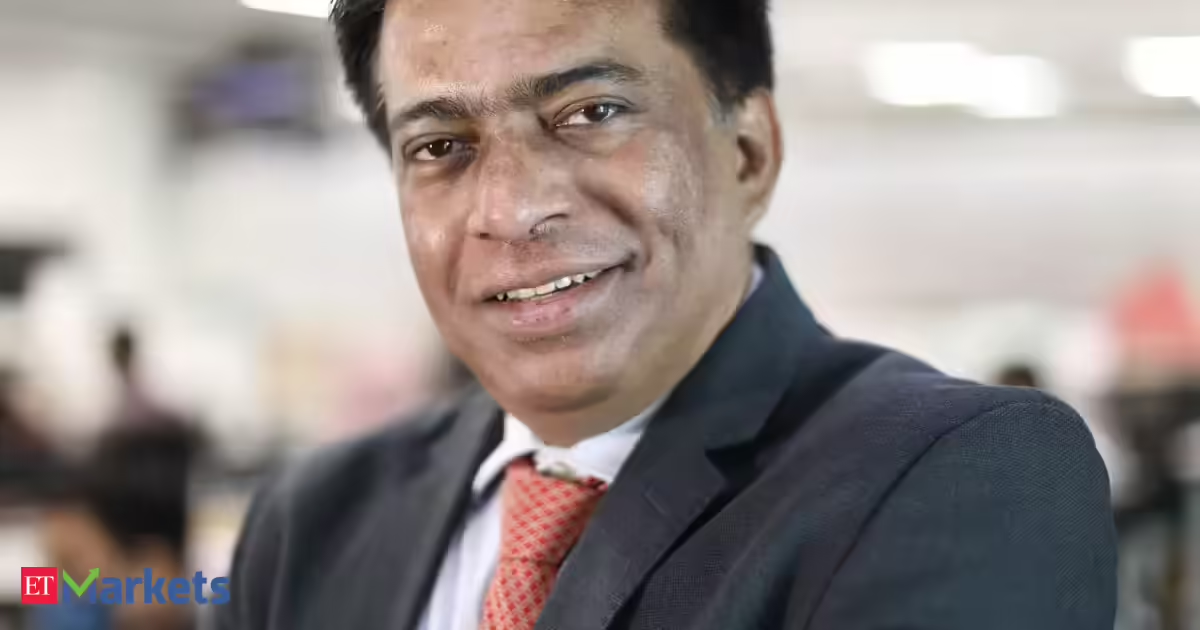
When asked about the current trajectory, Trideep Bhattacharya from Edelweiss AMC offered a measured outlook, suggesting that the worst phase of uncertainty may already be behind us.
“So, in my opinion, in most logical circumstances we have probably seen the worst of the war in the sense of worst of the uncertainty. While the exact deal, the nature of it is still pending and will take time to evolve over time, we have seen the worst of it and that is our base case,” he said.
He emphasized that the base case scenario points toward a gradual normalization by the end of April. “The base case is that by the end of April most of war-related uncertainty is resolved and we gradually live back to normalcy because some of the energy infrastructure will take a bit of time to normalise but the market will discount once it knows that the worst point of the event is over.”
However, he cautioned that risks remain if key developments fail to materialize. “The reason why it is vacillating around the higher level of the mark that you are talking about is we do not seem to find yet a common ground of understanding between the warring parties and that is necessary, by the way, before we end April. If it does not happen… the way to keep track of this is if oil price stays above 100 for a period of three months, which means March, April and May put together, then the negative scenario starts playing out on the economic front which will be global in nature. India will also go through its impact.”
Bhattacharya summarized the outlook succinctly: “The base case is the majority of the event ends in April. The earnings impact is manageable and we go back to where we started the warlike scenario. But if it were not to happen, oil stays above $100 for three months… then economic circumstances is something that we need to be prepared for.”
Midcaps and Smallcaps Regain Investor Interest
Recent weeks have seen renewed buying in midcap and smallcap stocks, a trend Bhattacharya views positively.
“We have been positive. We have been positive on this space because on a relative basis we find the valuations during this correction for both mid and smallcaps have actually reached a five-year low versus broader markets,” he noted.
He added that valuation excesses have normalized, making these segments attractive again. “Structurally we feel that this end of the market, particularly the midcap end of the market, is that part of the market where we have relatively stronger business models that are gaining market share and… have better earnings growth.”
With valuations now at more reasonable levels, he believes gradual allocation into these segments makes sense.
Energy Theme Gains Prominence
Energy, particularly the power sector, has emerged as a dominant theme in recent months. Bhattacharya highlighted that this trend predates current geopolitical tensions.
“Power overall is a segment where we have been positive on… because as a growing economy the energy needs of the economy kind of grows multi-fold more than just the GDP,” he explained.
India’s economic ambitions will require significant expansion in power generation, transmission, and distribution. He also pointed out that the ongoing conflict has underscored the importance of energy diversification.
“This war… has put this issue right in the forefront that we need to look at how do we have multiple sources of energy so that we are not too much dependent on the Strait of Hormuz or any particular channel.”
Sector Rotation: Financials, Power, and Capital Goods Lead
Looking ahead, Bhattacharya identified three key sectors where his outlook remains positive.
“We are overweight on three areas where we think demand is relatively insulated,” he said.
First, financial services stand out as credit growth shows signs of recovery. “We think that clearly credit growth has bottomed out and over the next three, six, nine months we will see credit growth move up to somewhere between 14% to 16% and as a play on the same financial services is a good place to be.”
Second is the power sector, which continues to benefit from structural demand trends.
Third, capital goods—particularly short-cycle segments—are expected to gain from post-conflict rebuilding activity. “As we come out of this conflict and as the rebuild phase starts to happen, you will see some of the capital goods companies benefit from the same.”
On the flip side, he remains underweight on telecom, utilities, and parts of the oil and gas sector following their recent rally.
Financials: Moving Down the Market Cap Curve
Within financials, Bhattacharya suggests taking a broader approach.
“So given that it is a rising tide right now within financials where liquidity is decent, where credit growth is bottoming out, it makes sense to take a bit of risk within financials,” he said.
This includes exploring opportunities beyond large private banks. “Which means going down the market cap chain in the context of private sector banks, also maybe PSU banks and some NBFCs. And finally I would say capital markets is another place where we have been structurally positive.”
IT Sector in Transition
On the technology front, Bhattacharya struck a cautious tone, describing the sector as being in the midst of a structural shift driven by artificial intelligence.
“So, strong is not the view that I have… We think that AI is like any other technology cycle which will reorient, which will create some newer avenues for growth and will take away some of the old ones,” he said.
He noted that the transition phase may weigh on performance in the near term. “At the moment you are looking at a sector which is IT sector in the transition… During these periods generally the sector derates.”
Despite this, he remains watchful rather than outright negative. “We are marginally underweight and watching the data points carefully to see when the growth rates start to go better maybe in three to four quarters.”
A Market at an Inflection Point
As markets balance recovery with uncertainty, the coming months will be critical. While the base case suggests stabilization, key variables—particularly oil prices and geopolitical developments—will determine whether optimism holds or gives way to renewed volatility.
For now, investors appear to be positioning selectively, focusing on sectors with structural strength while keeping a close eye on evolving risks.

Resurgent oil prices have helped push Australia’s share market lower for a third straight session as the US and Iran escalate their respective shipping blockades.

Two men arrested after east Belfast security alert
After the Oscars, what’s next for silent stars of The Artist?

KelpDAO Attacker Launders 75,700 ETH Into Bitcoin in Day-and-a-Half Sprint

Manchester United reach agreement with Casemiro over contract clause amid transfer speculation

Steven Gerrard disagrees with Gary Neville over ‘shock’ Chelsea and Arsenal claim | Football

US brings back mandatory military draft registration

What Is Financial Management | Explain Financial Management | Meaning | Definition #bcom #commerce

Beginner’s Guide to Crypto Trading | Where to Start? | @BudhilVyas | Sagar Sinha Show

Financial Audit’s Most Abusive Husband
-

 Sports6 days ago
NWFL Suspends Two Players Over Post-Match Clash in Ado-Ekiti
-

 Fashion6 days ago
Weekend Open Thread: Theodora Dress
-

 Politics6 days ago
Palestine barred from entering Canada for FIFA Congress
-
Entertainment3 days ago
NBA Analyst Charles Barkley Chimes in on Ice Spice McDonald’s Fiasco
-

 Business4 days ago
Powerball Result April 18, 2026: No Jackpot Winner in Powerball Draw: $75 Million Rolls Over
-

 Tech4 days ago
Auto Enthusiast Scores Running Tesla Model 3 for Two Grand and Turns It Into Bare-Bones Go-Kart
-

 Politics4 days ago
Zack Polanski demands ‘council homes not luxury flats for foreign investors’
-

 Crypto World5 days ago
Russia Pushes Bill to Criminalize Unregistered Crypto Services
-

 Politics3 days ago
Gary Stevenson delivers timely reminder to register to vote as deadline TODAY
-

 Politics15 hours ago
Disabled people challenge government SEND proposals over segregation concerns
-

 Politics15 hours ago
Making troops accountable for war crimes threatens US alliance, ex-SAS colonel warns
-

 Business24 hours ago
Rolls-Royce Voted UK’s Most Iconic Trade Mark as IPO Register Hits 150
-
 Business7 days ago
Creo Medical agree sale of its manufacturing operation
-

 Crypto World5 days ago
Russia Introduces Bill To Criminalize Unregistered Crypto Services
-

 Politics16 hours ago
Starmer handler McSweeney to be dragged from shadows by Foreign Affairs Committee
-

 Politics16 hours ago
Zack Polanski responds to home secretary’s taser threat
-
Politics16 hours ago
Wings Over Scotland | How To Get Away With Crimes
-
 Crypto World4 days ago
Kelp DAO rsETH Bridge Hack Drains $292M as DeFi Losses Top $600M in Two Weeks
-

 Politics14 hours ago
‘Iran is still a nuclear threat’
-

 Business7 days ago
Cheaper Doritos and Lays helps PepsiCo win back struggling snackers
You must be logged in to post a comment Login