
Crypto World
Tesla Shares: Quarterly Results Provide No Clear Direction

On 22 April, Tesla released its Q1 2026 results: adjusted earnings per share came in at $0.41 versus expectations of $0.37, but revenue of $22.39 billion fell short of the $22.64 billion forecast. The automotive segment continues to lose ground under pressure from competitors, particularly China’s BYD and Xiaomi. Additional concern came from the energy storage division, where deployments dropped 38% compared to the record fourth quarter of 2025 — a segment that had recently been seen as a key growth driver.
Management continues to pin its long-term growth strategy on robotaxis and autonomous driving.
Technical picture
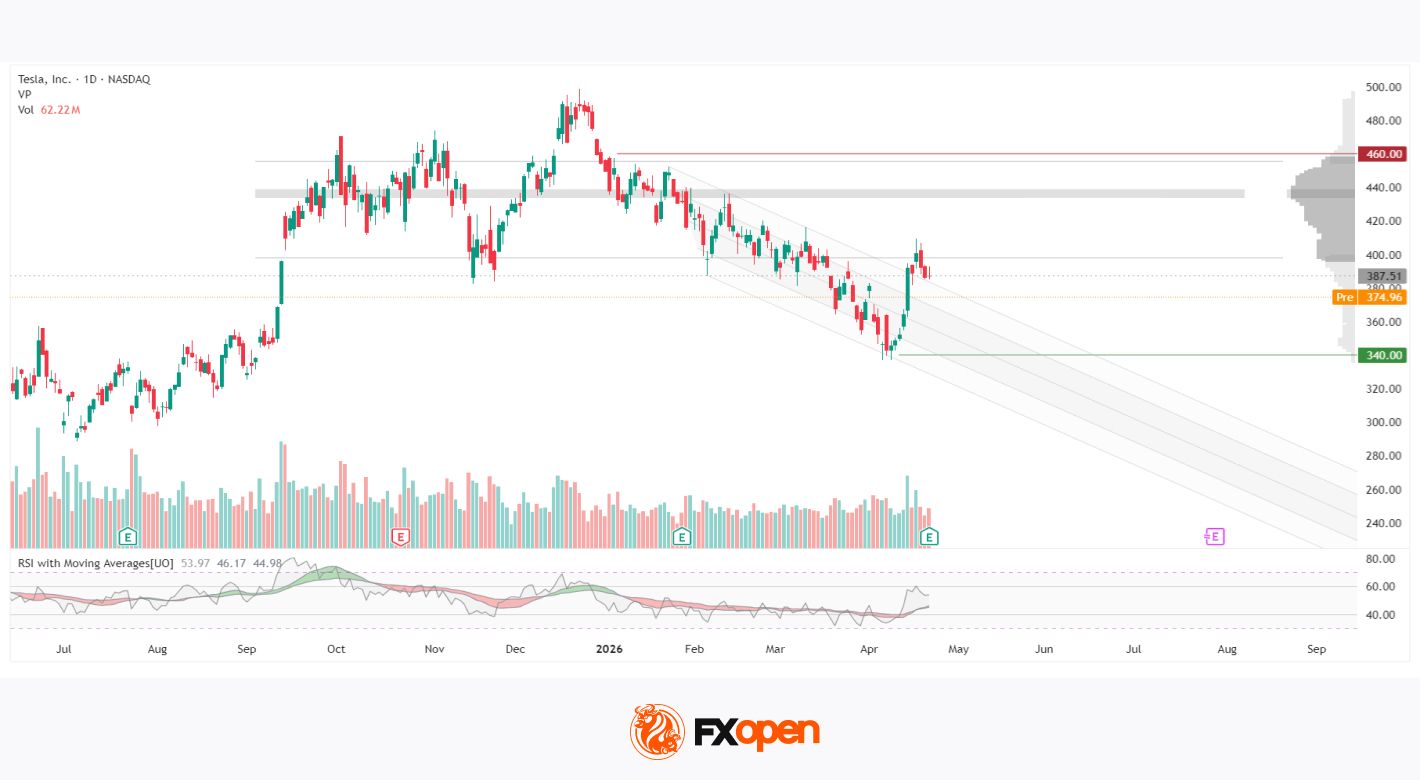
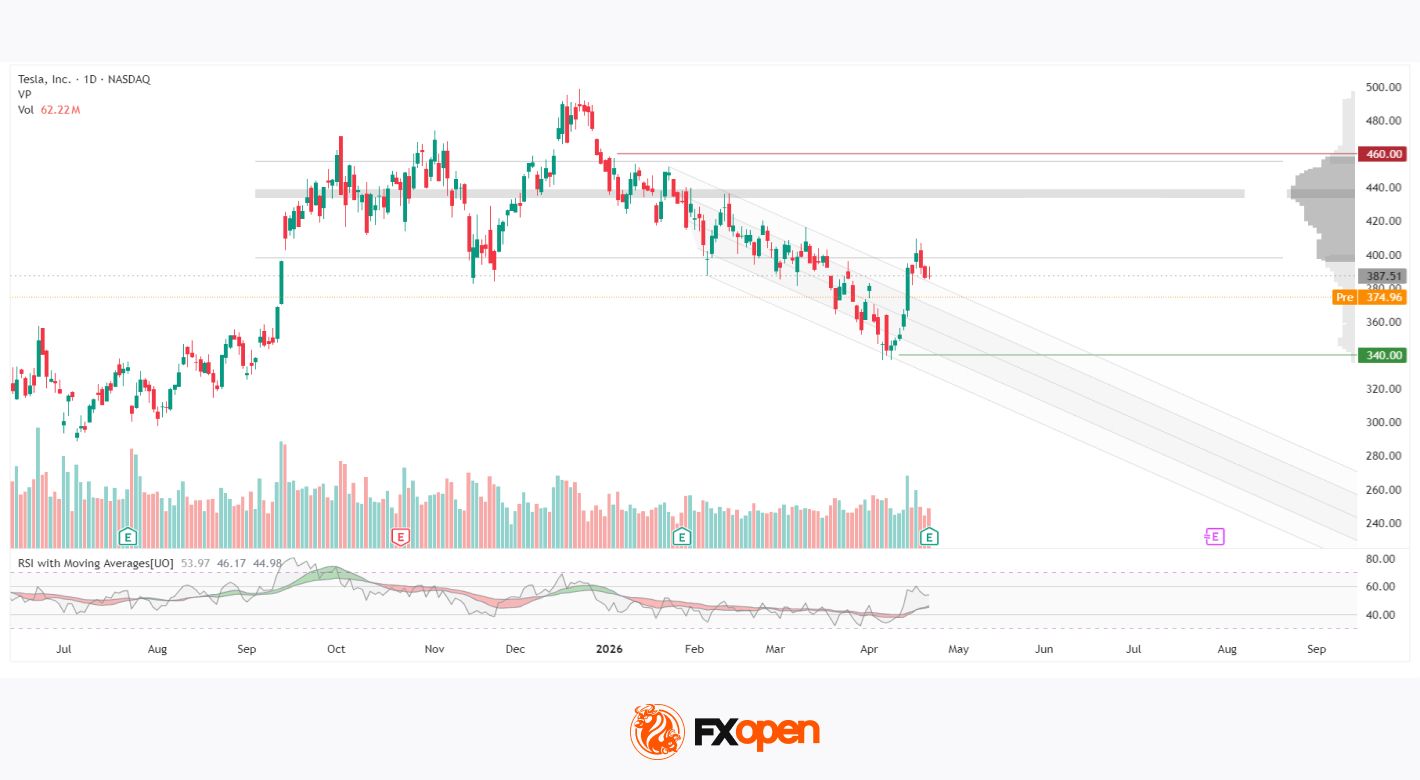
On the daily chart, TSLA has been trading within a sustained downward channel since peaking near $500 in December. In early April, the price reached the $340 level, which coincided with the lower boundary of the channel — the confluence of these levels strengthened buyer reaction. In recent sessions, the price has moved above the upper boundary of the channel, though the breakout has yet to be confirmed by a sustained close, and the earnings release has not clarified the near-term trend. Nevertheless, the move itself is noteworthy.
The horizontal volume profile spans the $398–455 range, with the Point of Control concentrated around $433–440 — an area of high liquidity that now represents the nearest resistance. The RSI with moving averages shows readings of 53 / 46 / 44: the indicator has crossed above the neutral 50 level, while both moving averages remain below it, suggesting that a sustained bullish impulse has yet to be confirmed.
Summary
The earnings report delivered mixed signals to the market: the earnings beat was not sufficient to offset weaker revenue and a sharp decline in the energy segment. From a technical perspective, the key question is whether the price can hold above the upper boundary of the channel — an unconfirmed breakout can easily turn false, particularly with a dense volume zone overhead.
Buy and sell stocks of the world’s biggest publicly-listed companies with CFDs on FXOpen’s trading platform. Open your FXOpen account now or learn more about trading share CFDs with FXOpen.
This article represents the opinion of the Companies operating under the FXOpen brand only. It is not to be construed as an offer, solicitation, or recommendation with respect to products and services provided by the Companies operating under the FXOpen brand, nor is it to be considered financial advice.


FIGR stock retreated after a brief rally as shifting sentiment hits crypto-linked equities, even as analysts point to strong growth in the fintech’s blockchain-based lending.
Crypto World
More than 90% of Web3 games failed after $15 billion boom as gamers never showed up: Caladan
Web3 gaming burned through up to $15 billion chasing a token-driven future that gamers never bought into.
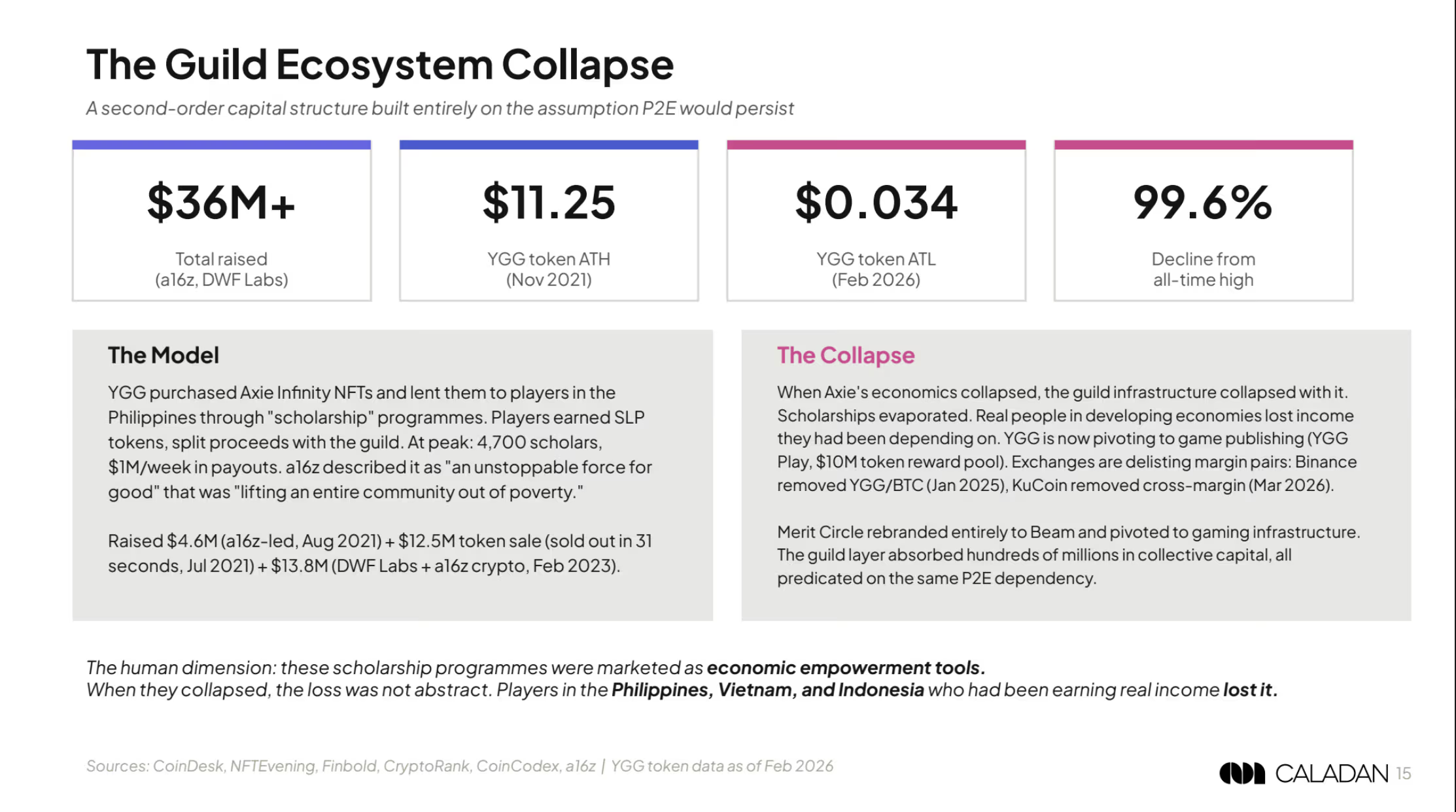
Data from Caladan, a market-making and trading firm, shows roughly 93% of so-called GameFi projects are now effectively dead, with token values down about 95% from their 2022 peaks and funding to studios collapsing 93% by 2025.
Investors and studios poured billions into tokens and non-fungible tokens (NFTs) before building blockchain-based games containing tradable properties. Then capital shifted into AI, asset tokenization and infrastructure, and more than 300 games shut down, turning Web3 gaming into a cautionary tale about chasing speculation over product-market fit.
“Capital was destroyed at every layer simultaneously,” the report states, pointing to venture capital, retail NFT buyers, gaming guilds and Telegram’s 300-million-user tap-to-earn wave as parallel casualties. Hamster Kombat alone lost 96% of its users within six months of launch. YGG, the flagship gaming-guild token, trades 99.6% below its November 2021 peak.

Individual post-mortems are brutal. Pixelmon raised $70 million in a 2022 NFT mint and, four years on, still has no public game. Ember Sword burned through $18 million over seven years of development before shutting down last May with no refunds. Gala Games is embroiled in a lawsuit alleging its co-founder diverted $130 million in tokens. Square Enix quietly wound down its Symbiogenesis experiment last July.
Structural mismatch
The failure wasn’t just a bad cycle or weak execution. The data indicate it was a structural mismatch between a model built around financial incentives and an audience that consistently signaled it wanted entertainment instead.
At the heart of the boom was GameFi, the play-to-earn model that turned gameplay into a financial feedback loop.
Players bought tokens or NFTs, earned rewards in those same assets, and cashed in as long as newcomers kept piling in. Once the inflows slowed, the math broke down. Token prices slumped, rewards thinned out, and users walked away — dragging entire in-game economies down with them.
Axie Infinity, the sector’s one-time flagship, watched daily active users crater from roughly 2.7 million at the peak to around 5,500 today, according to DappRadar data.
The demand side never caught up with the flood of capital. Even at the height of the mania, just 12% of gamers had tried a crypto game, according to a Coda Labs survey, cited by Caladan.
Capital allocation made the problem worse. Studios raised tens or hundreds of millions of dollars before shipping viable products, removing the pressure to build games that could retain players.

The most telling data point may be where the money went instead. Gaming commanded 62.5% of all Web3 venture investment in 2022; by 2025, its share had collapsed to single digits as AI, real-world-asset tokenization and layer-2 infrastructure absorbed the displaced capital.

Even Animoca Brands, the sector’s most prolific backer, has cut gaming to roughly 25% of its portfolio and is pivoting to stablecoins, RWAs and AI.
At the same time, development timelines stretched three to five years, while tokens traded in real time and demanded constant momentum. By the time many projects were ready to launch, their associated tokens had already collapsed.
The result is a sector that expanded rapidly on speculative demand and contracted just as quickly when that demand faded. More than 300 blockchain games have shut down, according to DappRadar, and remaining investment has shifted away from titles toward infrastructure.
What was once pitched as the future of gaming now looks more like a cautionary example of what happens when financial engineering runs ahead of product market fit.
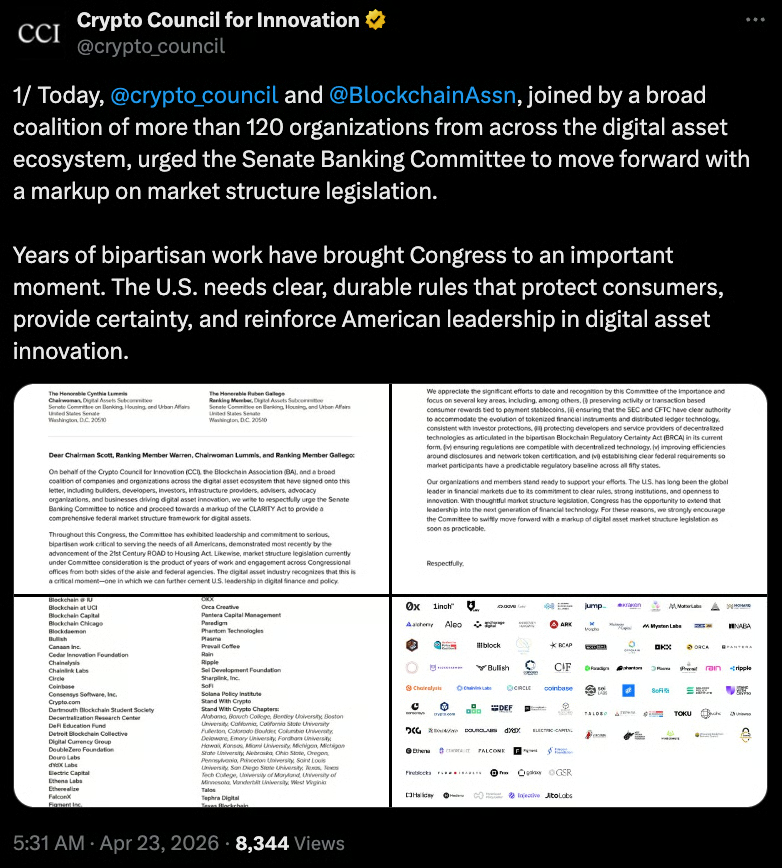
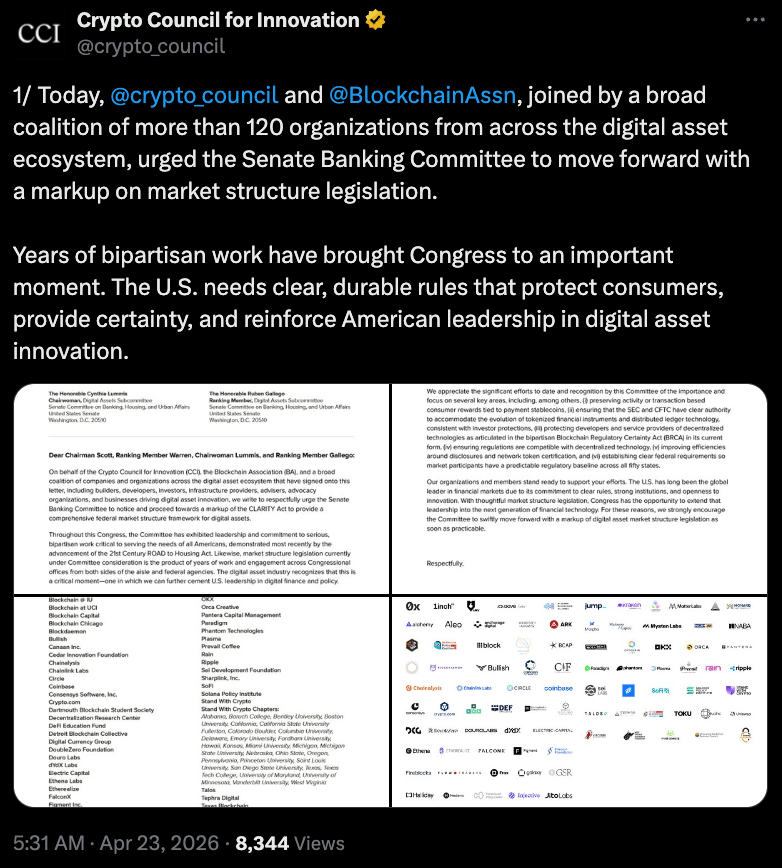
More than 120 entities affiliated with the cryptocurrency and blockchain industry are urging US lawmakers to stop stalling on the advancement of a digital asset market structure bill.
In a Thursday letter to leaders in the US Senate Banking Committee, the Crypto Council for Innovation (CCI) and Blockchain Association said that the body should “proceed towards a markup of the CLARITY Act to provide a comprehensive federal market structure framework for digital assets.”
The legislation, expected to be one of the most significant laws to potentially impact the industry crypto, passed the House of Representatives in July 2025 but has been delayed due in part to government shutdowns and debates over stablecoin yield and other issues.
“Timely action is critical, as other major jurisdictions have already implemented comprehensive frameworks, and the absence of comparable US policy risks ceding both economic and strategic advantages,” said the letter. “The US needs a comprehensive market structure framework to support domestic digital asset innovation, or risk migration of investment, jobs, and technological development offshore.”
Source: CCI
The Senate Banking Committee, under chair Tim Scott, postponed a markup on the CLARITY Act in January hours after Coinbase CEO Brian Armstrong said that the company could not support the bill as written. Since that time, representatives from the banking and crypto industries have met with lawmakers to discuss issues within the bill — e.g. how to address stablecoin yield — and possible paths forward.
As of Thursday, the banking committee had not publicly announced a new date for the bill’s markup. However, US Senator Thom Tillis on Monday called for committee leaders to consider postponing any markup until May to give crypto and banking representatives more time to discuss a compromise on stablecoin yield.
Related: Four reasons why the crypto market is rallying today: Will bulls maintain control?
About 120 crypto companies and organizations signed onto the letter, including exchanges like Coinbase and Kraken, but also groups like the Texas Blockchain Council and Solana Policy Institute. It came just three days after the advocacy organization The Digital Chamber asked the banking committee to schedule a markup “as soon as the calendar allows”:
“We are now more than halfway through the 119th Congress, and it has been more than 270 days since the House passed the CLARITY Act with strong bipartisan support and we recognize the legislative window for this Congress is narrowing.”
Banking association asks for more, not less, time to address stablecoins
On Tuesday, the American Bankers Association asked four US government agencies responsible for GENIUS regulations for 60 additional days to comment after the Office of the Comptroller of the Currency finalized its rules. The request, if granted, would likely delay full implementation of the stablecoin bill.
Magazine: AI-driven hacks threaten to kill DeFi — unless projects act now
Crypto World
Bitcoin Price Hits 11-Week High After Strategy Buys $2.54 Billion in BTC. What Comes Next?
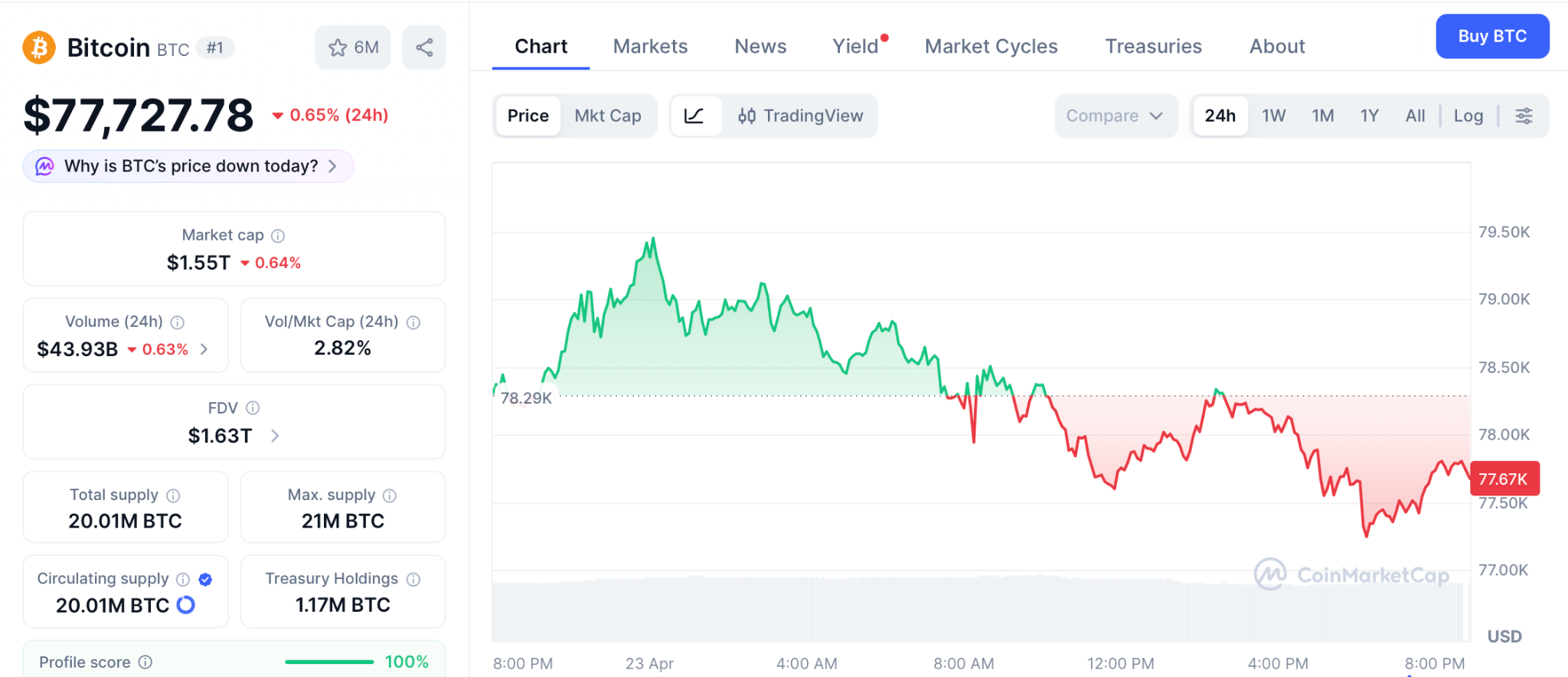
The Bitcoin price climbed to $77,727 on April 23 after Strategy purchased 34,164 BTC for $2.54 billion, the company’s third-largest weekly buy on record. CoinDesk reported total holdings now sit at 815,061 BTC, and spot Bitcoin ETFs posted five straight days of inflows through April 22 with a single-day peak of $238 million. Total ETF assets under management crossed $96.5 billion as the market turned risk-on after the US-Iran ceasefire extension.
But a full recovery to $126,021, the all-time high from October 2025, returns 61% from current levels. Ethereum (ETH) at $2,340 targets roughly 3x at best. The same capital in Pepeto at $0.0000001866 before the confirmed Binance listing targets 267x, the kind of return that presales with working infrastructure deliver before the first trading candle opens.
Strategy Adds 34,164 Bitcoin as Spot ETFs Post Five Straight Positive Days
Strategy disclosed the purchase on April 20 at an average cost of $74,395 per coin per CoinDesk. That buy lifted the company above BlackRock’s spot ETF, which holds roughly 800,000 Bitcoin on behalf of clients. Spot Bitcoin ETFs recorded five consecutive positive sessions through April 22, with the strongest day pulling $238 million.
President Trump extended the US-Iran ceasefire on April 21, removing the key risk weighing on markets for weeks. The Bitcoin price touched $79,388, an 11-week high, before settling at $77.727 The token trades above the short-term holder realized price of $69,400, a level that historically supports further gains.
Bitcoin Price Compared: Bitcoin, Ethereum, and the Presale Opportunity Pepeto
The Pepe Cofounder Ships a Working Exchange as Pepeto Crosses $9.45 Million
The original Pepe Coin launched at roughly the same cost Pepeto sits at today. Wallets that entered Pepe at $0.0000001 and held through the listing turned small positions into six-figure returns as the token reached $11 billion on community strength alone. That entry window stayed open for days and nearly everyone who saw it chose to wait.
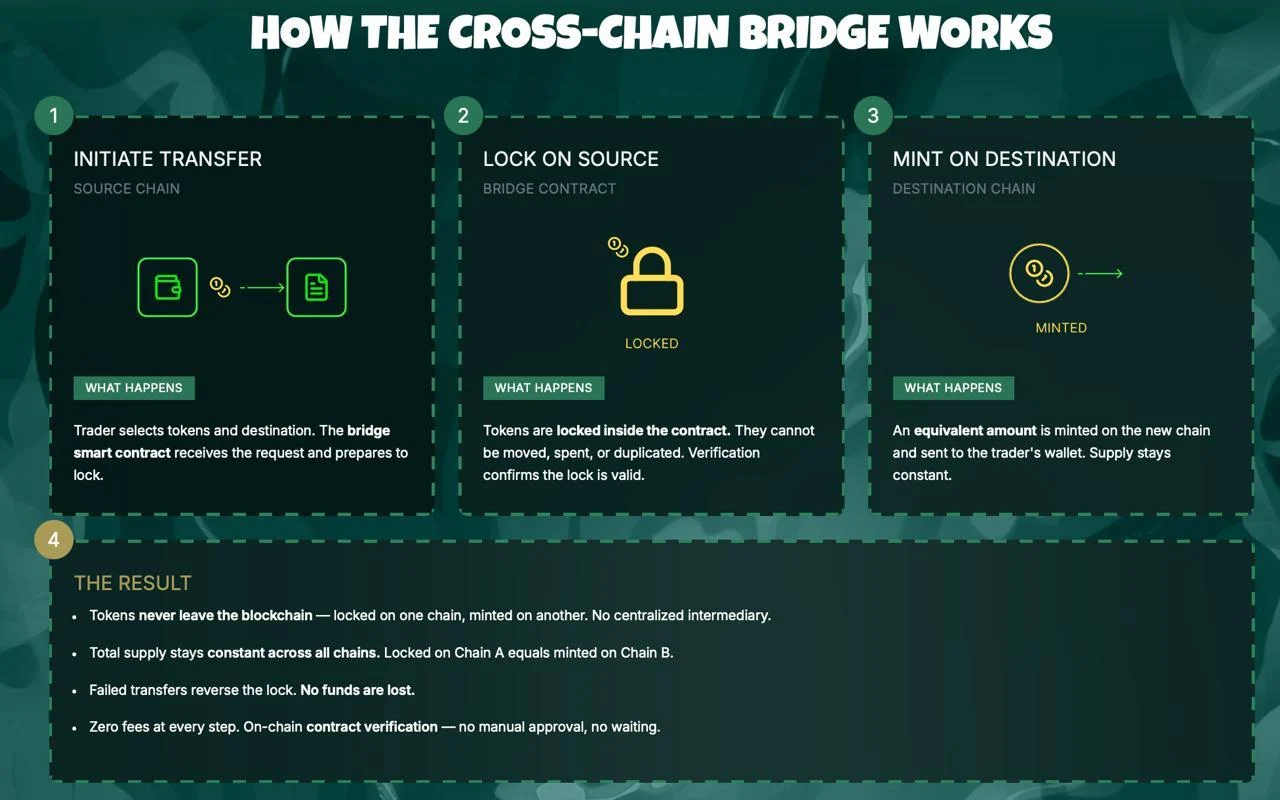
Pepeto brings that window back with stronger foundations. The same builder who guided Pepe now runs an exchange handling trades on Ethereum, BNB Chain, and Solana with zero fees. An AI tool scans every contract for hidden permissions and exit traps before capital enters, and a bridge connects all three networks at zero gas cost. SolidProof reviewed the full codebase before the presale opened.
Over $9.45 million entered during a period where fear controlled the market. Staking runs at 178% APY, compounding daily at $0.0000001866. A former Binance listing specialist leads the technical path, and the CoinMarketCap page is live, which lines up directly with listing confirmation. The Bitcoin price offers 1.6x back to $126,021. Pepeto offers a path from six decimal zeros to listing valuation for the return that rewrites a portfolio permanently.
Bitcoin Price Outlook: Where BTC Heads and Why Presale Returns Lead
Bitcoin (BTC) Price at $77,727 as Institutional Demand Hits New Highs
Bitcoin (BTC) trades at $77,727 on April 23 per CoinMarketCap, consolidating after its $79,388 high on April 22. The token sits 38% below the $126,021 all-time high from October 2025. Support holds near $75,000 with resistance at $80,000.
Strategy’s 815,061 BTC position and $96.5 billion in ETF assets confirm demand not seen since late 2025. Ethereum trades at $2,340 as capital rotates from ETH into Bitcoin on institutional flows. Analysts target $80,000 to $85,000 if the ceasefire holds through May. Even the bullish case delivers 1.6x from a $1.5 trillion base, a clean trade but not close to what a presale at six decimal zeros creates.
Conclusion:
Every cycle follows the same pattern. Institutional capital lands on Bitcoin first, the broader market responds days later, and presales with real products absorb the next wave before most traders notice the window closing. Strategy’s $2.54 billion purchase and five straight days of ETF inflows confirm the 2026 leg is underway, and the Bitcoin price pushing toward $80,000 is the trigger for presale positions that outperform the blue chip by magnitudes.
Pepeto sits in that position because the builder behind Pepe delivered a working exchange, a full SolidProof review, and a confirmed Binance listing at a presale cost that still reads $0.0000001866. The moment the first candle opens, that number turns into history. Each completed round raises the floor and brings the listing date forward, so the distance between reading this article and taking action shrinks with every token that leaves the presale.
Click To Visit Pepeto Website To Enter The Presale

FAQs
What is the Bitcoin price target for 2026 compared to Pepeto?
Bitcoin (BTC) trades at $77,727 with a path to its $126,021 all-time high for roughly 1.6x. Pepeto at $0.0000001866 targets 267x at listing, the kind of return only early presale entries produce while large caps never reach those multiples.
What is Pepeto and why are large wallets entering the presale?
Pepeto is a meme coin presale built by the Pepe cofounder with a zero-fee exchange, cross-chain bridge, and AI contract scanner. The presale raised $9.45 million with 178% APY staking and a confirmed Binance listing.
Disclaimer: This is a Press Release provided by a third party who is responsible for the content. Please conduct your own research before taking any action based on the content.



OpenAI released GPT-5.5 on April 23, codenamed “Spud,” positioning the model as its most capable system for autonomous, multi-step work.
The launch arrives one week after Anthropic shipped Claude Opus 4.7, setting up a direct comparison between the two frontier models.
GPT-5.5 Targets Agentic Work and Coding
GPT-5.5 is built to plan, execute, verify, and iterate across tools without constant human oversight. OpenAI describes it as “a new class of intelligence for real work and powering agents.”
Follow us on X to get the latest news as it happens
“We believe in iterative deployment; although GPT-5.5 is already a smart model, we expect rapid improvements. Iterative deployment is a big part of our safety strategy; we believe the world will be best equipped to win at the team sport of AI resilience this way,” wrote Sam Altman in a post.
The model rolls out now to ChatGPT Plus, Pro, Business, and Enterprise users. A more powerful Pro variant is also available. API pricing starts at $5 per million input tokens and $30 per million output tokens with a one-million-token context window.
OpenAI’s own benchmarks show GPT-5.5 ahead of Claude Opus 4.7 on several agentic tasks. It scored 82.7% on Terminal-Bench 2.0, compared to 69.4% for Opus 4.7.
On FrontierMath Tiers 1 through 3, it reached 51.7% versus 43.8%. Early independent tests reported similar trends in coding and knowledge-work evaluations.
Where Claude Opus 4.7 Still Leads
Anthropic’s model retains advantages in research writing, legal and financial reasoning, and instruction-following consistency, according to independent reviewers.
Opus 4.7 also supports higher-resolution vision at up to 3.75 megapixels, more than three times its predecessor.
On computer use, the gap narrows. GPT-5.5 scored 78.7% on OSWorld-Verified, while Opus 4.7 posted 78.0%.
The two models also trade leads on browsing benchmarks, with GPT-5.5 Pro pulling ahead at 90.1% versus 79.3%.
AI Race Accelerates in 2026
The back-to-back launches reflect a broader pattern. OpenAI has shipped multiple GPT-5.x variants this year, while Anthropic has steadily upgraded Claude through successive releases.
Google’s Gemini 3.1 Pro also competes for the same enterprise market.
For developers choosing between the two, the decision may come down to use case. GPT-5.5 appears stronger for agentic automation and long-horizon coding.
Claude Opus 4.7 may suit precision-heavy analytical workflows better. Whether independent benchmarks confirm OpenAI’s published numbers will become clearer in the days ahead.
Subscribe to our YouTube channel to watch leaders and journalists provide expert insights
The post OpenAI Launches GPT-5.5 to Challenge Anthropic’s Claude Opus 4.7 appeared first on BeInCrypto.
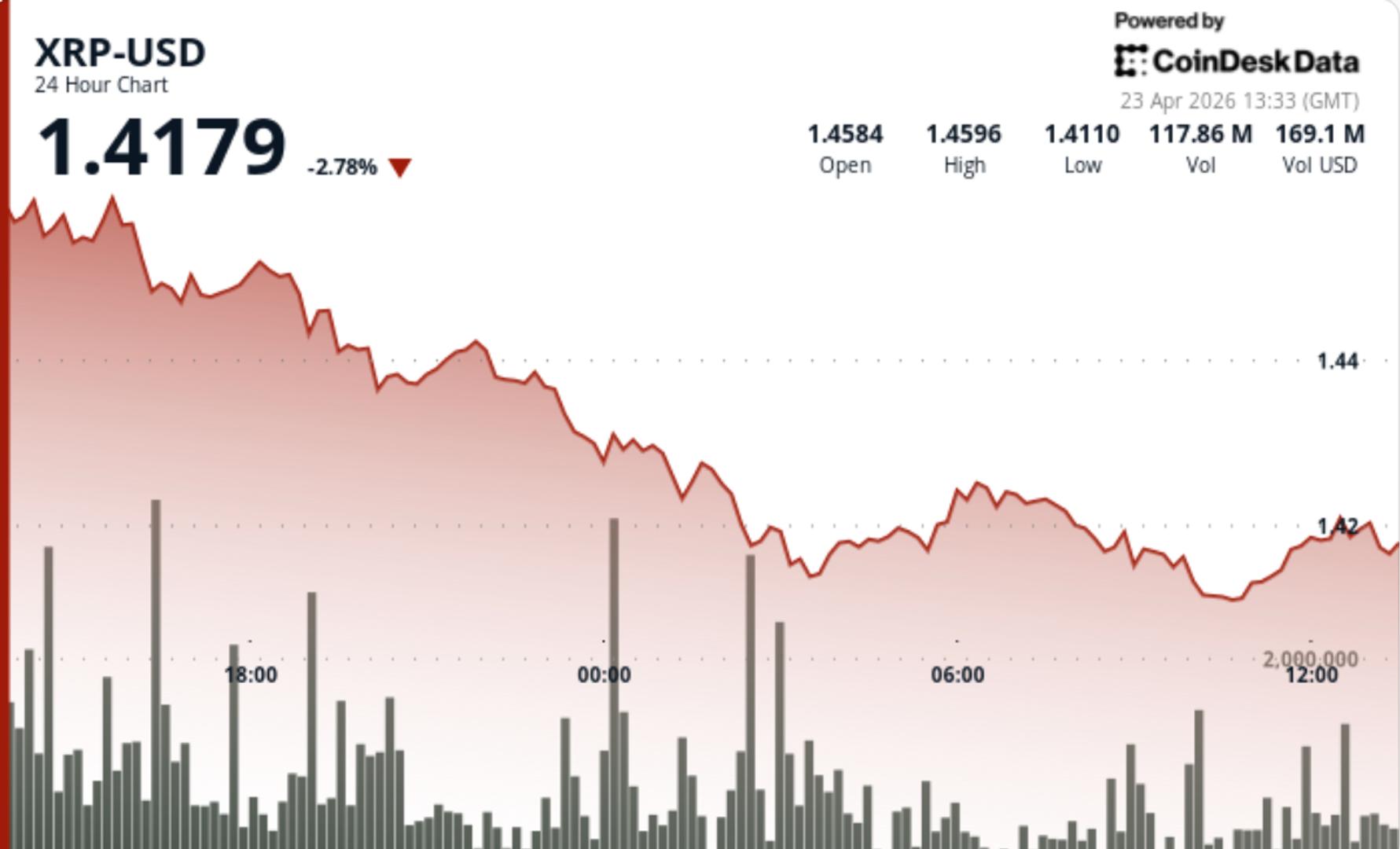
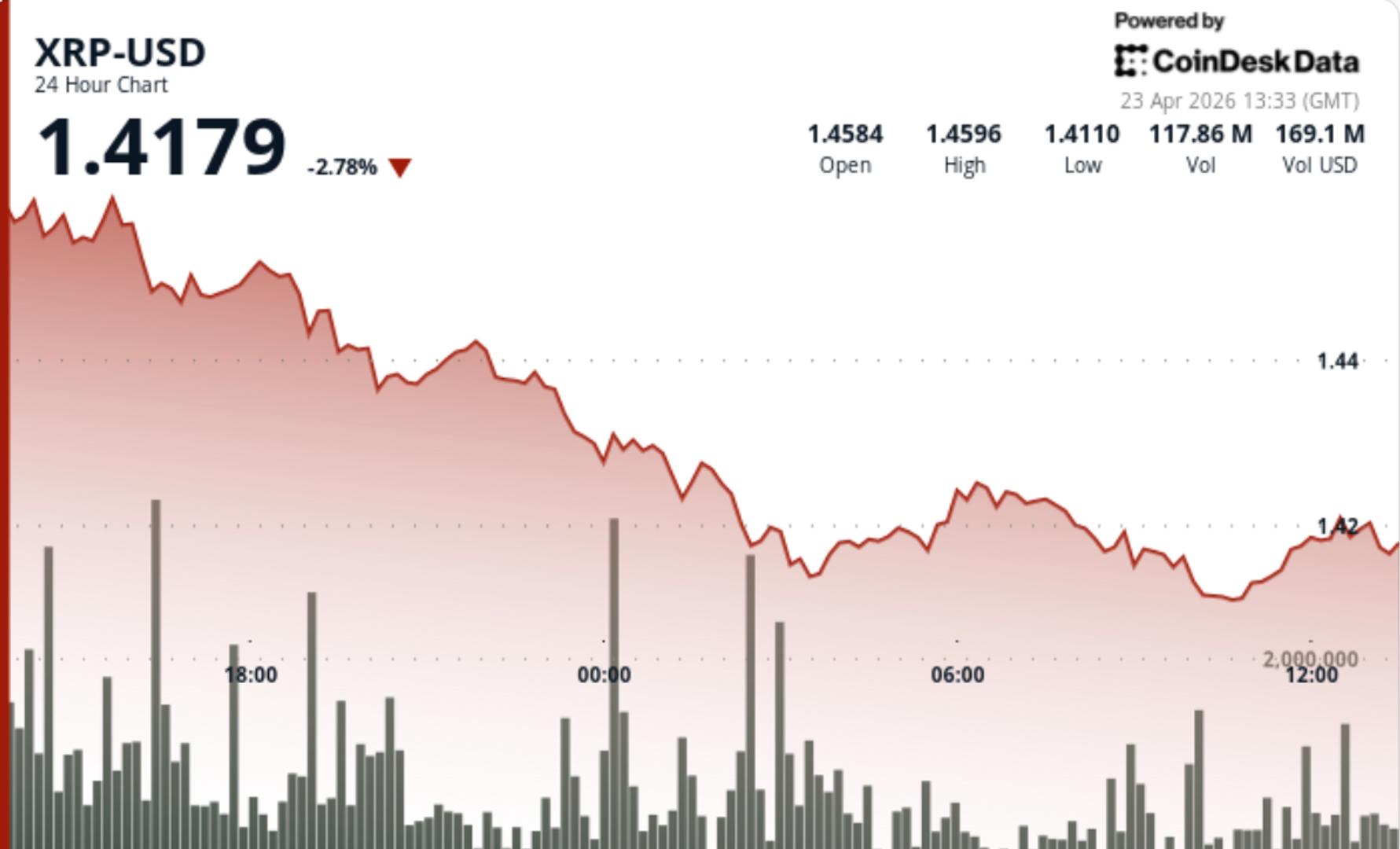
XRP moved higher briefly on Wednesday, but the move didn’t hold as bitcoin slid on profit-taking following its move to near $80,000 in Asian morning hours Thursday. Sellers stepped in near resistance and pushed price lower, suggesting the market still lacks conviction to break out, especially as broader crypto sees profit-taking led by bitcoin.
News Background
• GraniteShares has pushed back the launch of its 3x leveraged crypto ETFs to May 7, including XRP products. The delay removes a near-term catalyst that could have boosted speculative demand.
• The proposed products would offer both long and short exposure, amplifying daily price moves and potentially increasing volatility once live, particularly among retail traders.
Price Action Summary
• XRP tested the $1.44 level before reversing and slipping back toward $1.42.
• The move failed to sustain above resistance, with selling pressure accelerating into the close.
• Price is now drifting back into its prior range after the rejected breakout attempt.
Technical Analysis
• The key signal is the rejection at resistance. Buyers pushed price higher but couldn’t maintain control.
• Volume picked up during the move, but lacked follow-through needed to confirm a breakout.
• The broader structure remains range-bound, with no clear shift in trend yet.
• This kind of failed breakout often leads to either consolidation or a deeper pullback.
What traders should watch
• $1.44 remains the key resistance. A clean break is still required to change the structure.
• $1.40 is the immediate support level. Losing it would increase downside risk.
• Continued weakness after the rejection could push XRP back toward lower range levels.
Crypto World
Inside the $71 million freeze on Arbitrum that has the crypto world questioning what decentralization really means


The Arbitrum Security Council moved swiftly this week to contain the fallout from the KelpDAO exploit, touting the emergency “freeze” of more than 30,000 ETH linked to the attacker as a win for user protection.
But beneath the language of containment, the intervention has reopened one of crypto’s oldest and most uncomfortable debates: What decentralization actually means when a group of people can step in and override outcomes for a network after the fact.
At the center of the debate is the role of Arbitrum’s Security Council, a small, elected group chosen by token holders every 6 months, empowered to act in emergencies. In this case, it exercised those powers to take control of funds associated with the exploit, effectively locking them away pending further governance decisions.
Supporters see this as a system working as intended, preventing tens of millions of dollars from being laundered and buying time for potential recovery. Critics, however, argued the move underscores a different reality: That even in ostensibly decentralized systems, ultimate control can still rest with a handful of actors.
For Arbitrum insiders, however, the decision was far from a reflexive intervention. According to Steven Goldfeder, co-founder of Offchain Labs, the company that originally created and supports Arbitrum, the starting point was inaction.
“The default was do nothing,” Goldfeder said to CoinDesk, describing the early stages of the Security Council’s deliberations. “Then this idea actually emerged [from a security council member]… a way to do it in a very surgical way… without affecting any other user, not affecting the network performance and not having any downtime.”
The result was what Arbitrum has described as a “freeze.” But technically, the move required something more active: The use of privileged powers to transfer funds out of the attacker-controlled address and into a wallet with no owner, effectively rendering them immobile.
That distinction is at the heart of the decentralization debate. In its purest form, decentralization implies that no individual or group can unilaterally interfere with transactions once they are executed, often summed up by the phrase “code is law.” Critics worry that if a small group can step in to stop a hacker, the same mechanism could, in theory, be used in other situations as well, whether under regulatory pressure or political influence.
In simpler terms, the concern is less about this specific case and more about precedent: If intervention is possible, where is the line drawn, and who decides?
That capability, now demonstrated in practice, raises broader questions about the boundaries of decentralization on Layer 2 blockchains, and the tradeoff between security and neutrality.
While the Security Council is elected by token holders, it is still a relatively small group capable of acting quickly and, in this case, decisively.
Patrick McCorry, the head of research at the Arbitrum Foundation and who coordinates with the Security Council, emphasized that this structure is by design.
The Security Council is “a very transparent part of the system,” according to McCorry; “You can see exactly what powers they have.” In addition, he said, “they’re elected by token holders… not hand-picked by us [Arbitrum Foundation + Offchain Labs].”
Currently, the Security Council is selected through recurring on-chain elections, with token holders voting every six months to appoint its 12 members
From that perspective, Arbitrum’s model reflects a different interpretation of decentralization, one where authority is delegated by the community, rather than eliminated entirely.
Some critics have argued that a decision of this magnitude should have gone through token-holder governance. But Goldfeder pushed back on that idea, arguing that speed and discretion were essential.
“The DAO cannot be consulted, because the second the DAO is consulted, that essentially means North Korea is consulted,” he said, referring to ongoing investigative efforts suggesting the attacker’s ties.
“If you say, ‘hey guys, should we move these funds?’ then you might as well do nothing,” he said.
In that framing, the choice was not between decentralized and centralized decision-making, but between acting quickly or allowing the funds to disappear. Indeed, the attackers began moving and laundering the remaining stolen funds within hours of the Security Council’s intervention.
Supporters of the move say that reality highlights a different tradeoff, one between ideals and practical risk management. Without some form of emergency intervention, stolen funds in crypto are typically unrecoverable, and large exploits can cascade through the ecosystem.
From this perspective, the Security Council functions less as a centralized authority and more as a last-resort safeguard, designed to step in only under extreme conditions.
“We’re no more or less decentralized today than we were yesterday,” Goldfeder said.
Read more: Arbitrum freezes $71 million in ether tied to Kelp DAO exploit
Ether’s (ETH) 33% rally from its sub-$1,800 multi-year lows appears to be cooling, but several key metrics suggest the top altcoin may be primed for a bigger rally toward $6,000 or higher.
Key takeaways:
- Ether is currently displaying a technical setup similar to past cycles that ignited a massive rally in ETH price.
- Supply squeeze potential is growing as increasing accumulation and exchange outflows reduce immediate sell pressure.
- A rising Coinbase premium reflects the return of US institutional demand.
Ether’s fractal targets a $6,000 ETH price
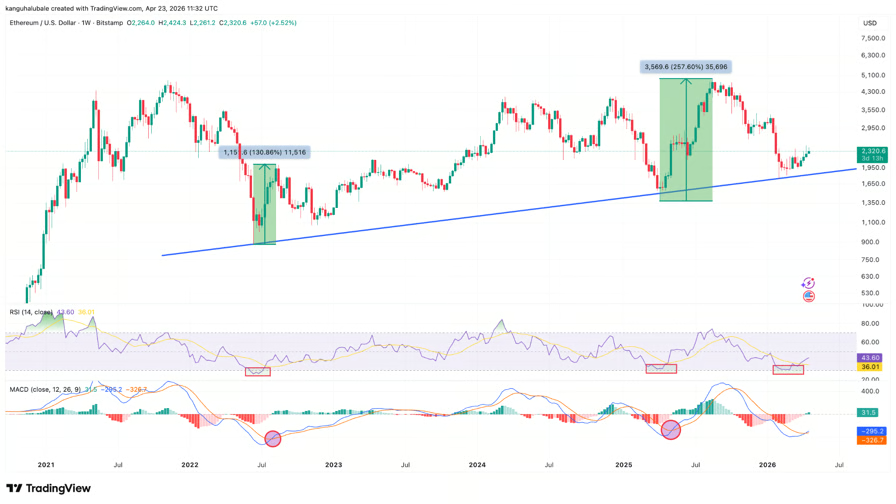
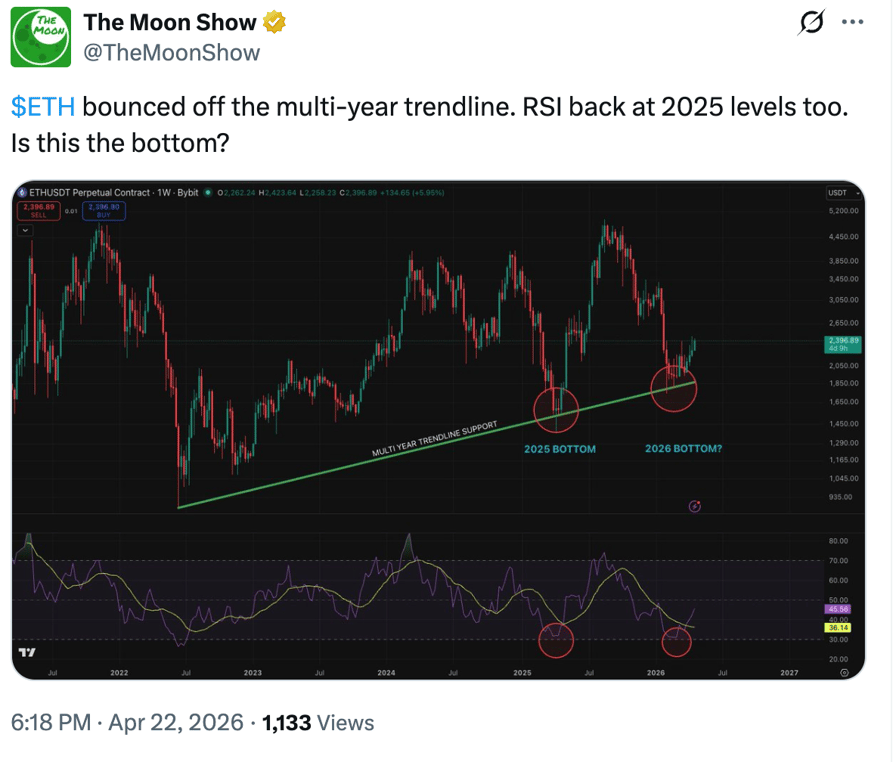
Ether is currently bouncing off a multi-year trend line that has historically marked macro ETH price bottoms. Previous instances in April 2025 and mid-2022 resulted in 260% and 130% ETH price rallies, respectively.
“$ETH is holding a long-term ascending trendline support,” analyst CryptoJack said in a recent X post, adding:
“Will history repeat itself?”
ETH/USD weekly chart. Source: Cointelegraph/TradingView
A bullish cross from the moving average convergence divergence (MACD) indicator also confirmed the price bottom.
“$ETH weekly MACD bullish cross is now confirmed,” analyst Ash Crypto said in a recent X post, adding:
“The last 2 times this happened, ETH pumped 183% and 75%.”
The weekly RSI is meanwhile recovering from levels that marked previous macro lows, suggesting that Ether’s recent drop to $1,750 was the bottom.
ETH/USD weekly chart. Source: The Moon Show
Ether’s current price action is following a similar pattern, with the price again bouncing off the same structural support, a confirmed bullish MACD crossover, and the RSI’s recovery from oversold conditions.
If history repeats itself, ETH may rally by between 75% and 260% from the bottom, placing Ether’s upside target at $3,000-$6,300.
ETH supply squeeze potential rises
Ethereum’s on-chain metrics reveal a tightening supply dynamic, an occurrence that has previously ignited significant ETH price rallies.
The Binance ERC-20: Stablecoin Whale Activity Index indicator reveals structural supply exhaustion.
The chart below shows that the number of daily accumulation addresses (wallets steadily buying ETH) has increased to 2,434, surpassing the number of exchange depositing addresses (wallets preparing to sell), which has dropped to 2,300.
This shift suggests that large players have moved from a “wait-and-see” phase into active accumulation, CryptoQuant analyst GugaOnChain said in a recent QuickTake analysis.
“This scenario is extremely positive for the price structure, as it reveals that there are significantly fewer addresses sending ETH to the exchange with the intention to sell than players accumulating or positioned to absorb liquidity,” the analyst said, adding:
“The supply shock is fully underway.”
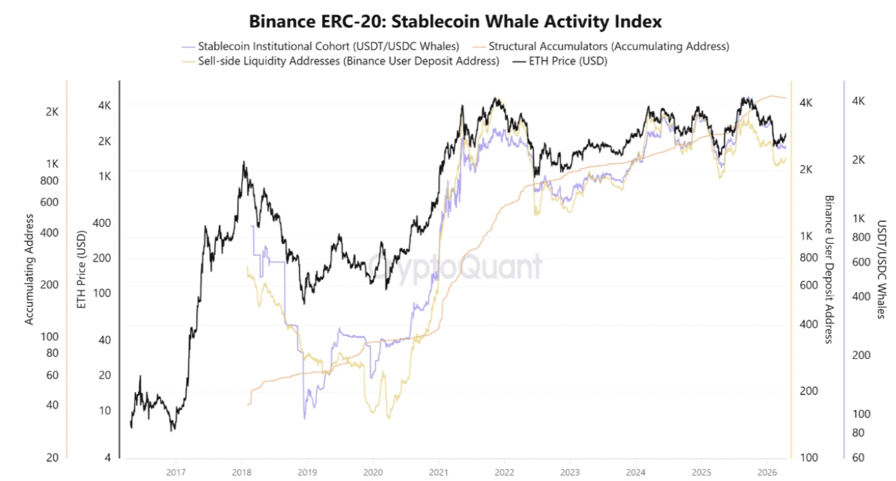
Binance ERC-20 stablecoin whale activity index. Source: CryptoQuant
This is also seen in increasing exchange outflows, as the ETH net position change among exchanges for the past 30 days fell by 1.4 million ETH on April 2, marking the largest spike in seven months, according to Glassnode data.
The net position change is at -351,300 ETH (30 days) at the time of writing on Thursday.
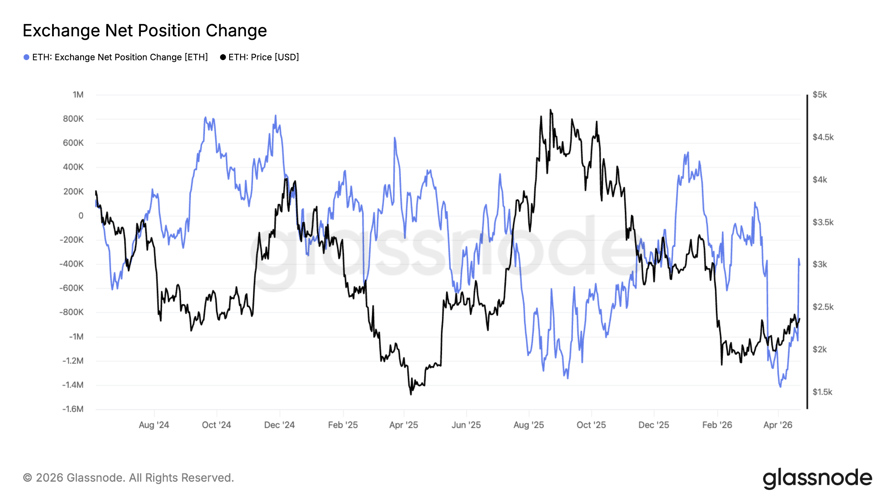
ETH: Exchange net position change. Source: Glassnode
Such outflows typically indicate strong accumulation by large holders, who move tokens to cold storage or invest in investment products, thereby reducing immediate sell pressure.
This is usually referred to as a “supply squeeze,” conditions that have, historically, preceded sharp upside moves, especially when combined with improving market sentiment.
Ethereum demand recovers
As Cointelegraph reported, Ether futures on Binance have risen to a near two-month high as aggressive buyers stepped into the market over the past week. Buy-taker volume rose above $5 billion, and the current setup leans bullish.
The US market is driving a significant share of this demand, as measured by the Coinbase premium index.
The ETH Coinbase premium index measures the price difference between the ETH/USD pair on Coinbase and Binance.
This metric flipped positive on April 4, rising to 0.055 on April 14, its highest level since October 2025. The index fell to as low as -0.21 in early February and has now recovered to 0.04.
This typically signals increased demand from institutional investors, particularly in the US market.
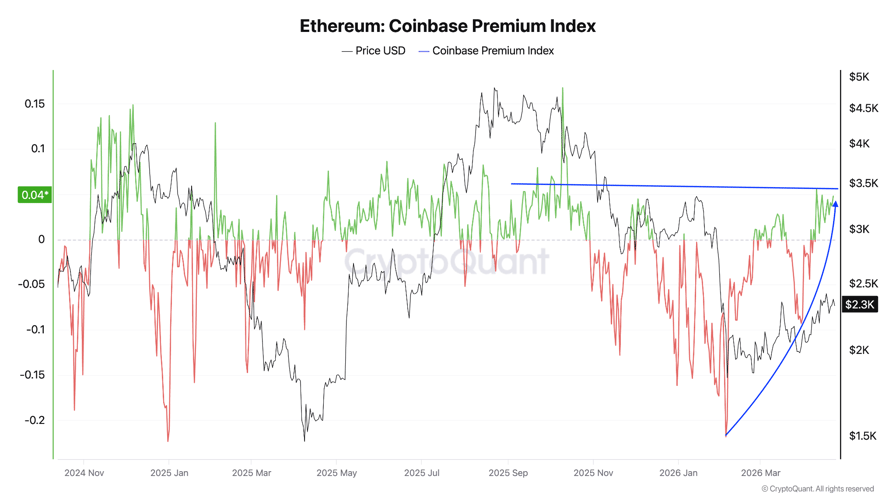
Ethereum Coinbase Premium Index. Source: CryptoQuant
Meanwhile, spot Ethereum ETFs have recorded net inflows for 10 consecutive days, totaling $590 million. This marks the longest inflow streak since December 2024, accompanying a 95% ETH price rally in Q4 2024.
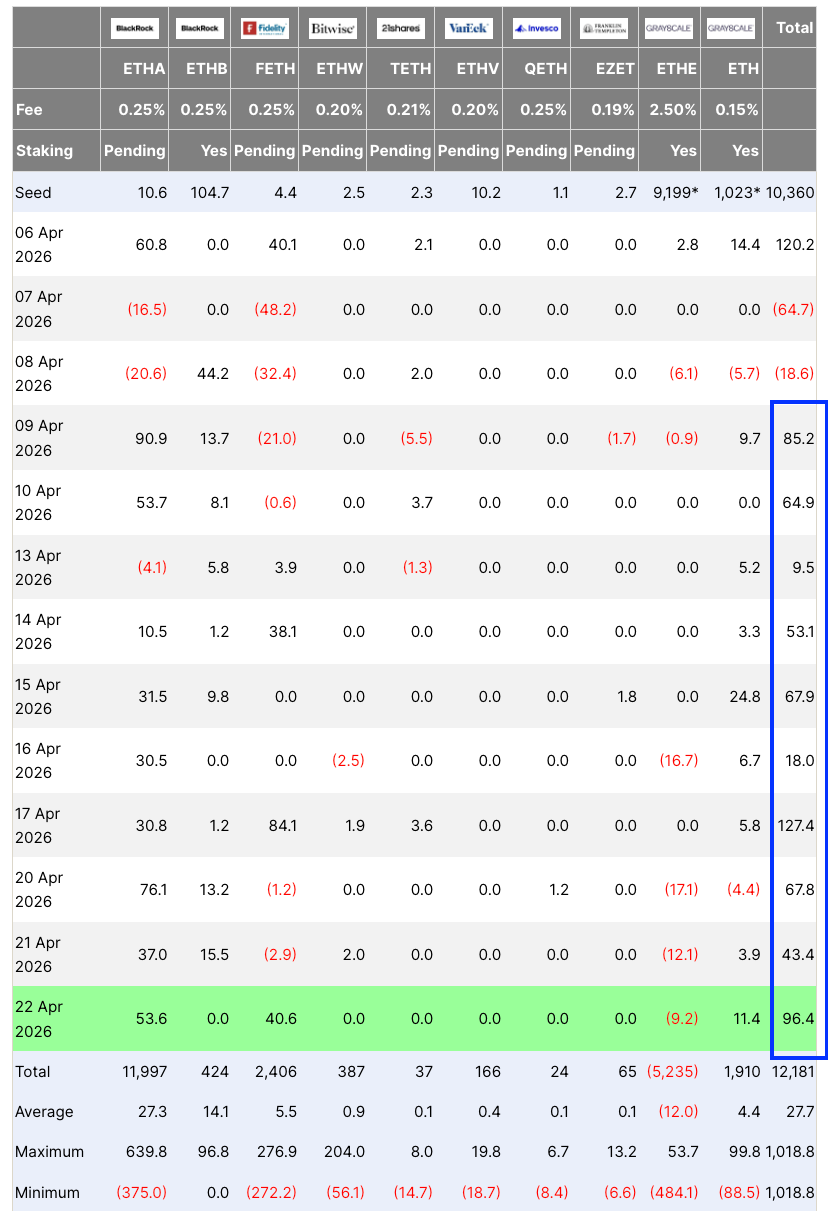
Spot Ethereum ETF flows table. Source: SoSoValue
Meanwhile, Bitmine Immersion Technologies, the world’s largest public holder of Ether, increased its holdings last week with another 101,627 ETH purchase, reflecting a return of demand for ETH among institutional investors.


Zach Witkoff, a co-founder of Donald Trump-linked World Liberty Financial, recently had a video of his 2022 arrest, where officers located a bag of cocaine on his person, surface.
The bodycam footage from the arresting officers was published by The Newsground, “an independent publication launched in March 2026” by Scott Stedman.
During the arrest, Witkoff repeatedly insisted he was friends with Marc Roberts, who runs Club E11even, where Witkoff was being arrested, resulting in the security guard insisting that Witkoff should “stop dropping names.”
Read more: Who is behind World Liberty Financial, Trump’s new crypto?
Zach is the son of Steve Witkoff, who serves as Trump’s special envoy to the Middle East and was also a co-founder of World Liberty Financial.
Witkoff wasn’t prosecuted following this arrest.
Besides serving as co-founder of World Liberty Financial, Witkoff also intends to lead World Liberty Trust Company, a stablecoin-focused trust company that applied for a national charter.
Protos reached out to World Liberty for comment on Witkoff’s previous arrest, but it didn’t immediately respond.
Beef with Justin Sun
World Liberty Financial and Justin Sun have been in a slow-moving, months-long confrontation since World Liberty chose to blacklist a substantial portion of Sun’s WLFI tokens.
This slow-rolling conflict finally came to a head with Sun suing World Liberty, while simultaneously insisting that he still fully supports President Trump.
Sun claims that World Liberty “wrongfully froze all of my tokens, stripped me of my right to vote on governance proposals, and have threatened to permanently destroy my tokens by burning them.”.
Read more: Justin Sun goes to war with World Liberty Financial
Witkoff took to X to claim that this lawsuit is “a desperate attempt to deflect attention from Sun’s own misconduct.”
He continued to allege that Sun “engaged in misconduct that required World Liberty to take action to protect itself and its users.”
When World Liberty originally blacklisted these tokens, it noted that one address it froze was “suspected of misappropriation of other holders’ funds.”
People have assumed that this was Sun since the WLFI tokens he moved, that he claims are entirely his own, came from an address associated with an exchange he owns, HTX.
Sun has additionally threatened a possible defamation lawsuit related to claims that World Liberty has made about him.
Got a tip? Send us an email securely via Protos Leaks. For more informed news and investigations, follow us on X, Bluesky, and Google News, or subscribe to our YouTube channel.


Bitcoin’s path to $100k hinges on Kevin Warsh’s Fed bid and the CLARITY Act’s shrinking window, as Washington rewires crypto market structure.
Summary
- Bitcoin eyes $100,000 as it trades near $78,000, with structural macro tailwinds more important than short‑term rate moves.
- Kevin Warsh could become the most crypto‑literate Fed chair ever, but his confirmation odds have slid, adding policy risk to Bitcoin’s rally.
- The CLARITY Act’s passage window is narrowing, threatening to delay comprehensive U.S. crypto market rules and blunt bullish structural momentum.
Bitcoin (BTC) at $100,000 is back on the table if its recent rally holds, but the outcome hinges on Washington’s next moves on the Federal Reserve and the Clarity Act. A crypto‑friendly Fed chair and a comprehensive US market‑structure bill could cement the surge — or fizzle out, if politics get in the way.
Bitcoin has climbed about 10% over the past two weeks to trade near $78,000, even as it remains roughly 38% below its October peak while the S&P 500 has pushed to fresh all‑time highs. Polymarket traders now price just a 28% chance that the next big catalyst — Kevin Warsh’s confirmation as Fed chair by May 15 — actually happens, down from 92% in March.
The $100,000 level is the “next magnet” for Bitcoin if momentum continues, according to Luca Köymen, investment strategist at Sygnum Bank, who told DL News the “structural story is where we see the bigger signal.” He argued that “clearer bank access, no CBDC competition, and a chair who treats crypto as embedded rather than exotic is a bigger deal than a quarter or two of marginally more hawkish tone.”
Fed regime change risk
US President Donald Trump has already banned a central bank digital currency via an executive order titled “Strengthening American Leadership in Digital Financial Technology,” blocking federal agencies from creating or endorsing a retail CBDC. Trump has nominated former Fed governor Kevin Warsh — widely seen as a crypto bull — to replace Jerome Powell when his term ends on May 15.
During his Senate confirmation hearing this week, Warsh told lawmakers that cryptocurrencies are already part of the “fabric” of the US financial system and called a US CBDC a “bad policy choice” he would not support as chair. Köymen said Warsh would be “the most crypto‑literate chair in Fed history,” adding that he “understands the technology and has publicly called Bitcoin a disciplining force on bad policy.”
Still, Warsh’s confirmation is far from assured. Republican Senator Thom Tillis has raised concerns about market stability under Warsh, and a hold from his office has helped drag Polymarket odds for confirmation by May 15 down to 28%.
Clarity Act window narrows
The Clarity Act, billed as the most consequential US crypto market‑structure bill to date, would lock in clearer rules for exchanges, stablecoins, and digital‑asset custody. Galaxy Digital head of research Alex Thorn has warned that “if the markup slips past mid‑May, the probability of enactment in 2026 will drop sharply,” as the Senate juggles Iran debates, Department of Homeland Security funding, and a packed nominations calendar.
In a recent note, Thorn put passage odds around 50% this year, saying the bill risks falling off the agenda entirely after midterms if it misses the current window. Polymarket traders now give the Clarity Act roughly a mid‑40s percentage chance of being signed into law in 2026, down from more than 80% earlier in the year.
For Köymen, early passage would lock in a structural win. “Passage of the Clarity Act before the midterms would finally provide the market structure framework US crypto markets need,” he said, arguing that, alongside potential tweaks to bank leverage rules, the package would improve financial conditions for Bitcoin and broader crypto assets.
Crypto market movers
Bitcoin is trading sideways over the past 24 hours at around $78,049, according to price data from crypto.news. Ethereum has slipped roughly 1.9% over the same period to about $2,344.
In a previous crypto.news story, analysts highlighted how Fed personnel shifts have repeatedly realigned Bitcoin’s macro narrative. Another crypto.news story examined Trump’s CBDC ban and its implications for private digital assets, while a third story explored why the Clarity Act is seen as a last shot at comprehensive US crypto legislation before midterms.

Girl describes finding rare Mexican axolotl in Wales

Meta says it will cut 8,000 jobs as AI spending grows
Figure shares sink 9% as $1B lending milestone meets market volatility

Manchester United reach agreement with Casemiro over contract clause amid transfer speculation

Steven Gerrard disagrees with Gary Neville over ‘shock’ Chelsea and Arsenal claim | Football

US brings back mandatory military draft registration


-

 Sports6 days ago
NWFL Suspends Two Players Over Post-Match Clash in Ado-Ekiti
-

 Fashion6 days ago
Weekend Open Thread: Theodora Dress
-

 Politics6 days ago
Palestine barred from entering Canada for FIFA Congress
-
Entertainment4 days ago
NBA Analyst Charles Barkley Chimes in on Ice Spice McDonald’s Fiasco
-

 Tech5 days ago
Auto Enthusiast Scores Running Tesla Model 3 for Two Grand and Turns It Into Bare-Bones Go-Kart
-

 Business4 days ago
Powerball Result April 18, 2026: No Jackpot Winner in Powerball Draw: $75 Million Rolls Over
-

 Politics4 days ago
Zack Polanski demands ‘council homes not luxury flats for foreign investors’
-

 Crypto World6 days ago
Russia Pushes Bill to Criminalize Unregistered Crypto Services
-

 Politics3 days ago
Gary Stevenson delivers timely reminder to register to vote as deadline TODAY
-

 Business1 day ago
Rolls-Royce Voted UK’s Most Iconic Trade Mark as IPO Register Hits 150
-

 Politics1 day ago
Disabled people challenge government SEND proposals over segregation concerns
-

 Politics1 day ago
Making troops accountable for war crimes threatens US alliance, ex-SAS colonel warns
-
 Business7 days ago
Creo Medical agree sale of its manufacturing operation
-

 Crypto World6 days ago
Russia Introduces Bill To Criminalize Unregistered Crypto Services
-

 Politics1 day ago
Starmer handler McSweeney to be dragged from shadows by Foreign Affairs Committee
-

 Politics1 day ago
Zack Polanski responds to home secretary’s taser threat
-
Politics1 day ago
Wings Over Scotland | How To Get Away With Crimes
-
 Crypto World5 days ago
Kelp DAO rsETH Bridge Hack Drains $292M as DeFi Losses Top $600M in Two Weeks
-

 Politics23 hours ago
‘Iran is still a nuclear threat’
-

 Crypto World2 days ago
New York sues Coinbase, Gemini over prediction market offerings
You must be logged in to post a comment Login