
Crypto World
Crypto Groups Urge Action on Market Structure Bill as Critical

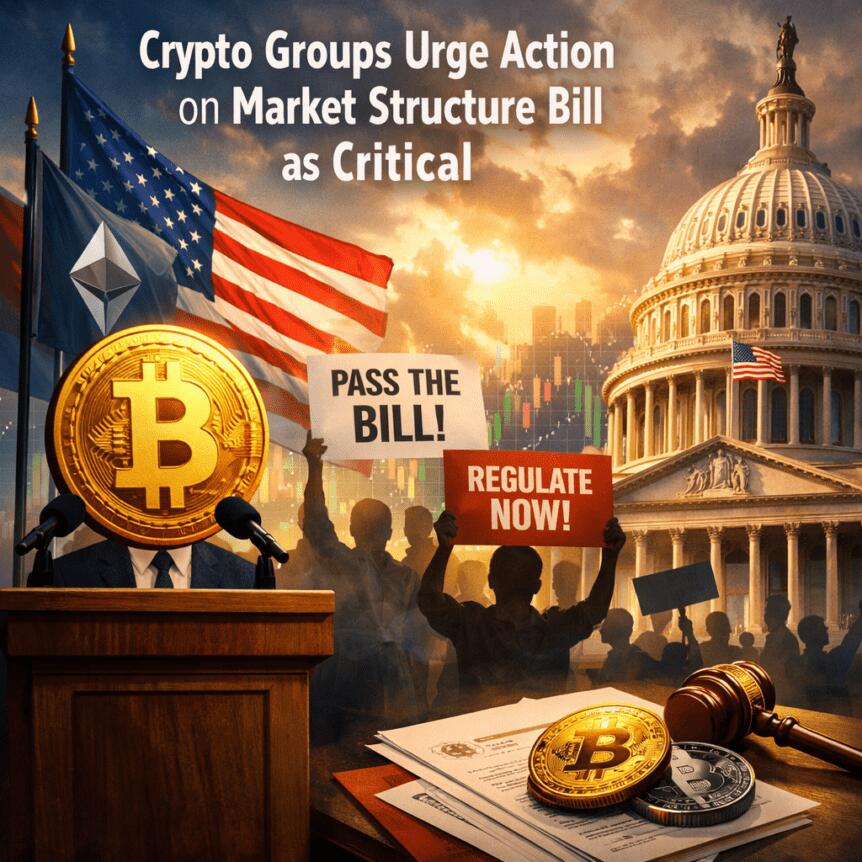
A broad coalition of more than 120 crypto and blockchain entities is pressing U.S. lawmakers to accelerate the markup of the CLARITY Act, a comprehensive federal framework for the market structure of digital assets. In a letter addressed to leadership of the Senate Banking Committee, the Crypto Council for Innovation (CCI) and the Blockchain Association urged that the committee move forward with a markup rather than continue delays.
The CLARITY Act, which passed the House of Representatives in July 2025, has seen its progress stall due to a combination of government funding stoppages and ongoing disputes over issues such as stablecoin yield and other policy questions. The signatories contend that timely action is essential, noting that other major jurisdictions have already enacted broad regulatory regimes and warning that failure to act could erode the United States’ competitive standing in digital-asset innovation, investment, and jobs.
According to Cointelegraph, the letter was signed by roughly 120 entities, including prominent exchanges such as Coinbase and Kraken, alongside industry groups like the Texas Blockchain Council and the Solana Policy Institute. The push comes as concurrent advocacy efforts from other industry groups amplify pressure on lawmakers to settle differences and proceed to markup.
The Senate Banking Committee, chaired by Tim Scott, postponed a markup on the CLARITY Act in January, hours after Coinbase CEO Brian Armstrong signaled public reservations about the bill as written. Since that postponement, industry representatives and lawmakers have held meetings to discuss concerns—most notably how to address stablecoin yield and potential paths forward for a regulatory framework that satisfies both innovation and oversight.
As of Thursday, there had been no public announcement of a new markup date. In a related development, U.S. Senator Thom Tillis publicly urged committee leaders to consider delaying any markup until May to allow additional time for crypto and banking stakeholders to negotiate a compromise on stablecoin yield prospects.
On the same regulatory thread, industry letters have underscored the importance of a unified framework. The Digital Chamber, another advocacy voice for the sector, argued that the legislative window for this Congress is narrowing, urging swift scheduling of a markup “as soon as the calendar allows.”
Key takeaways
- More than 120 crypto and blockchain entities are pressing Congress to markup the CLARITY Act, spanning exchanges, trade associations, and policy institutes.
- The CLARITY Act seeks to establish a comprehensive federal market structure framework for digital assets, a policy objective that has gained bipartisan support but remains unsettled on key design questions.
- The bill advanced in the House in July 2025 but has been delayed in the Senate amid staffing gaps, funding uncertainties, and policy debates, particularly around stablecoin yield.
- There is growing engagement between lawmakers and industry participants to resolve differences that could unlock US leadership in digital-asset markets or risk delayed implementation and offshore migration.
- Regulatory process dynamics include calls for additional time to discuss GENI-style regulation and a related push by banking groups to extend comment periods for related rules.
Legislative push to finalize CLARITY Act
The core message from the coalition is simple: a timely markup on the CLARITY Act is critical to establishing a predictable and comprehensive federal framework for digital assets. The letter argues that a mature U.S. regime would reduce regulatory uncertainty for market participants, support domestic innovation, and help retain jobs and capital that might otherwise move offshore in search of clearer rules.
The House of Representatives previously advanced the CLARITY Act, signaling bipartisan support for a federal market structure. However, a year marked by fiscal standoffs and policy debates—especially surrounding stablecoins—has slowed progress in the Senate. In that context, industry participants have urged lawmakers to converge on a compromise that can be translated into binding legislation rather than sustained delay.
Representative dynamics have become more complex as lawmakers, regulators, and practitioners seek to align on how the programmatic approach to asset classification, custody, liquidity, and disclosures should operate in practice. The ongoing discussions reflect a broader cross-border policy push, with stakeholders noting that the absence of a cohesive U.S. policy risks economic and strategic setbacks relative to other jurisdictions that have moved forward with digital-asset regulation.
As the dialogue evolves, several lawmakers have signaled readiness to explore a May markup window in order to accommodate additional stakeholder input. The prospect of a mid-year markup underscores the balancing act between rigorous consumer protection, financial stability, and the need to catalyze domestic innovation in a rapidly evolving market.
Regulatory landscape and policy implications
The coalition’s appeal unfolds against a backdrop of shifting regulatory expectations and a wider international trend toward formalizing digital-asset markets. The European Union’s MiCA framework, for example, has already established a broad set of rules governing asset issuance, trading, and service-provider transparency, prompting U.S. policymakers to consider how a federal program would interact with global standards and cross-border activity.
Central to the debate is how to regulate stablecoins and their yield mechanisms. The letters from industry groups emphasize the need for a clear federal framework that can accommodate stablecoin issuance and liquidity management while ensuring investor protection, market integrity, and financial-system resilience. This inquiry continues to be a focal point for discussions between the crypto industry and banking regulators, with the Office of the Comptroller of the Currency (OCC) having recently finalized related GENIUS regulations that governs stablecoin contexts and other digital-asset activities in the banking space.
In parallel, policymakers are weighing licensing, supervisory oversight, anti-money-laundering (AML) and know-your-customer (KYC) obligations, and the potential for a unified federal standard that reduces fragmentation across states. The push for a federal framework aligns with overarching regulatory objectives—transparency, resilience, and investor protection—while acknowledging the distinct characteristics of different digital assets and market participants.
Industry observers note that the CLARITY Act’s passage would influence not only crypto firms and exchanges but also banks engaging with digital-asset clients or custody solutions. A federal market structure could clarify licensing expectations, supervisory approaches, and product disclosures, thereby shaping risk management practices, compliance programs, and contractual relationships across the sector. At the same time, the design choices embedded in such legislation—how to classify tokens, define market participants, and regulate exchange operations—carry significant operational implications for both incumbents and new entrants.
Industry coalition and signatories
The letter’s signatories span a spectrum of market participants and policy organizations, signaling a broad base of support for a federal, coherent framework. In addition to exchanges like Coinbase and Kraken, signatories include industry associations and policy think tanks that advocate for streamlined oversight and robust consumer protections. The coalition’s posture reflects a preference for timely action on federal market structure rules to prevent regulatory drift and to set a clear path for digital-asset innovation under a unified regime.
“We are now more than halfway through the 119th Congress, and it has been more than 270 days since the House passed the CLARITY Act with strong bipartisan support and we recognize the legislative window for this Congress is narrowing.”
Complementing these efforts, The Digital Chamber issued a letter urging the banking committee to schedule a markup “as soon as the calendar allows,” highlighting the urgency of advancing a framework that can keep pace with evolving technology and market dynamics.
As part of broader regulatory engagement, the American Bankers Association recently requested an extension of 60 days to comment on GENI regulations from four federal agencies, following the OCC’s finalization of related rules. If granted, the extension would delay the full implementation of that particular regulatory package, illustrating how timing and sequencing of related rules can influence the trajectory of digital-asset policy in the United States.
Impact on stablecoins, banking integration, and compliance
Across the policy dialogue, stablecoins occupy a central role in shaping both regulatory expectations and practical compliance requirements. The debate over yield, reserve assets, and liquidity management has driven calls for clear federal rules that can accommodate stablecoin products while protecting consumers and the financial system. A comprehensive market structure framework would need to address whether and how stablecoins are regulated as tokens, deposits, or another class of financial instruments, along with corresponding reporting, capital, and risk-management standards.
From a banking perspective, the evolution of GENIUS rules and related oversight frameworks will influence how banks interact with digital-asset businesses. Institutions considering custody, settlement, and payment rails for digital assets require regulatory certainty about licensing, customer due diligence, and cross-border transactions. The ongoing discussions signal a broader expectation that any federal framework should harmonize with existing AML/KYC regimes and align with oversight expectations across federal and state jurisdictions.
In this context, the policy trajectory has practical implications for exchanges and liquidity venues, custody providers, and institutional investors. A well-defined federal framework could reduce compliance fragmentation, lower ambiguity in product classifications, and clarify the scope of permissible activities. Conversely, protracted delays raise concerns about competitive risk and policy fragmentation, potentially encouraging activity to migrate to regions with clearer rules or more predictable timelines.
Closing perspective
The coordinated federal-market-structure push reflects a strategic attempt to harmonize regulation with innovation, ensuring the United States remains a global hub for digital-asset activity while maintaining robust oversight. With lawmakers weighing stability, usability, and enforcement, the coming weeks will be critical in determining whether a markup can be scheduled and how the final framework will balance risk with opportunity for both incumbents and emerging participants.

Crypto World
BNB Price Prediction Steady at $634 After Osaka Hard Fork Sets April 28 Deadline. Where Does Pepeto Fit?
The BNB price prediction gained fresh momentum on April 22 after Yahoo Finance reported BNB Chain’s sector adding 3.8% to its market cap in a single week, with BNB climbing 4.2% to $634. Node operators must upgrade before the Osaka and Mendel hard fork on April 28, a move that positions BNB Chain as the fastest EVM-compatible network in 2026.
An $86 billion cap keeps the math clear. BNB at $634 needs $1,375 to reclaim its October 2025 all-time high, a 114% run. Wallets tracking the BNB price prediction are also watching Pepeto cross $9.45 million raised, with a Binance listing confirmed and a presale entry still open at $0.0000001866.
BNB Chain Hard Fork Targets April 28 as Network Speed and Stablecoin Volume Keep Rising
BNB Chain announced the Osaka and Mendel hard fork for April 28, requiring node operators to upgrade before the cutoff per Yahoo Finance. The upgrade builds on January’s Fermi release that pushed block time to 0.45 seconds. BNB Chain handles around 40% of all stablecoin transfers on any network.
Bitcoin reclaimed $78,000 this week and the CMC Fear and Greed Index hit 63 for the first time in six months. BNB held firm, adding 4.2% while altcoins followed. But an $86 billion cap limits the returns that change portfolios. Pepeto at presale pricing offers the early exchange-token math that BNB carried at $0.15 in 2017.
BNB Price Prediction Compared: BNB, Solana, and the Presale Opportunity Pepeto
Pepeto: The Exchange Token Loading Live Tools Ahead of Binance Listing
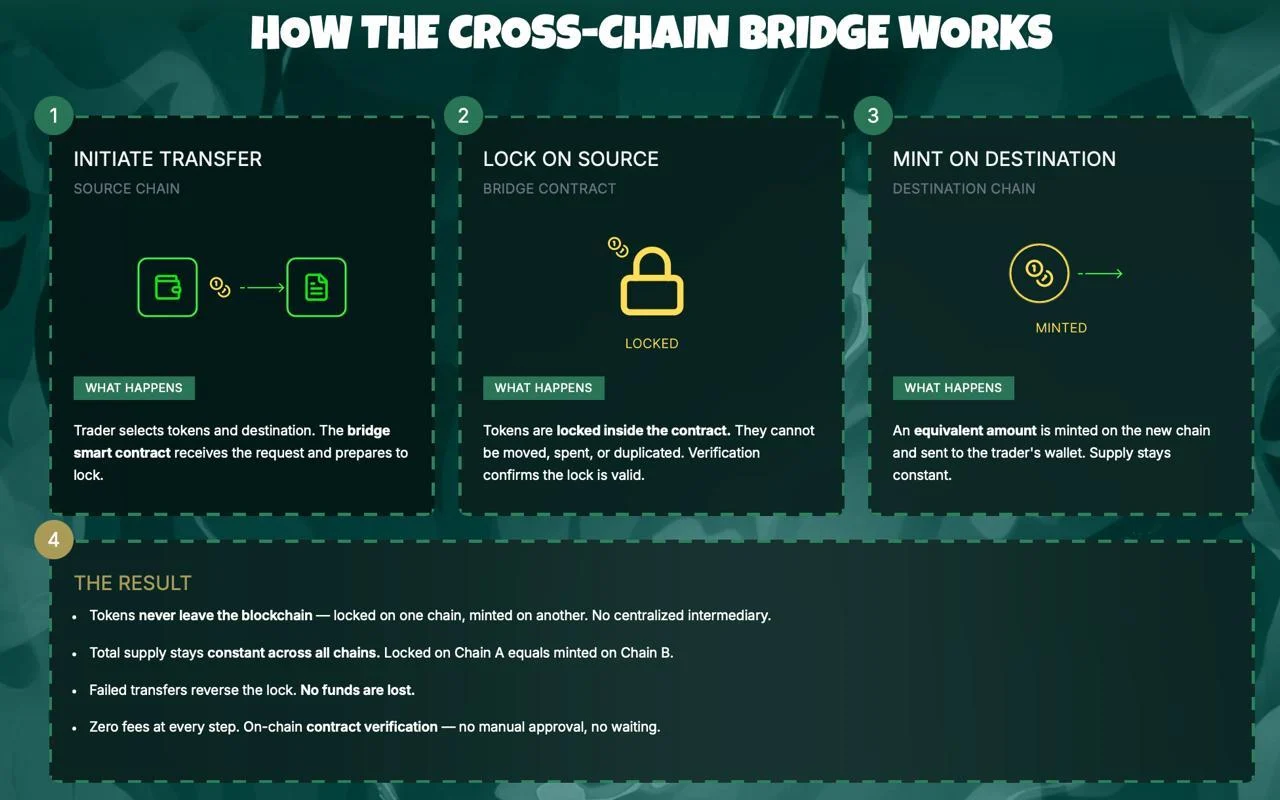
Pepeto runs a working zero-fee exchange connecting Ethereum, BNB Chain, and Solana, removing gas costs and failed fills that drain DeFi wallets daily. A cross-chain bridge shifts assets without charging fees, and a live AI scanner flags risky contracts before a wallet signs. The Pepe cofounder who built a project to a $7 billion cap leads this team, a former Binance executive manages delivery, and SolidProof cleared every contract line.
Each trade, bridge transfer, and scan routes value through the Pepeto token, creating the same token-level demand engine that took BNB from $0.15 at ICO to $634. Over $9.45 million is in at $0.0000001866, staking runs at 178% APY, and the Binance listing sits directly ahead.
A $2,000 entry at $0.0000001866 buys over 10.7 billion Pepeto tokens. Analyst desks project 100x once the first exchange trade prints, turning $2,000 into $200,000 the moment listing volume confirms the target.
The math is simple and the window is short. Every presale stage that closes pushes the price higher, and the day Binance opens the order book, no wallet on earth can buy at this level again. BNB proved what exchange tokens do when the product works. Pepeto follows that path at a lower starting price than BNB ever carried.
BNB Price at $634 as Osaka Hard Fork Deadline Hits April 28
BNB (BNB) trades at $634 per CoinMarketCap, down 1.4% on the day with support holding at $615 and resistance at $650.
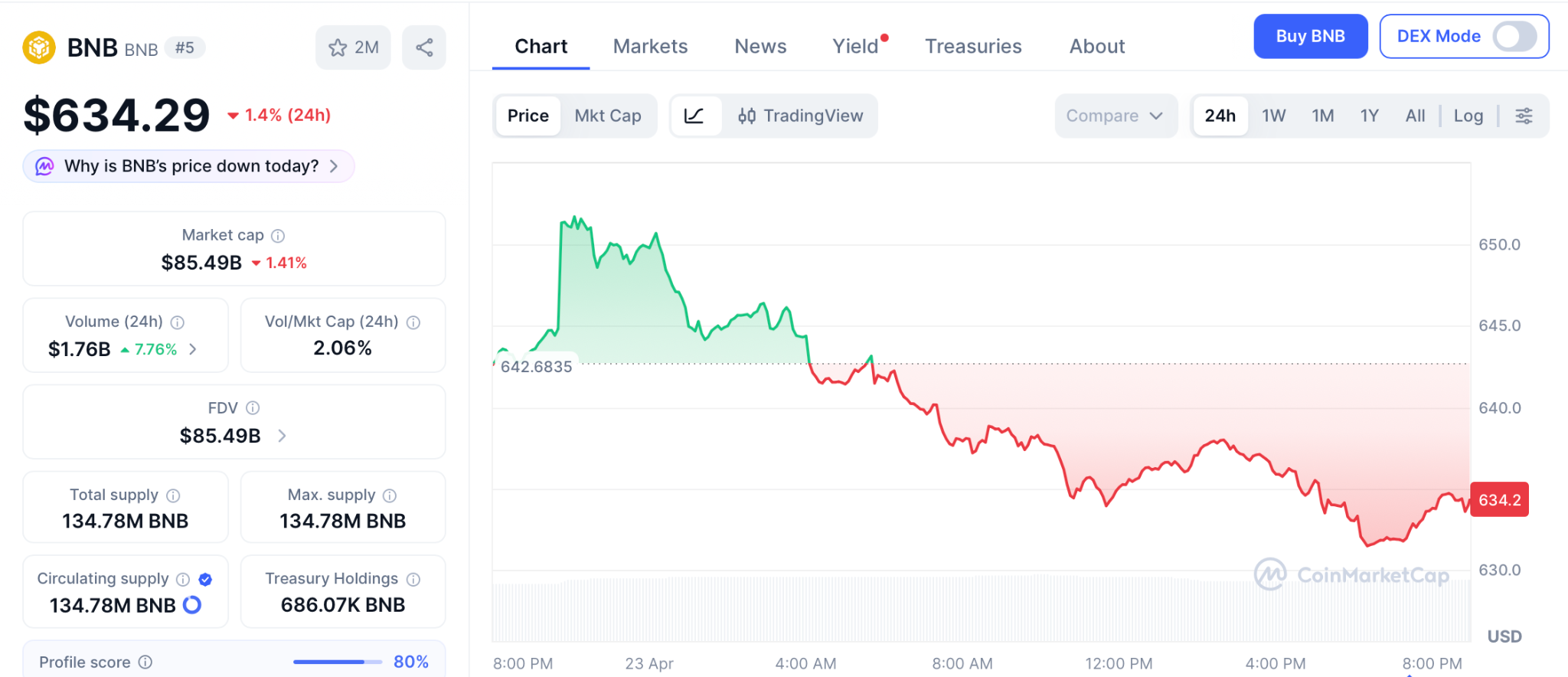
MEXC analysts target $665 by late April if the hard fork lands clean, and Binance user consensus points to $803 for 2026. The October 2025 all-time high of $1,375 sits 114% above the current price, solid for a large cap but far from the multiple that presale entries deliver at listing.
Solana (SOL) Price at $85 as Daily Users Hold Above 6 Million
Solana (SOL) sits at $85 per Coinbase, holding steady as daily active addresses stay above 6.3 million. Standard Chartered keeps $250 as its 2026 target, roughly 2.9x from current levels. Putting $1,000 into Solana at $85 buys 11 tokens, while $1,000 into Pepeto at $0.0000001866 secures over five billion tokens before listing day.
Conclusion:
The BNB price prediction keeps $800 and beyond on the table for 2026, and the Osaka hard fork on April 28 sets the next technical step. But 114% to ATH from an $86 billion cap is a different trade than catching an exchange token at presale before its first listing.
Pepeto sits at $0.0000001866 with $9.45 million raised, 178% APY staking live, and a confirmed Binance listing weeks away. One wallet that put $500 into BNB at $0.15 in 2017 held over $2 million by the 2025 high. Pepeto carries the same structure at a lower entry. The presale closes, the listing opens, and $2,000 today turns into $200,000 the moment the 100x target lands. Visiting Pepeto official website before the ticker goes live is how those positions are built.
Click To Visit Pepeto Website

FAQs
What is the BNB price prediction after the Osaka hard fork on April 28?
The BNB price prediction targets $665 to $803 for 2026 as the Osaka hard fork cuts block time and BNB holds $634 with support at $615. The October 2025 all-time high of $1,375 sits 114% above current levels.
Why is Pepeto drawing attention alongside BNB in April 2026?
Pepeto is drawing attention because it pairs a working zero-fee exchange with presale pricing at $0.0000001866 and 178% APY staking, giving buyers 100x potential before the confirmed Binance listing opens.
Disclaimer: This is a Press Release provided by a third party who is responsible for the content. Please conduct your own research before taking any action based on the content.


Cryptocurrency exchange OKX is accelerating its push into the United States by rolling out off-exchange settlement for its US institutional clients.
OKX has integrated the Off-Exchange Settlement (OES) platform by publicly listed digital asset custodian BitGo, the company said Thursday in an announcement shared with Cointelegraph.
The integration enables institutional clients to trade on OKX while keeping assets secured in BitGo’s cold custody, aiming to eliminate pre-funding requirements and improve capital efficiency.
“Institutional capital entering crypto requires capital to be protected and to be put to work,” OKX US CEO Roshan Robert told Cointelegraph. “Our proprietary custody infrastructure has been proven at scale, and our partnership with BitGo gives clients flexibility in how they protect assets while freeing capital to work harder,” he said.
The development marks a broader industry push to improve security and liquidity access by raising custody standards and securing partnerships with major custodians.
OKX’s first US steps after ICE took stake in the exchange
The integration with BitGo is among OKX’s first US institutional infrastructure steps since Intercontinental Exchange invested in the company at a $25 billion valuation in early March, with ICE executives taking a board seat at the exchange.
OKX Global CEO Star Xu then said the partnership would shape the platform’s approach to the US, adding that the company viewed its local presence as a “blank sheet of paper.”
The investment came about a year after OKX officially reentered the US in April 2025, alongside the appointment of former Barclays director Roshan Robert as its US CEO.
Related: BitMEX taps Zodia custody as exchanges tighten post-FTX safeguards
Addressing the BitGo integration, Xu emphasized that safeguarding customer assets has always been a foundation to OKX. “At the same time, we’ve expanded our custody partnerships with trusted leaders like BitGo to give clients greater flexibility and choice in how they secure their assets,” he added.
BitGo has disclosed risks tied to its off-exchange settlement platform
BitGo has operated its off-exchange settlement platform for at least a couple of years, acting as custodian and settlement facilitator for digital asset transactions executed on third-party exchanges.
Despite the operational efficiencies provided by its OES platform, BitGo said it still faces multiple categories of risk, including operational, regulatory and counterparty risks.
“Operational risks associated with our OES services include potential errors in processing trade data, delays or failures in asset transfers, employee or insider misconduct, cybersecurity incidents, technological disruptions and reconciliation errors,” the company said in its IPO filing in January.
Magazine: How to fix suspected insider trading on Polymarket and Kalshi

MoonPay has launched fiat-to-stablecoin virtual accounts in New York, allowing businesses to convert incoming funds from bank rails such as ACH and SWIFT into stablecoins and settle them directly to non-custodial wallets through a single API.
The product is underpinned by technology provider Iron and allows platforms to issue named, dedicated accounts that receive fiat and automatically convert it into stablecoins, enabling payment, trading and treasury flows without relying on prefunded balances or multiple intermediaries.
The rollout in New York follows MoonPay’s acquisition of Iron in 2025 and builds on integrations with platforms including Deel and Paysafe, extending its stablecoin infrastructure across payroll and payments networks, according to Thursday’s announcement.
MoonPay said it obtained a BitLicense, money transmitter licenses and a New York limited purpose trust charter from the New York State Department of Financial Services in 2025, allowing it to offer the service in one of the most tightly regulated crypto markets.

Source: MoonPay
The company said the accounts enable faster settlement and programmable payments by linking traditional banking rails with blockchain-based infrastructure through a single integration.
Max von Wallenberg, CEO of Iron, told Cointelegraph that launching in New York allows the company to target institutional clients operating in one of the most tightly regulated financial hubs. He said:
New York is the center of global finance — where the largest banks, asset managers and enterprises operate… Being able to operate here signals we meet the highest regulatory and operational standards.
He added that demand for the product in other jurisdictions has been driven by enterprise use cases including payroll, treasury management and cross-border payments, as well as tokenized real-world asset issuers that require fiat-to-stablecoin settlement flows.
Related: Stablecoins not a threat to banks in near term: Moody’s analyst
Stablecoins reduce reliance on prefunded accounts
Major payment companies and fintechs are increasingly integrating stablecoins into payment infrastructure to streamline cross-border transactions and reduce reliance on prefunded accounts.
On Tuesday, Singapore fintech Nium integrated USDC payments through Coinbase, allowing businesses to send, receive and convert stablecoins to fiat across more than 190 countries through a single platform.
The setup enables companies to fund cross-border payouts on demand using stablecoins and settle in either digital assets or local currencies, reducing the need to prefund accounts across multiple jurisdictions and streamlining global payment flows.
Card networks are also expanding stablecoin-linked payment infrastructure. In March, Visa and Stripe-owned Bridge rolled out stablecoin-linked cards across more than 100 countries and are testing onchain settlement that would allow transactions to be settled in digital assets rather than fiat. As of December 2025, Visa’s annualized stablecoin settlement run rate reached $4.6 billion, according to a company spokesperson.
Mastercard has also moved to expand its stablecoin capabilities, agreeing to acquire BVNK in a deal valued at up to $1.8 billion. The acquisition is aimed at strengthening its ability to connect traditional payment rails with blockchain-based transactions, supporting use cases including cross-border payments and business payouts.
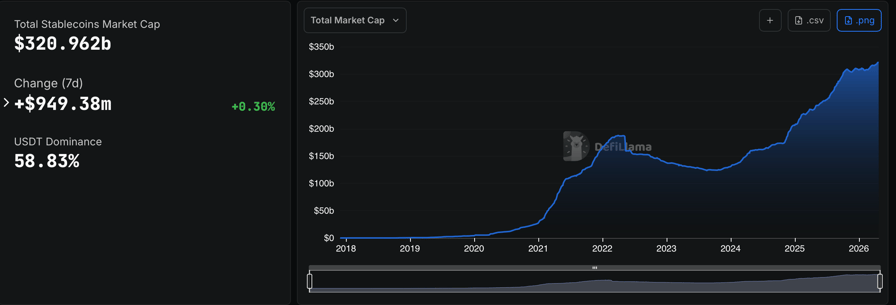
The total stablecoin market capitalization stands at about $320 billion, according to DefiLlama data.
Magazine: AI-driven hacks threaten to kill DeFi — unless projects act now
Robinhood Markets has outlined its principles for opening private markets to retail investors through Robinhood Ventures, while simultaneously securing regulatory approval to offer brokerage services in Singapore.
The twin announcements signal the company’s push to expand both its product range and geographic footprint in 2026.
Robinhood Ventures Targets Private Market Access
Robinhood CEO Vlad Tenev laid out three guiding principles for the firm’s private markets arm. The fund pledges to operate with transparency, protect investors through valuation discipline, and respect issuer preferences on retail exposure.
Robinhood Ventures Fund I, which trades on the New York Stock Exchange under the ticker RVI, holds stakes in companies including OpenAI, Stripe, Ramp, Revolut, and Databricks.
The fund requires no accreditation minimums and charges no performance fees.
RVI recently acquired a $75 million position in OpenAI, purchased on April 17. After an 11% decline on its March debut, the fund has since rebounded 30%.
Singapore Expansion Through MAS Approval
Separately, Robinhood crypto head Johann Kerbrat announced that the Monetary Authority of Singapore (MAS) granted in-principle approval for the company to offer brokerage services in the city-state.
The approval covers trading of securities and exchange-traded derivatives, custody services, product financing, and collective investment funds.
Singapore serves as Robinhood’s Asia-Pacific headquarters, where its subsidiary Bitstamp Asia already holds a Major Payment Institution license.
An in-principle approval does not yet constitute a full license. MAS must confirm that specified conditions are met before Robinhood Singapore Pte. Ltd. can begin operations.
Robinhood’s stock has dropped roughly 39% year-to-date after tripling in 2025. The company approved a $1.5 billion share buyback program in March to counter the slide.
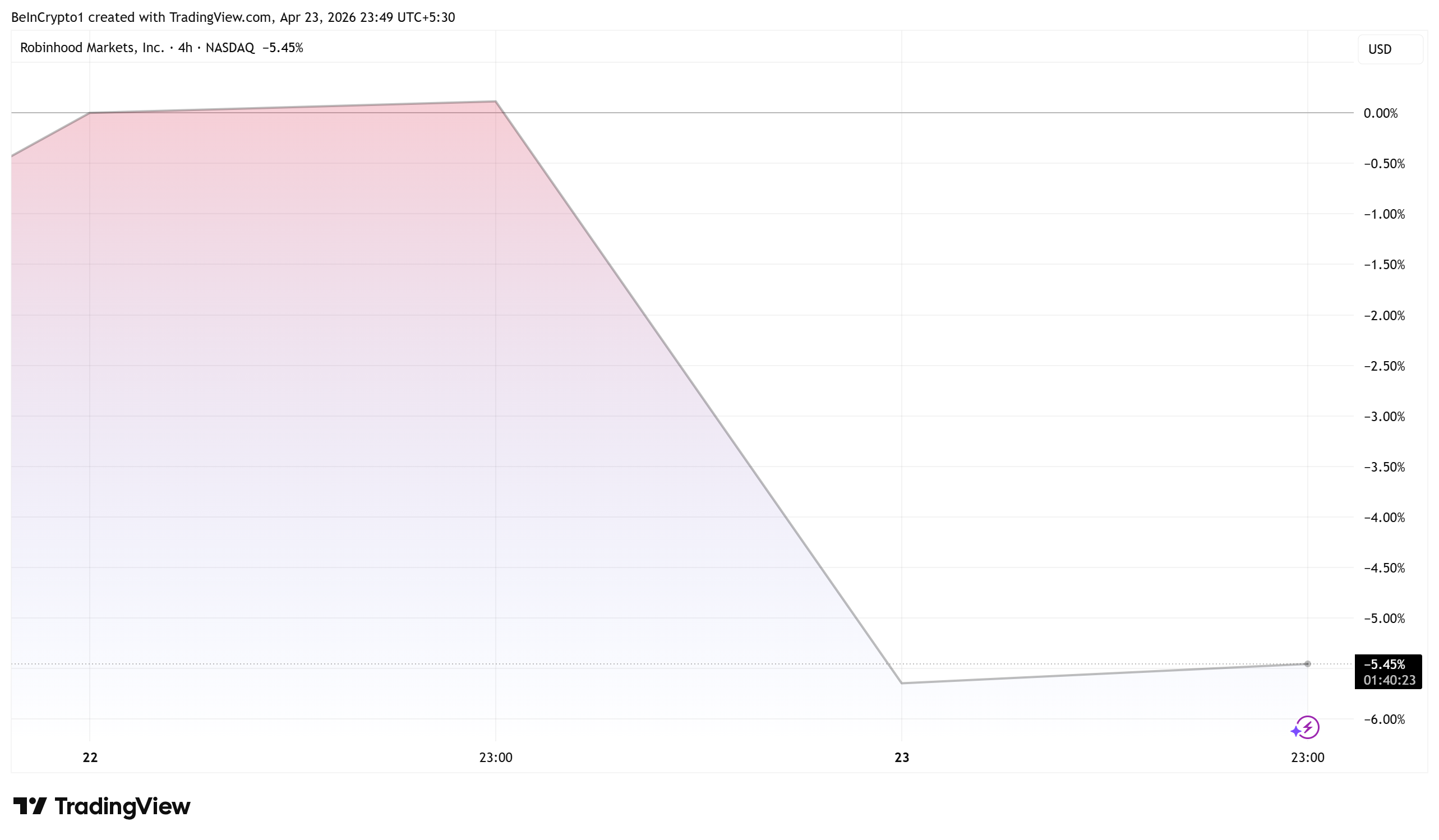
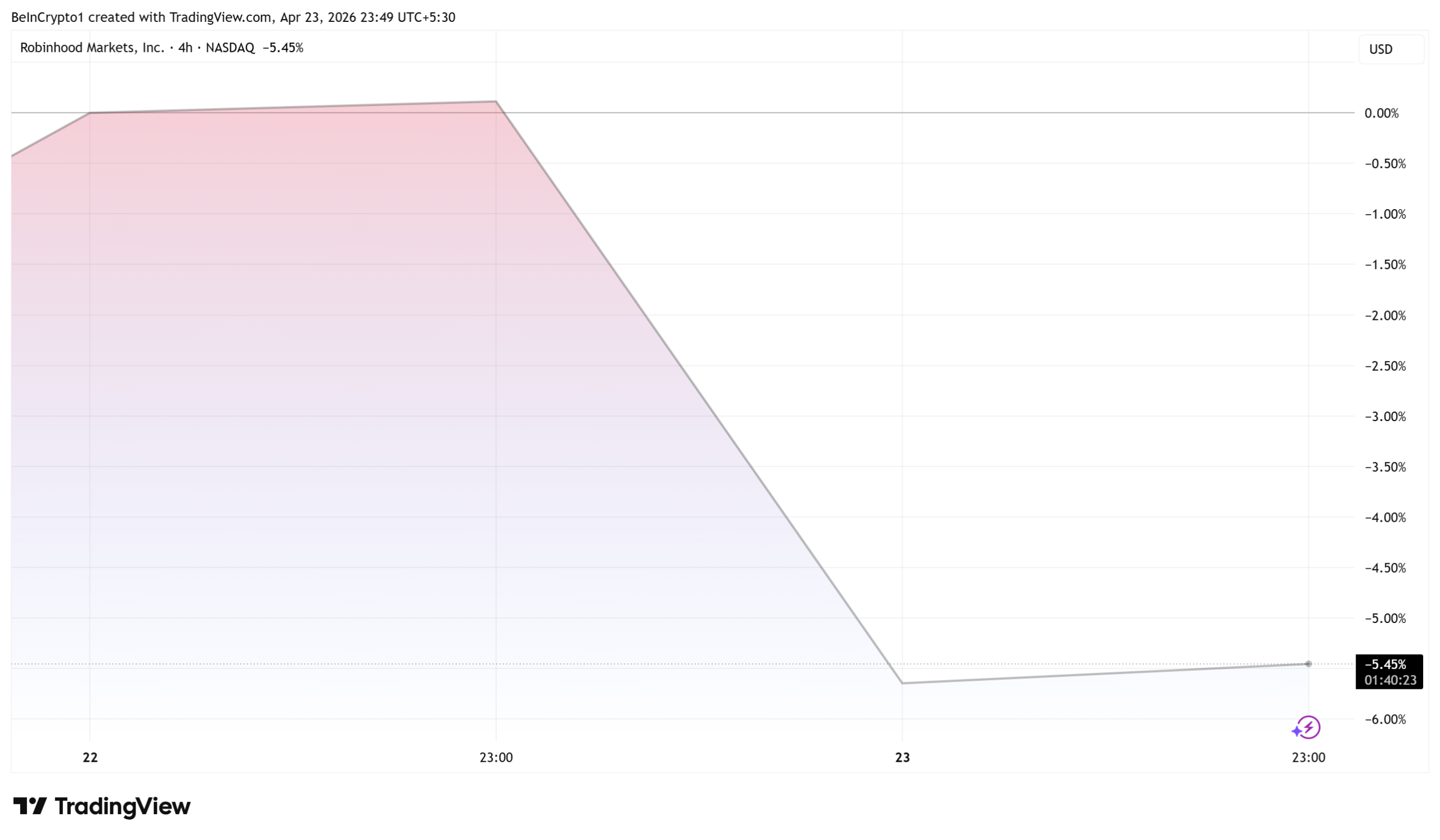
Despite this news, Robinhood stock, HOOD, is down 5%, and was trading for $83.44 as of this writing.
The post Robinhood Fund Opens OpenAI, Revolut, Stripe to Retail as Singapore Approves Expansion appeared first on BeInCrypto.


Galaxy Digital head of firmwide research Alex Thorn has assessed the CLARITY Act’s chances of being signed into law in 2026 at roughly 50-50, and possibly lower, in a research note being published this week, warning that the bill faces more unresolved questions than most of Washington appreciates and that time pressure is now its biggest enemy.
Summary
- Galaxy Research puts the CLARITY Act’s odds of becoming law in 2026 at approximately 50-50 or lower, with Thorn warning that a markup slipping past mid-May would drop chances sharply.
- Polymarket traders are pricing the bill’s passage at approximately 43%, down from 82% earlier in the year, reflecting the compounding delays and calendar pressure.
- Galaxy identifies the core risk as not any single issue but the sequential nature of the bill’s remaining hurdles under severe time pressure.
Alex Thorn, head of firmwide research at Galaxy Digital, warned in a note shared with DL News that “if the markup slips past mid-May, the probability of enactment in 2026 will drop sharply.” The firm’s overall assessment is blunt: “In our view, the odds of CLARITY being signed into law in 2026 are roughly 50-50, and possibly lower. The uncertainty stems not from any single issue but from the sheer number of unresolved questions that must be settled in sequence under severe time pressure.”
CLARITY Act Galaxy Research Note Highlights Sequential Risk as the Core Threat
Thorn’s analysis identifies several individual flashpoints that each carry veto power over the bill’s progress. Beyond the stablecoin yield dispute that has dominated coverage, the note flags the Blockchain Regulatory Certainty Act provision embedded in the Senate draft, which clarifies that non-custodial software developers who write code but do not control user funds are not money transmitters. Crypto advocates view this as essential to keeping open-source development onshore, but it has drawn pushback from some regulatory quarters. Polymarket traders, whose prediction market on the CLARITY Act has generated over $557,000 in trading volume since January, currently price the bill’s passage at approximately 43%, down sharply from 82% earlier in the year. As crypto.news has tracked, the bill faces a four-way standoff among crypto firms, banks, the SEC, and structural critics, with each faction holding effective veto power over a different provision.
What Would Need to Go Right for the Bill to Pass
For the CLARITY Act to become law in 2026, five sequential steps must succeed in rapid succession: a Senate Banking Committee markup, a 60-vote Senate floor threshold, reconciliation of the Banking and Agriculture Committee versions, reconciliation with the House-passed text from July 2025, and a presidential signature. Each of those steps is a potential point of failure. As crypto.news reported, the White House has described the stablecoin yield compromise as holding firm, and White House crypto adviser Patrick Witt said the deal is a “must-have” for unlocking the remaining issues. If that compromise breaks down again, it would trigger another delay that Galaxy’s timeline math suggests the bill cannot survive.
What Passage Would Mean for Crypto Markets
JPMorgan analysts have publicly described CLARITY Act passage by midyear as a positive catalyst for digital assets, a view that reflects how much institutional deployment in crypto is currently gated behind regulatory clarity. As crypto.news documented, Coinbase CEO Brian Armstrong reversed his company’s earlier opposition and backed the current bill version in April, and approximately 65% of institutional investors surveyed by Coinbase and EY-Parthenon have cited regulatory clarity as the condition holding them back from serious XRP and broader digital asset deployment. Galaxy’s 50-50 assessment is not a call to give up on the bill but a warning that the path is narrower than the most optimistic forecasters in Washington and the crypto industry have been projecting.
A lame duck session of Congress following the November midterms has been mentioned as a last-resort option by some insiders, though Galaxy describes that scenario as low probability given the compressed legislative dynamics.

TLDR:
- SHIB added over 10,000 new holder addresses on Ethereum between April 19 and April 22, 2026.
- Around 505 billion SHIB moved off centralized exchanges, pointing to rising self-custody behavior.
- Shibarium crossed 1 billion total transactions, strengthening the burn mechanism tied to SHIB supply.
- A Q2 2026 privacy upgrade using Fully Homomorphic Encryption is underway with cryptography firm Zama.
SHIB holder addresses on Ethereum recorded a sharp rise between April 19 and April 22. More than 10,000 new wallets joined the network during that period, pushing the total above 1.573 million.
Etherscan data captured the move, which ranks as one of the fastest short-term expansions in the holder base this year.
The surge aligns with fresh activity on the Shibarium Layer 2 network and renewed technical interest in the token’s price chart.
What Drove the Wave of New SHIB Wallets
The single largest daily addition came on April 21, when 4,958 new wallets entered the SHIB network. That figure marks the highest one-day gain recorded in 2026 so far.
The cleanest seven-day net gain, however, sits closer to 5,653 wallets on Etherscan. For context, the holder base only crossed 1.55 million in late March.
Price movement played a role in drawing fresh buyers into the token. SHIB climbed more than 7% in the week leading into April 22.
The token also broke through a multi-year descending triangle pattern on its daily chart. Retail wallets tend to respond quickly when a memecoin clears a long-standing technical level.
On-chain data added another layer to the story. Around 505 billion SHIB moved off centralized exchanges over the past week.
That kind of outflow typically points to holders transferring tokens into self-custody. When exchange balances fall at that scale, available supply can tighten over time.
Long-term conviction also appears to be growing within the holder base. Data shows long-term holders have grown roughly 78% over the past year.
Meanwhile, the Shibarium Layer 2 has been generating fresh ecosystem headlines. That type of news often pulls speculative capital back into the parent token.
Shibarium Milestones Shape SHIB’s Broader Narrative
Shibarium crossed 1 billion total transactions, a target the project had been tracking for months. The Layer 2 network generates automatic burns of BONE and, indirectly, affects SHIB supply through fee activity.
Each transaction feeds into the broader burn mechanism over time. That makes sustained network usage relevant to SHIB’s long-term supply picture.
The @Shibtoken team is also targeting a Q2 2026 privacy upgrade built on Fully Homomorphic Encryption. The integration is being developed alongside cryptography firm Zama.
It aims to enable encrypted transactions and data processing directly on Shibarium. The upgrade opens pathways for privacy-preserving DeFi and gaming use cases.
At the time of writing, SHIB trades near $0.0000061 with a market cap of roughly $3.59 billion. That places the token at rank 27 on CoinMarketCap.
Twenty-four-hour volume sits around $91 million, down about 13.5% from the prior day. The week is largely flat at negative 0.3%, after earlier highs near $0.0000064 faded.
The LEASH v2 migration continues in phases following its completed security audit. Other roadmap items include Layer 3 expansion and AI-related tooling.
Traders watching SHIB will want to track Etherscan holder data alongside Shibarium’s daily transaction figures. Whether the holder growth converts into price strength depends on how SHIB handles its current breakout retest.


Pi Network has set a hard deadline of April 27 for all Mainnet node operators to upgrade to Protocol 22, warning that any node still running version 21.2 after the cutoff will be automatically disconnected from the network.
Summary
- Pi Network issued a mandatory Protocol 22 upgrade deadline of April 27 for all Mainnet nodes, with non-compliant nodes to be automatically disconnected.
- The upgrade is described as a critical infrastructure step preparing the network for full smart contract functionality, expected under Protocol 23 in May 2026.
- PI traded at approximately $0.1687 on April 23 with an $1.73 billion market cap, largely unmoved by the technical development activity despite the network surpassing 18 million KYC-verified users.
Pi Network’s Core Team posted on X that all Mainnet nodes must complete the upgrade to Protocol 22 before April 27 to remain connected to the network. Nodes that fail to make the transition will fall out of consensus and be disconnected automatically, as the upgrade requires strict version alignment across Pi’s infrastructure to maintain network synchronization and stability.
Pi Network Protocol 22 Upgrade Deadline Puts Node Operators on Notice
Protocol 22 introduces a dual-interface setup allowing node operators to use both a node screen and a desktop Pi application simultaneously, enabling balance checks and network feature access from a computer rather than only a phone. Node operators must update their software to version 0.5.4, and the Pi Core Team says the upgrade takes under 15 minutes if operators follow the correct traffic redirection protocols to avoid resyncing issues. As crypto.news reported, Pi Network also expanded smart contract tools on Testnet on April 17, introducing subscription smart contract capability designed to support recurring blockchain-based services and business models, with PiRC2, the second Pi Request for Comment, opening the design to technical review and community feedback before any Mainnet rollout.
Why the Protocol 22 Deadline Matters for What Comes Next
Protocol 22 is not the destination but the foundation. The upgrade is explicitly positioned as the prerequisite for Protocol 23, which is expected to introduce full smart contract functionality in May 2026. Smart contracts would allow developers to build automated, condition-based transactions and more complex decentralized applications directly on Pi’s blockchain, transforming the network from a transactional system into a programmable platform. Pi Network’s 18 million KYC-verified users give it a structurally different developer environment from most other Layer-1 networks, where identity verification is not built into the architecture. As crypto.news tracked, PI surged more than 30% on its March Kraken listing as the market responded to the expanding exchange access and roadmap milestones, though the rally faded quickly, reflecting the market’s consistent pattern of treating each technical development as a sell-the-news event rather than a re-rating trigger.
PI Price Has Not Responded to the Technical Progress
Despite a busy stretch of protocol upgrades, PiRC1 launch, and the approaching Protocol 22 deadline, PI has remained largely unmoved. As crypto.news documented, CoinGecko showed PI at $0.1687 on April 23, with a 24-hour trading volume of approximately $11.17 million and a market cap of $1.73 billion, ranking it 49th. Co-founders Nicolas Kokkalis and Chengdiao Fan are both scheduled to speak at Consensus 2026 in Miami in early May, with sessions framed around utility, identity, and trusted participation, the same themes underpinning the Protocol 22 and PiRC1 rollouts. Traders appear to be watching whether the combination of the April 27 deadline, Testnet smart contract progress, and the Consensus 2026 appearance can give the project a fresh catalyst for price action heading into the Protocol 23 launch.
Pi Network has not confirmed whether the Protocol 23 smart contract rollout will be preceded by an additional community feedback period similar to the PiRC1 and PiRC2 processes, or whether it will move directly to Mainnet deployment upon readiness.

Are you ready to experience the thrill of online gaming? Look no further than 4Bet, the premier online casino that offers a wide range of games and features to suit every player’s taste. In this guide, we’ll take you on a journey through the world of 4Bet, highlighting its most popular games, features, and benefits.
4Bet is a well-established online casino that has been in operation for several years, and it has built a reputation for being a reliable and trustworthy platform. With a user-friendly interface and a vast array of games, 4Bet is the perfect destination for players of all levels.
One of the standout features of 4Bet is its impressive game selection. With over 1,000 games to choose from, you’ll never be bored. From classic slots to table games, video poker, and live dealer games, there’s something for everyone at 4Bet. And with new games being added all the time, you’ll always find something fresh and exciting to play.
But 4Bet is more than just a game selection. It’s also a community-driven platform that offers a range of features to enhance your gaming experience. With features like 4rabet login, 4rabet app login, and 4ra bet, you can easily access your account and start playing in no time. And with 4rabet official website, you can stay up-to-date with the latest news and promotions.
So, what are you waiting for? Sign up for 4Bet today and start experiencing the thrill of online gaming. With its user-friendly interface, vast game selection, and range of features, 4Bet is the perfect destination for players of all levels. And with its commitment to providing a safe and secure gaming environment, you can trust that your experience will be nothing but positive.
So, don’t miss out on the fun. Join the 4Bet community today and start playing your favorite games. With its 4rabet online, 4rabet login, and 4ra bet features, you’ll never be far from the action. And with its 4rabet official website, you’ll always be up-to-date with the latest news and promotions.
Ready to get started? Click the link below to sign up for 4Bet and start playing today!
4Bet: A Comprehensive Guide to Games and Features of the Online Casino
Are you ready to explore the world of 4Bet, a popular online casino that offers a wide range of games and features? In this guide, we’ll take you through the ins and outs of 4Bet, helping you to make the most of your online gaming experience.
4Rabet Login: Getting Started
To start playing at 4Bet, you’ll need to log in to your account. Simply visit the 4Rabet official website, click on the “Login” button, and enter your username and password. If you’re new to 4Bet, you can register for an account by clicking on the “Register” button and filling out the required information.
Once you’re logged in, you can access a variety of games, including slots, table games, and live dealer games. You can also take advantage of 4Bet’s loyalty program, which rewards you for your deposits and gameplay.
4Bet also offers a mobile app, which allows you to play on the go. Simply download the 4Rabet app login, and you’ll be able to access your account and play your favorite games from anywhere.
One of the standout features of 4Bet is its live dealer games. These games are broadcast live from a studio, and you can interact with the dealers and other players in real-time. It’s a unique and exciting way to play online, and it’s definitely worth trying out.
Another great feature of 4Bet is its customer support. The site offers a range of support options, including live chat, email, and phone support. This means you can get help whenever you need it, whether you’re having a problem with your account or just need some advice on how to play a particular game.
Overall, 4Bet is a great choice for anyone looking for a fun and exciting online gaming experience. With its wide range of games, loyalty program, and excellent customer support, it’s a site that’s definitely worth checking out.
Games Offered by 4Bet
4Bet is a popular online casino that offers a wide range of games to its users. On the 4rabet official website, you can find a variety of games, including slots, table games, and live dealer games. To access these games, simply log in to your 4rabet account using the 4rabet login feature.
One of the most popular games offered by 4Bet is its selection of slots. With hundreds of games to choose from, you’re sure to find something that suits your taste. From classic fruit machines to more complex video slots, there’s something for everyone. And with new games being added all the time, you’ll never get bored.
But 4Bet isn’t just about slots. The platform also offers a range of table games, including blackjack, roulette, and baccarat. These games are available in both online and live dealer formats, giving you the option to play with real dealers or against the house. And with the 4rabet app login feature, you can access these games on the go.
So why choose 4Bet? With its wide range of games, user-friendly interface, and 4rabet app login feature, it’s the perfect choice for anyone looking to try their luck at online gaming. And with new games being added all the time, you’ll never get bored. So why wait? Sign up for 4Bet today and start playing!


Ethereum opened at $2,375.12 on Thursday April 23, 2026, rising 2% from Wednesday’s open as Bitcoin led a broad morning rally past $78,000, though ETH pulled back to $2,316.88 by 7:10 a.m. ET as traders remained cautious over the lack of progress in Iran peace talks and continued US naval activity near the Strait of Hormuz.
Summary
- Ethereum opened at $2,375.12 on April 23, 2026, up approximately 2% from Wednesday’s opening price, tracking Bitcoin’s move above $78,000 for the first time since early February.
- ETH pulled back to $2,316.88 by 7:10 a.m. ET as traders weighed stalled Iran ceasefire talks and ongoing naval blockade activity against improved macro sentiment.
- Spot Ethereum ETFs logged a ninth straight day of net inflows totaling over $530 million, providing institutional support beneath the price action.
Ethereum opened at $2,375.12 on Thursday and quickly retraced, settling near $2,316.88 by early morning as Bitcoin’s own rally above $78,000 proved difficult to sustain. Yahoo Finance confirmed ETH was up 2% from Wednesday’s opening price, though the reversal pattern was consistent with the cautious risk environment that has defined markets since the Iran ceasefire extended without progress toward a formal peace agreement.
Ethereum Price April 2026 Rally Tracks Bitcoin but Traders Hold Back
Thursday’s morning move followed Bitcoin’s strongest open since early February, with BTC briefly clearing $78,000 before giving back gains as rising oil prices introduced fresh inflation concerns. As crypto.news reported, ETH rose nearly 5% on Wednesday to $2,402, with spot Ethereum ETFs recording a ninth consecutive day of net inflows totaling over $530 million, the open interest in ETH futures climbing to $32.7 billion, and a bullish crossover forming between the 20-day and 50-day exponential moving averages on the daily chart. Thursday’s price action is being watched closely for whether that institutional inflow momentum can hold the $2,300 level as a support floor, with $2,574 identified as the next meaningful resistance aligned with the 50% Fibonacci retracement level.
The Geopolitical Ceiling Keeping ETH Range-Bound
The broader pattern for Ethereum in April 2026 has been one of sharp macro-driven rallies followed by partial retracements, all within a narrowing range anchored by the Iran conflict. As crypto.news documented, ETH surged more than 9% on April 14 to a 10-week high of $2,393 as ceasefire diplomacy briefly lifted risk sentiment, with $123.5 million in short liquidations accelerating the move. That rally also stalled near the same $2,400 zone ETH is testing again this week, reinforcing it as a key resistance ceiling the asset has not been able to close above convincingly since the war with Iran began in February. Iran fired on three ships near the Strait of Hormuz on April 22, and while the US extended the ceasefire indefinitely, the naval blockade remains in place, sustaining the geopolitical risk premium that has kept crypto and risk assets broadly range-bound.
What Would Change the Ethereum Outlook
A sustained close above $2,500 would be the first meaningful structural signal that Ethereum’s rally has shifted from macro relief trading to a genuine trend. As crypto.news tracked, ETH has held its multi-year ascending support trendline that connects bear market lows going back to 2019, with the April monthly low of $2,017 testing and holding that level. The monthly MACD histogram has turned positive at 129.89, the first constructive macro momentum signal since the late 2025 decline from the $4,800 peak. Ethereum’s Glamsterdam upgrade, expected in the first half of 2026, targets significant gas limit increases, parallel transaction execution, and lower Layer-2 transaction costs, providing a fundamental catalyst that could eventually support price independent of the macro environment.
ETH remains approximately 53% below its August 2025 all-time high of $4,953.73, and traders are watching whether the combination of institutional ETF inflows, smart contract network growth, and improving technical structure can produce a sustainable recovery above the $2,500 resistance zone.
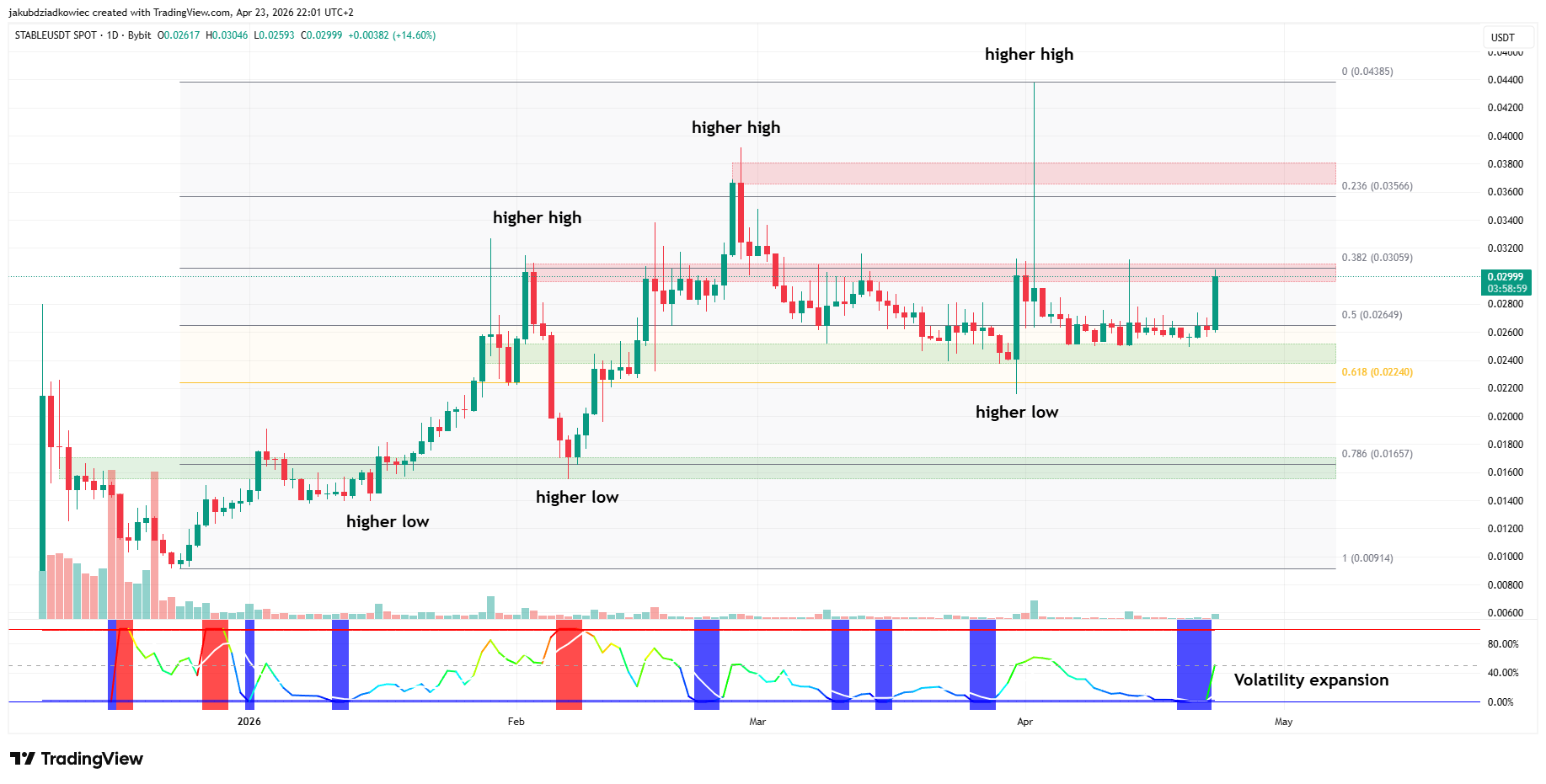
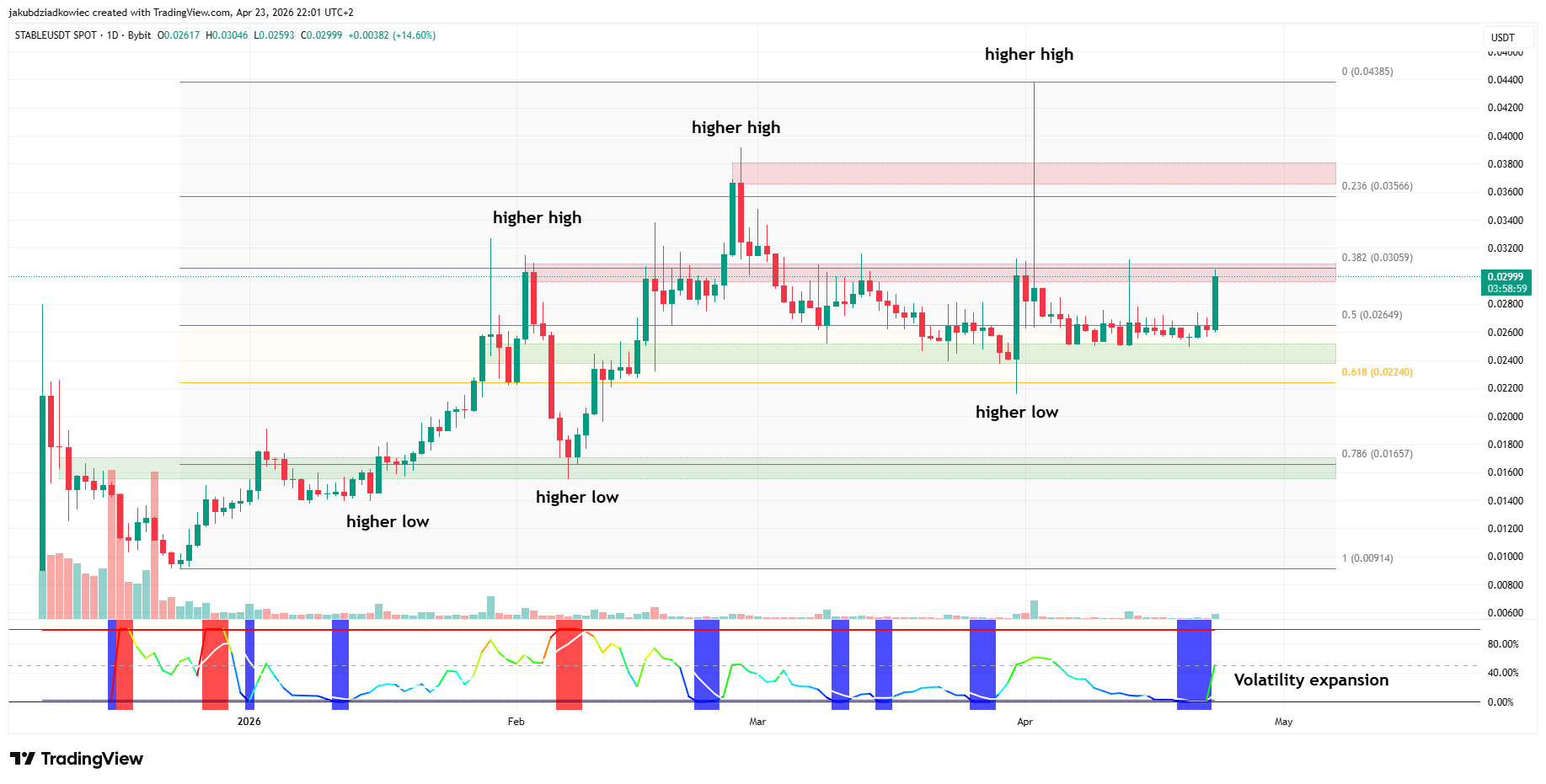
STABLE (STABLE) rallied 14.6% on April 23 to trade at $0.02999, breaking weeks of tight consolidation with the strongest daily volatility reading since early February. The move coincided with a Relative Strength Index breakout on the daily chart.
The rally pushes the token toward the 0.382 Fibonacci retracement at $0.03059, a level that capped every bounce across March and April. A sustained close above that line would clear the path to the next resistance cluster.
Daily Chart Holds a Higher-Low Structure Above the 0.5 Fib
The daily chart frames a higher-timeframe structure that remains constructive. STABLE has printed a series of higher lows since its December bottom near $0.00914, along with three higher highs. The April 22 low at $0.02580 preserved that structure and sits directly on the 0.5 Fibonacci retracement at $0.02649.
Price now trades at $0.02999, just below the 0.382 Fibonacci level at $0.03059. That ceiling has rejected multiple rally attempts since March 7, making it the most important short-term resistance on the chart.
A daily close above $0.03059 would confirm continuation toward the 0.236 retracement at $0.03566 and the February 27 high near $0.0389.
Critical support sits at $0.02649. A break below that invalidates the current leg and exposes the 0.618 retracement at $0.02240. Other altcoins have stalled at equivalent retracement clusters this cycle, including ORDI at its own 0.382 level.
Daily RSI Breaks a Three-Month Resistance Line
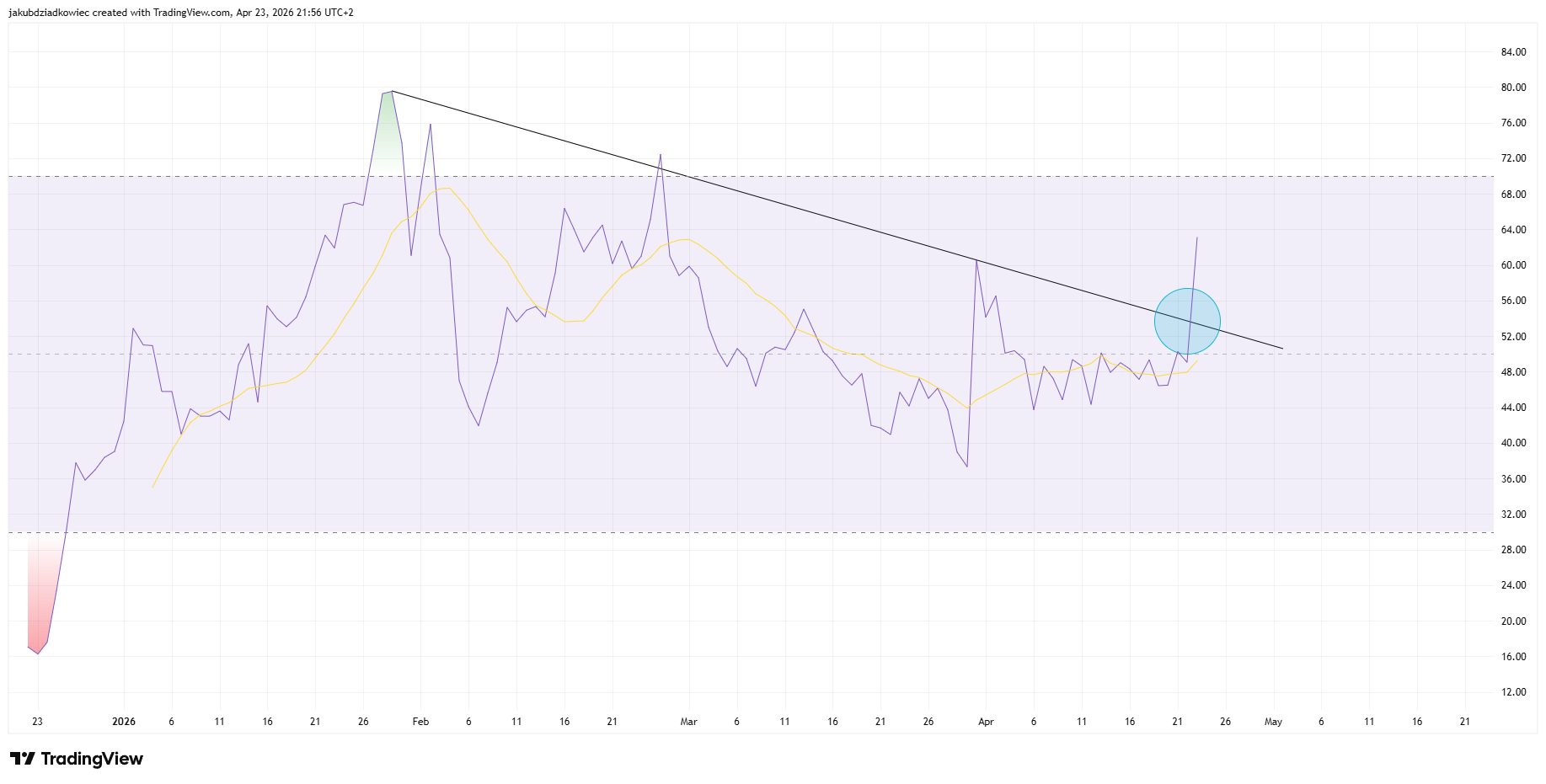
The STABLE Relative Strength Index (RSI) finally pushed above a descending trendline that had capped every rally since late January. The indicator jumped from near 50 into the mid-60s on the April 23 candle. It was the first decisive move above 60 in more than 10 weeks.
The trendline originated at the RSI peak above 80 set in late January, just before STABLE printed its all-time high near $0.04385. Each subsequent rally stalled at progressively lower RSI readings, producing a steady sequence of lower highs that mirrored the price correction.
A clean break above this line often precedes a shift from distribution to accumulation. The reading still sits well below the overbought threshold at 70, leaving room for further upside before momentum exhausts itself. Similar momentum setups preceded the recent HBAR breakout attempt.
Momentum flips bearish only if RSI closes back below 50. That outcome would confirm a false breakout and hand control back to sellers.
STABLE Price Prediction Points to the $0.0367 W-Pattern Target
The 4-hour view delivers the clearest roadmap for the next move. STABLE carved out a rounded W pattern between April 2 and April 23, with the neckline near $0.03100. Price broke above the neckline on April 23 and stalled around $0.03003 by session close.
The measured move projects a $0.03673 target, roughly 22% above the April 22 low near $0.02580. That zone aligns with the 0.236 Fibonacci retracement at $0.03566, creating a dense resistance cluster between $0.03566 and $0.03673. Volume confirmed the breakout leg, printing the largest bullish candle in more than two weeks.
However, the token must first clear the 0.382 Fibonacci level at $0.03059 on the higher timeframe. A rejection from the $0.03059 to $0.03100 band would likely send STABLE back toward the 0.5 Fibonacci support at $0.02649. A recovery in broader Bitcoin strength would accelerate the upside.
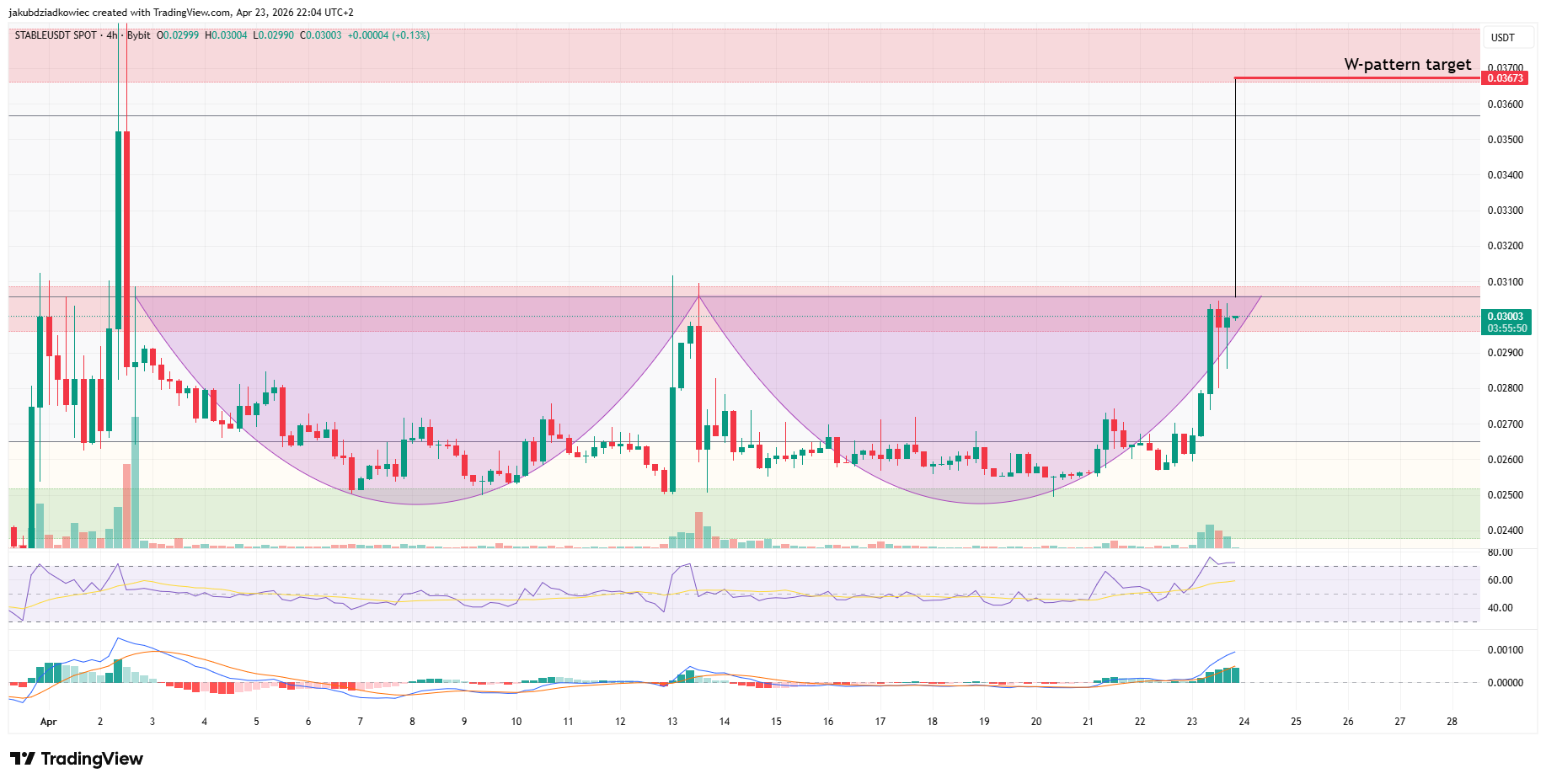
The binary is clear. STABLE either clears $0.03059 and confirms a path to $0.03673, or fails and slides back into the mid-range.
The post STABLE Price Rallies 20%, Here’s Why and Where It’s Going Next appeared first on BeInCrypto.

I made easy burnt Basque cheesecake at home and it was incredibly creamy and rich

Costco shoppers warned to stop using popular product over safety issue

BNB Price Prediction Steady at $634 After Osaka Hard Fork Sets April 28 Deadline. Where Does Pepeto Fit?

Manchester United reach agreement with Casemiro over contract clause amid transfer speculation

US brings back mandatory military draft registration

Steven Gerrard disagrees with Gary Neville over ‘shock’ Chelsea and Arsenal claim | Football


-

 Sports7 days ago
NWFL Suspends Two Players Over Post-Match Clash in Ado-Ekiti
-

 Fashion6 days ago
Weekend Open Thread: Theodora Dress
-

 Politics6 days ago
Palestine barred from entering Canada for FIFA Congress
-
Entertainment4 days ago
NBA Analyst Charles Barkley Chimes in on Ice Spice McDonald’s Fiasco
-

 Tech5 days ago
Auto Enthusiast Scores Running Tesla Model 3 for Two Grand and Turns It Into Bare-Bones Go-Kart
-

 Business4 days ago
Powerball Result April 18, 2026: No Jackpot Winner in Powerball Draw: $75 Million Rolls Over
-

 Politics5 days ago
Zack Polanski demands ‘council homes not luxury flats for foreign investors’
-

 Crypto World6 days ago
Russia Pushes Bill to Criminalize Unregistered Crypto Services
-

 Politics3 days ago
Gary Stevenson delivers timely reminder to register to vote as deadline TODAY
-

 Business2 days ago
Rolls-Royce Voted UK’s Most Iconic Trade Mark as IPO Register Hits 150
-

 Politics1 day ago
Disabled people challenge government SEND proposals over segregation concerns
-

 Politics1 day ago
Making troops accountable for war crimes threatens US alliance, ex-SAS colonel warns
-

 Crypto World6 days ago
Russia Introduces Bill To Criminalize Unregistered Crypto Services
-

 Politics1 day ago
Starmer handler McSweeney to be dragged from shadows by Foreign Affairs Committee
-

 Politics1 day ago
Zack Polanski responds to home secretary’s taser threat
-
Politics1 day ago
Wings Over Scotland | How To Get Away With Crimes
-
Crypto World5 days ago
Kelp DAO rsETH Bridge Hack Drains $292M as DeFi Losses Top $600M in Two Weeks
-

 Politics1 day ago
‘Iran is still a nuclear threat’
-

 Crypto World2 days ago
New York sues Coinbase, Gemini over prediction market offerings
-
 Sports7 days ago
Kevin Kisner apologizes for Masters criticism: ‘I crossed the line’
You must be logged in to post a comment Login