Bilal Mazhar Khawaja, 44, runs three restaurants in Islamabad. For the past few days his business has been severely hit, with food supply chains disrupted and movement of staff restricted as the Pakistani capital remains in an indefinite lockdown in anticipation of the stalled US-Iran talks.
No date for the talks has been set, but the city remains under sweeping security restrictions, forcing locals to grapple with uncertainty.
Khawaja tells The Independent over the phone: “They (the administration) have blocked all main roads leading to Islamabad. Trucks full of bread and cooking oil, which have been denied entry to the city, have not been able to deliver supplies.”
Advertisement
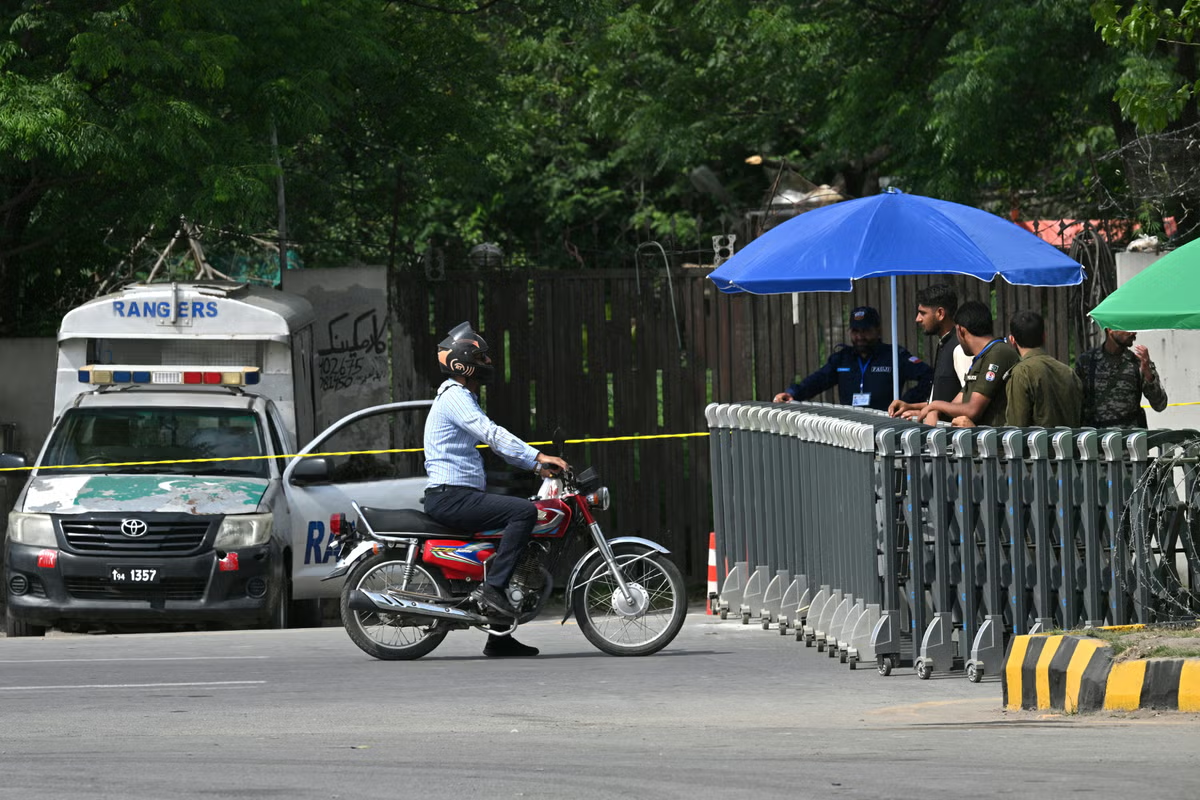
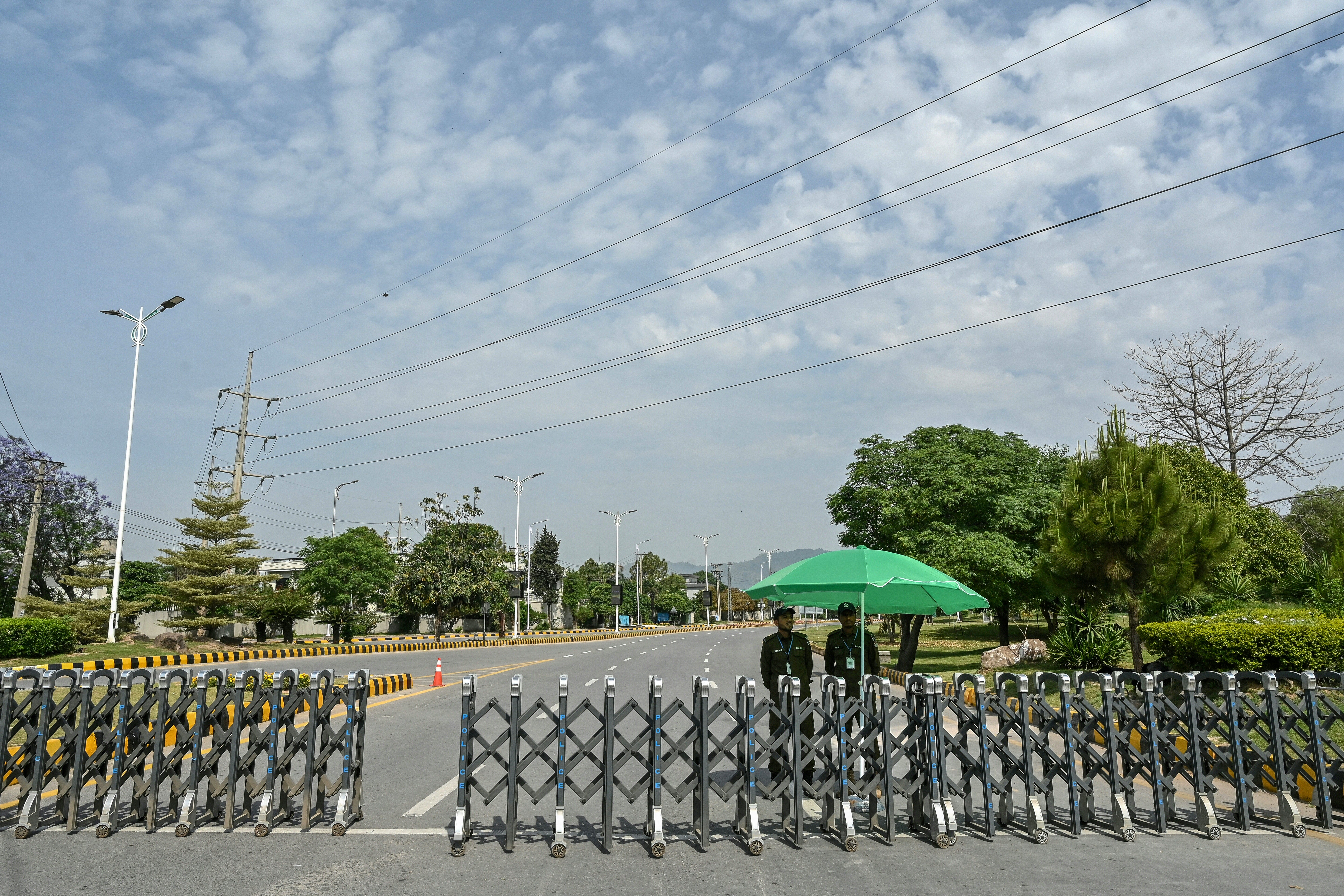
Security personnel stand guard at a closed road leading to the Serena Hotel in the Red Zone area of Islamabad on 23 April 2026. – Pakistan’s capital was still locked in gear on 22 April to host high-stakes US-Iran talks that were pushed back at the last minute overnight, but many residents began to tire of the heavy personal and economic toll of tight security restrictions (AFP/Getty)
His staff have not been able to travel to the restaurants because movement of public transport has been restricted. “Earlier, they would spend, say, 50 to 60 (Pakistani) rupees to reach their work using the public transport. Now, if they hire a taxi, for example, it will cost them 300. Most of them prefer to stay home.”
Khawaja, whose businesses have been impacted severely, says if in the next few days the administration doesn’t ease out the restrictions, he would be forced to let some of his staff go. “It is impacting everyone.”
“Near the (Islamabad) airport, there are no shops open. Not even chemists. Fuel stations have no fuel.”
It was previously reported that US vice president JD Vance would lead the US delegation to Pakistan. The visit got delayed even though there were reports that Iran was reconsidering its initial refusal to engage in further talks.
Islamabad remains hopeful that the talks will take place soon. On Wednesday, Pakistan’s prime minister, Shehbaz Sharif, met with Iran’s ambassador, and according to one official who was briefed on the talks, the second round of negotiations could take place within the next few days.
Advertisement
However, Iran’s capture of two cargo ships in the Strait of Hormuz on Wednesday has led to fresh uncertainty in Islamabad over the plans for the second round of peace negotiations to end the war in the Middle East.
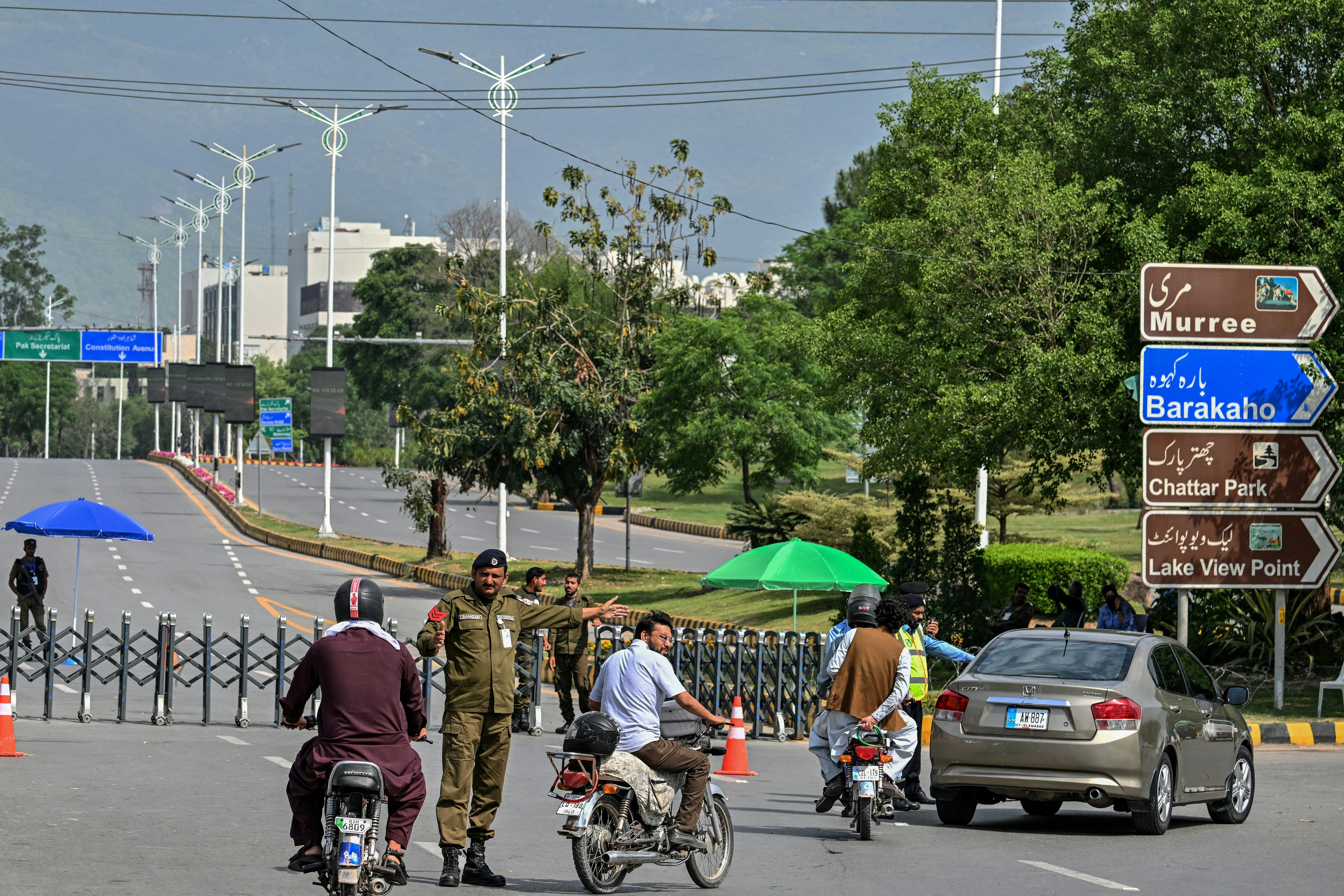
Residents who have had to deal with high security, road closures, and scarce public transport for days now, say their daily lives are badly impacted by the stringent measures.
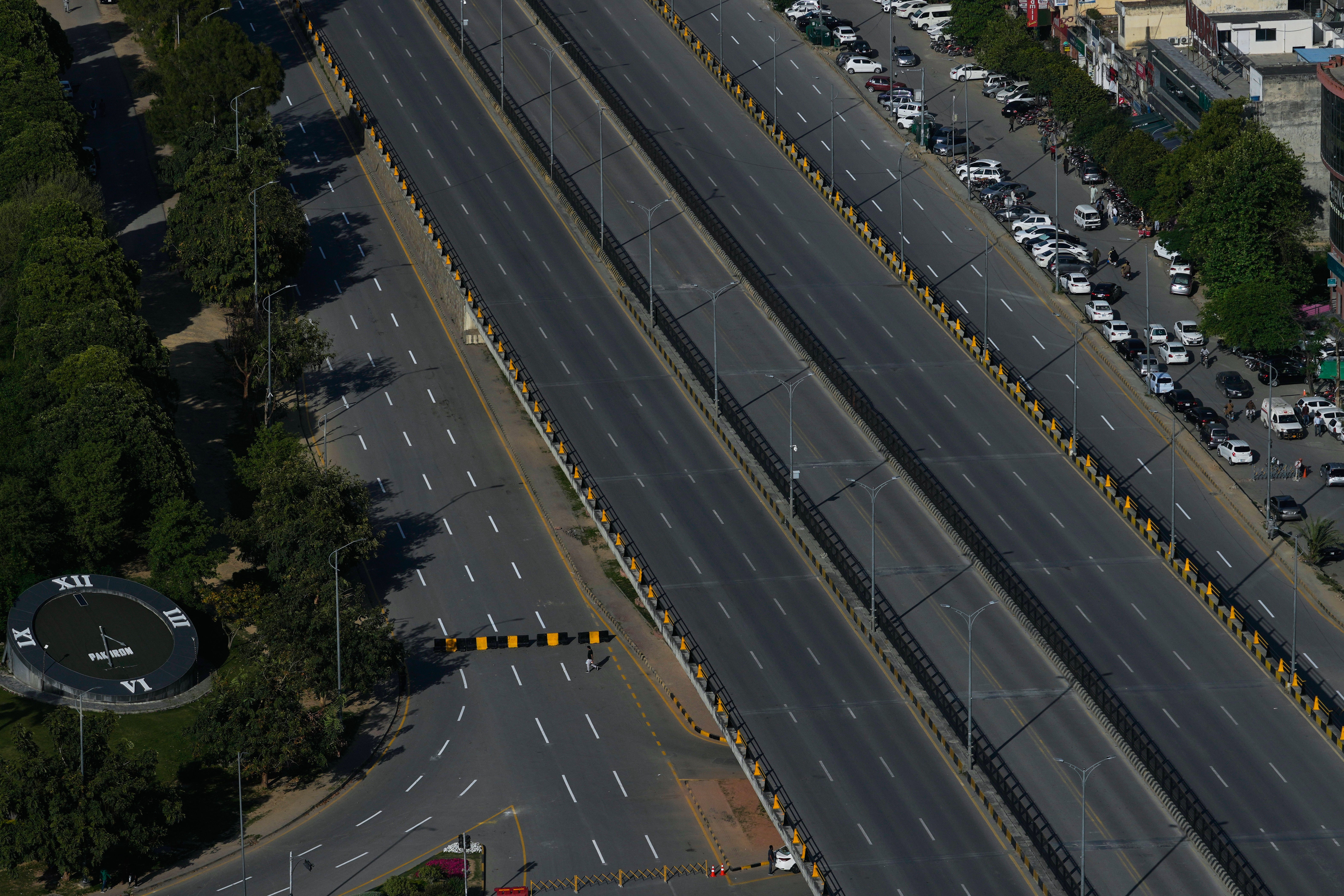
The government has asked offices to close and urged employees to work from home. Schools have been moved online. Streets which were once crowded are mostly empty.
Several areas, especially “red zone”, which houses critical government institutions, including the parliament, Supreme Court, the prime minister’s secretariat, and foreign embassies.
Advertisement
Al Jazeera said that for ordinary Islamabad residents, the impact has been “devastating”.
An X user wrote: “Islamabad was turned into a lockdown zone for days leaving ordinary people stuck in traffic missing flights work and daily routines. Security is important but when an entire city suffers before talks even begin it raises serious questions about priorities and planning.”
Another person wrote: “Islamabad & Rawalpindi are in lockdown with public transport & electric buses suspended in anticipation of US & Iran delegations’ arrival…The public is going through hell!”
A security personnel manages traffic at a closed road leading to the Serena Hotel in the Red Zone area of Islamabad on 23 April 2026 (AFP/Getty)
“Take the red zone out of Islamabad and move it outside, and kindly let the people of Islamabad and Pindi live a normal life,” wrote another social media user.
Daily wage earners have been among the worst affected. Muhammad Zubair, 45, a labourer, told The Guardian: “A lockdown means no work and no work means no food. The government does not care about the poor. We need work to feed our children.”
Advertisement
He has not been able to find work for the past six days. Small business owners are struggling too. Earnings have dropped sharply.
Muhammad Ahsan, 35, the owner of a small jewellery kiosk, told AFP: “The impact of the lockdown is that we are not seeing any customers here in the market… the government does not know what one day of their lockdown does to our households.”
“Our stoves do not run, we do not find food (in the markets).”
A man crosses a deserted road barricaded by authorities due to security arrangements for the US and Iran talks, in Islamabad, Pakistan, Wednesday, 22 April 2026 (AP)
Areej Akthar, a health officer at Pakistan Institute of Medical Sciences, told The Guardian: “Saturday was chaotic. I am lucky enough that my village is a three-hour drive away. But many people [who] were from distant cities and province[s] had to beg their colleagues, friends and relatives to allow them to stay until the US-Iran negotiations took place.”
With transport services suspended, commuting has become difficult or impossible.
Advertisement
Akhtar added: “It is like we are living in a cage.”
Students are also feeling the strain. Some exams have been moved to another city, forcing candidates to travel long distances.
The ongoing conflict in the Middle East has already disrupted global energy supplies. Pakistan has also been hit hard. Fuel shortages have led to long power cuts. Gas shortages have forced restaurants to close. The latest lockdown has only deepened these problems for the citizens.
However, despite the difficulties, there are locals who back the administration’s decision to put the city in an indefinite shutdown. “We are giving a small sacrifice to reduce the size of the larger sacrifice. So we will continue to sacrifice,” a local was quoted as saying byAFP.
Advertisement
Pakistani officials are hopeful that the diplomatic channels will reopen.
Maleeha Lodhi, a former Pakistani ambassador to the US and UK who was also briefed on the continuing diplomatic efforts, told The New York Times: “The cease-fire has opened a space that Pakistan thinks is enough for the diplomatic path to resume. Neither side has rejected the talks.”
In a message on X via the official supporters’ club,, external Millwall said the “serious misuse of a registered club badge” created a “false and damaging image of the club”.
Millwall said the council confirmed any remaining copies of the booklet they have will be destroyed and no more copies will be made and distributed.
“The club is still considering its legal position on the matter and are unable to comment further,” it said.
The Paul Canoville Foundation said it was aware of the image, which was widely shared on social media, but stressed it had no involvement in the material’s content, saying it was “not produced by, commissioned by, or approved” by the foundation or Canoville.
Advertisement
“Our involvement in the associated programme was limited solely to Paul’s personal appearance; meeting students and sharing his lived experience,” the foundation’s chief executive officer Raphael Frascogna said in a statement., external
“At no stage were we shown, consulted on, or asked to approve the content of the booklet, including any illustrations within it.”
Frascogna added the illustration does depict a real incident Canoville experienced when playing for Chelsea reserves against Millwall reserves in the 1980s, “in which he was subjected to serious racial abuse by a number of individuals wearing Ku Klux Klan-style white hoods”.
Former winger Canoville, now 64, played for Chelsea for five years from 1981 and scored 15 goals in 103 games, later retiring because of a knee injury aged 25 after a short spell at Reading.
Advertisement
Millwall are third in the Championship this season, level on points with second-placed Ipswich, who are in the automatic promotion places.
An artist’s impression of the planet Epsilon Indi Ab, with water clouds floating over its ammonia-dominated atmosphere (Picture: E. C. Matthews, MPIA / T. Müller, HdA/Cover Media)
Astronomers have found a Jupiter-like planet several light years away which probably smells of urine.
Epsilon Indi Ab has an ammonia atmosphere with clouds of water floating above the surface – and ammonia and water are the two primary components of urine.
The pungent planet may not be top of the list for any colonisation plans by Elon Musk, but it has intrigued scientists studying it with the James Webb Space Telescope (JWST).
Elisabeth Matthews, from the Max Planck Institute for Astronomy, is the lead author of a new study.
Advertisement
She said: ‘JWST is finally allowing us to study solar-system analogue planets in detail. If we were aliens, several light years away, and looking back at the Sun, JWST is the first telescope that would allow us to study Jupiter in detail.
‘For studying Earth in detail, we would need much more advanced telescopes, though.’
The team studied Epsilon Indi Ab using Webb’s mid-infrared instrument.
They found it is around 7.6 times the mass of Jupiter but a similar size and orbits its star at a much greater distance than most exoplanets studied so far, giving it a relatively low temperature of between –70C and +20C.
Advertisement
The discovery of the clouds of water were unexpected and not typical of many existing models of exoplanet atmospheres, as they are complex to simulate.
A digital image creation of Jupiter. Epsilon Indi Ab is the same size but far heavier (Picture: Getty Images)
James Mang of the University of Texas at Austin said: ‘It’s a great problem to have, and it speaks to the immense progress we’re making thanks to JWST.
‘What once seemed impossible to detect is now within reach, allowing us to probe the structure of these atmospheres, including the presence of clouds.
‘This reveals new layers of complexity that our models are now beginning to capture, and opens the door to even more detailed characterisation of these cold, distant worlds.’
Advertisement
NASA’s planned Nancy Grace Roman Space Telescope, expected to launch later this decade, may be able to detect such reflective clouds more directly.
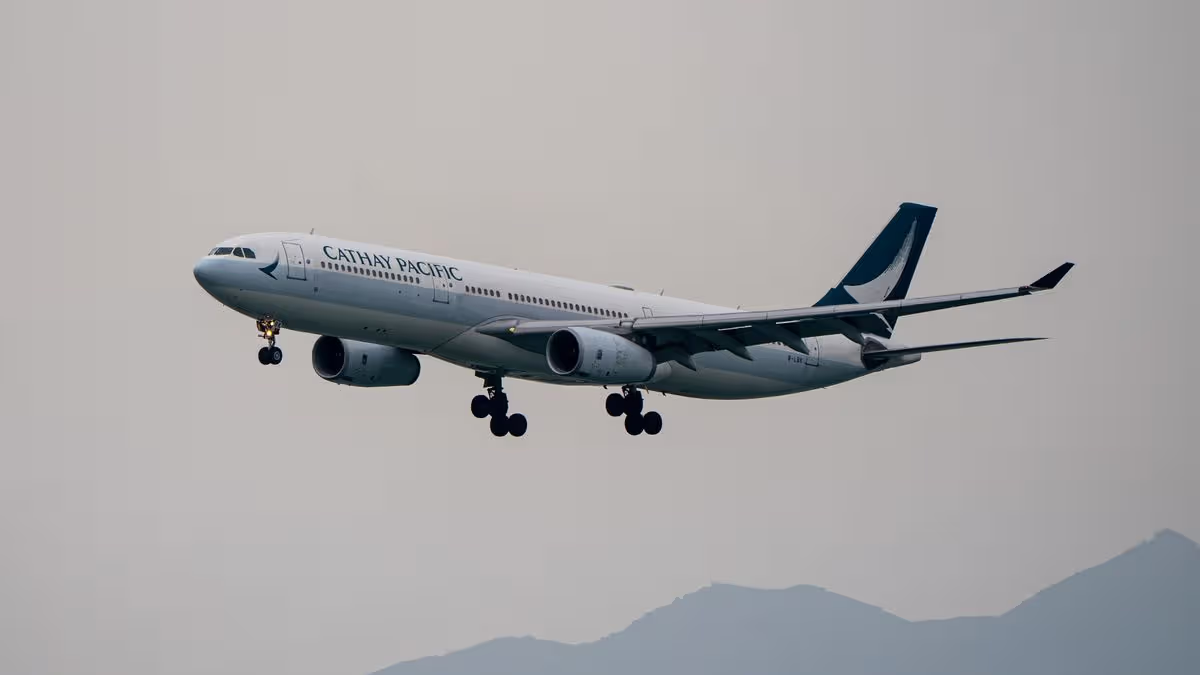
A 51-year-old man died during a Cathay Pacific flight from Manchester to Hong Kong on Friday morning – this is a breaking story
A 51-year-old man has died during a Cathay Pacific flight from Manchester to Hong Kong.
Advertisement
The passenger lost consciousness during flight CX216, which departed Manchester Airport at 11.04am HKT on Thursday and landed at Hong Kong International Airport at 6.53am on Friday (11.53pm BST on Thursday). Hong Kong police said they received a report at around 6.15am local time on Friday that a passenger had collapsed on board the flight, according to the Hong Kong Free Press.
An autopsy is currently underway to determine the cause of death, the outlet reports.
In a statement to the South China Morning Post, a spokesperson for Hong Kong’s flag carrier said that “the crew and a doctor on board had provided immediate first aid to the victim”. The spokesperson added that an ambulance was called and paramedics boarded the plane upon landing.
It comes just days after doubts were raised over Jimmy Bullard’s attendance, following an explosive row during filming with Adam Thomas.
Although Jimmy has now confirmed he will be appearing on tonight’s (April 24) ITV show, when viewers will vote for their I’m a Celeb ‘ultimate legend’, sadly, Beverley Callard will not be there.
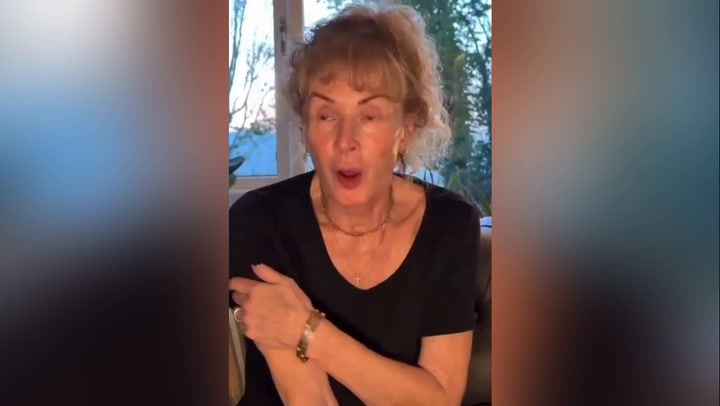
The Coronation Street favourite who was diagnosed with breast cancer in February issued an update to fans on her TikTok account yesterday (April 23).
Advertisement
Why is Beverley Callard not attending I’m a Celebrity final tonight?
In the caption alongside a video message, she shared: “A last minute change of plans…Absolutely gutted but I know it’s for the best. Resting up and getting well is more important at the moment.”
Beverley, who currently lives in Dublin, went on to explain: “Yesterday I should have flown over to England to get ready for the I’m a Celeb final which is tomorrow at 7.30pm.
“I was so excited and looking forward to it, and on medical advice I can’t go.
“So I’m absolutely gutted, I was dying to see them all, and it would have been brilliant, but I can’t go.”
Health professionals have told Beverley that attending the I’m a Celebrity South Africa final would be “too long a day” as she recovers from surgery.
Advertisement
She continued: “Flying there and you know, very late night… so here I am.”
However, the soap star will still be featuring in the live ITV final this evening and reuniting with her fellow campmates via Zoom, to “chat to everyone”.
Beverley added: “I’ve got to make the best of a bad job but I am resting, I am doing as I’m told, thanks to everybody.”
The actress was advised by medics to leave camp in the last week of the ITV reality show.
Advertisement
Beverley told the other celebrities she “didn’t feel well” after having “a bit of a funny turn”.
As she tearfully said her goodbyes, the 69-year-old said she was “absolutely gutted and wanted to finish” her time on the all-star show, and that she “wanted to prove that older women could do it”.
Since announcing her diagnosis of early-stage breast cancer, Beverley has documented her treatment on social media and has recently undergone surgery to remove the cancer.
Who is in the final of I’m a Celebrity South Africa 2026?
The four celebrities who have made it to Friday night’s final are Olympian Sir Mo Farah, former football manager Harry Redknapp, actor and DJ Craig Charles, and actor Adam Thomas.
Advertisement
Scarlett Moffatt just missed out and said she was “gutted” to become the latest campmate to be evicted during Thursday’s episode.
The Gogglebox star learnt she would be leaving the ITV programme after she came last in a trial, telling hosts Ant and Dec: “I felt like I was so close. I was the last girl standing.”
The challenge saw the celebrities have to count coloured balls as they rolled down a tube in front of them while they were showered with maggots, cockroaches, crickets and mealworms.
The five contestants were then asked how many blue balls there had been and were told that whoever’s estimate was the furthest from the correct figure would be evicted.
Advertisement
Thursday night’s instalment also saw the celebrities take part in the Cyclone challenge, which saw them have to clamber along a water slide to reach stars while being pelted with huge balls and sprayed with high-pressure hoses.
The group won the task, which resulted in them all receiving phone messages from their loved ones at home.
They also enjoyed a breakfast of 10 eggs between them after successfully catching them from a large “chicken” roosting in a tree above their camp.
The final of I’m a Celebrity South Africa will be shown from 7.30pm tonight on ITV1, STV, ITVX and STV Player.
Advertisement
Let us know which celebrity campmate you will be voting for to win, in the comments below.
Four months after filming in September, Callard was diagnosed with early-stage breast cancer.
Advertisement
In a new video posted on Thursday (23 April), the star said she “should have flown to England to get ready for the I’m A Celeb final” but “on medical advice, I can’t go, I am absolutely gutted.”
She added: “I was dying to see them all and it would have been brilliant. I can’t go and yesterday, the flights were booked and everything but no, they said, it is basically too long a day with flying there and then a very late night, so here I am.”
Can we ever really understand Chernobyl? As a researcher in visual culture, I find myself returning to this question again and again as I examine films, TV shows, documentaries, visual novels and artworks.
We know that the explosion occurred on April 26 1986 at 1:23am due to a safety test gone wrong, and that the radioactive contamination spread across the exclusion zone and far beyond, reaching other parts of Europe. Beyond these facts, however, things get shaky. Although the official death toll was, according to the World Health Organization’s 2005 report, less than 50, the real number is considered to be much higher, with thousands affected by the long-term consequences of exposure.
Radioactive contamination is what made this technological disaster so extraordinary. While many people may not be interested in decay chains or wavelengths, popular culture renders radioactive pollution immediately legible.
At the same time, these representations often operate in the space between historical fact and dramatisation. Although many can be criticised for exaggerating an already fantastical disaster, that dramatisation is also part of what keeps audiences engaged and ensures that Chernobyl remains alive in our cultural awareness.
Advertisement
Here are five of my favourite pop culture depictions of the Chernobyl disaster, that I believe give a pretty good glimpse of what the disaster entailed.
1. Chernobyl (2019)
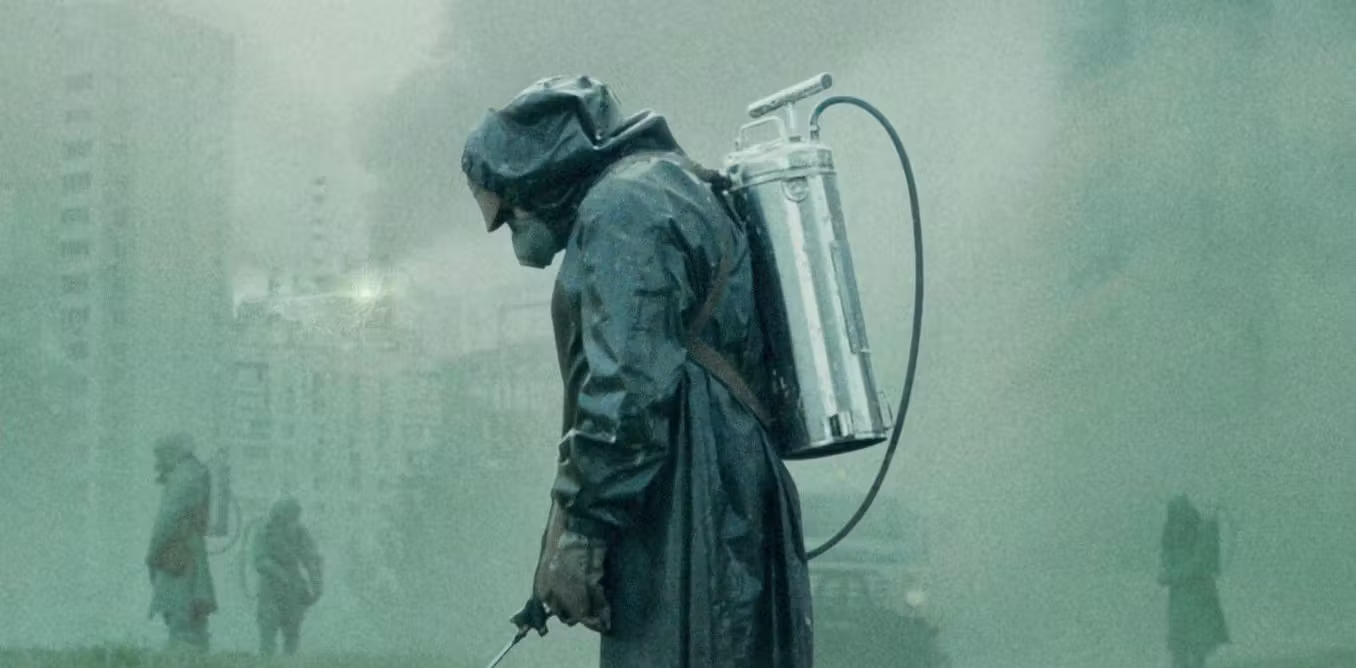
This series is one of the best ways to understand or be introduced to Chernobyl. Over the course of five episodes, HBO’s drama series brought viewers through the social, political and bureaucratic aspects of the disaster.
The trailer for Chernobyl.
Following the scientist Valery Legasov (Jared Harris), as well as the story of firefighter’s wife Lyudmilla Ignatenko (Jessie Buckley), the series does a great job at narrating the disaster in compelling ways. It is visually well constructed with attention to every minor detail.
Advertisement
The series finds ingenious ways to visualise invisible radiation, while scientists’ struggle to force the truth into the open is heart-wrenching enough to hold the viewer through all five episodes.
2. Chernobylite (2021)
The horror indie video game Chernobylite allows players to wander freely around Chernobyl’s exclusion zone – one of the most radioactively contaminated areas on Earth.
With time and climate change, the structures and buildings within the zone are at increasing risk of disappearing from both wildfires or age that leaves buildings crumbling. In an effort to preserve the zone, the creators of Chernobylite began to 3D scan it. Left with a virtual map, they decided to turn their project into a video game.
Advertisement
The trailer for Chernobylite.
In Chernobylite, players can roam freely and uncover the mystery of the zone. Although embellished with green glowing crystals and monsters, the game does offer a setting that allows you to walk around and experience the zone while scientists tell you information about the disaster.
This game is a wonderful way to experience the zone at a distance. It is photo-realistic and allows the players to really locate some of the famous landmarks of the zone (such as the Ferris wheel or the monument for the firefighters).
3. Chernobyl Abyss (2021)
This Russian disaster film follows fictional firefighter, Alexey Karpushin (Danila Kozlovsky) through some of the challenges in the immediate aftermath of the Chernobyl disaster.
Advertisement
The trailer for Chernobyl Abyss.
To save his son from radiation poisoning, Karpushin agrees to become a “liquidator” in exchange for having him sent to a care facility in Switzerland. Around 600,000 military personnel were drafted as liquidators – sent to high-radiation zones (often wearing inadequate protection) to clear radioactive debris and manage contaminated waste.
While it’s not a perfect film, it gives a good impression of the emotional and individual toll of the disaster.
4. The Babushkas of Chernobyl (2015)
Amid the tragic and often action-driven representations of Chernobyl, this documentary feels hopeful rather than bleak. It portrays life in the exclusion zone (some people have returned to live on their generational land) in all its complexity.
More importantly, it’s a reminder that while the zone may be reduced to a story for those of us watching from afar, for the people who live there, it remains a home.
Advertisement
The trailer for The Babushkas of Chernobyl.
5. YouTube
Before the escalation of the Russo-Ukrainian war in 2022, the zone was frequently visited. In fact, after the release of HBO’s Chernobyl series, tourism allegedly increased by 40%.
In a space where souvenirs like a stone from the ground are illegal to pick up, many instead captured the zone through their camera lens. Viewing videos from tourists and “stalkers” (illegal explorers) on YouTube, offers one of the best ways to gain insights into how the Chernobyl disaster has affected the land.
Many of these tourists capture the samoesely (resettlers), wildlife and guides who talk about the zone and what the disaster means to them.
It comes after the EU has issued a warning that passengers face a ‘very serious crisis’
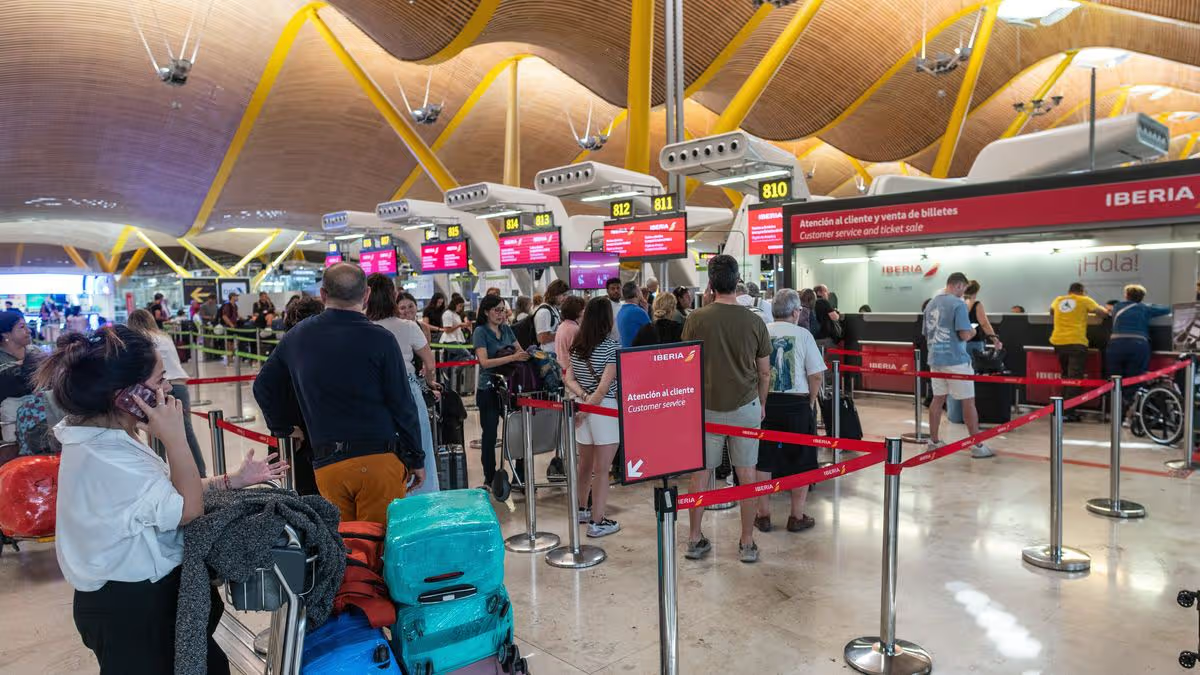
Airlines have announced they are cancelling and cutting back flights to and from the UK amidst massive rises in jet fuel costs and fears over shortages. The BBC has reported that 6 carriers so far which fly to the UK have said they’re going to operate fewer flights.
Advertisement
It comes after the EU has issued a warning that Europe faces a “very serious crisis” as aviation fuel supplies begin to dwindle due to the conflict in Iran, and holidaymakers may need to alter their summer travel plans.
“Unfortunately, it’s very likely that many people’s holidays will be affected, either by flight cancellations or very, very expensive tickets,” Dan Jorgensen, the EU energy commissioner, told Sky News. “Even if we do everything we can do, if the jet fuel is not there, then it’s not there.”
Jorgensen added: “[Currently] it is primarily a crisis of prices and not yet a crisis of supply, but unfortunately we cannot be sure to prevent a crisis of supply, especially on jet fuel in the future, if the crisis continues.”
The International Energy Agency has cautioned that significant supply problems could emerge within the next five to six weeks. Airlines are already implementing measures to curb demand: the Lufthansa Group, among Europe’s largest airline operators, has confirmed the scrapping of 20,000 flights over the coming months. Meanwhile, other carriers are hiking ticket prices on long-distance routes to offset rising fuel costs.
The price of flights has been rising since the start of the conflict in the Middle East, a worry for anyone planning a summer holiday.
Which airlines are cancelling flights?
Airlines that serve the UK which plan to operate fewer flights.
KLM
Air Canada
Asiana Airlines
Delta Airlines
Lufthansa
SAS
The following companies have said they don’t plan to change their schedules:
British Airways owner IAG
EasyJet
Jet2Holidays
Flight prices
While some airlines have cut back on the number of flights to save money, others have said they will start charging more per passenger or will put up charges for luggage.
Advertisement
These include:
Air France-KLM
Indigo
Pakistan International Airlines
Thai Airways
Turkish Airlines-Sun Express
Virgin Atlantic
Rory Boland, travel editor at consumer publication Which?, says overall cancellations will be a very small proportion of the millions of flights in and out of the UK, and the changes will be targeted on routes where there are multiple flights a day so that passengers can be rebooked on to an earlier or later flight. Low-cost Spanish regional airline Volotea has come under fire for saying it will add a surcharge to tickets it has already sold and is being challenged by local consumer rights groups.
Holiday giant Tui said the Iran war cost it around 40 million euros (£34.8 million) last month after it was forced to repatriate thousands of holidaymakers and staff.
Europe’s largest travel operator cut its profit forecast and suspended revenue guidance as a result, sending it shares lower.
Advertisement
The company is among travel firms to have been significantly disrupted by the conflict in the Middle East, which began at the end of February. It is also among airline firms to face pressure from a surge in jet fuel prices after the conflict pushed up the price of oil.
On Wednesday, Tui told shareholders that it had to absorb 40 million euros worth of costs in March due to “repatriation efforts and related operational disruptions”.
Following the start of the war, Tui repatriated around 5,000 passengers from two cruise ships anchored in ports in Abu Dhabi.A lot of the industry’s jet fuel supplies come from the Gulf region, and most of it passes through the Strait of Hormuz, which has effectively been closed to shipping since the start of March.
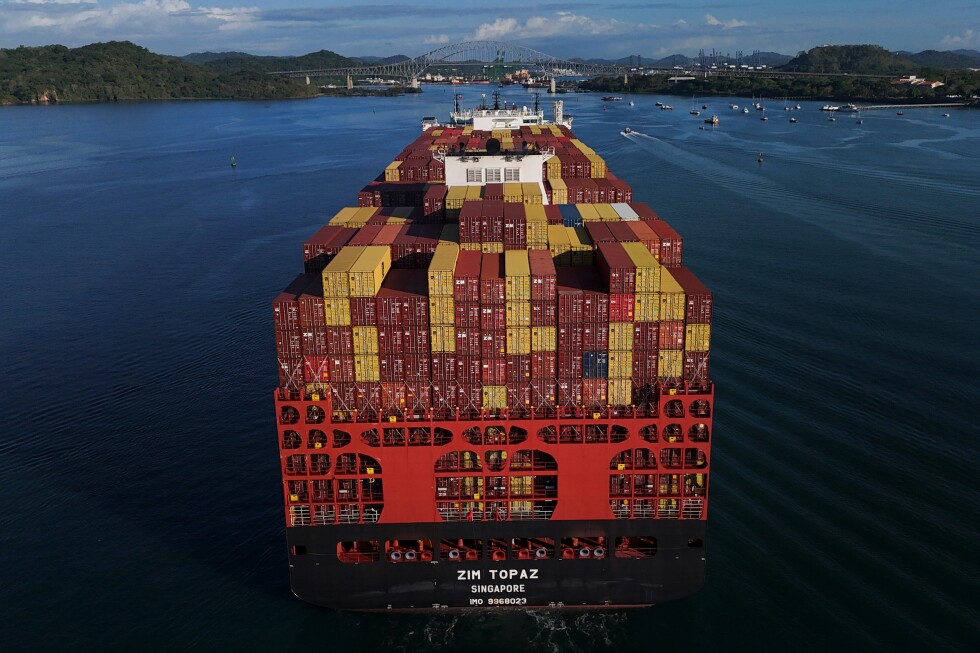
PANAMA CITY (AP) — Businesses have doled out up as much as $4 million to move boats through the Panama Canal with the Strait of Hormuz effectively closed, according to the Panama Canal Authority, in a move that has created a seismic shift in global trade flows.
While passage through the waterway usually comes at a flat rate via reservations, companies without reservations can cross by paying an additional fee in an auction for slots, which are awarded to the highest bidder rather than waiting for days off the coast of Panama City.
That price has ballooned in recent weeks as Iran and the United States have bottlenecked the key shipping route, the Strait of Hormuz, and demand for those slots has skyrocketed. Ships have increasingly traveled through the Panama Canal as shipments are rerouted and buyers purchase from other countries to avoid commerce through now-treacherous Middle Eastern waterway.
“With all the bombings, the missiles, the drones … companies are saying it’s safer and less expensive to cross through the Panama Canal,” said Rodrigo Noriega, said lawyer and analyst in Panama City. “All of this is affecting global supply chains.”
Advertisement
Meanwhile, Noriega said Panama’s government is “maximizing what it can earn from the Panama Canal.”
The average price to cross through the canal ranges between $300,000 and $400,000 depending on the vessel. Previously, to get an earlier crossing, businesses would pay an additional $250,000 to $300,000. In recent weeks, the average additional cost has jumped to around $425,000.
Ricaurte Vásquez, the canal’s administrator, said another company that he would not name paid an extra $4 million when its fuel vessel had to change its destination because of ongoing geopolitical tensions.
“It was a ship carrying fuel to Europe, and they redirected it to Singapore, and it needed to get there because Singapore is running out of fuel,” he said.
Advertisement
Other oil companies paid an excess of $3 million in addition to the crossing fee to accelerate their passage in the face of soaring oil prices.
Vásquez said that ships have not piled up at the canal, but rather the costs can be attributed to last-minute shifts and greater urgency by vessels needing to get from one point to another faster in the wake of larger trade chaos.
Vásquez emphasized that the costs were not a blanket market rate, but rather a temporary toll shouldered by companies.
“They decide how high a price to go,” Vásquez said.
Advertisement
At the same time it’s earning more money from the new business, Panama’s government has also been dealt a blow by the geopolitical struggle.
On Wednesday, the country’s foreign ministry accused Iran of illegally seizing a Panama-flagged vessel from the Italian company, MSC Francesca, in the Strait of Hormuz.
Panama, a country with one of the world’s largest ship registries, said the ship was “forcibly taken” by Iran. It wasn’t immediately clear if the boat remained in Iranian custody.
“This represents a serious attack on maritime security and constitute an unnecessary escalation at a time when the international community is advocating for the Strait of Hormuz to remain open to international navigation without threats or coercion of any kind,” it said.
Advertisement
Noriega, the analyst, said that the amount companies are paying to cross the Panama Canal may only go up if the conflict continues to stretch on, as oil prices are already skyrocketing. The price of a barrel of Brent crude oil briefly jumped above $107 this week, soaring from around $66 a barrel a year ago.
“No one really foresaw the potential effects (the war) would have on global trade,” Noriega said.
Neil Donaldson, commercial director of growers Hall Hunter, which has farms near Wokingham and Wargrave in Berkshire and Godalming in Surrey, said: “Cool nights and warm sunny days create the perfect conditions for growing sweet, full-flavoured strawberries — and that’s exactly what this weekend’s forecast is bringing.
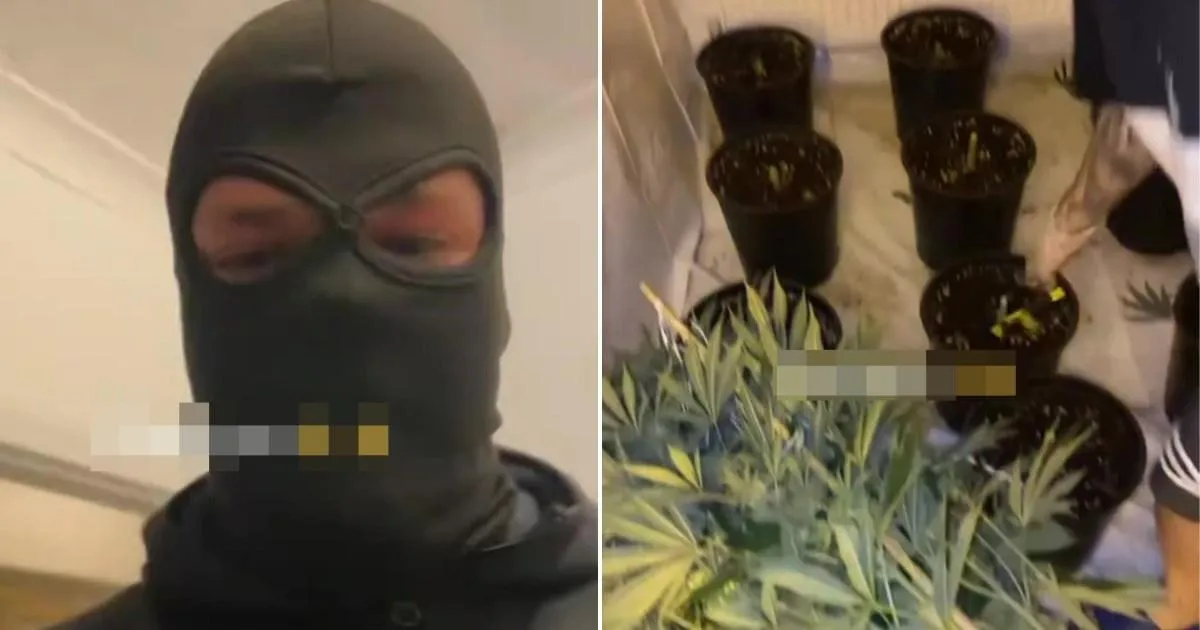
Footage appears to show an Albanian gang clad in balaclavas filming themselves on TikTok raiding a cannabis ‘crop house’.
Advertisement
The chilling post shows masked men using infrared scanners on normal suburban streets to locate the heat from cannabis grow lamps. Once they have found a target, they make their way inside.
They pose for the camera with a violent trap song accompanying the footage with ‘f*** you’ written as a caption as the gang appear to rob the house.
The clip shows a bewildered-looking man in shorts and a T-shirt who apparently lives or works in the house being intimidated by the gang. The camera focuses on the raiders clutching cannabis plants.
Footage apparently showing an Albanian gang ‘robbing’ grow houses is getting views on TikTok (Picture: TikTok)
Sign up for all of the latest stories
Start your day informed with Metro’s News Updates newsletter or get Breaking Newsalerts the moment it happens.
Advertisement
The ‘crop houses’ are kitted out with high-tech lighting and heating to aid the growth of the plants in what can be a highly lucrative business.
The shocking footage is one of a series of videos featuring the men in what seems to be a celebration of their criminal lifestyle. The house, allegedly a ‘crop house’ in which cannabis is grown on an industrial scale, features several times on the account.
Advertisement
The property, which looks like an ordinary suburban house, cannot be identified.
The gang uses infrared cameras to identify their target (Picture: TikTok)
The video is believed to have been shot in West Yorkshire, according to the online footprint of the account holder who posted the clip.
Other footage posted on the same TikTok account shows a masked member of the ‘gang’ climbing up the side of a house before clambering through an open window.
Another shows an apparent reconnaissance mission in which the gang hide and watch a crop house.
Some of the footage is tagged with Albanian flags and accompanied by slogans in Albanian.
Advertisement
Once inside gang appear to get a worker to load cannabis for them before they leave with the drug (Picture: @TikTok)
The rap themes are charged with violence and knives are mentioned. But no weapons are featured in the clips.
In one of the films the ‘gang’ members are seen holed up in what appears to be a safe house.
The latest ‘crop house’ footage is chillingly similar to that posted by another Albanian ‘crew’ this time in east London.
In Barking, a heavily armed Albanian gang called the Hellbanianz filmed themselves brandishing weapons while flaunting cash, Rolexes while driving Ferraris.
They ran the Gascoigne estate where their ‘soldiers’ lived. Their brash online posts eventually led the police to the door and some members have been convicted.
Advertisement
Meanwhile the Metro exposed a criminal network operating in Southgate, north London, where people trafficking and drug deals are bringing in huge sums.
A source told Metro: ‘We call it little Tirana around here. The Albanian gangs have a grip on the community and there is a lot of fear about being taken out [killed]. They have taken over some of the businesses and have threatened others.
Advertisement
‘There have been connections with people trafficking, protection rackets and drug dealing. It’s their turf for sure and they hide in plain sight.They have taken over some of the businesses and have threatened others.
‘There have been connections with people trafficking, protection rackets and drug dealing. It’s their turf for sure and they hide in plain sight. We know who they are and where they operate out of. It has been reported to the police they need to get a grip of this.’
Southgate is being called ‘Little Tirana’ after the Albanian capital, by locals (Picture: John Dunne)
Other areas of the capital have also seen the rise of Albanian gangs.
When raiders stormed an Albanian cannabis factory to steal the product their machetes and knives proved no match for the handguns the Albanians pulled to defend their territory.
A court heard that the robbers who were trying to steal from the factory in Croydon had ‘brought knives to a gunfight’.
Advertisement
The Shqiptare is the term used by the National Crime Agency to describe the Albanian crime syndicates.
They sell huge amount of cocaine smuggled into into the UK via Latin America.
It is believed they run a majority of the estimated £5bn cocaine market. They are buying for up to £5,000 a kilo according to police estimates. They started selling for less profit than their rivals to corner the market.
The supply of cocaine and other drugs on an industrial scale has provided the Albanian mob with funds to almost ‘buy up’ communities.














![LISA - 'MONEY' 2023 WORLD TOUR [BORN PINK] KYOCERA DOME OSAKA](https://wordupnews.com/wp-content/uploads/2026/02/1770253317_hqdefault-80x80.jpg)


































You must be logged in to post a comment Login