
Crypto World
Liquidity Mining Is Just Customer Acquisition With Tokens Instead of Cash


Liquidity mining has long been framed as a cornerstone innovation in decentralized finance—an elegant mechanism to bootstrap liquidity, decentralize ownership, and align incentives between users and protocols. But beneath the narrative, a more familiar pattern emerges: liquidity mining often functions as a form of paid customer acquisition, with tokens replacing traditional cash incentives.
This framing does not diminish its importance. Instead, it clarifies both its strengths and its limitations
Reinterpreting Liquidity Mining
At its core, liquidity mining distributes tokens to users who provide capital or perform activities for a protocol. Whether through supplying liquidity, staking assets, or executing trades, participants are rewarded for behaviors that enhance the protocol’s functionality and attractiveness.
From a business perspective, this resembles a classic growth strategy:
- Incentivize user participation
- Increase platform activity
- Build initial network effects
The only difference is the currency. Instead of spending fiat on ads or promotions, protocols issue native tokens—effectively subsidizing early adoption with future upside.
Paid User Acquisition, Repackaged
Traditional startups allocate significant budgets to acquire users through marketing campaigns, referral bonuses, and discounts. Liquidity mining mirrors this approach, but with a structural twist:
- Tokens as incentives: Users are compensated directly in protocol-native assets
- Lower upfront cost: Instead of depleting cash reserves, protocols dilute token supply
- Speculative appeal: Rewards are not just payments—they are perceived investments
This creates a powerful feedback loop. As long as token prices remain stable or increase, participation appears profitable, attracting more users and reinforcing growth.
However, the mechanism is not fundamentally different from paid acquisition—it is simply more capital-efficient in the short term.
Temporary Engagement Spikes
Liquidity mining programs are highly effective at generating rapid traction. When rewards are attractive, capital flows in quickly, often producing dramatic increases in:
- Total Value Locked (TVL)
- Trading volume
- User activity
These spikes can create the appearance of strong product-market fit. Yet, much of this activity is incentive-driven rather than organic.
Participants, particularly sophisticated users, optimize for yield. They allocate capital where rewards are highest and withdraw it just as quickly when incentives decline. This behavior introduces a critical dynamic: engagement is often rented rather than earned.
The Retention Problem
The most significant challenge emerges when rewards taper off.
Without continuous incentives, many users disengage, leading to:
- Declining liquidity
- Reduced trading activity
- Increased volatility in protocol metrics
This reveals a fundamental issue: liquidity mining does not inherently create loyalty. It attracts capital, but it does not guarantee that capital will stay.
In traditional terms, this is equivalent to acquiring users who churn as soon as discounts disappear.
Token Emissions as a Cost
While liquidity mining avoids immediate cash expenditure, it is not free. Token emissions represent a form of cost—one that is often less visible but equally impactful.
Key considerations include:
- Dilution: Increased token supply can suppress long-term value
- Sell pressure: Recipients frequently sell rewards, affecting price stability
- Sustainability: Continuous emissions may be required to maintain engagement
In effect, protocols are paying for growth, just as traditional companies do—only the cost is denominated in equity-like instruments rather than cash.
When Liquidity Mining Works
Despite its limitations, liquidity mining can be highly effective under the right conditions. It performs best when:
- The underlying product delivers genuine utility
- Incentives are used to accelerate, not replace, organic adoption
- Token design aligns long-term participation with protocol success
In these cases, liquidity mining acts as a catalyst—helping a protocol reach critical mass before transitioning to more sustainable growth drivers.
Toward Sustainable Incentive Design
The next evolution of liquidity mining lies in improving retention and reducing reliance on continuous emissions. Emerging approaches include:
- Time-weighted rewards that favor long-term participation
- Revenue-sharing mechanisms that tie rewards to real protocol income
- Dynamic incentive systems that adjust based on user behavior and market conditions
These models aim to shift the focus from short-term attraction to long-term alignment.
Finale
Liquidity mining is not a flawed concept—it is a misinterpreted one. At its essence, it is a sophisticated form of customer acquisition, optimized for decentralized systems and powered by token economics.
The challenge is not whether to use it, but how to use it responsibly. Protocols that recognize liquidity mining as a cost of growth—and design accordingly—are far more likely to convert temporary participation into lasting ecosystems.
Because in the end, incentives can bring users in. Only real value makes them stay.
REQUEST AN ARTICLE



Artificial intelligence has now expanded its dominance to US equities and the credit market.
The shift is rewriting how capital flows through Wall Street, with AI-linked companies crowding out traditional sectors from benchmark indices while also redefining the largest corners of the bond market.
AI Stocks Hit Record 45% of S&P 500 as Credit Markets Follow Suit
AI-linked stocks now account for a record 45% of the S&P 500’s total market cap, according to data from The Kobeissi Letter. That share has risen by 20 percentage points since OpenAI launched ChatGPT in November 2022.
Follow us on X to get the latest news as it happens
The shift in the credit market is equally stark. A record 15.4% of US investment-grade debt is now tied to AI, up +3.5 points since 2020. It has also become the market’s largest segment.
Total AI-linked debt has nearly doubled since 2020, reaching an all-time high of $1.4 trillion. Hyperscalers such as Amazon, Alphabet, Meta, Microsoft, and Oracle have dominated the trend.
Together, the five issued $121 billion in US corporate bonds during 2025, well above the $28 billion annual average they posted between 2020 and 2024.
“Never before has a single theme dominated both US equity and credit markets to this magnitude,” The Kobeissi Letter wrote.
The AI trade is also reshaping global equity leadership. Taiwan’s stock market cap climbed to $4.14 trillion, passing the UK’s $4.09 trillion for the first time.
The country’s market cap has tripled since 2020, driven almost entirely by semiconductor stocks. Taiwan Semiconductor Manufacturing Company (TSMC) alone accounts for more than 40% of the market capitalization.
In effect, the trajectory of AI adoption and monetization may now set the direction for much of the global market. Meanwhile, any pause could expose how much of that valuation rests on a single theme.
Subscribe to our YouTube channel to watch leaders and journalists provide expert insights
The post AI Swallows Wall Street: Stocks Hit Record 45% of S&P 500 Market Cap appeared first on BeInCrypto.


Key takeaways
- ADA is trading below key resistance zones, signaling a bearish near-term bias and limiting recovery attempts.
- Whales are reducing their exposure to ADA, which could lead to further price decline.
Cardano (ADA) continues to trade under pressure, hovering below $0.250 on Friday as price action remains subdued beneath key resistance zones.
On-chain data from Santiment indicates that certain whale wallets have begun reducing their holdings, adding to selling pressure.
Whales reduce exposure amid shifting accumulation trends
Santiment’s Supply Distribution data points to a weakening outlook for Cardano as large-wallet investors adjust their positions. Whales holding between 100,000 and 1 million ADA and 1 million–10 million ADA have collectively offloaded around 80 million tokens since April 19.
Furthermore, wallets in the 10 million–100 million ADA range have accumulated approximately 60 million ADA over the same period.
This divergence suggests a rotation in holdings: mid-sized whales are selling, while larger entities are absorbing supply. Such behavior often reflects distribution at elevated levels, increasing short-term downside risk.
Cardano’s derivatives data present a mixed outlook with a slight bearish tilt. CoinGlass data shows open interest falling to $444 million on Friday, down from $490 million on April 18. This indicates declining trader participation and weakening speculative demand.
Additionally, ADA’s long-to-short ratio stands at 0.80, its lowest level in over a month. A ratio below 1 indicates bearish positioning, with more traders expecting price declines.
Despite that, the funding rate paints a bullish narrative. The OI-weighted funding rate turned positive on Thursday and currently sits at 0.0076%, suggesting that long positions are paying shorts—often interpreted as a mild bullish signal.
Cardano price outlook: bears continue to halt recovery
The ADA/USD 4-hour chart is bearish and efficient as Cardano remains technically weak, trading below $0.250.
The coin is facing immediate resistance at the 50-day EMA of $0.258, followed by $0.269 (23.6% Fibonacci retracement) and the 100-day EMA at $0.294.
Momentum indicators remain neutral. The Relative Strength Index (RSI) sits at 51, while the MACD is flat just above zero, indicating a lack of strong directional conviction.
If the bearish trend persists, immediate support is found at $0.245. A breakdown below this level could expose ADA to further losses toward $0.220, a key prior-cycle support zone.

However, if the bulls regain control and close above the $0.258 resistance, it would be the first sign of recovery strength, potentially opening the path toward $0.269 and higher resistance levels near $0.294 and $0.299.
An extended bullish reversal would require a move above $0.323 and eventually toward the 200-day EMA near $0.383.
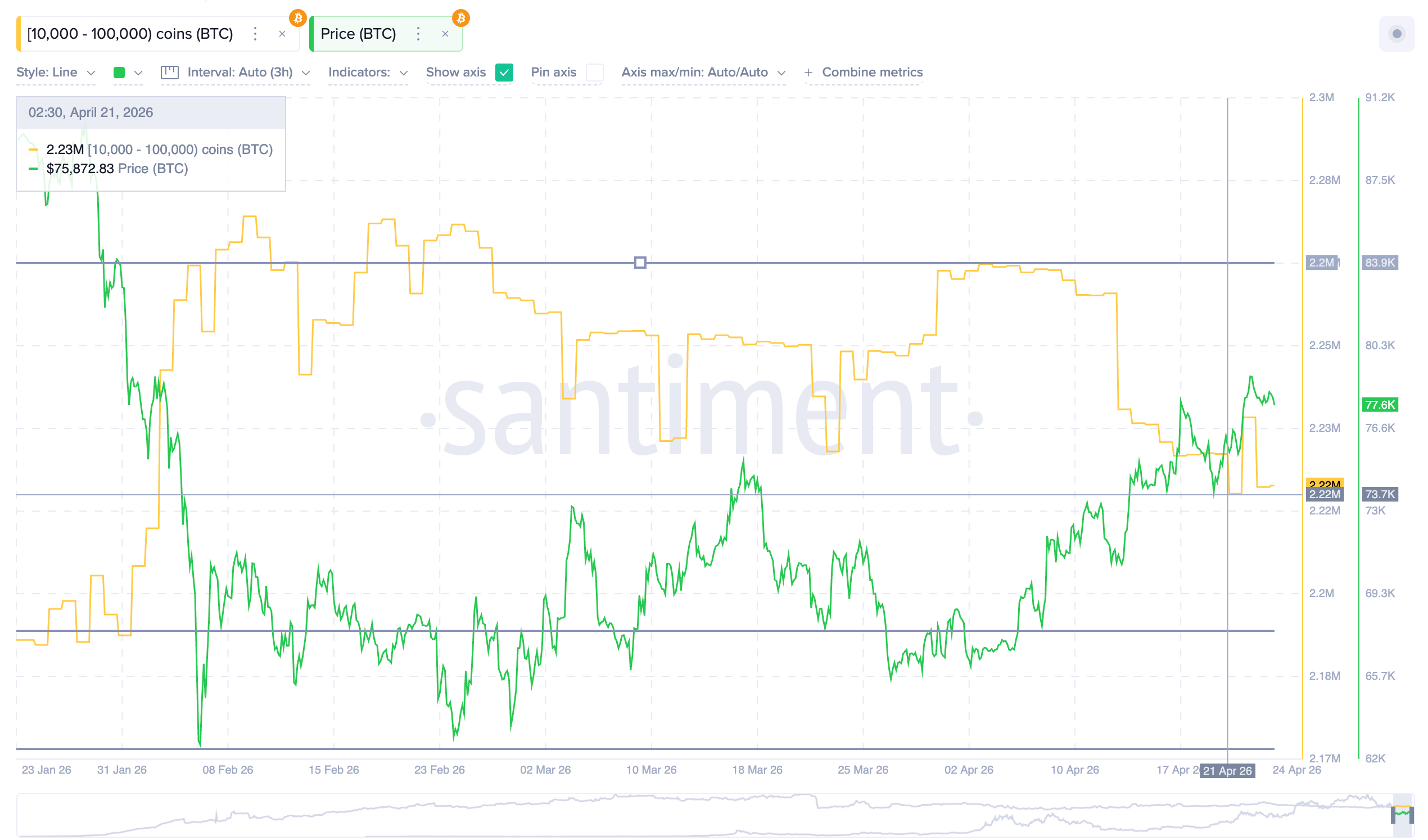
Bitcoin whales are buying the bounce. Hodlers are not. The split between the two cohorts tells a very different story than the one the Bitcoin price rally is showing.
Bitcoin (BTC) trades at $77,670 on April 24, sitting inside a rising channel that has defined the chart since February 24. The rally back above $77,000 looks constructive on the surface. Yet beneath it, two on-chain signals pull in opposite directions. And the divergence reveals what the biggest wallets are actually doing.
Bitcoin Whales Buy Every Bounce, and the April 22 Crossover Was the Trigger
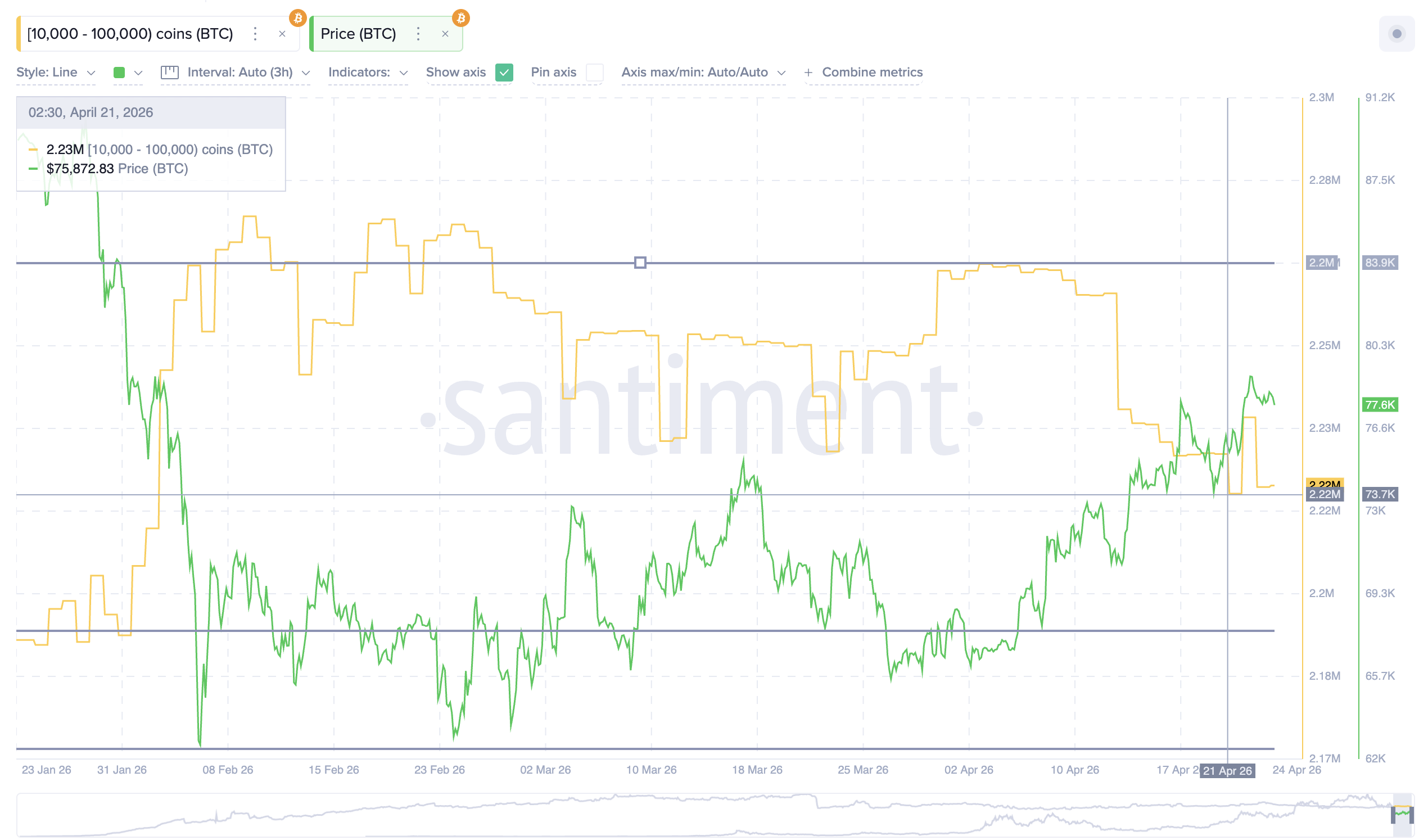
The 10,000 to 100,000 BTC whale cohort has a clear pattern. They buy local bottoms, ride the bounce, and step back. Santiment data shows the cohort jumped its stash from 2.26 million to 2.27 million BTC within four days of Bitcoin’s February 6 low under $62,000. The same cohort added from 2.23 million to 2.26 million BTC between March 23 and early April as price bottomed near $67,700. Now, they are buying again, starting April 22.
Want more token insights like this? Sign up for Editor Harsh Notariya’s Daily Crypto Newsletter here.
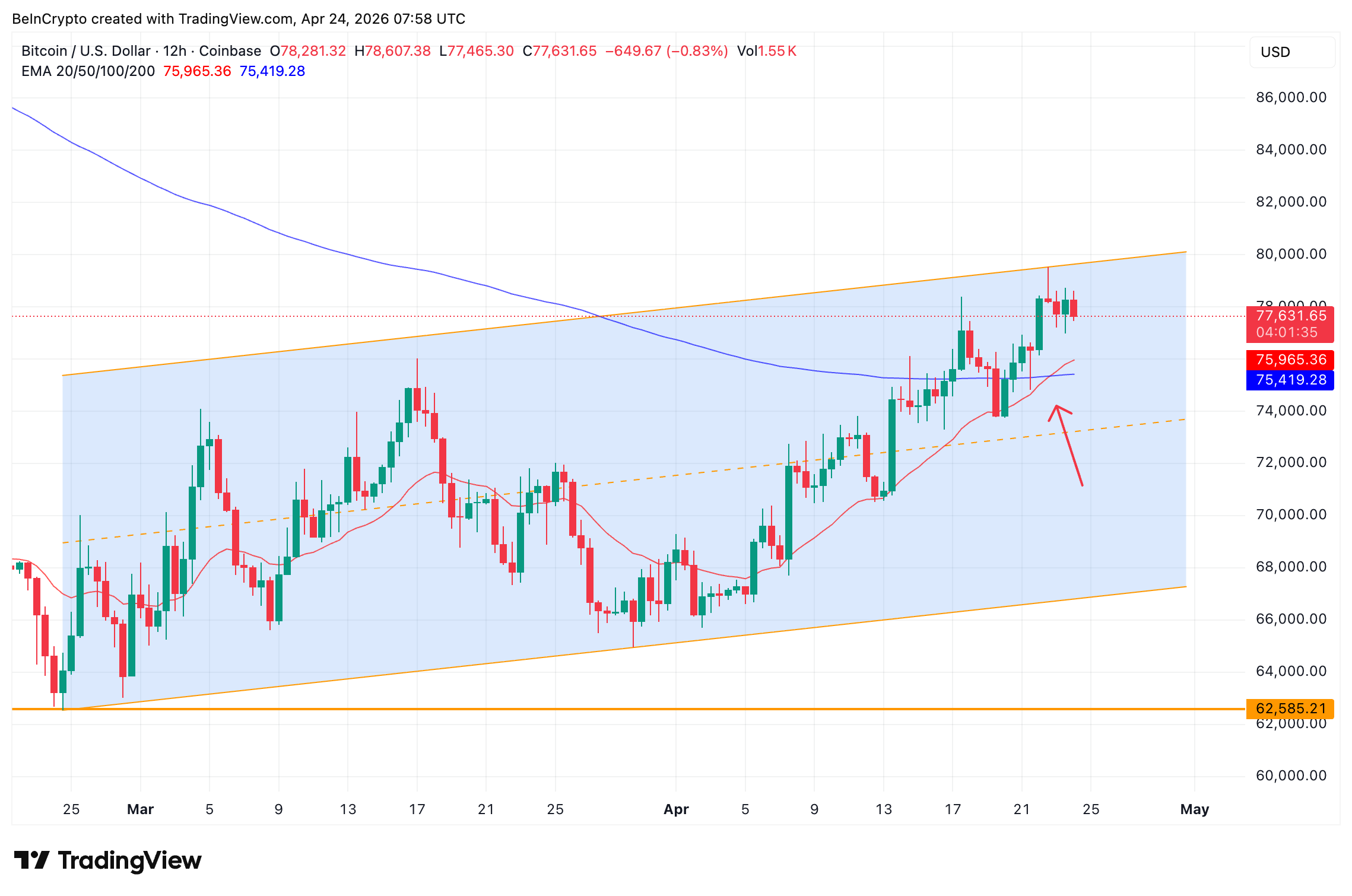
The April 22 buy had a technical trigger. On the 12-hour chart, the 20-period Exponential Moving Average (EMA), a trend line that averages price with more weight on recent candles, crossed above the 200-period EMA. That bullish crossover formed the exact day whales restarted buying. This points to a timing (opportunistic) trade rather than a conviction bet.
ARK Invest’s Q1 2026 Bitcoin Quarterly adds context. The big money buyers expanded their holdings by 69%, from 2.13 million to 3.60 million BTC during Q1’s 22% drawdown, marking the fastest accumulation pace since the 2020 cycle. However, price has since recovered off those lows.
And the current whale buying is happening at $77,000, not the $68,200 levels where ARK’s conviction data was captured. These are bounce buyers, not bottom buyers.
Hodlers Are Not Joining the Rally, Validating the Bottom Is Not In
If this rally were the start of a durable recovery, mid-term holders would be adding. They are not. Glassnode’s Hodler Net Position Change, a metric that tracks whether mid-term holders are accumulating or distributing BTC, peaked at 38,401 BTC on April 21 at a BTC price of $76,470. By April 24, that reading dropped to roughly 32,303, a 16% collapse in three days. Conviction wallets are not chasing the bounce.
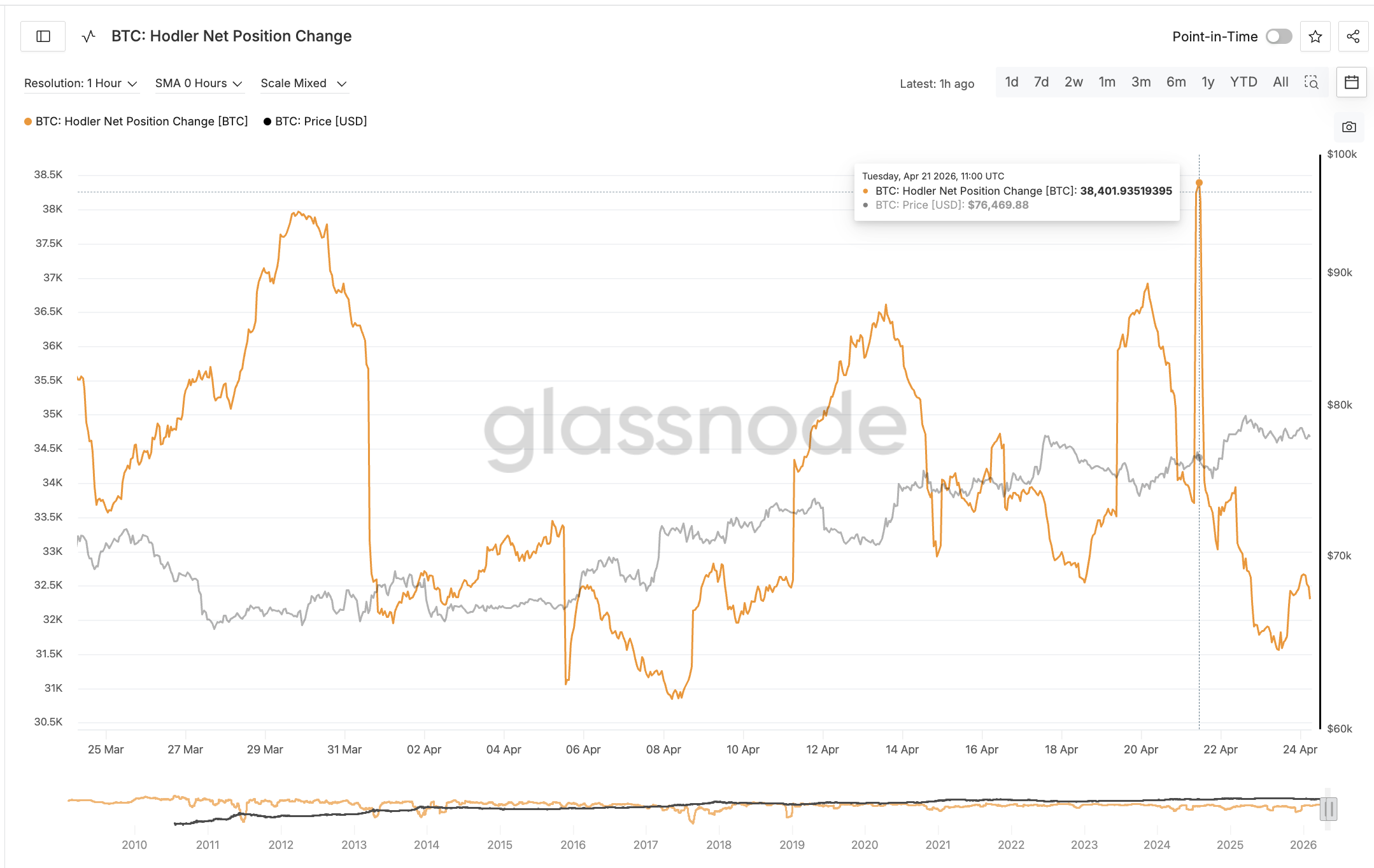
The real conviction wallets are not chasing the bounce. That could be possibly due to the lack of a clear market bottom indicator, one that we highlighted in our previous Bitcoin price analysis.
Bitcoin Price Faces Rejection at $79,528 as the Channel Top Caps the Rally
Bitcoin pushed to the top of its rising channel at $79,528 on April 22 before reversing. That rejection aligns with the whale pattern. The bounce trade ran into the same upper trendline that has capped every rally since February, and without hodler support, the move has stalled.
A daily close above $79,528 would flip the structure and open the channel’s ceiling near $80,000, with hodler conviction likely to follow. However, rejection here exposes the 0.236 Fibonacci retracement at $75,523 as the first downside test.
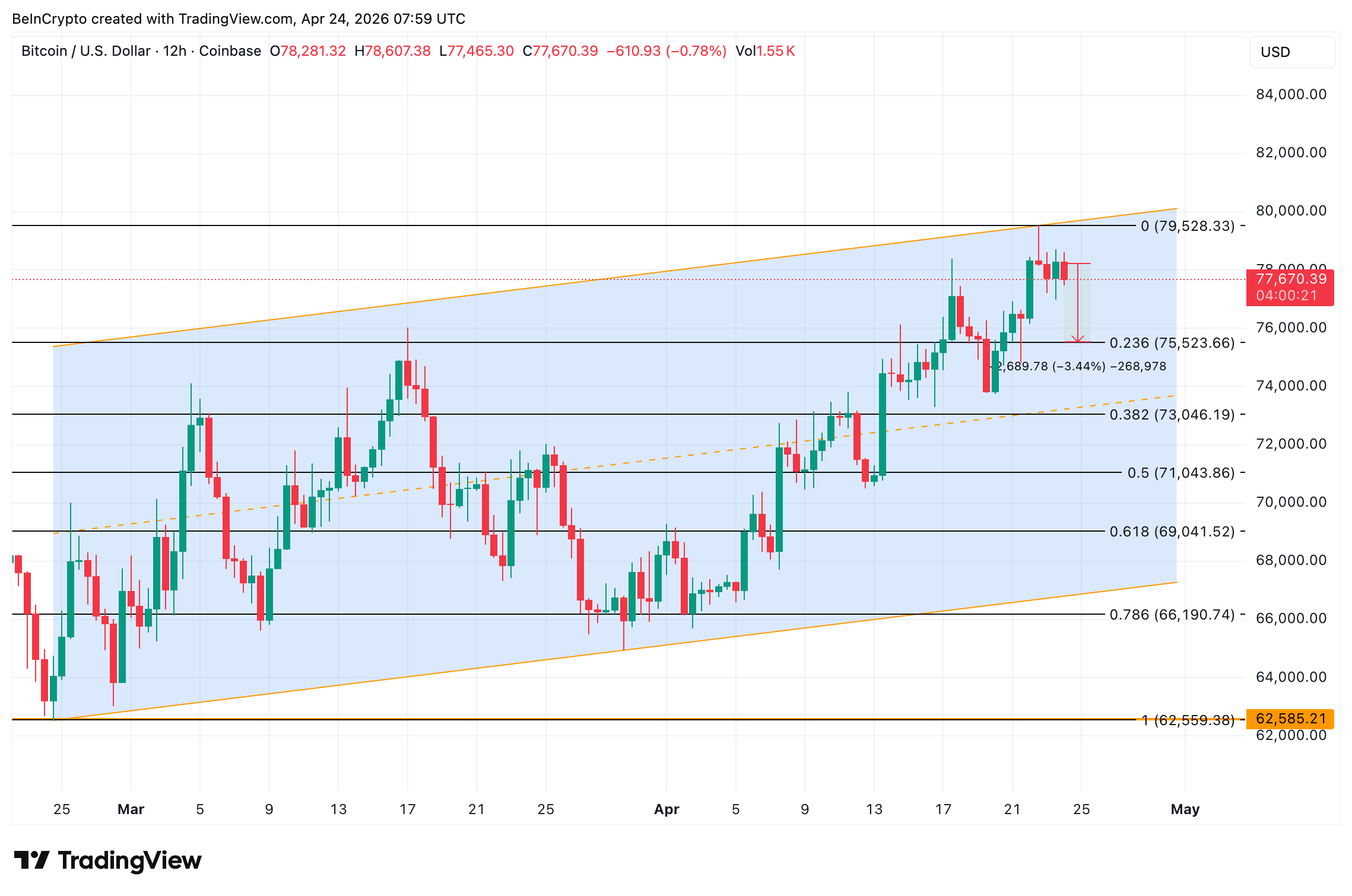
A break under $75,523 opens $73,046 and $71,043, and a slide toward the 0.786 Fibonacci level at $66,190 would unlock the channel floor near $62,559. The January rally of 10% can unwind quickly if whales decide the bounce has no legs. For now, $79,528 separates a confirmed breakout from another whale-led bounce that fades back into the channel.
The post Are Bitcoin Whales Opportunists? On-Chain Data Reveals the Truth appeared first on BeInCrypto.

A journalist films Xiaomi SU7 Ultra cars during a Xiaomi track day driving experience in Tianjin, in northern China on April 23, 2026, ahead of the Beijing Auto Show which opens on April 24. (Photo by GREG BAKER / AFP via Getty Images)
Greg Baker | Afp | Getty Images
BEIJING — Foreign automakers are finally catching up with their Chinese rivals on technology, as they battle a sales slump in the world’s largest car market.
U.S., Korean and German automakers rushed to announce a new lineup of models for China around the Beijing auto show that kicked off Friday.
“We have plans to really build this brand and return [to] where we used to be in terms of volume and [market] share,” Will Stacy, vice president, Cadillac China at General Motors, told CNBC’s Eunice Yoon.
Cadillac on Wednesday announced its first car with driver-assist technology for China: a three-row “luxury” electric SUV, priced at 468,000 yuan ($68,000) and 508,800 yuan.
Called the VISTIQ, the vehicle uses advanced driver assist software that can handle highways and city roads, as well as automatic parking. The tech was co-developed with Chinese autonomous driving startup Momenta.
“We’ve been mostly an ICE [internal combustion engine] brand here in China, and with this vehicle that enables us to enter the game here in China,” Stacy said. He said sourcing locally in China allows Cadillac to compete effectively with its local rivals — cutting production time to 18 months — while the brand aims to attract customers with a promise of trust on safety.
Hyundai officially launched its all-electric IONIQ brand in China on Friday as the Korean automaker kicks off its most ambitious local expansion to date.
“China is where the future of mobility is being defined, and Hyundai intends to help define it, in China, for China, and ultimately, for the world,” José Muñoz, president and CEO of Hyundai Motor Company, said in a release.
Muñoz added in an interview with CNBC’s Eunice Yoon that as China has fallen from 17% to 4% of Hyundai’s total sales, the automaker had to “reimagine the strategy.”
Hyundai’s new IONIQ V also comes with advanced driver-assist co-developed with Momenta, and offers voice-control functions using an AI assistant that runs on a Qualcomm Snapdragon 8295 chipset.
Muñoz told CNBC that Hyundai could export the brand to Asia-Pacific, Australia and the Middle East if sales in China do well.
Hyundai’s China sales in March were about a third of what they were in the same month in 2019, before the pandemic. A number of other foreign carmakers have also seen sales drop over the same period. Figures compiled by CNBC suggest Nissan sales in China in March were down 47% on March 2019, while Cadillac fell 39%.
“I’m glad to see that these foreign brands are humble enough and recognize the value of the Chinese tech that they’re incorporating it,” said Stephen Dyer, partner and managing director and head of AlixPartners’ Asia automotive and industrials consulting practice.
He’s less optimistic that the foreign brands can win back significant market share in China, but said they have an opportunity to bring technology from China to their home markets.
“I think the technology … will disseminate throughout the world,” Dyer said. “I don’t think you can keep it locked up in the bottle of China. I think it’s already gone out.”
Cars with personality
German automaker Volkswagen, which is also embarking on its most ambitious China product campaign, announced Tuesday that it will begin rolling out AI-powered voice command in its cars in China starting in the second half of the year.
“The car should be like a companion,” Volkswagen China CTO Thomas Ulbrich said.
He said the company’s in-car AI agent would draw on tech from Tencent, Alibaba and Baidu, among others, to create a tool with “personality” that can anticipate a driver’s needs.
Volkswagen revealed four cars in Beijing on Tuesday, including the ID. UNYX 09, which the company said it co-developed with EV maker Xpeng in two years.
The German automaker has built a research and development center in Hefei where it can manage the entire production process.
Hyundai and its local state-owned partner BAIC had committed 8 billion yuan to a joint venture as of December 2024.
The venture, Beijing Hyundai, plans to introduce 20 new models in China over the next five years. The cars include the new IONIQ V, and another SUV in the first half of 2027 — with the goal of 500,000 sales annually.
China market leader BYD recorded sales of 688,993 in China in the first three months of 2026, though that marked a 30% drop on the same period in 2025. BYD sold 2.26 million battery-powered cars globally last year, exceeding Tesla‘s 1.64 million vehicle sales.
On average, 10 to 15 cars launch in China in the span of about a month, which means automakers “need to remain relevant and fresh” for customers who face many choices, Ivan Espinosa, president and CEO of Nissan, told CNBC’s Elaine Yu.
“The fact that we have established dealers with established experience, good relationships and good service for them, this is also starting to become more and more important,” Espinosa said.
Nissan plans to launch five new energy vehicles utilizing plug-in electric technology in the next 12 months.
The Japanese automaker has a joint venture with China’s Dongfeng, and integrated DeepSeek AI capabilities into its N7 electric sedan last year.

Subscribe now
— CNBC’s Matthew Chin contributed to this report


Fold Holdings has rolled out a Bitcoin-based bonus program for employees, expanding its push to bring BTC into everyday workplace compensation.
Summary
- Fold has introduced a Bitcoin bonus program that lets companies distribute recurring BTC rewards without handling custody or compliance.
- Steak ‘n Shake has rolled out the program to more than 10,000 hourly workers, contributing $0.21 per hour into bonuses that vest after two years.
Fold said the new offering, launched under its enterprise arm Fold Business, allows companies to distribute recurring bonuses in Bitcoin without handling custody or compliance requirements themselves.
“We launched our Bitcoin Bonus Program because we saw a gap that no one was filling,” said Fold co-founder and CEO Will Reeves.
“An employer-grade bonus vehicle that’s differentiated enough to matter, accessible enough for every employee, and operationally simple enough that HR and Finance don’t need to become Bitcoin experts to run it. We’ve created a recruiting story that didn’t exist before.”
Fold handles conversion from dollars into Bitcoin and manages distribution, allowing employers to set bonus structures in fiat terms while offering exposure to BTC.
Bitcoin bonuses move beyond pilot stage
Early adoption has already come from Steak ‘n Shake, which introduced the program across its workforce after first announcing the initiative in January and putting it into effect on March 1. More than 10,000 hourly workers across the U.S. are now eligible, with the company contributing $0.21 per hour worked into a Bitcoin bonus that fully vests after two years.
Simple Mining has also adopted the program for salaried staff, allocating 1% of employee pay into Bitcoin that is redeemable at year’s end.
According to the company’s head of revenue, Matt Garland, the option gives employees access to a bonus that “grows with time” and gives workers more reason to stay.
Fold’s latest move builds on its earlier collaboration with Steak ‘n Shake, which introduced Bitcoin into its customer experience in late 2025. At the time, the chain offered a $5 BTC reward with select meals across nearly 400 locations, requiring customers to upload receipts and redeem rewards through the Fold app.
“Bitcoin goes mainstream when it starts showing up in everyday life,” Reeves said during that rollout.
“For many people, this will be the first time they ever own bitcoin, and it will come from something as ordinary as grabbing a burger.”
Moving from consumer rewards to payroll-linked incentives, the company is extending the same approach into workplace finance. Plans for the Fold Business platform include payroll services, corporate Bitcoin treasury tools, and payment cards aimed at enterprise use.


For years, enterprise blockchain adoption was measured through wallet growth, transaction counts, and pilot announcements. Now, in 2026, a different benchmark is gaining attention.
Financial institutions and regulators increasingly want to know who operates the networks they may rely on for tokenization, settlement, and real-world financial activity.
That focus places validator identity near the center of the next adoption cycle. As banks, asset managers, and regulated service providers move deeper into blockchain participation, they are looking beyond passive exposure and toward direct operational roles.
This trend is especially visible in Asia, where digital asset regulation has advanced quickly and institutional engagement continues to expand.
It is also visible in ecosystems built with enterprise participation in mind, including XDC Network, which has developed a validator model centered on known operators and accountability.
HashKey Cloud Joins XDC Network as a Masternode Validator
That direction gained another example with HashKey Cloud joining XDC Network as a Masternode Validator.
HashKey Cloud is the institutional staking and node services arm of HashKey Holdings, a publicly listed group on the Hong Kong exchange. Its entry into validator operations on XDC adds another regulated operator to a network already known for targeting trade finance, tokenized assets, and enterprise use cases.
Indeed, rather than limiting involvement to investment positions or advisory partnerships, established firms seem to be taking responsibility for transaction verification, ledger maintenance, and governance functions.
This is especially important as institutions evaluating network risk often assess governance standards, uptime expectations, operator accountability, and jurisdictional alignment alongside technical performance.
What is a Masternode Validator?
On XDC Network, Masternode Validators are responsible for validating transactions, maintaining the ledger, and participating in governance decisions.
Unlike fully anonymous validator environments, XDC uses a curated validator model built for enterprise-grade reliability.
The structure aims to serve organizations that require predictable operations and identifiable counterparties across critical workflows such as trade finance, treasury products, and tokenized securities.
HashKey Cloud enters this role with regulatory standing across major Asian markets, including licenses tied to the Monetary Authority of Singapore and the Securities and Futures Commission.
For institutions considering blockchain-based operations, the presence of known and supervised validators can support internal risk reviews, vendor due diligence, and compliance processes.
Chen Shanlong, Head of Asia at XDC Network, said the partnership reflects the type of participation the network has been building toward.
“Every institution that joins as a validator strengthens the case for XDC as the network that financial institutions and governments can rely on. These institutions operating at the validator level bring compliance standards, governance accountability, and a level of credibility that anonymous operators cannot provide.”
The Pattern Behind XDC’s Validator Set
HashKey Cloud joins a validator ecosystem that already includes major corporate and financial names such as Deutsche Telekom, SBI Holdings, and UOB Venture Management.
Rather than pursuing scale through a large anonymous validator base, XDC has prioritized recognized operators with institutional standing.
This model may appeal to sectors where transaction certainty and governance visibility carry high importance. Trade finance, cross-border business payments, supply chain records, and tokenized fixed-income products often require standards closer to traditional financial markets than open retail networks.
The network has already developed traction in tokenized real-world assets, with more than $1.3 billion in tokenized U.S. Treasury bonds and private credit reportedly facilitated on-chain.
As tokenization grows, the validator conversation may become increasingly relevant. Asset issuers and institutional users are likely to ask who secures the chain hosting regulated products, how governance decisions are made, and whether operational participants can be held accountable.
Asia’s Expanding Role in Institutional Blockchain
Asia remains one of the strongest regions for this trend.
Hong Kong has advanced digital asset licensing. Singapore continues to develop regulated frameworks for tokenized finance and digital payment activity. Regional banks and financial groups are exploring tokenized deposits, securities settlement, and blockchain-based treasury infrastructure.
Leo Li, CEO of HashKey On-Chain BG, said XDC’s track record in trade finance and tokenization made it a natural fit.
“Asia is at the forefront of institutional blockchain adoption. As financial institutions and governments across the region move toward blockchain-based settlement and tokenization, we see this as the first of many steps in deepening our engagement with the ecosystem.”
What Comes Next
The next phase of blockchain competition will, no doubt, differ from earlier cycles.
Instead of focusing mainly on token listings or retail activity, enterprise networks may compete on validator quality, regulatory readiness, governance standards, and proven real-world use.
XDC Network is well aware of this, with additional institutional validator partnerships across Asia, the Middle East, and Europe expected in the coming months.
Validator identity may become one of the clearest indicators of which networks are prepared for institutional-scale finance.
The post Validator Identity as the Next Test of Institutional Blockchain Adoption appeared first on BeInCrypto.


India is turning to welfare payments to drive adoption of its central bank digital currency as it prepares to put the CBDC in the spotlight at a summit of BRICS nations later this year.
The Reserve Bank of India is running about 10 pilot programs routing portions of the country’s roughly $80 billion welfare system through the e-rupee, Reuters reported Thursday. The effort aims to reduce leakage and corruption in subsidy programs while giving the CBDC a clearer use case after a slow rollout.
In Maharashtra’s Phulenagar village, farmers are receiving programmable subsidies covering up to 80% of drip-irrigation costs, spendable only at approved vendors. A separate pilot in Gujarat aims to onboard all 7.5 million households eligible for subsidized food by June, effectively using targeted transfers to scale adoption.
The push underscores a core challenge for CBDCs globally: usage. The e-rupee has grown to about 10 million users from roughly 7 million earlier this year, but cumulative transactions since its December 2022 introduction total just $3.6 billion. That remains small compared with India’s Unified Payments Interface, which processes about $300 billion each month.
Early adoption efforts have at times been engineered. CoinDesk reported in 2024 that several major banks, including HDFC, Kotak Mahindra and Axis Bank, credited employee salaries into CBDC wallets to help the system surpass 1 million daily transactions in December 2023, a milestone that did not persist.
India’s domestic experimentation comes as policymakers consider a larger geopolitical role for the technology. The Reserve Bank of India has urged the government to advance a proposal for linking CBDCs across the economies of Brazil, Russia, India, China and South Africa at the bloc’s 2026 summit, aiming to streamline cross-border trade and reduce reliance on the U.S. dollar.
That ambition carries political risk. President Donald Trump has threatened tariffs on BRICS countries pursuing alternatives to the dollar and has already imposed duties on Indian imports tied in part to its purchases of Russian crude, raising the stakes for any coordinated monetary effort.
UPDATE (April 24, 90:27 UTC): Rewrites headline to explain CBDC acronym.
Crypto World
Ethereum Price Prediction: Today’s Options Expiry as 10 Straight Days of ETF Inflows Snap
Ether’s 10-day ETF inflow streak just snapped hard. Ethereum price is slipping to $2,300 in today’s Asia session, but that doesn’t mean we are getting a bearish prediction.
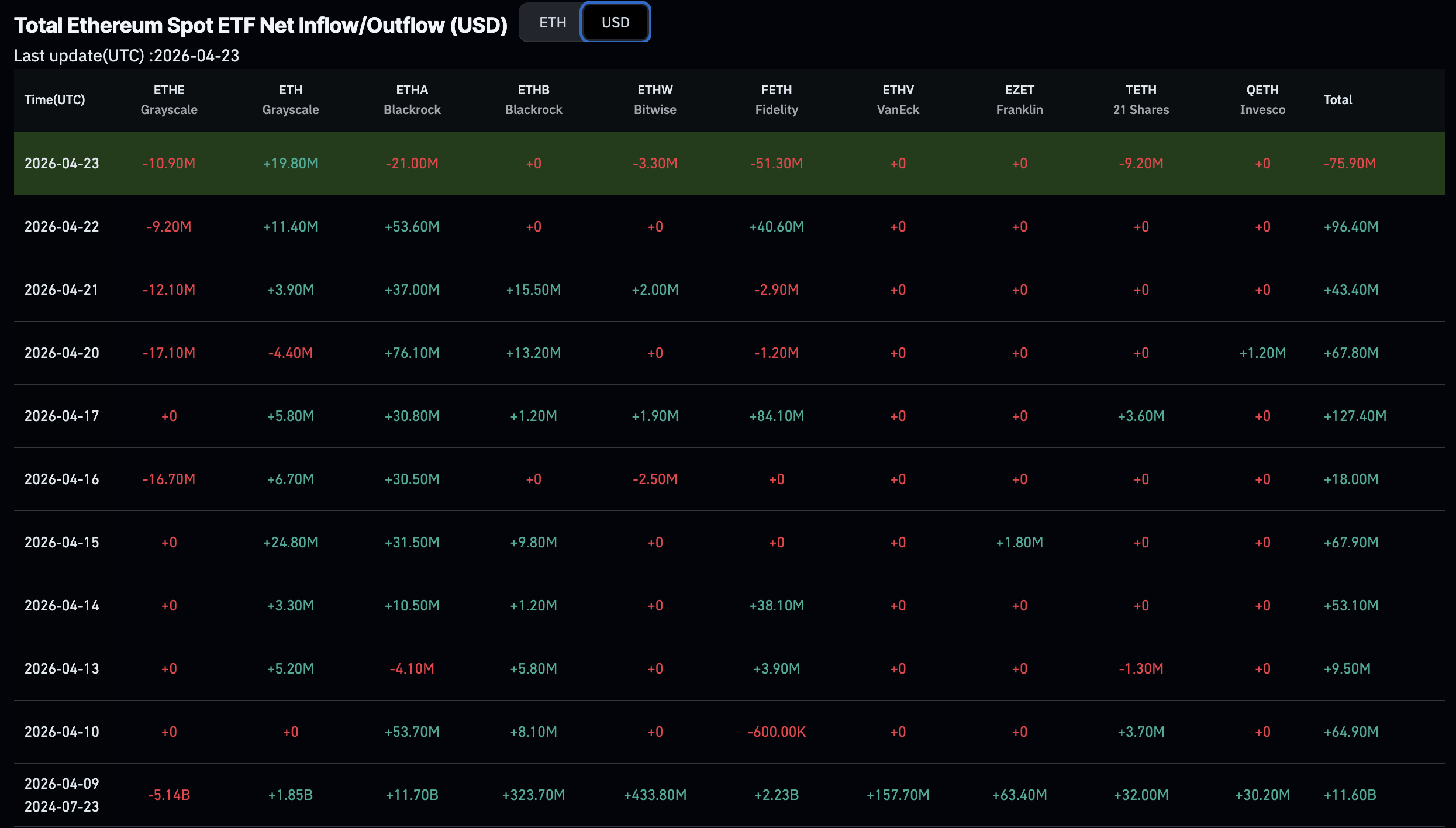
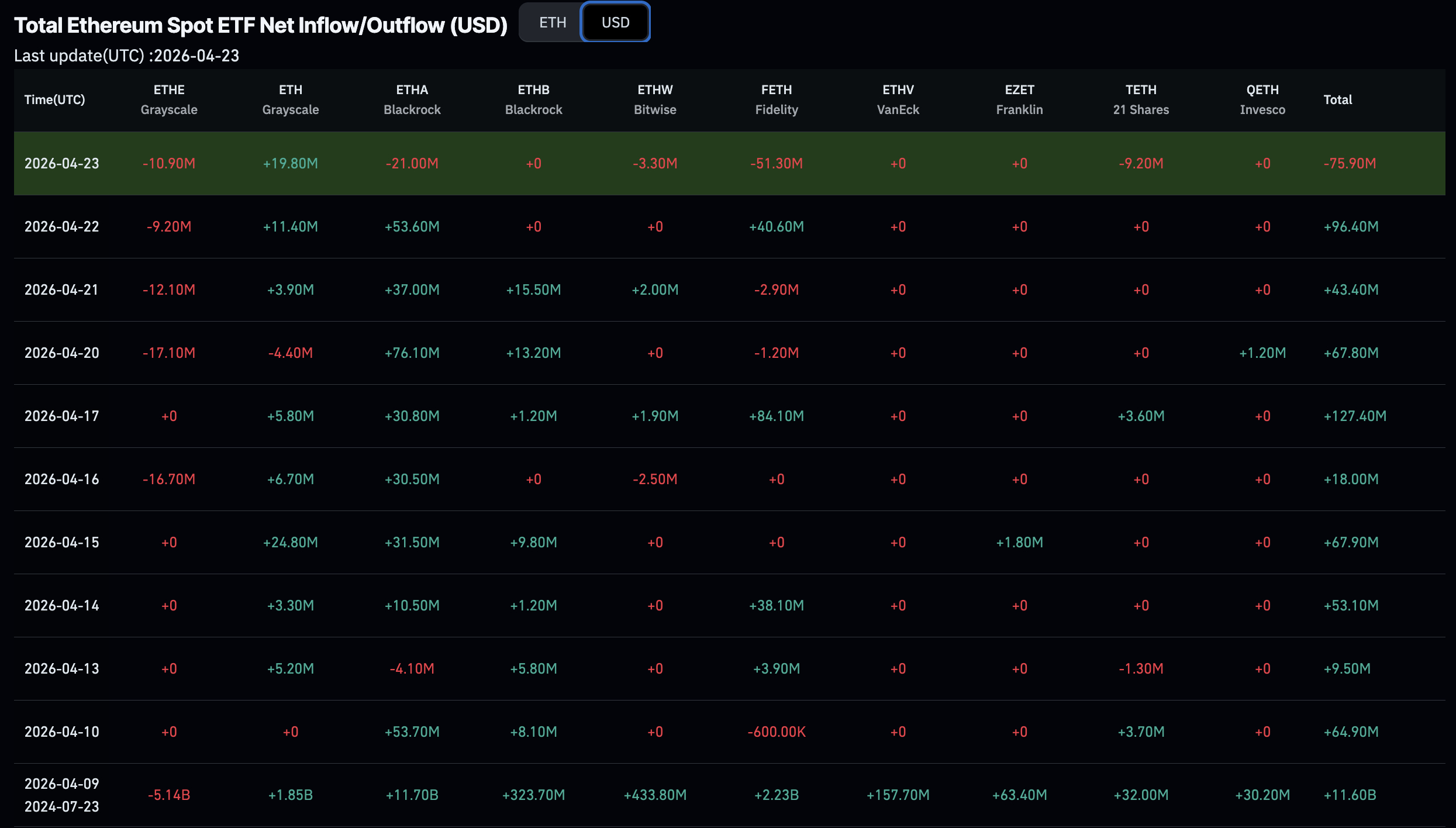
Spot Ethereum ETFs recorded a net outflow of $75.9 million on April 23, abruptly ending a 10-day consecutive inflow run. Yesterday’s compares poorly with the prior session’s $96.4 million in ETH ETF inflows. Yesterday was a $172.3 million single-day swing in the wrong direction.
Meanwhile, spot Bitcoin ETFs drew $223 million on the same day, extending their own inflow streak to eight days. Strategy’s latest purchase, worth $2.54 billion, added further tailwind to the BTC side of the ledger.
NEW: CNBC reports that spot Bitcoin ETF inflows are ramping up and BTC is "closing in on $80k" — Bitcoin Magazine (@BitcoinMagazine) April 23, 2026
 pic.twitter.com/felRafNxd1
With an $8.6 billion BTC/ETH options expiry landing today and Bitcoin dominance sitting at 60%, the ETH/BTC trade is suddenly back in focus.
Discover: The best pre-launch token sales
Ethereum Price Prediction: $2,500 A Pipe Dream?
ETH opened today at $2,375 before sliding to $2,310 by late morning, a move that put the price back below the $2,400 uptrend level that bulls need to reclaim. Binance analysts flag $2,500 as the critical support zone, warning that failing to break the resistance level could open the path to $2,200.
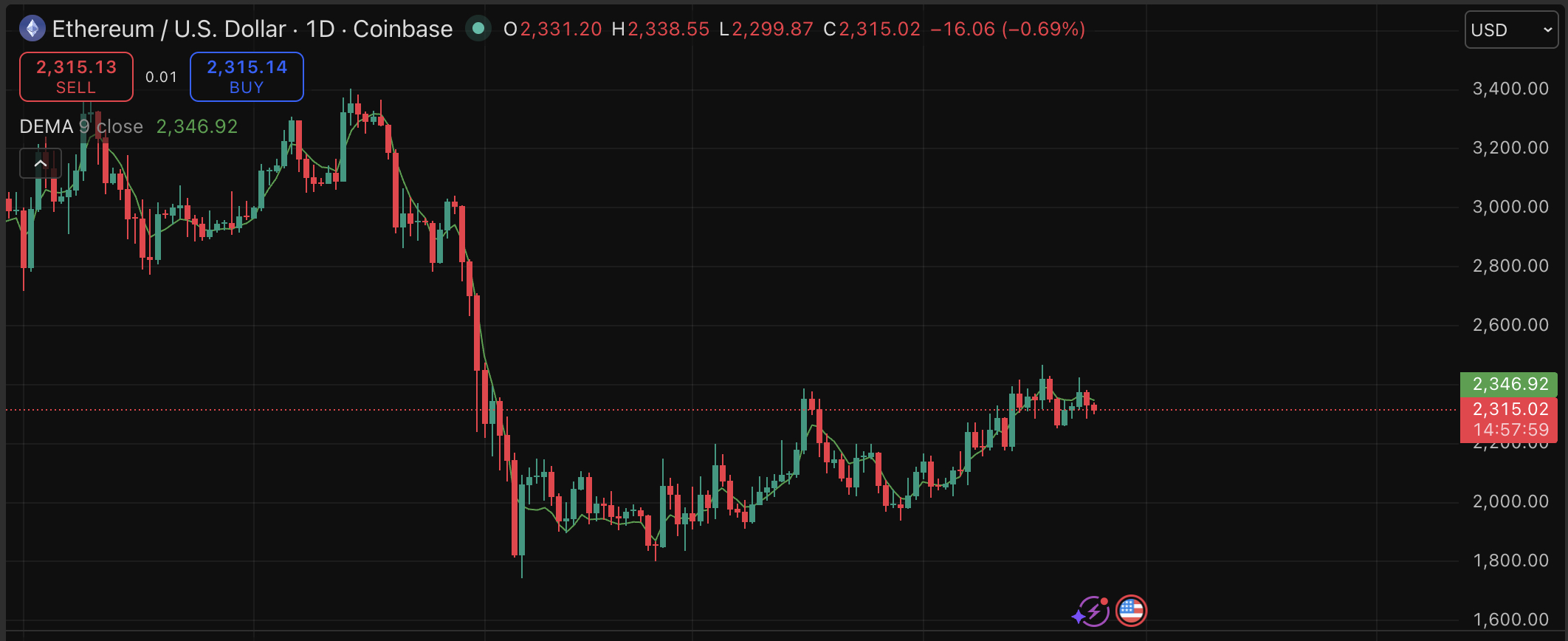
24-hour volume dropped 8% to approximately $17 billion, which can mean capitulation is still ahead. The Fear & Greed Index sits at 39 (Fear), way better than what it was during last month’s extreme fear situation. RSI registers around 58, technically neutral, so there is still some room to run.
If ETH can reclaim $2,400 once again with recovering volume, not just $2,500, it could as well try to retest the higher $2,800–$3,000 resistance.
$ETH 1D:
Faces key resistance at $2,500 and $2,800, zones characterized by bearish liquidity voids. A push toward these levels is expected, with the 200 day MA serving as my major target. It’s almost ready to breakout IMO. NFA DYORpic.twitter.com/2MCZ0kvqN8
— RStacker (@RaberTrades) April 23, 2026
The options’ expiry on April 24 adds a near-term volatility wildcard. Price could whip either direction into the settlement print before establishing a cleaner trend. Stay alert.
Discover: The best crypto to diversify your portfolio with
LiquidChain As Liquid as Ethereum ETFs
ETH’s ETF streak ending mid-rally is a useful reminder: even assets with genuine institutional momentum can stall at the wrong technical junction. Rotation into earlier-stage infrastructure plays tends to pick up precisely when large-cap assets lose momentum at resistance. It’s a dynamic worth considering.
This is where it begins. ⟁ — LiquidChain (@getliquidchain) April 24, 2026
 https://t.co/vqvBcdSQYC pic.twitter.com/4WNFR37XmU
LiquidChain ($LIQUID) is a Layer 3 infrastructure project positioning itself as the cross-chain liquidity layer, fusing Bitcoin, Ethereum, and Solana liquidity into a single execution environment. Developers deploy once and access all three ecosystems simultaneously, which addresses one of DeFi’s most persistent friction points: fragmented liquidity across incompatible chains.
The project’s Unified Liquidity Layer and Single-Step Execution architecture are the core differentiators. Its presale has raised $700K to date at a current price of $0.01452 per LIQUID token. Not to forget its high 1400% APY staking bonus for early buyers.
Research LiquidChain and review the presale terms here.
The post Ethereum Price Prediction: Today’s Options Expiry as 10 Straight Days of ETF Inflows Snap appeared first on Cryptonews.
Crypto World
U.S. government’s Intel stake swells to $35 billion, netting $26.5 billion unrealized gain


The U.S. government is holding an unrealized gain of roughly $26.5 billion on its Intel (INTC) stake after the chipmaker’s shares jumped more than 22% in pre-mrket trading on Friday, following a stronger-than-expected first-quarter earnings report.
The position stems from an August deal in which the Trump administration converted $8.9 billion in CHIPS Act grants and Secure Enclave funding into 433.3 million Intel shares at $20.47 apiece, giving it about a 9.9% ownership stake. With Intel trading near $81.80 in pre-marketing trading Friday, the holding is now valued at approximately $35.4 billion, nearly tripling in less than a year.
The government also holds warrants to purchase an additional 5% stake at $20 per share, options that are now deep in the money.
Intel’s rally was driven by a sharp earnings beat. The company reported first-quarter revenue of $13.6 billion, up 7% year over year and above Wall Street expectations of $12.4 billion. Non-GAAP earnings per share came in at $0.29, far exceeding the consensus estimate of a $0.01 loss.
Growth was led by Intel’s Data Center and AI segment, which rose 22% to $5.1 billion as demand for Xeon processors accelerates alongside the broader AI infrastructure buildout.
CEO Lip-Bu Tan pointed to a shift in AI computing toward inference and agentic workloads, saying the trend is “significantly increasing the need for Intel’s CPUs.”
Intel guided revenue in the range of $13.8 billion to $14.8 billion for the second quarter.


Crypto prices stayed muted with major assets, including Bitcoin, experiencing slight declines on Friday as hopes of peace between the U.S. and Iran began to fade.
Summary
- Crypto prices remained subdued as fading U.S.-Iran peace hopes kept Bitcoin range-bound and weighed on overall market sentiment.
- Ongoing naval blockade and stalled negotiations pushed oil prices higher, raising macro uncertainty and keeping investors in a wait-and-watch mode.
- Analysts remain divided, with derivatives data signaling caution while some expect a potential short squeeze if Bitcoin breaks key resistance near $80,000.
Bitcoin (BTC) price traded sideways between $77,000 and $79,000 over the past 24 hours before consolidating around $77,700 at press time, down 0.6% in the period. Ethereum (ETH) was down 1.5%, exchanging hands at $2,314, while XRP (XRP), BNB (BNB), and Solana (SOL) saw less than 1% sideways movement on the day. The global crypto market cap was down 0.2% at $2.68 trillion, indicating subdued interest from investors.
This trend is likely from traders entering a wait-and-watch mode as the odds of peace between the U.S. and Iran look rather slim while both continue with their back-and-forth escalation at the Strait of Hormuz.
Per recent reports, U.S. President Donald Trump has noted that the U.S. is under no pressure to end the war with Iran, though a failure to reach terms could likely lead to a heavy attack on Iranian infrastructure.
“I have all the time in the world, but Iran doesn’t. The clock is ticking!” Trump wrote in a recent Truth Social post.
The U.S. has continued the naval blockade against Iranian ports for the tenth consecutive day to pressure Iran to accept a denuclearization deal. However, Iran, for its part, has rejected any peace talks in Islamabad as long as the blockade remains in place, stating it will not succumb to bullying.
The stalemate regarding the shipping lanes has led crude oil prices to move back to $95 and could surge back above $100 if no resolution is found. Concerns remain over a potential global recession if conflict disrupts the Strait of Hormuz for a prolonged period.
Traditional markets echoed these concerns with safe-haven assets such as gold and silver down slightly on the day. However, Asian tech stocks like the Nikkei 225 and Hang Seng ended a little higher despite the geopolitical noise.
As such, if there is a delay in any peaceful resolution to the conflict, it could continue to pressure markets, especially risk assets such as cryptocurrencies, including Bitcoin.
A prolonged geopolitical standoff could cause Bitcoin to lose its gains over the past month and hence trigger a wider selloff across the altcoin market. If it fails to hold its current support levels, investors may see a rapid exodus from more volatile projects as capital seeks the relative safety of cash or stablecoins.
How will Bitcoin react?
Singapore-based QCP Capital maintains that the recent bounce in Bitcoin does not signal a structural shift and is unlikely to reverse the bearish momentum seen in recent months.
The firm noted that confidence in risk assets has been supported mainly by the temporary truce extension and reassurances from Federal Reserve Chair nominee Kevin Warsh regarding the central bank’s independence.
Derivatives data also suggests caution. Options markets continue to show muted short-term volatility, while demand for downside protection remains elevated, indicating hedging activity.
In contrast, analysts at K33 Research see scope for further upside. They point to a divergence between Bitcoin’s price recovery and persistently negative funding rates, which could leave the market exposed to a potential short squeeze.
Even so, the $79,000 to $80,000 range is emerging as a key resistance zone, aligning with the realized price of short-term holders who may look to exit positions as prices rise. Data platform CryptoQuant has similarly described the $80,000 level as a “critical inflexion point.”
From a longer-term perspective, Anthony Pompliano argued that sharp pullbacks can lay the foundation for stronger rallies. He suggested that a 50% correction from October highs could eventually pave the way for new peaks, adding that “Bitcoin has become the king of safe havens in all kinds of chaos.”
Disclosure: This article does not represent investment advice. The content and materials featured on this page are for educational purposes only.

Clavicular Hit With New YouTube Crackdown

Elon Musk Shares Major Robotaxi Milestone

AI Swallows Wall Street: Stocks Hit Record 45% of S&P 500 Market Cap

Manchester United reach agreement with Casemiro over contract clause amid transfer speculation

US brings back mandatory military draft registration

Steven Gerrard disagrees with Gary Neville over ‘shock’ Chelsea and Arsenal claim | Football


-

 Fashion7 days ago
Weekend Open Thread: Theodora Dress
-

 Politics7 days ago
Palestine barred from entering Canada for FIFA Congress
-

 Business5 days ago
Powerball Result April 18, 2026: No Jackpot Winner in Powerball Draw: $75 Million Rolls Over
-
Entertainment4 days ago
NBA Analyst Charles Barkley Chimes in on Ice Spice McDonald’s Fiasco
-

 Tech5 days ago
Auto Enthusiast Scores Running Tesla Model 3 for Two Grand and Turns It Into Bare-Bones Go-Kart
-

 Politics5 days ago
Zack Polanski demands ‘council homes not luxury flats for foreign investors’
-

 Crypto World6 days ago
Russia Pushes Bill to Criminalize Unregistered Crypto Services
-

 Politics4 days ago
Gary Stevenson delivers timely reminder to register to vote as deadline TODAY
-

 Business2 days ago
Rolls-Royce Voted UK’s Most Iconic Trade Mark as IPO Register Hits 150
-

 Politics2 days ago
Disabled people challenge government SEND proposals over segregation concerns
-

 Politics2 days ago
Making troops accountable for war crimes threatens US alliance, ex-SAS colonel warns
-

 Crypto World6 days ago
Russia Introduces Bill To Criminalize Unregistered Crypto Services
-

 Politics2 days ago
Starmer handler McSweeney to be dragged from shadows by Foreign Affairs Committee
-
Politics2 days ago
Wings Over Scotland | How To Get Away With Crimes
-

 Politics2 days ago
Zack Polanski responds to home secretary’s taser threat
-
 Crypto World5 days ago
Kelp DAO rsETH Bridge Hack Drains $292M as DeFi Losses Top $600M in Two Weeks
-

 Politics2 days ago
‘Iran is still a nuclear threat’
-

 Crypto World2 days ago
New York sues Coinbase, Gemini over prediction market offerings
-
 Sports7 days ago
Kevin Kisner apologizes for Masters criticism: ‘I crossed the line’
-

 Business2 days ago
The Job Benefits Most Men Don’t Know to Negotiate
You must be logged in to post a comment Login