
Crypto World
Kalshi steps up surveillance amid growing scrutiny of prediction markets



Kalshi, the federally regulated prediction market platform, announced a major expansion of its market surveillance and enforcement framework aimed at preventing insider trading and market manipulation across its platform.
Summary
- Kalshi has expanded its market surveillance framework to prevent insider trading and market manipulation on its regulated prediction markets platform.
- The company formed an independent Surveillance Advisory Committee and partnered with Solidus Labs to strengthen trade monitoring and enforcement.
- The move positions Kalshi as a compliance-focused alternative as prediction markets face growing regulatory and public scrutiny.
The updates were shared on February 5, 2026, as part of a broad initiative to boost trading integrity.
Kalshi tightens market surveillance
Founded in 2018, Kalshi established prediction markets as a regulated financial asset class in the United States. Unlike many offshore trading platforms, Kalshi operates under oversight from the U.S. Commodity Futures Trading Commission (CFTC), enforcing rules similar to those in traditional financial markets.
At the center of Kalshi’s announcement is the formation of an independent Surveillance Advisory Committee. The committee includes industry experts such as Lisa Pinheiro, Managing Principal at Analysis Group, and Daniel Taylor, Director of the Wharton Forensic Analytics Lab, known for his work on fraud and insider trading detection.
The group will review flagged trades, monitor investigations, and issue public quarterly reports on enforcement activity.
Kalshi also unveiled partnerships with Solidus Labs, a provider of advanced trade surveillance technology, and other market integrity advisors. The Solidus platform will augment Kalshi’s internal systems with deeper data analysis, helping detect sophisticated manipulation or suspicious trading patterns across more than 4,000 active markets.
The enhanced surveillance measures come amid growing scrutiny of prediction markets worldwide. Platforms like Polymarket have faced criticism and controversy over alleged insider advantage and market manipulation, leading lawmakers to consider new regulations targeting such practices.
The announcement also follows recent legal friction involving prediction markets more broadly. In Nevada, a state court recently declined to immediately block Coinbase’s prediction markets, which operate in partnership with Kalshi, after state regulators sought an emergency halt under gaming laws.



Google has set 2029 as its target to roll out post-quantum cryptography across its products, adding a firm deadline to a risk that has moved closer in recent years.
Summary
- Google sets 2029 deadline for post quantum cryptography amid faster progress in quantum computing hardware
- Ethereum plans protocol level quantum resistance while Bitcoin community remains divided on urgency and approach
- Solana introduces quantum resistant vaults but requires users to shift funds into specialized wallet structures
The company linked that timeline to faster gains in quantum hardware, better error correction, and new estimates on how quickly current encryption could become vulnerable.
Google said the industry should move sooner rather than later as quantum computing advances continue. The company stated that current cryptographic standards used for encryption and digital signatures will not remain safe forever.
In its update, Google said,
”Quantum computers will pose a threat to current cryptographic standards.”
It also said post-quantum migration is needed so users can continue to rely on secure authentication services across its products.
The 2029 timeline marks the first time Google has attached a clear migration target to its post-quantum work. That date arrives earlier than some estimates for Q-Day, the point when quantum machines could break widely used public-key encryption.
Google said it wants to set a public example for other companies and institutions. The company added, ”It’s our responsibility to lead by example and share an ambitious timeline,” while calling for wider action across the industry.
Moreover, the push toward quantum-safe systems is also gaining attention in crypto. The Ethereum Foundation launched a Post-Quantum Ethereum resource hub this week and said it wants protocol-level protections in place by 2029.
Ethereum’s plan focuses on securing the network against future quantum threats, with execution-layer work expected later. The effort reflects broader concern over how blockchains that rely on existing cryptographic systems may need upgrades over time.
Bitcoin and Solana show different approaches
Solana developers introduced a quantum-resistant vault in January 2025. The design uses hash-based signatures and creates a new key during each transaction, but users must move funds into special Winternitz vaults because the feature does not upgrade the full network.
Bitcoin developers remain divided on timing and need. Blockstream chief executive Adam Back said quantum risks are overstated and that action is not needed for decades, while Ethan Heilman and other researchers backed BIP-360, a proposal that would add a new output type to reduce short-exposure quantum risks.
Key Highlights
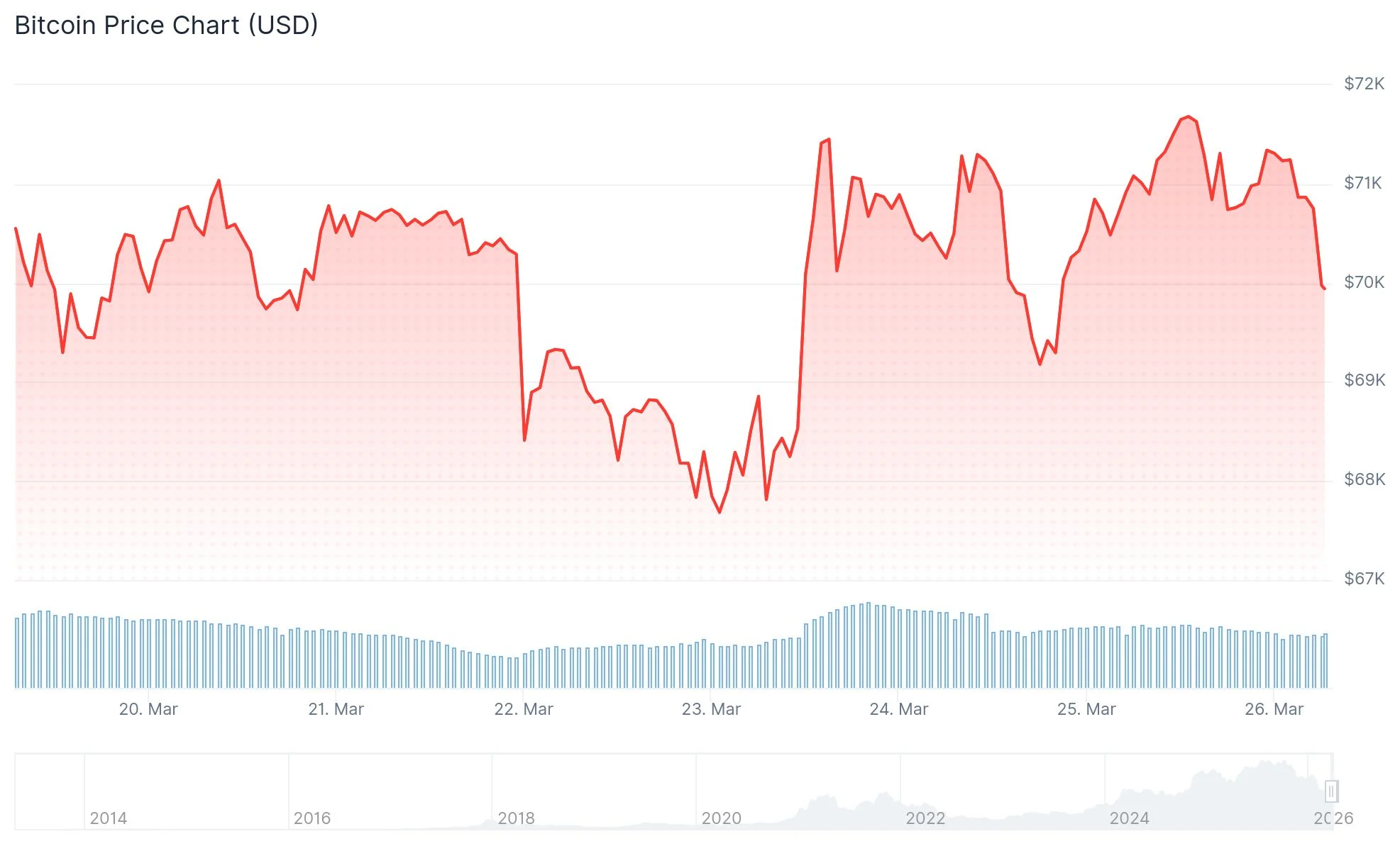
- Bitcoin surged past the $71,000 threshold driven by Middle East de-escalation optimism boosting risk-on sentiment
- Tehran dismissed Washington’s ceasefire initiative despite Trump’s claims, creating market confusion with contradictory messaging
- American equity futures declined 0.4% during Wednesday’s evening session amid persistent geopolitical concerns
- Crude oil retreated on peace prospects, with WTI closing at $90.32 and Brent finishing at $102.22
- The United Kingdom prohibited cryptocurrency contributions to political organizations and limited foreign donations to £100,000 annually
The flagship cryptocurrency rallied past the $71,000 mark on Wednesday as market participants priced in potential de-escalation between Washington, Tel Aviv, and Tehran. By early evening Eastern Time, Bitcoin was trading at $71,129, representing a 1.1% gain.
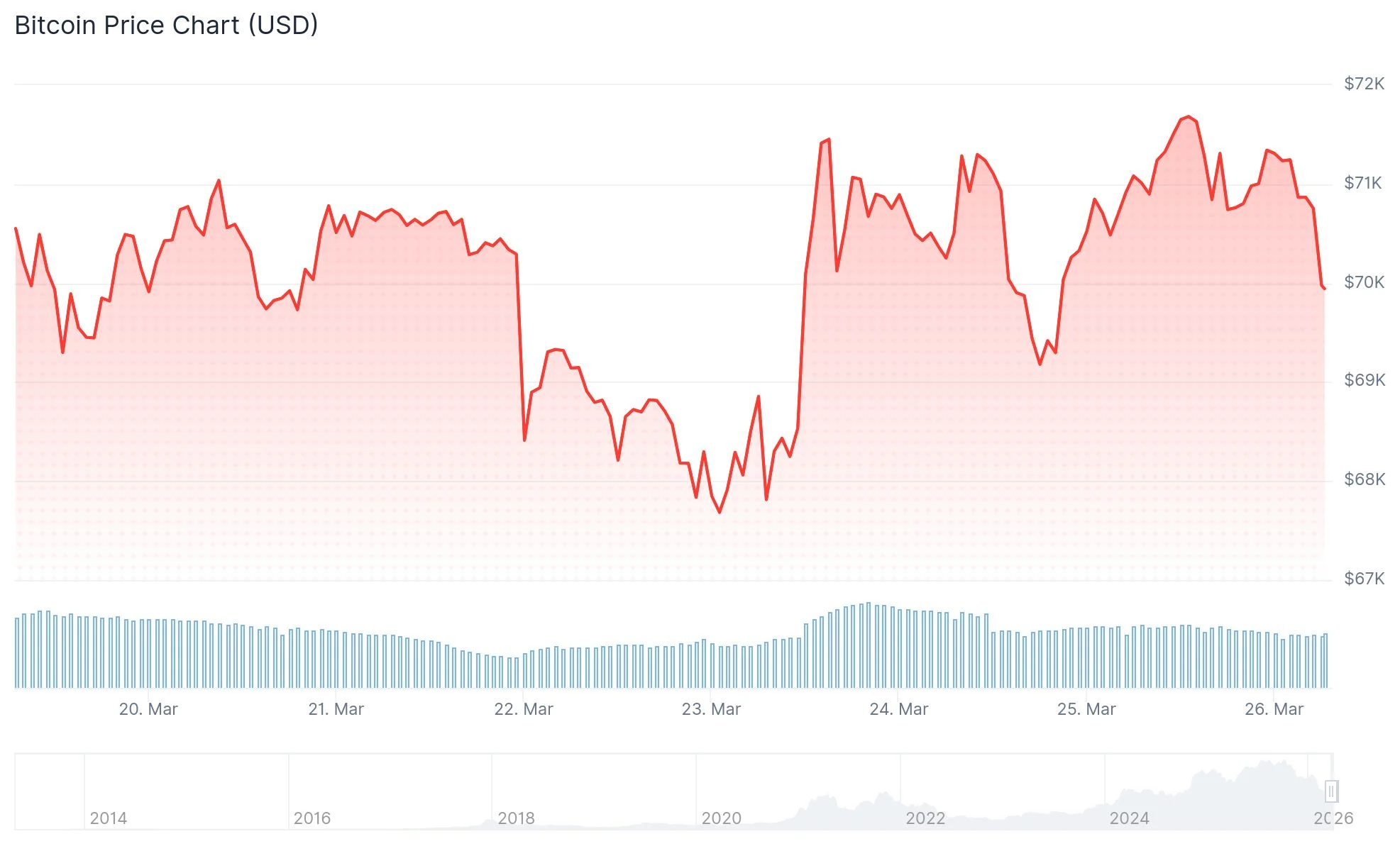
The week had started with the digital asset dipping beneath the $70,000 level following escalating tensions in the Middle East that prompted widespread liquidation across risky investments.
President Trump indicated on Tuesday that discussions were underway with Iranian officials, suggesting Tehran might be receptive to diplomatic resolution. Multiple sources reported that Washington had submitted a comprehensive 15-point framework designed to terminate hostilities.
However, Iran’s communications presented conflicting narratives. Fars News Agency stated that Tehran rejected any ceasefire arrangement, while Foreign Minister Abbas Araghchi explicitly denied ongoing negotiations with American counterparts.
Iranian state media published five core requirements, including complete cessation of military operations and global acknowledgment of Tehran’s sovereignty over the Strait of Hormuz. Additional demands reportedly included dismantling all U.S. military installations throughout the Gulf region.
Despite public rejection, Axios sources indicated Washington had not yet received formal notification from Iran declining the proposal. The contradictory signals maintained markets in a state of tentative confidence.
Oil prices declined Wednesday as energy traders factored in reduced supply disruption risks. West Texas Intermediate benchmark settled at $90.32 per barrel while Brent crude concluded trading at $102.22.
Equity Markets Navigate Geopolitical Turbulence
American stock index futures retreated 0.4% during Wednesday’s after-hours trading. Contracts tracking the S&P 500, Nasdaq 100, and Dow Jones Industrial Average all registered downward movement as market participants maintained cautious positioning.
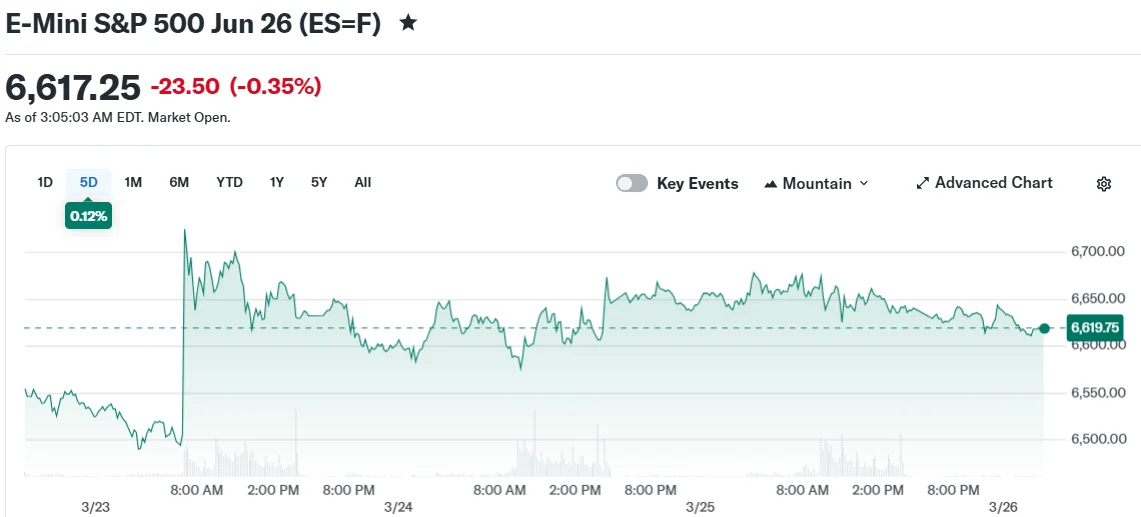
Notwithstanding the futures decline, primary equity benchmarks have accumulated weekly gains, positioning themselves to terminate a four-week consecutive downturn. Crude oil price fluctuations and economic contraction fears have persistently dampened consumer confidence.
Market observers are anticipating Thursday’s weekly unemployment insurance claims report. Carnival Corporation is scheduled to release quarterly results before Friday’s opening bell.
Britain Implements Cryptocurrency Political Contribution Prohibition
The United Kingdom instituted a prohibition on digital currency contributions to political organizations, taking effect Wednesday. Simultaneously, authorities established a £100,000 annual ceiling on overseas contributions from British nationals residing internationally.
Housing Secretary Steve Reed explained the cryptocurrency restriction addresses a “clear pathway” enabling questionable funds to penetrate political operations. The regulation follows an investigation into foreign monetary influence, initiated after a former Reform UK representative received imprisonment for accepting illegal payments.
Reform UK, under Nigel Farage’s leadership, had pioneered Bitcoin acceptance among British political organizations. Approximately two-thirds of its previous year’s financial support originated from international contributors.
Most alternative cryptocurrencies appreciated Wednesday. Ethereum advanced 1% reaching $2,166, XRP increased 0.2% to $1.41, and Dogecoin climbed 1.5%.

Key Takeaways
- Bhutan moved 519.7 BTC valued at $36.75 million in its latest transaction on Wednesday
- The kingdom has liquidated more than $152 million in Bitcoin so far in 2026
- BTC reserves have plummeted 66% from approximately 13,000 BTC to just 4,453 BTC
- Singapore’s QCP Capital receives most transfers through structured OTC deals
- The nation’s 10,000 BTC commitment to Gelephu Mindfulness City appears impossible to fulfill
The Kingdom of Bhutan continues its systematic liquidation of Bitcoin holdings in 2026, with the selling momentum accelerating in recent weeks. Wednesday’s transaction saw the government transfer 519.7 BTC valued at $36.75 million to an external wallet, based on tracking data from Arkham Intelligence.
Bhutan’s cumulative Bitcoin disposals for 2026 have now surpassed the $152 million threshold.
The Himalayan nation accumulated its cryptocurrency treasury through government-operated hydroelectric mining facilities. With abundant renewable energy from surplus hydropower, mining costs were virtually negligible. This means every Bitcoin liquidation represents nearly 100% profit for the Royal Government.
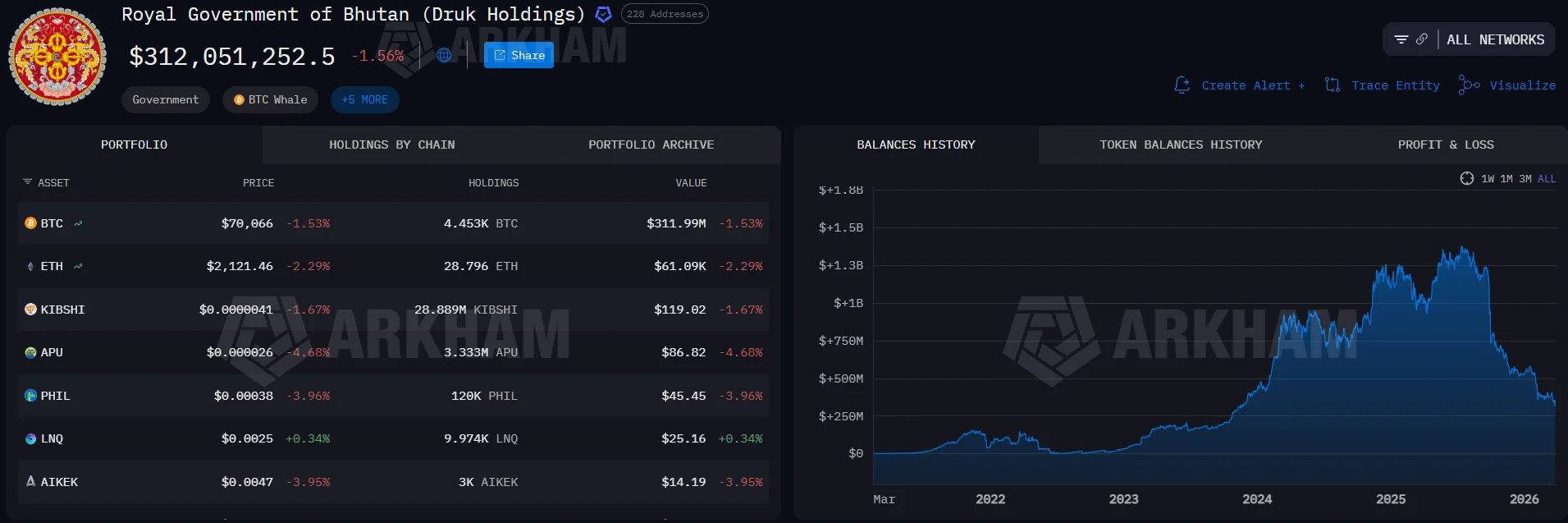
At their zenith in late 2024, Bhutan’s Bitcoin reserves reached approximately 13,000 BTC. However, systematic outflows have dramatically reduced that position. Current holdings stand at merely 4,453 BTC—representing a staggering 66% decline from peak levels.
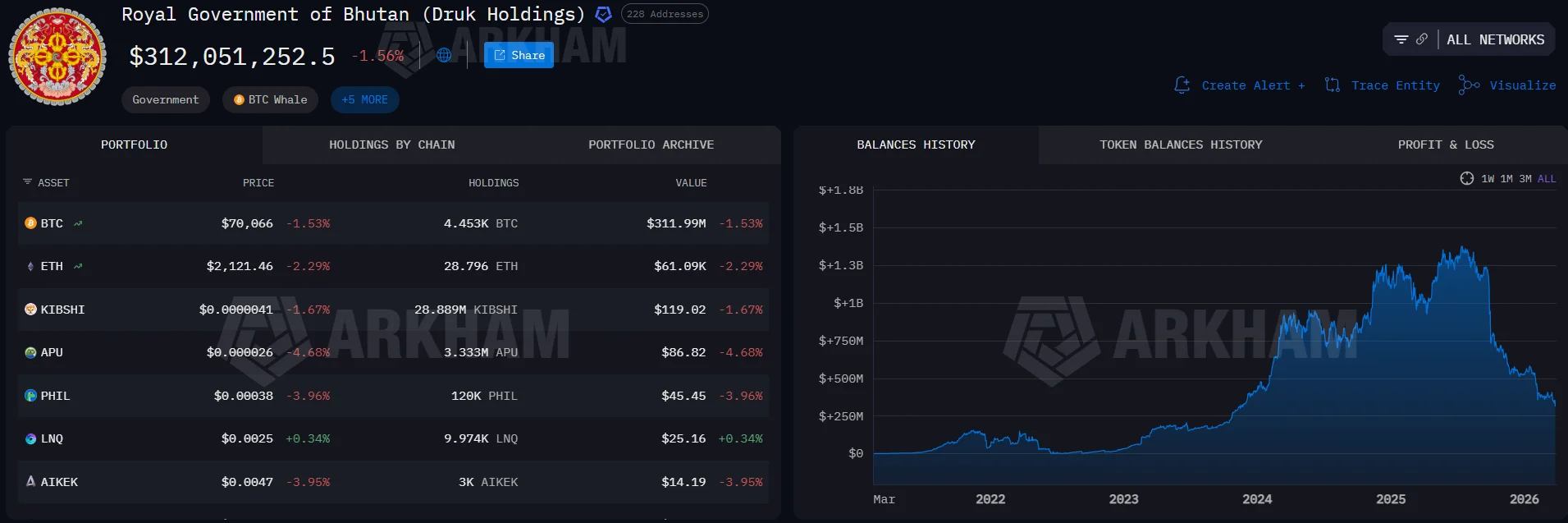
The liquidation campaign began conservatively. During January and February, individual transfers ranged from $5 million to $15 million. March witnessed a dramatic escalation, with transaction sizes ballooning to between $35 million and $45 million per movement.
The previous week marked the most intensive period of Bitcoin activity from Bhutan on record. A series of coordinated transfers moved approximately $72 million worth of Bitcoin within just seven days. The most substantial single transaction involved 595.8 BTC worth $44.44 million.
Strategic OTC Liquidation Framework
QCP Capital, a Singapore-headquartered digital asset trading firm, has been the recipient of three distinct Bitcoin transfers from Bhutan this year, totaling approximately $16.6 million. The recurring pattern of transfers to this specific entity indicates a formal over-the-counter liquidation agreement.
OTC transactions enable large-scale holders to dispose of significant positions without directly impacting public exchange markets, thereby minimizing adverse price movements. Bhutan’s approach of segmenting sales into multiple transactions serves precisely this purpose.
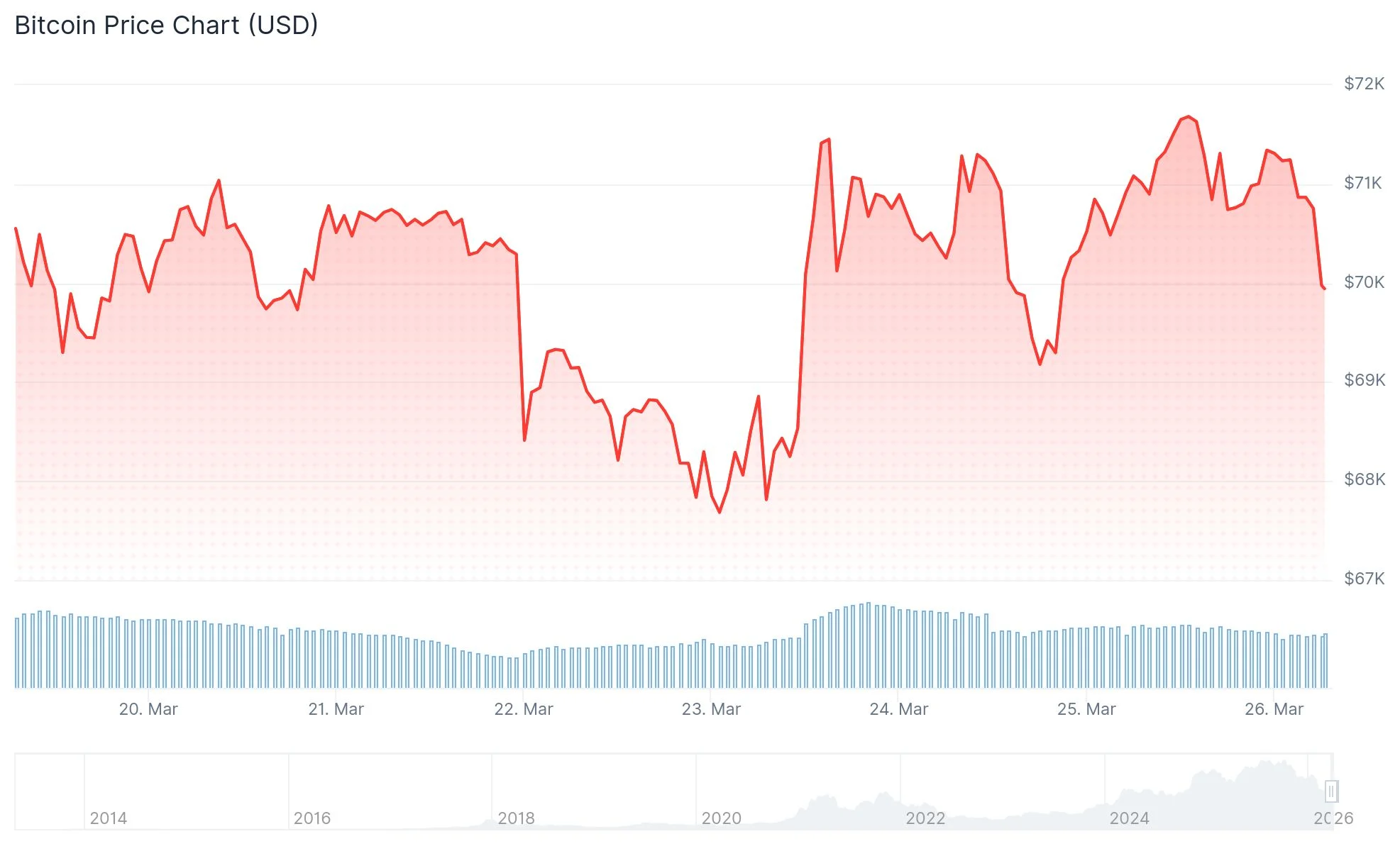
Bitcoin has traded in a range of $65,000 to $75,000 throughout March, significantly below the near-$119,000 peaks witnessed earlier. At maximum valuation, Bhutan’s portfolio approached $1.88 billion. Today’s holdings are worth approximately $315 million.
Blockchain analysis reveals minimal to zero fresh Bitcoin entering Bhutan’s wallets from mining activities recently. This pattern suggests the kingdom may have reduced or completely suspended its mining operations following the latest Bitcoin halving event.
The Gelephu Commitment Conundrum
Last December, Bhutan unveiled its Bitcoin Development Pledge, committing up to 10,000 BTC toward financing the ambitious Gelephu Mindfulness City initiative. When announced, that allocation represented approximately $860 million in value.
With current reserves sitting below 4,500 BTC, fulfilling the original 10,000 BTC pledge would require Bhutan to completely reverse its entire drawdown and acquire additional coins.
Wednesday’s 519.7 BTC transfer represents the latest chapter in what has evolved into an increasingly aggressive sovereign Bitcoin liquidation strategy throughout 2026.


- Bitcoin price falls below $70,000 as network activity weakens.
- Declining transactions and addresses signal lower demand.
- Key support is at $69,400, while resistance stands near $71,600.
Bitcoin price today hit a daily low of $69,914.54 after soaring above $71,000 at the start of the week, following news of a truce proposal to Iran by US President Donald Trump.
The sudden pullback has pushed Bitcoin back below the $70,000 level, a psychological zone that traders often watch closely for signs of strength or weakness.
This decline did not happen in isolation, as the underlying data suggests that the broader network is also losing momentum.
Bitcoin Network Activity signals weakening demand
Recent on-chain data shows that Bitcoin’s Network Activity Index continues to trend downward, pointing to a steady cooling in user participation.
This index tracks a combination of key metrics that together reveal how actively the network is being used daily.
Among these metrics are active addresses, which measure how many unique participants are sending or receiving Bitcoin.
A decline in active addresses often signals reduced interest or engagement from both retail users and larger players.
Transaction counts have also softened, indicating that fewer transfers are taking place across the network.
This drop in transaction activity suggests that demand for block space is easing, which usually aligns with quieter market conditions.
Another important indicator, the UTXO count, reflects how coins are being distributed and reused, and its slowdown points to less frequent movement of funds.
Block data, including the number of bytes per block, further confirms that network usage is not as intense as it was during more active periods.
On-chain activity is still cooling off 📉
Bitcoin’s CryptoQuant Network Activity Index keeps declining, pointing to weaker demand across the network.
Key indicators tracked:
• Active addresses (sending + receiving)
• Transactions (total & per block)
• UTXO count
• Bytes per… pic.twitter.com/U4aSKjz2Pk— Maartunn (@JA_Maartun) March 24, 2026
Taken together, these signals paint a clear picture of declining demand rather than temporary disruption.
The BTC price struggles mirror on-chain weakness
The recent dip below $70,000 appears to be more than just a reaction to short-term news or macro headlines.
Instead, it reflects a broader lack of strong buying pressure needed to sustain higher price levels.
Even though Bitcoin managed to climb earlier in the week, the rally lacked the support of rising network activity.
This disconnect between price and usage often leads to corrections, as the market struggles to justify higher valuations.
Short-term performance data also shows mild losses across multiple timeframes, reinforcing the idea that momentum is fading.
While the market has not entered a sharp sell-off, the gradual decline suggests a slow shift in sentiment.
Investors seem to be taking a more cautious approach, with fewer participants actively entering the market.
At the same time, existing holders appear less willing to move their coins, contributing to the drop in transactional activity.
The key Bitcoin price levels to watch in the coming days
Bitcoin is now approaching a critical zone where price action in the coming days could define its short-term direction.
Notably, most technical indicators are leaning bearish, with Bitcoin trading below major exponential moving averages on the daily chart.

This positioning suggests that the broader trend remains under pressure unless the price can reclaim key moving averages.
Currently, the most important level to watch is $69,423, which now acts as immediate support for the market.
If this support holds, it could allow Bitcoin to regain strength and attempt a push toward the first major resistance at $71,645.
If buyers manage to break above $71,645, momentum may build toward the next resistance level at $73,687.
A stronger rally could then open the door for a test of $75,930, which stands as the third key resistance level in the current structure.
On the downside, failure to hold above $69,423 would weaken the current structure and expose Bitcoin to further losses.
In that scenario, analysts note that the next support would be $67,167.
The news to watch
From a macro perspective, traders should closely watch the upcoming inflation data, particularly the PCE print expected early next month.
A softer reading below 2.8% could support risk assets and provide Bitcoin with a chance to recover.
On the other hand, a higher-than-expected figure above 3% may add pressure and push prices lower.
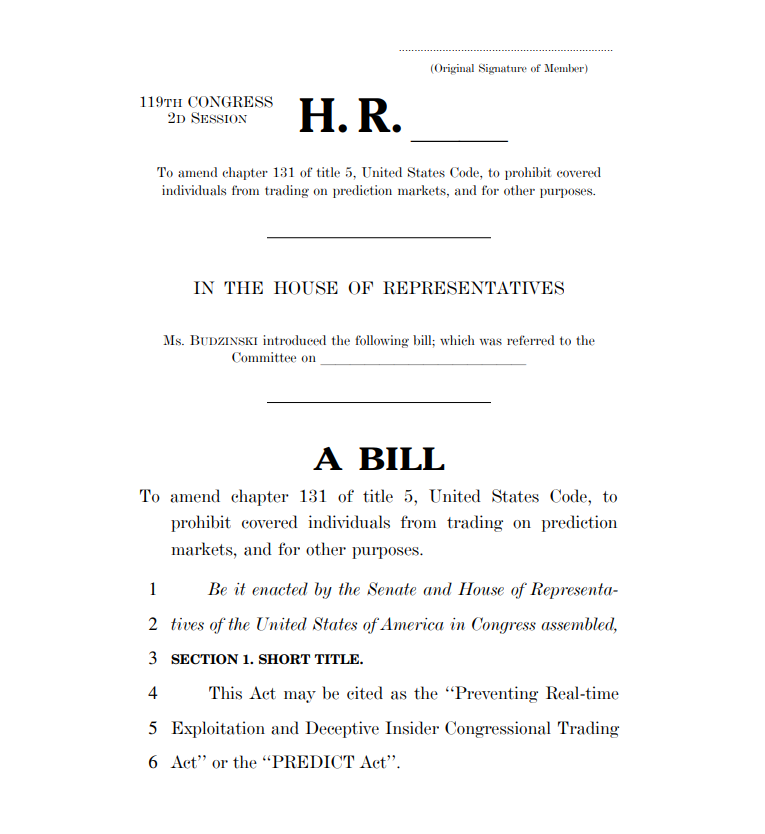
US lawmakers have introduced a bill aiming to ban members of the US Congress, the president and other high-ranking government officials from wagering on prediction markets.
The proposed bill, a bipartisan effort from US Representative Adrian Smith and Representative Nikki Budzinski, was introduced on Tuesday and is called the Preventing Real-time Exploitation and Deceptive Insider Congressional Trading Act (PREDICT Act).
“In recent months, we’ve seen instances of little-known traders making massive profits on events ranging from war with Iran to how long a government shutdown will last, raising necessary questions about the use of inside information,” Budzinski said.
The move comes amid growing scrutiny of prediction markets in the US, with lawmakers and regulators taking aim at platforms such as Kalshi and Polymarket over contracts related to sports, war and politics.
The bill seeks to bar members of Congress, the president, vice president and political appointees from wagering on the “outcomes of political events, policy decisions, and other government actions on prediction markets.” It also extends to the spouses and dependents of these government officials.

The potential penalties listed in the PREDICT Act include a 10% fine on the total value of the contract and the disgorgement of all profits to the US Treasury.
Commenting on the bill, Budzinski stressed the importance of closing loopholes to ensure people with inside knowledge “cannot profit from it.”
Budzinski isn’t the only one sounding off on alleged corruption on prediction markets. Earlier this month, two Democratic lawmakers introduced a separate bill called the Banning Event Trading on Sensitive Operations and Federal Functions (BETS OFF) Act.
Speaking about the bill, Senator Chris Murphy alleged that it was likely that people used “inside information” to make bets on US President Donald Trump’s military actions involving Iran.
US lawmakers turn up heat on prediction markets
US lawmakers aren’t just flagging concerns with insider trading on prediction markets. Sports-related contracts have also recently drawn attention at both the federal and state levels.
Cointelegraph reported earlier this week that 11 states have taken legal action against prediction markets, while another two states also have pending legal action in the works.
At the federal level, Sens. John Curtis and Adam Schiff introduced a bill on Monday aiming to ban any Commodity Futures Trading Commission (CFTC) registered entity from listing prediction market contracts that resemble “a sports bet or casino-style game.”
Related: Why Argentina is blocking Polymarket despite its global growth
The senators argued that many companies have been offering significant amounts of contracts that “are indistinguishable from gambling” and also took aim at the CFTC for its approach to the sector.
“For fifteen years, the CFTC has enforced its authority to prohibit the listing of a contract that involves, relates to or references ‘gaming.’ However, the CFTC and its chair have abruptly reversed course — intervening in ongoing litigation and proceeding with rulemaking to significantly relax the CFTC’s enforcement of this clause,” they said.
Following the move, both Kalshi and Polymarket, two of the largest prediction market platforms, made efforts to tighten their rules to stop professional athletes and political candidates from wagering on prediction markets.
Magazine: Are DeFi devs liable for the illegal activity of others on their platforms?
Key Highlights
- Record-breaking 33.1% of total ETH supply is currently locked in staking protocols
- Exchange reserves have plummeted to their lowest levels observed since 2016
- Major withdrawal of $1.67 billion worth of ETH from OKX exchange occurred on March 22
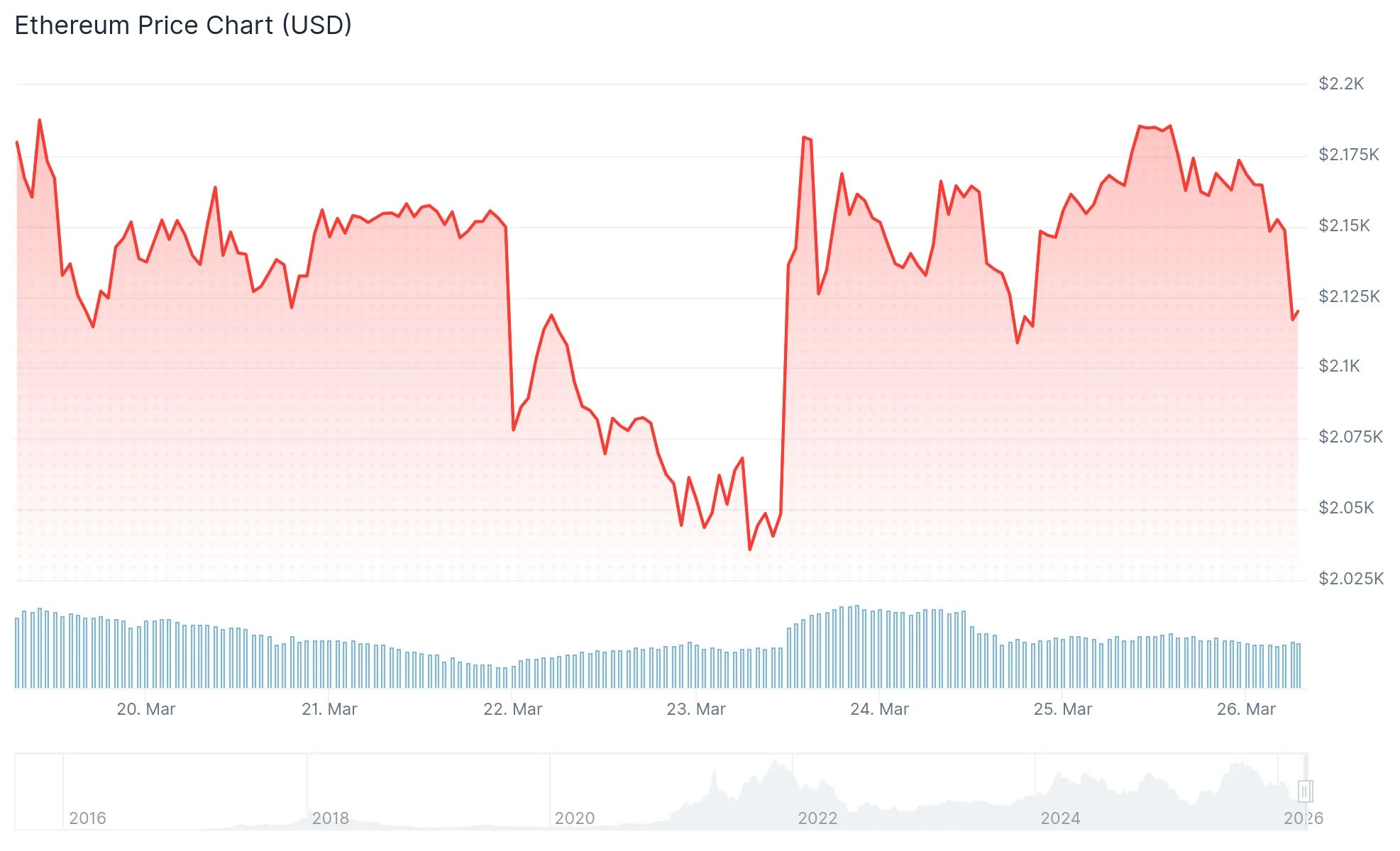
- Current ETH trading price hovers around $2,119, facing critical resistance zones at $2,356 and $2,500
- Technical analyst Ali Charts identifies MVRV-based support at $1,655 with upside targets extending to $5,624
A significant supply reduction is underway across the Ethereum network. Multiple on-chain analytics platforms confirm that the amount of ETH held on centralized exchanges has reached its lowest concentration in nearly eight years, while validator participation in staking protocols continues its upward trajectory.
Current figures from staking infrastructure provider Everstake indicate that approximately 38.1 million ETH tokens are now secured in staking contracts. This represents roughly 33.1% of the entire circulating token supply — establishing an all-time high for staking participation.
The validator entry queue currently contains 2,876,752 ETH, requiring prospective validators to wait nearly 50 days before activation. In stark contrast, the exit queue holds a mere 40,504 ETH, with withdrawal processing times under 17 hours.
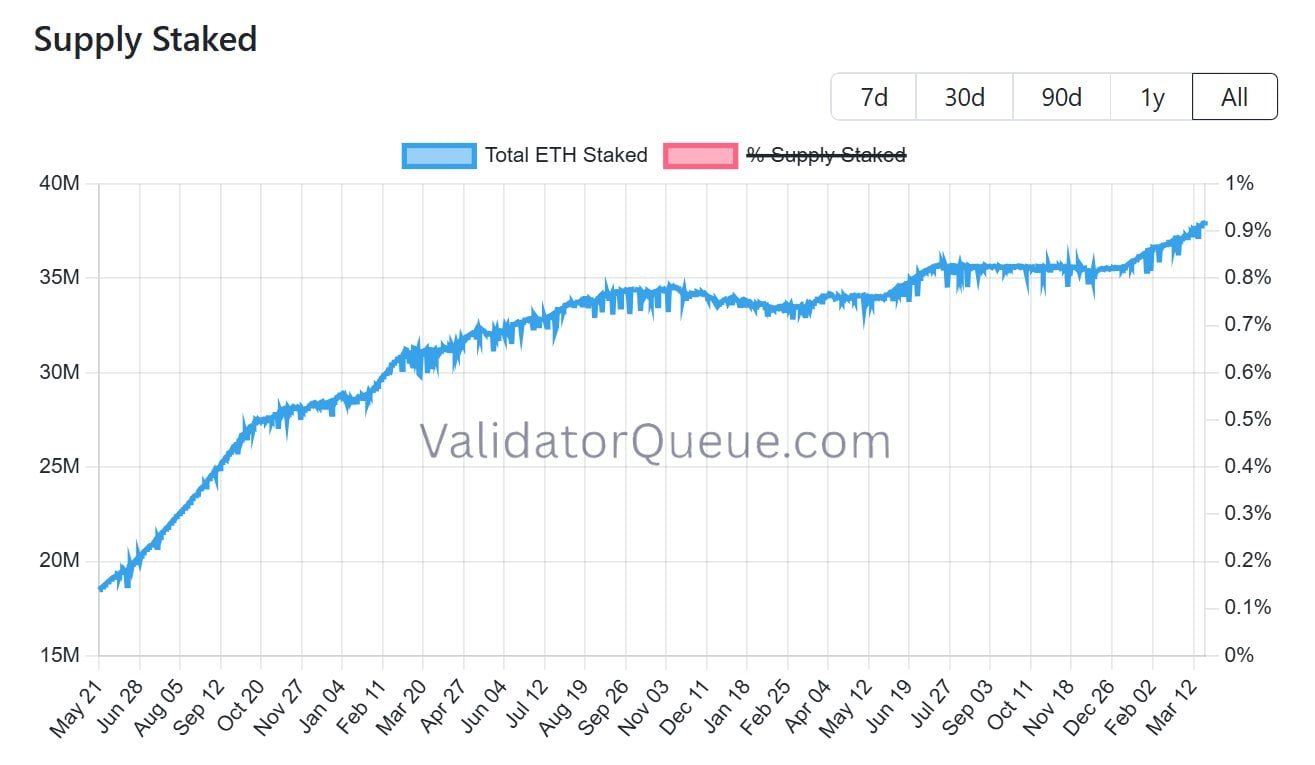
This significant disparity indicates that ETH is entering staking contracts at a substantially faster pace than it’s being withdrawn. The protocol-enforced churn limit of 256 validators per epoch restricts how rapidly staked tokens can reenter circulation, even if market sentiment shifts dramatically.
Major Exchange Withdrawals Accelerate
Centralized exchange holdings have experienced consistent decline. Market analyst Amr Taha documented a substantial $1.67 billion ETH withdrawal transaction from the OKX platform on March 22. Earlier in February, Binance processed two separate withdrawal events exceeding $300 million each.
On-chain analytics from CryptoQuant reveal that ETH holdings across centralized exchanges have contracted to levels not witnessed since 2016. Specifically, Binance’s ETH reserves are currently positioned near their December 2020 minimum of approximately 3.3 million ETH.
According to Everstake: “This steady reduction in liquid supply, combined with ongoing demand, creates the conditions for a structurally stronger price environment.”
Technical analyst Ali Charts has outlined critical MVRV-derived price zones for ETH. His analysis pinpoints $1,655 as the primary support threshold, $2,356 as the initial major resistance barrier, intermediate objectives at $2,647 and $3,639, and extended upside targets positioned at $4,632 and $5,624.
Critical Price Zones Under Surveillance
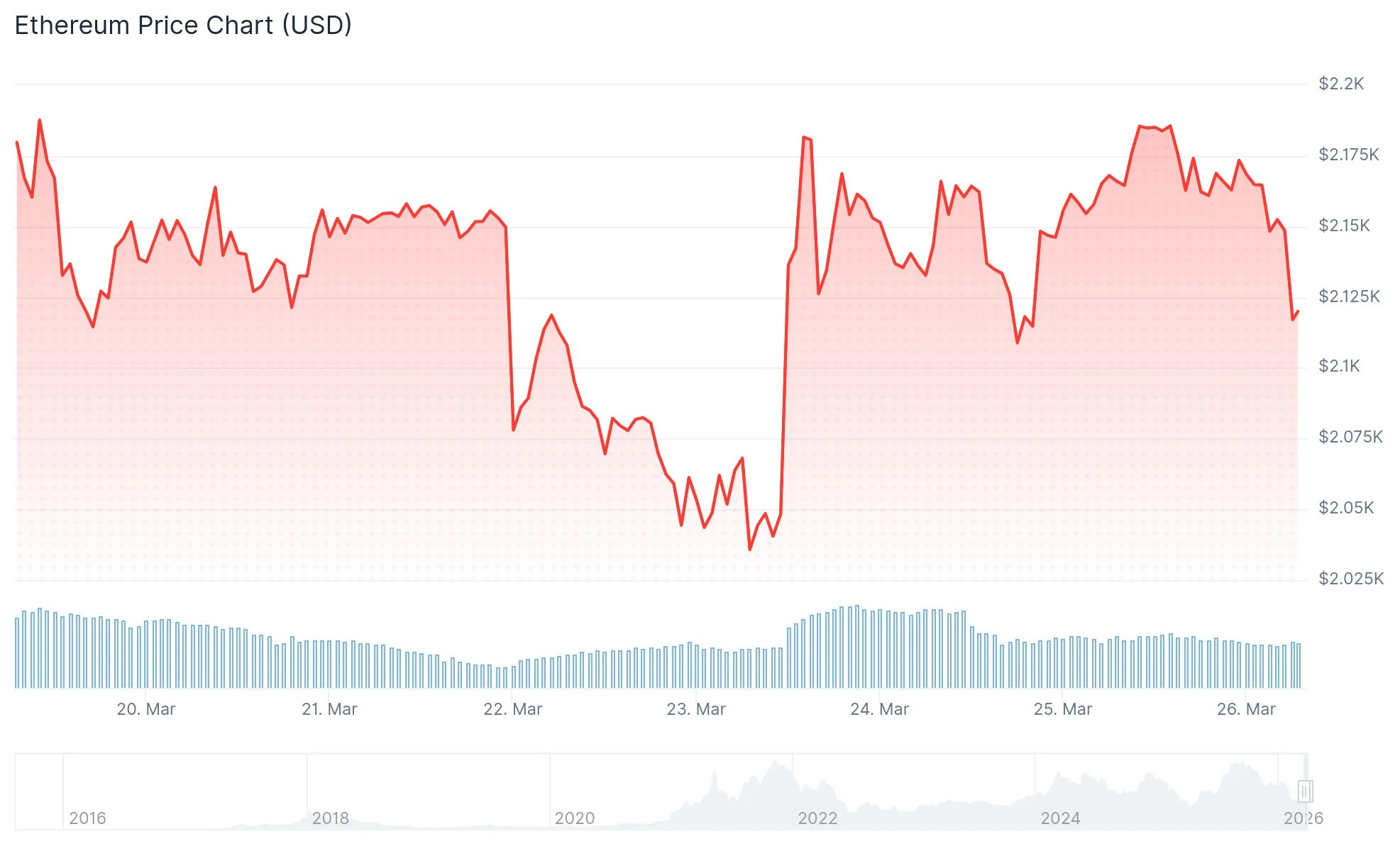
Ethereum recently reclaimed the $2,150 level, which technical analyst Ted Pillows highlighted as a crucial threshold on the daily timeframe. He observed that this price action coincided with market volatility stemming from reported diplomatic negotiations between the United States and Iran.
A technical chart shared by analyst Satoshi Flipper presents a dual-phase bullish projection: an initial objective at $2,500, requiring ETH to breach the upper boundary of its current descending channel pattern, followed by an extended target of $4,750 contingent upon a comprehensive trend reversal.
ETH currently trades in the vicinity of $2,119. According to Ali Charts’ MVRV framework, the immediate resistance level warranting close attention is positioned at $2,356.
Bitcoin price fell below the $70,000 mark as traders prepared for a massive Bitcoin options expiry set to occur later today.
Summary
- Bitcoin price slipped to $69,990 ahead of a $18.6 billion crypto options expiry on Deribit, with BTC options accounting for over $14.1 billion in open interest.
- The $75,000 max pain level remains a key magnet as market makers may attempt to steer prices higher to minimize payout obligations.
- Technical indicators remain supportive, but $71,000 resistance and $69,000 support will likely dictate short-term price direction.
According to data from crypto.news, Bitcoin (BTC) price fell roughly 2.5% to $69,990 last check on Friday, March 27, after bulls faced rejection at the $72,000 psychological resistance.
Bitcoin’s price drop can mainly be attributed to market sentiment turning cautious ahead of a massive $18.6 billion options expiry across the crypto market on the crypto exchange Deribit at 08:00 UTC. Out of the total market, Bitcoin options alone account for over $14.1 billion, which represents nearly 40% of the platform’s total open interest.
For context, options are contracts that allow traders to buy or sell an asset at a set price by a specific date. A call option gives the holder the right to buy the asset, while a put option provides the right to sell it.
As such, a Bitcoin options contract gives investors the ability to hedge against volatility or speculate on future price movements. However, traders do not necessarily have to purchase the underlying asset if the price movement does not favor their position.
According to Deribit’s data, the maximum pain price, where the most options would expire and become worthless, lies at $75,000 at a key psychological resistance level.
Analysts note that Bitcoin, currently trading just around $70,000, could gradually move toward the $75,000 level as large institutions or market makers with significant capital attempt to steer the spot price closer to this level in order to minimize payout obligations.
The massive options expiry falls on the same date when U.S. President Donald Trump has set a potential deal with Iran to end the ongoing conflict between them in the Middle East. This follows after Trump revealed that the U.S. would be postponing a military strike on Iran’s infrastructure after he communicated with diplomatic channels, despite Iran’s previous denials of such negotiations.
Today’s massive expiry also coincides with a U.S. Securities and Exchange Commission deadline for 91 crypto ETF filings that could further reshape the institutional landscape.
During previous cycles when large amounts of options expired, the crypto market crashed. However, this time, it remains to be seen if the market will hold steady, especially if the U.S.-Iran deal successfully eases global tension.
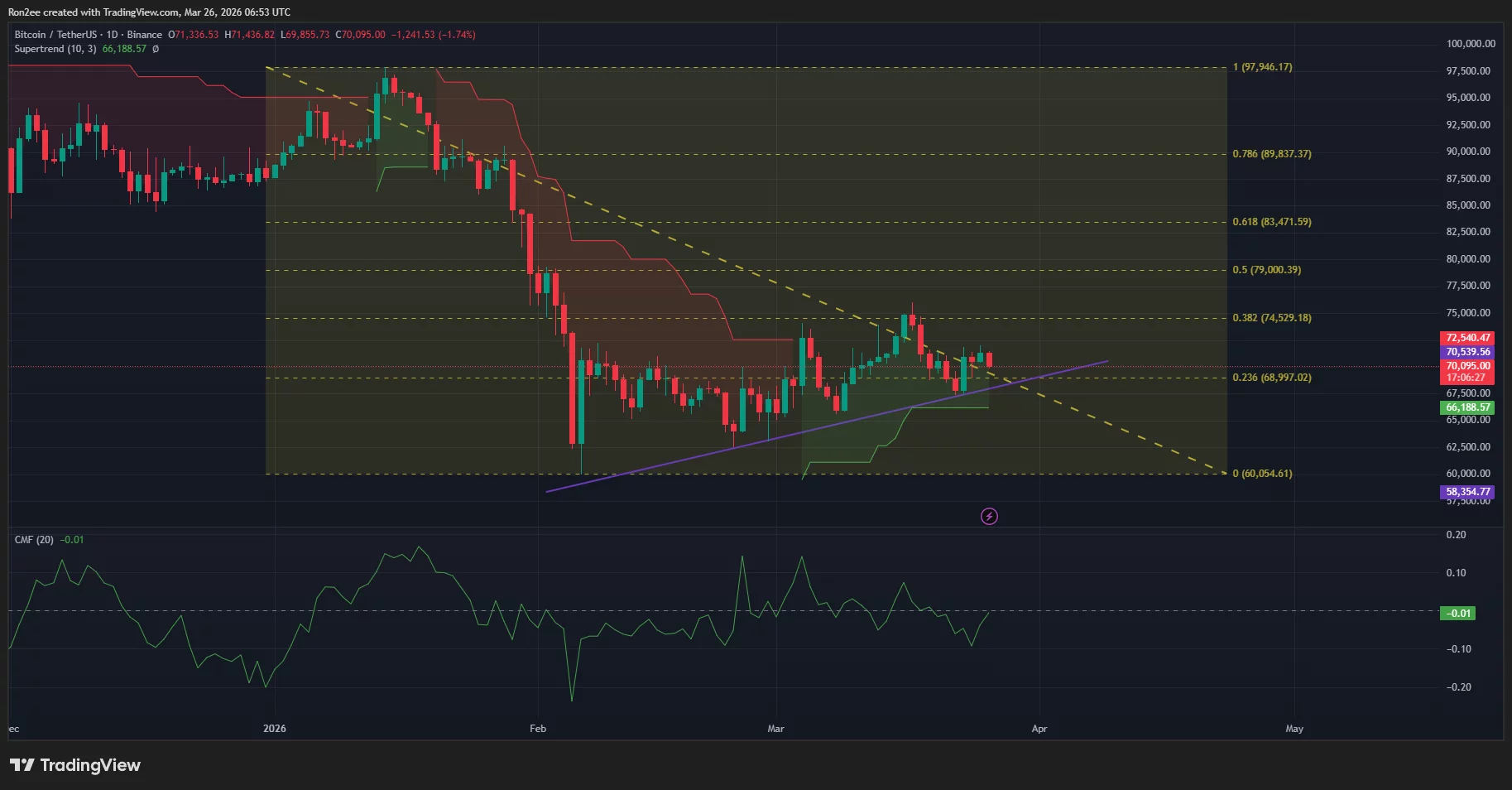
On the daily chart, Bitcoin price has respected an ascending trendline that has been acting as a dynamic support for price since its drop in February. As long as Bitcoin price remains above this diagonal floor, it could stay firmly on a bullish path toward new all-time highs.
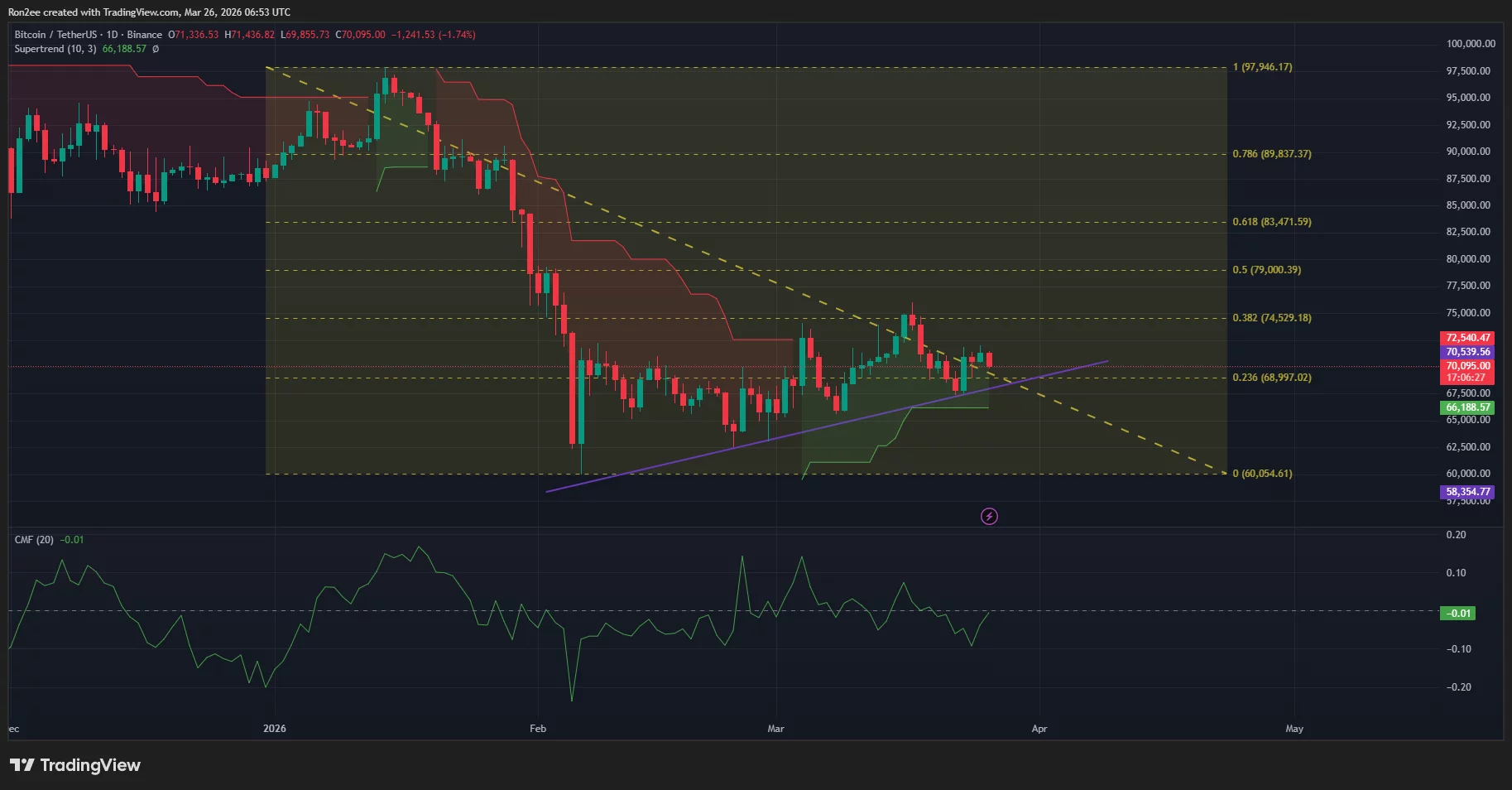
The SuperTrend indicator showed a green signal on the daily timeframe, which means the broader market trend is still considered positive for buyers. Furthermore, the Chaikin Money Flow index is close to turning positive, a sign that institutional buying pressure is beginning to outweigh selling volume.
For now, $71,000 is the key psychological hurdle that traders will be keeping an eye on during the London and New York sessions. A decisive break above this could trigger a short squeeze that sends BTC price rapidly toward the max pain zone.
On the contrary, $69,000, which aligns with the 23.6% Fibonacci retracement level, could serve as the final line of defense for bulls before a deeper correction toward the $65,000 region.
Disclosure: This article does not represent investment advice. The content and materials featured on this page are for educational purposes only.
Key Highlights
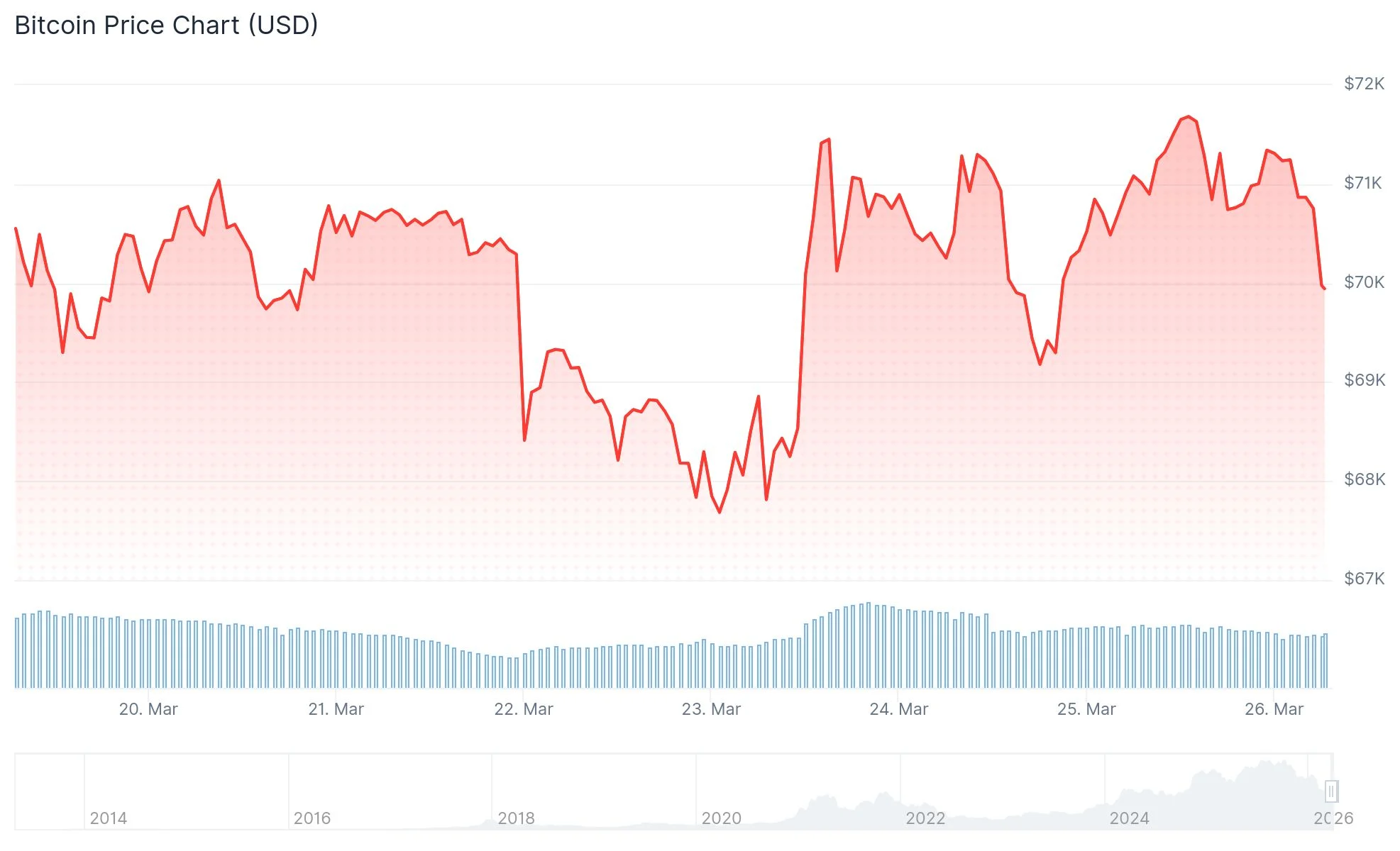
- Bitcoin declined approximately 1%, hovering around $70,712, following reports that Trump privately informed advisors of his desire to conclude the US-Iran conflict within a four to six-week timeframe.
- Tehran dismissed American ceasefire proposals, introducing additional uncertainty into diplomatic negotiations and weighing on risk-sensitive assets.
- Approximately $16 billion worth of Bitcoin and Ethereum options contracts are approaching expiration this Friday, creating near-term market headwinds.
- Chart analysts are monitoring a possible advance toward $80,000, with critical resistance positioned at $71,500.
- Market observer Ali Charts highlighted that speculative investors have exited Bitcoin positions, with the realized cap for new holders reaching levels historically correlated with accumulation cycles.
Bitcoin continues hovering around the $70,000 threshold as international political developments generate near-term volatility in cryptocurrency valuations.
According to reporting from The Wall Street Journal, President Donald Trump has privately communicated to his inner circle his intention to wrap up the ongoing US-Iran military engagement within a four to six-week window. Trump reportedly believes the confrontation is approaching its conclusion and seeks resolution ahead of a scheduled mid-May diplomatic meeting with Chinese President Xi Jinping in Beijing.
Initially scheduled for late March, Trump’s China visit was postponed to May. He reportedly expressed to confidants that the war is diverting his focus from domestic priorities, including preparations for upcoming midterm elections and advocacy for the Safeguard American Voter Eligibility (SAVE America) Act.
Following this development, Bitcoin experienced a roughly 1% decline on Thursday, settling at $70,712. The digital asset fluctuated within a 24-hour band spanning $70,558 to $71,985.
Tehran Dismisses American Peace Proposals
Iran rejected the ceasefire framework proposed by Washington, instead presenting its own requirements for conflict resolution. These stipulations encompass the elimination of all American economic sanctions, financial reparations for conflict-related damages, expanded authority over the Strait of Hormuz, continuation of its ballistic missile initiatives, and assurances preventing future US military intervention.
White House spokesperson Karoline Leavitt issued a forceful statement: “The U.S. will hit Iran harder than they have ever been hit before if Tehran doesn’t make an agreement to end the conflict.”
The diplomatic impasse intensified market ambiguity. Bitcoin had previously experienced upward momentum based on de-escalation expectations, but Iran’s refusal reversed investor sentiment.
Escalating crude oil valuations compounded market pressure, as energy economics have proven to be a significant factor influencing how cryptocurrency markets react to Middle Eastern geopolitical developments.
Derivatives Expiration and Trading Metrics
Over $16 billion in Bitcoin and Ethereum options contracts are scheduled to reach maturity on Friday, an event that has traditionally generated short-duration price fluctuations. Derivatives metrics indicated BTC open interest climbing by $500 million to reach $16.5 billion during the past 24-hour period, while funding rates shifted into positive territory at 0.03%.
Notwithstanding this activity, the recent price movement was predominantly futures-market driven. Spot exchange participation remained subdued, evidenced by a cumulative volume delta of negative $87 million and a declining Coinbase premium indicating weakened American investor demand.
Market analyst Skew characterized Bitcoin’s present situation as a “compression zone,” where contracting price movement could precipitate a significant directional breakthrough. To achieve a sustainable advance beyond $71,500, he emphasized the necessity for robust spot market demand, consistent accumulation patterns, and successful absorption of selling pressure.
A $60 million buy order was executed during the New York trading window, demonstrating some renewed purchasing interest, although analysts emphasize that sustained follow-through remains essential.
Analyst Ali Charts observed on X that Bitcoin’s realized capitalization for recent holders has declined to levels historically associated with the elimination of speculative participants, which in previous market cycles has foreshadowed accumulation periods.
BTC open interest currently registers at $16.5 billion, with the $71,500 threshold remaining the critical level market participants are monitoring.

Crypto exchange Coinbase is reportedly against the latest compromise over stablecoin yields that the Senate is looking to include in its crypto market structure bill.
Coinbase representatives told Senate lawmakers in a meeting Monday that they had concerns over the language around stablecoin yields in the new compromise version of the bill, Punchbowl News reported Wednesday, citing four people briefed on the exchange.
A proposal that circulated earlier this week would have reportedly prevented third parties, such as exchanges, from paying stablecoin yields, a measure aimed at addressing banks’ concerns over the risk of deposit flight.
Coinbase is one of the largest crypto lobbyists in the US, and its withdrawal of support for the bill in January came just before the Senate Banking Committee indefinitely postponed a markup to advance the legislation.
Republican Senator Thom Tillis and Democratic Senator Angela Alsobrooks are leading the latest effort to advance the bill, and talks are reportedly ongoing. Coinbase did not immediately respond to a request for comment.

Yield fight plagues Senate bill
The fight between the crypto and banking lobbies over the Senate’s bill, which aims to outline how regulators should approach crypto, has largely revolved around stablecoin yields.
The White House has hosted at least three meetings for the groups to agree on a compromise, which has yet to materialize.
Banking groups argue that stablecoin yield payments by exchanges are a loophole in the GENIUS Act, which banned stablecoin issuers from paying yield to holders, and present a risk of deposit flight from the banking system.
Stablecoin yields are a major business for crypto exchanges, and the crypto lobby has argued that the risks are overstated and has accused the banks of anticompetitive behavior.
Related: CLARITY Act 2026 odds ‘extremely low’ if not passed before April: Exec
Republicans are pushing to pass the bill ahead of the midterms, where the makeup of Congress could change and derail momentum around the legislation. The House passed its version of the bill, called the CLARITY Act, in July.
Patrick Witt, the executive director of the President’s Council of Advisors for Digital Assets, posted to X on Wednesday that there was “plenty of uninformed FUD [fear, uncertainty and doubt] circulating on social media this week.”
“It’s all going to work out. Bullish,” he added.
Republican Senator Cynthia Lummis also posted to X on Wednesday that “we can’t wait until 2030 for another chance” to pass the crypto bill.
“Bipartisan compromise is necessary for the Clarity Act to pass,” she added. “We’re working around the clock to ensure stablecoin rewards are protected and to prevent deposit flight from community banks.”
Magazine: How crypto laws changed in 2025 — and how they’ll change in 2026
The UK government is advancing plans for a moratorium on political donations made through cryptocurrencies, following an independent review and pressure from multiple high-ranking politicians.
Cointelegraph reported on Wednesday that the Rycroft Review, an independent inquiry into foreign financial interference in the UK’s political and electoral systems, recommended a moratorium on crypto donations to political parties.
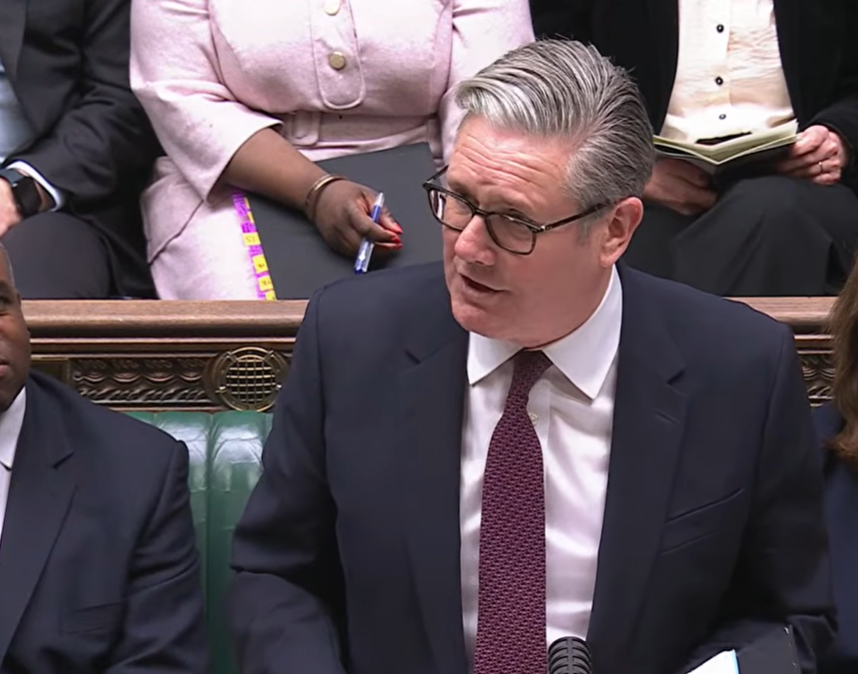
New statements from UK Prime Minister Keir Starmer on Wednesday have confirmed that they will pursue the temporary ban.
“I can tell the House we will act decisively to protect our democracy. That will include a moratorium on all political donations made through cryptocurrencies,” said Starmer during Prime Minister’s Question Time on Wednesday.
Several members of parliament, including the chair of the security committee, have been pushing for a full ban this year, warning that foreign states could exploit crypto payments to influence UK politics.

Under the new measure, crypto will be prohibited for political donations until robust regulations are in place to prevent untraceable funds and foreign interference in UK elections, according to a separate government statement on Wednesday.
Bill still has to pass and become law
The ban would require amending the Representation of the People Bill, and the government said the changes would take “retrospective effect” from March 25.
The legislation is at the committee stage in the House of Commons. It needs to pass through both the House of Commons and the House of Lords, then be approved by King Charles III to become law.

“Once the legislation comes into force, political parties and regulated entities like candidates and MPs will then have 30 days to return any unlawful donations they may have received in the interim, after which enforcement action can be taken,” the government said.
Related: Top UK Labour lawmakers push to ban political donations made in crypto
Reform UK was the first political party in the country to accept crypto donations in May last year, with leader Nigel Farage announcing at the Bitcoin 2025 conference in Las Vegas that the group would accept Bitcoin and other cryptocurrencies from eligible donors.
Ban won’t lift until sign off from government
Once the ban comes into force, it won’t lift until “Parliament and the Electoral Commission are satisfied that the regulatory environment is robust enough to ensure confidence and transparency in donations being made in this way.”
The next general election in the UK must be held by Aug. 15, 2029.
Magazine: How crypto laws changed in 2025 — and how they’ll change in 2026

Celebrities Who Are Grandparents: Multi-Generational Family Pics

Pilot uttered four chilling last words before crash killed all 170 on board

Trump says Gorsuch and Barrett ‘sicken’ him after Supreme Court tariff ruling


-
 Crypto World5 days ago
NIO (NIO) Stock Plunges 6.5% as Shelf Registration Sparks Dilution Worries
-

 Fashion6 days ago
Weekend Open Thread: Adidas – Corporette.com
-
 NewsBeat22 hours ago
Manchester United reach agreement with Casemiro over contract clause amid transfer speculation
-

 Politics6 days ago
Jenni Murray, Long-Serving Woman’s Hour Presenter, Dies Aged 75
-

 Crypto World4 days ago
Best Crypto to Buy Now: Strategy Just Spent $1.57 Billion on Bitcoin During Fear While Early Investors Quietly Enter Pepeto for 150x Potential
-

 Crypto World4 days ago
Bitcoin Price News: Bhutan Sells $72 Million in BTC Under Fiscal Pressure, but the Smart Money Entering Pepeto Sees What the Market Does Not
-

 Tech6 days ago
inKONBINI Lets You Spend Summer Days Behind the Register
-

 News Videos5 hours ago
Parliament publishes latest register of MPs’ financial interests
-

 Sports3 days ago
Remo Stars and Kano Pillars Strengthen Survival Hopes in NPFL
-

 Politics7 days ago
Gender equality discussions at UN face pushbacks and US resistance
-

 Business4 days ago
No Winner in March 21 Drawing as Prize Rolls to $133 Million for Next
-

 Sports3 days ago
Gary Kirsten Accuses Pakistan Cricket Board Of ‘Interference’, Mohsin Naqvi Responds
-

 Tech3 days ago
Give Your Phone a Huge (and Free) Upgrade by Switching to Another Keyboard
-

 Sports6 days ago
2026 Kentucky Derby horses, odds, futures, preview, date: Expert who nailed 12 Derby-Oaks Doubles enters picks
-
Sports7 days ago
Vikings Free Agency Enters Phase 2 with Key Questions
-

 Tech3 days ago
AI enters the chat: New Seattle dating app relies on tech to facilitate meaningful human connections
-

 Politics7 days ago
Scotland’s rejection of assisted dying is a victory for humanity
-

 Business6 days ago
DLocal: Entering 2026 At Escape Velocity
-
Business5 days ago
Columbia Sportswear enters $500 million credit agreement with JPMorgan Chase
-

 NewsBeat7 days ago
Missile lands next to presenter during live report
You must be logged in to post a comment Login