
Crypto World
XRP Poised for 30% Gain as 35M Tokens Moved Off Exchanges in a Day

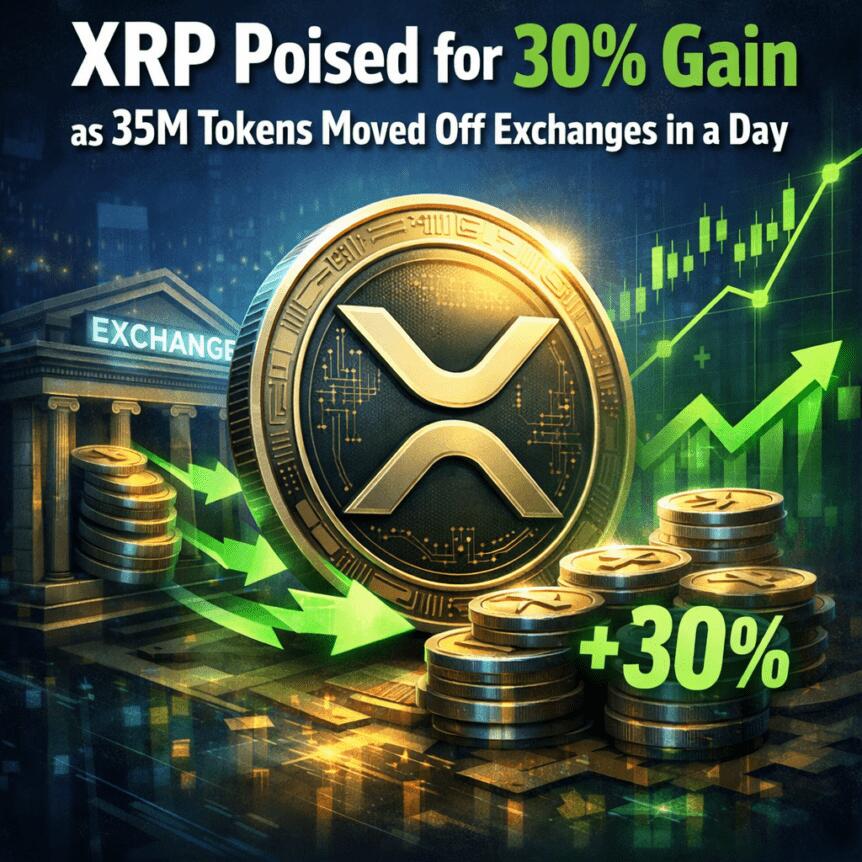
XRP has climbed more than 30% over the last three months, and fresh on-chain and market signals are fueling a cautiously constructive outlook for the XRP/USD pair. As institutional interest, token flows, and a key technical setup align, traders are watching whether the momentum can extend into late spring and early summer.
Analysts are dialing in on a confluence of factors: a notable outflow of XRP from exchanges, renewed large-holder accumulation signals, and a tilt in U.S. spot XRP ETF demand. Together, these elements paint a picture of a market shifting away from near-term selling pressure and toward a more sustained demand dynamic, even as the price hovers near a critical technical juncture.
Key takeaways
- Exchange outflows are signaling a shift of XRP into private wallets or custody, with nearly 35 million XRP leaving exchanges in the last 24 hours—the sixth-largest daily outflow of the year, according to Santiment.
- U.S. spot XRP ETFs have seen three consecutive weeks of net inflows, totaling about $82.88 million as of Saturday, lifting assets under management to roughly $1.1 billion, per SoSoValue data.
- Whale flows have turned positive, with CryptoQuant data showing the 90-day moving average moving back above zero, indicating accumulation by larger holders.
- Technically, XRP/USD sits inside a long-running falling wedge, with a potential 30% move higher by June if the price breaks toward the wedge’s upper boundary, targeting the 50-week EMA near $1.87–$1.89.
On-chain and custody signals bolster the bull case
Exchange outflows have historically accompanied rebounds in XRP price, and the latest spike of around 35 million XRP moving out of exchanges in a 24-hour window marks a notable moment in the current cycle. Santiment highlights that this is among the year’s larger daily outflows, suggesting a concentration of tokens in private wallets or custody rather than ready-for-sale stock on exchanges.
Looking back, similar outflow surges have preceded meaningful upside moves. In March, a pronounced exchange withdrawal spike preceded roughly a 20% price rebound, while February’s outflow surge foreshadowed a near 50% rally. Although past performance is not a guarantee of future results, the pattern adds weight to the view that lower sell-side availability could support higher prices if demand remains steady.
The current outflow narrative dovetails with other positive signals from the XRP ecosystem, offering a more data-driven rationale for optimism over the near term. As long as private wallets and custody arrangements continue to grow while on-exchange liquidity remains constrained, the downside pressure from day-to-day selling may subside, allowing other buyers to push the price higher on favorable momentum.
Institutional demand rises as XRP ETFs attract capital
Institutional interest appears to be crystallizing through benchmark XRP spot exchange-traded products in the United States. SoSoValue data shows three consecutive weeks of net inflows into XRP spot ETFs, with total inflows around $82.88 million through the most recent tally. This flow has helped push the aggregate assets under management for XRP ETFs to roughly $1.1 billion, a milestone that underscores growing institutional exposure to the token.
For traders and investors, ETF inflows can be a proxy for broader appetite among institutions and wealth managers. The persistence of inflows suggests a more constructive stance toward XRP-related products, especially when combined with the custody-driven on-chain dynamics mentioned above. While the ETF channel is just one of several data points, it reinforces the case that demand for XRP products remains more robust than it did earlier in the year.
Whale activity confirms persistent accumulation
Beyond exchange outflows and ETF demand, large-holder behavior is flashing a positive signal. CryptoQuant data indicate that XRP whale flows have flipped to a net-positive regime, with the 90-day moving average rising above zero after spending most of early 2026 in negative territory. Historically, positive whale-flow environments have preceded notable price upswings, lending additional credibility to the current bulge of accumulation by bigger holders.
In the context of the broader accumulation narrative, the shift in whale behavior aligns with the exchange outflows and ETF inflows. When whales accumulate and tokens move into non-exchange custody, the supply-side pressure from sell orders tends to ease, while demand-side pressure from institutions and retail buyers looking to participate in a potential breakout can sustain upside momentum.
Technical setup signals a potential 30% lift, with clear risks
From a chart perspective, XRP/USD has spent a lengthy period trapped inside a falling wedge—two converging downward-sloping lines that have defined the asset’s path for nearly two years. Recent price action has rebounded off the wedge’s lower boundary, setting the stage for a test of the upper boundary. If the pair can clear resistance near the wedge’s apex, the technical picture points toward a measured upside objective near the 50-week exponential moving average, around $1.87 to $1.89. That zone also coincides with the 0.5 Fibonacci retracement level, positioning the move roughly 30% above current prices by June, according to the prevailing technical framework drawn from weekly charts.
On the flip side, a decisive break below the lower trend line would undermine the bullish setup. A break that closes below the wedge could open the door to a revisit of support near the apex point, with a potential retreat toward the $0.98 level—the wedge apex coinciding with the 0.786 Fibonacci retracement.
For traders, the key takeaway is that the current arrangement requires confirmation. The convergence of on-chain outflows, ETF inflows, and positive whale activity lowers the risk of a sudden, sharp pullback, but the technical pattern will remain invalidated unless XRP breaks decisively above the wedge’s resistance. If the price sustains a move into the upper boundary and beyond, the upside path becomes clearer, but any erosion of the momentum or a return of selling pressure could shift the risk-reward balance toward the downside.
What readers should watch next
As May unfolds, the market will be testing whether the confluence of outflows, custody trends, ETF inflows, and whale accumulation translates into a durable uptrend for XRP. Investors should watch two interlinked developments: whether exchange outflows maintain their tempo, signaling ongoing token migration away from tradable liquidity, and whether ETF inflows sustain their momentum, indicating continued institutional appetite for XRP exposure. Additionally, the price action around the wedge’s resistance will be a critical signal for the near-term trajectory. If XRP can establish a breakout above the upper boundary with convincing volume, the medium-term case for a roughly 30% rise by mid-year strengthens. If not, a revisit to the wedge’s lower bound or apex could introduce renewed caution for bulls.

TLDR:
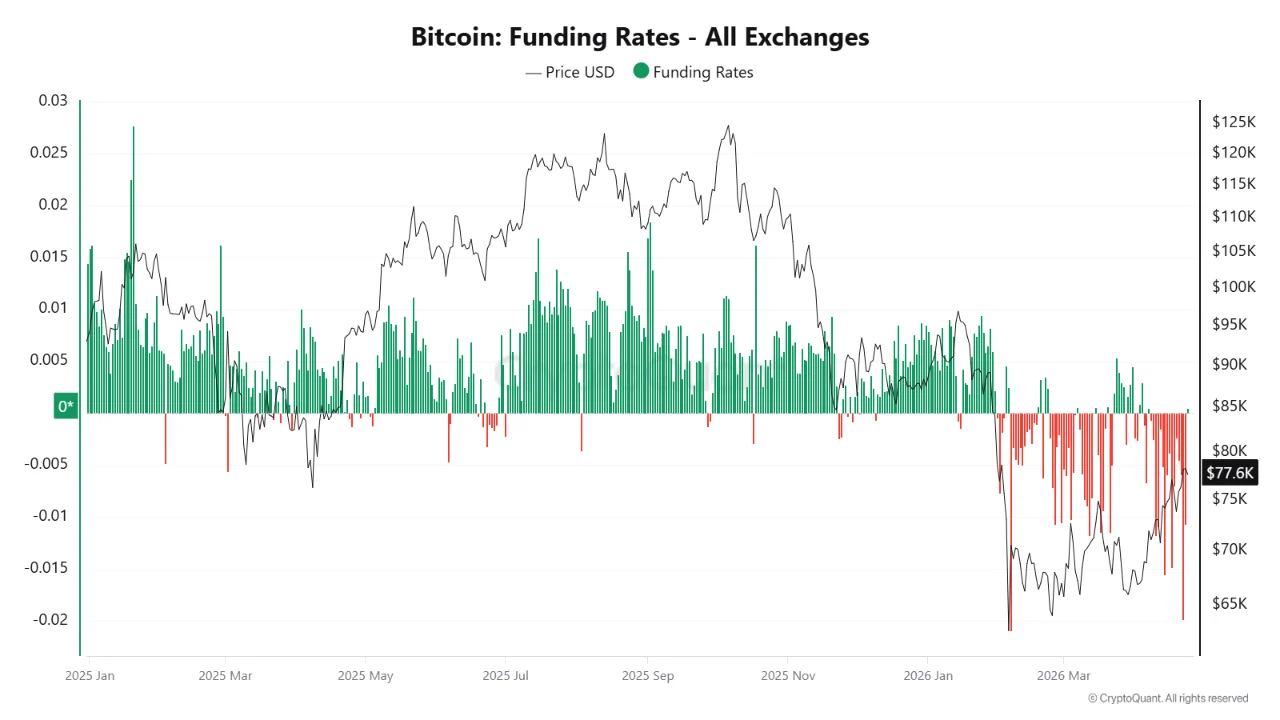
- Bitcoin funding rates have dropped into deeply negative territory, showing strong bearish conviction among traders.
- Rising open interest confirms more capital is entering the market, with the majority positioned on the short side.
- Heavily crowded short trades create structural fragility, making the market vulnerable to a sudden sharp reversal.
- Historical data shows deeply negative funding paired with rising open interest often precedes a strong upward price move.
Bitcoin derivatives data is flashing a warning signal that seasoned traders rarely ignore. Funding rates have fallen sharply into negative territory while open interest continues to climb.
Together, these two indicators paint a picture of a market that is heavily positioned toward the downside. The combination raises the possibility of a violent reversal if price momentum shifts.
Negative Funding Rates Reveal Heavy Bearish Conviction in the Market
Bitcoin funding rates have dropped into deeply negative territory across major derivatives exchanges. This means short sellers are currently paying a premium to keep their positions open. The market is not simply leaning bearish — traders are committing real cost to maintain that stance.
CryptoQuant analyst G a a h drew attention to this development through on-chain data. According to the analyst, the depth of negative funding reflects strong confidence among bearish participants. That level of conviction is notable because it often appears near market turning points.
Negative funding alone does not signal a reversal. However, when it reaches extreme levels, history shows that the setup tends to become unstable. The cost of holding short positions builds over time, creating pressure to close those trades.
As short sellers face mounting costs, even a modest price increase can trigger a wave of forced buying. That buying pushes prices higher, which in turn forces more shorts to cover. This chain reaction is what traders refer to as a short squeeze.
Rising Open Interest Adds Pressure to an Already Crowded Short Trade
Open interest in Bitcoin futures is rising at the same time funding rates are falling. This means more capital is flowing into the market through new positions. Since funding is negative, the bulk of that capital is entering on the short side.
This creates a structurally fragile setup. A large number of traders are betting on further price declines, and they are all sitting in the same direction. When a trade becomes too crowded, it becomes vulnerable to sharp and sudden reversals.
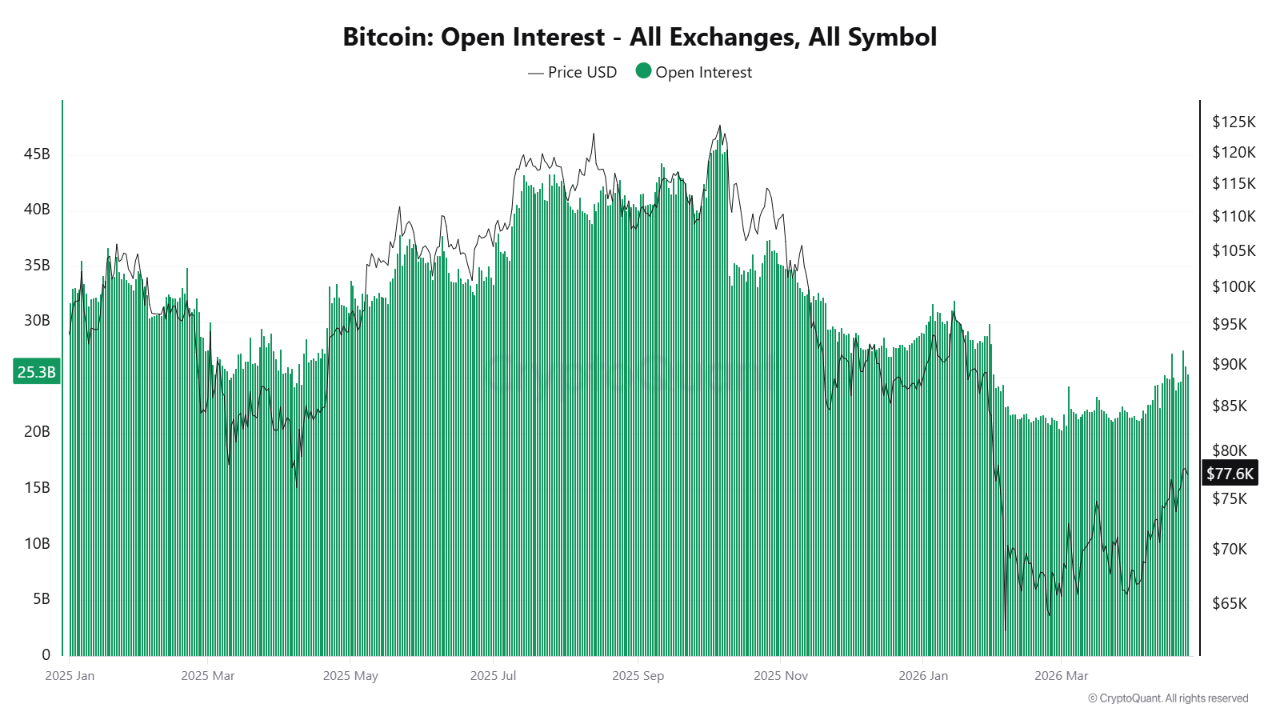
The rise in open interest is not a bearish signal on its own. It simply reflects that more active bets are in play. The direction of those bets, confirmed by negative funding, is what defines the current market condition.
Historically, periods where both open interest rises and funding turns deeply negative have preceded sharp upward price movements.
That pattern does not guarantee a rally. Rather, it points to a market that has built up enough tension to produce a large move in either direction, with upside being the more likely path of least resistance for short-side pressure.


TLDR:
- Goldman Sachs warns global oil stocks could fall below 7.4 billion barrels if Hormuz stays shut through May.
- JPMorgan estimates a 4.3 million barrel-per-day demand drop in April, with Asia absorbing over 80% of the cut.
- The Philippines, India, and Japan have already imposed fuel rationing amid worsening Hormuz supply disruptions.
- Europe’s jet fuel stocks could reach critically low levels by June, the International Energy Agency has cautioned.
The oil market is experiencing an unprecedented supply disruption, with around 13 million barrels per day trapped behind the Strait of Hormuz for over 50 days.
Despite Brent crude rising nearly 20% to $107 a barrel, prices remain far below 2008 inflation-adjusted levels. Analysts point to rapidly depleting global inventories, falling demand, and misplaced optimism over a U.S.-Iran deal as key factors distorting market signals.
Asia Bears the Brunt of the Hormuz Supply Shock
Global crude and product storage stood at roughly 8.2 billion barrels before the Iran conflict began in February. Goldman Sachs projects that figure could drop to 7.6 billion barrels if the strait reopens before April ends. A prolonged standoff through May could push stocks below 7.4 billion barrels.
Of those reserves, only 2 billion barrels sit in OECD importing nations, according to the IMF. Furthermore, only a fraction of those are government stocks that can be quickly distributed.
JPMorgan analysts have warned that OECD commercial crude inventories could reach operational minimums by early May.
Asia, the primary destination for Hormuz oil shipments, is already feeling the sharpest pressure. Refineries across the region have cut throughput, and governments have introduced active rationing measures. The Philippines declared a national energy emergency, while India halted commercial LPG supplies.
Japan has curtailed bus and ferry services due to fuel shortages. JPMorgan estimates global demand fell by 4.3 million barrels per day in April alone. Over 80% of that reduction has been absorbed by Asia and the Middle East.
Europe Faces Rising Fuel Costs as Inventory Cushion Shrinks
The demand crunch is not expected to stay confined to Asia. As reserves shrink further and refined product prices climb, wealthier regions will face increasing pressure. The International Energy Agency has warned that European jet fuel stocks could fall to critically low levels by June.
Physical oil markets are already reflecting the strain. The premium on Dated Brent over futures contracts hit $35 a barrel earlier this month, a historically wide gap.
After a brief ceasefire between the U.S. and Iran, that premium narrowed to around $10 a barrel as panic-bought reserves were released.
However, the standoff around the Strait of Hormuz continues, with both sides actively working to restrict traffic through the waterway.
That means physical and futures prices will likely need to climb further to curb demand among traditionally price-resistant consumers. Markets have not yet fully priced in the pace at which inventories are disappearing.
Investors continue treating dwindling reserves as though they represent stable, long-term supply. That assumption grows harder to justify with each passing week the strait remains disrupted.


The rapid rise of AI agents is beginning to reshape how payments happen online, and crypto infrastructure is emerging as a natural fit, according to Coinbase’s Jesse Pollak.
“What was almost impossible nine months ago is now totally possible,” Pollak said in an interview with CoinDesk, pointing to the accelerating capabilities of autonomous AI systems. As these agents evolve, one need is becoming clear: they require native ways to transact.
“Agents are defined in software and operating software, they want money as software,” said Pollak, who will be speaking at Consensus Miami 2026 next month.
That shift is fueling interest in so-called “agentic payments,” where AI systems can autonomously pay for services like data access, compute or travel bookings.
Pollak said he hopes a key piece of that stack will be x402, an open-source payments protocol that Coinbase and collaborators like Microsoft, Google, and Mastercard have been developing, which enables on-demand API payments without subscriptions or traditional billing systems.
Instead of relying on legacy rails, blockchain-based payments allow agents to “make a single API call or smart contract call and move money globally, instantly, basically for free,” Pollak said.
Early traction is already visible. According to Pollak, roughly $48 million in payment volume has flowed through X402 so far, with about 95% of transactions occurring on Base, the Ethereum layer-2 network founded by Pollak and incubated by Coinbase. The ecosystem is also expanding quickly, with integrations spanning AI providers, data platforms and travel services that agents can tap into directly.
Pollak said the long-term vision is to create an open marketplace of services that agents can access programmatically, without hitting paywalls or requiring human intervention. “You want agents to be able to run wild,” he said, describing a system where software can seamlessly discover, purchase and use digital services in real time.
While fully autonomous “zero-human” businesses are beginning to emerge, Pollak said the bigger near-term shift will come from people augmenting themselves with AI.
“The top performers are now using agents to become even more top performers,” he said, describing workflows powered by multiple parallel AI systems.
For crypto, the broader challenge remains adoption. Pollak argued the solution isn’t better marketing, but invisibility.
“It’ll be a lot easier to sell crypto when you don’t have to tell people about it, they just experience it,” he said.
Pi Network has confirmed it is an official sponsor of Consensus 2026 in Miami, with co-founders Nicolas Kokkalis and Chengdiao Fan each presenting at the event on May 7 and May 6 respectively, as the network simultaneously faces a mandatory April 27 deadline for all node operators to upgrade to Protocol 22.
Summary
- Pi Network is an official sponsor of Consensus 2026 in Miami, with both co-founders scheduled to present at the Convergence Stage.
- Nicolas Kokkalis joins a May 7 panel on proving human identity online without exposing personal data, while Chengdiao Fan speaks May 6 on aligning Web3, AI, and blockchain for utility.
- The Consensus appearance coincides with Pi’s mandatory April 27 Protocol 22 upgrade deadline, after which any non-compliant nodes will be automatically disconnected from the network.
Pi Network has confirmed it is an official sponsor of Consensus 2026 in Miami, with co-founder Nicolas Kokkalis joining a panel on May 7 from 10:15 to 10:45 AM EDT titled “How to Prove You’re Human in an AI World (Without Doxing Yourself)” and co-founder Chengdiao Fan presenting on May 6 from 11:15 to 11:35 AM EDT in a session titled “Aligning Web3, AI, and Blockchain for Utility.” The event runs May 5 to 7 and is expected to draw over 20,000 attendees.
Pi Network Consensus 2026 Appearance Frames Identity as Its Core Market Thesis
The panel Kokkalis is joining addresses one of the fastest-growing problems in the AI era: AI systems can now generate convincing fake profiles and interact across platforms in ways that are nearly indistinguishable from real human behavior. Pi Network argues that its 18 million KYC-verified users, built through a mobile-first identity verification system that has processed over 526 million validation tasks, give it a structural answer to that problem that pure code-based blockchains cannot replicate. As crypto.news reported, Pi competes directly in the proof-of-personhood space with Worldcoin and Humanity Protocol, a category that has attracted significant venture capital attention as AI-generated content proliferates. Fan’s May 6 session is positioned around the idea that tokens should function as tools within real applications rather than as stand-alone financial instruments, framing PI not as an exit vehicle but as infrastructure for sustainable ecosystem growth.
Protocol 22 Deadline Arrives Days Before the Conference
The Consensus 2026 sponsorship lands at a tight operational moment for Pi Network. All Mainnet node operators must upgrade to Protocol 22 by April 27, and nodes that miss the deadline will be automatically disconnected from the network. As crypto.news documented, the upgrade takes under 15 minutes and must be completed to version 0.5.4, introducing a dual-interface setup that allows node operators to use both a node screen and a desktop Pi application simultaneously. Protocol 22 is not the endpoint but the prerequisite for Protocol 23, which is scheduled for May 18 and is expected to introduce full smart contract functionality across the network. As crypto.news tracked, PI was trading at approximately $0.1687 on April 23 with a $1.73 billion market cap, largely unmoved by the technical activity, with the market continuing to treat each milestone as a sell-the-news event.
What Consensus 2026 Could Mean for PI’s Market Trajectory
The combination of the Protocol 22 deadline, the PiRC1 token framework launch, and the Consensus 2026 sponsorship represents the busiest three-week period in Pi Network’s recent history. As crypto.news noted, PI’s market trajectory in 2026 has been heavily dependent on whether technical milestones translate into actual on-chain usage. The Consensus stage gives both founders a direct channel to institutional investors, developers, and policy audiences at exactly the moment Pi is asking the market to recognize its identity infrastructure as commercially relevant. Whether the Miami appearance generates developer adoption and institutional recognition beyond the existing Pioneer community will be the clearest signal yet of whether Pi’s long-term thesis is gaining traction.
Pi Network has not confirmed whether specific ecosystem announcements will accompany the founders’ Consensus 2026 presentations, or whether the sessions will focus primarily on the project’s broad identity and utility thesis.
Key Takeaways
- A dozen defense contractors received Space Force contracts totaling up to $3.2 billion for orbital missile defense technology.
- Major recipients include SpaceX, Lockheed Martin, Northrop Grumman, General Dynamics, and RTX’s Raytheon division.
- These awards support the “Golden Dome” initiative championed by President Trump, with overall costs projected at $185 billion.
- Functional prototype systems must be demonstrated by 2028.
- Budget analysts caution that complete implementation could reach $542 billion across two decades.
The United States Space Force has distributed contract awards valued at up to $3.2 billion across 12 defense industry participants tasked with creating orbital missile interception capabilities. These agreements advance President Donald Trump’s “Golden Dome” defense architecture.
[[TWITTER_EMBED]]
Recipients of the contracts include major defense players such as SpaceX, Lockheed Martin, Northrop Grumman, General Dynamics, and the Raytheon business unit of RTX Corporation, alongside a number of smaller specialized firms.
The Space Force utilized an accelerated procurement strategy for these awards. The intention was to minimize bureaucratic bottlenecks while maintaining competitive pressure among multiple vendors for subsequent phases.
Golden Dome represents a strategic enhancement to America’s existing missile shield infrastructure. The program envisions adding space-deployed capabilities to identify, monitor, and neutralize hostile projectiles during their flight trajectory toward American territory.
Different from conventional ground-stationed interceptor missiles, the Space-Based Interceptor initiative positions defensive weapons in orbital deployment. This configuration enables military forces to engage adversary missiles during their boost phase, immediately following launch.
According to Space Force officials, multiple contract recipients were chosen to maintain “contracting flexibility to award to the best provider.” This competitive approach ensures no contractor receives automatic follow-on business.
The contract distribution occurred between late 2025 and early 2026 via the Space Force’s Space Systems Command. These initial agreements focus on prototype creation rather than mass production.
2028 Deadline for Working Demonstrations
Each contracted firm faces a 2028 deadline to present fully integrated, operational prototypes. Since the underlying technology remains largely unvalidated at scale, defense experts note this timeline introduces substantial pressure alongside considerable technical risk.
The complete Golden Dome infrastructure carries an estimated price tag near $185 billion. The comprehensive system would integrate current terrestrial defense installations with advanced satellite constellations and weapons platforms operating in orbit.
Budgetary considerations present substantial challenges, however. Congressional Budget Office projections suggest a fully operational space-based interceptor constellation could demand expenditures approaching $542 billion throughout a 20-year operational lifecycle.
Pentagon leadership has emphasized that economic feasibility will determine program continuation. Should projected expenses escalate beyond acceptable thresholds, the initiative may undergo significant restructuring or scaling back.
Investment Community Monitors Defense Sector
Financial analysts are closely tracking publicly traded defense contractors participating in the Golden Dome program. Lockheed Martin has attracted particularly strong interest from the investment research community among contract recipients.
Analyst consensus places Lockheed Martin’s price objective at $674.15 per share. This target represents approximately 33% appreciation potential compared to current market valuations, based on aggregated analyst forecasts.
Northrop Grumman and RTX Corporation also secured positions among the winning bidders. Both organizations bring established missile defense portfolios that strengthened their competitive proposals.
The Space Force previously distributed an additional group of Golden Dome development contracts in November focused on alternative prototype designs. Industry observers view these earlier awards as laying groundwork for subsequent production contracts potentially worth tens of billions of dollars.

Bitcoin market participants favored a short-term return to $73,000 as resistance stayed in place, with some analysis seeing even lower levels.

Brazilian authorities have moved to shut down 27 prediction market platforms, including Kalshi and Polymarket. The action, announced Friday, follows a directive from the Finance Ministry and enforcement by Anatel, Brazil’s telecom regulator, which contends that these services operate outside the country’s current legal framework.
Finance Ministry executive secretary Dario Durigan described the moment as a turning point for the sector, telling reporters at the Palácio do Planalto that Brazil previously experienced “a period of anarchy because there were no rules, no oversight, from 2018 to 2022.”
The crackdown aligns with a new rule framework issued by the National Monetary Council (CMN). Resolution 5.298, issued on Friday, takes effect in early May and narrows the scope of permissible prediction-market contracts. Under the CMN’s plan, contracts tied to sports, politics, entertainment, or social events are banned, as authorities deem them closer to gambling than to financial investments. Only contracts linked to economic indicators—such as inflation, interest rates, exchange rates, or commodity prices—will remain allowed and fall under financial-market oversight.
The block list spans both international operators and Brazil-focused platforms. Among the best-known affected names are Kalshi, Polymarket, PredictIt, and Robinhood’s forecasting feature, along with Fanatics Markets. The crackdown also targets ProphetX, Hedgehog Markets, Novig, Polyswipe, PRED Exchange and Stride, as well as several Brazil-centric services such as Palpita, Cravei, Previsao and MercadoPred.
Related: Kalshi bans 3 US politicians for betting on their own election races
Brazil flags prediction platforms as debt risk
Durigan argued that prediction markets could deepen household debt and expose users to financial harm. “At a time when we are working to reduce debt levels among families, small businesses, and students, we must also prevent new forms of harmful indebtedness,” he said.
The government’s stance frames these markets as potential vectors of financial risk at a moment when Brazil seeks to curb indebtedness across households and enterprises. The Ministry and Anatel emphasized that only markets tied to tangible economic indicators will remain within the legitimate financial-market framework.
Global trend and what to watch next
The Brazilian move fits a broader, ongoing pattern as several jurisdictions move to restrict or ban prediction markets, often by folding them into gambling or broader financial-regulatory regimes. In Europe, countries such as France, Belgium and the Netherlands have restricted or penalized operators operating without authorization. The United States presents a more fragmented picture, with ongoing friction between federal authorities and individual states over how to regulate or limit prediction-market activity.
Earlier coverage noted that Kalshi has also taken steps to limit betting on political events in other markets, underscoring the regulatory sensitivity surrounding this sector.
As the CMN rule takes effect and enforcement continues in Brazil, investors and users should watch whether other markets in the region follow suit and how platforms adapt—whether by narrowing offerings, seeking licenses, or exiting certain jurisdictions altogether.
The shift signals a clarifying moment for the intersection of prediction markets and financial regulation. While the technology and its potential for price discovery persist, the path to legitimate, supervised use remains tightly tethered to national frameworks and consumer-protection considerations. Watch how Brazil’s enforcement actions influence platform strategies, local participation, and the broader adoption of regulated forecasting markets in Latin America.


Rep. Anna Paulina Luna accused former House Speaker Nancy Pelosi of insider trading on Thursday, arguing that her reported 17,000% portfolio return since entering Congress is statistically impossible without access to nonpublic government information.
The Florida Republican posted the allegation on X, contrasting Pelosi’s stock market gains with the federal prosecution of a Special Forces soldier facing decades behind bars over prediction market bets tied to a classified mission.
Pelosi’s $280 Million Portfolio and the 17,000% Claim
The Pelosi household portfolio sits near $280 million, with returns since 1987 estimated around 17,000%. That cumulative gain dwarfs the Dow Jones Industrial Average’s roughly 2,300% over the same period and outpaces every benchmark Warren Buffett’s Berkshire Hathaway has set during the same stretch.
Paul Pelosi has repeatedly drawn scrutiny for trading technology options before related legislation moved through Capitol Hill. The household reset its portfolio in January 2026, exiting Nvidia, Apple, Amazon, and Alphabet positions before re-entering through long-dated options on the same names.
STOCK Act Penalties Versus a 50-Year Sentence
Civil penalties under the 2012 STOCK Act remain at $200 per disclosure violation, and watchdog reviews show most late filings draw no fine at all.
Treasury Secretary Scott Bessent has publicly called for an outright ban on congressional stock trading, a stance now shared by senators in both parties. Critics argue that without meaningful criminal exposure, the disclosure regime will continue to produce the kind of returns Luna highlighted.
Master Sergeant Gannon Van Dyke, the soldier Luna referenced, was indicted last week over roughly $409,000 in Polymarket profits tied to the Maduro capture operation.
He faces up to 50 years in prison on charges of commodities fraud, wire fraud, and unlawful monetary transactions.
Renewed Pressure for a Congressional Trading Ban
Luna’s post lands amid bipartisan momentum building behind legislation that would require lawmakers and their immediate family members to divest individual stock holdings within 180 days.
Whether the Van Dyke prosecution accelerates that effort or hardens partisan lines could shape how Congress confronts conflict-of-interest concerns in the coming months.
With midterm campaigns ramping up, both chambers face mounting pressure to enforce penalties beyond the STOCK Act’s $200 penalty.
The post Rep. Luna Accuses Nancy Pelosi of Insider Trading After 17,000% Gains appeared first on BeInCrypto.
BridgeTower Capital has officially deployed Chainlink’s full infrastructure stack to tokenize securities tied to the DOM X Arizona Copper-Gold Project, an $11 billion US natural resource initiative, in what the companies describe as live production infrastructure rather than a pilot.
Summary
- BridgeTower Capital is using Chainlink’s complete stack, including CCIP, Proof of Reserve, NAVLink, and CRE, to tokenize $11 billion in securities from the DOM X Arizona Copper-Gold Project.
- The deployment is live production infrastructure, not a pilot, making it one of the largest single-asset tokenization builds ever brought to institutional scale.
- BridgeTower plans to expand the same platform to tokenize over $25 billion in additional US natural resources, energy, and metals assets.
BridgeTower Capital announced on April 23 the adoption of Chainlink’s full infrastructure stack to tokenize securities from the DOM X Arizona Copper-Gold Project, a US natural resource initiative valued at $11 billion. The deployment covers the complete tokenization lifecycle: Chainlink’s CCIP for cross-chain connectivity to regulated DeFi venues and licensed secondary markets, Proof of Reserve for on-chain asset verification, NAVLink for real-time valuation data, and the Chainlink Runtime Environment to coordinate compliance, reserve checks, and settlement automation in a single operational environment.
Chainlink Tokenization BridgeTower DOM X Marks a First for Physical Commodity Infrastructure
The distinction between live production and pilot matters materially. As crypto.news reported, institutional buyers evaluating tokenization vendors require production evidence, not proof-of-concept demonstrations, before approving vendor relationships or allocating capital. The DOM X deployment provides that evidence in the physical commodities sector, where Chainlink’s institutional reach has until now been concentrated in financial assets like equities, treasuries, and funds. Johann Eid, Chief Business Officer at Chainlink Labs, said the deployment shows “what it looks like when tokenized assets become core institutional infrastructure,” adding that the world’s largest financial institutions are watching tokenization right now and looking for exactly this kind of production-scale evidence. KYC, KYB, and AML controls are embedded at the protocol level throughout the platform, while investor subscriptions are funded through fiat and stablecoin rails powered by Iron, a MoonPay company. Privacy-preserving workflows for institutional primary issuance are also being developed, keeping ownership positions confidential while preserving compliance and on-chain verifiability.
Why Physical Commodities Are the Next Tokenization Frontier
The BridgeTower deployment arrives as the tokenized commodities market is accelerating. As crypto.news documented, tokenized commodities had surpassed $7 billion in value by April 2026, rising nearly 600% since early 2025, with gold-backed tokens dominating but oil, natural gas, and agricultural products gaining share rapidly. Physical commodities present a different tokenization challenge than financial assets: they require verified reserve attestation of underlying physical material, real-time commodity pricing data that can vary by location and grade, and cross-chain connectivity to the multiple settlement venues where institutional commodity trades clear. Chainlink’s Proof of Reserve, NAVLink, and CCIP address each of those requirements directly. As crypto.news tracked, CCIP was averaging approximately $90 million in weekly token transfers by March 2026 and the network had enabled over $28 trillion in cumulative transaction value, providing the operational track record that institutional compliance teams require before deployment.
A $25 Billion Pipeline Behind the Initial Deployment
BridgeTower has structured the DOM X deployment as the first phase of a much larger program. The company plans to tokenize a pipeline exceeding $25 billion in natural resources, energy, and metals assets through the same Chainlink-powered platform, with the DOM X copper-gold project serving as the production reference point for that expanded rollout. As crypto.news noted, Chainlink launched 24/5 US equity data streams across more than 40 blockchains in the same week as the BridgeTower announcement, with the tokenized RWA sector at $27 billion and Chainlink positioned as the primary oracle infrastructure across the growing institutional pipeline. LINK was trading at approximately $9.31 on April 23 as the announcement landed, consolidating below the $9.50 resistance level that analysts have identified as the near-term trigger for a potential directional move.
BridgeTower CEO Cory Pugh described the platform as an end-to-end system in which CRE acts as the orchestration layer linking data agents, regulatory agents, compliance logic, and payments inside one coordinated environment, with institutional issuance and distribution readiness built in from day one.

Quick Summary
- Intel shares skyrocketed approximately 24% on Friday following a massive Q1 earnings surprise
- Adjusted earnings per share reached $0.29 versus Wall Street’s modest $0.01 projection; total revenue hit $13.6B compared to $12.36B consensus
- The Data Center and AI division generated $5.1B in revenue, surpassing analyst expectations of $4.41B
- Forward guidance for Q2 revenue of $13.8B–$14.8B significantly exceeded the $13.03B Street estimate
- Citigroup elevated Intel to Strong-Buy status; numerous Wall Street firms increased their price targets post-earnings
Intel delivered results that caught Wall Street completely off guard. The semiconductor giant reported adjusted earnings of $0.29 per share, demolishing the meager $0.01 consensus projection — representing a stunning $0.28 beat. Total revenue reached $13.6 billion, substantially exceeding analyst forecasts of $12.36 billion.
This marks the sixth straight quarter where Intel has exceeded its own revenue projections, a streak CEO Lip-Bu Tan attributed to a “deliberate reset” in the company’s operational approach.
Shares finished Friday’s session at $82.54, representing a remarkable 23.6% single-day gain. The closing price positions the stock close to its 52-week peak of $85.22, a dramatic recovery from its yearly low of $18.97.
Intel’s Data Center and AI division emerged as the clear winner. This segment generated $5.1 billion in revenue, significantly outpacing the $4.41 billion Wall Street projection. Company leadership characterized CPU demand for AI applications as “unprecedented.”
The AI Agent CPU Thesis
Intel’s positioning is clear and focused. While graphics processors dominate AI model training and execution, the actual tasks performed by AI agents — web navigation, data retrieval, workflow execution — depend heavily on CPUs. This represents Intel’s core strength.
“The next wave of AI will bring intelligence closer to the end user,” Tan explained, “moving from foundational models to inference to agentic.”
The Client Computing division, encompassing PC processors, also exceeded expectations. Revenue reached $7.7 billion versus the $7.1 billion forecast — despite IDC projecting an 11.3% contraction in the global PC market for 2026.
Outlook for Q2 landed between $13.8 billion and $14.8 billion. Analysts had previously estimated $13.03 billion. Intel also projected Q2 earnings per share at $0.20, surpassing the current full-year analyst consensus of $0.08.
Major Partnership Announcements
Intel secured multiple significant contracts during Q1. The company will collaborate with Elon Musk on the upcoming Terafab project, manufacturing chips for SpaceX, xAI, and Tesla. Tesla’s selection of Intel’s 14A manufacturing process represents a significant validation of its foundry operations.
Additionally, Intel announced an extended partnership with Google, with Xeon processors designated to support AI and inference applications across Google Cloud infrastructure.
In a strategic transaction, Intel announced plans to reacquire a 49% ownership stake in a manufacturing plant previously sold to Apollo in 2024 for $11.2 billion — now repurchasing it for $14.2 billion.
Regarding analyst coverage, Citigroup elevated Intel from Hold to Strong-Buy after reviewing the results. Royal Bank of Canada increased its price target from $48 to $80. BNP Paribas shifted from Underperform to Buy. The overall consensus rating remains Hold, with an average target of $72.12 — which now sits below the current trading price.
Major institutional investors had been accumulating shares prior to the report. Norges Bank initiated a position valued at approximately $2.2 billion during Q4. Vanguard increased its stake by 3.5%. Institutional ownership currently stands at roughly 64.5% of outstanding shares.
Despite supply constraints in its Data Center business — where demand continues to exceed production capacity — the company confirmed it will progressively increase output each quarter.

Slovenia To Broadcast Palestinian Filmmakers’ Work On Eurovision Night

WWE releases several superstars after WrestleMania 42

Cohere acquires, merges with Germany-based startup to create a ‘transatlantic AI powerhouse’

Manchester United reach agreement with Casemiro over contract clause amid transfer speculation

US brings back mandatory military draft registration

Steven Gerrard disagrees with Gary Neville over ‘shock’ Chelsea and Arsenal claim | Football

monkey shot reels YouTube#shorts #youtubeshorts #money #reels #fuuny #trending #tiktok #viral

The SEVEN Things You NEED To Learn for Your Financial FREEDOM – Robert Kiyosaki

Easiest Way to Make Money with AI Now (Zero Code)
-

 Business6 days ago
Powerball Result April 18, 2026: No Jackpot Winner in Powerball Draw: $75 Million Rolls Over
-

 Politics6 days ago
Zack Polanski demands ‘council homes not luxury flats for foreign investors’
-

 Fashion20 hours ago
Weekend Open Thread – Corporette.com
-
Entertainment6 days ago
NBA Analyst Charles Barkley Chimes in on Ice Spice McDonald’s Fiasco
-

 Tech6 days ago
Auto Enthusiast Scores Running Tesla Model 3 for Two Grand and Turns It Into Bare-Bones Go-Kart
-

 Politics5 days ago
Gary Stevenson delivers timely reminder to register to vote as deadline TODAY
-

 Politics3 days ago
Making troops accountable for war crimes threatens US alliance, ex-SAS colonel warns
-

 Business3 days ago
Rolls-Royce Voted UK’s Most Iconic Trade Mark as IPO Register Hits 150
-

 Politics3 days ago
Disabled people challenge government SEND proposals over segregation concerns
-
Crypto World5 days ago
Bank of Hawai’i (BOH) Q1 2026: Net Income Drops to $57.4M as Net Interest Margin Expands
-

 Politics3 days ago
Zack Polanski responds to home secretary’s taser threat
-
Politics3 days ago
Wings Over Scotland | How To Get Away With Crimes
-

 Politics3 days ago
Starmer handler McSweeney to be dragged from shadows by Foreign Affairs Committee
-
Crypto World7 days ago
Kelp DAO rsETH Bridge Hack Drains $292M as DeFi Losses Top $600M in Two Weeks
-

 Politics3 days ago
‘Iran is still a nuclear threat’
-
 Crypto World4 days ago
Five Value Stocks with Recovery Potential in 2026: PayPal (PYPL), Nike (NKE), and More
-

 Crypto World4 days ago
New York sues Coinbase, Gemini over prediction market offerings
-

 Business3 days ago
The Job Benefits Most Men Don’t Know to Negotiate
-

 Crypto World1 day ago
Michael Saylor says BTC winter is over. Market analyst disagrees, says bitcoin was in a pullback
-

 Politics6 days ago
Reform investigating candidate who ‘hates’ the NHS
You must be logged in to post a comment Login