
Crypto World
Bank of Hawai’i (BOH) Q1 2026: Net Income Drops to $57.4M as Net Interest Margin Expands


Executive Summary
- BOH net income decreases to $57.4M while net interest margin gains strength
- BOH shares advance as spread improvement offsets quarterly profit reduction
- BOH demonstrates consistent loan and deposit trends alongside enhanced margin performance
- BOH quarterly profit declines but fundamental balance sheet indicators remain robust
- BOH registers reduced earnings while preserving superior credit metrics and capital adequacy
Bank of Hawai’i Corporation unveiled a contrasting picture in its first quarter 2026 financial performance, with net income retreating while fundamental banking indicators displayed resilience. Shares climbed to $81.52, gaining 1.79%, as investors responded positively to intraday price action and consistent upward trajectory. The quarterly report emphasized net interest margin expansion, deposit stability, and disciplined credit management even as bottom-line figures softened.
Profitability Softens as Spread Performance Strengthens
Bank of Hawai’i Corporation disclosed diluted earnings per share of $1.30 during the opening quarter of 2026. The institution generated net income totaling $57.4 million, representing a sequential quarterly reduction of 5.7%. Return on average common equity contracted to 13.90% from the preceding quarter’s 15.03%.
Net interest income expanded to $151.0 million, posting a 3.9% sequential increase. This advancement stemmed from reduced funding costs following monetary policy adjustments. The net interest margin strengthened to 2.74%, climbing 13 basis points and demonstrating enhanced profitability on the core balance sheet.
Average yields on earning assets experienced modest compression to 4.03%, while loan portfolio yields retreated to 4.75%. These declines originated from repricing dynamics on variable-rate instruments responding to the evolving rate environment. Nonetheless, reinvestment activities in fixed-rate instruments provided offsetting yield support.
Asset Portfolio Consistency and Operating Cost Dynamics
Total assets registered $23.9 billion as of quarter-end March 2026, reflecting a modest 1.1% sequential contraction. The reduction primarily originated from diminished cash position holdings. Securities classified as available-for-sale alongside total loan exposures posted incremental growth throughout the reporting period.
Aggregate loans and leases climbed to $14.2 billion, bolstered by expansion in commercial real estate portfolios. Business lending advanced 2.0%, while retail loan segments experienced slight attrition attributable to scheduled principal payments. Total deposit liabilities contracted 1.1% to $21.0 billion, although non-interest-bearing deposits held steady near the 27% threshold.
Noninterest income retreated to $41.3 million reflecting subdued origination volumes and fee generation. Concurrently, noninterest expenses elevated to $116.1 million, propelled by compensation-related outlays and infrastructure investments. Adjusted calculations revealed moderate expense trajectory growth, underscoring disciplined cost oversight despite typical quarterly patterns.
Superior Asset Quality Metrics and Capitalization Framework
Credit quality indicators maintained exceptional performance as non-performing assets contracted to $12.1 million. This figure constituted merely 0.09% of aggregate loans and leases outstanding. Credit loss provisioning similarly declined to $1.8 million, signaling contained portfolio stress.
Net charge-off activity totaled $1.1 million, demonstrating enhanced collection outcomes relative to the prior reporting period. The allowance for credit losses measured $147.0 million, sustaining a steady coverage ratio of 1.04%. These measurements validated ongoing prudent underwriting and portfolio monitoring practices.
Capital adequacy ratios persisted at elevated levels surpassing regulatory thresholds. The Tier 1 capital ratio stood at 14.40%, while the leverage ratio strengthened to 8.62%. The company executed $15.1 million in share repurchases and announced a $0.70 per share quarterly dividend, underscoring its commitment to shareholder capital distribution.



TLDR
- Strategy purchased 34,164 BTC for about $2.54 billion at an average price of $74,395 per coin.
- MSTR stock fell more than 2.5% in pre-market trading after the announcement.
- The company now holds 815,061 BTC acquired for about $61.56 billion.
- Strategy funded the purchase through preferred and common stock sales.
- Michael Saylor said the company achieved a 9.5% BTC yield year-to-date in 2026.
Strategy expanded its Bitcoin holdings with a $2.54 billion purchase, yet MSTR stock fell in pre-market trading. The company disclosed that it acquired 34,164 BTC at an average price of $74,395 per coin. However, shares declined more than 2.5%, even as the firm increased its treasury reserve.
Bitcoin Purchase Expands Corporate Treasury
Strategy confirmed in a Form 8-K filing with the U.S. Securities and Exchange Commission that it completed the acquisition last week. The company funded the transaction through capital raised from its at-the-market equity programs. As a result, Strategy increased its total Bitcoin holdings to 815,061 BTC.
Michael Saylor announced the purchase on X and stated that the company achieved a 9.5% BTC yield year-to-date in 2026. He said Strategy acquired its total holdings for about $61.56 billion at an average price of $75,527 per Bitcoin. Therefore, the company’s cost basis stands close to current Bitcoin prices in the mid-$75,000 range.
Strategy reported that it raised $2,542.3 million during the reporting period. It generated $2,176.3 million in net proceeds from selling 21,795,389 shares of STRC preferred stock. It also secured $366.0 million from issuing 2,165,000 shares of Class A common stock.
The company stated that it still holds $19,463.0 million in remaining STRC issuance capacity. It also listed $26,729.7 million available under common stock offerings. Consequently, Strategy retains room to pursue further Bitcoin acquisitions using equity markets.
MSTR Stock Reacts to Funding Structure
MSTR stock declined more than 2.5% in pre-market trading following the disclosure. The drop occurred despite the company expanding its Bitcoin reserve by over 34,000 BTC in one week. Market participants assessed the impact of ongoing share issuance on existing shareholders.
Peter Schiff criticized the financing approach and said the model could lead to continued shareholder dilution. He pointed to preferred shares carrying an 11.5% yield as part of the capital structure. He stated that Strategy “is moving toward more expensive forms of capital.”
Strategy’s dashboard showed a BTC reserve value of $58,756 million based on internal metrics. The company reported Bitcoin per share at 205,812 sats and an mNAV ratio of 1.28. It also listed $8,254 million in debt and a net leverage ratio of 10%.
The company disclosed annual dividend obligations of $1,237 million tied to preferred stock. It reported 47.5 years of dividend coverage based on its current Bitcoin holdings. The latest filing confirmed that capital markets remain the primary funding source for ongoing Bitcoin purchases.
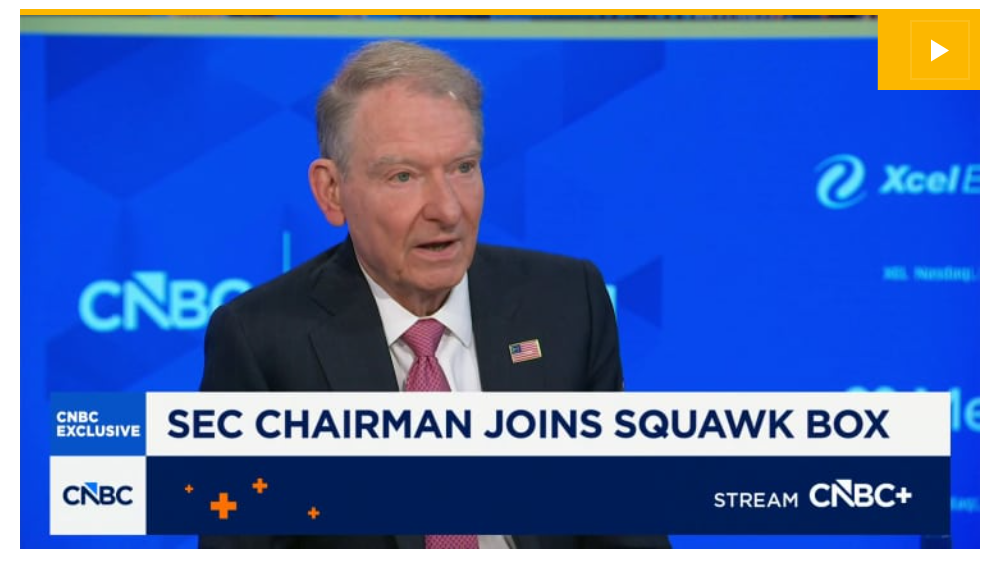
Since Paul Atkins was sworn in as chair of the US Securities and Exchange Commission (SEC) on April 21, 2025, the agency has significantly changed its position on regulation and enforcement related to digital assets, marking a shift from the leadership of former chair Gary Gensler during the Biden administration.
During his 2024 presidential campaign, Donald Trump made removing Gensler one of his promises to the crypto industry, along with creating a national Bitcoin (BTC) stockpile and opposing the issuance of a US central bank digital currency.
His November 2024 election win led to Gensler’s resignation in January 2025 and the appointment of SEC commissioner Mark Uyeda as acting chair of the financial regulator until the Senate could confirm Atkins as Trump’s pick to lead the agency.

Even before the Senate voted to confirm Atkins, the SEC was already signaling a change in crypto regulation and enforcement under Trump. Uyeda oversaw the creation of an SEC crypto task force headed by Commissioner Hester Peirce and the agency began to drop civil enforcement actions and investigations into crypto companies, starting with Coinbase in February.
The first 12 months of Atkins’ chairmanship has seen the SEC push policies and approaches to regulation widely viewed as favorable to the crypto and blockchain industry.
In addition to wrapping up enforcement actions, the regulator has approved multiple exchange-traded funds tied to various crypto assets, signed a memorandum of understanding with the Commodity Futures Trading Commission (CFTC) over coordination on digital asset regulation and issued an interpretative notice on not treating most cryptocurrencies as securities under federal law.
Related: One year after Gary Gensler’s exit, SEC’s crypto playbook looks very different
“A year goes by quickly, but we’ve made huge progress, I think,” said Atkins in a Monday CNBC interview. “I promised a new day at the SEC when I came aboard, and we have. We’ve pivoted from the old practice of regulation through enforcement and the opaqueness of the agency, as, for example, with crypto.”

SEC chair faces scrutiny from Democratic lawmakers
While many in the crypto industry have lauded Atkins’ approach to digital assets since taking office, Congressional Democrats have criticized the SEC and chair for potential conflicts of interest following dropped investigations and enforcement actions against companies tied to Trump and his family.
Last week, Massachusetts Senator Elizabeth Warren accused the SEC chair of misleading Congress in his testimony before a House committee in February. Warren said in an April 15 letter that the SEC’s own data from the 2025 fiscal year showed the agency had fewer enforcement actions than at any point in the previous 10 years.
Magazine: Adam Back says current demand is ‘almost’ enough to send Bitcoin to $1M
Early Threats Recovery Plan
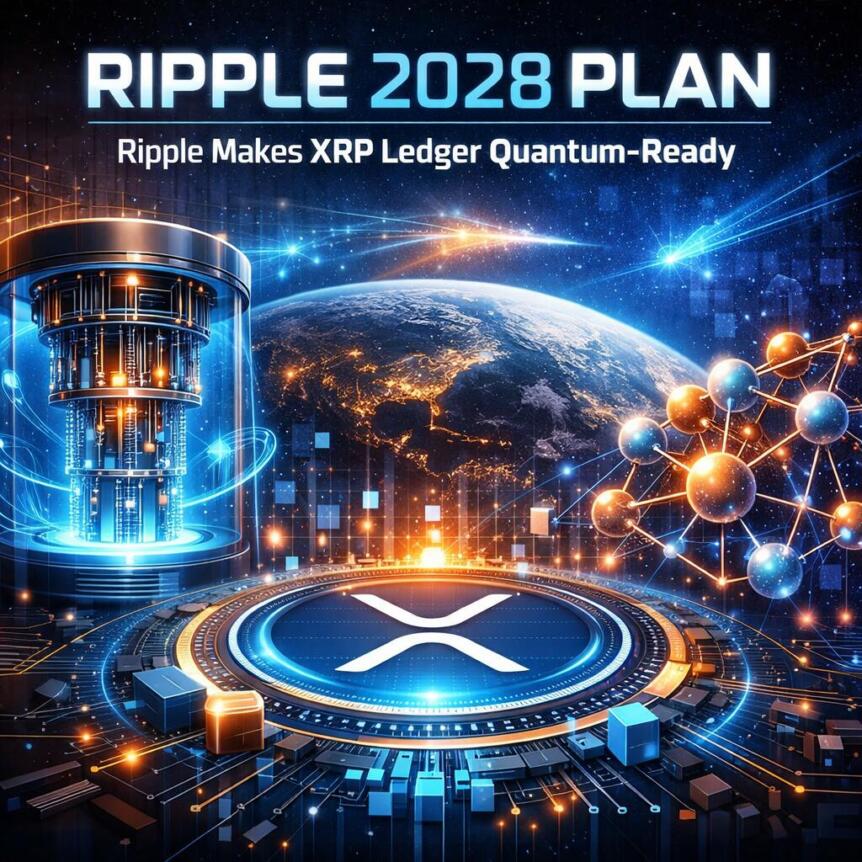
The first phase focuses on recovery actions in case of the failure of classical cryptography. Engineers will introduce a comprehensive migration trajectory, which will require users to transfer funds to quantum-secure accounts. Moreover, the strategy will guarantee that user assets are not exposed in case of a transition event caused by compromised keys. Ripple engineers are exploring zero-knowledge proof systems that prove ownership of existing accounts without disclosing any private keys. As a result, the network will be able to promote safe migrations and safeguard sensitive information. The XRP Ledger already has building blocks that facilitate this approach such as seed-based key generation.
The second step is concerned with testing the algorithms suggested by the National Institute of Standards and Technology. In addition to in-house testing, Ripple has collaborated with Project Eleven to build hybrid signing systems that fuse existing and post-quantum techniques. The next stage will involve developers starting to incorporate new signature systems with the existing elliptic curve techniques. Additionally, developer networks will begin to be tested to enable applications to be modified. Ripple will also analyse encryption tools that uphold privacy and compliance to tokenized assets.
The final stage involves a full transition toward post-quantum cryptography within the XRP Ledger ecosystem. Ripple therefore intends to implement protocol changes that will facilitate the adoption of new signature systems on a large scale. This move will transition the network from testing into full deployment in line with the stated timeline. The XRP Ledger already includes features to enable long-term resilience against quantum risks. Notably, key rotation enables users to refresh private keys without changing accounts, and deterministic generation of keys enables security upgrades to be controlled. These functionalities will provide a foundation for future upgrades as quantum technology advances.
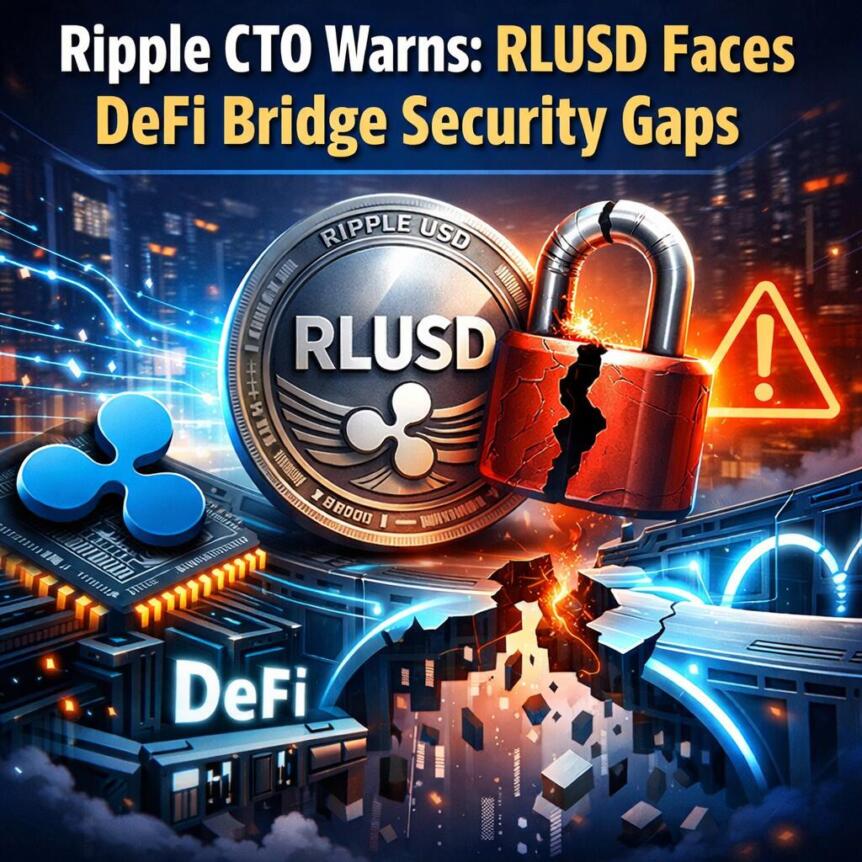
David Schwartz raised fresh concerns about integrating decentralized finance bridges for Ripple’s RLUSD stablecoin. He focused on security risks after reviewing several cross-chain systems. Besides that, his findings showed that most protocols had strong technical foundations but still faced deployment weaknesses.
I evaluated a lot of DeFi bridging systems for use by RLUSD. I was almost exclusively focused on the security and risk aspect. One thing I noticed is that most schemes were very well designed and had really strong mechanisms available to protect against exactly the type of attack…
— David ‘JoelKatz’ Schwartz (@JoelKatz) April 20, 2026
However, he stressed that operational decisions often weaken security layers. Many teams prioritize ease of use and faster expansion across networks. Consequently, critical safeguards get overlooked, which increases exposure to exploits across connected chains.
Convenience Trade-Offs Create Vulnerabilities
Schwartz explained that several bridge systems discourage full use of key security features. He noted that developers avoid complex safeguards due to cost and operational challenges. Moreover, this approach creates gaps that attackers can exploit during high-value transactions.
Additionally, he linked this pattern to recent exploit cases in the DeFi sector. He pointed out that convenience-driven decisions reduce resilience against advanced attacks. Hence, systems that appear secure in design may fail under real-world pressure.
KelpDAO Exploit Reflects Broader Risks
The recent attack on KelpDAO involved the loss of around $292 million tied to rsETH tokens. Attackers exploited cross-chain messaging linked to LayerZero infrastructure. Significantly, the exploit relied on manipulating transaction validation processes.
On-chain data showed that about 116,500 rsETH tokens moved to attacker-controlled wallets. Moreover, the attacker used these assets as collateral on Aave V3 to borrow ETH and WETH. Consequently, the funds moved through Tornado Cash to obscure transaction trails.
Cross-Chain Weaknesses Raise RLUSD Concerns
Schwartz noted similarities between the exploit and potential risks for RLUSD integration. He suggested that ignoring LayerZero’s advanced security features may have contributed to the breach. Additionally, he described the attack as more complex than initially expected.
Moreover, he emphasized that cross-chain infrastructure introduces multiple points of failure. Each connection between networks increases risk exposure. Hence, stablecoin systems relying on such bridges must prioritize strict validation mechanisms.
Broader Ecosystem Flags Additional Risks
Concerns also extend to wrapped assets such as wXRP on other networks. An XRPL validator highlighted counterparty risks tied to issued tokens across chains. Besides that, ecosystem participants continue to evaluate governance changes for lending protocols.
However, some developers argue that proposed updates may not deliver strong utility for XRP holders. Meanwhile, discussions continue around collateral use cases and protocol efficiency.
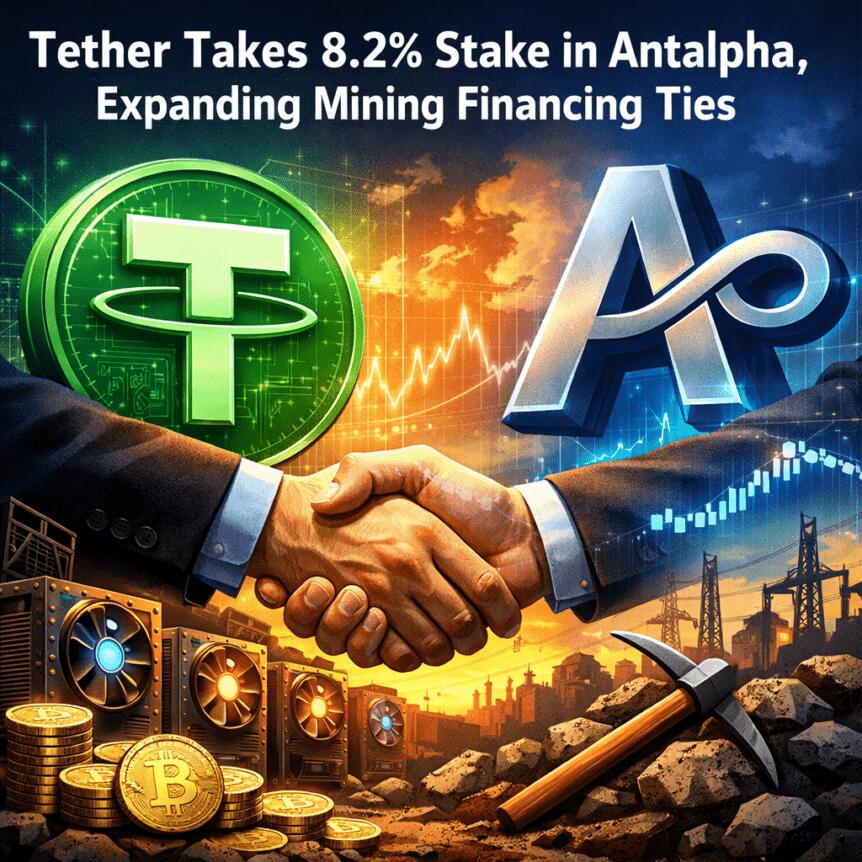
Tether has disclosed an 8.2% stake in Antalpha, acquiring about 1.95 million Antalpha shares through related entities. The position, disclosed in a Schedule 13D filed with the U.S. Securities and Exchange Commission, places the stablecoin issuer among Antalpha’s largest shareholders following the mining-focused lender’s May 2025 initial public offering. Giancarlo Devasini, Tether’s chairman, shares voting and dispositive power over the stake, according to the filing. The document also notes that Tether and its affiliates may adjust their holdings over time in response to market conditions and other factors.
Antalpha operates in the Bitcoin-backed lending and equipment-financing space, catering to mining operators. The company reported a loan portfolio of about $1.6 billion as of the end of 2024 and maintains close ties to the Bitmain ecosystem, a major supplier of mining hardware.
Antalpha raised roughly $49.3 million in its IPO, at $12.80 per share. Tether had previously signaled a potential interest in purchasing up to $25 million worth of shares.
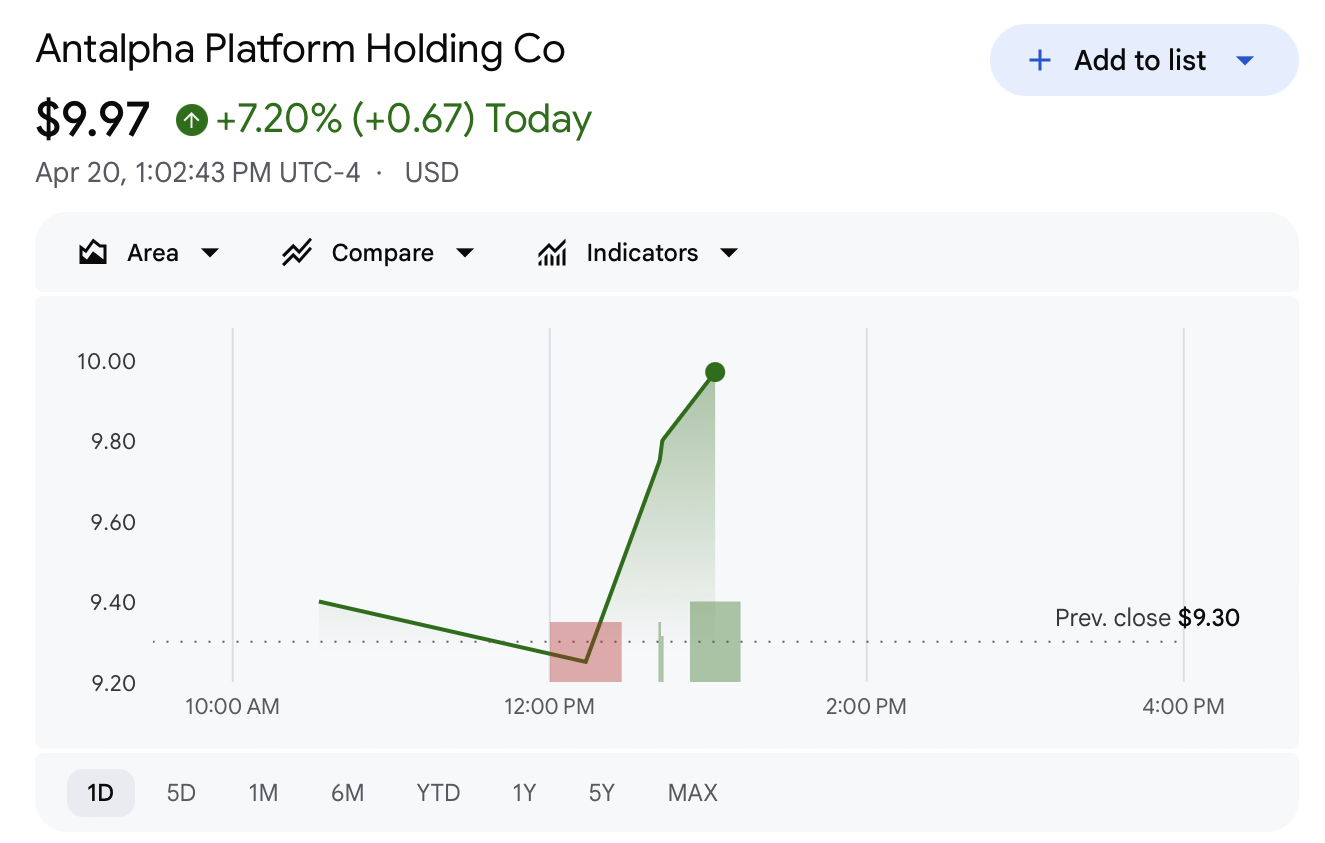
In its latest annual figures, Antalpha posted 2025 revenue of $79.7 million, up 68% year over year, with net income rising to $18.5 million—more than triple the previous year’s figure. On the day of the disclosure, Antalpha’s stock climbed about 7.2% to around $9.97 in early trading, according to Google Finance data.
Source: Cointelegraph, based on the Schedule 13D filing and Antalpha’s financial disclosures.
Key takeaways
- Tether now holds roughly 1.95 million Antalpha shares, representing an 8.2% stake and giving the founder’s circle voting power over the position, per the Schedule 13D.
- The stake arrives after Antalpha’s May 2025 IPO, with Tether previously indicating interest in buying up to $25 million of shares.
- Antalpha’s core business centers on Bitcoin-backed lending and mining equipment financing, with a reported $1.6 billion loan portfolio at year-end 2024 and ties to the Bitmain ecosystem.
- Tether’s broader investment strategy is to deploy profits across crypto infrastructure, tokenized assets, and related tech—new bets alongside existing holdings in Eight Sleep, Gold.com, Anchorage Digital, and a Kaio-backed round.
- The stablecoin issuer remains the dominant player in the market, with USDT accounting for about $187 billion in market capitalization and the total stablecoin market near $320.7 billion.
Antalpha and the mining-finance niche
Antalpha’s business model emphasizes liquidity and equipment financing for mining operators, a space that has drawn interest from investors seeking exposure to the cyclical upswing of crypto mining. The company’s sizable loan portfolio signals a continued focus on securing scalable credit lines for operators navigating equipment cycles and capital expenditure needs. Its connection to Bitmain’s ecosystem underscores a strategic alignment with a major supplier in the mining hardware sector, potentially easing access to hardware and related financing channels for clients.
Tether’s stake: governance, strategy, and potential impacts
The Schedule 13D filing confirms that Tether’s stake in Antalpha is substantial enough to position the company as a major shareholder. With Devasini listed as sharing voting and dispositive power, the arrangement signals an intentional governance role in Antalpha’s ongoing development. While the filing notes that Tether and its affiliates may adjust their position over time, the move reflects a broader pattern of Tether diversifying beyond its core stablecoin operations into strategic investments across crypto finance, infrastructure, and real-world asset initiatives.
Cointelegraph has previously reported on Tether’s expansive capital deployment—an approach that taps profits from USDT to fund ventures across mining, AI, financial services, and tokenized assets. The recent Antalpha stake complements a portfolio that has included investments in tokenized real assets and regulated financial infrastructure. The company’s strategy has included selective allocations to fintech and on-chain finance ventures, with profits fueling these bets rather than reserve-backed liquidity alone.
Tether’s broader venture footprint and what it signals
Beyond Antalpha, Tether’s investment activity this year has spanned several notable deals. In March, the company led a $50 million funding round for Eight Sleep, a firm building sleep-focused wellness hardware and software, which valued the company at around $1.5 billion. In February, Tether acquired a roughly $150 million stake in Gold.com, representing about 12% ownership, as part of its push to widen access to tokenized gold through its XAUt stablecoin product. In the same month, Tether announced a $100 million equity investment in Anchorage Digital, a federally chartered U.S. digital asset bank that provides custody, settlement, and stablecoin issuance services to institutional clients.
CEO Paolo Ardoino has publicly highlighted the breadth of Tether’s venture exposure, noting that the firm has invested in more than 120 companies through its venture arm, with funding drawn from profits rather than from stablecoin reserves. This approach aims to diversify the company’s revenue streams and digital-asset ecosystem exposure while maintaining a cautious stance toward custodial and regulatory-compliant ventures.
Earlier this month, reports surfaced that Tether could pursue fresh capital at a valuation around $500 billion, with the company signaling that fundraising could be delayed if investor appetite does not materialize. The stake in Antalpha, along with the broader lineup of strategic bets, reinforces a narrative of continuous expansion into crypto infrastructure and related industries—an approach that aligns with Tether’s long-term ambition to anchor a broader ecosystem around stablecoins and on-chain finance.
Market context and what to watch next
Antalpha’s performance, combined with Tether’s growing investment footprint, offers a window into how stablecoin issuers are recalibrating their role in the crypto economy—from liquidity providers to strategic accelerators for on-chain assets, mining finance, and tokenized real-world assets. For investors, the key questions revolve around governance outcomes, the impact on Antalpha’s strategy and profitability, and how Tether’s venture portfolio may influence regulatory and market perceptions of stability-backed capital in crypto markets.
As the crypto landscape evolves, observers will watch how Tether’s stake translates into governance influence at Antalpha, how Antalpha leverages this partnership to scale its lending and financing operations, and how the broader set of Tether-backed ventures interacts with growth in mining, asset tokenization, and institutional-grade on-chain infrastructure.
Readers should stay attentive to Antalpha’s quarterly results and any subsequent regulatory disclosures that illuminate how such strategic holdings shape governance, risk, and value creation in the mining-finance niche and beyond.
Tether has taken an 8.2% stake in Antalpha, making the stablecoin issuer one of the company’s largest shareholders following its May 2025 initial public offering (IPO), according to a Monday filing.
The Schedule 13D filing with the US Securities and Exchange Commission indicates that Tether now holds 1.95 million shares through related entities, with Giancarlo Devasini, chairman of Tether, sharing voting and dispositive power over the position.
The filing also states that Tether and its related entities may increase or reduce their holdings over time depending on market conditions and other factors.
Antalpha provides Bitcoin-backed lending and equipment financing to mining operators, reporting a loan portfolio of about $1.6 billion as of the end of 2024, and is closely tied to the Bitmain ecosystem, a major supplier of mining hardware.
Antalpha raised about $49.3 million in last year’s IPO at $12.80 per share, according to its prospectus. Tether had previously indicated interest in purchasing as much as $25 million worth of shares.
Antalpha reported 2025 revenue of $79.7 million, up 68% year over year, while net income rose to $18.5 million, more than tripling from the previous year.
On Monday, its shares rose about 7.2% to around $9.97 in early trading, per Google Finance data.

Tether is the issuer of Tether (USDT), the largest stablecoin by market capitalization, with a market cap of about $187 billion, roughly 58.4% of the total stablecoin market, which stands near $320.7 billion, according to DefiLlama data.

Related: Tether announces $150M recovery program for Drift Protocol
Tether expands investments across crypto infrastructure and beyond
Tether’s investment in Antalpha comes as the company is using its recent profits to expand into a range of sectors tied to digital assets, including mining, artificial intelligence, financial services and tokenized assets.
Earlier on Monday, real-world asset tokenization protocol Kaio said Tether participated in an $8 million funding round.
“The participation of Tether reflects direct strategic alignment,” the announcement said. “USDT has become the dominant settlement layer for cross-border capital flows. KAIO provides the next layer: structured, compliant access to institutional-grade yield for USDT holders.”
In March, Tether led a $50 million investment in Eight Sleep, a company that develops sleep-focused products such as smart mattresses and wellness systems, valuing it at $1.5 billion.
In February, the company acquired a $150 million stake in Gold.com, representing about 12% ownership, as part of a push to expand access to tokenized gold through its XAUt product.
The same month, Tether made a $100 million equity investment in Anchorage Digital, a federally chartered US digital asset bank that provides custody, settlement and stablecoin issuance services to institutional clients.
CEO Paolo Ardoino said in July that Tether has invested in more than 120 companies through its venture arm, with those investments funded from company profits rather than stablecoin reserves.

Earlier this month, Tether was reported to be seeking fresh capital at a $500 billion valuation, with the company indicating it could delay the raise if investor demand falls short.
Magazine: Adam Back says current demand is ‘almost’ enough to send Bitcoin to $1M


Iran peace talks entered their most uncertain phase yet Monday as Vice President JD Vance prepared to lead a delegation to Islamabad alongside envoys Steve Witkoff and Jared Kushner, Axios reported, even as Iran’s Foreign Ministry formally stated it has “no plans” for a second round and Tehran suspected the invitation was cover for a surprise US military strike before Wednesday’s ceasefire expiry.
Summary
- Two US Air Force C-17 cargo planes landed at a Pakistani air base Sunday carrying security equipment, and Islamabad’s Red Zone was locked down with thousands of security personnel deployed in anticipation of a US arrival.
- Trump told Axios: “I feel fine about it. The concept of the deal is done. I think we have a very good chance to get it completed,” directly contradicting Iran’s public rejection of talks.
- Pakistan’s foreign ministry confirmed its counterpart spoke with Iran’s foreign minister by phone Sunday about “the need for continued dialogue,” leaving a narrow window for Iran to reverse its stance.
Iran peace talks are entering their most consequential 48 hours with the ceasefire set to expire Wednesday and no Iranian delegation publicly confirmed. The US delegation is traveling regardless. Pakistan has kept Islamabad under security lockdown in anticipation of a second round, with thousands of paramilitary and army personnel deployed through the Red Zone.
The US team, the same configuration that led the failed first round on April 11 and 12, is led by Vance and includes Witkoff and Kushner. Two US Air Force C-17 cargo planes had already landed at a Pakistani air base Sunday with security equipment and vehicles, signaling the delegation was committed to arriving whether or not Iran confirmed participation.
Tehran has told intermediaries it believes the US announcement of talks is designed to build a “blame game” narrative: publicly committing to negotiations while preparing military strikes to coincide with the ceasefire expiry. The Sunday seizure of the Touska, arriving hours after Trump announced the Pakistan talks, reinforced that suspicion. Iran’s Foreign Ministry described US statements about negotiations as “a media game.”
Iran’s chief negotiator Ghalibaf said in state television remarks Saturday that Iran’s armed forces remain “ready” even while pursuing diplomacy, framing the two tracks as simultaneous rather than alternative. The original ceasefire was announced hours before a midnight deadline during which Trump had threatened “a whole civilization will die tonight.” Iran’s negotiating team arrived at the first round dressed in black, in mourning for those killed in the war. The level of institutional mistrust is not rhetorical.
What Pakistan Is Attempting as Mediator
Pakistan has framed this engagement as an ongoing “Islamabad process” rather than a single discrete round, giving itself diplomatic room to survive a second collapse without the entire framework breaking down. Prime Minister Sharif spoke with Iranian President Pezeshkian on Sunday. Pakistan’s army chief Field Marshal Asim Munir has served as the primary interlocutor between delegations throughout the conflict.
Despite Iran’s public rejection, Pakistani authorities completed Red Zone security preparations, suggesting Islamabad has reasons to believe Iran may still participate. An Iranian parliamentary official told Al Jazeera that Iran would “likely” send a team Monday or Tuesday, a gap between the Foreign Ministry’s statement and the parliamentary official’s remark that Pakistan is actively working to close.
What the Outcome Means for Crypto Markets
The next 48 hours will determine which scenario plays out for Bitcoin price markets. A ceasefire extension or genuine deal replicates the April 8 template: oil crashes and BTC surges, potentially toward $80,000. A confirmed collapse with resumed strikes tests the institutional demand floor below $70,000.
The Iran nuclear sticking point remains the hardest to bridge: the US requires Iran to permanently halt uranium enrichment, and Iran has said it will not surrender its 440-kilogram stockpile. A second round would need to find a formula, such as third-party custody of the stockpile, that neither side has publicly endorsed but that both have reportedly discussed through Pakistani intermediaries.


If Michael Saylor can sustain his trailing four-week pace of bitcoin (BTC) buying, Strategy (formerly MicroStrategy) could own more than Satoshi Nakamoto by September 2026.
Buying at the world’s largest BTC treasury company now averages nearly 2,800 BTC per trading day after accelerating 40% over the last four weeks above its year-to-date average.
Strategy has publicly targeted 1 million BTC under its so-called 21/21 capital plan.
Monday’s SEC Form 8-K filing pushed the company’s holdings to 815,061 BTC. Saylor picked up 34,164 BTC last week alone, a single-week record for 2026, at an average purchase price of $74,395 per coin.
Strategy’s blended cost basis across all holdings is now $75,527, which sits within 1% of the prevailing market price of BTC.
Although there are a variety of estimates for the total holdings of Bitcoin creator Satoshi Nakamoto, 1.1 million is a common estimate. For example, Arkham Intelligence attributes 1,096,354 BTC to Satoshi from roughly 22,000 coinbase rewards of the blockchain’s earliest blocks.
Strategy is a mere 281,293 coins short of that figure.
If Saylor continues his pace over the last 30 days through autumn, Strategy could close the gap in 101 trading days, or about 147 calendar days.
Strategy could buy more bitcoin than Satoshi
Strategy can buy and hold BTC around the clock, but it cannot fund new buys 24/7. At the market (ATM) offerings of MSTR common stock; as well as the preferreds STRC, STRK, STRF, and STRD; occur when Nasdaq is open.
Any realistic projection of when Strategy might own more BTC than Satoshi has to measure pace by trading day, i.e. roughly 21 trading days per month adjusted for federal market holidays.
Year-to-date through April 19, Strategy has bought 142,561 BTC for roughly $11.13 billion across 73 trading days. That’s approximately 1,953 BTC per trading day.
Extrapolating the 2026 average through November 13 would put Strategy past Satoshi on that date.
However, the trailing four weeks are running about 40% hotter than the first quarter. Strategy’s last four weekly announcements, covering March 23 through April 19, totaled 52,962 BTC across 19 trading days.
That acceleration tracks Strategy’s March 23 expansion of its ATM sales. On that day, the company authorized another $21 billion of new MSTR common stock, $21 billion of new STRC preferreds, and a more limited $2.1 billion of STRK preferreds.
Saylor posted, “The Second Century Begins” in early March. He meant that Strategy had just completed its 100th BTC purchase since 2020. Six weeks into his “second century,” Saylor has bought another 76,330 BTC.
STRC preferred is doing most of the work
Of the roughly $11.34 billion Strategy has raised this year through its ATMs, almost all of which went to buy BTC, MSTR common stock provided about 50.8% or $5.77 billion. STRC provided 49.1% or $5.57 billion.
STRF and STRD preferreds contributed nothing, and STRK raised just $3.4 million.
Thanks to an aggressive advertising campaign likening STRC to a high-yield bank account or money market fund — in addition to a surge in trading volume to capture the dividend snapshot for STRC’s then-once-monthly, 11.5% annualized dividend — Strategy reported $2.2 billion of STRC sales, dwarfing its $366 million of MSTR sales.
Although MSTR has historically funded the vast majority of Strategy’s BTC buying, STRC funded 85% of last week’s purchase.
Last year, in contrast, Strategy sold zero STRC through its ATM from August through October 2025.
Read more: STRC controversy goes mainstream
STRC is supposed to trade near $100 per share, but shares have traded below $91 at times. The company has raised its dividend rate seven times in order to encourage bids after its price fell.
Strategy has also been stockpiling a few dollars, not just BTC.
The company disclosed $2.25 billion USD as of January 4. This cash is earmarked to service preferred dividends and bond interest payments. The reserve started at $1.44 billion in December 2025.
Got a tip? Send us an email securely via Protos Leaks. For more informed news, follow us on X, Bluesky, and Google News, or subscribe to our YouTube channel.
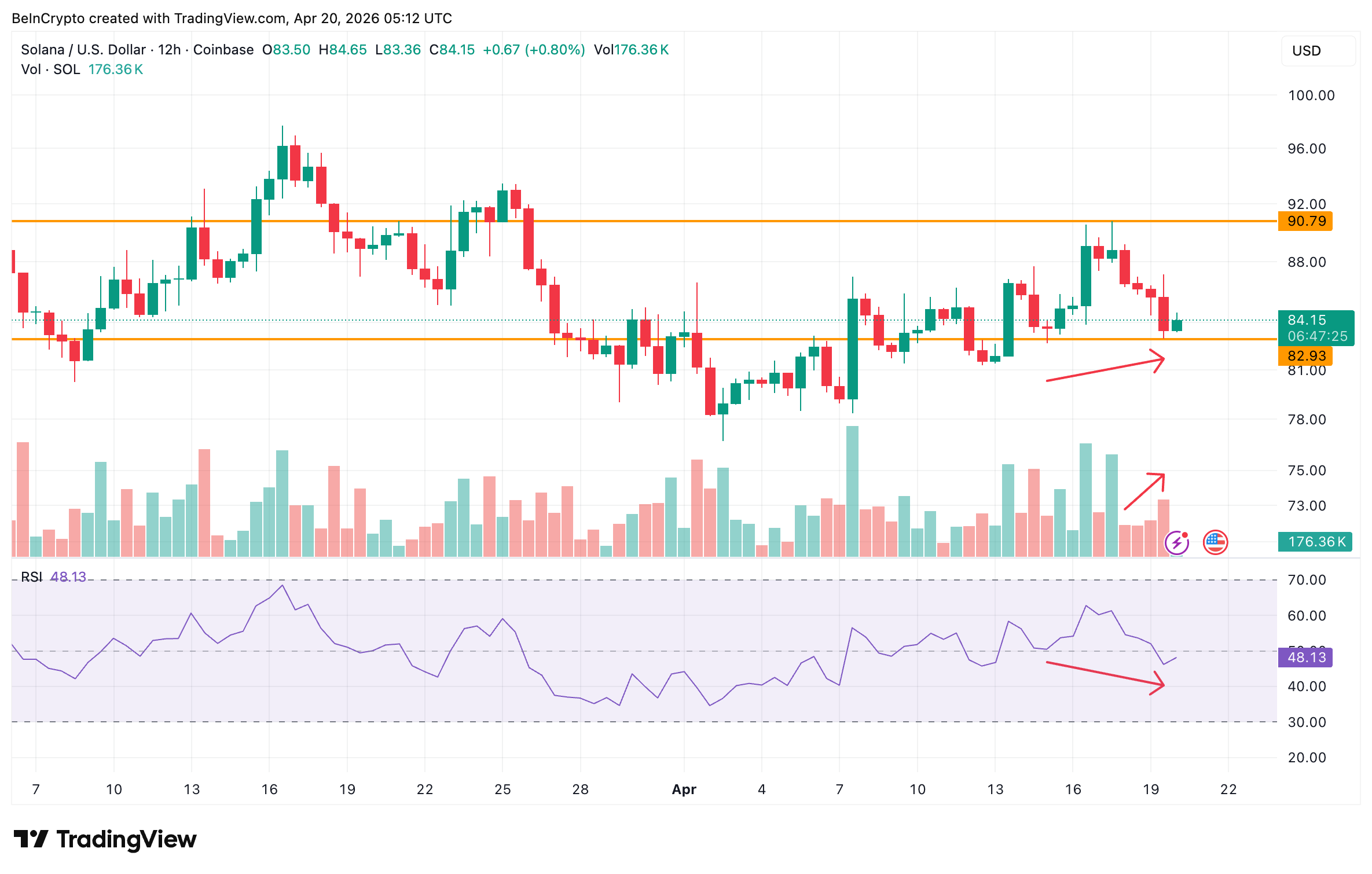
Solana (SOL) price trades at $84.15 on the 12-hour chart, attempting a rebound from the $82.93 support. A hidden bullish divergence has formed between April 15 and April 19, signaling that selling momentum may be exhausting.
However, rising sell volume and a massive spike in exchange inflows complicate the setup. Someone is consistently offloading SOL into each rebound attempt, and the DeFi contagion spreading from Ethereum explains why.
Price Flashes a Rebound Signal but Sell Volume Tells a Different Story
Solana price peaked at $90.79 on April 17 before pulling back sharply. The low at $82.93 on April 19 marked a higher low compared a level reached on April 15. During that same window, the Relative Strength Index (RSI) printed a lower low. RSI is a momentum indicator that measures the speed of recent price changes.
That pattern is a hidden bullish divergence. Price made a higher low while RSI made a lower low, which typically signals that selling pressure is weakening. A rebound attempt has already started from that level.
Want more token insights like this? Sign up for Editor Harsh Notariya’s Daily Crypto Newsletter here.
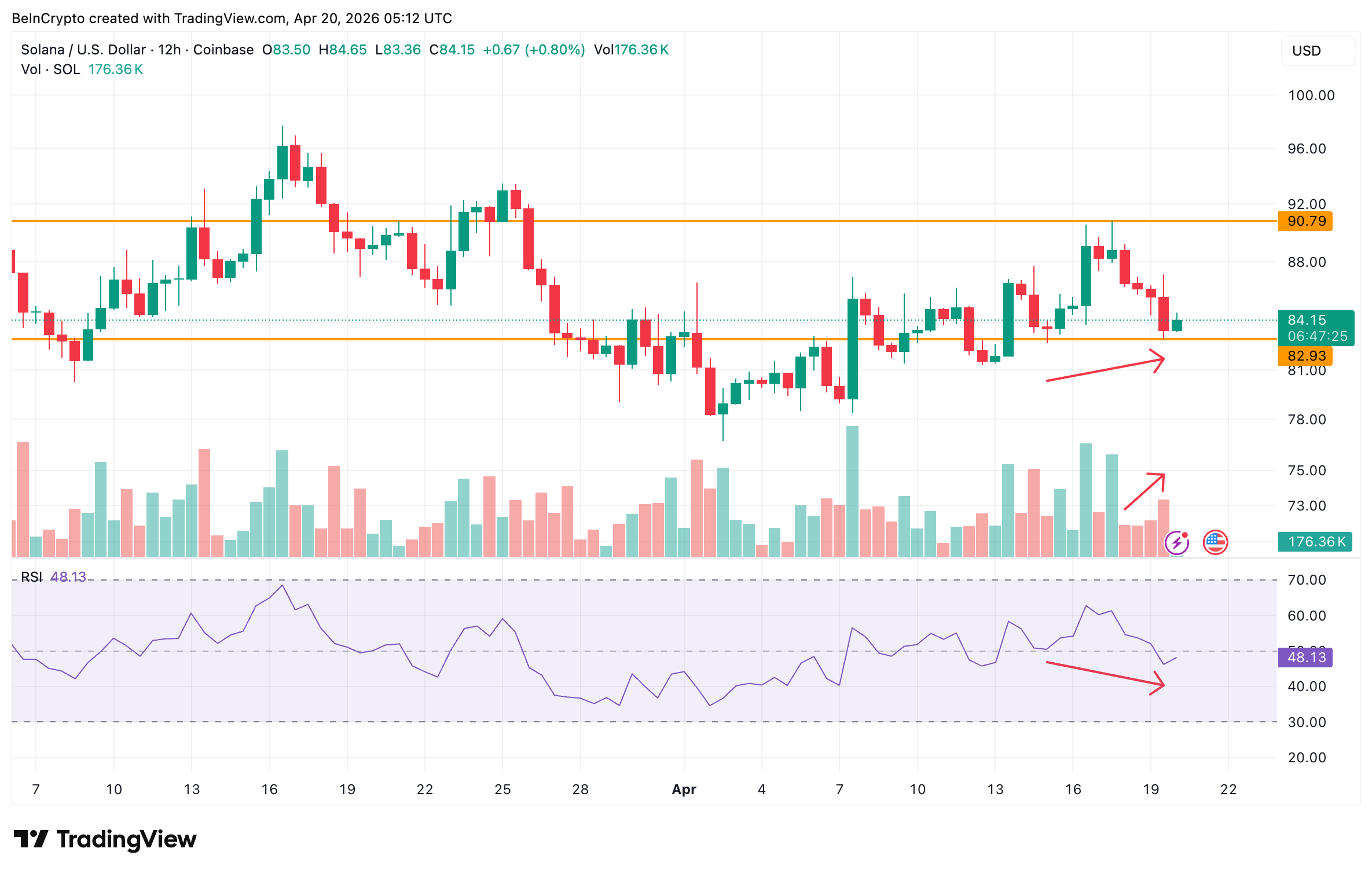
Yet volume tells the opposite story. Sell-side volume has been rising since April 18, even as RSI suggests momentum is fading. That combination carries a specific meaning. Fewer percentage moves per sell wave, paired with more participants, points to distribution rather than panic. Someone is consistently unloading SOL into each small rebound.
Meanwhile, the likely source is the spreading DeFi contagion. Following the KelpDAO rsETH exploit, Solana’s Kamino Prime Market USDC reserve hit 100% utilization on April 20.
Zero liquidity is available. Multiple USDC vaults are above 95% utilization. Funds with stuck USDC positions may be selling SOL on spot markets to raise cash. That pressure creates the supply cap the chart is showing.
Exchange Inflows Surge 1,102% as Hodlers Add Nearly 500K SOL
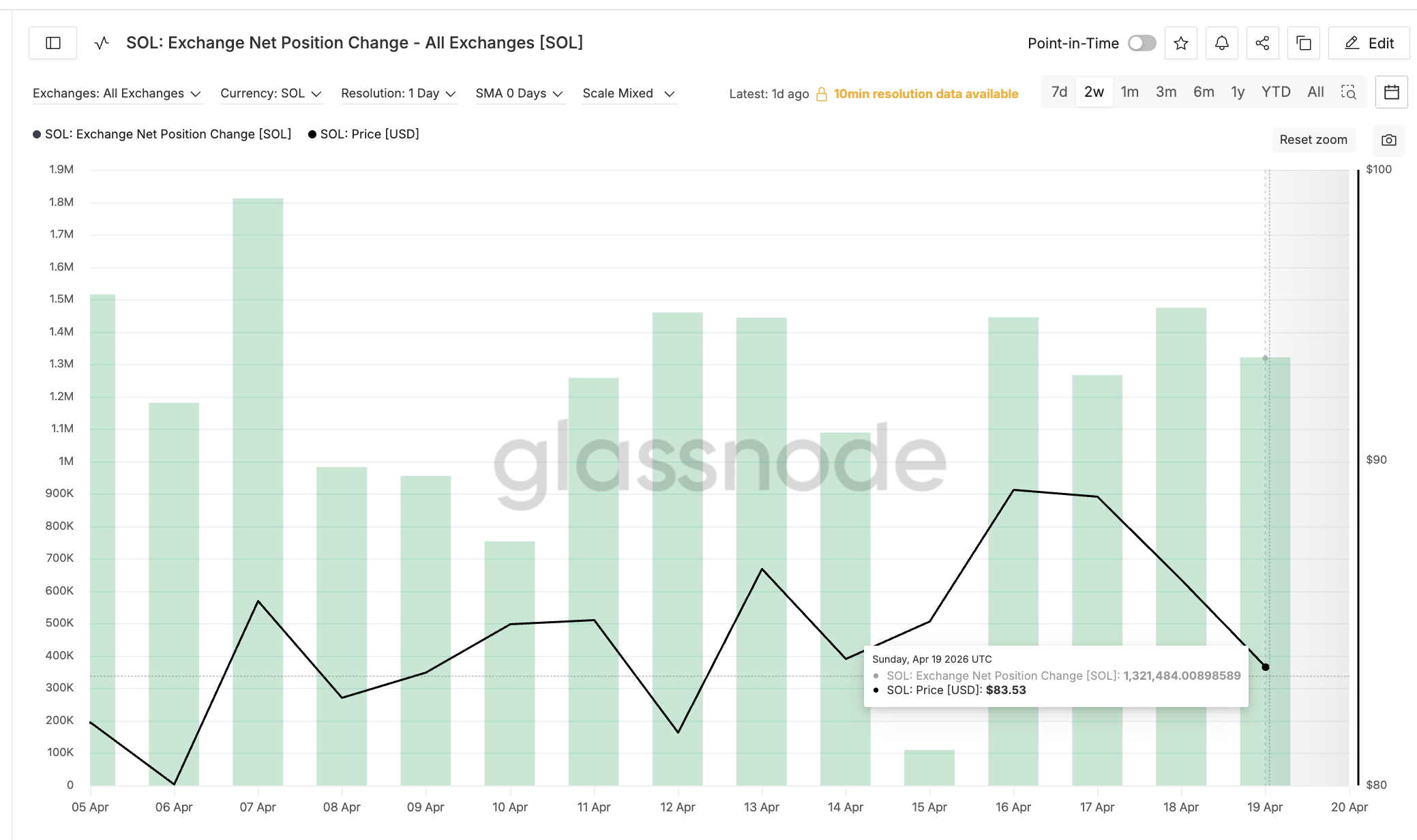
On-chain data confirms the forced-selling thesis. The SOL Exchange Net Position Change has exploded. This metric tracks the 30-day flow of coins into or out of exchange wallets.
Meanwhile, on April 15, the metric read 109,932 SOL. By April 19, it had surged to 1,321,484 SOL. That is a 1,102% increase in four days. More SOL is now sitting on exchanges, typically a precursor to selling.
Yet the other side of the market is doing the opposite. The SOL Hodler Net Position Change is climbing. This metric tracks the 30-day change in supply held by wallets older than 155 days.
On April 16, hodlers held a net 2,434,566 SOL added over the prior month. By April 19, that figure had climbed to 2,921,661 SOL. Long-term holders added roughly 487,000 SOL in three days, a 20% jump.
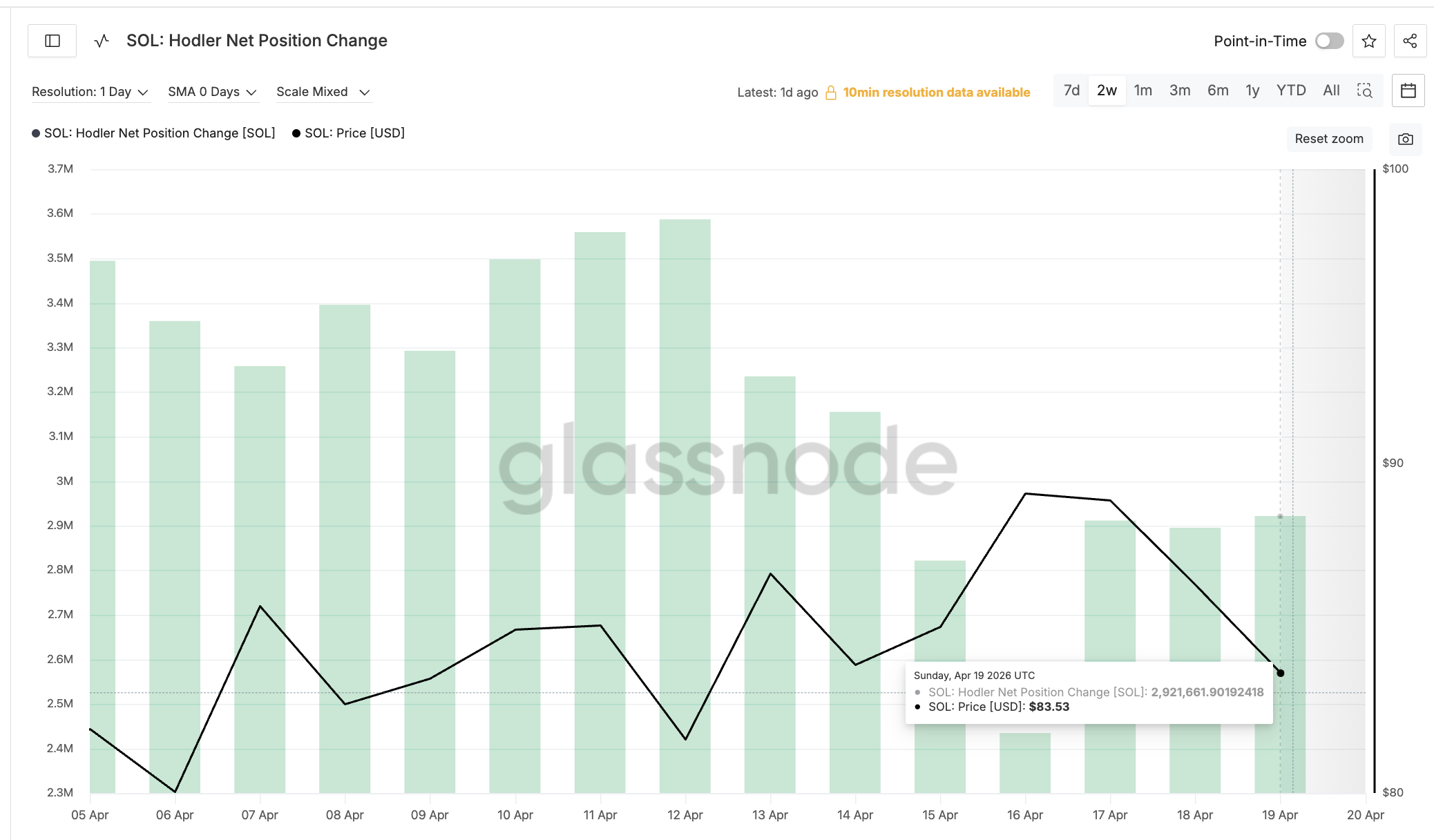
The split is the key to the entire picture. Forced sellers from the DeFi crisis are possibly depositing to exchanges. Long-term holders are absorbing the supply. That structure produces a shallow rebound rather than a collapse, with each side fighting for control at specific price levels.
Solana Price Levels That Decide Between a Shallow Bounce and a Breakdown
Solana price at $84.15 sits between two tight levels. The first upside test is $85.42. A clean move above that strengthens the rebound. However, the next resistance at $90.79 is the April 17 high, a level that already rejected once. A reclaim there would neutralize the current weakness and open a path toward $93.40.
Yet if forced sellers overwhelm the hodler bid, the rebound fails. A touch of $82.93 invalidates the hidden bullish divergence. A break of $82.11, the 0.618 Fibonacci, opens $79.95 and $76.74 as the next downside targets.
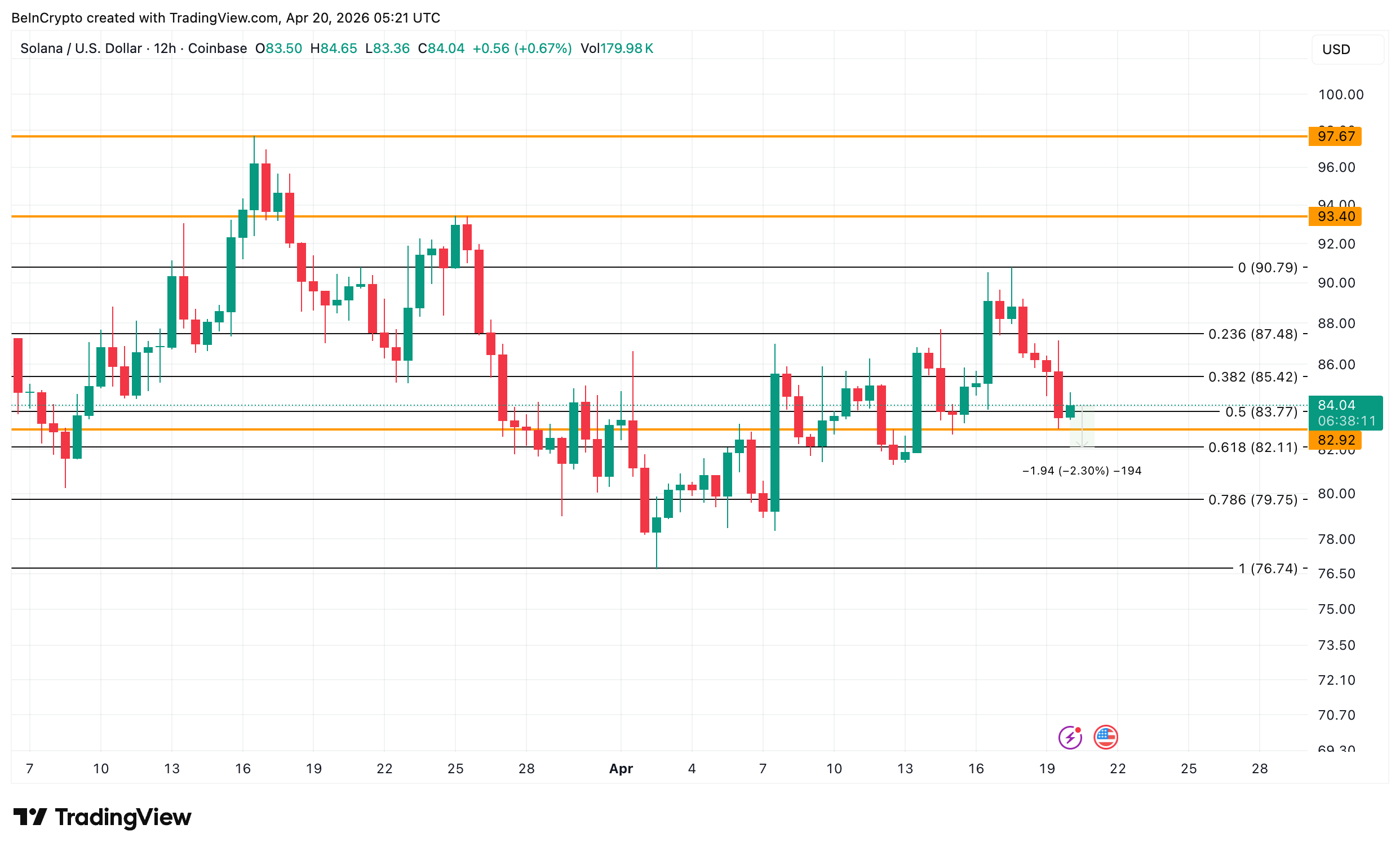
Solana price at $82.93 separates a rebound that holds long-term conviction from a breakdown driven by the DeFi crisis.
The post Solana Tries to Rebound but a DeFi Contagion Sends 1.32 Million SOL to Exchanges appeared first on BeInCrypto.
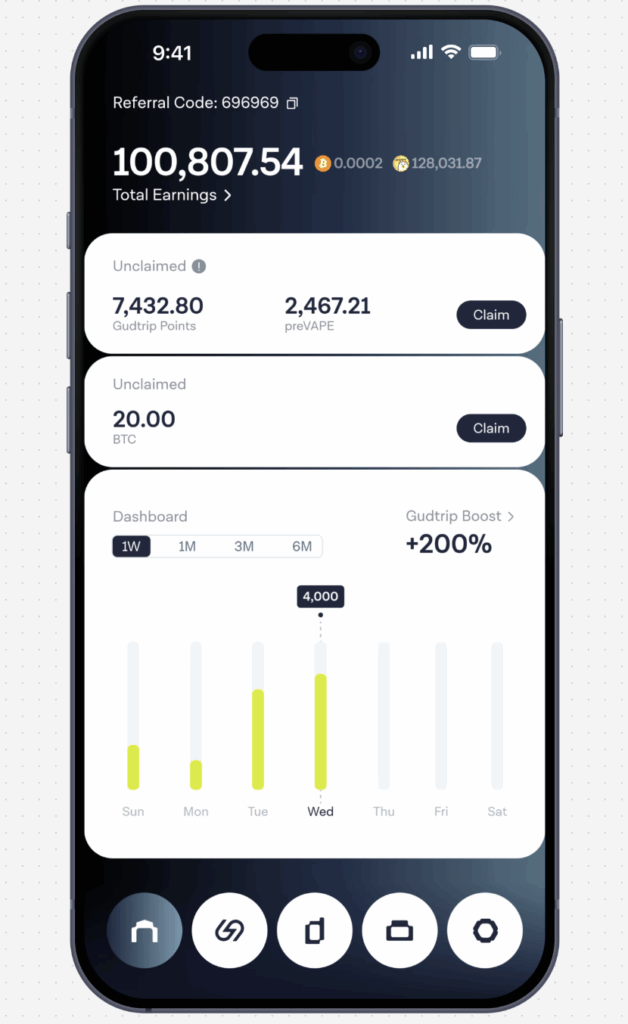
Gudtrip, the AI-powered weed vape created by “vape-to-earn” firm Puffpaw, has been branded a contender for the “grifter buzzword world record” this 4/20.
On today of all days, X users decided to comment on Gudtrip’s claims that it combines “premium cannabis, blockchain rewards, and AI-powered asset tools in one product,” asking, “Is Gudtrip going for a grifter buzzword world record?”
Gudtrip says it will reward its users with “Bitcoin [BTC], Gudtrip Points, and VAPE token” when they smoke using the device.
As for the AI integration, Gudtrip says that users wishing to invest their crypto rewards can use its “open-source AI agent tools to explore supported blockchain-based strategies.”
Another X user said, “In a just world, ‘AI-powered crypto weed vape’ is an object that when conceived opens a chasm to hell beneath your feet,” while one claimed, “I’ve never seen a group of more ridiculous buzz words surrounding a drug device please dear god fuck off with your crypto/agentic AI bullshit scam thanks.”
While puffing on your vape, you’re likely to be accruing its VAPE token — the price of which Protos has been unable to confirm — rather than the 20 BTC worth $1.5 million its promotional images suggest.

Read more: Crypto’s smoking ‘solution’ will likely create more vape addicts
Just last week, shoe firm Allbirds was able to juice its stock by 508% after pivoting its operations towards investment in AI data centers.
AI has also been a major buzzword linked to many big-name layoffs this year.
Many on social media weren’t at all impressed with theGudtrip concept, with some asking for ways to short the product. Others described it as a sign of a “bubble.”
Attempting to join in on the joke that is ripping into Gudtrip’s buzzword playbook, its own founder, Reffo Tse, also asked “how do I short this?”
Read more: AI agents want to identify your crypto wallet using social media
Puffpaw’s ‘vape-to-earn’ would only make addictions worse
When Tse first released the vaping device Puffpaw, he promised to disincentivize vaping by offering users crypto rewards for using smaller amounts of nicotine.
However, it was mocked by users who noted that a vaping habit tied to a financial incentive will only incentivize continuous vaping.
UK Addiction Treatment Centres told Protos that Puffpaw wasn’t going to lower the usage of vapes. It said, “If anything, it could have the complete opposite effect because of the enticing gamification and crypto reward that comes with vaping.”
Read more: Snoop Dogg quits ‘smoke’ amid NFT, edibles launch rumors
The addiction center said Puffpaw might “worsen a person’s addiction,” and that it feels like “a corporate way of making money off people trying to quit smoking and lead healthier lives.”
The vaping product seems not to have been enough for Puffpaw’s CEO, however, and Gudtrip entered the scene in October 2025.
Got a tip? Send us an email securely via Protos Leaks. For more informed news and investigations, follow us on X, Bluesky, and Google News, or subscribe to our YouTube channel.

BITCOIN: what the FU*K just happened?

Krispy Kreme to open stores in The Netherlands
MSTR Stock Slips After Strategy’s $2.54B Bitcoin Buy



-

 NewsBeat6 days ago
Trump and Pope Leo: Behind their disagreement over Iran war
-

 Fashion3 days ago
Weekend Open Thread: Theodora Dress
-

 Crypto World7 days ago
SEC Signals Exemption for Crypto Interfaces From Broker Registration
-

 News Videos5 days ago
Secure crypto trading starts with an FIU-registered
-

 Sports3 days ago
NWFL Suspends Two Players Over Post-Match Clash in Ado-Ekiti
-

 Crypto World7 days ago
SEC Proposes Certain Crypto Interfaces Don’t Need to Register as Brokers
-

 Business1 day ago
Powerball Result April 18, 2026: No Jackpot Winner in Powerball Draw: $75 Million Rolls Over
-

 Crypto World3 days ago
Russia Pushes Bill to Criminalize Unregistered Crypto Services
-

 Politics3 days ago
Palestine barred from entering Canada for FIFA Congress
-
 Business4 days ago
Creo Medical agree sale of its manufacturing operation
-

 Politics1 day ago
Zack Polanski demands ‘council homes not luxury flats for foreign investors’
-
 Entertainment7 days ago
Brand New Day’ Footage Reveals the Devastating Impact of ‘Now Way Home’
-

 Crypto World3 days ago
Russia Introduces Bill To Criminalize Unregistered Crypto Services
-

 Tech6 days ago
Microsoft adds Windows protections for malicious Remote Desktop files
-
 Entertainment7 days ago
Karol G’s ‘Ultra Raunchy’ Coachella Set Gave ‘Satanic Vibes’
-

 Entertainment7 days ago
How Babylon 5 Turned Brief Side Story Into Emotional Masterpiece
-

 Tech5 days ago
‘Avatar: Aang, The Last Airbender’ Leaked Online. Some Fans Say Paramount Deserves the Fallout
-

 Tech2 days ago
Auto Enthusiast Scores Running Tesla Model 3 for Two Grand and Turns It Into Bare-Bones Go-Kart
-

 Tech7 days ago
What was the first ransomware attack to demand payment in Bitcoin?
-

 Business7 days ago
Intuitive Machines Stock Climbs 2.4% as $180M NASA Lunar Contract and $900M Revenue Outlook Fuel Momentum
You must be logged in to post a comment Login