

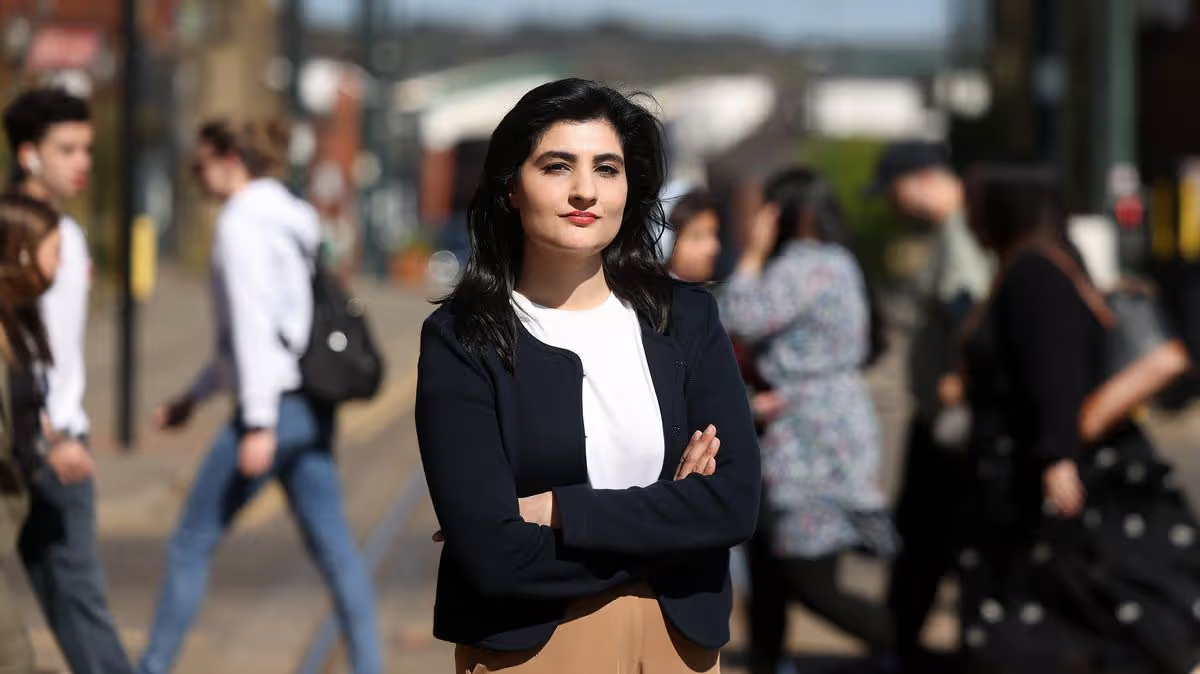
Eight years is a long time to be away from your hometown. It’s enough time for busy high streets to become empty or vibrant once again. It’s long enough for the small, everyday rhythms of a place to feel unfamiliar.
That’s what I’ve noticed since moving back to Oldham from London. The mood has changed. There is a sense that something has hardened, both socially and politically.
This is a town where the council leader has faced death threats; where a meeting in the Chamber had to be abandoned after a row over the war in Gaza; and where politicians have had their cars set on fire.
The town has also made national headlines because of the local authority’s perceived failure to deal with historic cases of child sexual exploitation.
Ahead of local elections on May 7, I wanted to understand what has happened in Oldham, and how its politics have become so toxic.
Labour, which has long dominated the council, is keen to highlight regeneration, particularly the replacement of the old Tommyfield Market with a new £40 million indoor market.
Yet recent analysis shows Oldham has moved from the 19th to the 11th most deprived among the 296 measured council areas. The cost of living crisis continues to affect household incomes.
“It’s just me, my partner and my dad, but my weekly shopping has gone up from £50 to £120,” says Darcie Stanley, a 26-year-old retail worker from Derker.
“By the time I’ve paid off everything there’s nothing left at the end of the month.”
Trevor Johnson, a former Ring and Ride driver in his 60s, shares that view telling us: “Everything has gone up, but people’s wages go up by a few pence. It’s hard for young people to get a house.”
However, pensioners Howard and Christine, who regularly visit from nearby Rochdale, see mainly progress. “It’s great what they have done with the new market,” says Howard, contrasting it with his own town.
“People in Oldham like a good moan but I tell them, ‘Come to Rochdale!’ Some of the shops are empty. Parts of it feel like a third world country.”
Oldham, they say, still offers something.
“We spend our money on more than just coffee,” says Christine. “There’s a bank that’s still open, so we go there, then we get a coffee and browse the shops. It keeps people inside the town.”
But even within that relatively positive view, the conversation quickly turns, as it often does here, to immigration and identity. While Howard sees the positive impact on the next generation – “Our granddaughter’s primary school is mixed. At that age they don’t see colour” – he understands why the arrival of new communities can cause tensions among residents, and put pressure on local services.
That tension runs through many conversations in Oldham. It’s impossible to understand that dynamic without looking back to May 2001, when the town became the epicentre of the worst racial unrest seen in England for a generation.
Over three nights, violence erupted between white and Asian youths, with cars torched in Glodwick and hundreds clashing with police. The unrest soon spread to other northern towns.
“A [white] lad who I worked with was in a pub in Glodwick at the time,” Howard recalls. “The owners locked him inside.”
The riots were seen as a failure of community cohesion and social policy, with a report by Professor Ted Cantle pointing to communities living “parallel lives”. A quarter of a century on, things haven’t really moved on. Areas are largely segregated, with high concentrations of Pakistani and Bangladeshi families living in specific enclaves, often separate from white Brits.
“Integration is non-existent,” says Mo, an Asian solicitor in his 30s. “It’s gotten worse, and will continue to do so. I’ve moved out now and good riddance.”
A woman from Glodwick, which has the biggest concentration of families hailing from Pakistan-administered Kashmir, admits that people still don’t mix at home.
“Of course if you’re going to school or university you’re going to meet different people from other races and cultures,” she says. “But here, in tight-knit communities, people stay with their own [kind].”
The result is not just parallel lives, but parallel grievances – and everyday frustrations can breed resentment. That’s what I find when I speak with two white men smoking outside the town centre Wetherspoon. “I used to vote for the BNP back in the day,” the younger of the two grins. It’s not entirely clear if he’s joking.
However, both say they’ll be voting Reform. Why? “Have you seen the state of this town?” the older one replies. Immigration dominates their explanation. “It’s too high here and around the country. Everybody realises it now.”
The housing crisis also comes up repeatedly and they insist that immigrants are given priorities over native Brits. They both complain about the number of HMOs (house in multiple occupation), which are surging in popularity in the UK.
They’re a problem, because “you don’t know who is coming or going, where they’re from,” says the younger one, a father of four from Chadderton. “But 99 percent will be immigrants,” he asserts.
Asked whether they believe Reform will tackle these issues, the older one replies: “Doesn’t really matter, does it? They’re all liars, all taking the p**s.”
This is less ideological conviction than disillusionment, a loss of faith in politics altogether. That disillusionment isn’t confined to older voters.
“I’m not trying to be funny but all these councillors p**s in the same bucket. They say they’re going to do something but then nothing happens,” says Darcie. She, too, plans to vote Reform.
Yet that narrative is not universal. Bashir Hussain, 63, who has lived in Oldham since 1955, paints a different picture. “I’ve seen things change here, but for the better,” he says. “My children are doing well… I think the council has done a good job in the town centre.” He has long been a Labour voter and remains loyal to the party.
“I don’t believe in these independent candidates,” he says. “They just create rifts. It’s better to stay and influence change that way.”
Local elections here have become increasingly fragmented, with independents and smaller parties gaining ground. In 2024, Labour lost control of Oldham Council for the first time in 13 years, following a backlash over the party’s stance on the war in Gaza.
Independent candidates, on a pro-Palestine ticket, gained five seats, leaving Labour with 26 councillors and pushing the council into no overall control.
In September, a budget meeting was abandoned after an exchange on Gaza between Labour Councillor Shaid Mushtaq and Councillor Kamran Ghafoor of the Oldham Group turned into a blazing row.
Oldham has a large South Asian and Muslim population, making up 25 percent of the town’s demographics. For many of them, global conflicts resonate – especially with younger residents like Roxsar Raja and Zainab Ghafar, who are 17-year-old sixth form students.
“They’re letting little kids die,” says Zainab. “I’ve seen videos on TikTok of Palestinians begging. There’s a lot of injustice in the world; the concentration camps [for Muslims] in China, and no one is doing anything.”
They stress that their views aren’t just about identity. “We’re both Muslims but that’s not why we feel this way. It’s about being human,” Roxsar adds.
If they could vote, they say, it would be Green. However, Mo, who is also Muslim, criticises the use of international conflicts in political campaigning. “Whilst I’m of the firm belief that there is a genocide going on in Palestine, I don’t see how that [has anything to do] with local elections,” he adds.
The fallout over Gaza isn’t the only thing adding to this toxicity. In December, a prospective candidate’s car was set on fire. It followed an alleged “firebomb” attack on the car of Labour councillor Josh Charters.
Then there’s the calibre of the political candidates. Many residents say they’re “appalled” that Mohammed Imran Ali is allowed to stand for elections in Werneth. Also known as “Irish Imy”, Ali was jailed for seven years in 2013 for being the getaway driver for convicted cop killer Dale Cregan.
“He shouldn’t be allowed to stand,” says the older man outside Wetherspoon. “It’s a joke. But the council leader is friends with him.”
Council Leader Arooj Shah was forced to defend her long-standing association with Ali after much speculation online. “I can’t turn my back on people I’ve known since childhood,” she said a few years ago.
That controversy is part of another, deeper problem. One issue that continues to cast a long shadow on the town is the grooming gangs scandal.
In early 2025, the subject exploded into national and even international attention when safeguarding minister, Jess Phillips, told Oldham council that the government would not fund a statutory inquiry into child sexual exploitation in the town.
Tech billionaire Elon Musk took to X to say Philips should be in prison. The media storm that ensued forced a reckoning on a crisis that continues to blight the country’s reputation, not least because the majority of the criminals abusing young, mostly white girls hailed predominantly from a Pakistani background. While some questioned Musk’s motives, many welcomed his intervention for effectively forcing the government to commission a statutory national inquiry on grooming gangs in England and Wales.
“When you talk to people they get angry that the council and police were too scared of being labelled racist, so it got swept under the carpet,” says Howard.
Mo says the whole thing has been a “debacle”, adding: “No accountability, no investigation, no nothing. Oldham is one of the most corrupt towns in the UK.”
So what has happened to Oldham?
There are clearly efforts being made to regenerate the town – much of which is welcomed by residents and observers. But that sits alongside visible signs of deprivation. There is diversity, but also distrust and division. What feels different, coming back after all this time, is how politics has become personal and visceral.
Politicians seem to be talking at – rather than to – each other. The one sentiment that cuts across the age, ethnic and class barrier is that nothing is working.
Once faith in institutions is gone, it rarely comes back. Maybe that’s the real story of Oldham. A town running out of patience, no longer convinced that anything or anyone is coming to fix it.






































You must be logged in to post a comment Login