
Crypto World
Why moving IP on-chain is right for the entertainment industry



Onchain IP turns static, illiquid rights into transparent, tradable assets, letting games like My Pet Hooligan convert fans from passive consumers into real economic stakeholders
Summary
- Traditional IP is illiquid, opaque, and structurally misaligned with fans and creators.
- Putting IP on-chain makes rights transparent, tradable, and programmable for global markets.
- Projects like AMGI Studios’ My Pet Hooligan show how NFT-based IP can turn audiences into owners.
The entertainment industry has long treated intellectual property like the paranoid owner of a rare painting, locked away in a private vault. It is extremely valuable, but static, illiquid, and accessible only to whoever holds the key.
The traditional framework for registering IP such as movie franchises, songs, and video games is broken, especially in a world where virtually all entertainment has gone digital. Yet the underlying legal infrastructure that records ownership is still stuck in the 20th century.
The problems with IP
The structural issues of traditional IP start with inaccessibility. Access to high-value IP investments is generally restricted to a small circle of institutions that can afford to hire lawyers to search registries, negotiate licenses, and structure sales, effectively excluding the people who prize the IP most – the fans and creators who generate its value and drive its growth.
Take the Star Wars movie franchise. Licensing the likeness of a character like Chewbacca is eye‑wateringly expensive, yet that image would be worth nothing without the movie’s loyal, fanatical audience keeping it relevant across decades.
Entertainment IP is also extremely illiquid. Trademarks and similar rights are “lumpy” assets that are hard to price and even harder to sell, with transactions that can take weeks or months to close. The model suffers from weak alignment too, because brands rarely reward communities for their role in making a property successful; the most dedicated players of a video game, for example, earn nothing from its global breakout beyond the privilege of continuing to play, and pay, inside a closed system.
Blockchain offers a better way
Bringing IP on-chain is the obvious upgrade. Instead of being locked in a vault, rights can live in a transparent, liquid, global market where success and value are measured by real engagement rather than opaque internal accounting.
On-chain IP enables immutable, verifiable ownership. If someone holds an NFT granting defined rights to a piece of IP, no one can quietly strip those rights away, and anyone can verify who owns what, see what revenue it generates, and bid to acquire or license it through open, decentralized mechanisms. Because these rights are on programmable infrastructure, they can be traded in real time, split among multiple parties, or wrapped into new financial and creative products.
Proof that this model works is already here in projects like AMGI Studios’ My Pet Hooligan, a blockchain game built around 8,888 unique 3D characters that live as NFTs on Ethereum. AMGI has transformed dozens of characters, weapons, and accessories into player‑owned assets, moving beyond the dominant free‑to‑play model where users effectively lease “skins” from a closed server.
AMGI’s approach effectively turns its My Pet Hooligan IP into a new kind of real‑world asset. If the game goes viral and more people start playing, demand for those NFTs should increase, rewarding early adopters who took the risk of backing the ecosystem before it was mainstream. The assets provide in‑game utility, and their scarcity and desirability are visible on-chain through price, volume, and engagement metrics on marketplaces and analytics dashboards.
Music, film, and beyond
The same logic extends far beyond gaming. Musicians can bypass traditional labels by issuing NFTs or tokens that encode royalty rights, enforce revenue splits through smart contracts, and allow fans to buy into future streaming income directly. Independent filmmakers can sell tokens that entitle supporters to a share of box office, streaming, and licensing revenue, turning their communities into both financiers and evangelists.
Such systems create an entirely new asset class where discoverability becomes meritocratic, and value is easier to assess simply by looking at on-chain engagement and cash flow. Compared with today’s black‑box IP regime, on-chain IP is more open, transparent, and accessible to anyone with an internet connection and a wallet.
For entertainment, the logic is hard to ignore. Blockchain‑based IP protects creators, empowers consumers, and provides a standardized framework for participation, turning audiences from passive consumers into active stakeholders. As adoption grows, expect the walls of today’s media empires to erode, replaced by open ecosystems where every song, film, and video game character has a fair shot at finding its market.



Robinhood customers received some particularly convincing phishing emails this weekend. The messages, which appeared to come directly from the company, featured authenticated headers, were correctly signed, included a genuine sender’s address, were sent from an authentic email server, and weren’t caught by spam filters.
Worse, the email from [email protected] even earned Gmail’s automatic route into the same conversation threads as legitimate, prior security alerts from Robinhood.
The only fraudulent things about the email were obscure technical irregularities and its contents, a phishing call-to-action seeking login information.
By Sunday night, hackers used Robinhood’s own notification pipeline to render their assault.
Analysis of the exploit went viral on social media soon after.
Robinhood phishing emails were ‘kinda beautiful’
Security researcher Abdel Sabbah posted an analysis of the event, calling it “kinda beautiful” with a sinister connotation. Unfortunately, he was right.
To craft the attack, the hacker first utilized a Gmail “dot trick,” a well-known Google feature whereby Gmail routes [email protected], [email protected], and [email protected] to the same inbox.
Gmail, unlike the rest of the internet, ignores dots in the part of the address before the @ symbol, so all of those variants deliver to the same inbox.
Because Robinhood, unlike Gmail, doesn’t normalize the dotted variants, an attacker used a “dot” modified version of Robinhood’s legitimate customer emails.
Next, the attacker set the device name on the new account to a block of raw HTML. When Robinhood’s “unrecognized activity” email is generated, the template inserts that device name without sanitizing it, rendering the nefarious HTML.
The result, in Sabbah’s words, is what appeared to be “a real email from [email protected], DKIM pass, SPF pass, DMARC pass, with a phishing CTA.”
That CTA or “call to action,” of course, is a fake security alert email with a hyperlink to an attacker-controlled webpage that harvests login credentials and two-factor authentication codes.
The ultimate goal, like almost all phishing campaigns, was to steal customer’s money — in this case, from their Robinhood account.
Read more: Robinhood pays $605M to buy Sam Bankman-Fried’s stake
Think before you click on any email
Many crypto influencers warned people about the convincing emails.
Ripple’s David Schwartz amplified the warning. “Any emails you get that appear to be from Robinhood (and may actually be from their email system) are phishing attempts,” he posted. Quoting Sabbah’s thread, Schwartz added, “It’s quite sneaky.”
In April 2025, Ethereum Name Service Lead Developer Nick Johnson documented an almost identical exploit involving emails that appeared to send from Google itself.
Attackers used a similar series of tricks to use Google’s own infrastructure to deliver DKIM-signed phishing emails from [email protected].
The lesson then is the lesson now: beware of clicking any link in any email, no matter how authentic it appears.
Traditional anti-phishing advice tells users to check the sender domain and look for authentication failures. None of that helped here. The domain appeared real. The signatures appeared real. Only the intent was criminal.
Robinhood’s own scam guidance tells customers to verify the sender’s email domain and lists @robinhood.com as the authentic example.
Protos reached out to Robinhood for comment but didn’t receive a reply prior to publication time. In Nasdaq trading today, the common stock of Robinhood opened flat for trading relative to Friday’s closing print.
Got a tip? Send us an email securely via Protos Leaks. For more informed news, follow us on X, Bluesky, and Google News, or subscribe to our YouTube channel.


Elfa AI begins offering continuous listening and real-time interpretation for AI agents to execute transactions on Solana when market conditions are met.
Elfa AI announced Monday a platform enabling AI agents to listen continuously to market conditions and execute transactions on Solana in real time. The platform interprets data and triggers automated agent actions the moment specified conditions are met, leveraging Solana’s blockchain infrastructure for market-driven decision-making.
The launch positions Elfa AI within the growing ecosystem of automation tools on Solana, targeting traders and developers seeking to capitalize on attention-driven market dynamics through AI-powered execution.
Sources: Solana
This article was generated automatically by The Defiant’s AI news system from publicly available sources.
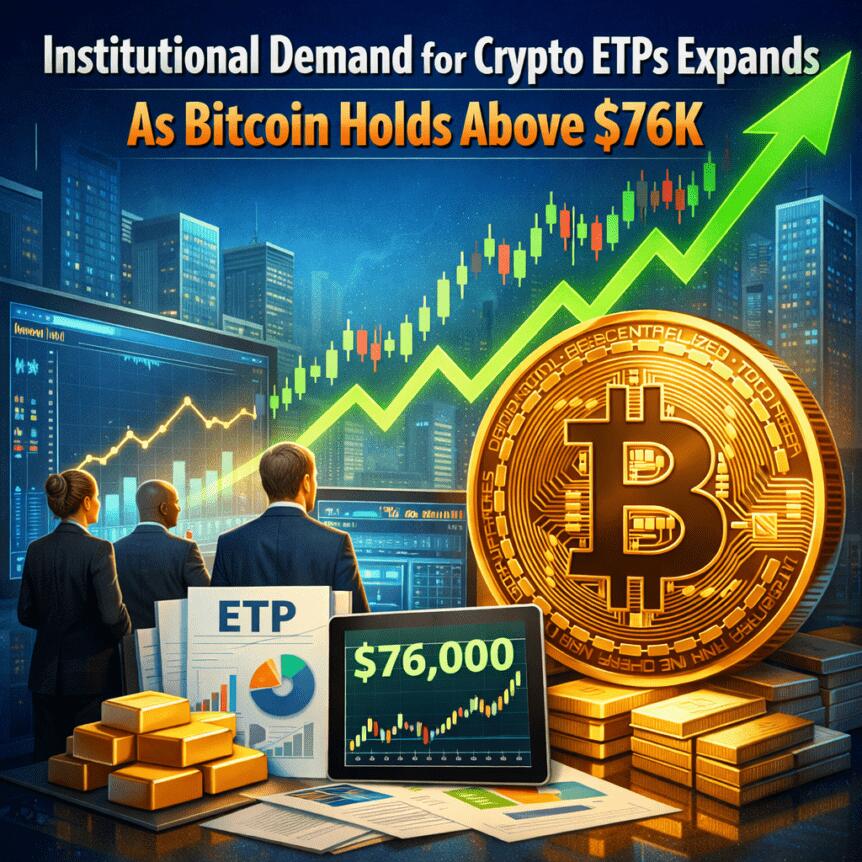
Crypto investment products extended their inflow streak last week as Bitcoin traded above $76,000, a level not seen since February’s pullback. Crypto exchange-traded products (ETPs) attracted $1.2 billion in fresh inflows, the fourth consecutive weekly gain, according to CoinShares. The run lifted assets under management to $155 billion—the highest level since February 1—while the four-week total reached about $3.9 billion, surpassing March’s prior four-week figure of $2.9 billion. CoinShares head of research James Butterfill framed the shift as evidence of improving institutional demand in the wake of a Bitcoin rally, even as traders prepared for the Federal Reserve’s policy decision later in the month.
Key takeaways
- Bitcoin-led inflows dominated the week, with $932.5 million flowing into BTC ETPs, pushing year-to-date BTC-related inflows to approximately $4 billion.
- US-listed spot Bitcoin ETFs attracted roughly $824 million in inflows, according to SoSoValue.
- Ether ETPs gathered $192 million, the third straight week of gains above $190 million, bringing year-to-date Ether inflows to about $390 million.
- XRP-related funds returned to inflows, adding $56 million after outflows the prior week.
- Short-Bitcoin products saw $16.5 million of inflows, indicating hedging activity within a constructive market backdrop.
- Blockchain equity ETFs posted a record weekly inflow, with about $617 million flowing in over a three-week span, underscoring rising demand for exposure to the broader digital-asset tech sector.
- Regional dynamics remained led by the United States, which accounted for about $1.1 billion in inflows, with Germany at $62 million and Switzerland at $35 million.
Bitcoin gains anchor broader demand for crypto ETPs
Bitcoin’s resilience near and above the $76,000 mark helped anchor the week’s inflows, amplifying the appeal of ETPs as a vehicle for institutional exposure. In addition to the price level, Butterfill noted that the market’s momentum is likely supported by improving fundamentals for crypto products, even as participants tread carefully ahead of the FOMC’s late-April meeting. “The market now turns to the FOMC decision on April 28–29, which is likely contributing to caution at the margin,” he said. The sustained higher price backdrop appears to be translating into continued appetite for BTC-focused ETPs, with the four-week run painting a clearer picture of renewed institutional interest.
Broader asset mix strengthens: Ether, XRP, and hedges
While Bitcoin led the charge, other digital-asset ETPs also showed strength. Ether ETPs registered $192 million of inflows, marking the third consecutive week above $190 million and lifting year-to-date Ether inflows to roughly $390 million. XRP funds rebounded to inflows of $56 million after a prior week’s outflow, illustrating ongoing interest in the wider payments-focused altcoin family. Short-Bitcoin products, a gauge of hedging sentiment, drew $16.5 million—an amount broadly in line with recent averages and suggesting steady hedging demand without dramatic spikes.
Blockchain equities continue to attract interest
Beyond native crypto assets, investors rotated into blockchain equity exchange-traded funds, which experienced a record week of inflows. Over the past three weeks, blockchain equity ETFs accumulated about $617 million in inflows, highlighting a broader appetite for exposure to the technology surrounding digital assets and their ecosystems. This pattern points to a shift where investors are not only chasing price moves but also seeking strategic exposure to the sector’s infrastructure and potential use cases.
Regional dynamics and what they imply
The regional breakdown showed the United States continuing as the dominant driver of inflows, with roughly $1.1 billion moving into crypto ETPs. Europe’s activity remained positive but more modest: Germany saw about $62 million in inflows, while Switzerland reversed last week’s outflows with $35 million of inflows. The concentration of flows in the U.S. underscores the ongoing regulatory and market structure advantages perceived by institutional participants in that region, even as other markets calibrate their own uptake of crypto products.
As the market looks ahead, investors will be watching how the forthcoming Federal Reserve decision shapes risk appetite for crypto investments and whether prices hold above key support levels. With aggregate ETP flows touching new yearly highs and a steady return of institutional interest, the landscape for crypto investment products appears to be shifting toward broader participation, albeit with ongoing caution as macro and policy signals evolve.

Key Takeaways
- Jefferies upgraded AAL price target from $12 to $13 while maintaining Hold rating
- First quarter unit revenue jumped 7.6%, with second quarter projected between 9.5%–10.5%
- Carrier launching $1.14 billion aircraft-backed bond offering
- Rising fuel expenses threaten profitability, potential 2026 loss flagged
- BMO Capital increased target to $13.50; Evercore maintains $14.00 target
American Airlines delivered first quarter results that surpassed Wall Street expectations, reporting a loss of $0.40 per share versus consensus estimates calling for a $0.47 loss. Total revenue reached $13.91 billion, beating the $13.79 billion projected by analysts.
American Airlines Group Inc., AAL
The carrier’s unit revenue expanded 7.6% during the quarter. Management provided guidance for second quarter unit revenue growth in the range of 9.5% to 10.5%.
Following the quarterly report, Jefferies analyst Sheila Kahyaoglu increased her price objective on AAL shares from $12 to $13. Her Hold recommendation remained unchanged.
AAL is presently changing hands near $12.10, trading beneath InvestingPro’s Fair Value calculation of $14.05. This variance indicates potential undervaluation at present price levels.
Jefferies established an annual EPS projection of $0.10, falling within the company’s broad guidance band spanning -$0.40 to +$1.10. The investment firm highlighted opportunities for improved margin execution under favorable market conditions.
BMO Capital similarly lifted its price objective, advancing from $12.00 to $13.50. BMO cited an improved yield environment and noted the first quarter performance exceeded projections.
Raymond James maintained its Market Perform stance, recognizing advancement in narrowing the margin differential with established competitors. Evercore ISI preserved its In Line assessment with a $14.00 valuation target.
Aircraft-Backed Bond Offering Totals $1.14 Billion
Earlier this week, American Airlines initiated a $1.14 billion bond issuance to fund 32 aircraft, including both new deliveries and current fleet assets. The financing package takes the form of enhanced equipment trust certificates, commonly known as EETCs.
The principal tranche comprises a $905 million offering carrying an average maturity of 7.7 years. Initial pricing discussions center around a 5.625% yield.
EETC structures enable sub-investment-grade airlines to tap investment-grade debt channels by pledging aircraft as security. While S&P assigns AAL a B+ corporate rating, sitting four levels beneath investment grade, the senior bonds in this transaction are anticipated to receive an A rating from S&P.
Goldman Sachs, MUFG, and Morgan Stanley serve as lead underwriters for the bond transaction.
Escalating Fuel Expenses Pressure Margins
Increasing oil prices continue pressuring airline profitability industry-wide. Fuel represents one of American’s most substantial operating expenses.
The previous week, management reduced its full-year profit forecast. Leadership cautioned that fiscal year 2026 could conclude with a net loss following the absorption of approximately $4 billion in incremental fuel expenditures.
American simultaneously deferred $300 million in aircraft delivery capital spending from 2026, creating additional financial flexibility.
The airline intends to expand capacity roughly 4% during the current year, approximately double the industry-wide expansion rate. Jefferies indicated that prevailing macroeconomic conditions likely necessitate additional downward adjustment to capacity growth plans.
Based on InvestingPro intelligence, ten analysts have lowered earnings forecasts for the forthcoming reporting period.
AAL shares declined approximately 2.4% on Monday as investors digested the bond offering announcement and earnings developments.

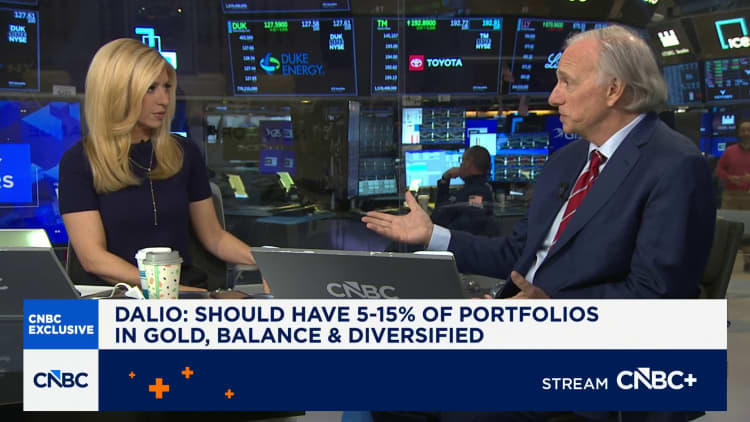

Billionaire investor Ray Dalio warned that the U.S. economy has slipped into a stagflationary environment and said it would be a mistake for potential Federal Reserve chair successor Kevin Warsh to lower interest rates.
The founder of Bridgewater Associates said persistent inflation pressures alongside slowing growth create a backdrop that demands caution from policymakers.
“We are certainly in a stagflationary period,” Dalio said Monday on CNBC’s “Money Movers.” “Because of the issues that are here, in terms of a more immediate inflation, farther from the target.”
Dalio said that if Warsh, who now has a clear path to replacing Jerome Powell as the next leader of the Fed in mid-May, were to cut rates, it would risk damaging confidence in the central bank at a critical moment.
“Certainly, you would not cut interest rates now,” Dalio said. “You will lose your credibility. The Federal Reserve would lose its credibility, particularly now. … If you look at monetary policies by other countries, you’re not going to see them cutting,” he said. “So whatever your benchmarks are, you’re not going to be inclined to cut … not with today’s information.”
Traders are currently pricing in a 100% chance that the Fed will leave rates unchanged at this week’s meeting, with fed funds futures indicating policy is most likely to stay on hold for the rest of the year, according to the CME FedWatch tool.
Dalio said the dramatic rebound in equities made sense despite the ongoing war with Iran because of the strength of corporate earnings. Still, he said he recommends a 5% to 15% allocation to gold as an “effective diversifier.”
Cryptocurrency investment products continued their run of inflows last week as Bitcoin traded at its highest levels since early February.
Crypto exchange-traded products (ETPs) recorded $1.2 billion in inflows last week, marking their fourth consecutive week of gains, CoinShares reported Monday.
The inflow streak is the largest so far this year, as the four-week total has reached about $3.9 billion, surpassing the previous four-week run of $2.9 billion in March.
Total assets under management rose to $155 billion, the highest level since Feb. 1, supported by Bitcoin trading above $76,000 for the first time since its February correction, CoinShares head of research James Butterfill said.
He said that crypto ETP growth likely reflects improving institutional demand against a backdrop of a Bitcoin surge. “The market now turns to the FOMC decision on April 28–29, which is likely contributing to caution at the margin,” Butterfill added.
Bitcoin leads inflows as most assets see gains
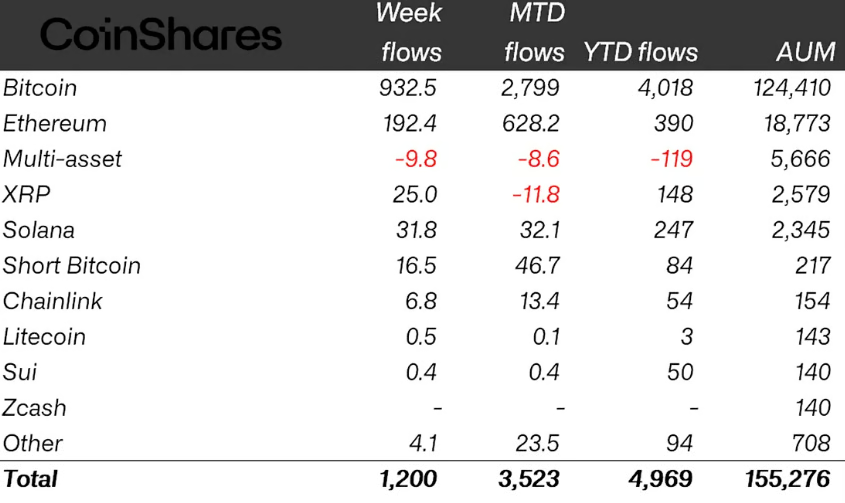
Bitcoin led last week’s ETP inflows, drawing $932.5 million and lifting year-to-date flows to $4 billion. A large share of these inflows came from US-listed spot Bitcoin exchange-traded funds, which recorded about $824 million in inflows last week, according to SoSoValue.
Ether ETPs ranked second with $192 million of inflows, marking the third consecutive week of gains above $190 million, with year-to-date inflows now at $390 million.
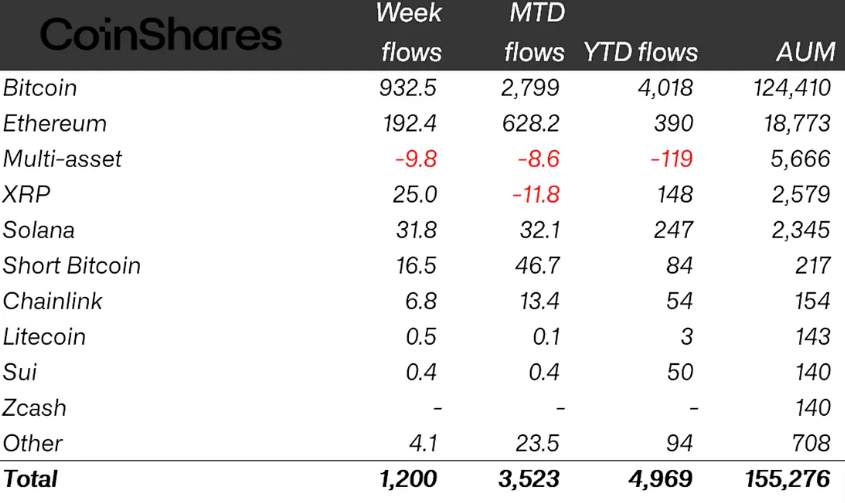
Crypto ETP flows by asset (in millions of US dollars). Source: CoinShares
XRP funds returned to inflows after recording $56 million in outflows the previous week.
Despite the positive trend, short-Bitcoin products also recorded modest inflows of $16.5 million. That was broadly in line with the prior month’s average, suggesting persistent but not elevated hedging demand, Butterfill said.
Blockchain equity ETFs hit record weekly inflows.
The analyst also noted that blockchain equity ETFs recorded a record week of inflows.
The ETFs have seen $617 million in inflows over the past three weeks, Butterfill said, highlighting rising demand for exposure to the broader technology and digital asset sector.
Related: Morgan Stanley launches stablecoin offering through money market fund
Regionally, the US dominated with $1.1 billion of inflows. Germany saw around $62 million, more than double the prior week, while Switzerland reversed last week’s $138 million of outflows with $35 million of inflows.
Magazine: XRP hints at 30% spike, Bitcoin ETFs post 9-day inflow streak: Hodler’s Digest, April 19 – 25


The Solana Foundation says it has a plan for dealing with future quantum computing risks, outlining in a new blog post how its developers are already aligned on a potential solution.
The foundation said on Monday two of the network’s core developer teams, Anza and Jump Crypto’s Firedancer, have independently landed on the same solution, a new type of digital signature called Falcon designed to withstand quantum computing, and have already started building early versions of it.
The alignment is notable given Solana’s technical constraints. The network’s high-speed, low-latency design has raised questions about whether more computationally intensive post-quantum cryptography could be adopted without trade-offs. The foundation said, however, that any eventual migration would be manageable and unlikely to significantly impact performance.
The blog post comes as debate intensifies across the crypto industry about whether advances in quantum computing could eventually undermine blockchain security. The Solana Foundation’s position: the risk is real but still distant.
“Quantum is still years away,” the foundation said, adding that migration plans are “well-researched, understood, and ready to deploy.”
Beyond core protocol work, the foundation pointed to existing efforts within the ecosystem, including Blueshift’s “Winternitz Vault,” a quantum-resistant primitive that has been live on Solana for more than two years and was recently cited by Google Quantum AI.
For now, no immediate changes are planned. Solana outlined a phased roadmap that includes continued research into Falcon and alternatives, introducing post-quantum schemes for new wallets if needed, and eventually migrating existing wallets.
Read more: Solana’s quantum-threat readiness reveals harsh tradeoff: security vs speed
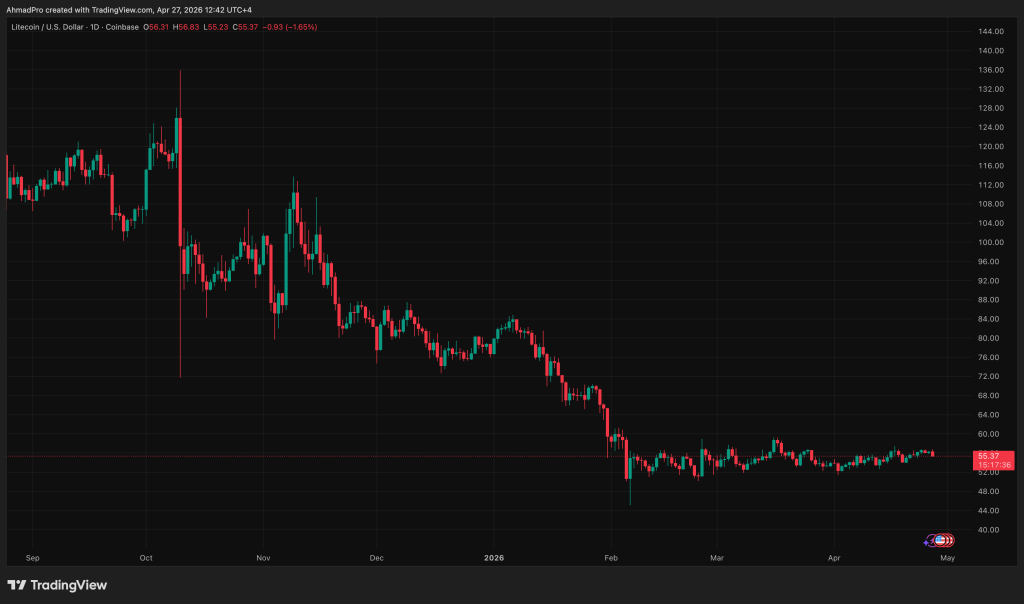
Litecoin (LTC) took a hit on April 25, and not a small one. What exactly triggered the chaos, and whether the hack damage is truly contained, deserves a closer look.
A zero-day vulnerability in Litecoin’s codebase was exploited on April 25, triggering a 13-block reorganization that temporarily halted transaction finality across major mining pools.
The attack vector: un-updated nodes incorrectly accepted invalid MWEB (MimbleWimble Extension Block) transactions, which a Denial-of-Service attack exploited to flood the network.
The Litecoin team confirmed the bug on their official X account and stated a patch has been fully deployed, with node operators urged to update immediately.
No user funds were lost, but the reorg reversed transactions across those 13 blocks, a depth that qualifies as a serious network event by any measure.
A 13-block reorg isn’t a rounding error. Broader crypto markets are already navigating fragile sentiment around Bitcoin stalling near key levels, and a security incident on a top-20 chain adds pressure that technical analysis alone can’t absorb.
Can Litecoin Price Recover to $94 After the Hack Incident?
LTC holding up after the incident is actually the story, not the dip. Price bounced despite negative headlines, which tells you sellers did not fully take control.
But it is not strong either, it is just stable. Volume is messy across exchanges, which points to fragmentation, not a clean trend.
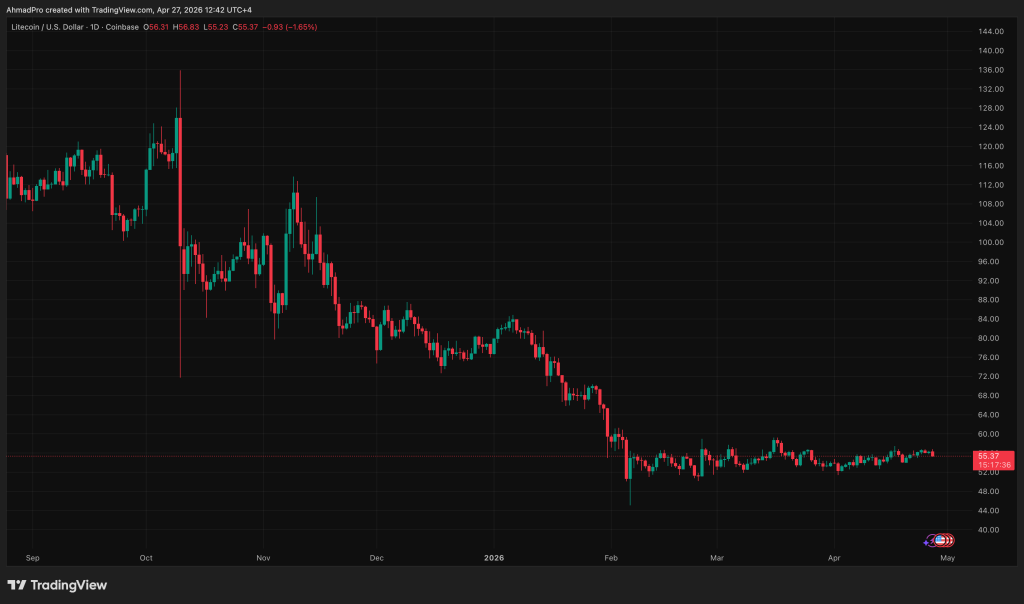
Right now, everything comes down to $60. That is the level that flips the structure if it breaks with volume.
If that happens, LTC can move back toward the top of its range and regain momentum.
More realistically, this just stays sideways between roughly $56 and $59 while the market moves on and the news fades.
The risk is if issues resurface or sentiment weakens, because $52 is the floor, and if that breaks, downside opens quickly.
So this is a neutral setup, holding steady for now, but still waiting for a real direction.
Here is Why LiquidChain Could Be Replacing OG Coins Like Litecoin
LiquidChain is positioning around that idea, aiming to connect Bitcoin, Ethereum, and Solana liquidity into one layer so developers and users are not tied to a single ecosystem.
The pitch is about reducing fragmentation and making execution smoother across chains.
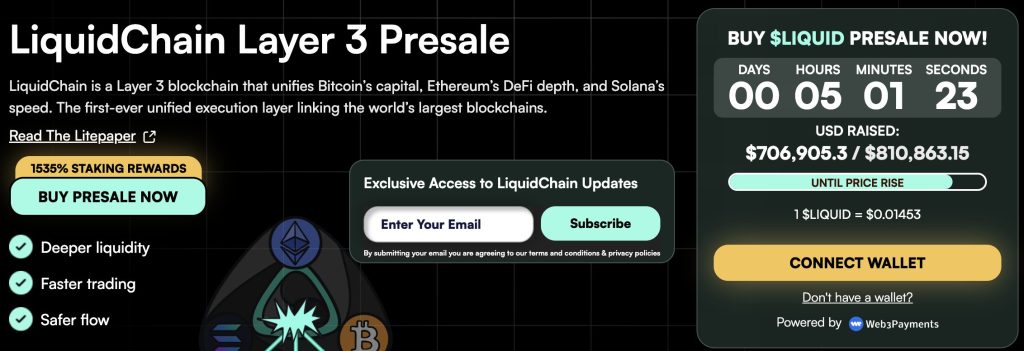
The presale is still early, around $0.01453 with just over $700K raised, which means it is in the early accumulation phase rather than widely priced.
But that also comes with the trade-off. Early-stage projects carry real execution risk, and liquidity only comes after launch.
So the contrast is simple, LTC offers stability with limited upside, while something like LiquidChain offers higher potential, but with much higher uncertainty.
The post A Zero-Day Hack Triggered a 13-Block Reorg on Litecoin: Are User Funds Actually Safe? appeared first on Cryptonews.


The plan allows trapped lenders to sell tokenized claims on deposits, offering buyers an option-like bet on CRV’s recovery.


Banking Circle’s stablecoin settlement launch follows its CASP approval, entering a crowded market with SocGen, Sygnum and a 12-bank euro stablecoin consortium.

Pope meeting significant ‘regardless of me being a woman’, says archbishop

Read this before you click on any Robinhood email

Which Bank Holidays Are Left In The UK In 2026?

Manchester United reach agreement with Casemiro over contract clause amid transfer speculation

US brings back mandatory military draft registration

Steven Gerrard disagrees with Gary Neville over ‘shock’ Chelsea and Arsenal claim | Football


-

 Politics7 days ago
Gary Stevenson delivers timely reminder to register to vote as deadline TODAY
-

 Fashion3 days ago
Weekend Open Thread – Corporette.com
-
 Crypto World2 days ago
Hyperliquid $HYPE Rally Builds Momentum as AI Sector Enters Prove-It Phase
-
Crypto World7 days ago
Bank of Hawai’i (BOH) Q1 2026: Net Income Drops to $57.4M as Net Interest Margin Expands
-

 Politics5 days ago
Making troops accountable for war crimes threatens US alliance, ex-SAS colonel warns
-

 Politics5 days ago
Disabled people challenge government SEND proposals over segregation concerns
-

 Business5 days ago
Rolls-Royce Voted UK’s Most Iconic Trade Mark as IPO Register Hits 150
-

 Business4 days ago
Patterson-UTI Energy, Inc. (PTEN) Q1 2026 Earnings Call Transcript
-

 Politics5 days ago
Zack Polanski responds to home secretary’s taser threat
-
 Crypto World6 days ago
Five Value Stocks with Recovery Potential in 2026: PayPal (PYPL), Nike (NKE), and More
-

 Politics5 days ago
Starmer handler McSweeney to be dragged from shadows by Foreign Affairs Committee
-
 Sports1 day ago
IPL 2026: Ruturaj Gaikwad registers slowest fifty of the season, enters all-time unwanted list | Cricket News
-
Politics5 days ago
Wings Over Scotland | How To Get Away With Crimes
-

 Crypto World6 days ago
New York sues Coinbase, Gemini over prediction market offerings
-
Entertainment6 days ago
Sydney Sweeney cameo cut from “The Devil Wears Prada 2”, source explains why (exclusive)
-
 Business6 days ago
HCL Tech share price tank over 9% after weak Q4. JPMorgan, HSBC & 3 others cut target price
-

 Politics5 days ago
‘Iran is still a nuclear threat’
-

 Crypto World6 days ago
Crypto’s great hope in Senate’s Clarity Act still has a path to survive tight calendar
-
 Sports5 days ago
Tim Bradley names the current best in the world: “Better than Inoue and Usyk”
-

 NewsBeat1 day ago
LK Bennett closes all stores after entering administration
You must be logged in to post a comment Login