

Structurally, Romeo and Juliet is almost a Shakespearean comedy. The Bard’s comic plays tend to turn the world upside down and then neatly restore the social order, usually by means of marriage.
The world of Romeo and Juliet is turned upside down when two adolescents from warring families fall in love, and the world is set right when the families are united in marriage. But then there are three more acts and the plot veers towards tragedy, tallying six deaths by its end.
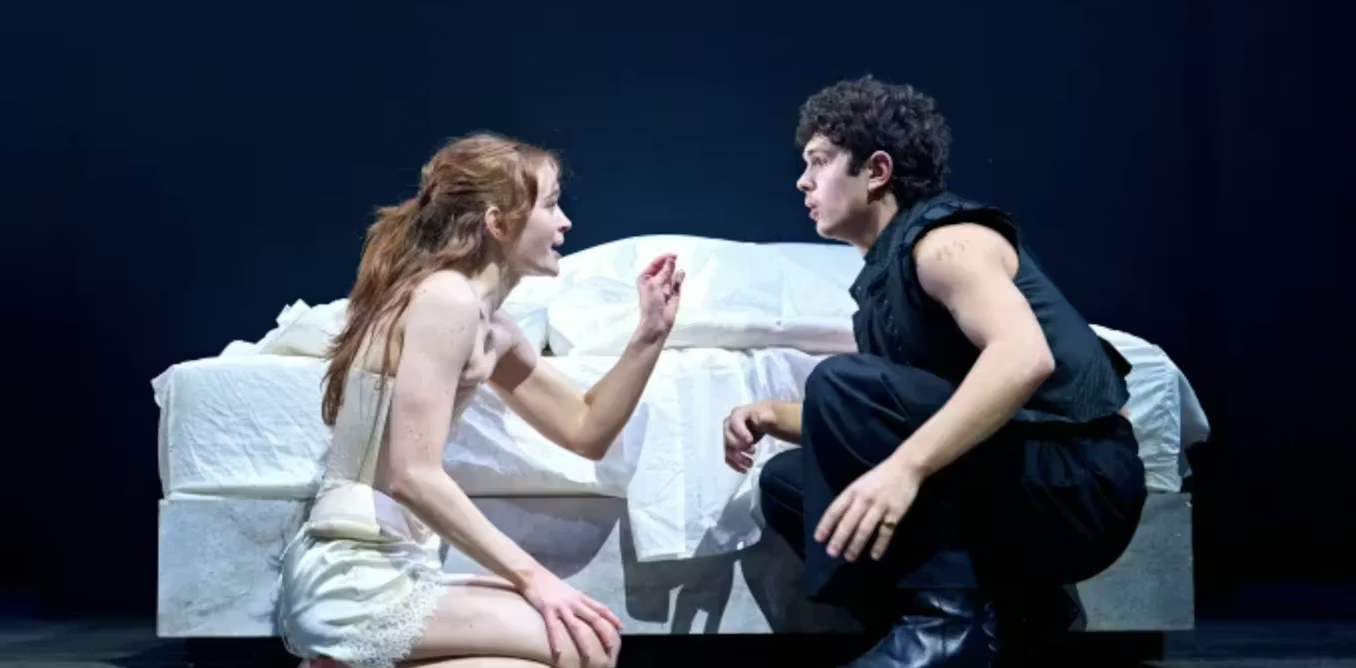
Robert Icke’s new production of Romeo and Juliet at the Harold Pinter Theatre thoughtfully interrogates the play’s structure by introducing moments of might-have-been throughout. Starring Noah Jupe (Hamnet) and Sadie Sink (Stranger Things) in the respective titular roles, Icke offers glimpses of how the story might have unfolded differently, in a kind of Sliding Doors version of the play.
Early in the production, Lord Capulet (Clark Gregg) gives the invitation list for his party to the Nurse (Clare Perkins). Then time freezes, we move backwards, and Capulet hands the note instead to an illiterate servant, who bumps into Romeo on the street and asks for his help reading it. Romeo learns of the party and decides to attend in order to see his current crush, Rosaline. Had the Nurse been given the task, she would never have needed help reading the list and Romeo would never have met Juliet.
In this way, the production is riddled with tiny moments that could have altered the plot’s trajectory away from tragedy. In doing so, we get to see alternate universes that make up a multiverse. The multiverse has been a regular device in recent popular storytelling, from the Marvel Cinematic Universe to the adult cartoon Rick and Morty.
Plays like Nick Payne’s Constellations, which had a West End revival in 2021, stage a multiverse by showing how the same scene between two characters might have happened in several different ways, across an infinite number of timelines.
I have written about theatrical multiverses, demonstrating that they offer the audience space to reflect upon how things might have gone differently in their own worlds. In 2021, just after the third UK Covid lockdown, the audience of Constellations was likely attuned to contemplating a world in which they did not expect to find themselves.
With the tumultuous state of the world, it can sometimes feel like we are living in the wrong timeline. The popularity of multiverse stories may seen as ways of reconciling living in our own world, that often feels as if it has been turned upside down.
Romeo and Juliet’s multiverse
As Daniel Swift’s programme note attests, Romeo and Juliet is very much about time. The plot is compressed into five days and it includes more references to days of the week, hours and minutes than any of Shakespeare’s other works. This preoccupation with time is emphasised by Hildegard Bechtler’s set design, which includes two moving panels with illuminated clocks, presenting the precise time and date in fair Verona.
Along with helping the audience understand when we see alternate timelines, the constant reminder of time allows us to reflect on just how quickly things escalate for Romeo and Juliet.
The lovers marry within hours of meeting each other and Romeo is already banished in Mantua before they’ve been wedded for a full day. In this way, the clock points to the youthful haste which creates so much waste. This theme is developed in the emphasis on how quickly Lady Capulet (Eden Epstein) was was made a wife and mother (younger than Juliet, and based on the text she could be as young as 26). This comes through in her subtle portrayal of depression at the thought of lost youth and cowardice in the face of her much older husband.
Manuel Harlan
Jupe’s performance is standout. He is able to capture a contemporary take on the lines without losing any of their rhythm and poetry. This is in contrast to Sink, whose staccato delivery and frequent line breaks (perhaps emphasised by the American accent) jar against the poetry.
Kasper Hilton-Hille’s Mercutio – Romeo’s closest confidant – is a convincingly arrogant scamp. Throughout the production he is an active agent of chaos, always looking for trouble, mooning the Nurse and shaking his crotch at the fiery Tybalt (Aruna Jalloh). In fact he has been so relentlessly seeking out trouble across every timeline explored, that it is curious when in his death throes he calls down a plague on both the houses of Montague and Capulet. Surely he himself is to blame for his own demise?
My one criticism of the use of the multiverse in this production relates to the parts of the plot in which it is deployed. Often, Icke’s alternate timelines relate to chance, rather than the decisions made by the characters. For example, a drink is accidentally spilled, preventing Tybalt from attacking Romeo before he meets Juliet at the party. Or a messenger evades quarantine and delivers a letter informing Romeo that Juliet is actually still alive.
But what if it was the decisions of the characters that played out instead? For example, it would have been interesting to see Romeo not take revenge on Tybalt because he values his duty to Juliet over Mercutio. This would elevate the importance of the actions we take over the randomness of external factors. By emphasising happenstance over agency, Icke’s multiverses situate humans as flotsam on the waves of fate.
A more powerful call to action in our turbulent times would be to emphasise that it is the choices we make that can shape whether our story is a comedy or a tragedy.
Romeo and Juliet is at the Harold Pinter Theatre, London until June 20.


















































You must be logged in to post a comment Login