
Crypto World
MARA Holdings targets bitcoin quantum threat and network resilience with new foundation



Las Vegas — MARA Holdings (MARA) CEO Fred Thiel announced the launch of the MARA Foundation at the Bitcoin Conference Monday, outlining a broad effort to support the long-term resilience of the bitcoin network beyond the firm’s bitcoin and AI mining operations.
“Bitcoin is the most important decentralized system ever created, but its future is not guaranteed,” Thiel said, framing the initiative around the idea that the network requires active stewardship.
Thiel described bitcoin as “a public utility that nobody owns, but everybody depends on,” adding that decentralization “doesn’t mean it runs on itself, it means responsibility is distributed.”
The foundation will focus on maintaining bitcoin’s core properties as “sound, durable money,” while advocating for its open and global use. Key priorities include supporting the network’s security budget, particularly the development of a sustainable transaction-fee market, and funding research into emerging risks, such as quantum computing.
MARA also plans to fund open source development across scaling, mining, and user infrastructure, expand access to self-custody, and promote financial sovereignty worldwide.
Education and policy engagement are central to the initiative, including technical training, multilingual resources, and outreach to regulators.
As part of the launch, MARA will award $100,000 to one of three nonprofit organizations, with the recipient chosen by community vote, underscoring Thiel’s call for shared responsibility across the ecosystem.



- Pudgy Penguins (PENGU) price touched $0.010 amid double-digit gains.
- The token surged as the Pudgy Penguins floor price pumped.
- Other non-fungible tokens also soared, including the Bored Ape Yacht Club.
Pudgy Penguins’ native PENGU token is up double digits in the past 24 hours, riding high on skyrocketing floor prices to touch three-month highs.
This surge comes amid notable price increases in the Pudgy Penguins NFT, with other tokens related to the sector also experiencing significant gains.
However, an uptick for Bitcoin and Ethereum fizzled on Monday, a scenario that puts the tokens’ prices in danger of retreating amid profit-taking.
Pudgy Penguins soars 14% amid NFT price gains
Data shows top non-fungible token collections are experiencing a remarkable resurgence, with floor prices extending their upside momentum.
Pudgy Penguins currently leads the charge as its floor price climbs above 5 ETH, with over 20% in weekly gains.
Market data highlights this momentum, with over 20 sales and nearly 1,000 ETH in trading volume over the past seven days.
The Bored Ape Yacht Club (BAYC) NFT boosts similar metrics and shows an 81% spike in floor price over the last 30 days.
Yet, this optimism contrasts with contracting overall NFT market participation.
Global sales, transactions, and active users have nearly halved since February, even as average sale prices have more than doubled.
This divergence suggests a concentration of capital among high-value collections like Pudgy Penguins, potentially signaling selective bullishness rather than broad recovery.
Notably, PENGU price is up 40% over the past week, and the 14% gain in the last 24 hours has pushed it to above $0.010 for the first time since late January.
Pudgy Penguins is in double digits up year-to-date.
Pudgy Penguins price analysis
Analysts attribute the NFT rally primarily to surging cryptocurrency prices, with Bitcoin (BTC) recently touching $80,000 and Ethereum (ETH) reaching $2,400.
The broader market sentiment looks to have amplified demand for top-tier NFTs, where Pudgy Penguins has stood out with elevated transaction counts accompanying its price climb.
In the market, surging floor prices typically reflect strong conviction, and the opposite shows amid declining floor prices.
PENGU gains mirror Pudgy Penguins’ NFT momentum, and the upmove lifts bulls above the $0.008 supply zone.
The surge to above $0.010 makes the 100-day and 50-day moving averages key support levels at $0.0082 and $0.007.

Among technical indicators to note is the Relative Strength Index (RSI) that currently hovers above 70, signalling overbought conditions.
Traders may need to watch out for NFT market fatigue or a significant BTC pullback.
If this happens, PENGU price could test lower support levels, including Feb 6 low of $0.0052.
On the flipside, the moving averages hint at a potential golden cross, with price likely to extend towards the YTD peak around $0.014.

TLDR
- Shiba Inu added 24000 new wallets between April 20 and April 27, 2026.
- The total number of SHIB holders surpassed 1.585 million, reaching a new high for 2026.
- On April 25, the network recorded its largest daily increase with 10718 new holders.
- Shibarium has processed more than 1 billion total transactions since its launch.
- The team confirmed the updated wallet and transaction data on April 27, 2026.
Shiba Inu (SHIB) recorded sharp user growth and network activity between April 20 and April 27, 2026. The team reported 24,000 new wallets during the period, pushing total holders above 1.585 million. At the same time, Shibarium processed more than 1 billion transactions, marking a new network record.
SHIB Wallet Count Climbs to 1.585 Million
Shiba Inu’s team shared updated wallet data on April 27 through its official X account. The update confirmed that SHIB holders increased by 24,000 wallets within one week. As a result, the total number of SHIB wallets surpassed 1.585 million, reaching a new high for 2026.
The data showed the largest daily rise occurred on April 25. On that day, the network added 10,718 new holders, which marked the strongest daily growth this year. The team stated, “The ecosystem continues to expand as new users join the network each day.”
Earlier in the week, wallet growth began to accelerate from April 20. The steady rise continued through April 24 before the sharp spike on April 25. This pattern reflected rising participation during the recent crypto market rebound.
After the peak day, growth levels moderated but remained positive. On April 26, the network added 1,040 new holders. On April 27, it recorded another 1,100 new wallets, according to the team’s update.
These additions brought the cumulative holder count to its current level. The team described the increase as a continuation of rising engagement across the ecosystem. The figures reflect on-chain wallet data recorded during the reporting period.
Shibarium Surpasses 1 Billion Transactions
Shibarium also reached a new usage milestone during the same period. The layer 2 network processed more than 1 billion transactions, according to the shared data. This achievement places Shibarium among networks with high cumulative activity counts.
The team confirmed the milestone while outlining recent network statistics. It stated, “Shibarium has now crossed 1 billion total transactions.” The update linked the transaction growth to expanding network usage.
Transaction volumes increased as wallet numbers climbed during the week. The network handled daily transfers that contributed to the cumulative total. Each processed transaction is added to the overall count tracked on-chain.
Shibarium operates as Shiba Inu’s layer 2 scaling solution. The network supports faster transactions and lower fees compared to the main Ethereum chain. Developers continue to build and deploy projects within the ecosystem.
The 1 billion transaction mark reflects total processed transfers since launch. The data covers all confirmed transactions recorded on the network ledger. The team released the figures alongside updated holder statistics on April 27, 2026.
The latest wallet additions and transaction totals represent the most recent verified data. Shibarium’s cumulative transaction count now stands above 1 billion as of April 27. Total SHIB wallet addresses exceed 1.585 million based on on-chain records.


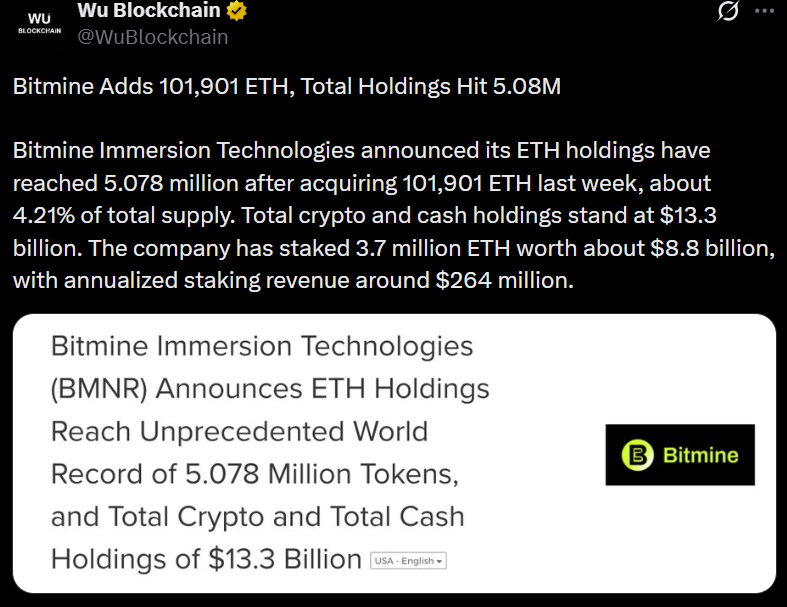
BitMine Immersion Technologies, the Ether treasury company backed by Fundstrat’s Tom Lee, has expanded its ETH holdings for the second time in as many weeks, even as large unrealized losses underscore the strategy’s risks.
The company said Monday it purchased an additional 101,901 Ether last week, bringing its total holdings to roughly 5.08 million ETH. Its combined crypto and cash reserves now stand at about $13.3 billion.
Source: Wu Blockchain
The latest acquisition follows a purchase of 101,627 ETH a week earlier, which was the company’s largest accumulation since December.
Despite the aggressive buying, BitMine is sitting on more than $6.5 billion in unrealized losses, based on total investments of approximately $17.6 billion, highlighting the impact of recent volatility in Ether prices.
The share price of the NYSE-listed BMNR stock is down more than 20% year-to-date, according to Yahoo Finance data.
Still, the company is generating yield on a portion of its holdings. BitMine has staked roughly 3.7 million ETH, allowing it to earn rewards for helping secure the Ethereum network and validate transactions, a strategy that provides a steady income stream even during price downturns.
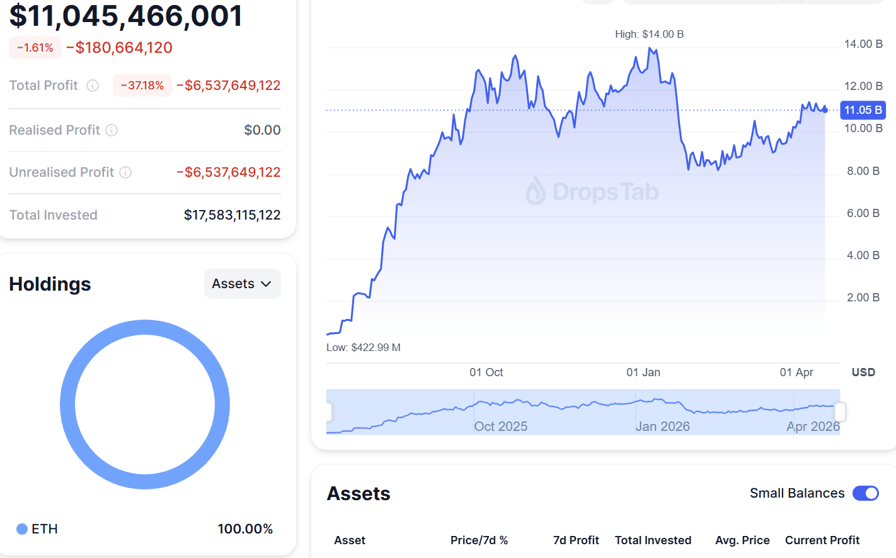
BitMine’s unrealized losses on its ETH treasury have topped $6.5 billion. Source: Dropstab
Related: Crypto Biz: Same players, bigger bets as crypto eyes a rebound
Ether, crypto markets show signs of stabilization
BitMine’s large purchases come as the broader crypto market shows early signs of stabilizing after months of declines through March.
Ether rebounded above $2,400 last week after falling to a low near $1,800 earlier this year, according to TradingView data. Despite the recovery, the second-biggest crypto by market cap remains down roughly 23% year-to-date.
The rebound mirrors a broader uptick across equities and other risk assets in recent weeks, suggesting improving investor sentiment.
However, the volatility underscores the challenges facing crypto treasury players. Companies that accumulate large digital asset reserves are highly exposed to price swings, which can lead to significant unrealized losses during downturns, even as they continue buying.
While strategies like staking can generate yield, they often do little to offset large drawdowns in asset value, leaving balance sheets sensitive to market cycles.
Related: Michael Saylor’s Strategy adds 3.2K Bitcoin at nearly $78K per BTC
TLDR
- Strategy purchased 3,273 Bitcoin for $255 million at an average price of $77,906 per coin.
- The latest acquisition increased Strategy’s total holdings to 818,334 BTC.
- The company funded the purchase by selling 1,451,601 MSTR shares through its at-the-market program.
- Strategy’s Bitcoin holdings are now valued at about $63.7 billion at current market prices.
- The company’s position has returned to profit with an estimated gain of $1.9 billion.
Strategy expanded its Bitcoin holdings with a new 3,273 BTC purchase worth $255 million. The acquisition lifted total reserves to 818,334 BTC and returned the company to profit. However, Peter Schiff challenged Michael Saylor’s $1 million Bitcoin forecast and questioned the accumulation strategy.
Strategy Expands Bitcoin Holdings With $255M Purchase
Strategy confirmed it purchased 3,273 Bitcoin for about $255.0 million at an average price of $77,906. The company increased its total holdings to 818,334 BTC as of April 26, 2026. It acquired the entire stash for $61.81 billion at an average price of $75,537 per coin.
At current prices near $77,850, the holdings carry a market value of $63.7 billion. This valuation places Strategy at roughly $1.9 billion in profit. Earlier this year, Bitcoin traded below $70,000 and left the company’s position underwater.
Michael Saylor announced the purchase on X and reported a 9.6% Bitcoin Yield year-to-date in 2026. He also released the company’s Form 8-K filing with the U.S. SEC. The filing detailed that Strategy funded the purchase through its at-the-market equity program.
Between April 20 and April 26, 2026, Strategy sold 1,451,601 MSTR shares. The share sales generated $255.0 million in net proceeds after commissions. During the same period, the company sold no preferred stock.
Schiff Challenges $1 Million Bitcoin Prediction
Peter Schiff responded to Saylor’s update and targeted his $1 million Bitcoin forecast. In 2025, Saylor said Bitcoin could reach $1 million if Strategy acquired 5% of the total supply. Schiff argued that current accumulation trends do not support that outlook.
Schiff stated that Strategy now controls about 3.9% of the total Bitcoin supply. He said the company purchased 231,666 BTC since Saylor made the forecast. According to Schiff, similar price reactions to future purchases could push Bitcoin below $60,000 before Strategy reaches 5%.
He wrote that “if the next 231,666 BTC move the market as the last ones did, the price could be under $60,000.” Schiff used this calculation to dispute the $1 million target. He has repeatedly supported gold as an alternative store of value.
Schiff also criticized claims about covering a reported 11.5% yield on STRC with modest Bitcoin growth. He argued that continuous issuance raises the required price increase. He said falling STRC prices could force higher yields and strain the structure.
According to Schiff, selling Bitcoin to cover yields would pressure the market. He warned that such actions could trigger a “death spiral” unless Strategy cancels the dividend. Strategy’s latest Form 8-K filing, dated April 27, 2026, confirms the recent equity-funded purchase.
TLDR
- Bitcoin reached $79,488 before easing to $78,223 as futures activity powered the latest price move.
- CryptoQuant CEO Ki Young Ju said the current Bitcoin rally is driven by derivatives, not strong spot demand.
- On-chain data shows Bitcoin’s 30-day apparent demand metric remains in negative territory.
- Michael Saylor’s firm, Strategy, purchased $255 million in Bitcoin after a $2.54 billion acquisition last week.
- Bitcoin ETFs acquired more than $2.6 billion worth of BTC this month despite weak on-chain demand.
Bitcoin climbed toward two-month highs as derivatives activity powered the latest advance. The asset reached $79,488 before easing to $78,223 during the session. However, CryptoQuant CEO Ki Young Ju said futures markets, not spot demand, drive the current Bitcoin rally.
Bitcoin Rally Fueled by Futures While Spot Demand Stays Weak
Ki Young Ju stated that derivatives traders lead the present move in Bitcoin. He said rising open interest shows traders are increasing leverage across futures markets.
He explained, “This rally is futures-driven,” and he pointed to negative on-chain demand data. CryptoQuant data shows Bitcoin’s 30-day apparent demand metric remains below zero.
Meanwhile, institutional buyers continued acquisitions through direct purchases and exchange-traded funds. Michael Saylor’s firm, Strategy, bought $255 million in Bitcoin after acquiring $2.54 billion last week.
At the same time, Bitcoin ETFs accumulated more than $2.6 billion worth of BTC this month. Yet on-chain metrics did not reflect matching growth in spot-driven demand.
CryptoQuant data showed futures demand in strong positive territory during the same period. However, Ju said bear cycles end only when both spot and futures demand recover together.
He added that current data does not show that alignment. Therefore, the structure behind the Bitcoin rally remains uneven.
Short Squeeze Accelerates Bitcoin Price Surge
On April 23, Bitcoin rose from $76,351 to $79,447 within hours. The move marked a 4.05% increase during that session.
Carmelo Alemán, an on-chain analyst at CryptoQuant, attributed the surge to forced liquidations. He said short traders closed positions rapidly as prices climbed.
Open interest jumped from $24.88 billion to nearly $28 billion during the rally. This rise showed a sharp increase in leveraged futures positions.
Short liquidations exceeded $607.9 million in Bitcoin during that move. Ethereum short liquidations reached $580.9 million in the same period.
Together, short liquidations totaled about $1.19 billion across both assets. In contrast, long liquidations remained just above $111 million combined.
Alemán said the imbalance highlighted strong pressure on bearish traders. As shorts closed, forced buying pushed prices higher.
CryptoQuant data indicated that derivatives activity expanded faster than spot transactions. Therefore, leverage played a central role in the advance.
Ju reiterated that on-chain demand still shows weakness despite price gains. He stated that negative apparent demand contrasts with rising futures exposure.
Bitcoin traded near $78,223 after touching $79,488 earlier in the day. Open interest remained elevated near $28 billion at the latest reading.
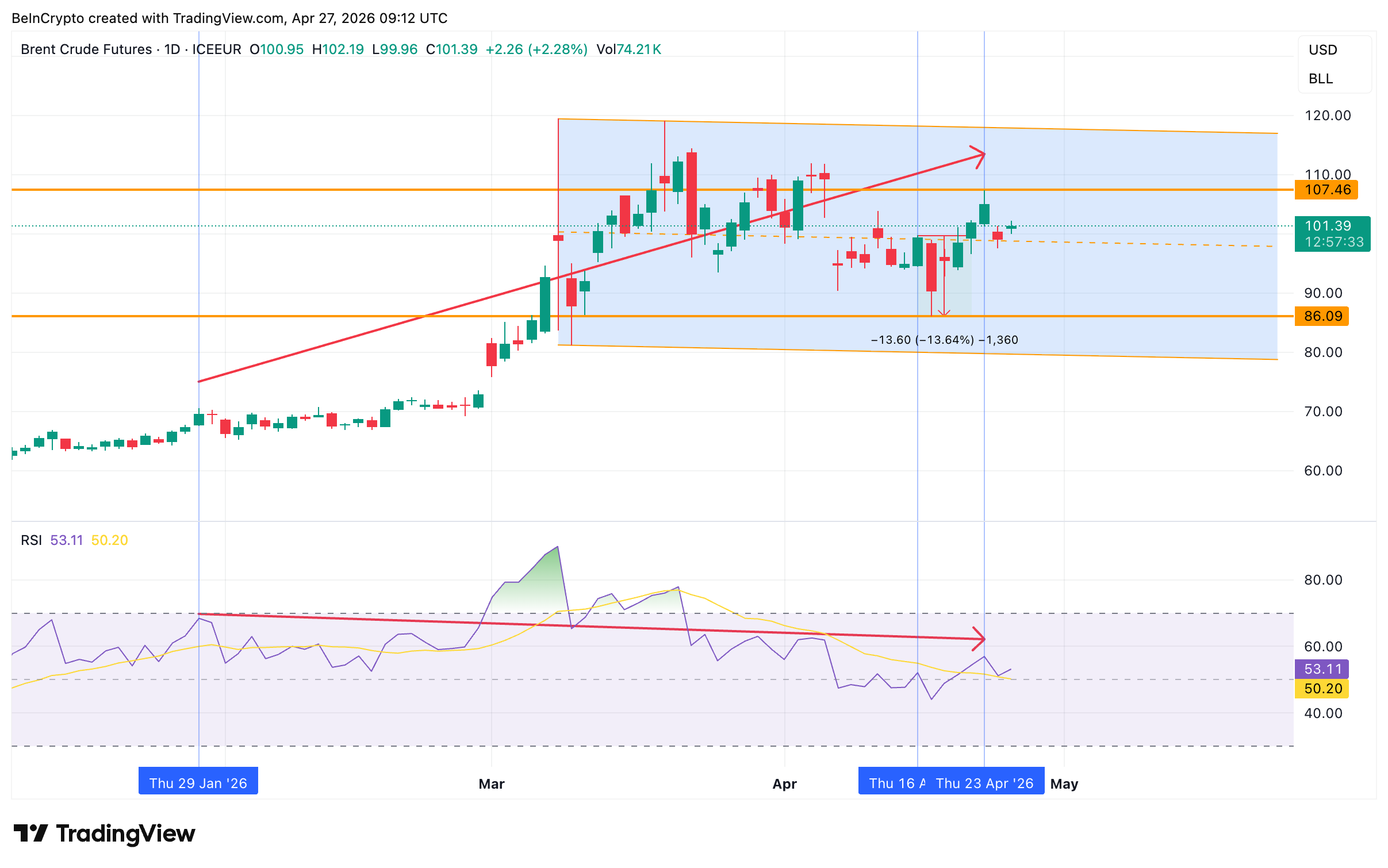
Oil prices are sitting in the same chart setup that triggered a 13% drop two weeks ago, but the options market and a deepening supply shock have rewritten the variables that determine whether the drop happens again or fails.
Brent crude trades at $101.39 on April 27, up 2.28% on the day and just below the $107.46 high it rejected on April 23. The pattern that triggered April’s drop is back. But the conditions around it are different.
Bearish Divergence Mirrors the Setup That Crashed Brent Crude 13% in April
Since March 9, Brent crude has traded inside a falling channel, a bearish pattern. Within that channel, the pattern flashing now is the same one that preceded April’s drop.
Between January 29 and April 23, Brent printed a higher swing high in price while the Relative Strength Index (RSI) printed a lower swing high. That is a textbook bearish divergence, where price strength outpaces underlying momentum and often signals a trend reversal.
The precedent is uncomfortable. The same divergence formed between January 29 and April 16. Brent then rolled over and dropped over 13% to a local low of $86.09.
Want more insights like this? Sign up for Editor Harsh Notariya’s Daily Newsletter here.
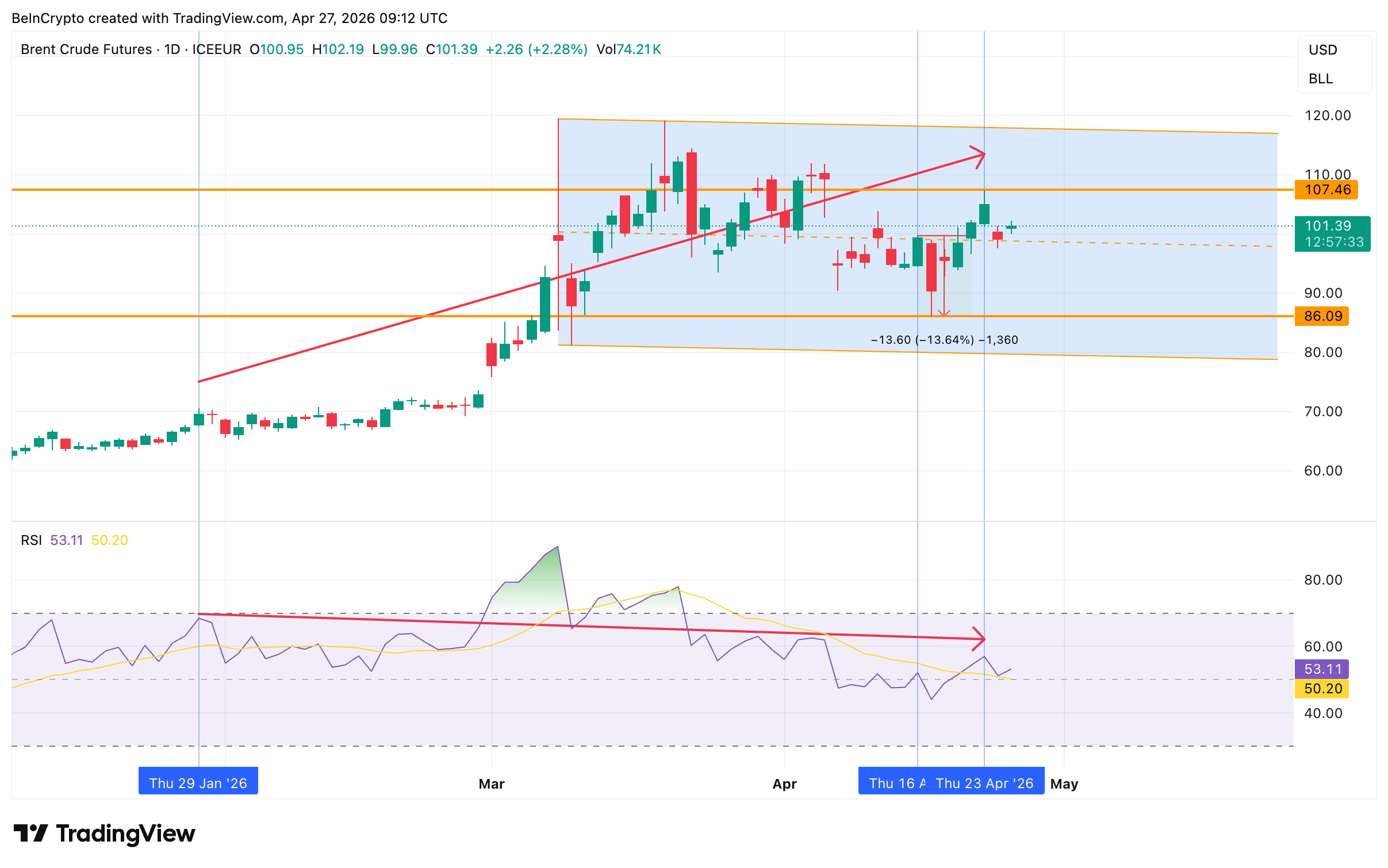
The pattern playing out today is structurally identical, with the same channel, the same momentum failure, and a similar rejection at the upper boundary. If the playbook holds, oil price faces a measured drop back toward the channel floor near $81.72.
Goldman, Inventory Draws, and a Collapsing Put-Call Ratio Disagree With the Chart
The chart says one thing. The options market says another. The United States Brent Oil Fund (BNO), a US-listed exchange-traded fund (ETF) that tracks Brent crude prices, gives a clean window into how options traders are positioning.
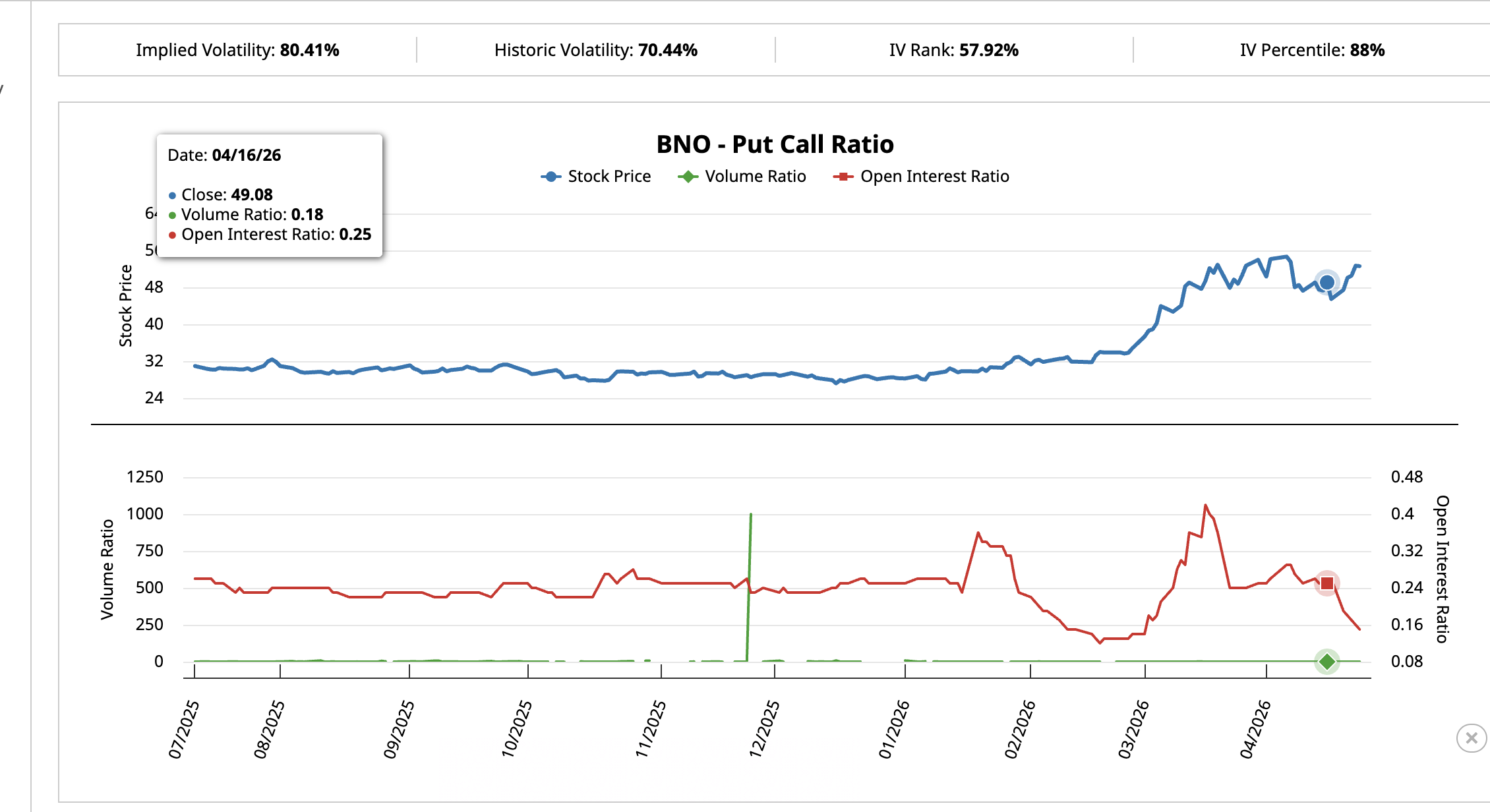
On April 16, when the prior bearish divergence flashed, BNO’s volume put-call ratio, a measure of bearish versus bullish bets in daily options flow, sat at 0.18, while its open interest put-call ratio, which measures standing positioning, was 0.25.
Brent then dropped 13%.
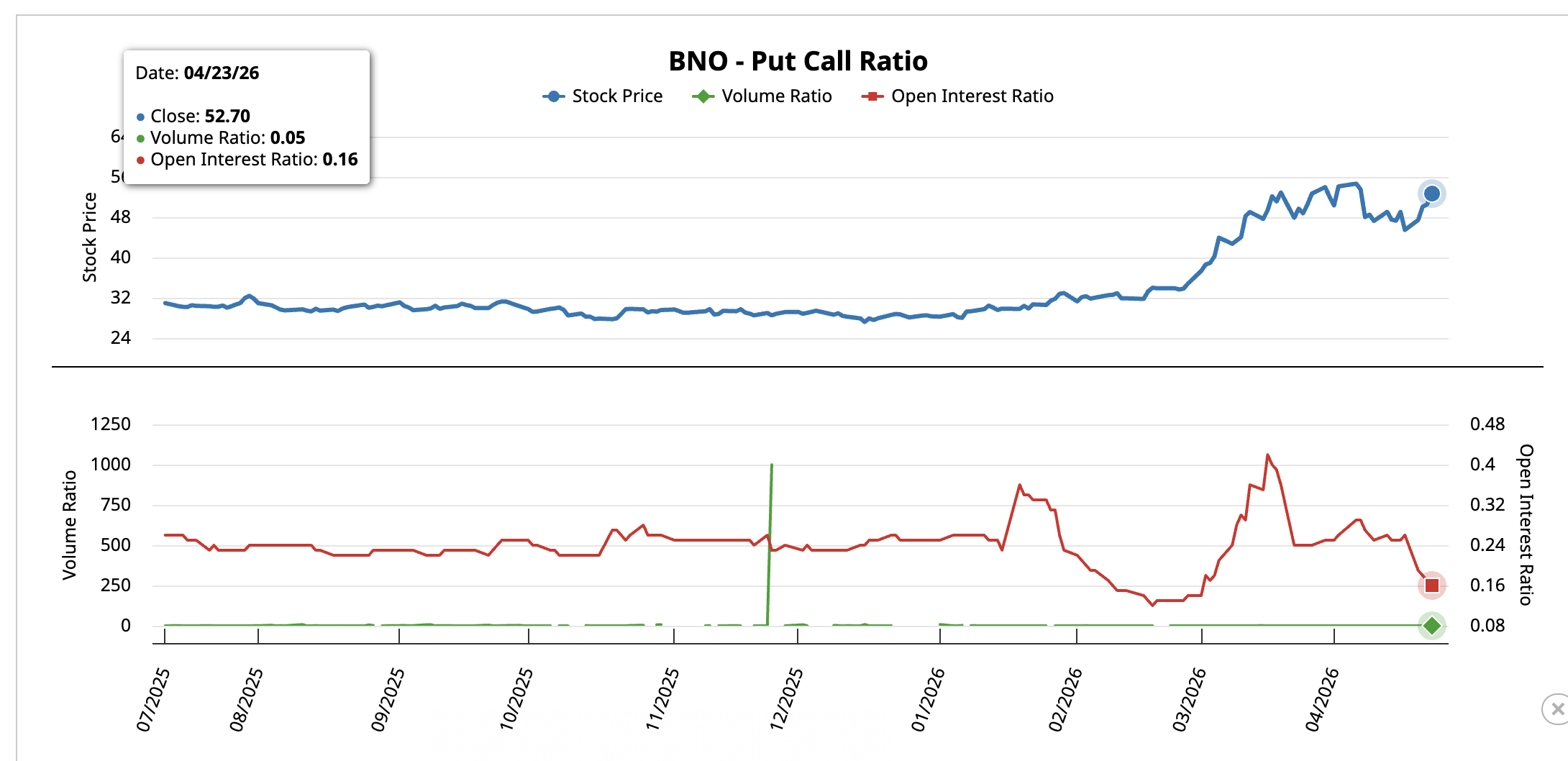
By April 23, when the latest divergence printed, the picture flipped. Volume put-call collapsed to 0.05, and open interest put-call dropped to 0.16, indicating shorts were liquidated and call demand surged.
Implied volatility (IV), the market’s expectation of future price swings, sits at 80.41% with an IV percentile at 88%, signaling traders are pricing a large move ahead.
The supply side explains the bullish positioning. Goldman Sachs raised its Q4 2026 Brent forecast to $90 per barrel from $80 on Monday, citing 14.5 million barrels per day in Persian Gulf production losses and global inventory drawdowns running at 11 to 12 million barrels per day.
That is the structural fuel keeping a bid under oil price, even as the technical picture warns of a drop.
Oil Price Levels Make $99.17 the Trigger, $107.46 the Reversal
The decision sits at $99.17, the 20-day Exponential Moving Average (EMA), where EMA is a trend line that averages price with more weight on recent candles.
On April 13, when oil price lost the 20-day EMA, a 13% drop accelerated within sessions. The same line is now sitting just below the current price.
A daily close above $101.40, the 0.236 Fibonacci level, keeps the bullish path open and points back toward $107.46. A clean break above $107.46 confirms the supply shock thesis. It opens room toward $119.11, the upper channel boundary.
However, a $99.17 loss mirrors the April 13 trigger.
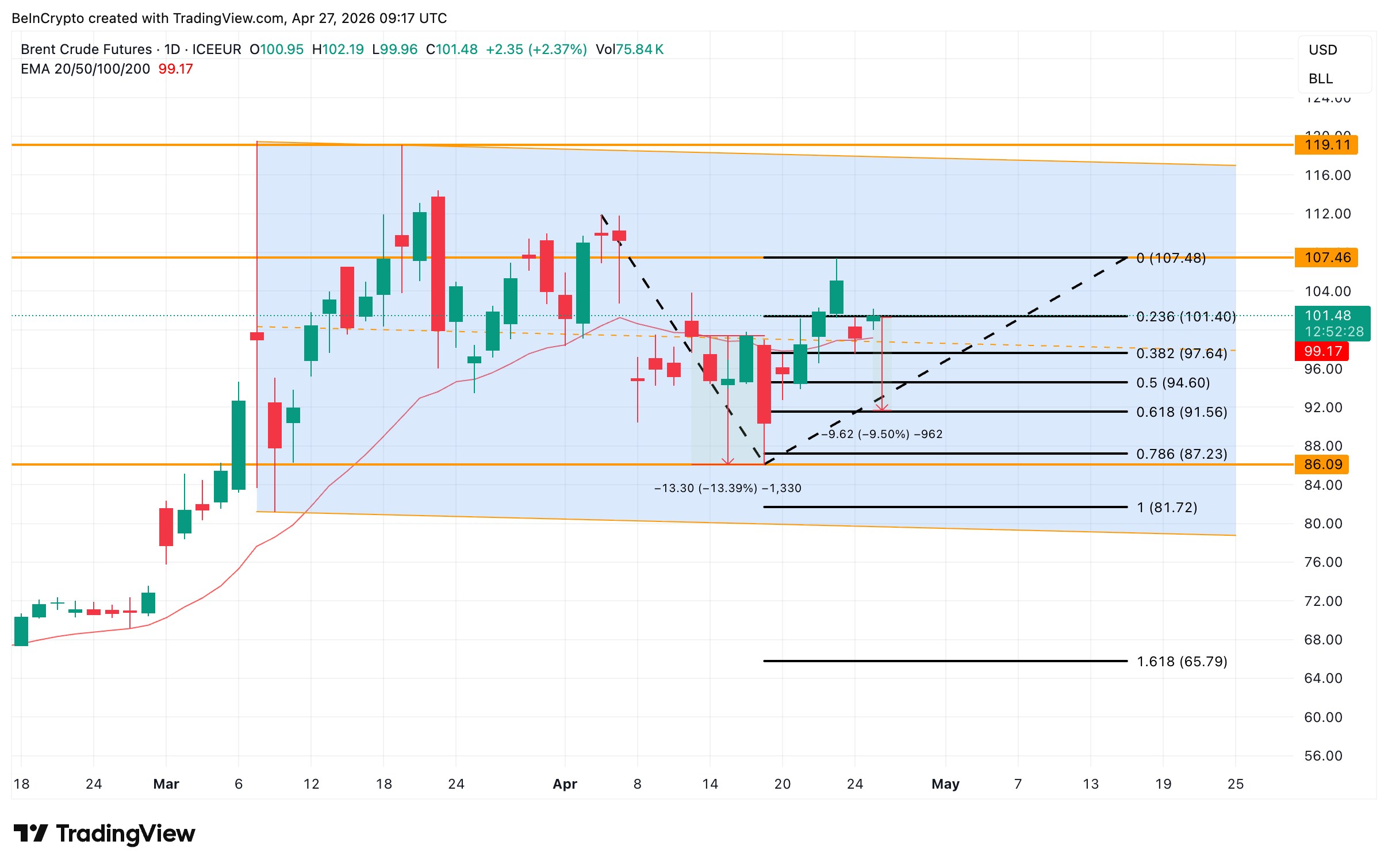
It then exposes $97.64 at the 0.382 Fibonacci level, with $94.60 at the 0.5 Fibonacci level as the next test. The decisive cluster sits at $91.56, the 0.618 Fibonacci, which is the strongest support on the daily chart.
A break below $91.56 opens $87.23 and then $81.72, the channel floor that would complete the repeat-of-April scenario.
For now, $99.17 separates a bearish repeat from a supply-shock-driven rally.
The post Will Oil Price Drop Again or Has the Supply Shock Rewritten the Playbook? appeared first on BeInCrypto.
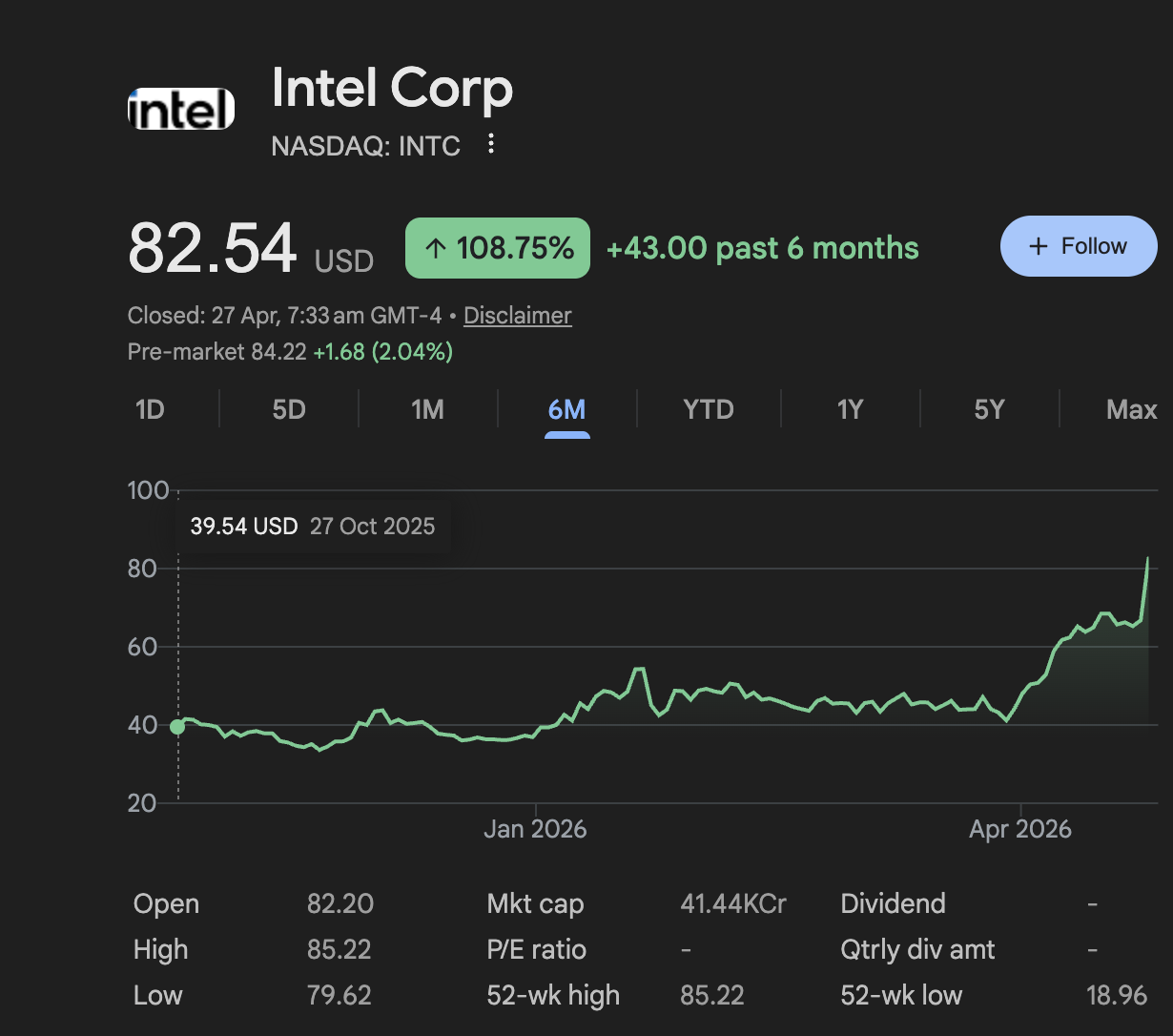
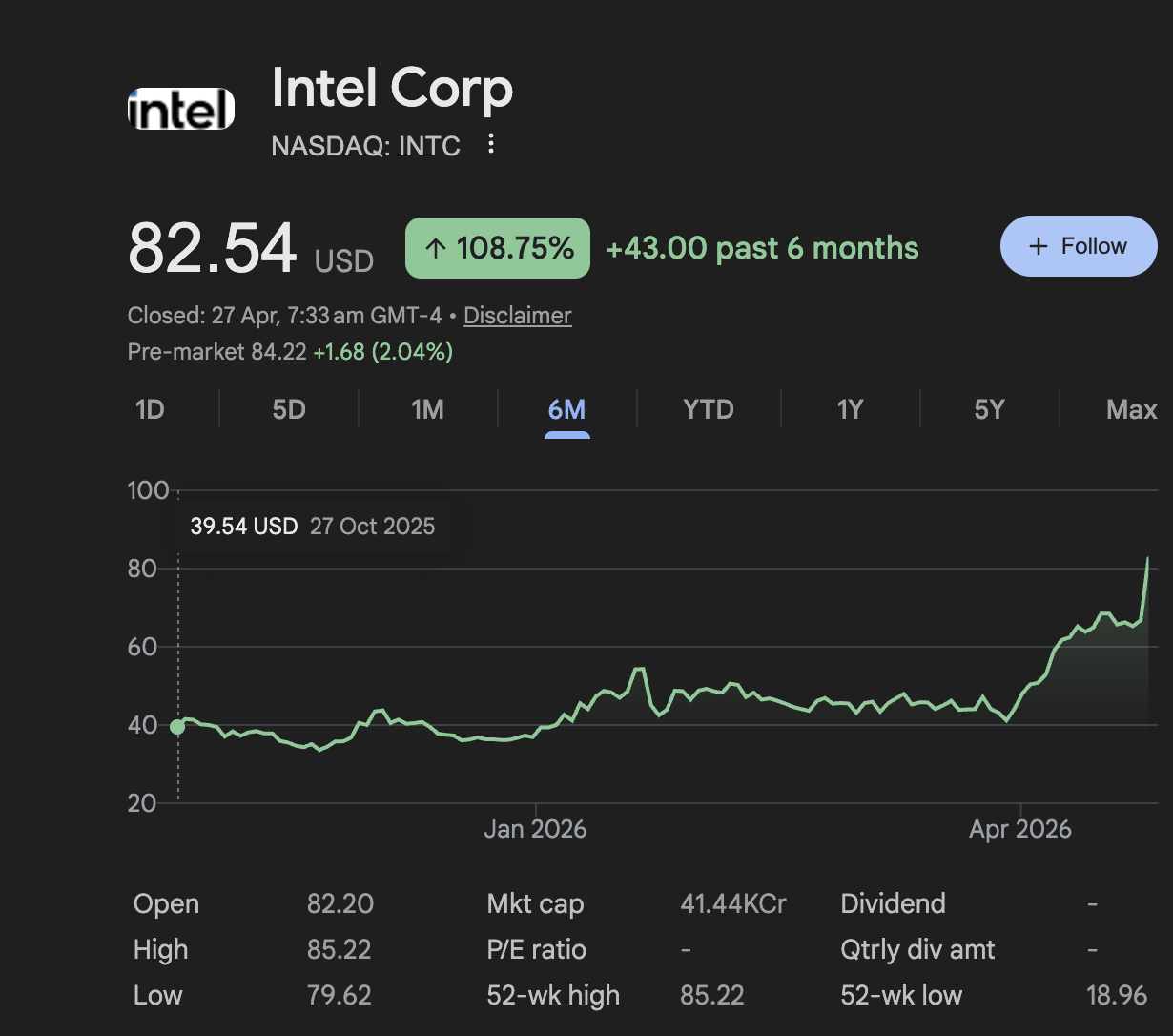
Intel (INTC) stock closed Friday at $82.54, capping a roughly 100% surge in a single month and printing fresh all-time highs, as traders now ask whether $100 is reachable before May ends.
The post-earnings melt-up has pushed Intel into deeply overbought territory while bearish options positioning quietly builds. Whether the chip giant breaks higher or pulls back from here now hinges on a single chart pattern forming on the two-day timeframe.
Intel Stock Volume Divergence Flashes Warning at Overbought RSI
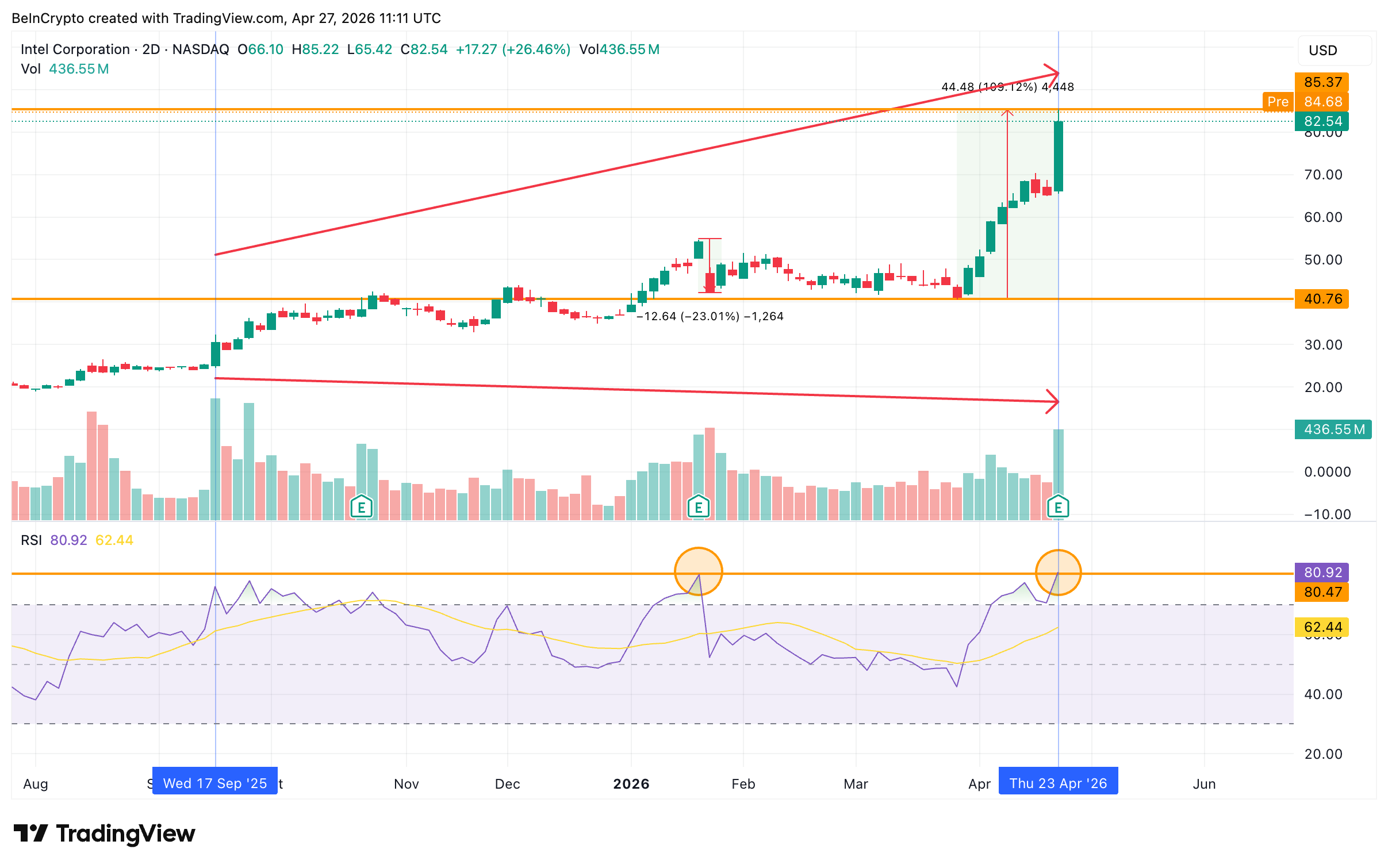
Intel stock has rallied for seven months on the two-day chart, but volume has been thinning the entire way. Between September 17 and April 23, price trended steadily higher while traded volume trended in the opposite direction.
That gap is a classic volume divergence, a warning that conviction behind the move is fading.
Want more insights like this? Sign up for Editor Harsh Notariya’s Daily Newsletter here.
The Relative Strength Index (RSI), a momentum indicator, just printed 80.92. That marks the second time INTC has tagged this exact overbought zone in less than a year.
The first hit came in early 2026, and the stock corrected by roughly 23% in the days that followed. The same volume divergence preceded that pullback, and the same divergence is present now.
That technical exhaustion matters because of what sits underneath the rally.
Intel now trades above 120 times next year’s expected earnings, the richest forward valuation among large-cap chip stocks, meaning every dollar of future profit is already priced in many times over.
On a clean accounting basis, the company posted a $3.7 billion net loss last quarter after a Mobileye writedown, and the Intel Foundry segment, the centerpiece of the entire turnaround thesis, lost another $2.4 billion in the same quarter.
Momentum is the only thing currently holding price above the underlying business. When the RSI resets, that gap tends to close.
Whether options positioning confirms or contradicts that pullback risk is the next piece of the puzzle.
INTC Put-Call Ratio Rises Even as Analysts Stay Cautious
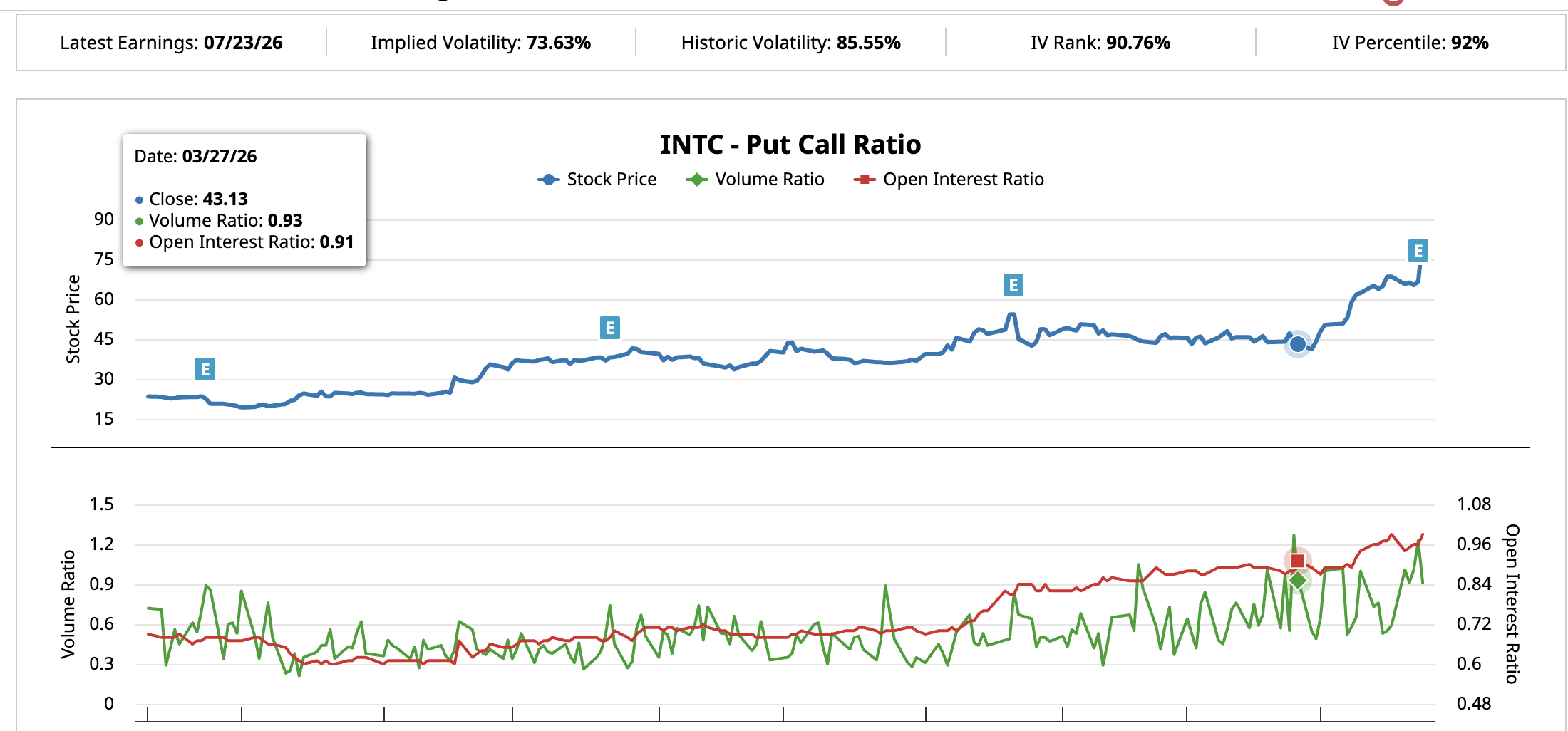
On March 27, when Intel closed at $43.13, the options market sat in balance. The put-call ratio by volume printed 0.93 and the open interest ratio printed 0.91, with neither calls nor puts dominating.
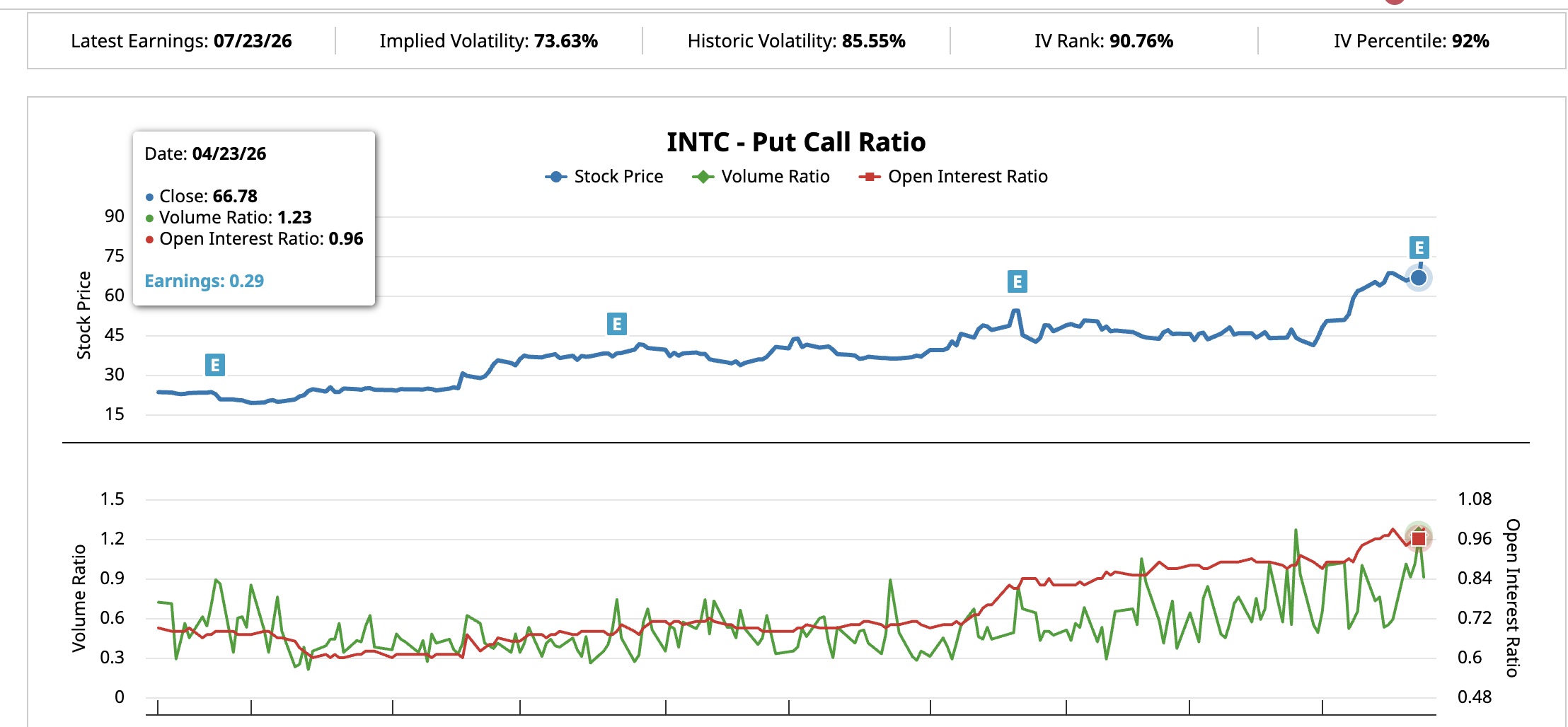
By April 23, the day Intel reported Q1 earnings with the stock at $66.78, the volume ratio had climbed to 1.23 and the open interest ratio to 0.96. Bearish positioning continued to build as the price rose.
That positioning carries two edges. If Intel pushes higher, those bearish bets get caught, and forced covering can amplify the move, the same dynamic that fueled the 24% single-day rip on April 24.
If the stock breaks down instead, the put wall becomes a magnet that pulls the price further down.
Implied volatility, which reflects how big a price move options traders expect over the coming year, sits at 73.63%. The IV Rank of 90.76 shows that reading is near the top of the past year’s range, meaning the market is bracing for one of its largest expected swings in either direction.
Wall Street has not stepped in to defend the rally. Analyst targets were raised across the board after earnings, but most ratings stayed cautious.
Barclays raised its price target to $65 with a Hold rating. Bank of America reiterated Sell at $56, implying roughly 32% downside. Morgan Stanley is rated Hold with a $73 price target. RBC went to $80, also Hold. Only Roth MKM at $100 and Northland at $92 carry a Buy.
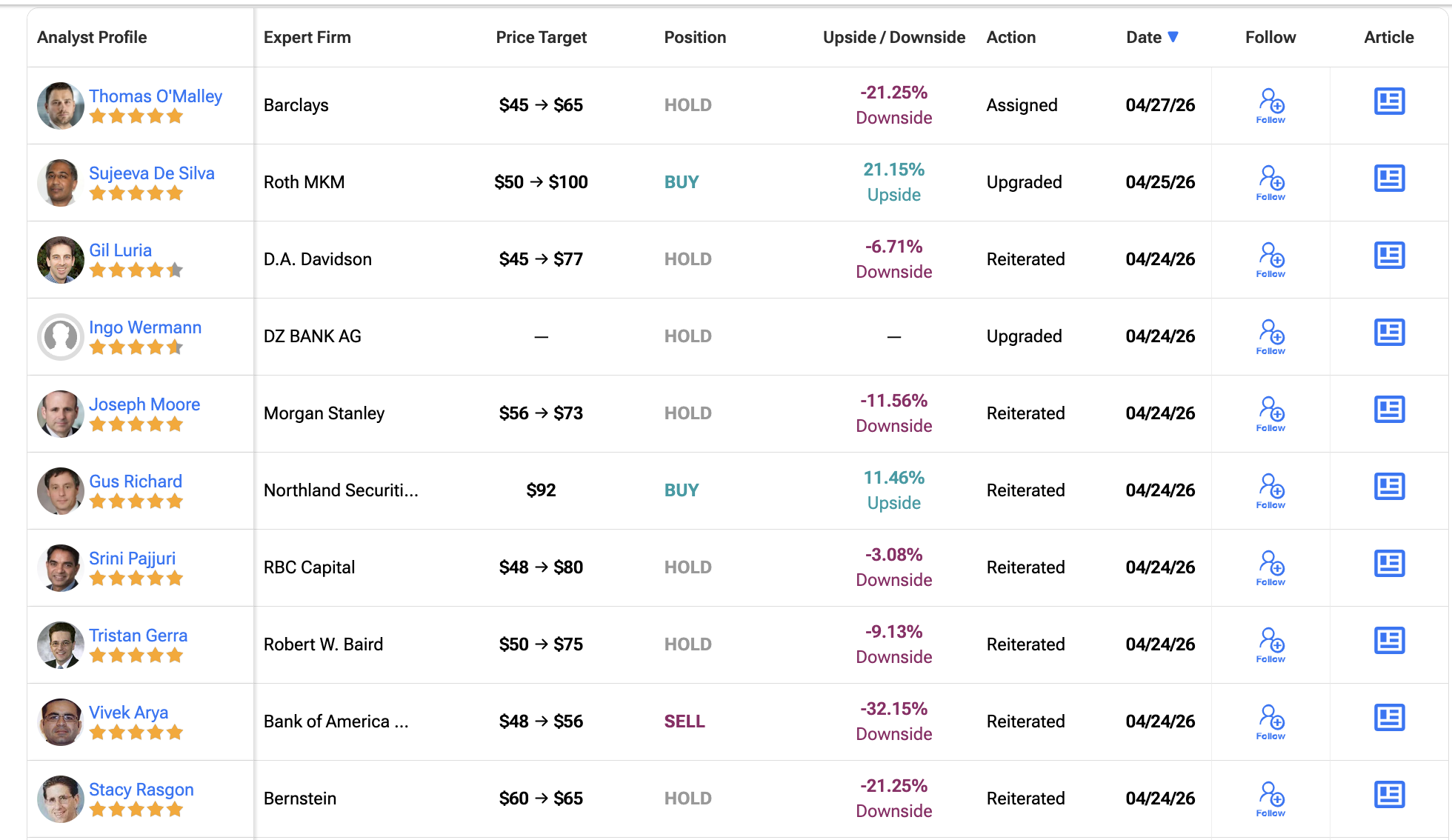
With positioning bearish and most price targets sitting below spot, the price chart itself becomes the decider.
Intel Stock Price Levels and the May $100 Question
The rally from $40.76 to the April 24 peak at $85.37 forms the pole of a potential bull flag pattern. It is a continuation setup where a sharp move higher is followed by a tight sideways drift before the next leg up. Intel stock currently consolidates near $82.54.
The flag stays intact as long as the price holds above $64.84. A 2-day close above $83.10, the 0.618 Fibonacci level, would confirm the breakout.
That can push INTC stock price toward $94.39 and even $112.66, followed by a measured move toward $171.76 over the medium term.
For the May $100 target, the stock first needs to clear $83.10 cleanly, then break $88.07 (0.786 Fib) and the 1.0 Fib at $94.39. Above $94.39, the path to $100 opens through the 1.618 extension at $112.66.
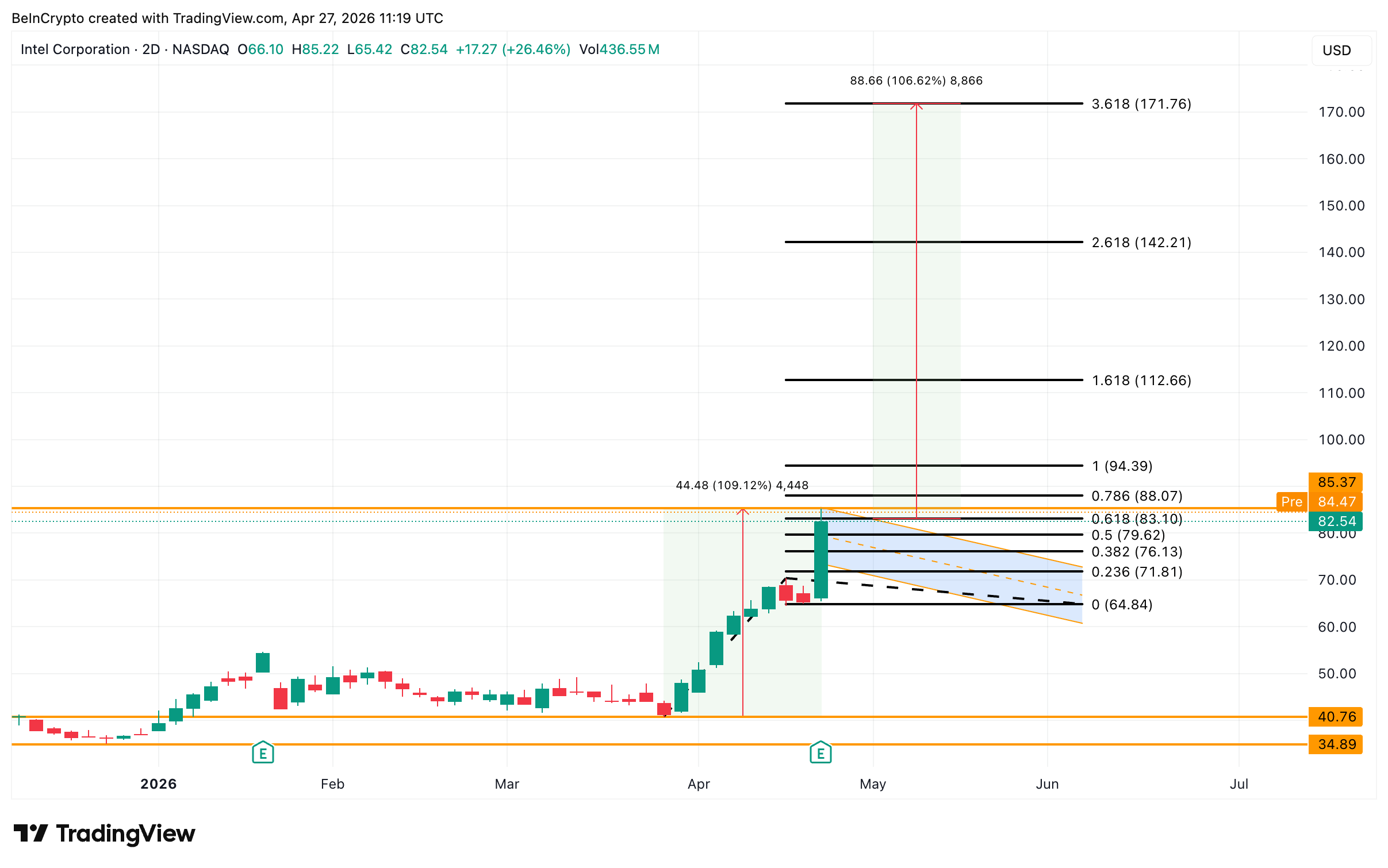
The setup carries a real caveat. With RSI already at 80.92 and volume thinning into the move, a sharp pullback toward $76.13 (0.382 Fib) or even $71.81 (0.236 Fib) remains possible before any clean breakout.
A 2-day close below $64.84 invalidates the bull flag and the bullish thesis. The next major support from there sits all the way down at the $40.76 base from late March, the same level Intel traded at before the rally began.
Below that line, the price is no longer pricing in the AI turnaround at all, just the loss-making business shown in the latest filing.
The $83.10 close is the line in the sand. A clean break sends Intel stock toward $100 in May. A rejection here, with bearish options positioning, an extreme RSI reading, and a foundry segment still losing $2.4 billion a quarter as fuel, opens the door for a 23% pullback that would mirror the last overbought reset.
The post Can Intel Stock Hit $100 in May? appeared first on BeInCrypto.

Bernstein’s latest research paints IREN as potentially the next Bitcoin miner to pivot into AI infrastructure, anchored by a multi-billion-dollar deal with Microsoft. The note frames this move as part of a broader, upcoming shift in mining economics as operators redirect energy and capital toward high-margin AI compute rather than traditional crypto mining.
The analysts spotlight IREN’s AI cloud push, noting about 150,000 GPUs already contracted and forecasting an annual revenue run rate of roughly $3.7 billion once the capacity is fully functional. A five-year engagement with Microsoft sits at the core of the plan, with Microsoft committing GPU capacity for AI workloads and providing substantial prepayments that help fund the infrastructure expansion.
Overall, Bernstein estimates IREN’s GPU program amounts to about $5.8 billion in invested capital. The note emphasizes that this sum is largely funded through Microsoft prepayments and GPU-backed financing facilities, supplemented by other cash and capital sources, which helps keep borrowing costs comparatively favorable during the rollout.
Bernstein’s central thesis is that this transition could redefine IREN’s business model. The firm suggests IREN will progressively sunset its Bitcoin mining operations as it retrofits sites to accelerate cloud deployment. Rather than a wholesale shutdown, IREN is repurposing existing mining hardware and facilities—particularly in Texas and British Columbia—replacing ASIC rigs with GPUs designed for AI workloads.
On balance, Bernstein anticipates that IREN’s AI cloud revenue could emerge as the primary source of income in the coming years, with Bitcoin mining shifting into a legacy role as power capacity is redirected toward contracted, higher-margin AI computing workloads. The shift is already underway in practice, with the company pursuing a hardware and location strategy built around AI workloads rather than pure BTC production.
IREN isn’t isolated in this pivot. Several peers in the mining sector, including TeraWulf and HIVE Digital, have begun reallocating power and capital toward AI and high-performance computing, often while maintaining some level of ongoing BTC mining. The trend has sparked discussion about how AI data centers might reshape the economics of crypto mining, and whether the shift could stabilize revenue streams in a landscape of volatile energy prices and crypto cycles.
Key takeaways
- Bernstein identifies IREN as a potential leader in AI infrastructure, anchored by a Microsoft-backed, GPU-heavy expansion.
- Approximately 150,000 GPUs are contracted, with an estimated $3.7 billion in annual revenue run rate once the capacity is fully operational.
- Microsoft’s five-year agreement includes substantial prepayments that fund the build-out, complemented by GPU-backed financing.
- The broader GPU investment—around $5.8 billion—faces capital structure designed to minimize new debt through prepayments and financing facilities.
- Bernstein projects AI cloud revenue as the main income driver for IREN in the medium term, with Bitcoin mining becoming a legacy segment as energy capacity shifts to AI workloads.
- From an investor perspective, Bernstein assigns a $100 price target and maintains an Outperform rating, acknowledging dilution risks and the gradual wind-down of mining as factors.
- The sequence mirrors a wider industry transition, as other miners explore AI data-center strategies in parallel with existing mining operations.
Strategic pivot and financing mechanics
At the heart of the thesis is a deliberate redeployment of IREN’s physical footprint. Rather than shuttering operations, the company is retrofitting sites to host GPU farms that can support AI-centric workloads. The initial focus areas include North American locations such as Texas and British Columbia, where available power capacity and supportive infrastructure could accommodate high-demand AI compute tasks in parallel with ongoing mining activities.
The financial scaffolding reinforces the strategy. Microsoft prepayments and GPU-backed financing facilities are designed to underpin the capex-heavy transition, reducing the immediate need for traditional equity raises or debt funding. Bernstein notes that this arrangement can cushion the transition against capital-cost fluctuations, provided AI demand holds up through the deployment cycle.
Industry context: a broader AI data-center shift
The IREN narrative sits within a broader wave of miners examining AI and HPC as revenue diversification. Firms like TeraWulf and HIVE Digital have publicly signaled similar pivots, emphasizing the opportunity to monetize surplus power by supporting AI workloads in addition to BTC mining. If this trajectory persists, it could alter the economics of crypto mining by introducing longer-term, contracted revenue streams that are less sensitive to spot energy price movements.
Nevertheless, the transition introduces new risks. AI compute contracts typically involve longer commitments and higher upfront capex, which could heighten exposure to technology cycles and utilization risk. Execution quality, regulatory considerations, and the pace of AI adoption will shape whether these reorganizations translate into durable profitability for the companies pursuing them.
Investor outlook: what Bernstein sees for IREN
In its note, Bernstein assigns IREN a price target of $100, implying substantial upside should the company successfully scale its AI cloud platform while winding down mining. The target sits with an Outperform rating, reflecting confidence in the strategic shift but tempered by the dilution concern and the gradual decline of mining revenue. The target marks a revision from a prior $125 price objective, signaling a more cautious stance on near-term dilution and transition risk.
As of the report, IREN trades below the $50 level, presenting what Bernstein characterizes as roughly 10x upside potential if the AI infrastructure strategy materializes as envisioned. The firm emphasizes that the outcome depends on execution, the durability of Microsoft’s utilization, and the sector’s ability to absorb additional AI capacity in a market that remains sensitive to macro and energy-cost dynamics.
Beyond IREN, the trend toward AI data-center deployment across the mining sector is drawing attention from investors and regulators alike. The coming quarters will reveal how quickly these firms can scale GPU-centric operations, how favorable the financing terms remain, and whether AI demand proves resilient through varying market cycles.
As the industry watches, the central questions revolve around utilization risk, the pace of retrofits, and the long-term profitability of AI-first business models for crypto miners. If IREN and its peers can demonstrate stable AI revenue streams alongside disciplined capital management, the shift could redefine what it means to operate a crypto mining enterprise in the current era.
Investors should monitor quarterly updates for site retrofit progress, GPU procurement milestones, and disclosures on Microsoft utilization patterns. The trajectory of the AI cloud run rate and the evolution of the company’s funding framework will be telling signals for how quickly this strategic pivot can translate into sustained financial performance.
As the transition unfolds, the market will be keen to see whether the combination of Microsoft’s support and GPU-backed financing can sustain a robust AI compute business, and how durable these AI-driven margins prove to be in a competitive data-center landscape.
Tether has released an open-source development framework for Bitcoin mining, aimed at giving operators and developers unified control over hardware and software across mining operations.
According to Monday’s announcement, the framework combines a backend SDK and user interface tools to replace fragmented, vendor-specific systems, allowing miners to monitor devices, manage operations and build custom applications across sites from a single control layer.
It uses a modular architecture in which hardware exposes standardized functions and independent modules can be added without altering the core system, enabling integration across different machines, services and locations.
The toolkit supports deployment across Windows, macOS and Linux, and is designed to scale from individual setups to large industrial operations, with features for automation, monitoring and coordinated hardware management, Tether said.
The framework is designed to reduce reliance on proprietary tools and simplify operations across fragmented mining setups, where vendor lock-in and interoperability challenges can increase costs and limit flexibility.
Tether said the release builds on the company’s earlier open-sourcing of its Mining OS, extending its mining software stack with a development layer for building dashboards, workflows and analytics tools on top of existing infrastructure.
The move comes about a week after the company disclosed an 8.2% stake in Antalpha, a Bitcoin-focused lender and equipment financing provider with close ties to mining hardware supplier Bitmain.
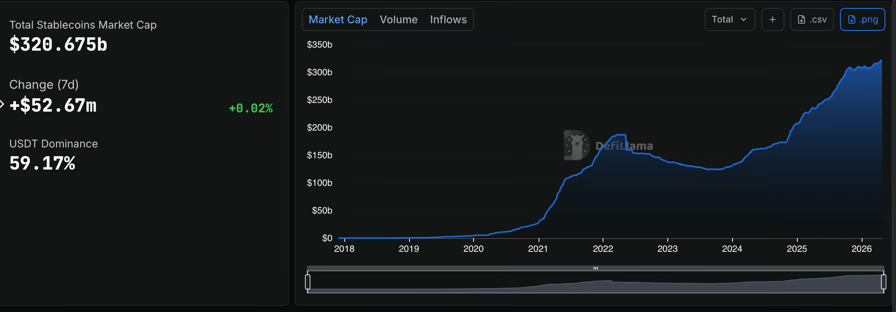
Tether is the issuers of USDT (USDT), the largest stablecoin by market capitalization, accounting for about $190 billion of the roughly $320.7 billion global stablecoin market cap, according to DefiLlama data.
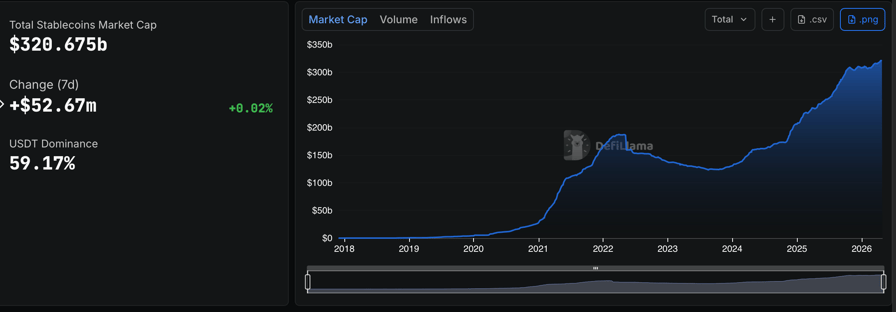
Total stablecoin market cap. Source: DefiLlama
Related: Mining companies move deeper into AI, HPC as MARA may sell Bitcoin
Miners continue to push into AI infrastructure
As Tether moves deeper into Bitcoin mining infrastructure, traditionally pure-play mining operators across the industry are increasingly turning to artificial intelligence and high-performance computing workloads to diversify revenue.
One of the earliest companies to pivot was CoreWeave, originally a crypto mining operation that began shifting toward cloud and high-performance computing in 2019 as demand for AI compute increased.
Since then, a growing number of publicly traded miners, including Riot Platforms, HIVE Digital, MARA Holdings, TeraWulf and Cipher Mining, have pursued similar strategies, redirecting power capacity and infrastructure toward AI and high-performance computing.
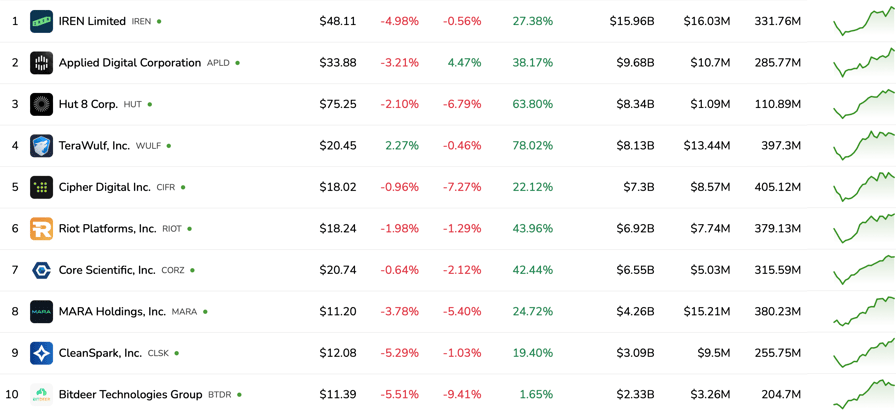
Top 10 publicly traded Bitcoin miners by market cap. Source: Bitcoinminingstock.io
Last week, Core Scientific said it plans to raise $3.3 billion through senior secured notes due in 2031 to fund data center expansion and refinance short-term debt.
On Monday, Hut 8 said in a filing that it is seeking to raise $3.25 billion in senior secured notes to fund a 245-megawatt AI data center in Louisiana, tied to a 15-year, $7 billion lease agreement with Fluidstack, according to The Miner Mag.
Some miners are moving further. Also on Monday, analysts from Bernstein said IREN, the largest publicly traded Bitcoin miner by market capitalization, will likely phase out its mining operations over time as it scales its AI cloud business.
Magazine: 6 weirdest devices people have used to mine Bitcoin and crypto
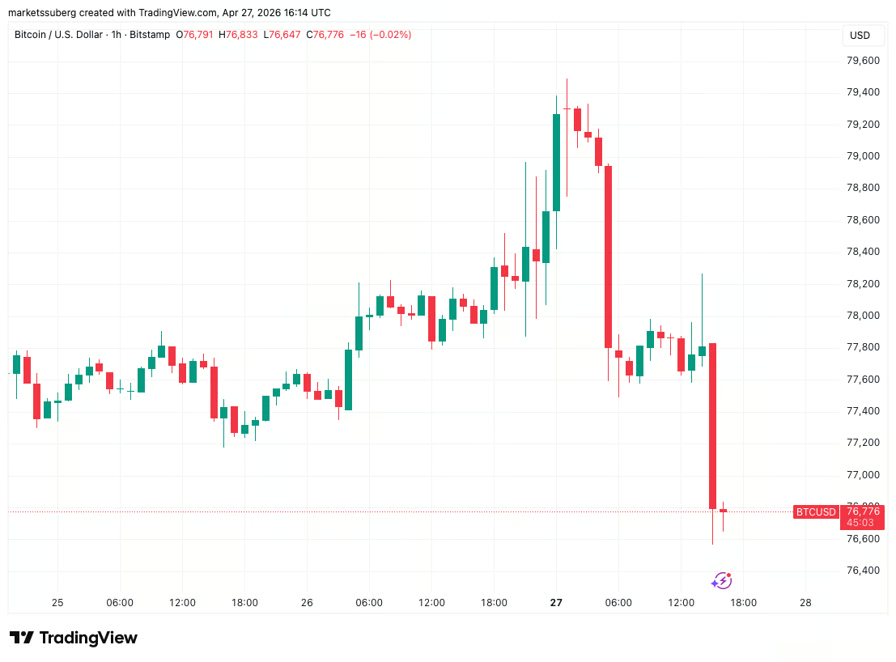
Bitcoin (BTC) fell more than 2% on Monday as US-Iran war nerves again guided macro markets.
Key points:
- Bitcoin gave back early-week gains as its downside extended toward 3% on Monday.
- Two key moving averages hang in the balance amid macro uncertainty over the war in Iran.
- Bulls need to clear the low $80,000 area next, says market analysis.
Crypto exec: Bitcoin needs to clear bull market support band
Data from TradingView showed BTC/USD hitting local lows of $76,567 on Bitstamp, giving back earlier gains.
BTC/USD one-hour chart. Source: Cointelegraph/TradingView
The pair had managed a weekly candle close above a key moving average — something that market participants had hoped would allow it to avoid a fresh retracement.
“Bitcoin just reclaimed the 21W EMA for the first time since Oct 2025,” trader Ryan Hogue noted in a post on X.
“$84.5K (200DMA) looks like the next stop this week.”
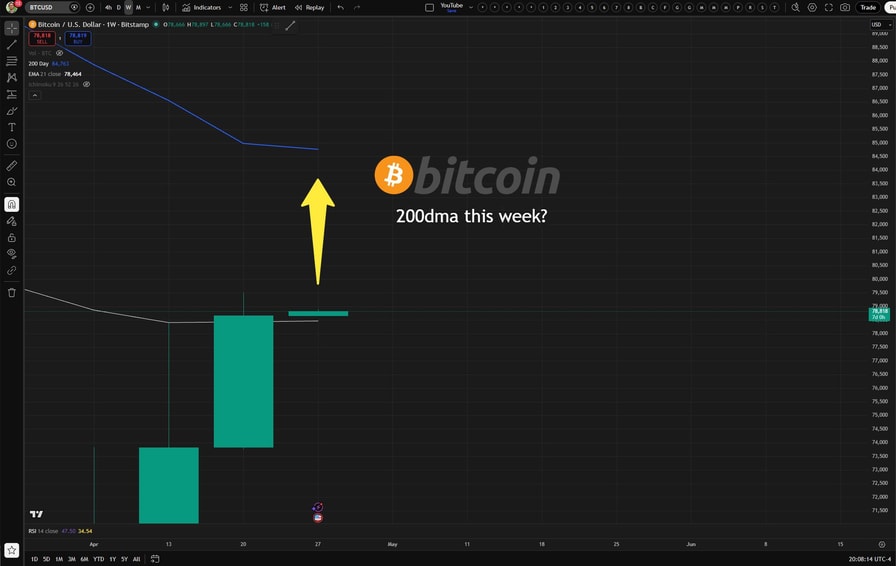
BTC/USD one-week chart. Source: Ryan Hogue/X
Nic Puckrin, CEO and cofounder of crypto education platform Coin Bureau, added that Bitcoin reclaiming its bull market support band — two moving averages of which the 21-week EMA is one — was now key.
“We are right in the middle of the Bull Market Support Band. This has historically served as a key support for bull markets. We broke below the band in October last year,” he told X followers.
“While 80k is acting as a resistance right now, if we flip the band to support, it would point to a major macro-bullish shift.”
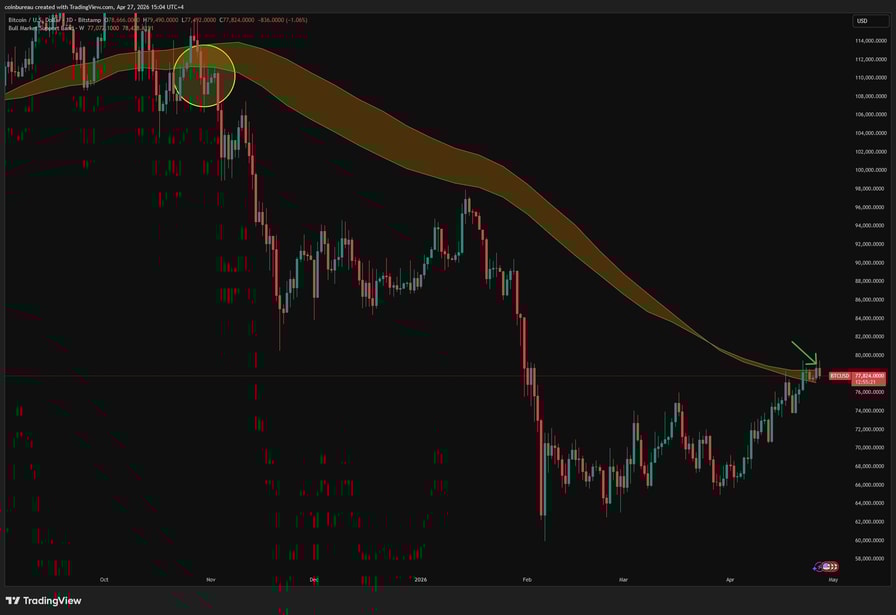
BTC/USD one-day chart with bull market support band. Source: Nic Puckrin/X
Crypto markets “shaping up for more upside”
Uncertainty over progress between the US and Iran on ending the war nonetheless directed Bitcoin lower at the Wall Street open, along with US stocks.
Related: First 21-week trend line reclaim since October 2025: Five things to know in Bitcoin this week
Oil conversely began to gain, with WTI crude reaching $97.50 per barrel to near two-week highs.
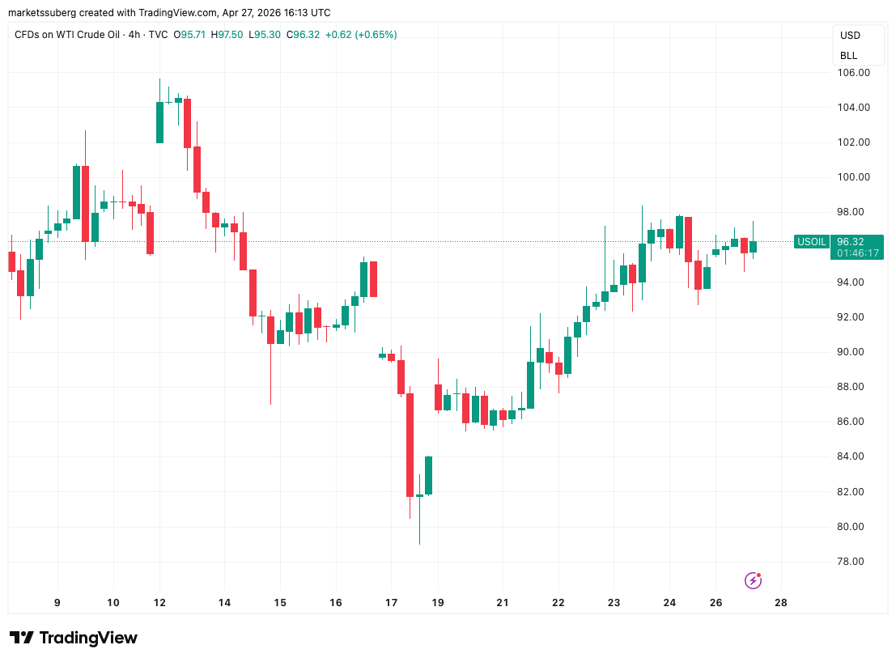
CFDs on US WTI crude oil four-hour chart. Source: Cointelegraph/TradingView
Commenting, trading company QCP Capital suggested that Iran’s foreign minister flying to Russia for talks with President Vladimir Putin was “reviving concerns of broader geopolitical alignment and escalation, and adding to market uncertainty.”
“Whether the next leg higher proves to be another classic bull trap or a more durable recovery will hinge on BTC’s ability to close above 82k,” it wrote in its latest Market Color analysis.
QCP added that corporate earnings represented another source of potential risk-asset volatility for the week ahead.
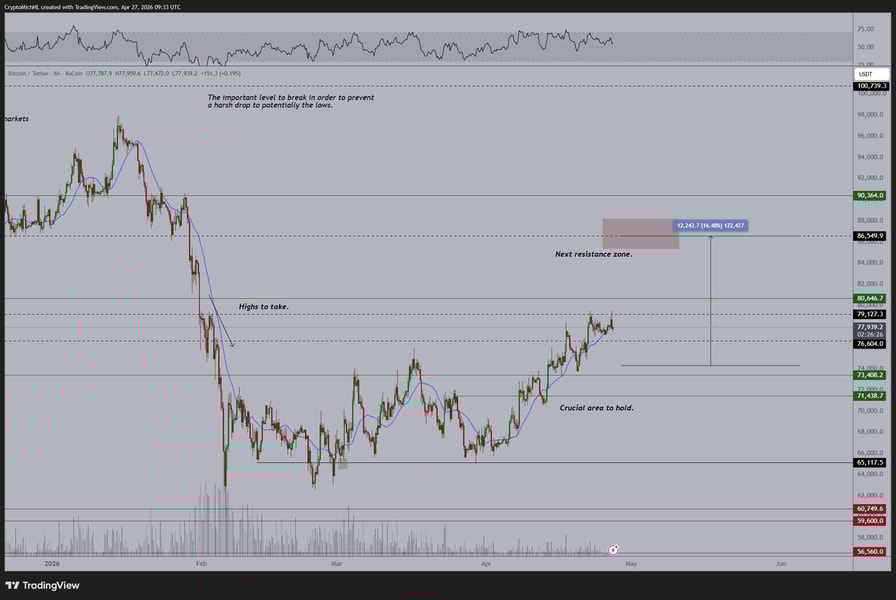
BTC/USDT six-hour chart. Source: Michaël van de Poppe/X
Elsewhere, crypto trader Michaël van de Poppe was confident about a breakout beyond the current multimonth trading range.
“The markets are still shaping up for more upside, and it’s still holding crucial levels,” he wrote on the day.
“I think that we’ll see $85-88K in May and correct/consolidate from there.”

PENGU token jumps 14% amid Pudgy Penguins floor price pump

Could Shohei Ohtani win the NL Cy Young Award?

Microsoft and OpenAI revamp partnership, with trial in Elon Musk suit set to begin

Manchester United reach agreement with Casemiro over contract clause amid transfer speculation

US brings back mandatory military draft registration

Steven Gerrard disagrees with Gary Neville over ‘shock’ Chelsea and Arsenal claim | Football

Raj Rejects His Father’s Support and Falls Into Financial Crisis, Asks Sheldon to Be His Financial

LOVE FOR MONEY || CHAPTER 1 – KWADWO NKANSAH LIL WIN – WEEZY EMPIRE TV

Saylor’s Infinite Money Glitch Explained, DeFi Hack, Pakistan Opens Banks to Crypto
-

 Politics7 days ago
Gary Stevenson delivers timely reminder to register to vote as deadline TODAY
-

 Fashion3 days ago
Weekend Open Thread – Corporette.com
-
Crypto World2 days ago
Hyperliquid $HYPE Rally Builds Momentum as AI Sector Enters Prove-It Phase
-

 Politics5 days ago
Making troops accountable for war crimes threatens US alliance, ex-SAS colonel warns
-

 Politics5 days ago
Disabled people challenge government SEND proposals over segregation concerns
-

 Tech3 hours ago
Register Renaming | Hackaday
-

 Business4 days ago
Patterson-UTI Energy, Inc. (PTEN) Q1 2026 Earnings Call Transcript
-

 Business5 days ago
Rolls-Royce Voted UK’s Most Iconic Trade Mark as IPO Register Hits 150
-
 Crypto World6 days ago
Five Value Stocks with Recovery Potential in 2026: PayPal (PYPL), Nike (NKE), and More
-

 Politics5 days ago
Starmer handler McSweeney to be dragged from shadows by Foreign Affairs Committee
-

 Politics5 days ago
Zack Polanski responds to home secretary’s taser threat
-
 Sports1 day ago
IPL 2026: Ruturaj Gaikwad registers slowest fifty of the season, enters all-time unwanted list | Cricket News
-
Politics5 days ago
Wings Over Scotland | How To Get Away With Crimes
-

 Crypto World6 days ago
New York sues Coinbase, Gemini over prediction market offerings
-
Entertainment6 days ago
Sydney Sweeney cameo cut from “The Devil Wears Prada 2”, source explains why (exclusive)
-
 Business6 days ago
HCL Tech share price tank over 9% after weak Q4. JPMorgan, HSBC & 3 others cut target price
-

 Politics5 days ago
‘Iran is still a nuclear threat’
-
 Sports5 days ago
Tim Bradley names the current best in the world: “Better than Inoue and Usyk”
-

 Crypto World6 days ago
Crypto’s great hope in Senate’s Clarity Act still has a path to survive tight calendar
-

 NewsBeat1 day ago
LK Bennett closes all stores after entering administration
You must be logged in to post a comment Login