
Crypto World
Will Oil Price Drop Again or Has the Supply Shock Rewritten the Playbook?

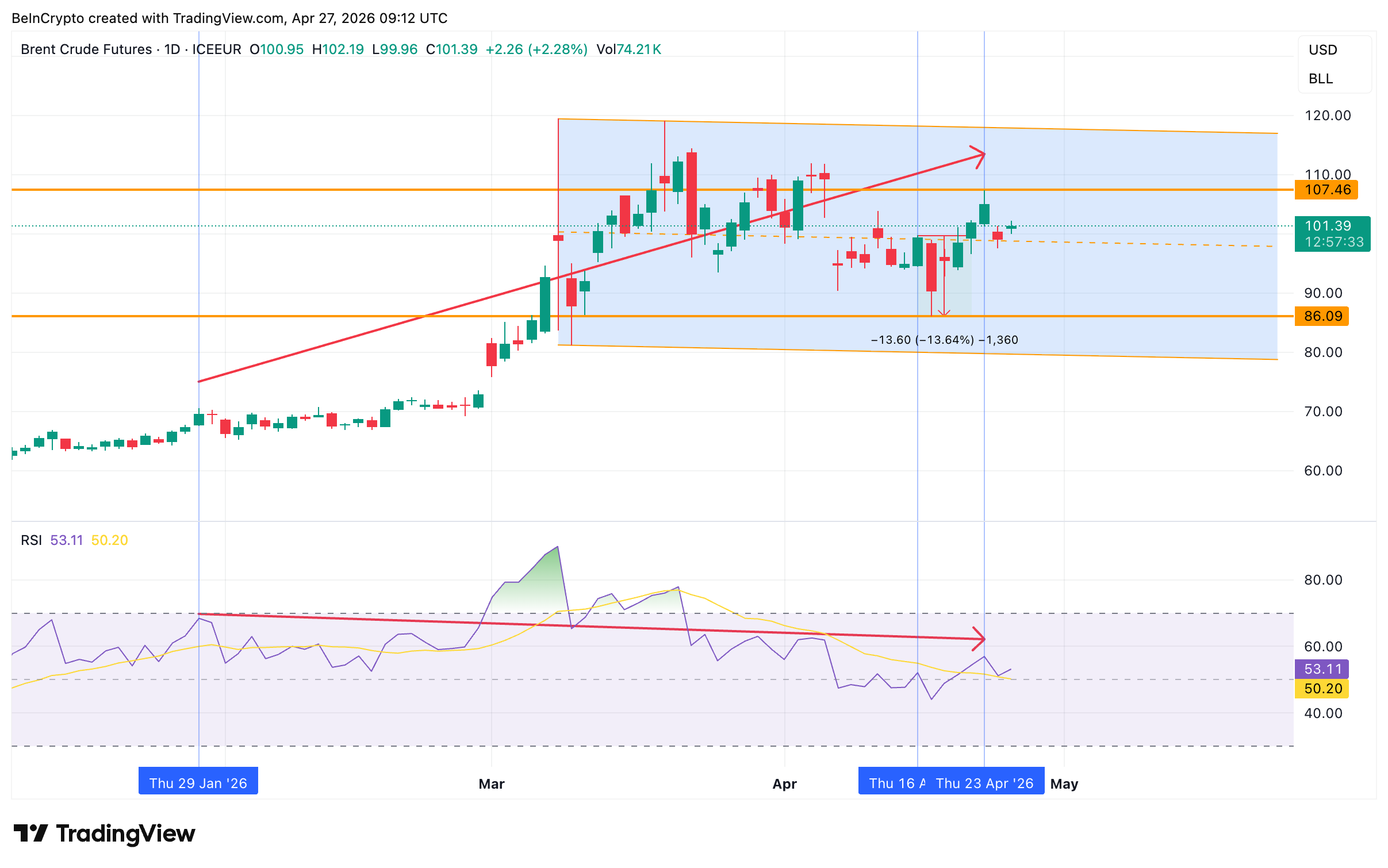
Oil prices are sitting in the same chart setup that triggered a 13% drop two weeks ago, but the options market and a deepening supply shock have rewritten the variables that determine whether the drop happens again or fails.
Brent crude trades at $101.39 on April 27, up 2.28% on the day and just below the $107.46 high it rejected on April 23. The pattern that triggered April’s drop is back. But the conditions around it are different.
Bearish Divergence Mirrors the Setup That Crashed Brent Crude 13% in April
Since March 9, Brent crude has traded inside a falling channel, a bearish pattern. Within that channel, the pattern flashing now is the same one that preceded April’s drop.
Between January 29 and April 23, Brent printed a higher swing high in price while the Relative Strength Index (RSI) printed a lower swing high. That is a textbook bearish divergence, where price strength outpaces underlying momentum and often signals a trend reversal.
The precedent is uncomfortable. The same divergence formed between January 29 and April 16. Brent then rolled over and dropped over 13% to a local low of $86.09.
Want more insights like this? Sign up for Editor Harsh Notariya’s Daily Newsletter here.
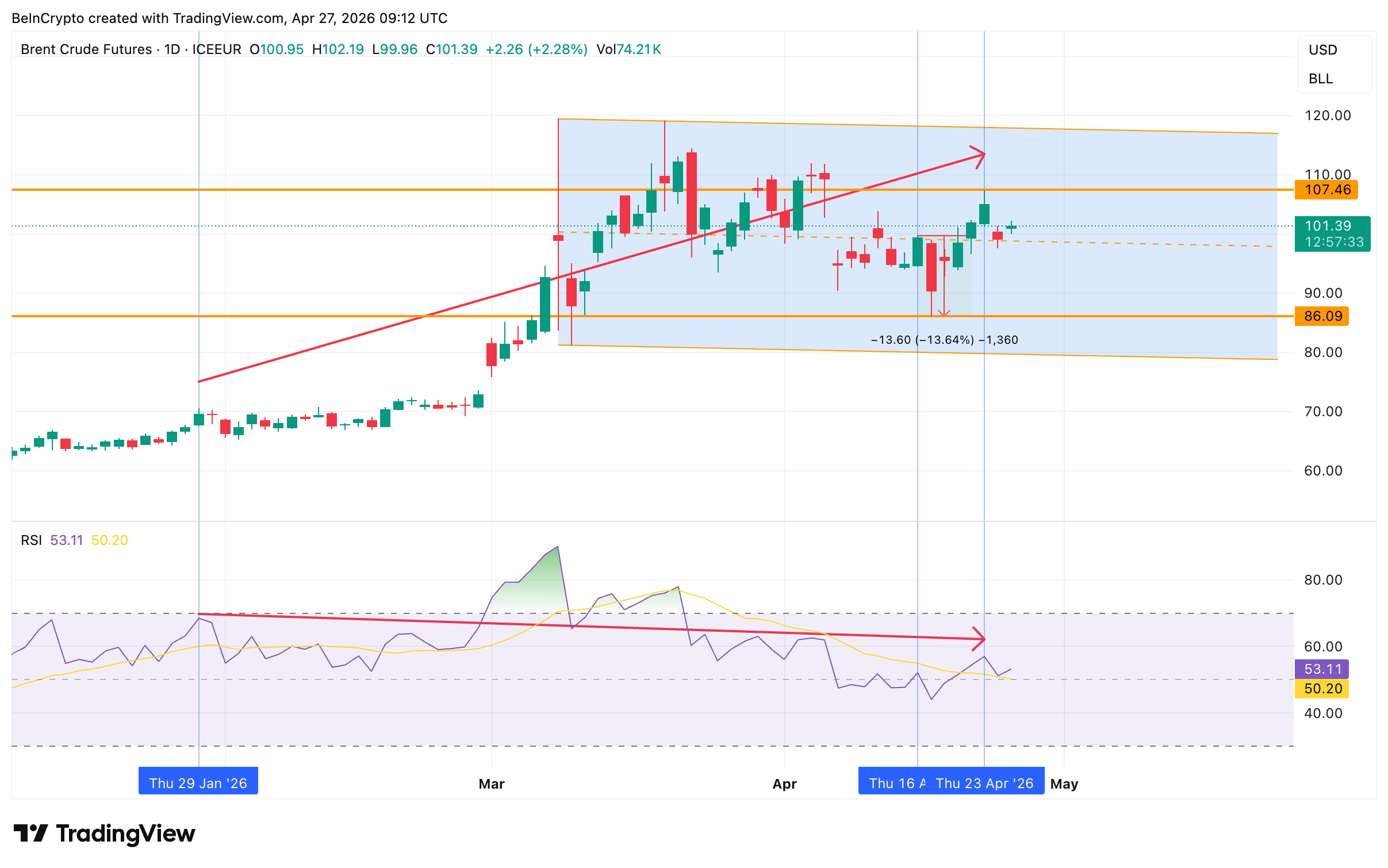
The pattern playing out today is structurally identical, with the same channel, the same momentum failure, and a similar rejection at the upper boundary. If the playbook holds, oil price faces a measured drop back toward the channel floor near $81.72.
Goldman, Inventory Draws, and a Collapsing Put-Call Ratio Disagree With the Chart
The chart says one thing. The options market says another. The United States Brent Oil Fund (BNO), a US-listed exchange-traded fund (ETF) that tracks Brent crude prices, gives a clean window into how options traders are positioning.
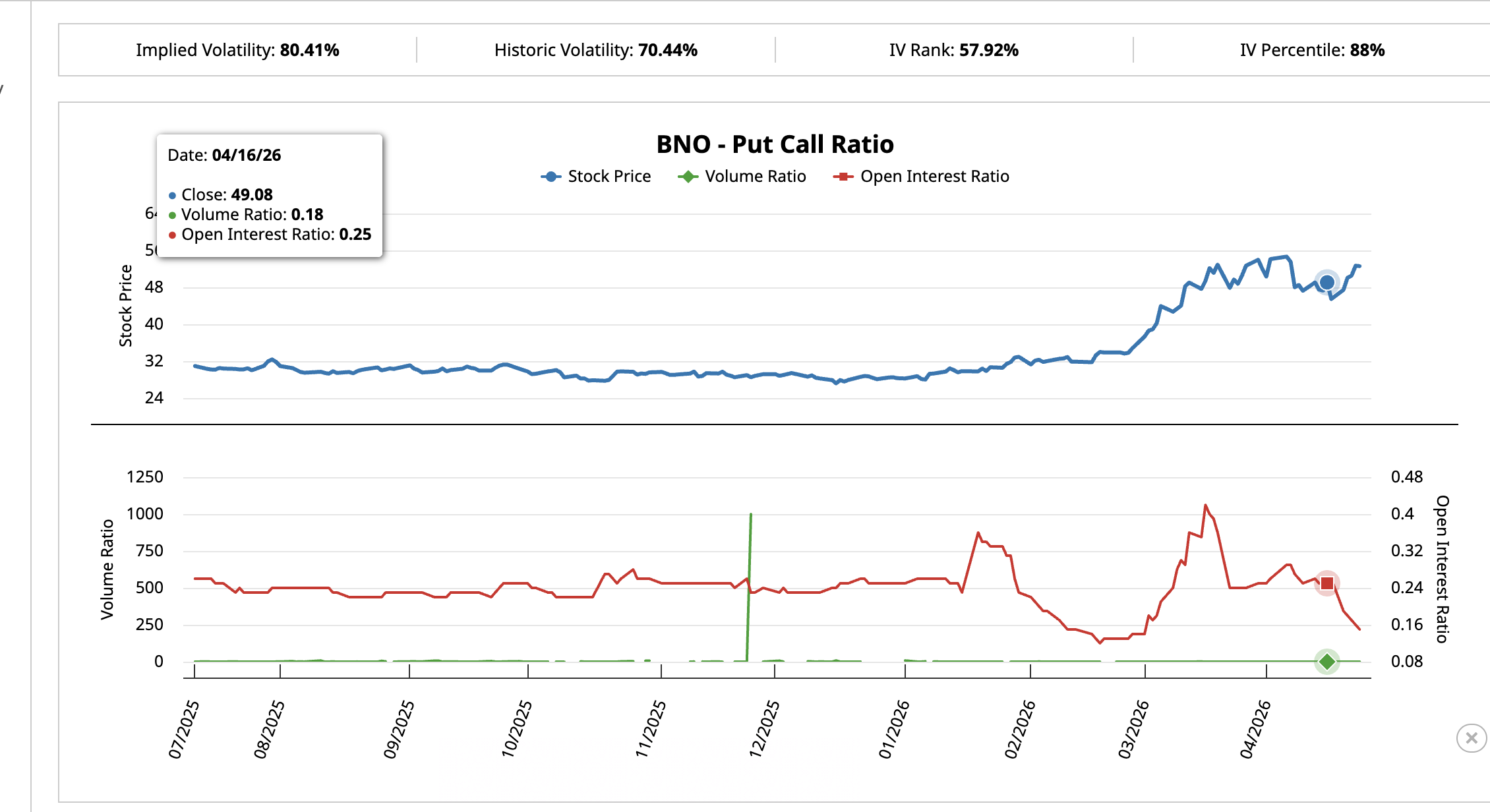
On April 16, when the prior bearish divergence flashed, BNO’s volume put-call ratio, a measure of bearish versus bullish bets in daily options flow, sat at 0.18, while its open interest put-call ratio, which measures standing positioning, was 0.25.
Brent then dropped 13%.
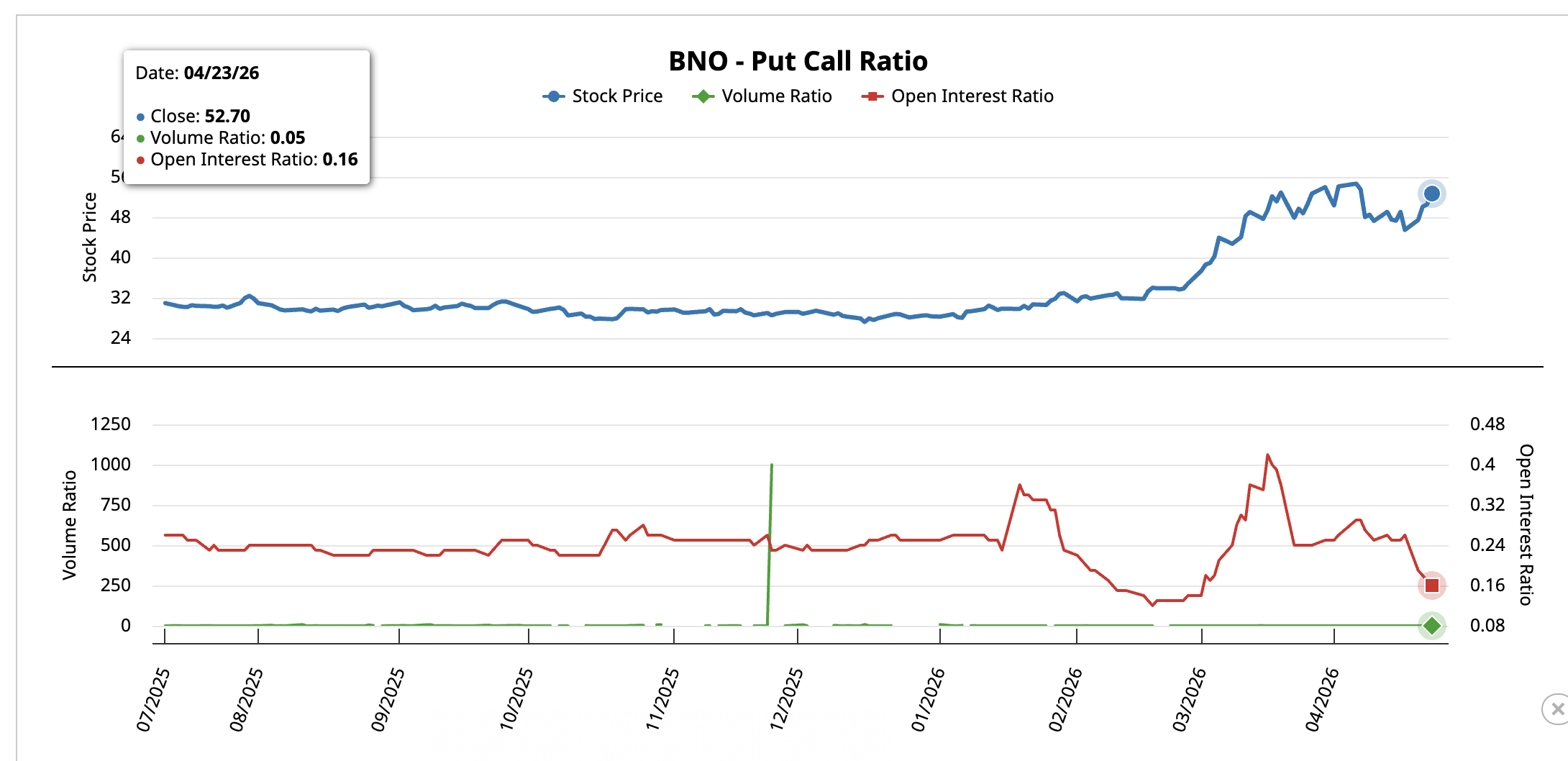
By April 23, when the latest divergence printed, the picture flipped. Volume put-call collapsed to 0.05, and open interest put-call dropped to 0.16, indicating shorts were liquidated and call demand surged.
Implied volatility (IV), the market’s expectation of future price swings, sits at 80.41% with an IV percentile at 88%, signaling traders are pricing a large move ahead.
The supply side explains the bullish positioning. Goldman Sachs raised its Q4 2026 Brent forecast to $90 per barrel from $80 on Monday, citing 14.5 million barrels per day in Persian Gulf production losses and global inventory drawdowns running at 11 to 12 million barrels per day.
That is the structural fuel keeping a bid under oil price, even as the technical picture warns of a drop.
Oil Price Levels Make $99.17 the Trigger, $107.46 the Reversal
The decision sits at $99.17, the 20-day Exponential Moving Average (EMA), where EMA is a trend line that averages price with more weight on recent candles.
On April 13, when oil price lost the 20-day EMA, a 13% drop accelerated within sessions. The same line is now sitting just below the current price.
A daily close above $101.40, the 0.236 Fibonacci level, keeps the bullish path open and points back toward $107.46. A clean break above $107.46 confirms the supply shock thesis. It opens room toward $119.11, the upper channel boundary.
However, a $99.17 loss mirrors the April 13 trigger.
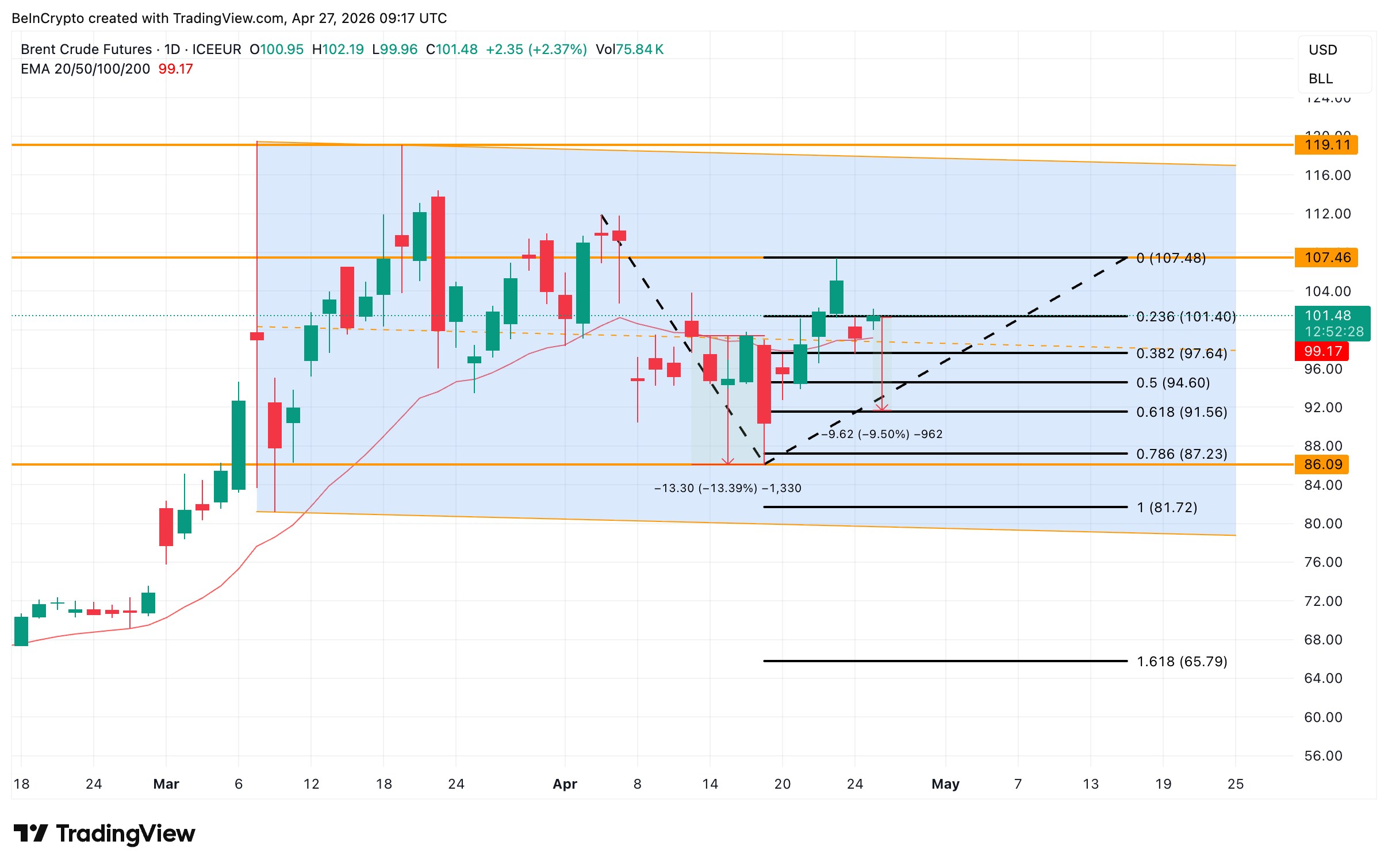
It then exposes $97.64 at the 0.382 Fibonacci level, with $94.60 at the 0.5 Fibonacci level as the next test. The decisive cluster sits at $91.56, the 0.618 Fibonacci, which is the strongest support on the daily chart.
A break below $91.56 opens $87.23 and then $81.72, the channel floor that would complete the repeat-of-April scenario.
For now, $99.17 separates a bearish repeat from a supply-shock-driven rally.
The post Will Oil Price Drop Again or Has the Supply Shock Rewritten the Playbook? appeared first on BeInCrypto.


TLDR
- DeFi United has raised more than 132,000 ETH, valued at over $300 million, to address losses from the Kelp DAO exploit.
- Consensys and Ethereum co-founder Joseph Lubin pledged 30,000 ETH to support the coordinated recovery effort.
- Circle Ventures confirmed it is purchasing AAVE tokens to help stabilize the protocol after the exploit.
- The exploit involved unbacked rsETH minted through a compromised LayerZero bridge and used as collateral on Aave.
- Aave service providers proposed allocating 25,000 ETH from the DAO treasury to support the recovery plan.
DeFi United has secured more than 132,000 ETH valued at over $300 million to address losses from the Kelp DAO exploit. Consensys and Ethereum co-founder Joseph Lubin pledged 30,000 ETH to support the recovery. Circle Ventures also confirmed AAVE token purchases to reduce pressure on the lending protocol.
DeFi Coalition Accelerates Funding Drive
Circle Ventures announced it is buying AAVE tokens to support market stability. The firm stated, “Strong DeFi infrastructure does not build itself.” It added that Aave helps shape onchain finance and supports its broader community.
At the same time, Consensys and Joseph Lubin committed 30,000 ETH to the coordinated recovery plan. Aave confirmed the pledge on Monday and credited the contribution for accelerating progress. It said, “The recovery would not be progressing as it is without them.”
Consensys-backed treasury firm Sharplink will also provide strategic advice to the initiative. The combined effort has now raised more than 132,000 ETH. That amount equals over $300 million at current market prices.
Aave and Partners Target rsETH Shortfall
The exploit occurred after an attacker minted unbacked rsETH through a compromised LayerZero bridge. The attacker then used the tokens as collateral on Aave to borrow assets. This sequence left Aave with bad debt tied to the unbacked rsETH.
DeFi United directs contributions to close the remaining shortfall linked to rsETH. Last week, Aave service providers proposed allocating 25,000 ETH from the protocol’s DAO. That allocation equals nearly $58 million based on recent prices.
As of Monday, the broader effort had raised roughly $235 million worth of Ethereum before the latest pledges. Lido DAO proposed contributing up to 2,500 ETH to the plan. Ether.fi also proposed up to 5,000 ETH to support the recovery.
Kelp DAO pledged 2,000 ETH to help restore rsETH backing. Dozens of individuals have also transferred smaller amounts of ETH and stablecoins. X user DCF GOD estimated that the funding gap had already been filled if all proposals passed.
Data from The Block shows total value locked across DeFi protocols stands at nearly $82 billion. That figure reflects a decline of over 25% from $110 billion at the start of the year.

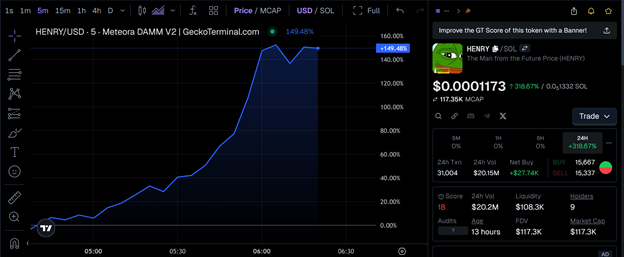
Henry ($HENRY), an Ethereum-based meme coin, rallied nearly 320% on Monday. A viral 2023 post appeared to predict the alleged White House shooter’s name, fueling “time travel Pepe” speculation.
Wallet trackers show the token’s market cap is somewhere between $500,000 and $1.8 million. Extreme volatility persisted throughout the session.
White House Shooter Conspiracy Sparks Pepe Frenzy
On April 25, 2026, a gunman identified as Cole Tomas Allen, 31, rushed a Secret Service checkpoint. The incident happened at the Washington Hilton during the White House Correspondents’ Dinner.
One agent was struck in his protective vest before Allen was subdued and arrested.
Within hours, online sleuths resurfaced a single dormant X (Twitter) post from December 2023 by the account @HenryMa79561893.
The post contained only the text “Cole Allen” alongside a glitchy collage. The image featured Pepe the Frog and US President Trump at a formal dinner.
The official Pepe (PEPE) account on X quote-tweeted the post on April 26 with the caption “time travel pepe.” That endorsement drew hundreds of thousands of views and routed speculators toward meme coin plays tied to the prophecy theme.
On-chain observers noted the $HENRY contract had been deployed roughly 342 days earlier. The token was repurposed around the Henry Martinez narrative just before the rally.
Some traders called the rebrand a fake-OG move, while others defended it as the original deployment. HENRY meme coin rallied by almost 320% on this news, and was trading for $0.0001173 as of this writing.
Copycat HENRY tokens have also surfaced on Solana, with most traders treating the Ethereum version as the original prophecy.
It is worth noting that the rally may not hold, as such momentum often depends on continued attention from the broader community.
However, fresh details about Allen could further invigorate volatility, potentially undermining the durability of the time-travel narrative.
The post Meme Coin Based on White House Shooter Conspiracy Rallies 320% appeared first on BeInCrypto.
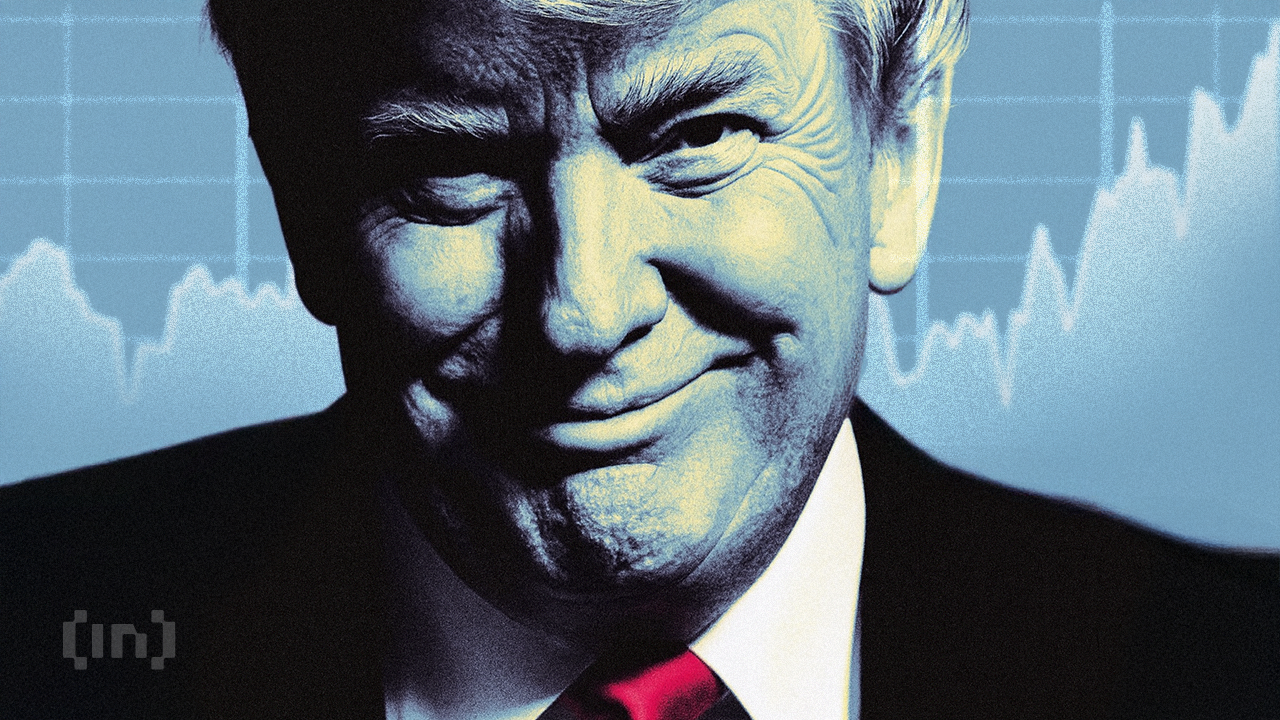
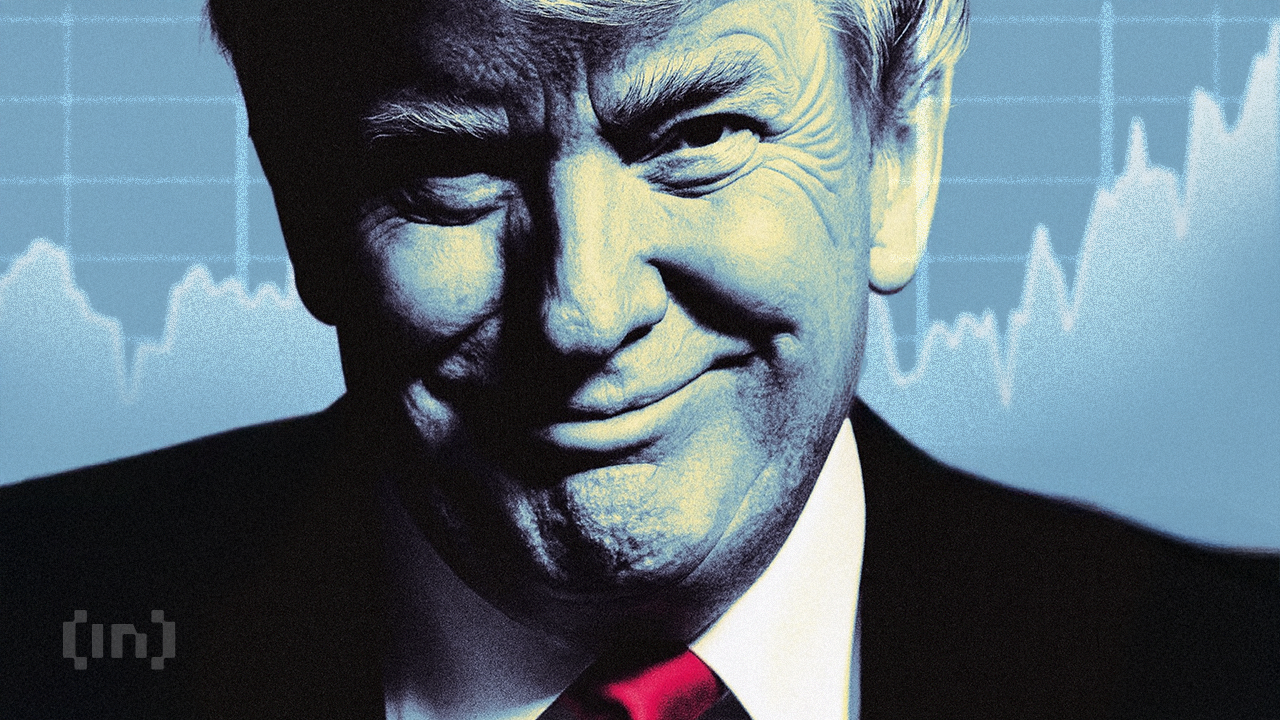
President Donald Trump bought up to $161 million in bonds during March 2026. The disclosure came in a Periodic Transaction Report released by the US Office of Government Ethics.
The filing arrives days before the Federal Open Market Committee meets to decide on interest rates. The vote could move bond prices broadly across the market.
Filing Shows Heavy Bond Buying Across Sectors
The filing lists 175 transactions, with 164 purchases and 11 sales. Trump’s report uses value brackets rather than exact dollar amounts. The bond purchases total at least $51 million at the low end of those ranges.
Many of the largest trades fell into the $1 million to $5 million bracket. Most of those positions were municipal bonds or US Treasuries. The combined upper-end value across all transactions reaches about $161 million.
The buys also covered corporate debt from Nvidia, Microsoft, Goldman Sachs, and Boeing. Other issuers named in the filing include Citigroup, Netflix, General Motors, Broadcom, and Meta.
The disclosure also lists a high-yield bond exchange-traded fund.
Fed Rate Decision Could Move Bond Prices
The Federal Open Market Committee begins its two-day meeting on Tuesday. The committee releases its rate decision on Wednesday at 2 p.m. Eastern.
The Fed last cut its benchmark rate by 25 basis points in December, its third reduction of 2025.
Treasury yields fell after that decision, and bond prices rose across the market. The 10-year yield dropped more than three basis points immediately afterward.
A second cut would likely produce a similar response, since bond prices generally move inversely to interest rates. Markets will watch Wednesday’s vote for guidance on whether the bond rally has further room to extend.
The post Trump Bought Millions in Treasury Bonds Days Before Fed Rate Cut Decision appeared first on BeInCrypto.
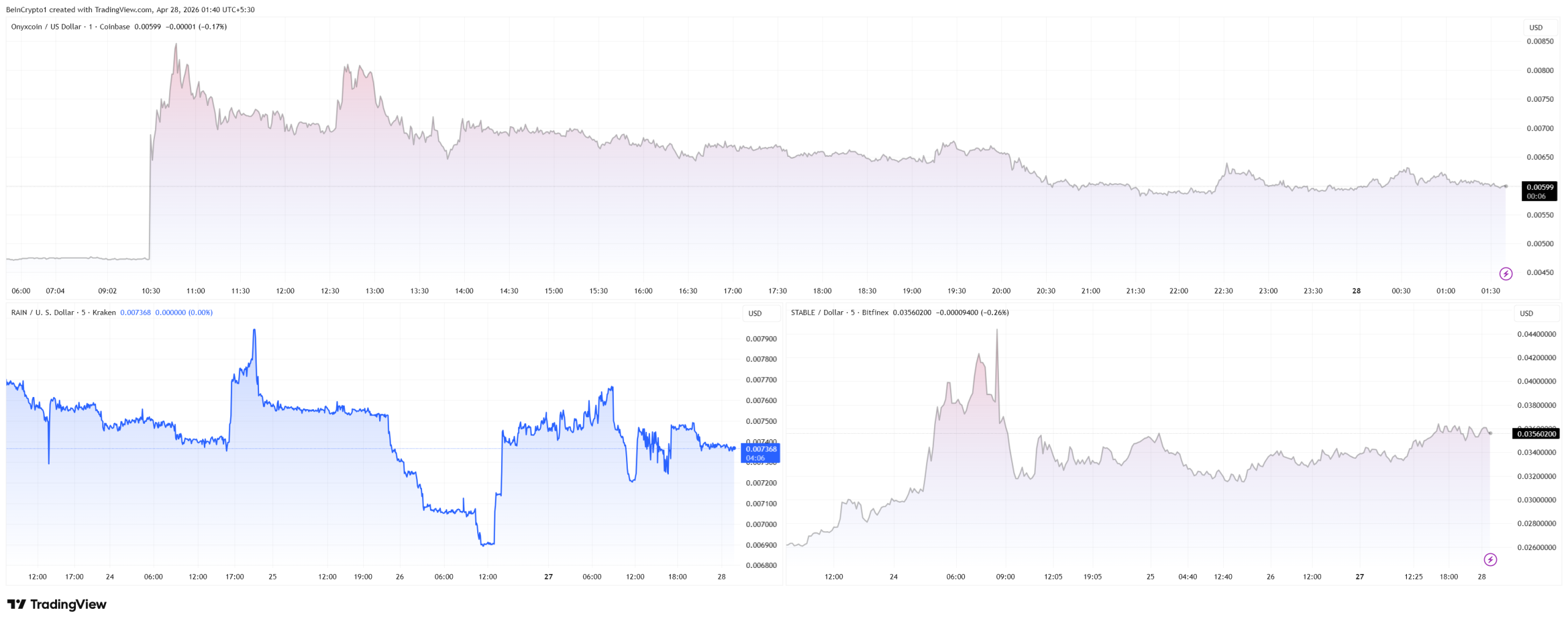
Three altcoins entered the final week of April 2026 at sharply different technical inflection points. Onyxcoin (XCN) printed a 47% daily gain while Rain (RAIN) and STABLE held their Fibonacci structures.
The three setups span a breakout retest, a neutral consolidation, and a healthy pullback. Each chart prints distinct signals on the daily timeframe heading into May.
Onyxcoin (XCN) Surges to Lead Altcoins in Final Week of April
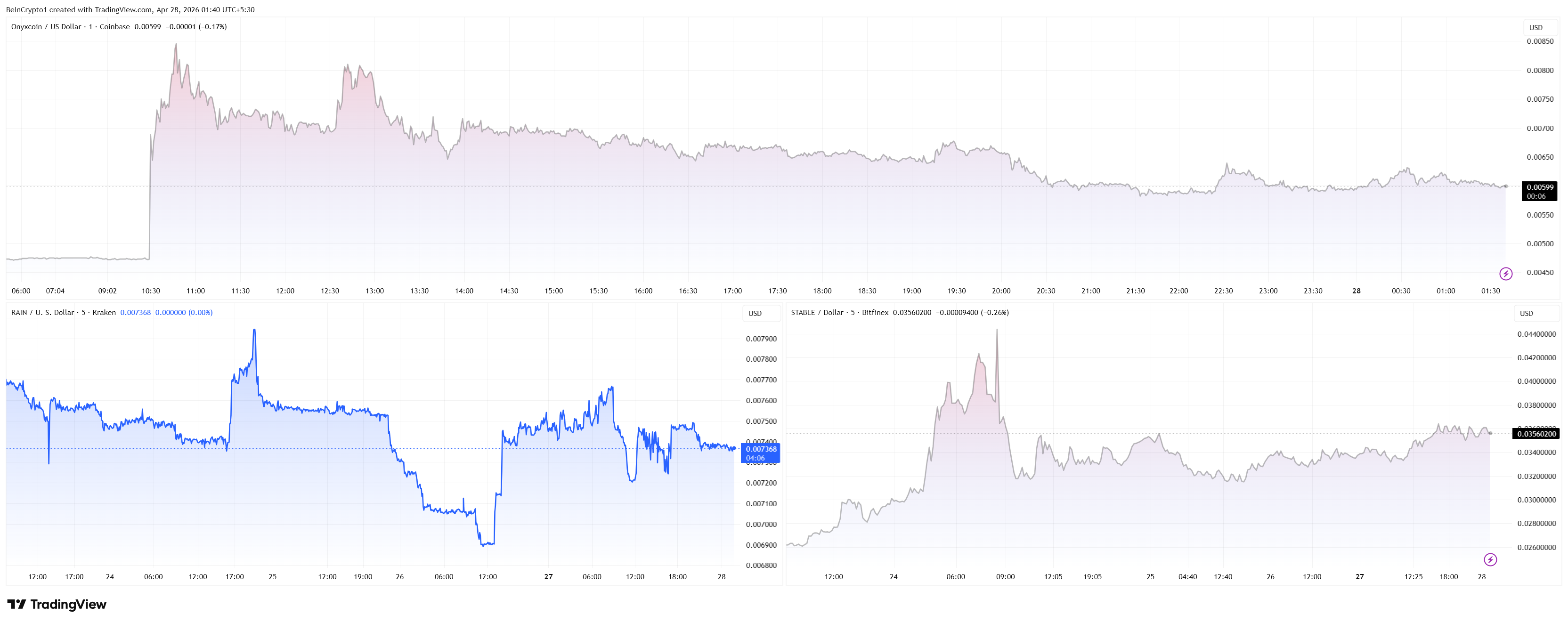
Onyxcoin (XCN) led the group on April 27 with a 47.20% daily gain. Price pushed to $0.0086 intraday, its highest level since mid-January. XCN has since pulled back to $0.0069, retesting the resistance zone between $0.0068 and $0.0075.
The Upbit listing provided the catalyst, but the daily structure still looks fragile. The price remains below a descending trendline that dates back to July 2025. Overhead resistance at $0.010 and $0.013 caps any sustained breakout attempt.
The Relative Strength Index (RSI) broke out sharply to the upside, suggesting momentum favors the bulls. However, volume on the breakout candle came in below the prior demand spikes from March 26 and January 6.
If XCN fails to reclaim the $0.0068 to $0.0075 zone as support, the rally may be short-lived. A clean daily close above the descending trendline would shift the structure and open a path toward $0.010.
Rain (RAIN) Sits Between Fibonacci 0.382 and 0.5 as Volume Dries Up
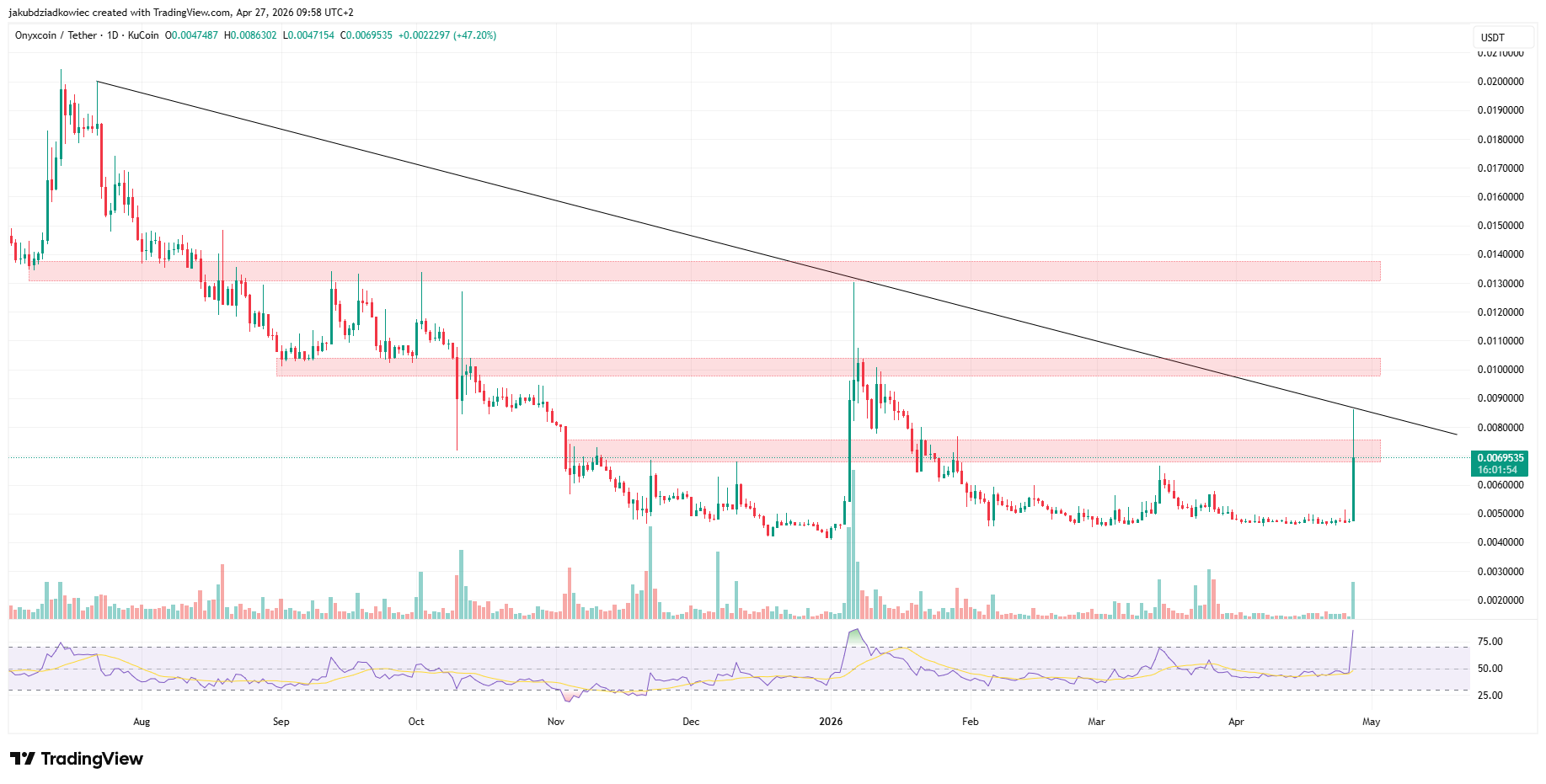
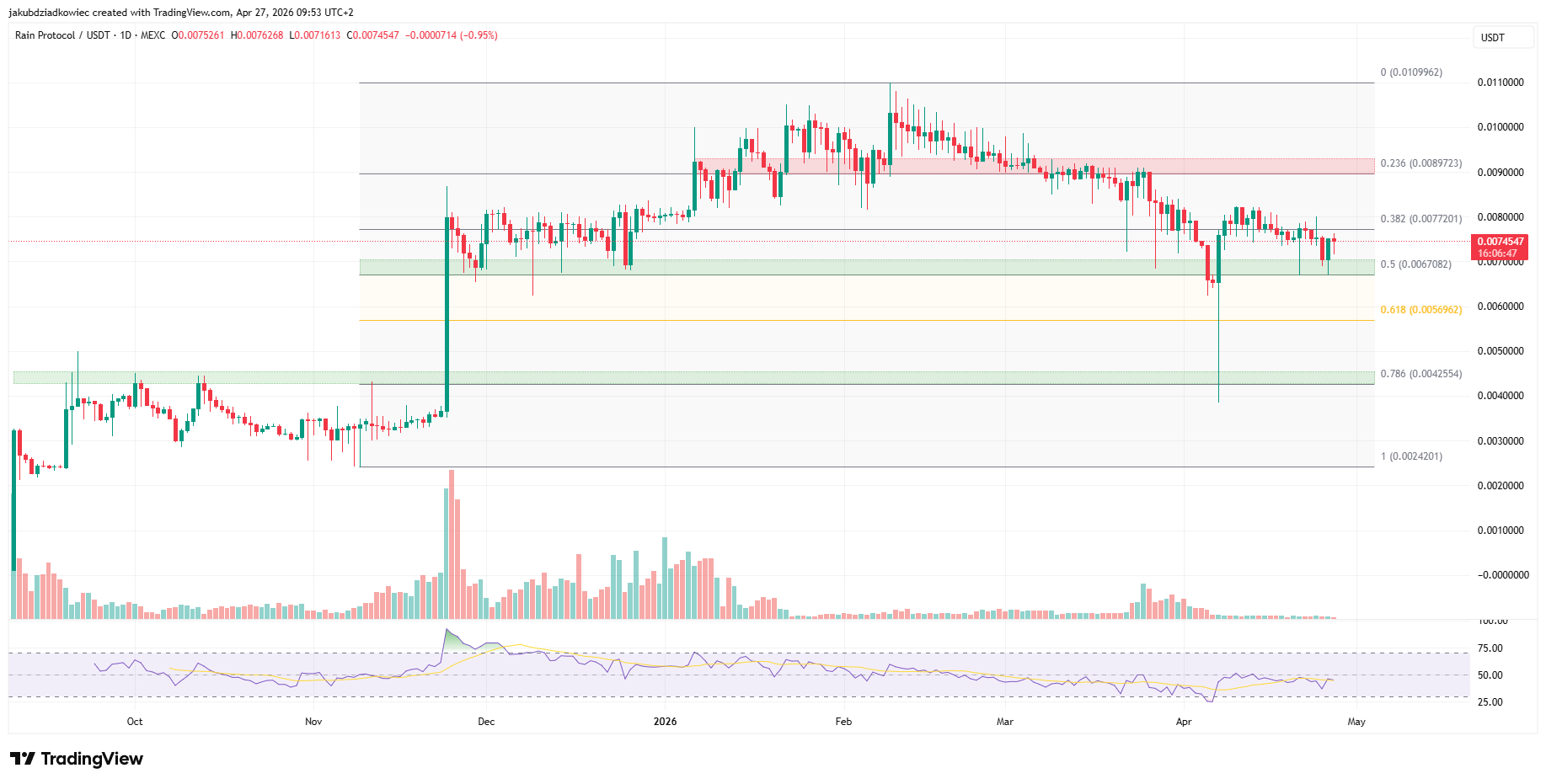
Rain (RAIN) trades at $0.00745 on the daily chart. The token sits between the 0.382 Fibonacci retracement at $0.0077 and the 0.5 retracement at $0.0067. The grid runs from the November 9, 2025, low of $0.0024 to the February 9, 2026, high of $0.011.
The 0.5 level has acted as the first line of support for several weeks. Price has repeatedly tested the area, only to bounce. RSI sits at roughly 46, a neutral reading, and daily volume has compressed to the lowest range of the year. Neither buyers nor sellers are pressing the tape.
A deeper correction would target the 0.786 Fibonacci at $0.0042, the next major demand zone visible on the chart. To the upside, the 0.236 Fibonacci at $0.009 marks the first resistance. That level would be the immediate target if buyers step back in.
The setup is binary. Continued absence of volume keeps RAIN coiling between Fibonacci levels. The breakout direction will likely come from a broader altcoin rotation rather than token-specific demand.
STABLE Holds Higher Highs After Tagging W-Pattern Target
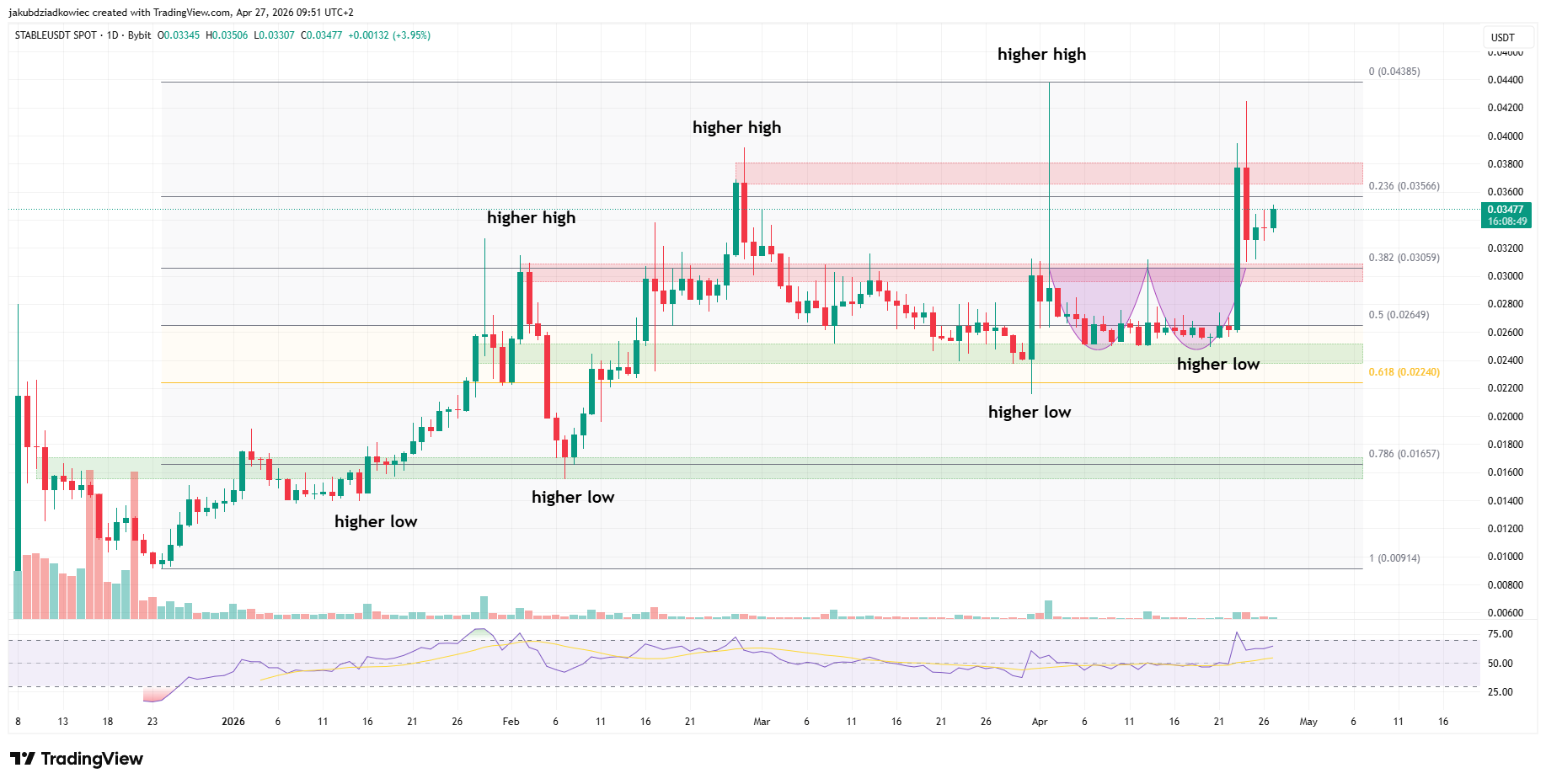
STABLE was the cleanest technical structure of the three. Price hit the W-pattern target from the prior BeInCrypto analysis on April 23. The token then tagged resistance at $0.037 and corrected to the 0.382 Fibonacci at $0.0306 before bouncing.
The daily chart continues to print higher highs and higher lows, the textbook signature of a healthy uptrend. RSI sits at approximately 65, just below the overbought threshold. Price trades at $0.03477 with a 3.95% daily gain.
The next test sits at $0.037, the same level that capped the prior leg up. A daily close above this band, which extends to $0.038, would confirm continuation. The break would likely open a path toward $0.04385, the swing high marked on the Fibonacci grid.
Volume has been declining through the bounce, which signals weakening momentum even as price advances. The structure looks intact. A failure to break $0.037 with conviction would set up another retest of the 0.382 Fibonacci at $0.0306. STABLE remains one of the more constructive altcoins of the cycle on the daily timeframe.
The post 3 Altcoins to Watch in Final Week of April With Onyxcoin Up 30% appeared first on BeInCrypto.
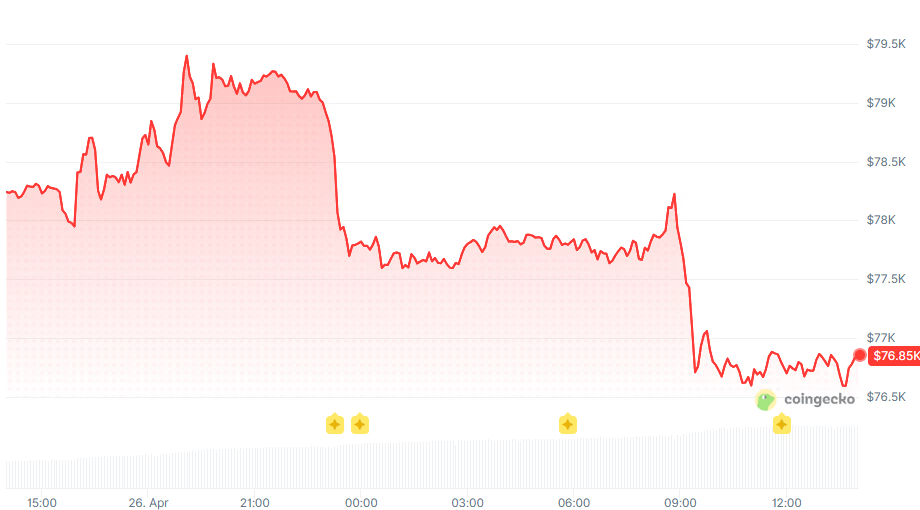
Crude oil jumped as Trump called off Iran peace talks, dragging BTC back below $77,000 and triggering $288 million in long liquidations.
Bitcoin failed at the $80,000 level for the third time this month on Monday, briefly tagging $79,500 before reversing sharply, as a renewed move higher in oil prices amid stalling U.S.-Iran peace talks pushed risk assets into the red ahead of this week’s FOMC decision.
BTC last changed hands at around $76,800 per CoinGecko, down 1.8% over the past 24 hours but still up 1.2% on the week. Ether (ETH) led losses among the majors, falling 3.3% to $2,287. Meanwhile, SOL traded near $84, down 3%, XRP at $1.39, down 2.8%, and BNB at $623, down 2%.

Total crypto liquidations reached $435 million over the past 24 hours, according to CoinGlass, with more than 108,000 traders liquidated.
Stalled Peace Talks
President Donald Trump on Sunday called off a planned Pakistan trip by two senior U.S. negotiators, stalling a fresh round of peace talks even as Iran reportedly sent Washington a new proposal over the weekend. The Strait of Hormuz remains under a U.S. naval blockade.
The risk-off backdrop is unfolding two days before the April 28-29 FOMC meeting. CME FedWatch puts the odds of a rate hold at 100%, with the federal funds rate expected to remain in the 3.50-3.75% range. April carries no fresh dot plot or Summary of Economic Projections, leaving Chair Jerome Powell’s tone the focal point for traders. The Bureau of Economic Analysis releases its advance Q1 GDP estimate on Thursday, with PCE and the Employment Cost Index expected the same morning.
ETFs
U.S. spot Bitcoin ETFs pulled in $823.7 million in net inflows during the week ending April 24, the fourth consecutive positive week, per SoSoValue. April month-to-date inflows now exceed $2.4 billion, nearly double March’s total. Total BTC ETF AUM stood at $102.64 billion as of Friday, with the products holding 1,322,094 BTC, or roughly 6.3% of the circulating supply.
Spot Ether ETFs added $155 million for the week, their third consecutive positive week, while spot Solana ETFs added $9.4 million and spot XRP ETFs added $15.7 million.
Elsewhere
Strategy disclosed its fourth consecutive weekly Bitcoin purchase, adding 3,273 BTC for $255 million at an average price of $77,906, with the latest fill now sitting roughly 1.4% above spot. Total holdings stand at 818,334 BTC, acquired for roughly $61.81 billion at an average cost basis of $75,537, with chairman Michael Saylor citing a 9.6% year-to-date BTC yield. The buy follows last week’s $2.54 billion accumulation of 34,164 BTC, the firm’s largest since 2024.
In DeFi, Aave founder Stani Kulechov said the DeFi United recovery fund has reached the level needed to fully re-collateralize rsETH following the April 18 KelpDAO bridge exploit, subject to pending governance votes. Consensys and Ethereum co-founder Joe Lubin committed up to 30,000 ETH, while the Solana Foundation said it would lend USDT on Aave for the first time.
Outlook
With oil at multi-week highs, and four mega-cap tech names (Microsoft, Alphabet, Meta, Amazon) reporting Wednesday evening after the FOMC decision, the path of least resistance for crypto this week runs through the macro tape rather than crypto-native catalysts.
Crypto World
Western Union (WU) gears up stablecoin launch to settle global transactions without SWIFT


Western Union (WU) is preparing to roll out a stablecoin strategy that could reshape how the 175-year-old money-transfer company settles payments across its global network.
CEO Devin McGranahan said on the company’s first-quarter earnings call that Western Union’s U.S. dollar stablecoin (USDPT) is in the final stages of readiness and is expected to launch next month. The firm announced in October that the digital dollar will run on Solana (SOL) and will be issued with federally chartered crypto bank Anchorage Digital.
Western Union plans to use the stablecoin first as an alternative to the interbank settlement rails it uses today to move money between the company and its agents.
“We are not originally launching [USDPT] as consumer-facing,” McGranahan said. “We are launching it as an alternative to the interbank SWIFT settlement network that we use today.”
That matters, he said, because Western Union’s business still depends on legacy banking systems that settle only on business days and can take two or three days in some markets. Stablecoins could allow the company to settle with partners in real time, including over weekends and holidays, while reducing capital tied up in the system, he added.
The second piece of the company’s strategy is the Digital Asset Network (DAN), which lets crypto wallet companies offer Western Union as a cash-out option. Through that network, wallet users will be able to convert digital assets into local currency through Western Union’s retail footprint, McGranahan said.
The company said its partner pipeline represents tens of millions of crypto wallets globally.
Western Union also plans to launch a Stable Card, expected later this year. It will let customers hold funds in stablecoins and spend through card networks. McGranahan said the card could be useful in inflation-sensitive markets where customers want access to U.S. dollar-denominated value with everyday spending utility.
“We expect to begin rolling this out across dozens of markets with an initial wave targeted for later this year,” he said.
Western Union’s stablecoin push comes as its core remittance business faces pressure, with rival fintechs and crypto payments firms increasingly using blockchain tech for cross-border payments. MoneyGram, for example, is looking to Circle’s USDC stablecoin, while Stripe launched its own stablecoin infrastructure with a payments-focused chain Tempo.
Read more: DoorDash is bringing stablecoin payments to masses with Stripe-backed blockchain
TLDR
- Solana Foundation confirmed that its core developer teams selected Falcon as a post-quantum digital signature solution.
- Anza and Jump Crypto’s Firedancer independently agreed on adopting Falcon for future network protection.
- Solana developers have already started building and testing early versions of Falcon implementations.
- The foundation stated that current quantum computing risks remain distant, but migration plans are ready.
- Solana outlined a phased roadmap that includes research, wallet updates, and eventual network migration.
Solana Foundation detailed a plan to address future quantum computing risks and protect network security. The foundation confirmed that core developers aligned on a post-quantum signature standard. It said the threat remains distant, yet teams have prepared migration strategies.
Solana Aligns Core Teams on Falcon Quantum-Resistant Signatures
The Solana Foundation said its core teams selected Falcon as a post-quantum digital signature scheme. Anza and Jump Crypto’s Firedancer reached the same conclusion through independent technical reviews. The foundation stated that both teams have started building early Falcon implementations for testing.
The foundation said Solana developers examined performance tradeoffs before selecting Falcon for integration. The network’s high-speed design requires low latency and efficient cryptography. However, developers concluded that Falcon can operate within existing technical limits without harming throughput.
The foundation said it will continue research and testing before any protocol change. It added that developers understand migration steps and maintain readiness for deployment. “Quantum is still years away,” the foundation said in its blog update.
Roadmap Covers Wallet Migration and Ecosystem Tools
Solana outlined a phased roadmap for introducing post-quantum protections across the network. The plan includes research on Falcon and other cryptographic options. It also covers potential deployment for new wallets if quantum risks increase.
The foundation said developers could introduce post-quantum schemes for newly created wallets first. Later, teams would migrate existing wallets through planned updates. The foundation stated that such a transition would remain manageable under the current infrastructure.
The blog post also referenced ecosystem work that already supports quantum resistance. Blueshift launched its Winternitz Vault primitive on Solana more than two years ago. The foundation said Google Quantum AI recently cited this implementation in research materials.
The foundation explained that Winternitz Vault operates as a quantum-resistant primitive on chain. It allows users to store assets with alternative cryptographic safeguards. Developers have maintained the tool live on Solana without protocol disruption.
Solana developers stated that they will monitor advances in quantum computing research. They will adjust timelines based on scientific progress and industry benchmarks. The foundation emphasized that no immediate network changes are scheduled.
The foundation said internal testing of Falcon implementations will continue across both core teams. Anza and Firedancer engineers will refine performance benchmarks during development cycles. The foundation confirmed that deployment would follow clear governance processes.


- Pudgy Penguins (PENGU) price touched $0.010 amid double-digit gains.
- The token surged as the Pudgy Penguins floor price pumped.
- Other non-fungible tokens also soared, including the Bored Ape Yacht Club.
Pudgy Penguins’ native PENGU token is up double digits in the past 24 hours, riding high on skyrocketing floor prices to touch three-month highs.
This surge comes amid notable price increases in the Pudgy Penguins NFT, with other tokens related to the sector also experiencing significant gains.
However, an uptick for Bitcoin and Ethereum fizzled on Monday, a scenario that puts the tokens’ prices in danger of retreating amid profit-taking.
Pudgy Penguins soars 14% amid NFT price gains
Data shows top non-fungible token collections are experiencing a remarkable resurgence, with floor prices extending their upside momentum.
Pudgy Penguins currently leads the charge as its floor price climbs above 5 ETH, with over 20% in weekly gains.
Market data highlights this momentum, with over 20 sales and nearly 1,000 ETH in trading volume over the past seven days.
The Bored Ape Yacht Club (BAYC) NFT boosts similar metrics and shows an 81% spike in floor price over the last 30 days.
Yet, this optimism contrasts with contracting overall NFT market participation.
Global sales, transactions, and active users have nearly halved since February, even as average sale prices have more than doubled.
This divergence suggests a concentration of capital among high-value collections like Pudgy Penguins, potentially signaling selective bullishness rather than broad recovery.
Notably, PENGU price is up 40% over the past week, and the 14% gain in the last 24 hours has pushed it to above $0.010 for the first time since late January.
Pudgy Penguins is in double digits up year-to-date.
Pudgy Penguins price analysis
Analysts attribute the NFT rally primarily to surging cryptocurrency prices, with Bitcoin (BTC) recently touching $80,000 and Ethereum (ETH) reaching $2,400.
The broader market sentiment looks to have amplified demand for top-tier NFTs, where Pudgy Penguins has stood out with elevated transaction counts accompanying its price climb.
In the market, surging floor prices typically reflect strong conviction, and the opposite shows amid declining floor prices.
PENGU gains mirror Pudgy Penguins’ NFT momentum, and the upmove lifts bulls above the $0.008 supply zone.
The surge to above $0.010 makes the 100-day and 50-day moving averages key support levels at $0.0082 and $0.007.

Among technical indicators to note is the Relative Strength Index (RSI) that currently hovers above 70, signalling overbought conditions.
Traders may need to watch out for NFT market fatigue or a significant BTC pullback.
If this happens, PENGU price could test lower support levels, including Feb 6 low of $0.0052.
On the flipside, the moving averages hint at a potential golden cross, with price likely to extend towards the YTD peak around $0.014.
TLDR
- Shiba Inu added 24000 new wallets between April 20 and April 27, 2026.
- The total number of SHIB holders surpassed 1.585 million, reaching a new high for 2026.
- On April 25, the network recorded its largest daily increase with 10718 new holders.
- Shibarium has processed more than 1 billion total transactions since its launch.
- The team confirmed the updated wallet and transaction data on April 27, 2026.
Shiba Inu (SHIB) recorded sharp user growth and network activity between April 20 and April 27, 2026. The team reported 24,000 new wallets during the period, pushing total holders above 1.585 million. At the same time, Shibarium processed more than 1 billion transactions, marking a new network record.
SHIB Wallet Count Climbs to 1.585 Million
Shiba Inu’s team shared updated wallet data on April 27 through its official X account. The update confirmed that SHIB holders increased by 24,000 wallets within one week. As a result, the total number of SHIB wallets surpassed 1.585 million, reaching a new high for 2026.
The data showed the largest daily rise occurred on April 25. On that day, the network added 10,718 new holders, which marked the strongest daily growth this year. The team stated, “The ecosystem continues to expand as new users join the network each day.”
Earlier in the week, wallet growth began to accelerate from April 20. The steady rise continued through April 24 before the sharp spike on April 25. This pattern reflected rising participation during the recent crypto market rebound.
After the peak day, growth levels moderated but remained positive. On April 26, the network added 1,040 new holders. On April 27, it recorded another 1,100 new wallets, according to the team’s update.
These additions brought the cumulative holder count to its current level. The team described the increase as a continuation of rising engagement across the ecosystem. The figures reflect on-chain wallet data recorded during the reporting period.
Shibarium Surpasses 1 Billion Transactions
Shibarium also reached a new usage milestone during the same period. The layer 2 network processed more than 1 billion transactions, according to the shared data. This achievement places Shibarium among networks with high cumulative activity counts.
The team confirmed the milestone while outlining recent network statistics. It stated, “Shibarium has now crossed 1 billion total transactions.” The update linked the transaction growth to expanding network usage.
Transaction volumes increased as wallet numbers climbed during the week. The network handled daily transfers that contributed to the cumulative total. Each processed transaction is added to the overall count tracked on-chain.
Shibarium operates as Shiba Inu’s layer 2 scaling solution. The network supports faster transactions and lower fees compared to the main Ethereum chain. Developers continue to build and deploy projects within the ecosystem.
The 1 billion transaction mark reflects total processed transfers since launch. The data covers all confirmed transactions recorded on the network ledger. The team released the figures alongside updated holder statistics on April 27, 2026.
The latest wallet additions and transaction totals represent the most recent verified data. Shibarium’s cumulative transaction count now stands above 1 billion as of April 27. Total SHIB wallet addresses exceed 1.585 million based on on-chain records.

BitMine Immersion Technologies, the Ether treasury company backed by Fundstrat’s Tom Lee, has expanded its ETH holdings for the second time in as many weeks, even as large unrealized losses underscore the strategy’s risks.
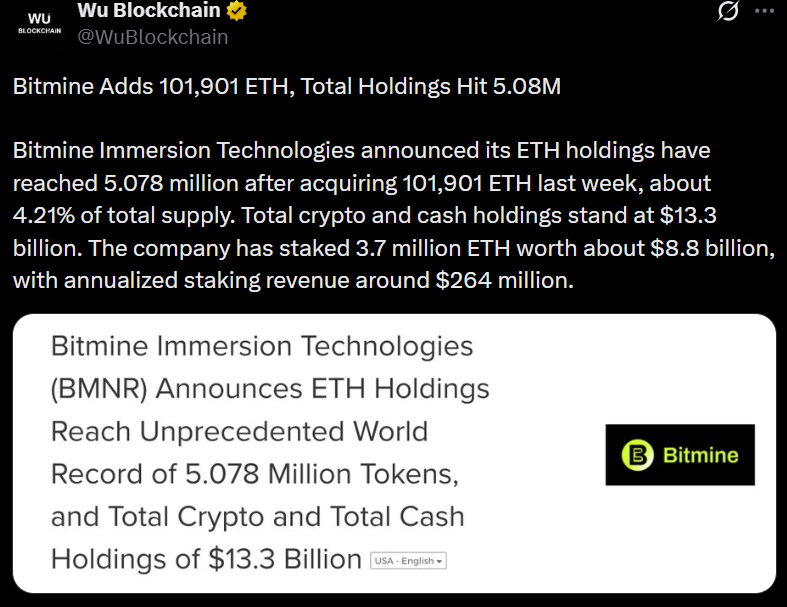
The company said Monday it purchased an additional 101,901 Ether last week, bringing its total holdings to roughly 5.08 million ETH. Its combined crypto and cash reserves now stand at about $13.3 billion.
Source: Wu Blockchain
The latest acquisition follows a purchase of 101,627 ETH a week earlier, which was the company’s largest accumulation since December.
Despite the aggressive buying, BitMine is sitting on more than $6.5 billion in unrealized losses, based on total investments of approximately $17.6 billion, highlighting the impact of recent volatility in Ether prices.
The share price of the NYSE-listed BMNR stock is down more than 20% year-to-date, according to Yahoo Finance data.
Still, the company is generating yield on a portion of its holdings. BitMine has staked roughly 3.7 million ETH, allowing it to earn rewards for helping secure the Ethereum network and validate transactions, a strategy that provides a steady income stream even during price downturns.
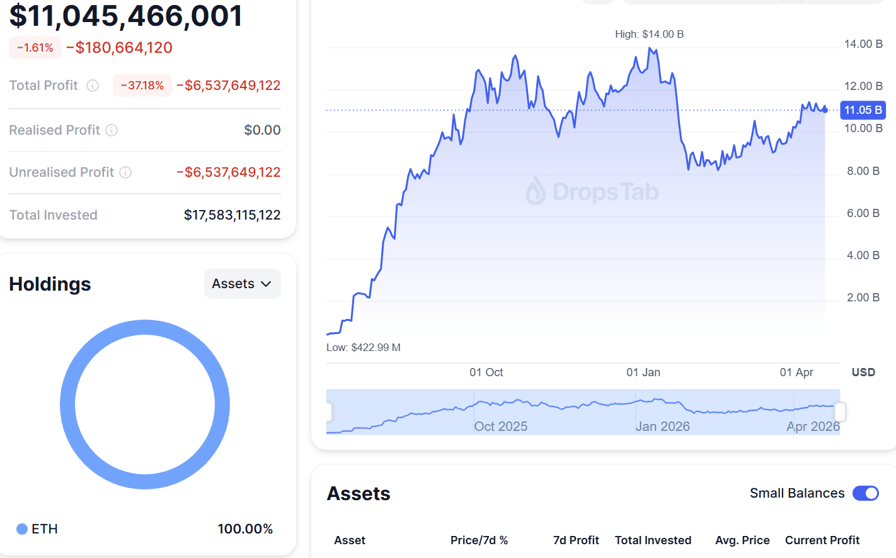
BitMine’s unrealized losses on its ETH treasury have topped $6.5 billion. Source: Dropstab
Related: Crypto Biz: Same players, bigger bets as crypto eyes a rebound
Ether, crypto markets show signs of stabilization
BitMine’s large purchases come as the broader crypto market shows early signs of stabilizing after months of declines through March.
Ether rebounded above $2,400 last week after falling to a low near $1,800 earlier this year, according to TradingView data. Despite the recovery, the second-biggest crypto by market cap remains down roughly 23% year-to-date.
The rebound mirrors a broader uptick across equities and other risk assets in recent weeks, suggesting improving investor sentiment.
However, the volatility underscores the challenges facing crypto treasury players. Companies that accumulate large digital asset reserves are highly exposed to price swings, which can lead to significant unrealized losses during downturns, even as they continue buying.
While strategies like staking can generate yield, they often do little to offset large drawdowns in asset value, leaving balance sheets sensitive to market cycles.
Related: Michael Saylor’s Strategy adds 3.2K Bitcoin at nearly $78K per BTC

Bitcoin Crash Alert! (Death Cross Points LOWER)

Deal ‘within sight’ to end Birmingham bin strike

Budget carriers including Frontier, Avelo reportedly seek $2.5B in federal aid

Manchester United reach agreement with Casemiro over contract clause amid transfer speculation

US brings back mandatory military draft registration

Steven Gerrard disagrees with Gary Neville over ‘shock’ Chelsea and Arsenal claim | Football


-

 Fashion3 days ago
Weekend Open Thread – Corporette.com
-
Crypto World2 days ago
Hyperliquid $HYPE Rally Builds Momentum as AI Sector Enters Prove-It Phase
-

 Politics5 days ago
Making troops accountable for war crimes threatens US alliance, ex-SAS colonel warns
-

 Tech4 hours ago
Register Renaming | Hackaday
-

 Politics5 days ago
Disabled people challenge government SEND proposals over segregation concerns
-

 Business4 days ago
Patterson-UTI Energy, Inc. (PTEN) Q1 2026 Earnings Call Transcript
-

 Business5 days ago
Rolls-Royce Voted UK’s Most Iconic Trade Mark as IPO Register Hits 150
-
 Sports1 day ago
IPL 2026: Ruturaj Gaikwad registers slowest fifty of the season, enters all-time unwanted list | Cricket News
-
 Crypto World6 days ago
Five Value Stocks with Recovery Potential in 2026: PayPal (PYPL), Nike (NKE), and More
-

 Politics5 days ago
Starmer handler McSweeney to be dragged from shadows by Foreign Affairs Committee
-

 Politics5 days ago
Zack Polanski responds to home secretary’s taser threat
-
Politics5 days ago
Wings Over Scotland | How To Get Away With Crimes
-

 Crypto World6 days ago
New York sues Coinbase, Gemini over prediction market offerings
-
Entertainment6 days ago
Sydney Sweeney cameo cut from “The Devil Wears Prada 2”, source explains why (exclusive)
-
 Business6 days ago
HCL Tech share price tank over 9% after weak Q4. JPMorgan, HSBC & 3 others cut target price
-

 Politics5 days ago
‘Iran is still a nuclear threat’
-
 Sports5 days ago
Tim Bradley names the current best in the world: “Better than Inoue and Usyk”
-

 Crypto World6 days ago
Crypto’s great hope in Senate’s Clarity Act still has a path to survive tight calendar
-

 NewsBeat2 days ago
LK Bennett closes all stores after entering administration
-

 Fashion6 days ago
Kilkenny Design New Beauty Arrivals for Spring 2026
You must be logged in to post a comment Login