
Business
California billionaire tax collects more than enough signatures for November ballot


FOX Business’ Gerri Willis joins ‘Varney & Co.’ to report on the growing red vs. blue state divide over taxes, as new wealth levies target billionaires, property tax revolts spread nationwide and a wave of income tax cuts reshapes the economy
After months of campaigning for a first-of-its-kind retroactive wealth tax in California, the union-led effort is now taking its next step.
The Service Employees International Union–United Healthcare Workers West (SEIU-UHW) said it has collected more than 1.55 million signatures, according to a press release, nearly double the 875,000-signature requirement — to put a one-time tax on billionaire assets on the California ballot.
The California Billionaire Tax Act would target the net worth of roughly 200 residents and would impose a one-time 5% tax on the net worth of California residents with assets exceeding $1 billion. The tax would be due in 2027, and taxpayers could spread payments over five years, with interest, according to the Legislative Analyst’s Office.
If the measure is approved by voters in November, anyone who was a California resident on Jan. 1, 2026, would owe the tax, according to the proposal. In practical terms, a resident with $20 billion in net worth on that date would owe a one-time tax of $1 billion, payable over five years.
THE $1,600 LETTUCE: CALIFORNIA GROWERS WARN OF ‘MASTER PLAN’ STRANGLING FAMILY FARMS
Supporters argue the tax is a direct response to “cuts to Medicaid and other federal health insurance programs by the Trump administration last year.”
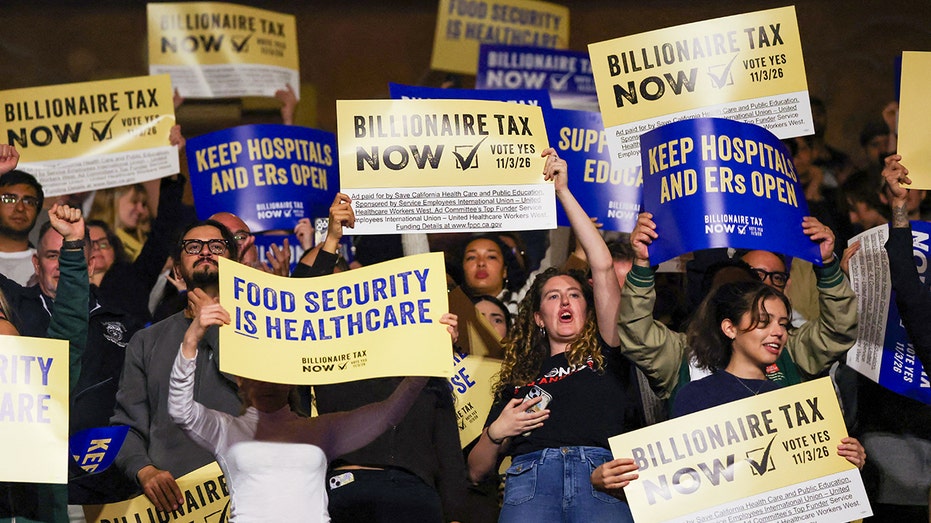
Attendees cheer during the speech of Sen. Bernie Sanders, I-Vt., during the campaign kickoff for the California Billionaire Tax Act in Los Angeles, Feb. 18, 2026. (Getty Images)
“Most Californians and most billionaires recognize how reasonable and necessary this proposal is — both to keep emergency rooms open and to save California businesses from closing,” SEIU-UHW chief of staff Suzanne Jimenez said in a press release.
“A very small group of the most controversial billionaires on the planet tried to stop Californians from being able to save their local emergency rooms and hospitals — but our current signature tally proves frontline healthcare workers will prevail in bringing this commonsense proposal to voters,” she continued. “When our growing coalition files these signatures, David will have won the first round against Goliath, but healthcare workers and our allies won’t quit until we fully protect our patients from the looming healthcare disaster that will be caused by $100 billion in cuts to California healthcare.”
‘The Big Money Show’ panel discusses California’s proposed wealth tax, the potential economic impact and the exodus from blue states.
The SEIU-UHW did not immediately respond to Fox News Digital’s request for comment.
Opponents of the measure have warned the tax could kill an estimated 108,000 high-paying jobs over the next 20 years, The New York Times reported Sunday. Democratic Gov. Gavin Newsom even acknowledged that the state’s proposed wealth tax is bad economics, previously saying he feels vindicated in opposing the proposal after reports showed some of California’s wealthiest residents moving money and businesses out of the state, warning the measure would damage the economy and drive away investment.
GET FOX BUSINESS ON THE GO BY CLICKING HERE
California gubernatorial candidate Steve Hilton discusses new developments in the investigation into former California congressman Eric Swalwell on ‘The Evening Edit.’
While the Legislative Analyst’s Office predicts a temporary surge in cash, it warned of an “ongoing decrease in state income tax revenues of hundreds of millions of dollars or more annually” as billionaires flee the state in response.
Some of those public figures who moved their residencies or businesses out of California before the Jan. 1 retroactive tax deadline include Google co-founders Larry Page and Sergey Brin, Meta’s Mark Zuckerberg, Peter Thiel, Steven Spielberg, Uber’s Travis Kalanick and car loan magnate Don Hankey.



Trapping Value is a team of analysts with over 40 years of combined experience generating options income while also focusing on capital preservation. They run the investing group Conservative Income Portfolio in partnership with Preferred Stock Trader. The investing group features two income-generating portfolios and a bond ladder.
Trapping Value provides Covered Calls, and Preferred Stock Trader covers Fixed Income. The Covered Calls Portfolio is designed to provide lower volatility income investing with a focus on capital preservation. The fixed income portfolio focuses on buying securities with high income potential and heavy undervaluation relative to comparatives. Learn more.
Analyst’s Disclosure: I/we have a beneficial long position in the shares of LANDP either through stock ownership, options, or other derivatives. I wrote this article myself, and it expresses my own opinions. I am not receiving compensation for it (other than from Seeking Alpha). I have no business relationship with any company whose stock is mentioned in this article.
Seeking Alpha’s Disclosure: Past performance is no guarantee of future results. No recommendation or advice is being given as to whether any investment is suitable for a particular investor. Any views or opinions expressed above may not reflect those of Seeking Alpha as a whole. Seeking Alpha is not a licensed securities dealer, broker or US investment adviser or investment bank. Our analysts are third party authors that include both professional investors and individual investors who may not be licensed or certified by any institute or regulatory body.

Expanding a young tech company into a new region is rarely a snap decision. For Nikesh Panchal, founder and chief executive of Wavee Ai, the choice to bet on Asia Pacific as the next chapter for its residential platform has been a slow build rather than a sudden leap.
Wavee Ai, born in London to tidy up chaotic building group chats and parcel rooms, is now preparing to bring its verified, community-first model to cities across the region, from Singapore to Australia. Panchal has already grown Wavee Ai to a £10 million valuation with its continuous push into one of the world’s most dynamic sectors.
After raising more than £1 million to fund international rollout, its expansion is framed as a response to growing demand for safer, more organised digital communities, supported by a strategy that leans on partnerships, localisation, and brand trust.
Lessons From London for a Region on the Move
Alongside running Wavee Ai, Panchal sits on the board of London Tech Equity Ltd, where he has seen early-stage companies stall after chasing quick wins without the proper governance or metrics in place. That experience has reinforced his preference for a founder-led, long-term strategy over rapid, scattershot expansion and informs how he thinks about entering new markets.
Wavee Ai’s story began in London, where Panchal spent time watching the small frictions that define life in managed buildings: missed deliveries, noisy group chats, anonymous neighbours, and concierge desks buried in paper logs. Wavee Ai was built as a direct response to that jumble, replacing scattered tools with a single, verified platform. Residents use one app, concierges work from one portal, and local businesses connect through one controlled channel into a defined community.
Those early years in London gave Panchal lessons he now intends to carry into Asia, while adapting them to local realities. He stresses the importance of staying small in scope even when ambitions are big. Rather than trying to run every aspect of a building’s operations, the platform focuses on a narrow band: communication, community, and local commerce.
It offers a small set of features, such as parcel tracking, visitor management, a private neighbour feed, and curated local offers. That restraint has helped the company avoid being pulled into custom projects that dilute its core product and has become a cornerstone of its quality-over-speed approach.
Those results underpin another lesson: residents will embrace a new app only if it clearly replaces pain points rather than adding to them. In buildings where Wavee Ai was implemented, concierge staff reported time saved on manual logging, and residents valued having one trusted place for updates instead of chasing information across group chats and noticeboards. Local businesses that aligned their offers with building rhythms found steadier engagement.
Panchal says, “London taught us patterns. We know what tends to work for concierges, what residents respond to, and how local businesses like to plug in. But each city and each building has its own personality. Our job in Asia Pacific is to listen first, then apply what we’ve learned.”
A Founder’s Long-View Strategy
The concrete success of Wavee Ai in London is what Panchal plans to bring into the room with Asia-based stakeholders. In practice, that means entering the region through pilot projects and portfolio-level experiments, listening to how each city and building works, then applying London’s patterns in ways that can be localised and refined on the ground. The basic idea remains straightforward: the app connects residents, concierge teams, and local businesses inside a private, building-verified network, where parcel arrivals, visitor notifications, building announcements, and neighbourhood offers land in one feed, and every resident is authenticated through their building rather than signing up anonymously.
This business model is what Panchal now wants to adopt in apartment-heavy markets across Asia Pacific, where dense living, rising rents, and a growing class of professionally managed buildings are pushing community management to the top of the priority list for owners and residents alike.
These conditions, he believes, echo the pressures that helped Wavee Ai gain traction in London, but on a larger, faster-moving scale. He frames Asia Pacific not only as a growth market, but as a proving ground for how verified, community-first platforms can become part of the fabric of urban living.
Panchal also sees the expansion as an opportunity to bring local shops closer to the people who live above and around them, turning independent cafés, gyms, studios, and specialty retailers into trusted, visible partners in residents’ daily routines.
For residents, that means having reliable options for everyday needs and passions without searching across multiple platforms or travelling far—often just by looking at what is available on the ground floor or around the corner. For local businesses, it offers a direct, accountable route into the vertical communities they have always served but rarely reached in such a focused, building-by-building way.
“I see a win-win opportunity,” Panchal mentions. “We designed Wavee Ai to be scalable so that it can adapt to the needs of different residential communities.”
A Founder’s Bet on How Cities Will Feel
The story of Wavee Ai’s Asia Pacific expansion is, at its core, about how one founder imagines cities will feel in the coming decade. Panchal is betting that verified, community-first platforms will become the norm in dense urban living, and that residents from London to Singapore will increasingly expect their buildings to provide safe, organised digital spaces, just as they provide clean lobbies and working lifts.
In his view, the cultural shift toward secure, accountable online communities aligns closely with how many Asian cities already think about shared living, security, and neighbourhood identity.
In the Asia Pacific, where the living sector is attracting serious investment and attention, Wavee Ai’s arrival is another sign of how quickly expectations are changing. Buildings are no longer just assets; they are communities that need tools to match their complexity.
Panchal’s insistence on partnerships, brand trust, and a measured, quality-first rollout reflects a belief that residential technology should behave more like infrastructure than like a passing trend. If the platform can quietly become part of residents’ routines in Sydney, Singapore, or Tokyo the way it has in parts of London, his bet will look less like a gamble and more like a blueprint for how cities everywhere might choose to live together.

Hamborner REIT: Don't Be Fooled By A High Yield – It Is Not Sustainable

Further, the Board has declared final dividend for FY26 at Rs 5.25 per share. Payment of final dividend for FY26 will be made subject to approval of shareholders in the ensuing AGM.
Profit before tax for the quarter stood at Rs 14,627 crore, also up 12% from Rs 13,070 crore a year ago, reflecting stable operating performance despite cost pressures. Total income rose 8% to Rs 51,618 crore during the quarter.
The company’s EBITDA grew 12% to Rs 17,917 crore, with margins expanding to 39% from 36% in the year-ago period, indicating improved operating leverage.
Revenue growth was driven largely by higher realizations, even as overall sales volumes remained largely flat. Average realization per tonne increased 6% year-on-year to Rs 2,290, while total sales volume declined marginally by about 1% to 198.83 million tonnes.

On the operational side, coal production for the quarter rose slightly to 239 million tonnes compared to 238 million tonnes last year, while offtake declined 2% to 199 million tonnes, reflecting softer dispatches. Overburden removal remained largely flat at 577 million cubic metres.
Expenses increased 6% to Rs 37,107 crore during the quarter, driven by a sharp rise in other expenses and finance costs. Other expenses surged 18% YoY due to higher levies, particularly the increase in Jharkhand mineral-bearing land cess, while finance costs jumped 42%, indicating higher borrowing and cost of funds.Segment-wise, performance remained mixed across subsidiaries. Key profit contributors such as Northern Coalfields (NCL) and Mahanadi Coalfields (MCL) delivered strong growth, while Western Coalfields (WCL) and Bharat Coking Coal (BCCL) saw a decline in profitability, highlighting regional variability in operations.
For the full year FY26, Coal India reported a 12% decline in profit after tax to Rs 31,071 crore, even as revenue from operations remained broadly flat at Rs 1.68 lakh crore. The decline in annual profitability was attributed to higher expenses, including a one-time provision related to executive pay revision and increased statutory levies.

Opus Genetics president Benjamin Yerxa sells $39,121 in stock
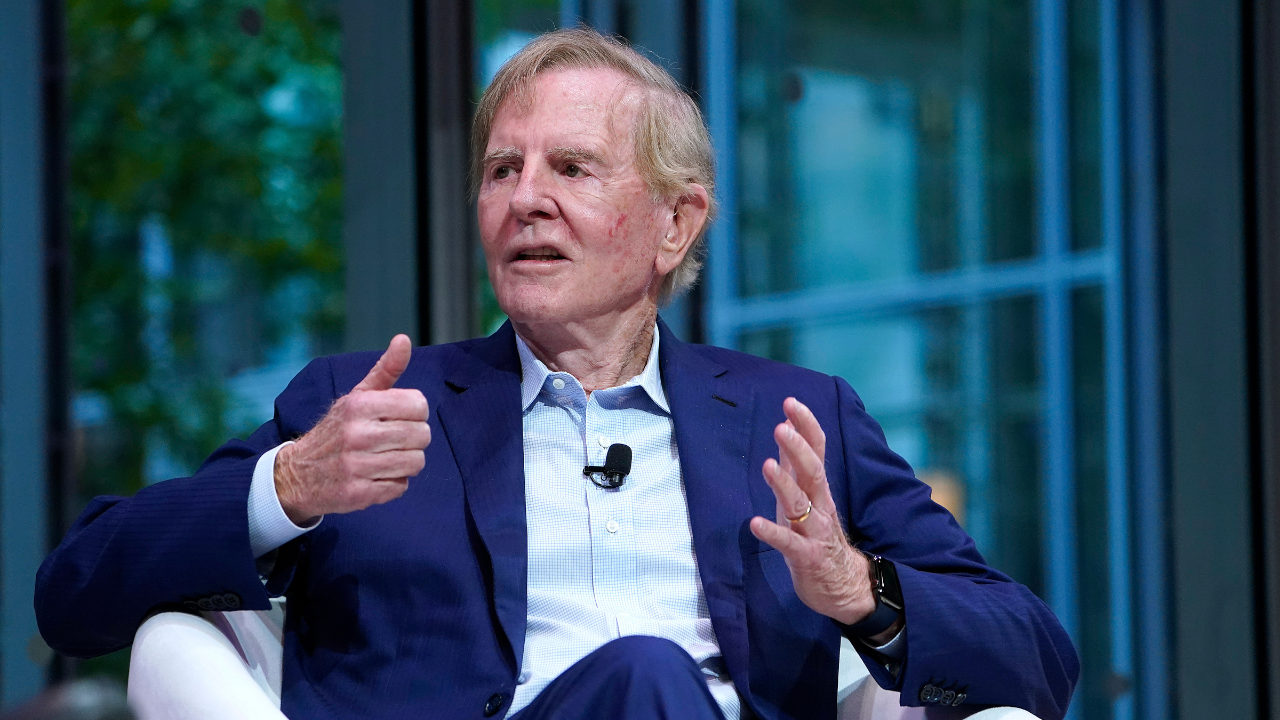
Former Apple CEO John Sculley discusses the future of the technology company amid leadership changes and the rise of artificial intelligence on ‘The Claman Countdown.’
Former Apple CEO John Sculley identified OpenAI as the largest competitive threat facing Apple in years, marking a potential shift after decades of dominance by the iPhone maker in the technology industry.
“This is the biggest thing I think that’s happened since Tim Cook took over from Steve Jobs 15 years ago,” he told “The Claman Countdown” Monday.
Sculley’s comments come one week after it was announced that Tim Cook is stepping down as Apple’s CEO and will become its executive chairman, and as both Apple and OpenAI are reportedly exploring the development of similar next-generation AI products.
Apple is reportedly set to launch a wearable AI pin, Sculley said, while former Apple designer Jony Ive, credited for helping transform the company’s product vision, is partnering up with OpenAI to create its own AI-powered hardware.
TECH TITANS ELON MUSK AND SAM ALTMAN HEAD TO COURT IN TRIAL OVER OPENAI: WHAT TO KNOW

Open AI CEO Sam Altman speaks during a talk session with SoftBank Group CEO Masayoshi Son at an event titled “Transforming Business through AI” in Tokyo, Japan, on Feb. 3. (Tomohiro Ohsumi/Getty Images / Getty Images)
“It’s one that may have a camera in it. It won’t have a screen. And it’s going to be able to have what’s called ambient awareness, meaning it’s always on, it’s listening, and you get it through an ear pod,” he explained. “And that would be an entirely new user experience for people in the Apple ecosystem.”
Sculley said each company’s interpretation of the device will be different, but warned the competition poses a threat to Apple’s longstanding tech dominance.
He signaled that consumer loyalty may vary, as buyers will gravitate toward their preferred product, rather than defaulting to Apple’s ecosystem.
“I expect that they’re going to be taking very different ways of interpreting it in terms of a product,” the former Apple CEO said.
WHO IS JOHN TERNUS, SET TO SUCCEED TIM TOOK AS APPLE’S CEO?
“Some are going to become loyal to one version and some are gonna become loyal to another.”
The emergence of OpenAI as a dominant force in the tech world is part of what Sculley described as a “weather system” that is constantly shifting the industry.

Tim Cook to become Apple Executive chairman and John Ternus to become Apple CEO on September 1, 2026. (Reuters / Reuters)
CLICK HERE TO DOWNLOAD THE FOX NEWS APP
Sculley affirmed that amid the AI storm, Apple’s leadership remains strong, even amid concerns surrounding Cook’s transition.
“Tim Cook did a spectacular job as CEO,” Sculley told FOX Business. “And the incoming CEO, John Ternus, looks incredibly qualified to be the next leader. So, from that standpoint, Apple’s in a very good position.”
Sculley went on to share advice for Apple as it rings in its 50th year in operation and as the race for AI dominance only intensifies.
“Stay true to the values Apple has been so successful at: beautiful products, no compromises,” he said.

While many airlines say they are raising prices due to high fuel costs, József Váradi says European airlines are trying to boost demand

Form 144 IMAX Corporation For: 27 April

‘Barron’s Roundtable’ panelists discuss investment opportunities among airline stocks.
A group of budget airlines is reportedly seeking financial assistance from the federal government that could convert to an equity stake in the air carriers.
The Wall Street Journal reported on Sunday that the group of budget airlines, including Frontier and Avelo, is seeking $2.5 billion in federal assistance through stock warrants that could convert into equity stakes in the airlines, according to people familiar with the matter.
Some of the Journal’s sources told the outlet that the group’s $2.5 billion figure was derived from an estimate of how much they expect to spend on jet fuel this year compared with earlier forecasts, with the estimate assuming jet fuel prices will remain above an average of $4 a gallon for the rest of the year.

A Frontier Airlines plane approaches Ronald Reagan Washington National Airport. (Ken Cedeno/Reuters)
Conversations about a possible relief package for budget airlines are reportedly expected to continue in the coming days, according to the Journal’s report. The news follows a reported meeting between the leaders of several budget carriers with Transportation Secretary Sean Duffy and Federal Aviation Administration chief Bryan Bedford last week.
“As the smallest and newest airline in the country, Avelo competes against significantly larger airlines who have unprecedented market dominance,” Avelo Airlines said in a statement to FOX Business. “Our focus on unserved and underserved airports gives millions of U.S. consumers low fare nonstop air service options they otherwise would not have. We have no specific comment on the report, but we emphatically agree that a healthy airline industry with strong competition is important to the U.S. economy, especially during this period of high fuel prices.”
FOX Business reached out to Frontier Airlines for comment.
WHAT A GOVERNMENT STAKE IN SPIRIT AIRLINES COULD MEAN FOR PASSENGERS AND THE INDUSTRY
Rising jet fuel prices amid the war in Iran have strained the outlooks for air carriers, who face higher costs than anticipated.
Some air carriers, including larger rivals like United and American, have responded by raising fares and checked baggage fees on consumers.

United Airlines recently raised passenger fares, citing the rising cost of jet fuel. (Tayfun Coskun/Anadolu Agency via Getty Images)
TRUMP SIGNALS INTEREST IN BUYING SPIRIT AIRLINES WITH TAXPAYER BACKING, AIMS TO RESELL FOR PROFIT
Last week, leading budget carriers requested that Congress pass a bill to suspend the 7.5% federal excise tax on airline tickets and the $5.30 per segment tax, which the Association of Value Airlines estimated would offset about one-third of the increased fuel costs.
The group represents Spirit Airlines, Frontier Airlines, Allegiant Air, Sun Country and Avelo.
The budget airlines’ pursuit of federal aid comes as the Trump administration is weighing a separate proposal to provide relief for Spirit Airlines in the form of a $500 million loan that would give the federal government the ability to convert warrants into equity stakes in the airlines.
CHEVRON CEO WARNS AVIATION STRAIN COULD WORSEN AS JET FUEL CRUNCH DEEPENS
The deal would see the federal government receive warrants equal to about 90% of Spirit’s equity in exchange for the funding.

The Trump administration is weighing a separate proposal to provide relief for Spirit Airlines. (AaronP/Bauer-Griffin/GC Images)
Rising jet fuel costs have complicated Spirit’s plan to exit bankruptcy this summer, after the budget carrier entered Chapter 11 bankruptcy proceedings for the second time last year.
During the COVID-19 pandemic, the Treasury Department received warrants in major airlines after a roughly $54 billion support package to prevent mass layoffs during the pandemic.
GET FOX BUSINESS ON THE GO BY CLICKING HERE
The federal government ultimately opted against exercising the warrants it acquired and instead sold them in actions that yielded over $550 million.
Reuters contributed to this report.

More than 300 pubs, bars and restaurants have served their last pint and plated their last cover since the start of the year, as Britain’s licensed trade groans under the combined weight of higher wage bills, stubborn energy costs and customers who are quietly drinking and dining at home.
Fresh analysis from CGA by NIQ, the market research group, shows the number of licensed premises across the UK slipped to 98,609 by the end of March, a net loss of 305 venues since December, or rather more than three closures every single day. Coming on top of the 382 sites lost between September and December, the figures mean the country has shed 0.7 per cent of its licensed estate in just six months.
It is a slow-motion contraction that is now accelerating. Casual dining has been hit hardest, with the number of restaurants in that bracket falling by 0.9 per cent in the first quarter alone. Bars, nightclubs, traditional pubs and social clubs have also gone to the wall as households defer the small discretionary treats, a Friday curry, a midweek pint, a birthday dinner, that have long propped up neighbourhood operators.
Behind the headline numbers sits a familiar but increasingly toxic mix of cost pressures. April’s rise in employers’ national insurance contributions, the upward ratchet on business rates and persistently elevated food prices have eaten into already wafer-thin margins. Energy bills, which many operators had hoped would ease this year, have instead been pushed higher by the war in the Gulf, with wholesale gas and fuel prices feeding through to suppliers and threatening another round of menu price rises that publicans are reluctant to pass on to bruised customers.
Karl Chessell, director of hospitality operators and food at NIQ, said confidence among both businesses and consumers remained stubbornly low and warned that “geopolitical crises are likely to cause more damage in the months ahead”. While many operators had “shown remarkable resilience”, he said, “thousands are now nearing breaking point”.
“Soaring costs have taken a heavy toll on hospitality in the first quarter,” Chessell added. “Without targeted support, more closures can be expected over the rest of 2026.”
The trade is now lobbying ministers in earnest for a sector-specific package, a permanent reduction in business rates for hospitality, a lower rate of VAT on food and drink in line with much of continental Europe, and a softening of the national insurance changes for smaller employers. Operators argue that the alternative is the slow hollowing-out of the British high street, with independents and chains alike disappearing from market towns and city centres at a rate not seen since the depths of the pandemic.
For now, the maths is brutally simple. Wages, energy and tax are all rising; footfall and spend per head are not. Until that equation shifts, through policy, peace or a meaningful rebound in consumer confidence, the country’s pubs, bars and restaurants will keep going dark, three a day, one local at a time.

Jamie Young
Jamie is Senior Reporter at Business Matters, bringing over a decade of experience in UK SME business reporting.
Jamie holds a degree in Business Administration and regularly participates in industry conferences and workshops.
When not reporting on the latest business developments, Jamie is passionate about mentoring up-and-coming journalists and entrepreneurs to inspire the next generation of business leaders.

NFTs Attempt Another Comeback as Blue Chips Surge

MPs defend right to get pissed at work

AJ Dybantsa pens thank you message to BYU — on LinkedIn

Manchester United reach agreement with Casemiro over contract clause amid transfer speculation

US brings back mandatory military draft registration

Steven Gerrard disagrees with Gary Neville over ‘shock’ Chelsea and Arsenal claim | Football

Hearing about XRP was like Moses Coming Down. #xrp #crypto #bitcoin #ethereum @digitalassetinvestor

Paisa kamane wala app 2026 || NEW UPI MONEY EARNING APP | New Earning App Today | Ajio App Shein App

Crypto Gold Live Trading 27 APRIL – stock_learners
-

 Fashion3 days ago
Weekend Open Thread – Corporette.com
-
 Crypto World2 days ago
Hyperliquid $HYPE Rally Builds Momentum as AI Sector Enters Prove-It Phase
-

 Tech5 hours ago
Register Renaming | Hackaday
-

 Politics5 days ago
Making troops accountable for war crimes threatens US alliance, ex-SAS colonel warns
-

 Politics5 days ago
Disabled people challenge government SEND proposals over segregation concerns
-

 Business4 days ago
Patterson-UTI Energy, Inc. (PTEN) Q1 2026 Earnings Call Transcript
-

 Business6 days ago
Rolls-Royce Voted UK’s Most Iconic Trade Mark as IPO Register Hits 150
-
 Crypto World6 days ago
Five Value Stocks with Recovery Potential in 2026: PayPal (PYPL), Nike (NKE), and More
-
 Sports1 day ago
IPL 2026: Ruturaj Gaikwad registers slowest fifty of the season, enters all-time unwanted list | Cricket News
-

 Politics5 days ago
Starmer handler McSweeney to be dragged from shadows by Foreign Affairs Committee
-

 Politics5 days ago
Zack Polanski responds to home secretary’s taser threat
-
Politics5 days ago
Wings Over Scotland | How To Get Away With Crimes
-

 Crypto World6 days ago
New York sues Coinbase, Gemini over prediction market offerings
-
Entertainment6 days ago
Sydney Sweeney cameo cut from “The Devil Wears Prada 2”, source explains why (exclusive)
-
 Business6 days ago
HCL Tech share price tank over 9% after weak Q4. JPMorgan, HSBC & 3 others cut target price
-

 Politics5 days ago
‘Iran is still a nuclear threat’
-

 Crypto World6 days ago
Crypto’s great hope in Senate’s Clarity Act still has a path to survive tight calendar
-
 Sports5 days ago
Tim Bradley names the current best in the world: “Better than Inoue and Usyk”
-

 Fashion6 days ago
Kilkenny Design New Beauty Arrivals for Spring 2026
-

 NewsBeat2 days ago
LK Bennett closes all stores after entering administration
You must be logged in to post a comment Login