
Crypto World
Tennessee Crypto Kiosk Ban Set to Go into Effect July 1

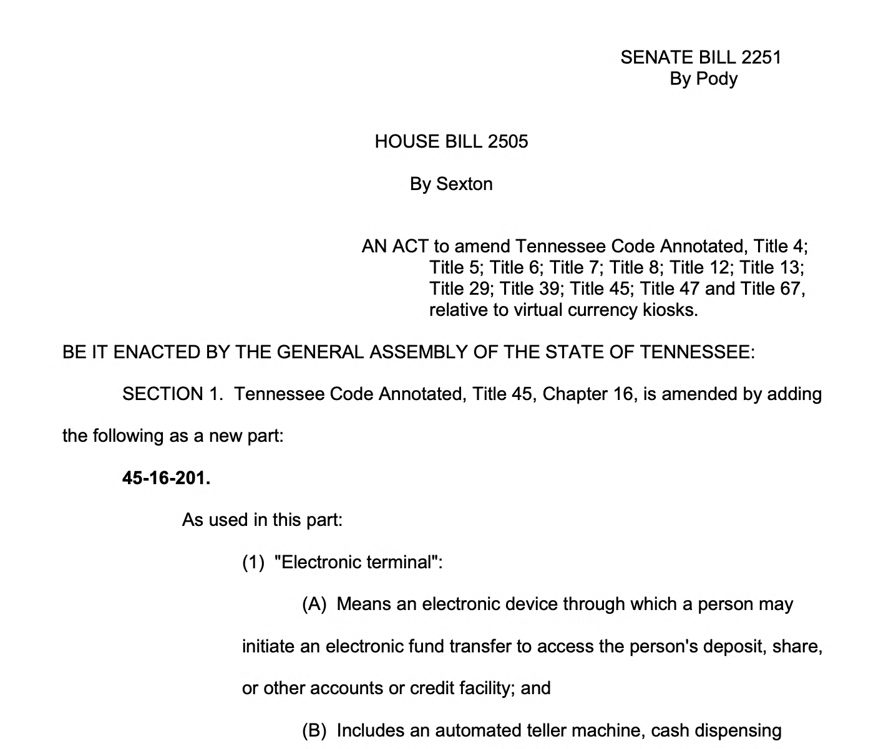
Tennessee Governor Bill Lee has signed a bill into law that will officially ban the use and installation of cryptocurrency ATMs and kiosks in the southeastern US state, leaving only a matter of weeks for companies to be in compliance.
Lee signed Tennessee House Bill 2505 into law on April 13, making the installation of a cryptocurrency kiosk a Class A misdemeanor starting on July 1. The reclassification of the machines as illegal under state law would potentially put operators and businesses hosting the machines at risk of up to 11 months and 29 days in prison and a $2,500 fine.
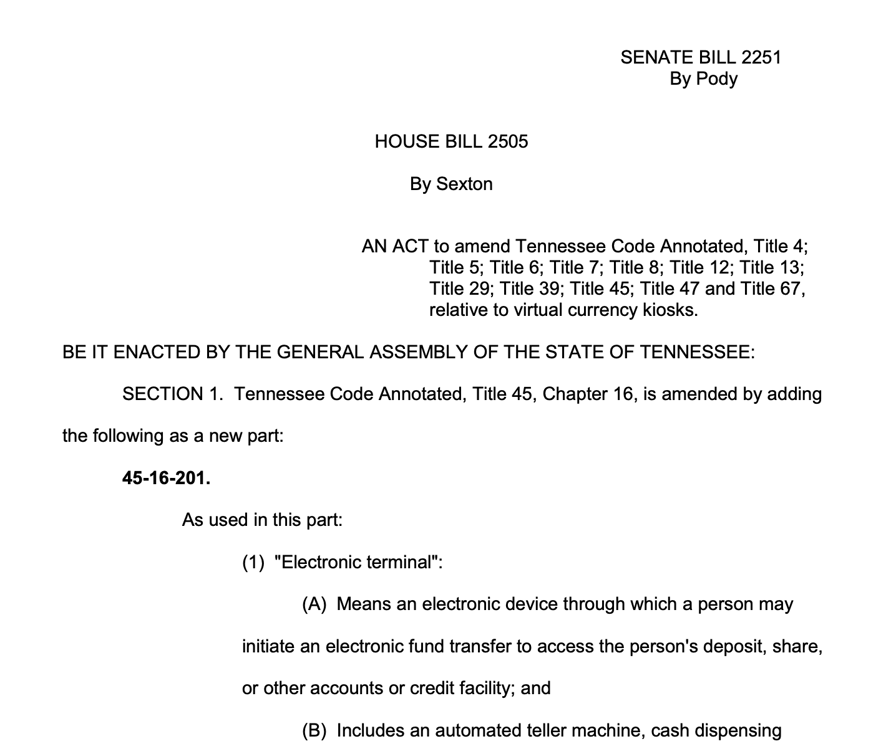
Source: Tennessee General Assembly
According to data from CoinATMRadar, there were more than 570 crypto kiosks and ATMs as of Monday, with operators including Bitcoin Depot and CoinFlip. Cointelegraph reached out to a Bitcoin Depot spokesperson for comment but did not receive an immediate response. The kiosk operator’s Nasdaq-traded shares closed down about 6.9% on Monday, according to Yahoo Finance.
The Tennessee law is just one of many state-level actions in the US targeting crypto kiosks in response to its residents being the victims of scams and other illegal activities. A Massachusetts town banned the machines earlier this month, and Minnesota’s State Senate recently advanced a bill that could ban crypto kiosks across the state.
Related: Massachusetts city to weigh crypto ATM ban, citing financial risks
“Virtual currency kiosks have become a gateway for scammers to exploit Tennesseans, especially our seniors, with little hope of recovering their money once it’s gone,” said Tennessee House Speaker Cameron Sexton, who sponsored the bill.
FBI reported Americans lost $11B to crypto scams in 2025
The US Federal Bureau of Investigation (FBI) said that cryptocurrency and AI-related scams were “among the costliest” for Americans in 2025. Its annual internet crime complaint report released in April cited more than 13,000 complaints related to crypto ATMs and kiosks last year, resulting in more than $389 million in losses.
Some of the types of scams involving ATMs include tricking people into sending Bitcoin (BTC) or other cryptocurrencies to an address by pretending to be a family member in need of assistance, or an authority figure claiming the individual needs to send money to avoid arrest or pay off a debt.
Magazine: AI-driven hacks could kill DeFi — unless projects act now


Western Union Advances USDPT Stablecoin Strategy on Solana
Western Union has moved ahead with plans to launch its USDPT stablecoin on the Solana blockchain next month. The company aims to strengthen its payment infrastructure and reduce reliance on traditional banking rails. This development follows earlier internal announcements made in late 2025.
Western Union Expands Digital Asset Network and Payment Tools
Western Union has also progressed with its Digital Asset Network platform, which links crypto wallets to its retail system. The company expects to onboard its first partner as the platform goes live this week. This integration will allow users to convert digital assets into local currencies through existing agent locations.
The firm has designed the network to support seamless interaction between blockchain assets and traditional cash systems. It aims to simplify transactions for users while maintaining familiarity for agents. This approach supports both accessibility and operational continuity.
In addition, Western Union has prepared a new product called the USD Stable Card for later release. The card will allow users to store and spend stablecoin balances globally. The company plans to target regions where local currencies face volatility and instability.
Solana Faces Price Pressure Despite Growing Network Adoption
Solana has experienced a price decline even as network activity and partnerships continue to expand. The token traded at $85.08 on April 27, reflecting a modest daily decrease. Market performance has not fully aligned with the network’s recent developments.
Solana $SOL could be setting up for a 10% move as it approaches the apex of this triangle. pic.twitter.com/uO6HnZJjcp
— Ali Charts (@alicharts) April 27, 2026
However, analysts have noted a potential technical setup that may signal a short-term price movement. Chart patterns indicate a possible breakout as the asset approaches a consolidation point. This outlook suggests that price action may shift in the near term.
Despite current pressure, Solana continues to attract institutional and enterprise-level integrations. The blockchain has positioned itself as a high-speed and low-cost platform for financial applications. These factors continue to support its role in evolving digital payment systems.
Ryan Lee, Chief Analyst at Bitget Research, says Bitcoin and Ethereum are supported by steady institutional ETF demand and lower leverage, with BTC expected to break $80,000 to $85,000 short term and ETH targeting $2,800 to $3,000.
Summary
- Bitget Research Chief Analyst Ryan Lee says the current rally has a firmer base than earlier retail-driven cycles because it is being led by institutional allocation rather than speculative positioning.
- Lee expects gold’s elevation near record highs to reflect capital distributing across multiple stores of value rather than concentrating in a single hedge.
- Oil remaining elevated adds macro pressure that could delay rate cuts and tighten liquidity, with crypto upside remaining linked to whether institutional inflows continue absorbing volatility rather than reacting to it.
Bitget Research Chief Analyst Ryan Lee says Bitcoin and Ethereum remain in a constructive short-term trend supported by steady institutional allocation, with ETF demand, lower leverage, and improving spot market participation keeping both assets on a firm footing. As crypto.news reported, US spot Bitcoin ETFs logged eight consecutive days of net inflows totaling $2.1 billion through April 23, the longest streak since October 2025, with BlackRock’s IBIT capturing approximately 75% of all capital entering the category.
Bitget Research Sees BTC Breaking $80K to $85K With Sustained Inflows
“The current move is not being driven by aggressive speculative positioning, which gives the rally a firmer base than earlier cycles shaped mainly by retail momentum,” Lee said. In the short term, Lee expects Bitcoin to break above $80,000 to $85,000 with sustained inflows, while Ethereum is expected to follow with gains toward $2,800 to $3,000, driven by ecosystem upgrades and broader adoption. As crypto.news documented, institutional spot ETF inflows and corporate balance-sheet buying have been reinforcing Bitcoin’s role as a digital reserve, with analysts noting that Bitcoin and Ethereum have outperformed gold and broad equity indices this year even as geopolitical risk and higher oil prices would typically favor bullion. Lee’s assessment that the rally has a firmer institutional base than prior retail-driven cycles aligns with that data: the eight-day inflow streak absorbed roughly 19,000 BTC against approximately 2,100 BTC produced by miners in the same period, meaning institutional demand absorbed about nine times new supply.
Gold and Oil Are Reshaping the Macro Environment for Digital Assets
Lee noted that gold holding near elevated levels reflects continued demand for defensive assets as markets price in geopolitical uncertainty, sticky inflation expectations, and slower policy easing across major economies. He described this as a sign that capital is being distributed across multiple stores of value rather than concentrated in a single hedge. As crypto.news tracked, Bitcoin ETF flows have proven sensitive to exactly that dynamic in 2026, with oil rising toward $100 per barrel earlier in the year triggering risk-off conditions that pulled over $296 million out of spot Bitcoin ETFs in a single week. Lee acknowledged that oil staying elevated adds another layer of macro pressure because higher energy costs can delay rate-cut expectations and tighten liquidity conditions across markets.
What Institutional Absorption Means for Crypto’s Position in Portfolios
Lee said that for digital assets, upside remains linked to whether institutional inflows continue absorbing macro volatility rather than reacting to it. “If that continues, crypto remains positioned as part of broader portfolio construction,” Lee said. As crypto.news noted, Lee has previously argued that ETF flows are not the only factor behind Bitcoin’s performance and that technical and macroeconomic catalysts combine with institutional positioning to drive price action across cycles. The current environment, in which institutional inflows are absorbing supply at nine times the mining rate, represents precisely the kind of structural demand base Lee’s framework identifies as more durable than speculative retail momentum.

Investigate XRP, Solana, and Hedera as three top altcoins that possess great fundamentals and have massive upside potential going into 2026.
Key Insights
- XRP strives to remain at the forefront of global low-cost and fast payment options.
- Solana has a great chance of becoming a prominent player in Web3 thanks to its advanced tech.
- The Hedera Hashgraph protocol has enterprise-grade capabilities and applications.
Ripple (XRP) Changing the Way Global Payments Are Made
In 2012, Ripple Labs launched the XRP currency to optimize global payments by removing inefficiencies found in the banking industry. While traditional finance systems depend on intermediary financial services, Ripple’s technology facilitates direct peer-to-peer transactions, which drastically reduces costs and speeds up processes.
Transactions within the XRP Ledger occur almost instantaneously, with the transaction fee usually amounting to only fractions of cents. This makes XRP highly beneficial for cross-border remittances as well as for business and financial transactions. In addition, the use of Ripple’s technology has been investigated by financial organizations around the world to improve their liquidity and payment methods.
The other key advantage of using XRP is the opportunity to convert money from one currency into another instantly. As the demand for fast and efficient payments rises, the application of XRP keeps increasing. Clearly, proper regulation can help XRP thrive.
Solana (SOL) Fast Blockchain for Future Web3 Growth
In recent years, Solana has developed into one of the most scalable and fast blockchain networks within the industry. Founded in 2018, Solana uses the innovative Proof of History protocol that allows processing tens of thousands of transactions in a single second.
The ability to perform a large number of transactions enables developers to create dApps, NFTs, and DeFi solutions that operate flawlessly on the Solana blockchain. They take advantage of relatively low gas fees and a reliable architecture to ensure scalability and prevent any kind of traffic congestions.
Apart from blockchain development, Solana focuses on innovations such as mobile applications and convenient solutions intended to facilitate access for ordinary users. Many startups have been developed by Solana teams working in the gaming, financial, and digital identity sectors.
While the developer community is dominated by Ethereum, Solana comes in close second when considering new projects launched. As long as updates are made and more institutions invest, SOL may be considered a promising choice for potential investors in Web3.
Hedera (HBAR) Enterprise Efficiency with Hashgraph Technology
One notable project using Hashgraph technology is Hedera, a platform that uses this technology instead of blockchain for more efficient results.
Since its inception in 2018, Hedera has emerged as one of the most attractive platforms for enterprises looking for blockchain technologies to use within their organizations. This platform is ideal for implementing smart contracts and many other use cases.
HBAR refers to the token used for operations within the Hedera platform. It serves various purposes, ranging from transaction operations and security through staking to file storage and computation.
Hedera’s governance structure, involving global enterprises, provides even greater assurance for its future. This project seems to be promising, especially in view of growing enterprise interest in blockchain technology.
Positioning for Long-Term Cryptocurrency Growth
XRP, Solana, and Hedera are the three pillars of the changing cryptocurrency landscape. They have solid foundations, increasing adoption rates, and established use cases, making them ideal choices for those considering long-term investments.
While every investment carries a certain level of risk, concentrating on cryptocurrencies with real-world applications and viable technology will increase the likelihood of generating returns in the future.
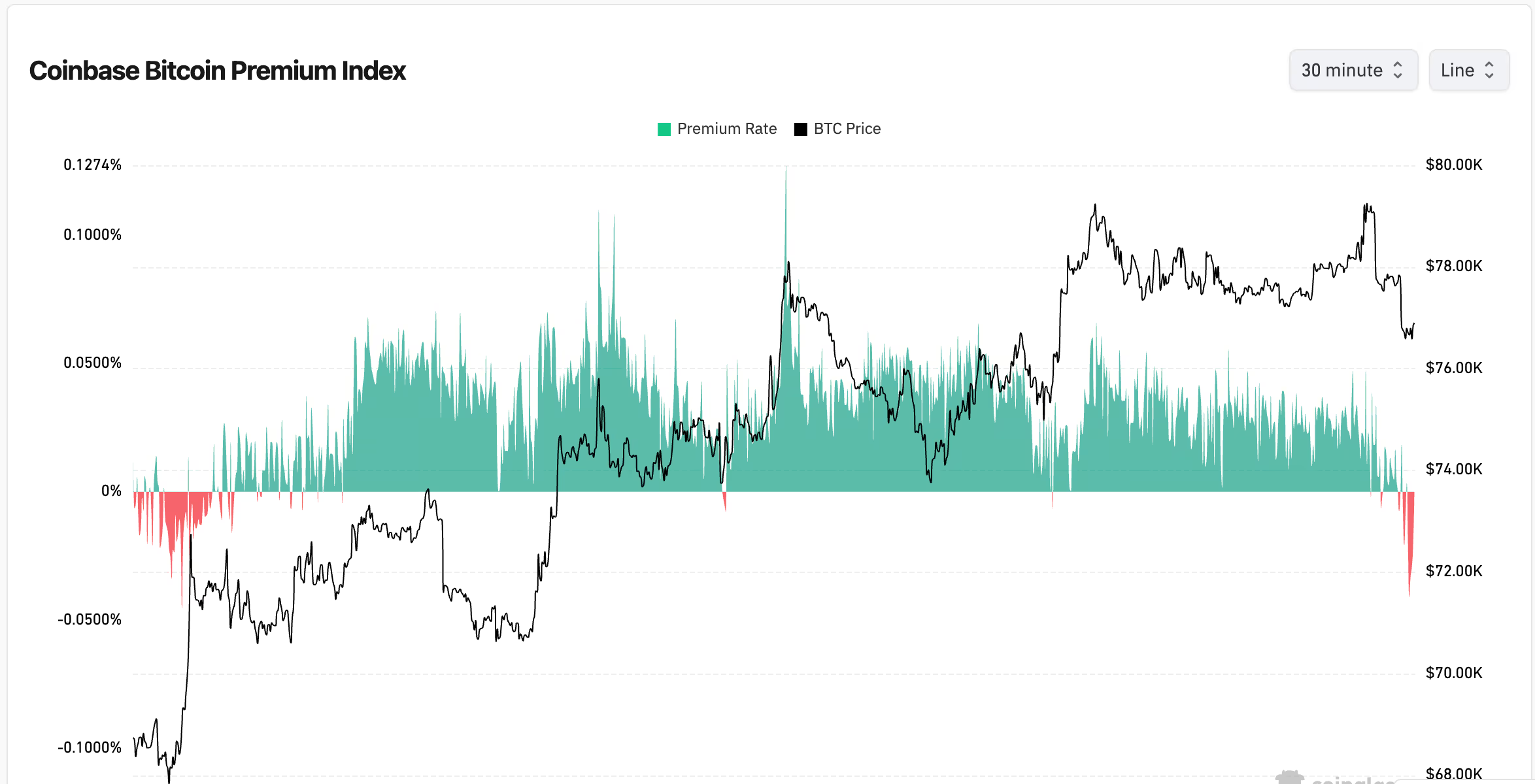
Bitcoin’s Sunday night rally stalled out near $79,400 and is beginning to show signs of fatigue, with several indicators pointing to potential short-term weakness as the price trades back around $77,000.
First, the Coinbase premium index has turned negative for the first time since April 8, according to Coinglass data.
The move to -0.04% follows a 14-day stretch of positive readings, the longest since October, that signaled consistent demand from U.S. investors and a run-up in the bitcoin price from $66,000 to $79,000.
The index measures the price difference between Coinbase, a platform for U.S. institutions, and offshore exchanges like Binance. A flip into negative territory suggests that this cohort is no longer aggressively buying, leaving the market more reliant on offshore flows. As the Coinbase premium turns negative, this tends to coincide with price pullbacks or consolidation.

At the same time, the large Bitfinex whale, closely tracked for directional pricing, remains near cycle peak long exposure. Holdings currently sit at 79,342 BTC, just shy of the 80,100 BTC high. This entity typically divests its position once a local bottom is all but confirmed or when there is clear upside momentum.
The fact that exposure remains near the cycle peak despite bitcoin’s push toward $79,000 suggests a lack of short-term upside, raising the risk of a price decline.
Adding to these headwinds, bitcoin failed to reclaim the short-term holder realized price (STHRP) at $79,200. This metric represents the average on-chain acquisition cost of coins held for fewer than 155 days, a cohort that tends to be more reactive to price swings. The longer the price stays below the STH RP, the more likely recent buyers are to continue to exit, putting further pressure on the price.
Last but not least, the flagship Bitcoin conference has begun, with prior gains already fading, and if history is any guide, further downside follows.
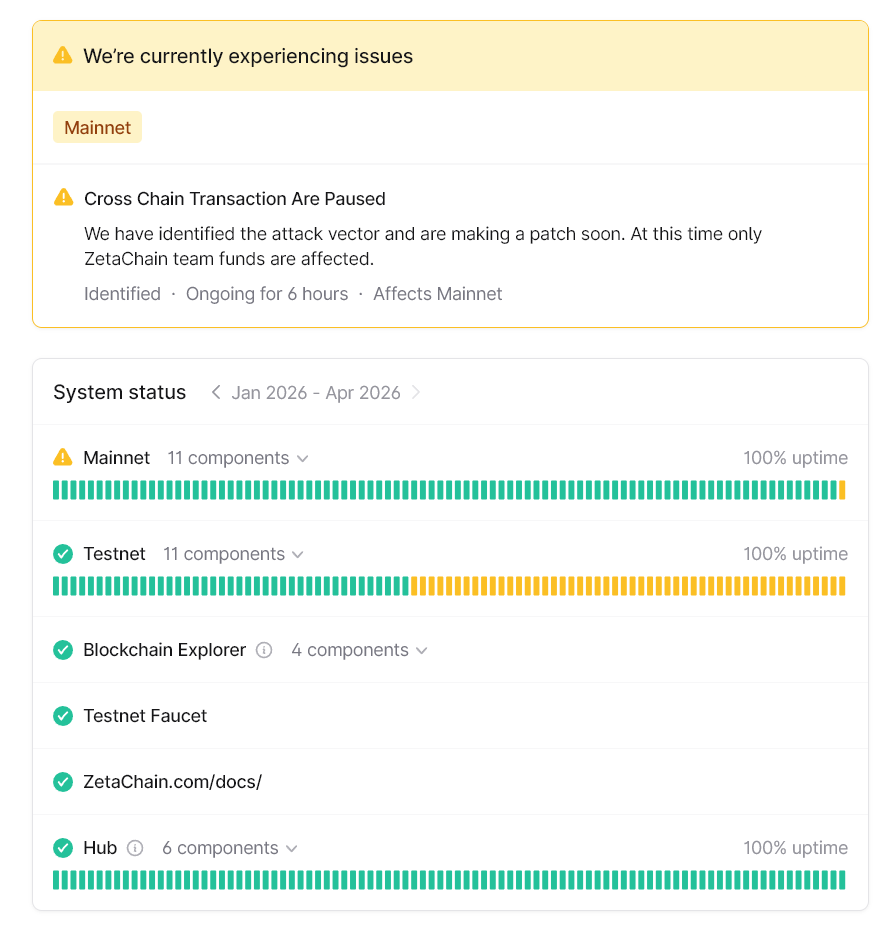
Layer-1 network ZetaChain said it was hacked on Monday. But the project claimed the attack only affected its own internal team wallets and did not hit user funds.
The network paused cross-chain transactions while the team investigated the incident. This is the second cross-chain exploit in April, after the earlier KelpDAO hack.
The team said it had already blocked the attack vector and would release a full post-mortem after completing its investigation.
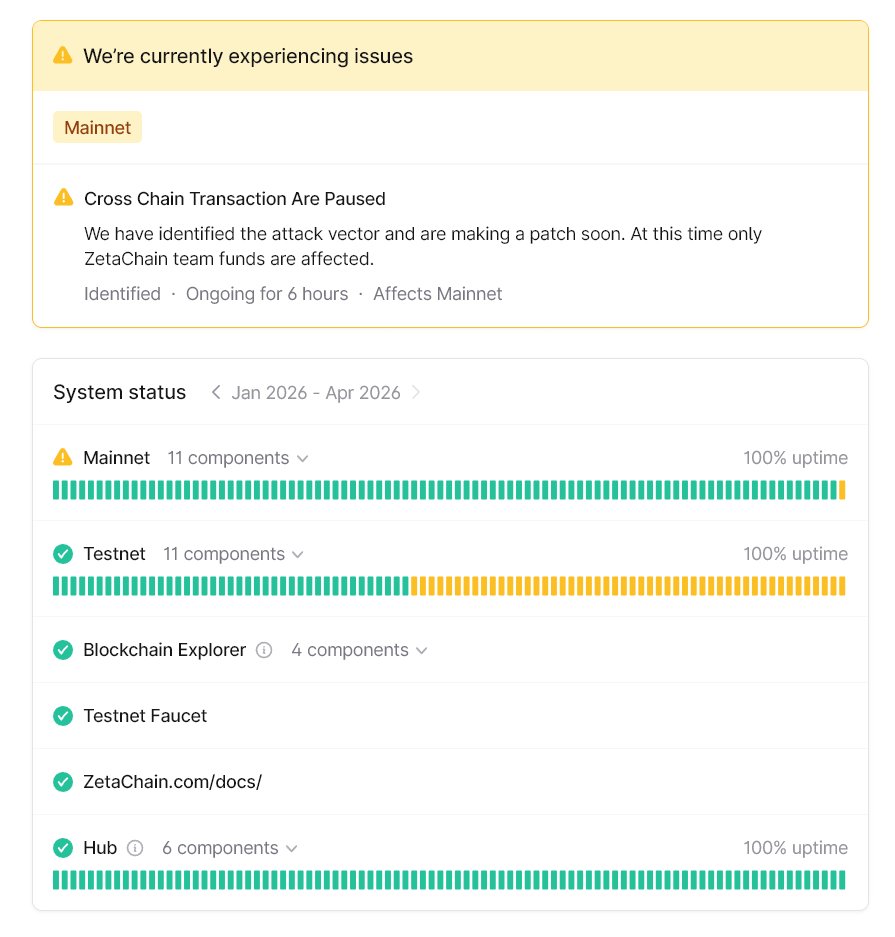
ZetaChain’s status page showed mainnet cross-chain transactions paused as a precaution.
The incident was marked as identified and ongoing for around six hours, with the status page noting that the team had identified the attack vector and was preparing a patch.
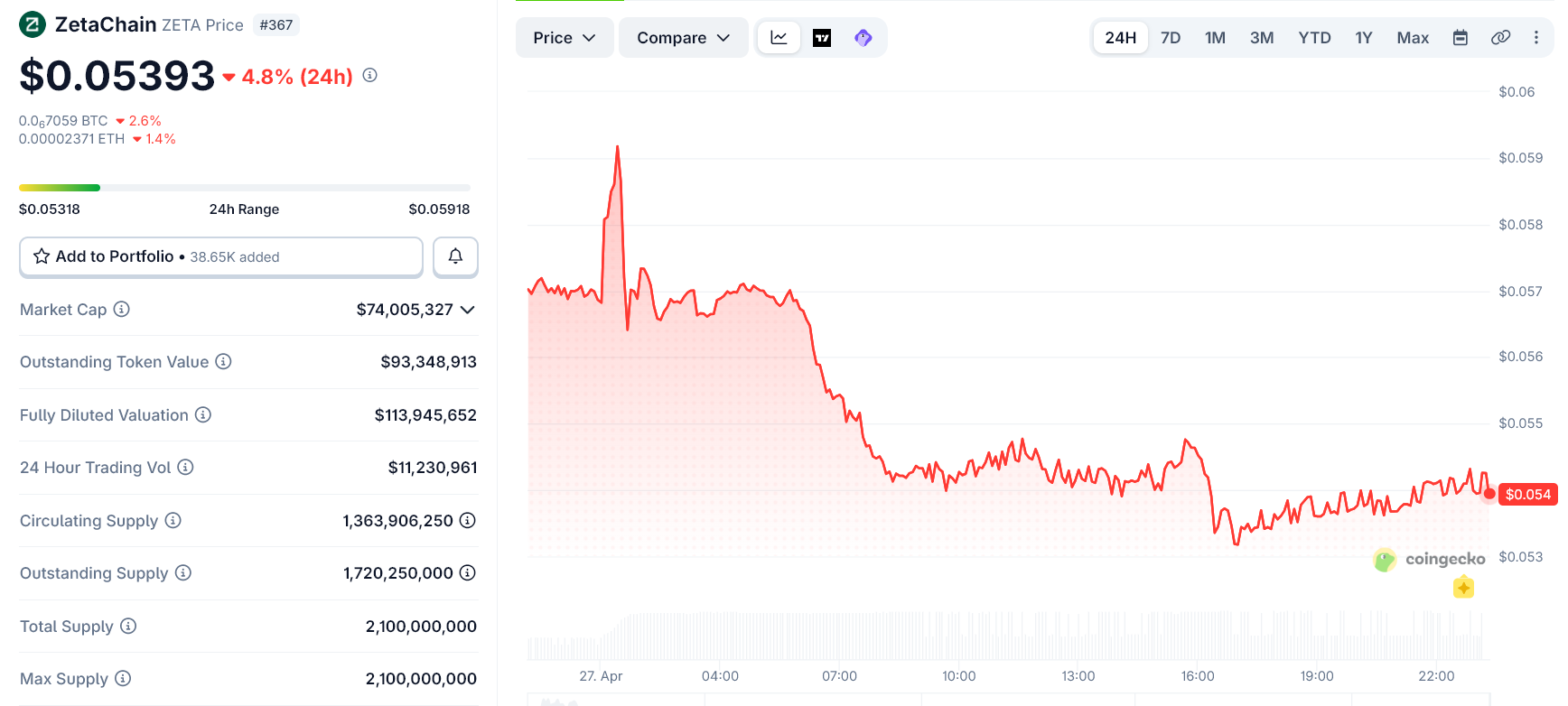
The ZETA token also traded lower during the incident. CoinGecko data shown in the attached chart placed ZETA near $0.054, down about 4.8% over 24 hours. Its 24-hour range was between roughly $0.053 and $0.059.
Community reaction was mixed. Some users praised the public disclosure, while others raised concerns about cross-chain attack surfaces after recent incidents involving interoperability infrastructure.
The post ZetaChain Pauses Mainnet After Hack Hits Team Wallets appeared first on BeInCrypto.


Sen. Thom Tillis is drawing a second red line, vowing to vote against the Clarity Act without ethics language targeting the Trump family’s crypto businesses.
The Republican broke ranks just days after lifting his hold on Kevin Warsh’s Fed chair confirmation. That blockade ended Sunday only after the Justice Department dropped its criminal probe of Fed Chair Jerome Powell.
Negotiations Inch Toward a Bipartisan Deal
Tillis is the first Senate Banking Republican to publicly demand ethics language in the bill. He joined Democratic negotiators pushing a provision aimed at the Trump family’s crypto holdings.
The proposed text would bar federal officials, including the president, from sponsoring or issuing digital assets. This is what the retiring North Carolina senator demands.
Sens. Adam Schiff and Ruben Gallego are leading Democratic talks on the ethics provision. White House crypto policy adviser Patrick Witt is steering negotiations alongside GOP Sens. Cynthia Lummis and Bernie Moreno.
Schiff said the parties are narrowing their differences as other parts of the bill come together. Republicans on the Senate Banking Committee aim to advance the legislation in the coming weeks.
“There has to be ethics language in the bill before it leaves the Senate, or I’ll go from one of the people working on negotiating it to voting against it,” Tillis reportedly told Politico.
Trump Crypto Empire Tops $1 Billion
The Trump family’s crypto ventures account for more than $1 billion of their wealth, according to Politico. World Liberty Financial, co-founded by Trump and his sons, launched the USD1 stablecoin and applied for a federal banking license.
An entity tied to the Official Trump (TRUMP) meme coin hosted nearly 300 top holders at a Mar-a-Lago conference Saturday.
Republicans face a narrow legislative window before the midterm elections. Tillis’s pattern of conditional votes shows how hard passage will be without a bipartisan ethics deal.
The post Senator Tillis Draws New Red Line on the CLARITY Act appeared first on BeInCrypto.


dLocal (NASDAQ: DLO) has launched Stablecoin Full, a stablecoin payments solution that enables merchants to collect, convert, and pay out funds in stablecoins across more than 44 emerging markets through a single API.
Summary
- Stablecoin Full allows global merchants to accept stablecoin payments at checkout, send payouts in stablecoins, and manage treasury operations across 44-plus markets through one integration.
- The product treats stablecoins as a local payment method within dLocal’s existing platform, removing the need for merchants to build separate crypto infrastructure or manage market-by-market regulatory complexity.
- The launch was announced on April 21, 2026, from Montevideo, Uruguay, with Marcelo Dutilh, Product Lead for Stablecoins at dLocal, credited as the product lead.
dLocal stablecoin payments went live on April 21 when the company announced the launch of Stablecoin Full, a product designed to let global merchants accept, convert, and pay out funds using stablecoins across high-growth economies in Africa, Asia, the Middle East, and Latin America. Merchants operating across these markets have historically faced a combination of multiple currencies, fragmented liquidity, foreign exchange volatility, and different regulatory requirements in each country.
dLocal Stablecoin Full Positions Stablecoins as a Standard Local Payment Method
Stablecoin Full provides a single compliant infrastructure through which merchants can accept stablecoins at checkout, choose settlement in either USD or stablecoins, send payouts globally in stablecoins, convert between local currency and stablecoins, and manage reporting and reconciliation across all flows in one integration. The offering is aligned with dLocal’s broader “One dLocal” model, where merchants use a single API, platform, and contract to access local payment capabilities across multiple markets without managing separate local entities. As crypto.news reported, stablecoin transaction volume hit $1.78 trillion in February 2026 alone as infrastructure across emerging market corridors continues to mature. “Emerging markets are where the next wave of digital consumers is coming from, but moving money in and out of these economies is still complex,” said Marcelo Dutilh, Product Lead for Stablecoins at dLocal. “With Stablecoin Full, we treat stablecoins as just another local payment method inside dLocal’s platform. Merchants get the benefits of faster, more flexible rails, without having to manage crypto infrastructure or regulatory complexity.”
The Compliance and Infrastructure Layer Behind the Product
The solution is designed to align stablecoin flows with local regulations, data requirements, and compliance standards in each market where dLocal operates. According to dLocal, the infrastructure coordinates stablecoin and fiat flows across pay-ins, payouts, treasury, and on/off-ramps within a unified reporting and reconciliation environment. As crypto.news documented, companies deploying stablecoin payments across multiple jurisdictions typically rely on providers that handle payment processing, identity verification, regulatory compliance, and conversion between fiat and stablecoins through a single infrastructure layer. “Stablecoins are moving from experimental to real payment infrastructure,” Dutilh added. “Our merchants don’t want to become crypto experts or navigate regulation market by market. They want a single partner that handles that complexity for them. That’s exactly what dLocal provides.”
Why Stablecoins Are Gaining Traction in High-Inflation Emerging Markets
Stablecoins have found particular traction in high-inflation markets where they are already used daily for remittances, savings, and e-commerce. As crypto.news tracked, stablecoins now process $27.6 trillion annually, outpacing Visa and Mastercard combined, with cross-border remittances running 60% cheaper than traditional methods and B2B settlements settling instantly rather than over multi-day windows. For merchants selling into emerging markets, the shift to stablecoin rails reduces dependence on correspondent banking chains that trap capital in prefunded accounts across multiple regions. dLocal said Stablecoin Full is designed to work alongside existing local payment methods rather than replacing them, extending the company’s infrastructure into digital asset flows without requiring merchants to adopt a separate system.
Canada is moving closer to banning political donations made in cryptocurrency, as lawmakers in Ottawa tighten rules around how money flows into elections.
That’s after a proposed law — Bill C-25, the Strong and Free Elections Act — passed a second reading in the House of Commons on Friday. The vote signals that lawmakers support the bill in principle and will now study it in detail at committee, where amendments can still be made.
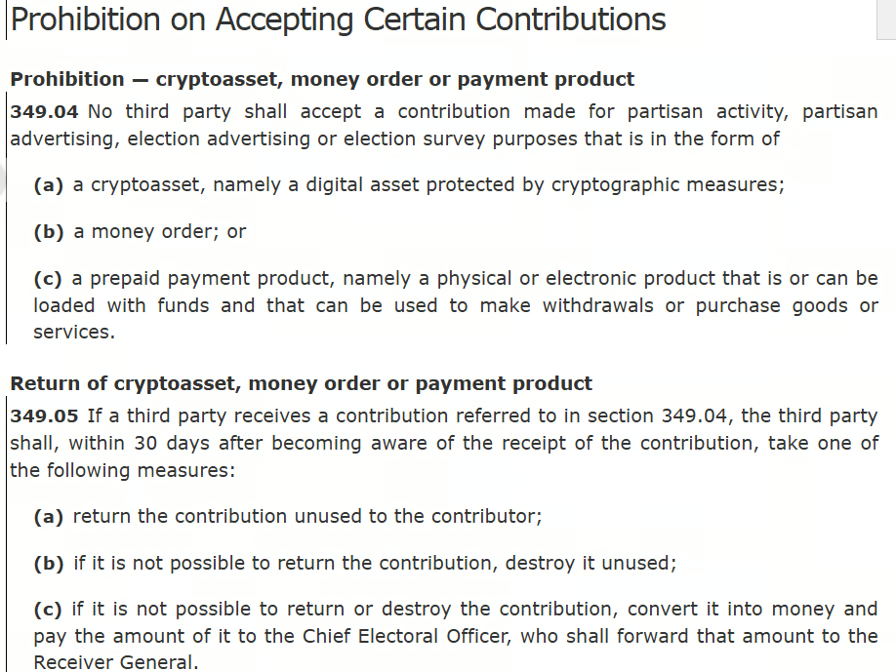
The legislation would prohibit political parties and candidates from accepting cryptocurrency donations, closing what regulators see as a gap in campaign finance rules.
First introduced on March 26, the bill is a broader overhaul of election laws aimed at strengthening transparency, tightening enforcement and reducing the risk of foreign interference. As Cointelegraph previously reported, crypto donations became a focal point due to concerns over traceability and compliance with existing limits.
While the bill is not solely focused on digital assets, it explicitly includes crypto in its restrictions on political financing.
There is no fixed date yet for when Bill C-25 will be taken up in committee.
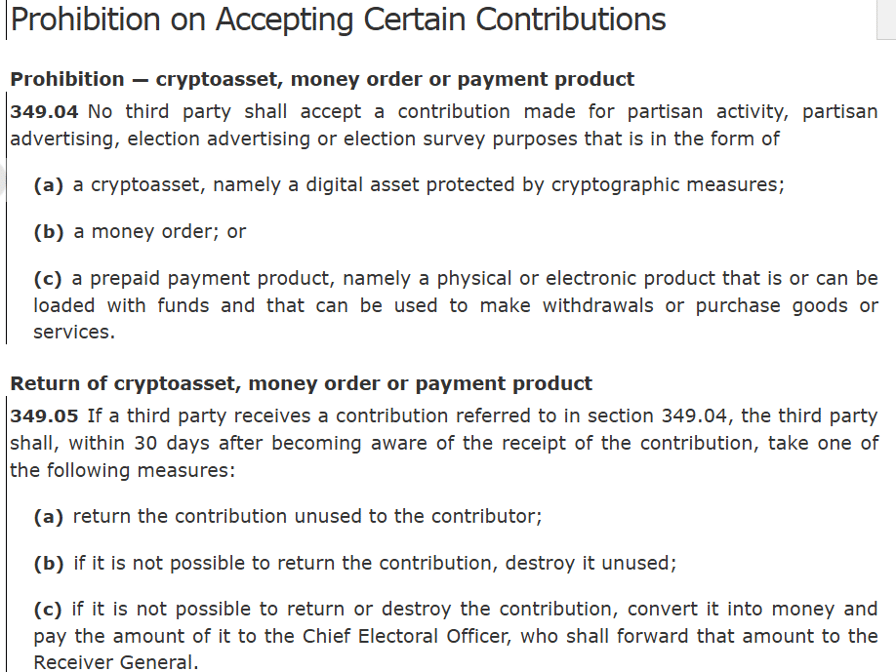
An excerpt from Bill C-25. Source: Parliament of Canada
Related: Canada’s bid to ban crypto donations highlights transparency issue
Political ban comes amid Canada’s crypto embrace
The proposed ban comes as cryptocurrencies and blockchain infrastructure become more embedded in Canada’s financial system.
Regulators have advanced stablecoin frameworks that would give oversight powers to the Bank of Canada, while also refining rules for crypto investment funds, custodians and cold storage practices.
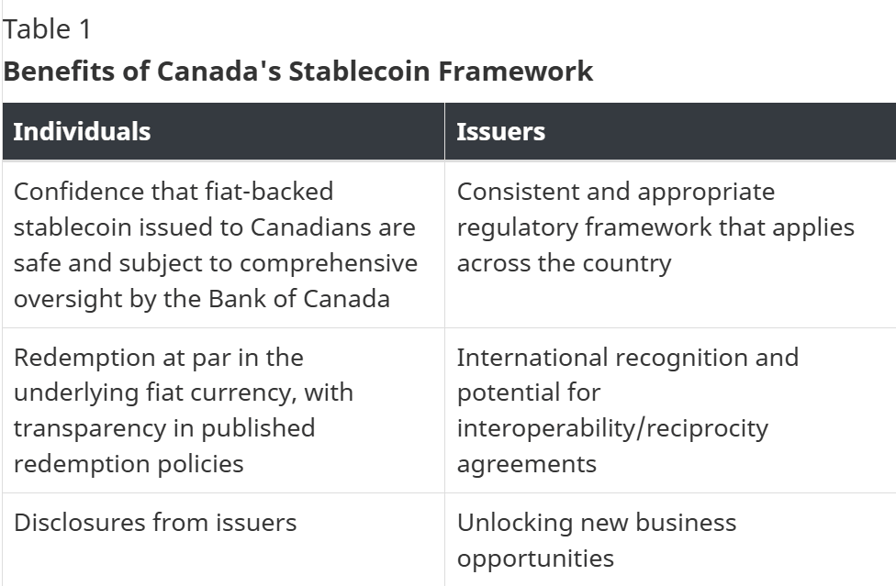
Canadian lawmakers have identified several potential benefits of a national stablecoin framework. Source: Government of Canada
This shift is unfolding under Prime Minister Mark Carney, a former central banker who has previously expressed skepticism about cryptocurrencies. Despite that stance, policymakers are moving toward a more defined regulatory structure that integrates digital assets into the financial system while imposing tighter limits on their use in sensitive areas such as elections.
Related: Deloitte, Stablecorp plan stablecoin infrastructure for Canadian institutions
Bored Apes, Mutant Apes, Pudgy Penguins, Azuki and Doodles are all up double digits on the month.
The NFT sector has posted its strongest 30-day performance in months, with Yuga Labs’ flagship collections soaring and Azuki, Doodles, and Meebits catching bids.
The global NFT market cap sits at $1.87 billion after topping $2 billion over the weekend for the first time in three months, according to CoinGecko.
Yuga Ecosystem Leads
Bored Ape Yacht Club’s floor is 9.49 ETH, or roughly $21,715, up 15% on the week and 79% over the past 30 days. Meanwhile, Mutant Ape Yacht Club is up 26% on the week and 112% on the month. Otherdeed Expanded and Otherdeed for Otherside, the metaverse land tied to the Yuga ecosystem, are up 66.2% and 37.4% over 30 days, respectively.
While there is no clear catalyst for the move, Yuga Labs recently settled its long-running trademark suit against artist Ryder Ripps and partner Jeremy Cahen.
Other Ethereum blue chips are also participating. Azuki is at 1.09 ETH, up 28% on the week and 61% on the month, while Doodles is up 30% and Clone X is up 28% over 30 days. Meebits, the pixel-art collection that Yuga acquired from Larva Labs and subsequently sold, is up 28% on the month.
CryptoPunks Maintain Top Spot
CryptoPunks remain the largest collection by market cap, with the floor at 30.94 ETH, or about $70,805, up 16% on the week and 7.6% on the month. The relatively muted 30-day performance likely reflects the collection’s much higher starting base.
Pudgy Penguins, the third-largest collection, has rallied harder, with the floor at 5.05 ETH, up 15% on the week and 25% on the month. The collection has been a focal point for crypto-native consumer IP this cycle, with parent Igloo Inc. launching its browser-based Pudgy World metaverse in March and a mobile racing title that briefly topped Apple’s App Store rankings last year.
Canary Capital’s proposed spot PENGU ETF, which would also hold up to 15% of assets in Pudgy Penguins NFTs, remains pending at the SEC.
This article was written with the assistance of AI workflows. All our stories are curated, edited and fact-checked by a human.

TLDR
- Voltage conducted a 30-day pilot that processed 88.2 BTC over the Bitcoin Lightning Network for an iGaming operator.
- The pilot handled 237,000 payments with a 99.94% success rate and an average settlement time of 1.86 seconds.
- The report found that 80% of deposits and withdrawals came from Cash App users using Lightning.
- Bitcoin Lightning reduced transaction fees to about 0.0029% per payment during the trial period.
- Lightning transactions removed chargeback risk because payments settle instantly and remain irreversible
Bitcoin’s Lightning Network is moving deeper into online gambling payouts, according to a new report from Voltage. The company released fresh pilot data that shows instant withdrawals and near-zero fees for operators. The findings position Lightning as a working payment rail for real-time betting markets.
Voltage based its report on a 30-day pilot with a single iGaming operator. During that period, the platform routed 88.2 BTC through Lightning and processed 237,000 payments. The system recorded a 99.94% success rate and averaged 1.86 seconds for settlement.
The company stated that 80% of deposits and withdrawals came from Cash App users. That figure shows that mainstream wallets already support large Lightning volumes. Voltage said this dynamic brings Bitcoin closer to daily payment use inside gambling platforms.
Bitcoin Lightning Cuts Fees and Settlement Times
Voltage compared on-chain Bitcoin transfers with Bitcoin Lightning transactions in the report. On-chain payments can take minutes or hours, and fees can rise during congestion. By contrast, Lightning routes payments through peer-to-peer channels and settles later on the base chain.
The pilot showed that operators paid fees of under one cent per transaction. Voltage calculated that the average fees reached about 0.0029% of the transaction value. The report said Lightning runs about 1,000 times cheaper than card processors on a percentage basis.
Traditional card networks usually charge between 2.9% and 5% per payout. They also allow chargebacks weeks after funds leave an account. Lightning transactions are final and irreversible, which removes chargeback exposure.
Voltage wrote, “Operators do not need to trust a separate governance structure or bridge.” The company added that Lightning inherits Bitcoin’s proof-of-work security when channels close. As a result, operators can move funds without relying on external validator groups.
The report stated that instant settlement reduces reserve balances held for processing risk. Operators can free capital that would otherwise sit in clearing accounts. That shift increases capital velocity inside live betting platforms.
Bitcoin Lightning Gains Traction in iGaming
Voltage-linked payout speed is directly tied to player retention metrics. Surveys cited in the report showed that 72% of players rank payout speed among their top three loyalty drivers. The data also showed that 71% left a platform due to slow withdrawals.
The company argued that instant Bitcoin Lightning payouts create a direct link between gameplay and wallet balance updates. A winning bet can reflect in seconds inside a supported wallet. That speed reinforces user trust in platform operations.
The report also compared Lightning with other blockchain networks. Ethereum mainnet can move ERC-20 tokens but uses 15-second blocks and a shared global state. Fees on Ethereum can rise to $10 or $30 during congestion periods.
Voltage said Tron and Solana offer lower fees and higher throughput. However, it pointed to smaller validator sets and past outages on those networks. The company presented Bitcoin’s network effect as a differentiating factor.
Public Lightning capacity now stands in the thousands of BTC, according to the report. Mobile Lightning wallets number in the millions worldwide. Voltage also references Taproot Assets, which allow stablecoins like USDT to move over Lightning rails.
Tether has announced support for Lightning-based transfers using this framework. That setup combines dollar-linked balances with Bitcoin infrastructure. The report closed by stating that operators can now process instant BTC or USDT payouts over the same network.


Western Union Pushes USDPT Stablecoin Launch on Solana Network

Virat Kohli Can’t Keep Calm As Delhi Capitals Lose 6 Wickets For 8 Runs vs RCB In Worst Powerplay Display

Letterboxd, the social platform for film buffs, reportedly looking for new owner

Manchester United reach agreement with Casemiro over contract clause amid transfer speculation

US brings back mandatory military draft registration

Steven Gerrard disagrees with Gary Neville over ‘shock’ Chelsea and Arsenal claim | Football


-

 Fashion3 days ago
Weekend Open Thread – Corporette.com
-
Crypto World2 days ago
Hyperliquid $HYPE Rally Builds Momentum as AI Sector Enters Prove-It Phase
-

 Tech6 hours ago
Register Renaming | Hackaday
-

 Politics5 days ago
Making troops accountable for war crimes threatens US alliance, ex-SAS colonel warns
-

 Politics5 days ago
Disabled people challenge government SEND proposals over segregation concerns
-

 Business4 days ago
Patterson-UTI Energy, Inc. (PTEN) Q1 2026 Earnings Call Transcript
-

 Business6 days ago
Rolls-Royce Voted UK’s Most Iconic Trade Mark as IPO Register Hits 150
-
 Crypto World6 days ago
Five Value Stocks with Recovery Potential in 2026: PayPal (PYPL), Nike (NKE), and More
-
 Sports1 day ago
IPL 2026: Ruturaj Gaikwad registers slowest fifty of the season, enters all-time unwanted list | Cricket News
-

 Politics5 days ago
Starmer handler McSweeney to be dragged from shadows by Foreign Affairs Committee
-

 Politics5 days ago
Zack Polanski responds to home secretary’s taser threat
-
Politics5 days ago
Wings Over Scotland | How To Get Away With Crimes
-

 Crypto World6 days ago
New York sues Coinbase, Gemini over prediction market offerings
-
Entertainment6 days ago
Sydney Sweeney cameo cut from “The Devil Wears Prada 2”, source explains why (exclusive)
-
 Business6 days ago
HCL Tech share price tank over 9% after weak Q4. JPMorgan, HSBC & 3 others cut target price
-

 Politics5 days ago
‘Iran is still a nuclear threat’
-

 Crypto World6 days ago
Crypto’s great hope in Senate’s Clarity Act still has a path to survive tight calendar
-
 Sports5 days ago
Tim Bradley names the current best in the world: “Better than Inoue and Usyk”
-

 Fashion6 days ago
Kilkenny Design New Beauty Arrivals for Spring 2026
-

 NewsBeat2 days ago
LK Bennett closes all stores after entering administration
You must be logged in to post a comment Login