
Crypto World
Tennessee Imposes Crypto Kiosks Ban, Effective July 1


Tennessee Governor Bill Lee signed into law a bill that effectively curtails the deployment of cryptocurrency kiosks and ATMs in the state, setting a rapid compliance timeline for operators. House Bill 2505, enacted on April 13, reclassifies the installation of a crypto kiosk as a Class A misdemeanor beginning July 1, exposing operators and hosting venues to penalties of up to 11 months and 29 days in jail and a $2,500 fine for violations.
Industry data show Tennessee is home to more than 570 crypto kiosks and ATMs, with operators including Bitcoin Depot and CoinFlip active in the state. Market data reflected the regulatory development, as Bitcoin Depot’s Nasdaq-traded shares closed down roughly 6.9% on Monday, per Yahoo Finance, underscoring investor sensitivity to policy shifts affecting the on‑ramp sector.
The Tennessee measure sits within a broader pattern of state‑level actions aimed at crypto kiosks, particularly after episodes in which residents reported scams and other illicit activity linked to these machines. A Massachusetts town recently moved to ban the machines, and Minnesota’s State Senate advanced legislation that could extend a statewide prohibition.
“Virtual currency kiosks have become a gateway for scammers to exploit Tennesseans, especially our seniors, with little hope of recovering their money once it’s gone,” said Tennessee House Speaker Cameron Sexton, the sponsor of the bill.
Key takeaways
- HB 2505, signed by Governor Lee, bans the installation of cryptocurrency kiosks in Tennessee starting July 1, making violations a Class A misdemeanor with penalties up to 11 months and 29 days in prison and a $2,500 fine.
- Current data indicate Tennessee hosts more than 570 crypto kiosks and ATMs, operated by players such as Bitcoin Depot and CoinFlip.
- Bitcoin Depot’s stock performance reflected the regulatory environment, with shares down about 6.9% on the day of the law’s enactment.
- This move is part of a wider U.S. crackdown, with Massachusetts and Minnesota weighing or advancing restrictions on crypto kiosks in recent weeks.
- Federal data underline the risk environment: the FBI’s 2025 Internet Crime Report highlighted crypto and AI scams as costly, with more than 13,000 complaints about crypto ATMs and kiosks and losses topping $389 million.
Legislation tightens the screws on crypto on-ramps in Tennessee
The core of HB 2505 is a redefinition of what constitutes permissible activity around crypto-onramps within the state. By classifying the installation of a crypto kiosk as a Class A misdemeanor starting July 1, Tennessee suppliers and venues hosting these machines face meaningful criminal exposure for enabling such services. The policy rationale, as cited by supporters, centers on safeguarding residents—particularly seniors—from scams facilitated by kiosk-based crypto transfers. The bill’s sponsor, House Speaker Cameron Sexton, characterized the measure as a necessary response to escalating concerns about consumer protection in the digital currency space.
Industry landscape and market reaction
With more than 570 kiosks and ATMs reported in Tennessee, operators have built a sizable footprint in the state. The presence of major players like Bitcoin Depot and CoinFlip underscores the commercial importance of these machines even as regulators move to constrain their proliferation. The immediate market response—Bitcoin Depot’s stock decline on the day of the bill’s signing—illustrates the sensitivity of public markets to state regulatory shifts that could affect the economics of kiosk deployments, maintenance, and consumer trust.
Beyond Tennessee, the regulatory weather in the United States is increasingly heterogeneous. Massachusetts, for example, has seen local jurisdictions weigh bans on crypto kiosks, and Minnesota’s legislature has considered measures to ban or restrict the machines at the state level. Operators and investors alike are watching how these state-level actions might converge or diverge, potentially pushing the sector toward more centralized or alternative on-ramp channels.
Regulatory backdrop and the risk landscape for kiosk operators
The crackdown on crypto kiosks is taking place against a backdrop of rising enforcement activity in the broader crypto and digital‑asset sector. The FBI’s 2025 Internet Crime Report underscored that crypto and AI‑related scams were among the costliest threats to Americans online. The report documented more than 13,000 complaints tied to crypto ATMs and kiosks, resulting in losses of at least $389 million. Authorities point to scam modalities that exploit social engineering, including impersonation of family members or authorities to induce transfers to crypto wallets, highlighting why regulators view on‑ramp points as high-risk channels for illicit behavior.
The Tennessee measure also aligns with a broader policy trajectory that treats crypto kiosks as a potential vector for fraud, money laundering, and other illegal activities. As policymakers weigh additional restrictions, the on‑ramp sector could experience accelerated consolidation, relocation, or pivot toward regulated, compliant configurations that emphasize consumer protections and transparent fee structures. The coming weeks will likely determine which operators, if any, reconfigure their footprints in Tennessee and how other states respond to similar concerns.
For readers watching policy developments, the immediate question is how many more jurisdictions will introduce bans or tighter controls on crypto kiosks and what alternative on-ramps will emerge to serve users while balancing safety and innovation. The next regulatory moves in Minnesota, Massachusetts, and other states will be telling indicators of the sector’s trajectory in 2026.

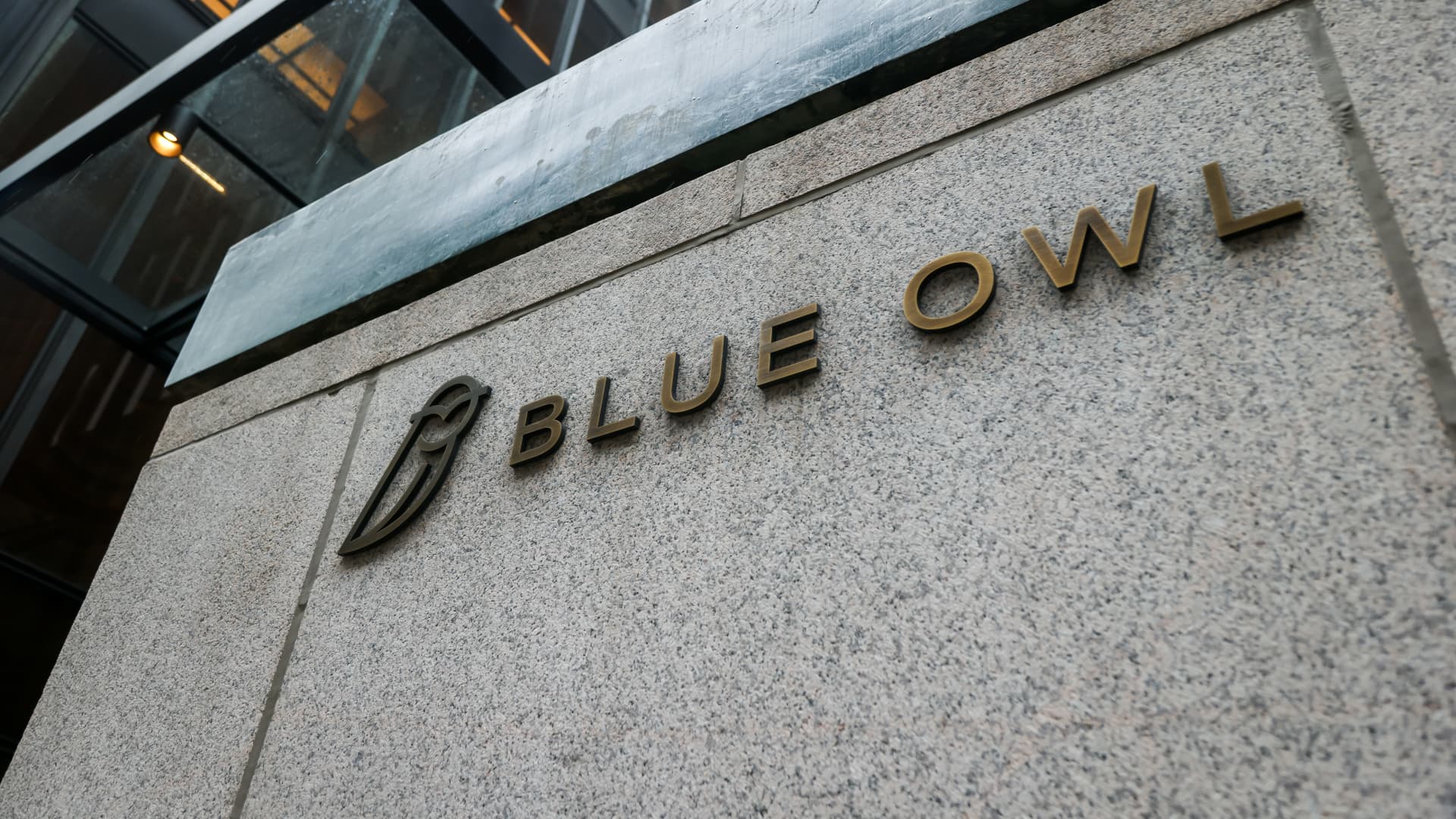
Blue Owl signage outside the Seagram Building at 375 Park Avenue in New York, US, on Thursday, March 12, 2026.
Michael Nagle | Bloomberg | Getty Images
Saba Capital Management said that the tender offers for shares in non-traded business development companies managed by Blue Owl Capital and Starwood Capital came in “below initial expectations.”
In early March, the hedge fund Saba offered liquidity to locked-up investors in Blue Owl Capital Corporation II (OBDC II), a non-traded private-credit fund, at a 35% discount. It launched a similar program at Starwood Real Estate Income Trust (SREIT) at a 24% or 29% discount, depending on the share class.
On Monday, Saba said that through the tenders, it was able to acquire about $10 million in aggregate face value across 190 separate trades, “substantially all” from SREIT. The tender for Blue Owl shares reportedly failed to garner more than 1% of what was offered.
The disinterest by investors in garnering liquidity at a steep discount comes amid a quarter that saw elevated redemptions across most private-credit, non-traded BDCs. Blue Owl was among the poster children of this phenomenon, halting quarterly redemptions in OBDC II in mid-February, and opting instead to return capital periodically through portfolio asset sales. In early April, investors sought to redeem $5.4 billion from two of its other private-credit funds during the first quarter. Like many of its peers, the fund manager opted to cap these requests at 5%.
In the wake of the OBDC II decision, Saba Capital’s Boaz Weinstein told CNBC that they were “hearing from investors in these funds that they wanted their money back,” which is why the firm saw a market opportunity. As such, Saba announced on Monday that it was “considering providing bids on a number of additional products, including the Cliffwater interval fund and Blue Owl’s OCIC.”
“Saba’s goal is straightforward: retail investors in these products deserve access to liquidity, just as investors in public BDCs have long enjoyed,” Saba said in a statement. “We intend to be a consistent, credible bid in this market.”
The hedge fund said that following its public activity in SREIT, Starwood Chairman and CEO Barry Sternlicht announced a commitment to inject equity capital to fund investor redemptions. Saba said it “commends” Sternlicht for that decision.
“We believe our entry into this market was a catalyst for that outcome and that all SREIT investors have benefitted as a result,” the firm said.
Saba said that in terms of OBDC II, the “pool of illiquid capital available to tender was naturally limited” due to only $332 million remaining in the fund. However, the firm said it sees credit risk accumulating into 2027 and 2028 and believes the “opportunity set for providing liquidity at scale will grow considerably.”
“Saba believes the question is not whether this space will experience significant stress, but when,” the firm said in Monday’s statement. “Hundreds of billions of dollars of private credit are currently held by retail investors in products that offer limited or no secondary liquidity. Saba intends to be a consistent source of that liquidity – and to have the capital deployed and ready when the need intensifies.”
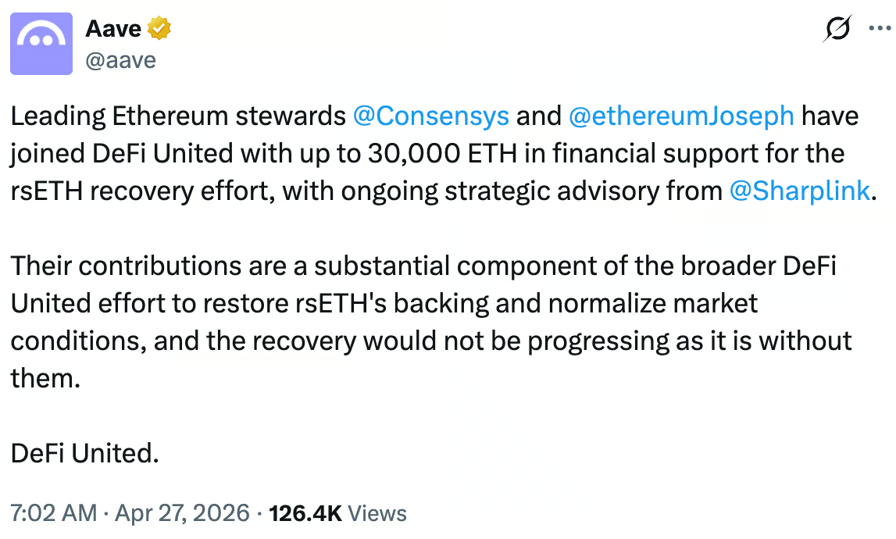
Consensys and Ethereum co-founder Joe Lubin have joined DeFi United, committing as much as 30,000 ETH to a recovery effort aimed at restoring rsETH backing after a $290 million bridge exploit triggered widespread disruptions across DeFi.
The initiative, led by participants in Aave DAO, aims to support affected users and stabilize rsETH markets, with governance approvals still pending across involved protocols.
The funding is intended to provide immediate liquidity while governance processes continue, with an eye on limiting disruption across DeFi protocols. Sharplink, a publicly traded Ethereum treasury company, has joined in an advisory role to help structure the recovery plan.
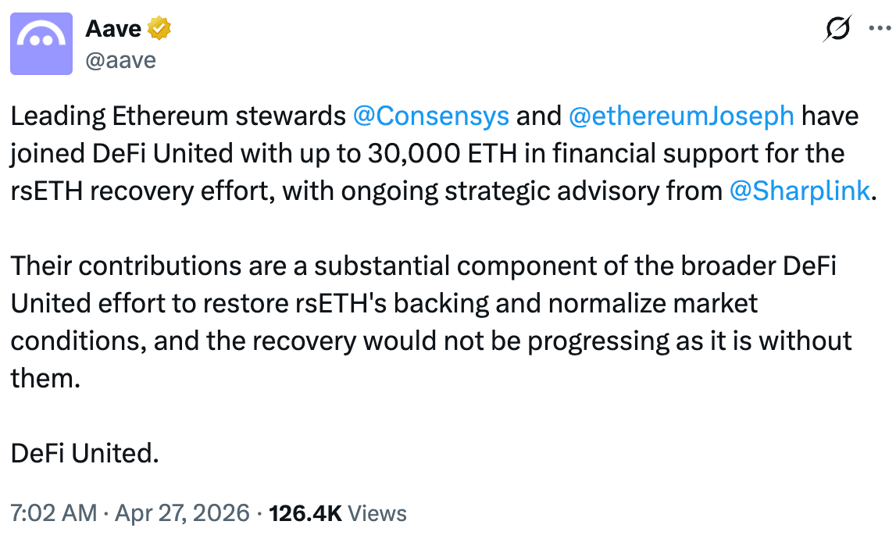
Source: Aave on X
DeFi United was announced April 23 by service providers to Aave DAO, with participants including Lido, EtherFi, Ethena, Mantle and Frax, among others.
The recovery effort follows an April 18 exploit that drained roughly 116,500 rsETH, worth about $290 million, from a LayerZero-based bridge operated by Kelp DAO.
The incident triggered disruptions across the DeFi ecosystem, with dozens of protocols pausing some functions. On Aave, the attacker used rsETH as collateral to borrow liquidity, contributing to as much as $200 million in bad debt and forcing the protocol to freeze rsETH markets.
According to LayerZero Labs, the exploit was linked to a configuration issue in Kelp’s setup that relied on a single verification path for cross-chain messages.
Separately, Circle said Monday that its venture arm is purchasing AAVE tokens to support the protocol and broader DeFi ecosystem.
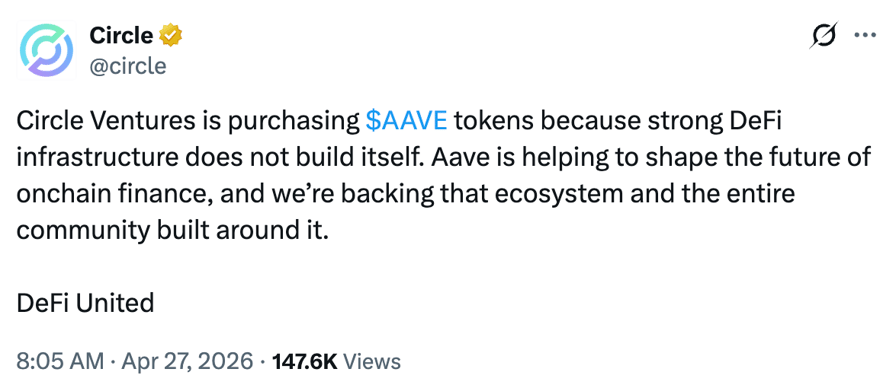
Source: Circle on X
Related: Aave asks Arbitrum to send 30K ETH from Kelp exploiter to ‘DeFi United’
DeFi hacks surge in April
The incident comes amid a wave of recent attacks targeting DeFi protocols. According to DefiLlama, about $729 million has been lost to crypto hacks over the last 90 days, with roughly $623 million occurring in April alone.
The month began with a roughly $280 million exploit of Drift Protocol on April 1, carried out through a social engineering attack by an attacker suspected to have ties to North Korea.
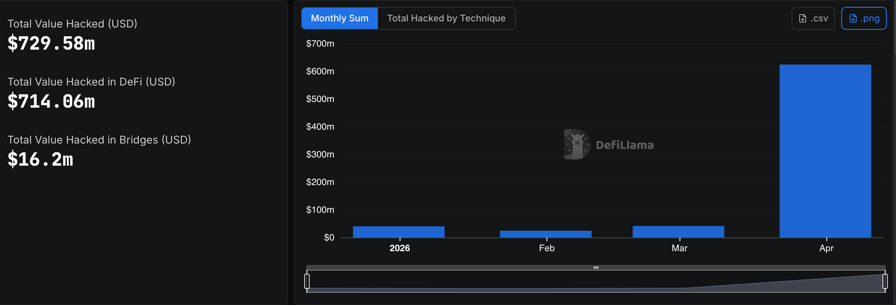
DeFi hacks, February-April 2026. Source: DefiLlama
Two weeks later, Rhea Finance said an attacker exploited a vulnerability in its margin trading feature to manipulate liquidity pools, resulting in roughly $7.6 million in losses, according to CertiK. The protocol has since paused operations and is undergoing a phased recovery, with most funds recovered and some USDT still frozen pending release by Tether.
The string of attacks also includes smaller exploits earlier in the month, such as a $410,000 loss at Dango on April 13, a $392,000 oracle-related incident at Silo Finance on April 3 and a $423,000 access control exploit at Aethir on April 9.
While none of the recent attacks have been conclusively linked to artificial intelligence, researchers say advances in the technology are making it easier to identify and exploit vulnerabilities in DeFi systems.
In late 2025, researchers at Anthropic found that AI models could identify more than half of known smart contract exploits, highlighting how the technology could accelerate future attacks.
Data from Polymarket shows traders are pricing in a high likelihood of another major crypto hack this year, with odds at 84% by the end of 2026.
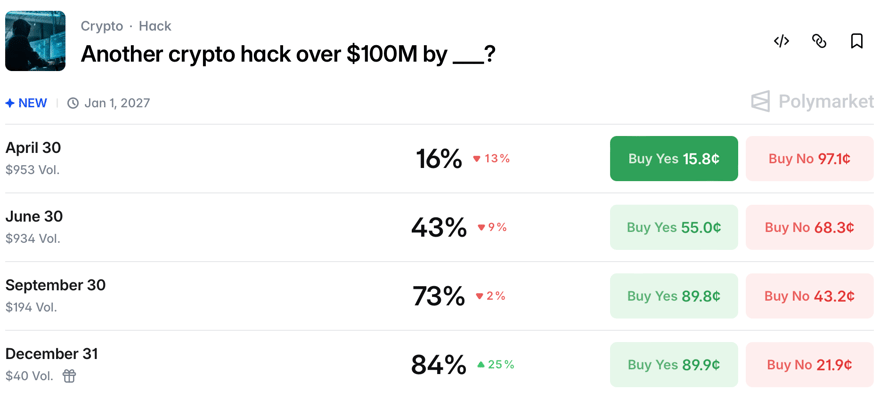
Odds of another crypto hack over $100 million. Source: Polymarket
Magazine: AI-driven hacks could kill DeFi — unless projects act now

The European Commission announced a package of crypto-related sanctions against Russia in response to the country’s military actions against Ukraine.
In a Thursday notice, the commission said the sanctions targeted Russia’s energy and financial sectors, including a “total sectorial ban on carrying out exchanges with any Russian crypto asset service provider as well as any decentralised platforms enabling crypto trading” that could be used to circumvent the measures.
The EC, composed of 27 member states in the European Union, also prohibited the use of stablecoins pegged to the Russian ruble and the central bank digital currency (CBDC) under development by the Central Bank of Russia.
“This package puts further pressure on Russia to engage in negotiations and do so on terms acceptable for Ukraine,” said the commission. “Every day of further Russian attacks on Ukrainian civilian infrastructure is another day of suffering for the Ukrainian people.”

Source: European Commission President Ursula von der Leyen
The sanctions package came after a meeting between European Commission President Ursula von der Leyen and Ukrainian President Volodymyr Zelenskyy discussing the bloc’s support for Ukraine amid ongoing military attacks from Russian forces.
According to the commission, Russia was becoming “increasing[ly] reliant on cryptocurrencies for international transactions” in reaction to global sanctions. This has led to measures targeting entities tied to the country using stablecoins like A7A5 and crypto operators linked to Belarus.
Related: Russia introduces bill to criminalize unregistered crypto services
Iran sanctions also under scrutiny in US
Amid the United States and Israeli military actions against Iran, many lawmakers have been questioning whether the Islamic Republic could be circumventing sanctions using digital assets.
Reports last month suggested that Binance fired individuals responsible for telling executives that that exchange facilitated $1 billion in transactions to entities tied to Iran.
Magazine: AI-driven hacks could kill DeFi — unless projects act now
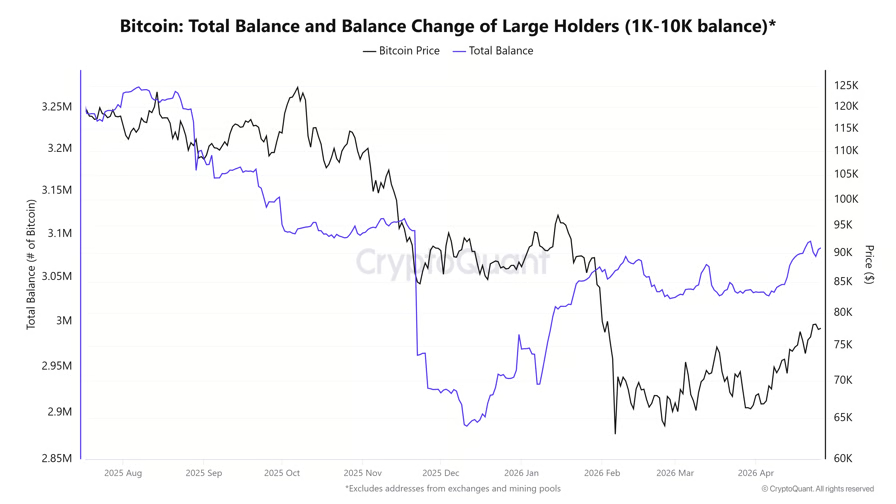
Bitcoin (BTC) whales holding between 1,000-10,000 BTC have increased their BTC exposure over the past five months, with the total balance reaching 3.09 million, a level last seen on November 11, 2025.
Short-term data suggest that Bitcoin traders may move toward existing liquidity at $73,700, but futures market activity and the longer-term market structure hint at higher levels above $80,000.
Bitcoin whales and institutions rebuild BTC exposure
Bitcoin wallets holding between 1,000 and 10,000 BTC have been steadily accumulating since December, adding approximately 240,000 BTC to their balances.
This brings the cohort’s total holdings to around 3.09 million BTC, recovering to pre-correction levels last seen before Bitcoin’s 18% pullback in November 2025, when the price declined to $85,000 from $103,500.
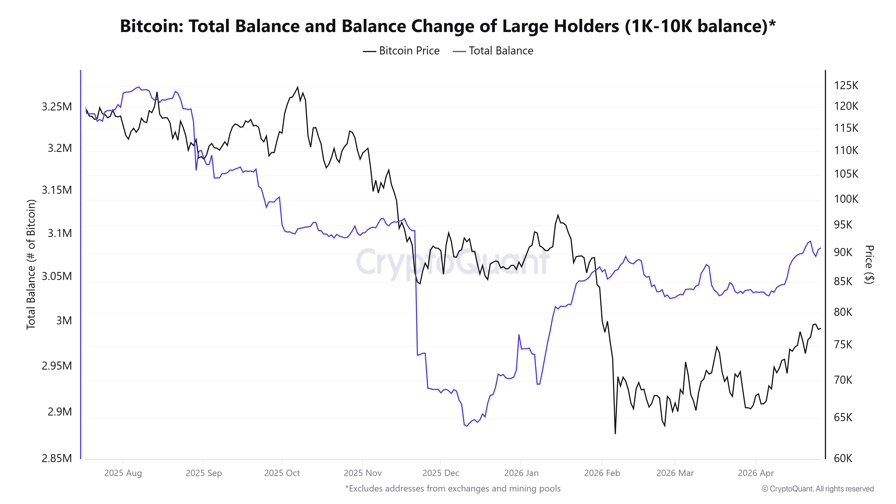
Total BTC balance of large holders. Source: CryptoQuant
The long-term holders (LTHs) continue to absorb supply at a steady pace. LTHs’ balance has reached 14.57 million BTC, aligning with the prior accumulation peaks. The distribution activity was 42,100 BTC sold over the past 30 days, one of the lowest readings in 2026.
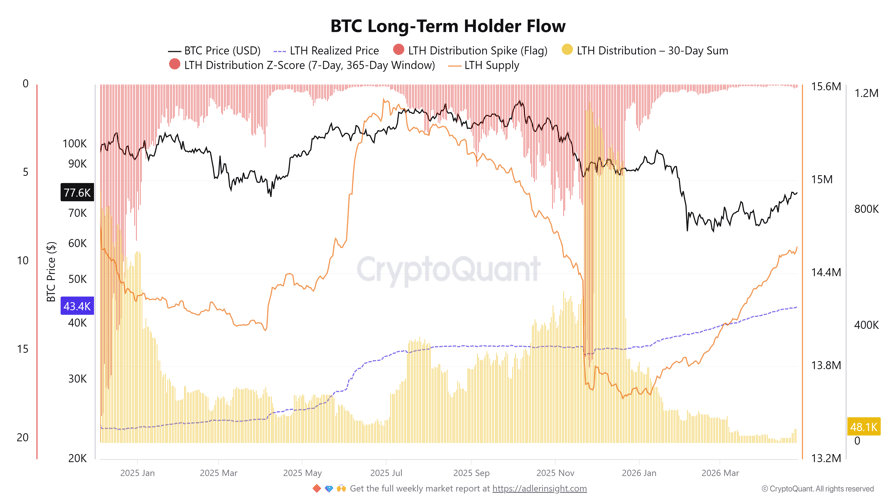
BTC long-term holder flow. Source: CryptoQuant
The Crypto Market Compass report from Bitwise highlights a similar trend across institutional flows. Over the last month, the institutional investors have added about 92,900 BTC.
The onchain realized cap flows show only 14,900 BTC in net selling during the same period. This report indicates that the demand from larger players has outpaced sell-side pressure, tightening the available BTC supply.
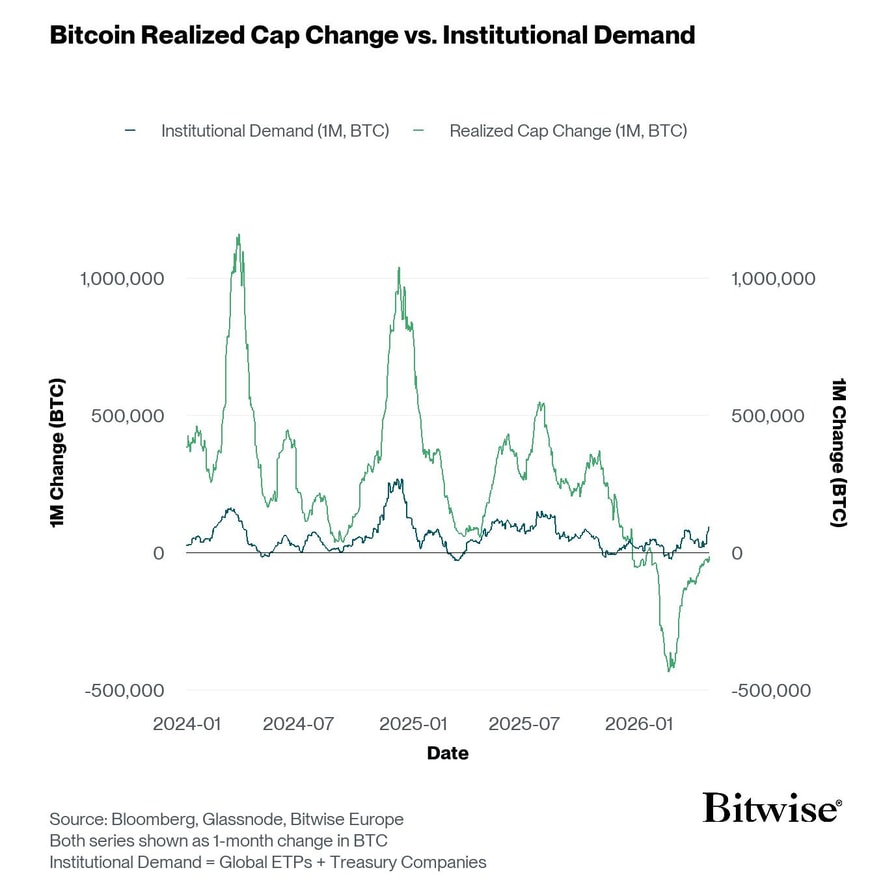
Rise in BTC institutional demand. Source: Bitwise
BTC double top pattern indicates a short-term liquidity sweep at $74K
The four-hour chart shows a potential double top forming near $79,400 after two quick rejections for BTC over the past week. The second pullback came late Sunday night, with weaker buy volumes, pointing to fading short-term momentum.
Currently at $77,731, the price may rotate toward liquidity pockets near $74,700 and $73,700.
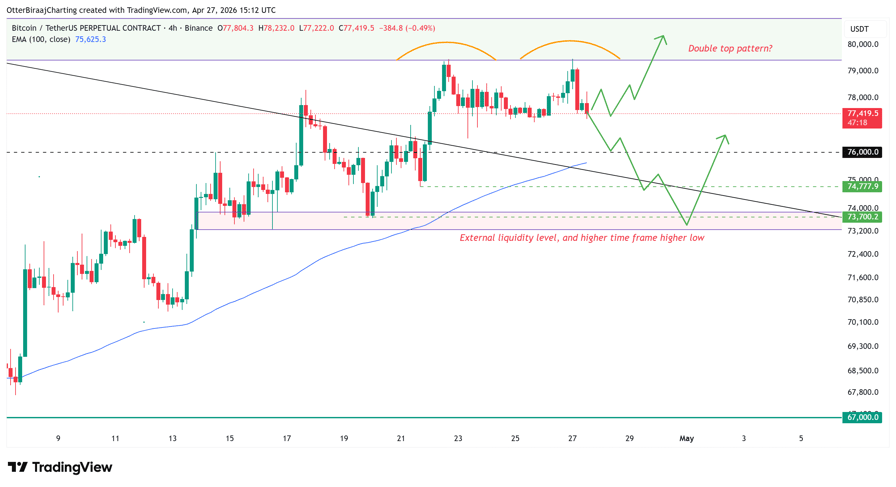
BTC/USDT on the four-hour chart. Source: Coinelegraph/TradingView
The $74,700 level aligns with a prior consolidation range and sits just above the 100-period exponential moving average (EMA). A deeper move into $73,700 would test key higher-time-frame support and a prior higher-low range.
Holding above this zone keeps the broader trend intact and maintains room for a bullish continuation.
The derivatives market activity is adding short-term pressure to Bitcoin price. Crypto analyst Darkfost noted that over $1.2 billion in sell volume hit Binance within an hour, contributing to a sharp intraday decline on Sunday.
The funding rates have also stayed deeply negative, reaching -7% on a 30-day basis, one of the lowest readings ever recorded.
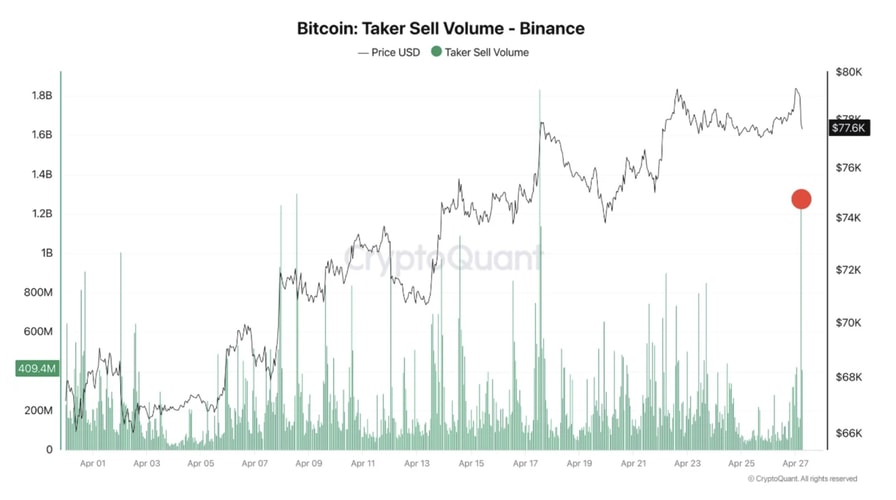
Bitcoin: taker sell volume on Binance. Source: CryptoQuant
However, such positioning may create conditions for a short squeeze, in which crowded short positions unwind, driving the price higher. A move above $80,000 would invalidate the double-top signal and turn short-term momentum bullish again.
According to MN Capital founder Michaël van de Poppe, the price continues to hold key levels, with upside targets of $85,000-$88,000 still valid for May. The liquidity range between $74,700 and $73,700 now serves as a reset zone, where BTC demand could be tested ahead of another breakout attempt above $80,000.
Related: Michael Saylor’s Strategy adds 3.2K Bitcoin at nearly $78K per BTC


The CFTC filed a lawsuit against New York on April 24 in the Southern District of New York, seeking a permanent injunction to stop the state from enforcing its gambling laws against federally registered prediction market exchanges.
Summary
- The CFTC sued New York after the state filed suits against Coinbase and Gemini earlier that week, alleging their prediction market products violated state gambling laws.
- The CFTC is seeking a declaratory judgment of federal preemption and a permanent injunction blocking New York from enforcing gambling rules against its registered exchanges.
- New York joins Arizona, Connecticut, Illinois, and other states already facing CFTC lawsuits in a rapidly expanding federal-state jurisdictional battle over prediction markets.
CFTC New York lawsuit was filed on April 24 in the US District Court for the Southern District of New York. The CFTC announced that it is seeking a declaratory judgment that federal law gives it exclusive authority to regulate event contracts and a permanent injunction preventing New York from enforcing state gambling statutes against its registrants. CFTC Chairman Michael Selig said that “CFTC-registered exchanges have faced an onslaught of state lawsuits seeking to limit Americans’ access to event contracts and undermine the CFTC’s sole regulatory jurisdiction over prediction markets,” adding that New York is “the latest state to ignore federal law and decades of precedent.”
CFTC New York Lawsuit Escalates a Fight Already Spanning Six States
As crypto.news reported, the New York action was triggered directly by the state attorney general suing Coinbase and Gemini earlier that week, alleging their prediction market platforms operated as unlicensed gambling without meeting state gaming licensing requirements or minimum age restrictions. Attorney General Letitia James and Governor Kathy Hochul responded to the CFTC lawsuit by stating that “New York’s gambling laws are designed to protect consumers, whether they are placing bets in a prediction market or a casino,” and vowed to continue defending state law in court. As crypto.news documented, the CFTC had already sued Arizona, Connecticut, and Illinois earlier in April, arguing those states were making “aggressive and overzealous attempts to overstep the CFTC,” with New York’s addition making it the fourth direct state defendant. The CFTC’s core legal argument is that event contracts are classified as swaps under the Commodity Exchange Act, giving the federal agency exclusive jurisdiction and preempting any state gambling statute.
The Third Circuit Ruling That Made New York’s Position Harder
The CFTC’s lawsuit against New York arrives shortly after a significant federal judicial precedent. As crypto.news tracked, the Third US Circuit Court of Appeals ruled in April that New Jersey cannot bar Kalshi from offering sports-related event contracts, finding that the Commodity Exchange Act and CFTC hold exclusive authority over those markets. That ruling strengthened the federal preemption argument the CFTC is now deploying against New York. Courts in Tennessee have similarly issued temporary restraining orders blocking state enforcement against Kalshi. New York’s case will now be decided in federal district court, where the Third Circuit’s reasoning, while not binding, carries significant persuasive weight. A loss for New York would likely cause other states to drop parallel enforcement actions, while a New York victory would almost certainly accelerate the conflict to the Supreme Court.
What a Resolution Means for Prediction Markets and Crypto
The stakes extend beyond the immediate parties. As crypto.news noted, New York’s lawsuit against Coinbase and Gemini sought at least $2.2 billion in fines from Coinbase and $1.2 billion from Gemini, making the financial exposure from state enforcement potentially existential for smaller prediction market operators. Wisconsin has also sued Polymarket, Kalshi, and Robinhood, seeking forfeiture of profits from Wisconsin residents. If the CFTC prevails across its state lawsuits, prediction markets would operate under a single federal regulatory framework with no state-by-state licensing requirements, a structure that would massively expand their addressable market. If states prevail, prediction markets would face a patchwork of 50 different regulatory environments, effectively operating only in states that permit them.
A bipartisan group of US senators has separately proposed legislation to ban sports and casino-style contracts on CFTC-regulated prediction markets entirely, meaning that even a CFTC victory in court could be reversed by Congress if the political will materializes.

Israel’s Capital Market, Insurance and Savings Authority has greenlit the launch of a shekel-pegged stablecoin by the virtual exchange exchange Bits of Gold.
In a Monday notice, the Israeli regulator said that it had granted approval of the BILS stablecoin after a two-year pilot program of the stablecoin on the Solana blockchain.

Source: LinkedIn
According to the announcement, the stablecoin’s reserve assets will be held in Israel in “designated and separate accounts.” The project was part of a larger effort by the Israel Tax Authority and the country’s Finance ministry to regulate the crypto industry, including by allowing certain stablecoin activities.
“BILS creates a direct bridge between the Israeli shekel and the global digital assets economy, enabling real-time payments, on-chain trading and programmable financial applications based on a regulated local currency,“ said Bits of Gold founder and CEO Youval Rouach.
Related: Zondacrypto CEO goes off radar as Poland probe deepens
As of Monday, the global stablecoin market capitalization was more than $320 billion, dominated by US dollar-pegged stablecoins like Tether’s USDt (USDT).
The launch of BILS, as one of the first Israeli shekel-pegged coins, came as the fiat currency was at a 30-year high against the US dollar, at 1 ILS to 0.34 USD at the time of publication.
Stablecoin yield under scrutiny in US amid market structure debate
In the United States, lawmakers continue to debate provisions within a digital asset market structure bill over stablecoin yield, tokenized equities, and ethics concerns related to US President Donald Trump’s potential conflicts of interest with the industry. The legislation, effectively stalled in the US Senate since July 2025, requires a markup by the chamber’s banking committee before a potential vote.
Magazine: Should users be allowed to bet on war and death in prediction markets?
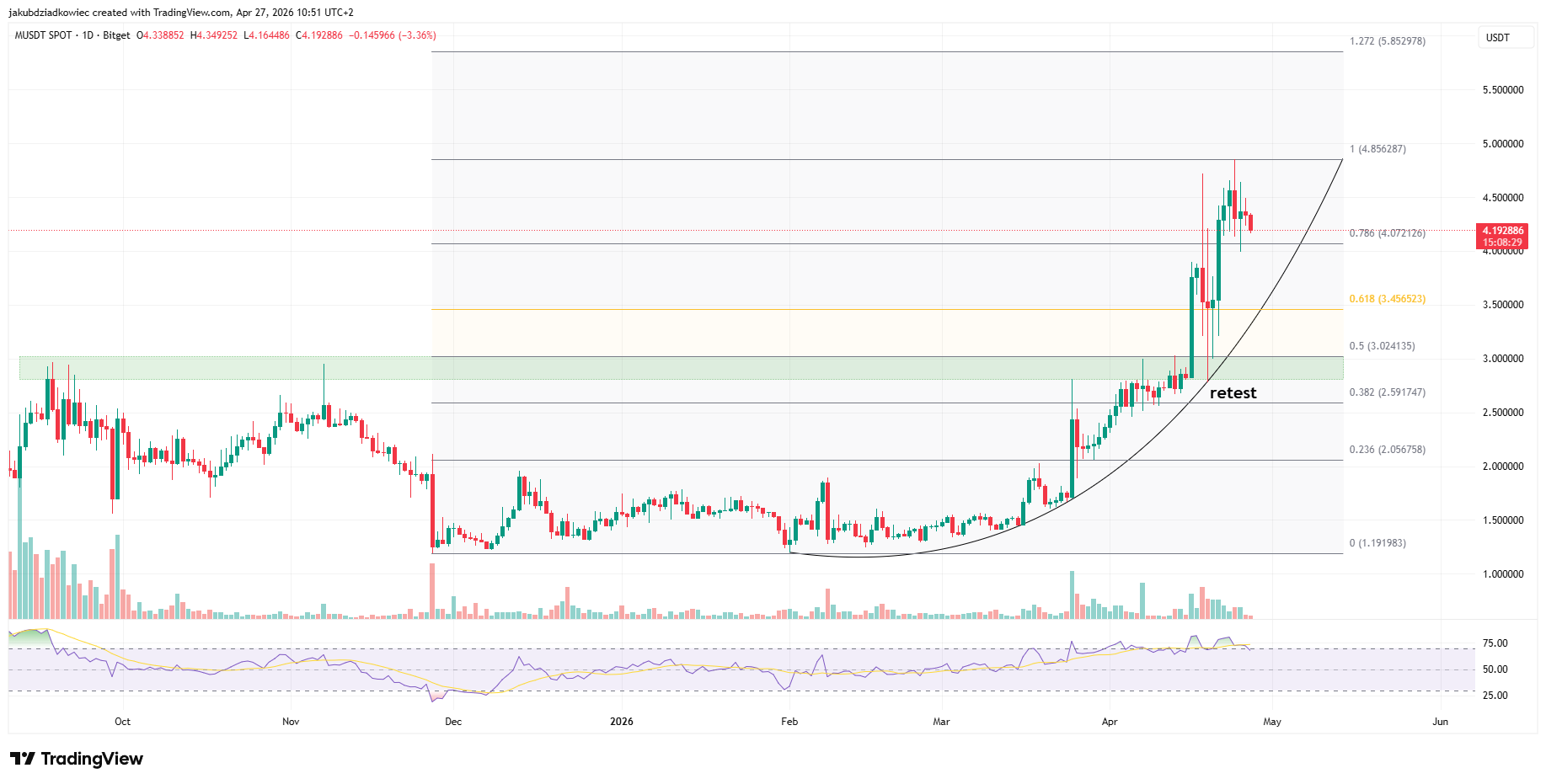
The April meme coin rally accelerated as Pudgy Penguins (PENGU), MemeCore (M), and SPX6900 (SPX) posted weekly gains between 19% and 32%, with each chart now testing decisive Fibonacci levels.
The three tokens dominate this week’s meme coin leaderboard, but their technical setups diverge. One faces a stretched RSI, another breaks fresh resistance, and the third attempts a breakout on uncertain volume.
MemeCore (M) Stalls Near $4.86 After Fibonacci Extension Hit
MemeCore (M) trades near $4.19 after a 23% weekly advance, holding within the upper Fibonacci pocket between the 0.786 and 1.0 retracement levels. The token printed a recent swing high of $4.86 on April 24.
The Fibonacci structure draws from the November low and a second test of that same low on February 1. After retracing toward the 0.618 golden pocket near $3.46, buyers stepped back in.
That bounce coincided with a retest of an ascending exponential curve and the green-box support zone close to $3.00.
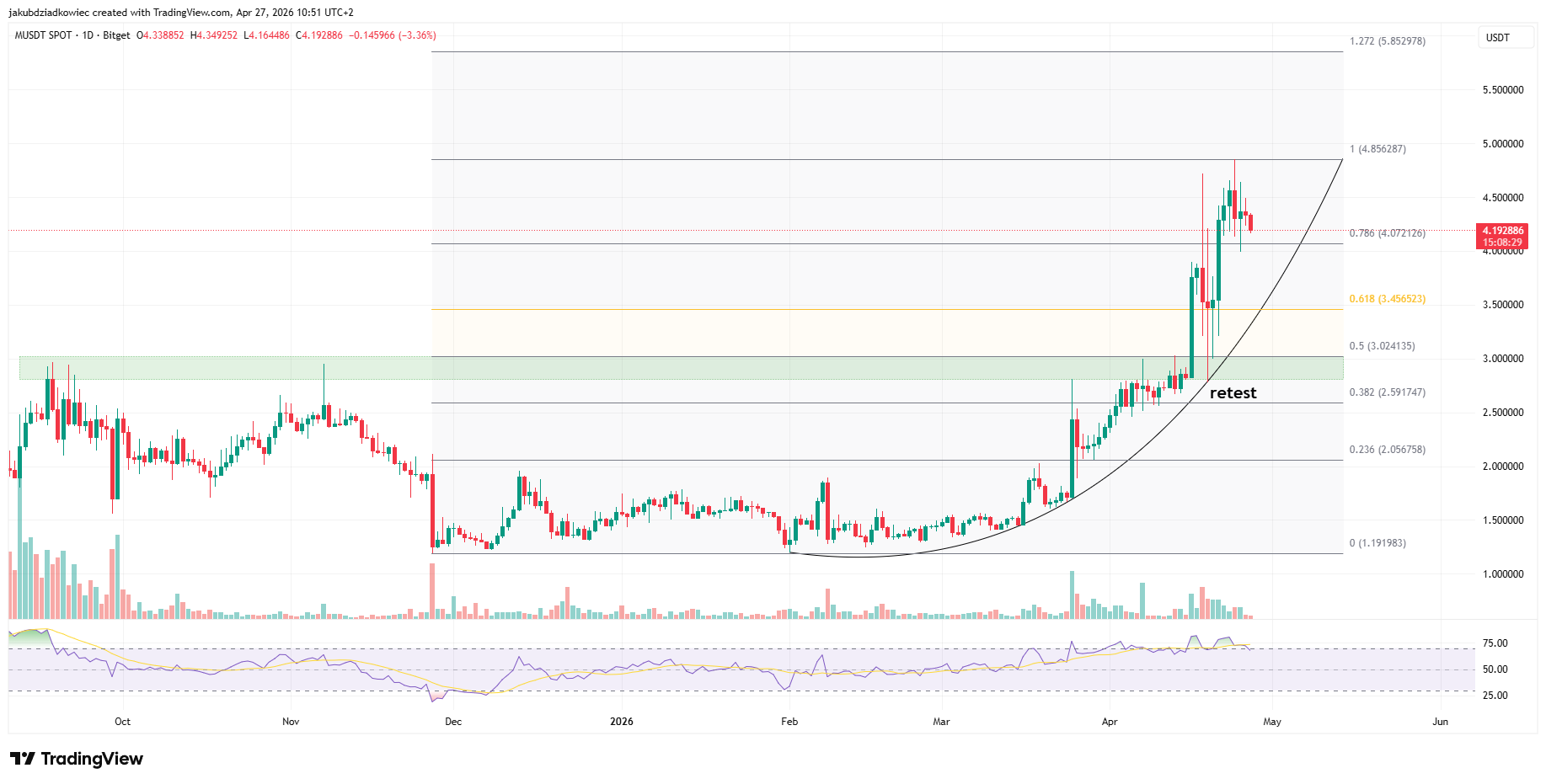
Momentum signals warrant caution. The Relative Strength Index (RSI) sits at the edge of overbought territory and prints one bearish divergence against the latest swing high. Volume is also contracting, which weakens the case for an immediate continuation.
A clean break above $4.86 opens the path to the 1.272 Fibonacci extension at $5.85, the next bullish target. Failure to reclaim that high keeps M trapped in the upper pocket and exposes a deeper retest of the $3.46 golden pocket.
Pudgy Penguins (PENGU) Powers Meme Coin Rally With Breakout
PENGU trades near $0.0096 after a 32% weekly surge. The token broke decisively above the $0.008 resistance zone that had capped price action since early February, flipping that level to support.
The breakout escapes a multi-month accumulation range that formed between $0.006 and $0.008. Daily volume picked up sharply during the move, supporting the validity of the breakout. RSI climbs toward the overbought line yet has room to run before signaling exhaustion.
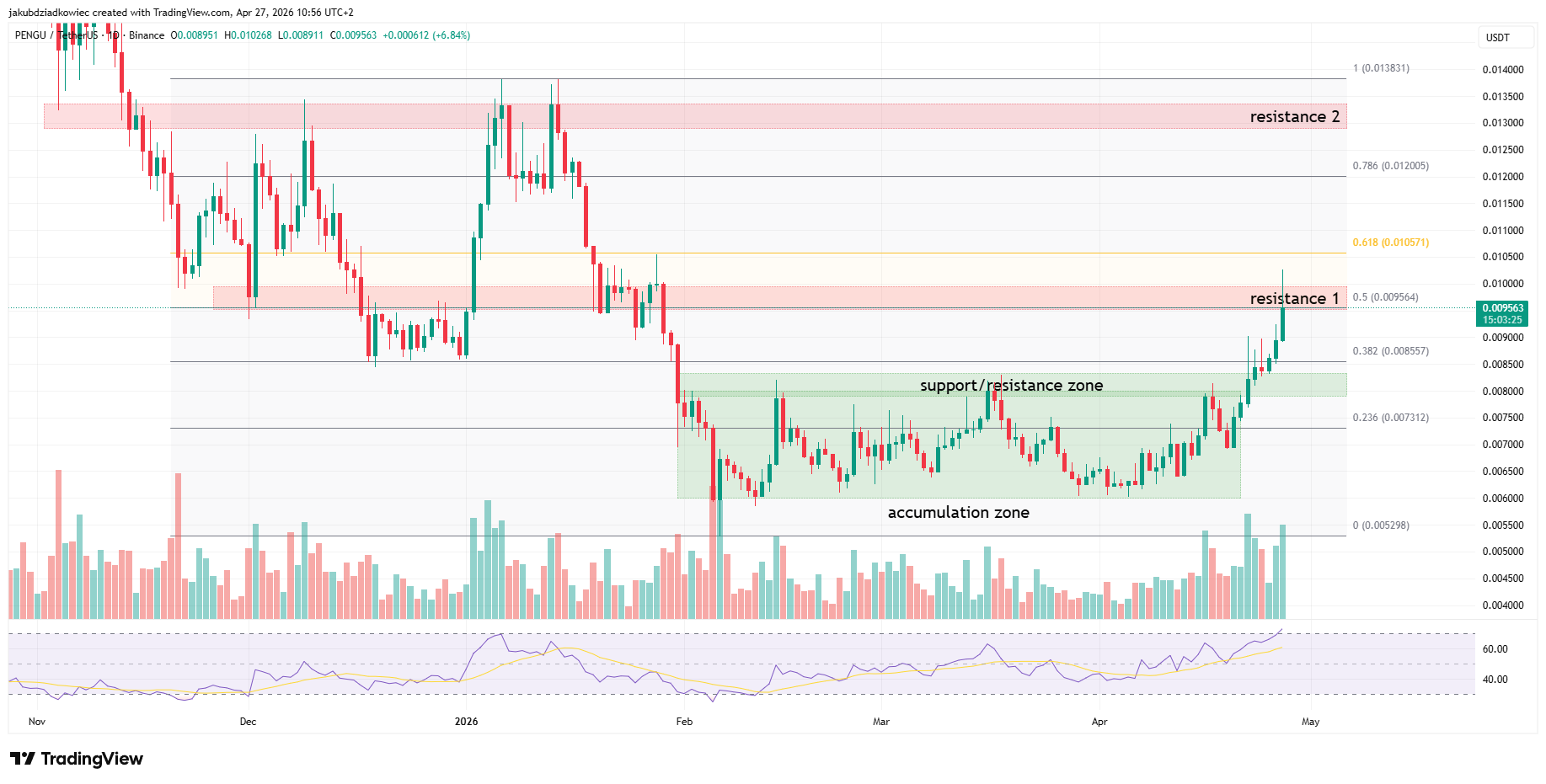
Price now contests the 0.5 Fibonacci retracement at $0.0096, the immediate resistance flagged on the chart. A long upper wick shows sellers defending the level. Holding above $0.008 keeps the bullish structure intact.
A daily close above $0.0096 sets the next destination at the 0.618 golden pocket near $0.0106. Beyond that, the $0.013 zone marks the prior resistance shelf and aligns with the 1.0 Fibonacci level. Loss of $0.008 invalidates the breakout.
SPX6900 (SPX) Breakout Lacks Volume Confirmation
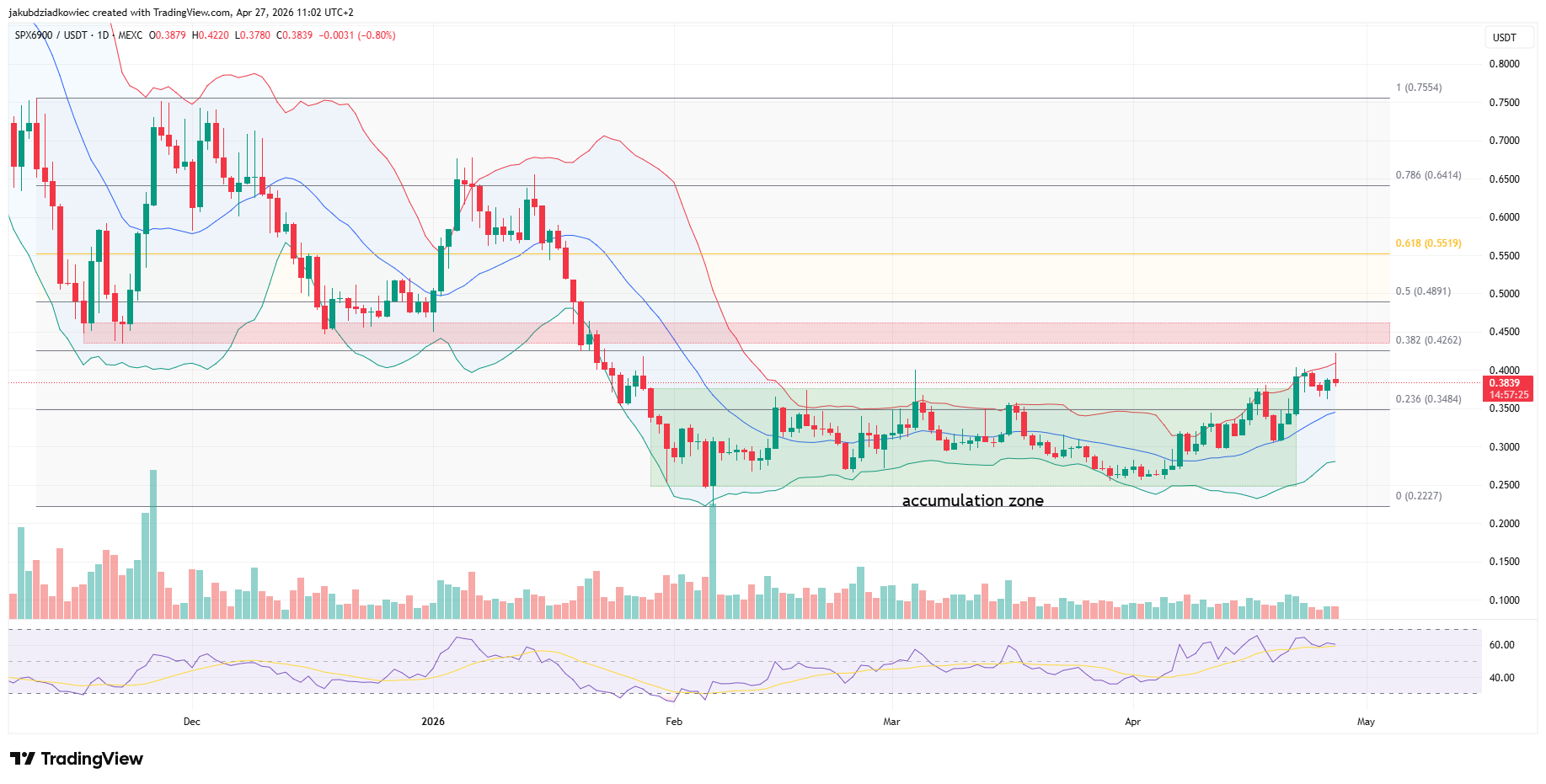
SPX6900 (SPX) sits near $0.3839 after a 19% weekly advance, mirroring a setup the token printed earlier in the year. Price emerged from an accumulation channel between $0.27 and $0.35 that held throughout most of February, March, and the first half of April.
The current resistance challenge sits at the 0.382 Fibonacci retracement near $0.426, the next zone where sellers have previously blocked rallies. RSI hovers around 60 and tilts higher, which fits a healthy uptrend rather than an overheated reading.
Bollinger Bands have widened, with price riding the upper band. That expansion confirms increasing volatility and a bullish bias on the short-term tape. Volume tells a different story. The breakout attempt prints on subdued turnover, reducing conviction in the move.
A volume-backed close above $0.426 would unlock the 0.5 retracement near $0.489 and then the 0.618 golden pocket at $0.55.
Without participation, SPX risks slipping back into the upper end of the accumulation channel near $0.35, with the lower bound at $0.22 acting as the structural floor. Broader sector rotation into meme coins could supply the missing volume.
The post Top 3 Meme Coins to Watch in Final Week of April 2026 appeared first on BeInCrypto.


Western Union plans to roll out its USDPT stablecoin next month, alongside a digital wallet network and Stable Card for global payments.
Western Union will launch its USDPT stablecoin in May as part of a broader digital assets strategy, CEO Devin McGranahan announced. The stablecoin rollout will integrate with a new network connecting digital wallets to Western Union’s existing retail infrastructure and a planned global Stable Card for payments.
Western Union is embedding digital assets into its core money movement platform, positioning stablecoin settlement as a central feature alongside its legacy remittance and payment services. The USDPT launch represents one of the largest traditional financial institutions moving into stablecoin issuance and crypto infrastructure integration.
Sources: Cointelegraph | The Block | Crypto.news
This article was generated automatically by The Defiant’s AI news system from publicly available sources.

Tether has rolled out an open-source development framework for Bitcoin mining, aiming to give operators and developers a unified control layer over both hardware and software across multiple mining sites. The company described the framework as a modular, scalable option designed to move mining operations away from fragmented, vendor-locked toolsets toward a cohesive stack that can monitor devices, automate workflows and host custom applications from a single interface.
Dubbed a development framework, the kit blends a backend software development kit with user interface tools to enable cross-site oversight. Its architecture exposes standardized functions from mining hardware, allowing independent modules to be added without rewriting the core system. Tether said the design supports a wide range of machines, services and locations, enabling operators to tailor dashboards and automation while preserving a common control layer.
Compatibility spans Windows, macOS and Linux, and the framework is pitched to scale from a single rig to large industrial deployments. In its release notes, Tether highlighted features for automation, continuous monitoring and coordinated hardware management, all aimed at simplifying operations in environments where interoperability has historically been a challenge and vendor lock-in has raised costs.
The MDK builds on Tether’s prior open-source work with Mining OS, expanding the stack with a development layer that makes it easier to build dashboards, workflows and analytics atop existing mining infrastructure. In short, the company frames the release as an evolution of openness in the Bitcoin-mining software ecosystem.
The timing aligns with broader industry activity and capital moves within the crypto mining sector. Last week, Tether disclosed an 8.2% stake in Antalpha, a Bitcoin-focused lender and financing platform with ties to Bitmain, a major hardware supplier. The move underscores a broader convergence between traditional finance-style capital and mining infrastructure developers.
Beyond the pure software story, the wider market context remains deeply linked to the stability and liquidity of crypto rails. Tether is the issuer of USDT, the largest stablecoin by market capitalization, accounting for about $190 billion of the roughly $320.7 billion global stablecoin market, according to DefiLlama data.
Key takeaways
- The Mining Development Kit (MDK) marks a shift toward vendor-agnostic control of mining fleets, offering a unified layer for monitoring, automation and custom building across sites.
- The modular approach lets operators add new hardware integrations and software modules without touching the core system, potentially reducing complexity in mixed-vendor environments.
- MDK extends Tether’s open-source mining stack, following Mining OS, and aims to empower dashboards, workflows and analytics on top of existing infrastructure.
- The development is taking place amid a broader trend of miners diversifying into AI and high-performance computing, supported by large-scale data-center expansions and new financing plans.
Modular control in a fragmented ecosystem
At the heart of MDK is a modular architecture designed to accommodate a wide array of mining hardware. By exposing standardized functions from machines and allowing independent modules to plug in, the framework seeks to reduce the friction that comes with assembling a heterogeneous fleet. Operators can add monitoring, automation and specialized tooling without retooling the entire software stack, which could lower operating costs and shorten deployment cycles for multi-site operations.
The planned cross-platform reach—covering Windows, macOS and Linux—addresses a long-standing pain point for mining operators who mix old and new rigs across geographies. With the framework, operators could potentially orchestrate firmware updates, thermal management, thermals, and energy-use optimization from a single cockpit, rather than juggling disparate tools from several vendors.
Open-source lineage and practical implications
By building on Mining OS, MDK represents a continuation of Tether’s push toward openness in the mining software stack. The company said the new framework is designed to let developers craft dashboards, workflows and analytics that sit atop existing hardware and software setups. For operators, this could translate into more transparent tooling, easier integration with third-party services and more room to customize operations without depending on a single vendor’s ecosystem.
Analysts and observers have long noted that open frameworks can help reduce total cost of ownership and accelerate innovation in mining operations that use diverse hardware from multiple suppliers. The MDK release therefore sits at the intersection of software tooling and strategic resilience—aimed at improving uptime, performance visibility and workflow automation across distributed deployments.
Industry momentum: miners expanding into AI and HPC
The MDK news arrives as a broader segment of the mining industry pursues artificial intelligence and high-performance computing workloads to diversify revenue and make use of power capacity beyond traditional mining. Early movers like CoreWeave have shifted from crypto mining toward cloud-based AI compute since 2019, signaling a broader recalibration of what mining infrastructure can power.
Publicly traded mining operators have followed suit, investing in AI-centric data centers and HPC capabilities. Companies such as Riot Platforms, HIVE Digital, MARA Holdings, TeraWulf and Cipher Mining have publicly signaled or pursued strategies to repurpose capacity toward AI and HPC workloads, aiming to monetize processing power in the AI era.
In recent weeks, financing moves have underscored this shift. Core Scientific signaled plans to raise about $3.3 billion through senior secured notes due in 2031 to fund data-center expansion and debt refinancing. Separately, Hut 8 announced plans to raise approximately $3.25 billion in senior secured notes to support a 245-megawatt AI data center in Louisiana, linked to a long-term lease with Fluidstack valued around $7 billion.
Analysts have also started to map how AI and cloud computing could reshape the profitability and strategic outlook of leading miners. Bernstein analysts recently suggested that IREN, the largest publicly traded Bitcoin miner by market capitalization, may gradually pivot away from mining and toward expanding its AI cloud business over time as the company scales its non-mining operations.
As the sector morphs, observers caution that the balance between traditional mining economics and the emerging AI-driven infrastructure model remains delicate. Open questions include how quickly operators can monetize AI workloads, how financing cycles will adapt to shifting capex needs, and how regulatory developments could influence cross-border data and energy strategies.
Broader market context and transmission effects
While MDK targets the operational layer of mining, the surrounding market environment remains closely tied to the health of stablecoins and digital-asset liquidity. USDT’s dominance—sitting at roughly two-fifths of the stablecoin market by market capitalization—helps underpin a range of on-ramps, liquidity pools and financing arrangements used by mining firms seeking working capital and equipment liquidity. DefiLlama’s data provides a snapshot of this ecosystem and highlights how stablecoins continue to factor into mining and crypto-finance activity.
Industry observers also flagged potential strategic implications for suppliers and operators. An open-source, interoperable framework could encourage more hardware compatibility and reduce the risk of vendor lock-in, potentially shifting negotiating leverage toward mining operators and away from a handful of dominant toolmakers. The Antalpha stake disclosure ties into the broader narrative of financial players deepening exposure to mining infrastructure and equipment financing, a trend that could accelerate collaboration between lenders, equipment providers and miners.
In terms of next steps, the market will be watching for early adopter deployments of the MDK, the breadth of hardware integrations that surface, and how dashboards and analytics built on top of the framework perform in real-world, multi-site environments. Adoption signals—such as new integrations, case studies, and community contributions—will be key indicators of whether MDK becomes a standard layer in the evolving open mining software stack.
Cointelegraph continues to monitor how these developments intersect with the industry’s broader diversification into AI compute and data-center capacity, as well as the financing dynamics that underpin major buildouts across North America and beyond.
Readers should watch for updates on MDK adoption, new partnerships with hardware vendors or service providers, and any regulatory considerations that could shape the adoption curve for open-source mining infrastructure in the months ahead.
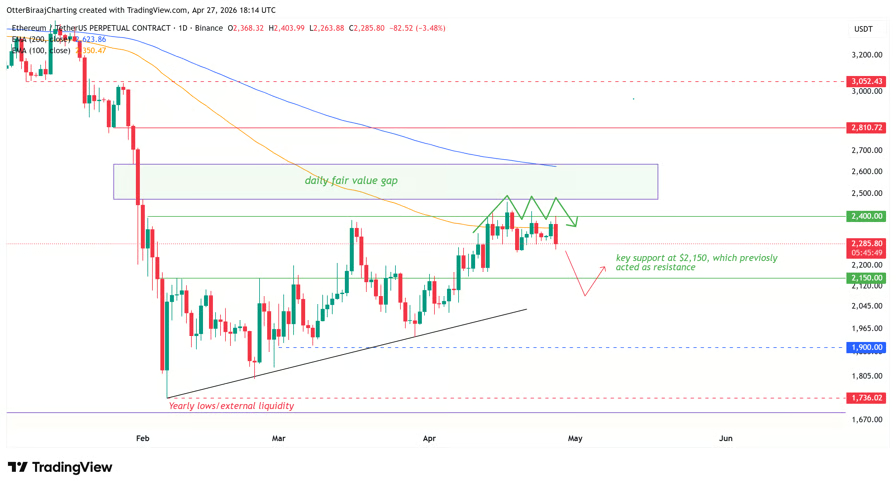
Ether (ETH) fell 3.4% to $2,287 on Monday, after its fourth rejection at the $2,400 level since April 14. The price continues to trade below the 100-day moving average, with over $2.5 billion in liquidation risk concentrated near the $2,150 support zone.
Crypto analyst Michaël van de Poppe also flagged weakness in Ether relative to Bitcoin, raising doubts about the strength of any near-term uptrend.
Repeat rejections at $2,400 cap ETH’s upside
Ether has failed to break $2,400 four times over the past two weeks, forming a clear triple top pattern on the daily chart. Each retest saw a loss of strength near that level, suggesting supply absorption by sellers.
The 100-day exponential moving average (EMA) near $2,350 continues to act as a dynamic resistance. The price has not held above it on the one-day chart, keeping upside attempts short-lived.
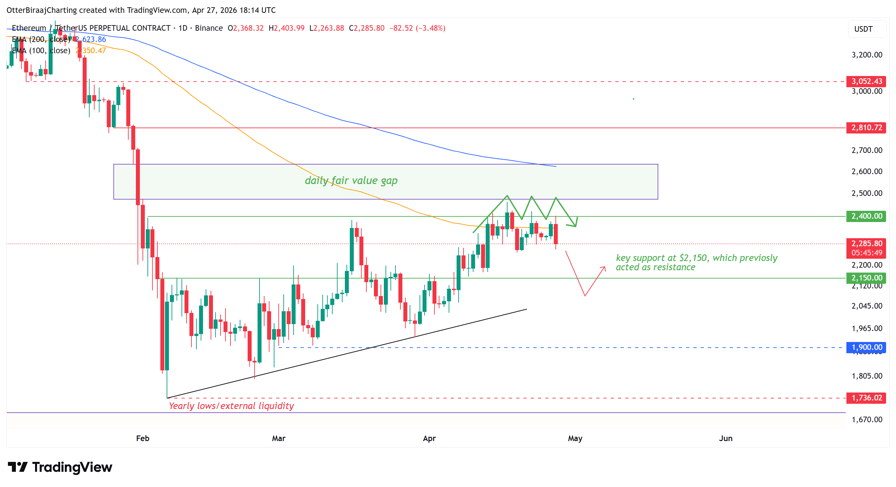
ETH/USDT on the one-day chart. Source: Cointelegraph/TradingView
The support at $2,150 now carries more weight. The level previously acted as resistance and could be tested as a base in the coming days. A move below it opens the door to deeper downside levels.
Liquidation data adds pressure to this zone, with $2.5 billion in leveraged longs sitting below $2,150. A break below this level could trigger forced selling into the $2,050 to $1,900 range.
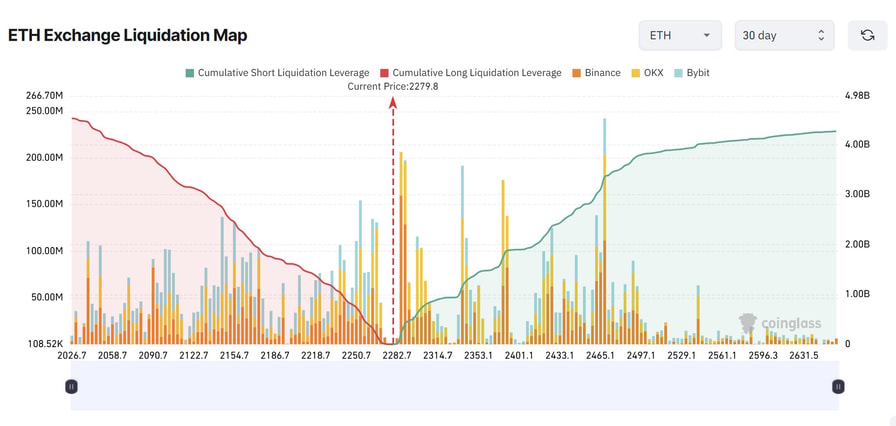
Ether liquidation map. Source: CoinGlass
MN Capital founder Michaël van de Poppe noted weakness in the ETH/BTC pair. The ratio dropped below 0.032 BTC, removing a key support level tied to prior continuation attempts.
The ETH/BTC ratio also slipped under the 21-period moving average, signaling fading relative strength against Bitcoin. The next higher-time frame level sits near 0.026 BTC, where buyers previously stepped in.
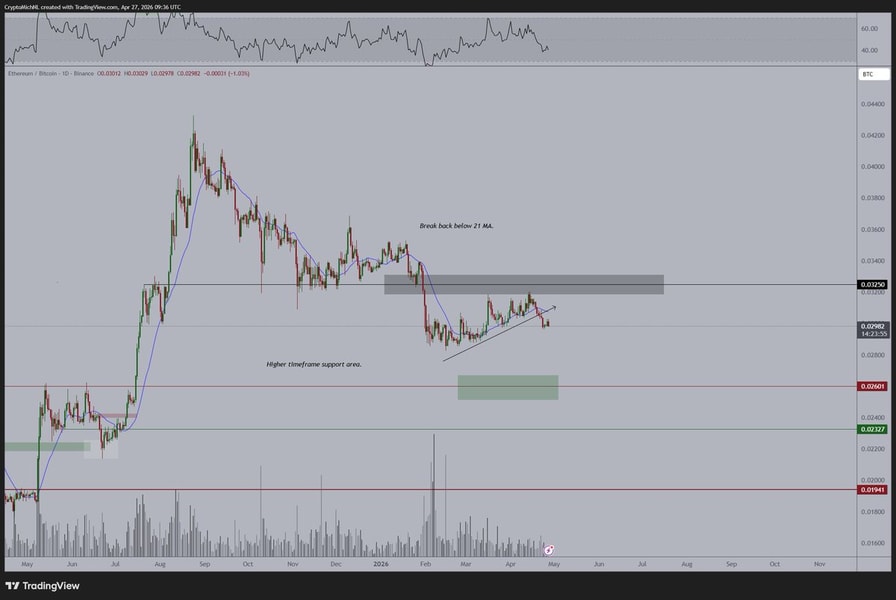
ETH/BTC chart analysis on Binance. Source: CryptoQuant
Related: BitMine acquires 101,000 ETH despite $6.5B in unrealized losses
ETH futures positions hint at a market reset
On Binance, Ether’s open interest (OI) has dropped to $2.58 billion, matching levels seen when ETH traded near $2,200 earlier this month. The decline points to a reset in leverage following the recent positioning buildup.
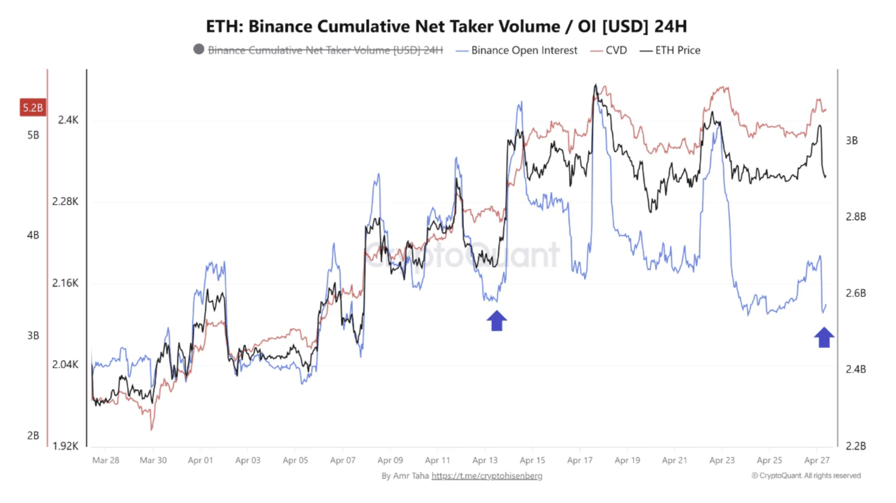
ETH: Binance cumulative net taker volume. Source: CryptoQuant
The funding rate offers a clearer signal, sitting near -0.013%, the lowest reading since February. The short positions dominate new activity while earlier long exposure has been reduced.
Crypto analyst Amr Taha noted that this combination places ETH in a shorts-heavy setup with lower leverage. If price holds near current levels, the imbalance between positioning and price could tighten, leading to a breakout sooner than later.
The key zone centers on $2,150, where liquidation risks and the current technical level converge on the daily chart.
Related: ETH price up 10% in April, so why is Ethereum Foundation selling?

Carrick deserves full-time job after guiding Man Utd to brink of Champions League

Amkor Technology, Inc. (AMKR) Q1 2026 Earnings Call Transcript

Saba Capital tender offers for shares are below initial expectations

Manchester United reach agreement with Casemiro over contract clause amid transfer speculation

US brings back mandatory military draft registration

Steven Gerrard disagrees with Gary Neville over ‘shock’ Chelsea and Arsenal claim | Football


-

 Fashion3 days ago
Weekend Open Thread – Corporette.com
-
 Crypto World2 days ago
Hyperliquid $HYPE Rally Builds Momentum as AI Sector Enters Prove-It Phase
-

 Tech7 hours ago
Register Renaming | Hackaday
-

 Politics5 days ago
Making troops accountable for war crimes threatens US alliance, ex-SAS colonel warns
-

 Politics5 days ago
Disabled people challenge government SEND proposals over segregation concerns
-
 Business4 days ago
Patterson-UTI Energy, Inc. (PTEN) Q1 2026 Earnings Call Transcript
-

 Business6 days ago
Rolls-Royce Voted UK’s Most Iconic Trade Mark as IPO Register Hits 150
-
 Crypto World6 days ago
Five Value Stocks with Recovery Potential in 2026: PayPal (PYPL), Nike (NKE), and More
-
 Sports2 days ago
IPL 2026: Ruturaj Gaikwad registers slowest fifty of the season, enters all-time unwanted list | Cricket News
-

 Politics5 days ago
Starmer handler McSweeney to be dragged from shadows by Foreign Affairs Committee
-

 Politics5 days ago
Zack Polanski responds to home secretary’s taser threat
-
Politics5 days ago
Wings Over Scotland | How To Get Away With Crimes
-

 Crypto World6 days ago
New York sues Coinbase, Gemini over prediction market offerings
-
Entertainment6 days ago
Sydney Sweeney cameo cut from “The Devil Wears Prada 2”, source explains why (exclusive)
-
 Business6 days ago
HCL Tech share price tank over 9% after weak Q4. JPMorgan, HSBC & 3 others cut target price
-

 Fashion6 days ago
Kilkenny Design New Beauty Arrivals for Spring 2026
-

 Crypto World6 days ago
Crypto’s great hope in Senate’s Clarity Act still has a path to survive tight calendar
-

 Politics5 days ago
‘Iran is still a nuclear threat’
-
 Sports5 days ago
Tim Bradley names the current best in the world: “Better than Inoue and Usyk”
-

 NewsBeat2 days ago
LK Bennett closes all stores after entering administration
You must be logged in to post a comment Login