
Crypto World
Top 3 Meme Coins to Watch in Final Week of April 2026

The April meme coin rally accelerated as Pudgy Penguins (PENGU), MemeCore (M), and SPX6900 (SPX) posted weekly gains between 19% and 32%, with each chart now testing decisive Fibonacci levels.
The three tokens dominate this week’s meme coin leaderboard, but their technical setups diverge. One faces a stretched RSI, another breaks fresh resistance, and the third attempts a breakout on uncertain volume.
MemeCore (M) Stalls Near $4.86 After Fibonacci Extension Hit
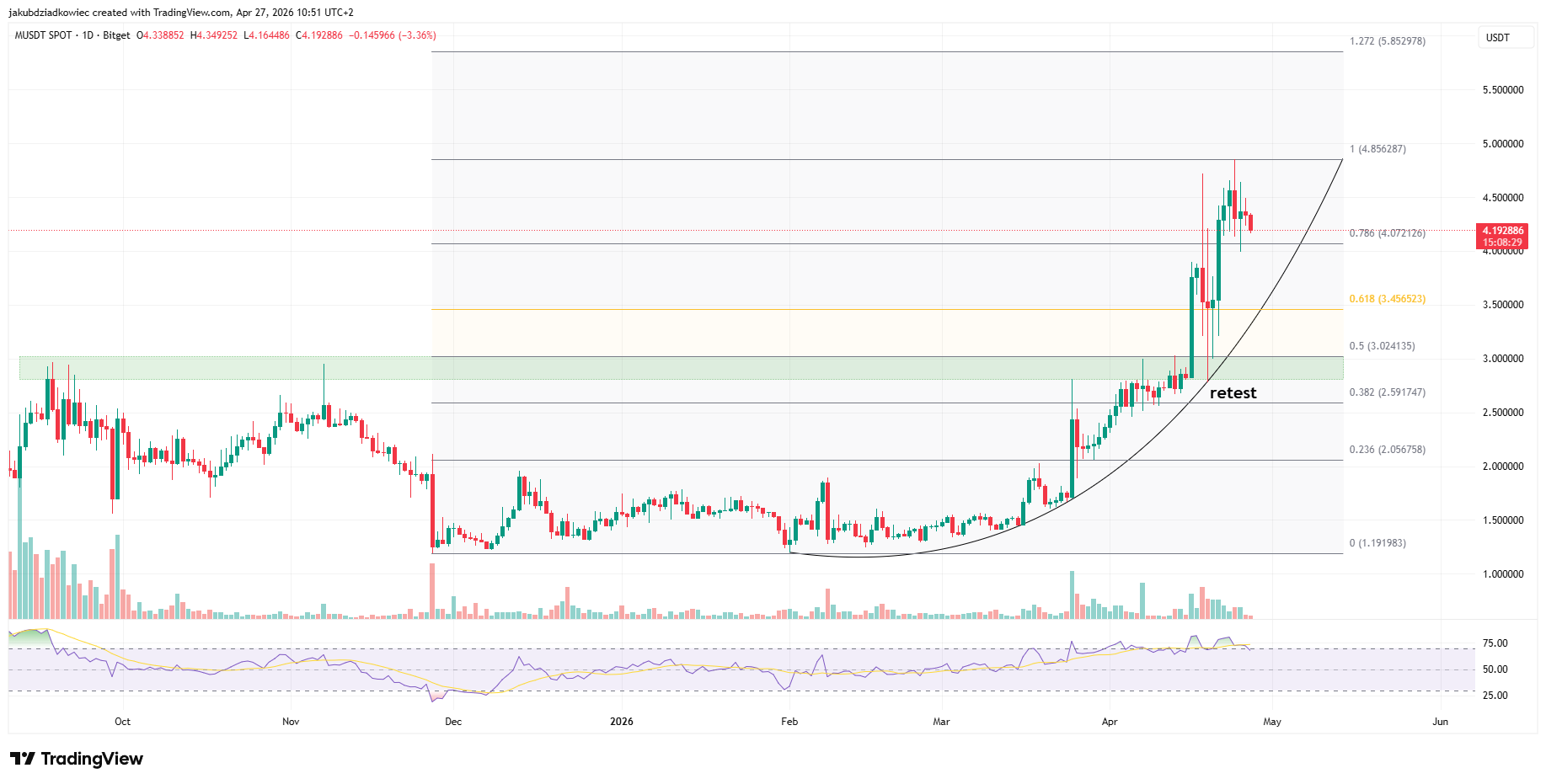
MemeCore (M) trades near $4.19 after a 23% weekly advance, holding within the upper Fibonacci pocket between the 0.786 and 1.0 retracement levels. The token printed a recent swing high of $4.86 on April 24.
The Fibonacci structure draws from the November low and a second test of that same low on February 1. After retracing toward the 0.618 golden pocket near $3.46, buyers stepped back in.
That bounce coincided with a retest of an ascending exponential curve and the green-box support zone close to $3.00.
Momentum signals warrant caution. The Relative Strength Index (RSI) sits at the edge of overbought territory and prints one bearish divergence against the latest swing high. Volume is also contracting, which weakens the case for an immediate continuation.
A clean break above $4.86 opens the path to the 1.272 Fibonacci extension at $5.85, the next bullish target. Failure to reclaim that high keeps M trapped in the upper pocket and exposes a deeper retest of the $3.46 golden pocket.
Pudgy Penguins (PENGU) Powers Meme Coin Rally With Breakout
PENGU trades near $0.0096 after a 32% weekly surge. The token broke decisively above the $0.008 resistance zone that had capped price action since early February, flipping that level to support.
The breakout escapes a multi-month accumulation range that formed between $0.006 and $0.008. Daily volume picked up sharply during the move, supporting the validity of the breakout. RSI climbs toward the overbought line yet has room to run before signaling exhaustion.
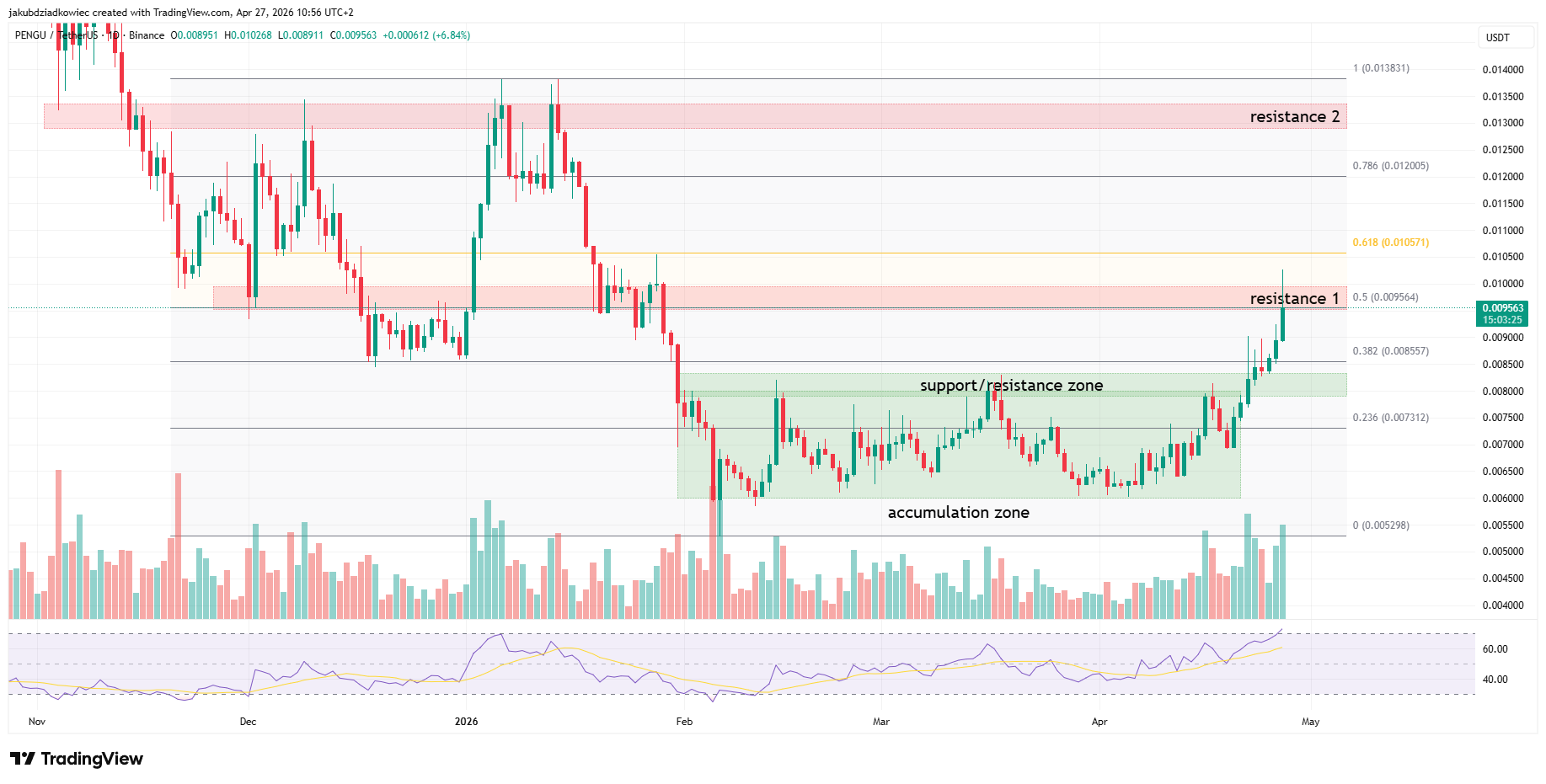
Price now contests the 0.5 Fibonacci retracement at $0.0096, the immediate resistance flagged on the chart. A long upper wick shows sellers defending the level. Holding above $0.008 keeps the bullish structure intact.
A daily close above $0.0096 sets the next destination at the 0.618 golden pocket near $0.0106. Beyond that, the $0.013 zone marks the prior resistance shelf and aligns with the 1.0 Fibonacci level. Loss of $0.008 invalidates the breakout.
SPX6900 (SPX) Breakout Lacks Volume Confirmation
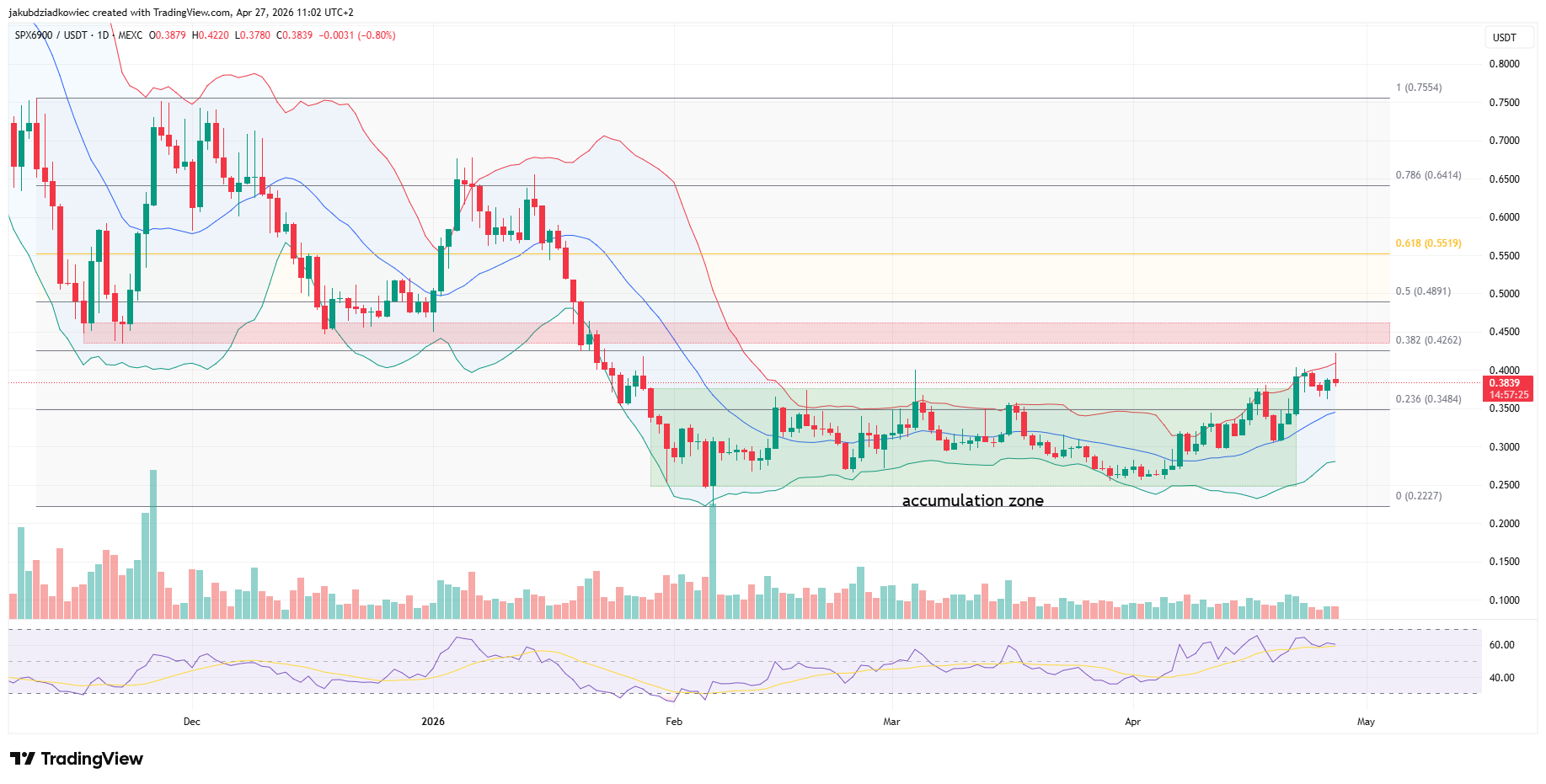
SPX6900 (SPX) sits near $0.3839 after a 19% weekly advance, mirroring a setup the token printed earlier in the year. Price emerged from an accumulation channel between $0.27 and $0.35 that held throughout most of February, March, and the first half of April.
The current resistance challenge sits at the 0.382 Fibonacci retracement near $0.426, the next zone where sellers have previously blocked rallies. RSI hovers around 60 and tilts higher, which fits a healthy uptrend rather than an overheated reading.
Bollinger Bands have widened, with price riding the upper band. That expansion confirms increasing volatility and a bullish bias on the short-term tape. Volume tells a different story. The breakout attempt prints on subdued turnover, reducing conviction in the move.
A volume-backed close above $0.426 would unlock the 0.5 retracement near $0.489 and then the 0.618 golden pocket at $0.55.
Without participation, SPX risks slipping back into the upper end of the accumulation channel near $0.35, with the lower bound at $0.22 acting as the structural floor. Broader sector rotation into meme coins could supply the missing volume.
The post Top 3 Meme Coins to Watch in Final Week of April 2026 appeared first on BeInCrypto.

The Bitcoin 2026 Conference opened Monday in Las Vegas to a backlash from early adopters. They say the event has drifted far from Bitcoin’s anti-establishment origins.
Speakers include the Securities and Exchange Commission chair, the acting US attorney general, and the Trump family. Purists argue the gathering now celebrates the institutions Bitcoin was built to bypass.
Bitcoin 2026 Conference Stages Wall Street and Washington
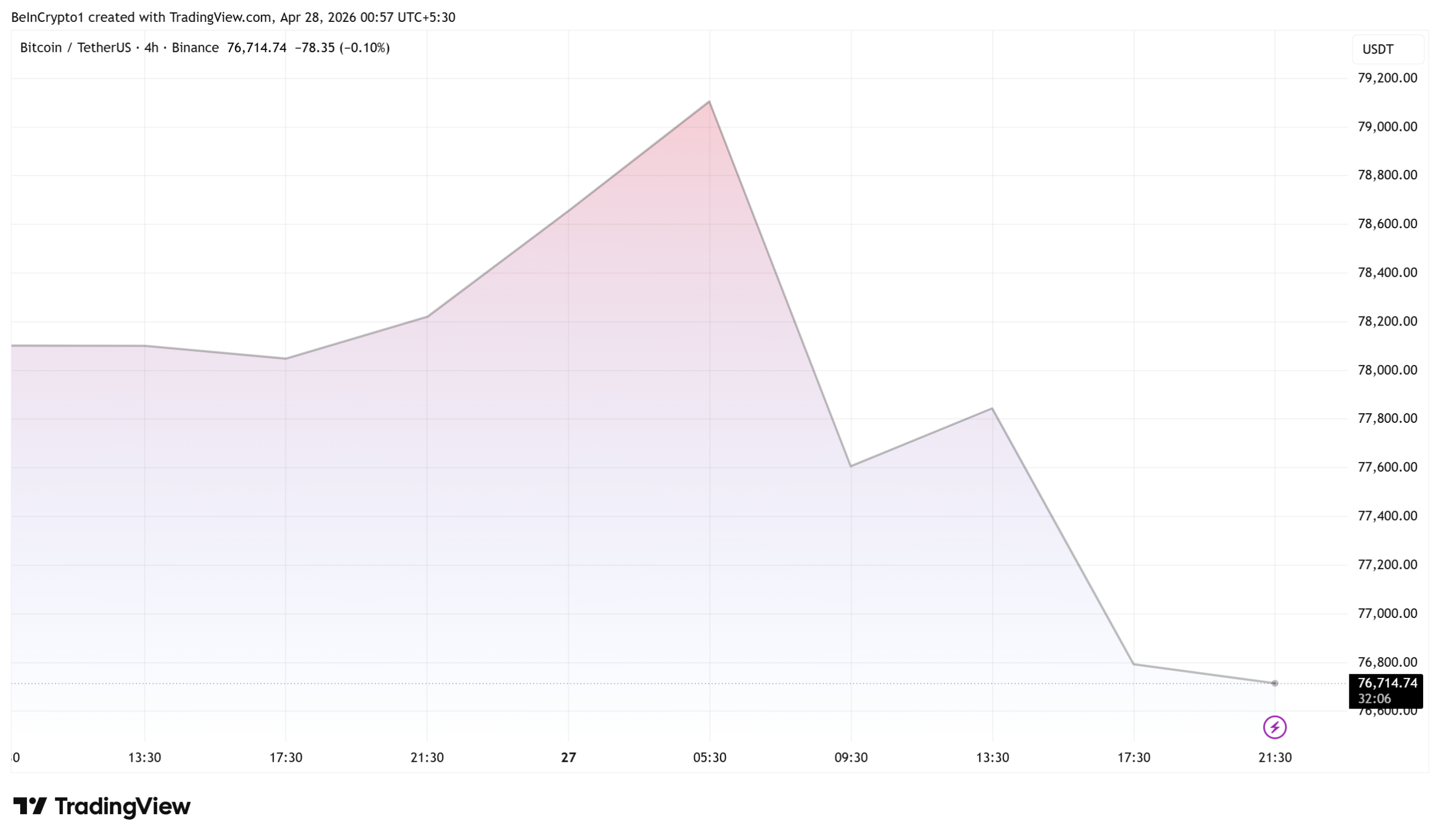
The BTC price was trading for $76,714 as of this writing, recording lower highs on the 4-hour timeframe amid sour sentiment from Day-1 of the Bitcoin 2026 Conference. With this, it has effectively erased all the Sunday gains.
The three-day event runs through Wednesday at The Venetian. Organizer BTC Inc. expects more than 40,000 attendees across 500 scheduled speakers.
The agenda features regulators, lawmakers, and corporate executives. Strategy founder Michael Saylor, Tether chief Paolo Ardoino, and Senator Cynthia Lummis headline the main stage.
US officials carry equal weight. SEC Chairman Paul Atkins, CFTC Chairman Mike Selig, and Acting Attorney General Todd Blanche are all scheduled to appear. Eric Trump represents American Bitcoin as co-founder.
Tickets range from $699 for general admission to $12,999 for the Whale Pass with luxury perks. The official theme this year is “All In On the Future of Money.”
Bitcoin’s Cypherpunk Roots Meet 2026 Reality
Bitcoin emerged from the cypherpunk movement of the 1990s. Satoshi Nakamoto’s whitepaper framed the network as a way to bypass banks and governments.
That positioning is what makes the 2026 lineup jarring for early holders. Many speakers represent the agencies and corporations the protocol was built to route around.
Simon Dixon, an early Bitcoin investor and inaugural conference speaker, posted his frustration on the eve of the event.
“Let’s face it, this Bitcoin conference is compromised. Bitcoin is open source code… It’s a big mistake not to understand the difference,” he wrote.
Supply Shift Worries the Bitcoin Faithful
Beyond the speaker list, critics point to a deeper structural shift. Bitcoin holdings are moving from individual wallets toward spot ETFs, corporate treasuries, and custodial platforms.
That trend pushes a network built for individual sovereignty closer to traditional finance. Self-custody advocates argue the conference now markets products that reverse Bitcoin’s founding promise.
Spot Bitcoin ETFs collectively hold more than a million coins. That concentration would have been unthinkable to the network’s earliest users.
“Meet the 2026 Bitcoin Conference speakers. Or how Bitcoin slowly became the system it was built to escape,” one user quipped.
Other accounts amplify the criticism, framing the lineup as proof of institutional capture rather than mass adoption.
A Conference That Won the Mainstream and Lost the Faithful
BTC Inc. has not publicly responded to the criticism. The conference could win mainstream legitimacy this week. Yet it could also lose the holders who built Bitcoin to escape exactly this.
Sessions through Wednesday will either deepen that divide or test whether institutional adoption can coexist with the cypherpunk crowd.
The post Bitcoin Las Vegas Faces Cypherpunk Revolt Over Regulator-Heavy Lineup appeared first on BeInCrypto.

Industry coalition says JPX’s consultation would add a vague, asset-specific screen to a benchmark that already has objective investability rules.
Nashville, TN — April 26, 2026 — Bitcoin For Corporations (BFC), in coordination with member companies and other affected market participants, today called on JPX Market Innovation & Research, Inc. (JPX) to withdraw its proposed exclusion of companies whose principal asset is cryptoassets from new inclusion in TOPIX and other periodically reviewed indices.
JPXI’s April 3, 2026 consultation does not publicly propose a specific numerical threshold. Instead, it states that, “for the time being,” companies whose principal asset is cryptoassets would be deferred from new inclusion in TOPIX and other periodically reviewed indices. The consultation also states that the proposal would not apply to companies already in the index.
BFC and participating companies oppose the proposal because it is not a true investability rule. TOPIX already has objective criteria designed to protect investability and stability, including liquidity screens, free-float-adjusted market capitalization criteria, continuation buffers, and existing treatment for delistings and other listing-quality events. The proposed crypto-asset exclusion does not measure liquidity, free float, replicability, or listing quality. It instead excludes companies because of the composition of their balance sheet.
“TOPIX is meant to be a broad, neutral, investable benchmark of the Japanese equity market,” said George Mekhail, Managing Director of Bitcoin For Corporations. “If a company satisfies the ordinary market-based eligibility standards, excluding it because of one asset category is not a normal investability screen. It is a policy judgment about one asset class, and it does not belong in the methodology of a flagship market benchmark.”
BFC said the proposal raises four core concerns
- It is not a proper investability rule. The consultation is framed in the language of investability and stability, but the proposed exclusion does not address the criteria that normally determine whether a stock belongs in a broad market index: liquidity, free float, market capitalization, and listing quality. It introduces an asset-specific screen into a benchmark that already has objective eligibility rules.
- It is too vague to administer coherently. The consultation refers to companies whose “principal asset is cryptoassets,” but does not explain how that standard would be applied in practice. It does not say whether the test would be based on parent-company holdings or consolidated holdings, whether it would look through subsidiaries or affiliates, or whether indirect exposure through securities or similar instruments would be captured. A rule that cannot be applied clearly and consistently should not be inserted into a flagship benchmark.
- It creates obvious form-over-substance arbitrage. If direct Bitcoin holdings by a parent company are disfavored, but equivalent exposure through a wholly owned subsidiary, an affiliated company, or a strategic equity position is not, then the rule is targeting legal form rather than economic substance. That would encourage balance-sheet engineering rather than improve index quality.
- It is preemptive and open-ended. October 2026 will be the first periodic review under the next-generation TOPIX framework in which Standard and Growth market companies can become eligible through the new process. Yet JPX is proposing to exclude a category of companies before they have even been assessed under the ordinary criteria. At the same time, the consultation says the exclusion would apply “for the time being,” without setting out a clear review period, exit standard, or sunset mechanism. That is not a disciplined framework. It is an indefinite deferral with uncertain boundaries.
BFC also noted that major global index providers have treated this issue with greater caution. MSCI considered a threshold-based exclusion for digital-asset treasury companies and ultimately did not adopt a blanket exclusion, instead acknowledging the need for further work to distinguish operating companies from non-operating or investment-like entities. FTSE Russell has not announced a comparable blanket exclusion. In BFC’s view, JPX should show the same restraint rather than moving ahead with a crypto-only exclusion before a broader principle has been defined.
More broadly, BFC said the issue extends to the neutrality, credibility, and representativeness of Japan’s flagship equity benchmark.
“If JPX believes there is a broader question about highly concentrated or investment-like companies, then an asset-neutral framework applied consistently would be more appropriate,” Mekhail said. “Singling out one asset class by introducing a vague rule that is easy to evade and difficult to administer would be unprecedented and untethered from TOPIX’s actual investability criteria.”
Bitcoin For Corporations and participating market participants are calling on JPXI to:
- Withdraw the proposed exclusion for companies whose principal asset is cryptoassets.
- Preserve TOPIX as a neutral, broad, rules-based benchmark tied to objective investability and listing-quality standards.
- Refrain from adopting an open-ended deferral without a clear review process, exit standard, or sunset mechanism.
- Engage with issuers and market participants on any broader, asset-neutral framework before changing TOPIX methodology.
Organizations and individual investors may review the full position letter and add their signatures at: topix.bitcoinforcorporations.com
About BTC Inc
BTC Inc. is the world’s leading Bitcoin media enterprise, operating Bitcoin Magazine, The Bitcoin Conference, and Bitcoin for Corporations. Through its media, events, and educational platforms, BTC Inc. delivers trusted news, research, and experiences that advance Bitcoin adoption among individuals, institutions, and enterprises worldwide.
BTC Inc is a subsidiary of Nakamoto Inc. (NASDAQ: NAKA), a publicly held Bitcoin company that owns and operates a global portfolio of Bitcoin-native enterprises.
Forward-Looking Statements
Certain statements in this press release constitute forward-looking statements, as defined under U.S. federal securities laws. Forward-looking statements can be identified by the use of words such as “estimate,” “project,” “predict,” “believe,” “expect,” “anticipate,” “potential,” “intend,” “could,” “would,” “may,” “plan,” “will,” “seek,” “target,” or the negative of such terms or other variations thereof. However, the absence of these words does not mean that a statement is not forward-looking.
Forward-looking statements in this press release include, but are not limited to, statements regarding BTC Inc.’s business plans and strategies, including plans for new products, services, and media platforms; projected or targeted audience size, reach, impressions, and distribution; expected launch dates and production schedules; the Company’s advocacy positions and the expected outcomes of industry and regulatory engagement; and the anticipated role and growth of Bitcoin-related media, events, and educational services.
These forward-looking statements are inherently uncertain and involve numerous assumptions and risks. Factors that could cause actual results to differ materially from those projected include, but are not limited to: (i) the volatility of Bitcoin prices and its effect on audience interest, advertiser demand, and the commercial viability of Bitcoin-focused media; (ii) changes in audience size, engagement, or platform distribution that could affect BTC Inc.’s reach or revenue; (iii) the risk that new products or services, including new media platforms, may not launch on schedule, achieve projected audience levels, or generate anticipated revenue; (iv) the risk that advocacy or industry engagement efforts may not achieve their intended outcomes; (v) dependence on third-party distribution platforms whose policies, algorithms, or terms of service may change; competition from other media companies and content providers; (vi) the evolving regulatory environment for digital assets and its potential impact on BTC Inc.’s operations, content, and audience; (vii) reliance on key personnel and creative talent; the risk that projected audience metrics, impressions, or distribution figures may not be achieved or sustained; (viii) risks associated with the integration of BTC Inc. into Nakamoto Inc.’s operations following the February 2026 acquisition; (ix) general economic conditions and their impact on advertising and events revenue; and (x) other important factors detailed in Nakamoto Inc.’s Annual Reports on Form 10-K, Quarterly Reports on Form 10-Q, Current Reports on Form 8-K, and other documents that are filed, or will be filed, with the SEC and that are or will be available on Nakamoto’s website at www.nakamoto.com and on the website of the SEC at www.sec.gov.
Because Nakamoto Inc. (NASDAQ: NAKA) is the parent company of BTC Inc., investors in Nakamoto Inc. common stock should be aware that the performance and risks of BTC Inc.’s media, events, and educational businesses may affect Nakamoto Inc.’s business, financial condition, results of operations, and stockholder value.

A new policy analysis from Blockchain for Europe contends that the European Union’s landmark Markets in Crypto-Assets Regulation (MiCA) has produced euro-denominated stablecoins that are ultra-safe but commercially weak. The authors argue this has left the bloc lagging behind US dollar–pegged tokens in digital payments, liquidity provision, and on-chain trading, even as the euro remains a dominant global currency. According to Cointelegraph, DeFiLlama data show euro stablecoins account for less than 1% of global stablecoin volume, a stark underutilization given Europe’s broader financial footprint.
Drafted by European Central Bank official Ulrich Bindseil and Blockchain for Europe’s Erwin Voloder, the report centers on MiCA’s rules for euro electronic money tokens (EMTs). These tokens must be fully backed and are prohibited from paying interest. That remuneration ban was intended to prevent stablecoins from acting as deposit substitutes; however, the authors argue it pushes MiCA-compliant euro EMTs into a “downward-sloping” portion of a regulatory Laffer curve, where heightened restrictions depress the activity the framework is designed to govern. In a world of rising rates, the zero-interest remit is presented as a structural handicap.
The paper also takes aim at MiCA’s reserve requirements, noting that at least 30% of EMT reserves must be held as bank deposits, a threshold that climbs to 60% for significant issuers. The authors call this provision a feature not paralleled in stablecoin regulation abroad and advocate a shift toward a principle-based approach compatible with the EU’s Liquidity Coverage Ratio (LCR) framework and a broader mix of high-quality euro assets. Rather than a wholesale rewrite, the study urges targeted reforms to EMT reserve, remuneration, and transparency rules while proposing that large issuers should have carefully bounded access to central bank settlement accounts during severe stress scenarios.
Key takeaways
- MiCA’s euro EMT framework prioritizes safety and transparency but may curtail market activity by prohibiting yield on reserves and imposing strict reserve-rule thresholds.
- DeFi and on-chain liquidity in euro stablecoins remain disproportionately small relative to Europe’s financial scale, suggesting a competitive gap with USD-backed tokens and their yield mechanisms.
- A shift toward principle-based liquidity standards and a broader asset mix could preserve safety while improving competitiveness for euro EMTs.
- The debate feeds into broader policy considerations about MiCA 2.0, with regulators weighing safety safeguards against the need for market maturity and cross-border competitiveness.
- Stability and supervisory concerns persist, including potential concentration of demand in euro-area sovereign bonds during redemptions and the risk of regulatory arbitrage if safeguards are weakened.
MiCA’s euro EMT framework: safety versus market relevance
The analysis underscores a fundamental tension in MiCA’s euro EMT rules. By mandating full collateral backing and banning remunerations, the framework aims to curb the risk that EMTs become mere substitutes for bank deposits. Still, the authors argue that this combination—strict safeguards paired with zero interest—creates a competitive disadvantage in a positive-rate environment. In practice, euro EMTs may appeal to risk-conscious institutions seeking stability, but their utility for yield-seeking users or liquidity providers could be limited relative to dollar-pegged tokens or euro-denominated products that distribute yields through alternative mechanisms.
Beyond the remuneration constraint, the 30% reserve floor (60% for larger issuers) is highlighted as a distinctive EU feature. The report contends that these thresholds are not aligned with comparable regimes in other major jurisdictions, potentially raising funding costs and dampening liquidity. The authors propose replacing rigid numeric thresholds with a more flexible, risk-based regime that mirrors the EU’s LCR language and would allow a diversified reserve mix consisting of high-quality euro assets that meet liquidity objectives without the rigidity of a fixed percentage.
Regulatory context and policy debate
The paper situates its recommendations within a broader, ongoing policy conversation around MiCA’s global competitiveness. As Europe contemplates “MiCA 2.0,” officials signal a willingness to revisit the framework to keep pace with market maturation, a stance echoed by Brussels’ policy discourse. At the same time, supervisory authorities warn against diluting safeguards. The European Banking Authority (EBA) has warned that proposed changes to MiCA’s technical standards could erode protections and elevate arbitrage risk if not carefully calibrated. This tension highlights the high-stakes balancing act facing regulators: foster innovation and cross-border activity while preserving safety and financial stability.
On a cross-jurisdictional basis, comparisons with U.S. policy are instructive. The US Guiding and Establishing National Innovation for US Stablecoins (GENIUS) Act, which prohibits interest payments on balance holdings of payment stablecoins, shares a similar safety motive but operates in a different market architecture. In the U.S., dollar-pegged stablecoins remain central to DeFi lending pools and other on-chain yield strategies, which helps attract liquidity without issuer-paid yields. The divergent design choices between MiCA and U.S. policy frameworks illuminate how regulatory intent translates into distinct market structures and risk profiles.
Stability considerations and macroprudential context
Macroprudential analysis from the European Central Bank this year has drawn attention to the potential systemic implications of large-scale euro-stablecoin adoption. The ECB cautions that significant growth in euro stablecoins could concentrate demand in short-dated euro-area government bonds, potentially impacting yields and liquidity during periods of redemptions. The report’s authors echo the concern that supervisory frameworks must carefully manage these dynamics as stablecoins scale within Europe’s financial ecosystem. In this view, the rigidities embedded in MiCA’s EMT rules could hamper timely risk management and liquidity provisioning in stress scenarios, unless reforms are crafted to preserve both safety and operational resilience.
Overall, the analysis frames MiCA’s euro EMT regime as a carefully calibrated, safety-first model that may need calibrated adjustments to remain effective as markets mature. The authors advocate a targeted reform path rather than a sweeping overhaul, arguing that a more flexible reserve and remuneration regime, grounded in robust liquidity standards and asset diversity, would better align EU policy with evolving market practice while maintaining the protective intent of MiCA.
Prospects for MiCA 2.0 and regulatory oversight
The report arrives as policymakers weigh the scope of a potential MiCA 2.0 overhaul. Proponents argue that updates could refine liquidity principles, enhance transparency, and ensure Europe remains competitive in a global digital-asset landscape. Critics, however, warn that loosening safeguards could invite arbitrage and stability risks if not matched with rigorous supervisory standards. Regulators are likely to consider empirical evidence from market development, including euro-stablecoin usage, cross-border settlements, and the resilience of EMT issuers under stress.
For market participants—issuers, banks, exchanges, and institutional allocators—the discussion signals a shifting preference for clarity on reserve composition, yield mechanics, and settlement access. The policy trajectory will bear on licensing decisions, cross-border cooperation, and the integration of stablecoins with traditional payment rails and central-bank money infrastructure. In particular, the debate touches on licensing regimes for EMT issuers, eligibility criteria for settlement accounts, and the alignment of EMT operations with AML/KYC frameworks and broader compliance standards.
Closing perspective
As Europe weighs refinements to MiCA, the central questions revolve around preserving financial stability and investor protection without stifling innovation or liquidity. The ongoing dialogue signals a nuanced policy path: targeted adjustments that acknowledge market realities while retaining the safeguards essential to regulatory resilience. Watch for further regulatory filings, official statements, and sectoral feedback as MiCA’s evolution continues to unfold, with implications for institutions, markets, and cross-border operations alike.
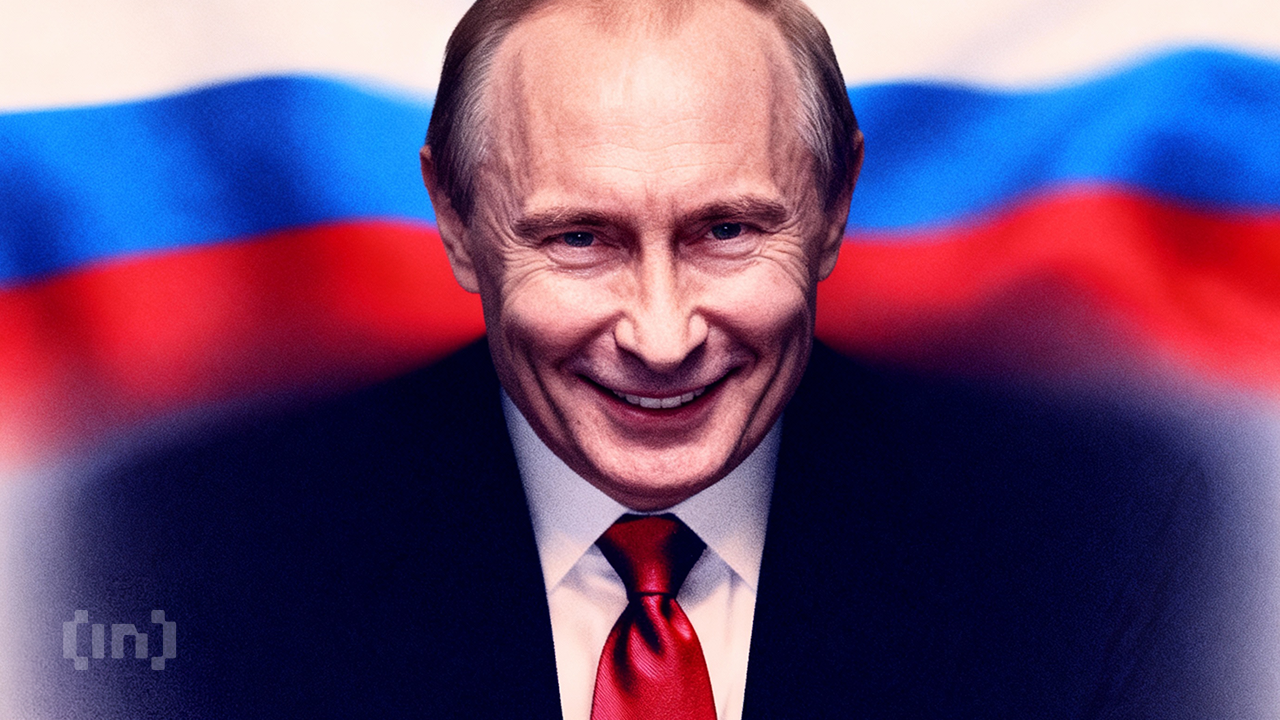
The $500 million superyacht Nord, linked to sanctioned Russian billionaire Alexey Mordashov, transited the Strait of Hormuz over the weekend. The crossing has drawn fresh scrutiny to gaps in Western sanctions enforcement.
The 142-meter Lürssen-built yacht sailed openly from Dubai to Muscat between April 24 and 26. It broadcast its position via the automatic identification system while commercial shipping stalled at both ends of the chokepoint.
Sanctions On Paper, Not At Sea
Mordashov has carried United States, European Union, and United Kingdom sanctions since 2022 over his close ties to Vladimir Putin.
The designations cite his roughly 77% stake in Severstal, Russia’s largest steelmaker. They also target his interests in Bank Rossiya and state-aligned media.
The yacht itself has never been seized. Public registries do not list Mordashov as the owner. Shipping records instead tie Nord to a Russian firm controlled by his wife, Marina Mordashova. The structure is widely seen as a buffer against Western asset freezes.
Reuters reported the vessel departed a Dubai marina at around 1400 GMT on April 24. It crossed Hormuz the next morning and reached Muscat early Sunday. MarineTraffic data tracked the route in real time.
Selective Passage Through Hormuz
Hormuz traffic has collapsed since the United States imposed a maritime blockade on Iranian ports on April 13.
Daily transits have fallen from roughly 140 vessels to single digits. Hundreds of tankers now wait at both ends of the strait.
Iran has granted preferential passage to Russia-linked vessels under a 2025 cooperation pact, according to reporting from The Independent.
Nord followed an Iranian-declared safe lane south of Larak Island while bound for Oman. The route placed it outside the US enforcement focus on Iranian-port traffic.
The crossing illustrates how layered ownership structures and aligned host states insulate sanctioned Russian assets from coordinated Western action.
Broader maritime restrictions continue to tighten elsewhere across the Gulf.
The post Sanctioned Russian Billionaire’s $500 Million Yacht Slips Through Hormuz Blockade appeared first on BeInCrypto.

BitMine Immersion Technologies, the Ether treasury company backed by Fundstrat’s Tom Lee, expanded its ETH holdings for a second straight week, purchasing an additional 101,901 ETH last week. The new addition lifts BitMine’s ETH stash to roughly 5.08 million and pushes its overall crypto-and-cash reserves to about $13.3 billion, according to market tracking and disclosures cited by industry observers.
The ongoing accumulation comes even as the firm sits on sizable unrealized losses tied to its ETH tranche, highlighting the risk-reward calculus involved in large-scale crypto treasury management during periods of elevated volatility.
The latest buy follows an earlier move of 101,627 ETH a week prior, which Cointelegraph described as the largest accumulation by BitMine since December 2025. That earlier purchase was noted by Cointelegraph as a notable uptick in sustained treasury buying during a period of price fluctuations for Ether.
In addition to the hard-layer exposure, BitMine’s public disclosures show a substantial gap between the book value of its ETH holdings and the current mark-to-market value. Unpacked, the company’s unrealized losses on the ETH treasury exceed $6.5 billion, based on total investments around $17.6 billion. The figure underscores how recent Ether price swings have amplified the drag on balance sheets even as the company continues to deploy capital into ETH.
The stock market side of BitMine reflects a separate pressure. BMNR, the NYSE-listed ticker for BitMine Immersion Technologies, has declined more than 20% year-to-date, according to Yahoo Finance data. That performance contrast—strong buy activity in the treasury alongside a downbeat equity mood—illustrates the divergent paths crypto-focused corporates can navigate when asset prices and broader risk sentiment diverge.
Nevertheless, BitMine has not stood idle on the yield front. The company reports staking roughly 3.7 million ETH, a step that generates rewards by contributing to Ethereum’s security and transaction validation process. In a market where price moves dominate headlines, staking offers a potential ongoing income stream that can help offset some near-term declines, though it does not fully shield balance sheets from drawdowns during sharp downturns.
Context for these moves is crucial. Ether’s price action in recent weeks has offered a glimmer of stabilization after a wave of declines through March. Ether rebounded above $2,400 last week after a dip to around $1,800 earlier in the year, according to TradingView data cited by Cointelegraph. Even with the rebound, Ether remains well below its year-to-date highs, and the asset remains roughly 23% lower on the year. The broader market backdrop—an improving tilt in risk assets alongside still-fragile sentiment—helps explain why treasury players like BitMine are doubling down on holdings amid volatility.
Analysts and market observers point to the tension at play in large crypto treasuries: the upside of accumulating strategic reserves during price weakness versus the downside of mark-to-market losses when markets turn against those accumulations. The yield from staking provides a counterpoint to this risk, but it does not replace the need for discipline in capital deployment or risk management. For investors and managers alike, the question remains how much longer these large-scale purchases can continue if Ether’s price remains volatile or if regulatory and macro conditions shift meaningfully.
BitMine’s approach also highlights a broader question for corporate and institutional treasuries in crypto: when does ongoing accumulation begin to tilt the balance toward longer-term strategic positioning vs. the immediacy of mark-to-market volatility? The company’s leadership—backed by notable figures such as Fundstrat’s Tom Lee—appears to envision a thesis where continued accumulation is part of a multi-year strategy, but the path is clearly defined by price cycles, staking yields, and the evolving risk landscape.
Additionally, observers are watching how such treasury strategies interact with the broader market’s liquidity environment. As Ether price cycles evolve, the ability of large holders to realize or offset losses may hinge on liquidity, staking rewards, and the pace at which new capital can be deployed without triggering outsized price impact. In this context, BitMine’s ongoing purchases and staking activity provide a real-world case study in how corporate crypto reserves can navigate a choppy market while pursuing yield-generation opportunities.
What comes next remains uncertain. If Ether continues its tentative stabilization alongside a broader improvement in risk appetite, BitMine and peers may press further into accumulation, potentially signaling institutional confidence in Ethereum’s long-run fundamentals. Conversely, renewed volatility or macro headwinds could test the durability of this strategy and the capacity of treasuries to sustain large, mark-to-market losses while maintaining growth of reserves and yield streams.
As investors weigh these developments, market watchers will monitor Ether’s price trajectory, staking yields, and corporate treasury disclosures for signs of how risk-taking is evolving in crypto-native balance sheets. The coming weeks will be telling in whether BitMine’s strategy proves resilient amid ongoing price swings or whether the unrealized losses will force a re-evaluation of appetite for heavy ETH exposure.
Watch next for how Ether’s price action interacts with treasury strategies across the sector, and whether BitMine’s continued purchases will influence market sentiment or simply reflect a broader risk posture among crypto-linked enterprises.
References: Wu Blockchain reported the latest ETH purchase; Cointelegraph noted the prior week’s 101,627 ETH as the largest accumulation since December 2025; Dropstab data cited unrealized losses topping $6.5 billion on a roughly $17.6 billion ETH portfolio; Yahoo Finance tracks BMNR stock performance; Ether price context drawn from TradingView data via Cointelegraph.
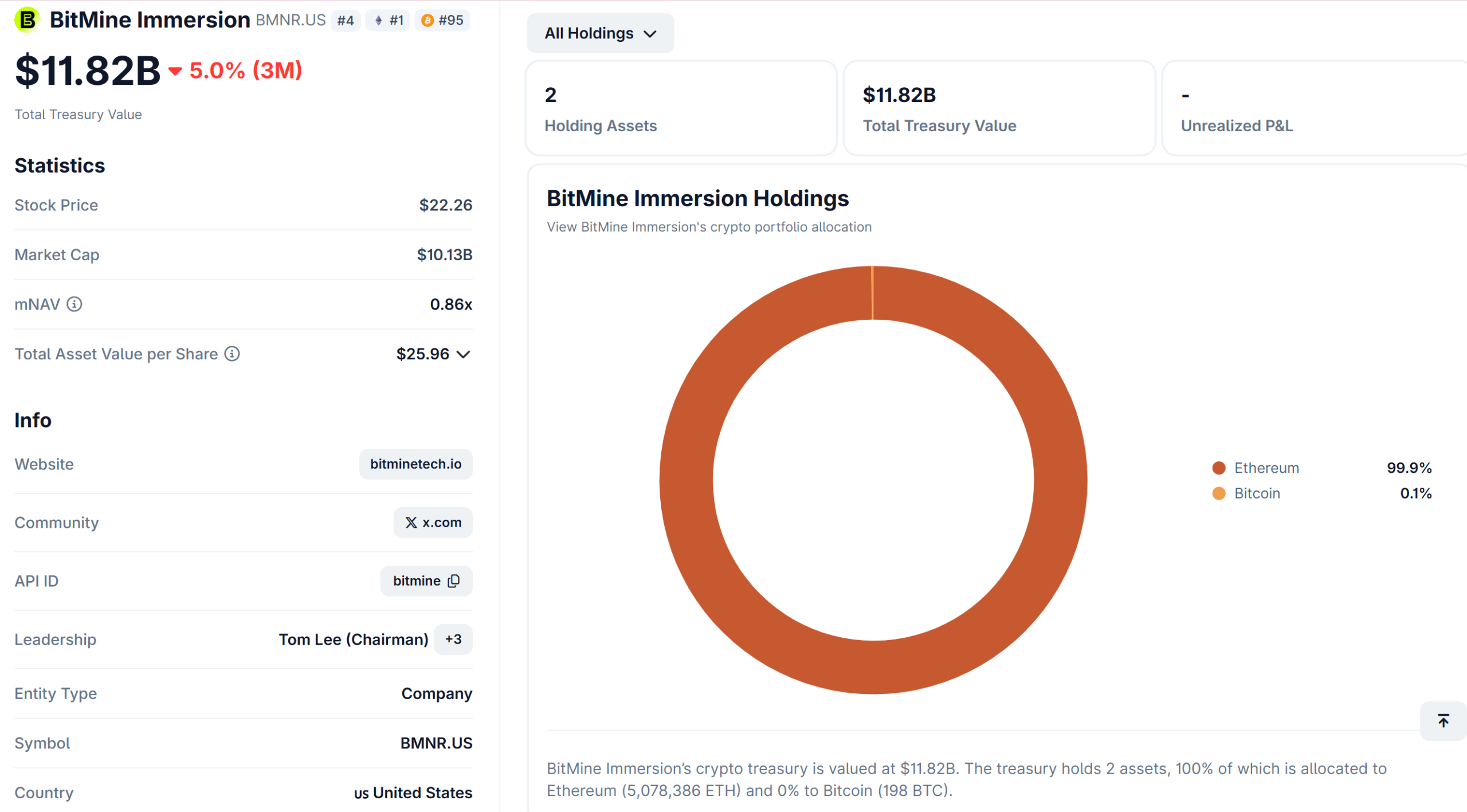
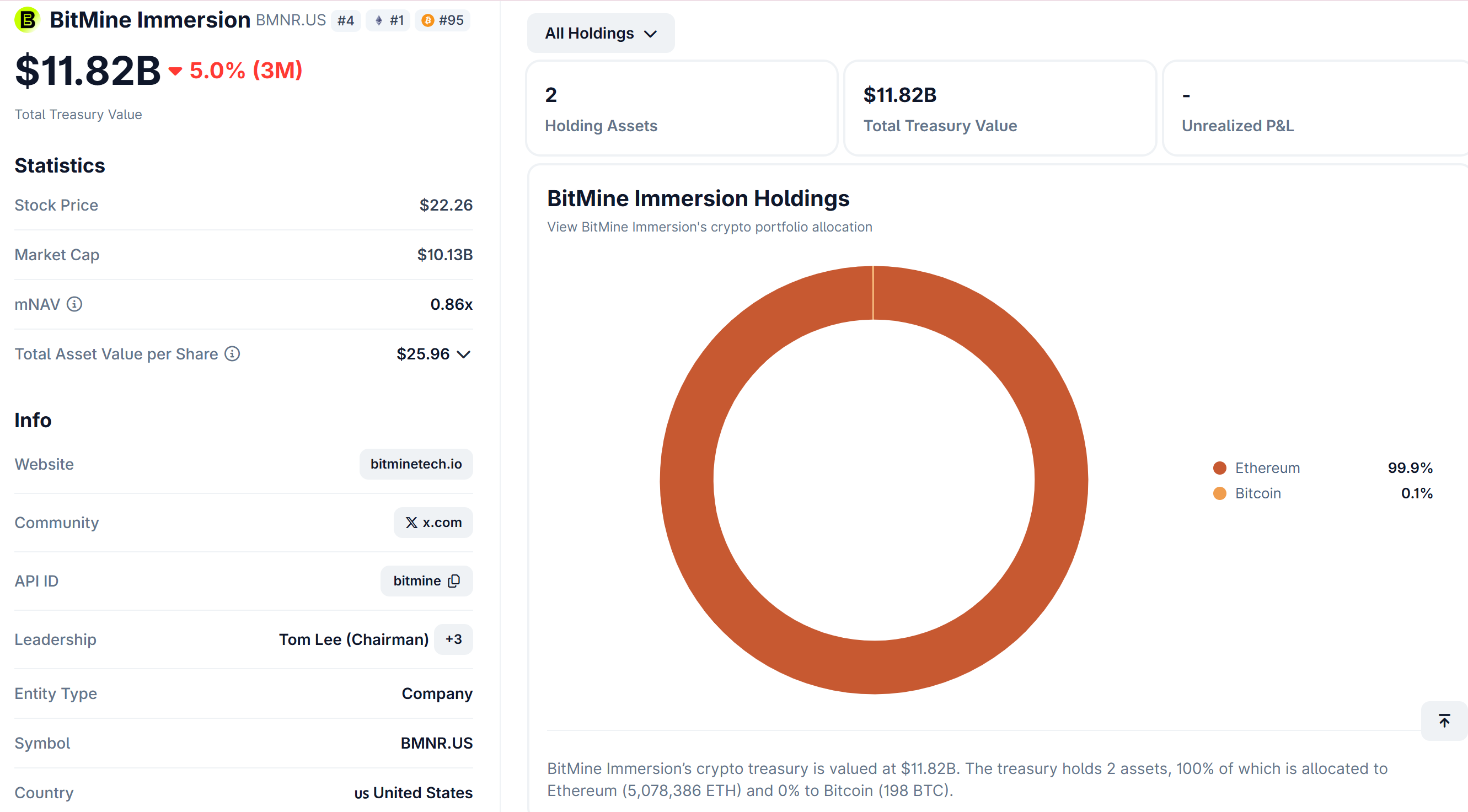
MicroStrategy and BitMine Immersion Technologies are racing toward different crypto accumulation targets. BitMine has pulled ahead. The Ether treasury is 16% short of its goal, while Strategy still trails by roughly 18%.
BitMine crossed 5 million Ether (ETH) on April 27, a milestone that puts it 84% of the way to 5% of all ETH. Strategy holds 818,334 Bitcoin (BTC) and is 181,666 tokens short of 1 million.
Race to Corporate Crypto Dominance
BitMine, chaired by Tom Lee, holds 5.078 million ETH worth roughly $11.5 billion at $2,314 per coin. The company adds $940 million in cash, $200 million in Beast Industries, and $91 million in Eightco Holdings. Total assets reach $13.3 billion.
MicroStrategy, led by Executive Chairman Michael Saylor, has paid an average of $75,537 per BTC. Its cost basis sits at $61.81 billion. The latest weekly purchase added 3,273 BTC for $255 million at $77,906 per coin.
BitMine Has the Shorter Runway
BitMine needs about 1 million more ETH to reach its 5% of supply goal. At current prices, that means roughly $2.4 billion in additional buying.
Meanwhile, MicroStrategy needs nearly $14 billion at $77,000 per BTC. The dollar gap is almost six times (6x) larger. BitMine could close that gap with a single quarter of capital raising at recent run rates.
The funding model differs. MicroStrategy raises capital through STRC perpetual preferred shares and at-the-market equity sales.
The company carries $8.25 billion in debt and $13.53 billion in preferred stock. Annual dividend obligations sit at $1.49 billion on a non-yielding asset.
BitMine generates yield. The company stakes 3.7 million ETH through its Made in America Validator Network (MAVAN) platform at roughly 3%.
That produces $264 million in annualized revenue. Full staking would push rewards toward $363 million a year.
Are Bitcoin and Ethereum the Ultimate Winners in Any Scenario?
MicroStrategy reaching 1 million BTC would lock up 4.76% of Bitcoin’s capped supply under one corporate roof.
“Based on their 2026 average weekly buys, they will have 1 Million Bitcoin by December of this year. 1M BTC is 4.76% of the ending total supply once fully mined. Why do I buy MSTR? Duh,” remarked one investor.
Persistent absorption at that scale shrinks the float available to spot markets. That could pressure BTC higher in tight liquidity conditions.
However, BitMine controlling 5% of Ethereum carries a different effect. Most of those coins remain staked, removing them from the circulating supply while reinforcing network security.
The combined accumulation and staking lockup may amplify ETH price sensitivity to fresh demand.
“If just 3-4 more institutions follow BitMine’s playbook, we’re looking at a supply crisis that makes 2021 look tame…319K ETH removed + staking lockup = deflationary pressure accelerating…$15K ETH by December isn’t optimistic. It’s mathematical inevitability if this institutional FOMO spreads. Smart money is positioning NOW. Retail will chase at $8K+,” wrote investor and technologist Paul Barron.
Tom Lee has framed Ether as a store of value and collateral for tokenized finance. He points to its outperformance versus the S&P 500 since geopolitical tensions escalated.
The growing demand for tokenization and AI-driven blockchain infrastructure adds to the case.
BitMine trades $845 million a day on the NYSE main board, ranking 129th among US-listed equities. The investor roster includes ARK Invest’s Cathie Wood, Founders Fund, Pantera Capital, Galaxy Digital, and Kraken.
Strategy’s MSTR, on the other hand, sits at a 1.25x premium to net asset value.
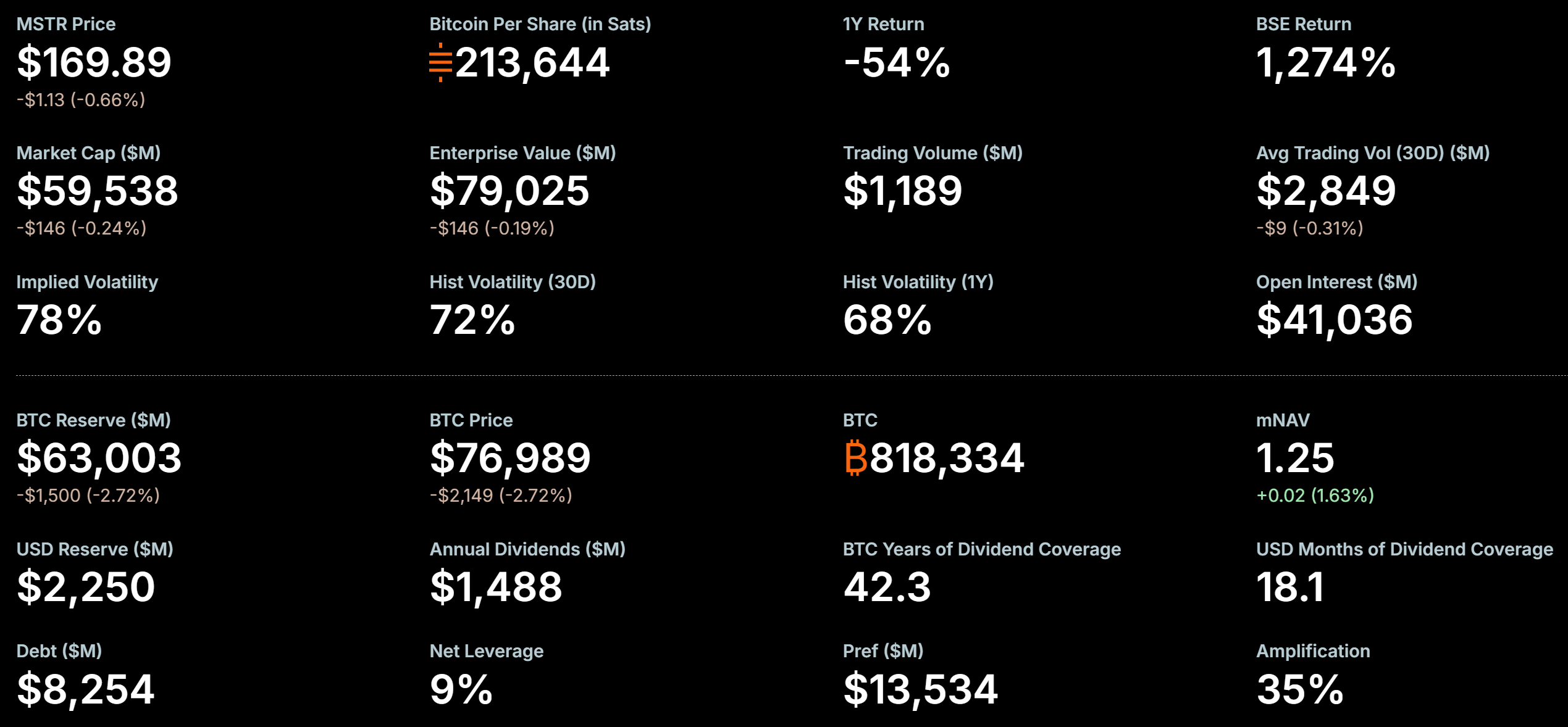
BitMine looks set to cross the line first if its current pace and capital access hold.
While this could mean ETH outperforms BTC, it depends on how cleanly both treasuries fund the final stretch.
The race may also test whether Saylor’s pace of 5,250 BTC a week remains repeatable over the next eight months.
The post MicroStrategy vs Tom Lee’s BitMine: Who Hits Target First? appeared first on BeInCrypto.
Key takeaways:
- Persistent spot market accumulation from Bitcoin ETFs and Strategy provided a price floor for Bitcoin and threatens to trigger a short squeeze.
- Negative funding rates and cautious options skews could trap bears if the Federal Reserve policy shifts or high oil prices trigger higher inflation.
Bitcoin (BTC) price sustained levels above $76,000 for the past week, distancing itself from its year low at $60,500. The recent bullish momentum came as crude oil prices jumped above $100 and the S&P 500 hit new trading highs, but futures market data may point to a short-term rally-ending outcome for Bitcoin.
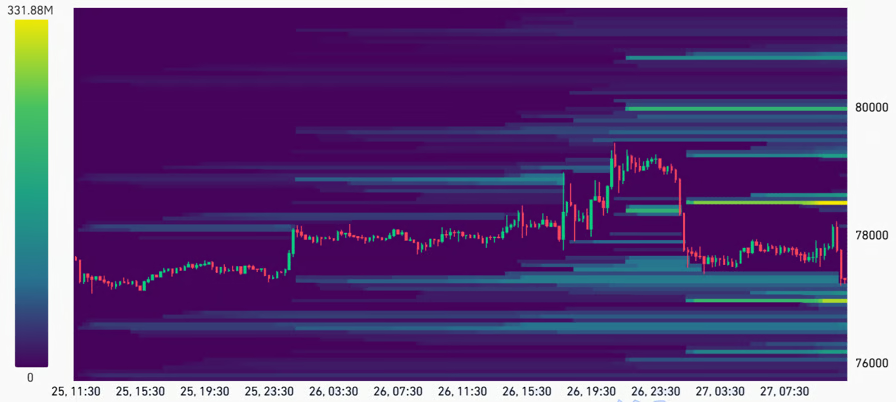
A total of $1.4 billion in leveraged short positions near $80,000 has been built over the past 48 hours, according to CoinGlass data, and Bitcoin’s rejection at $79,500 has raised alarm.
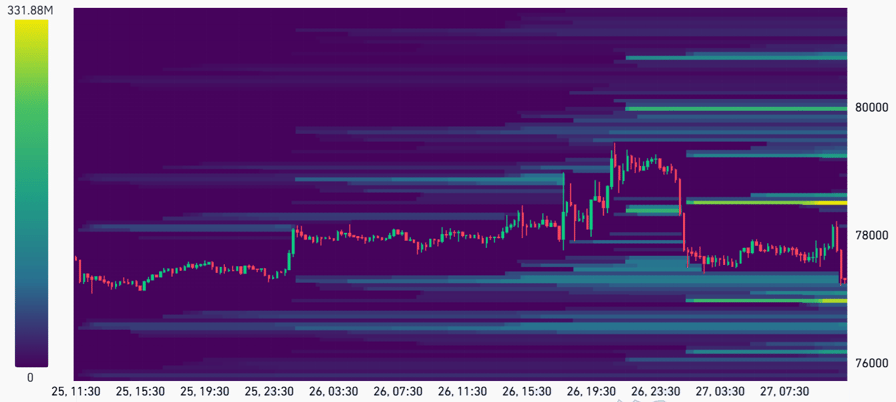
Estimated Bitcoin futures liquidation levels, USD. Source: CoinGlass
Federal Reserve decision, inflation data may push Bitcoin above $80,000
The lack of investors’ appetite for bullish Bitcoin leverage has been evident, but a bear trap could spring if the US Federal Reserve adopts a less restrictive monetary policy or if investors anticipate higher inflation, which would reduce the expected net returns from fixed-income assets.
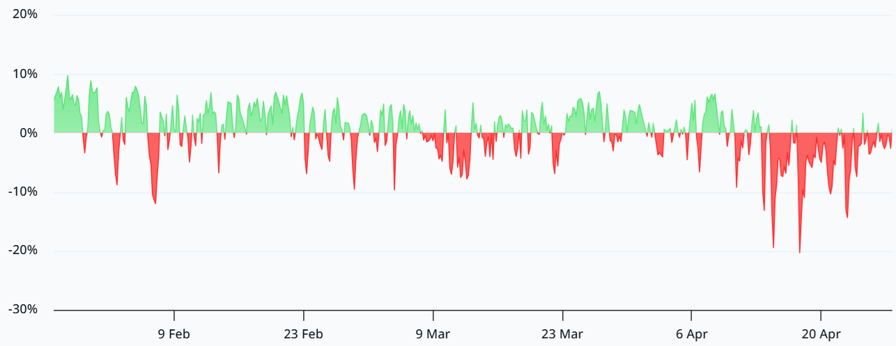
Bitcoin perpetual futures annualized funding rate. Source: Laevitas
The Bitcoin perpetual futures annualized funding rate has remained mostly negative over the past two weeks, a typical sign of growing bearish confidence. Curiously, this happened while Bitcoin’s price jumped to $78,000 from $72,000 on April 9 and most of those bets are at a loss at $76,700. A rally above $80,000 would likely force traders to close their positions.
Data show investors are no longer anticipating interest rate hikes from the Fed, even as Brent crude prices have reclaimed the $100 level. The pressure from high energy prices has a cascading impact on inflation expectations, but the Fed is also concerned with the weakening job market and economic growth.
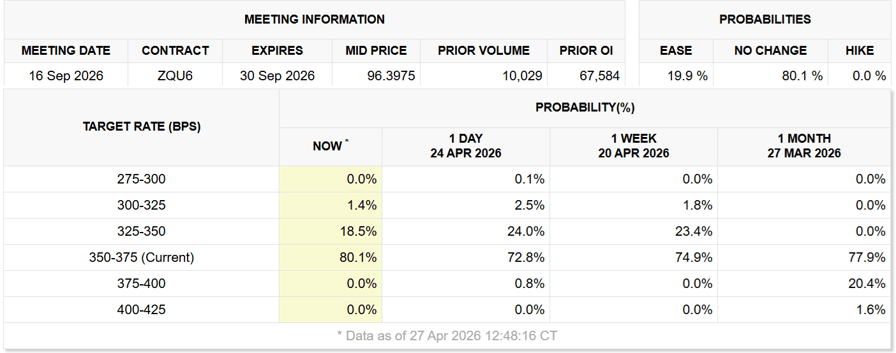
Implied target rate probabilities for Sept. 16 Fed meeting. Source: CME FedWatch tool
US government bond futures contracts presently indicate 20% odds of interest rates decreasing by September, marking a complete turnaround from one month prior. Traders realized that the Fed is in a tough spot, hence the 3.95% yield on 5-year US Treasury became less appealing. An interest rate cut exerts upward pressure on inflation.
Sustained spot Bitcoin buying supports BTC’s bullish momentum
Bitcoin’s bullish momentum has been driven by the spot market, evidenced by Strategy (MSTR US) adding $255 million in BTC between April 20 to April 26 and the $824 million net inflows into US-listed Bitcoin exchange-traded funds (ETFs). Bitcoin buyers continued to accumulate despite the failed attempts to hold above $79,000.
Related: Critical Bitcoin trend change in works, but analysts say daily close above $80K required
To determine if professional Bitcoin traders are effectively leaning bearish, one should assess the options markets.
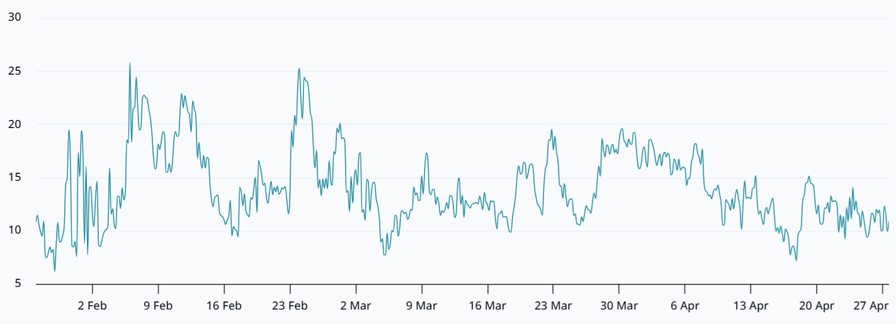
Bitcoin options 30-day delta skew (put-call) at Deribit. Source: Laevitas
The Bitcoin options delta skew shows put (sell) options trading at an 11% premium relative to call (buy) options, consistent with a bearish market. Whales and market makers are uncomfortable with downside risk, which reinforces the thesis of a potential bear trap if Bitcoin reclaims $80,000 in the near term.
Further Bitcoin bullish momentum remains far from certain, but as long as spot market demand remains strong, the pressure on short positions may continue to mount. If the current accumulation trend persists alongside a softening of Federal Reserve policy, the resulting liquidity squeeze could easily propel the price well beyond the $80,000 resistance level.


Bitmine crossed 5 million Ethereum tokens on April 27 after buying 101,901 ETH for approximately $236 million, making it the first company in history to hold more than 5 million ETH and the world’s largest corporate Ethereum treasury by a wide margin.
Summary
- Bitmine bought 101,901 ETH for approximately $236 million in the week ending April 26, pushing total holdings to 5,078,386 ETH worth roughly $12 billion at $2,369 per coin.
- The firm now controls 4.21% of Ethereum’s total circulating supply of 120.7 million tokens, 84% of the way to its stated 5% target.
- About 3.7 million of those tokens are actively staked through Bitmine’s MAVAN platform, generating approximately $264 million in annualized staking revenue.
Bitmine ETH holdings officially crossed the 5 million token milestone on April 27 after the company announced total holdings of 5,078,386 ETH as of April 26, purchased at a price of $2,369 per coin. “Bitmine ETH holdings crossed 5 million this past week,” chairman Thomas Lee said. “This is a major milestone as the company moves towards acquiring 5% of the ETH supply.” The latest 101,901 ETH buy was the largest single-week purchase since mid-December 2025.
Bitmine ETH Treasury Reaches 4.21% of Total Ethereum Supply
The 5 million ETH threshold was reached approximately 10 months after Bitmine pivoted from bitcoin mining to a digital asset treasury strategy in June 2025. As crypto.news reported, the company was carrying an estimated $3.5 billion in unrealized losses in February 2026 with average ETH entries around $3,960, but continued accumulating through the drawdown. At $2,369 per coin, the 5,078,386 ETH position is worth approximately $12 billion. Combined with 200 Bitcoin, $940 million in cash, and equity stakes including a $200 million position in Beast Industries and $91 million in Eightco Holdings, total company assets reach $13.3 billion. The firm ranks second among global crypto treasuries overall, behind only Strategy’s 818,334 BTC position worth $63.7 billion. Tom Lee said ETH has outperformed the S&P 500 by 1,696 basis points since the Iran conflict began on February 28, calling it “the ultimate wartime store of value” and attributing its resilience to two structural demand drivers: Wall Street tokenization and agentic AI systems requiring neutral public blockchains.
MAVAN Staking Platform Generates $264 Million Annually
About 3.7 million ETH, or 73% of Bitmine’s total holdings, are now actively staked through MAVAN, the company’s Made in America Validator Network, which launched in March 2026. As crypto.news documented, Bitmine had been building toward this staking infrastructure since January 2026, with the MAVAN platform designed to serve not only Bitmine’s own treasury but also institutional clients, custodians, and ecosystem partners seeking validator infrastructure. At full deployment, the company projects $363 million in annual staking revenue at a 3.033% seven-day yield. Annualized revenue from the current 3.7 million staked ETH already stands at approximately $264 million. As crypto.news tracked, Bitmine’s staking program began in earnest in late December 2025 when the firm made its first major validator deposit of $352 million, laying the operational foundation for what is now the world’s largest corporate Ethereum staking operation.
The Institutional Backing Behind Bitmine’s Accumulation
Bitmine’s investor roster reflects the depth of institutional conviction behind its ETH thesis. As crypto.news noted, the company’s shareholders include ARK Invest’s Cathie Wood, Founders Fund, Pantera Capital, Kraken, Digital Currency Group, Galaxy Digital, and Bill Miller III, alongside Lee himself as a personal investor. The firm uplisted to the New York Stock Exchange main board on April 9, 2026, and has been trading at an average daily dollar volume of $845 million over the five days ending April 24, ranking it 129th among all 5,704 US-listed stocks. BMNR shares showed no movement in pre-market trading following the 5 million ETH announcement, reflecting a market that has largely priced in the accumulation pace.
Bitmine said it remains committed to reaching its “Alchemy of 5%” target, requiring approximately an additional 225,000 ETH to close the gap between the current 4.21% position and the 5% goal.
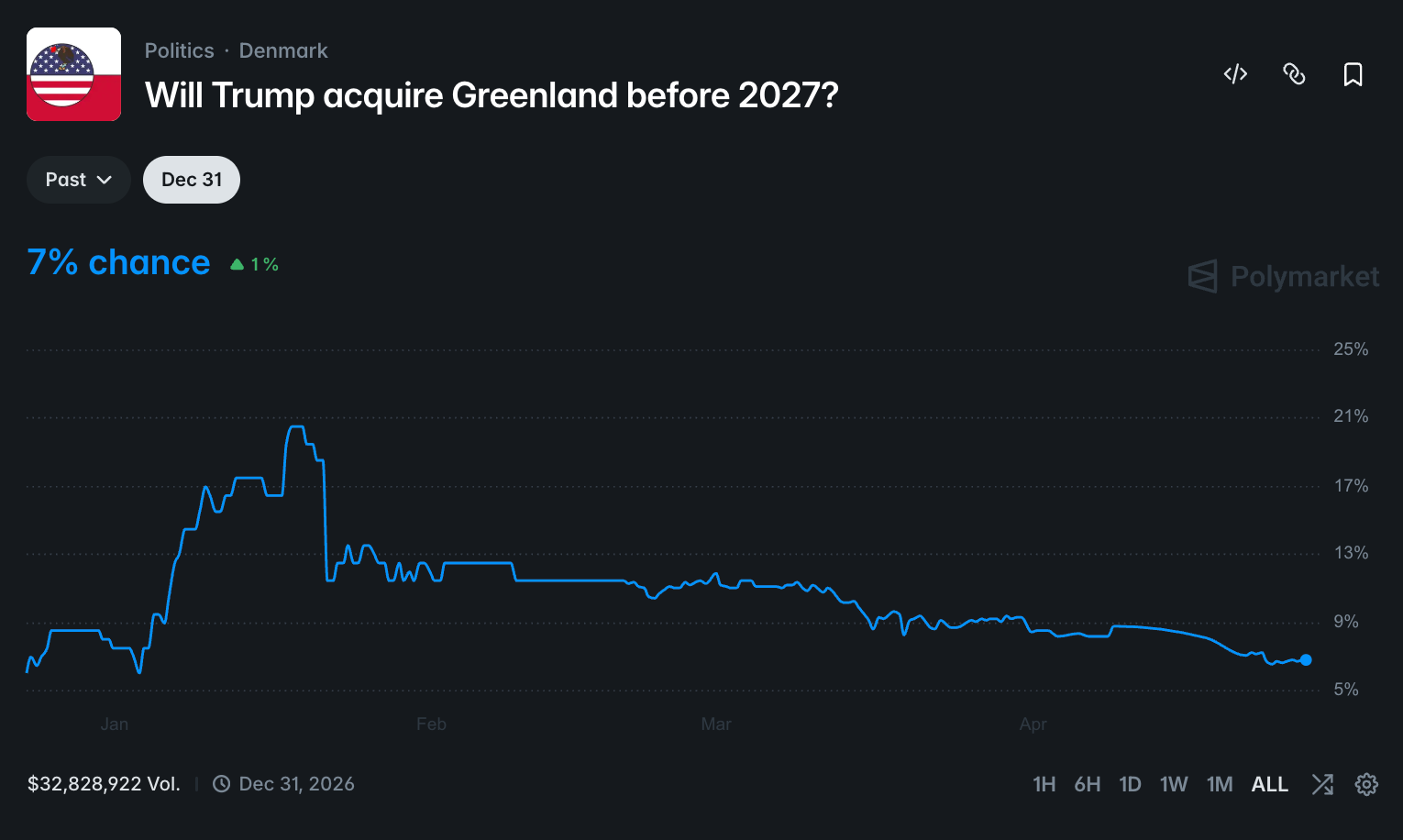
Prediction markets are supposed to be the internet’s truth machine. They offer a place where real money forces honest thinking. Yet, they have a structural vulnerability.
Hype, fear, and confirmation routinely push the odds of absurd outcomes far higher than reality warrants. Recognizing this truth, a small minority of level-headed contrarians have sniffed out a predictable, exploitable pattern.
Betting Against the Crowd
Vitalik Buterin was notably the first public figure to confirm this trend. In January, the Ethereum co-founder revealed in an interview that he had made $70,000 on Polymarket by using this tactic.
Buterin explained that he had spent $440,000 on a series of events contracts, which he described as “crazy and irrational predictions.” His strategy worked, yielding him a comfortable 16 percent return.
What stuck was the simple thought process behind his bets. The idea is to find the most absurd and highly unlikely polls that have gained the most traction and go against the current.
On prediction market platforms, these types of contracts are easy to find.
In fact, in the past year, the volume on irrational markets has grown substantially. A more politically charged news cycle and an expanding user base with a higher appetite for speculative bets have driven much of that growth.
This is where human psychology comes into play. When a story dominates the news cycle, people instinctively treat its emotional intensity as evidence of its likelihood.
A threatening tweet from a president, a congressional hearing about UFOs, or a pundit screaming about economic collapse all create a feeling of imminence that has nothing to do with actual probability.
The result is an emotionally charged outcome that gets systematically overpriced.
The Polls That Defied Common Sense
Prediction market polls range from anything from crypto to politics and sports to culture. Some of them are straightforward, aiming to forecast who will be the next Democratic presidential nominee or this year’s LaLiga winner.
Others verge on the side of absurdity. So far this year, there’s been an abundance of them. One surfaced at the beginning of the year during the height of Trump’s face-off with his European allies over the sovereignty of Greenland.
Bettors began flocking to Polymarket to predict how soon the United States would acquire the island. Though the odds remained low, they reached a 21 percent ceiling around the time Trump posted on social media, threatening to take Greenland by force.
Though not impossible, a scenario where Trump invades Greenland is highly unlikely. Such a move would mean attacking a NATO ally and potentially fracturing the entire Western alliance. The consequences would be catastrophic.
Despite this, the traction the polls received was alarming. One of them, which is still active and seeks to predict whether Trump will acquire the island before the end of 2026, has generated nearly $33 million in trading volume.
Polls predicting that Trump would win the Nobel Peace Prize also surged in trading. Amid public remarks by the president himself touting the award, many bettors placed their money on that outcome, with some odds reaching 14 percent. Buterin bet against them, arguing they were fueled by sentiment rather than logic or actual probability.
Other contracts were equally driven by hype, varying from predicting whether the US government would confirm alien life to whether the US dollar would completely collapse before the end of the year. Despite their low probability, many received positive bets in the double digits.
How the News Warps Judgment
These behaviors have a name in behavioral economics. They’re a known phenomenon called narrative bias.
When applied to the psychology of prediction markets, they represent the tendency to treat how dramatic or emotionally gripping a story feels as a measure of how likely it is to actually happen.
The more a scenario dominates headlines, the more plausible it feels, regardless of whether the underlying facts support it.
Eric Zitzewitz, an economics professor at Dartmouth College who studies prediction markets, noted in an October interview with Ipsos that politics and sports are particularly fertile ground for this type of distortion.
He even pointed out that this is a necessary factor for the industry to function. Without them, informed traders –like Buterin– have no one to trade against.
“For markets to work you need either people to be overconfident or willing to lose money on average because it’s fun,” he said.
Confirmation bias makes the problem more acute.
Bettors who already believe Trump is an unconventional disruptor are more likely to find the Greenland invasion plausible. Those primed by years of UFO discourse are more likely to treat a congressional hearing as a breakthrough.
When a market’s odds start climbing, the movement itself becomes a signal.
Much like a meme coin caught in a hype cycle, newcomers interpret the crowd’s enthusiasm as collective wisdom and pile in, driving odds even higher. At that point, the market stops reflecting probability and starts reflecting momentum.
The pattern is consistent and repeatable enough that a small group of disciplined traders has built entire strategies around exploiting it. Buterin is the most prominent, but he is not alone.
The Science Behind Boring Bets
Domer, one of Polymarket’s biggest bettors and a former professional poker player, has won $400,000 in bets on the platform by employing a similar brand of contrarianism.
His most striking win came when he bet $100,000 that Cardinal Robert Francis Prevost would become the next pope. At the time, the market gave Prevost only a 5 percent chance.
Domer pulled off similar moves before, correctly predicting Sam Bankman-Fried’s 25-year prison sentence and Sam Altman’s 2023 firing as OpenAI CEO.
Across hundreds of bets, the edge holds– and there’s data to back up why.
Polymarket publishes on its own accuracy page that 73.3 percent of all resolved markets on the platform end in “No.”
Most questions are framed around specific events that materialize by a deadline, meaning the status quo has a built-in advantage.
An engineer named Sterling Crispin confirmed this tendency by building a bot that automatically buys ‘No’ on every non-sports market it finds. His success rate was nearly identical to Polymarket’s own data. According to his findings, 73.4% of all bets on the platform do not occur.
The contrarian edge, then, is not some obscure secret. It only exists because human irrationality is a permanent feature of these markets, rather than a bug to be fixed.
The post Vitalik Buterin Reveals the Easy Money Strategy for Prediction Markets appeared first on BeInCrypto.

Israel’s Capital Market, Insurance and Savings Authority has approved Bits of Gold’s BILS, a stablecoin pegged to the Israeli shekel, following a two-year pilot on the Solana blockchain. The development marks a regulatory milestone for Israel’s crypto sector, signaling a move to integrate stablecoin activity within a regulated domestic financial framework and aligning with broader efforts by the Tax Authority and Finance Ministry to oversee digital assets.
According to the regulator’s announcement, BILS will be backed by reserve assets held in Israel in designated and separate accounts. The project sits within a wider government initiative to regulate crypto activity and pave the way for select stablecoin operations within the country’s financial system.
“BILS creates a direct bridge between the Israeli shekel and the global digital assets economy, enabling real-time payments, on-chain trading and programmable financial applications based on a regulated local currency,” stated Bits of Gold founder and CEO Youval Rouach.
As context, Cointelegraph notes that the global stablecoin market remains substantial, with a market capitalization exceeding $320 billion, led by USD-pegged coins such as Tether’s USDT. The Israeli launch comes as the shekel trades at roughly 0.34 USD in recent figures, reflecting the currency’s ongoing macro dynamics during this regulatory milestone.
Key takeaways
- The Capital Market, Insurance and Savings Authority approved Bits of Gold’s BILS stablecoin after a two-year Solana-based pilot.
- Reserve assets backing BILS will be held in designated and separate Israeli accounts, signaling strong local oversight.
- The approval aligns with Israel’s regulatory push led by the Tax Authority and Finance Ministry to sanction certain stablecoin activities within a regulated framework.
- BILS is positioned as a regulated conduit between the shekel and global digital-asset markets, enabling real-time payments, on-chain trading and programmable finance.
- In a broader policy context, US regulatory developments on stablecoins and market structure continue to influence how cross-border stablecoins are treated and integrated into traditional financial systems.
Regulatory approval and pilot background
The two-year Solana pilot demonstrated the technical feasibility and risk controls necessary for a shekel-linked stablecoin within a regulated environment. The regulatory authority’s decision to authorize BILS reflects a calibrated approach to digital assets, balancing innovation with investor protection, financial stability and compliance requirements. Bits of Gold described the move as a meaningful step toward broader adoption of digitized, regulated local currency instruments.
From a policy standpoint, the approval signals a purposeful alignment with Israel’s ongoing regulatory reforms in the crypto space. The government has signaled that certain stablecoin activities can be accommodated under a robust oversight regime, provided they meet reserve, disclosure and governance standards designed to protect users and the integrity of the financial system.
Reserve architecture and regulatory oversight
The BILS framework requires reserve assets to be held within Israel in designated and separate accounts, reinforcing segregation and transparency for token holders. This arrangement is intended to support auditability, liquidity management and regulatory compliance, including potential AML/KYC requirements applicable to stablecoin issuers and custodians. The design underscores a broader trend toward formalizing stablecoins through domestic regulatory infrastructure rather than relying solely on private backstops.
As part of the regulatory narrative, Israel’s Tax Authority and Finance Ministry have been active in shaping the contours of crypto regulation, seeking to normalize stablecoin activity where appropriate while imposing stringent governance standards. The Israeli approach may influence future licensing pathways and supervisory expectations for crypto firms, exchanges and custodians operating within or engaging with the local market. In broader terms, the case of BILS resonates with global discussions around how stablecoins tied to national currencies could integrate with conventional payment rails and banking services, a topic increasingly relevant for cross-border settlement and liquidity management.
Global policy context and implications for institutions
Israel’s move sits within a shifting regulatory landscape for stablecoins worldwide. In the United States, lawmakers continue to debate provisions within a digital asset market structure framework, including questions around stablecoin yield, tokenized equities and potential ethics concerns linked to public office figures’ involvement in the industry. The legislation, effectively stalled in the Senate for months, underscores the complexity of harmonizing financial innovation with prudential safeguards and enforcement authorities. The ongoing policy dialogue in the United States compounds the relevance of Israel’s approach, particularly for institutions seeking cross-border operations or multi-jurisdictional compliance programs.
For banks, exchanges and institutional participants, the Israeli precedent could influence licensing considerations, onboarding standards and the integration of stablecoins with domestic payment systems. The coexistence of a regulated local-currency stablecoin with a transparent reserve framework may offer a model for other jurisdictions seeking to balance innovation with formal oversight, while also illustrating the friction points that arise when aligning national rules with evolving global standards such as the European Union’s MiCA framework and related AML/KYC expectations.
Overall, the BILS milestone highlights how a regulated, country-specific stablecoin can function as a bridge between fiat and digital-asset ecosystems, with implications for regulatory design, financial stability, cross-border settlement and the future of central-bank–adjacent digital currencies within market infrastructure.
Looking ahead, observers will monitor how the BILS framework evolves under ongoing supervision and how it interacts with cross-border payments, banking relationships and the broader regulatory harmonization intended to support compliant innovation in the crypto economy.

How TRILLION$ in dirty money are laundered

York Minster and Wizard Walk in Tripadvisor Awards

Resolute provides Mali update

Manchester United reach agreement with Casemiro over contract clause amid transfer speculation

US brings back mandatory military draft registration

Steven Gerrard disagrees with Gary Neville over ‘shock’ Chelsea and Arsenal claim | Football


-

 Fashion3 days ago
Weekend Open Thread – Corporette.com
-

 Tech9 hours ago
Register Renaming | Hackaday
-
 Crypto World2 days ago
Hyperliquid $HYPE Rally Builds Momentum as AI Sector Enters Prove-It Phase
-

 Politics5 days ago
Making troops accountable for war crimes threatens US alliance, ex-SAS colonel warns
-

 Politics5 days ago
Disabled people challenge government SEND proposals over segregation concerns
-

 Business4 days ago
Patterson-UTI Energy, Inc. (PTEN) Q1 2026 Earnings Call Transcript
-

 Business6 days ago
Rolls-Royce Voted UK’s Most Iconic Trade Mark as IPO Register Hits 150
-
 Crypto World7 days ago
Five Value Stocks with Recovery Potential in 2026: PayPal (PYPL), Nike (NKE), and More
-
 Sports2 days ago
IPL 2026: Ruturaj Gaikwad registers slowest fifty of the season, enters all-time unwanted list | Cricket News
-

 Politics5 days ago
Starmer handler McSweeney to be dragged from shadows by Foreign Affairs Committee
-

 Politics5 days ago
Zack Polanski responds to home secretary’s taser threat
-
Politics5 days ago
Wings Over Scotland | How To Get Away With Crimes
-

 Crypto World6 days ago
New York sues Coinbase, Gemini over prediction market offerings
-
Entertainment7 days ago
Sydney Sweeney cameo cut from “The Devil Wears Prada 2”, source explains why (exclusive)
-
 Crypto World6 days ago
Crypto’s great hope in Senate’s Clarity Act still has a path to survive tight calendar
-
 Business6 days ago
HCL Tech share price tank over 9% after weak Q4. JPMorgan, HSBC & 3 others cut target price
-

 Fashion7 days ago
Kilkenny Design New Beauty Arrivals for Spring 2026
-

 Politics5 days ago
‘Iran is still a nuclear threat’
-
 Sports5 days ago
Tim Bradley names the current best in the world: “Better than Inoue and Usyk”
-

 NewsBeat2 days ago
LK Bennett closes all stores after entering administration
You must be logged in to post a comment Login