
Crypto World
MicroStrategy vs Tom Lee’s BitMine: Who Hits Target First?

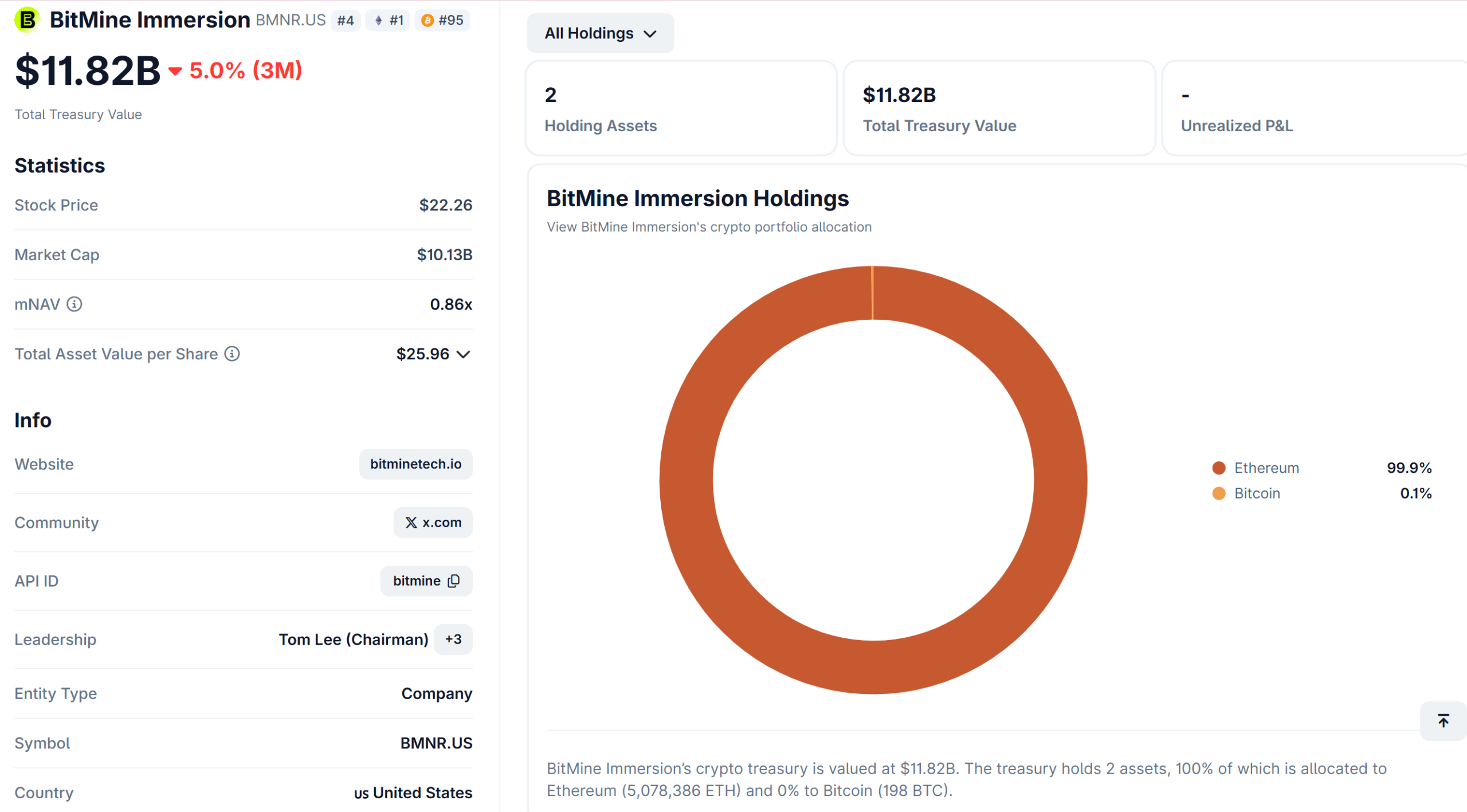
MicroStrategy and BitMine Immersion Technologies are racing toward different crypto accumulation targets. BitMine has pulled ahead. The Ether treasury is 16% short of its goal, while Strategy still trails by roughly 18%.
BitMine crossed 5 million Ether (ETH) on April 27, a milestone that puts it 84% of the way to 5% of all ETH. Strategy holds 818,334 Bitcoin (BTC) and is 181,666 tokens short of 1 million.
Race to Corporate Crypto Dominance
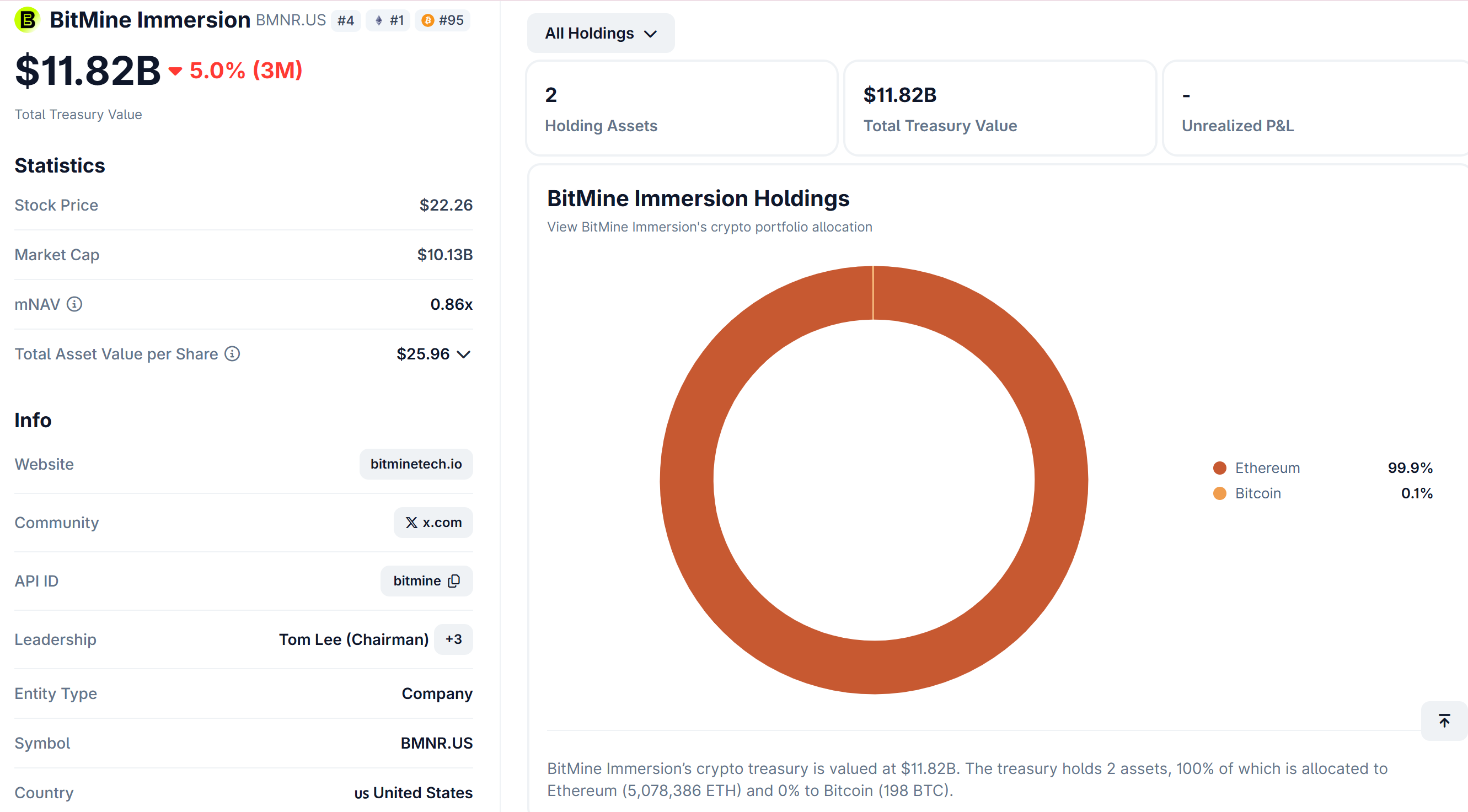
BitMine, chaired by Tom Lee, holds 5.078 million ETH worth roughly $11.5 billion at $2,314 per coin. The company adds $940 million in cash, $200 million in Beast Industries, and $91 million in Eightco Holdings. Total assets reach $13.3 billion.
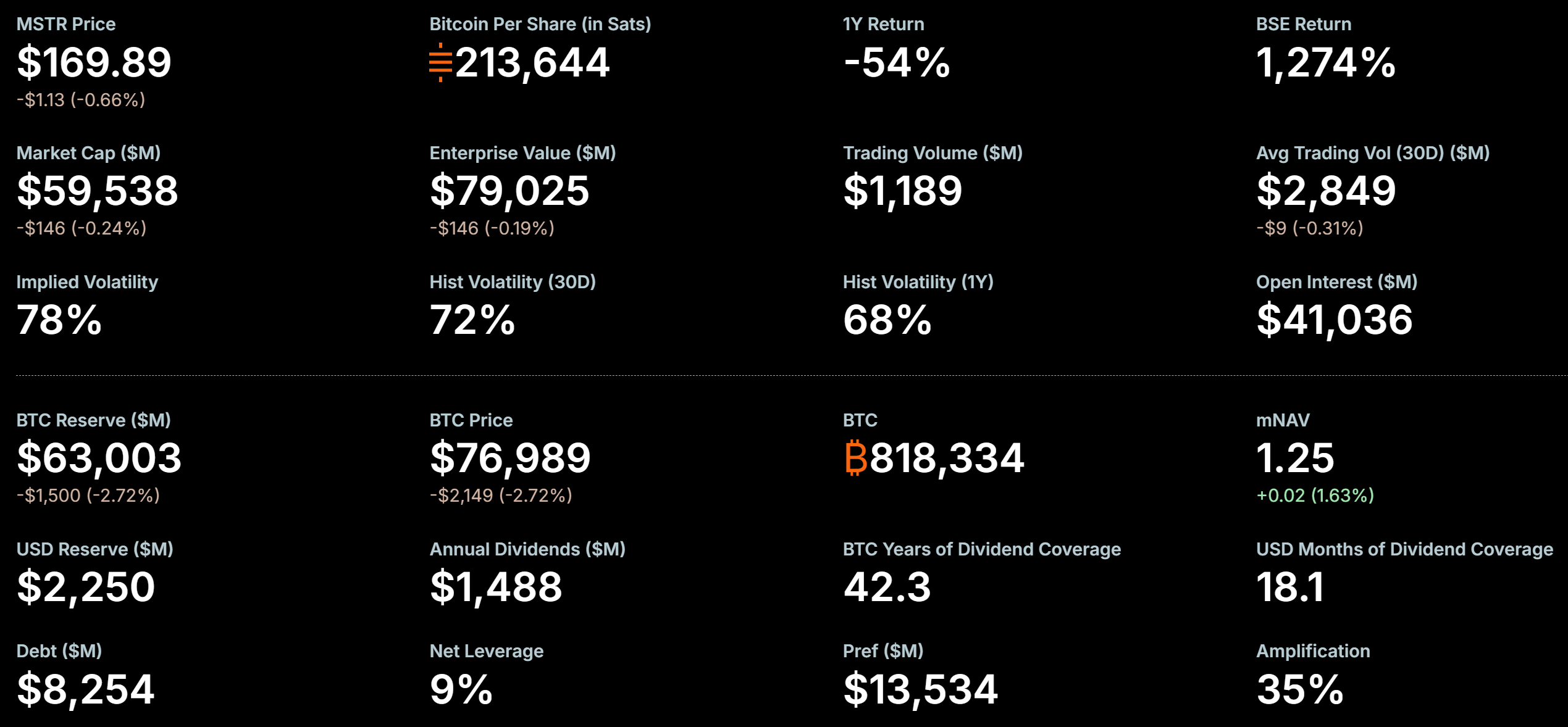
MicroStrategy, led by Executive Chairman Michael Saylor, has paid an average of $75,537 per BTC. Its cost basis sits at $61.81 billion. The latest weekly purchase added 3,273 BTC for $255 million at $77,906 per coin.
BitMine Has the Shorter Runway
BitMine needs about 1 million more ETH to reach its 5% of supply goal. At current prices, that means roughly $2.4 billion in additional buying.
Meanwhile, MicroStrategy needs nearly $14 billion at $77,000 per BTC. The dollar gap is almost six times (6x) larger. BitMine could close that gap with a single quarter of capital raising at recent run rates.
The funding model differs. MicroStrategy raises capital through STRC perpetual preferred shares and at-the-market equity sales.
The company carries $8.25 billion in debt and $13.53 billion in preferred stock. Annual dividend obligations sit at $1.49 billion on a non-yielding asset.
BitMine generates yield. The company stakes 3.7 million ETH through its Made in America Validator Network (MAVAN) platform at roughly 3%.
That produces $264 million in annualized revenue. Full staking would push rewards toward $363 million a year.
Are Bitcoin and Ethereum the Ultimate Winners in Any Scenario?
MicroStrategy reaching 1 million BTC would lock up 4.76% of Bitcoin’s capped supply under one corporate roof.
“Based on their 2026 average weekly buys, they will have 1 Million Bitcoin by December of this year. 1M BTC is 4.76% of the ending total supply once fully mined. Why do I buy MSTR? Duh,” remarked one investor.
Persistent absorption at that scale shrinks the float available to spot markets. That could pressure BTC higher in tight liquidity conditions.
However, BitMine controlling 5% of Ethereum carries a different effect. Most of those coins remain staked, removing them from the circulating supply while reinforcing network security.
The combined accumulation and staking lockup may amplify ETH price sensitivity to fresh demand.
“If just 3-4 more institutions follow BitMine’s playbook, we’re looking at a supply crisis that makes 2021 look tame…319K ETH removed + staking lockup = deflationary pressure accelerating…$15K ETH by December isn’t optimistic. It’s mathematical inevitability if this institutional FOMO spreads. Smart money is positioning NOW. Retail will chase at $8K+,” wrote investor and technologist Paul Barron.
Tom Lee has framed Ether as a store of value and collateral for tokenized finance. He points to its outperformance versus the S&P 500 since geopolitical tensions escalated.
The growing demand for tokenization and AI-driven blockchain infrastructure adds to the case.
BitMine trades $845 million a day on the NYSE main board, ranking 129th among US-listed equities. The investor roster includes ARK Invest’s Cathie Wood, Founders Fund, Pantera Capital, Galaxy Digital, and Kraken.
Strategy’s MSTR, on the other hand, sits at a 1.25x premium to net asset value.
BitMine looks set to cross the line first if its current pace and capital access hold.
While this could mean ETH outperforms BTC, it depends on how cleanly both treasuries fund the final stretch.
The race may also test whether Saylor’s pace of 5,250 BTC a week remains repeatable over the next eight months.
The post MicroStrategy vs Tom Lee’s BitMine: Who Hits Target First? appeared first on BeInCrypto.



Strategy acquired 3,273 Bitcoin for approximately $255 million on April 27, its fourth purchase in April 2026, lifting total holdings to 818,334 BTC worth roughly $63.7 billion.
Summary
- Strategy bought 3,273 BTC at an average of $77,906 per coin on April 27, funded entirely through at-the-market sales of MSTR Class A common stock.
- Total holdings now stand at 818,334 BTC acquired for $61.81 billion at an average cost of $75,537 per coin, representing 3.9% of Bitcoin’s 21 million hard cap.
- The company has achieved a BTC Yield of 9.6% year-to-date in 2026, with $26.47 billion in MSTR shares still available for future equity-funded purchases.
Strategy acquired 3,273 Bitcoin for approximately $255 million on April 27, according to a Form 8-K filing with the US Securities and Exchange Commission. Yahoo Finance reported that the purchase was made at an average price of $77,906 per coin and funded entirely through the sale of 1,451,601 MSTR Class A common shares via the company’s at-the-market equity offering program. “As of 4/26/2026, we hodl 818,334 BTC acquired for approximately $61.81 billion at approximately $75,537 per bitcoin,” executive chairman Michael Saylor said on X.
Strategy Bitcoin Holdings Cross 818,000 BTC With April Accumulation Pace Accelerating
The April 27 purchase is Strategy’s fourth acquisition in April alone. As crypto.news reported, the company added 34,164 BTC for $2.54 billion just the prior week between April 13 and April 19, its third-largest single purchase on record. That purchase used proceeds from both MSTR stock sales and issuances of STRC, its Stretch preferred stock. The latest $255 million buy diverges from that pattern, having been funded solely through MSTR common stock sales with no STRC component. Strategy’s 818,334 BTC represents 3.9% of Bitcoin’s fixed 21 million supply, a concentration that Saylor has consistently framed as a long-term structural bet rather than a trading position.
The Equity Funding Machine Behind Each Purchase
Strategy’s Bitcoin accumulation model operates through a continuous cycle of equity issuance. As crypto.news documented, the company purchased 17,994 BTC for $1.28 billion in early March 2026 using proceeds from 6.3 million MSTR shares sold and 3.7 million STRC shares issued. As of the April 27 filing, $26.47 billion in MSTR shares remain available under the current program, providing significant runway for continued accumulation without needing to raise new capital facilities. The company’s cumulative cost basis of $61.81 billion against a current market value of approximately $63.7 billion implies roughly $1.9 billion in paper gains at current Bitcoin prices near $77,000.
What Saylor’s Accumulation Pace Signals for Bitcoin Markets
As crypto.news tracked, Saylor argued in March that there is a systematic time delay between when Strategy buys Bitcoin and when markets price in the supply tightening that follows. Four April purchases totaling well over $3 billion in a single month represent one of the most concentrated accumulation periods in Strategy’s history, arriving precisely as Bitcoin tests multi-month highs above $78,000 and spot ETF inflows hit an eight-day streak. Whether the market reprices the compounding supply removal ahead of the FOMC meeting on April 28 and 29 will be the next near-term test of Saylor’s thesis.
Strategy has not announced any change to its long-term target of accumulating Bitcoin toward one million BTC, and Saylor’s Sunday tracker post carrying the phrase “the beat goes on” has become the company’s standard pre-announcement signal to markets.


South Korea’s KBank signed a strategic partnership with Ripple on April 27 to test blockchain-based cross-border remittances, marking Ripple’s second Korean institutional deal this month and its first with a major Korean digital bank.
Summary
- KBank and Ripple are conducting a second-phase proof of concept using Ripple’s Palisade wallet for on-chain remittances to the UAE and Thailand.
- KBank serves 15 million users as the exclusive banking partner of Upbit, South Korea’s largest crypto exchange.
- The deal follows Ripple’s April 15 Kyobo Life partnership and arrives as South Korea finalizes its Digital Asset Basic Act.
Ripple KBank partnership was confirmed on April 27 when KBank CEO Choi Woo-hyung and Ripple Asia-Pacific Managing Director Fiona Murray signed an agreement at KBank’s headquarters in Seoul. The Korea Herald reported that the deal focuses on testing whether blockchain-based overseas remittances can improve speed, cost efficiency, and transparency compared to traditional correspondent banking rails.
Ripple KBank Test Targets UAE and Thailand Remittance Corridors
The partnership is structured as a multi-phase proof-of-concept rather than a live commercial product. The first phase tested a wallet-based remittance model through a separate app interface. The second phase, now underway, digitally connects KBank’s customer accounts and internal systems to test on-chain transfer stability across corridors to the UAE and Thailand, using Ripple’s Palisade SaaS-based digital wallet. As crypto.news reported, the partnership does not yet use XRP as a bridge asset, with testing currently using stablecoin-based settlement to avoid the volatility constraints that compliance-heavy bank pilots require. Murray said that KBank “has helped set the standard for digital banking in Korea and continues to drive innovation,” adding that Ripple is pleased to bring its global blockchain network to KBank’s remittance infrastructure.
KBank’s Position Makes This Deal Strategically Significant
KBank is not a typical bank partner for Ripple. It is South Korea’s first internet-only lender and the exclusive banking partner of Upbit, the country’s largest crypto exchange by trading volume. Korean regulations require all crypto exchange users to link a verified bank account, with each major exchange paired exclusively with one bank, a monopoly structure that drove KBank’s user base from approximately 2 million in 2020 to 15 million by the end of 2025. As crypto.news documented, this is the second Ripple institutional deal in Korea this month, following the April 15 Kyobo Life Insurance partnership for tokenized government bond settlement. That deal used Ripple Custody and also involved Fiona Murray on Ripple’s side, suggesting that the same Asia-Pacific leadership team is systematically building Korea into one of Ripple’s primary institutional expansion markets.
What the Deal Signals for Ripple’s Korea Strategy
South Korea is finalizing its Digital Asset Basic Act, a comprehensive digital asset regulatory framework that is expected to formally classify stablecoins as payment instruments and impose new requirements on cross-border digital asset activity. As crypto.news tracked, major Korean financial institutions have been accelerating blockchain infrastructure deals ahead of the law taking effect, with Ripple positioning its Palisade wallet, Ripple Custody platform, and RLUSD stablecoin as the settlement layer for Korean institutions building that infrastructure now. If the KBank proof-of-concept succeeds and regulators approve, the partnership could expand into live remittance services, potentially generating real XRP demand if KBank activates Ripple’s On-Demand Liquidity service using XRP as a bridge between Korean won and foreign currencies.
KBank said it plans to continue technical verification of remittance use cases for stablecoins as South Korea’s legal framework for digital assets develops, and has not confirmed a commercial launch timeline.
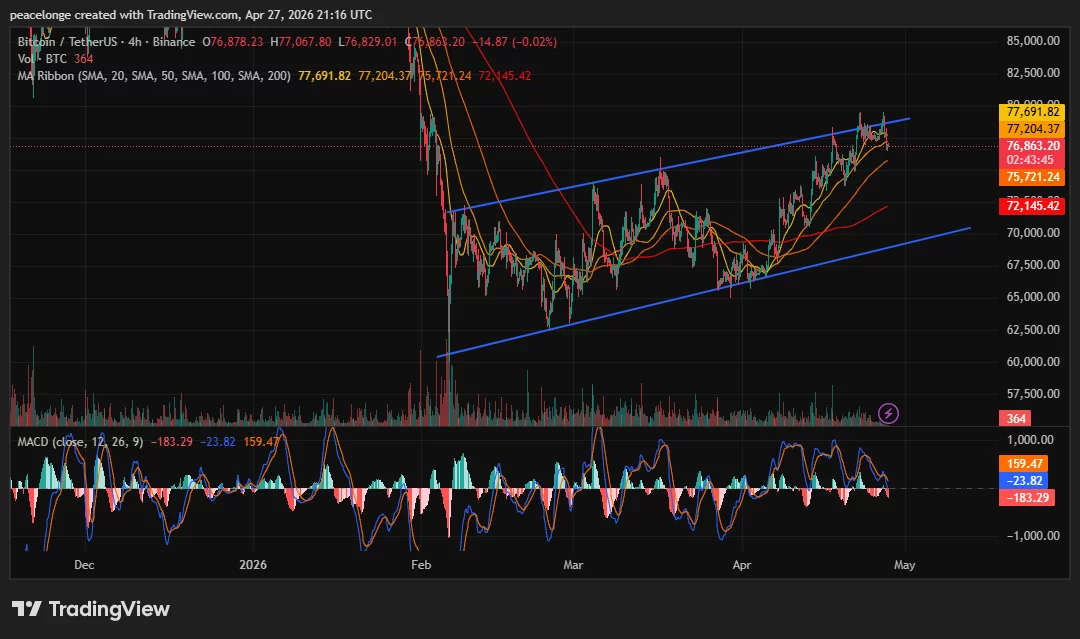
Bitcoin is pressing the upper boundary of a two-month ascending channel near $77,500, with the 4H MACD histogram turning negative at the trendline and the FOMC meeting on April 28 and 29 serving as the next major catalyst. This article examines the technical structure, key levels, and on-chain data shaping Bitcoin’s next directional move.
Summary
- Bitcoin is pressing the upper boundary of a 4H ascending channel near $77,500 as the MACD histogram turns negative at -183.29.
- The SMA ribbon remains bullishly stacked below price, but momentum is decelerating at the trendline.
- A confirmed 4H close above $80,000 targets the 200-day SMA near $85,000; rejection risks a pullback to $75,721.
Bitcoin (BTC) is trading at approximately $76,863 on April 27, up less than 1% on the session, after briefly touching $77,067 during Asian hours. The asset has climbed nearly 30% from its February lows near $59,000 inside a well-defined ascending channel, but is now pressing the upper boundary of that structure at the same time as the 4H MACD histogram turns deeply negative, setting up a directional tension that the FOMC meeting on April 28 and 29 may finally resolve.
Bitcoin ascending channel reaches a critical juncture
The 4H chart shows Bitcoin constructing a textbook ascending channel, defined by two parallel upward-sloping trendlines, since the February lows near $59,000. The pattern has delivered a sequence of higher highs and higher lows across roughly two months, with price now pressing the upper boundary near $77,500 where prior tests have stalled.
The moving average ribbon remains constructively positioned. The SMA 20 sits at $77,691, the SMA 50 at $77,204, the SMA 100 at $75,721, and the SMA 200 at $72,145, all stacked below price in a bullish order that has supported the entire recovery.
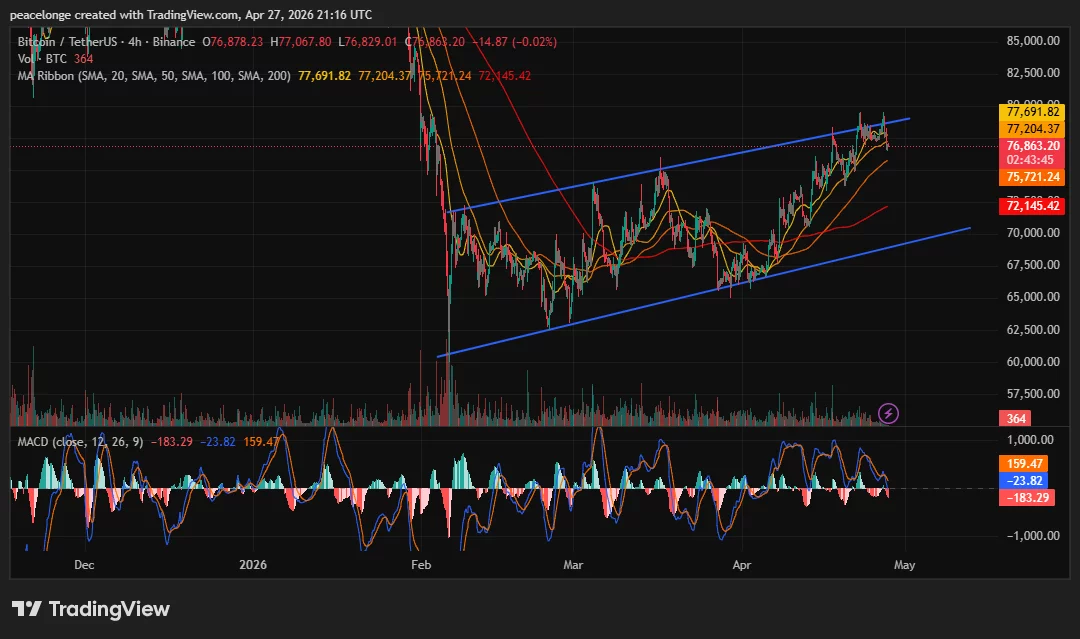
However, the MACD indicator is sending a cautionary signal. The MACD line reads at 159.47 with a signal line at -23.82, producing a histogram of -183.29. A negative histogram at the channel’s upper trendline indicates that upside momentum is decelerating rather than accelerating, a pattern that in prior channel tests has preceded consolidation or a brief pullback rather than an immediate breakout. Crypto analyst Ali Martinez said on X that “technical patterns are not fixed; they morph as price develops,” and that buyer and seller behavior at resistance ultimately decides whether a level becomes a liquidity wall.
Key levels: support, resistance, and price targets
The immediate resistance sits at the upper channel trendline between $77,500 and $78,000, which aligns with the level that capped Bitcoin during April 22’s 11-week high test. Above it, the $80,000 round number is the primary bull-case target and the level that would confirm a channel breakout. A 4H close above $80,000 with volume expansion would open the path toward the 200-day SMA near $85,000, the threshold analysts identify as separating the prevailing corrective trend from a confirmed structural reversal.
On the downside, the SMA 100 at $75,721 is the first meaningful support on a closing basis. A 4H close below that level removes mid-channel support and exposes the lower boundary of the ascending channel near $72,000 to $73,000, where the SMA 200 at $72,145 converges. A daily close below that zone invalidates the ascending channel structure entirely and shifts the near-term bias bearish.
ETF inflows and derivatives positioning
The rally into the channel’s upper boundary has been supported by a historic institutional inflow streak. According to data tracked by crypto.news, spot Bitcoin ETFs logged an eight-day inflow streak totaling $2.43 billion through April 23, with BlackRock’s IBIT absorbing $907.97 million across the week of April 13 to 17 alone. April’s total inflows are already nearly double March’s $1.32 billion haul.
Despite the strong institutional bid, Glassnode on-chain data indicates that short-term holders are using ETF demand as exit liquidity near the $78,000 to $80,100 range, levels that have repeatedly capped rallies in 2026. Bitcoin futures open interest fell over 6% in the 24 hours surrounding the most recent $78,000 test, per CoinGlass data, pointing to leverage unwinding rather than fresh long accumulation at resistance.
FOMC as the next defining catalyst
The FOMC meeting on April 28 and 29 is the primary macro event that could resolve the channel test in either direction. As crypto.news reported, CME FedWatch shows a 98% probability of a rate hold, making the tone of Chair Jerome Powell’s press conference the key variable. A dovish signal implying rate cuts in the second half of 2026 would reduce the opportunity cost of holding BTC and could provide the catalyst for a close above $80,000. A neutral or hawkish tone would likely extend the channel consolidation and increase the probability of a pullback toward mid-channel support.
If Bitcoin holds the ascending channel and clears $80,000 on volume following the FOMC outcome, the 200-day SMA near $85,000 becomes the next structural test for a confirmed trend reversal.
Crypto World
AI Is Making Marketing Less Authentic While Crypto Communities Are Automating Away Their Soul

Two industries are optimizing for scale at the cost of authenticity. Both are discovering the hard way that growth without connection is just noise.
The Moment Everything Clicked
Coca-Cola released an AI-generated holiday ad. It was technically impressive. Completely soulless.
Amazon pulled AI-generated Prime Video recaps after users mocked the quality.
McDonald’s Netherlands removed an AI Christmas ad amid backlash.
Meanwhile, crypto communities are installing AI bots to manage Discord servers, automate content, and optimize “community engagement” metrics.
Both industries are making the same mistake: they’re confusing scale with authenticity. And both are discovering that when you optimize for one, you lose the other.
What’s Actually Happening in Marketing
Brands like Coca-Cola, Amazon, and Paramount faced public backlash for using AI-generated content, with audiences labeling the results as low-quality “AI slop” and questioning the lack of human creativity.
The irony is brutal. Marketing’s entire purpose is to connect. To make people feel something. To create emotional resonance between a brand and an audience.
So what happens when you automate connection?
You get technically competent content that nobody wants to engage with. You get ads that are perfectly optimized for algorithmic distribution but emotionally empty. You get a scale that looks impressive in dashboards while authenticity evaporates.
The real problem isn’t that AI-generated content is bad. It’s that brands are using it to replace the human element that actually made marketing work.
Instead of asking “What does our audience actually want to feel?”, they’re asking “How do we generate more content faster?”
Instead of investing in creative people who understand their brand, they’re spinning up AI systems that can generate thousands of variations of mediocre content.
The result? Growth in output. Collapse in resonance.
The Same Thing Is Happening in Crypto
Here’s where it gets interesting. Crypto is experiencing the exact same phenomenon, but from the opposite angle.
Crypto’s entire value proposition was authenticity. Real people. Real communities. Real belief in something different.
You didn’t join Bitcoin because of marketing. You joined because you read the whitepaper and believed. You joined Ethereum because you engaged with actual humans building something you cared about. You participated in DAOs because communities actually meant something.
That required friction. Real dialogue. Disagreement that mattered. Commitment that wasn’t algorithmic.
Now? Crypto projects are automating community management with AI bots, using algorithms to optimize engagement, and scaling “community involvement” through tools designed to simulate what authentic community looks like.
The result is the same as Coca-Cola’s AI ads: technically efficient, emotionally hollow.
You join a crypto Discord and you’re greeted by an AI bot. You ask a question and get an algorithmic response. You see “community highlights” curated by a system designed to maximize engagement metrics. And somewhere deep down, you know none of it’s real.
The Metric That’s Killing Both Industries
Here’s what both marketing and crypto got wrong:
- They optimized for scale instead of connection.
- Marketing said: “We can reach more people with AI-generated content.”
- Crypto said: “We can manage larger communities with AI-powered tools.”
- Both are technically true. Both are strategically disastrous.
- Because the metric that matters isn’t reach. It’s belief.
- But you can’t patch authenticity. Once you’ve automated it away, it’s gone.
The Cost of Scale
Marketing brands that used AI to generate content faster are now dealing with:
- Public backlash and brand damage
- Audience skepticism (“Is this real or AI?”)
- Content that performs worse despite being “optimized”
- Loss of creative talent who feel replaced
Crypto projects that automated community management are dealing with:
- Communities that don’t actually believe in the project
- Engagement metrics that look good but don’t translate to real adoption
- Token holders who have no conviction
- Networks that are mechanically large but culturally hollow
The math looked good on paper. In practice, it’s a catastrophe.
What Authenticity Actually Costs
Here’s the uncomfortable truth: authentic marketing and authentic communities are expensive.
They require:
- Real creative people (which costs money)
- Real community managers (which takes time)
- Real dialogue (which is slow and messy)
- Real belief (which can’t be optimized)
All of these things compress margins. They reduce scale. They make quarterly targets harder to hit.
But they’re also the only things that actually work.
The brands people trust aren’t the ones with the most AI-generated content. They’re the ones with creative people who mean something.
The crypto projects that survive aren’t the ones with the biggest automated communities. They’re the ones where actual humans believe in what’s being built.
The Question for Both Industries
If you’re a brand, here’s what you need to ask: Do you want to reach more people, or do you want people to actually care about what you’re building?
Because you can’t have both if you’re using AI to replace the human element.
If you’re a crypto project, here’s the equivalent question: Do you want bigger community metrics, or do you want a community that actually believes?
Because automating community management guarantees you’ll get the former and lose the latter.
Who’s Going to Win
The marketing brands that win in the next cycle won’t be the ones with the most sophisticated AI content generation. They’ll be the ones that refused to automate away the human element.
The crypto projects that win won’t be the ones with the largest automated communities. They’ll be the ones that had the courage to let community be messy, slow, and genuinely human.
This is antithetical to everything Silicon Valley has taught us about scale. Scale is supposed to be the answer. Efficiency is supposed to be the goal.
But authenticity doesn’t scale. Belief doesn’t optimize. Community can’t be automated.
The moment you try to scale them, you lose them.
The Real Paradox
The deepest irony: both industries are using AI to optimize away the exact thing that made them valuable in the first place.
Marketing became powerful because it could make people feel something authentic. AI-generated content can make people feel… like they’re being sold to by a machine.
Crypto became revolutionary because it was built by communities that actually believed. AI-managed communities feel like they’re being… managed by algorithms.
We built tools to amplify scale and accidentally destroyed authenticity in the process.
And now we’re realizing: scale without authenticity is just noise.
What Comes Next
This is the inflection point.
Some brands and crypto projects will double down on AI optimization. Metrics will keep growing. Authenticity will keep shrinking. Until one day they’ll look around and realize they have scale without meaning.
Others will step back. They’ll invest in real people. Real creativity. Real community. They’ll grow slower. Their metrics will be smaller. But they’ll have something that actually matters.
The question isn’t whether AI should exist in marketing or crypto. It does, and it’s not going away.
The question is: Are you going to use it to replace authenticity, or amplify it?
Because right now, every brand and crypto project that’s trying to scale through automation is making the same choice. And they’re all discovering the same result.
Scale without soul is just expensive noise.

Michael Saylor signaled another Bitcoin purchase as BTC traded near $66,000 during early Monday activity. His social media activity revived expectations of continued accumulation by Strategy. The move follows a pattern where similar posts preceded confirmed Bitcoin acquisitions.
The company has steadily increased its Bitcoin holdings and reinforced its treasury strategy over recent months. It recently added a large BTC position, which strengthened its status as the largest corporate holder. The accumulation strategy continues to shape market sentiment and influence institutional positioning.
Meanwhile, market participants assessed the implications of another potential purchase and its timing. The recurring signals have built a pattern that aligns with prior disclosures. As a result, expectations for another announcement have gained traction.
STRC Mechanism Drives Funding Strategy for Bitcoin Purchases
Strategy has relied on STRC, a preferred equity instrument, to fund its Bitcoin acquisitions. The instrument offers a fixed annual return near 11.5% and attracts yield-focused participants. This structure allows the company to raise capital while maintaining its Bitcoin accumulation approach.
However, STRC has traded slightly below its par value of $100, raising concerns about demand strength. Despite new capital inflows, the pricing reflects cautious positioning within the market. The instrument’s performance remains closely tied to Bitcoin’s price direction and Strategy’s broader financial strategy.
At the same time, external entities have increased exposure to STRC, signaling continued interest in the yield structure. These allocations support Strategy’s ability to maintain its acquisition pace. Still, pricing dynamics indicate that confidence remains mixed.
🚨JUST IN: Bitcoin is about to close its 4th consecutive green weekly candle, up +5.64% this week alone to $78K.
This marks BTC’s longest weekly winning streak since May 2025, nearly a full year ago.
Bitcoin has now rallied +25% from its “Iran War” low of $62K.
The “Ceasefire… pic.twitter.com/BWVQFhfADn
— Coin Bureau (@coinbureau) April 26, 2026
Schiff Challenges Sustainability of Strategy’s Bitcoin Model
Peter Schiff has intensified criticism of Strategy’s funding approach and Bitcoin reliance. He argues that the model depends heavily on continued capital inflows and rising Bitcoin prices. His stance highlights structural concerns tied to long-term sustainability.
Schiff has questioned assumptions that modest Bitcoin growth can sustain the yield obligations attached to STRC. He suggests that increased issuance could demand stronger price appreciation. This argument places focus on the balance between funding costs and asset performance.
Additionally, he has raised concerns about potential risks linked to dividend obligations and market pressure. He warns that adjustments to the payout structure could trigger wider impacts across Strategy and Bitcoin markets. His critique continues to shape the broader debate around leveraged Bitcoin strategies.
Broader Context and Market Positioning
Strategy has built a Bitcoin reserve exceeding 815,000 BTC through continuous acquisitions and financing strategies. This position places the company at the center of corporate Bitcoin adoption. Its actions often influence broader institutional sentiment and market narratives.
The firm’s approach combines equity issuance and yield instruments to support ongoing purchases. This model has drawn both support and criticism due to its reliance on market conditions. It also reflects a growing trend of financial engineering within the digital asset space.
Meanwhile, Bitcoin’s price stability has supported continued accumulation efforts despite market volatility. The asset remains a focal point for both proponents and critics of corporate treasury strategies. As signals from Saylor persist, attention remains on the next official disclosure.


Avraham “Avi” Eisenberg, the trader convicted over the 2022 Mango Markets exploit, denied ever threatening to attack Aave (AAVE). His pushback followed an Arkham post claiming his wallet had become active again.
The on-chain analytics firm shared screenshots of a transaction signed by an address tied to Eisenberg. Arkham framed the activity as his potential return to crypto after a prison sentence on fraud and manipulation charges.
Eisenberg Rejects the Threat Framing on Aave
Eisenberg insisted that he never targeted Aave with an exploit, describing the 2022 episode as responsible disclosure. He said he privately notified the team about a potential risk before going public.
“I informed the team privately about a potential risk, then disclosed it publicly after they said they were aware and monitoring,” he explained.
The 2022 narrative traces back to Eisenberg’s attempt to liquidate Curve (CRV) founder Michael Egorov’s large CRV position.
That trade ended with Eisenberg getting liquidated instead. He later went to prison after pleading guilty on a separate charge.
Chaos Labs DM Dispute Adds Heat
Eisenberg also rejected claims from Chaos Labs founder Omer Goldberg, whose firm previously advised Aave on risk parameters. Chaos Labs ended its risk engagement with Aave on April 6, 2026.
Goldberg told Laura Shin’s Unchained podcast earlier in April that Eisenberg had requested access to Chaos Labs’ attack-cost models. The remarks referenced the period after the Mango incident.
“The DM described here never happened,” he articulated.
The dispute revives long-running tensions in DeFi. Probing a protocol’s weaknesses could be seen as a threat or as white-hat work, and the line remains contested.
Eisenberg’s address was never blacklisted, and no fresh exploit activity has surfaced beyond the flagged signature.
The post Aave Dragged Into New Avi Eisenberg Controversy appeared first on BeInCrypto.


Institutional crypto capital is concentrated across a small group of fund managers. From venture and hedge funds to ETFs and asset managers, these firms raise and deploy capital across crypto markets.
Fund Manager of the Year is an award category within The BeInCrypto Institutional 100, an annual research-driven program recognising institutional digital asset excellence across 26 categories and six pillars.
This category sits in Pillar 3: Access to Digital Assets. The 15 firms below are its longlist, drawn from crypto-native fund managers active between April 2025 and March 2026. A shortlist will be named in May 2026, and the winner will be announced at Proof of Talk in Paris on June 2–3, 2026.
- Longlist: 15 firms covering venture capital, multi-strategy hedge, ETF/ETP issuers, and diversified crypto asset management
- Candidates screened: Starting pool of more than 30 crypto-native fund managers; 15 advanced to this longlist, with 5 additional firms held in the outreach pool
- Scoring (Track B): Editorial quantitative 30% | Expert Council 50% | Disclosed data 20%
- Criteria assessed: AUM (assets under management) and growth, investment performance, product suite breadth, institutional credibility, regulatory standing, thought leadership, team quality and stability
- Sources: SEC Form ADV filings (Fortune, April 2026), PitchBook, Tracxn, Crunchbase, Fortune Crypto 40, firm disclosures, and reporting by WSJ, Bloomberg, and other mainstream financial press
| # | Firm | Founded · HQ | Key People | AUM & Recent Fund | Investment Focus | Representative Work |
|---|---|---|---|---|---|---|
| 1 | Grayscale | 2013 · Stamford, USA | Peter Mintzberg (CEO) Michael Sonnenshein (former CEO) |
$35B AUM IPO filed Nov 2025 |
ETF issuer, crypto trusts, index products | Filed for NYSE IPO (2025) GBTC and ETHE dominate AUM |
| 2 | a16z Crypto | 2018 · Menlo Park, USA | Chris Dixon (Founder) Sriram Krishnan (GP) |
$9.5B AUM Fund V targeting $2B |
Crypto venture investing | Fund I returned 5.4x DPI Portfolio includes Coinbase, Uniswap |
| 3 | Paradigm | 2018 · San Francisco, USA | Matt Huang (Co-Founder) Fred Ehrsam (Co-Founder) |
$12.7B AUM New fund targeting $1.5B |
Research-driven venture | Expanding into AI and robotics Backed Uniswap, StarkWare |
| 4 | Pantera Capital | 2003 / 2013 crypto · SF, USA | Dan Morehead (CEO) Paul Veradittakit (Managing Partner) |
Fund V closed 2025 $547M realized on $137M invested |
Multi-strategy venture and tokens | First US Bitcoin fund (2013) 16 portfolio IPOs including Circle |
| 5 | Galaxy Digital | 2018 · New York, USA | Mike Novogratz (CEO) Christopher Ferraro (President) |
Nasdaq-listed (2026) $1.4B project financing |
Diversified crypto platform | Helios data center (1.6 GW) Shifted listing fully to Nasdaq |
| 6 | Haun Ventures | 2022 · Menlo Park, USA | Katie Haun (CEO) Diogo Mónica (GP) |
$2.5B AUM (+30% YoY) Raising ~$1B new funds |
Crypto venture (early + growth) | BVNK and Bridge exits (2025) Only major VC with AUM growth |
| 7 | Polychain Capital | 2016 · San Francisco, USA | Olaf Carlson-Wee (CEO) | $2.6B AUM Multi-fund structure |
Hybrid hedge + venture | Early $1B crypto fund (2017) Active governance across protocols |
| 8 | Bitwise Asset Management | 2017 · San Francisco, USA | Hunter Horsley (CEO) Matt Hougan (CIO) |
$11B+ assets 70+ investment products |
ETFs, SMAs, staking strategies | BITB ETF publishes on-chain data Broad institutional product suite |
| 9 | Multicoin Capital | 2017 · Austin, USA | Tushar Jain (Managing Partner) Kyle Samani (Co-Founder) |
$2.7B AUM Down from 2024 peak |
Venture + liquid tokens | Early Solana backer Leadership transition in 2026 |
| 10 | Electric Capital | 2018 · Palo Alto, USA | Avichal Garg (Managing Partner) Maria Shen (Partner) |
$1B+ raised Early-stage focus |
Infrastructure, developer tooling | Developer Report benchmark Backed Aave, dYdX, NEAR |
| 11 | Dragonfly Capital | 2018 · San Francisco, USA | Haseeb Qureshi (Managing Partner) Tom Schmidt (GP) |
$4B AUM Fund IV: $650M (2026) |
Multi-stage venture | Avoided Terra, Yuga Labs Backed Ethena, Polymarket |
| 12 | CoinShares | 2013 · Jersey | Jean-Marie Mognetti (CEO) Daniel Masters (Co-Founder) |
$6B+ AUM Nasdaq listed (2026) |
Crypto ETPs, asset management | $1.2B SPAC listing (2026) 34% EU ETP market share |
| 13 | Coinbase Ventures | 2018 · United States | Shan Aggarwal (CBO) Justin Mart (Investor) |
500+ investments Funded via Coinbase balance sheet |
Strategic venture arm | Backed OpenSea, FalconX 35+ acquisitions under team |
| 14 | Bain Capital Crypto | 2022 · San Francisco, USA | Alex Evans (Managing Partner) Stefan Cohen (Managing Partner) |
$560M first fund Bain parent $165B AUM |
Early-stage crypto venture | Backed Superstate, M0, Turnkey Linked to Bain Capital platform |
| 15 | Blockchain Capital | 2013 · San Francisco, USA | Bart Stephens (Managing Partner) Brad Stephens (Managing Partner) |
$2B AUM $580M latest fund |
Early-stage through growth | First tokenized VC fund (2017) Backed Coinbase, Kraken |
About This List
The BeInCrypto Institutional 100 — Fund Managers (2026 Long List) identifies crypto-native firms managing institutional capital across venture, hedge, and asset management strategies. These firms raise capital from institutional investors and deploy it across digital asset markets.
Methodology
This category evaluates fund managers under Track B of the BIC 100 methodology: 30% quantitative metrics, 50% Expert Council scoring, and 20% disclosed data.
Assessment spans seven criteria: AUM and growth, investment performance, product breadth, institutional credibility, regulatory standing, thought leadership, and team stability.
Data was verified using SEC Form ADV filings, company disclosures, and private-market sources, including PitchBook, Tracxn, and Crunchbase. Figures reflect the most recent available data at the time of publication.
The post BeInCrypto Institutional Research: 15 Firms Managing Crypto Capital and Liquidity appeared first on BeInCrypto.
Jury selection opened on April 27 in federal court in Oakland, California, in the civil trial pitting Elon Musk against OpenAI and CEO Sam Altman over the company’s transformation from a nonprofit research lab into a for-profit enterprise worth approximately $852 billion.
Summary
- Jury selection began April 27 in Oakland before Judge Yvonne Gonzalez Rogers in a trial expected to last four weeks.
- Musk is seeking to force the return of profits to OpenAI’s nonprofit arm, strip Altman and Greg Brockman of their positions, and reverse the for-profit conversion he argues was illegal.
- Scheduled witnesses include Musk, Altman, Microsoft CEO Satya Nadella, and current and former OpenAI board members, with a remedies phase set for May 18 if the court finds liability.
The Musk OpenAI trial opened on April 27 in Oakland’s federal district court, with jury selection beginning in a civil case that Yahoo Finance reported carries the potential to determine OpenAI’s corporate structure at precisely the moment the company is preparing for a blockbuster IPO. Judge Yvonne Gonzalez Rogers, who is presiding, has described the case as “billionaire vs. billionaire” and will retain ultimate authority over any remedies, with the nine-person jury serving in an advisory capacity only.
Musk OpenAI Civil Trial Puts the Future of the Company on the Stand
Musk co-founded OpenAI in 2015 with Altman and a small group of others as a nonprofit organization explicitly committed to developing AI for the benefit of humanity rather than shareholders. He claims he donated more than $44 million under that premise and that Altman subsequently manipulated the company into a for-profit structure to enrich himself and others, in what Musk’s lawyers called “perfidy and deceit of Shakespearean proportions.” NPR reported that OpenAI’s current valuation sits at approximately $852 billion according to the company’s own court filings, with close to a billion people using its products weekly, making the remedies Musk is seeking among the most consequential ever sought in a Silicon Valley civil case. OpenAI has dismissed the litigation as a campaign driven by jealousy and competitive spite, arguing that Musk was aware of and at times advocated for the for-profit conversion, and that he pushed to fold OpenAI into Tesla before leaving the board in 2018 after a power struggle.
What a Musk Victory Would Mean for OpenAI’s IPO Ambitions
The trial arrives at what may be OpenAI’s most commercially exposed moment. As crypto.news reported, a finding against OpenAI in the Musk lawsuit could disrupt SoftBank’s commitment to OpenAI’s $40 billion funding round, which was already reported to be at risk of shrinking from $30 billion to $20 billion if the company’s restructuring faced legal interference. OpenAI completed a recapitalization in October 2025 that left the nonprofit with a controlling stake in the for-profit business, a structure the attorneys general of California and Delaware approved. Among the remedies Musk is seeking is the forced return of all profits from the for-profit conversion to OpenAI’s charitable foundation, and the removal of Altman and co-founder Greg Brockman as officers. A finding of liability would trigger a separate remedies phase before Judge Gonzalez Rogers alone, beginning May 18.
The Broader AI Governance Question Behind the Lawsuit
Musk has framed the case as having implications well beyond OpenAI. In court filings, he argued that OpenAI’s conduct “could represent a paradigm shift for technology start-ups,” claiming that if allowed to stand, the structural conversion sets a precedent for how AI safety commitments made during nonprofit fundraising can be abandoned for commercial gain. As crypto.news documented, OpenAI has been rapidly expanding its commercial infrastructure into financial services, advertising, and enterprise AI tooling throughout 2026, moves that reinforce how far the company has moved from its founding safety-first mandate. Musk himself has since launched xAI, a for-profit AI competitor, which OpenAI cites as evidence that his lawsuit is commercially rather than ethically motivated. As crypto.news tracked, OpenAI crossed $10 billion in annual revenue in mid-2025 and is projecting close to $30 billion in 2026, a commercial scale that makes the question of who controls the company’s mission more consequential than at any prior point in its history.
Opening arguments are scheduled to follow jury selection on April 27, with the trial expected to run approximately four weeks before the advisory jury delivers its liability finding to Judge Gonzalez Rogers.
The Bitcoin 2026 Conference opened Monday in Las Vegas to a backlash from early adopters. They say the event has drifted far from Bitcoin’s anti-establishment origins.
Speakers include the Securities and Exchange Commission chair, the acting US attorney general, and the Trump family. Purists argue the gathering now celebrates the institutions Bitcoin was built to bypass.
Bitcoin 2026 Conference Stages Wall Street and Washington
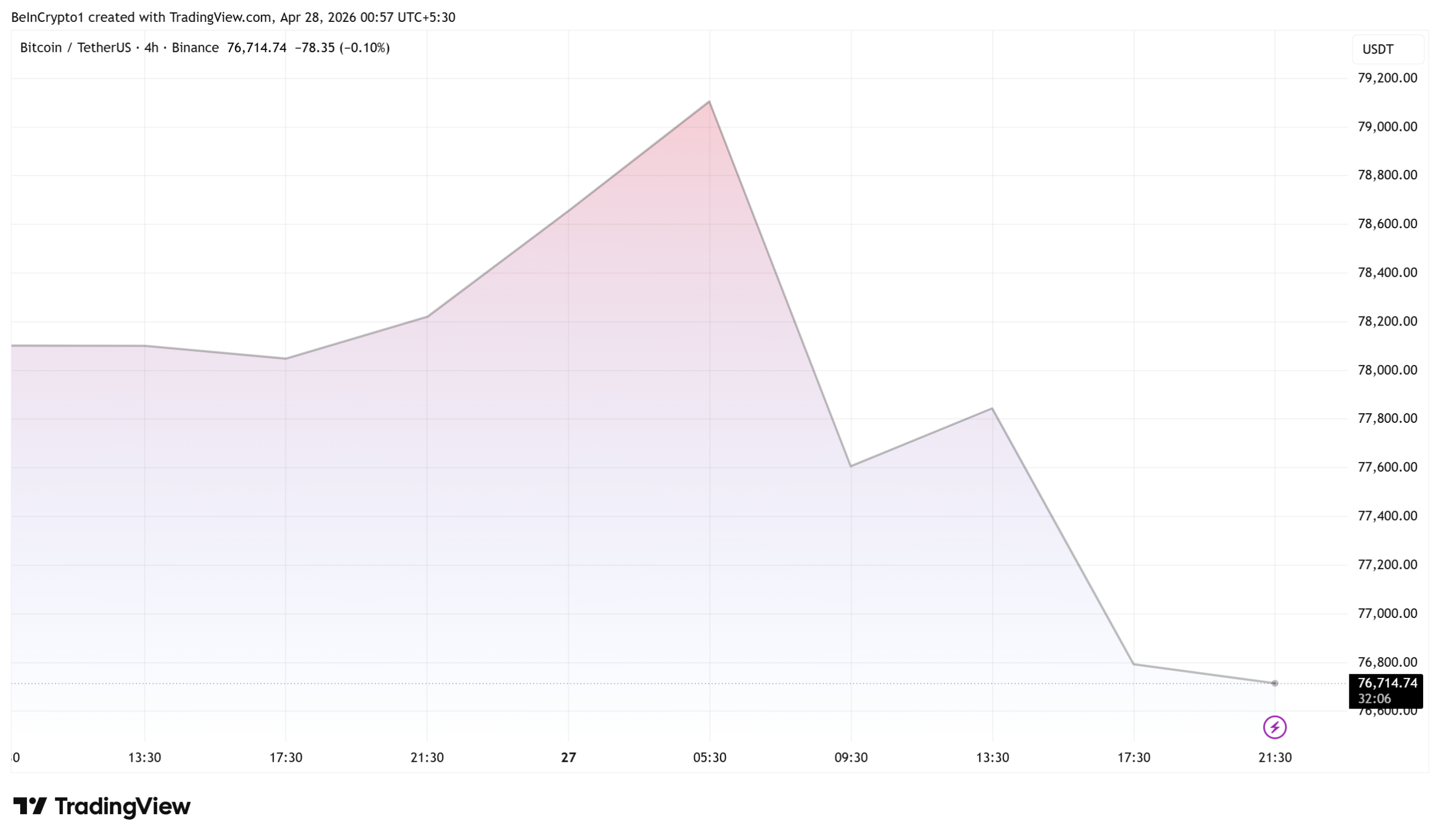
The BTC price was trading for $76,714 as of this writing, recording lower highs on the 4-hour timeframe amid sour sentiment from Day-1 of the Bitcoin 2026 Conference. With this, it has effectively erased all the Sunday gains.
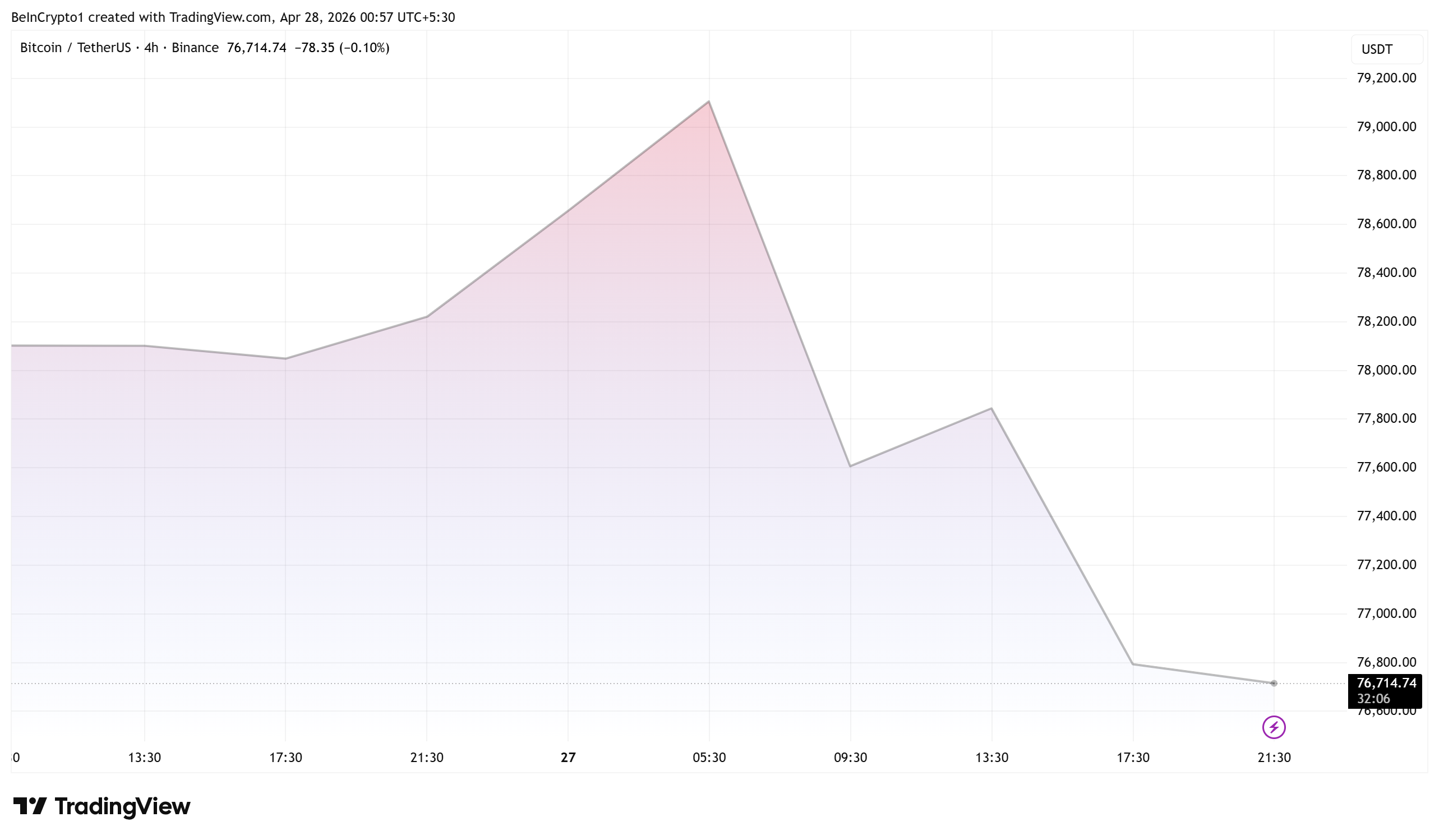
The three-day event runs through Wednesday at The Venetian. Organizer BTC Inc. expects more than 40,000 attendees across 500 scheduled speakers.
The agenda features regulators, lawmakers, and corporate executives. Strategy founder Michael Saylor, Tether chief Paolo Ardoino, and Senator Cynthia Lummis headline the main stage.
US officials carry equal weight. SEC Chairman Paul Atkins, CFTC Chairman Mike Selig, and Acting Attorney General Todd Blanche are all scheduled to appear. Eric Trump represents American Bitcoin as co-founder.
Tickets range from $699 for general admission to $12,999 for the Whale Pass with luxury perks. The official theme this year is “All In On the Future of Money.”
Bitcoin’s Cypherpunk Roots Meet 2026 Reality
Bitcoin emerged from the cypherpunk movement of the 1990s. Satoshi Nakamoto’s whitepaper framed the network as a way to bypass banks and governments.
That positioning is what makes the 2026 lineup jarring for early holders. Many speakers represent the agencies and corporations the protocol was built to route around.
Simon Dixon, an early Bitcoin investor and inaugural conference speaker, posted his frustration on the eve of the event.
“Let’s face it, this Bitcoin conference is compromised. Bitcoin is open source code… It’s a big mistake not to understand the difference,” he wrote.
Supply Shift Worries the Bitcoin Faithful
Beyond the speaker list, critics point to a deeper structural shift. Bitcoin holdings are moving from individual wallets toward spot ETFs, corporate treasuries, and custodial platforms.
That trend pushes a network built for individual sovereignty closer to traditional finance. Self-custody advocates argue the conference now markets products that reverse Bitcoin’s founding promise.
Spot Bitcoin ETFs collectively hold more than a million coins. That concentration would have been unthinkable to the network’s earliest users.
“Meet the 2026 Bitcoin Conference speakers. Or how Bitcoin slowly became the system it was built to escape,” one user quipped.
Other accounts amplify the criticism, framing the lineup as proof of institutional capture rather than mass adoption.
A Conference That Won the Mainstream and Lost the Faithful
BTC Inc. has not publicly responded to the criticism. The conference could win mainstream legitimacy this week. Yet it could also lose the holders who built Bitcoin to escape exactly this.
Sessions through Wednesday will either deepen that divide or test whether institutional adoption can coexist with the cypherpunk crowd.
The post Bitcoin Las Vegas Faces Cypherpunk Revolt Over Regulator-Heavy Lineup appeared first on BeInCrypto.

Industry coalition says JPX’s consultation would add a vague, asset-specific screen to a benchmark that already has objective investability rules.
Nashville, TN — April 26, 2026 — Bitcoin For Corporations (BFC), in coordination with member companies and other affected market participants, today called on JPX Market Innovation & Research, Inc. (JPX) to withdraw its proposed exclusion of companies whose principal asset is cryptoassets from new inclusion in TOPIX and other periodically reviewed indices.
JPXI’s April 3, 2026 consultation does not publicly propose a specific numerical threshold. Instead, it states that, “for the time being,” companies whose principal asset is cryptoassets would be deferred from new inclusion in TOPIX and other periodically reviewed indices. The consultation also states that the proposal would not apply to companies already in the index.
BFC and participating companies oppose the proposal because it is not a true investability rule. TOPIX already has objective criteria designed to protect investability and stability, including liquidity screens, free-float-adjusted market capitalization criteria, continuation buffers, and existing treatment for delistings and other listing-quality events. The proposed crypto-asset exclusion does not measure liquidity, free float, replicability, or listing quality. It instead excludes companies because of the composition of their balance sheet.
“TOPIX is meant to be a broad, neutral, investable benchmark of the Japanese equity market,” said George Mekhail, Managing Director of Bitcoin For Corporations. “If a company satisfies the ordinary market-based eligibility standards, excluding it because of one asset category is not a normal investability screen. It is a policy judgment about one asset class, and it does not belong in the methodology of a flagship market benchmark.”
BFC said the proposal raises four core concerns
- It is not a proper investability rule. The consultation is framed in the language of investability and stability, but the proposed exclusion does not address the criteria that normally determine whether a stock belongs in a broad market index: liquidity, free float, market capitalization, and listing quality. It introduces an asset-specific screen into a benchmark that already has objective eligibility rules.
- It is too vague to administer coherently. The consultation refers to companies whose “principal asset is cryptoassets,” but does not explain how that standard would be applied in practice. It does not say whether the test would be based on parent-company holdings or consolidated holdings, whether it would look through subsidiaries or affiliates, or whether indirect exposure through securities or similar instruments would be captured. A rule that cannot be applied clearly and consistently should not be inserted into a flagship benchmark.
- It creates obvious form-over-substance arbitrage. If direct Bitcoin holdings by a parent company are disfavored, but equivalent exposure through a wholly owned subsidiary, an affiliated company, or a strategic equity position is not, then the rule is targeting legal form rather than economic substance. That would encourage balance-sheet engineering rather than improve index quality.
- It is preemptive and open-ended. October 2026 will be the first periodic review under the next-generation TOPIX framework in which Standard and Growth market companies can become eligible through the new process. Yet JPX is proposing to exclude a category of companies before they have even been assessed under the ordinary criteria. At the same time, the consultation says the exclusion would apply “for the time being,” without setting out a clear review period, exit standard, or sunset mechanism. That is not a disciplined framework. It is an indefinite deferral with uncertain boundaries.
BFC also noted that major global index providers have treated this issue with greater caution. MSCI considered a threshold-based exclusion for digital-asset treasury companies and ultimately did not adopt a blanket exclusion, instead acknowledging the need for further work to distinguish operating companies from non-operating or investment-like entities. FTSE Russell has not announced a comparable blanket exclusion. In BFC’s view, JPX should show the same restraint rather than moving ahead with a crypto-only exclusion before a broader principle has been defined.
More broadly, BFC said the issue extends to the neutrality, credibility, and representativeness of Japan’s flagship equity benchmark.
“If JPX believes there is a broader question about highly concentrated or investment-like companies, then an asset-neutral framework applied consistently would be more appropriate,” Mekhail said. “Singling out one asset class by introducing a vague rule that is easy to evade and difficult to administer would be unprecedented and untethered from TOPIX’s actual investability criteria.”
Bitcoin For Corporations and participating market participants are calling on JPXI to:
- Withdraw the proposed exclusion for companies whose principal asset is cryptoassets.
- Preserve TOPIX as a neutral, broad, rules-based benchmark tied to objective investability and listing-quality standards.
- Refrain from adopting an open-ended deferral without a clear review process, exit standard, or sunset mechanism.
- Engage with issuers and market participants on any broader, asset-neutral framework before changing TOPIX methodology.
Organizations and individual investors may review the full position letter and add their signatures at: topix.bitcoinforcorporations.com
About BTC Inc
BTC Inc. is the world’s leading Bitcoin media enterprise, operating Bitcoin Magazine, The Bitcoin Conference, and Bitcoin for Corporations. Through its media, events, and educational platforms, BTC Inc. delivers trusted news, research, and experiences that advance Bitcoin adoption among individuals, institutions, and enterprises worldwide.
BTC Inc is a subsidiary of Nakamoto Inc. (NASDAQ: NAKA), a publicly held Bitcoin company that owns and operates a global portfolio of Bitcoin-native enterprises.
Forward-Looking Statements
Certain statements in this press release constitute forward-looking statements, as defined under U.S. federal securities laws. Forward-looking statements can be identified by the use of words such as “estimate,” “project,” “predict,” “believe,” “expect,” “anticipate,” “potential,” “intend,” “could,” “would,” “may,” “plan,” “will,” “seek,” “target,” or the negative of such terms or other variations thereof. However, the absence of these words does not mean that a statement is not forward-looking.
Forward-looking statements in this press release include, but are not limited to, statements regarding BTC Inc.’s business plans and strategies, including plans for new products, services, and media platforms; projected or targeted audience size, reach, impressions, and distribution; expected launch dates and production schedules; the Company’s advocacy positions and the expected outcomes of industry and regulatory engagement; and the anticipated role and growth of Bitcoin-related media, events, and educational services.
These forward-looking statements are inherently uncertain and involve numerous assumptions and risks. Factors that could cause actual results to differ materially from those projected include, but are not limited to: (i) the volatility of Bitcoin prices and its effect on audience interest, advertiser demand, and the commercial viability of Bitcoin-focused media; (ii) changes in audience size, engagement, or platform distribution that could affect BTC Inc.’s reach or revenue; (iii) the risk that new products or services, including new media platforms, may not launch on schedule, achieve projected audience levels, or generate anticipated revenue; (iv) the risk that advocacy or industry engagement efforts may not achieve their intended outcomes; (v) dependence on third-party distribution platforms whose policies, algorithms, or terms of service may change; competition from other media companies and content providers; (vi) the evolving regulatory environment for digital assets and its potential impact on BTC Inc.’s operations, content, and audience; (vii) reliance on key personnel and creative talent; the risk that projected audience metrics, impressions, or distribution figures may not be achieved or sustained; (viii) risks associated with the integration of BTC Inc. into Nakamoto Inc.’s operations following the February 2026 acquisition; (ix) general economic conditions and their impact on advertising and events revenue; and (x) other important factors detailed in Nakamoto Inc.’s Annual Reports on Form 10-K, Quarterly Reports on Form 10-Q, Current Reports on Form 8-K, and other documents that are filed, or will be filed, with the SEC and that are or will be available on Nakamoto’s website at www.nakamoto.com and on the website of the SEC at www.sec.gov.
Because Nakamoto Inc. (NASDAQ: NAKA) is the parent company of BTC Inc., investors in Nakamoto Inc. common stock should be aware that the performance and risks of BTC Inc.’s media, events, and educational businesses may affect Nakamoto Inc.’s business, financial condition, results of operations, and stockholder value.

Man Utd: Champions League football all but secured, yet big decisions loom

BOJ keeps rates steady but 3 board members dissent, call for hike
Naoya Inoue confirms his interest in US super fight after Nakatani: “Yes I’d beat him”

Manchester United reach agreement with Casemiro over contract clause amid transfer speculation

US brings back mandatory military draft registration

Steven Gerrard disagrees with Gary Neville over ‘shock’ Chelsea and Arsenal claim | Football


-

 Fashion3 days ago
Weekend Open Thread – Corporette.com
-

 Tech10 hours ago
Register Renaming | Hackaday
-
 Crypto World2 days ago
Hyperliquid $HYPE Rally Builds Momentum as AI Sector Enters Prove-It Phase
-

 Politics5 days ago
Making troops accountable for war crimes threatens US alliance, ex-SAS colonel warns
-

 Politics5 days ago
Disabled people challenge government SEND proposals over segregation concerns
-

 Business4 days ago
Patterson-UTI Energy, Inc. (PTEN) Q1 2026 Earnings Call Transcript
-

 Business6 days ago
Rolls-Royce Voted UK’s Most Iconic Trade Mark as IPO Register Hits 150
-
 Crypto World7 days ago
Five Value Stocks with Recovery Potential in 2026: PayPal (PYPL), Nike (NKE), and More
-
 Sports2 days ago
IPL 2026: Ruturaj Gaikwad registers slowest fifty of the season, enters all-time unwanted list | Cricket News
-

 Politics5 days ago
Starmer handler McSweeney to be dragged from shadows by Foreign Affairs Committee
-

 Politics5 days ago
Zack Polanski responds to home secretary’s taser threat
-
Politics5 days ago
Wings Over Scotland | How To Get Away With Crimes
-

 Crypto World6 days ago
New York sues Coinbase, Gemini over prediction market offerings
-
Entertainment7 days ago
Sydney Sweeney cameo cut from “The Devil Wears Prada 2”, source explains why (exclusive)
-
 Business6 days ago
HCL Tech share price tank over 9% after weak Q4. JPMorgan, HSBC & 3 others cut target price
-

 Crypto World6 days ago
Crypto’s great hope in Senate’s Clarity Act still has a path to survive tight calendar
-

 Politics6 hours ago
Drax board avoid their own AGM, accused of greenwashing & environmental racism
-

 Fashion7 days ago
Kilkenny Design New Beauty Arrivals for Spring 2026
-

 Politics5 days ago
‘Iran is still a nuclear threat’
-
 Sports5 days ago
Tim Bradley names the current best in the world: “Better than Inoue and Usyk”
You must be logged in to post a comment Login