
Crypto World
Critics Push Back Against Developer’s Plan to Reassign Satoshi’s Coins in eCash Fork

Paul Sztorc, co-founder and CEO of LayerTwo Labs and a Bitcoin developer, has unveiled plans for eCash, a hard fork scheduled to launch in August 2026.
The plan’s treatment of coins linked to Satoshi Nakamoto has sparked backlash across X.
What Sztorc Proposed for the Bitcoin eCash Hardfork
In a post, Sztorc revealed that eCash’s L1 node will be a “near-copy of Bitcoin Core.” The chain will use SHA-256d mining with a one-time difficulty reset.
“I am helping create a **new Bitcoin Hardfork** — dropping this August, called ‘eCash’. Your coins will split. For example, if you have 4.19 BTC, then you will get 4.19 eCash. You may sell your eCash — or keep it. Or ignore it!” Sztorc wrote.
Follow us on X to get the latest news as it happens
The Layer 1 (L1) network will activate Sztorc’s BIP300 and BIP301 proposals via soft fork. Seven drivechains are already in development, including Truthcoin for prediction markets and CoinShift as a decentralized exchange (DEX).
Other L2s include BitNames for identity, BitAssets for non-fungible tokens (NFTs), and Photon for quantum resistance. The team will also release a coin-splitter tool.
Sztorc framed eCash as a permanent fix, unlike the 2017 Bitcoin Cash (BCH) split, which focused on increasing the block size. A notable aspect involves the planned allocation of a portion of coins attributed to Satoshi Nakamoto.
“Satoshi has 1.1M coins in the so called patoshi pattern. We will be manually reassigning some of these coins (fewer than half) to investors today. This will no doubt be a controversial decision. But I think it is necessary, and in fact, ideal,” he added.
In a separate post, the developer clarified that the process does not involve taking any BTC linked to Satoshi Nakamoto. Instead, it would assign 600,000 newly created eCash tokens to Satoshi on the forked chain, less than the 1.1 million coins typically attributed to those holdings, but more than allocations seen in other networks.
“Our coins are not named BTC; they are named eCash. BTC balances are untouched by eCash. To move BTC, you always need BTC software + the BTC private key. We lack both.” he noted. “It is fun to virtue signal about property rights, I get it. But be careful who you listen to and who you get your information from — in the heat of the moment, it may not be reliable!”
Subscribe to our YouTube channel to watch leaders and journalists provide expert insights
Community Calls Satoshi Coin Reassignment
Nonetheless, the plan has already drawn pushback from parts of the crypto community. Commenting on X, Caffè Satoshi urged “extreme caution when receiving this eCash.”
Others were more critical of the distribution model. Podcast host Peter McCormack argued that any attempt to take coins linked to Satoshi Nakamoto is both “theft” and “disrespectful.”
“Taking Satoshi’s coins is a major flaw in this. All the rest is great. Satoshi’s property being taken sets a horrible precedent that will kill your narrative,” another user added.
Follow us on X to get the latest news as it happens
Satoshi Nakamoto’s Bitcoin holdings have long been a source of philosophical tension within the Bitcoin community. Even in debates around potential quantum threats, opinions remain sharply divided.
Some argue the coins should be burned to mitigate future risks, while others oppose any intervention, maintaining that such actions would undermine Bitcoin’s core principles of decentralization and immutability.
The post Critics Push Back Against Developer’s Plan to Reassign Satoshi’s Coins in eCash Fork appeared first on BeInCrypto.



DeFi United, a coalition of ecosystem participants led by Aave service providers, has released a technical implementation plan to restore rsETH backing.
The plan comes after a major exploit on April 18, 2026. Hackers likely associated with North Korea’s Lazarus Group stole approximately $292 million (116,500 rsETH) from KelpDAO’s LayerZero bridge.
DeFi United Releases Technical Roadmap to Make rsETH Whole
In a detailed post, the team said seven wallets tied to the exploiter still hold active rsETH-backed positions on Aave and Compound. This totals around 107,000 of the 116,500 rsETH originally stolen.
Follow us on X to get the latest news as it happens
The recovery plan has two goals: restoring rsETH’s backing and recovering the ~107,000 rsETH in excess collateral. To restore the backing, rsETH must match its nominal Kelp exchange ratio of 1.07 ETH. This will be done via the DeFi United initiative.
It has already lined up the ETH commitments needed to bring affected systems back online. Final execution depends on governance approvals, execution timelines, and signed definitive agreements.
After the plan’s execution, the backing will be fully restored by depositing ETH into the bridge lockbox (RSETH_OFTAdapter 0x85d456b2…98ef3).
“The restoration process involves converting the committed ETH into rsETH in tranches, which will then be transferred to the affected lockbox contract, allowing the bridge to securely resume full operation,” the blog read.
The plan also clears the eight affected positions on Aave’s Ethereum Core and Arbitrum markets. This step is necessary to recover roughly 13,000 ETH and resolve the related impairment.
The blog stated that the initiative seeks to restore rsETH backing without socializing losses, though several risks remain. Deployment still depends on finalized agreements and governance approvals.
Closing the impacted positions also requires proposals to pass on Ethereum and Arbitrum, and attacker interference could trigger extra liquidation steps.
LayerZero and Kelp have added new safeguards, but “residual risk remains until those measures are validated in production.” If all goes well, rsETH backing will be fully restored, and markets stabilized.
Subscribe to our YouTube channel to watch leaders and journalists provide expert insights
The post DeFi United Unveils Technical Plan to Restore rsETH Backing After KelpDAO Exploit appeared first on BeInCrypto.
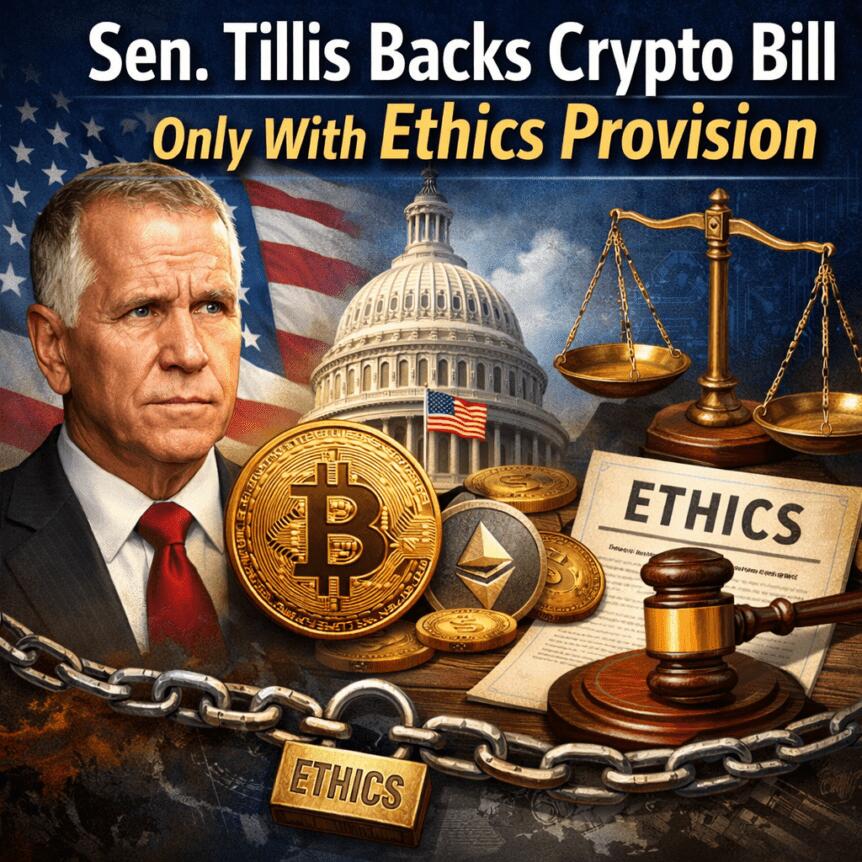
Senior Republican U.S. Senator Thom Tillis indicated that he will not support the Senate’s prospective crypto market structure legislation unless ethics provisions are included to constrain how White House officials may engage with digital assets. According to Politico, Tillis said there must be ethics language in the bill before it advances from the chamber, or he will oppose it.
Democratic Senator Ruben Gallego echoed the sentiment, stating that “there is no final bill — there is no final movement — unless there is a bipartisan agreement when it comes to the ethics provision.”
Tillis, who is slated to retire early next year, is a senior member of the Senate Banking Committee, the panel overseeing the legislation’s progress. The House of Representatives previously passed a version of the package, known as the CLARITY Act, in July. The Senate proposal would divide crypto regulatory responsibility between the Commodity Futures Trading Commission and the Securities and Exchange Commission and has faced protracted discussions, particularly on ethics language and questions surrounding stablecoin yield payments.
Lawmakers on both sides of the aisle have raised concerns about potential conflicts of interest tied to political figures and the crypto sector. Democratic lawmakers have criticized the activities of the Trump family’s crypto ventures and have sought to use the bill to address perceived conflicts of interest.
Talks on the ethics provisions are reportedly moving forward, though the exact language remains unsettled. “We’re making progress,” said Democratic Senator Adam Schiff to Politico. “We have been talking for a long time without making much progress, and now that other parts of the bill are starting to come together, we’re narrowing our differences.”
Schiff has previously signaled support for a comprehensive ethics framework that would constrain federal involvement with digital assets, including prohibitions on federal employees sponsoring, endorsing or issuing certain assets. He noted that such restrictions would apply broadly, potentially covering the president, who has publicly engaged with memecoins and NFT projects bearing his name.
As the policy process unfolds, the underlying regulatory architecture remains a central point of contention. The CLARITY Act’s approach to formally delineate jurisdiction between the CFTC and the SEC continues to be debated, with stakeholders concerned about gaps, preemption, and the treatment of complex instruments such as stablecoins. The negotiations also reflect a broader tension between enforcement aims and the creation of a clear, predictable regulatory framework for crypto markets.
Beyond the substantive regulatory mechanics, the discourse touches on how enforcement agencies—ranging from the SEC to the DOJ and the CFTC—will coordinate in policing digital-asset activities that intersect securities law, commodities rules, and anti-money-laundering standards. Compliance teams, exchanges, and financial institutions are watching closely for any shifts that could affect licensing, cross-border operations, and banking-crypto integration. The discussion also occurs within a wider international context, where peers in other jurisdictions are pursuing their own ethics and disclosure frameworks for political contributions and crypto-related sponsorships. For instance, Canada has moved to advance legislation addressing crypto political donations, illustrating how political finance considerations are converging with crypto regulation in multiple markets.
Industry participants are contending with a dynamic policy environment in which ethics provisions, if enacted, could shape how corporate actors interact with policymakers and legislators. The potential reach of a broad ethics regime—one that could apply to the president and other senior officials—would set a high compliance bar for political communications and asset endorsements, with implications for corporate governance, lobbying disclosures, and conflict-of-interest management.
In sum, the trajectory of the Senate’s crypto market structure bill remains contingent on the ethical guardrails inserted into the package. With the CLARITY Act already enacted in the House and ongoing negotiations in the Senate, the outcome will influence how regulators allocate oversight between the CFTC and SEC, how digital-asset products are treated under securities and commodities laws, and how public-private sector collaboration proceeds in a landscape marked by rapid innovation and heightened scrutiny.
Closing perspective: The next phase hinges on whether ethics provisions achieve bipartisan consensus. If such language is adopted, it could materially alter the policy trajectory, enforcement priorities, and compliance burdens for crypto firms and financial institutions operating in the United States.

TLDR
- GOP Senator Thom Tillis pledges to oppose the Clarity Act without ethics safeguards in place
- The North Carolina lawmaker seeks restrictions on White House personnel profiting from digital currencies
- Democratic legislators push for prohibitions on federal workers endorsing or launching digital tokens
- Financial firm TD Cowen identifies Tillis as the “latest roadblock” hindering legislative progress
- Market watchers now estimate a 33% probability of passage before year’s end
North Carolina Republican Senator Thom Tillis has issued an ultimatum regarding the Senate’s cryptocurrency regulatory framework, the Clarity Act, stating he will oppose the legislation without provisions governing how administration officials engage with or benefit from digital assets.
The senator outlined his stance publicly this Monday. “Ethics language must be incorporated into the legislation before Senate passage, or I’ll transition from negotiator to opposition,” he stated to Politico.
As a ranking member of the Senate Banking Committee, Tillis wields considerable authority over the bill’s progression through the legislative process.
His decision not to pursue another term adds weight to his position, according to policy analysts who suggest this frees him from political calculations typically associated with reelection campaigns.
Financial services firm TD Cowen characterized Tillis as the “latest roadblock” impeding the measure. “We anticipate Tillis will maintain his position, given his recent successful confrontation with the administration regarding the Federal Reserve,” noted Jaret Seiberg, who serves as managing director at TD Cowen’s Washington Research Group.
The senator had previously prevented advancement of Kevin Warsh’s Federal Reserve chairman nomination, reversing course only after Friday’s announcement that a Justice Department investigation into sitting chairman Jerome Powell had been terminated. Following that development, Tillis indicated support for Warsh’s appointment.
Ethics Provisions at the Center of the Debate
Democratic members of Congress have persistently advocated for ethical guardrails within the legislation. Senator Adam Schiff articulated earlier this year that Democrats are seeking “a ban on sponsoring, endorsing or issuing digital assets that applies to all federal employees,” explicitly including the commander-in-chief.
Such provisions would presumably impact the Trump family’s ventures, which include a memecoin launch and non-fungible token collections bearing the president’s likeness and branding.
Democratic Senator Ruben Gallego emphasized that “no final bill — no final movement — unless there is a bipartisan agreement when it comes to the ethics provision.”
Senator Schiff reported that negotiations are gaining momentum. “We have been talking for a long time without making much progress, and now that other parts of the bill are starting to come together, we’re narrowing our differences,” he explained.
What the Bill Does
The Clarity Act establishes a regulatory division of responsibility between the Commodity Futures Trading Commission and the Securities and Exchange Commission for cryptocurrency oversight. The House of Representatives approved its companion legislation this past July.
The measure has encountered numerous postponements connected to ethics requirements, stablecoin interest distribution, and various outstanding matters.
TD Cowen’s Seiberg identified several additional obstacles, including insufficient commissioner appointments at the CFTC, controversies surrounding the Trump-affiliated cryptocurrency venture World Liberty Financial, and questions regarding Iran’s utilization of digital currency transactions.
Seiberg acknowledged last month he is “increasingly pessimistic” and calculates a one-in-three probability of passage during the current year. He has previously suggested the legislation might be postponed until 2027, with implementing regulations potentially not taking effect until 2029.
Tillis requested that the Senate Banking Committee postpone markup proceedings on the bill until May.

Key Takeaways
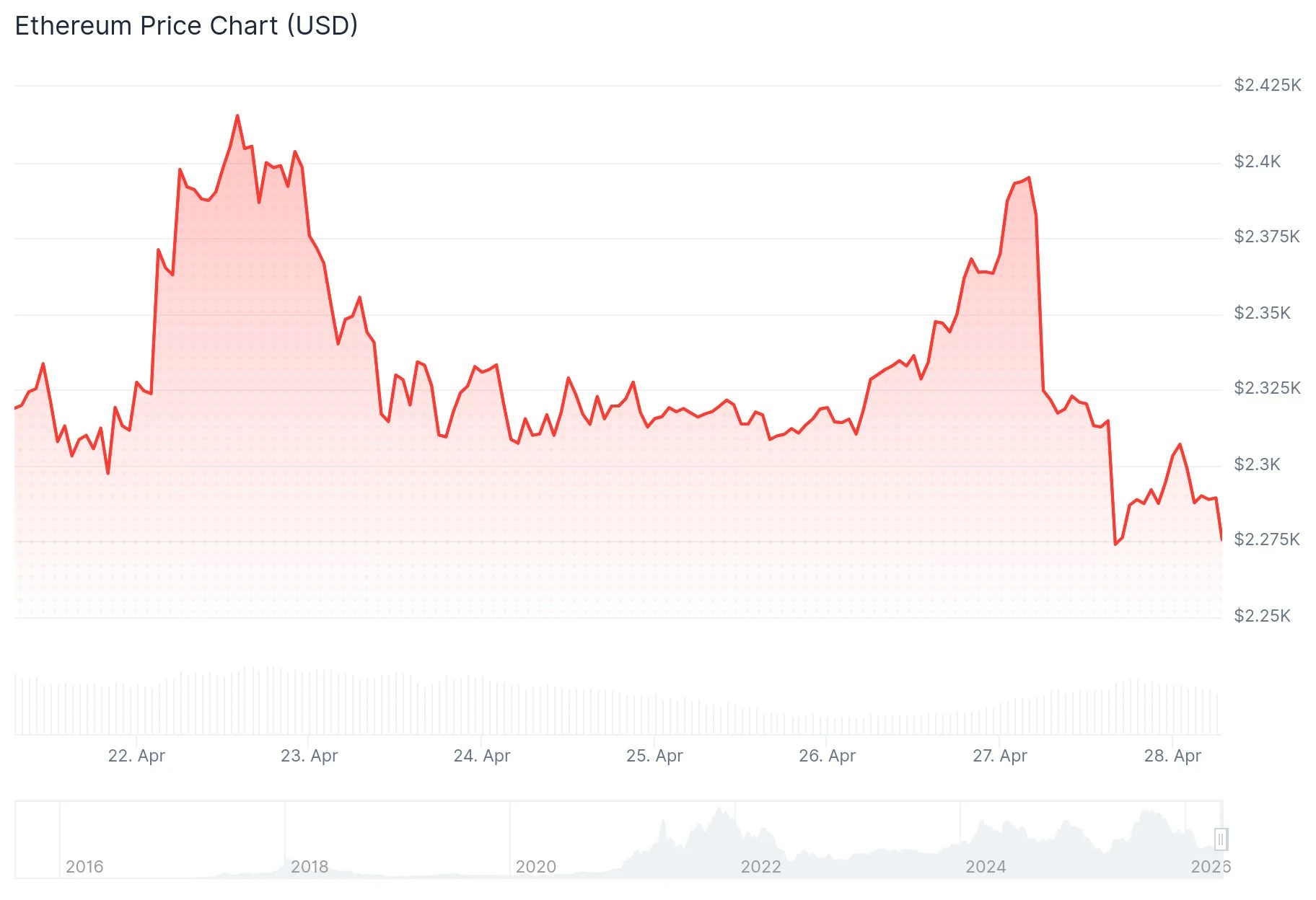
- Ethereum declined 3.4% to reach $2,287 following its fourth consecutive failure to surpass the $2,400 threshold
- Daily chart analysis reveals a triple top formation, with critical support positioned at $2,150
- Approximately $2.5 billion in leveraged long positions are vulnerable below the $2,150 mark
- The ETH/BTC trading pair declined beneath 0.032, indicating relative underperformance versus Bitcoin
- Higher timeframe analysis suggests accumulation activity, though no definitive reversal confirmation exists
Ethereum has encountered significant resistance at the $2,400 threshold on four separate occasions beginning April 14, creating a triple top formation visible on daily timeframes. During Monday’s trading session, ETH experienced a 3.4% decline to $2,287, extending a pattern of unsuccessful breakout attempts.
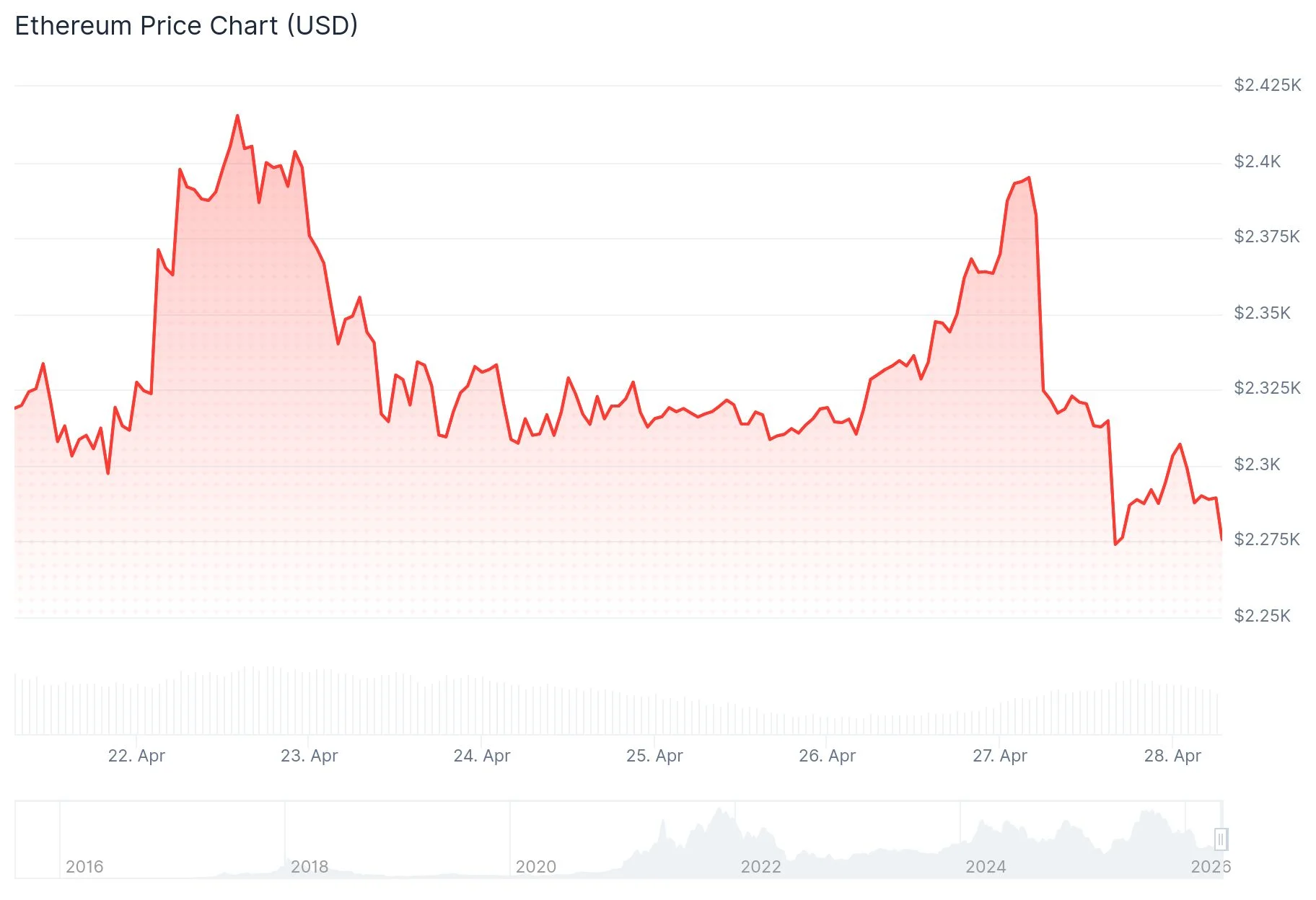
The 100-day exponential moving average positioned around $2,350 has served as persistent overhead resistance during this timeframe. Daily candle closes have consistently failed to establish themselves above this technical level, restricting upward momentum.
Michaël van de Poppe from MN Capital highlighted deteriorating conditions in the ETH/BTC trading pair. The ratio descended below the 0.032 BTC threshold, violating a support boundary that had previously maintained bullish structure. Additionally, the ratio moved beneath its 21-period moving average, confirming diminishing relative strength compared to Bitcoin.
For the ETH/BTC pair, the subsequent higher timeframe support zone is located around 0.026 BTC, representing a level where demand has historically emerged.
Critical Support at $2,150 Under Scrutiny
Market participants are closely monitoring the $2,150 price level as the pivotal zone. This area previously functioned as overhead resistance before converting into a support foundation. Should this level fail to hold, Ethereum would likely test the $2,050 to $1,900 price corridor.
Liquidation information sourced from CoinGlass reveals that more than $2.5 billion in leveraged long contracts are positioned just beneath $2,150. A breach of this critical threshold could initiate a cascade of forced liquidations.
On the Binance exchange, Ether’s open interest has contracted to $2.58 billion, matching concentration levels observed when ETH traded near $2,200 earlier in April. The funding rate currently hovers near -0.013%, representing its lowest measurement since February, with short position establishment outpacing longs in recent activity.
Analyst Amr Taha observed that this configuration — characterized by reduced leverage and shorts-dominant positioning — creates conditions for a potential short squeeze if ETH maintains current price floors.
Extended Timeframe Analysis Points to Consolidation
Crypto Patel published a two-week timeframe chart on X illustrating Ethereum trading within the lower boundary of an extended rising channel pattern. The $1,700 to $2,250 range is identified as a liquidity capture and accumulation territory, representing a zone that has provided foundational support structure since 2022.
The initial resistance obstacle above present prices is situated near $2,480, with subsequent resistance spanning the $3,500 to $4,900 zone, encompassing the previous all-time high region around $4,876.
A complementary three-day chart presented by James Easton on X demonstrates a recurring pattern where substantial rallies have historically followed significant retracements. A white indicator marks the current 2026 low point, implying ETH may be constructing another foundational base.
Both technical perspectives refrain from confirming an imminent bullish reversal. Ethereum would need to successfully defend the accumulation territory and recapture the $2,480 level before any constructive thesis gains validation.
The decisive level for near-term price action remains $2,150, where technical support structure intersects with concentrated liquidation exposure on the daily chart.
ZetaChain has paused cross-chain transactions on its mainnet after detecting an attack on its GatewayEVM contract.
Summary
- ZetaChain paused cross-chain transactions after detecting an attack on its GatewayEVM smart contract.
- The team said only internal wallets were affected and no user funds were lost.
- DefiLlama reported $300,000 in losses as ZetaChain prepared a detailed post-mortem.
The Layer 1 network said the move was a precaution while the team investigates the incident. GatewayEVM works as a key entry point for cross-chain activity between EVM-compatible networks and applications on ZetaChain. The contract helps route interactions across connected chains.
ZetaChain said the attack affected only internal team wallets. The team added that it had already closed the attack path to stop more funds from being compromised.
“As a precaution, cross-chain transactions are currently paused on ZetaChain,” the team said. “Investigation is still ongoing, and at this time no user funds were impacted by this attack.”
DefiLlama reports $300,000 loss
DefiLlama data shows the attack caused about $300,000 in losses. ZetaChain has not confirmed the exact amount and said it plans to publish a full post-mortem.
According to ZetaChain’s official status page, cross-chain transactions remained paused as of 9:00 p.m. ET on Monday. That was about nine hours after the team first identified the attack.
DeFi security concerns continue
ZetaChain launched its mainnet in early 2024 and focuses on blockchain interoperability. The project describes itself as a universal blockchain that connects networks such as Bitcoin, Ethereum, and Polygon.
The attack comes after several recent DeFi security incidents. The LayerZero-powered Kelp DAO bridge exploit drained $292 million and created bad debt on Aave. Since that event, DefiLlama data shows at least 10 attacks on DeFi projects.

Online payments firm Block has launched proof-of-reserves for its corporate Bitcoin treasury and two of its flagship products, Cash App and Square, joining a growing list of crypto companies proving their holdings onchain.
“People shouldn’t have to trust that their bitcoin is there, they should be able to verify it,” the Jack Dorsey-led company said in a post to X after announcing the proof-of-reserves feature and other new offerings in Las Vegas on Monday.
Block said anyone can “independently confirm Block’s holdings” through on-chain signatures. “Reserves are actively controlled, not just historically observed,” it added.

Source: Block
The proof-of-reserves seeks to verify the 8,883 Bitcoin, worth $681.4 million, marked on Block’s balance sheet — the 14th-largest Bitcoin holding among corporate treasuries.
Proof-of-reserves became more widely adopted after the collapse of FTX in November 2022 as a transparency measure to assure customers that holdings were fully backed, secure and not at risk of misuse.
Binance, Kraken, OKX, Bitfinex and Bitget are among the largest crypto trading platforms that have adopted proof-of-reserves disclosures.
Strategy’s Saylor once said proof-of-reserves is a ‘bad idea’
Strategy, the biggest corporate holder of Bitcoin in the world, has not issued any proof-of-reserves.
In May 2025, Strategy executive chairman Michael Saylor flagged proof-of-reserves as a security risk when asked why his company doesn’t adopt the measure, arguing that it exposes sensitive information.
“It actually dilutes the security of the issuer, the custodians, the exchanges and the investors,” Saylor said at the time. “It’s not a good idea. It’s a bad idea.”

Display of Bitcoin proof-of-reserves for Block’s Bitcoin treasury, Cash App and Square. Source: Block
Block also launched a Bitkey hardware wallet with a touchscreen to verify transactions while rolling out a feature on Cash App allowing certain users to have payments automatically converted into Bitcoin.
Related: ‘Historical average’ could push Bitcoin bottom at $57K level: Analyst
Block is also offering 5% Bitcoin cash back rewards at Square merchants and has raised customer withdrawal limits fivefold to $10,000 per day and $25,000 per week.
Dorsey is one of the biggest advocates seeking to push Bitcoin payments into the mainstream.
He previously said Bitcoin payments must see wide adoption to uphold Satoshi Nakamoto’s original vision of Bitcoin as an electronic peer-to-peer cash system.
Magazine: Adam Back says current demand is ‘almost’ enough to send Bitcoin to $1M
Crypto World
BTC remains under pressure after three Bank of Japan (BoJ) members call for a rate hike


The Bank of Japan’s (BoJ) monetary policy decision on Tuesday boosted expectations of a hike in borrowing costs by the end of the second quarter. The yen is loving it, while bitcoin remains under pressure.
The central bank kept its benchmark interest rate unchanged at 0.75% as widely expected. The decision, however, wasn’t unanimous, as three board members wanted to hike rates today itself.
The 6–3 vote split is the largest since Kazuo Ueda became governor of the central bank, indicating that more policymakers are now pushing to raise borrowing costs.
Markets price June rate hike
The central bank also raised its forecast for core inflation to 2.8% for this fiscal year, while revising economic growth projections lower to 0.5% from 1%. The rationale behind the BoJ’s hawkish tilt is largely tied to war-related disruptions in energy flows through the Strait of Hormuz, which have pushed up global energy prices and fed into inflationary pressures across energy-import-dependent economies like Japan.
Traders immediately priced in a 74% chance of a rate hike on June 16. That aligns with the consensus among Bank of Japan watchers, who had widely expected a June hike ahead of the decision, according to Bloomberg News.
Yen jumps: Another carry unwind shock ahead?
The Japanese yen rose, pushing the dollar-yen (USD/JPY) pair down nearly 0.5% to 158.95 (For major currencies, that’s a notable move). Rate hikes, or expectations of them, typically support a country’s currency, in this case, the yen.
The bitcoin-yen pair (BTC/JPY) listed on bitFlyer fell by 0.6% to 12.28 million yen, consistent with the weakness in the dollar-denominated prices, according to data source TradingView.
Trends in the Japanese yen are closely watched, given its long-standing role as a funding currency.
Sustained yen strength is often associated with risk aversion. This is because the Bank of Japan’s prolonged period of ultra-low interest rates over the past decade, including the post-COVID years, encouraged traders to borrow in yen and invest in higher-yielding assets abroad.
As a result, yen strength is often seen as triggering the unwinding of these so-called carry trades. The unwinding of yen-funded positions was widely cited as weighing on global risk assets in August 2024, when bitcoin fell from $65,000 to $50,000 over the course of a week.
It is therefore possible that growing expectations of a potential rate hike in June could renew concerns about another episode of yen carry trade unwind-driven global risk aversion.
That said, the latest available data on market flows from February suggests otherwise. Japan continued increasing its holdings of U.S. Treasury notes, indicating that yen-funded carry trades remain active.
“Japan, the largest foreign holder, raised its stockpile by +$14 billion, to $1.24 trillion, the highest since February 2022. This marks Japan’s 13th monthly purchase of the last 14 months, as Japanese institutions continue chasing higher yields overseas,” the founders of newsletter service LondonCryptoClub said.
“As we have said, there is no “JPY carry unwind” trade. Those who are talking about that don’t understand how Japanese investors operate and you should ignore them,” they added.
Crypto World
Acting US AG Says Devs Will No Longer Be Charged Unless they Knowingly Help Third Parties Commit Crimes
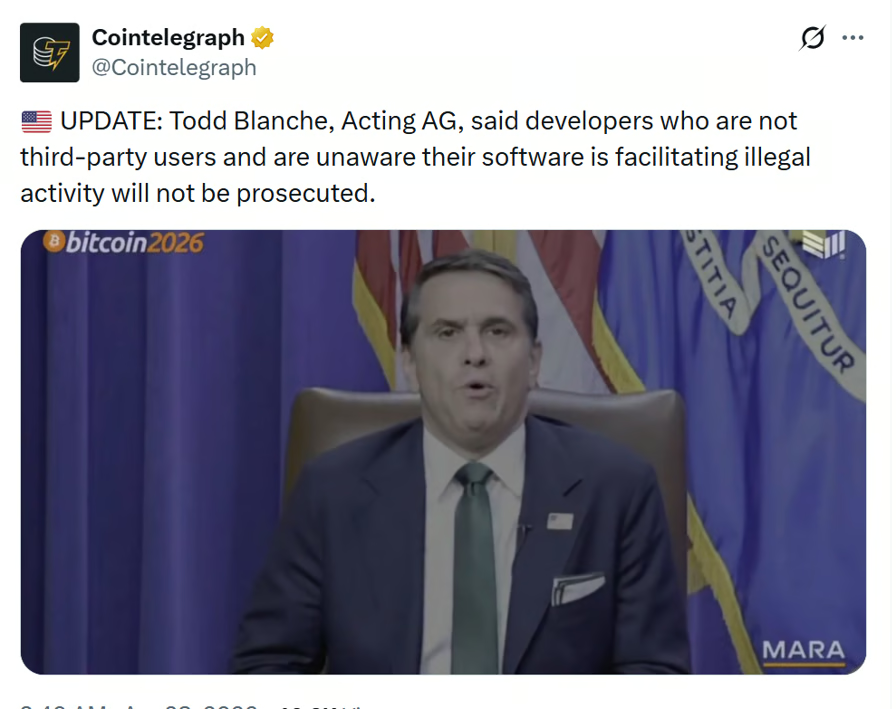
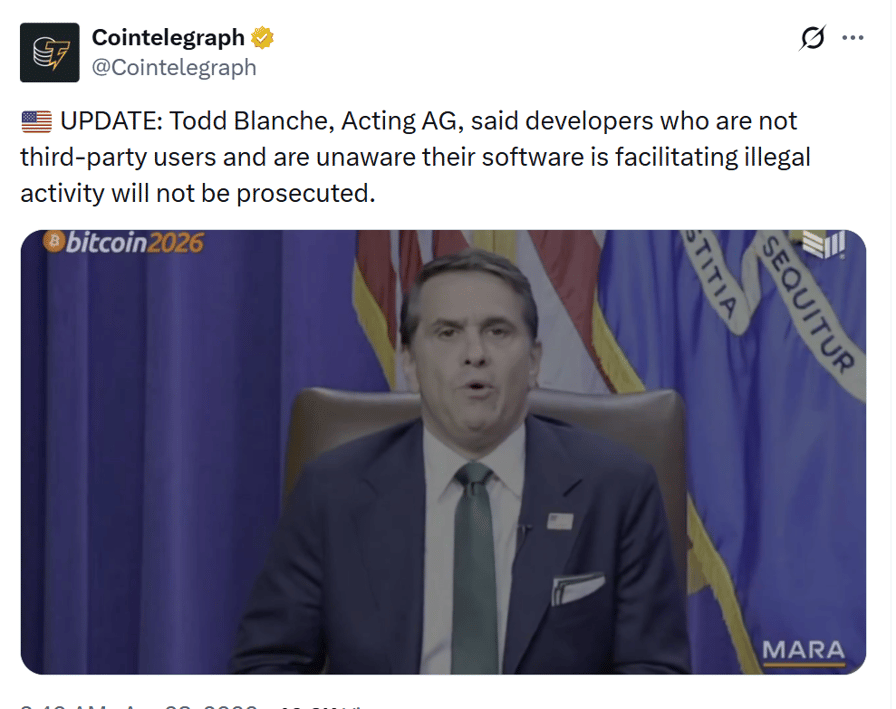
Acting US Attorney General Todd Blanche said the US Department of Justice and FBI are no longer targeting blockchain developers over platforms used for illegal activity, instead shifting focus to the users engaged in financial crime.
Speaking at a Bitcoin conference in Las Vegas alongside FBI Director Kash Patel and Coinbase chief legal officer Paul Grewal on Monday, Blanche said that the approach to enforcement has significantly changed under the Trump administration.
The acting attorney general explained that as long as developers have nothing to do with illicit activity, the DOJ and FBI have no reason to go after them, noting that “we have fundamentally changed the game when it comes to our investigations.”
“The basic principle is that if you are developing software, if you are a coder, if you are part of that process and you are not the third-party user, and you are not helping and knowing the third party is using what you developed to commit crimes, you are not going to be investigated and not going to be charged,” he said.
The comments mark a shift in tone from the US government, which had taken strong action against the developers of platforms like Tornado Cash. The crypto mixer and privacy protocol faced significant enforcement action over illicit activity facilitated on the platform, such as money laundering and sanctions evasion.
Tornado Cash was sanctioned by the Office of Foreign Assets Control in August 2022 before the sanctions were lifted in November 2024. Developers Roman Storm and Roman Semenov were indicted in August 2023; Storm was convicted in August 2025, while Semenov remains at large. Storm has denied any wrongdoing.
Source: Cointelegraph
Doubts remain over DOJ’s approach
Blanche’s comments were seen as positive within the crypto community, but some argued that more work needs to be done to provide developers with clarity.
Responding to Blanche on X, Coin Center executive director Peter Van Valkenburgh said it was a “better message than developers have heard from DOJ in recent years,” but the message still leaves room for doubt.
“But the real question is where [the] DOJ draws the line between publishing noncustodial software and ‘helping’ or ‘knowing’ about a bad user,” he said.
Van Valkenburgh pointed to a court case in which developer Michael Lewellen sued the DOJ for pre-enforcement clarity on whether publishing his Ethereum-based crowdfunding tool constituted money transmission.
Related: Tennessee crypto kiosk ban set to go into effect July 1
The case was dismissed in late March, with a Texas court finding that Lewellen had failed to demonstrate that there was a credible threat of enforcement from the DOJ.
“DOJ is publicly acknowledging that developers are still sleeping with one eye open. At the same time, DOJ is telling the courts that Lewellen should not be allowed to ask for legal clarity because there is no credible threat,” he said, adding:
“If the law is so clear why are devs sleeping with one eye open? If the law is so clear why fight to have the case dismissed?”
The DOJ’s change in approach has been taking shape for more than a year. In April 2025, Blanche released a memo explaining how the DOJ would handle enforcement differently going forward.
The memo outlines a commitment to “ending regulation by prosecution,” under which developers will not be targeted for the actions of users of their platforms or for unwitting regulatory violations.
“I do not want any platform to look at the Department of Justice or the FBI as somebody who’s going to just cause them a lot of problems,” Blanche said at the Las Vegas conference.
Magazine: AI-driven hacks could kill DeFi — unless projects act now


Japanese crypto exchange Bitbank has launched a crypto-linked credit card that allows users to settle bills with assets held on its platform.
Summary
- Bitbank users can settle monthly credit card bills directly with bitcoin held on the exchange.
- The EPOS Crypto Card offers 0.5% cashback in bitcoin, ether, or Aster to users monthly.
- Bitbank and EPOS may add more crypto payment options after the bitcoin-only launch in Japan.
The product marks a new step for crypto payments in Japan’s regulated market.
The card, named “EPOS Crypto Card for Bitbank,” was launched through a partnership with EPOS Card, the fintech arm of Marui Group. Bitbank said the service is the first in Japan to let credit card bills be settled directly from crypto exchange balances.
Bitcoin bill payments added for users
The card allows users to pay monthly credit card bills with bitcoin from their Bitbank accounts. The payment feature is currently limited to bitcoin, according to the company’s Monday release.
Bitbank said the service gives crypto holders another way to use digital assets without moving funds to another platform. The exchange and EPOS Card may consider adding more cryptocurrencies later.
Moreover, the EPOS Crypto Card for Bitbank also offers 0.5% cashback in crypto on monthly spending. Users can receive rewards in bitcoin, ether, or Aster.
The rewards will be deposited into users’ Bitbank accounts. This setup keeps the cashback inside the exchange and gives users direct access to their crypto rewards.
Japan’s crypto card market sees more activity
Bitbank’s launch follows growing activity around crypto-linked cards in Japan. Binance Japan introduced its own Binance Japan Card in January, allowing users to earn BNB from card spending.
The Bitbank card takes a different route by focusing on bill settlement from exchange-held crypto assets. The launch shows how Japanese crypto firms are adding payment services while working within local market rules.
Anthropic’s implied pre-IPO valuation crossed $1 trillion on Jupiter’s Prestocks market, making the artificial intelligence (AI) company the third private firm to reach that mark.
The onchain pricing aligns with Forge Global, a private marketplace exchange, which also places the valuation at that level.
Onchain and Secondary Markets Converge on Anthropic’s Valuation
According to a post from The Kobeissi Letter, Anthropic’s implied valuation has jumped 733% since October 2025. The AI firm joins OpenAI and SpaceX in the pre-IPO trillion-dollar club, a group whose combined implied market cap now stands at $3.7 trillion.
Forge Global, a leading private marketplace exchange, confirmed similar demand. CEO Kelly Rodriques told Business Insider that Anthropic’s valuation on the platform was around $1 trillion. By comparison, Forge pegged OpenAI at roughly $880 billion.
Hiive, another accredited secondary venue, priced Anthropic shares at $849 per share, implying an $851 billion market cap. That figure sits within 18% of Jupiter’s onchain reading.
“A Solana DEX and a regulated US secondary market for accredited investors are pricing the same private company within 18% of each other. Pre-IPO discovery used to be a quarterly tender pegged to a 409A. It is now a real-time book,” Podcast host Aakash Gupta said.
Follow us on X to get the latest news as it happens
Anthropic closed its Series G round in February, valuing the firm at a $380 billion post-money. It raised $30 billion in the round led by GIC and Coatue.
“It has been less than three years since Anthropic earned its first dollar in revenue. Today, our run-rate revenue is $14 billion, with this figure growing over 10x annually in each of those past three years,” the team said.
Google also plans to invest up to $40 billion in the AI firm, starting with $10 billion at the same valuation, with the remaining $30 billion tied to performance milestones.
“Anthropic has fielded multiple offers from VCs valuing the startup behind Claude at as much as $800 billion in recent weeks, more than double its current valuation, according to multiple people familiar with the matter,” Business Insider reported.
Meanwhile, the listing race is heating up. In early April, SpaceX submitted a confidential draft Initial Public Offering (IPO) registration to the SEC, on track for a June listing.
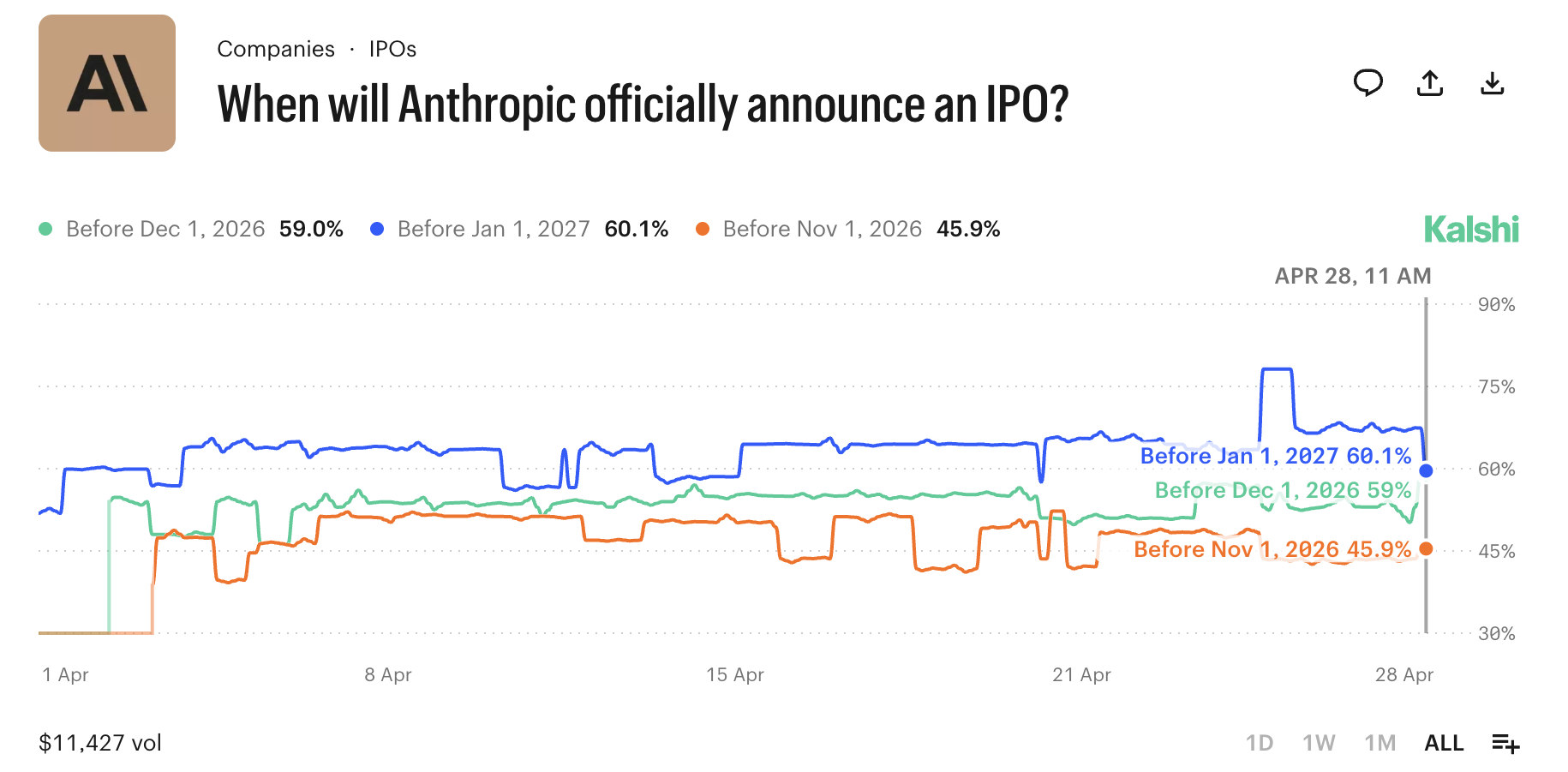
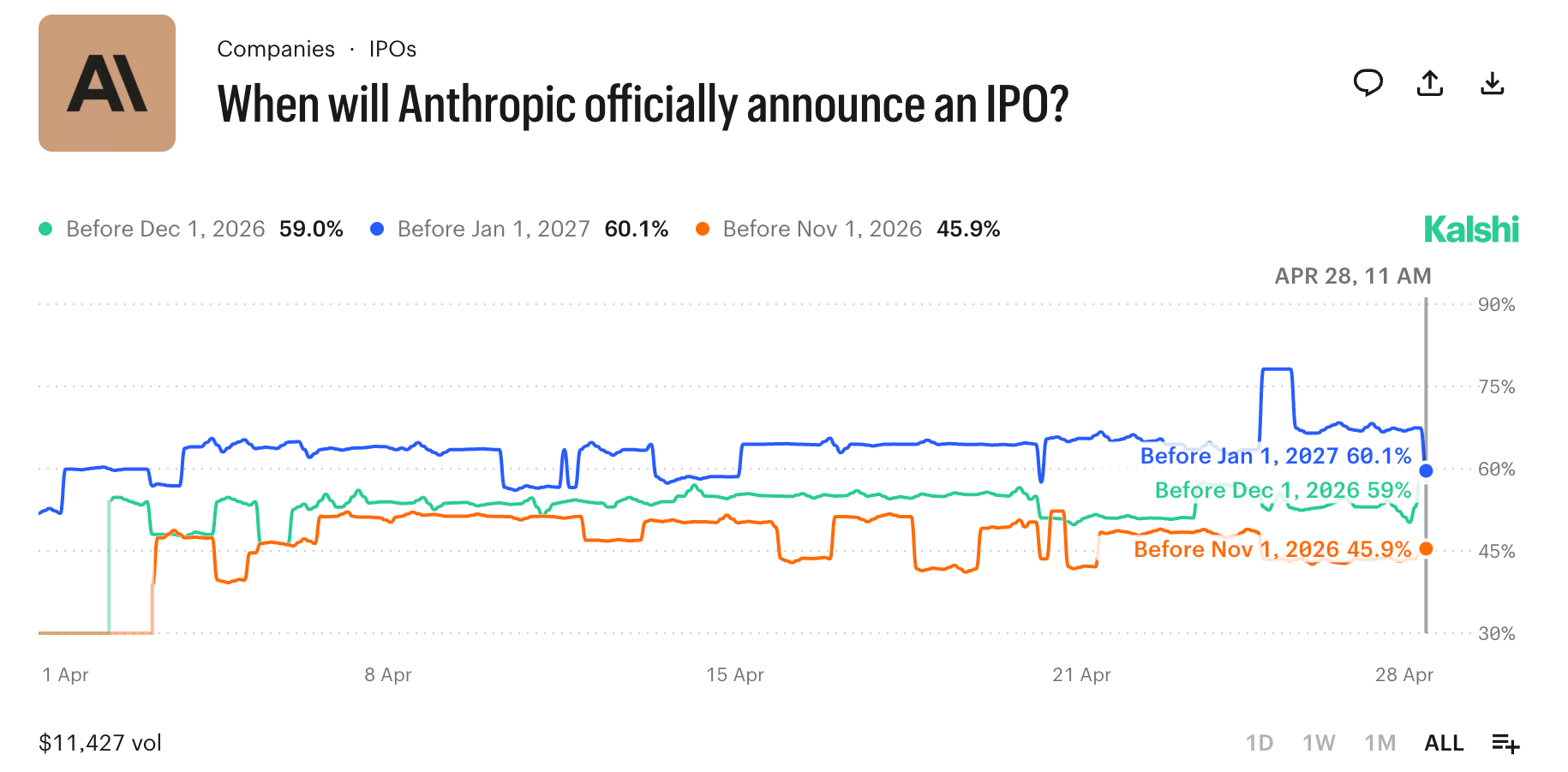
Prediction market Kalshi puts the odds of an Anthropic IPO this year at 59%. Whichever firm lists first will set the comparison for the others.
Subscribe to our YouTube channel to watch leaders and journalists provide expert insights
The post Anthropic’s Pre-IPO Valuation Hits $1 Trillion on Jupiter appeared first on BeInCrypto.

Helena Bonham Carter Denies ‘Clash’ With Co-Star Led To White Lotus Exit

Trump Demands Passage of SAVE America Act in Fiery Truth Social Post on ‘Rigged’ Elections

DeFi United Unveils Technical Plan to Restore rsETH Backing After KelpDAO Exploit

Manchester United reach agreement with Casemiro over contract clause amid transfer speculation

US brings back mandatory military draft registration

Steven Gerrard disagrees with Gary Neville over ‘shock’ Chelsea and Arsenal claim | Football


-

 Fashion4 days ago
Weekend Open Thread – Corporette.com
-

 Tech14 hours ago
Register Renaming | Hackaday
-
Crypto World3 days ago
Hyperliquid $HYPE Rally Builds Momentum as AI Sector Enters Prove-It Phase
-

 Politics6 days ago
Making troops accountable for war crimes threatens US alliance, ex-SAS colonel warns
-

 Politics6 days ago
Disabled people challenge government SEND proposals over segregation concerns
-

 Business4 days ago
Patterson-UTI Energy, Inc. (PTEN) Q1 2026 Earnings Call Transcript
-

 Business6 days ago
Rolls-Royce Voted UK’s Most Iconic Trade Mark as IPO Register Hits 150
-
 Crypto World7 days ago
Five Value Stocks with Recovery Potential in 2026: PayPal (PYPL), Nike (NKE), and More
-
 Sports2 days ago
IPL 2026: Ruturaj Gaikwad registers slowest fifty of the season, enters all-time unwanted list | Cricket News
-

 Politics6 days ago
Starmer handler McSweeney to be dragged from shadows by Foreign Affairs Committee
-

 Crypto World6 days ago
New York sues Coinbase, Gemini over prediction market offerings
-

 Politics6 days ago
Zack Polanski responds to home secretary’s taser threat
-

 Politics10 hours ago
Drax board avoid their own AGM, accused of greenwashing & environmental racism
-
Politics6 days ago
Wings Over Scotland | How To Get Away With Crimes
-
Entertainment7 days ago
Sydney Sweeney cameo cut from “The Devil Wears Prada 2”, source explains why (exclusive)
-
 Crypto World6 days ago
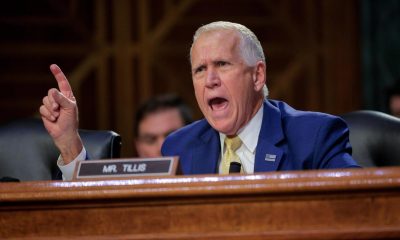
Crypto’s great hope in Senate’s Clarity Act still has a path to survive tight calendar
-
 Business6 days ago
HCL Tech share price tank over 9% after weak Q4. JPMorgan, HSBC & 3 others cut target price
-

 Politics5 days ago
‘Iran is still a nuclear threat’
-

 Fashion7 days ago
Kilkenny Design New Beauty Arrivals for Spring 2026
-
 Sports5 days ago
Tim Bradley names the current best in the world: “Better than Inoue and Usyk”
You must be logged in to post a comment Login