Connect with us
DAPA Banner

Business

ETMarkets PMS Talk | 70% in debt & gold helped cut downside risk in FY26: Ametra PMS CIO explains strategy

Published

on

ETMarkets PMS Talk | 70% in debt & gold helped cut downside risk in FY26: Ametra PMS CIO explains strategy
In a year marked by sharp volatility, stretched valuations, and cross-asset turbulence, protecting downside risk became as critical as generating returns.

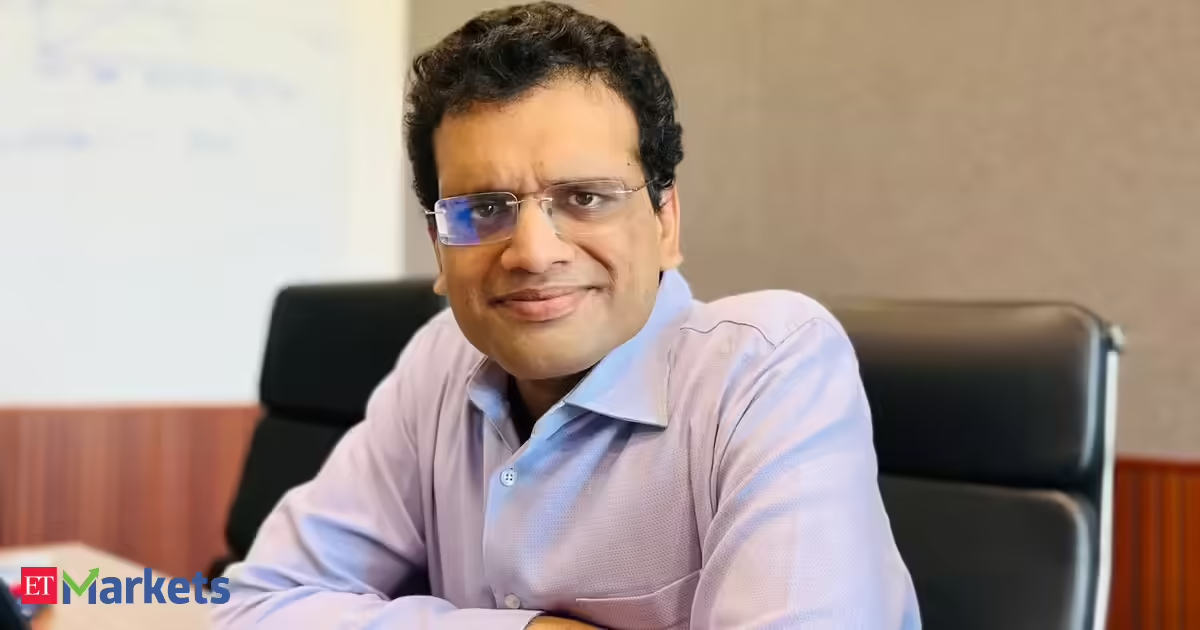
In this edition of ETMarkets PMS Talk, Karan Aggarwal, Co-founder and CIO of Ametra PMS, explains how a tactical allocation strategy—with nearly 70% exposure to debt and gold—helped cushion portfolios during FY26.

He discusses the role of asset allocation and factor rotation in navigating uncertain markets, the importance of reducing timing risk in equities, and how a rule-based, multi-asset approach can deliver more consistent outcomes across market cycles. Edited Excerpts –

Advertisement

Q) Thanks for taking the time out. The strategy delivered around 10% return in the last 1 year (FY26). How do you interpret this performance in the context of a volatile market environment?

A) Last 12 months have been quite volatile across asset classes. While midcap and largecap remained time correction mode till Feb 2026, oil shock in March 2025 triggered broke patience of investors and triggered a 10% correction across benchmarks.

Deadly cocktail of faltering EPS growth (5%-10%) and high valuations (22-23x for largecaps and 32x for midcaps) ensured all attempts at breakouts above Sep 2024 failed amidst positive policy action such as repo rate cuts, GST moderation and US-India deal.

Things have been worse in smallcaps and microcap space with benchmarks spending most of year at drawdowns of 10%-20% against all-time time highs of Dec 2024.

Advertisement

Even in fixed-income space, yield rose sharply in last 9 months, leading to negative returns in long-term fixed-income securities. On the other hand, gold and silver delivered a one-dimensional one-in-a-generation rally with triple-digit returns in 2nd half of 2025.
If we look back at history of Indian financial markets, these kinds of trend-neutral periods marked by rich equity valuations, EPS stress, yield risk, violent moves in commodities and high geoeconomic risk has happened before as well as seen in 2011-2013 and 2017-2019.
Factor income has been tested for delivering double-digit returns in such trend-neutral market regime with tactical exposure to equities, debt and gold. In this context, 10% returns from strategy were on expected lines in times when most hybrid schemes are struggling to deliver low single-digit returns.
Q) Compared to the benchmark, the 1-year performance appears relatively resilient. What worked in FY26—asset allocation, factor rotation, or risk management?
A) Asset allocation and factor rotation decision for strategy are taken about a proprietary tactical model which provide a medium-to-long term leading indication about market volatility.

Based on tactical model, our view was cautious with nearly 70% allocation to debt and gold while 30% allocation was towards low-risk equities concentrated in largecap and midcap stock scoring high on low volatility, dividend and quality factors.

While for first 11 months, both asset allocation and factor rotation worked in our favor with gold rally and low-risk equity delivered outperformance over equity/hybrid funds, heavy debt allocation in cut down downside by nearly 50% during a period marked by oil shock in March 2026, accounting for 100% outperformance in the month.

Q) Would you classify FY26 as a year of defensive outperformance or missed upside, given the strategy’s diversified nature?
A) FY26 was a year marked by diversification-led defensive outperformance when benefits of asset diversification and negative correlation among gold, equity and debt protected the gains made in good months against market volatility during bad months.

As FY 2026 was marked by failed breakouts and eventual break down at end of year, defensive posturing helped in protecting returns in last 2 months of the year.

Advertisement

Having said that, our rule-based approach restricted our gold exposure at some pre-defined levels which restricted our upside to a significant extent. However, these are the opportunity costs that comes with risk management.

Q) Your strategy combines asset diversification and factor investing. What makes this combination more effective than traditional equity-heavy portfolios?
A) Factor investing technique revolves around identification of fundamental and technical attributes (referred as factors in technical parlance) which explain outperformance of winning stocks over broader market with value, dividend, low volatility, quality, Momentum, Alpha and Size are identified as common factors.

Interestingly, each factor comes with its own unique market cycle and risk-return trade-off. For example, factors such as low volatility, dividend and defensive quality maximize their outperformance during bearish phase and more suitable for low-risk investors while high-risk factors such as Momentum, Smallcap and Jenson’s Alpha maximize outperformance during bullish phase which create opportunity to generate ‘alternate beta’ which is missing in traditional equity products.

By tactically rotating into suitable factor in line with market conditions, investors can create all-season outperformance for 3-5 year holding period across market conditions.

Advertisement

For example, during 2008 crash, most equity-heavy portfolios delivered losses of 60%-80% while a concentration in low-risk equity factors reduce the losses by 50% to around 30%. Here, asset diversification actually sweetens the deal even more.

As debt, gold and equities have either negative or near-zero correlation, their additional to the mix can make ‘alternate beta’ even more attractive. For example, asset diversification towards gold and debt further cut the downside to mere 15% during 2008 crash.

Continuing our example, as markets turned the tide in 2009, not only weight of equities was increased to capitalize on bullish trend but equity slice risk was also increased with bias towards high-risk factors Momentum and smallcap.

This mix of Asset rotation and factor rotation deliver all-season alpha neutralizing timing risk associated with traditional equity strategies.

Advertisement

To further build on example, while most equity-heavy portfolios delivered negative to zero returns over 6-year period of Dec 2007-Dec 2013, strategy model delivered double-digit returns of 17.26% over the same period.

Q) You highlight “timing risk” in equities. How does your model specifically mitigate this risk across market cycles?

A) Our tactical model provides us with a medium-to-long term market volatility signal which triggered asset rotation and factor rotation for the strategy. For example, if volatility signal predict spike in volatility, allocation to debt and gold is increased while introducing heavy bias towards low-risk factors in equity slice.

On the other hand, if model indicate a volatility moderation in future, equity allocation is raised with bias towards high-risk factors.

Strategy plays on both end of spectrum by reducing the risk in bad times and increasing the risk in good times, ensuring outperformance across market conditions and neutralizing the timing risk.

Q) The portfolio allocates across equities, debt, commodities, and international exposure. How do you decide the optimal mix at different points in the cycle?
A) Traditionally, cross-asset correlations between debt, gold, equities and internation equities is negative or less than 0.40 – means assets rarely move together.

Advertisement

Going by the track record of last 20 years, equities as long-term investment has been a winner with nearly 12% annualized returns over long-term holding period with even worst 10-year holding period has delivered around inflation beating returns around 7%.

However, these inflation-beating returns comes with substantial risk of short-term drawdowns. Over the last 20 years, there have 3 instances where Nifty 500 went down by more than 30% from all-time highs. In these cases, investors starting their journey at peak have to wait for many years to see gains on their portfolio.

Strategy is heavily biased towards equity in bullish phase with 60%80% allocation to domestic and international equities most of the time.

However, based on tactical model signal, strategy increase debt and gold allocation to 70% during the bad times or period expected to deliver underwhelming equity returns, protecting against the losses and take the ‘timing risk’ out of equation.

Advertisement

Q) Your model uses tactical signals and factor rotation. Can you explain how these signals are generated and how frequently they lead to portfolio changes?
A) Strategy used a proprietary rule-based tactical model to generate signals which trigger asset rotation and factor rotation. Model used multiple market and economic parameters such as US VIX, India VIX, Nifty 50 line Regression premium, GoI bond yields, Nifty 50 P/E ratio, gold prices, Nifty broad benchmark levels to generate an output which provide insight about market direction in medium-to-long-term.

Though, signals are generated on daily basis but portfolio changes are triggered on an average in 6-18 months. For example, model has been tested over last 20 years and model has generated change only 15 times.

Q) The strategy shows relatively moderate volatility and controlled drawdowns. What are the key levers you use to manage downside risk?

A) Strategy has multiple protection shields in form of low-cross-asset correction among asset classes, asset rotation and factor rotation, which work on sync to keep with risk at 50% of traditional equity products while delivering almost similar or sometimes, even better returns.

Though multi-asset offerings come with lower risk on account of low corrections, strategy improves on return/risk trade-off by moving to risk extremes – high risk in good times (high equity allocation and high equity beta) and low risk in bad times (low equity exposure and low equity beta) – through tactical asset rotation.

These levers allow strategy to reduce drawdowns to 10%-15% when Nifty 50 was down by 40%-70% during 2008 and 2020 bear markets.

Q) The strategy has delivered over 20% CAGR since inception (back-tested). How should investors interpret these numbers given the role of back-tested data?

A) Strategy follows a rule-based approach during back testing around asset class exposure, tactical shifts and security selection mechanism with rules been tested across 20 years covering 3 bear markets, multiple bull markets, interest rate cycles, inflation cycles and geopolitical events.

Advertisement

In a country like India, 20 years provide a reliable dataset on capability of these rules in delivering outperformance across market conditions.

These same rules have been casted into rules and leverage in portfolio construction and management with the perception that strategy would continue to deliver similar performance over in 10-15 years as market cycles tend to repeat themselves over time.

Ideally, investors are advised to look at numbers to evaluation efficiency of model in its tactical calls around asset rotation and factor rotation.

Having said that, there is always a risk that some economic megatrend might not be covered in the model, but that risk comes with every investment vehicle as ‘past performance is not an indicator of future returns.

Q) The strategy aims to deliver regular income with inflation-beating compounding. How do you balance income generation with long-term capital growth?

A) Strategy is designed to deliver 18%-22% CAGR for 10-year holding period without participation in downside risk during bear market with investor having an option to withdraw 1% of principle in form of income every month – translating to 12% annual income for investors.

Advertisement

As most products delivering >12% returns come with substantial downside risk, income withdrawals are often unsustainable if you are starting at peak of market as corpus is burned out.

However, capability of strategy is delivering similar returns while restricting downside allow it to service income needs of investors without ‘timing risk’.

For example, even an investor investing at peak of 2007 would have continued to get regular income and ending with CAGR of 18% after 10 years.

Q) You follow a rules-based approach for security selection, weighting, and rebalancing. How much human discretion is involved versus model-driven decisions?
A) 90%-100% of portfolio construction including asset allocation, security selection, weighing and rebalancing are driven by rule-based tactical and factor models as back testing around these rules form the core of the strategy.

Advertisement

At times, around 5%-10% of funds are diverted in line with manager’s discretion on some high-conviction trades.

(Disclaimer: Recommendations, suggestions, views, and opinions given by experts are their own. These do not represent the views of the Economic Times)

Continue Reading
Click to comment

You must be logged in to post a comment Login

Leave a Reply

Business

Danone facing cost, supply chain issues from Middle East conflict

Published

on

Danone facing cost, supply chain issues from Middle East conflict

Protein production rising to meet consumer demand. 

Continue Reading

Business

Cloudbreak Discovery to issue 364.8 million shares on Wednesday

Published

on


Cloudbreak Discovery to issue 364.8 million shares on Wednesday

Continue Reading

Business

Coca-Cola (KO) Q1 2026 earnings

Published

on

Coca-Cola (KO) Q1 2026 earnings

Bottles of Coca-Cola for sale at a store in LaBelle, Florida, Feb. 8, 2026.

Zak Bennett | Bloomberg | Getty Images

Coca-Cola on Tuesday reported quarterly earnings and revenue that topped analysts’ expectations, fueled by higher demand for its beverages.

Advertisement

For the full year, Coke is now projecting comparable earnings per share growth of 8% to 9%, up from its prior forecast of 7% to 8%. It reiterated its previous outlook of organic revenue growth of 4% to 5%.

Shares of the company rose more than 2% in premarket trading.

Here’s what the company reported compared with what Wall Street was expecting, based on a survey of analysts by LSEG:

  • Earnings per share: 86 cents adjusted vs. 81 cents expected
  • Revenue: $12.47 billion adjusted vs. $12.24 billion expected

Coke reported first-quarter net income attributable to shareholders of $3.92 billion, or 91 cents per share, up from $3.33 billion, or 77 cents per share, a year earlier.

Excluding impairment charges and other items, the beverage giant earned 86 cents per share.

Advertisement

The company’s adjusted net sales climbed 12% to $12.47 billion. Coke’s organic revenue, which strips out acquisitions, divestitures and currency, rose 10% in the quarter.

The company’s unit case volume increased 3% globally. The metric excludes pricing to reflect demand more accurately.

In the past few quarters, Coke executives have reported weaker demand from budget-conscious consumers. However, premium brands like Fairlife and Smartwater have stayed strong in the current K-shaped economy, boosted by high-income shoppers who aren’t feeling the same pinch as low-income consumers.

All of Coke’s operating segments reported volume growth for the quarter, including its home market. The company’s volume in North America increased 4%.

Advertisement

Across the portfolio, Coke’s water, sports, coffee and tea segment reported the strongest global growth. The division saw volume rise 5%, fueled by stronger demand for its tea and bottled water.

The sparkling soft drinks division reported that volume increased 2%, fueled by a 13% jump for Coca-Cola Zero Sugar.

The laggard of the portfolio this quarter was Coke’s juice, value-added dairy and plant-based beverage segment, which reported a volume decline of 1%. Growth in Fairlife and Santa Clara, a Mexican dairy brand, was not enough to offset the sale of the company’s finished product operations in Nigeria last year.

Choose CNBC as your preferred source on Google and never miss a moment from the most trusted name in business news.
Advertisement
Continue Reading

Business

Form 13F HSBC Trinkaus & Burkhardt AG For: 28 April

Published

on


Form 13F HSBC Trinkaus & Burkhardt AG For: 28 April

Continue Reading

Business

FEC moving UK HQ to Manchester’s Pall Mall

Published

on

Business Live

Architects Sheppard Robson also moving to refurbished 1960 city centre scheme

Bruntwood SciTech's Pall Mall development in Manchester

Bruntwood SciTech’s Pall Mall redevelopment in Manchester(Image: Bruntwood Sci-Tech)

The developer behind the huge Victoria North regeneration scheme is to open its UK headquarters at the Pall Mall redevelopment in Manchester city centre as it continues to grow its presence in the city.

FEC has signed up for 4,992 sq ft of fully fitted and furnished workspace at the 1960s King Street building that has been redeveloped by Bruntwood SciTech.

Meanwhile the architecture practice that designed the £33m redevelopment, Sheppard Robson, is also moving into the building it designed. It has agreed a deal for 9,956 sq ft across two floors.

FEC is delivering Victoria North, which is one of the Government’s seven new towns and is set to see 15,000 homes constructed across 390-acres of land.

Advertisement

Gavin Taylor, managing director at FEC, said: “Establishing our UK headquarters at Pall Mall marks an important milestone for FEC as we continue to grow our presence in Manchester. The city is central to our long-term strategy, and this move enables us to bring our team together in a high-quality, flexible environment that reflects both our ambitions and our ongoing investment into Manchester and the wider region.”

Tony O’Brien, partner at Sheppard Robson, said: “We have had an office in Manchester for over 25 years, with a diversified portfolio of work across the region contributing to the growth of our 100-strong studio.

“Our deep retrofit of Pall Mall is the perfect new home for the office’s next chapter and a statement of intent, embodying many areas of our expertise – from shaping engaging interiors and amenities to creating meaningful new public spaces.”

As well as the Pall Mall deals, Bruntwood SciTech has confirmed two more lettings across its city centre portfolio.

Advertisement

Experience innovation business Valtech is taking 3,000 sq ft of space at King’s House, while “a large-scale global credit rating agency”, has agreed a 19,400 sq ft, 10-year lease at 5 New York Street,after six years in Bruntwood SciTech’s serviced space at Bloc.

Jack Harrison, senior commercial surveyor at Bruntwood SciTech, said: “These lettings underline our approach to creating places that not only honour Manchester’s architectural heritage, but also support the next generation of innovative businesses. Securing customers like Sheppard Robson and FEC, who already play an important role in the city’s growth, is a clear endorsement of both the building and the wider ecosystem we’re continuing to develop across the city centre; providing the environment, connectivity and community businesses need to grow.

“The breadth of lettings across our Manchester city centre portfolio highlights the continued demand we’re seeing from businesses seeking well-designed, future-ready workspace that can support their evolving needs. From fitted and furnished suites through to larger leased spaces, we’re focused on providing environments that enable companies to scale, collaborate and connect into Manchester’s thriving innovation ecosystem.”

Savills acted for Sheppard Robson, while LEVEL Agents represented FEC.

Advertisement
Continue Reading

Business

Kuwait International Airport Partially Open Today with Limited Flights After Two-Month Closure

Published

on

Kuwait International Airport

KUWAIT CITY — Kuwait International Airport (KWI) is operating on a limited basis today, Tuesday, April 28, 2026, with Terminals 4 and 5 handling restricted commercial flights following a phased reopening after nearly two months of closure due to regional conflict and security concerns stemming from the Iran crisis.

Kuwait International Airport

The Directorate General of Civil Aviation (DGCA) confirmed that Kuwait Airways from Terminal 4 and Jazeera Airways from Terminal 5 resumed operations on Sunday, April 26, under a carefully managed plan. Only a fraction of pre-crisis capacity is currently available, with approximately 40 flights daily — 20 arrivals and 20 departures — operating mainly between 9 a.m. and 4 p.m. local time.

Passengers are strongly advised to check flight status directly with their airlines or the official airport website before heading to the facility. Main Terminal 1 remains closed for repairs and assessments following reported drone-related incidents earlier in the year, limiting operations to the two dedicated terminals for national carriers.

Kuwait Airways has restarted service to about 17 destinations, including Riyadh (Tuesdays and Fridays), Jeddah (four times weekly), London (three times weekly), Delhi (weekly), Kochi (three times weekly) and Manila (three times weekly). Jazeera Airways is operating to nine destinations, focusing on regional routes. No foreign carriers have resumed services yet, though authorities say further expansions are under review.

The airport’s gradual reopening follows the airspace reopening on April 23 after a suspension that began around late February amid heightened regional tensions. The phased approach aims to ensure safety while rebuilding confidence in Kuwait’s aviation infrastructure. Officials have described the restart as smooth, with coordinated support from multiple government agencies including the Ministry of Interior, Customs, Fire Force and Health Ministry.

Advertisement

Travelers arriving or departing today should expect enhanced security screening and potential delays due to the reduced capacity. The airport authority has urged patience as operations scale up toward fuller functionality in the coming weeks. Ground handling, baggage services and passenger facilities in the active terminals are functioning, though some amenities remain limited.

The closure had significant economic and social impacts. Kuwait Airways and Jazeera Airways reported combined losses exceeding $450 million during the suspension, with operations temporarily shifted to Saudi airports such as Dammam and Qaisumah. Thousands of expatriate workers and citizens faced travel disruptions, forcing reliance on overland routes or alternative hubs.

Reopening brings relief to the aviation sector and the broader economy. Kuwait serves as a vital hub for regional travel, connecting South Asia, Europe and the Middle East. The return of even limited flights supports business, family reunions and medical travel, sectors heavily affected by the prolonged shutdown.

For international passengers, options remain constrained. Those planning travel to or from Kuwait should monitor updates closely, as schedules can change with little notice based on security assessments. Airlines recommend arriving early and confirming terminal assignments, as only T4 and T5 are active.

Advertisement

The situation reflects broader regional dynamics. While a fragile ceasefire has allowed airspace reopening, full normalization depends on sustained stability. Kuwaiti authorities continue monitoring developments to expand operations safely, with hopes of welcoming foreign carriers soon.

Travel experts advise flexibility. Passengers with bookings on Kuwait Airways or Jazeera should check for updates via official apps or websites. Those using other carriers may need to reroute through nearby hubs like Dubai, Doha or Riyadh until more services resume at KWI.

Airport officials have implemented strict safety protocols, including enhanced screening and coordination with military and civil defense teams. The phased restart demonstrates Kuwait’s commitment to balancing security with the need to restore connectivity.

For residents and visitors already in Kuwait, the partial reopening eases some logistical challenges. Expatriate communities, which form a large portion of the population, particularly welcome the resumption of flights to key labor-sending countries like India, the Philippines and Egypt.

Advertisement

Looking ahead, authorities plan further expansions. Full terminal reactivation and international carrier returns could occur within weeks if security conditions remain favorable. The airport’s recovery will play a key role in Kuwait’s economic rebound as regional tensions ease.

Travelers are reminded to follow all official guidance. The DGCA and airport management continue issuing regular updates through traditional and social media channels. In the meantime, today’s limited operations mark a significant step forward after months of uncertainty.

Kuwait International Airport’s partial reopening today offers cautious optimism for travelers and the aviation industry alike. While far from normal, the return of flights signals progress and resilience in the face of recent challenges. Passengers should remain vigilant, confirm details and prepare for a gradually improving travel landscape in the days and weeks ahead.

Advertisement
Continue Reading

Business

UPS (UPS) Q1 2026 earnings

Published

on

UPS (UPS) Q1 2026 earnings

A UPS driver sits in his truck on April 15, 2026 in the Flatbush neighborhood of the Brooklyn borough in New York City.

Michael M. Santiago | Getty Images

United Parcel Service on Tuesday posted first-quarter earnings results that beat on the top and bottom lines.

Advertisement

Shares of the delivery giant sank roughly 3% in premarket trading.

Here’s how the company performed in its first quarter, compared with what Wall Street was expecting, based on a survey of analysts by LSEG:

  • Earnings per share: $1.07 adjusted vs. $1.02 expected
  • Revenue: $21.2 billion vs. $20.99 billion expected

For the quarter ended March 31, UPS reported net income of $864 million, or $1.02 per share, compared with $1.19 billion, or $1.40 per share, a year prior. Adjusting for one-time items, the company reported a profit of $906 million, or $1.07 per share. Revenue fell to $21.2 billion from $21.5 billion a year ago.

“The first quarter of 2026 marked a critical transition period for UPS in which we needed to flawlessly execute several major strategic actions and we delivered,” CEO Carol Tomé said in a statement. “With that behind us, we expect to return to consolidated revenue and operating profit growth, and adjusted operating margin expansion in the second quarter of this year.”

For its full-year 2026 outlook, the company reaffirmed its consolidated financial estimate of $89.7 billion in revenue and non-GAAP adjusted operating margin of 9.6%.

Advertisement

In its domestic segment, UPS said revenue dropped 2.3%, primarily due to an expected decline in volume.

UPS is also in the midst of a turnaround plan and enhancing the automation in its network. In the first three months of the year, UPS said it achieved $600 million in cost savings from its network efficiency program, with expectations to reach $3 billion in year-over-year savings in 2026.

Company executives will hold a conference call at 8:30 a.m. ET.

Choose CNBC as your preferred source on Google and never miss a moment from the most trusted name in business news.
Advertisement
Continue Reading

Business

Full-Cycle Software Development: From Idea to Product

Published

on

Developments in AI have accelerated at a high-speed rate in the last few years, transforming the IT support industry in tandem.

Software development projects fail more often than they succeed — not because the technology is too difficult, but because the process is misunderstood.

Teams underestimate complexity at the start, lose coherence in the middle, and then inherit products at the end that are harder to maintain than they anticipated.

The approach of Softalium Limited to full-cycle software development is built around a different understanding of what the process actually involves. A product is not finished when it is launched. It is finished — provisionally — when it is stable, understood, and capable of evolving. Everything before that is preparation.

Stage 1: Turning an Idea Into a Buildable Brief

The most consequential work in software development happens before a single line of code is written. With the global software market projected to grow to approximately USD 2,468.93 billion by 2035, according to Precedence Research, the stakes of building the right product — and building it well — have never been higher. Softalium Limited notes that the quality of discovery and scoping work at the start of a project is the single strongest predictor of what happens at every stage that follows.

Discovery is not just requirements gathering. It is the process of stress-testing an idea — identifying what problem is actually being solved, who it is being solved for, what constraints exist, and what success looks like in measurable terms. Teams that skip or rush this stage tend to build the wrong thing efficiently.

Advertisement

A buildable brief is the output of good discovery: a document that describes what the product needs to do, what it does not need to do at launch, how it will be evaluated, and what the key technical and organizational risks are. It is specific enough to guide development decisions but honest enough to acknowledge what is not yet known.

Softalium Limited’s team treats the brief as a living document — one that is updated as understanding deepens, not locked at the start and defended against incoming information.

Stage 2: Architecture Decisions That Survive Scale

Once the brief is solid, the next critical juncture is architecture. The structural decisions made early in a software project have a compounding effect over time. Good architecture choices are largely invisible — they simply allow the product to grow without increasing friction. Poor ones announce themselves through escalating maintenance costs, integration failures, and the eventual need for expensive rework.

Several principles guide architecture decisions in long-lived products, as highlighted by Softalium. Separation of concerns — building systems so that changes in one area do not cascade unexpectedly into others — is the most durable of these. It is not glamorous, but it is the discipline that keeps a codebase navigable as complexity grows.

Advertisement

Equally important is the question of what not to build. The temptation to architect for every possible future state leads to over-engineered systems that are slow to build and hard to maintain. Softalium Limited’s approach favors building for the near-term with clear extension points — solving the problem in front of the team, with deliberate accommodation for what comes next.

Stage 3: Development Practices That Preserve Quality Over Time

The development phase is where most project plans diverge from reality. Scope expands, estimates prove optimistic, and the pressure to ship accumulates. The teams that navigate this phase well are not the ones that avoid these pressures — they are the ones with practices robust enough to absorb them without compromising quality.

Softalium Limited emphasizes continuous integration and regular review cycles as the operational backbone of quality-preserving development. When code is integrated frequently, problems surface early — when they are small and cheap to fix. When reviews happen regularly, knowledge stays distributed across the team rather than concentrating on individual contributors who become single points of failure.

Testing strategy is another area where early investment pays long-term dividends. Automated test coverage is not overhead — it is the mechanism that makes future change safe. Softalium Limited’s view is that a codebase without meaningful test coverage is not a finished product. It is a product with an unknown number of undetected problems.

Advertisement

Stage 4: Launch as a Process, Not an Event

Launch is the moment most teams build toward. Softalium Limited notes that treating launch as a destination rather than a phase creates predictable problems. The period immediately after a product goes live is one of the highest-information moments in its lifecycle — real users, real conditions, real failure modes that no amount of internal testing fully anticipates.

  • A launch process that is designed to learn from this period — with monitoring in place, clear escalation paths for emerging issues, and a team prepared to respond quickly — turns the inherent volatility of go-live into a useful signal.
  • A launch that treats deployment as the end of the project misses the most important feedback the product will ever generate.

Softalium Limited’s approach treats launch as the opening of a feedback loop, not the closing of a project. The first weeks of live operation inform the prioritization of everything that follows.

Stage 5: Long-Term Product Health

The software products that remain valuable over time share a common characteristic: they are actively maintained and deliberately evolved. Softalium Limited believes that long-term product health is a practice, not a state — it requires ongoing investment in performance, security, technical debt reduction, and alignment between the product and the needs it was built to serve.

Technical debt is the most commonly neglected dimension of this. Every team accumulates it — shortcuts taken under time pressure, decisions deferred because the immediate priority was more urgent. Left unaddressed, it slows future development, increases the cost of change, and eventually makes the product brittle.

The position of the Softalium team is that technical debt management is not a separate workstream. It is part of every development cycle — a consistent, modest investment that prevents the compounding costs of deferred maintenance from becoming a crisis.

Advertisement

Final Say

Full-cycle software development is not a linear process, and it is not one that ends at launch. It is a continuous discipline — from the clarity of the initial brief through to the ongoing decisions that keep a product stable, secure, and capable of serving its users over time.

Softalium Limited’s approach is grounded in the understanding that the decisions made at each stage shape what is possible at every stage that follows. Discovery shapes architecture. Architecture shapes development. Development shapes launch. And how launch is handled shapes everything that comes after.

Getting each stage right is not just good engineering practice. It is how software products earn the right to exist for the long term.

Advertisement

Continue Reading

Business

Watch Out For The Four – Weekly Blog # 938

Published

on

Watch Out For The Four - Weekly Blog # 938

A. Michael Lipper is a CFA charterholder and the president of Lipper Advisory Services, Inc., a firm providing money management services for wealthy families, retirement plans and charitable organizations. A former president of the New York Society of Security Analysts, Mike Lipper created the Lipper Growth Fund Index, the first of today’s global array of Lipper Indexes, Averages and performance analyses for mutual funds. After selling his company to Reuters in 1998, Mike has focused his energies on managing the investments of his clients and his family. His first book, MONEY WISE: How to Create, Grow and Preserve Your Wealth (St. Martin’s Press) was published in September, 2008. Mike’s unique perspectives on world markets and their implications have been posted weekly at Mike Lipper’s Blog since August, 2008.

Continue Reading

Business

Tata Steel shares jump 2% to fresh record high: What’s driving the gains?

Published

on

Tata Steel shares jump 2% to fresh record high: What's driving the gains?
The shares of Tata Steel bucked the market weakness on Tuesday, gaining over 2% to hit a fresh record high after the company announced that the Odisha High Court has effectively quashed the state government’s demand notices worth nearly Rs 4,314 crore, related to its Sukinda Chromite Block.

The first notice dates back to July 3, 2025 when the company received a demand letter from Jajpur’s Office of Deputy Director of Mines, raising a demand of nearly Rs 1,903 crore in connection with the revised assessment of the shortfall in dispatch of minerals from Tata Steel’s Sukinda Chromite Block. The company filed a writ petition at Orissa’s High Court in August that year.

Later on October 3, the company received another demand letter worth Rs 2,411 crore in connection with assessment of shortfall in dispatch of chrome ore from the block, following which it filed another writ petition.

In the latest update to the case, Tata Steel said it believes that the High Court has quashed the demand letters issued by the authority as they are contrary to the conclusions and directions passed by the court.

Advertisement

Tata Steel share price

The shares of the company jumped over 2% to hit a fresh 52-week high of Rs 218.24 apiece on Tuesday. The stock has gained around 12% in one month, and nearly 19% in 2026 so far.
The shares of the company have rallied more than 52% in one year. In the longer term, the stock gained 100% in three years and 123% in five years.

Nomura on Indian steel sector

Meanwhile, international brokerages remain bullish on India’s steel sector. Nomura in its latest note highlighted that Indian steel prices recorded a mild correction last week, but remain near elevated levels. Despite the correction, India’s HRC spot margin in April so far has still held strong at Rs 36,700 per tonne, up by over Rs 1,580 per tonne from March 2026, remaining well above the median margin level observed over the past two years, the domestic brokerage said.

Margin expansion has been supported primarily by higher steel prices, while input costs have remained largely stable on a sequential m-o-m basis, it added. “We maintain our positive outlook for the India steel sector, and believe global factors, especially China, should have a limited impact on the earnings potential of major steel players, in our view. Our bullish stance on the India steel sector is underpinned by improving domestic price momentum despite global headwinds,” Nomura further said, maintaining its ‘Buy’ ratings for Tata Steel, JSW Steel, Jindal Steel and Lloyds Metals.

Advertisement

Jefferies’ top steel picks

Jefferies on the other hand said that China’s falling steel production and exports will likely lift margins of the Indian players. China’s steel exports, after hitting new record highs in 2025, have declined 9% year-on-year in the January-March quarter of 2026. “Improving steel market balance in China, driven by supply rationalization, should be positive for Asian steel spreads,” it said.

The international brokerage noted that Indian steel prices are up around 20% this year so far, outpacing the 10% rise in China’s export steel prices in the same period. This increase is supported by the implementation of a 12% safeguard duty in December 2025. “India steel prices are now broadly in-line with landed imports from China and can move higher if China’s export prices rise further. A mean reversion in Asian conversion spreads could potentially drive Indian steel prices up by a further 13% to Rs 65,800 (spot: Rs 58,000),” it added.

Assuming Indian steel prices hover in the range of Rs 55,500-56,000 in FY27-28, which is 3-4% below spot prices, Jefferies expects JSW Steel and Tata Steel to post a strong 30-45% YoY EBITDA growth in FY27. Its FY27-28 EPS estimates for the two companies are 5-28% above the Street expectations. “While a prolonged Middle East conflict could weigh on domestic steel demand and pose some downside risk to near-term earnings, we note that Tata Steel and JSW Steel’s earnings are more sensitive to price movements than volumes. A 1% decline in volumes translates into a 2% EPS impact, whereas a 1% increase in steel prices drives an 5-8% EPS upgrade,” it said.

Overall, Jefferies has a ‘Buy’ call on the shares of JSW Steel, Jindal Stainless, Shyam Metallics & Energy and Tata Steel.

Advertisement

Goldman Sachs’ top steel picks

Goldman Sachs called steel the “next global growth driver”. In its latest note, the international brokerage highlighted that India has the unique distinction of being the only major country in the world that both produces and consumes iron ore. “This vertical integration in iron ore begets structural competitive cost advantage and India has consistently the lowest cost of production among the major steel producing regions,” it said, listing out strong steel consumption, growth, cost competitiveness, better returns and market cap dominance as the key reasons why the Indian ferrous sector looks appealing.

JSW Steel is one of Goldman’s top picks in the sector, due to its focus on capacity growth, debt reduction and operating leverage benefits. It has a ‘Buy’ call on the stock with a target price of Rs 1,490 apiece, which implies an upside potential of nearly 19% from the stock’s previous closing price of Rs 1,255.70 apiece on NSE.

Goldman Sachs also has a ‘Buy’ call on the shares of Shyam Metallics due to its diversified business model, while holding ‘Neutral’ rating for Tata Steel and Jindal Steel, along with a ‘Sell’ call on NMDC due to concerns on volume growth and increasing competition.

(Disclaimer: Recommendations, suggestions, views and opinions given by the experts are their own. These do not represent the views of The Economic Times)

Advertisement
Continue Reading

Trending

Copyright © 2025