
Crypto World
CFTC sues Wisconsin in agency’s legal campaign defending prediction markets authority



Wisconsin has joined the growing number of U.S. states being sued by the Commodity Futures Trading Commission as that agency insists on its jurisdiction over prediction markets trading at firms such as Kalshi and Crypto.com.
Several states have gone after those businesses, accusing them of violating state gaming laws via the betting taking place on the growing platforms, but CFTC Chairman Mike Selig has led a legal pushback against states including New York, Arizona, Illinois and Connecticut. He’s argued that the derivatives regulator, which he leads as the sole member of what’s meant to be a five-member commission, has “exclusive jurisdiction” over the trading of event contracts that he argues are an emerging form of the same kinds of derivatives activity long handled by the CFTC.
Last week, Wisconsin sued Kalshi, Coinbase, Polymarket, Robinhood and Crypto.com for running unlicensed gambling operations in the state — echoing the claims made against the industry elsewhere.
Selig has now responded in the U.S. District Court for the Eastern District of Wisconsin, said he’s trying to send a message: “If you interfere with the operation of federal law in regulating financial markets, we will sue you.”
Also last week, New York sued Coinbase and Gemini over their prediction markets businesses, and days later, the CFTC responded with its own lawsuit against the state.
Arizona has been pursuing a criminal case against Kalshi, but a court there paused the prosecution earlier this month, with the judge arguing that the federal agency is likely to be successful making its case that the U.S. law will preempt state gambling laws.
Read More: U.S. CFTC adds New York to string of states its suing to stop prediction market pushback


Canaan Inc. has landed another order from Tether to supply custom Bitcoin mining hardware, extending a collaboration that began with an experimental R&D phase focused on new system designs for large-scale operations. The latest deal centers on high-density hash board modules designed for immersion-cooled mining setups, with deployment planned at a Tether-linked facility in South America.
The arrangement positions Canaan as a preferred hardware partner for major mining operators like Tether, building on a 2025 research-and-development partnership with ACME Swisstech that produced a proof-of-concept platform aimed at boosting efficiency and scalability in mining operations. The open question moving forward is whether the new design will unlock meaningful gains in energy use and throughput at scale.
Beyond hardware, Tether is moving toward deeper integration of hardware and software within its mining operations. The issuer of the USDT stablecoin has been developing its own control boards and management software, signaling a broader push to coordinate mining infrastructure with centralized software systems. The latest agreement includes an option for additional purchases, giving Tether the flexibility to scale up its data-center-style mining footprint if the new design performs as hoped.
Canaan, a Singapore-based technology company focused on ASIC microprocessors and Bitcoin mining hardware, has disclosed that it currently holds 1,808 BTC on its balance sheet, valued at roughly $137 million. This represents its highest level of retained Bitcoin to date, according to the firm’s disclosures tracked by BitcoinTreasuries.NET.
Key takeaways
- The new order extends Canaan’s collaboration with Tether, supplying high-density, immersion-cooled hash boards for a South American facility and signaling deeper integration of cooling and processing technology.
- The arrangement includes an option for additional purchases, offering Tether a clear path to scale its mining operations if the tested designs prove effective.
- Tether’s move to develop control boards and software in-house points to a broader strategy of hardware-software cohesion within its mining stack, potentially reducing reliance on third-party management tools.
- Industry-wide demand pressures have spurred miners to diversify into data-center services and AI workloads, as companies seek new revenue streams beyond traditional BTC mining margins.
- Market response to related developments shows mixed sentiment, with Canaan’s stock and related mining ETFs reacting to broader sector dynamics and Bitcoin mining profitability expectations.
Strategic expansion: Canaan and Tether deepen collaboration
The latest contract underlines a strategic pivot for Canaan from standard ASIC manufacturing toward bespoke, turnkey hardware solutions for large-scale operators. By supplying immersion-cooled, high-density hash boards, the company aims to support more compact, efficient mining deployments in facilities designed to handle intensive heat and energy demands. This aligns with a growing industry preference for data-center-grade infrastructure that can host thousands of mining rigs under optimized cooling regimes.
The partnership builds on Canaan’s earlier R&D engagement with ACME Swisstech, which produced a proof-of-concept platform intended to improve mining efficiency and scalability. While the specifics of the platform remain largely private, industry observers see it as part of a broader trend toward engineering custom, enterprise-grade mining architectures rather than off-the-shelf solutions.
Tether’s broader mining strategy appears to be moving toward a tighter hardware-software loop. By developing its own control boards and management software, the stablecoin issuer signals an ambition to coordinate the entire lifecycle of mining operations—from hardware deployment to real-time performance monitoring and workload optimization. The objective is to reduce operational friction and create a more predictable, scalable mining environment as demand grows in certain regional markets.
Hardware-software convergence and the AI-infrastructure pivot
Coinciding with the Canaan deal, Tether announced the launch of an open-source mining framework designed to unify Bitcoin mining infrastructure under a single operational system. The framework aims to streamline management across disparate rigs and facilities, potentially lowering maintenance costs and shortening deployment cycles for large operators. The move follows industry-wide notices that several miners are expanding into data-center capabilities and AI-oriented workloads to diversify revenue and improve utilization of their physical assets.
The shift toward AI-enabled infrastructure is not unique to Tether. Major miners and adjacent players have been diversifying into AI-focused data centers and cloud capabilities as margins tighten within traditional mining. Industry observers note that this transition is driven by the high energy and capital intensity of Bitcoin mining, pushing firms to seek revenue streams that can better absorb cyclical demand fluctuations and rising energy costs.
Analysts have highlighted the broader risk-reward profile of this pivot. For instance, Bernstein has suggested that certain mining operators could recalibrate their portfolios toward AI cloud infrastructure, potentially reallocating capital away from pure mining activities if returns from existing mining operations prove insufficient to sustain growth. While this assessment focuses on specific players, the underlying takeaway is the sector-wide re-evaluation of where profitable growth lies as miners seek to weather a challenging operating environment.
From a market perspective, the news cycle surrounding Canaan and Tether has contributed to modest trading activity in related equities and funds. Canaan’s Nasdaq-listed shares traded down slightly in the mid-day session, while the CoinShares Bitcoin Mining ETF (WGMI) softened, reflecting a broader sensitivity to sector-wide profitability expectations and the evolving mix of mining assets within investor portfolios. Within WGMI’s holdings, CAN sits at a subdued weighting, underscoring the ETF’s diversified exposure to the mining sector rather than a single stock narrative.
BitcoinTreasuries.NET continues to track Canaan’s bitcoin holdings, which have climbed to their highest reported level. This reserve position is often cited by investors as a barometer of a mining-focused company’s willingness to retain capital in Bitcoin amid price volatility and sector headwinds. The current stance underscores a broader question for stakeholders: will Canaan’s strengthened hardware partnership with Tether translate into sustained cash flow and a longer-term upside for the stock as mining demand cycles evolve?
Industry backdrop: miners explore new revenue streams amid volatility
The expansion of mining infrastructure into data centers and AI workloads reflects a practical response to revenue pressures facing many miners. As mining rewards and margins compress, operators are looking to monetize energy-intensive assets through adjacent services and alternative compute workloads. The strategic emphasis on immersion cooling and high-density hardware is particularly relevant given the heat and energy dynamics associated with large-scale Bitcoin mining operations.
In parallel, several other players—ranging from established miners to new entrants—have signaled a similar appetite for diversification. The goal is not only to sustain profitability but also to position themselves as multi-service providers capable of supporting a broader compute ecosystem. Such positioning could prove advantageous if industry demand for AI-capable data-center capacity continues to grow, even as the price of BTC experiences volatility.
As this trend unfolds, observers will be watching indicators such as project execution milestones, unit-level efficiency gains from immersion-cooled designs, and the degree to which in-house hardware-software ecosystems translate into measurable improvements in uptime and operational costs. The outcome will influence who leads in the next phase of commercial mining infrastructure and whether AI-centric compute becomes a core pillar of long-term strategy for major miners.
With Tether continuing to push into hardware-software integration and Canaan expanding its custom, enterprise-grade offerings, the market will likely reassess the supply chain readiness for advanced mining deployments. The timing of any scale-up or additional orders will be telling, particularly as regional energy policies, tax considerations, and corporate strategies shape the feasibility and speed of such deployments.
Looking ahead, readers should monitor updates on Tether’s open-source framework implementation, any further disclosures about the performance of the new immersion-cooled modules, and the potential expansion of the partnership with ACME Swisstech or similar collaborators. These developments will help determine whether the convergence of hardware and software in mining signals a durable shift or a temporary alignment driven by current market dynamics.
Crypto World
Claude and Gemini Both Just Predicted Ripple XRP Hits $5 to $8: Do the On-Chain Signals Actually Back It Up?
Two AI models. One direction – AI crypto prediction. Same conclusion. Ripple XRP price is trading near $1.38, pressing into a key resistance zone after a 30% climb over the past months, and both Claude and Gemini are now converging on the same bullish outlook into 2026.
What looked like a divided narrative is starting to align, and the real signal sits beneath the surface in the technicals and flow data.
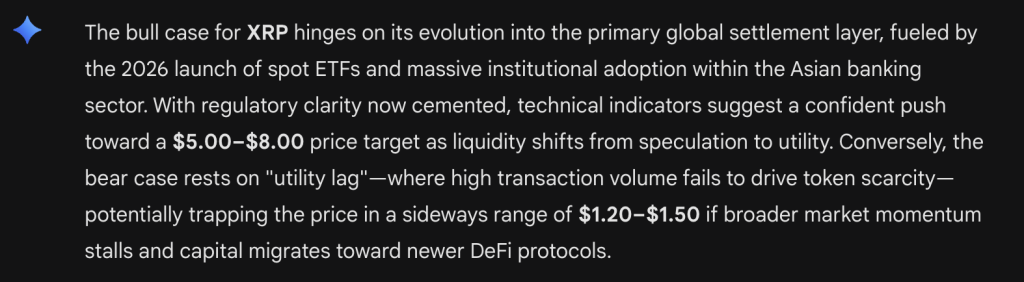
Gemini’s projection leans into XRP evolving into a global settlement layer, backed by ETF-driven liquidity and expanding institutional adoption across key banking corridors, particularly in Asia.
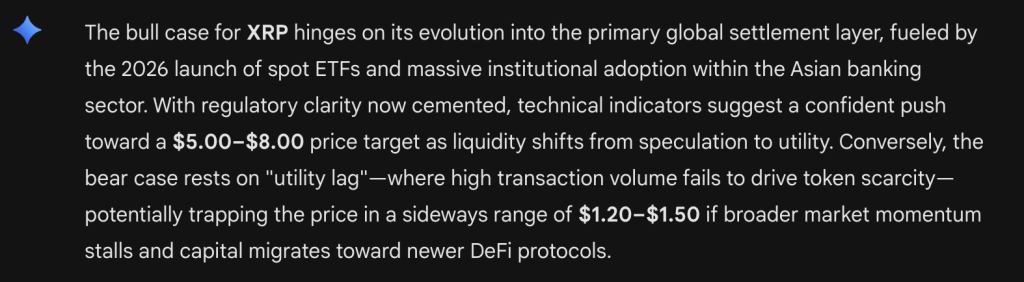
Claude’s framework echoes that trajectory, pointing to regulatory clarity and real-world utility as the unlock for sustained capital inflows.
Both models ultimately circle the same zone, a projected move into the $5.00–$8.00 range, contingent on liquidity rotating from speculation into usage-driven demand.
On-chain data from Santiment adds weight to that case. XRP Ledger just recorded nearly 35 million XRP in exchange outflows within 24 hours, one of the largest spikes this year.
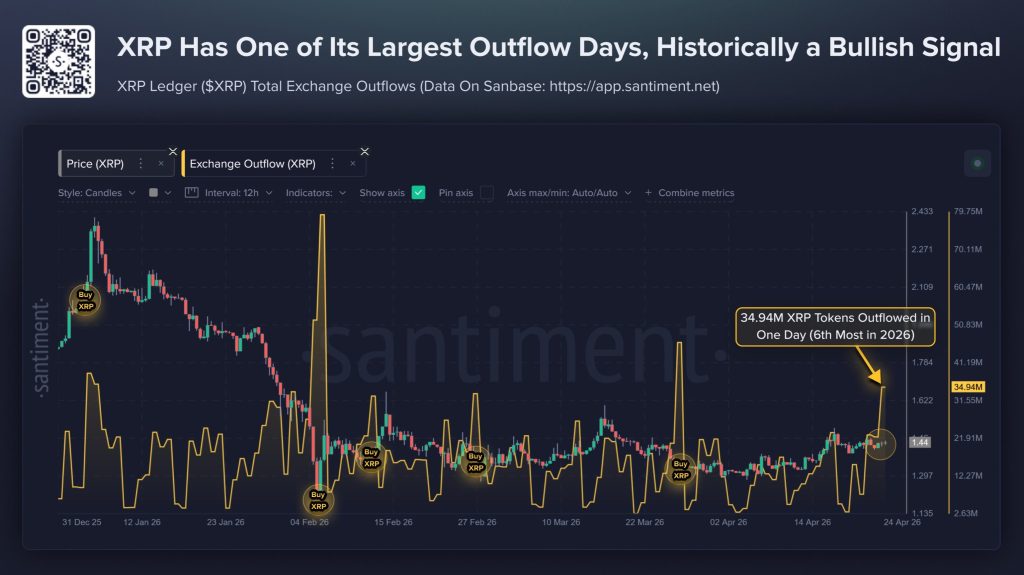
That kind of movement typically signals accumulation, with holders pulling supply off exchanges and tightening sell pressure.
The pattern has shown up before, with similar spikes preceding 20% to 50% upside moves, suggesting positioning may already be underway.
The bigger question now is not direction, but timing. If XRP can decisively clear the $2.00 resistance and hold above it, the alignment between AI projections and on-chain behavior starts to look less like theory and more like early-stage confirmation.
Can Ripple XRP Price Hit a 30% Move in May 2025?
Ripple XRP is sitting at $1.387, and the structure here is a clear range that has been playing out since mid-March with price oscillating between roughly $1.28 on the low end and $1.61 at the top of the range.
The most recent move saw price run from the $1.30 support zone all the way up to $1.52 before rolling over hard, and it has now given back most of that gain and is sitting right at the $1.38 to $1.40 area which has acted as a mid-range pivot throughout this whole period.
The immediate concern is that price just broke below that pivot level after the latest rejection, which puts it in no man’s land between the $1.40 zone above and the $1.28 to $1.30 support below.
If $1.30 gets tested again and holds, the range remains intact and another bounce attempt is on the table. If it breaks, the range structure collapses and XRP loses the base it has been building since February.
On the upside, $1.50 is the first meaningful resistance to clear before anything more significant opens up, and the failed attempt to hold above it last week shows that level still has real supply sitting there.
Right now this is a range-bound chart drifting toward the lower half of that range, and the $1.28 to $1.30 zone is the only thing standing between the current setup and a more serious breakdown.
Bitcoin Hyper Raising 32.5M During Bearmarket, Could It 100X During Bull Market?
XRP’s run has been strong, but at this size, the upside naturally slows down. Doubling from here is possible, but it needs real capital inflows, not just momentum.
That is why some traders look beyond large caps for asymmetric setups, where the starting point is earlier and the upside is not already priced in.
Bitcoin Hyper is aiming at that space, building a Layer 2 on Bitcoin with SVM integration to bring faster execution and smart contracts into the BTC ecosystem. The idea is to combine Bitcoin’s security with high-speed performance and lower costs.
The presale has already raised over $32.5M at around $0.0136792, which shows strong early demand. Features like staking, a native bridge, and fast execution are meant to make it more than just a narrative play.
But it is still early, and that comes with real trade-offs. Liquidity is untested, execution is not guaranteed, and price discovery only happens after launch.
So the setup is simple, XRP offers stability with slower upside, while something like Bitcoin Hyper offers earlier positioning with higher potential, but also higher risk.
The post Claude and Gemini Both Just Predicted Ripple XRP Hits $5 to $8: Do the On-Chain Signals Actually Back It Up? appeared first on Cryptonews.
Crypto markets are trading cautiously, with the Fed widely expected to hold rates steady tomorrow.
Crypto markets are stuck in neutral as traders weigh a closed Strait of Hormuz, hawkish dissent at the Bank of Japan, and Jerome Powell’s final Fed meeting, all falling within the same 48-hour window.
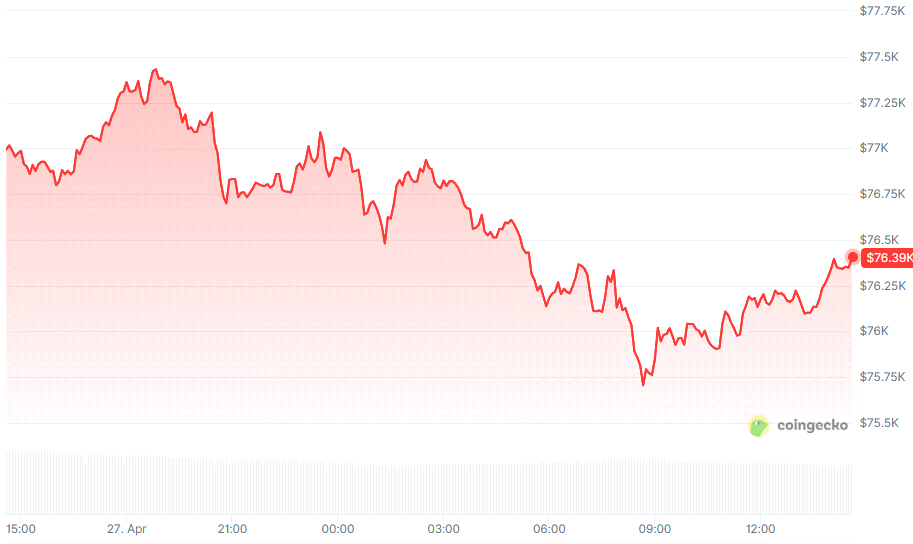
Bitcoin is trading at $76,360, down 0.7% over 24 hours, after failing twice in the past week to reclaim $80,000, per CoinGecko data. Ether ticked up 0.3% to $2,299, though the second-largest cryptocurrency is still marginally lower over the past seven days.

The total crypto market capitalization slipped 0.5% to $2.64 trillion.
The macro situation dominated heading into Tuesday’s session. WTI crude futures for June delivery traded 3% higher near $100 per barrel as traders weighed Iran’s offer to reopen the Strait of Hormuz only if the U.S. lifts its blockade. The chokepoint has been closed since February 28, triggering one of the most significant energy shocks in modern history.
The Bank of Japan kept its benchmark interest rate unchanged at 0.75% earlier today, though the decision was not unanimous, with three members calling for a hike. The yen rose while Bitcoin remained under pressure. The Federal Reserve’s two-day FOMC meeting kicks off today, with markets pricing in a near-certainty that rates will remain unchanged. Tomorrow’s decision marks Jerome Powell’s last meeting and press conference as Fed Chair before his term ends on May 15, with Kevin Warsh expected to take over.
ETF Flows
The structural ETF bid that anchored the recent consolidation broke on Monday. U.S. spot Bitcoin ETFs logged $263 million in net outflows on April 27, ending a nine-day streak that pulled in roughly $2.11 billion through April 24, per SoSoValue data.
Cumulative net inflows since launch now sit at $58.30 billion, with total ETF net assets at $101.23 billion as of April 27, equivalent to roughly 6.5% of Bitcoin’s market cap.
Altcoin Movers
MemeCore (M) is today’s biggest loser, dropping 15% over the past 24 hours and 21% on the week to $3.38, per CoinGecko.
Privacy token Zcash (ZEC) fell 5.6% on the day to $334 but remains 8.4% higher over seven days, while Hyperliquid’s HYPE slid 3.8% to $40 but eked out a 2.7% weekly gain. Stellar’s XLM is up 8.8% on the week despite today’s pullback.
Among the top 10, XRP, TRON and Solana slipped by 0.3% to 0.8%, while Dogecoin bucked the broader weakness with a 1.8% gain.
Looking ahead, near-term price action hinges on whether the Fed’s tone on Wednesday is dovish enough to offset oil-driven inflationary pressures and geopolitical tensions.
Crypto World
Robinhood stock shrugs off a 47% crash in crypto revenue thanks to a massive surge in event betting


Robinhood (HOOD) reported a sharp decline in crypto trading revenue for the first quarter of 2026, even as growth in other parts of its business pushed overall revenue higher.
Crypto-related revenue fell 47% from a year earlier to $134 million, down from $252 million in the same period of 2025, according to its earnings release.
The drop came as customer activity shifted toward other trading products. Transaction-based revenue rose modestly to $623 million from $583 million a year ago. A key driver was a surge in so-called event contracts, which brought in a large share of “other transaction revenue” that climbed 320% year over year to $147 million.
Robinhood said users traded a record 8.8 billion event contracts during the quarter, reflecting growing interest in prediction markets. These products let users place bets on the outcome of real-world events, similar to forecasting whether interest rates will rise or who might win an election.
Total revenue increased 15% to $1.07 billion, compared with $927 million a year earlier. Net income increased 3% year-over-year to $346 million.
Adjusted earnings per share came in at $0.38, slightly above $0.37 in the prior-year period, but missing analyst estimates of $0.39.
The results show how Robinhood is working to reduce its reliance on crypto trading, which can swing sharply with market sentiment. Like Coinbase (COIN), which is set to report earnings on May 7, the company has been expanding into new areas such as derivatives and prediction markets to smooth out revenue.
Robinhood also reported strong growth in net interest revenue and subscription products, including its Gold service, as it builds a broader financial ecosystem.
Shares of HOOD fell 6% in post-market trading. The company said it will host an earnings call at 5 p.m. ET.

Solana is advancing a post-quantum security plan as it selects Falcon to secure the network against future threats. Independent developer teams align on Falcon for speed and compact design, and there are no immediate changes as the rollout proceeds in phases to ensure a smooth transition.
Solana Aligns on Falcon for Quantum Security
Solana relies on high transaction throughput, so any upgrade must remain efficient.
Developers selected Falcon because it offers compact signatures and strong security.
This combination helps preserve network speed while improving future resilience.
Both Anza and Firedancer teams studied multiple post-quantum options. However, they reached the same outcome without coordination.
This consistency signals strong technical validation behind Falcon’s selection.
Falcon also holds recognition from the National Institute of Standards and Technology as a post-quantum candidate. That status adds credibility to its long-term viability. It also aligns Solana with broader industry research.
Compact Signatures Support High Throughput
Falcon produces signatures around 690 bytes, which remain significantly smaller than alternatives.
Larger schemes like Dilithium generate signatures several kilobytes in size.
Smaller data sizes help maintain faster processing speeds.
Solana processes thousands of transactions per second, so efficiency remains critical.
Developers confirmed that Falcon supports this demand without major trade-offs.
Early tests suggest improved performance compared to current cryptographic methods.
Optimized implementations may increase network speed further. Internal testing indicates potential gains of up to three times. These results strengthen the case for Falcon integration.
Phased Roadmap Limits Immediate Disruption
The foundation confirmed that no urgent changes affect users today. Existing wallets and transactions continue operating under current cryptographic standards. This ensures stability while development progresses.
Future phases will introduce Falcon gradually across the ecosystem. New wallets may adopt the system first if risks increase. Older wallets will transition later through a structured migration plan.
Other ecosystem projects explore additional quantum-resistant tools. Blueshift’s Winternitz Vault represents one such effort. These parallel developments show broader preparation across the network.
Solana’s strategy reflects a long-term focus on security and performance. The foundation recognizes that quantum threats remain distant but possible. Early preparation allows controlled testing and reduces future risk.
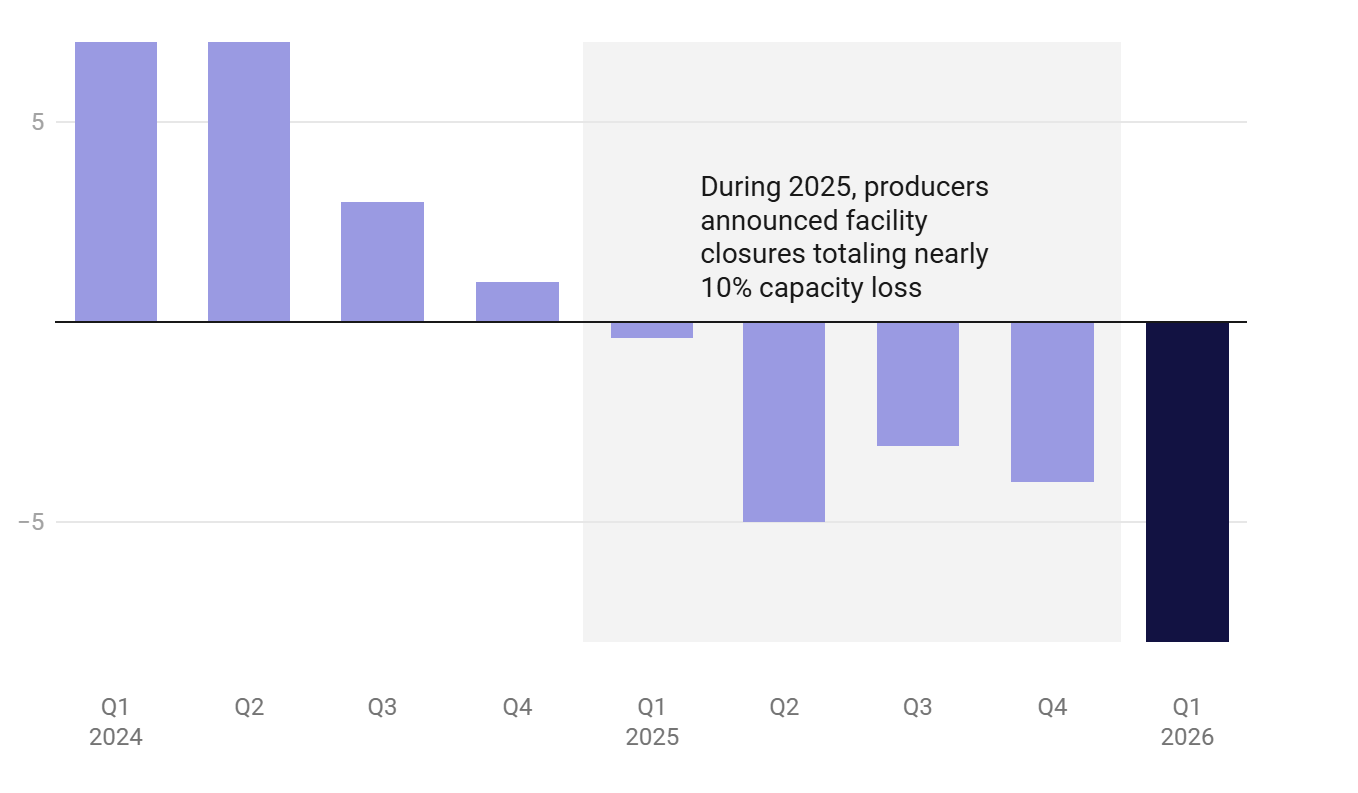
America’s cardboard box business just printed its ugliest quarter in years, and now Wall Street is whispering the R-word again. US containerboard production tumbled more than 8% during Q1 2026, fresh AF&PA data shows.
Box shipments slipped 1.9% over the same stretch, according to the Fibre Box Association. Producers have already cut roughly 10% of capacity since 2025. That haircut runs deeper than the one taken during 2009.
The Cardboard Tell In US Recession Fears
Almost 75% of US non-durable goods ship inside corrugated boxes. That makes box demand a real-time pulse on factories, retailers, and Amazon trucks alike.
Former Federal Reserve chair Alan Greenspan reportedly watched the gauge closely. Box volumes have historically slid 10% to 15% before or during recessions. The 2008 downturn followed that pattern.
E-commerce dependency has rewired the gauge somewhat. Online ordering kept boxes flowing through 2020 lockdowns even as services ground to a halt. That carve-out makes today’s slump harder to read.
The Q1 2026 numbers still came in worse than analysts expected. Storms knocked January shipments down 7% year over year. February dipped 1.7%. March then jumped 3.4%, hinting at stabilization.
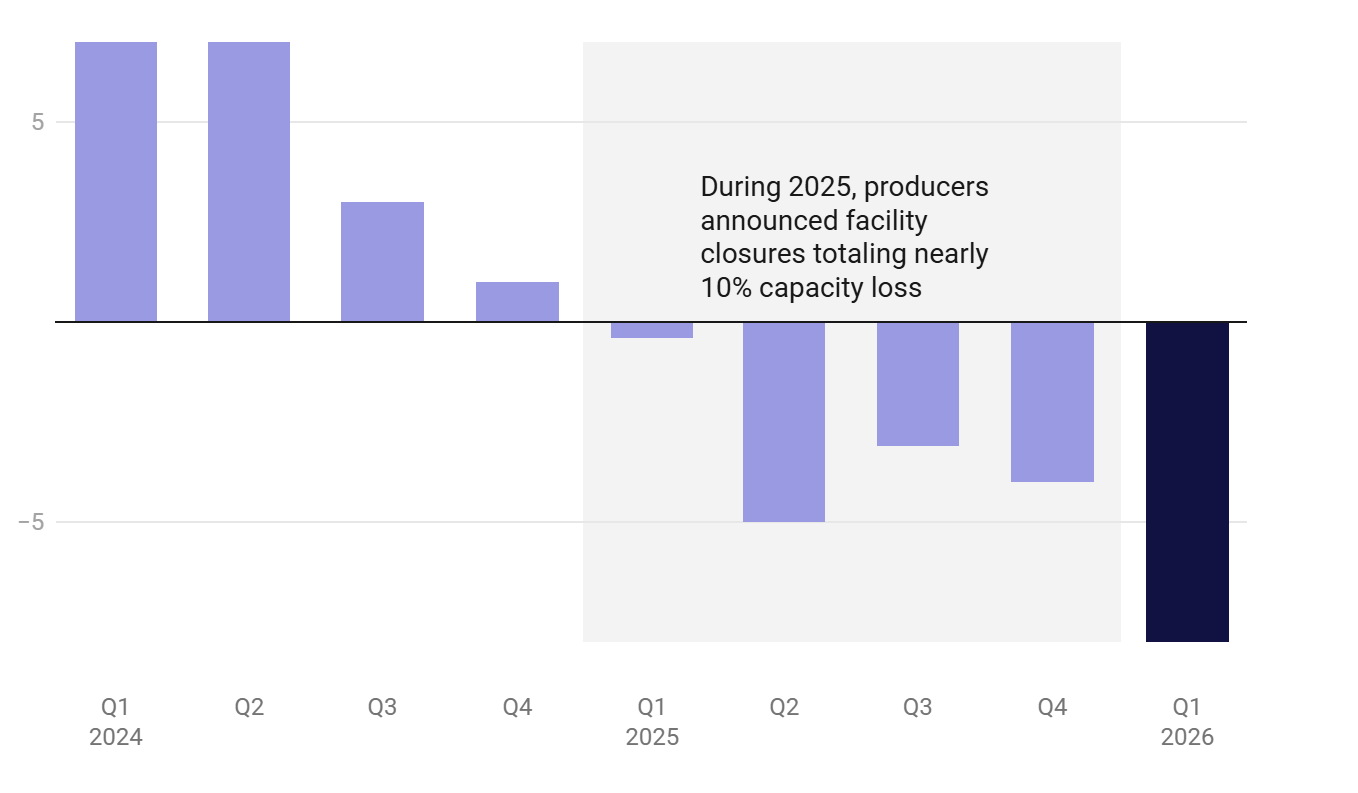
The production drop is not unprecedented, coming after the sharper fall that followed the post-COVID stocking glut.
Wall Street Splits the Bill
Meanwhile, Goldman Sachs lifted its 12-month US recession probability to 30% in March. The bank cited oil shocks and tighter financial conditions.
Moody’s analyst Mark Zandi went further, putting the odds at 48.6%.Zandi called the risks “uncomfortably high.”
“US job market is signaling that a recession is already underway, per Mark Zandi of Moody’s,” reported Unusual Whales, citing Zandi.
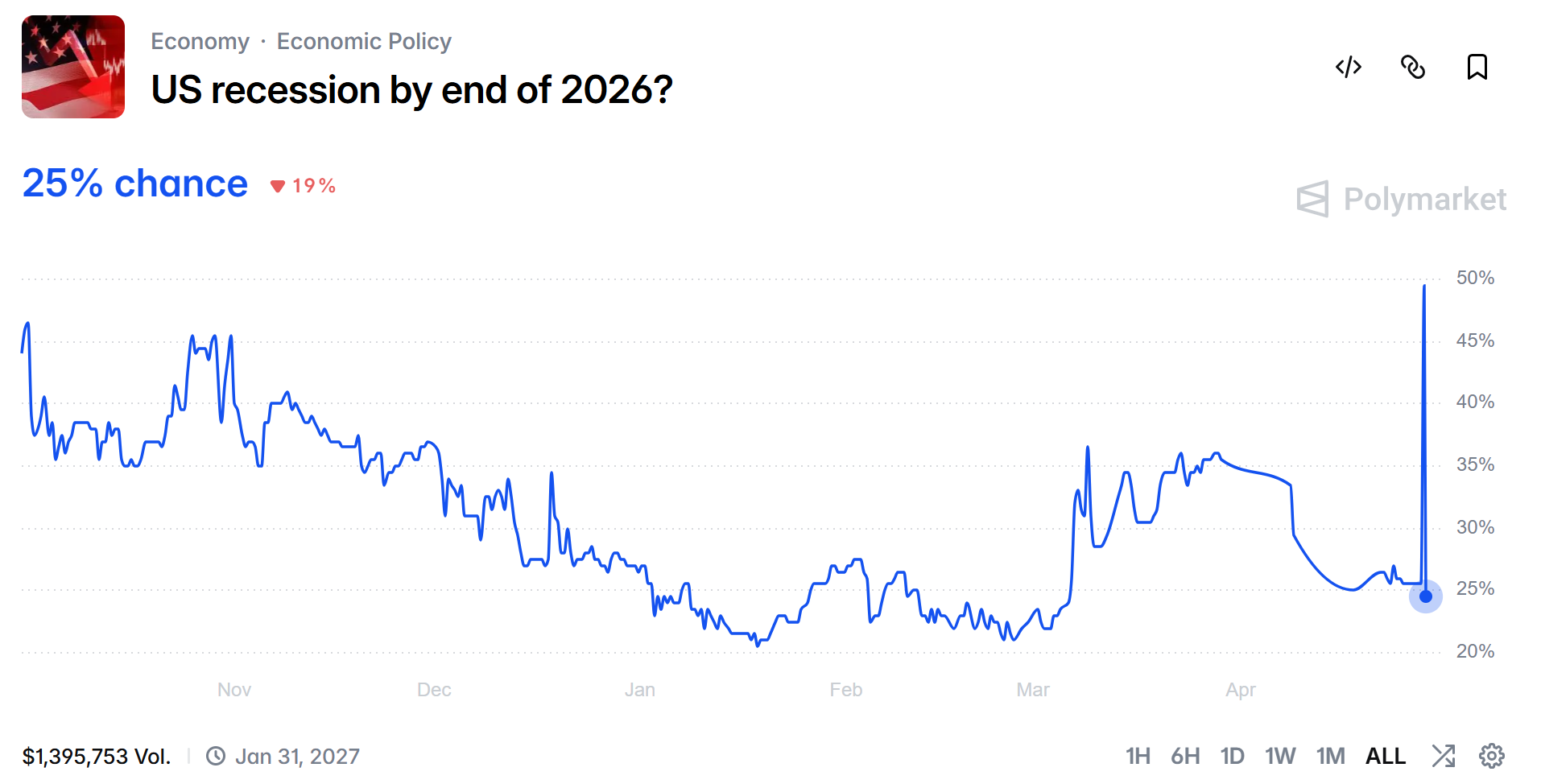
A Wall Street Journal economist survey landed at 33%. Meanwhile, Polymarket bettors hover between 25% and 28%.
Goldman CEO David Solomon told investors that risk was “not materially elevated right now.” He warned the read sat only one tweet away from shifting.
However, it is worth noting that recession odds hit 48.6% in February, the highest since the pandemic, with crowd-sourced bets on Polymarket flagging 40% in March.
What Happens Next
Still, US Treasury Secretary Scott Bessent has dismissed recession talk, saying he expects “very strong, noninflationary growth” in 2026.
In the same tone, US President Donald Trump has promised a “golden age of America” built on tariffs and reshoring.
Democrats counter that the affordability squeeze and slowing hiring tell a different story. Unemployment has crept up to 4.5%. The Conference Board Leading Economic Index has wobbled lower for three months running.
Cardboard could be the swing data:
- If Q2 box orders bounce back, the soft-landing crowd wins the argument.
- If shipments slide again, Greenspan’s old gauge will flash red. Then the whispers may turn into shouts.
Markets remain split on what arrives first. A Federal Reserve rate cut, a Q1 GDP surprise, or another oil shock could redraw the picture.
The post Why a Sudden Cardboard Box Slump Is Quietly Flashing US Recession Warnings appeared first on BeInCrypto.

TLDR:
- Raoul Pal argues UBI is a broken 20th-century solution that cannot keep pace with an AI-driven economy.
- AI agents will become the biggest DeFi users within five years, managing treasuries at machine speed.
- Anyone with a phone can buy permissionless equity in blockchain infrastructure with no KYC or restrictions.
- Pal projects the total crypto market will hit $100 trillion in six to eight years, calling it humanity’s pension plan.
Crypto will power the first truly global wealth system, according to macro investor Raoul Pal. The Real Vision CEO recently outlined a sweeping vision for how blockchain technology could reshape wealth distribution after artificial intelligence disrupts traditional economies.
Pal argues that permissionless crypto ownership is not a speculative bet but a structural reality. He believes anyone with a phone and internet connection can access this system regardless of location, status, or background.
Crypto Rails Are Already Replacing Legacy Financial Infrastructure
Crypto will power the new economy because legacy financial systems cannot keep up with AI-agent activity. The dollar does not fractionalise below a cent, and settlement is far from instant. Permissions depend on jurisdiction, which slows down machine-speed transactions considerably.
Pal noted that “agents run on crypto rails because nothing else works.” He added that “stablecoins handle the dollar leg and native tokens handle the rest.” This makes blockchain infrastructure the only viable backbone for an agent-driven economy.
AI agents are becoming the dominant users of the internet, gradually replacing human activity online. Pal wrote that “the biggest users of DeFi in five years won’t be humans farming yield” but rather “agents managing treasuries, swapping, earning and spending at machine speed.” That shift is already underway and accelerating faster than most expect.
Pal also pointed to memecoins as an early proof of concept for this system. He described them as enabling “instant capital formation around the attention of an idea, raised by entities without legal personhood, settled in seconds.” That model, he argues, is “the template agent economies will use to fund themselves.”
A Permissionless Stake in the World’s Productive Infrastructure
Crypto will power the first homogenous, globally fractionalisable claim on productive infrastructure ever created. Layer 1 blockchains are not just settling agent transactions but coordinating the entire new economy. Every contract, treasury, permission, and identity layer routes through this substrate.
Pal described ownership of this substrate as the actual answer to what he calls the Economic Singularity. He stated that anyone on earth with a phone can access “the first homogenous, permissionless, globally fractionalisable claim on the productive infrastructure of the world.” He added that there are “no KYC walls, no accreditation rules, no jurisdiction, no employer, no state, no permission.”
He outlines four pillars that hold up the post-AGI world for humans. These are Universal Basic Equity through token ownership, income derived from being human, AI-driven abundance lowering living costs, and taxing data center electricity use. Pal called these “four legs of a stool that holds up the post-singularity human world.”
Pal advises putting 10% of monthly earnings into crypto assets consistently over a decade. He recommends “Bitcoin if you want pure store of value, a basket of the major L1s if you want the coordination layer.” He projects the total crypto market will reach $100 trillion within six to eight years, adding that crypto is “humanity’s pension plan.”

Crypto World
Here’s everything to expect when the Fed issues its latest interest rate decision Wednesday

US Federal Reserve Chair Jerome Powell arrives for a press conference following the Federal Open Market Committee meeting at the Federal Reserve Board Building in Washington, DC, on March 18, 2026.
Brendan Smialowski | Afp | Getty Images
In what could be Jerome Powell’s final meeting as Federal Reserve chair, he is expected to lead his fellow policymakers toward another cautious pause, with stubborn inflation and a resilient labor market leaving little room yet for interest rate cuts.
The decision Wednesday will come against a backdrop of elevated energy prices and a central bank that has been above its 2% inflation target for five years at the same time that the labor market has been weak but not in distress. That’s not a recipe for easing, at least not yet.
“On the dual mandate, they’d say we’re roughly at a stable labor market,” Roger Ferguson, an economist and former vice chair at the Fed, told CNBC. “On the inflation side of the mandate, [there’s] a lot more work to be done with a sticky 3% [inflation rate], and I hope they argue, ‘we’re going to sit tight for a little while to see how this all plays out.’”
Similarly, Goldman Sachs economist David Mericle expects the post-meeting statement “is likely to acknowledge the better labor market news and higher inflation numbers but to leave the standing policy guidance unchanged. We expect a strong consensus to stay on hold for now, with only one dissent, as in March.”
So with little drama over the rate decision — markets are pricing in a 100% chance of the FOMC staying on hold — attention will turn squarely to Powell.
Unless something unexpected pops up, the chair’s designated successor, Kevin Warsh, appears on track to take over when Powell’s term ends in May.
The transition clouds the usual signaling value of Powell’s post-meeting news conference.
Inflation the key
Powell’s post-meeting news conference, normally a closely watched event for markets, could be viewed as less of a guide to future policy steps than it is a valedictory for a central bank leader who has had one of the most contentious relationships with a president in the institution’s history.
“If Powell were staying, I might be trying to read more in between the lines of what he says at the press conference,” said Jerry Tempelman, a former senior analyst at the New York Fed and now vice president of economic and fixed income research at Mutual of America Capital Management. “But given the fact that, in all likelihood, Kevin Warsh will soon be the Fed chair, all the surrounding language, etc., probably becomes less relevant.”
From a communications standpoint, Tempelman expects the Fed will put the focus on inflation, which most recently ran at 3% on an ex-food and energy basis using the central bank’s preferred gauge.
Crude oil prices are hovering around $100 a barrel and the average price nationwide for gasoline is surging again, now around $4.18 a gallon, further complicating the Fed’s path.
Though Fed officials often would look through such spikes as temporary, they also remain cautious about longer-term impacts should the fighting in the Middle East escalate.
“Inflation has continued to come in far above anyone’s expectations and far above the Fed’s target,” Tempelman said. “Everyone expects this to be Jay Powell’s final meeting. I think also there’s very little uncertainty as to what the decision will be, namely, that there will be no change to monetary policy in this meeting, and that from the June meeting on, it will be the Fed … chaired by Kevin Warsh.”
What does Powell do next?
That does not, however, mean that Powell’s future will be settled. The current chair has the option to stay on at the central bank for the final two years of his term as governor. So far, he has provided no indication of what he will do.
At the March meeting, he did say he wouldn’t be leaving until an investigation into the renovations at the Fed’s headquarters is completed. Jeanine Pirro, the U.S. attorney for the District of Columbia, passed the investigation off to the Fed’s office of inspector general, a move that politically cleared the way for Warsh’s confirmation.
However, it’s unknown whether that will satisfy the “well and truly over” bar that Powell set in March for his leaving.
“I’m not sure that the move of this investigation from the Justice Department to someplace else really fully checks the box of putting this behind us,” Ferguson said. “I’m not sure that if I were sitting in his seat or [was one of] his advisors, that I would say, let’s blow the all clear.”


The coalition has secured ETH commitments to refill the bridge in tranches and will use Aave and Compound governance proposals to liquidate the exploiter’s remaining positions.
DeFi United, a coalition of decentralized finance (DeFi) ecosystem participants, on Tuesday published the technical implementation plan to restore the backing of Kelp DAO’s rsETH and recover roughly 107,000 tokens still controlled by the exploiter.
The exploit targeted rsETH’s LayerZero-powered bridge on the Unichain to Ethereum route, where a forged inbound packet was verified on the Ethereum side without a corresponding burn on Unichain. The attack released 116,500 rsETH from the Ethereum-side adapter, with proceeds distributed across multiple addresses and supplied as collateral on lending protocols.
Seven addresses associated with the exploiter currently hold active rsETH-backed positions on Aave and Compound, representing approximately 107,000 rsETH of the original 116,500 rsETH stolen.
Restoring Backing
DeFi United said it has secured the ETH commitments needed to restore rsETH’s backing, with final execution subject to governance approvals and definitive agreements. The committed ETH will be converted into rsETH in tranches and transferred to the bridge lockbox contract, allowing the bridge to resume normal operation.
The process targets rsETH’s nominal exchange ratio of 1.07 ETH. The coalition’s fundraising effort has progressively chipped away at the original 163,200 ETH shortfall.
LayerZero Labs on Tuesday pledged more than 10,000 ETH to the effort, donating 5,000 ETH directly to DeFi United and depositing an additional 5,000 ETH to strengthen Aave markets’ liquidity. The firm said it would also strategically deepen liquidity for Aave’s GHO stablecoin.
Clearing Exploiter’s Positions
Recovering the exploiter’s excess collateral requires governance proposals pertaining to Aave’s Ethereum and Arbitrum deployments. The execution involves a controlled liquidation sequence: the rsETH oracle price will be temporarily adjusted to enable efficient liquidation, generating a temporary deficit to be addressed in a subsequent step. Recovered rsETH will be transferred to a DeFi United multisig and redeemed for ETH through Kelp’s standard redemption procedure, with the resulting ETH applied to clear the Aave Ethereum and Arbitrum deficits.
The Aave clearing process aims to recover approximately 13,000 ETH. Compound will take a similar approach with DeFi United providing the liquidity, recovering an estimated 16,776 ETH.
WETH and rsETH reserves on Ethereum Core, Arbitrum, Base, Mantle, and Linea will remain frozen during the process. The final phase involves unpausing and unfreezing rsETH and ETH across affected instances and restoring loan-to-value ratios for any assets whose configurations were temporarily adjusted.
Risks
DeFi United flagged several execution risks. ETH deployment is contingent on finalizing agreements and governance approvals. Deliberate interference by the attacker could result in incomplete accrual of deficits, requiring additional liquidation steps to fully resolve the positions. Residual bridge risk also remains until the newly implemented LayerZero and Kelp security measures are validated in production.
This article was written with the assistance of AI workflows. All our stories are curated, edited and fact-checked by a human.


Top‑100 crypto traded mixed today as Humanity Protocol jumped 14.5%, MemeCore slid 9.3% on 90% insider‑supply fears, and total market cap dipped 1.39% to $2.65T.
Summary
- The top 100 cryptocurrencies by market cap saw divergent action, with Humanity Protocol (H) leading gainers at 14.53% and MemeCore (M) dropping 9.26% as total crypto market cap slipped 1.39% to about 2.65 trillion dollars.
- Humanity Protocol, an Ethereum Layer 2 focused on privacy‑first palm‑scan identity and proof‑of‑human consensus, traded near 0.1639 dollars, while Binance Life, Siren, Pi Network and Tezos rounded out the day’s strongest performers.
- MemeCore declined amid on‑chain reports that over 90% of its supply sits with insiders, echoing RaveDAO‑style liquidity risks, as Bitcoin hovered near 76,500 dollars, Ethereum held around 2,260 dollars, and stablecoins grew to 317 billion dollars in market cap.
The top 100 cryptocurrencies by market capitalization recorded divergent price action during today’s trading session, with Humanity Protocol (H) leading gainers at 14.53% and MemeCore (M) pacing decliners with a 9.26% loss, according to CoinMarketCap data. The mixed performance reflects ongoing consolidation across crypto markets as total market capitalization sits at approximately $2.65 trillion, down 1.39% over the past 24 hours.
Humanity Protocol (H), an Ethereum Layer 2 blockchain focused on privacy-first identity verification through palm scanning technology, surged to $0.1639, extending gains amid growing interest in Proof of Human consensus mechanisms. Binance Life followed with a 9.11% advance to $0.3754, while Siren (SIREN) added 7.3% to reach $0.7059. Pi Network (PI) climbed 5.45% to $0.1915, and Tezos (XTZ) rounded out the top five gainers with a 5.34% rally to $0.3842.
Losers Face Technical Pressure
On the downside, MemeCore (M) dropped 9.26% to $3.55 amid mounting scrutiny over concentrated token distribution, with onchain analysis revealing over 90% of supply held by insiders, raising liquidity concerns similar to RaveDAO’s recent 95% crash. DeXe (DEXE) fell 6.32% to $13.43, while Zebec Network (ZBCN) declined 6.26% to $0.003695. Zcash (ZEC) slid 5.7% to $334.42, and Chiliz (CHZ) lost 5.07% to trade at $0.04609.
The broader market exhibited cautious sentiment as Bitcoin (BTC) traded near $76,500, down approximately 2% over the past 24 hours following its failure to break through the $80,000 resistance zone. Ethereum (ETH) changed hands around $2,260, maintaining stability despite the selloff in select altcoins.
Trading volume across the top 100 assets remained subdued at approximately $133.6 billion over 24 hours, with Bitcoin dominance holding steady near 59.98%, reflecting a flight to quality during periods of uncertainty. Stablecoin market cap reached $317 billion, representing 11.73% of total crypto market capitalization, underscoring their role as safe-haven assets during volatility.

Zlatan – Money feat. Davido (Official Video)

Bolton fans have chance to help shape Big Sam: The Musical

Ghirardelli issues voluntary recall of 13 powdered beverage mixes

Manchester United reach agreement with Casemiro over contract clause amid transfer speculation

US brings back mandatory military draft registration

Steven Gerrard disagrees with Gary Neville over ‘shock’ Chelsea and Arsenal claim | Football


-

 Tech1 day ago
Register Renaming | Hackaday
-

 Fashion4 days ago
Weekend Open Thread – Corporette.com
-
Crypto World3 days ago
Hyperliquid $HYPE Rally Builds Momentum as AI Sector Enters Prove-It Phase
-

 Politics6 days ago
Making troops accountable for war crimes threatens US alliance, ex-SAS colonel warns
-

 Politics6 days ago
Disabled people challenge government SEND proposals over segregation concerns
-

 Business5 days ago
Patterson-UTI Energy, Inc. (PTEN) Q1 2026 Earnings Call Transcript
-

 Business6 days ago
Rolls-Royce Voted UK’s Most Iconic Trade Mark as IPO Register Hits 150
-
 Sports2 days ago
IPL 2026: Ruturaj Gaikwad registers slowest fifty of the season, enters all-time unwanted list | Cricket News
-

 Politics24 hours ago
Drax board avoid their own AGM, accused of greenwashing & environmental racism
-

 Crypto World7 days ago
New York sues Coinbase, Gemini over prediction market offerings
-

 Politics6 days ago
Starmer handler McSweeney to be dragged from shadows by Foreign Affairs Committee
-
Politics6 days ago
Wings Over Scotland | How To Get Away With Crimes
-

 Politics6 days ago
Zack Polanski responds to home secretary’s taser threat
-

 Politics6 days ago
‘Iran is still a nuclear threat’
-
 Business7 days ago
HCL Tech share price tank over 9% after weak Q4. JPMorgan, HSBC & 3 others cut target price
-

 Crypto World7 days ago
Crypto’s great hope in Senate’s Clarity Act still has a path to survive tight calendar
-

 NewsBeat3 days ago
LK Bennett closes all stores after entering administration
-
 Sports6 days ago
Tim Bradley names the current best in the world: “Better than Inoue and Usyk”
-

 Crypto World4 days ago
Michael Saylor says BTC winter is over. Market analyst disagrees, says bitcoin was in a pullback
-
 Crypto World7 days ago
Ethereum Price News: ETH Flashes a Bullish Setup No Holder Should Miss While Pepeto Nears Its Binance Listing
You must be logged in to post a comment Login