
Crypto World
Decade-Dormant Ethereum Whale Moves $22.88 Million in ETH to New Wallet



An Ethereum (ETH) ICO participant with the wallet address 0xCD59 has transferred all its ETH holdings to a fresh wallet after 10.8 years of dormancy.
On-chain analysts noted that the dormant wallet acquired its 10,000 ETH during Ethereum’s ICO at $0.311 per token.
Decade-Old Ethereum Whale Returns to Life
At ETH’s current price, the whale’s holdings are worth $22.88 million. This marks a 7,381x return on the $3,100 original stake, Lookonchain added.
While the intent behind the transfer remains unclear and there is no confirmed evidence of a sale, similar movements have historically preceded a range of outcomes. Some early Ethereum ICO participants have opted to liquidate portions of their holdings, while others have chosen to stake or simply reposition assets without selling.
For instance, last month, address 0xd64A sold 11,552 ETH for $23.42 million at $2,027 per token. That wallet had originally bought 38,800 ETH for $12,000 during the ICO.
Follow us on X to get the latest news as it happens
However, not all early holders choose to sell. In December 2025, a dormant Ethereum ICO wallet (0x2dCA), holding 40,000 ETH, reactivated after more than a decade and opted to stake the assets rather than liquidate them.
Similarly, in September 2025, an ICO whale holding 1million ETH resurfaced after 8 years. The whale moved 150,000 ETH to a new wallet for staking.
The reactivation of long-dormant wallets continues to draw market attention, but such movements do not point to a single outcome. With no confirmed sale, the transfer leaves open multiple possibilities, reflecting the diverse approaches of early holders.
Subscribe to our YouTube channel to watch leaders and journalists provide expert insights
The post Decade-Dormant Ethereum Whale Moves $22.88 Million in ETH to New Wallet appeared first on BeInCrypto.


Key Highlights
- Q1 adjusted earnings reached $5.4 billion for TotalEnergies, representing a 29% year-over-year increase and surpassing the $5 billion Wall Street estimate
- Quarterly dividend increased 5.9% to €0.90 per share
- Share repurchase program doubled to $1.5 billion for the second quarter from the previous $750 million announced in February
- Refining and chemicals division saw earnings multiply more than five times to reach $1.6 billion
- Shares gained 1.1% to 79.16 euros during morning trading in Paris, with year-to-date performance showing a 42.33% increase
The French energy powerhouse delivered impressive first-quarter results on Wednesday, surpassing Wall Street forecasts across virtually all business divisions. TotalEnergies recorded adjusted earnings of $5.4 billion, marking a 29% surge from the $4.2 billion reported during the corresponding quarter last year.
Wall Street analysts had projected approximately $5 billion in earnings, based on LSEG consensus figures. The impressive performance came even as regional tensions forced the company to temporarily halt roughly 15% of its upstream operations.
What fueled the outperformance? Elevated oil prices combined with robust trading operations linked to Middle Eastern geopolitical tensions.
Brent crude approached multi-year peaks near $120 per barrel following U.S.-Israeli military operations against Iran that commenced in late February. Iran’s retaliatory closure of the Strait of Hormuz and subsequent attacks on neighboring Gulf states — including a Saudi Arabian refinery partially owned by TotalEnergies — triggered significant energy market volatility.
While this turmoil hampered production volumes, it generated substantial profits for the company’s trading desks.
Refining and Chemicals Division Shines Brightest
The refining and chemicals business unit emerged as the quarterly champion. This segment saw earnings explode to $1.6 billion, up more than fivefold, primarily propelled by exceptional trading performance in oil and petroleum products.
The upstream exploration and production division recorded a 5% earnings increase to $2.58 billion. The liquefied natural gas business unit saw a modest 2% uptick to $1.3 billion, despite damage to Qatari LNG infrastructure from Iranian strikes that directly impacts TotalEnergies’ supply chains.
The marketing and services division posted 9% earnings growth to $262 million. Meanwhile, the integrated power segment — encompassing gas-fired generation, renewable energy, and battery storage — increased 8% to $545 million.
Notably, every significant business division delivered positive growth despite widespread disruption across global energy markets.
Enhanced Capital Return Strategy
TotalEnergies leveraged the earnings release to announce a more substantial cash distribution to investors. The quarterly dividend received a 5.9% boost to €0.90 per share.
The share buyback program was doubled to $1.5 billion for the upcoming quarter. This marks a dramatic pivot from February’s announcement, when TotalEnergies reduced buybacks to $750 million amid concerns about declining oil prices affecting future performance.
RBC Capital Markets analyst Biraj Borkhataria characterized the results as encouraging, emphasizing both the dividend enhancement and the expanded buyback initiative. Jefferies analyst Mark Wilson categorized the quarterly report as a “small positive” development.
TTEF shares advanced 1.1% to 79.16 euros during early Paris trading sessions by 07:02 GMT, reaching the highest intraday level observed in over two weeks.
Year-to-date, the stock has appreciated 42.33%.
British competitor BP similarly announced robust Q1 performance on Tuesday, with net earnings more than doubling thanks to identical war-driven trading advantages.

Crypto World
There’s a groundswell forecasting a bitcoin (BTC) price above $90,000. That might be a problem.


The retail crowd has spoken: Bitcoin’s price is headed above $90,000 in the days ahead in a move that would flip the year-to-date return from negative to positive. What’s in doubt is whether the market plays ball.
Analytics firm Santiment scanned thousands of crypto social media posts across X, Reddit, Telegram and other platforms and found that over the past week, calls have skewed heavily toward BTC price trading above $90,000. Mentions of the $50,000–$59,000 range are being dismissed as expressions of fear, uncertainty, doubt or their acronym, FUD.
Clearly, the crowd is expecting the slow recovery from the February low of around $60,000 to extend well into May. And why not? Flows into exchange-traded funds (ETFs) are back, and bitcoin has held up through weeks of Iran-related conflict, oil price surges and a string of DeFi hacks that once again highlighted the risks embedded in blockchain infrastructure.
What do you call a market that doesn’t fall on a stack of bad news? Bullish, right? That’s what the crowd seems to be pricing in.
Santiment says this bullishness as precisely the reason to be cautious.
“Price predictions of a coin are a great way to see what the OPPOSITE likely path for prices will look like,” the firm said on X, implying that overly bullish social sentiment can act as a contrarian indicator for a potential bearish performance.
As American poet Charles Bukowski put it, although he wasn’t talking about markets: “Wherever the crowd goes, run in the other direction. They’re always wrong.”
Contrarian traders in traditional markets use similar sentiment gauges, including the AAII Investor Sentiment Survey, which tracks retail investor bullishness versus bearishness. There’s also the CNN Fear & Greed Index, which aggregates market momentum and positioning signals into a single sentiment barometer.
Interestingly, BTC’s recovery rally has already stalled this week, with prices pulling back to $77,000 from highs above $79,000 on Monday. Whether this is just a pause, or the start of a broader reversal, remains to be seen.


OpenAI is expanding access to its generative AI models by bringing them onto Amazon Web Services, a move that follows closely on the heels of a revised agreement with Microsoft that loosens earlier exclusivity around cloud usage.
Summary
- OpenAI brings its latest models and Codex agent to Amazon Web Services via Amazon Bedrock, following a revised agreement with Microsoft that enables multi-cloud deployment.
- New Amazon Bedrock Managed Agents, powered by OpenAI, allow enterprises to build AI agents with memory and multi-step task capabilities within AWS environments.
- Amazon expands AI push with deeper OpenAI ties and up to $25 billion investment in Anthropic, as demand for large-scale AI infrastructure accelerates.
According to reports, the update allows OpenAI to deploy its products across multiple cloud providers. Within a day of that change, the company confirmed that its models will now be offered through AWS, giving enterprise customers another channel to access its latest systems.
Developers using AWS will be able to test OpenAI models alongside its Codex coding agent via Amazon Bedrock, according to a joint announcement on Tuesday. Wider availability is expected in the coming weeks.
AWS CEO Matt Garman said at a San Francisco event that demand for such integration has been consistent, noting, “This is what our customers have been asking us for for a really long time.”
Earlier, AWS users could only access OpenAI’s open-weight models introduced in August. The latest rollout expands that offering to include more advanced systems through Bedrock’s unified APIs and enterprise controls.
A key part of the launch is Amazon Bedrock Managed Agents, powered by OpenAI, which is designed to help businesses build AI agents capable of handling multi-step tasks with memory of prior interactions. The system combines OpenAI’s models with AWS infrastructure, allowing companies to deploy production-ready agents within their existing environments.
OpenAI’s ties with Microsoft remain significant. The software company has supplied computing capacity since before the 2022 debut of ChatGPT. Still, internal messaging suggests the arrangement had constraints. Revenue chief Denise Dresser told staff the partnership “has been critical” but “has also limited our ability to meet enterprises where they are — for many that’s Bedrock.”
The revised agreement announced earlier in the week allows OpenAI to cap revenue-sharing commitments with Microsoft and serve customers across different cloud platforms. Andy Jassy described the development as “very interesting” in a post on X, hinting at further updates.
Expanding AWS partnership
OpenAI’s collaboration with Amazon has been building over recent months.
In November, the company outlined a $38 billion commitment tied to AWS, shortly after indicating that Microsoft Azure would remain the sole cloud provider for certain API services involving third parties.
Roughly three months later, Amazon deepened the relationship, announcing plans to invest $50 billion in OpenAI. The AI firm also said it would rely on AWS infrastructure, including up to two gigawatts of Trainium chip capacity, to train its models.
The announcement came amid scrutiny following a report by The Wall Street Journal suggesting OpenAI had missed internal targets related to user growth and revenue. The report also raised questions about spending plans, triggering declines in shares of chipmakers such as Nvidia and Broadcom.
OpenAI leadership pushed back strongly. CEO Sam Altman and CFO Sarah Friar said in a joint statement, “This is ridiculous,” adding that the company remains “totally aligned on buying as much compute as we can.”
Amazon deepens AI infrastructure push
Amazon has been stepping up its investments across the AI ecosystem alongside its work with OpenAI.
Just a week earlier, the company confirmed a fresh $5 billion investment in Anthropic, the developer behind the Claude family of AI models, as competition for computing capacity intensifies.
The deal includes provisions for up to $20 billion in additional funding tied to performance milestones, bringing the total potential investment to $25 billion.
As part of the arrangement, Anthropic has committed to spending more than $100 billion over the next decade on AWS infrastructure to support model training and deployment. The company has also secured access to up to 5 gigawatts of computing power, with about 1 gigawatt expected to come online using Trainium2 and Trainium3 chips by the end of the year.
The series of moves signals Amazon’s intent to position AWS as a central platform for advanced AI workloads, while OpenAI’s latest shift points to a more flexible, multi-cloud approach for delivering its technology to enterprises.
Disclosure: This article does not represent investment advice. The content and materials featured on this page are for educational purposes only.
SHRMiner gains traction as investors turn to regulated cloud mining for XRP ecosystem exposure in 2026.
Summary
- SHRMiner gains traction as investors seek daily crypto rewards through cloud mining without hardware or active trading.
- Rising volatility pushes users toward SHRMiner’s cloud mining model for simplified Bitcoin mining and steady returns.
- The platform offers global users low-barrier cloud mining with daily rewards, flexible contracts, and no technical setup.
This week, the cryptocurrency market once again took center stage, with XRP becoming the most-watched asset. Influenced by recent remarks from Trump and an influx of institutional funds, the price of XRP surged in just a few days, attracting the attention of global investors. According to some reports, investors can earn up to $20,000 per day in a short period through cloud mining.
The Trump family’s involvement in the cryptocurrency market has evolved from initial experimental digital collectibles into a multi-billion-dollar financial empire. Financial disclosures and market reports show that a significant portion of the family’s net worth is now directly tied to digital assets.
This shift marks a move by the president and his sons from traditional real estate and hospitality to the decentralized finance (DeFi) space. Recent reports indicate that the family has expanded its investments to include other highly utility altcoins, including Ripple (XRP), Solana (SOL), and Cardano, bringing Trump’s cryptocurrency portfolio to at least $50 billion. His involvement in cryptocurrencies has influenced the prices of Bitcoin and XRP.
As XRP approached a key technical resistance level, trading volume surged by 37.56%, further supporting the token’s price increase. This upward trend echoes Bitcoin’s recent performance, which has benefited from strong institutional investment in cryptocurrency ETFs, driving the overall market’s upward trend.
Analysts emphasize that Trump’s rhetoric and the possibility of promoting XRP through an ETF structure are bringing new liquidity and market support. This is leading more investors to seek stable returns in volatile markets, rather than simply speculating on short-term price fluctuations.
The rise of cloud mining – SHR Miner focus
In an environment of heightened price volatility and numerous short-term opportunities, regulated cloud mining platforms like SHRMiner are becoming the preferred choice for investors. Users do not need to possess their own hardware or technical expertise; they simply purchase computing power to participate in mining, earn daily rewards, and benefit from the growth potential of the XRP ecosystem.
In this environment, investors are no longer simply asking: “Will prices go up?”
But increasingly: “How can I make a profit every day, even without actively trading?”
Why has cloud mining suddenly sparked such heated discussion?
SHRMiner, a UK-based cloud mining platform, is dedicated to providing secure, efficient, and scalable cloud mining services to over 5 million users in more than 180 countries. Users do not need to purchase mining hardware or bear complex costs such as electricity, cooling, or maintenance; they simply purchase computing power contracts provided by the platform to indirectly participate in Bitcoin mining. Compared to traditional individual mining, this model significantly lowers the barrier to entry while making the allocation of computing resources more centralized and professional.
Here are the methods to add SHRMiner
1. Register an account
Visit the official website or download the mobile application. Register using an email address to instantly receive a $15 bonus, plus a daily login bonus of $0.60. (Click here to register with one click).
2. Choose an investment plan
The platform offers various options with different terms and sizes, allowing users to choose the one that best suits their available funds and target returns.
3. Supported cryptocurrency deposits
Users can participate using a variety of supported cryptocurrencies, including XRP, BTC, ETH, and USDT. The system will automatically convert their deposited assets into cloud mining power.
4. Activate the contract and earn rewards.
Once the contract is activated, earnings will be automatically settled within 24 hours. Users can choose to withdraw profits or reinvest them to take advantage of the compounding effect.
The main advantage of this model is that it significantly lowers the barrier to entry. Users do not need to research specific mining hardware models or computing power configurations, nor do they need to build their own system environment; they only need to complete account registration, deposit assets, and select a mining plan to start earning profits.
SHRMiner platform advantages:
- Supports daily automatic settlement
- No additional electricity or maintenance costs required
- Utilizes advanced ASIC mining hardware, powered by renewable energy sources including hydro, wind, and solar power
- Supports mining multiple currencies: earn XRP, BTC, ETH, DOGE, USDC, USDT, SOL, LTC, BCH, and more.
- Equipped with SSL encryption and DDoS protection, a real-time earnings dashboard for easy monitoring of mining performance
- 100% remote access, fully accessible via the SHRMiner app or browser without hardware requirements, and 24/7 online technical support.
- Affiliate Program: The Affiliate Program allows you to earn up to 4.5% commission by referring friends, with the opportunity to earn an additional bonus of up to 30,000.
Common contract examples:
Contract Name
Price
Profit
Days
Principal + Total Return
New User Experience Agreement
$100
$4
2
$100+$8
Bitdeer Sealminer A2 Pro
$500
$6.25
5
$500.00 + $31.25
Litecoin Miner L9
$1000.00
$13.00
10
$1000.00 + $130
Bitcoin Miner S21 XP Imm
$5000.00
$70.00
25
$5000.00 + $1750
Bitcoin Miner S21e XP Hyd
$10000.00
$150.00
35
$10000.00 + $5250
ANTSPACE HW5
$50000.00
$900.00
45
$50000.00 + $40500
After purchasing the contract, earnings will be automatically credited to an account within 24 hours. The principal will be fully returned upon contract expiration. Users can withdraw their principal or reinvest it to enjoy compound interest.
For more details on mining contracts, click here.
Conclusion
For those who are looking for ways to increase passive income, cloud mining is an excellent option. When used correctly, these opportunities can help investors easily accumulate cryptocurrency wealth in “autopilot” mode. Market opportunities belong to those who act quickly, and now is the perfect time to capitalize on XRP’s growth potential and earn stable daily returns through SHRMiner — a key to achieving sustainable wealth accumulation.
For more information, visit the official website and download the mobile app.
Disclosure: This content is provided by a third party. Neither crypto.news nor the author of this article endorses any product mentioned on this page. Users should conduct their own research before taking any action related to the company.


Celsius founder Alexander Mashinsky has agreed to a settlement with the Federal Trade Commission that bars him from promoting asset-related products and ties a $10 million payment to a much larger suspended judgment.
Summary
- FTC settlement has barred Alexander Mashinsky from promoting asset-related products and tied a $10 million payment to a $4.72 billion suspended judgment.
- A court order has allowed the larger penalty to be revived if Mashinsky is found to have misstated or concealed assets in financial disclosures.
- U.S. prosecutors secured a 12-year sentence in 2025 after Mashinsky pleaded guilty to fraud tied to misleading Celsius customers.
According to the Federal Trade Commission, the stipulated order entered by Judge Denise Cote in the U.S. District Court for the Southern District of New York states that Mashinsky is “permanently restrained and enjoined” from advertising, marketing, promoting, offering, or distributing any service that allows users to deposit, exchange, invest, or withdraw assets.
Filed on Tuesday, the order imposes a $4.72 billion monetary judgment in favor of the FTC, although most of the amount remains suspended. The FTC said Mashinsky must pay $10 million, with the order allowing this requirement to be met if he pays at least that amount to the U.S. Department of Justice under a forfeiture order tied to his criminal case.
Regulators have structured the settlement to preserve a larger consumer recovery claim while limiting the immediate payment burden. The FTC noted that it retains the ability to pursue the full judgment if Mashinsky is found to have misrepresented or failed to disclose assets in financial filings.
Suspended penalty tied to disclosure conditions
Details in the order show that the suspended portion of the $4.72 billion judgment can be reinstated if the FTC requests court action and the court determines that Mashinsky misstated asset values, failed to disclose material holdings, or made other significant omissions.
If reinstated, the order states the full amount would become immediately payable, adjusted for any funds already paid under the FTC settlement, distributed to consumers through the DOJ forfeiture process, or recovered through related proceedings such as the Celsius bankruptcy case.
The agreement adds to ongoing fallout from Celsius Network’s 2022 collapse, which led to a Chapter 11 filing in July of that year after the firm halted withdrawals and disclosed a balance sheet gap exceeding $1.2 billion. In May 2025, U.S. prosecutors secured a 12-year prison sentence against Mashinsky after he pleaded guilty to commodities fraud and securities fraud, with authorities stating he misled customers on profitability, risks, and the safety of their deposits.
Recovery efforts tied to the bankruptcy have continued through separate legal actions. In October 2025, Blockchain Recovery Investment Consortium, backed by GXD Labs and VanEck, disclosed that Tether agreed to pay $299.5 million to settle claims linked to collateral transfers and liquidations from July 2022, according to a press release issued by the consortium.
Crypto World
Crypto exchange KuCoin EU hires anti-money laundering talent to appease Austrian regulator, FMA
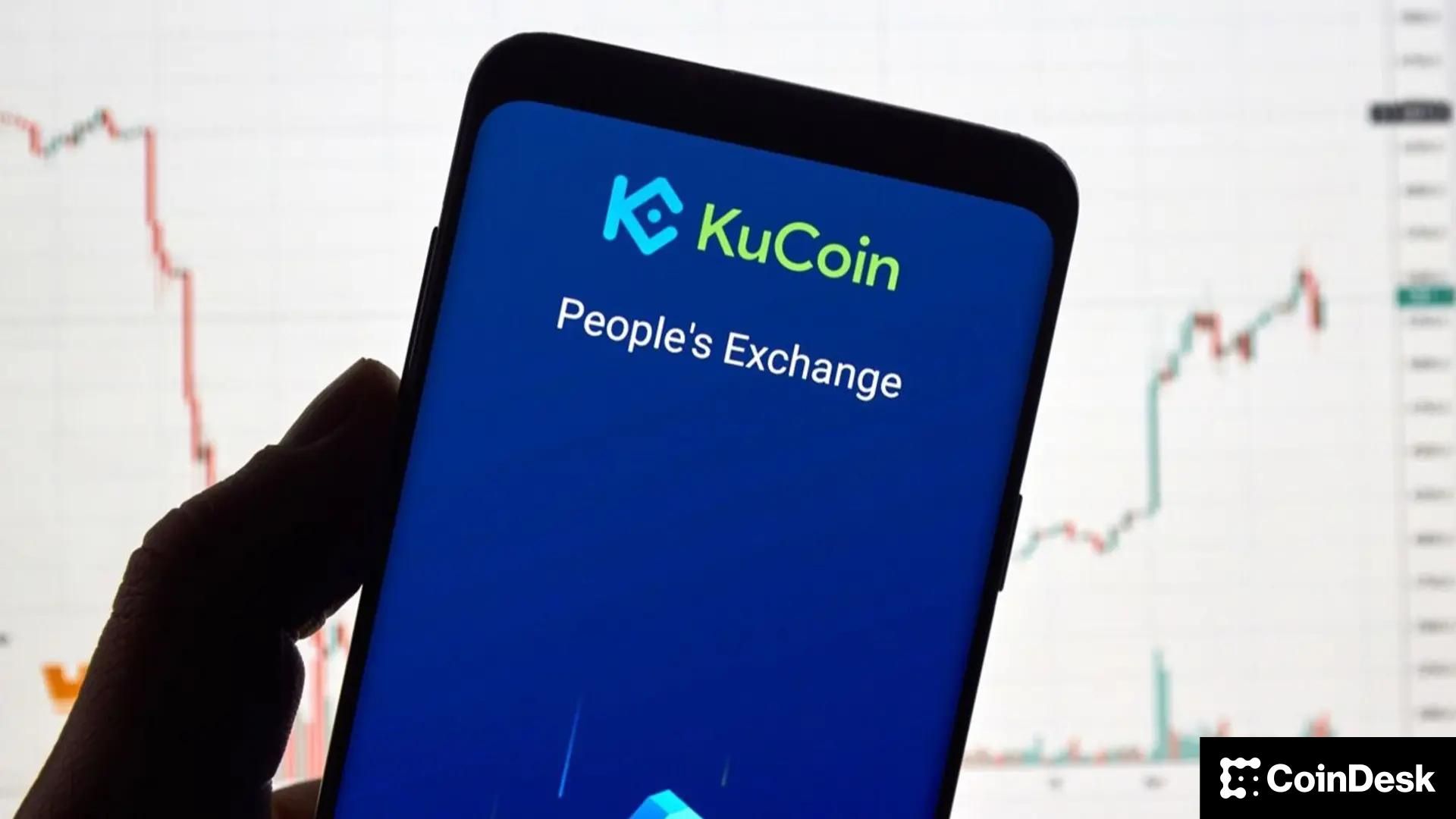
The European arm of global cryptocurrency exchange KuCoin has hired anti-money laundering (AML) and compliance expertise in a bid to appease its regulator, which recently demanded the exchange halt business in Europe due to a staffing shortfall.
KuCoin EU, which holds a Markets in Crypto Assets (MiCA) license from Austria’s FMA, appointed Carmen Kleinhans as anti-money laundering officer (AMLO), alongside the expansion of its broader AML function, the company said in a press release on Wednesday.
The exchange also hired Austrian compliance veterans Stephan Klinger and Bernd Träxler as deputy anti-money laundering officers.
KuCoin EU Managing Director Sabina Liu said the exchange had “communicated fully” with the FMA when the action happened in February.
“We always maintain a very transparent, open dialog with them, and the other way around as well. They have been very honest, transparent and very supportive of us,” Liu said in an interview. “Since February, we have been looking to strengthen the whole compliance team, making many appointments. So it is quite a large team now.”
KuCoin has had a rough rise of late, having been barred from the U.S. after a Commodity Futures Trading Commission (CFTC) order and being slapped by Dubai’s VARA regulator for operating without the appropriate license.
Liu was unable to provide a timeline for when the Austrian regulator would allow KUCoin EU to resume operations in Europe. “I think everything needs to be in discussion with the FMA,” she said.
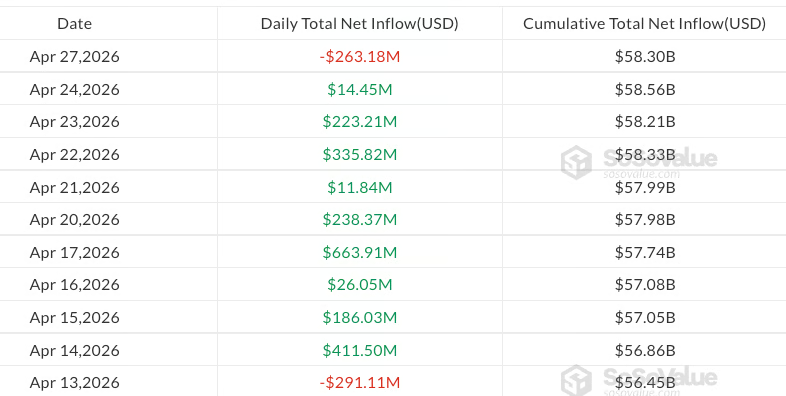
US-listed spot Bitcoin exchange-traded funds posted their first net outflows in nine sessions as BTC slipped below $77,000 on Monday.
Bitcoin ETFs saw $263 million in net outflows on Monday, marking the first outflows since mid-April, according to SoSoValue data.
The losses came after spot ETFs drew $2.1 billion in inflows since April 13 as BTC rose about 10% over the period, according to CoinGecko.
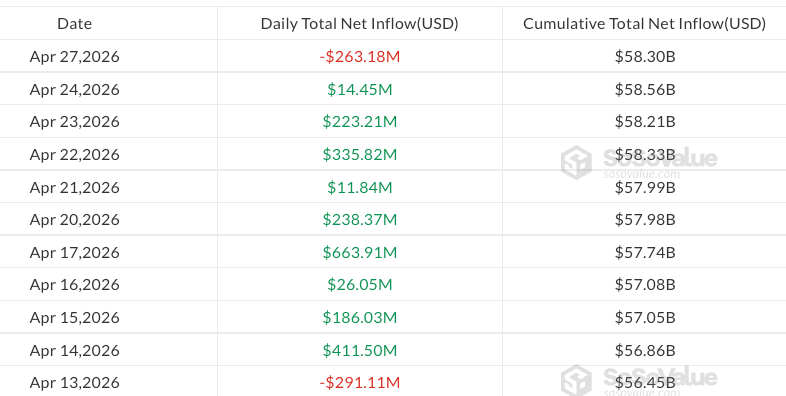
Daily spot Bitcoin ETF inflows from April 13, 2026. Source: SoSoValue
Alongside Bitcoin’s run, the Crypto Fear & Greed Sentiment Index on Monday moved into “Neutral” territory for the first time in three months, clocking a score of 47. However, the index flipped back to “Fear” on Tuesday as BTC failed to extend its rally above $80,000.
Fidelity’s Bitcoin ETF leads outflows at $150 million
The majority of Monday’s losses came from the Fidelity Wise Origin Bitcoin Fund (FBTC), which saw $150 million in outflows, according to Farside.
The Grayscale Bitcoin Trust ETF (GBTC) and the ARK 21Shares Bitcoin ETF (ARKB) followed with about $47 million and $43 million, respectively.
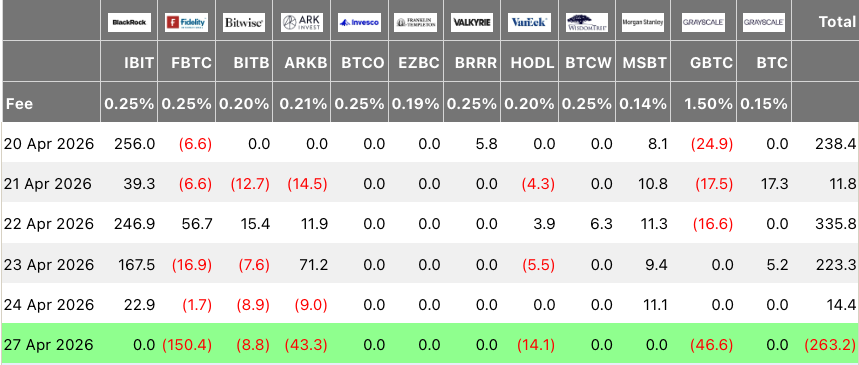
Daily spot Bitcoin ETF inflows by issuer from April 20, 2026. Source: Farside
BlackRock’s iShares Bitcoin Trust ETF (IBIT) and the Morgan Stanley Bitcoin Trust ETF (MSBT) recorded flat flows after multi-day inflow streaks.
Related: Bitcoin leads $1.2B weekly inflows into crypto investment products
Negative sentiment also extended to spot Ether ETFs, which posted $50.5 million in outflows on Monday. XRP and Solana ETFs recorded zero inflows.
Bitcoin institutional demand outpaces mining supply
Bitcoin’s rally in April came as institutional demand far outpaced mining supply.
Michael Saylor’s Strategy has purchased 56,235 BTC in April so far, while global ETFs added another 34,552 BTC on behalf of their clients over the same period.
This compares with 11,829 BTC estimated to have been mined so far this month, according to HODL15Capital data.
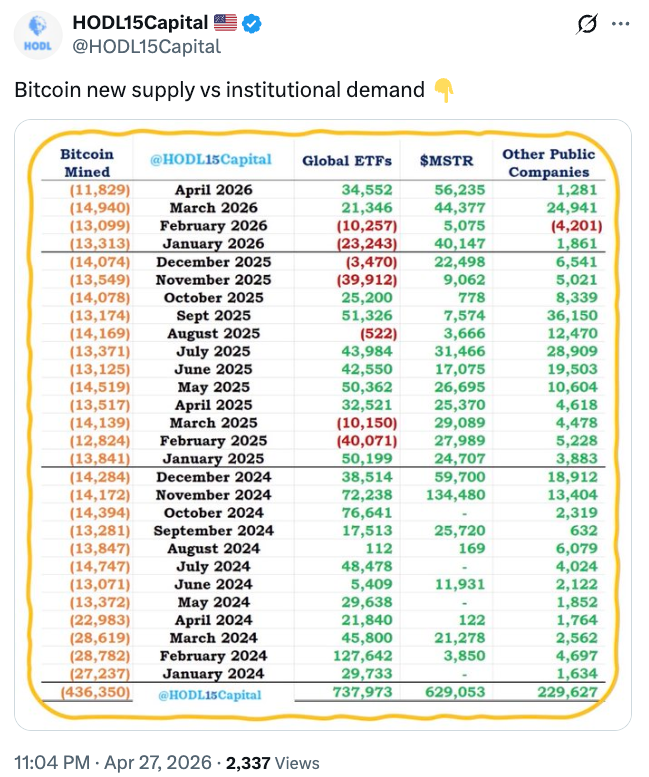
Source: HODL15Capital
CryptoQuant analyst XWIN Japan said Bitcoin’s sharp decline over the past few days was likely not driven by spot supply-demand imbalance, but by a “classic liquidity event” triggered by forced liquidations of leveraged long positions.
In earlier analysis, CryptoQuant said a rejection of the $80,000 level would signal overhead supply at that level, potentially extending the drawdown for both ETF investors and short-term whales.


DeFi United has released a recovery plan to restore full backing for Kelp DAO’s rsETH after a $292 million exploit earlier this month.
Summary
- DeFi United will convert committed ETH into rsETH tranches to restore full backing after the exploit.
- Aave may recover about 13,000 ETH through controlled liquidations of eight affected lending positions.
- The recovery still needs governance approvals, legal agreements, and staged security checks before full execution.
The coalition includes several DeFi protocols that joined efforts after the attack. The April 18 exploit targeted Kelp DAO’s rsETH bridge through a forged message. The attacker minted 116,500 unbacked rsETH tokens. Around 107,000 rsETH later moved into lending positions on Aave.
The recovery plan will convert committed ETH into rsETH in several tranches. The converted rsETH will then move to the affected lockbox contract to restore backing and support bridge operations.
“The restoration process involves converting the committed ETH into rsETH in tranches, which will then be transferred to the affected lockbox contract,” the coalition said.
Aave said DeFi United has gathered enough ETH commitments to begin the process. The initiative raised more than $300 million in ETH from DeFi participants.
Aave and Compound positions face cleanup
The plan also targets eight affected positions across Aave Ethereum Core and Arbitrum markets. Clearing those positions may help recover about 13,000 ETH from Aave.
The process will use a controlled liquidation sequence. The rsETH oracle price will be adjusted for a short period to allow the affected positions to be liquidated. The rsETH collateral will then move to a DeFi United-controlled multisig.
Compound may follow a similar path to clear the attacker’s position. That step could recover about 16,776 ETH worth of funds, according to the recovery outline.
The final phase will unpause and unfreeze rsETH and ETH across affected markets. It will also restore loan-to-value ratios that were changed during the response.
Governance approvals and security checks remain
The recovery plan still depends on governance approvals, legal agreements, and execution timelines. DeFi United said these steps must happen before the full restoration can move forward.
The coalition also noted that the attacker could try to interfere during the process. It said such action could require more liquidation steps to resolve the affected positions.
“Deliberate interference by the attacker could result in incomplete deficit accrual, requiring additional liquidation steps to fully resolve the positions,” the statement said.
DeFi United also said new security measures on LayerZero and Kelp DAO remain in production. For that reason, the ETH-to-rsETH conversion and lockbox deposits will happen in stages rather than all at once.

April 27, 2026 — Changelly and Tonkeeper have teamed up to make cross-chain deposits into TON a seamless, in-wallet experience. Users can now fund their Tonkeeper wallet with USDT, USDC, or DAI from 13 decentralized networks, without leaving the app.
For Changelly users already familiar with cross-chain swaps, this extends existing functionality into direct wallet deposits. For Tonkeeper’s user base, it introduces a new way to move assets into the TON ecosystem within a single interface.
Cross-chain deposits without leaving the app
With Changelly’s infrastructure integrated into Tonkeeper, cross-chain deposits can be completed within the wallet, while routing is handled in the background.
Support spans 13 networks: Ethereum, Solana, TRON, BSC, Polygon, Arbitrum, Base, Liquid, Avalanche, NEAR, Optimism, Matic, and Tezos.
The integration removes the need to use external bridges or manage multiple interfaces when moving assets across chains, keeping the entire process within the wallet environment.
Launch campaign
To mark the integration, the companies have introduced a campaign running from April 27 to May 10, 2026. Users who deposit USDT, USDC, or DAI from any of the supported networks into Tonkeeper via the integration during this period will be eligible to enter a draw for 20 one-year subscriptions to Telegram Premium.
About Tonkeeper
Tonkeeper gives users access to TON assets and dApps, USDT on TRC20, NFTs in one wallet. Tonkeeper supports powerful features like the Battery and Gasless transactions, while Tonkeeper Pro unlocks advanced tools like multisig support.
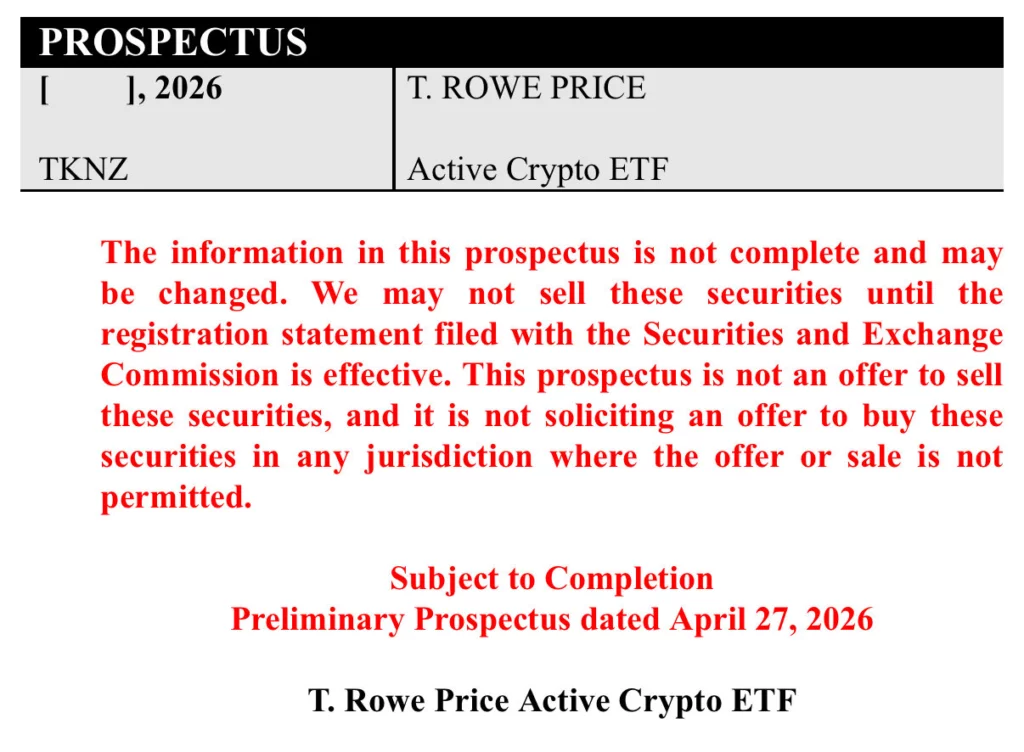
T. Rowe Price has advanced its entry into the crypto ETF market with a further amendment to its actively managed digital asset fund filing, bringing a potential launch closer.
Summary
- T. Rowe Price has advanced its active crypto ETF filing with a third amendment, bringing a potential launch of ticker $TKNZ closer pending SEC approval.
- The proposed fund is expected to hold 5 to 15 digital assets, including Bitcoin, Ethereum, XRP, and Solana, with allocations guided by active management rather than market size.
According to a preliminary prospectus dated April 27, 2026, the Baltimore-based asset manager plans to list the T. Rowe Price Active Crypto ETF under the ticker TKNZ, with the document noting the filing remains subject to completion and regulatory approval from the U.S. Securities and Exchange Commission.
Commenting on the matter, Bloomberg ETF analyst Eric Balchunas said the filing has reached a “3rd amendment,” with ticker $TOKN and a 75bps fee, adding that a launch is “likely very soon” and calling it “by far biggest active manager” entering the space.
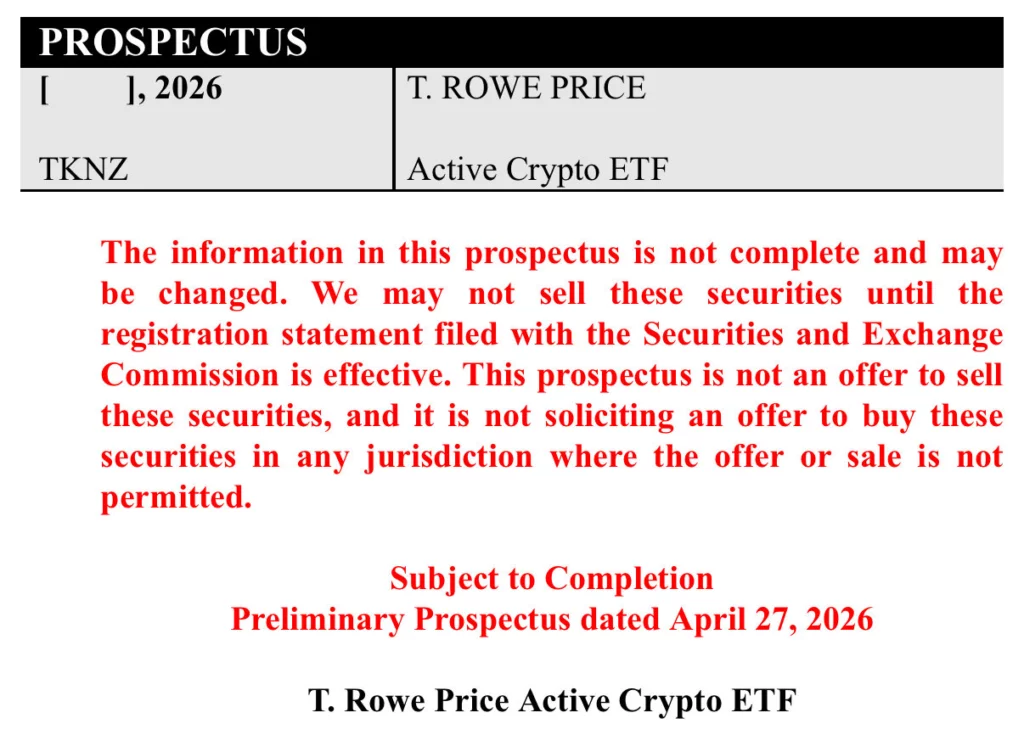
TKNZ fund prospectus. Source: Eric Balchunas.
Holding approximately $1.78 trillion in assets under management, T. Rowe Price has structured the proposed fund as an actively managed product that would invest directly in spot crypto assets, while avoiding leverage or complex derivatives, according to its SEC filings.
Active structure targets multi-asset exposure
Details outlined in the filing show the ETF is expected to hold between 5 and 15 cryptocurrencies selected under the SEC’s generic listing standards, moving away from the single asset structure seen in existing Bitcoin and Ethereum spot ETFs.
Eligible assets listed in the filing include Bitcoin, Ethereum, Solana, XRP, Cardano, Avalanche, Litecoin, Dogecoin, Hedera, Bitcoin Cash, Chainlink, Stellar, and Shiba Inu, with portfolio allocations guided by fundamentals, valuation, and momentum rather than market size alone.
An index snapshot included in the filing indicates Bitcoin carries a 42.83% weight, followed by Ethereum at 19.09%, while XRP stands at 10.56% and Solana at 7.93%, with smaller allocations assigned to assets such as Dogecoin, Cardano, and Avalanche.
Fund managers are expected to adjust holdings over time based on market conditions and internal research, with the stated objective of outperforming the FTSE Crypto US Listed Index, according to the prospectus.
Filing builds on earlier push into crypto ETFs
An earlier S-1 registration submitted on Oct. 22, 2025 confirmed the firm’s initial plans to launch an Active Crypto ETF, marking a departure from its long-standing focus on mutual funds.
“Point is that legacy asset managers are quickly trying to figure out how to implement some semblance of a crypto strategy. A number of these firms actually missed out on ETF boom. They want to avoid same mistake w/ crypto,” NovaDius Wealth Management President Nate Geraci said at the time.
Regulatory developments have also played a role in shaping the timing of the launch, as the SEC has recently moved to accelerate the approval process for crypto ETFs, even as applications tied to individual altcoins remain under review.

Man in hospital after car crashes into lamppost on A68 in Darlington

Barclay Brothers Avoid Bankruptcy: HSBC Drops High Court Petitions After IVA Deal
TotalEnergies (TTEF) Shares Surge as Q1 Earnings Soar 29% Above Forecasts

Manchester United reach agreement with Casemiro over contract clause amid transfer speculation

US brings back mandatory military draft registration

Steven Gerrard disagrees with Gary Neville over ‘shock’ Chelsea and Arsenal claim | Football


-

 Tech2 days ago
Register Renaming | Hackaday
-

 Fashion5 days ago
Weekend Open Thread – Corporette.com
-
 Crypto World4 days ago
Hyperliquid $HYPE Rally Builds Momentum as AI Sector Enters Prove-It Phase
-

 Politics7 days ago
Making troops accountable for war crimes threatens US alliance, ex-SAS colonel warns
-

 Politics7 days ago
Disabled people challenge government SEND proposals over segregation concerns
-

 Business5 days ago
Patterson-UTI Energy, Inc. (PTEN) Q1 2026 Earnings Call Transcript
-
 Sports3 days ago
IPL 2026: Ruturaj Gaikwad registers slowest fifty of the season, enters all-time unwanted list | Cricket News
-

 Politics2 days ago
Drax board avoid their own AGM, accused of greenwashing & environmental racism
-

 Politics7 days ago
Zack Polanski responds to home secretary’s taser threat
-

 Politics7 days ago
Starmer handler McSweeney to be dragged from shadows by Foreign Affairs Committee
-
Politics7 days ago
Wings Over Scotland | How To Get Away With Crimes
-

 Politics7 days ago
‘Iran is still a nuclear threat’
-

 NewsBeat3 days ago
LK Bennett closes all stores after entering administration
-
 Sports6 days ago
Tim Bradley names the current best in the world: “Better than Inoue and Usyk”
-

 Crypto World5 days ago
Michael Saylor says BTC winter is over. Market analyst disagrees, says bitcoin was in a pullback
-
 Entertainment4 days ago
Mariah Carey Slams Deposition Claims In Brother’s Lawsuit
-
Business6 days ago
Altimmune prices $225 million public offering at $3 per share
-
Entertainment6 days ago
Michael B. Jordan and Austin Butler's “Miami Vice” movie will bring the action back to the '80s
-
 NewsBeat5 days ago
Trump threatens to review UK’s claim to Falkland Islands and punish Nato allies over Iran war disagreement
-
Crypto World5 days ago
Is Algorand One of the Few Quantum-Resistant Blockchains? Here’s What the Data Shows
You must be logged in to post a comment Login