
Crypto World
Bitcoin price retraces to $77,000 ahead of Fed rate decision, will it crash?

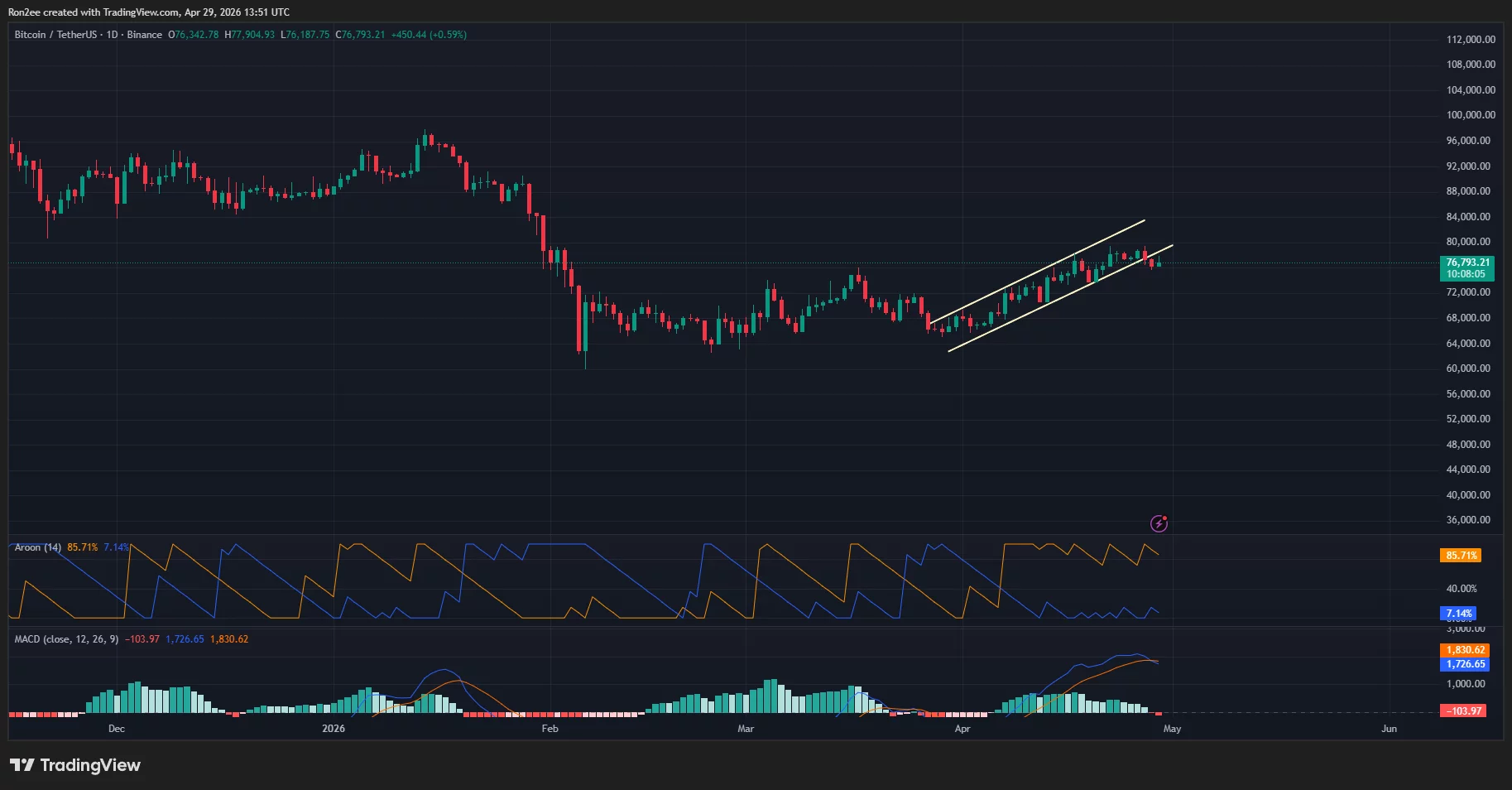
Bitcoin price fell back towards the $77,000 level after facing rejection at the $78K mark as investors remained cautious ahead of the FOMC decision today.
Summary
- Bitcoin price falls to $75,850 after rejection near $80K, as investors turn cautious ahead of the Federal Reserve rate decision.
- Markets price in no rate cut with 100% odds, while geopolitical tensions and macro uncertainty keep risk appetite subdued.
- Technicals show a bearish channel breakdown and MACD crossover, with $80K as key resistance and $75K–$70K as downside support zones.
According to data from crypto.news, Bitcoin (BTC) price faced rejection at around $80,000 on Monday, after which it fell 4% to an intraday low of $75,850 on Tuesday. This came as uncertainty surrounding the opening of the Strait of Hormuz amid stalled peace negotiations between the U.S. and Iran continues to keep investors in risk-off mode.
While investors bought the dip, helping push Bitcoin back to $77,800, it fell short of surpassing the $80K figure as investors entered a wait-and-watch mode ahead of the Fed rate decision set to be announced later today.
Both the CME FedWatch tool and predictions platform Polymarket showed that the odds of the Federal Reserve keeping the interest rates at 3.5% to 3.75% stood at 100%, reflecting a total consensus among market participants.
While the markets had already priced in no rate cuts for April, the ongoing hawkish stance from central bankers has dulled their appetite for Bitcoin and the broader crypto market as a whole, as borrowing costs remain elevated.
Looking ahead, the next key milestone for Bitcoin is the Core PCE data set to be revealed tomorrow. As the Fed’s preferred inflation gauge, this data will be crucial for determining if price pressures are cooling. Early estimates suggest that any surprise in this report could lead to significant volatility across all risk assets.
Despite the short-term dip, some analysts suggest that the current retracement in Bitcoin is typical behavior ahead of major monetary policy announcements. They believe that Bitcoin could still be in a phase of strong market conditions, suggesting that the current consolidation phase may give way to renewed strength once macro clarity emerges.
Bitcoin price analysis
On the daily chart, Bitcoin price has confirmed a bearish breakdown from an ascending channel pattern that has been forming since late March. Historically, such a move indicates that the previous upward momentum is fading and that a deeper correction might be on the horizon.
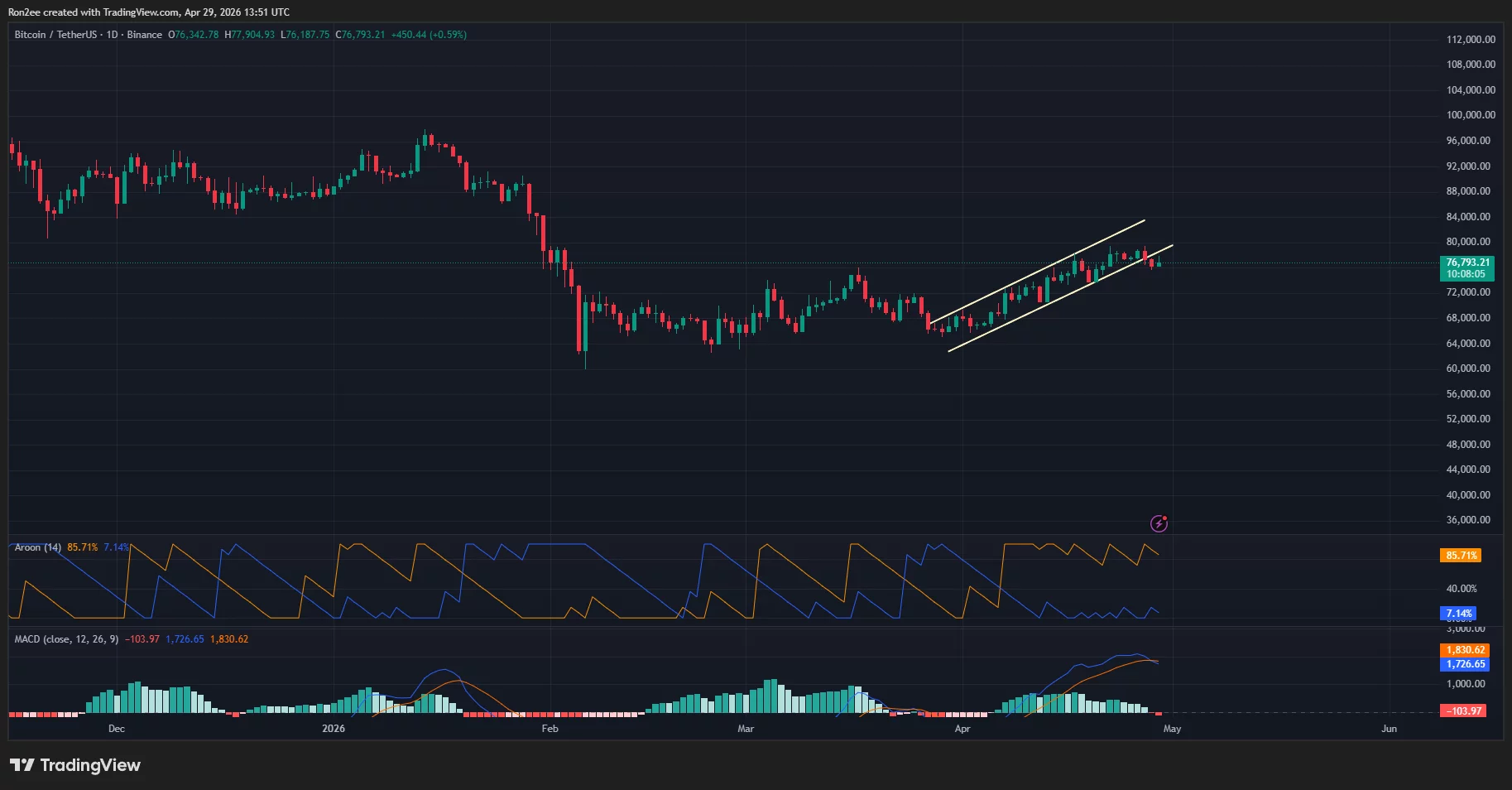
Adding to the bearish outlook, the MACD has printed a bearish crossover, indicating that short-term momentum has shifted in favor of sellers. This suggests caution for traders considering fresh long positions at current levels.
However, the Aroon indicator offers a mixed signal. While Aroon Up remains elevated at 85.71%, Aroon Down is still relatively low. This implies that despite the recent pullback, the broader uptrend has not fully lost strength, and buyers may still be attempting to maintain control.
For now, $80,000 serves as a formidable psychological resistance, especially with no rate cuts expected in the immediate future. However, if bulls manage to break through this barrier, the next targets would sit at $85,000 and potentially $90,000.
On the downside, a sustained drop below $75,000 would confirm further weakness and could push Bitcoin toward the $70,000 support zone.
Disclosure: This article does not represent investment advice. The content and materials featured on this page are for educational purposes only.

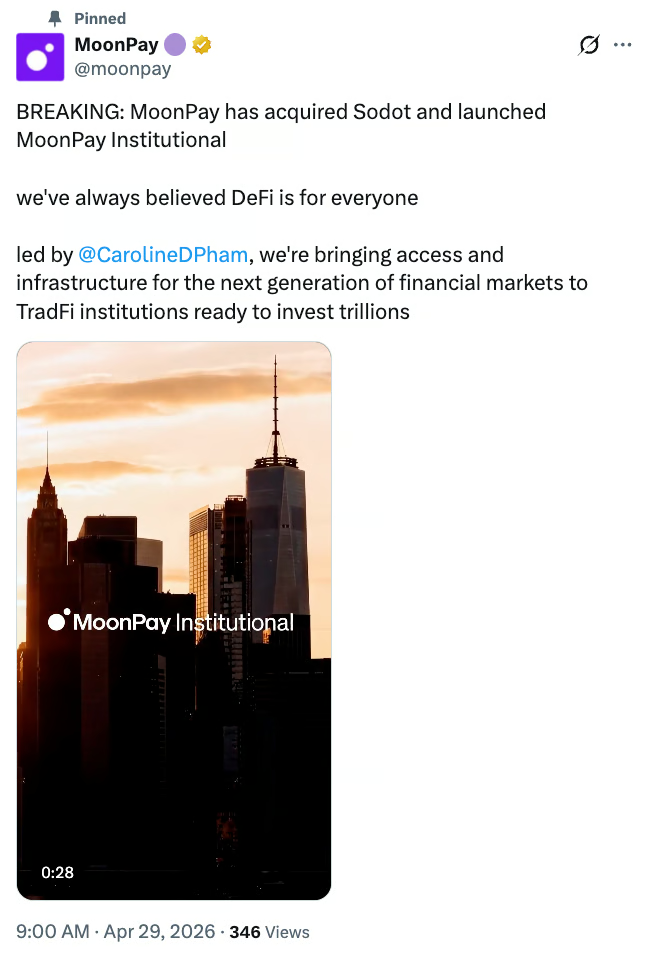
Crypto payments platform MoonPay is launching an institutional unit after acquiring Sodot, an Israeli crypto security infrastructure provider.
MoonPay on Wednesday announced the acquisition of Sodot, using Sodot’s key management technology as the core infrastructure layer of its new business serving financial institutions, asset managers, trading firms and exchanges entering digital asset markets.
“We built MoonPay to be the world’s leading crypto payments network,” MoonPay co-founder and CEO Ivan Soto-Wright said in a press release, adding that its institutional arm is the next stage for the company.
According to Bloomberg, the deal closed in April in an all-stock transaction valued at around $100 million. MoonPay did not immediately respond to Cointelegraph’s request for comment to confirm the deal’s details.
The move expands MoonPay’s business beyond retail crypto payments and reflects rising demand from traditional finance companies for secure wallet and custody infrastructure as they expand into digital assets.
MoonPay targets institutional demand
MoonPay’s new institutional division aims to serve large traditional financial firms across a range of areas, including trading, tokenized securities, payments, wallet management and stablecoin issuance.
The unit will be led by Caroline Pham, who joined MoonPay as its chief legal officer and chief administrative officer in December after serving as acting chair of the US Commodity Futures Trading Commission before joining MoonPay in late 2025.
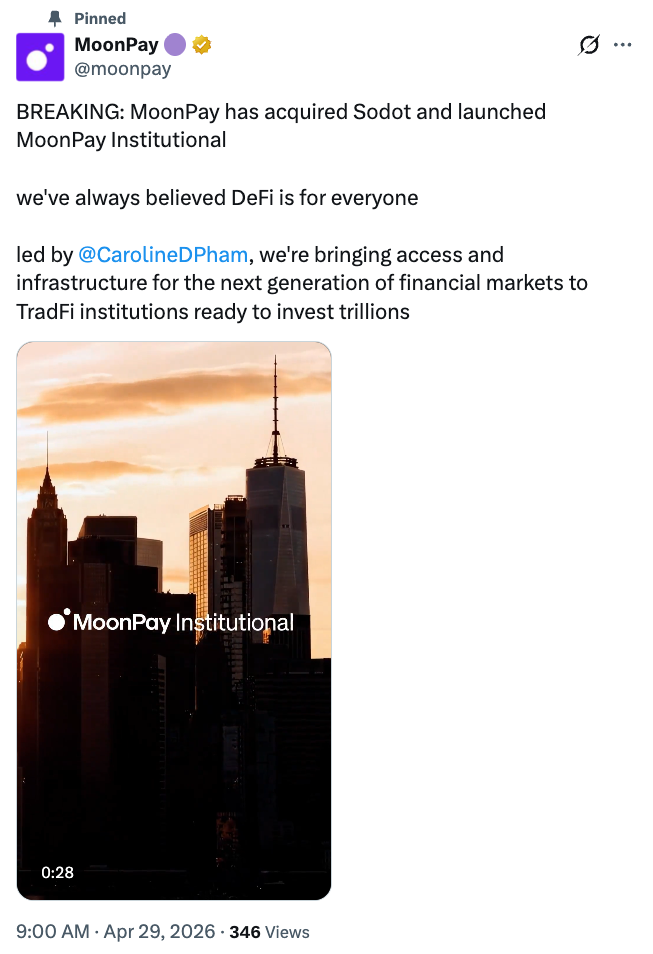
Source: MoonPay
“There is no one better suited to lead this business than Caroline, who brings decades of experience at the highest levels of financial regulation and capital markets,” Soto-Wright said.
Security race heats up in crypto
Founded in 2023, Sodot is a platform focused on crypto key management infrastructure, a critical part of safeguarding digital assets and operating institutional wallets.
The company specializes in self-hosted multi-party computation (MPC), a cryptographic method that splits a private key into separate shares distributed across multiple independent parties to increase the security of funds.
Related: Fireblocks launches tool for institutions to earn yield on stablecoins
The acquisition comes amid a growing trend of institutional services supported by crypto custody providers. Last week, crypto exchange OKX integrated off-exchange settlement by BitGo, a publicly traded digital asset custodian.
Previously, BitMEX partnered with European crypto custody firm Zodia Custody to enable institutional crypto derivatives trading, with collateral held in segregated custody off-exchange.
Magazine: Adam Back says current demand is ‘almost’ enough to send Bitcoin to $1M


Strive CEO Matt Cole said digital credit products STRC and SATA outperformed Bitcoin (BTC) during its recent 50% drawdown. He called both “extremely credit-worthy” as yield-bearing crypto-linked instruments gain traction.
Cole’s remarks came via the Bitcoin Treasuries account on X. Bitcoin fell from a peak near $126,000 in October 2025 to roughly $60,000 in February. The drawdown tested newly launched preferred stock vehicles tied to Bitcoin balance sheets.
How Digital Credit Held Up
Strategy’s STRC is a variable-rate perpetual preferred stock currently yielding around 11.5%. Strive’s SATA pays a 12.75% dividend following a recent 25-basis-point hike. Both products trade near par by design.
Bitcoin treasury equities such as Strategy and BitMine fell sharply during the February sell-off. Preferred shares stayed comparatively stable through the same period. SATA has logged roughly $1.28 billion in cumulative volume across 104 sessions since its November 2025 launch.
STRC and SATA as Bitcoin Credit Instruments
Strive bought $50 million of Strategy’s STRC in March. The firm described the position as high-quality credit with material yield and higher liquidity than traditional moderate-duration debt. Strive currently holds roughly 13,311 BTC alongside its cash reserves.
Strive raised the SATA dividend rate by 25 basis points to keep the security trading near its $100 par. SATA crossed that mark in March on volume that briefly outpaced JPMorgan preferred shares.
Those holdings back SATA’s dividend obligations of about $56 million annually. Strive said combined assets cover nearly 19 years of payments at recent Bitcoin prices. The buffer aims to keep SATA trading near par through periods of private credit market stress.
“STRC & SATA are extremely credit-worthy instruments,” Cole said at Bitcoin 2026 Conference.
The volatility test arrived early for digital credit. Bitcoin still trades well below its 2025 high. Cole’s claim that the segment held up will face further scrutiny if drawdowns continue.
Other Bitcoin-linked equities have not fared as well. Strategy shares are down roughly 70% from their 2025 peak. BitMine is sitting on about $3.8 billion in unrealized losses tied to its crypto reserves.
Cole has previously framed digital credit as a multi-trillion-dollar opportunity. Performance under sustained stress will determine whether yield-bearing Bitcoin instruments mature into mainstream credit allocation.
The post Strive CEO: Bitcoin’s 50% Crash Shows Why Digital Credit Is the Future appeared first on BeInCrypto.
Latest developments: ETF inflows are signaling renewed confidence from traditional investors.
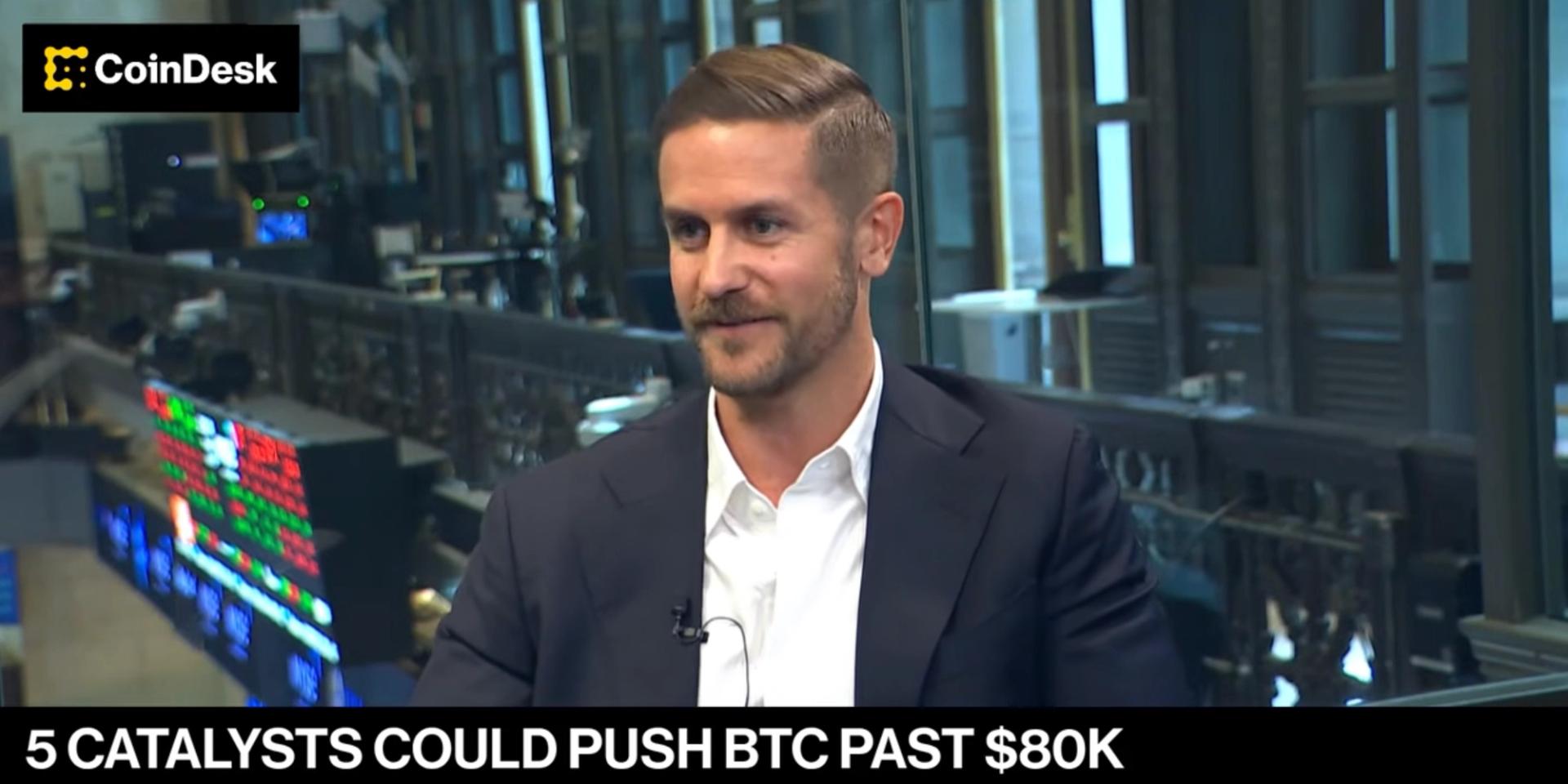
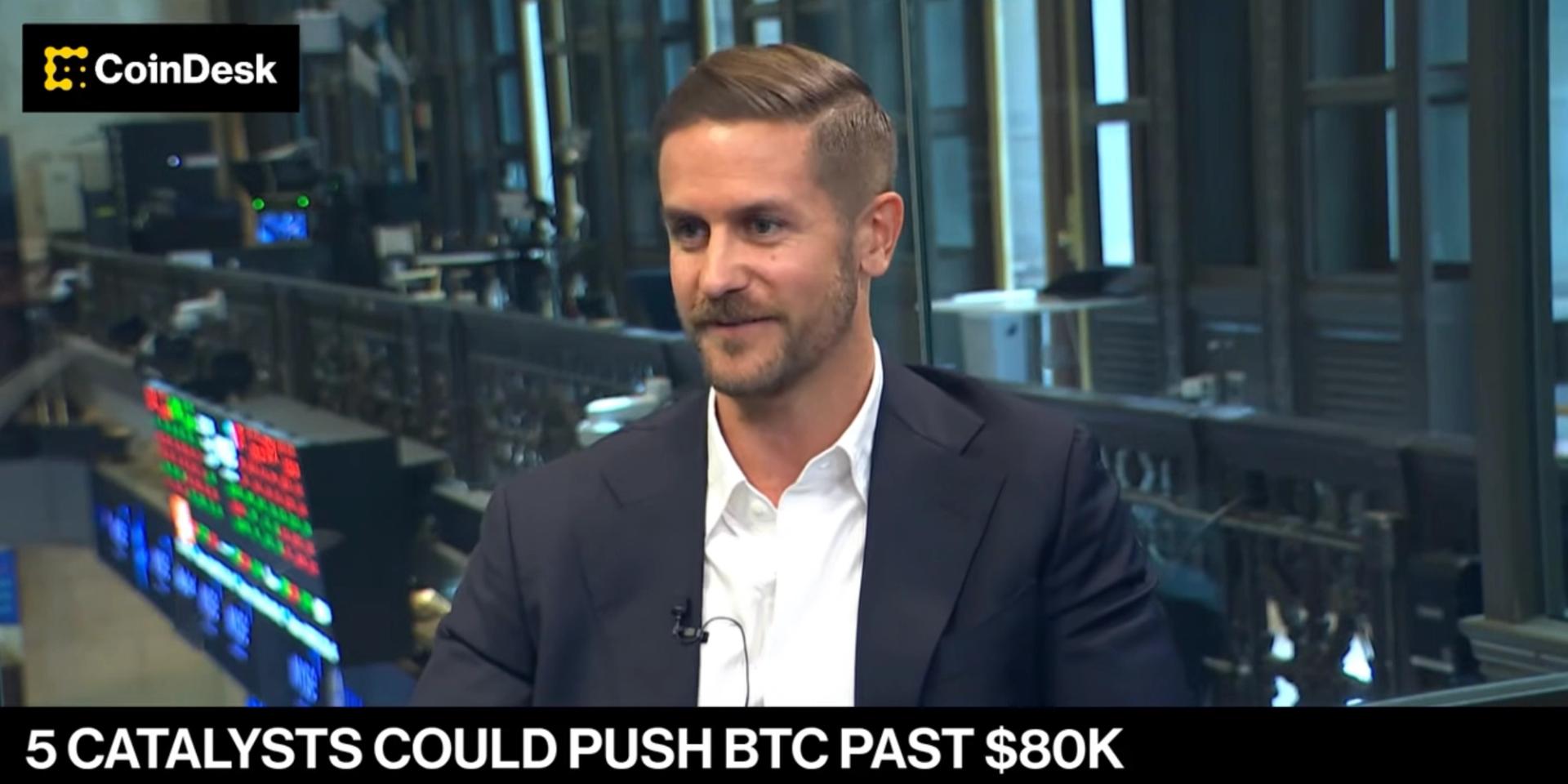
- Spot Bitcoin ETFs have absorbed almost $2 billion year-to-date, 21Shares CIO Adrian Fritz said on CoinDesk’s Public Keys
- Demand is coming from a mix of retail investors, institutions, and hedge funds using arbitrage and options strategies
- Morgan Stanley and other major asset managers entering crypto are accelerating institutional adoption
Why it matters: Liquidity — long a concern for skeptics — is no longer a barrier.
- Bitcoin now rivals mega-cap equities like Nvidia, with daily trading volumes exceeding $50 billion, Fritz said
- ETF structures provide both primary and secondary market liquidity, making the asset “institutional ready”
- Portfolio managers are increasingly viewing bitcoin as a viable multi-asset allocation despite volatility concerns
Reading between the lines: The ETF boom didn’t happen overnight.
- Adoption has been gradual, requiring education and comfort with crypto’s role in portfolios
- Investors are still grappling with correlations, volatility, and macro sensitivity
- The steady build in flows suggests a structural — not speculative — shift in demand
What to watch: Several catalysts could push Bitcoin past the key $80K level.
- Improving geopolitical sentiment, including any resolution tied to global conflicts, could boost risk appetite
- Continued ETF inflows remain a core driver of structural demand
- Negative perpetual futures funding rates could trigger short squeezes on upward price moves
- A breakout above the 200-day moving average ($85K–$90K range) would signal a stronger trend reversal
The big picture: Macro forces still dominate crypto’s trajectory.
- Investors are closely watching PCE inflation data and upcoming Fed decisions for policy direction
- Oil prices remain a driver — a spike above $100 could pressure risk assets, including bitcoin
- Adrian expects continued consolidation in the near term, with a move toward $100K by year-end if conditions align
The altcoin angle: Not all crypto assets will benefit equally.
- Ethereum is struggling but showing signs of renewed ETF inflows after a weak first quarter
- “Altcoin season” may not return in its previous form, as investors adopt more fundamentals-driven approaches
- Projects with real revenue and cash flow, like Hyperliquid, are gaining traction with traditional investors
- Weaker altcoin ETFs could face closures if underlying projects fail to demonstrate strength
Crypto World
Kaspa Crypto Is 95% Mined With Supply Running Out by Late 2026: Is a Scarcity Rally Coming Before It’s Too Late?

Kaspa crypto sits at approximately $0.033 today, with its market cap hovering near $1 billion, a figure that looks almost modest given the network’s technical pedigree.
The real story, though, isn’t the price. It’s the clock. Kaspa’s emission schedule now shows 27.37 billion KAS already mined, representing 95.39% of its hard-capped 28.7 billion supply, with the remaining issuance approaching zero by late 2026. That’s a scarcity event hiding in plain sight.
Crypto analyst Our Crypto Talk flagged the supply milestone on X, noting that Kaspa’s monthly halving emission model compresses new supply continuously, unlike most Layer 1 competitors still bleeding tokens through scheduled VC unlocks.
Can $KAS hit $10 billion? — Our Crypto Talk (@ourcryptotalk) April 24, 2026
Let me break down why that is possible.
It is the most logical outcome if the roadmap delivers.
Yes, it is down by 83% from the highs.
It even dropped after its Crescendo Hard Fork
So what needs to be done? THE ONLY FAIR LAUNCH LEFT STANDING… pic.twitter.com/GuBcOaGo5G
With ~95% of all KAS already in circulation and the final issuance window closing before mid-2026, the tokenomics argument for Kaspa is sharpening.
Whether the market re-rates the asset in time is the question every KAS holder is sitting with right now.

Can Kaspa Crypto Price Reach $0.20 Again Before the Supply Cap Locks In?
KAS is still deep below its peak, and that matters, because it shows how much momentum has faded after the last cycle. Right now it is not about hype, it is about whether the structure can stabilize.
The key level is $0.030. As long as KAS holds above it, the recovery idea stays alive. Lose it, and downside opens quickly toward the $0.015–$0.018 range.
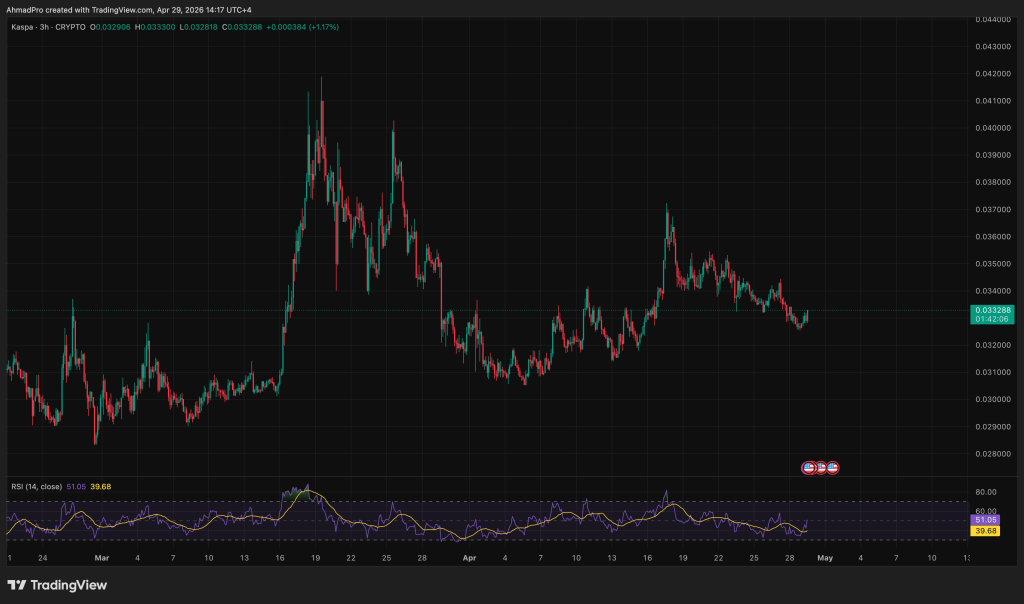
For a real turnaround, volume needs to come back. Without that, any bounce is just noise, not a trend shift.
The longer-term story is tied to supply dynamics. As emissions drop and miner pressure fades, the narrative shifts toward scarcity, which can support higher prices if demand returns.
If that happens, a move back toward $0.07–$0.10 is realistic as a gradual recovery, while stronger catalysts could push it higher over time.
New Chains Grab More Attention, This is Exactly Why Bitcoin Hyper Buys is Surging
Kaspa’s scarcity angle is strong, but a 10x from here needs more than tokenomics, it needs real demand, capital, and a narrative shift. Those moves do not come easily at this stage.
That is why some investors look earlier in the cycle, especially where new infrastructure is forming and not fully priced yet.
Bitcoin Hyper is positioning in that space, building a Layer 2 on Bitcoin with SVM integration to bring fast smart contracts into the BTC ecosystem. The idea is to combine Bitcoin’s security with high-speed execution, which is a compelling narrative if it works.
The presale has already raised over $32.5M at around $0.0136793, which shows strong early interest and steady accumulation. Features like staking and a native bridge are designed to support usage from the start.
But it is still early, and that matters. Execution is not proven, liquidity is untested, and the whole thesis depends on delivery after launch.
So the setup is clear, Kaspa offers a longer-term recovery tied to scarcity, while something like Bitcoin Hyper offers earlier positioning with higher potential, but also higher risk.
VISIT BITCOIN HYPER HERE
The post Kaspa Crypto Is 95% Mined With Supply Running Out by Late 2026: Is a Scarcity Rally Coming Before It’s Too Late? appeared first on Cryptonews.


Pantera Capital founder and CEO Dan Morehead said cryptocurrency markets may be undervalued compared with artificial intelligence stocks, which he described as overheated after a strong run.
Morehead framed the divergence as one of the largest he has seen between the two sectors, speaking at an event in New York on Tuesday.
“It’s just my intuition that although AI is very important, it’s going to go up big time over the long haul, seems to be pretty fully priced right now,” he said.
By contrast, “crypto…is incredibly cheap,” according to Morehead.
Pantera’s internal data backs that view. Morehead said an index of leading AI companies is “trading at 33% over its log trend of the last four years,” while bitcoin has fallen well below its own historical trajectory. “It’s 43% cheap to its trend,” he said, calling it “the biggest divergence we’ve seen in history.”
The gap comes as investor enthusiasm has tilted heavily toward AI, with large funding rounds and rising public market valuations. Crypto, meanwhile, has struggled to regain momentum despite broader adoption and regulatory progress in the U.S.
“The majority of institutions still don’t get it. They still don’t have any exposure,” Morehead said, adding that limited participation leaves room for future demand. Only a minority of large investors currently hold digital assets, he noted, even as the asset class matures.
That dynamic contrasts with AI, where investors have moved quickly to price in expected growth. For Morehead, the imbalance creates an opportunity for those willing to take a longer view.
He also pointed to structural cycles in crypto markets. “The four-year cycle is real,” he said, referring to bitcoin’s supply schedule. If past patterns hold, he suggested the market could remain in a weaker phase in the near term, even as the long-term outlook stays positive.
Beyond relative valuations, Morehead tied crypto’s appeal to broader macro trends. He described digital assets as a hedge against currency debasement, noting that inflation and monetary expansion have pushed investors toward scarce assets. “It’s actually all those things aren’t moving. It’s a massive devaluation of paper money,” he said.
Morehead sees convergence between AI and blockchain technologies. Pantera has invested in several projects at that intersection, and Morehead argued the two sectors are linked. “There’s really no world in which AI is important that crypto isn’t part of it,” he said.
Pantera views crypto as a relative value trade for now As capital continues to flow into AI, Morehead’s thesis rests on the idea that markets will eventually rebalance, drawing attention back to digital assets that remain, in his view, underpriced.
BitMEX has launched six FX perpetual swap contracts, giving crypto traders access to major global currency pairs through crypto collateral.
The new contracts cover EUR/USD, USD/JPY, GBP/USD, AUD/USD, USD/CHF, and USD/CAD. These pairs sit among the most traded currency markets in the world and are closely tied to interest rates, central bank policy, inflation expectations, and global risk appetite.
For BitMEX, the launch adds another traditional finance-linked product line to its derivatives platform. For traders, it creates a route into forex markets through crypto-native trading platforms.
Crypto Collateral Comes to Major FX Pairs
Foreign exchange is the world’s largest and most liquid financial market. Access still often depends on brokers, fiat deposits, banking systems, and market hours built around the traditional trading week.
With BitMEX’s FX perpetual swaps, traders can post crypto as margin and trade major currency pairs from the same environment used for digital asset derivatives. The contracts offer up to 100x leverage and carry a 0% base interest rate, removing overnight swap fees often charged by forex providers.
“Forex is the largest and most liquid market globally, yet access still depends on fragmented and time-bound systems,” said Stephan Lutz, CEO at BitMEX. “With FX Perpetual Swaps, traders can access major currency pairs at any time using crypto as margin, without the operational friction of traditional brokerage models.”
The product is aimed at experienced crypto traders who already understand perpetual swaps and want direct access to macro-driven markets beyond Bitcoin, Ethereum, and altcoins.
Why FX Perpetuals Fit Crypto-Native Trading
Perpetual swaps became one of crypto’s most popular trading products because they gave traders continuous exposure, leverage, and margin-based positioning. BitMEX helped popularize the format in digital asset derivatives. Its new FX launch applies the same model to currency markets.
A trader can use crypto collateral to take a view on EUR/USD, USD/JPY, or GBP/USD without opening a separate brokerage account or funding positions in fiat.
Macro conditions now have a strong influence on crypto markets. Dollar strength, rate expectations, inflation data, and central bank decisions all affect liquidity and risk appetite. FX pairs often react directly to these developments, while crypto traders usually read them through Bitcoin, stablecoins, or overall market sentiment.
FX perpetuals give those traders a more direct way to trade macro events. EUR/USD alone accounts for roughly 23% of daily FX volume, while USD/JPY and GBP/USD remain key pairs for monetary policy and risk positioning.
The Weekend Trading Angle
A key part of the launch is weekend access. Traditional forex markets usually close for around 48 hours from Friday evening to Sunday evening. Crypto markets run continuously.
BitMEX’s FX perpetual swaps stay open during those off-market periods. During regular market hours, pricing comes from aggregated external data. During off-hours, pricing transitions to internal order book activity, keeping the market open.
For traders, the appeal is the ability to react to weekend political news, emergency central bank developments, geopolitical events, and other macro shocks before conventional FX markets reopen.
The setup also brings added risk. Weekend liquidity can behave differently from regular sessions, while high leverage can magnify losses. The product is likely to fit experienced traders who understand funding, liquidation mechanics, and off-hours market conditions.
BitMEX Adds to Its TradFi Perpetuals Range
The FX launch sits within BitMEX’s wider expansion into traditional finance-linked perpetual products. The exchange already offers exposure to selected commodities and equities-linked markets, including WTI crude oil and silver.
The strategy is to bring more traditional market exposure into a crypto-native derivatives venue. Traders can move between crypto, currencies, commodities, and equities-linked products under one account and margin model.
For active traders, this creates more room for macro positioning and cross-asset strategies. A Bitcoin trade can sit alongside dollar-yen, sterling-dollar, or crude oil exposure without using a separate broker.
A Focused Return to Forex-Linked Products
BitMEX sees the launch as a more focused return to forex-linked perpetuals. Starting with six major pairs gives the exchange exposure to the most familiar and liquid parts of the FX market.
EUR/USD, USD/JPY, GBP/USD, AUD/USD, USD/CHF, and USD/CAD cover the core G10 currency relationships followed by many active traders. The selection also gives BitMEX room to test demand before adding more products.
The company said future TradFi perpetual launches will depend on user demand. More FX pairs, additional commodities, or deeper equity-linked coverage could follow.
What It Means for Crypto Derivatives
BitMEX’s FX perpetual swaps show how crypto exchanges are extending beyond digital assets while keeping the trading experience familiar to crypto users.
The launch also shows how crypto-native products are influencing access to traditional markets. Perpetual swaps began as a digital asset trading format. The same model is now being applied to forex, commodities, and equities-linked exposure.
For BitMEX, FX perpetuals strengthen its position as a derivatives platform for active traders. For the wider market, they point to a future where crypto collateral can support access to more global asset classes.
The result is a product built around the trading habits crypto users already know: continuous markets, crypto margin, leverage, and direct access from one derivatives platform.
The post BitMEX Opens 24/7 FX Perpetual Trading for Crypto Traders appeared first on BeInCrypto.
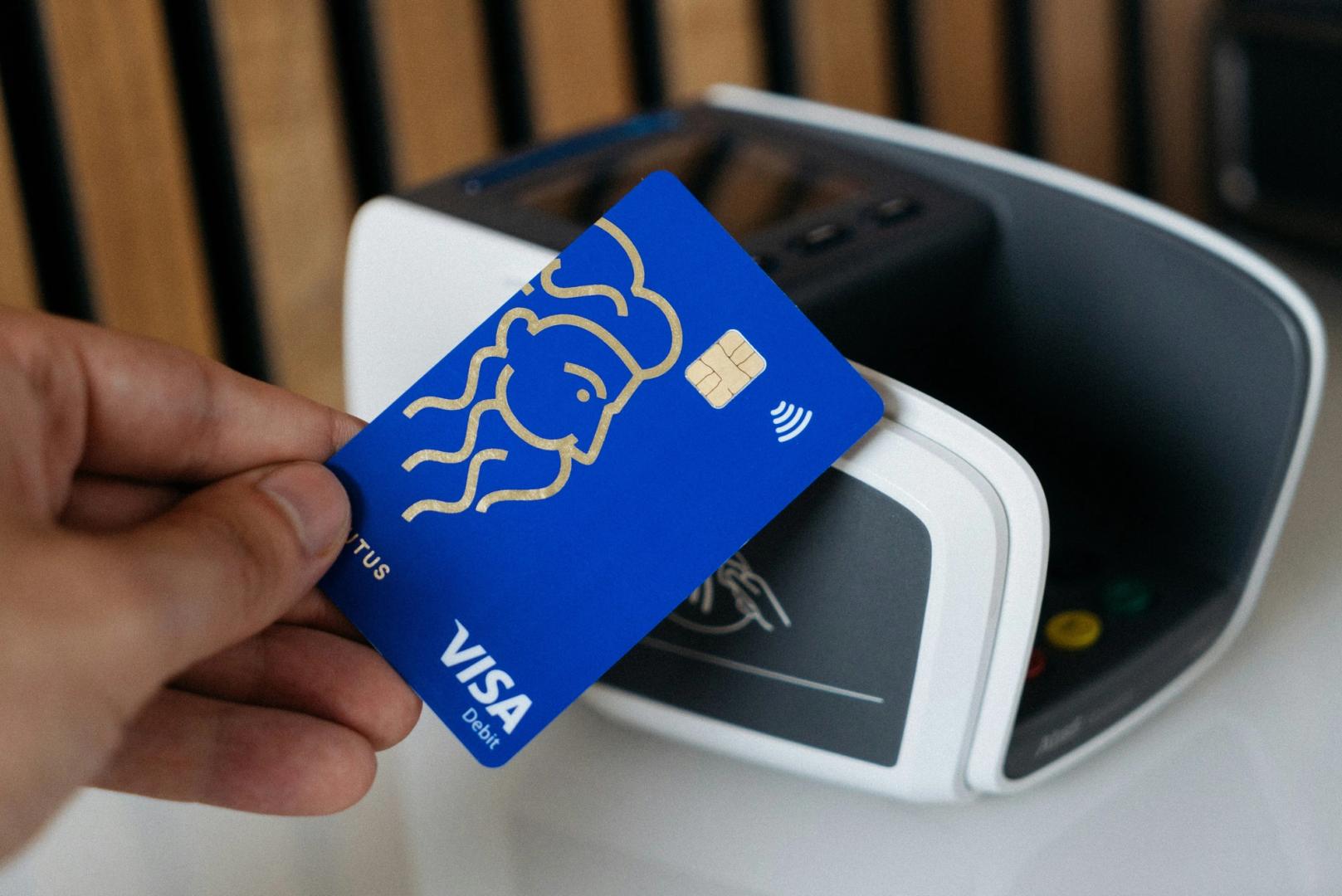
Visa (V) is expanding its stablecoin push by adding support for five more blockchains as it leans into a multichain approach to global payments.
The payments giant said Wednesday its stablecoin settlement pilot now spans nine networks and has reached a $7 billion annualized run rate, up 50% from the prior quarter. The program lets issuers and acquirers settle transactions using stablecoins instead of traditional banking rails.
The newly supported blockchains are Coinbase’s Base, Polygon, Canton Network, Circle’s Arc and Stripe-backed Tempo, joining existing integrations with Ethereum, Solana, Avalanche and Stellar.
Visa’s move comes as stablecoins — cryptocurrencies with prices tied to fiat money — are gaining ground as a way to move money across borders. Visa has been testing that model through pilots and regional rollouts, including USDC settlement tied to card programs in more than 50 countries.
Instead of waiting days for funds to move through banking systems, partners can settle transactions using blockchain-based dollars that move in near real time. By supporting multiple networks, Visa is aiming to give partners access to different pools of liquidity without added complexity.
“Our partners are building in a multi-chain world, and they expect their options to reflect that reality,” said Rubail Birwadker, Visa’s global head of growth products and strategic partnerships. “Expanding our stablecoin settlement pilot program to more blockchains means our partners can choose the networks that best fit their needs, while relying on Visa to provide a common settlement layer across all of them.”
KuCoin EU has appointed a new Anti-Money Laundering (AML) chief and expanded its compliance team in Vienna, weeks after Austrian regulators barred the exchange from taking on new business under Europe’s Markets in Crypto-Assets Regulation (MiCA) regime.
The MiCA-licensed entity named Carmen Kleinhans as its Anti-Money Laundering officer, alongside two deputy AML officers drawn from former Austrian regulators and bank compliance chiefs. According to a Wednesday release, the team will oversee AML, Counter-Terrorist Financing (CTF) and sanctions controls, as well as enterprise-wide risk management and regulatory engagement.
The move follows a February decision by Austria’s Financial Market Authority (FMA) to prohibit KuCoin EU from onboarding new clients or signing new contracts after finding that key AML/CTF and sanctions compliance roles were not adequately staffed, breaching internal organizational requirements.
The hires mark an effort by the exchange to address those gaps and align more closely with traditional financial services compliance expectations, as regulators increasingly focus on governance and controls rather than solely technical breaches.
Related: Thailand crypto platforms freeze 10K accounts in AML crackdown: Report
Wider regulatory pressure on KuCoin
The new staffing push also comes against a broader backdrop of rising AML and sanctions scrutiny in crypto, with regulators increasingly willing to freeze or partially suspend business over governance and staffing failures rather than just technical breaches of securities or licensing rules.
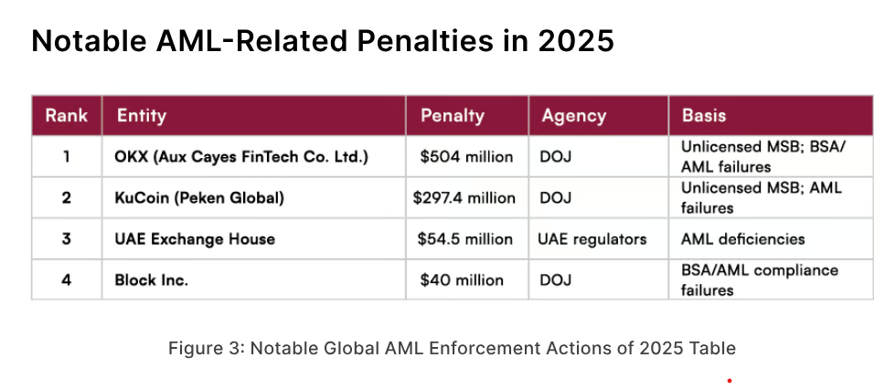
A Tuesday report by blockchain security auditor CertiK showed that KuCoin and OKX were among the exchanges hit with some of the largest AML-related penalties in 2025, highlighting how enforcement has shifted toward financial crime and controls rather than solely securities law issues.
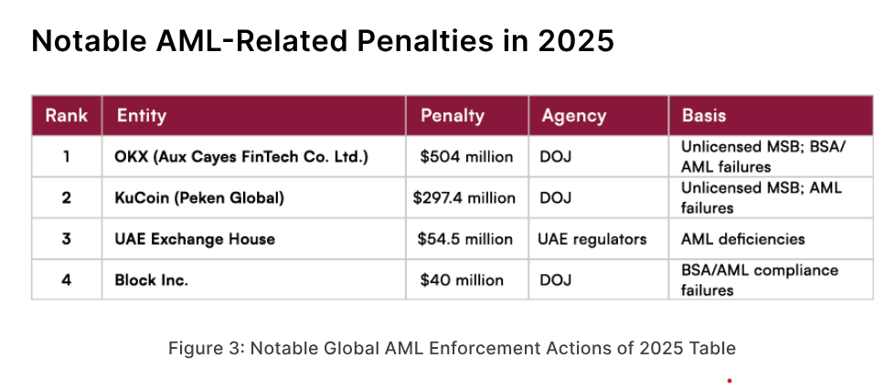
Notable AML-Related Penalties in 2025. Source: CertiK
At a group level, KuCoin has also faced regulatory action in other jurisdictions. In January 2025, it agreed to pay nearly $300 million and exit the US market for two years in a criminal resolution over unlicensed money-transmission and AML failures, the Wall Street Journal reported at the time.
On March 30, the parent company of KuCoin agreed to pay a $500,000 civil penalty to settle a case by the US Commodity Futures Trading Commission alleging it operated an unregistered offshore commodities exchange. Earlier that same month, KuCoin received a warning from Dubai’s Virtual Assets Regulatory Authority over allegedly offering virtual asset services in the emirate without the required local licence.
Whether the hires are enough to restore normal operations under KuCoin EU’s Austrian authorization now depends on the FMA’s assessment of whether the required control functions have been fully and suitably restored.
Cointelegraph reached out to KuCoin EU for comment, but had not received a response by publication.
Magazine: How AI just dramatically sped up the quantum risk for Bitcoin

Automated Market Makers (AMMs) are a foundational innovation within decentralized finance (DeFi), enabling permissionless and continuous trading without relying on traditional intermediaries. By replacing centralized order books with algorithmic pricing mechanisms, AMMs have transformed how digital assets are exchanged, making liquidity more accessible and markets more efficient
How AMMs Replace Traditional Order Books
In traditional financial markets, trading is facilitated through order books, where buyers and sellers submit bids and asks at specific prices. A trade occurs only when these orders match. While effective, this system depends on active participants and can suffer from low liquidity, especially for less popular assets.
AMMs eliminate the need for matching counterparties. Instead of waiting for a buyer or seller, users trade directly against a liquidity pool—a smart contract containing pairs of tokens supplied by liquidity providers (LPs).
This shift introduces several key advantages:
- Always-available liquidity (as long as funds exist in the pool)
- Permissionless participation (anyone can provide liquidity or trade)
- Elimination of intermediaries (reducing reliance on centralized exchanges)
The x * y = k Model Explained Simply
At the core of most AMMs lies a mathematical formula that governs pricing. The most widely used is the constant product formula:
x⋅y=kx \cdot y = k
Where:
- x = quantity of Token A in the pool
- y = quantity of Token B in the pool
- k = constant (must remain unchanged after trades)
How it works:
- When a trader buys Token A, they remove some of it from the pool.
- To maintain the constant (k), the pool requires more Token B to be added.
- This adjustment changes the ratio between x and y, which in turn alters the price automatically.
In simple terms:
The more you buy, the more expensive it gets. The more you sell, the cheaper it becomes.
This dynamic pricing mechanism ensures continuous liquidity—but it comes with trade-offs.
Slippage and Price Impact
Because AMMs rely on pool ratios rather than fixed prices, large trades can significantly shift the balance of assets. This leads to two important concepts:
1. Slippage
Slippage is the difference between the expected price of a trade and the actual executed price.
It occurs because the price moves during the transaction.
- Small trades → minimal slippage
- Large trades → higher slippage
2. Price Impact
Price impact refers to how much a trade changes the market price within the pool.
For example:
- If a liquidity pool is shallow (low funds), even a moderate trade can cause a large price swing.
- In deep pools (high liquidity), the same trade has a much smaller effect.
Bottom line:
Liquidity depth determines how stable prices are during trading.
Why Uniswap Changed Trading Forever
The launch of Uniswap marked a turning point in crypto markets. Before AMMs, decentralized exchanges struggled with low liquidity and poor user experience.
Uniswap introduced:
- Simple, elegant AMM design based on x * y = k
- Permissionless liquidity provision, allowing anyone to earn fees
- Seamless token swaps directly from wallets
- Trustless execution via smart contracts
This model unlocked a wave of innovation:
- Yield farming
- Liquidity mining
- Decentralized trading ecosystems
More importantly, it removed gatekeepers. Anyone with a token could create a market for it instantly—no approvals, no listings, no centralized control.
Conclusion
Automated Market Makers are more than just a trading mechanism—they are the core infrastructure of DeFi. By replacing order books with mathematical models and liquidity pools, AMMs enable open, efficient, and decentralized markets.
Understanding how AMMs function—from the constant product formula to slippage dynamics—provides a deeper insight into how value flows across decentralized ecosystems.
👉 Mastering AMMs isn’t optional in DeFi—it’s the difference between guessing and actually understanding how the system works.
Crypto World
Solana Is Failing to Reclaim $86 as ETF Flows Dry Up: Is the Channel Floor at $77 the Next Stop?
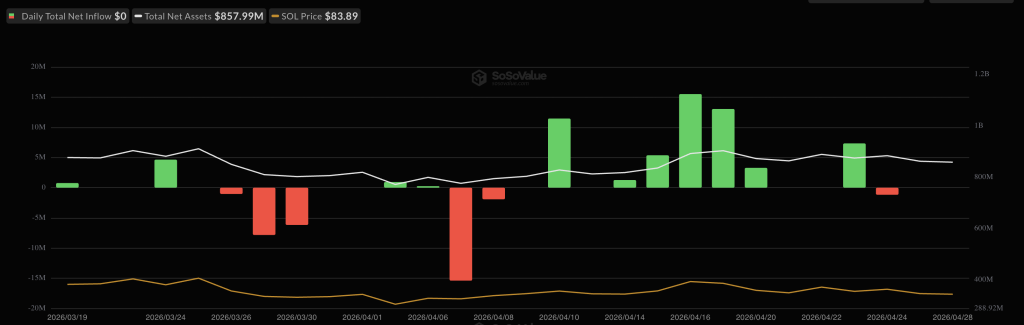
Solana price slipping under $85 matters more than it looks, because that level was acting as short-term support, and losing it shifts control toward sellers.
Momentum is weakening. RSI is drifting lower toward oversold, and MACD is still negative, which shows buyers are not stepping in with strength yet.
The key problem is overhead resistance. The $86–$88 zone is now a ceiling, and SOL has already failed to reclaim it multiple times, which reinforces the bearish pressure.
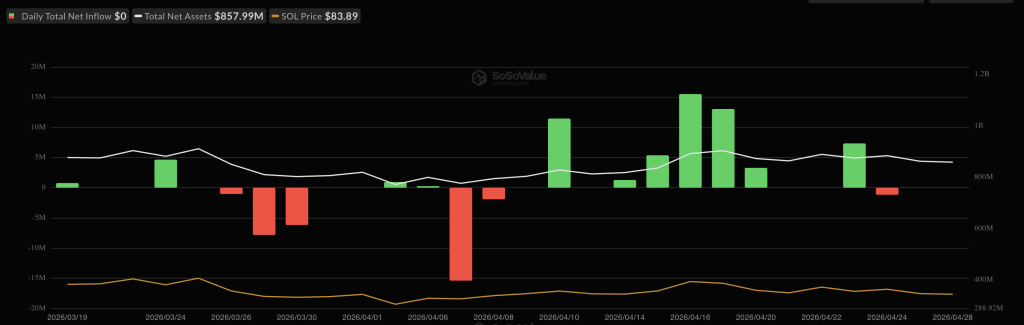
On top of that, flows are not helping. ETF demand is weak, and declining social activity points to fading attention, which usually leads to slow, extended consolidation rather than quick recoveries.
Discover: The best pre-launch token sales
Can Solana Price Reclaim $90 or Does the Channel Floor at $77 Open Next?
SOL is stuck inside a descending channel, and right now it is just compressing between roughly $84 and $86 with no real direction.
The key level is $86.3. If SOL can close above it, that is where the structure starts to shift and opens a move toward the mid-$90s.
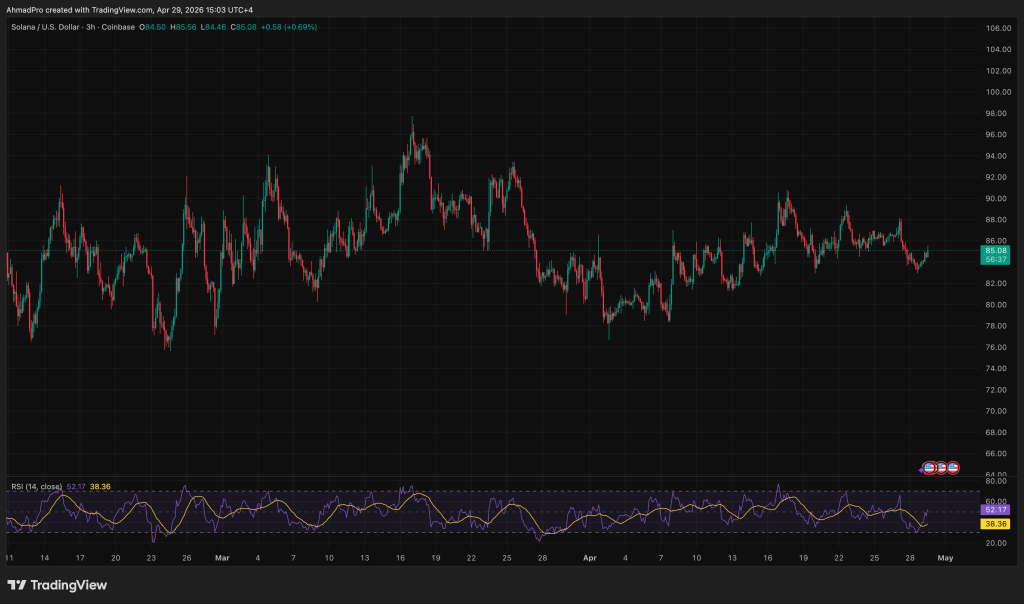
Below, $84 is the short-term support, but the real level is $80. If that breaks, downside opens quickly toward the mid-$70s.
Right now, the most likely outcome is more sideways movement between $81 and $87 while the range tightens.
So this is a compression setup, and the move will come from a break of either $86 or $80, not from inside the range.
Explore: Top cryptocurrencies worth watching right now
The post Solana Is Failing to Reclaim $86 as ETF Flows Dry Up: Is the Channel Floor at $77 the Next Stop? appeared first on Cryptonews.
MoonPay Launches Institutional Unit After Sodot Acquisition

Sydney Sweeney’s Circle React To ‘Devil Wears Prada 2’ Snub

FA Cup final referee announced with assistant to make history at Wembley

Manchester United reach agreement with Casemiro over contract clause amid transfer speculation

US brings back mandatory military draft registration

Steven Gerrard disagrees with Gary Neville over ‘shock’ Chelsea and Arsenal claim | Football


-

 Tech2 days ago
Register Renaming | Hackaday
-

 Fashion5 days ago
Weekend Open Thread – Corporette.com
-
 Crypto World4 days ago
Hyperliquid $HYPE Rally Builds Momentum as AI Sector Enters Prove-It Phase
-

 Politics7 days ago
Making troops accountable for war crimes threatens US alliance, ex-SAS colonel warns
-

 Politics7 days ago
Disabled people challenge government SEND proposals over segregation concerns
-

 Business6 days ago
Patterson-UTI Energy, Inc. (PTEN) Q1 2026 Earnings Call Transcript
-
 Sports3 days ago
IPL 2026: Ruturaj Gaikwad registers slowest fifty of the season, enters all-time unwanted list | Cricket News
-

 Politics2 days ago
Drax board avoid their own AGM, accused of greenwashing & environmental racism
-

 Politics7 days ago
Zack Polanski responds to home secretary’s taser threat
-

 Politics7 days ago
Starmer handler McSweeney to be dragged from shadows by Foreign Affairs Committee
-
Politics7 days ago
Wings Over Scotland | How To Get Away With Crimes
-

 Politics7 days ago
‘Iran is still a nuclear threat’
-

 NewsBeat3 days ago
LK Bennett closes all stores after entering administration
-
 Sports7 days ago
Tim Bradley names the current best in the world: “Better than Inoue and Usyk”
-

 Crypto World5 days ago
Michael Saylor says BTC winter is over. Market analyst disagrees, says bitcoin was in a pullback
-

 Fashion17 hours ago
Kylie Jenner’s KHY Enters a New Era with ‘Born in LA’
-
 Entertainment4 days ago
Mariah Carey Slams Deposition Claims In Brother’s Lawsuit
-
Business7 days ago
Altimmune prices $225 million public offering at $3 per share
-
Entertainment6 days ago
Michael B. Jordan and Austin Butler's “Miami Vice” movie will bring the action back to the '80s
-
Entertainment6 days ago
Russell Brand Had Sex With 16 Year Old When He Was 30
You must be logged in to post a comment Login