
Politics
EPH offices disrupted by 17 year olds



The Stop EPH Network’s international action days are seeing 13 protests taking place in seven different countries against fossil fuel giant EPH. The actions aim to shine a light on one of Europe’s top three carbon emitters.
On 28 April, five young people shut down the lobby of Byron House in London’s ultra-posh St James’s. They disrupted ongoing business with placards and drew attention to the resident company EP UK Investments. It’s the UK arm of Energetický a průmyslový holding (EPH).
Security locked three of the young people, two under 18, inside the building. They used force to keep them inside, take their placards and intimidate them.
This protest was against the expansion of unsustainable energy projects, exposing Czech fossil fuel giant EPH.
One of the young people taking part said:
EPH is one of the biggest CO2 emitters in Europe, yet they plan to continue expanding their coal and gas energy facilities.
Candy, 17, said:
EPH is putting profits over the planet by finding loopholes in just transition agreements.
Megan, 24, said:
EPH is one of the top three carbon emitters in Europe, but until now has remained relatively invisible to the public due to confusing structure, creative accounting and greenwashing. We are here to change that.
Lily, 17, said:
The security used intimidation tactics, locking us inside the building and claiming to have power over us. We refused to be intimidated, and will continue to expose EPH and Daniel Krětínský for destroying our futures and communities across Europe.
EPH is one of the biggest companies in Czechia, owned by billionaire Daniel Krětínský. It owns coal fired power stations in Czechia, Slovakia, Italy, and Germany. It claims to be moving mostly away from coal.
EPH owns Kilroot, in the North of Ireland, which was the UK’s penultimate coal power station. And it has gas infrastructure in Italy, France, Germany, Netherlands, UK, Slovakia, and Czechia.
Krětínský added the UK’s Royal Mail to his collection of companies in 2025. He’s also faced scrutiny for economic ties with Russia due to owning one of the main gas pipes from Russia to Europe (EUstream).
Featured image supplied
By The Canary



Under Zack Polanski, the Green Party has nearly quadrupled its membership while simultaneously leapfrogging Labour in the polls. Regardless of what you think of him, you have to acknowledge Polanski is a savvy political operator.
To tackle this political wunderkind, the Labour Party has dispatched Steve Reed — a man who’s essentially a sentient brick with a haircut. Reed has decided to go after Polanski by repeating the same attack lines over and over; attack lines which have shown no signs of resonating with voters and probably never will.
Polanski, meanwhile, is hitting back by reminding everyone that Reed is the absolute last person to making any sort of point about anything.
— Zack Polanski (@ZackPolanski) April 28, 2026
The cynical accusations of antisemitism are something the Labour right began playing around with under Corbyn. As you can see, however, Reed is not best placed to make such claims.
Polanski and pointless questions
As the Canary reported this week, the issue wasn’t that Polanski ‘wouldn’t answer questions’, as Reed suggested. The problem was Polanski was doing news shows to discuss the local elections, and interviewers kept asking him about breasts and the Royal Family.
.@ZackPolanski is asked, is it official green party policy to abolish the monarchy?
Sensible answer. pic.twitter.com/QWKMK9y8wy
— Saul Staniforth (@SaulStaniforth) April 27, 2026
So #GMB spent their entire interview with @ZackPolanski asking him about policies that aren't Green party policy & aren't in the manifesto for Mays elections, along with a story from the scum about Zack before he was a politician
Zack: "This is why people hate the media" — Saul Staniforth (@SaulStaniforth) April 27, 2026
 pic.twitter.com/nuphPCF8fY
Do the local elections not matter? The mainstream British media seem to think they don’t.
The Green Party could be offering real solutions to local problems, but the public will never know because nobody on the telly bothered to ask.
The British media openly disdains everyday citizens outside of London and the refusal to engage with local politics exemplifies that.
Steve Reed, the anti-Polanski minister
Now, back to Reed. Polanski isn’t the only one using his post as an opportunity to highlight how wretched this guy is.
If only @SteveReedMP would also step up and take accountability for his efforts (or lack of) to abolish leasehold. Perhaps Polanski should also hypnotise you to grow some balls, so you can stand up against vested interests and your donor buddies. https://t.co/KoKHiPD1dA
— Leasehold Hostage (@endleaseholduk) April 28, 2026
This next one is in reference to Reed being the housing minister (or was the housing minister, but anyway, he now seems to be the anti-Polanski minister?).
You have tough questions to answer regarding your lack of progress on the building safety crisis.
Less Twitter, more progress! https://t.co/PvlUx6NXe9
— Dan Bruce (@dannybster) April 29, 2026
Nothing going on
Many pointed out what we did, namely that Labour has very little substance when it comes to attacking the Greens.
The fact they have to keep repeating this same, tired old attack line only reinforces the fact that Labour MPs simply have no valid challenge against @ZackPolanski or @TheGreenParty policies. — Anne Greensmith
It really is beyond pathetic…and very boring. https://t.co/9Yqt179dsS
 (@snowleopardess) April 28, 2026
It seems Labour’s attacks aren’t working. Or, to be completely fair, the Green Party is doing well despite them.
Potentially things would be even worse if Reed wasn’t banging on about ‘boob hypnotherapy’ every five minutes. Perhaps if he gave up, Labour would be set to lose all of its seats in the upcoming local elections and not just most of them:
Median estimate via @Moreincommon_, April '26 pic.twitter.com/OFxPMxmoUV
— Stats for Lefties
 Projected net changes for local elections:
 Ref +1,437
 Grn +926
 Lib +327
 Con -627
 Lab -1,738

 (@LeftieStats) April 21, 2026
Featured image via X/ Barold
By Willem Moore


The Labour government’s ‘one in, one out’ migrant policy faces a major legal challenge in the High Court for violating human rights laws.
The court has heard that the Home Office’s decision to ban modern slavery appeals is a violation of human rights laws.
Previously, it was the case that if the Home Office rejected a migrant’s human trafficking claims, they could then ask for a review of the decision. Crucially, the appeals would typically overturn the rejection — recognising the migrant as a victim of modern slavery — in almost 80% of cases.
However, home secretary Shabana Mahmood, changed the modern slavery guidance in September 2025. She removed the right for a migrant to appeal the Home Office’s decision before they’re deported. Instead, Mahmood’s department argues that they can apply for help in France.
Should the High Court case be successful, it would massively impede the speed at which Mahmood can deport people under the ‘one in, one out’ scheme.
Asylum policy and ‘institutional disregard’ for evidence
Six migrants, all of whom have made human trafficking claims in the UK, brought the case to the High Court, the Independent reported. All six had previously arrived in the UK on small boats over the course of 2025.
The Home Office acknowledged one individual, known as AYA, as a victim of modern slavery. A last-minute court injunction blocked the deportation of another claimant, known as EXR.
However, as a result of the new asylum policy, three of the six were removed to France.
The claimants’ barrister, Sam Grodzinski KC, argued before the court that the UK system would only be lawful if it “identifies the paramount importance of identifying victims [of trafficking] correctly”.
However, Mahmood’s new policy shows an “institutional disregard of potentially relevant evidence”. As such, it fails to conform to either the Council of Europe Convention on Action against Trafficking (ECAT) or the European Convention on Human Rights (ECHR).
Claims should be ‘properly investigated’
Grodzinski highlighted that, according to 2025 government data, the overwhelming majority of appeals recognise migrants as victims of trafficking. He told the presiding judge, Justice Sheldon:
Individuals have a fundamental right under ECAT to have their claims properly investigated.
The barrister argued that the Home Office questions many migrants within hours after they arrive on small boats. Often, they’re confused and disoriented, and cannot understand the questions they’re being asked. As such, it’s unsurprising that they don’t communicate their history of human trafficking immediately.
Grodzinski added:
Victim identification is a process that takes time; it can’t be done speedily, not if it is to be done properly.
In its defence, the Home Office stated that it has made provisions for “exceptional circumstances” in which it might reconsider modern slavery rulings.
However, Grodzinski highlighted that these circumstances aren’t actually communicated to caseworkers. Likewise, such exceptional challenges usually only take place when the Home Office is threatened with significant legal action.
Age-disputed asylum seekers
The Home Office also argued that deportees can apply for support as victims of trafficking in France.
This latter point typifies the modern Labour attitude to asylum seekers in a nutshell. Figuring out whether the UK has an obligation to a trafficking victim might impede the ability to deport them. As such, the government simply chooses to ignore crucial steps in modern slavery decisions.
In a similar case, the Home Office recently landed itself in hot water over its failure to accurately determine whether migrant detainees were children.
Using freedom of information requests to local authority children’s services, the Independent Humans for Rights Network found that, in the seven months since ‘One in, one out’ began last September, the Home Office has detained 76 ‘age-disputed’ children.
The Home Office treats these individuals as adults for the purposes of detention and deportation. However, social workers later determine them to be children. Twenty-six of the ‘age-disputed’ group had either been reassessed as children by Social Services or were in the process of being, the Guardian wrote.
Meanwhile, 11 kids were waiting for an age assessment. The Home Office had already forcibly deported 13 to France. Damningly, one child was confirmed to be a minor after being forcibly deported.
Home Office closes its eyes and covers its ears
Just as in the modern slavery case, the Home Office closes its eyes and covers its ears, and pretends it heard nothing. Then, it lets France sort out its mess.
In the name of expediency, Labour has willfully ignored its duty to investigate human rights claims. However, our government doesn’t get to claim ignorance after removing a migrant’s right to appeal.
Mahmood and her cronies knew full well what they were doing. They simply thought they could get away with it.
Featured image via the Canary
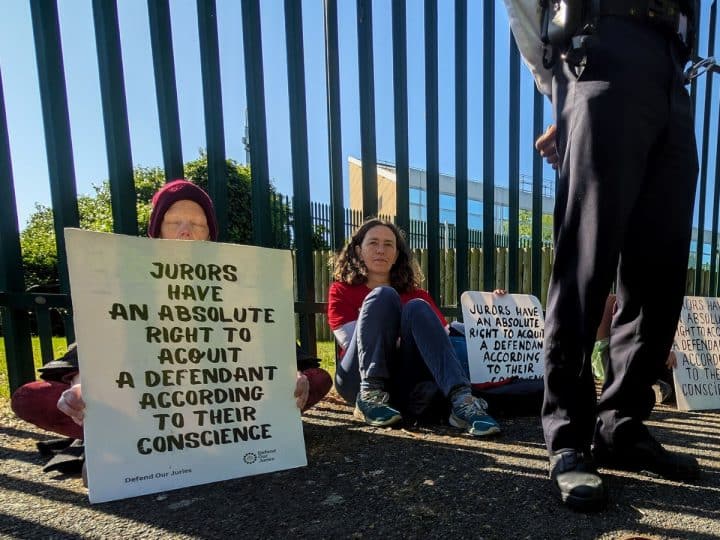

For a third time over the last week the Met police have made arrests outside Woolwich Crown Court of people holding signs communicating the principle of jury equity. The group of six people arrested on 29 April were sitting peacefully displaying the signs:
Jurors have an absolute right to acquit according to their conscience.
And:
Even without legal defence jurors can still acquit on conscience.
Meanwhile inside Woolwich Crown Court, there has been a shocking development in the Filton case. Five of the six defence barristers have left the trial following judicial rulings which cannot be reported until the end of the trial.
A spokesperson for Defend Our Juries said today:
In recent years we have seen judicial rulings that banned climate campaigners from saying the words ‘fuel poverty’ and ‘climate change’ in their trials.
Today we understand a judicial ruling has been given that goes even further, and as a response the legal professionals representing five of the six defendants on trial in the Filton case have no choice but to leave the trial because they have been left with literally nothing they can say in closing arguments.
We should all be alarmed to hear that the legal process has been so corrupted that, today we have lawyers in the UK walking away from a trial because it is impossible for them to do their job of defending their clients.
The trial of the first six defendants from the group known as the ‘Filton24’ has reached the stage of closing arguments. Five of the six defendants will now be giving their own closing speeches as they have no legal representation.
In her closing address to the jury today, defendant Charlotte Head said:
Sadly, despite how unbelievably kind and smart and wise my barristers are, after some decisions made by the court, I no longer feel like they are permitted to represent me in a way that does us all justice. So I’ve had to represent myself.
I recently found out that it wasn’t until 1898 that a person who was charged with a crime in the UK could speak to the jury under oath during their trial…
Under those conditions, me and my co-defendants would have had to sit quietly in the dock and await our fate, unable to tell you in our own words who we were and why we were sitting before you.
I was unsurprised to learn that, in 1898, when the first person was allowed to answer the charges they faced from the witness box and testify to their own defence, many people, including prosecutors and judges, were worried about what would happen.
Not because they feared that the defendants would lie but because they feared the jury sympathising more with normal people than the elites of the legal profession.
A long time has passed since then but it might be said that some prosecutors and judges still share that fear. A fear of the jury’s ability to be compassionate, to question the motives and integrity of the state, and to act as a barrier to the outcomes they want to achieve – namely to convict defendants…
They are frightened that you will listen to us, the defendants, when we talk to you and afraid of the power you hold as a jury. It’s entirely possible you may be one of the last juries to get to make decisions in a case like this before even that right is taken away from ordinary people.
17 arrests outside Woolwich Crown Court
Today’s arrests outside Woolwich Crown Court bring the total number of people arrested outside the court this week to 17.
Today’s arrests were made under the charge of Aggravated Trespass whereas the previous 11 arrests related to an alleged breach of Section 14 of the Public Order Act 1986.
It is understood that the change in the police’s approach to their powers of arrest may be because neither today’s, nor the two previous actions outside Woolwich Crown Court were in breach of the terms stated by the police as justification for the Section 14 being in place, namely, to prevent noisy demonstrations taking place within a one mile radius of the court.
This week’s sign-holding actions, as with all Defend Our Juries sign-holding actions, were held as a silent vigil. The grounds for arrest this week appear to be a cynical attempt to bypass the terms of the High Court ruling in Warner.
Featured image supplied
By The Canary


Last week, Maurice Glasman – the peer who supplied Blue Labour with its intellectual architecture – told the Telegraph that Keir Starmer “cannot conceivably continue” as Prime Minister. The remark was reported as a defection. It is more accurately read as a development inside a faction that has shaped the post-Corbyn Labour Party for the better part of a decade.
As previous Canary coverage of the Mandelson scandal has shown, the moment is one in which the assumptions of the present Labour government are being re-examined across the parliamentary party. Blue Labour’s relationship to that re-examination is now central to it.
An ascendant faction
Blue Labour has been close to the Starmer project since well before the 2024 election. Around twenty MPs now sit in its loose parliamentary caucus. A wider circle of advisers, journalists, and policy figures also move within its orbit. Its arguments – on family, faith, place, immigration, and the limits of liberalism – have given the soft-left of the parliamentary party much of the language it now uses to describe its own discontent.
The wider cultural moment has helped. A prevailing zeitgeist of disillusionment with the excesses of progressive ‘woke’ politics has supplied the faction with a popular grammar for arguments it has been making, in more academic registers, since its founding.
Blue Labour presents itself as the carrier of an older Labour tradition – post-war, ethical, communitarian – that the Fabian and Marxist currents are said to have crowded out. The cultural drift it expresses is real; the disillusionment that carries it is not without cause, and the parliamentary footprint it now commands is more substantial than that of any other distinct intellectual current within the present Labour Party.
A theological refoundation
The intellectual substance sits at a deeper level than the cultural commentary suggests. In The Economics of the Common Good, Glasman reaches past the standard sources of British socialism to Catholic Social Thought, and specifically to the 1931 papal encyclical Quadragesimo Anno. He quotes Pope Pius XI:
Capitalism violates right order whenever capital so employs the working or wage-earning classes as to divert business and economic activity entirely to its own arbitrary will and advantage without any regard to the human dignity of the workers, the social character of economic life, social justice and the common good.
From this premise, Blue Labour derives a theoretical break that distinguishes it from most of the British left. Classical social democracy and the Marxist tradition, on Glasman’s reading, share with their pro-capitalist antagonists a single underlying machinic outlook – one that denies the humanity of workers and treats them as mere factors of production.
Against that, the faction proposes labour as a moral good. Work is “received from the past and oriented towards the future”. The workplace becomes a site of meaning rather than of exchange. Labour is to be conditioned, in Glasman’s phrase, so as to “constrain capital and promote virtue”. Interconnecting systems of fealty, obligation, and mutual patronage are what make the working class.
The Labour Party itself, on this picture, is reconceived as a locus of tradition – something closer to a Church than a parliamentary vehicle. It is, by some distance, the most ambitious attempt to reconstitute British socialism on theological ground in a generation.
What it means in practice
The question that follows is what any of this means in real terms, in the real conditions of the present economic arrangement.
Here the project sits in an interesting position. Blue Labour’s public narrative locates the difficulties of contemporary British politics in moves made by other tendencies: by New Labour’s market liberalism; by the Corbyn movement’s identity politics; by the Starmer leadership’s lack of conviction.
Yet the faction has also been close to the centre of the current settlement, and supplied much of the intellectual texture for the operation that consolidated the party after 2020. The leader whose continuation Glasman now disputes is the same leader whose ascent the faction’s arguments did much to legitimise. How the project navigates that proximity is one of the open questions of its second decade.
The deeper question concerns the tradition Blue Labour claims to recover. The post-Fabian interregnum within which British politics has been suspended is not the consequence of a wrong turn taken by a single tendency. It is a longer pattern – one in which the working class has been treated, across the major currents of British socialism, as an object to be administered by an elite.
Catholic Social Thought is a serious philosophical resource, and the vocabulary it imports changes the texture of the argument. Whether it transforms the underlying relation between the party and the people it claims to represent is a separate, and considerably harder, question.
The shared inheritance
What the faction shares with its loudest critics on the parliamentary left is, on closer inspection, more substantive than what divides them.
The hostility Blue Labour generates is often presented as a quarrel about ends. It can also be read as a quarrel about idiom – about whether the same instinct toward discipline and direction should be expressed in the language of flag and faith, or in the language of progressive administration. Both inheritances belong to a tradition that has, in its various phases, treated the dignity of labour as something to be conferred from above as much as constituted from below.
Within its own terms, Blue Labour is on a marginal ascendency. Twenty-odd MPs is not nothing, and the cultural moment in which the faction’s ideas have begun to find their wider audience is unlikely to recede in the immediate future. Whether the project becomes a refoundation of British socialism – or a redecoration of it – is the question its second decade will answer, and the answer will tell us a great deal about where the British left is heading next.
Featured image via Sky News
Politics
CONTENT WARNING: Shocking video captures Israeli settler running over schoolgirls in Palestine


In a horrific and seemingly deliberate attack on Monday, a car driven by an Israeli settler ran over three schoolgirls in Palestine.
The attack was perpetrated in Tarqumiya, Hebron, in the occupied West Bank, where settlers continue to rampage.
The three victims have been hospitalised with serious injuries and at least one of the girls is in critical condition, it has been reported.
Police in Palestine seized the vehicle, which crashed shortly after the crime, and arrested the driver. However, the Palestinian Authority is not allowed by the occupation to prosecute Jewish Israelis. Meanwhile, the Israeli authorities have an appalling record of impunity for criminal settlers.
Settler violence against innocent Palestinians in the occupied West Bank has been high for decades, but has escalated dramatically since the occupation regime began its genocide in Gaza. At least three other teenagers in the West Bank were murdered in the past week in separate incidents.
Featured image via WhatFingerNews
By Skwawkbox

Ali Ahmadi, Catherine Barnard and Fiona Costello argue that government plans to revoke the duty to provide support to destitute asylum seekers will probably not significantly reduce costs or deter new arrivals but could push even more asylum seekers into destitution and illegal work.
Under the current 2005 Asylum Seekers (Reception Conditions) Regulations, the Home Office has a statutory duty to provide support (i.e., accommodation and financial help) to destitute asylum seekers. However, from June 2026, the government will revoke this duty and revert to a discretionary power under the Immigration and Asylum Act 1999. A duty means the Home Office must provide support if the legal criteria are met, while a power means the Home Office may provide support, giving it more choice about whether and how support continues.
This change is intended to reduce the numbers who can claim asylum support. According to the Home Secretary, the support will be conditional and reserved ‘only for those who play by our rules’. Under the new system, support will be denied to those who work illegally, have the right to work, ‘have the ability to support themselves,’ or break the law. This change (part of the Home Secretary’s Restoring Order and Control Policy) aims to cut costs, deter asylum seekers, and ensure compliance.
What difference, if any, will this change make in practice?
It is in fact difficult to answer that question, in part due to lack of current data. We do not know, for example, how many of the 107,000 asylum seekers currently receiving support will fall into the category of those whose support can be withdrawn.
Take the case of those with a right to work. In the year ending June 2025, 37% (41,100) of asylum seekers had previously arrived on a visa (e.g. work or study). Under current rules, if a person claims asylum before their existing visa expires, their visa conditions (e.g., right to work) are automatically extended until an initial decision is made on their claim. Recent data revealed that about 17,500 people are living in asylum accommodation after arriving on a visa and it is thought that about 8,500 of them have visas with a right to work.
Around 21,000 asylum seekers may have the right to work because they have been waiting more than 12 months for their asylum claims. The Home Office does not publish data on the number of asylum seekers actually granted permission to work. However, they are limited to jobs on RQF level 6 and above (graduate-level roles) of the Skilled Occupations (such as doctors, lawyers, software developers). One NGO survey reported that only a small number of asylum seekers can find jobs due to these restrictions. Many asylum seekers lack UK-recognised qualifications, fluency in English and/or the professional network to secure such jobs. Even experienced refugee and asylum seeking healthcare professionals struggle to find jobs in the NHS despite initiatives to support their inclusion.
Given this, the permission to work remains largely symbolic, and without unrestricted work rights (as recommended by the Commission on the Integration of Refugees), the policy of removing asylum benefits from this group risks creating a class of asylum seekers who are neither supported nor employable. This risks making them destitute. Any enforced destitution would be contrary to article 3 of the European Convention on Human Rights (ECHR) which prohibits torture and inhuman or degrading treatment. The ECHR is given effect in the UK by the Human Rights Act 1998. It is well established that denying asylum seekers food, shelter, and basic needs can breach the article 3 threshold.
The new policy also risks pushing asylum seekers further towards illegal work (and exploitation), and/or turning to food banks and third sector organisations for their basic living needs. It might also exacerbate asylum seekers’ mental and physical health with long term consequences for them and the NHS. So this would shift rather than reduce costs. Illegal working would, of course, make it even more likely that asylum support is removed.
Another area where data is lacking is as to how many asylum seekers commit crime and/or work illegally. The Ministry of Justice does not record crime data by immigration status nor is there a breakdown of illegal working arrests. The Home Office announced that in 2025 about 9,000 illegal working arrests were made, ‘some of which were asylum seekers.’
The Home Office will also withdraw asylum support from those with the ‘ability to support themselves’. This is something of a puzzle as asylum support is already means-tested. It is available only to those who are destitute (or likely to become so within 14 days). The Home Office indicated that asylum seekers’ assets such as jewellery, cars, and e-bikes could be taken to contribute towards their accommodation cost. It is difficult to know how many asylum seekers hold such valuables and the extent of their potential contribution to asylum cost, but it is expected to be negligible as most asylum seekers meet the destitution test which already requires them to disclose their assets.
According to the Home Secretary, the UK’s ‘generous’ asylum offer is a pull factor, encouraging more asylum seekers to head to the UK. However, research shows that restrictive asylum support and employment bans have a ‘modest’ or no impact on arrivals. As we have discussed before, asylum support is already minimal and many asylum seekers rely on the third sector and illegal work for their basic necessities.
To conclude, the shift from duty to power will probably not significantly reduce costs, deter new arrivals or promote compliance. It may push even more asylum seekers into destitution and illegal work. And individual decisions under the discretionary power could be subject to judicial review, particularly on grounds of unfairness, irrationality or incompatibility with human rights. As we have argued before, a better option would be an earlier and broader access to work that would save billions for the Home Office, improve wellbeing, and promote long-term integration.
By Ali Ahmadi, Research Associate, University of Cambridge and PhD student at Anglia Ruskin University, Catherine Barnard, Senior Fellow, UK in a Changing Europe & Professor of EU Law and Employment Law, University of Cambridge and Fiona Costello, Assistant Professor, University of Birmingham.
Sarah Stook is a Beat Reporter for Elections Daily and has written for a number of online publications.
‘Therefore, I shall resign the Presidency effective at noon tomorrow. Vice President Ford will be sworn in as President at that hour in this office.’
When President Richard Nixon gave his landmark resignation speech on the 8th of August 1974, it sent shockwaves around the United States. Never before had a president resigned.
Eight had died in office, but none had resigned, even in the toughest of circumstances. In the fifty-two years since, no president has done it again. Not Ronald Reagan during the Iran-Contra Affair. Not Bill Clinton during the Lewinsky Scandal. Not Joe Biden during the speculation about his health.
Compare that to the United Kingdom.
Five PMs have resigned this century- Tony Blair, David Cameron, Theresa May, Boris Johnson and Liz Truss. At the time of writing, it looks like a sixth resignation may come in the form of the beleaguered Keir Starmer. The PMs who did not resign- Gordon Brown and Rishi Sunak, did not even finish a full prime ministerial term. Indeed, David Cameron was the last to make it a full five years, and that was a decade ago.
The question remains: what can a PM do to last a full five years, or at least make it to the next election?
It is a puzzling question to say the least, for it requires a sustained level of popularity that seems to elude the men and women of Downing Street. Both Johnson and Starmer led their parties to electoral landslides, yet the spectre of unpopularity did not take long to appear. Even Margaret Thatcher, Prime Minister for eleven years and the entirety of the 1980s, had to face the music and leave. We can perhaps understand the case of Mrs. Thatcher, as she did see three elections in her time, but it was three years for Johnson and could be only two for Starmer.
To answer, we must perhaps look at the reasons why PMs have resigned.
For some, it was a result of health reasons- Winston Churchill suffered a severe stroke and Harold Macmillan suffered illness, though truthfully he would have probably been forced out anyway. For others, it was that they were simply exhausted – exit stage left, Harold Wilson.
These sympathetic reasons have not been the case for nearly forty years. Margaret Thatcher became increasingly unpopular within her own party, and the Poll Tax certainly helped finish her premiership off. Of the five PMs who have resigned this century:
- Tony Blair– a number of factors contributed to Blair’s record unpopularity, such as the Iraq War and hostility within his own cabinet. He left in June 2007, handing the premiership and Labour leadership to Gordon Brown in what was essentially a coronation.
- David Cameron – was on the losing side of the European Union referendum. Resigned believing he no longer had a mandate.
- Theresa May – her draft withdrawals from the EU were thrice defeated, the party performed poorly in the European elections and the Conservatives wanted to boot her out. Jumped before she was pushed.
- Boris Johnson – Johnson’s premiership went into freefall in 2022. The loss of two by-elections, the Chris Pincher scandal and mass resignations forced Johnson’s hand. He announced he would resign once a new leader was decided in September.
- Liz Truss – Truss’ short premiership saw her oversee the death and funeral of Elizabeth II and a mini-budget so unpopular that she fired her Chancellor. She left office and became the shortest-serving PM ever, lasting only fifty days.
With the exception of David Cameron, who it can be argued could have remained, the rest were essentially forced out by their own party and public unpopularity. Many Prime Ministers are unpopular, but is it fair that it’s essentially down to a few hundred MPs of their own party?
Well, that is the parliamentary system. It is a system of contrasts.
Prime Ministers are much more likely to be held accountable for their own failures, simply because the party holds more power than in a different political system. Truss found that out the hard way. Compare this to the American system, where presidents are not head of their party and are much less beholden to them. All presidents who have gone under impeachment hearings- Andrew Johnson, Bill Clinton and Donald Trump, have survived- indicted by the House, saved by the Senate. Is it because the president is Head of State, whereas the PM is only Head of the Government? Either way, that pressure is stronger in our nation than it is across the pond.
Still, that does not exactly help stability. When an American votes, it’s almost certain that their president will make it to the next election. The last time this did not occur was over fifty years ago. Meanwhile, we can go through Prime Ministers like we go through tissues during a cold.
That is, however, the price that we pay in a parliamentary system. It’s a system that priorities accountability at the risk of stability. Even then, it is still a stretch to say there is no stability, because the country hasn’t collapsed. Even if Parliament collapsed, we have a monarchy that has held firm since 1660- not even the Abdication Crisis of 1936 could bring it down.
This article is assuming that Keir Starmer is probably not going to make it until 2029. Even if he does- and I will eat my hat if he does- there will be a number of PMs in my lifetime that don’t. If he does make it to 2029 in one piece, I will have seen eight prime ministers in thirty-one years of life, compared to five US Presidents (assuming Trump finishes this term), four of whom will have served two full terms. It’s a remarkable contrast, even if we aren’t quite as trigger-happy about elections as Israel or Australia are.
This once again begs the question: what can a PM do to stay a full five years?
Well, it seems that he or she needs to be scandal-free, or at least able to keep their head during hard times.
They must also remain generally popular.
Scandal-free is stretching it, but it is probably harder to remain generally popular.
A PM could manage world peace, but someone is not going to like him. Some issues remain too fragmented. One only has to look at how divisive the Israel-Palestine Conflict is, with the pro-Palestine crowd and Muslims in particular looking away from Labour to the tantalising Green Party. Both major parties are hemorrhaging votes to Reform, and Reform are slowly losing support to Restore. Theresa May promised strong and stable leadership, but can such a thing exist in these fractured times?
In America, no president will probably ever reach George W. Bush’s 90 per cent approval rating following 90 per cent.
I’d wager that it is no different over here.
If a PM wanted to get a 90 per cent approval rating and keep it across at least four or so years, they would probably need to either bring back Woolworth’s Pick and Mix or ban VAR. I don’t see either of those things happening, and I’m thus still searching for success in a parliamentary system.


The Department for Work and Pensions has confirmed that disabled Universal Credit claimants going back into work will still face benefit reassessments. This is despite the ‘Right to Try’ scheme promising that reentering work will not trigger reassessment.
The DWP made a huge fanfare announcing the ‘landmark legislation’ that would mean:
Entering employment will not automatically trigger benefit reassessment for claimants on new-style Employment and Support Allowance, Personal Independence Payment, and Universal Credit health element.
This is supposed to alleviate disabled people’s fear that starting work would mean they lose their benefits. While PIP is not an out-of work benefit, starting a job could count as a change of circumstance. It could essentially signal, in the DWP’s eyes at least, that your disability has miraculously gotten better.
The Right to Try policy would, they claim, mean this doesn’t happen. It would basically just be a line inserted into different change of circumstances legislation, which says:
Doing work for payment or in expectation of payment, or doing voluntary work, is not a relevant change of circumstances.
However, as Benefits and Work discovered, this isn’t true. In a memo to DWP staff, the department explained that nothing is actually changing:
Previous guidance and policy for WCA reassessment and PIP award review does not refer to work, or voluntary work, as being a reason in itself to trigger a reassessment or award review.
DWP demonising disabled people even further
So what’s the fucking point? If that rule isn’t changing, it means the reassessment policy isn’t actually changing.
The memo continued to say that while, by starting work, the claimant won’t trigger a review automatically, it will if a DWP decisionmaker decides they want to do one anyway.
It continued:
The Secretary of State retains discretion to reassess entitlement to one of these benefits for other reasons (for example, a change in condition, improvement in functional ability or suspected fraud) which could be indicated, for example, by undertaking work of a particular nature.
So basically, if the type of work a disabled person chooses to do causes a not-medically-trained assessor to question their disability, they can be reassessed.
In theory, the only reason a reassessment should be triggered under this new legislation is if the DWP suspected fraud. But when they’re the ones deciding who’s committing fraud or not, it’s hard to see how this would reassure anyone.
This is particularly troubling in the current climate where the DWP is trying to prove many conditions such as ADHD, autism and anxiety are over-diagnosed. Just this week, the shady Tony Blair Institute have got the shitrags frothing with policy that would mean those conditions would be classed as ‘non-work-limiting’.
Disabled people are damned if they do and damned if they don’t – and that’s the whole point
A further memo from the DWP to decisionmakers has fully confirmed that this will be the case.
It told Universal Credit staff:
When notified that a claimant is working, DMs [decisionmakers] should continue to consider whether the nature of the work undertaken might indicate that a change in functional ability has occurred. Where this is the case, a determination can be made that a further WCA should be carried out in order to consider whether the claimant continues to have LCW or LCWRA.
For PIP claimants, while they don’t have to report a new job to the DWP, they do technically have to report anything that could mean their entitlement changes.
The example given in the memo is someone who says they can’t travel without assistance but has gotten a job that requires frequent travel. What’s missing here is that the decisionmakers don’t know if the person will have assistance to travel – they’re just assuming they won’t.
However, with the way the DWP is also absolutely decimating Access to Work, that person may have to travel unaided. Not only is Access to Work being cut, but they also have a horrific backlog of over 66,000 people waiting. On top of that, the department confirmed there will be no extra provision for the increased demand that will come from how many more disabled people will be forced into work.
It’s absolute absurd that, whilst the DWP is trying to force so many disabled people into work, they are the ones making it harder with their actions. But it’s becoming increasingly clear that the department doesn’t give a fuck about actually supporting disabled people into work. They just want the public to think they are, so it’s easier to turn the public against us and make it easier to cut benefits.
Featured image via the Canary


Alliance Party member John Blair has introduced a Stormont bill to ban the “cruel and inhumane” practice of fox hunting in the Six Counties.
Alliance also announced the move on Facebook.
These figures are comparatively consistent in urban and rural areas of NI.
Fox hunting: Rural voters back ban on cruel ‘sport’
This mirrors similar figures in the south of Ireland. After a poll showed 68% of rural voters wanted a ban there, Ruairí Ó Leocháin of Stand With Badgers, said:
Rural Ireland is tired of being falsely portrayed as supportive of this violence and rejects the suffering it inflicts on wildlife and the countryside alike.
The Countryside Alliance Ireland claims to “protect and celebrate the beauty and vitality of Ireland’s countryside”.
Leocháin cited the “routine destruction” caused by the barbaric so-called sport and the “displacement of protected wildlife”.
A previous Stormont vote on the issue failed in 2021 by a narrow margin of 45 votes to 38. That was partly the result of Sinn Féin whipping its MLAs to vote against it.
On this occasion that will be less likely. Last week the party voted at its annual Ard Fheis (conference) to back a ban on fox hunting. The vote took place at Belfast’s Waterfront Hall and will dictate party policy on both sides of the border.
Sinn Féin delegates at conference back ban too
Delegates rejected motion 28, which cynically tried to use Irish mythology to garner support for ripping defenceless foxes to shreds. It said:
…hunting in Ireland dates back thousands of years with Irish Mythology and examples such as Cu Chulainn the “Hound of Ulster” being defined by their hunting roles in Celtic lore.
Réada Cronin TD scoffed at this nonsense. She said:
I never expected to find Cú Chulainn on the clár [agenda] of our Ard Fheis. Cú Chulainn never put on a red coat and tally hoed after a fox on horseback with hounds.
That mindset, that entitlement was never part of our culture. Sinn Féin would never be the party that introduced fox hunting to Ireland but we must be the party to end it and send it back to where it belongs in our colonial past.
View this post on Instagram
Ann Graves TD took a similar line, quoting Oscar Wilde’s observation of:
The English country gentleman galloping after a fox: the unspeakable in full pursuit of the uneatable.
They backed motion 29, which described the fox hunting for leisure using dogs as:
unavoidably cruel and by necessity inflicts terror, exhaustion, irrevocable injury, and death on the foxes involved.
Shónagh Ní Raghallaigh TD called out the absurdity of describing the maiming and murdering of an animal as ‘sport’.
It is not a sport when the other team doesn’t know it’s playing.
Running for your life and enduring exhaustion and terror is indeed a very long way from play. Following the recent events at Stormont and the Waterfront, it will hopefully soon be a form of sadistic entertainment no longer available to these thugs on horseback.
Featured image via Pixabay/ Camera-man


New US CBS News boss and Israel fanatic Bari Weiss has removed the channel’s London bureau chief Claire Day for not being sufficiently pro-Israel. Day had clashed with Weiss over her coverage of Israel’s Gaza genocide and its US-backed war on Iran.
Like a ‘Hamas cell’
Weiss was installed to run CBS, despite a lack of experience, by its new Zionist owners – apparently because of her commitment to Israel. She promptly appointed or promoted pro-Israel presenters and staff. The excuse for the move on Day was a complaint from a freelance, evidently pro-Israel London cameraman that Day was running the bureau like a “Hamas cell”. Day was cleared of any bias but removed anyway.
As one insider told US press:
For Bari and Tom to discard her because she failed some undefined purity test is appalling.
Weiss has replaced Day with Shayndi Raice, a former Wall Street Journal Middle East correspondent based in Israel. Raice reportedly has no prior television or large-scale management experience. She takes up the post from 11 May 2026.
Featured image via CBS News
By Skwawkbox

BoT holds rate at 1%, cuts 2026 growth to 1.5% and 2027 to 2.0%

MoonPay Launches Institutional Unit After Sodot Acquisition

Sydney Sweeney’s Circle React To ‘Devil Wears Prada 2’ Snub

Manchester United reach agreement with Casemiro over contract clause amid transfer speculation

US brings back mandatory military draft registration

Steven Gerrard disagrees with Gary Neville over ‘shock’ Chelsea and Arsenal claim | Football


-

 Tech2 days ago
Register Renaming | Hackaday
-

 Fashion5 days ago
Weekend Open Thread – Corporette.com
-
 Crypto World4 days ago
Hyperliquid $HYPE Rally Builds Momentum as AI Sector Enters Prove-It Phase
-

 Politics7 days ago
Making troops accountable for war crimes threatens US alliance, ex-SAS colonel warns
-

 Politics7 days ago
Disabled people challenge government SEND proposals over segregation concerns
-

 Business6 days ago
Patterson-UTI Energy, Inc. (PTEN) Q1 2026 Earnings Call Transcript
-
 Sports3 days ago
IPL 2026: Ruturaj Gaikwad registers slowest fifty of the season, enters all-time unwanted list | Cricket News
-

 Politics2 days ago
Drax board avoid their own AGM, accused of greenwashing & environmental racism
-

 Politics7 days ago
Zack Polanski responds to home secretary’s taser threat
-

 Politics7 days ago
Starmer handler McSweeney to be dragged from shadows by Foreign Affairs Committee
-
Politics7 days ago
Wings Over Scotland | How To Get Away With Crimes
-

 Politics7 days ago
‘Iran is still a nuclear threat’
-

 NewsBeat3 days ago
LK Bennett closes all stores after entering administration
-
 Sports7 days ago
Tim Bradley names the current best in the world: “Better than Inoue and Usyk”
-

 Crypto World5 days ago
Michael Saylor says BTC winter is over. Market analyst disagrees, says bitcoin was in a pullback
-

 Fashion17 hours ago
Kylie Jenner’s KHY Enters a New Era with ‘Born in LA’
-
 Entertainment4 days ago
Mariah Carey Slams Deposition Claims In Brother’s Lawsuit
-
Business7 days ago
Altimmune prices $225 million public offering at $3 per share
-
Entertainment6 days ago
Michael B. Jordan and Austin Butler's “Miami Vice” movie will bring the action back to the '80s
-
Entertainment6 days ago
Russell Brand Had Sex With 16 Year Old When He Was 30
You must be logged in to post a comment Login