
Crypto World
DeFi Exploits Spur Builders to Harden Emergency Controls


Andre Cronje, the founder of Flying Tulip, argues that a large swath of what many call decentralized finance is no longer DeFi in the strict sense. In an interview with Cointelegraph, Cronje said many protocols have evolved into “teams running for-profit businesses” with upgradeable contracts, off-chain infrastructure, and formal operational controls rather than purely immutable on-chain code.
The shift, Cronje contends, alters the very security model of the space. Where early DeFi hinged on immutable smart contracts, newer systems increasingly rely on proxy upgrades, multisignature controls, infrastructure providers, and human response protocols. “I think what we have today, Flying Tulip included, is no longer DeFi. It’s not decentralized finance. It’s teams running for-profit businesses,” Cronje declared.
The remarks come as the industry confronts a wave of April exploits that broaden the security conversation beyond code audits to questions of operational risk. Flying Tulip itself recently introduced a withdrawal circuit breaker intended to delay or queue withdrawals during abnormal outflows. The move followed high-profile incidents involving Drift Protocol and a related restaking platform, Kelp, which together highlighted the scale of losses in the tens of hundreds of millions of dollars.
According to Cointelegraph’s coverage, the DeFi sector has grappled with losses estimated around $280 million for Drift Protocol and roughly $293 million tied to the Kelp scenario. These figures, while not the sole measure of risk, contributed to a broader debate about how to secure user funds in environments that blend on-chain mechanics with off-chain dependencies.
Crucially, the discussion centers not only on code but on governance, upgrade paths, and the resilience of the entire threat model—encompassing people, processes, and technology stacks that support deployed contracts.
Key takeaways
- DeFi’s security paradigm is expanding from immutable on-chain code to include upgrade processes, multisignature governance, and off-chain infrastructure as critical risk factors.
- Emergency controls such as circuit breakers are increasingly viewed as potential safety nets, but they raise concerns about centralization risk and the possibility of introducing new attack surfaces.
- Industry voices diverge on the right balance between automated safeguards and human intervention; the goal remains to minimize human-centric weaknesses while maintaining funds safety.
- Regulators and traditional finance observers see the evolution as a training ground for resilience, with upgrades and cross-project collaborations shaping a more robust DeFi ecosystem.
- Practically, users and builders should watch how governance, timelocks, and upgrade controls are implemented, and how these mechanisms interact with cross-chain interoperability and bridge security.
The evolving security landscape: from code to controls
In Cronje’s assessment, the DeFi world has shifted from a singular focus on auditing immutable contracts to considering who can alter code, how changes are approved, and whether timelocks or multisig approvals exist to guard against rash or malicious upgrades. He emphasized that audit checks are still essential but insufficient if a system’s governance and upgrade mechanisms can be exploited or manipulated by a compromised actor.
“The focus over all of the industry is still very much on the contract side and not sort of the more TradFi side,” Cronje told Cointelegraph. He pointed to recent exploits that leveraged traditional Web2-style weaknesses—infra access, social engineering, and other human-centered vectors—as evidence that security must extend beyond code audits.
To address upgrade risk, Cronje described Flying Tulip’s circuit breaker as a strategic pause rather than a permanent block. The aim is to “give us time to react” to abnormal capital outflows. The system is designed to pause withdrawals for a window—about six hours for Flying Tulip’s configuration, potentially longer for smaller teams with limited geographic distribution. He framed the circuit breaker as one layer in a multi-layered defense, alongside audits, timelocks, and distributed multisignature controls.
Still, industry voices varied on the desirability and design of emergency controls. Michael Egorov, founder of Curve Finance and Yield Basis, told Cointelegraph that recent incidents illustrate centralization risks and off-chain dependencies rather than pure contract bugs. He warned that a circuit breaker could itself become a vulnerability if the mechanism grants signers the power to alter code or freeze withdrawals in a compromised state.
Egorov argued for DeFi designs that can withstand shocks without requiring manual intervention. “The goal of DeFi design should be to minimize human-centric points of failure, not add to them,” he said. In his view, a resilient system should keep operating safely even when some actors are compromised, reducing reliance on privileged intervention.
Industry reactions: resilience, centralization, and the road ahead
The April incidents have also drawn involvement from traditional financial institutions. Standard Chartered published a note framing the Kelp episode as a signal of DeFi’s growing pains rather than a fatal flaw. The bank highlighted how the total lift in liquidity from the DeFi United coalition surpassed $300 million and noted ongoing upgrades—such as Aave V4 and the Ethereum Economic Zone—that aim to harden the ecosystem and reduce reliance on bridge-based cross-chain flows.
The bank characterized the heightened attention to decentralization and off-chain dependencies as a natural evolution for a space that remains early in its maturation. By incorporating these lessons, proponents argue, DeFi can improve operational resilience and user protection over time, even as the core codebase remains a critical focal point.
DeFi United’s fundraising activity—reported as over $321 million raised or committed according to the coalition’s site—illustrates a broader push to coordinate capital and governance in ways that strengthen defenses and liquidity for recovery scenarios. The big-picture takeaway for builders and investors is clear: risk management in DeFi is transitioning from a purely code-centric problem to a holistic program that blends on-chain security with robust governance, incident response, and cross-chain reliability.
What this means for builders and users
The shift Cronje describes has practical implications for developers, investors, and users. First, upgradeability introduces a new category of risk that must be mitigated with transparent governance, clear upgrade paths, and stringent access controls. Projects that rely on proxy patterns or admin keys will need to demonstrate robust disclosure and rigorous security reviews of their upgrade processes.
Second, the growing emphasis on operational risk elevates the importance of off-chain infrastructure and third-party dependencies. Audits can verify code correctness, but a compromised infrastructure provider or a successful social-engineering campaign can still endanger funds. This reality argues for diversified infrastructure, strict access management, and redundant systems to reduce single points of failure.
Third, the debate about circuit breakers highlights a tension between safety and centralization. While pause mechanisms can prevent cascading losses during extreme events, they also introduce a centralized layer that could be politicized or misused if not designed carefully. The consensus among many builders remains that any emergency control should be transparent, auditable, and have clear, time-bound constraints that limit abuse vectors.
For investors, these dynamics imply a recalibration of risk models. The strongest DeFi projects in the coming years may be those that demonstrate comprehensive governance architectures, robust migration and upgrade protocols, and explicit plans for incident response that minimize human-centric vulnerabilities while preserving user access and trust.
What to watch next
As the industry absorbs these lessons, observers will be watching how new security frameworks evolve. Expect continued experimentation with circuit breakers, time-locked upgrades, and multi-party governance, all aimed at reducing both on-chain and off-chain risk. Regulators and traditional financial actors will likely scrutinize governance processes and operational controls, seeking to codify best practices that can scale with the sector’s growth.
Readers should monitor how major DeFi protocols balance upgradeability with immutability, and how bridges and cross-chain infrastructure evolve to minimize single points of failure. The ongoing dialogue around resilience—covering code, governance, and operational risk—will shape which projects gain broader adoption and how quickly the sector can recover from future shocks.



A South Korean court overturned Bithumb’s six-month partial business suspension Thursday, according to Yonhap News.
The news agency cited legal sources, saying that the 2nd Administrative Division of the Seoul Administrative Court’s Judge Gong Hyeon-jin had accepted Bithumb’s application for a stay of execution on the same day it was presented. There was no clarification on whether a 36.8 billion won ($24.6 million) fine was also suspended. South Korea’s financial watchdog imposed the fine and suspension in March, alleging massive violations of local anti-money laundering rules.
Bithumb, one of South Korea’s largest crypto exchanges, filed a request with the court requesting it end the suspension and fine imposed by the Financial Intelligence Unit (FIU) in March along after the regulator said it discovered the exchange had committed millions of violations of the country’s anti-money laundering rules.
The sanctions stemmed from violations of the Act on Reporting and Using Specified Financial Transaction Information, the Financial Services Commission said in March.
The FIU said Bithumb committed about 6.65 million violations, of which 3.55 million involved failures to carry out required customer identity verification, while 3.04 million were related to cases where the exchange failed to properly block transactions that should have been blocked.
While the court ruling ending the suspension is good news for the exchange, it follows reports that South Korea’s Personal Information Protection Commission has initiated a probe into Upbit, Bithumb and other platforms regarding the sharing of order books with overseas platforms.
The case against Bithumb is part of South Korean regulators’ increased oversight of the cryptocurrency market. In 2025, the FIU handed Dunamu, the operator of the country’s largest exchange, Upbit, a three-month partial suspension and a 35.2 billion won fine for compliance gaps. Korbit, a rival platform, faced a smaller penalty of 2.73 billion won along with institutional warnings.
Bithumb was established in 2014 and currently ranks among the largest exchanges in South Korea by trading volume, according to CoinGecko data. The end of the suspension comes two months after Bithumb mistakenly distributed billions of dollars worth of bitcoin to users.


Latin American users have increased their reliance on stablecoins, with dollar-pegged tokens now accounting for a larger share of crypto purchases than Bitcoin.
Summary
- Stablecoins accounted for 40% of crypto purchases on Bitso in 2025, overtaking Bitcoin at 18% for the first time.
- Bitso said nearly 10 million users are increasingly using dollar-pegged tokens to store value and send payments in inflation-hit economies.
- Bitcoin remained in 52% of portfolios in 2025, with Bitso describing it as the region’s primary long term store of value.
According to Bitso’s 2025 crypto adoption report, 40% of purchases on its platform involved U.S. dollar-linked stablecoins such as Tether’s USDt and Circle’s USDC, while Bitcoin accounted for 18%, the first time stablecoins have overtaken the asset in the region. The exchange based its findings on activity from nearly 10 million retail users across Latin America.
Bitso said the pattern points to rising demand for what it described as “digital dollarization,” as users in inflation-prone economies seek alternatives to weakening local currencies.
Countries dealing with persistent price instability and limited access to banking services have seen users turn to stablecoins to store value, make payments, and send remittances tied to the U.S. dollar.
While the U.S. dollar itself faces inflation, Bitso noted it remains comparatively more stable than many regional currencies and continues to serve as a dominant unit of exchange, making dollar-pegged assets attractive for daily financial use.
Growth in global supply has supported that trend, with the stablecoin market reaching roughly $320 billion, expanding across both emerging and developed markets. Regional use cases continue to centre on payments and cross-border transfers, where access to dollar liquidity often remains restricted through traditional channels.
Developments in local markets have followed. As previously reported by crypto.news, Mercado Libre introduced a cross-border remittance product in early April using its Meli dollar stablecoin across Brazil, Mexico, and Chile. The rollout came after the company discontinued its earlier Mercado Coin issuance this year.
Bitso’s report said Bitcoin still holds a central position in portfolios despite reduced purchase share, with the asset present in 52% of holdings in 2025, compared with 53% a year earlier. The exchange described Bitcoin as the region’s primary long-term digital store of value, even as short-term buying activity has tilted toward stablecoins.
Price movements over the past year have reinforced its mixed profile, with Bitcoin rising above $126,000 in October before retreating to levels in the low $60,000 range.
Research from MarketVector highlighted characteristics such as fixed supply, decentralised structure, and resistance to changes in issuance, placing Bitcoin alongside gold in long-term value-preservation frameworks.

Key Takeaways
- Data from DeFi Llama confirms April 2026 set a record for the highest number of cryptocurrency hacking incidents in a single month
- Security analysts documented over 24 separate breaches resulting in combined losses exceeding $600 million
- Kelp DAO suffered the month’s most devastating attack, losing $292 million in the exploit
- Drift Protocol experienced the second-largest breach at over $280 million, later revealed to be a sophisticated six-month intelligence operation
- Security researchers discovered an active exploit on April 30 targeting inactive Ethereum wallets
The cryptocurrency industry experienced its darkest chapter in April 2026, setting an unprecedented record for the volume of security breaches. While the total dollar amount stolen didn’t surpass previous record-setting months, the frequency of attacks reached historic levels. Data analytics platform DeFi Llama documented that exploit incidents comfortably exceeded 20 for the first time in cryptocurrency history.
April Crypto Hacks Hit Record High, Exploit Losses Reach 651 Million Dollars
According to DefiLlama, April saw the highest number of crypto hacking incidents on record. CertiK Alert reported that confirmed losses from exploits totaled about $651 million in April, including… pic.twitter.com/rydZC5vVu2
— Wu Blockchain (@WuBlockchain) May 1, 2026
Industry analyst Stacy Muur identified a minimum of 24 distinct security incidents by month’s end, calculating aggregate losses surpassing $600 million.
The month’s most catastrophic breach targeted Kelp DAO, a decentralized finance platform, resulting in $292 million in stolen assets. This massive exploit raised alarm bells regarding potential bad debt exposure at Aave, considered one of the DeFi ecosystem’s most prominent lending protocols. Multiple entities mobilized with emergency funding and contributions to address the deficit.
Drift Protocol, a perpetuals trading platform built on Solana, experienced the month’s second-most damaging attack with losses exceeding $280 million. Drift’s team later clarified that the breach wasn’t a conventional smart contract vulnerability. They characterized it as a “structured intelligence operation” that attackers had carefully orchestrated over approximately half a year.
Human-Targeted Attacks Overtake Technical Exploits
The attack methodologies employed throughout April have become a focal point for security analysts. A crypto observer using the handle CuriousCrypto on X highlighted that neither Drift nor Kelp DAO fell victim to coding flaws or smart contract vulnerabilities. Rather, malicious actors leveraged social engineering tactics to compromise individuals holding administrative key access.
This represents a critical shift in attack patterns. Enhanced code auditing procedures and technical security measures would have proven ineffective against these human-focused attack vectors.
Hyperbridge, a protocol native to the Polkadot ecosystem, also fell victim to attackers in April, losing $2.5 million. The perpetrator initially extracted roughly 245 ETH before deploying a fabricated cross-chain message to circumvent a critical security validation. This manipulation enabled them to create approximately one billion bridged DOT tokens, which were subsequently liquidated on exchanges.
Long-Dormant Ethereum Wallets Targeted in Mass Drain
Blockchain security analyst Wazz raised the alarm on April 30 regarding what appeared to be an ongoing exploit targeting Ethereum’s mainnet. Hundreds of wallet addresses, many dormant for more than seven years, were systematically emptied by a single attacker address within a compressed timeframe.
Wazz characterized the situation as a “new live exploit, worth flagging,” while acknowledging that comprehensive details remained unverified at that time.
The notorious Lazarus Group, a cybercrime organization with ties to North Korea, was reportedly responsible for approximately 95% of April’s cumulative financial losses, per security reports. This collective had been previously implicated in the massive $1.4 billion Bybit compromise that occurred in February 2025.
While DeFi Llama’s historical data shows three separate months where cryptocurrency losses exceeded $1 billion in total value, April 2026’s significance lies in the unprecedented quantity of individual attacks rather than aggregate dollar amounts.
On April 30, the Arbitrum DAO initiated a governance vote to authorize the release of 30,766 frozen ETH to DeFi United, an action directly related to addressing consequences stemming from the Kelp DAO incident.

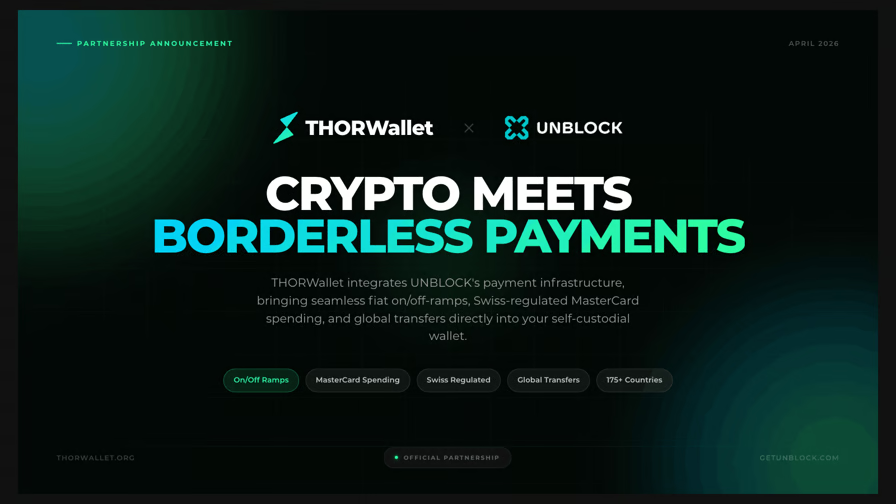
April 30, 2026 – THORWallet has partnered with Swiss-regulated provider Unblock to expand global access to non-custodial Mastercard solutions, advancing self-custodial finance adoption. This strategic collaboration enables the issuance of non-custodial cards in over 175 countries, allowing users to leverage digital assets for daily payments within a secure, compliant framework.
Rather than choosing one of the larger established crypto card players such as ether.fi or Kulipa, THORWallet selected Unblock for a very specific reason: flexibility, regulatory alignment, and global reach.
Unblock is headquartered in Switzerland, operates under a Swiss regulatory framework and maintains offices in Panama, Medellin, and Miami. This international setup allows the company to support efficient card issuance and delivery across more than 175 countries, giving THORWallet the ability to serve users in almost every region of the world.Unblock is headquartered in Switzerland, operates under a Swiss regulatory framework and maintains offices in Panama, Medellin, and Miami. This international setup allows the company to support efficient card issuance and delivery across more than 175 countries, giving THORWallet the ability to serve users in almost every region of the world. With this extensive reach, we are uniquely positioned to scale globally with speed and efficiency, reaching users in markets that remain inaccessible to most competitors.
For THORWallet, the partnership is especially strategic because it is Unblock’s first non-custodial wallet partnership. This means both teams can build the product from a clean slate, instead of adapting THORWallet to an existing custodial model. The result is significantly more flexibility around user experience, card functionality, stablecoin rails and future premium features.
THORWallet was among the first wallets to offer a real non-custodial Mastercard experience. With Unblock, the company is now expanding that offering into a much broader global payment and remittance product.
The vision is clear: allow users to hold assets in self-custody, access stablecoin rails and spend through virtual and physical Mastercard products almost anywhere in the world.
For users in emerging markets, freelancers, digital nomads, crypto native teams and global businesses, this combination could become especially powerful. Stablecoins already provide fast global settlement. Mastercard acceptance adds everyday usability. THORWallet’s non-custodial infrastructure keeps users in control of their assets.
Together, THORWallet and Unblock aim to turn crypto from something users hold into something they can actually use daily.
As stablecoin payments continue to gain traction and Web3 neobanks become one of the strongest narratives in crypto, THORWallet’s partnership with Unblock positions the company to become a global payment and remittance powerhouse built on self-custody, stablecoins and real-world card access.
About THORWallet
THORWallet is a Swiss-based non-custodial DeFi wallet built to bring on-chain finance to everyday users.
The platform combines self-custody, cross-chain swaps, DeFi access, stablecoin rails and card-based spending in one mobile-first application. THORWallet allows users to swap native assets across multiple blockchains without relying on wrapped assets, centralized exchanges or traditional bridge infrastructure.
Since launching, THORWallet has positioned itself as one of the leading mobile gateways for cross-chain DeFi, giving users access to protocols such as THORChain, Maya Protocol and other decentralized liquidity networks. The app also offers real-world finance features, including Swiss IBAN account access, crypto card functionality and DeFi yield opportunities.
THORWallet’s long-term vision is to become a self-custodial on-chain finance platform where users can hold, swap, earn and spend digital assets globally while remaining in control of their funds.
About Unblock
Unblock is a Swiss regulated payment infrastructure provider building crypto enabled financial services for users and businesses worldwide.
Headquartered in Switzerland, with offices in Panama, Medellin and Miami, Unblock combines regulatory alignment with international operational reach. Its infrastructure supports fiat and crypto payment flows, card issuance and global distribution across more than 175 countries.
Unblock provides the payment and card infrastructure needed to connect digital assets with real world spending. Through its global setup, Unblock enables partners to launch virtual and physical card products, support stablecoin based payment flows and reach users across both developed and emerging markets.
Through its partnership with THORWallet, Unblock is entering the non custodial wallet sector for the first time, helping build a new generation of payment products where users can access global spending infrastructure while maintaining self custody of their assets.
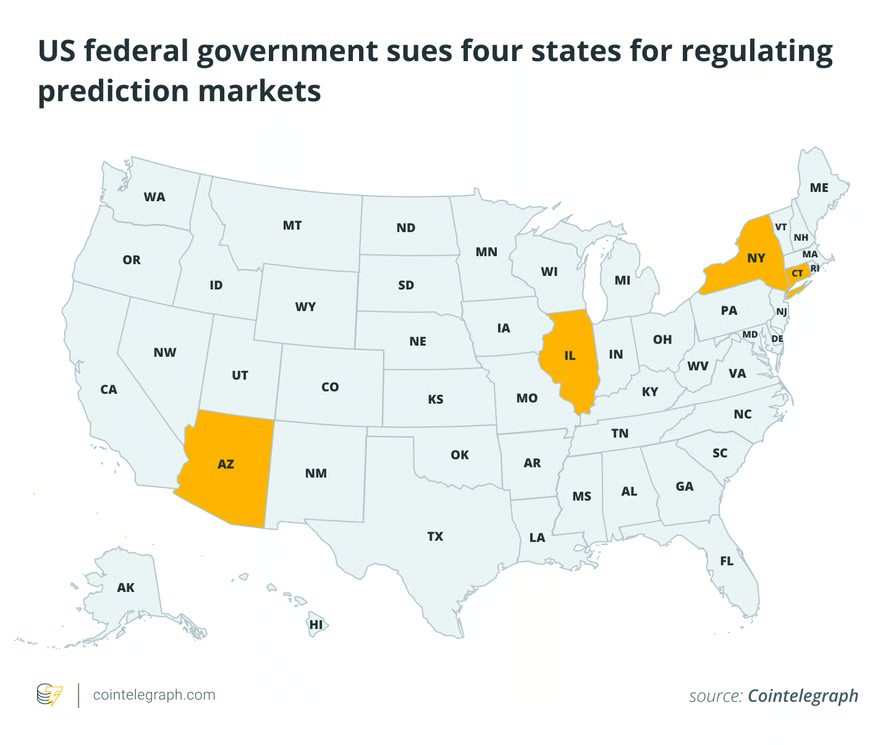
The US Commodity Futures Trading Commission (CFTC) is suing New York, Connecticut, Arizona and Illinois for applying state-level gambling laws to prediction markets.
The move follows a heated legal argument between states and companies like Kalshi, as they fight over who has jurisdiction to regulate the “prediction” platforms. Other states have issued cease-and-desist letters or sued the prediction markets.
Strategy bought over 56,000 Bitcoin. One of its last purchases in April was funded by a $250 million sale of the company’s common stock.
In France, prosecutors have charged 88 alleged “wrench attackers” accused of attempting to extort cryptocurrencies from investors through violence.
Here’s April by the numbers:
US federal government sues four states for legal action on prediction markets
On April 24, the CFTC sued the state of New York to stop it from applying state-level gambling laws to prediction markets like Kalshi and Polymarket.
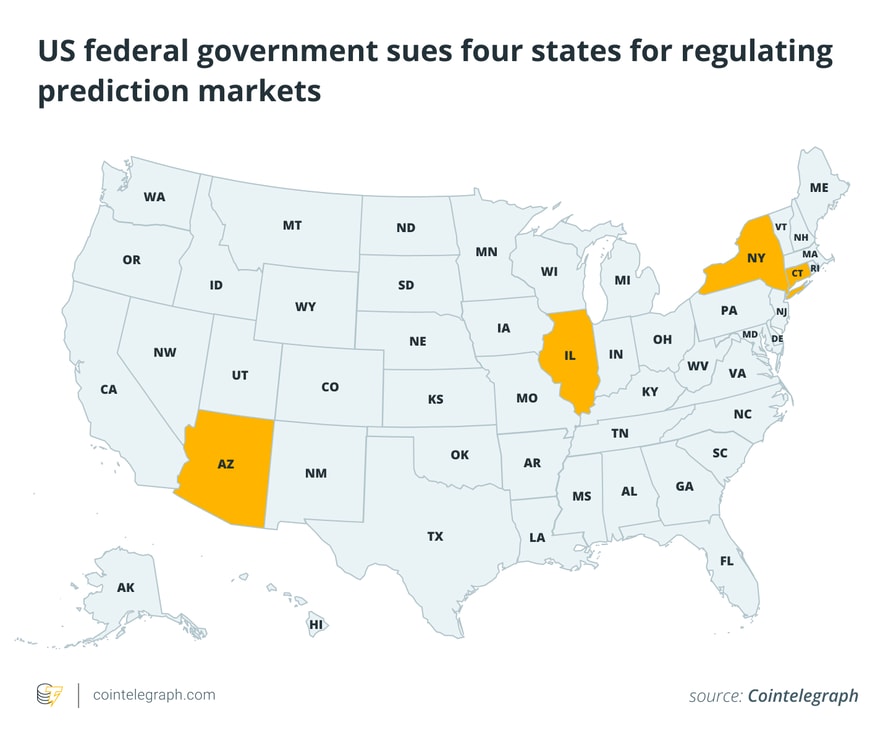
New York joins Connecticut, Arizona and Illinois as states targeted in federal actions asserting the CFTC’s authority over prediction markets.
States around the US are attempting to rein in gambling markets, namely Kalshi and those offered by Coinbase and Robinhood. States argue that gambling laws should apply to what are essentially sportsbooks, while the prediction markets claim they offer a form of swap contracts regulated solely by the CFTC.
An appellate court in New Jersey has ruled in favor of the CFTC and prediction markets’ interpretation. But a similar case in Nevada could fall in the other direction, making the issue ripe for the Supreme Court.
Strategy stacks 56,325 Bitcoin while STRC sits on sidelines
Strategy, the software company-cum-Bitcoin investment vehicle run by Michael Saylor, acquired 56,325 BTC in April.
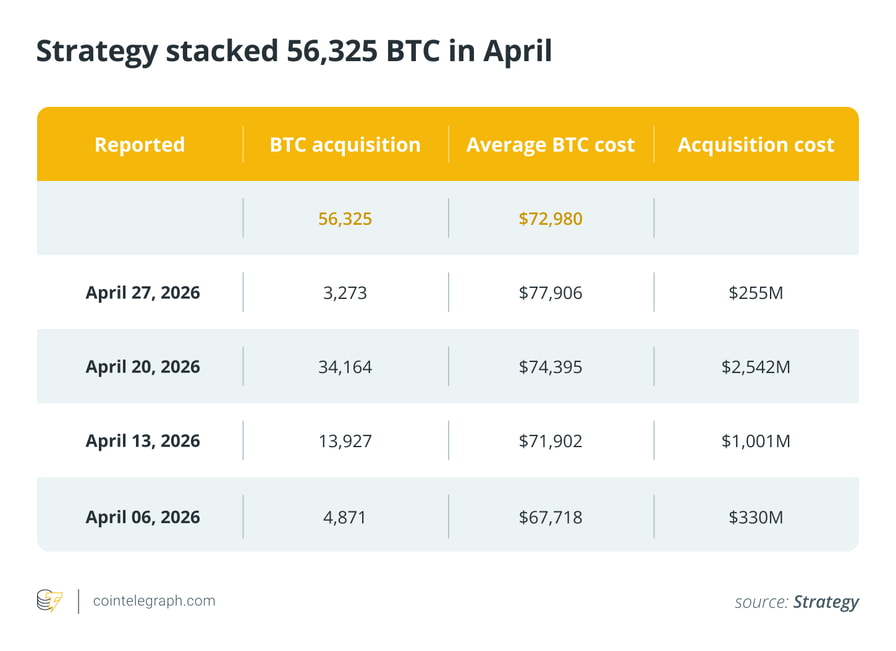
The company bought 3,273 BTC (about $249 million) on Monday through common stock (MSTR) sales. According to a filing with the US Securities Exchange Commission, Strategy sold 1,451,601 Class A common shares and used the proceeds to buy Bitcoin.
STRC, Strategy’s perpetual preferred stock, did not raise any capital in that filing. Strategy has become increasingly reliant on the short-duration high-yield credit product for capital raises to buy Bitcoin.
After a lackluster month for Bitcoin in March, when the company’s BTC holdings were briefly in the red, Strategy is showing nearly 1% on its Bitcoin holdings as of Tuesday.
Global tokenized RWAs surpass $30 billion in distributed asset value
The total distributed asset value of tokenized real-world assets (RWAs) surpassed $30 billion for the first time in April.
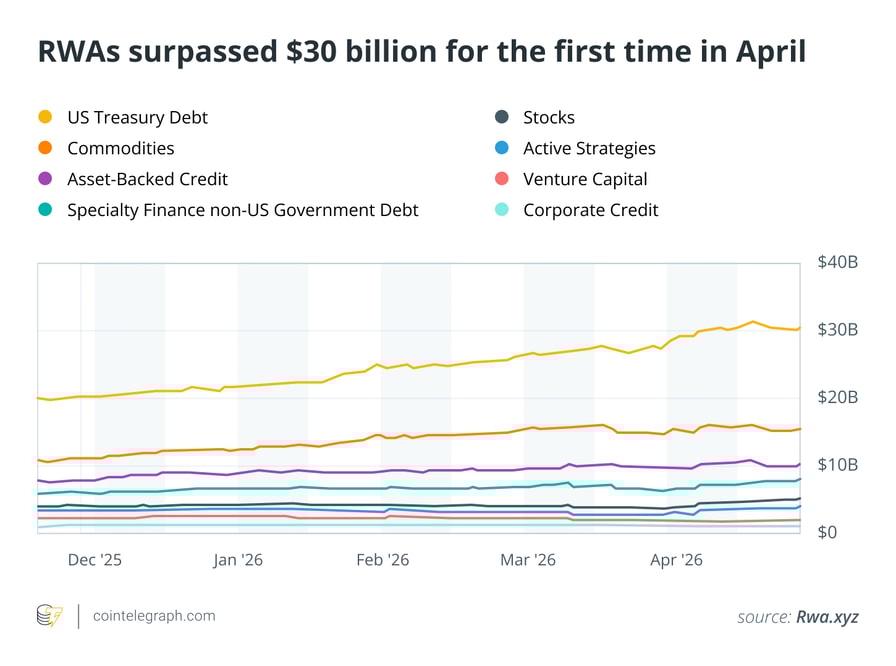
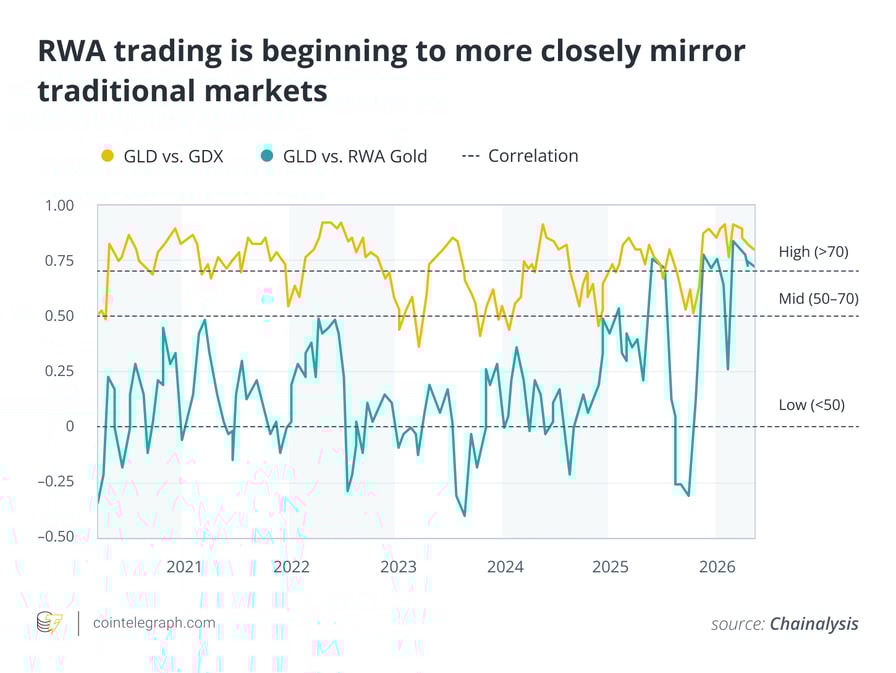
A Chainalysis report on the growing market said that institutions experimenting with tokenized RWAs are moving beyond their pilot programs and beginning to view onchain infrastructure as a practical solution.
This increased institutional participation and liquidity have led trading patterns in RWA markets to more closely mirror traditional finance, including responses to signals such as inflation and geopolitical risk.
Five wrench attacks in April, French prosecutors charge 88 suspects
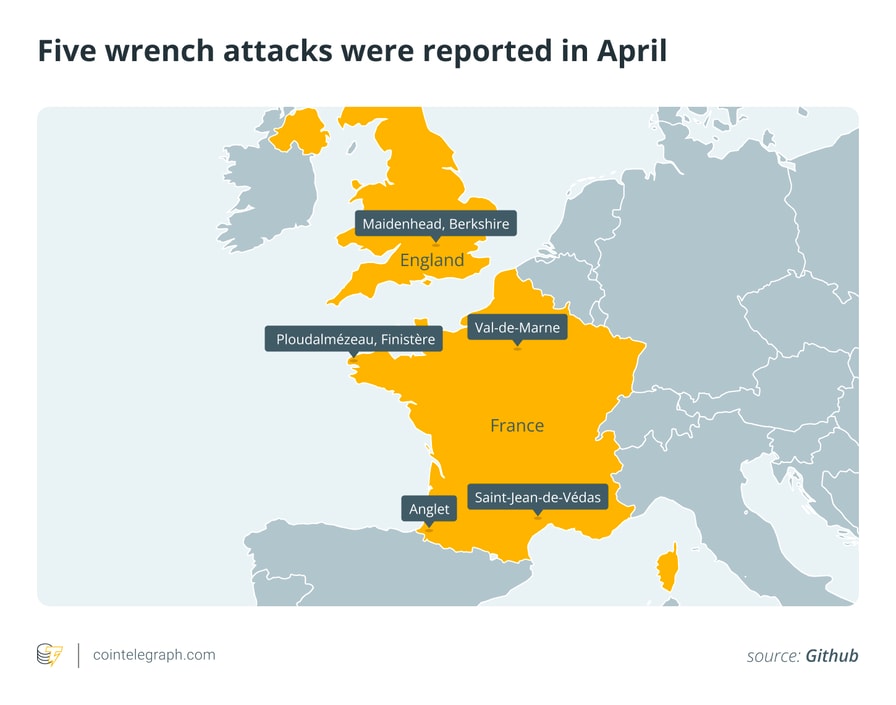
The trend of physical attacks on crypto holders continues, with five recorded incidents in April. Four happened in France, while the fifth occurred in England, according to Casa founder Jameson Lopp’s repository.
The increasing popularity and publicity of crypto traders and executives has led to a surge in kidnappings and ransom attacks on prominent figures in the industry.
There have reportedly been 47 attacks in France alone this year. One executive from crypto wallet firm Ledger, which is based in the country, claims that this is because of the law requiring entrepreneurs to register their names and addresses.
France has cracked down on offenders. On April 24, the National Organized Crime Prosecutor’s Office announced that it charged 88 offenders across 12 federal districts.
Crypto executives are spending more on personal safety, and boutique insurance firms have even begun offering kidnap and ransom policies amid skyrocketing demand.
Related: Crypto execs ramp up security as wrench attacks increase
Two US states now ban crypto kiosks, more move against Bitcoin ATMs
US states have been cracking down on crypto ATMs and kiosks amid scam and money laundering concerns. In April, Tennessee became the second state to ban them outright.
On April 13, Tennessee Governor Bill Lee signed House Bill 2505, making the installation of a cryptocurrency kiosk a Class A misdemeanor.
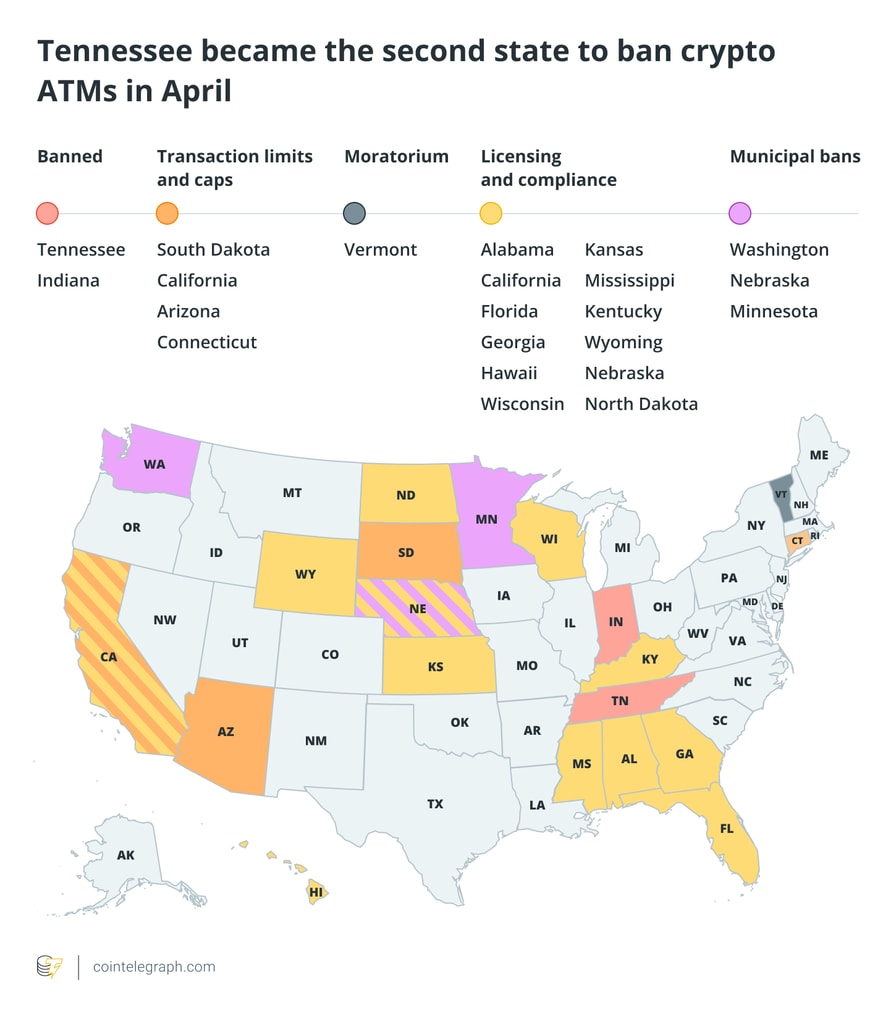
According to Coin ATM Radar, there are 560 crypto ATMs in the state. Operators and businesses hosting them will need to shut them down by July 1, or face up to 11 months and 29 days in prison and a $2,500 fine.
Indiana banned crypto ATMs last month. A number of other states have introduced strict licensing requirements and regulations. Vermont has a moratorium on crypto kiosks, and many cities have issued municipal bans on the devices.
The American Association of Retired People has particularly supported and lobbied for stricter controls, citing the kiosks proliferation in scams targeting senior citizens.

Crypto wallet startup Oobit has launched a Visa-supported virtual card for AI agents to make online purchases in USDT on behalf of businesses without human intervention.
The Agent Cards are funded directly from stablecoin issuer Tether’s treasury, meaning no fiat on-ramp or conversions are needed for AI agents to top up USDt (USDT) balances and make online purchases, Oobit said on Thursday.
The Tether-backed startup said the AI agents could use the cards to do anything from renewing a software-as-a-service subscription to topping up an advertising budget or even “spinning up cloud infrastructure at 3am because a workflow told it to.”
They will also be able to trade crypto and stocks, Oobit advisor Alex Obchakevich added in a post on X.

Source: Oobit
Many crypto executives have shared the view that AI agents could become the dominant users of blockchain-based payments in the coming years.
In April, Coinbase CEO Brian Armstrong predicted that “There will be more AI agents transacting online than humans very soon,” echoing comments from Circle CEO Jeremy Allaire in January that “literally billions of AI agents” will be transacting onchain in three to five years.
Oobit took the prediction one step further, stating that the “next trillion users on the internet” would be AI agents.
Agent Cards haven’t launched to the broader public yet
Oobit said Agent Cards launched to a founding group of businesses on Thursday and that onboarding would expand to a limited number of additional companies through June 30.
Businesses must pass a know-your-business compliance check to set up the Agent Cards.
Agent Cards work with AI agent frameworks offered by OpenAI, Claude, AutoGen and LangChain, Oobit added.
Related: Stablecoins overtake Bitcoin in Latin America crypto purchases — Bitso
Only one card is issued to each AI agent to ensure a clean identity and audit trail.
The crypto wallet startup said spend limits and merchant restrictions are enforced at the transaction layer to ensure that AI agents operate only within their authorized scope.
Magazine: AI Eye: Agent wastes 14 hours of scammers’ time, LLMs ‘poisoned’ by Iran

Bitcoin (BTC) has flirted with the upper $70,000s as momentum returns, but the latest snapshot of the market suggests a delicate balance between short-term upside and a looming supply wall. With price hovering near $77,000, traders are weighing a potential push toward the $80,000 mark against a sizable resting orderbook and limited spot-volume ignition that could sap momentum if buyers fade.
Data from the perpetuals market and leverage metrics underline a nuanced setup: while the immediate setup paints a bullish tilt, the absence of sustained buying pressure and a clear liquidity absorption path may keep moves short-lived unless new volume arrives. In particular, more than $130 million of ask orders sit between roughly $76,700 and $79,300, implying a meaningful obstacle zone that must be cleared to extend gains beyond the current swing high.
Key takeaways
- Over $130 million in sell orders sit from $76,700 to $79,300, forming a potential hurdle for a continued rally toward $80,000.
- The market currently shows a negative futures funding rate and a small net negative long-short delta of about $1.47 million, suggesting a fragile near-term edge for bulls.
- A notable concentration of short-side risk exists near $76,800, where negative delta estimates span roughly $66.5 million to $189 million—raising the odds of forced liquidations if price dips there.
- Technically, BTC has held $75,000 as support and reclaimed the 20-day moving average around $76,067, after dipping below it earlier in the week.
- For a sustained breakout, traders are watching for a fresh volume impulse—spot or perpetual—rather than a relief rally driven solely by short-covering and liquidations, as recent activity has shown.
Orderbook dynamics: a wall to hurdle the upside
From the perspective of market depth, the current orderbook paints a cautious backdrop for bulls. TRDR’s aggregated data highlights a substantial supply zone spanning roughly $76,700 to $79,300, where more than $130 million awaits sellers. This cluster constitutes a meaningful barrier that must be cleared to push BTC beyond the $79,000 resistance and toward the psychological milestone at $80,000.
The presence of such a wall underscores the risk of a retreat if buyers fail to muster enough conviction or if a wave of profit-taking accelerates near the current high. Traders tracking orderflow emphasize that walls like these often mark battlegrounds where price action becomes choppy and prone to reversals unless a broader liquidity shift occurs.
Derivatives positioning: a tenuous short-term tilt
On the derivatives side, the negative futures funding rate provides a nuanced read on the pulse of the market. While not a definitive signal on its own, a negative funding rate typically indicates prevailing downward pressure from long positions funding shorts, which can be interpreted as a marginal tailwind for bulls in the near term. In conjunction with a small negative long-short delta of −$1.47 million, the immediate tilt remains modest and does not suggest a robust, durable surge rather than a fragile uptick that could reverse with a single catalyst.
Additionally, the liquidity picture tightens near certain price pockets. At around $76,800, the market shows a concentrated negative delta, with estimates ranging from −$66.5 million to −$189 million—implying short positions are heavily exposed and risk of forced liquidations is elevated if price moves into that zone. In practice, this creates a potential short-squeeze dynamic if buyers manage to push through the barrier, but it also raises the risk of sudden pullbacks if the squeeze stalls or fails to gain traction.
Price action, moving averages, and the path to a higher high
From a technical viewpoint, BTC has re-established a foothold above a critical short- to mid-term reference. The price action around $75,000 is being interpreted as a support formation, particularly after a period during which Bitcoin traded under the 20-day moving average. The 20-day moving average sits near $76,067, acting as a fulcrum for near-term traders as BTC tried to reclaim above this line after dipping through it earlier in the week.
Another point of reference is the charted channel and the notion of a support-resistance flip. In recent observations, a bullish scenario includes BTC timely piercing the channel trendline resistance around $79,000, followed by a renewed SR-flip that would establish $80,000 as a new support level. That sequence would be a meaningful signal of a shift in momentum, potentially inviting longer-duration participation from both spot and perpetual traders.
However, even with a potential breakout above $79,000, the market faces a practical hurdle: a genuine sustained move requires fresh participation. The absence of robust spot volume or long-leveraged exposure—despite occasional rallies—has tended to yield pullbacks once price nears the upper end of the current range. This pattern, visible in a 4-hour TRDR view, shows intraday moves often driven by liquidations rather than broad, durable buying support.
Liquidity dynamics: what would move the needle?
The market’s recent history suggests that a meaningful, lasting uptrend requires a surge in buying volume that can absorb downside pressure from sellers and push price into higher territory without a quick reversal. TRDR’s data emphasize that current rallies have often been short-lived, with much of the leg higher powered by liquidations rather than persistent spot buying or fresh long exposure.
Analysts watching the data point to a need for a volume spike in either the spot market or the perpetual futures market to sustain a breakout beyond the $79,000–$80,000 zone. Without that, the price action could revert to range-bound behavior, with the supply wall between $76,700 and $79,300 continuing to cap upside attempts and adding to the risk of chop as traders reassess risk and position sizing.
What to watch next
Market participants should keep a close eye on two intertwined factors: liquidity absorption and price discipline. If BTC can push decisively through the $79,000 threshold and hold above the $80,000 level, that would be interpreted as a meaningful upgrade to the near-term bias, provided volume corroborates the move. Conversely, failure to sustain the move, or a failure to attract fresh demand on dips toward the $76,000–$77,000 region, could invite renewed testing of the supply wall and a risk-off retest of the 20-day moving average.
In practice, the trajectory remains contingent on a balance of orderbook dynamics, derivatives positioning, and the pace of new market participation. As traders weigh risk-reward, the key data points to watch are the orderbook depth around the critical zone, the evolution of the negative funding rate, changes in the long-short delta, and whether spot or perpetual volumes pick up sufficiently to sustain a breakout beyond the current resonant levels.
This analysis reflects ongoing market data and is intended to illuminate what the next price moves might imply for traders and builders navigating Bitcoin’s current phase. For ongoing context, traders may monitor the referenced TRDR and Hyblock indicators, along with related technical analyses highlighting support-resistance dynamics around the $75,000–$80,000 corridor.
The U.S. Senate has approved a resolution banning senators and Senate staff from using prediction markets.
Summary
- Senate approved a rule banning members and staff from using prediction markets, with the change taking effect immediately.
- Lawmakers cited risks of insider information misuse, with Senator Bernie Moreno saying the ban protects public trust.
According to Senate proceedings, the resolution passed by unanimous consent on Thursday changed the chamber’s standing rules and took immediate effect.
Lawmakers tied the ban to the risk that officials exposed to sensitive information could profit from event contracts.
“Engaging in any way in a prediction market or trying to place bets where we might have inside information deteriorates the confidence that our constituents have in us,” Republican Senator Bernie Moreno, who introduced the resolution, said on the Senate floor.
According to him, the rule change ensures “no member of the United States Senate, no member of the staff of the United States Senate, can ever use that inside information as a way to monetize this job whatsoever.”
Ethics concerns drive Senate action on prediction markets
Recent concerns intensified after a special forces soldier involved in the plan to capture former Venezuelan President Nicolás Maduro was charged on April 23 with using classified information to place bets on Polymarket.
The soldier has pleaded not guilty, while lawmakers have also raised concerns over well-timed bets tied to the Iran war.
Senate Democratic leader Chuck Schumer backed the rule change and framed the issue as a straightforward ethics matter.
“Of all the issues we debate in Washington, this falls clearly in the category of a ‘no-brainer. We must never allow Congress to turn into a casino where members representing the public can gamble on wars, or economic crises, or elections, “ Schumer said.
“We should go further; this is a good start, but not enough. The administration and its employees must apply these very same rules too, particularly this administration, which shows such a troubling affinity to corruption and self-dealing,” he added.
Reaction from the House followed soon after the Senate vote. Republican Representative Ashley Hinson said in a post on X that she would introduce a similar resolution to ban the use of prediction markets in the House.
Prediction market operators also responded to the Senate action. Polymarket said in a post on X that it fully supported the Senate resolution and noted that its terms of service “already prohibit such conduct, but codifying this into law is a step forward for the industry.”
Meanwhile, Kalshi’s Tarek Mansour also welcomed the resolution in a post on X and said Kalshi “already proactively blocks members of Congress and enforces against insider trading.”
The Senate ban lands as prediction markets face separate regulatory fights over whether event contracts should be treated as federally regulated financial products or state-regulated gambling activity.
As previously reported by crypto.news, the U.S. Commodity Futures Trading Commission has sued Wisconsin after the state filed complaints against Kalshi, Polymarket, Crypto.com, Robinhood, and Coinbase over prediction market products.
Key Takeaways
- Senate Banking Committee Chair Tim Scott requires unanimous Republican backing before proceeding with CLARITY Act markup
- Sen. John Kennedy refuses to commit support, partially due to grievances over blocked housing legislation
- Sen. Thom Tillis advocates for May committee action but insists on mandatory ethics provisions
- Contentious topics include stablecoin reward structures, DeFi regulatory framework, and presidential crypto business dealings
- Industry analysts estimate passage probability between 15–25%
A comprehensive cryptocurrency market structure bill known as the CLARITY Act is approaching a potential Senate committee hearing in May, though significant Republican resistance and ongoing policy disagreements threaten to derail its advancement.
Tim Scott, who chairs the Senate Banking Committee, has established a requirement for complete Republican consensus among his committee’s 13 GOP members before scheduling a markup session. While he confirmed recent commitments from Sen. Thom Tillis and several colleagues, achieving unanimous party support remains elusive.
In comments to Fox Business, Scott characterized negotiations as approaching the “red zone” for finalizing an agreement. His timeline envisions a bipartisan committee markup during May, potentially followed by floor consideration between June and July.
Tillis, serving as a primary Republican negotiator, has formally requested Scott to calendar a markup session and indicated that revised legislative text should be available several days beforehand. However, Tillis has issued an ultimatum: he will vote against the measure if it advances from the Senate without incorporating ethics safeguards.
John Kennedy stands among the Republicans withholding endorsement. Reporting from Punchbowl News indicates Kennedy’s resistance partially reflects broader dissatisfaction with the House and White House regarding a dormant Senate housing measure — extending beyond cryptocurrency policy itself.
Ethical Standards and Presidential Business Ventures Create Additional Obstacles
Democratic members have positioned ethics requirements as a non-negotiable element. Sen. Angela Alsobrooks stated that achieving bipartisan committee approval necessitates first addressing illicit finance prevention and ethical conduct concerns.
Chair Scott has argued that ethics-related provisions fall outside his committee’s jurisdictional authority. This leaves the matter unaddressed and potentially requiring separate legislative action before any complete Senate vote occurs.
President Trump’s cryptocurrency business activities have amplified scrutiny. Bloomberg analysis determined Trump has generated no less than $1.4 billion through various crypto enterprises, including involvement with DeFi and stablecoin platform World Liberty Financial. The Trump family additionally maintains a 20% ownership position in American Bitcoin, a mining operation.
Trump recently hosted an exclusive Mar-a-Lago event for individuals holding the TRUMP memecoin, triggering sharp criticism from Democratic legislators.
The House-approved version of this legislation, also titled Clarity, contains a prohibition preventing Congressional members and high-ranking executive officials from issuing digital commodities during their tenure. This provision represents an unacceptable condition for the White House.
Stablecoin Compensation Models and Decentralized Finance Remain Contentious
Separate from ethics debates, the legislation has encountered resistance regarding stablecoin reward mechanisms. Public disagreements between a senior White House cryptocurrency adviser and banking institutions have surfaced in open forums.
Decentralized finance provisions face particular examination. Legislators and law enforcement agencies worry that certain developer liability protections could impede financial crime prosecutions.
Senate Judiciary Committee Chair Chuck Grassley is currently engaged in substantive discussions with Sen. Cynthia Lummis to resolve these law enforcement considerations.
The legislation confronts a critical scheduling constraint. The Senate enters a five-week recess period in August preceding midterm elections. Should the bill fail to clear committee and reach floor debate beforehand, its advancement prospects diminish considerably.
A cryptocurrency industry analyst assessed the bill’s 2024 passage likelihood at between 15% and 25%. Research organization Galaxy offered a moderately more optimistic projection, estimating approximately 50% probability.
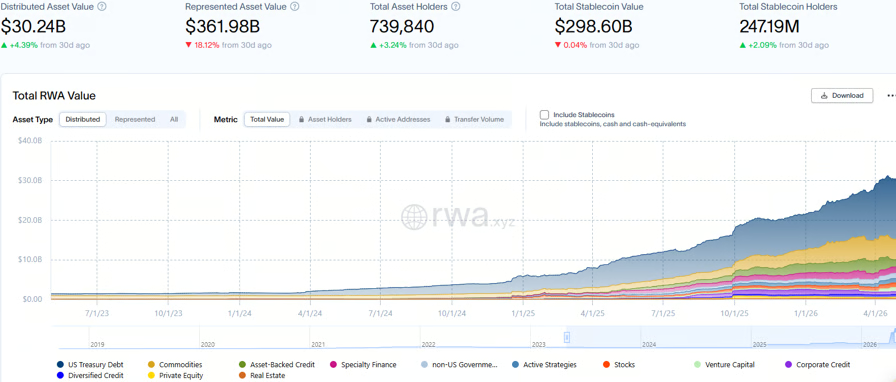
The size of the tokenized real-world asset (RWA) market has increased by more than 420% since the start of 2025, as investors were treated to easier market access and regulatory clarity, according to analysts.
The RWA market cap was about $5.8 billion on Jan. 1, 2025, but has since risen to more than $30.2 billion as of Wednesday, according to analytics platform RWA.xyz. Tokenized US Treasurys experienced the largest increase, from $3.9 billion at the start of 2025 to more than $15 billion, followed by commodities.
Dominick John, an analyst at Zeus Research, told Cointelegraph the surge in the RWA sector was driven by tokenized Treasurys, which offer compliant onchain access to real-world yield and effectively turn blockchain rails into a distribution layer for institutional capital.
“Expansion into tokenized funds and equities has materially increased the addressable market. This points to a shift from speculative inflows toward yield-driven capital,” he said.
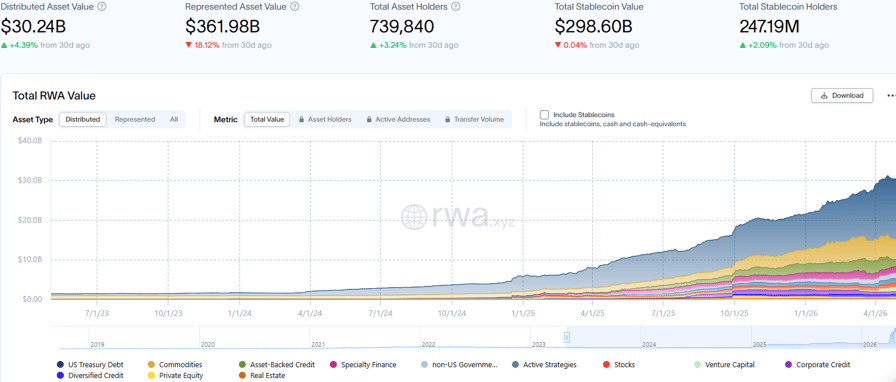
The RWA market capitalization was around $30.2 billion as of Wednesday. Source: RWA.xyz
“Tokenized commodities like gold have gained traction, particularly amid heightened volatility from ongoing geopolitical tensions, as 24/7 markets unlock continuous liquidity and global access when traditional venues are closed,” the analyst added.
Tokenization has been one of the drivers of institutional interest in blockchain and crypto over the past year. Cathie Wood’s ARK Invest predicts digital assets could grow into a $28 trillion market by 2030, with Bitcoin, decentralized finance, stablecoins and tokenized RWAs as key drivers.
Regulatory clarity coaxed institutional players into the market
Regulatory clarity through legislation such as Europe’s Markets in Crypto-Assets Regulation (MiCA) has also helped attract institutional players and fresh capital to the RWA sector, according to a Thursday report from crypto data aggregator CoinGecko.
Zhong Yang Chan, CoinGecko’s head of research, and research analyst Yuqian Lim said in the report that a few years ago, the RWA market rallied more on hype than substance.
“However, the RWA sector has finally started to take shape from 2024 onward. Regulatory clarity has enabled major TradFi institutional players to dip their toes in. As early experiments paved the way by turning into best practices and playbooks, the pace of tokenization has noticeably accelerated,” they said.
Source: CoinGecko
BlackRock’s USD Institutional Digital Liquidity Fund (BUIDL) went live in March 2024. The tokenized US Treasury fund provides onchain access to short-term US government debt. Fidelity followed suit in September 2025 with its own tokenized Fidelity Digital Interest Token (FDIT).
“2025 has proven to be a watershed year for RWAs. For both crypto-native and traditional players, competition within the RWA and tokenization stack has intensified, with issuers now differentiating on regulatory standing, asset coverage and distribution reach,” Zhong and Yuqian added.
Related: Flow Capital plans to tokenize $150M private credit fund via DigiFT: Report
Continued growth could depend on other areas of the sector
Tokenized Treasurys and commodities have experienced the largest rise in the RWA sector, but in the long term, other areas will likely need to be catalysts for continued growth, said John of Zeus Research.
“Growth remains strong as tokenized Treasurys keep absorbing capital and bring more institutions on board, but the rate of expansion should moderate as the easiest flow has been allocated,” he said.
“The next leg higher depends on whether tokenized equities, funds and private credit scale meaningfully.”
Magazine: Singapore isn’t a ‘crypto hub’ — it’s something better: StraitsX CEO

Bithumb’s six-month suspension in South Korea is overturned by local judge

Jack Draper withdraws from Roland Garros due to Injury

FBI links cybercriminals to sharp surge in cargo theft attacks

Manchester United reach agreement with Casemiro over contract clause amid transfer speculation

US brings back mandatory military draft registration

Steven Gerrard disagrees with Gary Neville over ‘shock’ Chelsea and Arsenal claim | Football


-

 Tech4 days ago
Register Renaming | Hackaday
-

 Fashion7 days ago
Weekend Open Thread – Corporette.com
-
Crypto World6 days ago
Hyperliquid $HYPE Rally Builds Momentum as AI Sector Enters Prove-It Phase
-

 Politics3 days ago
Drax board avoid their own AGM, accused of greenwashing & environmental racism
-

 Tech3 days ago
Images of Samsung’s rumored smart glasses have leaked
-
 Sports5 days ago
IPL 2026: Ruturaj Gaikwad registers slowest fifty of the season, enters all-time unwanted list | Cricket News
-

 NewsBeat5 days ago
LK Bennett closes all stores after entering administration
-

 Tech4 days ago
Why Blue Badges Disappeared From Toyota Hybrids
-

 Fashion2 days ago
Kylie Jenner’s KHY Enters a New Era with ‘Born in LA’
-

 Crypto World7 days ago
Michael Saylor says BTC winter is over. Market analyst disagrees, says bitcoin was in a pullback
-
 Entertainment6 days ago
Mariah Carey Slams Deposition Claims In Brother’s Lawsuit
-

 Business2 days ago
Most Commercial Energy Audits Miss the Real Losses
-
 NewsBeat7 days ago
Trump threatens to review UK’s claim to Falkland Islands and punish Nato allies over Iran war disagreement
-

 Business4 days ago
(VIDEO) Charlize Theron Climbs Times Square Billboard to Promote New Netflix Thriller ‘Apex’
-

 Business7 days ago
Jeanine Pirro announces closure of Federal Reserve building cost probe
-
 Crypto World6 days ago
Nvidia (NVDA) Stock Jumps 5% as Intel Earnings Ignite Semiconductor Rally
-

 Tech5 days ago
Microsoft to roll out Entra passkeys on Windows in late April
-

 Tech5 days ago
OpenAI’s Sam Altman apologizes for not reporting ChatGPT account of Tumbler Ridge suspect to police
-

 Crypto World3 days ago
CFTC’s AI will review U.S. crypto registration applications, chairman tells CoinDesk
-

 Tech5 days ago
OpenAI CEO apologizes to Tumbler Ridge community
You must be logged in to post a comment Login