Labour is on course to lose nearly 2,000 council seats in next month’s elections, according to a top pollster.
It would mean the party being left with barely a quarter of the councillors they currently have in the areas where voters will go to the polls on May 7.
The Tories are set to lose 600 councillors on what is set to be a grim night for the two main parties.
Reform UK will be the big winners, gaining 1,550 seats, while the Green Party is set to see its number of councillors boosted by 500.
Advertisement
The Lib Dems are on course to gain 150 seats, according to the analysis by Tory peer Lord Hayward.
Millions of English voters are set to take part in council elections in London and across the Midlands, Yorkshire, Merseyside, Lancashire and the north east.
In all, 5,014 council seats and six mayoralties are up for grabs in the biggest test of public opinion since the 2024 general election.
Hayward said Labour will lose 1,850 of the 2,558 council seats it has up for election.
Advertisement
He predicted that the SNP will once again win the Scottish Parliament elections also being held on May 7, but will fall short of an overall majority.
And in Wales, Labour is set to lose power for the first time since the Welsh Senedd was established in 1999, with Plaid Cymru winning for the first time ever.
Such a set of results across the UK would represent a disaster for Labour, and pile even more pressure on prime minister Keir Starmer.
Manchester mayor Andy Burnham, seen as a potential successor to Starmer if he manages to be re-elected an MP, said Labour will need to take “a different course” after May 7 – and declined to give the PM his support.
Advertisement
Speaking to Bloomberg, he said: “It’s got to be a moment of reflection.”
“I understand the real frustration people have got with politics and politicians,” he said. “I honestly, I really understand that. And they’re right to say politics just hasn’t been working.”
Starmer blocked Burnham’s attempt to stand for Labour in the Gorton and Denton by-election in February, but the former cabinet minister said he was not ruling out another attempt to become an MP again.
He said: “The politics we’ve pioneered as mayors: place first, not party first — that needs to go national, and so we do need to reform Westminster.
Advertisement
“I can’t remove the kind of feeling that someday I will try and go back. I’m not ruling it out.”
Subscribe to Commons People, the podcast that makes politics easy. Every week, Kevin Schofield and Kate Nicholson unpack the week’s biggest stories to keep you informed. Join us for straightforward analysis of what’s going on at Westminster.
A lot of people remain unclear about what their home insurance really covers.
And if this applies to you, you might want to pay attention.
From sheds and plants to outdoor furniture, many assume these items are automatically protected, but coverage can actually vary significantly depending on the policy.
Advertisement
With that in mind, experts at Tesco Insurance have highlighted what is and isn’t covered by home insurance, and where homeowners could get caught out.
Alex Cross, Chief Customer Officer, said: “Gardens are often the heart of the home, especially during warmer months when people are spending more time and money on their outdoor spaces.
“Despite this, many people only check what their insurance covers after something has gone wrong.
“That’s why it’s important to understand what your home insurance policy covers upfront, to avoid unexpected costs later on.”
Advertisement
What home insurance may cover in my garden?
What is often covered in your garden with home insurance?
Fixed outdoor structures such as sheds and greenhouses, along with boundary walls, are usually covered by building insurance.
They are typically protected from damage caused by risks such as fire, flooding, or vandalism, although cover can vary between providers.
What is classed as ‘contents’ in your garden, and which items are covered?
Powered tools, including leaf blowers, trimmers and lawnmowers, as well as other tools and equipment stored in sheds or outbuildings, BBQs, bicycles and outdoor furniture, are often included under contents insurance.
Advertisement
These items may be covered against theft, fire, and damage, subject to policy limits. It’s important to check these limits before taking out a policy, as payouts can be capped.
Are plants in my garden covered?
Trees, shrubs, plants and lawns that you own and are within the boundary of your home may be covered under contents insurance, depending on the policy.
Cover may apply to loss or damage caused by specific risks, such as storm or flood, but is often limited.
Other damage caused by disease, theft or lack of maintenance is commonly excluded. Each provider will be different, so it’s important to check your policy details.
Advertisement
With car & home insurance timing matters far more than you’d think.
Where do gaps commonly occur in your garden with home insurance?
Although many risks can be covered if they occur, understanding gaps can help homeowners avoid unexpected costs and determine whether additional cover is needed.
Common exclusions can include theft of items left unsecured outside and damage caused by weather that doesn’t meet the insurer’s definition of a storm.
Advertisement
Fences are also commonly excluded from cover for storm or flood damage, while wear and tear or poor maintenance affecting outdoor structures and hedges may also not be covered.
Do you find home insurance useful? Let us know in the comments
The horror film is set to be removed from Netflix in a matter of days
Aaliyah Rugg Senior reporter
22:20, 29 Apr 2026Updated 22:20, 29 Apr 2026
A divisive horror film that continues to split opinion among fans is set to disappear from a streaming platform within days. Netflix subscribers have just over one week to catch Night Swim before it is permanently removed from the service.
The horror, starring Wyatt Russell and Kerry Condon, centres on a family as they renovate their swimming pool, which unbeknownst to them is haunted and possessed by a sinister force. An official Netflix synopsis teases: “Terror hides beneath the deceptively calm surface of a family’s swimming pool in this supernatural thriller from James Wan and Jason Blum (Insidious).”
Advertisement
Viewers may also recognise Amélie Hoeferle, Gavin Warren, Jodi Long, Nancy Lenehan, Eddie Martinez as well as Ben Sinclair. Night Swim is scheduled to be removed from the platform on Thursday, May 7. Having originally been released in 2024 on the big screen, it quickly made its way to streaming as audiences remain at odds over its content, reports the Mirror.
One viewer wrote on IMDb: “The reviews make this movie look like a disappointment, however, it’s par for the course for a horror movie. The acting is pretty good, the plot is very intriguing, and the only failure is the effects.
“The monster is not consistent, it looks different literally every time we see it, and the effects are Ghostbusters level, or maybe worse actually. Like, clearly animated. But otherwise it’s a pretty good movie and actually gave me the heebie jeebies once or twice.”
Advertisement
Another described it as “unfairly rated”, adding: “Not sure why many low ratings on this one. I am a horror movie critic and to me, this movie fit every requirements for it to be a good horror / supernatural movie.” They went on to say: “Without revealing spoilers, I’d say this movie is on par with Sinister.”
A third wrote: “I thoroughly enjoyed going to the theater for this movie. It’s an original premise. I’ve never heard of a scary movie about a pool before! This movie evokes all the childhood fearful feelings of swimming in a pool at night.”
However, one viewer countered: “This film was weird. It wasn’t good but not bad. The good thing is effort is definitely put into this film, but the output just isn’t there.”
Advertisement
Another remarked: “The film is terribly clichéd. Take any other horror film and compare it with this one and you won’t see any difference. Quite a good story with water, but when you see the monster you start laughing.”
A third observed: “This movie is 90min but like a never-ending 3-hour ordeal. It’s more of a family drama than a horror movie.”
With a 19% rating on Rotten Tomatoes, opinions remained split as one person wrote: “One of the most anticipated horrors of 2024 but failed big time. It didn’t even tackle how the pool become evil.”
Another concluded: “Everything I could have possibly wanted from a movie about a haunted pool. 5/5 stars. No notes.”
Advertisement
Night Swim is currently available to stream on Netflix
President Donald Trump has reportedly told his aides to prepare for a prolonged blockade of Iran, choosing sustained economic pressure over further strikes or withdrawal.
Oil prices rose on news there was no end in sight to blockade
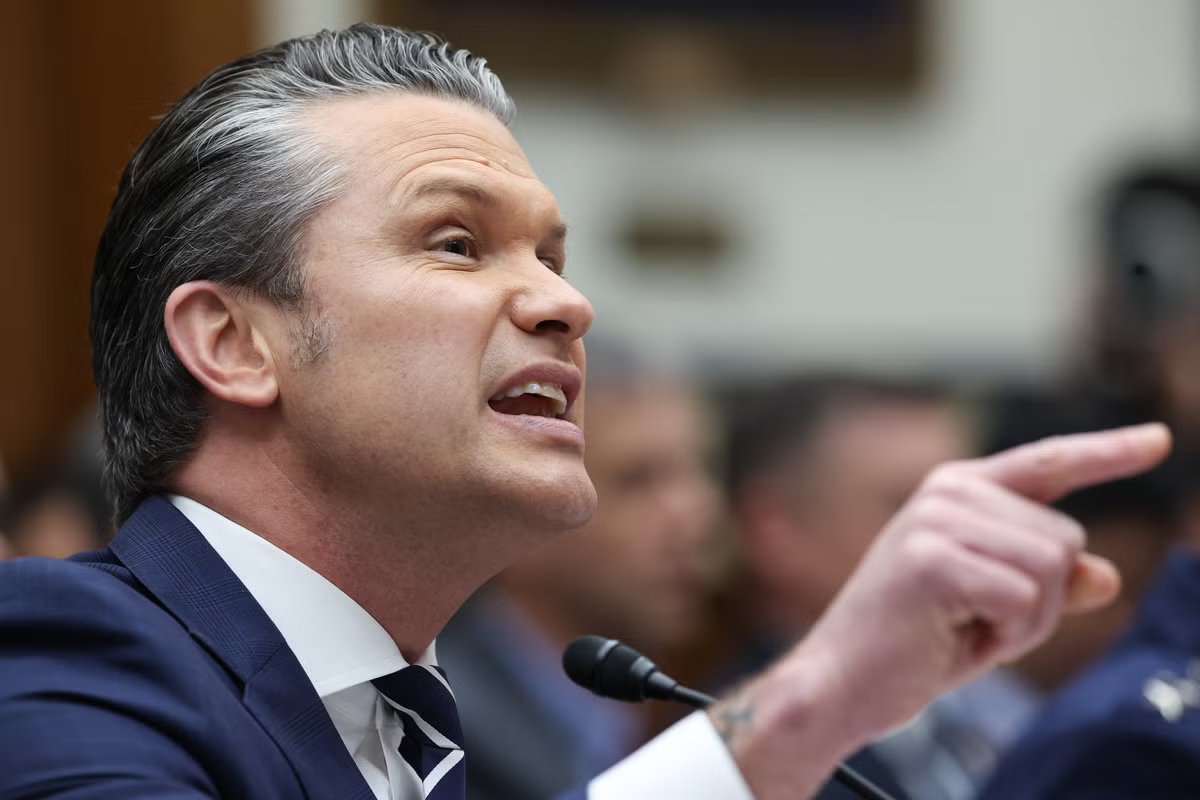
U.S. Defense Secretary Pete Hegseth testifies before Congress on war
Trump claimed Iran has informed the U.S. it was “in a State of Collapse”, though this has not been confirmed by Tehran.
A public spat between Donald Trump and German chancellor Friedrich Merz erupted after the latter said the U.S. was being “humiliated” by Iran
The United Arab Emirates has quit Opec after nearly 60 years, weakening the group and signaling a major shift in global oil politics and regional alliances.
Former US officials have criticized the lack of transparency over the deadly Minab school strike in Iran, calling the Pentagon’s silence “highly unusual”
Maroosha Muzaffar29 April 2026 05:45
Watch: Trump claims King Charles would have probably helped with military strikes against Iran
Trump claims King Charles would have probably helped with military strikes against Iran
Rachel Dobkin30 April 2026 00:52
Advertisement
Major revelation from Hegseth testimony was price tag of Iran war
One of the biggest revelations to emerge from Wednesday’s congressional hearing was that the war in Iran has so far cost an estimated $25 billion.
“Approximately, of this day, we’re spending about $25 billion on Operation Epic Fury,” Jules Hurst, a Pentagon budget official, told the hearing.
Most of that has been spent on munitions, he said.
(Reuters)
Rhian Lubin30 April 2026 00:00
Advertisement
ICYMI: Trump posts extraordinary picture holding assault rifle in new threat to Iran
President Donald Trump issued an astonishing new threat against Iran Wednesday, posting a mocked-up picture of himself brandishing an assault rifle with the strapline: “No more Mr Nice Guy!”
“Iran can’t get their act together,” the President wrote on Truth Social. “They don’t know how to sign a nonnuclear deal. They better get smart soon!”
The threat was accompanied by a meme of Trump, stood against a Middle Eastern backdrop of explosions devastating a hillside, wearing a dark suit and sunglasses and holding the heavy-duty firearm.
Advertisement
Donald Trump says Iran ‘better get their act together’ in latest bizarre post on Truth Social (@realDonaldTrump/Truth Social)
Rhian Lubin29 April 2026 22:45
Trump claims King Charles ‘probably would’ve helped’ US with Iran
President Donald Trump has claimed that King Charles “probably would have helped us” in Iran as he launched another attack on UK Prime Minister Keir Starmer and NATO.
Speaking during the King’s state visit, the president said the royal was a “phenomenal representative for his country” and suggested he would have differed in his approach to the conflict from the prime minister.
“The King loves his country, and he’s a great king, and he’s a great friend of mine. And I think if that it were up to him, he would have probably helped us with Iran,” Trump said.
Advertisement
Rhian Lubin29 April 2026 22:00
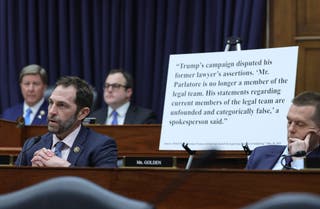
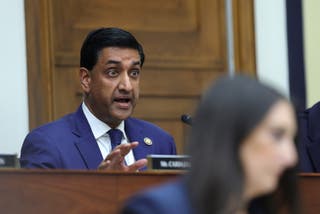
Pictured: Hegseth grilled by lawmakers for six 6
Defense Secretary Pete Hegseth was grilled by lawmakers for six hours, mostly about the war in Iran.
(Getty)
(Getty)
(Getty)
(Getty)
Rhian Lubin29 April 2026 21:15
Advertisement
Hearing is adjoured
The hearing is now adjourned after nearly six hours.
Rhian Lubin29 April 2026 20:54
Trump gives rambling answer on whether Ukraine or Iran war will end first
As Hegseth was testifying, Trump appeared to confuse the two countries as he turned an Oval Office meeting to honor the Artemis II lunar mission crew into a wide-ranging media session with reporters.
Advertisement
After four minutes of remarks to honor the NASA crew that traveled to the Moon for the first time since the Nixon administration, the president immediately launched into a question-and-answer session in which he told reporters a recent conversation with Russian president Vladimir Putin had focused on the Ukraine and Iran wars.
“I talked about Ukraine, and I talked a little bit about Iran. I talked about few different subjects, mostly about Ukraine, and we had a very good conversation. I think we’re going to come up with a solution relatively quickly,” he said Wednesday.
Rhian Lubin, Andrew Feinberg29 April 2026 20:37
Advertisement
Second Republican shares concern over Hegseth’s firing of top Army official
A second Republican questioned Pete Hegseth’s firing of Gen. Randy George, one of the top U.S. military officials.
Reps. Austin Scott of Georgia and Don Bacon of Nebraska both expressed their concern over George’s ousting.
“I do want you to know I disagree with the firing of General George,” Scott said. “I’ve sent you a letter. I hope you’ll look forward to seeing the responses on that.”
Rhian Lubin29 April 2026 20:05
Advertisement
Democrat quizzes Hegseth on gas prices: ‘You can’t answer this basic question’
Democratic Rep. Maggie Goodlander of New Hampshire asks Hegseth if he knows what the average price of gas was on February 28, at the start of the war, compared to now.
“Do you know what the average cost of a gallon of gas was in this country on February 28?” Goodlander asked.
“Well, it depends on where you live. If you live in California, it’s 8 bucks and 83 cents,” he replied.
Advertisement
“I gotta say, Mr. Hegseth, you said you’ve got a crack economic team that’s looking at the impacts of this war on the American taxpayer. And you can’t answer this basic question… that should shock the conscience of every American.”
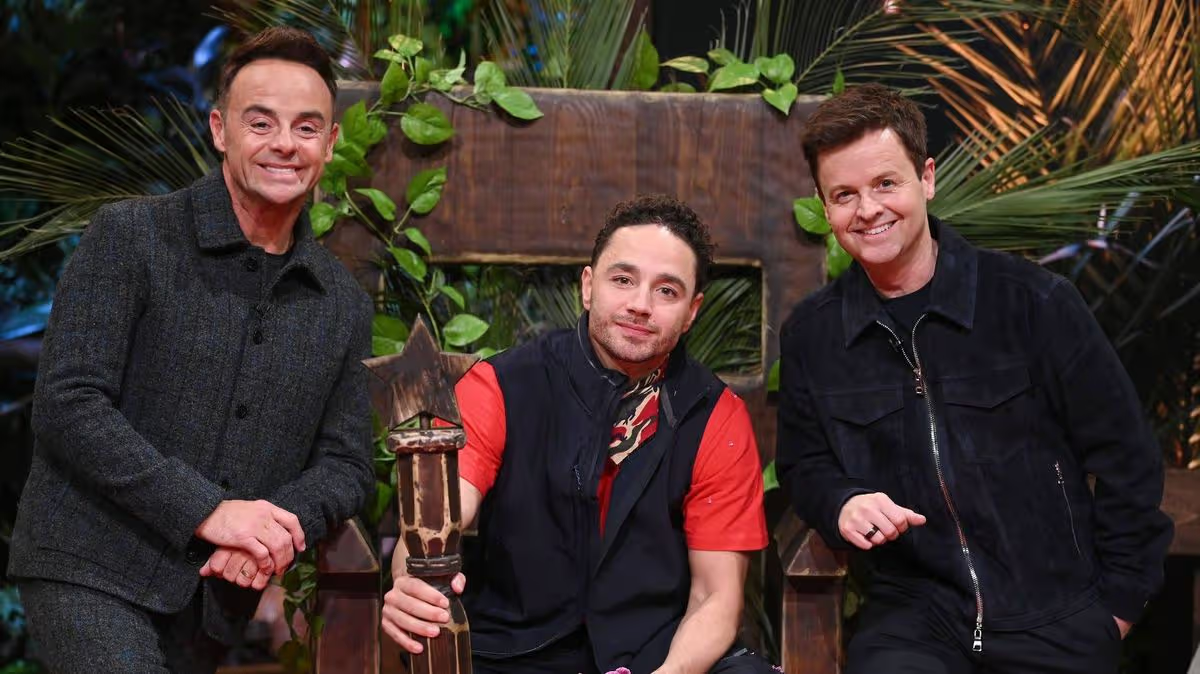
Ant McPartlin and Declan Donnelly have broken their silence on the I’m A Celebrity South Africa finale chaos, promising to reveal full details about the walkouts, Adam Thomas’s win and the tensions with Jimmy Bullard in their upcoming podcast
22:05, 29 Apr 2026Updated 22:05, 29 Apr 2026
Ant McPartlin and Declan Donnelly have addressed the chaotic I’m a Celeb South Africa live final that descended into mayhem last Friday night.
In the teaser for their podcast Hanging Out with Ant and Dec, the pair made light of the pandemonium from the broadcast, with Ant quipping: “If you didn’t see it, I bet you read about it!
“It was quite the night!” Dec remarked, vowing to reveal the “ins and outs” of what unfolded. Ant responded: “It was a weird night of TV,” noting there were “walk-outs” during the show. Previewing the key talking points of their forthcoming podcast episode, the duo pledged to discuss Jimmy Bullard, with Dec saying: “The first question was to Jimmy about why did you call I’m a Celebrity, Get Me Out of Here.”
Advertisement
Ant interjected: “On the night I said I disagreed with him,” seemingly referring to Jimmy Bullard, with whom Ant publicly clashed when Jimmy pressed him to confirm that Adam had been aggressive during the programme.
Dec then suggested that somebody had a “bee in his bonnet” they were eager to air, though the clip didn’t make it entirely clear whom he meant, reports the Mirror.
Dec also disclosed that two of the All Stars had departed the group WhatsApp – Gemma Collins and Adam Thomas. Meanwhile, Ant teased he’d share an anecdote about bumping into Adam Thomas and Jimmy Bullard following the recording. While this trailer merely hinted at what’s in store, the full episode drops on Thursday – meaning fans won’t need to hang around long to catch all the latest behind-the-scenes gossip from the hosts who witnessed the drama unfold first-hand.
Advertisement
Fans were thrilled with the snippets of information shared by the hosts, with some claiming it was shaping up to be their “best podcast ever” and expressing eagerness for this “juicy watch”.
The final episode saw Adam Thomas crowned King of the Jungle, but witness clashes with David Haye and Jimmy throughout the concluding instalment, prompting both Sinitta and Gemma to storm out of the live recording.
Following the show’s conclusion, the actor has admitted he feels ‘dead inside and numb’ about the experience and insisted he won’t return to the programme even if offered ‘£10million’, claiming it’s ‘eaten away at his soul.’ Adam revealed he felt the colour ‘drain from his face’ when Ant and Dec declared him the winner, as his worst nightmare became reality.
Advertisement
Speaking on The Thomas Bro’s podcast with brothers Scott and Ryan Thomas, Adam said: “The most disturbing is that I look at David and even after the show and after everything he did, you know he sent me a voice note and was like ‘oh mate, what a great show that was. I’m so happy you won. Congratulations.’”
And he disclosed the blunt response he fired back to his former campmate. “I just sent him a message back just saying, you know, ‘I think this is where we draw the line and I hope that you find happiness, bro, but I’m done.’”
Bacteriophages, or phages, are viruses that infect and kill bacteria. These microscopic predators are found everywhere from soil and water to food and the human gut. Because they attack only specific bacteria, researchers are increasingly exploring them as tools for reducing harmful bacteria in humans and animals without disturbing helpful microbes.
That makes them especially interesting at a time of rising antimicrobial resistance. This is when bacteria evolve ways to survive drugs designed to kill them. It’s a global health threat driven in part by the overuse of antibiotics in medicine and agriculture. Unlike broad-spectrum antibiotics, which kill many different kinds of bacteria and can also disrupt helpful gut microbes, research has shown that phages may be able to remove harmful bacteria with less disruption to the wider microbiome.
This has led researchers to investigate phages both as nutraceuticals, dietary supplements intended to promote health, and as feed additives in livestock production. In both cases, the aim is similar: reduce harmful bacteria, support gut health and potentially cut reliance on antibiotics.
How phages work
Phages work very differently from antibiotics. Rather than killing a broad range of bacteria, each phage typically infects only particular bacterial species or closely related types of bacteria.
Advertisement
When a phage encounters its target bacterium, it attaches to the cell and injects its genetic instructions. The virus then replicates inside the bacterium until the cell bursts. This releases new phage particles that go on to infect other bacteria.
This precision is one reason phages are attracting attention as a possible way to fight harmful bacteria. Unlike broad-spectrum antibiotics, which can disrupt entire communities of microbes, phages may be able to remove particular harmful bacteria without the same wider effects on the microbiome, according to studies of phage-microbiome interactions and research on antibiotic-associated microbiome disruption.
That raises the possibility that phages could be used not simply to kill bacteria, but to shape communities of microbes in ways that support health. Researchers have explored their potential in food safety, agriculture and human health.
Advertisement
In recent years, researchers and biotechnology companies have begun exploring phages as dietary supplements for humans. The idea is that people could ingest phages to reduce harmful gut bacteria in the hope of restoring balance in the gut microbiome, the community of microbes that lives in the digestive system.
Early findings are encouraging, though still preliminary. For example, one human clinical study found that a commercially available phage product targeting E. coli reduced levels of the bacteria in the gut without causing major disruption to the rest of the microbiome.
Other work has examined phage products designed to support digestive health by targeting bacteria associated with digestive discomfort or dysbiosis, an imbalance in gut microbes. A randomised controlled trial of a phage-based supplement reported improvements in digestive symptoms among participants with mild digestive issues.
This is still an emerging field, and the evidence remains limited. But the results so far suggest phage-based nutraceuticals could eventually form part of diet-based approaches to improving gut health.
Advertisement
There are already signs of commercial interest. In the US, phage products have been approved for certain food safety uses, such as reducing bacterial contamination on foods. Phage-containing supplements are already on sale.
Public acceptance, however, may prove just as important as scientific progress. Because viruses are usually associated with disease, researchers and manufacturers will need to explain clearly why these “good viruses” are different. They occur naturally, they are highly specific and they target bacteria rather than human cells.
Improving animal health through feed additives
Phages may also have an important role to play in livestock production. Farm animals often carry disease-causing bacteria such as Salmonella, Campylobacter and harmful strains of E. coli. These bacteria can harm animal health and contaminate food products. They can contribute to food-borne illness in humans.
Phage-based feed additives are being developed to target these bacteria in livestock. By incorporating phages into feed or drinking water, farmers may be able to reduce harmful bacteria while preserving beneficial microbes that support digestion and the immune system.
Advertisement
Experimental studies have produced promising results. In poultry, phage supplementation has been shown to reduce the presence of Salmonella and Campylobacter, two of the most common causes of food-borne infection worldwide. Research in pigs has also found that phage treatments can reduce harmful E. coli infections, improving gut health and growth.
Phages are also being investigated as alternatives to antibiotic feed additives used to prevent diseases such as liver abscesses – pockets of infection in the liver – in cattle. Because phages replicate only when their target bacteria are present, their effects may naturally taper off once those bacteria are gone, making them a potentially useful way to control infection.
Despite promising research, bacteriophage supplements are not yet widely authorised as feed additives in the UK. Regulators require extensive evidence of safety, stability and effectiveness. Because phages are biological entities that can evolve alongside bacteria, agencies must also consider whether they remain genetically consistent over time and what effects they might have on other microbial communities in the environment.
Even so, regulatory progress is emerging elsewhere. Phage-based food safety products targeting disease-causing bacteria such as Listeria monocytogenes and Salmonella have already been approved in several countries. This includes the US, where they are already being used in food safety applications.
Advertisement
More recently, European regulators authorised the first bacteriophage-based feed additive designed to reduce Salmonella in poultry. That marks an important step towards broader adoption of the technology.
Interest in bacteriophages reflects a wider shift in how microbes are understood in relation to health. If research continues to advance, and regulation keeps pace, phage-based nutraceuticals and feed supplements could become part of a new generation of more targeted ways to shape the microbiome, supporting both human health and more sustainable agriculture.
Tiny though they are, these bacterial viruses may end up playing a significant role in how we manage harmful bacteria.
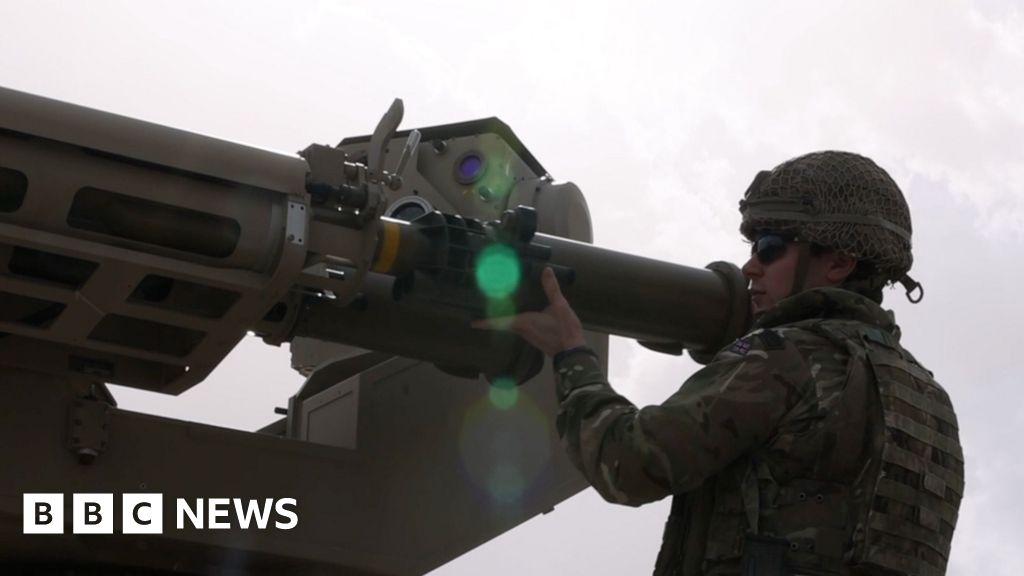
The BBC has been given access to a military base in Iraq where UK forces have been working together with their US counterparts during the conflict in the region.
The US announced an extended but fragile ceasefire on the US-Israel war in Iran – but prior to the ceasefire up to 28 drones were fired at the base on a daily basis.
“You hear weapons of destruction going off around you, and it’s bloody difficult,” an RAF air specialist at the base told the BBC’s defence correspondent Jonathan Beale.
British and US forces were working side by side at this military base long before the war with Iran started – in the fight against the Islamic State group.
Advertisement
Sharp differences over the war Iran have certainly strained transatlantic relations. But on this base the two are still joined at the hip.
Armed Forces Minister Al Carns said the close co-operation between the two militaries was a “message that needed to be elevated”. Since the conflict began “We’ve helped move Americans out of harms way; we’ve helped protect them and they’ve helped protect us,” Carns said – though he stressed that British forces were in a “defensive posture”.
Air Chief Marshal, Sir Harvey Smyth, said he’d met with the US commander of the base who’d been “effusive in praise” of UK forces. “I think our relationship is as strong as ever, and this operation has brought us even closer”, he said.
But that certainly hasn’t been reflected in the language between Washington and Westminster.
The reserve is expected to expand from 78 hectares to around 280 hectares
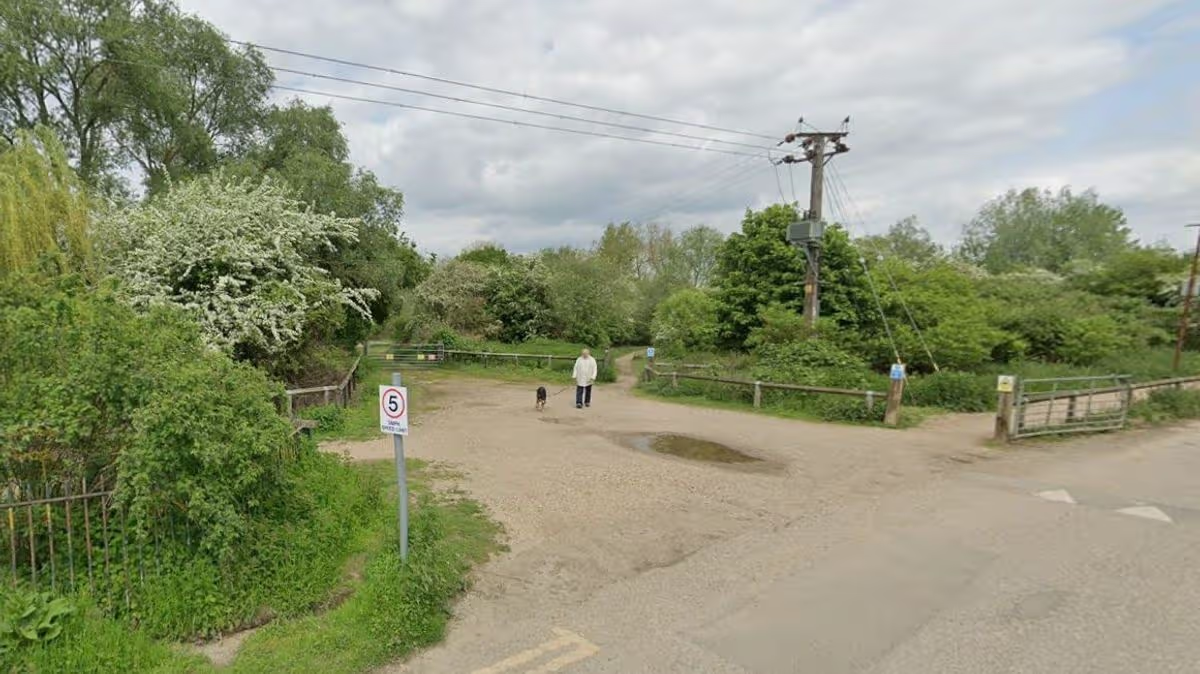
Plans to more than triple the size of a scenic nature reserve in Cambridgeshire have moved forward. Paxton Pits in Little Paxton near St Neots is set to expand from 78 hectares to about 280, making it one of the largest in Cambridgeshire.
Advertisement
Plans were initially submitted to Huntingdonshire District Council. The land was due to be transferred in phases over the coming years as gravel extraction is completed, with the new lease extending until 2087.
In the latest update, District Councillor Martin Hassall for Buckden, Diddington, and Southoe has confirmed that the final phase of excavation is scheduled for late summer to early autumn.
The footpath to the Ouse is now reportedly open and the quarry operator is currently submitting the paperwork to convert it into a bridleway. The bridleway from Diddington Pit to the Quarry, which continues to the Paxton Pits Visitor Centre is due to open by this summer, according to Cllr Hassall.
The nature reserve is expected to have three more lakes, islands for wading birds, and a variety of habitats. Extension leases for the reserve are due to be signed this month and a soft opening is expected to follow.
Advertisement
Councillor Hassall said: “The quarry team is working in full accordance with the current planning permission. A new planning and restoration application is underway. Site inspections from October and January were positive, with consultations indicating no technical issues.”
The councillor explained that ‘Area B’ was revisited based on new information and it was determined that significantly less inert material is required for restoration. This specific detail needs final approval and might be a delegated decision. If not, it would likely go to the June Planning Committee.
The project will also provide 27 kilometres of footpaths, 8.4 kilometres of cycleway, and new bird hides and viewpoints.
Viktor Gyokeres gave Arsenal the lead from the spot before Julian Alvarez converted a penalty of his own following a Ben White handball.
Arsenal were perhaps unlucky not to have another chance from the spot when Eberechi Eze went down in the box, with referee Danny Makkelie awarding a penalty before reversing his decision after a VAR review.
Advertisement
The Gunners will still fancy their chances of prevailing in the tie and reaching their first Champions League final since 2006, particularly having beaten Atletico 4-0 at the Emirates earlier in the competition.
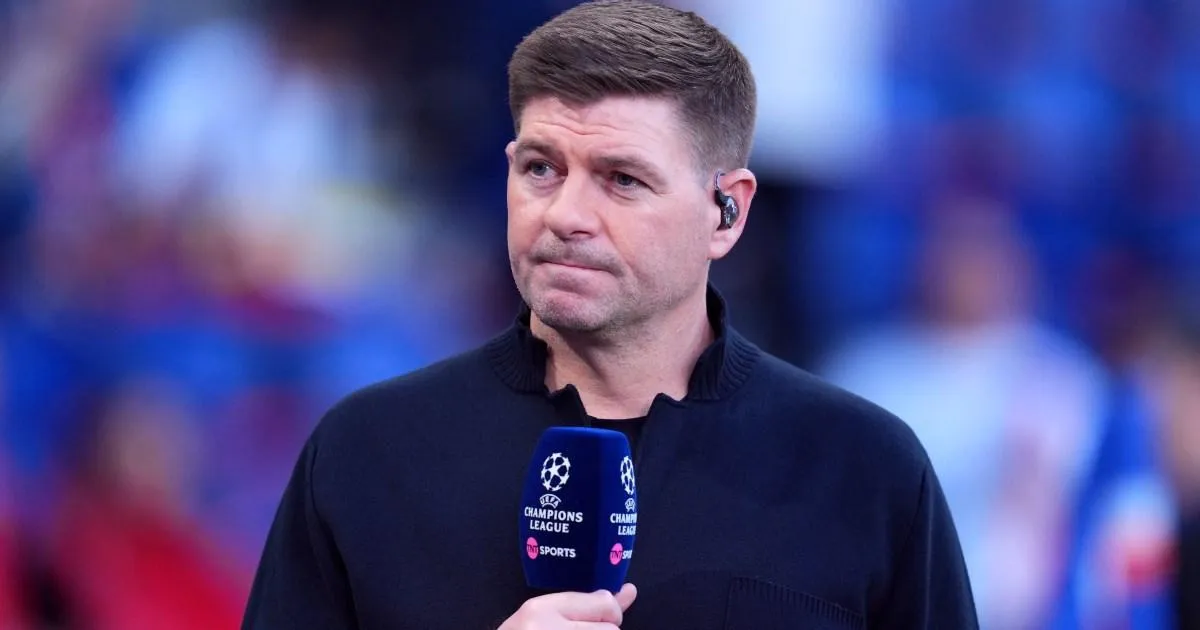
But Gerrard insisted that Arteta will need more attacking firepower to ensure that result, and urged the Spaniard to start both Eze and Saka next Tuesday after the pair were benched for the first leg.
‘I think in the second leg that have got to get Eze on the pitch,’ he told TNT Sports post-match.
Eberechi Eze came off the bench in the first leg (Picture: Getty)
‘I think he gives hem just that little bit more spark, little bit more power. He just looks that little bit more dangerous for me.’
Asked if Saka should also come into the team for the second leg, Gerrard added: ‘He does for me. You play your big-game players in the second leg.
Advertisement
‘You can understand them wanting to change and freshen the energy up and change the squad about, but you play your biggest players in the second leg of a Champions League semi-final.’
Gerrard also reserved special praise for Declan Rice, who showed a different side to his game in the first leg when asked to play in a deeper midfield role.
‘I thought he was immense, especially in the first half,’ Gerrard added. ‘He was dominant, in and out of possession, played a slightly different role, slightly deeper.
‘I think he was asked to drop in between the centre halves just to give them the extra man in the build-up because they were pressing with two centre forwards.
Advertisement
‘But I think out of possession, the way he rgains the ball, the way he covers ground, he’s some size and he’s some profile. I thought it was an outstanding performance from him once again.’
The BBC expert said: “Do not get seduced by this.”
BBC’s Dr Xand has issued a serious warning as a new health trend has been gaining traction online, promoting testosterone tests, supplements and medications to both men and women. The doctor clarified that, while it can offer benefits for certain people, others may be exposing themselves to “fatal” consequences.
Advertisement
The expert warned on Morning Live: “The bad news is that it does not seem to have the benefits that are claimed for it.” He clarified that it may only provide genuine benefits for people whose bodies are not physically producing sufficient amounts of the hormone.
Dr Xand delivered his scathing assessment of a recent claim that testosterone could ‘defy ageing’ for both men and women: “That headline is not just misleading, it is completely incorrect, wrong and dangerous.”
The doctor explained the medication can be “seductive” to people as many may feel they are experiencing the symptoms of low testosterone.
Common symptoms of low testosterone include:
Advertisement
Fatigue
Depression
Anxiety
Irritability
Mood changes
Low libido
Losing muscle and bone strength
Hair changes
He added: “That’s sort of most middle-aged men. Most people can look at that list and go; ‘yeah, a lot of days. I feel a bit like that life gets a bit tougher’. The answer is that it does not solve those problems.
“Those problems are caused by stress, lack of exercise, poor diet, poor sleep, all these things that all of us have in our lives that are hard to solve and those things will lower your testosterone, but pushing your testosterone levels up does not seem to fix it.”
A further worry for Dr Xand is the potential for people to exceed recommended doses: “Then it becomes dangerous. The side effects of testosterone, even at low, doses can include headache, acne, irritability, and aggressiveness mood changes, infertility is probably the biggest one.”
The specialist noted that consuming testosterone at any dosage could permanently impair a person’s fertility and might result in them developing a dependency on the substance.
Advertisement
He added: “If you are taking it as a sort of improvement, wellness, bodybuilding, sports drug, you’re at risk of very severe heart disease. Even fatal side effects. So this is why I think it’s very dangerous. You can manipulate your blood tests so that you can get a low result and get a big prescription from a wellness clinic and that can lead you down a very dangerous road.”
Content cannot be displayed without consent
The hormone can significantly influence numerous essential bodily functions, ranging from bone density and muscle mass to hair growth and mood. Both sexes produce the hormone, though women typically require lesser quantities, and testosterone medication was originally intended to assist those whose bodies were unable to produce sufficient levels naturally.
However, it has also been utilised as an anabolic steroid that gained popularity within gym and bodybuilding circles, though it carried a well-documented range of side effects. Only in recent times has it begun to be promoted as more of a holistic wellness product.
Dr Xand explained: “15 years ago, there were lots of concerns with it. We didn’t really know much about it was thought it might increase cancer it might increase heart disease, but it also might do all kinds of great things for you.
Advertisement
“Since then, there have been a couple of big trials that have looked at testosterone therapy in thousands of men in multiple countries in Europe. And so now we have some answers and the good news is that this is an inexpensive drug that does seem to be safe so it doesn’t seem to drive a lot of cancer.
“It does increase your risk of a few non-fatal heart conditions, but at the kind of doses you might get on the NHS it’s not hugely dangerous.”
Historically, women had no dedicated testosterone prescription available to them and were required to use men’s products when prescribed. However, there is potential evidence that testosterone therapy can work well for women during menopause.
Advertisement
Despite this, Dr Xand stressed: “It’s not for everyone and your GP can guide you through it. The marketing is designed to sell you a test to sell you a drug and then to send you all sorts of other things, all of which you should be going to your GP for and looking at.
“Do not believe it. Do not get seduced by this, if you are having a hard time with any aspect of your health, talk to your GP. The NHS is not against using testosterone, it will use it appropriately. Please, please, please do not go to a wellness clinic.”
Municipal elections in the occupied West Bank and in the central Gaza city of Deir al-Balah on April 25 have been quickly framed by Fatah, the dominant faction within the Palestinian Authority (PA), as a sweeping victory.
But it’s worth taking a closer look at how the election was organised. Candidates were required to commit to the political programme of the Palestine Liberation Organisation (PLO), which which includes the recognition of Israel, the renunciation of terrorism and the pursuit of a two-state solution. It was a condition that was widely seen as effectively excluding Hamas, which does not support these policies.
Hamas – which is understood to be preparing to hold elections for its leadership, which has been decimated during the 30-month conflict in Gaza – did not field candidates. A number of other groups, including the People’s Front for the Liberation of Palestine, the Democratic Front for the Liberation of Palestine, the Palestine People’s Party, FIDA, and Palestinian National Initiative, also opted not to field candidates in the election.
It’s important, when looking at the turnout and results, to bear this in mind. In the West Bank, turnout reached around 56%, but Fatah-affiliated lists were elected unopposed in 197 councils, roughly half of all municipalities in this round.
Advertisement
In the Gaza Strip, voting took place only in the central city of Deir al-Balah. Here, turnout was significantly lower, at around 23%, reflecting the mass displacement, incomplete voter registries and widespread loss of life. The Fatah-backed list won six of 15 seats. A list widely seen as aligned with Hamas secured two seats, with the remainder going to non-affiliated groups.
For the Fatah-dominated Palestinian Authority, these municipal elections serve several purposes. They are presented as a way to reaffirm a political link between the West Bank and Gaza, and to signal a continued role in Gaza’s future governance. They also offer a platform promising reforms to the watching world at a moment when the PA faces pressure to demonstrate political legitimacy.
While regular municipal elections have been held in the West Bank, presidential and legislative elections have not been held since 2005 and 2006. In the intervening two decades, concerns over the concentration of power under Fatah leader Mahmoud Abbas have intensified. In this context, the municipal elections represented a lower-stakes form of participation. It was a way to show electoral activity without reopening the broader question of national leadership.
Advertisement
Rather than a clear mandate, the results point to a constrained political landscape, shaped as much by exclusion and limited participation as by electoral competition. What these elections will change on the ground is unclear, particularly in Gaza, which remains stricken by 30 months of war.
Gaza in ruins
According to the UN, over 1.9 million people – between 80% and 90% of Gaza’s population – are displaced – six months into what is supposed to be a ceasefire. Families live in damaged homes, tents or overcrowded shelters, without reliable access to clean water, electricity, food or healthcare.
Children queue for water in Gaza City, April 27, 2026. Rizek Abdeljawad/Xinhua/Alamy Live News
According to the World Health Organization, only 19 of Gaza’s 36 hospitals function even partially and nearly half of essential medicines have run out. Conditions in displacement sites are deteriorating. Around 81% of sites show signs of rodents or pests, affecting 1.45 million people and increasing public health risks.
A recent joint World Bank–EU–UN assessment estimates that the recovery and reconstruction of the Gaza Strip will cost more than US$70 billion (£52 billion). The restoration of housing alone accounts for US$18 billion in damage, while more than 68 million tonnes of debris will need to be removed before rebuilding can begin.
Advertisement
But reconstruction depends on access to materials, land and infrastructure and Israel continues to control all of these. Israeli authorities control the entry of aid into Gaza, funnel deliveries through a single crossing, impose inspection regimes that delay or halt shipments, and close crossings altogether. Aid entering Gaza fell by 37% in the three months to April 2026, as raids and other ceasefire violations continue.
Reconstruction without Palestinians
While the people of Gaza remain in these conditions, outsiders are moving ahead with plans to shape Gaza’s future. In November 2025, the UN Security Council endorsed resolution 2803, backing a US-led initiative known as the Board of Peace to oversee the territory. When it first met on February 19, the Board of Peace pledged around US$17 billion – including US$10 billion from the US and additional commitments from Gulf states such as the UAE, Qatar, Saudi Arabia and Kuwait.
Donald Trump chairs the inaugural meeting on his ‘Board of Peace’ at the Donald J. Trump US Institute of Peace in Washington, February 19 2026. EPA/Alessandro Di Meo
Palestinians have no representatives on the Board of Peace, which is chaired by the US president Donald Trump, who also sets the agenda and calls meetings. Israel, however, does, as do Trump’s most prominent envoys, Jared Kushner and Steven Witkoff, who both have considerable business and real estate interests in the Middle East.
Palestinian civil society organisations have warned that the Board of Peace excludes Palestinians from meaningful decision-making and undermines their right to self-determination. European governments have also raised concerns about the concentration of authority in the hands of the US president and the lack of oversight.
Control over funding is also taking shape. The Gaza Reconstruction and Development (Grad) fund is structured as a World Bank Financial Intermediary Fund, with the bank acting as “limited trustee”. In practice, this means the World Bank manages donor money but has no say in how the money is spent. But World Bank president Ajay Banga also sits on the Board of Peace executive board, placing the institution inside the political structure that sets priorities.
Advertisement
In documents related to the Grad, the World Bank describes this moment as an opportunity to “fundamentally reshape” Gaza’s economy through private investment. The vision, as has been widely covered in the media, is to transform Gaza into a “hub” in the Imec development corridor that links India to the Middle East and beyond. The rebuilt Gaza would include a major port, high-tech industrial development, data centres and tourism resorts. Little provision has been made for the restoration of Palestinian homes, healthcare or water and power infrastructure.
Recent discussions with the Dubai-based port operator and logistics company DP World appear to highlight Board of Peace priorities. In April 2026, representatives linked to the board explored bringing the company in to manage key parts of Gaza’s supply chains, including warehousing, tracking systems and the movement of both humanitarian and commercial goods.
The talks also included proposals for a new port in Gaza or on the Egyptian coast, as well as a free-trade zone. It’s a plan for market-led development in its most concentrated form, which envisages the reconstruction of Gaza to serve regional and global economic interests. It reflects external priorities, not the needs on the ground in Gaza.












































You must be logged in to post a comment Login