
Crypto World
Circle Launches Gas-Free 'Nanopayments' on Mainnet Across 11 Blockchains



The stablecoin issuer’s new payment rail enables USDC transfers as small as $0.000001, targeting AI agents that pay per API call, per second, or per dataset read.

Disclosure: This article does not represent investment advice. The content and materials featured on this page are for educational purposes only.
SaintQuant expands AI trading adoption with automated strategies and 150,000+ global users.
Summary
- SaintQuant automates crypto trading with AI bots, managing risk, execution, and reinvestment 24/7 for hands-free growth.
- The AI trading platform processes 2.5M signals daily, executing strategies like DCA, Grid, and Swing with verified ROI.
- Trusted by 150K+ users, SaintQuant connects to major exchanges and delivers automated, data-driven crypto trading.
Bought Bitcoin for the first time. The wallet is set up. What comes next?
For most people, the next step is finding the best crypto app in 2026, one that handles trading, storage, automation, and passive income in a single place. That’s easier said than done. The market is flooded with apps that all look great on paper but fall apart the moment somebody tries to use them.
The problem isn’t just picking the wrong app. It’s picking the wrong type of app for what is actually needed. A day trader has completely different requirements from someone who wants to set up an automated crypto trading bot and let it run. Both deserve a platform built for them — not a one-size-fits-all solution that does everything adequately and nothing brilliantly.
In this guide, we’ve reviewed and ranked the 8 best crypto apps of 2026 across five categories: automated AI trading, exchange trading, wallet storage, crypto analytics, and passive earning. Whether someone is a complete beginner looking for the best crypto app to make money with no experience, or an intermediate trader ready to upgrade to automation, they’ll find a clear recommendation here.
Quick answer for scanners: Looking for the best automated crypto trading app in 2026 that genuinely works without having to watch charts all day? SaintQuant is #1 on this list — continue reading to know why.
The 8 best crypto apps ranked
- SaintQuant — Best AI-Automated Crypto Trading App for Passive Income in 2026
- MEXC — Best for Trading Thousands of Crypto Pairs at Low Fees
- Kraken — Best for Security-First Users Who Want Institutional-Grade Protection
- Binance — Best for Volume, Liquidity, and the Widest Range of Markets
- OKX — Best for Decentralized Trading With a Self-Custody Wallet
- Bybit — Best for Derivatives and High-Leverage Margin Trading
- PrimeXBT — Best for Multi-Asset Trading Across Crypto, Forex, and Commodities
- Crypto.com — Best for Beginners Who Want Cards, Rewards, and Simple Onboarding
Key Takeaways
- The best crypto apps in 2026 let users trade, store, and earn from their phone — but the best automated crypto apps go further, running trades on someone’s behalf 24/7.
- SaintQuant is the standout choice for anyone who wants hands-off automated crypto trading — no Telegram signals, no manual entries, no emotional decisions.
- Manual trading apps like MEXC, Kraken, and Binance remain excellent for active traders who want broad market access and low fees.
- Wallet apps like OKX are the right pick if self-custody and key control matter.
- In 2026, the best crypto apps combine ease of use, mobile access, and features that actually help users grow their portfolio — with or without actively managing it.
Best crypto trading apps reviewed
1. SaintQuant — Best AI-automated crypto trading app for passive income in 2026
For those who are tired of watching charts, chasing Telegram signals, and making emotional decisions at 2 am, SaintQuant is the answer.
SaintQuant is an AI-powered crypto trading bot platform trusted by over 150,000 users globally. It’s not a manual trading app. It doesn’t require users to pick entries, manage exits, or babysit positions. They choose a risk level and strategy, deposit funds, and the AI handles everything else — including execution, risk management, and reinvestment — 24 hours a day, seven days a week.
The platform is operated by SAIN PTY LTD (Australian-registered) and has been featured on MarketWatch, TradingView, Benzinga, AMBCrypto, and GlobeNewswire. It holds a Trustpilot rating of 4.3, Capterra 4.8, and G2 4.7 — rare consistency across all three major review platforms.
What makes SaintQuant different from every other app on this list?
Every other app here requires users to trade. SaintQuant trades on behalf of the user. The AI processes over 2.5 million daily signals — real-time prices, on-chain data, NLP sentiment analysis — and executes trades across three diversified bot types:
- DCA Bot (Dollar Cost Averaging): Automatically invests at regular intervals. Reduces the impact of volatility. Best for long-term, low-risk accumulation.
- Grid Bot: Places buy and sell orders at predetermined price intervals. Profits from sideways markets. Runs continuously without directional bias.
- Swing Bot: Captures medium-term price movements using momentum indicators and trailing profit targets. Backtested on five years of historical data.
Each strategy comes with a clearly labeled risk level (Low / Medium / High), bot type, trading frequency, and the verified average daily ROI target. There’s no guesswork about what the user is getting into.
SaintQuant’s verified average daily ROI is 1.2%. That’s not a marketing promise — it’s verified across the platform’s 4 million+ executed trades since 2021.
Here’s a snapshot of their current strategy tiers:
Plan
Investment
Duration
Target Daily ROI
Risk
Bot Type
Starter
$99 Free Trial
10 days
~1.00%
Low
DCA
Basic
$150
5 days
~1.35%
Medium
DCA
Advanced
$500
10 days
~1.48%
Medium
Grid
Pro
$1,000
14 days
~1.55%
Medium
Grid
Elite
$2,500
20 days
~1.62%
Medium
Grid
Premium
$6,000
25 days
~1.75%
Medium
Grid
Institutional
$15,000
30 days
~1.80%
Medium
Swing
At the end of each contract period, the original capital plus earned profit is returned to the user’s account.
SaintQuant connects officially to eight major exchanges — Binance, Bybit, Bitget, BingX, Kraken, OKX, KuCoin, and Coinbase — and funds are secured using institutional-grade cold storage. The platform also has an iOS and Android app with real-time portfolio tracking, push notifications on trade executions, and the ability to pause or adjust strategies on the go.
What it’s missing: SaintQuant doesn’t support manual trading from the app itself — it’s built purely for automated strategies. Thos who want to manually place spot trades or analyze individual charts within the same app need a secondary platform like MEXC or Kraken alongside it.
SaintQuant Key Features
- AI strategy execution running 24/7 — no manual input required after setup
- 2.5M+ daily signals processed across price, on-chain, and sentiment data
- Machine learning optimization continuously refines strategies across market cycles
- Automated stop-losses and exposure monitoring protect a user’s downside in real time
- 10+ strategies across Low, Medium, and High risk — pick what matches a user’s comfort level
- Free 10-day Starter trial — full access to live AI trading with no credit card required
- Available on iOS and Android with full portfolio monitoring and instant strategy controls
- Officially linked to 8 major exchanges, including Binance, Kraken, Bybit, OKX
Pros
- Genuinely hands-off — no chart-watching, no manual entries
Verified avg 1.2% daily ROI across 4M+ executed trades
150,000+ active users with Trustpilot 4.3
Three diversified bot types (DCA, Grid, Swing) that perform across market conditions
Institutional-grade cold storage and automated risk controls
Free 10-day trial with no credit card required
Australian-registered (SAIN PTY LTD) — adds regulatory confidence
Featured on MarketWatch, TradingView, Benzinga
Cons
- Not designed for manual trading — automated platform only
Requires crypto deposit (no fiat on-ramp)
Higher tiers require significant capital investment
Start the free 10-day trial with SaintQuant
2. MEXC — Trade thousands of crypto pairs at just 0.1% per side
MEXC is one of the best crypto trading apps for market diversity. It lists thousands of tradable pairs — ranging from Bitcoin, Ethereum, and Litecoin down to newly launched altcoins with limited trading history. For active traders who want maximum selection and rock-bottom spot fees, MEXC is hard to beat.
Spot trading fees come in at just 0.1%, making it one of the most affordable manual trading apps in 2026. MEXC also benefits from high daily trading volumes and premium liquidity, which means orders fill quickly without significant price impact.
The mobile app is available on iOS and Android and offers a comprehensive charting dashboard with technical indicators — everything needed for on-the-go analysis.
What it’s missing: MEXC doesn’t offer the kind of fully automated AI trading that SaintQuant provides. Users are still manually selecting entries, managing risk, and monitoring their positions. It’s an excellent tool for active traders, but not a set-and-forget solution.
MEXC App Key Features
- Spot trading fees of just 0.1% per side
- Thousands of tradable crypto pairs including new and low-cap altcoins
- Flexible savings accounts with competitive yields (up to 8.8% on Tether)
- iOS and Android app with full charting and technical analysis tools
- High daily volume and strong liquidity across major pairs
Pros
- Extremely low spot trading fees
Widest market selection of any app on this list
Strong mobile trading interface
Flexible savings products for passive yield
Cons
- No AI automation — all trading is manual
- The interface can feel overwhelming for a complete beginner
- Newer altcoins carry a higher liquidity risk
3. Kraken — Competitive fees and institutional-grade security
Kraken has been in the market since 2011 and has built one of the strongest security track records in crypto. For users who want a trustworthy, regulated exchange with solid fees and strong custodial storage, Kraken is a top-tier choice.
Spot fees start competitively for standard users and reduce further with volume. Kraken supports both spot and futures trading, along with staking on selected assets. The mobile app offers two-factor authentication and biometrics, and the exchange keeps the majority of client funds in offline cold storage.
What it’s missing: Like MEXC, Kraken is a manual trading platform. The interface is cleaner than many competitors, but the trader is still the one making every decision.
Kraken App Key Features
- Long-standing security record with no major breaches
- Spot and futures trading available
- 2FA and biometric login on mobile
- Staking available on selected assets
- Regulated in multiple jurisdictions including the US
Pros
- Exceptional security and regulatory compliance
Clean, beginner-friendly app interface
Competitive fees with volume-based discounts
Strong custodial storage with cold wallet majority
Cons
- No built-in AI automation
- Futures leverage lower than some competitors
- Fewer altcoins than MEXC
4. Binance — The largest crypto app for trading volume, liquidity, and active users
Binance is the world’s largest crypto exchange by trading volume. Binance is the gold standard for users who prioritize liquidity, especially when trading large positions. The app supports hundreds of coins, BNB-based fee discounts, staking, futures, and one of the deepest order books in the market.
The Binance app is available globally (with regional exceptions) and offers a sophisticated suite of tools for both beginners and advanced traders. BNB holders benefit from reduced trading fees across the platform.
What it’s missing: Binance requires active management. It has introduced some automated tools like copy trading and simple bots, but these pale in comparison to a dedicated AI platform like SaintQuant’s verified performance across 4M+ trades.
Binance App Key Features
- Deepest order book and highest trading volume globally
- Spot fees of 0.1%, reduced further with BNB
- Staking, savings, and launchpad for new projects
- Futures trading with up to 125x leverage
- Strong mobile app on iOS and Android
Pros
- Best-in-class liquidity
- Widest range of features in one platform
- BNB fee discounts reward loyal users
- Frequent promotions, airdrops, and events
Cons
- Regulatory pressure in several countries
- Overwhelming for complete beginners
- Manual trading only — automation is limited
5. OKX — Decentralized trading with a self-custody wallet
OKX occupies a unique position: it’s both a major centralized exchange and a powerful self-custody wallet. For users who want full control of their private keys while still having access to a CEX when needed, OKX covers both bases in one app.
The OKX wallet supports over 70 network standards and allows token swaps via decentralized liquidity pools — no account required. Fees are determined by the liquidity pool and are typically a small fraction of a percent. Security features include biometrics and multi-party computation (MPC), which removes the single-point-of-failure risk of traditional private keys.
OKX also connects to staking and liquidity farming pools for passive income. The centralized exchange portion requires KYC verification.
OKX App Key Features
- Self-custody wallet with full private key control
- Supports 70+ blockchain networks
- Token swaps via decentralized pools — no account needed
- Biometrics and MPC security
- Centralized exchange available with KYC
Pros
- Best self-custody option with no KYC needed for DEX trading
- Earn competitive yields on idle tokens
- Wide network compatibility
- Advanced security via MPC
Cons
- Decentralized trading is more complex for beginners
- Fees are only fully visible when creating an order
6. Bybit — The hottest app for derivatives and margin trading
Bybit has become one of the most popular apps for derivatives traders in 2026. It specializes in perpetual contracts and margin trading, with competitive funding rates and high leverage options. The app interface is well-designed for active traders who need speed and precision.
Bybit also offers copy trading, allowing users to mirror the positions of experienced traders. Its reward system and frequent promotions make it attractive for new users who want to start with a bonus.
Bybit App Key Features
- Perpetual and futures contracts with up to 100x leverage
- Copy trading for beginners who want to follow experienced traders
- Competitive maker/taker fee structure
- Frequent welcome bonuses and trading rewards
- Available globally on iOS and Android
Pros
- Leading platform for derivatives trading
- Copy trading feature ideal for newer active traders
- High leverage with robust risk tools
- Active rewards and promotions program
Cons
- High leverage amplifies losses — not suitable for inexperienced users
- Complexity of derivatives is a steep learning curve
7. PrimeXBT — Multi-asset trading with high leverage
PrimeXBT stands out for offering trading access across crypto, forex, and commodities in a single app. For users who want to trade Bitcoin alongside EUR/USD or gold without switching platforms, PrimeXBT is worth considering.
The app also offers a copy trading feature called Covesting, which lets traders follow the performance of top-ranked traders and mirror their positions. Leverage is available on most markets, and the interface is clean enough for intermediate-level users.
PrimeXBT App Key Features
- Trade crypto, forex, commodities, and indices in one app
- Covesting copy trading module
- Leverage available on all markets
- Clean interface suitable for intermediate traders
- Available on iOS and Android
Pros
- Unique multi-asset access in one app
- Copy trading lowers the barrier for new users
- Leverage across all asset classes
Cons
- Not beginner-friendly for first-time crypto users
- Copy trading quality depends heavily on the traders to follow
8. Crypto.com — Beginner-friendly app with cards, rewards, and broad market access
Crypto.com is one of the most recognizable names in retail crypto. Its app is designed with simplicity in mind — onboarding is fast, the interface is clean, and the Crypto.com Visa card lets traders spend crypto rewards in daily life.
For beginners who want their first crypto app to feel intuitive, Crypto.com removes a lot of the friction. It supports hundreds of coins and provides staking and savings products with competitive yields.
What it’s missing: Crypto.com’s trading fees include a spread, which can make it slightly more expensive than raw exchange fees on platforms like MEXC. But for beginners, the simplicity trade-off is often worth it.
Crypto.com App Key Features
- Crypto Visa card with crypto cashback rewards
- 250+ supported cryptocurrencies
- Simple buy/sell interface for beginners
- Staking and savings products with variable yields
- Fiat on-ramp with card and bank transfer
Pros
- Best-in-class beginner onboarding experience
- Crypto Visa card adds real-world utility
- Wide coin selection
- Recognizable brand with strong trust signals
Cons
- Spread-based fees can be higher than exchange-based pricing
- No automation or AI trading features
The methodology for ranking the best crypto apps
We reviewed and ranked these 13 apps based on the following criteria, weighted by what actually matters to real users in 2026:
Automation and AI capability — In 2026, the most valuable crypto apps are the ones that can execute profitable strategies. The article gave significant weight to platforms that offer genuine AI-powered automation, verified performance data, and hands-off operation.
Safety and security — Assessed both technical security (cold storage, 2FA, encryption, MPC) and regulatory compliance. Platforms with clean track records and transparent operations ranked higher.
Supported markets — Considered the breadth of tradable pairs, including major coins, altcoins, and derivative products.
User scenarios — Each app serves a different type of user. We matched apps to reader types: beginners, passive income seekers, active traders, and automation-first users.
Fees — Compared trading fees, deposit fees, withdrawal fees, and any hidden spread-based pricing.
Wallet type — Assessed whether wallets are custodial or self-custody, and what that means practically for different users.
Trading tools — Chart analysis, technical indicators, copy trading, and bot features all factored into our evaluation.
Deposit options — Checked fiat on-ramp availability, accepted payment methods, minimums, and deposit fees.
In-app support — Considered the availability and quality of customer support, including live chat and response times.
Best crypto apps for 2026: Compared
| App | Best For | Automation | Fees | Custodial | Fiat On-Ramp |
| SaintQuant | AI-automated passive income | ✅ Full AI | Strategy-based | Custodial | Crypto only |
| MEXC | Maximum market selection | ❌ Manual | 0.1% spot | Custodial | ✅ Yes |
| Kraken | Security-first traders | ❌ Manual | Competitive | Custodial | ✅ Yes |
| Binance | Volume & liquidity | ❌ Manual | 0.1% (BNB discount) | Custodial | ✅ Yes |
| OKX | Self-custody + DEX trading | ❌ Manual | Pool-determined | Self-custody | ✅ CEX only |
| Bybit | Derivatives trading | ❌ Manual | Competitive maker/taker | Custodial | ✅ Yes |
| PrimeXBT | Multi-asset copy trading | Partial (copy) | Competitive | Custodial | ✅ Yes |
| Crypto.com | Beginner onboarding | ❌ Manual | Spread-based | Custodial | ✅ Yes |
How to choose the best crypto app to start with
Safety
The most important question to ask about any crypto app is: Can I lose access to my funds? This depends on two things: the security of the platform itself, and whether it’s custodial or self-custody.
Custodial platforms like Kraken and Binance hold private keys on users’ behalf. They protect them with 2FA, cold storage, and institutional security — but in theory, users don’t control the keys. Self-custody apps like OKX put users fully in control, which is more secure in one sense and riskier in another (lose the seed phrase and there’s no recovery).
For automated platforms like SaintQuant, funds are secured via cold storage, and the bots operate via API — exchange withdrawal permissions are never granted to the bot, meaning funds can’t be removed from the exchange without the user’s action.
Security Features
Look for: two-factor authentication (2FA), biometric login, cold storage for the majority of funds, and where possible, MPC (multi-party computation) technology that removes single-point-of-failure risk.
Supported markets
For those who want to trade Bitcoin only, almost any app works. Want altcoins? Choose MEXC or Binance. For those who want derivatives and leverage, look at Bybit, Margex, or BloFin. Those looking for automated AI trading across strategies, SaintQuant is the only app on this list purpose-built for that.
User Scenarios
Here’s a fast guide:
- Want crypto to generate passive income without watching charts: SaintQuant
- Want to trade manually across thousands of coins: MEXC or Binance
- Prioritize security and regulation above everything: Kraken
- Want to own keys and trade on DEXs: OKX
- Want to copy an experienced trader: Bybit or WEEX
- Want a simple first app as a beginner: Crypto.com
- Want a taste of automation without paying extra: Pionex
Non-Trading Fees
Crypto deposits are usually free. Fiat deposits via card can carry processing fees of 1.5–3%, depending on the provider. Always check withdrawal fees before choosing a platform — these vary significantly across chains and token types.
Trading Fees
For spot trading, 0.1% is the standard benchmark (MEXC, Binance). Margex offers 0.06% for derivatives. SaintQuant’s fee structure is embedded in the strategy tier rather than per-trade commissions. Pionex charges 0.05% and offers bots for free.
Most platforms offer preferential rates for high-volume traders or for holding the exchange’s native token (BNB on Binance, MX on MEXC).
In-Built Wallet
The best crypto apps let users store their coins without a separate wallet app. However, the type of wallet matters enormously:
- Custodial wallets (Kraken, Binance, MEXC): The exchange holds keys. Secure, but the user is trusting the platform.
- Self-custody wallets (OKX): Users hold the keys. Full control, full responsibility.
- Automated platform storage (SaintQuant): Funds are secured via institutional cold storage by SaintQuant, with no exchange withdrawal permissions granted to the AI.
Trading Tools
Active traders should look for apps with full charting, technical indicators, and mobile-optimized interfaces. MEXC and Bybit are excellent here. For automated traders, the “tools” are the AI itself — and SaintQuant’s machine learning optimization, running 24/7, is more powerful than any charting suite.
Deposit Options
Most apps accept crypto deposits. Fiat options vary — Kraken, Binance, Crypto.com, and MEXC all offer card and bank transfer on-ramps. SaintQuant accepts crypto deposits only (supported assets listed in the dashboard after registration).
In-App Support
The leading apps offer 24/7 live chat. SaintQuant offers direct support via the contact page. When evaluating any platform, send a test message before committing capital and assess response time.
How to get started with a crypto app: Step-by-step guide for beginners
Step 1: Decide What to Do With Crypto
Looking to actively trade? Store crypto safely? Generate passive income? Each goal points to a different app.
Step 2: Download the App and Register an Account
Download the chosen app from the App Store or Google Play. Registration typically requires an email or phone number. Some platforms (Kraken, Binance, Crypto.com) require KYC identity verification. OKX lets users use the DEX features without an account.
For SaintQuant: visit the official website, create a free account in under two minutes, and choose a strategy.
Step 3: Deposit Funds
- Fiat platforms: Deposit via debit/credit card or bank transfer.
- Crypto-only platforms (SaintQuant): Transfer crypto to an account wallet. Supported assets are listed in the dashboard.
- Minimums vary: SaintQuant’s Starter plan begins at $99. MEXC and Kraken have low minimum deposit requirements.
Step 4: Activate the Strategy or Make the First Trade
For manual trading apps: search for the asset, choose the position size, and confirm.
For SaintQuant: choose the risk level (Low/Medium/High), select a strategy, activate it, and the AI begins executing immediately. No ongoing input required.
Conclusion: Best apps to buy, trade, and automate crypto in 2026
Crypto apps in 2026 are more capable than ever — but they’re not all built for the same person.
Want to manually trade thousands of crypto pairs with low fees and professional tools? MEXC and Binance are the standout options. If security and regulation are a priority, Kraken is hard to fault. For those who want full control of their keys without a custodial middleman, OKX delivers.
But if what a user actually wants is crypto generating consistent returns without trading manually — without chart-watching, without signal groups, without emotional decisions — then there’s only one platform on this list purpose-built for that: SaintQuant.
150,000+ traders globally. 4 million+ trades executed. Verified avg 1.2% daily ROI. Trustpilot 4.3 / Capterra 4.8 / G2 4.7. A free 10-day trial with no credit card required.
The best crypto app in 2026 isn’t just the one with the most coins or the lowest fees. It’s the one that actually works for a particular lifestyle.
Start the free SaintQuant trial — no credit card, no coding, no charts required
FAQs
What is the best crypto app in 2026?
The best crypto app depends on the goal. For automated passive income, SaintQuant is our top pick — it’s the only AI-powered trading platform on this list with verified average daily ROI and 150,000+ active users. For manual trading, MEXC offers the widest market selection at competitive fees.
What is the best crypto app for beginners with no experience?
SaintQuant is ideal for beginners who want returns without needing trading knowledge — choose a risk level, and the AI handles everything. For beginners who want to learn manual trading, Crypto.com’s simple interface is the easiest starting point.
Is it safe to use a crypto trading bot app?
Bot safety varies enormously by platform. SaintQuant operates via API with no exchange withdrawal permissions — meaning funds cannot be removed from the exchange by the bot. Look for platforms that are transparent about this and have verifiable track records.
What is the best crypto app to make money passively?
SaintQuant. Its AI-powered bots run 24/7, executing strategies across DCA, Grid, and Swing bot types with a verified avg 1.2% daily ROI target. Capital plus profit is returned at the end of each contract period.
What is the best crypto trading app for active traders?
MEXC for spot trading (0.1% fees, thousands of pairs), Bybit or Margex for derivatives (0.06% at Margex), and Binance for maximum liquidity. All require manual input and active management.
Disclosure: This content is provided by a third party. Neither crypto.news nor the author of this article endorses any product mentioned on this page. Users should conduct their own research before taking any action related to the company.
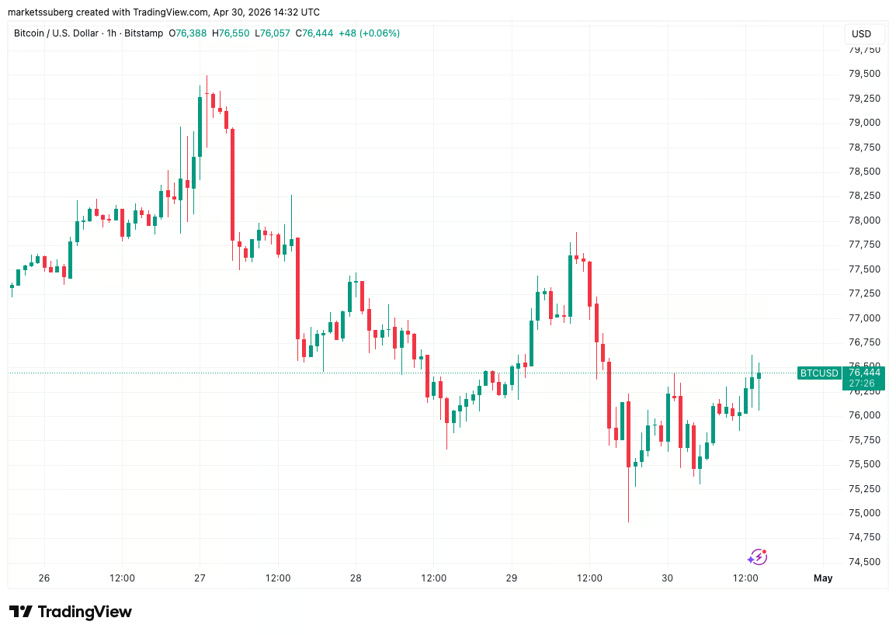
Bitcoin (BTC) rebounded above $76,000 at Thursday’s Wall Street open while traders stayed bearish on the short-term BTC price outlook.
Key points:
- Bitcoin’s Coinbase Premium Index flips negative as analysis warned the January breakdown could repeat.
- BTC price action is already at risk of repeating a bear flag breakdown to new macro lows.
- The April monthly close should still offer Bitcoin’s best gains in a year.
Bitcoin Coinbase Premium risks repeating bearish history
Data from TradingView showed 1% daily gains after initial pressure over high oil prices and a hawkish US Federal Reserve meeting the day prior.
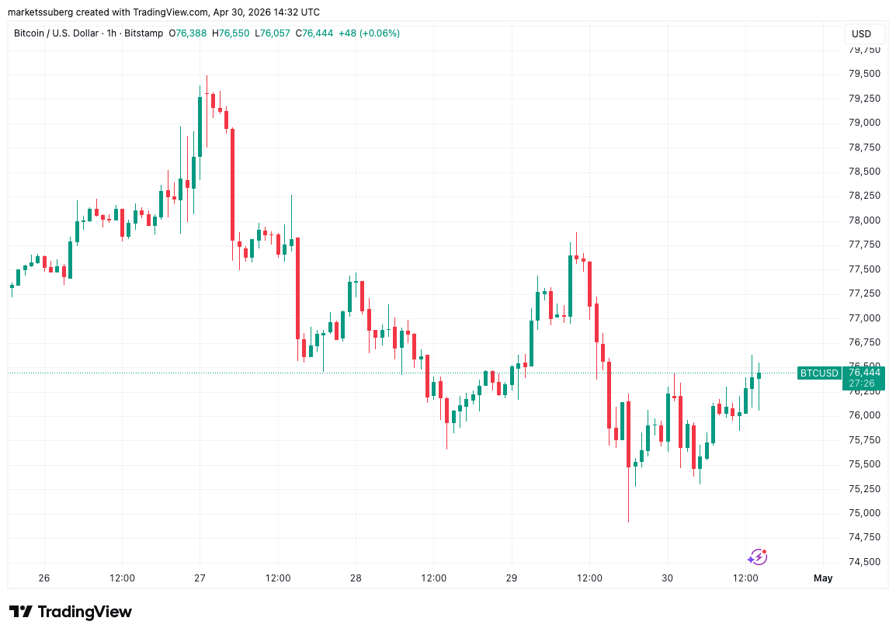
BTC/USD one-hour chart. Source: Cointelegraph/TradingView
With US stocks treading water, Bitcoin market participants saw little reason to flip bullish on shorter time frames.
Among the concerns was the Coinbase Premium — the difference in price between Coinbase’s BTC/USD and Binance’s BTC/USDT pairs.
“Bitcoin’s ripping higher… but the selling on Coinbase is getting DEEPER by the minute,” X user Against Wall Street wrote.
A negative Coinbase Premium implies insufficient demand for Bitcoin during US trading hours, with price action normally suffering as a result.
In January, a relief bounce on BTC/USD combined with a steepening negative Premium, and the pair ultimately broke to new macro lows.
.png?prefix=media%2Fcontent)
Bitcoin Coinbase Premium Index. Source: CryptoQuant
“We’ve seen this exact movie before, and spoiler alert: everybody already knows how it ends,” Against Wall Street continued, referring to January’s events.
As Cointelegraph reported, then, as now, price formed a so-called “bear flag” construction on the daily chart — a warning to buyers that a breakdown could occur.
BTC teases best monthly price gains since April 2025
Other traders also felt the need for caution, with trader CJ seeing little sign of a long-term floor already being in place.
Related: Bitcoin, stocks risk ‘months’ of losses as Kevin Warsh Becomes Fed chair
A chart uploaded to X on the day included a potential target of $65,000.
“I think even if we are putting in a bottom here, we *at least* see something like this,” they commented.
“This would be my bullish outlook. I’m ultimately waiting on April close to refine.”
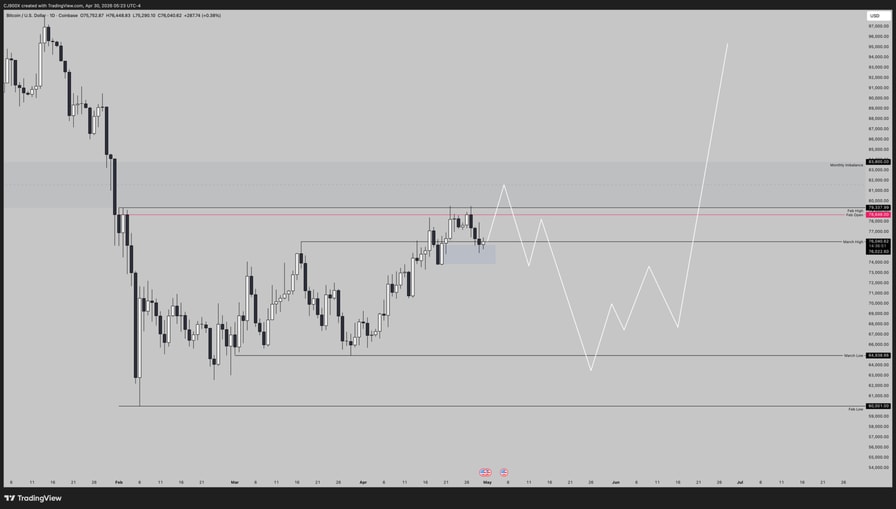
BTC/USD one-day chart. Source: CJ/X
The monthly close was set to offer 11.6% gains for April at the time of writing — still Bitcoin’s best performance in a year, per data from CoinGlass.
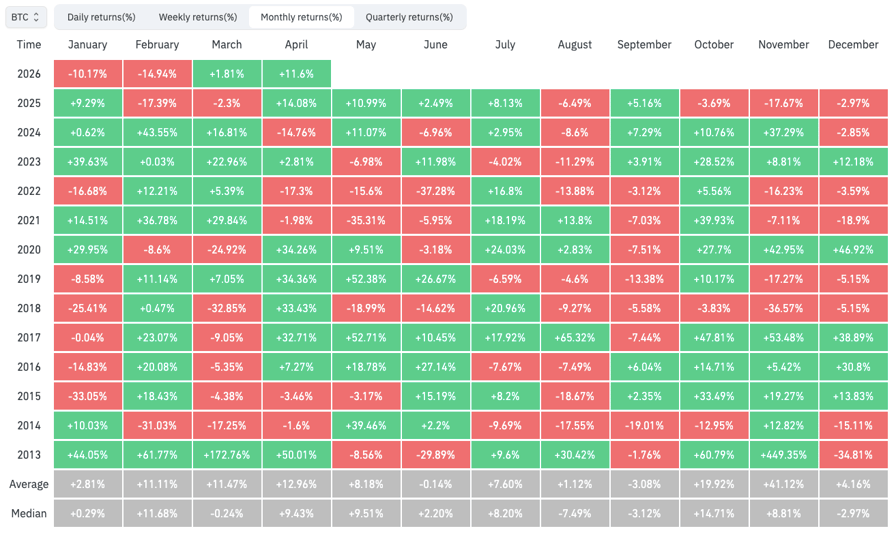
BTC/USD monthly returns (screenshot). Source: CoinGlass
Crypto World
Ethereum Price Prediction Hits $7,500: Standard Chartered Says 2026 Is ETH’s Year, But Pepeto Presale Offers Higher Potential
Ethereum price prediction from Standard Chartered just jumped to $7,500 for year end 2026, a number that caught even the bulls off guard. The bank’s analyst said this will be the year ETH takes back the market, and the data backs it: Glamsterdam targets a 78% gas fee cut by June, spot ETH ETFs just posted their strongest weekly inflows of 2026, and Citi holds $3,175 near term.
But even with $7,500 on the table, that is still a 3x move from 2,299 over eight months. A presale that keeps gaining attention across the market right now offers a path to returns that ETH at a $277 billion market cap will take years to match, and the numbers explain exactly why.
Standard Chartered Raises Ethereum Price Prediction to $7,500 and Declares 2026 the Year of ETH
Standard Chartered lifted its ethereum price prediction from $4,000 to $7,500, arguing that corporate treasury buyers and rising ETF demand will push ETH higher all year, according to The Block. Over half of all stablecoins run on Ethereum, and stablecoins already make up 40% of total blockchain fees.
ETH at 2,299 reaching $7,500 is a 223% gain by December, and that assumes the Glamsterdam upgrade ships on time, ETF inflows hold, and nothing breaks. What if you could earn from ETH trading volume without needing the price to triple?
The $7,500 Target and the Presale That Does Not Need ETH to Reach It
You Do Not Need to Wait for $7,500 When You Earn From Every ETH Trade Today
Standard Chartered says $7,500. Citi says $3,175. Both could be right, both could miss, and if you hold ETH you sit and wait to find out. Pepeto removes that wait entirely, because the exchange collects fees from every trade on the platform, and trades happen whether ETH runs to $7,500 or drops back to $2,000.
Presale wallets get a share of all exchange trading fees after launch, not a short term bonus, but a share of every trade going forward. After that detail came out, the last stage sold out in under 24 hours, and more than $200K hit the presale at a speed nobody expected in this market.
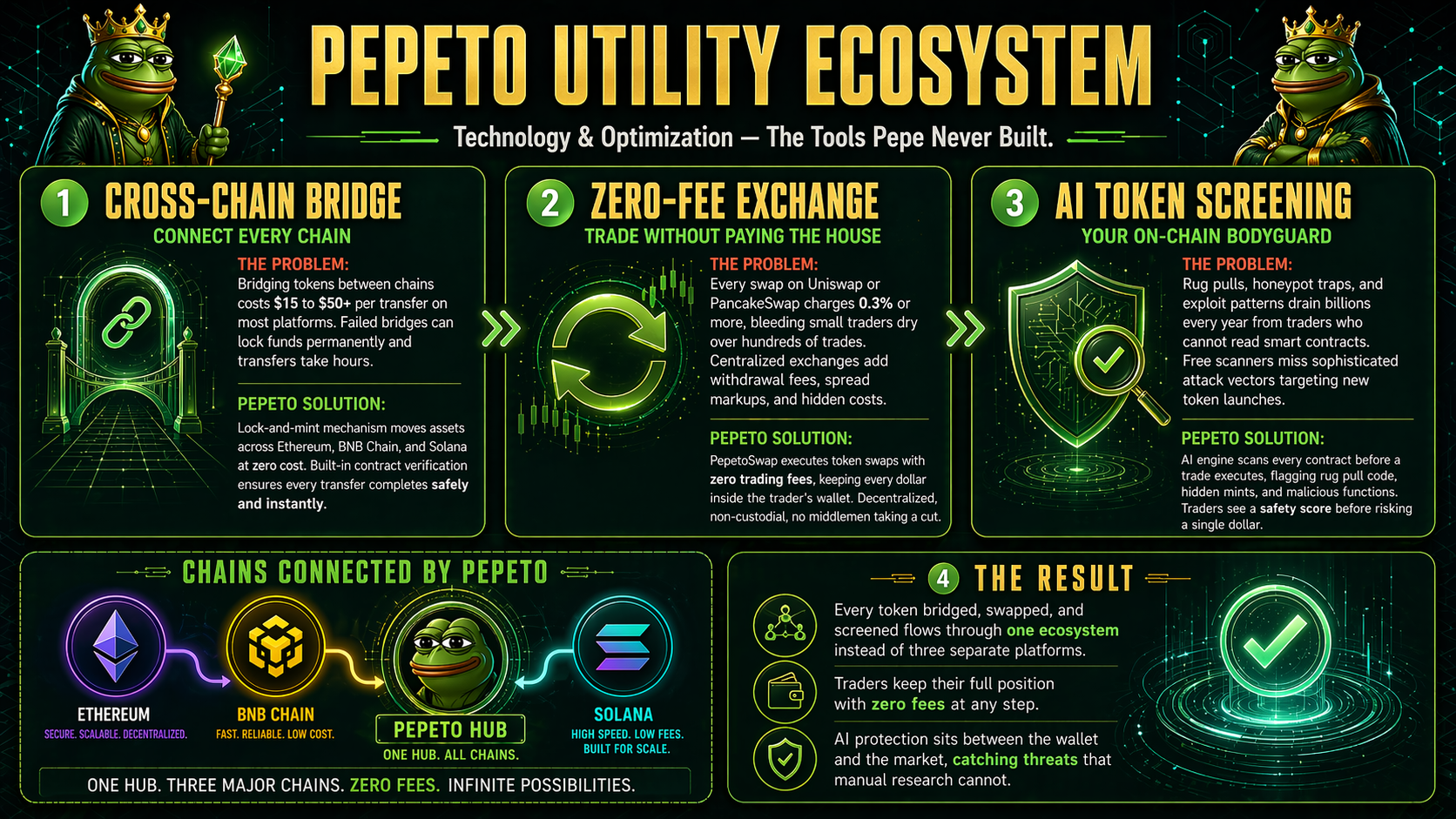
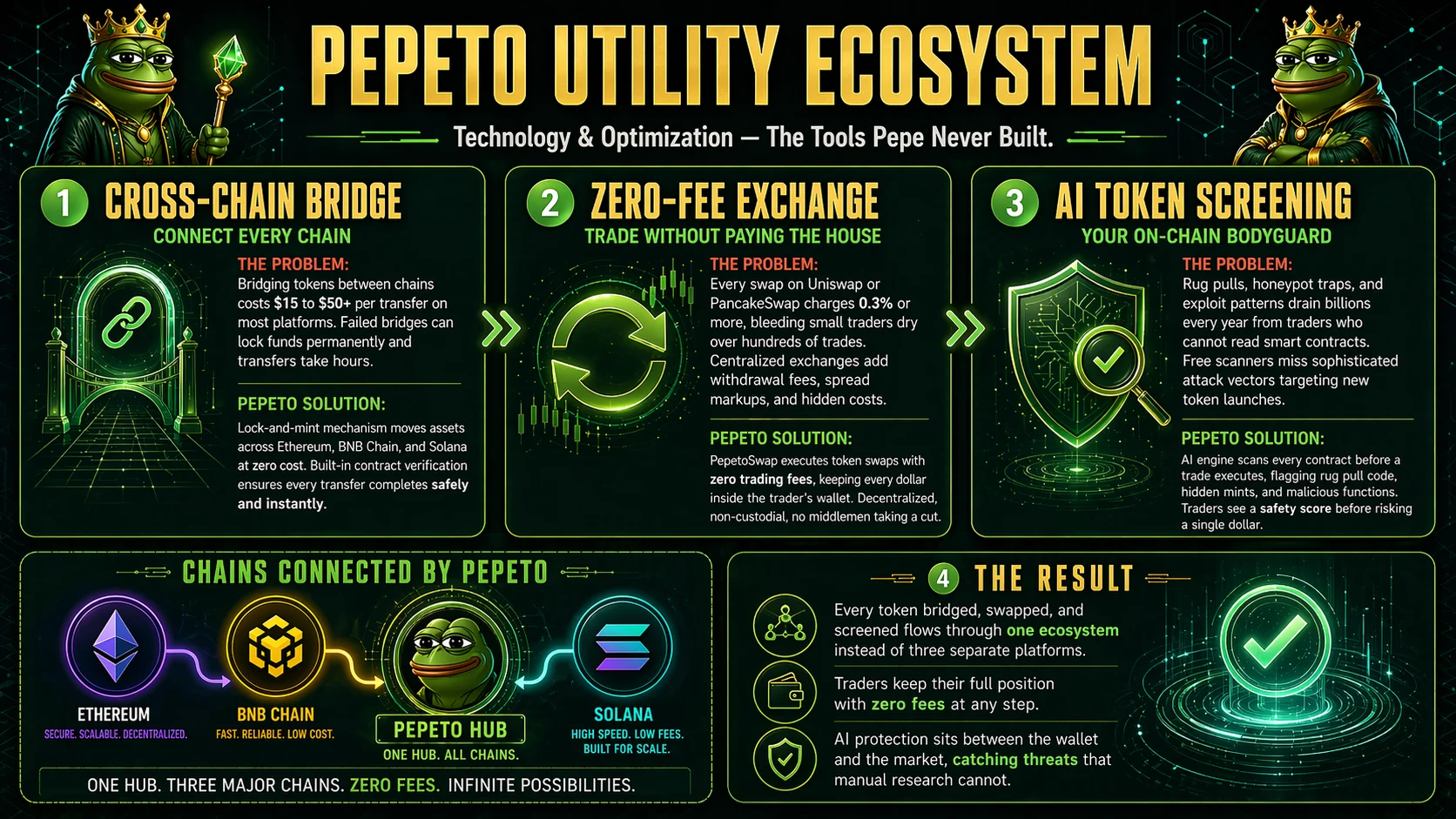
The person who turned Pepe into a $7 billion token came back to build an exchange connecting every blockchain through a cross chain bridge, because the real money is in trading volume, not in guessing direction. The SolidProof audit confirmed the system works before a single dollar entered, and the combination of a verified audit, a proven founder, and working exchange tools at this price is rare.
Funding crossed $9.6M during the same week Standard Chartered told the world to buy ETH. Staking at 177% APY pays holders while the ethereum price prediction debate plays out, and the Binance listing approaches on a timeline the team says is closer than anyone outside the project realizes. The entry at $0.0000001867 gets smaller with every stage, and once it closes, this price becomes something only early wallets will ever see.
Ethereum (ETH) Price at 2,299 as Glamsterdam Upgrade Targets 78% Gas Fee Cut in June
Ethereum (ETH) trades at 2,299 according to CoinMarketCap after gaining 11.66% over the past month. The Glamsterdam upgrade set for June 2026 targets a 78% gas fee cut and parallel processing that would push throughput to 10,000 TPS.
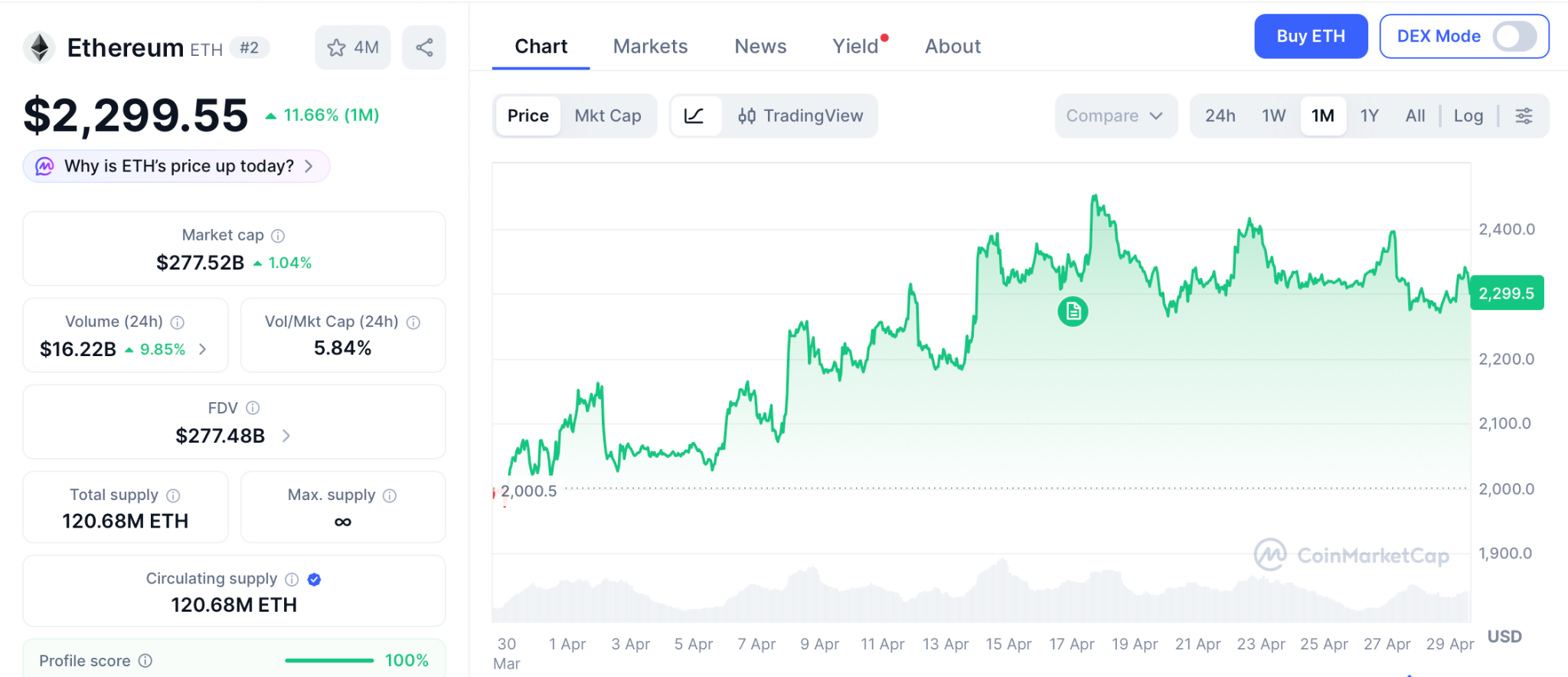
ETH spot ETFs recorded nine straight days of inflows through April 21 with total net inflows at $12.05 billion. Citi holds $3,175 near term, Standard Chartered keeps $7,500 for year end, and the 200 day moving average at $2,600 marks resistance. Even $7,500 sits 223% away over eight months, while presale exchange tools at six decimal zeros work on a faster timeline.
Conclusion
Standard Chartered just gave ETH its strongest call all year, and that $7,500 target will take the rest of 2026 to play out if it happens at all. The gap between Pepeto’s presale price and the listing is the entire opportunity, and it closes permanently once the Binance listing goes live.
Coverage grows louder every week, the ethereum price prediction keeps climbing, 177% APY compounds in wallets that have already entered, and when the Glamsterdam debate drives fresh ETH volume, that volume flows straight through the exchange this presale builds, which will benefit every single presale buyer .
Visit Pepeto Official Website to Enter the Presale

Disclaimer:
The Pepeto project is moving ahead fast, and because of its growing reach, bad actors have launched attacks on the official site.
The backup domain is now « PepetoSwap DOT com » in place of « Pepeto DOT io » until further notice. Users should always confirm they are on the correct URL before connecting wallets or sharing personal information.
FAQs
What is the ethereum price prediction for the end of 2026?
Standard Chartered set an ethereum price prediction of $7,500 for year end 2026, up from a prior $4,000 target, citing rising ETF demand and the Glamsterdam upgrade. Pepeto earns from ETH trading volume at any price level, offering returns that do not depend on ETH reaching that target.
Why is Pepeto a better entry than Ethereum at 2,299?
Pepeto at $0.0000001867 with verified exchange tools, 177% staking APY, and a Binance listing approaching offers listing multiples that Ethereum at 2,299 with a $277 billion market cap cannot match on any realistic timeline. The presale has raised $9.6M from thousands of wallets.
Disclaimer: This is a Press Release provided by a third party who is responsible for the content. Please conduct your own research before taking any action based on the content.

Ether (ETH) has rebounded more than 25% from its February low below $1,800, and a mix of technical and onchain signals suggests the recovery may still have more room to run in May.
Key takeaways:
- Ether’s technicals favor the bulls with a $3,000 ETH price target.
- ETH is holding a support zone that has previously triggered 22%–27% price rebounds.
- Ether’s spot taker CVD remains positive, suggesting confidence among buyers.
ETH price charts target $3,000
Ether’s technical setups on multiple time frames support the bull case for ETH price as April comes to a close.
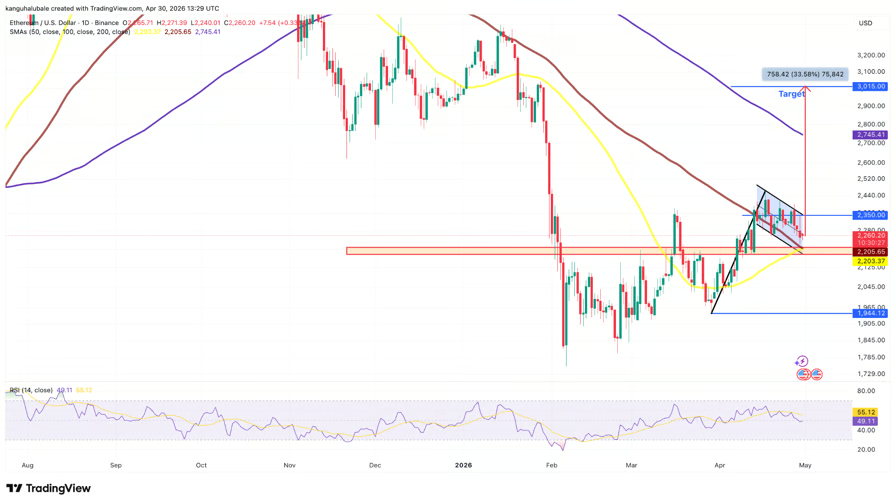
The ETH/USD pair has been forming a bull flag chart pattern on the daily chart since early April, as shown below.
Related: Ethereum to $60K? It’s a ‘generational play’ for ETH bull Tom Lee, says analyst
A bull flag pattern is a bullish continuation pattern that forms after the price consolidates inside a down-sloping range following a sharp price rise.
The flag will resolve once the price breaks above the upper trend line at $2,350 and could rise by as much as the previous uptrend’s height. This places the upper target for ETH price just above $3,000, about 33.5% above the current price.
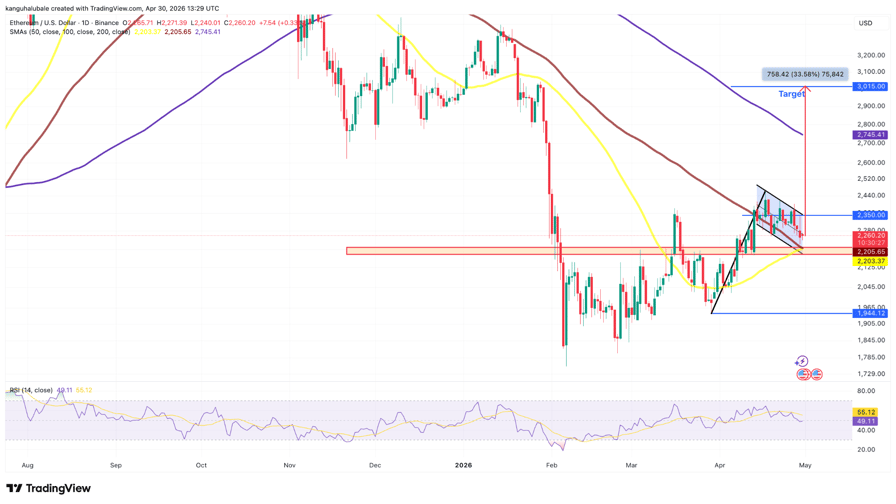
ETH/USD daily chart. Source: Cointelegraph/TradingView
Meanwhile, an ascending triangle on the eight-hour chart suggests that ETH was preparing for a significant upward move.
A break above the upper trend line of the triangle at $2,400 would validate the pattern, opening the way for a rally toward the measured target of the triangle at $3,305. Such a move would bring the total gains to 46%.
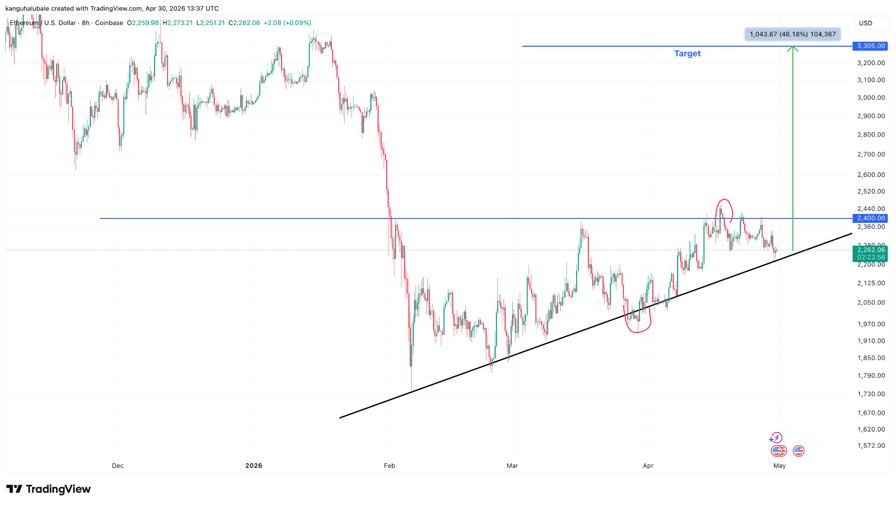
ETH/USD daily chart. Source: Cointelegraph/TradingView
Other technical setups suggest ETH’s price could climb toward $3,000-$6,000 in the coming months.
ETH price sits on strong support around $2,000
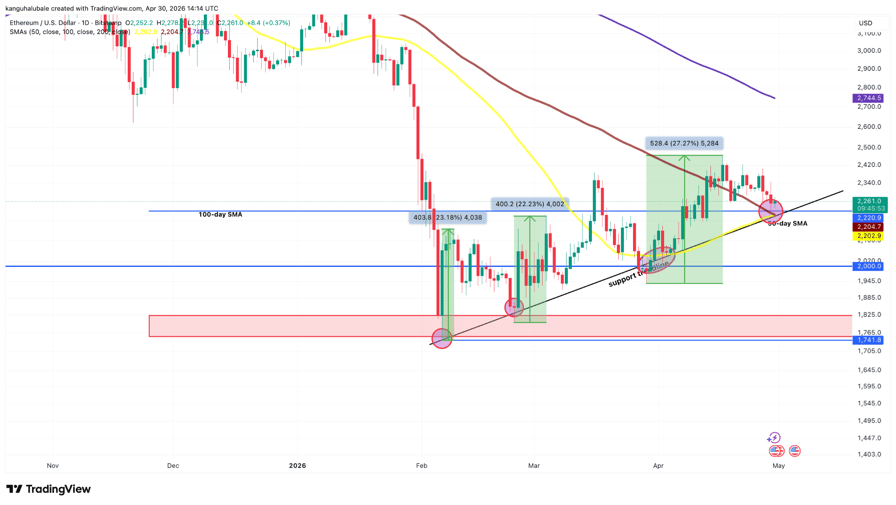
Since early February, ETH/USD has been forming higher lows, with the price consistently respecting a multi-month support trend line.
Each rebound from this trend line has preceded 22%–27% price rallies, often driving ETH back toward or even beyond the high formed after the last rebound. The current setup mirrors those prior cycles.
ETH/USD daily chart. Source: Cointelegraph/TradingView
Ether is now consolidating near the trend line support around $2,000-$2,200, which also coincides with the 50-day (yellow wave) and 100-day SMAs (brown), a key dynamic support level in ongoing uptrends.
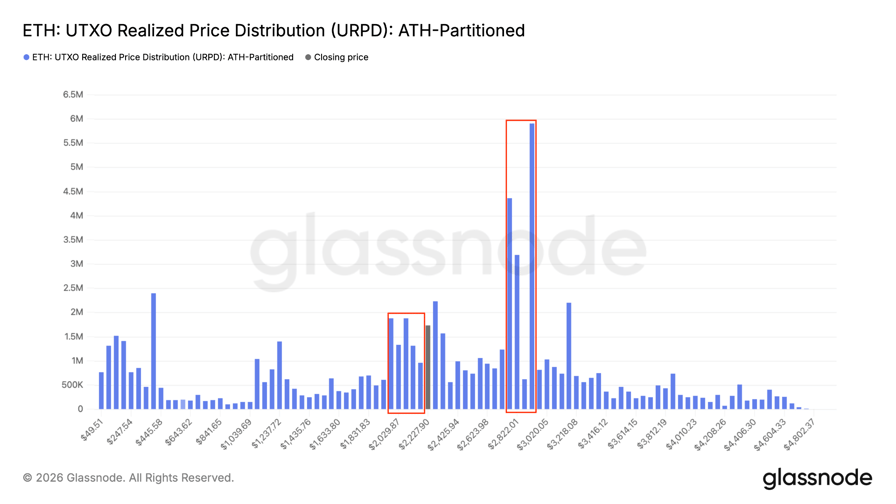
Meanwhile, UTXO realized price distribution (URPD) data shows that Ether is sitting on a significant support zone between $1,980 and $2,178, where investors acquired 7.4 million ETH.
ETH URPD all-time high partitioned. Source: Glassnode
A rebound from this range increased the odds of Ether’s price rising higher to beat resistance at $2,400, toward the next major resistance at $2,800-$3,000, where investors acquired approximately 14 million ETH.
Ether’s spot taker CVD signals high buyer volumes
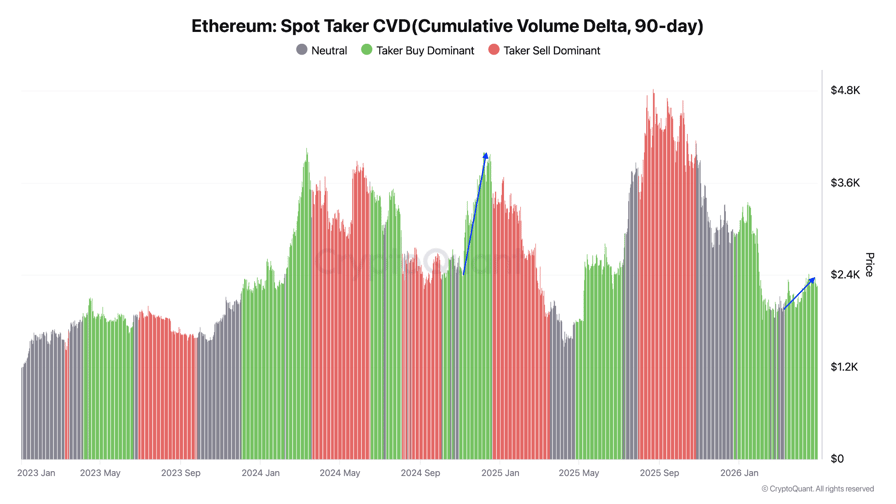
Ether’s 90-day spot taker cumulative volume delta (CVD) shows that buy-orders (taker buy) have become dominant again. CVD measures the difference between buy and sell volume over three months.
The metric remained in the neutral zone between mid-February and mid-March, as ETH/USD consolidated within the $1,800-$2,200 range.
The CVD flipped positive (green bars in the chart below) on March 15 as the price broke above the $2,200 resistance and has remained positive since. This indicates optimism among traders, as they’re actively positioning for further gains.
If the CVD remains green, it means buyers are not backing down, which could set the stage for another wave of upward movement, as seen in historical rallies. A similar occurrence in 2024 accompanied an 85% price rally.
ETH spot taker CVD. Source: CryptoQuant
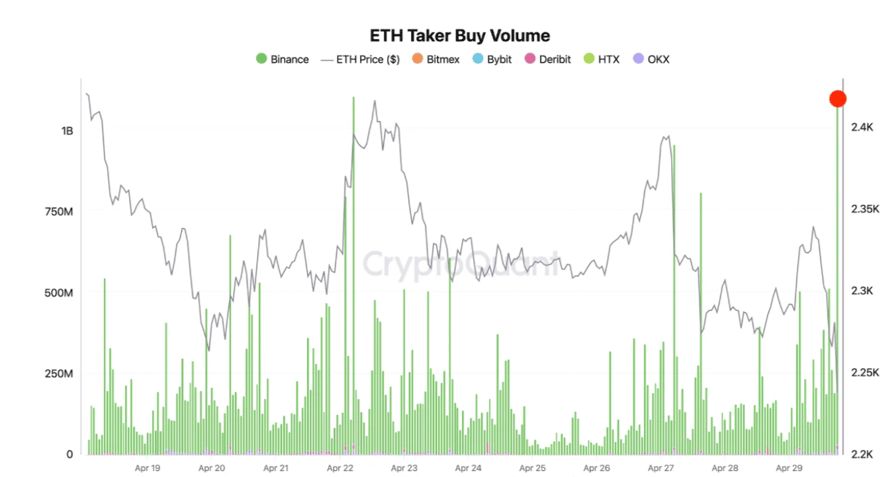
Meanwhile, Ether’s taker buy volume jumped to over $1 billion on Wednesday, suggesting bulls took advantage of the drop below $2,300 to buy more, data from CryptoQuant shows.
“The move below the $2,300 zone today nonetheless reignited interest among traders,” CryptoQuant analyst Darkfost said in a QuickTake note on Thursday, adding:
“This suggests that market participants still appear willing to bet on a more constructive short term outlook for Ethereum.”
ETH taker buy volume. Source: CryptoQuant
Prediction market platform Polymarket is rolling out new monitoring and detection tools following backlash over alleged insider-informed betting activity, partnering with blockchain analytics company Chainalysis to strengthen oversight.
Polymarket said Thursday it selected Chainalysis to provide an onchain market integrity solution aimed at monitoring trading activity and enforcing platform rules.
The detection model is “designed to surface patterns consistent with insider knowledge in prediction markets,” the company said.
The move follows a string of controversies in which traders appeared to profit from non-public or potentially manipulated information tied to real-world events.
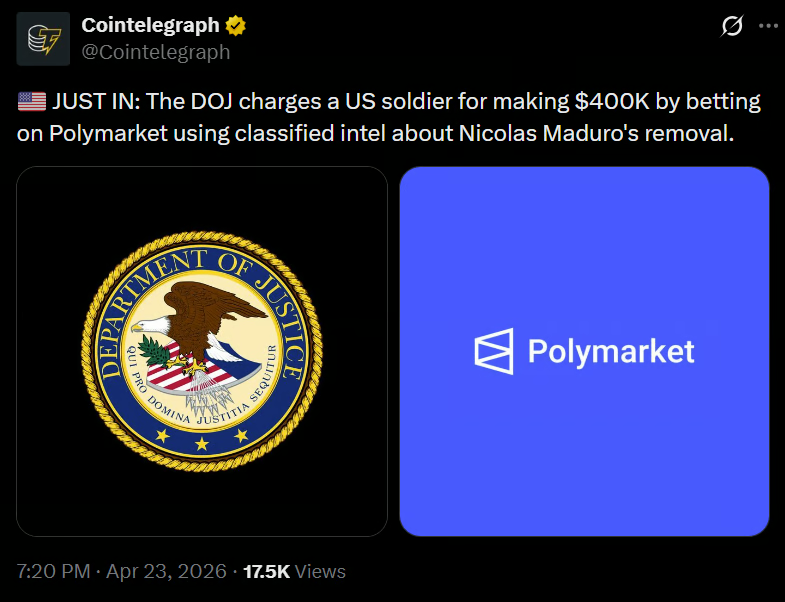
Recent incidents have intensified scrutiny from regulators and the public. In April, the US Justice Department charged a US Army soldier with using classified knowledge to place large winning bets on the US capture of Nicolas Maduro.
The US Senate on Thursday passed an amendment to the chamber’s Standing Rules that would immediately prohibit senators from trading on prediction markets.
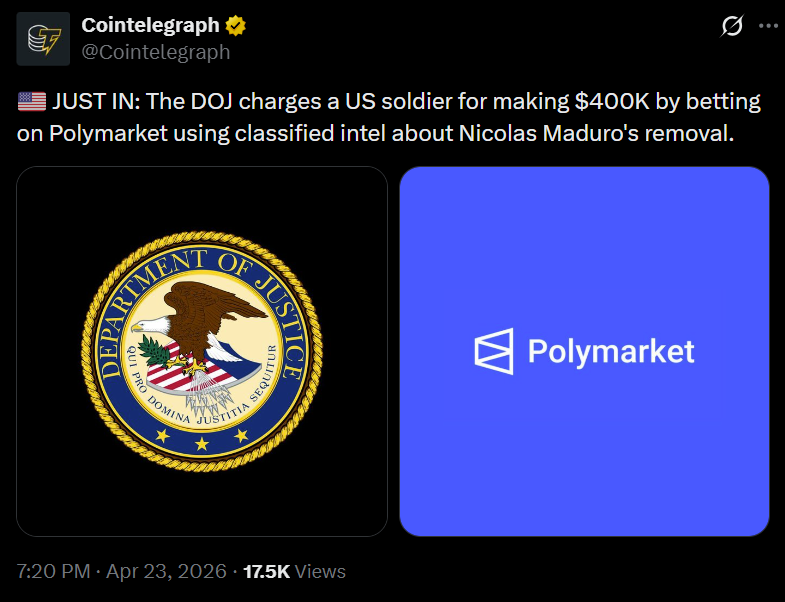
Source: Cointelegraph on X
In response, Polymarket is bolstering safeguards to flag suspicious trading behavior, aiming to curb insider activity and restore confidence in its markets. As Cointelegraph recently reported, the company has already implemented stricter trading safeguards to address concerns about manipulation.
The developments underscore mounting regulatory pressure on crypto-based prediction markets, which critics say enable speculation on sensitive geopolitical and real-world events.
Related: Kalshi mulls crypto expansion with perpetual futures launch: Report
Prediction markets draw surging volumes — and rising scrutiny
Prediction markets are attracting renewed attention as their size and scope continue to expand. A recent report by Bitget Wallet and Polymarket found that monthly trading volumes reached $25.7 billion in March, even as the broader crypto market remained in a prolonged slump.
The data suggests retail participants are driving much of the activity, with a shift away from one-off bets toward more sustained engagement, particularly in sports-related markets.
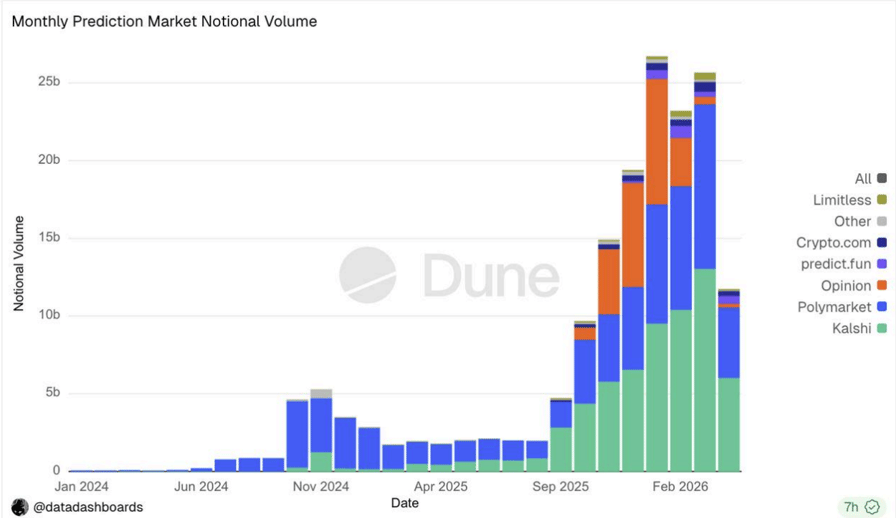
Prediction market trading volumes. Source: BitGet Wallet
At the same time, not all of the attention has been positive. Alongside concerns over market manipulation, a regulatory tug-of-war is emerging between US states and the federal Commodity Futures Trading Commission over how prediction markets should be governed.
New York has recently filed lawsuits against exchange operators Coinbase Financial Markets and Gemini Titan, alleging that their prediction market offerings violate state gambling laws.
Related: New York targets Coinbase, Gemini in fresh crackdown on prediction markets


The U.S. Air Force’s interceptor drone deal with Trump‑backed Powerus tightens family links to the Pentagon as Washington pivots to cheap AI drones against Iran.
Summary
- The U.S. Air Force has agreed to buy an undisclosed number of interceptor drones from Powerus, a defense startup backed by President Donald Trump’s sons, as the U.S.–Iran war enters its third month.
- Powerus co‑founder Brett Velicovich said the West Palm Beach-based firm will sell its drones to the Pentagon after a demonstration in Arizona, marking the company’s first contract to provide weapons to the U.S. military.
- The deal comes as Washington leans on cheap interceptor drones, including 10,000 AI-equipped Merops systems developed in Ukraine, to counter Iranian Shahed-style attack drones without burning through multimillion‑dollar missile stockpiles.
The U.S. Air Force has struck a weapons procurement agreement with Powerus, a drone company backed by President Donald Trump’s sons, further tightening ties between the Trump family’s business interests and the Pentagon as the U.S.–Iran war grinds into its third month.
Powerus signs first U.S. military weapons contract
According to Bloomberg, the Air Force has agreed to purchase an undisclosed number of interceptor drones from the West Palm Beach-based firm, which is supported by Eric Trump and Donald Trump Jr. through their investment vehicle Aureus Greenway Holdings.
Powerus co-founder and president Brett Velicovich told Bloomberg the company will sell the drones to the Pentagon after a demonstration at a facility in Arizona, describing the agreement as Powerus’s first contract to sell weapons to the U.S. military.
He declined to disclose the scope or value of the order, and officials did not comment on quantities, but the report notes that the Pentagon often makes limited purchases when evaluating new systems before committing to larger programs of record.
Cheap interceptors for a drone-saturated war
The contract underscores how the U.S. is racing to field cheaper counter‑drone options as Iran and its proxies lean heavily on low-cost Shahed-style one-way attack drones in the current conflict.
Analysts and officials have warned that firing multimillion‑dollar Patriot or THAAD interceptors at $30,000 drones is economically unsustainable, pushing the Pentagon toward smaller, expendable systems that can be deployed in large numbers.
That shift is already visible on the battlefield. In March, Ukrainian and U.S. officials said Washington had rushed roughly 10,000 AI-enabled Merops interceptor drones, originally developed and combat-tested in Ukraine, to the Middle East to protect U.S. forces and partners from Iranian drone swarms.
Reports from the manufacturer and defense analysts say Merops units combine a command station, launch platforms, and fleets of autonomous interceptors that rely on onboard machine vision rather than GPS or satellite links, allowing them to hunt and destroy drones even in heavily jammed environments.
The system has reportedly scored more than 1,000 kills against Russian and Iranian-made drones in Ukraine and has now been deployed in Poland, Romania, and U.S. bases across the region, illustrating how quickly novel counter‑drone tools can move from experimentation to mass deployment.
For Powerus, the new Pentagon deal comes just weeks after Bloomberg reported the startup was also pitching weapons sales to the United Arab Emirates, including an interceptor drone designed to target Iranian Shahed‑136s.
With Trump family-backed investors now funding a company selling drones into an active conflict shaped by U.S. policy decisions, ethics and oversight questions are likely to follow, even as military planners race to close the cost and capability gap against Iran’s expanding drone arsenal.


Visa added Base, Polygon, Canton, Arc, and Tempo to its global stablecoin settlement pilot on April 29, bringing the total to nine supported blockchains and reaching a $7 billion annualized settlement run rate, up 50% from last quarter.
Summary
- The five new additions join Avalanche, Ethereum, Solana, and Stellar, giving Visa’s issuers and acquirers nine blockchain options for settling transactions outside traditional banking rails.
- Visa is operating as a validator node on Tempo alongside Stripe and Standard Chartered’s Zodia Custody, making it one of the first major payment companies to run blockchain validation infrastructure directly.
- Visa now operates more than 130 stablecoin-linked card programs across more than 50 countries, bridging digital assets with traditional merchant acceptance at global scale.
Visa stablecoin settlement reached a $7 billion annualized run rate as the company announced the addition of five blockchains to its global pilot on April 29. “Our partners are building in a multi-chain world, and they expect their options to reflect that reality,” said Rubail Birwadker, Visa’s Global Head of Growth Products and Strategic Partnerships.
Visa stablecoin network now covers nine blockchains with distinct institutional roles
Each new chain targets a different part of the payments market. Arc is Circle’s Layer-1 blockchain built for programmable money and real-world economic activity. Base is Coinbase’s high-performance chain for low-cost stablecoin settlement. Canton is built with configurable privacy for regulated capital markets and institutional compliance. Polygon handles high-volume stablecoin transfers at sub-cent fees, and already processes approximately 35% of all USD stablecoin transfers globally. Tempo, backed by Stripe, focuses on real-time stablecoin liquidity and settlement flows. As crypto.news reported, Visa and Stripe’s Bridge were already expanding stablecoin card coverage toward 100 countries earlier in 2026, with this nine-chain expansion deepening the infrastructure behind those cards. As crypto.news documented, Polygon processed approximately $650 billion in stablecoin transactions in February 2026 alone, the highest monthly volume on any blockchain, making it one of the most consequential new additions to Visa’s pilot.
What the $7 billion run rate signals for traditional settlement rails
As crypto.news tracked, stablecoin settlement is accelerating across every major payments network simultaneously. The jump from approximately $4.7 billion to $7 billion in one quarter means Visa’s pilot added roughly $2.3 billion in annualized volume in 90 days, a pace that suggests institutional partners are treating stablecoin rails as a primary settlement option rather than a test. Visa’s decision to run validator nodes on Tempo is structurally significant: it means Visa is not simply using blockchain infrastructure but actively participating in its governance and operation, a posture no major payment network has previously taken.
Crypto World
Monero Price Prediction Gains Momentum as XMR Rallies 26% and Pepeto Presale Pulls Smart Capital
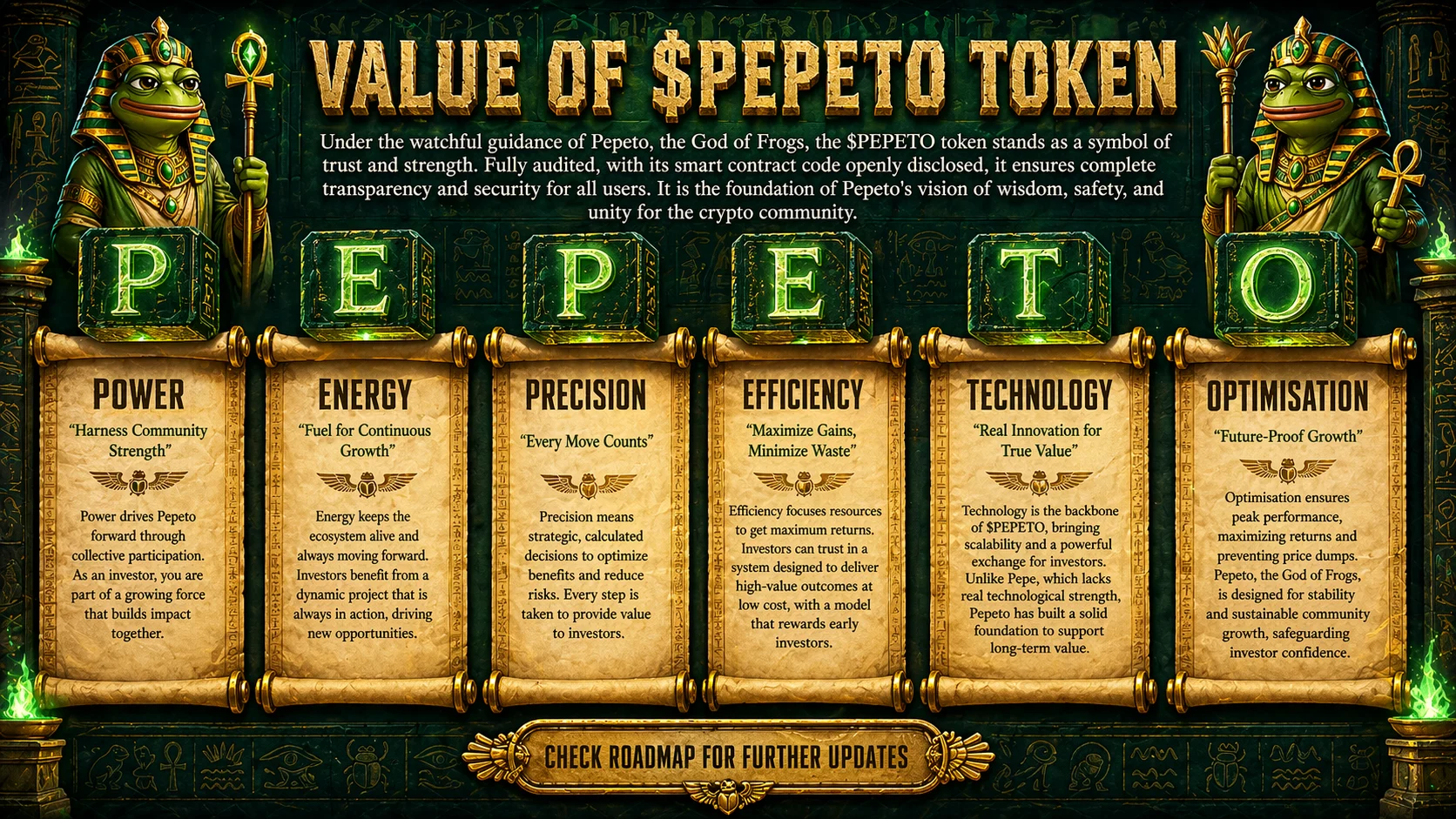
The monero price prediction carries real weight this cycle because XMR hit a new all-time high of $798 in January 2026 and now trades 52% below that peak at $376. Monero (XMR) climbed 26% in April on pure spot buying with zero retail participation according to Santiment data, and Strategy added another $255 million in Bitcoin on April 27 per Yahoo Finance, proving that institutional capital is positioning hard during fear.
While the XMR forecast plays out over months, Pepeto is pulling in the kind of capital that only appears before the biggest moves. More than $9.66 million raised, a Binance listing approaching, working tools already live, and a presale price of $0.0000001867 that disappears the second trading opens.
Monero Price Prediction Sharpens as Spot Buying Drives April Without Retail Participation
Monero (XMR) climbed from $320 to $405 between April 7 and April 26 while retail futures activity registered neutral every session according to Santiment data. Spot taker volume showed buy dominance in 24 consecutive sessions.
When a privacy coin gains 26% on spot accumulation alone with no retail crowd, the monero price prediction shifts from hope to pure timing.
XMR at $376 and Pepeto at $9.66M: Where the Timing Already Points
Pepeto: The Presale That Solved the One Problem XMR Holders Know Too Well
Monero (XMR) holders know the best entries happen when nobody is paying attention and the price has not caught up to the truth. That is where Pepeto sits right now, except the catalyst is not time and adoption. It is a single event, the Binance listing, and once it happens, the presale price is gone forever.
Every tool in the Pepeto network is already running. The exchange processes trades with no fee on either side, a bridge transfers tokens across Ethereum, BNB, and Solana and delivers the full amount with nothing removed, and a contract scanner reads every token’s code and rejects anything designed to take funds. SolidProof confirmed the full system with results on-chain.
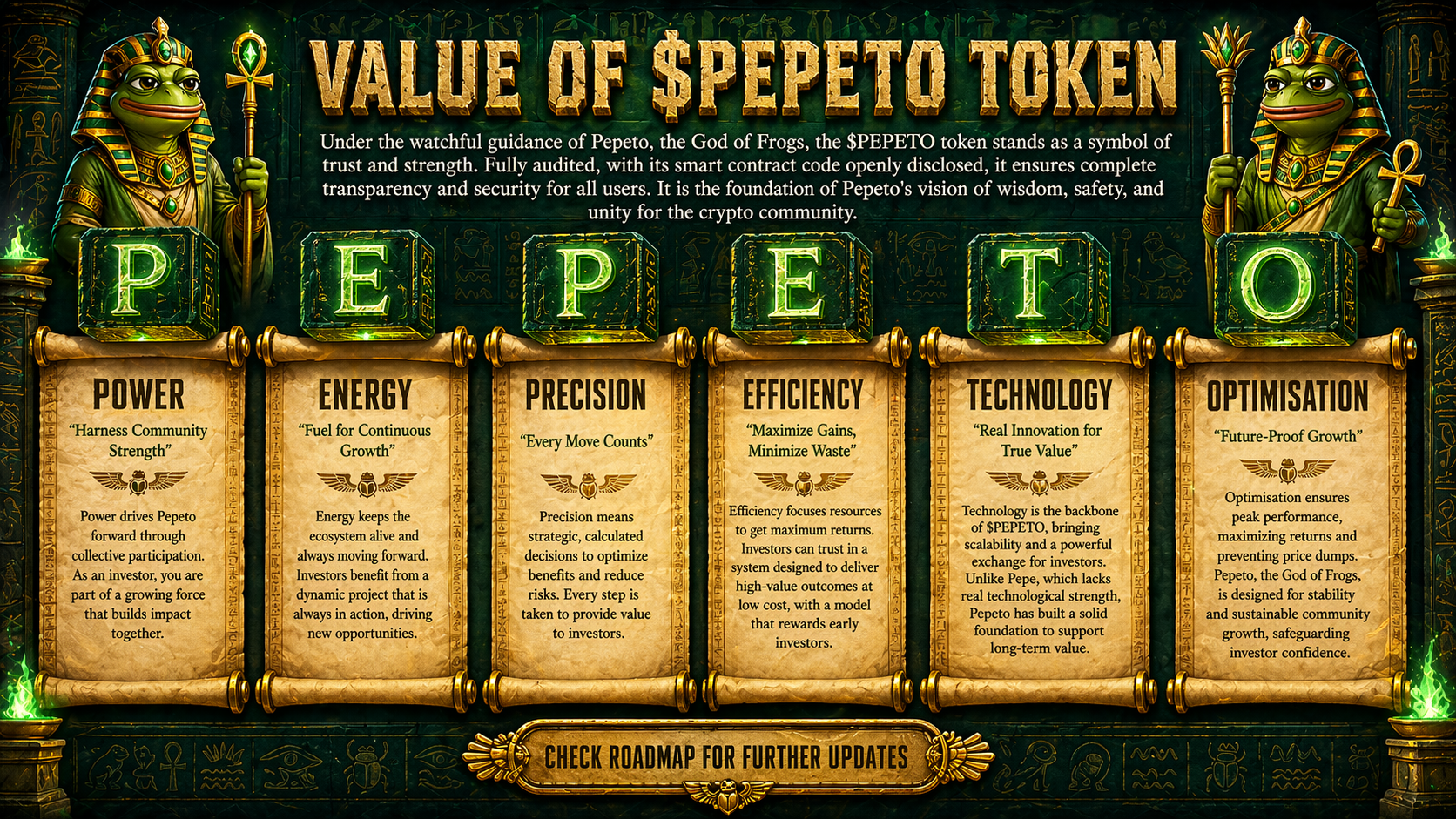
The original Pepeto domain was targeted by attacks as the project grew in size and attention. The team secured a new address, and Pepeto is where the presale now operates.
The same person who created the original Pepe token and grew it to $11 billion shipped every tool before this presale started, and a former Binance executive handles the listing. At $0.0000001867 with staking at 177% APY compounding positions every single day, the distance between presale price and listing price is the kind of gap that even the best monero price prediction cannot produce from a $6.94 billion base.
Monero (XMR) Price at $376 as Spot Accumulation Drives the Strongest April Rally in Years
Monero (XMR) trades near $376 with a $6.94 billion cap, sitting 52% below its January 2026 all-time high of $798 per CoinMarketCap. Analyst Will Taylor targets $1,160 per NewsBTC, while Changelly projects a bull case of $555 by year end.
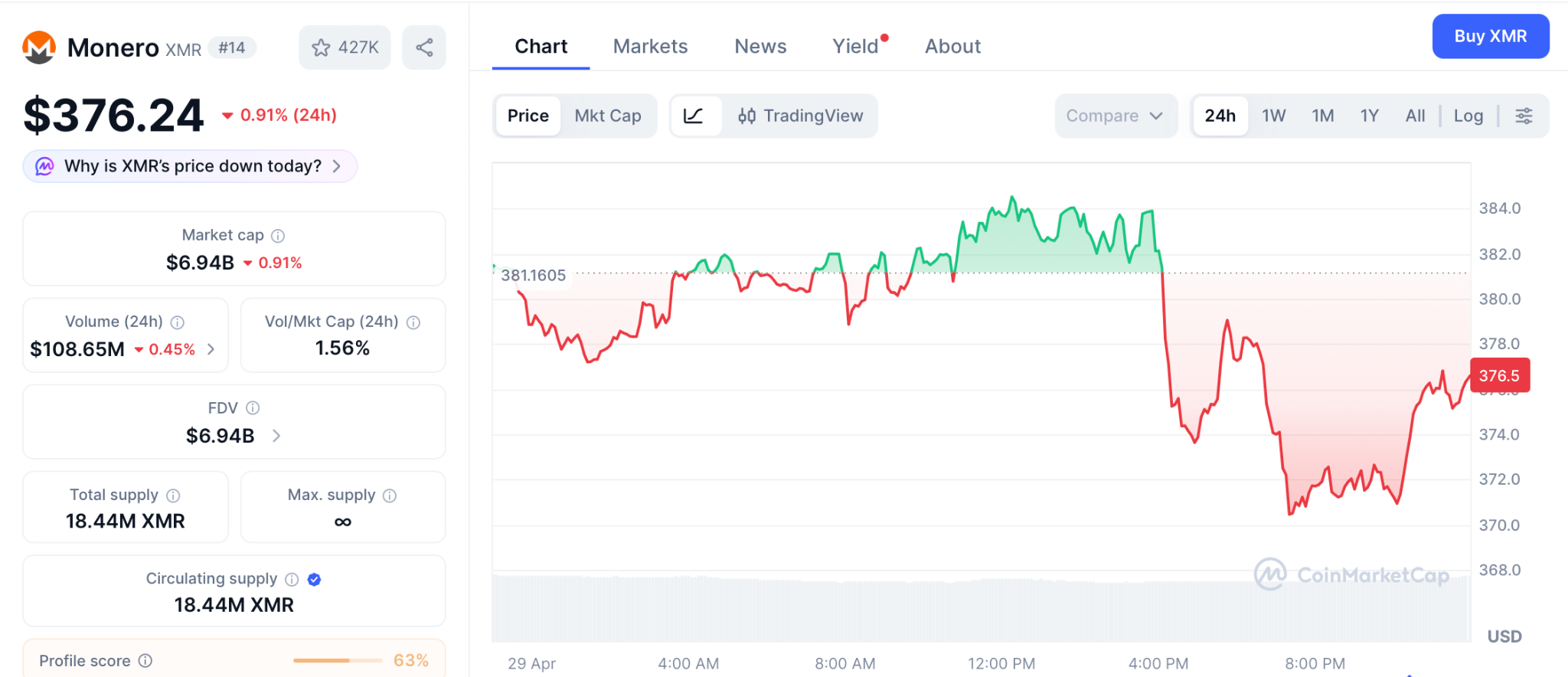
The $400 zone is key resistance, and a break above it confirms a fresh move higher. Even the bull case delivers 47% from current levels, strong for a privacy coin but months away.
Conclusion:
Monero (XMR) holds the privacy narrative and a 26% spot-driven April rally that proves serious capital is behind it, but even the bull case at $555 delivers 47% over months from a $6.94 billion base, and that is a trade, not the kind of event that changes how someone lives. The returns that change lives come from one decision made at the right time, before the listing opens and the entire market has to pay what early holders already locked in.
The person who built the $11 billion Pepe token shipped a full working exchange this time, a SolidProof audit sits on-chain for anyone to check, a former Binance executive runs the listing process, and $9.66 million came in from wallets that have seen presale-to-listing events turn small entries into life-altering returns and are placing themselves exactly where the biggest return sits.
The Binance listing is approaching, the presale price of $0.0000001867 disappears the moment trading opens, and every day closer to that date is one less day to enter at a price the open market will never offer again. Visit Pepeto right now, because when this listing hits, the difference between the people who acted and the people who waited will be the story of 2026.
Click To Visit Pepeto Website To Enter The Presale

Important Notice:
The Pepeto project is moving forward fast, and because of its growing impact, bad actors have hit the official website.
The backup domain is now « PepetoSwap DOT com » in place of « Pepeto DOT io » until further updates. Users must always check they are on the correct URL before connecting wallets or sharing personal information.
FAQs
How does the April spot rally affect the monero price prediction for 2026?
The monero price prediction improved because XMR gained 26% in April on pure spot buying without retail participation, and analyst targets now reach $1,160 per Cryptoinsightuk. Pepeto at presale pricing with an upcoming listing delivers returns XMR needs months to match.
What is Pepeto and why is it drawing more capital than privacy coins this cycle?
Pepeto is a working cross-chain trading hub where every trade costs nothing in fees, a verified bridge delivers the full token amount across chains, and a scanner rejects risky contracts before capital enters. More than $9.66 million raised and a Binance listing approaching make it the presale with the strongest capital flow during fear.
Disclaimer: This is a Press Release provided by a third party who is responsible for the content. Please conduct your own research before taking any action based on the content.

Polymarket, the prediction market platform, has enlisted Chainalysis to bolster on-chain oversight and curb insider-informed betting. The collaboration aims to provide an on-chain market integrity solution designed to monitor trading activity and surface patterns that may indicate non-public information being used to place bets. In a landscape where volatile real-world events increasingly feed digital markets, the move seeks to reinforce platform rules and restore user trust after a string of controversial bets tied to sensitive developments.
The initiative reflects a broader push within the crypto prediction ecosystem to adopt more rigorous surveillance measures as regulators scrutinize the space for manipulation and improper access to information. Polymarket described the model as one that can identify patterns consistent with insider knowledge and help flag transactions or trading behavior that warrant closer review.
Polymarket emphasized that it has already implemented stricter safeguards to address manipulation concerns, a trend highlighted by coverage from Cointelegraph. The latest partnership with Chainalysis adds an additional layer of on-chain analytics aimed at reinforcing market integrity and compliance with platform rules.
Key takeaways
- Polymarket is deploying an on-chain market integrity system with Chainalysis to detect patterns that may indicate insider information driving bets.
- The move comes amid heightened regulatory and public scrutiny of prediction markets, including legal action and proposed prohibitions on certain participants.
- Industry volumes in prediction markets continued to surge, with March trading activity estimated near $25.7 billion, underscoring retail-driven participation and a growing ecosystem.
- Regulators in the United States are pursuing a multi-front approach—from DOJ charges to state and federal enforcement—raising questions about the future of unregulated prediction markets.
Polymarket expands on-chain oversight with Chainalysis
Polymarket disclosed that it selected Chainalysis to provide an on-chain market integrity solution intended to monitor trading activity and enforce platform rules. The company said the detection model is designed to surface patterns that align with insider knowledge being used to place bets, with alerts routed to internal reviewers for potential action.
Chainalysis’ role centers on analyzing on-chain activity around Polymarket markets to identify anomalous sequences, clustering of trades, or other indicators that may signal non-public information is influencing market pricing. By integrating investigative analytics into its workflow, Polymarket seeks to deter exploitative behavior and improve response times to suspected misconduct.
Industry observers have stressed that such tools are increasingly necessary as prediction markets grow in size and complexity. While on-chain monitoring cannot eliminate all risks, it can provide a more proactive framework for safeguarding market integrity, aligning with broader moves across the ecosystem to implement governance and compliance controls.
Polymarket’s leadership has hinted that the collaboration with Chainalysis is part of a longer-term plan to elevate trust and transparency in prediction markets, a pillar of its value proposition for users who want to bet on real-world events with transparent settlement rules.
The company also noted that it had already introduced tighter trading safeguards to address concerns about manipulation—an evolution Cointelegraph covered in a prior report on Polymarket’s rule updates. The current partnership with Chainalysis complements those safeguards by adding a formal, on-chain analytics layer that can be scaled across markets.
Regulatory backdrop tightens around prediction markets
The policy environment for crypto-driven prediction markets has grown more complex in recent weeks. In a notable enforcement action, the U.S. Department of Justice charged a U.S. Army soldier with using classified information to place large winning bets on events linked to U.S. actions, illustrating how insider information can intersect with prediction-market activity. This case highlighted the potential legal exposure for participants who leverage confidential information to profit from outcomes in real time.
Separately, the U.S. Senate advanced an amendment to its Standing Rules that would immediately prohibit senators from trading on prediction markets. The move signals growing scrutiny at the highest levels of government over how elected officials interact with these platforms and the potential for conflicts of interest.
Against this backdrop, state authorities have also taken aim at unregulated markets. New York recently filed lawsuits against Coinbase Financial Markets and Gemini Titan, alleging that their prediction market offerings violate state gambling laws. The actions underscore a broader tension between innovation in digital markets and traditional regulatory frameworks.
For Polymarket and other platforms, the regulatory environment is a critical variable determining user adoption and long-term viability. While enhanced safeguards and monitoring can bolster compliance posture, ongoing legislative and judicial developments will shape how these markets evolve or retreat in certain jurisdictions.
Alongside these regulatory currents, market participants and observers have noted an expansion in engagement with prediction markets. Yet the regulatory appetite for tighter controls remains a significant counterweight to growth. Industry coverage has pointed to a mixed environment where investor curiosity and retail participation are rising, even as regulators pause to reassess governance, disclosure, and participant eligibility.
In this climate, observers are watching not only for headline enforcement actions but also for the practical effects of governance updates. How entities implement surveillance, how swiftly authorities respond to alleged misconduct, and how the market adapts to changing rules will determine whether prediction markets can scale while maintaining trust.
Markets rise, and scrutiny intensifies
A recent collaborative report from Bitget Wallet and Polymarket found that monthly trading volumes reached approximately $25.7 billion in March. The research indicates that retail participants are driving much of the activity and that trends are shifting toward more sustained engagement, particularly in sports-related markets. This level of activity demonstrates the demand for structured, event-based betting as a way to hedge opinions or speculate on outcomes beyond traditional financial instruments.
Nevertheless, the surge in volumes coexists with a tightening regulatory stance. The so-called “regulatory tug-of-war” between U.S. state authorities and federal regulators over how prediction markets should be governed continues. As enforcement actions and new restrictions unfold, platforms face a balancing act between innovation and compliance, with potential implications for liquidity, market depth, and user experience.
For market participants, the evolving landscape means heightened attention to risk management and governance frameworks. The introduction of Chainalysis’ on-chain integrity tools could help reduce the incidence of insider-informed betting and improve auditability, but questions remain about how these measures will influence user participation and market quality in the near term.
While the regulatory narrative remains unsettled, Polymarket’s emphasis on integrity and Chainalysis’ analytics points to a broader industry trend: prediction markets that blend open participation with robust oversight may become the norm, rather than the exception, if they can demonstrate resilience against manipulation and clear paths to compliance.
As policymakers and market operators navigate this terrain, investors and users should monitor ongoing enforcement actions, rule updates, and the outcomes of on-chain surveillance programs. The balance between innovation, inclusion, and protection will continue to shape the trajectory of crypto-based prediction markets in the months ahead.
What remains uncertain is how quickly regulators will formalize rules that can accommodate the unique characteristics of prediction markets while safeguarding against abuse. Readers should keep an eye on forthcoming policy developments, platform governance updates, and any measurable impact from enhanced on-chain oversight on trading behavior.


President Trump will receive a military briefing today from CENTCOM Commander Admiral Brad Cooper on new Iran options, including a “short and powerful” wave of infrastructure strikes, a Strait of Hormuz ground operation, and a special forces mission to secure Iran’s enriched uranium stockpile, as Bitcoin opened at its lowest level since April 13.
Summary
- The Iran briefing signals Trump is seriously considering resuming major combat operations to break the stalled nuclear negotiations, according to two sources who spoke to Axios.
- CENTCOM has also prepared an option for US forces to physically seize part of the Strait of Hormuz to reopen it for commercial shipping, a plan that could involve ground troops on Iranian-controlled territory.
- Bitcoin fell to its lowest morning open since April 13 as the Axios report circulated, with Ethereum hitting a multi-week low and oil prices pushing above $107 per barrel on escalation fears.
Iran briefing news broke this morning when Axios reported that CENTCOM Commander Admiral Brad Cooper is scheduled to brief Trump today on a range of new military options against Tehran. Joint Chiefs Chairman General Dan Caine is also expected to attend the session. The briefing comes as diplomatic talks between Washington and Tehran have stalled over Iran’s refusal to commit to abandoning its uranium enrichment program. Trump told Axios separately that he views the naval blockade as “somewhat more effective than bombing,” but made clear military action remains on the table.
As crypto.news reported, the US naval blockade has been in place since April 13 as leverage to force Iranian concessions on nuclear enrichment, with Tehran refusing to negotiate under what it describes as coercive pressure. Each confirmed escalation signal in this conflict has produced immediate Bitcoin selling, with BTC dropping from $79,000 to the mid-$74,000 range this week on the combined weight of the hawkish FOMC outcome and renewed Iran pressure. The April 30 Axios briefing report pushed crypto prices lower on the open, with Bitcoin opening at its weakest morning level since April 13 and Ethereum falling to a multi-week low. Oil prices, which directly shape Fed inflation expectations and therefore crypto liquidity conditions, rose above $107 per barrel on the news.
As crypto.news documented, Bitcoin’s sensitivity to every Iran diplomatic signal has been one of the defining market dynamics of 2026, with the asset tracking geopolitical headlines more closely than any on-chain metric. As crypto.news tracked, Iran has also been demanding stablecoin payments from ships seeking Strait of Hormuz transit, directly entangling crypto infrastructure in the conflict’s economic mechanics.

Lantern Pharma Inc. (LTRN) Discusses Live Demonstration of withZeta.ai AI Platform for Rare Cancer Drug Discovery Transcript

Canelo now ‘expecting’ to face one man for comeback fight: “I am unstoppable”

Apple’s memory price insulation holds, but price rises still loom

Manchester United reach agreement with Casemiro over contract clause amid transfer speculation

US brings back mandatory military draft registration

Steven Gerrard disagrees with Gary Neville over ‘shock’ Chelsea and Arsenal claim | Football


-

 Tech3 days ago
Register Renaming | Hackaday
-

 Fashion6 days ago
Weekend Open Thread – Corporette.com
-
 Crypto World5 days ago
Hyperliquid $HYPE Rally Builds Momentum as AI Sector Enters Prove-It Phase
-

 Politics3 days ago
Drax board avoid their own AGM, accused of greenwashing & environmental racism
-
 Sports5 days ago
IPL 2026: Ruturaj Gaikwad registers slowest fifty of the season, enters all-time unwanted list | Cricket News
-

 Tech3 days ago
Images of Samsung’s rumored smart glasses have leaked
-

 NewsBeat5 days ago
LK Bennett closes all stores after entering administration
-

 Tech4 days ago
Why Blue Badges Disappeared From Toyota Hybrids
-

 Fashion2 days ago
Kylie Jenner’s KHY Enters a New Era with ‘Born in LA’
-

 Crypto World7 days ago
Michael Saylor says BTC winter is over. Market analyst disagrees, says bitcoin was in a pullback
-
 Entertainment5 days ago
Mariah Carey Slams Deposition Claims In Brother’s Lawsuit
-

 Business2 days ago
Most Commercial Energy Audits Miss the Real Losses
-
 NewsBeat7 days ago
Trump threatens to review UK’s claim to Falkland Islands and punish Nato allies over Iran war disagreement
-

 Business6 days ago
Jeanine Pirro announces closure of Federal Reserve building cost probe
-

 Business4 days ago
(VIDEO) Charlize Theron Climbs Times Square Billboard to Promote New Netflix Thriller ‘Apex’
-

 Tech5 days ago
OpenAI’s Sam Altman apologizes for not reporting ChatGPT account of Tumbler Ridge suspect to police
-

 Tech5 days ago
Microsoft to roll out Entra passkeys on Windows in late April
-

 Crypto World3 days ago
CFTC’s AI will review U.S. crypto registration applications, chairman tells CoinDesk
-
 Crypto World6 days ago
Nvidia (NVDA) Stock Jumps 5% as Intel Earnings Ignite Semiconductor Rally
-

 Tech5 days ago
OpenAI CEO apologizes to Tumbler Ridge community
You must be logged in to post a comment Login