Reports of ants rocket in the UK during spring as they emerge from their winter homes but they can be hard to clear
Finding you have a stream of ants around your garden or even inside your home can be annoying and uncomfortable. According to pest clearing experts Pest UK, April is the time of year that they get most enquiries on how to clear the insects.
Advertisement
It said: “Depending on the weather they come out of hibernation (or over wintering, insects don’t hibernate in the same way that mammals and rodents do) in March or early April. Often ants in April will forage inside buildings as it may still be too cold outside.
“When its cold they can be difficult to control. The reasons for this are that the metabolism of the ants is still slow and so any uptake of insecticide will take time to work.
“Another reason is that only part of the nest may be active which means that it may take some time for ants from the rest of the nest to come into contact with the insecticides. The ants that you are seeing probably come from several nests.
Advertisement
“They follow pheromone trails left by ants and these trails will attract ants from many different nests. Control is not just finding the nest and killing it because most cases it will not just be one ants’ nest.”
The firm said it uses insecticide bait, a residual insecticide spray or a residual insecticide dust, adding that one or more of these types of treatments may be carried out.
Content cannot be displayed without consent
However if you want to try a home grown treatment one expert set out their method using “ingredients you probably already have”. Thach Nguyen, a real estate expert, said: “If you got ant problem in your rental house or even your own primary house, here’s the way how to get rid of it.
“Now you probably have these ingredients already in house, Borox, sugar, cotton balls and water.” He said you should mix together three-quarters of a cup of water, one-quarter cup of sugar and three-quarters of a tablespoon of this Borax.
Advertisement
While Borax is not available on general sale in the UK Borax substitutes that are available will do the same job. These cost as little as £6 for 500g on Amazon.
The expert explained: “Then you take the cotton ball, say, like two or three or four of them, depending how many you need. You dip it inside this mixture where you made then you put these cotton balls where you see a lot, where the ant comes out, and you put it there.
“And then basically, they come and they got to drink this stuff. They’re gonna bring it back to the nest.
“They’re gonna kill all the colony. Now, the next day you wake up, you’re gonna see you ain’t have no ants.”
The group warns the current system is “outdated, increasingly unaffordable, and too rigid” — piling pressure on public finances as the population ages.
At the centre of the proposals is a dramatic shift away from the traditional pension model.
Instead, the think tank wants a new “lifespan fund” – allowing people to build up state-backed support not just through work, but also caring responsibilities and education.
Advertisement
That support could then be used during key moments in life – including unemployment, retraining or caring for family.
Tom Smith, director of economic policy at the Tony Blair Institute, said: “Britain’s state pension system was built for a different era.”
He added: “We can’t keep pouring money into a system that is increasingly unaffordable.”
Triple lock ‘cannot continue’
The report takes direct aim at the triple lock — the policy that guarantees the state pension rises each year by the highest of earnings, inflation or 2.5%.
Advertisement
Smith said: “Pension spending must be contained, and that means the triple lock cannot continue after the next election.”
He added: “Ending it will require political leadership from all parties — but that should only be the first step.”
A £66bn warning
The intervention comes amid stark projections about the future cost of pensions.
The report warns that the number of pensioners is set to surge from 12.6 million today to nearly 19 million by 2070.
Advertisement
At the same time, spending on the state pension could rise sharply – from around 5% of GDP to 7.8%, putting pressure on taxes and public services.
By contrast, the proposed new system could limit spending to around 5.5% – potentially avoiding £66 billion a year in extra costs by 2070.
‘Real freedom’ but with a catch
Under the plans, people would be able to dip into their pension pot earlier in life but would later repay it through higher National Insurance contributions.
Smith said: “TBI’s proposed Lifespan Fund offers that better alternative.”
He added: “It gives people real freedom to use support earlier in life… and to top it back up before retiring on their own terms.”
Advertisement
Big political battle ahead
The think tank is urging cross-party talks to push through reforms before the next election – setting the stage for a major political debate over the future of pensions.
Caroline Abrahams, charity director at Age UK, said: “Age UK firmly believes that the Triple Lock should be retained into the next Parliament.
“Over time this policy has rebuilt the value of the State Pension, helping to improve the living standards of some of our poorest pensioners.
Recommended reading:
Advertisement
“Today, we continue to hear from older people who are struggling financially, and the extra money the Triple Lock delivers makes a meaningful difference to many lives.
“In new polling, 3 in 10 pensioners say they are struggling financially – even before the worrying rise in energy prices.
“Going forward, we need a national debate to determine the purpose and appropriate value of the State Pension as, at present, it is set too low to provide those reliant on it with a decent standard of living throughout their later lives.”
What do you think about these proposals to replace the triple lock? Let us know in the comments.
The Met Office has forecast temperatures could surge to 26C on Friday across the UK, with 38 counties across the UK expected to hit 20C or above during the warm spell.
20:33, 30 Apr 2026Updated 23:31, 30 Apr 2026
The Met Office has forecast temperatures could rocket to 24C within hours as Scotland enjoys a welcome warm spell.
Despite “showers” expected to arrive in the west and south-west tomorrow, with rain spreading northeastwards, the Met Office says conditions will be feeling “much warmer” in the east. It will “feel humid for many”, the national weather agency confirmed.
The Met Office’s afternoon forecast predicted highs of 26C in southern areas tomorrow, while temperatures are expected to climb to 24C in the north. Saturday is also set to be a warm day, with highs of 23C in the south and 20C in the north.
Advertisement
Temperature anomaly maps for tomorrow show the UK blanketed in deep red, indicating where temperatures are forecast to rise well above the seasonal average. Glasgow and Edinburgh are expected to see highs of 18C.
The ECMWF weather model predicts highs of 23C tomorrow, with the warmest conditions concentrated in the south-east of England, particularly in and around London. Afternoon highs of 22C and 23C are also expected across the Midlands and South Yorkshire, reports the Mirror.
Overall, the ECMWF model suggests as many as 38 counties will see temperatures reach 20C or above. Disappointingly for residents of Northern Ireland and Wales, all of these counties fall within either England or Scotland.
Advertisement
UK counties facing 20C or above on Friday
Scotland
Sutherland
Ross-shire and Cromartyshire
Nairnshire
Morayshire
Banffshire
Aberdeenshire
Berwickshire
Roxburghshire
England
Northumberland
Durham
Yorkshire
Lancashire
Cheshire
Shropshire
Staffordshire
Leicestershire
Nottinghamshire
Derbyshire
Lincolnshire
Norfolk
Suffolk
Cambridgeshire
Northamptonshire
Warwickshire
Worcestershire
Herefordshire
Oxfordshire
Buckinghamshire
Bedfordshire
Wiltshire
Berkshire
Hampshire
Surrey
Kent
Sussex
Essex
Middlesex
Devon
BBC Weather forecasts for Friday: “A band of cloud and showers will sweep into many western parts tomorrow. Eastern areas will be sunny and warm, particularly in south-east England. Showers will later push east into north-east England.”
It also predicts for the weekend: “Over the weekend, it will become unsettled and cloudier with frequent scattered showers, or even longer spells of rain on Sunday, for England and Wales, with a chance of thunder. Cloudier with lighter showers further north. Monday will be mainly cloudy with some lingering spells of rain. Some sunny breaks may develop towards the far south and north-west.”
Despite the scorching temperatures, this warm period is not anticipated to be classed as an official heatwave. An official heatwave is only declared when temperatures meet or surpass the heatwave threshold for three consecutive days.
The heatwave threshold ranges between 25C and 28C across the UK. It sits at 28C in the south-east of England where temperatures tend to be higher, dropping to 25C the further north you travel.
Today in n’aww-worthy news, we learned that babies do a little dress rehearsal of how to cry in the womb.
And it’s nothing to worry about as parents-to-be, they’re just practicing silently crying ready for their grand entrance into the world when they’ll be able to belt out some screams.
When TikTok creator Devora (@thisisdevo) found this out – her mind was truly blown.
“Babies practise being babies before they’re born,” she said in a video which has over 128k views. “Not only do they practise laughing and frowning and different facial expressions, they also practise silent crying.
Advertisement
“I can’t even deal with this fact,” she continued. “While we’re all out here waiting for them, getting ready for them, buying stuff for them, they’re inside practicing their little silent cries.”
According to Healthline, a baby’s practise cries include imitating the breathing pattern, facial expression and mouth movements of a baby crying outside of the womb.
The news hit a fair few people in the feels – especially those who are currently pregnant. “When I found out they cry inside, I cried,” said one person.
“Now I’m crying ’cause I know he’s crying,” said a mum-to-be. “And I feel bad I can’t help him. I know he’s practicing but I can’t help it.”
Advertisement
Imaging has also shown 28-week-old human babies can silently cry in response to noise, according to Ultrasound Ireland.
When they do cry, babies don’t make a noise because they’re totally immersed in amniotic fluid and there is no air in their lungs – which is needed to make a sound.
But once they’re born, and the air expands their lungs, they are ready to hit those high notes.
We all know vaguely what happens when you have a caesarean section – you’re given anaesthetic, a cut is made in your abdomen and then, minutes later, your baby is pulled out and passed to you. It’s a magical medical moment.
But it turns out there’s actually a hell of a lot going on from the obstetrician’s perspective. More than you could possibly know.
A fascinating Tiktok video explaining the anatomy of a C-section has been viewed more than 11 million times after showing just how complicated the surgery can be.
Using various sheets of coloured fabric and paper, Tina (@mamma_nurse) explained how there are various layers that surgeons have to cut through, before moving muscle out of the way and then manoeuvring past organs – and that’s before you’ve even reached the area where the baby is.
Advertisement
Most information given on C-sections by healthcare providers is lacking in details. Probably for good reason.
But if you’re the type of person who likes to be super informed ahead of birth – or you’re just really curious as to what the surgery involves – we asked Meg Wilson, an obstetrics and gynaecology consultant at London Gynaecology and the Whittington Hospital, to walk us through the process.
(Just a head’s up, there are some quite graphic images below.)
What happens during a C-section
Advertisement
First up, you’ll be given some pain relief – either a regional or general anaesthetic – and a catheter is fitted. Your abdomen will be cleaned and a drape will be put up so you won’t be able to see the surgery unfold.
An obstetrician will make a 10 to 15cm cut along the skin at the bottom of your abdomen, just at the top of your pubic hairline.
The first layer they cut through is the skin, and that cut also goes through a layer of fat. “Then you come down on to the rectus sheath – a white fibrous layer – that is covering the muscles of the abdomen,” says Wilson.
They’ll make a cut in that as well and all these cuts will be done in the same direction: horizontally.
Advertisement
Byba Sepit via Getty Images
Next up, they come to the rectus muscles “which people know as their six pack muscles,” says the obstetrician.
These two muscles run as a strip down the abdomen and where they join together is something called the linea alba. It’s a weak area which surgeons can basically “poke through” to open it up, says the obstetrician.
“That takes you into your abdomen, by making that little hole, and then you’re into what we call the peritoneal cavity which is the proper wet inside of your tummy.”
Advertisement
Surgeons will make the hole a bit bigger by basically moving the two muscles apart.
“You’re pulling them out to the side to make a hole there,” says Wilson. “I think it’s really important that people know you’re not actually cutting muscles, you’re just shifting them apart.”
When in the peritoneal cavity, surgeons will get a nice view of the surface of your bladder and then the main event: the womb itself.
Now comes the really interesting bit. They have to actually move organs to get to where they need to be – so yes, they shift your bladder out of the way.
Advertisement
“You lift up a little bit of something called the peritoneum,” she explains, which is “like a sheet that runs over the womb and the bladder.” Surgeons will make a small hole in that “sheet” and this allows them to see where the bladder is attached to the womb.
“It allows you to push the bladder out of the way and push it downwards a little bit,” Wilson says, noting it only gets moved about 1-2cm.
In the operating room, they have a specially designed surgical instrument that goes in to protect the bladder and hold it down and out of the way.
The surgeon cuts into the womb (again, a horizontal cut in the same direction as the skin cut). The womb is a muscle so they expect to have some bleeding at this point as muscles have a strong blood supply.
Advertisement
In cases where a parent has placenta previa – where the placentacompletely or partially covers the opening of the uterus – it might be a bit more complicated, she adds, and they might have to cut higher up in the womb or even through the placenta, which could result in more blood loss.
“Then you’re going to hit the membranes around the baby – the amniotic sac – and you see that bulging out when you reach it,” Wilson continues. “You keep going and make a little hole in that with the scalpel and usually lots of amniotic fluid all comes spilling out in a big gush.”
At this point it’s all about getting the baby out. In a straightforward pregnancy the baby will be in a head down position, so they’ll get a nice view of that.
The retrieval process involves a bit of teamwork. “You put your hand in and slip your hand around the baby’s head – like a cupping action – and your assistant will put lots of pressure on the top of the woman’s tummy, pushing right at the top of womb where the baby’s feet are, and you’ve got your hands acting as a little slide for the baby to come out,” she says.
Advertisement
The head pops out, then comes the neck, and then there’ll be a bit more gentle pulling to deliver the shoulders one at a time, and then the body “slips out relatively easily after”.
Michael Hanson via Getty Images
Doctors work to remove a baby from a woman’s uterus during a c section.
At this stage the curtain is often lowered and the parent(s) can see their baby and hold them. They tend to let the umbilical cord pulsate for at least a minute to give the baby beneficial nutrients and then they’ll clamp the cord, cut it and hand the baby to the midwife who will wrap them up and dry them off.
“Then it’s a case of removing the placenta, which is still stuck on to the lining of the inside of the womb,” says Wilson. “We pull a little bit on the cord and the placenta will be detaching.”
After the placenta has been removed, surgeons will then clean out the inside of the womb which Wilson says is “a very simple action” of rubbing a swab around the insides of the cavity “to make sure there’s no little bits of membrane or last little threads of placenta that are still there”.
Advertisement
The mum will still be bleeding at this point so time is of the essence to get the womb stitched up again. Once that’s done, surgeons will take a moment to do a check and assess that there’s no additional bleeding anywhere.
bymuratdeniz via Getty Images
At this stage, she says, they clean away any spilt fluid and blood that may have collected in the sides of the pelvis using a swab. They also check the womb is contracted and that the ovaries and fallopian tubes look normal.
“It’s just an opportunity to do a health check because you’ve got the tummy open and it’s a relatively straightforward thing to do,” she adds.
The instrument protecting the bladder is then taken out and “then you allow everything to fall back into place,” adds Wilson. “The bladder will go back to where it was originally placed and those two rectus muscles that you held open to get into the cavity of the tummy will fall back into place as well.
Advertisement
“You don’t routinely close the rectus muscles … they will come back together naturally and reform their meeting point.”
The next layer that’s surgically closed is the rectus sheath, which is the layer just beneath the fat. “We sometimes put a stitch in the fat layer but for most women we then just close the skin with another running stitch,” she adds.
“By routine we remove all the drapes and clean any collected blood that’s in the vagina,” she adds, “and make sure there’s no clots of blood or anything.”
At this point they might put in a painkiller suppository and a dressing is placed over the c-section wound. The whole process is complete in less than an hour.
To mark International Dawn Chorus day we’ve asked wildlife experts to make their case for why their favourite songbird deserves your vote. Cast your vote in the poll at the end of the article and let us know why in the comments. We hope their words will inspire you to step outside and soak up some birdsong this spring.
Championed by Cannelle Tassin de Montaigu, Research Fellow in Ecology and Evolution, University of Sussex
When people talk about the UK’s best bird songs they often go straight for the big names – loud, dramatic performers that grab your attention. But quietly in the background is the song thrush, a bird whose song is far more impressive than it first appears.
What sets the song thrush apart is not volume or flair, but structure. Its song is built from short, clear phrases, each repeated two or three times before moving on. It’s as if the bird is politely checking that its audience is paying attention. In a dawn chorus that often feels a bit chaotic, there’s something refreshingly organised about it. It’s a bird that’s actually thought things through.
Advertisement
It might not have the dramatic flair of the common nightingale, and it’s less showy than some of the usual favourites. There are no soaring crescendos or dramatic flourishes. But that’s part of its charm. The song is neat, rhythmic and surprisingly memorable once you start listening for it.
In the early morning soundscape, where many birds seem determined to out-sing one another, the song thrush isn’t trying to steal the spotlight. It just quietly does its thing, and does it very well. Underrated? Definitely. Worth your vote? I’d say so.
Championed by Judith Lock, Principal Teaching Fellow in Ecology and Evolution University of Southampton
The European robin is a delightfully common sight in gardens. You will very likely have heard the characteristic “tic”, followed by a tuneful verse lasting a few seconds. In noisy urban environments they sing louder, less complex songs, in order to be heard.
The male robins use their spring song (January to June) to signal their quality to females, then forming breeding pairs, and to signal competitive ability to other males. The spring song lasts one to three seconds, composed of four to six short motifs. They have an impressive repertoire of about 1,300 motifs, indicating that song is the particularly important for robins, in comparison to birds that rely more on colourful plumage or behavioural displays to communicate with each other.
Advertisement
Most birds sing mainly in the morning but robins sing all day. People often mistake their lovely evening song for a nightingale’s. Constant territory defence from non-migrating robins means that the robin song is a year-round soundtrack too. From July to December, both males and females sing the autumn song, of higher-pitched long, descending notes, with interspersed warbles. This song is to defend their individual winter territories. This indicates that song first evolved first in songbirds to ensure survival, before it became a signal used by males for reproduction. Each robin’s song is dynamic, constantly changing in response to the condition and age of the bird, and their rival.
Great tit
Championed by Josh Firth, Associate Professor of Behavioural Ecology, University of Leeds
Its song may not be as flashy as the nightingale or as poetically melancholy as the blackbird. But scientists have been taught so much by the great tit’s song, heard across British habitats from ancient woodlands to urban gardens. This spring marks 80 continuous years of UK-based scientists studying great tits at Wytham Woods, Oxford, the world’s longest-running study of individually-marked animals.
Advertisement
The unique dataset includes a family tree totaling over 100,000 great tits, with some birds’ lineages traceable back 37 generations. Early research on
Wytham’s great tits during 1970s-1980s resulted in some the first studies to inform the scientific world about how bird song can help males find mates and defend territories, how larger song repertoires can bring more reproductive success, and how young birds learn these repertoires from neighbours (not just their fathers).
And a pioneering study published in 1987 taught us how male great tit song even tracks female fertility, increasing their singing efforts as their female partner’s egg-laying period approaches, and then quietening after she starts laying. Modern technological advances are allowing insight into the hidden meaning embedded in great tits’ songs. In-depth processing of 109,000 recordings of great tit songs has revealed how each bird’s melody tells the story of their own identity as well as that of their local culture and social circles.
A great tit’s age also affects their song: older males keep singing rarer, fading song types while younger birds adopt newer ones. So, Britain’s greatest song belongs to the great tit’s “teacher-teacher” call, for all it has taught us, and for all we have left to learn.
Championed by Joey Baxter, PhD Candidate in Ecology and Evolutionary Biology, University of Sheffield
Why change a winning formula? As far as I’m concerned, the chaffinch sings the biggest banger that UK birds have to offer. While the blackcap attempts to impress with ostentatious bells and whistles, the chaffinch keeps things simple with a catchy riff. Where the starling goes for quantity and novelty, with a frankly plagiaristic repertoire of mimicry, the chaffinch goes for quality, singing proudly in the knowledge that it is delivering a true earworm.
Advertisement
Bubbling trills accelerate before tumbling downwards, slowing to rich watery chirps and finishing with the final flourish. This jaunty lick, the real hook of the song, is often punctuated by an upward inflection at its end, the rising intonation giving it the air of an unanswered question. The chaffinch’s song has rhythm, it has melody, and it’s instantly recognisable. It possesses the wisdom that sometimes it is better not to do everything, but to do one thing well.
The identity of United’s next full-time manager remains uncertain with only four matches left to play this term, though former long-serving midfielder Carrick is widely believed to be the frontrunner for the permanent role after impressing since taking the interim reins in January following the sacking of Ruben Amorim after only 14 months in charge.
Footage from the security checkpoint shows officers taking down magnetometers when the alleged gunman emerges from a doorway and starts sprinting toward them with a firearm
Prosecutors have shared a video of the moment authorities say an armed man stormed the White House Correspondents’ Association dinner in an attempt to kill the US president.
Advertisement
Jeanine Pirro, the US attorney for Washington, posted the video on social media on Thursday, April 30. The nearly six-minute video shows the alleged gunman, Cole Tomas Allen, walking back and forth down a hallway the day before the attack, and briefly checking out the hotel gym.
Footage from the security checkpoint shows federal officers taking down magnetometers when the alleged gunman emerges from a doorway and starts sprinting toward them. The gunman quickly reaches the officers before most of them appear to notice him.
Only one officer visible in the video appears to have drawn his gun before the gunman passed; Pirro said he’s the one who was shot and returned fire.
Advertisement
Prosecutors had previously claimed the agent was shot in the bullet-resistant vest during the melee, but had not confirmed it was Allen who shot the agent. Pirro said that there is no evidence that the officer was hit by friendly fire.
Allen, 31, from California, was injured but was not shot during the incident at the Washington Hilton, which disrupted the event packed with journalists and administration officials, including top-ranking leaders.
Allen earlier on Thursday agreed to remain jailed while he awaits trial. He did not enter a plea during his brief appearance in federal court.
Court papers state that Allen took a picture of himself in his hotel room minutes before the incident, and that he was outfitted with an ammunition bag, a shoulder gun holster and a sheathed knife.
Advertisement
Allen reportedly referred to himself as a “Friendly Federal Assassin” and alluded to grievances over a range of Trump administration actions.
He was charged on Monday with the attempted assassination of the president and two additional firearms counts, including discharging a weapon during a crime of violence.
He faces up to life in prison if convicted of the assassination count alone.
Passengers flying with easyJet have been reminded about an “important” 30-day rule – and ignoring it could cause a few issues. According to the airline, the online check-in process, which is “quick and easy”, should be done anywhere from 30 days up until 2 hours before departure.
And with many gearing up for the summer holidays, the more organised you are, the faster you can board without all the hassle.
Advertisement
Travellers are reminded: “You can check in between 30 days and 2 hours before your flight departs and you can download or print your boarding passes for all your flights. You may need your passport or identity card and we‘ll ask you to confirm your contact details.”
You can store your boarding pass in the free easyJet mobile app or print it out. A PDF on your phone won’t work because airport security can’t scan it. If you lose it, you can print it again – make sure it’s printed clearly.
You may need a new boarding pass
easyJet stress: “If you make any change to your booking – like adding hold luggage or flight changes – make sure you check in again, and print off a new boarding pass.”
Advertisement
It adds: “If you have any technical problems whilst checking in, please don’t give up and do try again later. If you continue to have difficulty, please ask our ground crew for help when checking in at the airport: this must be done before the bag drop closing time.”
“You’ll miss your flight”
Urging people to read its “important timings” section, easyJet stresses that all passengers need to ensure they have all documents ready and arrive at the airport in time or risk missing their flight.
It reads: “These are the important timings when you travel with us. You need to have all your documents ready and leave enough time to get through the airport so that you can be on time for your flight. If you’re late, we may not accept you for travel and you’ll miss your flight.
“All timings are based on your flight’s scheduled departure time. Unless we tell you otherwise, these timings still apply even if your flight is delayed, as we always do what we can to make up any delay.”
Advertisement
The budget airline flies to over 150 destinations across Europe and North Africa. It also operates from a host of airports and in an exciting update for holidaymakers, it introduced new flights to the Canary Islands, Egypt, France, Hungary, Iceland, Italy, Poland and Slovenia.
The new routes will launch in winter this year, and will see easyJet be the only airline to offer some of these holiday hotspots from three UK airports.
What’s the point of play? Is it simply a way to keep children occupied, or something more? For some, it’s about learning literacy and numeracy. For others, it’s how friendships form and relationships deepen. But it can be all of these at once, and more.
Most parents recognise that play matters. But there’s less agreement on what kind of play is best. Should children be guided towards activities designed to build specific skills, like sports for coordination, or construction for maths and engineering? Or should the child’s own interests lead the way, regardless of perceived educational value?
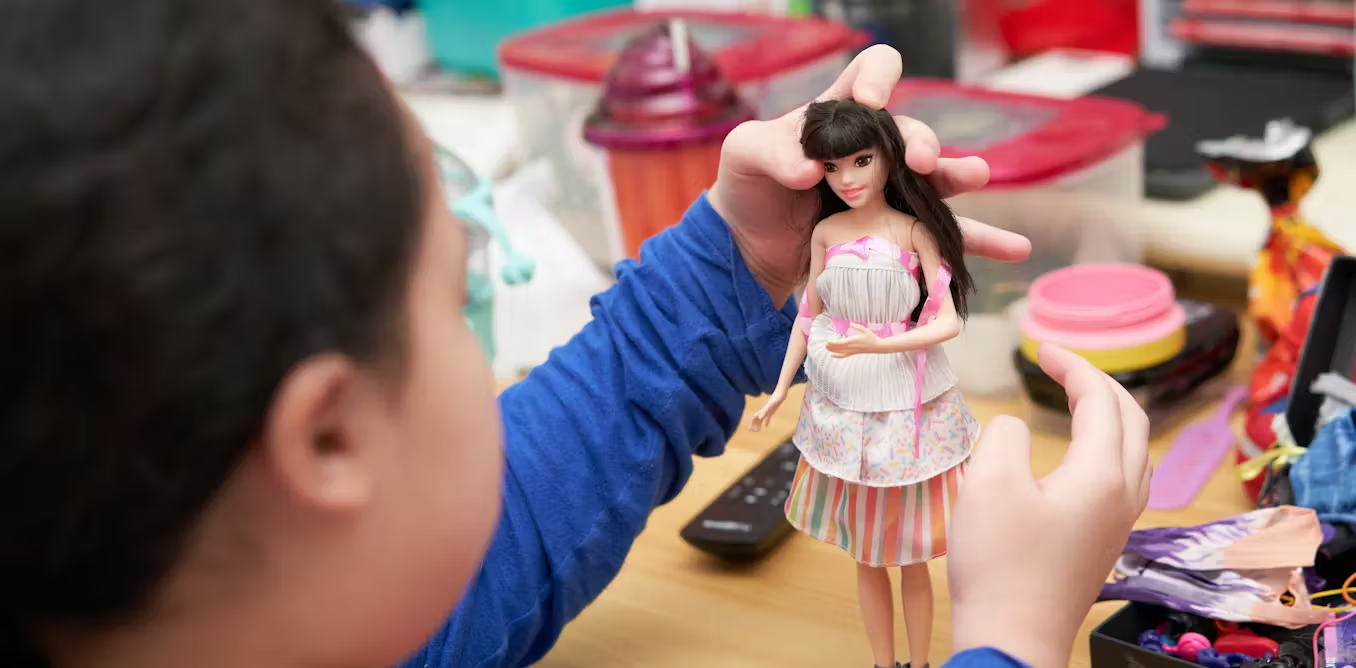
Our research focuses on a type of play often dismissed as “just for fun” – playing with dolls. Across a series of studies, we found that doll play can help children understand other people’s thoughts and feelings. This is a skill that underpins social interaction throughout life.
There is pressure on parents to create the “right” environment for development, often filled with toys that promise clear educational outcomes. STEM-focused toys (science, technology, engineering and maths), in particular, are widely seen as beneficial for learning. Doll play, on the other hand, can be viewed as having little educational benefit.
Advertisement
Our findings challenge that assumption.
More than make-believe
When playing with dolls, children often play out scenes between characters. These may seem simple on the surface but could present opportunities for the child to develop social and emotional skills.
As parents, it seems obvious that playmates are important for building and learning about relationships and other people, and recognising others’ emotions (empathy). But what if children can develop these skills even when playing alone?
Previous studies have found that children who engage more in pretend play tend to have stronger social understanding and empathy. Earlier studies, however, didn’t often use controlled methods to separate out the different factors linking pretend play and social understanding.
Advertisement
Doll play can help children understand other people’s thoughts and feelings. AlesiaKan/Shutterstock
So, we set out to test this more directly. We worked with children aged four to eight, assessing their ability to understand that others can hold different beliefs and desires to their own. This is an important milestone in social development. If children recognise that their own mental states may vary from others, this should help them better understand other people and know how to interact with them.
After that initial assessment session, children were randomly assigned either a set of dolls or a tablet with open-ended creative games. They were asked to play several times a week, with parents logging how and when play occurred. We didn’t instruct children how to play because we wanted to understand their natural behaviour.
After approximately six weeks, both sets of children came back and again completed the task about understanding others’ mental states. We found that the children who had been assigned dolls to play with, rather than tablets, showed a greater improvement in their understanding of others’ mental states during the intervening period.
Advertisement
The findings suggest that doll play can actively support the development of social understanding. This is consistent with prior research of ours showing that areas of the brain linked to social processing are activated during doll play, and that children use more language about thoughts and feelings when playing with dolls than when using tablets.
Why it matters beyond childhood
For parents, the message is reassuring – playing with dolls lets children practice skills that they can also use when playing with playmates, like understanding others, anticipating behaviour and responding appropriately.
These abilities matter far beyond childhood. They help us collaborate, resolve conflicts and navigate relationships. In a world that often feels increasingly divided, the capacity to see things from another person’s perspective is not just useful – it’s essential.
Metformin is the main treatment for type 2 diabetes but research is also investigating its potential for other conditions, including PCOS
People taking Metformin, the primary treatment for type 2 diabetes, have been informed that it can deliver numerous additional beneficial effects – alongside some adverse ones. Writing on The Conversation website, Dipa Kamdar, Senior Lecturer in Pharmacy Practice at Kingston University, explained that it has helped millions manage their blood sugar levels, and has sparked renewed research interest in areas ranging from ageing and cancer to cardiovascular health and fertility.
Advertisement
The drug originates from a plant called galega officinalis, also known as French lilac or goat’s rue, which was originally used in folk remedies for symptoms now understood to be linked with diabetes, such as excessive thirst and frequent urination. During the early 20th century, scientists extracted blood sugar-lowering compounds from the plant, Ms Kamdar explained. Following years of development and clinical testing, metformin proved to be a relatively safe and effective treatment, and was launched in the UK during the late 1950s.
Clinical trials demonstrated that Metformin was successful at reducing glucose levels while also decreasing diabetes-related complications. It subsequently became the principal treatment for type 2 diabetes throughout much of the world.
Scientists are currently investigating whether Metformin could be beneficial for other conditions. Ms Kamdar said: “One common off-label use, meaning a medicine is prescribed for a condition it has not officially been approved to treat, is polycystic ovary syndrome (PCOS).
“Many people with PCOS have insulin resistance, which means their bodies do not respond properly to insulin and need to produce more of it to keep blood glucose stable. High insulin levels can stimulate the ovaries to produce more androgens, a group of hormones that includes testosterone.
Advertisement
“Raised androgen levels can disrupt ovulation and contribute to irregular or absent periods. By improving insulin sensitivity, metformin can help reduce these effects and may help regulate the menstrual cycle.”
Ms Kamdar revealed the drug was also being investigated for its potential impact on ageing and longevity. She said: “Although early findings are intriguing, there is still no conclusive evidence that it slows ageing in humans, and it is not approved for that purpose.
“Some research has suggested that metformin may have neuroprotective effects, meaning it could help protect the brain and nervous system, particularly with long-term use. But the evidence is inconsistent, and large, long-term clinical trials are still needed to determine whether metformin really can protect against dementia and other neurodegenerative diseases.”
Those taking Metformin may encounter side-effects, Ms Kamdar noted – amongst them nausea, stomach discomfort, diarrhoea, changes in taste, and loss of appetite. More seriously, users can also be affected by vitamin B12 deficiency, which has consistently been observed in people with type 2 diabetes who take metformin. “This may happen because the drug reduces how well vitamin B12 is absorbed in the gut.
Advertisement
“Over time, low vitamin B12 can lead to anaemia or peripheral neuropathy. Anaemia means the body does not have enough healthy red blood cells to carry oxygen properly, while peripheral neuropathy refers to nerve damage, usually in the hands or feet, that can cause tingling, numbness, pain or weakness.”

























































You must be logged in to post a comment Login