Connect with us
DAPA Banner

NewsBeat

How authoritarian regimes use education as a political tool

Published

on

How authoritarian regimes use education as a political tool

It’s often assumed that expanding access to education is progressive – that it’s a means of ensuring social, economic and political development. However, this is not always the case.

We’ve carried out research examining the relationship between education and authoritarianism with a focus on Eritrea. Eritrea has been under a single political party and leadership since its independence in May 1993. The country lacks a functioning or implemented constitution and freedom of the press.

Our research has concluded that, in countries under authoritarian rule, education is not necessarily a path to empowerment. Instead, it’s a fertile ground for the spread of authoritarianism. Governments can spread their ideas and principles through repressive and ideological state apparatus – the processes and organisations they use to maintain power. This includes education.

Authoritarian regimes such as Eritrea claim to address societal problems through social justice and cohesion. However, they consolidate power around a single or dominant regime, which restricts democratic institutions and erodes civic liberties. They also apply preferential treatment based on political loyalty. People are elevated to positions of power for allegiance rather than merit. This causes division and political polarisation in the name of protecting national security.

Advertisement

Expanding education

Authoritarian states use education to maintain political stability to ensure the survival of the regime. Although many authoritarian regimes expand access to education, it is often used as a means of control and a tool for manufacturing loyalty.

For example, since independence, the number of schools and student enrollment in Eritrea has increased around fourfold. However, such regimes also see education as an opportunity to impose their attitudes onto young people. They use education to keep students isolated from ideas that may differ from or be critical of the regime.

Authoritarian regimes use deception and misinformation to uphold their ideology and extend their control. In doing so, they attempt to ensure that citizens accept the legitimacy of their rulers without question.

Additionally, authoritarian regimes politicise the school curriculum. They manipulate content, such as in history and citizenship education. This is used to mislead citizens and make them supporters of the degradation of human rights.

Advertisement
Flags on a government building in Asmara, Eritrea.
Angela N Perryman/Shutterstock

For example, Eritrea’s school curriculum normalises the creation of a militarised citizen who upholds the Eritrean People’s Liberation Front’s legacy and revolutionary culture. Similarly, North Korea uses school education to shape students’ behaviour, attitudes and beliefs to be compatible with and supportive of the regime. This is often supported by controlling the teaching and learning process and the academic environment.

Monitoring teachers and research

Authoritarian regimes recognise that safe education spaces can help students develop critical thinking and eventually question the country’s political system. They monitor teachers and school leaders, and promote those loyal to the regime’s ideas and principles. And, rather than encouraging critical thinking, they foster students’ sense of nationalism and patriotism.

Academic research is also a target of authoritarian regimes because of its scrutiny of government policies and actions. Researchers’ academic freedom is limited, and their choice of research topics is policed.

Most of these control measures are imposed in the name of protecting national security. For example, Eritreans are not allowed to conduct critical research that challenges the existing systems, inequalities and power structures of the country.

Advertisement

Researchers who cross the boundaries and criticise authoritarian regimes are silenced. Some are fired from their jobs while others face prison terms.

Meanwhile, authoritarian regimes rely on loyal academics to promote the state’s narrative. Loyal academics are also used to conceal authoritarian regimes’ failures by presenting selective evidence.

Many authoritarian states, such as China, Eritrea and North Korea, also incorporate military training into education. They blend political and ideological instruction to sustain their power. They teach students discipline and promote patriotism to develop loyal and obedient citizens.

Militarisation education sometimes places teachers and school leaders under military control. In Eritrea, all secondary school students complete their last year under military authority. This approach leads students to drop out of school. Additionally, it causes students and teachers to leave the country.

Advertisement

Authoritarian regimes manifest their true nature by spreading their ideas and principles. Our research shows that the education system is one of the most important levers in the propaganda machine for authoritarian countries.

Source link

Advertisement
Continue Reading
Click to comment

You must be logged in to post a comment Login

Leave a Reply

NewsBeat

All of the Norfolk beaches banning dogs until October

Published

on

Cambridgeshire Live

These beaches along the Norfolk coast will have restrictions in place for dogs throughout the summer

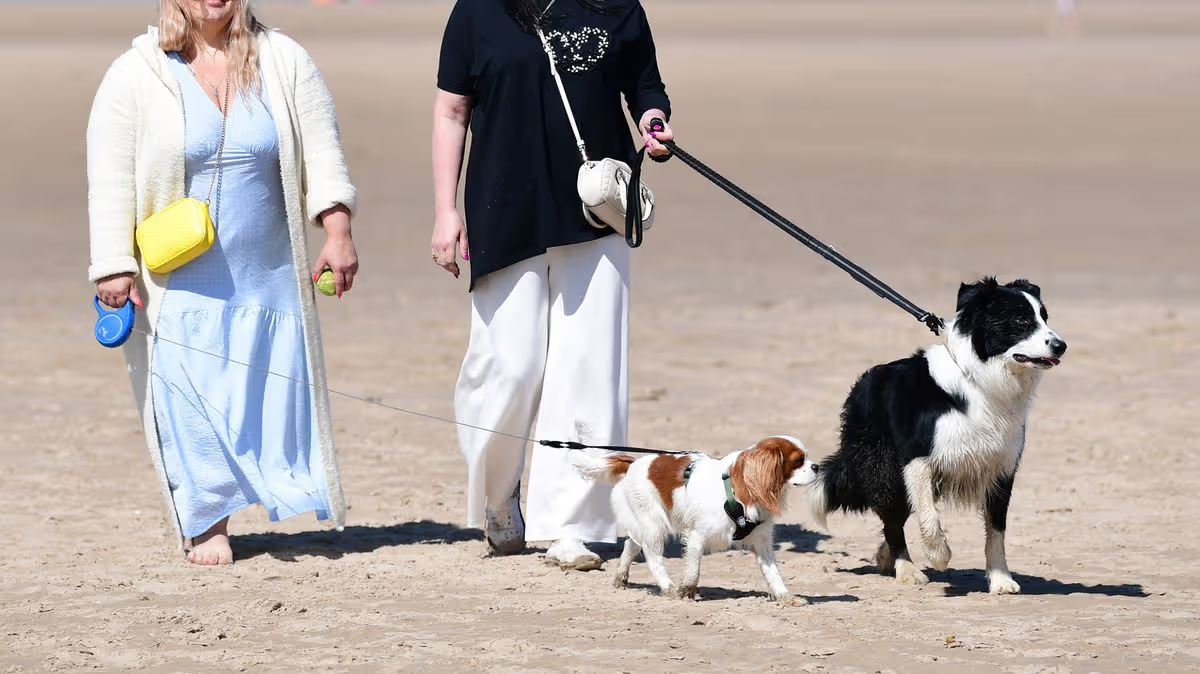
Dogs will be banned from a number of beaches on the Norfolk coast from this weekend until the start of October. Restrictions limiting where dogs can go along the British coastline will be coming into place from Friday, May 1, and will last until Wednesday, September 30.

Advertisement

Certain beaches in Norfolk will also be subject to Public Spaces Protection Orders, which tackle anti-social issues. The orders help to keep popular tourist beaches clean and safe for the public to use throughout the peak season.

The orders might also be in certain areas to preserve nature and wildlife. According to GOV.UK, if you breach one of the orders, you get an on-the-spot £100 fine, or a fine of up to £1000 if the issue goes to court.

It is worth checking individual beaches before travelling, as dogs might be allowed on some parts of the beach but not others. You might also need to keep dogs on a lead in different places in seaside towns.

If you are looking to take a day trip to Norfolk and want to spend some time on the beach with your dog, you might want to avoid the beaches listed below.

Advertisement

Here are all of the Norfolk beaches that will be affected by the restrictions:

  • Bacton
  • Cromer
  • East Runton
  • Mundesley
  • Overstrand
  • Sea Palling
  • Sheringham
  • Walcott
  • West Runton
  • New Hunstanton
  • Brancaster
  • Hemsby
  • Great Yarmouth
  • Gorleston-on-Sea

Source link

Continue Reading

NewsBeat

Rivington day tripper bus service returns for the summer

Published

on

Rivington day tripper bus service returns for the summer

The route linking Chorley, Adlington and Rivington operates on Sundays and Bank Holidays.

Lancashire County Council is reintroducing service 125R, utilising Lancashire Combined County Authority bus grant funding from HM Government.

The service will operate on Sundays and Bank Holidays until November 1.

Advertisement

The route will run hourly between Chorley Interchange and Rivington Village Hall, with stops in Adlington and a new link to Adlington Railway Station, allowing passengers to connect easily with rail services.

The service will be operated by Pilkingtonbus. Lancashire County Council day tickets will be valid on the route, along with the discounted Sunday single fare.

Andrew Varley, head of service for passenger and fleet transport at Lancashire County Council, said: “This seasonal service provides a practical way for people to reach Rivington without needing to drive, particularly at busy weekends and Bank Holidays.

“The addition of a stop at Adlington Railway Station also makes it easier for passengers to combine bus and rail travel when visiting the area.”

Advertisement

Timetables and further information are available on the Lancashire County Council website.

Source link

Advertisement
Continue Reading

NewsBeat

Migrant was seconds from attacking London’s Israeli embassy before cops stopped him | News UK

Published

on

Migrant was seconds from attacking London's Israeli embassy before cops stopped him | News UK

To view this video please enable JavaScript, and consider upgrading to a web
browser that
supports HTML5
video

A migrant tried to launch a terror attack against the Israeli embassy in London ‘as an act of revenge’ for Gaza.

Advertisement

Abdullah Sabah Albadri, 34, was caught scaling the fence of the diplomatic building in Kensington in April last year armed with two knives.

Footage shows the 34-year-old, wearing a red and white scarf wrapped around his head and sunglasses, being dragged down by armed officers before he is pinned to the ground.

He told officers he had weapons and wanted to ‘make a crime’ inside the Embassy.

Officers found a martyrdom note on him which explained that he intended to die ‘for the glory of God’.

Advertisement

Sign up for all of the latest stories

Start your day informed with Metro’s News Updates newsletter or get Breaking News alerts the moment it happens.

Albadri had entered the UK via small boat from France that same month and had been researching how to secure asylum status.

Advertisement

But he was also found to heave searched various Arabic terms relating to suicide and martyrdom in the five days before the attemped attack.

Commander Helen Flanagan, Head of Counter Terrorism Policing (CTP) London, said: ‘Albadri wanted to carry out a terrorist attack at the Embassy, but thanks to the courageous and swift actions of officers on duty, they prevented him from breaching the security perimeter and stopped what could have been a deadly incident.

‘I want to praise the officers’ incredible bravery and professionalism, which, remarkably, resulted in nobody being seriously injured – despite being confronted by a man armed with knives, intent on carrying out a terrorist attack.

‘Those officers responded within seconds, and after his safe arrest, a thorough investigation by Counter Terrorism Policing London ensured we gathered the evidence that secured this conviction.

Advertisement

‘Sadly, the Embassy has faced various security alerts in recent times. However, CTP works closely with the Embassy and our colleagues in the Met to continuously review and strengthen protective security plans to ensure the site and the wider community is kept as safe as possible.’

Source link

Continue Reading

NewsBeat

Superdry co-founder found guilty of rape after night out drinking

Published

on

Daily Record

James Holder, 54, had gone back to the woman’s home

The co-founder of Superdry has been found guilty of raping a woman after a night out drinking. A court heard how James Holder, 54, had gone back to the woman’s home, went to the toilet and then promptly fell asleep on her bed snoring.

The multi-millionaire fashion boss, the co-founder of the clothing brand, then woke up and beckoned the woman, who was trying to sleep in the lounge, into her bedroom and raped her.

Holder had denied charges of assault by penetration and rape and said what sexual activity took place between them was consensual.

Advertisement

A jury at Gloucester Crown Court, sitting in Cirencester, acquitted Holder of assault by penetration but found him guilty of rape after deliberating for four hours.

Holder, who wore a dark suit and light blue shirt and tie, showed no emotion as the verdicts were returned.

The court heard the woman was attacked in the early hours of May 7 2022 after a night out at a bar in Cheltenham.

Holder and a friend had gone back to her home uninvited, and he attacked her after waking from a short nap on her bed.

Advertisement

Giving evidence, the woman said she was crying and asking the married father-of-two to stop but he carried on.

The ordeal ended when she managed to escape the bedroom, and Holder left her home a short time later.

The woman denied suggestions from Holder’s barrister that she had initiated the encounter.

“He forced me to try and perform oral sex on him,” she said.

Advertisement

Michelle Heeley KC, defending, said: “Sex lasted for approximately 20 minutes.”

The woman replied: “I call it rape.”

Ms Heeley suggested: “This was a drunken sexual encounter that you regret?”

She replied: “Incorrect.”

Advertisement

The court heard the businessman and philanthropist was “old school and chivalrous” towards women and “adored sex”.

He told the jury she had kissed him first and it was “evident what she wanted to happen”.

“We walked to the bedroom, which was about a minute away … and began kissing again,” he said.

He told the court the complainant performed oral sex on him before they progressed to consensual sexual intercourse, but stopped when she said it was becoming painful.

Advertisement

“I did not see or hear her crying at any point,” he said.

Asked why he left the flat a short time later, Holder replied: “I had been out for much longer than I anticipated and I needed to go home.

“I let myself out. She was asleep on the bed.”

Under cross-examination, Holder denied the reason he had gone to the woman’s home was that he “saw an opportunity to have sex with her”.

Advertisement

James Haskell, prosecuting, asked: “You saw something you wanted and you took it, because the truth is that when you got to the doorway of the living room you said something like: ‘What’s happening, is everything all right?’ as you wanted to entice her to the bedroom and that’s why you said: ‘Can you show me?’

“It ended because she managed to escape off the bed.”

Holder replied: “That’s not correct. She fell straight to sleep. She was fast asleep, so I popped my clothes on and left.”

Mr Haskell asked: “Is the truth that it suddenly dawned on you of the reality of what you had just done, and you wanted to get out of the flat as soon as possible?”

Advertisement

Holder replied: “No, not true.”

The defendant, of Cheltenham, Gloucestershire, was remanded into custody ahead of sentencing at Bristol Crown Court on May 7.

Miss Heeley had asked for bail before the sentencing hearing to allow Holder “to put his affairs in order”, saying he had attended court promptly throughout the trial.

“I ask for bail as a matter of mercy to say goodbye to his wife and children and to put his affairs in order and financial matters,” she said.

Advertisement

“This is a plea of leniency and mercy for this man at this stage.”

Recorder David Chidgey refused the bail application saying Holder was a flight risk following his conviction.

“Mr Holder is a man of considerable means and in my judgment the temptation to attempt to use his considerable resources to flee is too great as he faces a considerable custodial sentence,” he said.

“On one view the victim is this case did not have the opportunity to put her affairs in order when she suffered an appalling distressing event.”

Advertisement

Source link

Continue Reading

NewsBeat

Madonna And Sabrina Carpenter’s Bring Your Love Makes Radio 1 A-List

Published

on

Madonna And Sabrina Carpenter's Bring Your Love Makes Radio 1 A-List

Madonna’s latest single has pushed her back onto Radio 1’s A-list for the first time in almost two decades.

On Thursday night, the Queen of Pop released her new bop Bring Your Love as the lead single from her upcoming album Confessions II.

Produced by former collaborator Stuart Price, the house-inspired tune features vocals from Sabrina Carpenter, and was first unveiled live when the two pop stars shared the stage at Coachella last month.

Advertisement

Earlier this week, The Sun claimed that its youth-oriented station Radio 1 would be pushing Madonna and Sabrina’s duet on their A-list – meaning it would receive the heaviest rotation on the channel – which would be the Like A Prayer’s first time on there in 18 years.

Radio 1 then unveiled its A-list for the coming week on Friday morning, with Madonna’s new song nestled among new offerings from the likes of Olivia Rodrigo, Taylor Swift, Zara Larsson and PinkPantheress, BTS and Sombr.

Sabrina Carpenter and Madonna performing together at Coachella last month

Kevin Mazur/Getty Images for Coachella

Prior to this, Madonna’s music had sparked an ageism row when Radio 1 refused to play her music.

Advertisement

“I thought it was so discriminatory and unfair,” she told The Sun in 2015. “Shouldn’t it be to do with whether you wrote a good, catchy pop song?

“We’ve made so many advances in other areas – civil rights, gay rights – but ageism is still an area that’s taboo and not talked about and dealt with.”

She added: “I’m so stupid. I didn’t know it was anything to do with my age. I just do my work.”

The BBC insisted at the time: “Radio 1 does not ever ban artists. Tracks are chosen on musical merit and their relevance to our young audience on a case-by-case basis and while around 40 per cent of the country’s 15- to 29-year-olds tune in to Radio 1 each week, an artist’s age is never a factor.”

Advertisement

Madonna claimed later that year: “Radio is ageist. If you’re not in your 20s they won’t play you on the radio. It’s bullshit – but that’s the way it is.

“It is disappointing. We live in an ageist society. I’ve tried my hardest to do whatever I can to change peoples’ perception of women, of age, of what is possible and why should any of us limit ourselves in any way, shape or form regardless of our sex, our sexual preference, our age, our religious beliefs, our race etc.

“So for me it’s shocking in this day and age where we’re now accepting gay marriages that we still treat women in a very sexist way. That’s one frontier that has not been conquered. Because if I was a man, things would be different…”

A similar debate emerged just a few years ago, when Radio 1 declined to playlist Kylie Minogue’s Padam Padam – until it became a top 10 hit.

Advertisement

Source link

Continue Reading

NewsBeat

Matthew McCallan: PSNI to take 40 more statements about Co Tyrone teen’s death

Published

on

Belfast Live

The 15-year-old died after attending a country music festival almost four years ago

Police are set to take a further 40 statements over the next four to six weeks in relation to the death of a teenager in Co Tyrone almost four years ago.

Advertisement

Matthew McCallan was just 15-years-old when he died after attending a country music event in Fintona in December 2022. After a two-day search involving the local community, PSNI, and the Community Rescue Service, Matthew’s body was found in a ditch just two miles from the festival he had attended.

At a pre-inquest review hearing held on Friday, May 1, counsel for Coroner Joe McCrisken said progress has been made, with 135 pages of new material disclosed in relation to the case. As well as this, Mr Quinn added that CCTV exhibits were also available to the coroner and this would be assessed for its relevance to the inquest.

READ MORE: Co Tyrone mum fighting for answers three years on from son’s tragic death after night outREAD MORE: Matthew McCallan: Family launch fundraiser for new search and rescue kit on first anniversary of son’s death

The coroner was told this new information would not extend the case beyond its current and set scope, as it was looking at the immediate response, and civilian witnesses. Mr Quinn said the new statements would be provided to the coroner’s office on a rolling basis within the next four to six weeks.

Advertisement

Additionally, he said an official within the Police Ombusman for Northern Ireland (PONI) office who had been dealing with the case had retired, with a new person now tasked to the case. A meeting was due to take place with their investigation team on new potential information.

The pre-inquest review also heard that discussions were taking place on whether expert evidence would be called during the inquest, and that it was also being reviewed whether a jury would hear the inquest.

Matthew’s parents had previously expressed concerns regarding the lack of progress with the inquest. Counsel for the next of kin, Michael McCartan, said it was clear “momentum is now building” in relation to the case.

A further pre-inquest review hearing has been scheduled to take place on June 26.

Advertisement

For all the latest news, visit the Belfast Live homepage here and sign up to our daily newsletter here.

Source link

Continue Reading

NewsBeat

Livingston MP announces extension to application deadline for Robin Cook Internship

Published

on

Daily Record

The paid summer internship, established in memory of the former Livingston MP and Foreign Secretary, offers S5 and S6 pupils from across the constituency the opportunity to gain first-hand experience of political life both locally and at Westminster.

Livingston MP Gregor Poynton has announced that the application deadline for the 2026 Robin Cook Internship has been extended following strong interest from local students.

Advertisement

The paid summer internship, established in memory of the former Livingston MP and Foreign Secretary, offers S5 and S6 pupils from across the constituency the opportunity to gain first-hand experience of political life both locally and at Westminster.

Applications will now close at midday on Friday, May 15, giving more young people across the Livingston constituency the opportunity to apply.

The successful applicant will undertake a two-week placement during summer 2026, working alongside Mr Poynton and his team in the constituency and at the House of Commons in London.

READ MORE: Almond Valley SNP candidate visits Livingston Community Shed

Advertisement

Announcing the extension, Mr Poynton said: “I’ve been really encouraged by the strong level of interest we’ve already seen in this year’s Robin Cook Internship.

“I want to make sure as many young people as possible across the Livingston constituency have the chance to apply, so we are extending the deadline to make sure we get as broad a range of applications as possible for this years programme.

“This internship is about opening up opportunities and showing young people that they can play a real role in shaping their communities and the future of our country. I would encourage anyone who is interested to put themselves forward.”

Applicants are required to submit (by email to Gregor.Poyton.MP@Parliament.uk) a CV and a 1,000–1,500 word essay on the theme:

Advertisement

“How Can Young People Shape the Future of the Livingston constituency?”

The internship pays the Real Living Wage and is open to S5 and S6 pupils attending schools across the Livingston constituency.

READ MORE: Girls at West Lothian school establish clothing bank with touch of class

Don’t miss the latest news from the West Lothian Courier. Sign up to our free newsletter

Advertisement

Source link

Continue Reading

NewsBeat

Cambridge voters praise early voting pilot scheme as ‘important for democracy’

Published

on

Cambridgeshire Live

Cambridge voters can cast their vote a week early in a new pilot scheme

Voters have praised a new pilot scheme allowing them to cast their vote for next week’s election early.

Advertisement

Alex Downie and his wife Fiona came to vote at the Guildhall in central Cambridge – one of three locations where votes can be cast this week from Thursday to Saturday. He said: “I think it’s a very good idea, because if you’re going on holiday it’s otherwise very awkward to vote – it’s important for democracy.”

The 77-year-old said they would register for postal vote otherwise, but praised the scheme for making voting much more convenient. He said: “It’s better this way because we come into town quite a lot – it’s nice and straight forward.”

Fiona, 66, added: “It’s fantastic, because as Alex said we were going to be away so we didn’t want to do a postal vote because it’s more hassle. Sometimes it’s hard to vote when you’re working, I once almost missed it. This was perfect – quick, easy and we were coming into town anyway. Do it all the time, do it in the general election!”

Voting will be open from 9am until 6pm and votes can also be cast at the Meadows Community Centre on Arbury Road and Clay Farm Centre in Trumpington.

Advertisement

Chris Burton said: “It was a very, very, efficient experience – immensely convenient because I’m not here next week and I don’t want to go through the postal vote and all of that. I do tend to be away from Cambridge the first or second week in May – this week is earlier, it’s the first week.”

Though he said he’s never failed to vote while being away, the 80-year-old said: “It just gets more complicated when you’ve got to take a postal vote.

“The fact you can come here and bring the day forward effectively works very well indeed – so as long as the system works on a legal basis, that’s all that matters.”

Advertisement

Corin Hoad praised the flexibility, after a last-minute change of plans meant he couldn’t make it to vote in person on May 7. The 32-year-old said: “It means I can still make it without having to worry about getting a last-minute postal vote or anything like that.

“You should have another few days to vote and have that flexibility – it should enable a lot more people to vote for a politician they might not have been able to.”

Vicky Jenner, electoral services manager at Cambridge City Council, said turnout was “busier than we expected” suggesting earlier voting “is an appealing option for many.”

Advertisement

She said: “We’ve received some very positive feedback from early voters, and in fact some people were so keen to take part that they were queuing outside at 9 o’clock this morning, waiting for the doors to open. Ultimately, giving people more options for how they can cast their vote is about strengthening democracy and enabling even more people to get involved in important decisions affecting their lives and the place they call home.”

Source link

Continue Reading

NewsBeat

Best British film of 21st century is a ‘masterpiece’ you probably have never heard of

Published

on

Wales Online

A sci-fi horror film has been ranked the best British film of the 21st century in the BFI’s prestigious Sight and Sound critics’ poll

Determining which films truly deserve the title of greatest of all time is no simple task, yet many have attempted it, including Britain’s own British Film Institute (BFI). Since 1952, Sight and Sound, the BFI’s esteemed magazine, has conducted a decennial poll to identify cinema’s finest achievements.

Advertisement

The most recent edition in 2022 saw more than 1,600 film critics, programmers, curators, archivists and academics submit their personal top 10 choices. These votes are compiled into a definitive ranking of the 250 greatest films ever made.

Given the sheer scale of this catalogue, we’re highlighting the list’s top-ranked British film from the 21st century – Under the Skin, a compelling thriller featuring Scarlett Johansson as an alluring extraterrestrial who drives through Scotland hunting for victims.

This sci-fi horror represents the vision of English director Jonathan Glazer, whose later work, The Zone of Interest, garnered accolades at the BAFTAs and Cannes in 2023.

A decade earlier, though, Glazer loosely adapted Under the Skin from Michel Faber’s novel of the same title. Johansson plays an unnamed extraterrestrial in human form who targets vulnerable, isolated men.

Advertisement

Remarkably, numerous sequences showing Johansson’s character travelling across Scotland and approaching men were genuine encounters filmed with concealed cameras, reports the Express.

While the novel explicitly reveals her ultimate purpose (specifically, to murder and process the men as food) without mystery, the film adopts a considerably more cryptic stance.

Explaining its position at number 169 on the list, the BFI stated: “The icily brilliant Scarlett Johansson stars as an alien predator scouring Scotland’s streets for human prey, in Jonathan Glazer’s astonishing amalgam of fantasy and reality.

Advertisement

“Mixing mind-bending visuals and hallucinatory sound design with an unexpected naturalism, Glazer returned to the screens after a nine-year absence in audacious style, utilising guerrilla filmmaking tactics to capture Glasgow and its unsuspecting inhabitants with intimate realism.”

The film holds a favourable 83% approval rating on Rotten Tomatoes, though its deliberately ambiguous narrative divided opinion, as the website’s critical consensus readily acknowledges.

“Its message may prove elusive for some, but with absorbing imagery and a mesmerising performance from Scarlett Johansson, Under the Skin is a haunting viewing experience.”

At the film’s Venice Film Festival premiere, the Guardian described it as a “genuine Marmite moment”, noting: “Some saw it as a masterpiece, others as a bore. The film’s closing credits played out to an accompaniment of booing.”

Despite performing poorly at the box office, the picture still earned BAFTA nominations for Outstanding British Film and Best Original Music.

A glowing review from the Chicago Sun-Times said: “This is what we talk about when we talk about film as art.”

Film lovers continue to argue over whether the picture genuinely warrants recognition as one of the finest.

Advertisement

“I just watched Under the Skin and I can’t decide whether it is a masterpiece or a terrible movie,” asked one viewer on Reddit in 2025, more than ten years following the film’s debut. “What is your opinion?”

One replied: “It’s one of the best movies of the previous decade.” Another concurred: “Masterpiece absolutely. Couldn’t stop thinking about that movie for weeks. Still think about it sometimes.”

A third summed it up: “It’s one of my favourite films, but one of my friends who I saw it with in theatres despised it.”

Under the Skin is available to stream on platforms including Amazon Prime, Apple TV, Sky Store and Google Play.

Advertisement

Source link

Continue Reading

NewsBeat

David Attenborough’s ‘long life’ diet as he turns 100 in a few days

Published

on

Daily Mirror

His decision to cut one food from his diet could be the secret behind his remarkable health and longevity

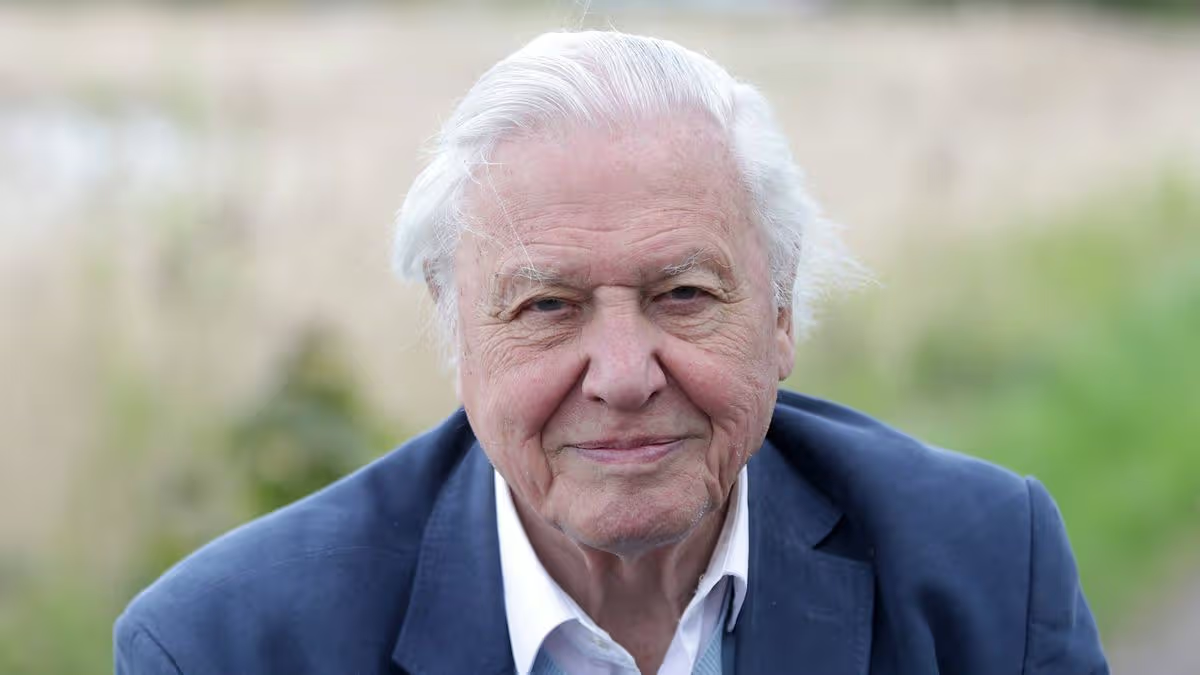
Legendary nature presenter Sir David Attenborough has previously said he’d love to reach his 100th birthday, which is just a few days away. The broadcasting icon credits part of his well-being and energy to a simple dietary choice that could help more people stay healthy for longer.

Advertisement

While not a complete vegetarian, it’s well documented that Sir David has cut out red meat consumption, a decision he suspects may be extending his life. This shift in habits isn’t new – Attenborough spoke openly about his dietary choices as far back as 2017.

He said: “I have certainly changed my diet. Not in a great sort of dramatic way. But I don’t think I’ve eaten red meat for months.” He admitted that although he continues to eat cheese and fish, he has otherwise “become much more vegetarian” than he’d ever imagined.

“There is clear science behind the benefits of adopting a more plant-based diet when it comes to overall health and longevity.” The 99-year-old has reduced his consumption of red meat, which includes things like beef, lamb, mutton, pork, veal, venison and goat.

The TV icon will mark his 100th birthday on Friday, May 8, having been born in 1926. As this remarkable milestone approaches, he has admitted during one of his most recent programmes, Ocean, that he is ‘approaching the end of his life.’

Advertisement

The NHS warns that eating too much processed and red meat can raise the likelihood of developing bowel (colorectal) cancer. A number of products in these categories contain high levels of saturated fat, which may cause blood cholesterol to rise when eaten in large quantities.

Elevated cholesterol heightens the risk of coronary heart disease, reports Surrey Live. Anyone considering cutting certain foods from their diet should make sure they’re still getting essential nutrients and consult their doctor beforehand.

Failing to maintain a nutritious, balanced diet may lead to health complications. Experts at Harvard Health suggest that people who want to cut down on red meat should find suitable alternatives to maintain sufficient protein intake.

Advertisement

Daniel Pendick, former executive editor of Harvard Men’s Health Watch, claims that replacing just one daily portion of red meat with other options might reduce mortality risk by 7% to 19%. People could swap red meat for other protein sources such as fish, chicken, turkey, nuts, beans, low-fat dairy products and whole grains.

Despite maintaining a healthy diet and staying mentally sharp, Sir David Attenborough revealed his private worries about growing older during a 2021 interview with Anderson Cooper. He shared his anxiety about mental decline and the fear of becoming “helpless” through conditions such as Alzheimer’s.

He also told the Telegraph about his worries regarding getting older and “coming to terms” with possible memory loss. But, Sir David remains a prominent figure, lending his voice to BBC wildlife documentaries with projects airing as recently as January 2026.

Advertisement

What are the benefits of cutting out red meat?

Red meat is widely associated with elevated levels of saturated fat, which can raise LDL ‘bad’ cholesterol and increase the risk of cardiovascular disease, according to Cleveland Clinic Health Essentials. Research further suggests that reducing or eliminating red meat may lower the risk of heart disease and related deaths.

Certain studies have linked excessive red meat consumption to a heightened risk of colorectal cancer, according to the Scottish Cancer Foundation. Cutting back on red meat may also reduce the risk of other cancers.

Evidence additionally suggests that a high red meat intake is associated with an increased chance of developing type 2 diabetes. Diets that restrict or exclude meat tend to be lower in calories and fat, supporting weight loss and helping maintain a healthy weight.

Advertisement

A meat-free diet is typically rich in fibre from vegetables, fruits, and wholegrains, which promotes a healthy gut microbiome and can boost metabolism and general wellbeing. It is essential to consult your GP before making any decision to reduce your red meat intake.

Who is David Attenborough?

Sir David Attenborough has mesmerised millions by bringing the natural world into our living rooms and classrooms. Throughout the decades, his extraordinary career has been driven by an insatiable passion for discovery, exploration, creativity, and enlightenment.

The celebrated writer, broadcaster, and naturalist studied at Clare College, Cambridge. Following a period with an educational publishing firm, he began his broadcasting journey as a BBC trainee in 1952. Serving as controller of BBC Two, he was instrumental in introducing Europe’s first colour television transmissions.

Advertisement

For seven decades, he has been the legendary voice of natural history programming, showcasing the splendour of the natural world through iconic series including Life on Earth, The Private Life of Plants, and The Blue Planet. More than 40 species of flora and fauna bear his name, alongside a constellation.

Source link

Continue Reading

Trending

Copyright © 2025