

Connect with us

Tech

First multi-coronavirus vaccine enters human testing, built on UW Medicine technology

Published

on

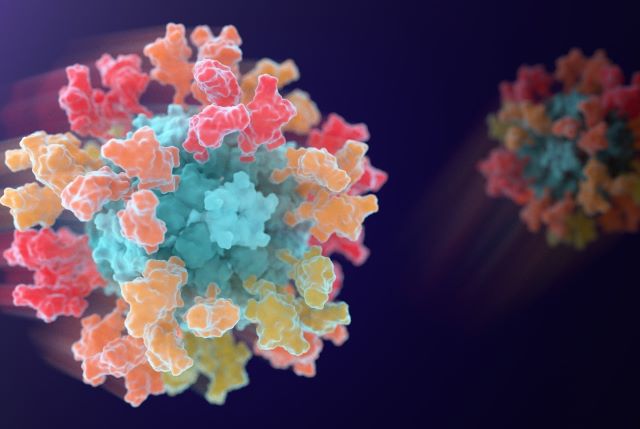
A model of a new vaccine targeting a family of coronaviruses that includes the virus that causes COVID-19. The image highlights pieces of several different viruses attached to a computer-designed nanoparticle to trigger an immune response. (Ian C. Haydon Image)

A candidate vaccine that fights a suite of coronaviruses including COVID-19 and related, deadly respiratory diseases is starting human clinical testing in Australia. The vaccine was developed using technology from the University of Washington’s Institute for Protein Design.

South Korean pharmaceutical company SK bioscience is leading the trial for the new coronavirus vaccine, called GBP511. SK bioscience previously partnered with UW researchers on a COVID-19 vaccine that received regulatory approval.

The Coalition for Epidemic Preparedness Innovations has provided the GBP511 program with approximately $65 million in funding. 

Unlike most vaccines that target a single virus or strain, GBP511 aims to protect against multiple coronaviruses at once.

Neil King (left) and David Veesler are University of Washington biochemistry professors developing computer-designed protein vaccines. (UW Photo / Ian C. Haydon)

“GBP511 is the first vaccine to reach human testing that is intended to protect against multiple strains of the virus that causes COVID-19 as well as related coronaviruses with the potential to spark dangerous outbreaks,” Neil King, associate professor of biochemistry at UW Medicine, said in a statement.

King, who is deputy director of the Institute for Protein Design, co-invented the self-assembling nanoparticle technology that was used to generate the vaccine. The institute is on the cutting edge of AI-assisted protein innovation and perhaps best known as the home of David Baker, a 2024 Nobel Prize winner in chemistry.

Advertisement

The new vaccine recognizes sarbecoviruses, a subgroup of coronaviruses that include the virus that causes COVID-19, as well as those responsible for other major disease outbreaks: the original SARS-CoV-1 virus that caused widespread illness in the early 2000s and MERS-CoV, which caused outbreaks primarily in the Middle East. The family also includes viruses found in animals such as camels and bats, some of which have already infected humans and others that potentially could.

The vaccine features pieces of four different coronaviruses attached to a computer-designed nanoparticle, triggering an immune response to a variety of invaders.

“The beauty of this approach is that by presenting the immune system with multiple related antigens at once, we can train it to recognize features that are conserved across the entire sarbecovirus family,” said David Veesler, a professor of biochemistry at UW Medicine who led the preclinical studies.

The international Phase 1/2 trial launched its enrollments last month and aims to include approximately 368 healthy adults in Perth, Western Australia. Results from the study examining the vaccine’s safety and effectiveness are expected by 2028. 

Advertisement

Source link

Continue Reading
Click to comment

Leave a Reply

Your email address will not be published. Required fields are marked *

Tech

Nothing Ear (a) Might be the Best ANC Wireless Earbuds for Your Money, Here’s Why

Published

on

Nothing Ear (a) Wireless Earbuds
The Nothing Ear (a) wireless earbuds, priced at $59 (was $109), deliver impressive performance without breaking the budget. Many consider them the go-to pick for active noise cancellation in this price range, and after a closer look, you’ll see why. Nothing built these earphones with an incredibly clean, transparent stem that showcases the internal components.


Each bud weighs approximately 4.8 grams, and the charging case is so small that it fits easily into a pocket. The case’s design is inspired by pill packaging, and it does an excellent job of remaining tiny and useful. You get three sizes of silicone tips that match the color of the buds, which is a nice addition; these not only help you establish a snug fit, but they also allow you to use your buds for long periods of time without them becoming unpleasant.

Sale


Nothing Ear (a) Wireless Earbuds, 45dB Hybrid Noise Cancelling Earbuds, Hi-Res Audio, Advanced Equaliser,…
  • Powerful 11 mm Driver: We’ve engineered an even more compact driver that delivers twice the power of Ear (2). In Nothing Ear (a) wireless earbuds,…
  • 45 dB Smart Active Noise Cancellation: Nothing Ear (a) earbuds continuously monitors the seal between the earbud and your ear canal. If noise leakage…
  • Clear Voice Technology: Crystal-clear calls, anytime, anywhere. Nothing Ear (a) ear buds isolates your voice from background noise, making on-the-go…

The sound is produced by 11mm dynamic drivers in each earbud, and the audio provides a pleasant sound with lots of bass presence, but it is not so overbearing that you become lost in the mids or higher frequencies. The companion app has a basic EQ for any modifications you may want to make, and if you have an Android, you can use the LDAC codec to stream at greater resolutions when your connection allows it. They also support AAC and SBC to ensure compatibility with almost anything else.

Advertisement


Active noise cancellation can reach up to 45 decibels and includes a variety of modes, including high, mid, low, and adaptive, in which the buds adapt to the seal in your ear and begin filtering out noise as they go. Transparency mode allows outside noise to be heard when necessary. The buds include six microphones that work together to make calls extremely clear, and background noise is virtually non-existent during discussions.

Battery life is one area where the Ear (a) earbuds excel, as with ANC turned off, you can get up to 9.5 hours from the buds alone or roughly 42.5 hours with the case. Even if you do turn on the noise cancellation, the playback will last for a long time before requiring another charge, and a short top-up of 10 minutes will provide you with a pleasant bit of extra time. The case itself charges via USB-C, but they’ve opted out of wireless charging to keep costs down.

Nothing Ear (a) Wireless Earbuds
The controls are all handled via pinch movements on the stems, which take some getting accustomed to but are really responsive once you’ve played around. You can control the volume by swiping, pinching to play or pause, or holding in to switch between ANC modes or access your voice assistant. They also have Bluetooth 5.3, which ensures a rock-solid connection, and multipoint pairing, which allows you to connect up to two devices and switch between them.

Nothing Ear (a) Wireless Earbuds
The Ear (a) earbuds are designed to survive some rough handling, with an IP54 classification for dust and water resistance, so you should be alright using them in the gym or outside in light rain. The case is not as durable, but it is adequate for general use. Nothing also includes a few extras, such as low-latency option for gamers to decrease annoying audio lag.

Source link

Advertisement
Continue Reading

Tech

Cork’s Hibra Design reaches GSA regional finals

Published

on

The start-up is the only Irish entry across all start-up categories to have earned a spot in the western Europe regional finals.

Hibra Design, a Cork-based vehicle specialist development company, has earned a place at the western Europe regional finals of the Global Start-up Awards (GSA). The organisation has been shortlisted in the Greentech Start-up of the Year category.

Founded in 2022 by Mike Keane, Hibra Design is an automotive engineering development company that creates sustainable and bespoke vehicle solutions with a focus on clean technology powertrain systems. The company develops new systems to allow fossil-fuel powered vehicles to be re-engineered with battery electric systems.

The GSA originated in Denmark in 2012 with the launch of the Nordic Start-up Awards. Since then, its co-founders Kim Balle and Peter Kovacs have introduced a unifying brand to connect all regional competitions under one umbrella. Currently, the competition includes 19 regions across 154 countries. 

Advertisement

The aim of the GSA is to empower innovative entrepreneurs, enable ecosystem collaboration and build thriving innovation economies, through global competition, events, collaboration and community building. 

Commenting on the news, Keane – who is also Hibra’s CEO – said: “Having won the 2024 Irish National Start-up award for Product and Manufacturing, we are thrilled to now see our achievements be held up against the best in the world. We develop completely new, bespoke vehicles to client specifications and we also re-engineer existing vehicles with battery electric technology for fleet operators. 

“We provide state-of-the-art solutions which offer improved vehicle performance, whilst showing a commitment to both clean technology and circular economy principles. Being named a regional finalist by the Global Start-up Awards is a powerful validation of this commitment.”

GSA finalists are selected by an expert jury sourced from across 154 countries. Category winners will be announced on 18 February, with the winners from each region progressing to the global finals in Valetta, Malta in early May. 

Advertisement

Also in Cork, Qualcomm Technologies recently announced a €125m investment to upgrade its Cork city site into a “strategic AI pillar” over the next three years. The investment is set to support the creation of around 300 additional roles, which will see the company’s workforce in the city grow to more than 1,000 people. 

Don’t miss out on the knowledge you need to succeed. Sign up for the Daily Brief, Silicon Republic’s digest of need-to-know sci-tech news.

Source link

Advertisement
Continue Reading

Tech

Cross-Country Skiing at Winter Olympics 2026 Free Streams

Published

on

Cross-country skiing live streams at the 2026 Winter Olympics will inevitably see Norway claiming another clutch of medals in a test of technique, endurance and speed that’s been a mainstay of the games since its inception in 1924.

Source link

Advertisement
Continue Reading

Tech

‘Stumble’ Peacock Release Schedule: How to Watch More of the Comedy Series

Published

on

Stumble — a new NBC sitcom about the world of junior college cheerleading that also streams on Peacock — won’t be entertaining crowds with a new episode this week. The series, which began airing in November, stars Jen Lyon as Courteney Potter, who gets fired from her job “one championship shy of being the winningest coach in college cheer history.” Stumble follows her as she leads a new, dysfunctional cheer team at Heådltston State Junior College in Oklahoma.

The show also features Taran Killam as Courteney’s husband, and recurring and guest stars include Kristin Chenoweth, Annaleigh Ashford, Busy Philipps and Jeff Hiller. Because of the 2026 Winter Olympics, there won’t be a new Stumble installment this week or next, per NBC. Here’s when you can catch up with the show’s ragtag cheerleading squad.

Advertisement

When to watch more Stumble on Peacock

Stumble will be back on screens later this month. The next episode of the mockumentary series will air on NBC on Friday, Feb. 20, and stream the following day on Peacock.

  • Episode 10, Finals Week, premieres on NBC on Feb. 20 at 10:30 p.m. ET/10:30 p.m. PT. Streams on Peacock on Feb. 21.

James Martin/CNET

Peacock offers three tiers, including a lower-priced option that includes NBC, Bravo and other TV shows. The downside is that you can’t watch Peacock Originals, movies or sports. Still, you could use the $8-per-month Select plan to watch Stumble and other shows like Yellowstone, The Office and Real Housewives. Peacock’s other plans are $11 per month Premium and $17 per month Premium Plus.

Advertisement

Source link

Continue Reading

Tech

Driving Sim Handbrake Based On Load Cell

Published

on

Simulator-style video games are designed to scale in complexity, allowing players to engage at anything from a casual level to highly detailed, realistic simulation. Microsoft Flight Simulator, for example, can be played with a keyboard and mouse, a controller, or a huge, expensive simulator designed to replicate a specific airplane in every detail. Driving simulators are similar, and [CNCDan] has been hard at work on his DIY immersive driving sim rig, with this hand brake as his latest addition.

For this build, [CNCDan] is going with a lever-style handbrake which is common in motorsports like drifting and rallying. He has already built a set of custom pedals, so this design borrows heavily from them. That means that the sensor is a load cell, which takes input force from a lever connected to it with a spring mechanism. The signal is sent to an Arduino for processing, which is set up to send data over USB like any joystick or controller. In this case, he’s using an Arduino that was already handling inputs from his custom shifter, so he only needed to use another input and add some code to get his handbrake added into his sim.

[CNCDan] built a version of this out of laser-cut metal parts, but also has a fully 3D printable one available as well. Plenty of his other videos about his driving rig are available as well, from the pedal assembly we mentioned earlier to the force-feedback steering wheel. It’s an impressive set of hardware with a feel that replicates racing about as faithfully as a simulator could. Interestingly, we’ve also seen this process in reverse as well where a real car was used instead as a video game controller.

Advertisement

Source link

Advertisement
Continue Reading

Tech

Telly’s Plan For ‘Free’ Ad-Based TV Revolution Runs Into Quality Control Problems

Published

on

from the inescapable-advertisements dept

Back in 2023 we noted how a company named Telly proclaimed it had come up with a new idea for a TV: a free TV, with a second small TV below it, that shows users ads pretty much all of the time. While the bottom TV could also be used for useful things (like weather or a stock tracker), the fact it was constantly bombarding you with ads was supposed to offset any need for a retail price.

But apparently there’s been trouble in innovation paradise.

Shortly after launch, Telly proclaimed that it expected to ship more than half a million of the ad-laden sets. Within a few months it had announced it had already received 250,000 pre-orders. But a recent report by Lowpass indicates that only 35,000 of the sets had made it to peoples’ homes.

What was the problem? Ars Technica, Lowpass and The Verge note that the problems began with a substandard shipping process that resulted in a lot of TVs showing up broken to folks who pre-ordered. Reddit is also full of complaints about general quality control issues, like color issues, ads being played too loudly, odd connectivity issues, remote controls randomly unpairing, and more.

Still, there’s evidence that the idea might still have legs, as the premise itself appears profitable:

Advertisement

“The investor update reportedly said Telly made $22 million in annualized revenue in Q3 2025. This could equate to about $52 in advertising revenue per Telly in use per month ($22 million divided by 35,000 TVs divided by 12 months in a year is $52.38).

That’s notably more than what other TV companies report, as Lowpass pointed out. As a comparison to other budget TV brands that rely heavily on ads and user tracking, Roku reported an average revenue per user (ARPU) of $41.49 for 2024. Vizio, meanwhile, reported an ARPU of $37.17 in 2024.”

The TV industry had already realized that they can make more money tracking your viewing and shopping behavior (and selling that information to dodgy data brokers) long term than they do on the retail value of the set. This just appears to be an extension of that concept, and if companies like Telly can get out of their own way on quality control, it’s likely you’ll see more of it.

In one sense that’s great if you can’t afford the newest and greatest TV set. It’s less great given that the United States is too corrupt to pass functional consumer privacy protections or keep its regulators staffed and functional, meaning there are increasingly fewer mechanisms preventing companies like this from exploiting all the microphone, input, and other data collected from users on a day-to-day basis.

I personally want the opposite experience; I’m willing to pay extra for a dumb television that’s little more than a display panel and some HDMI inputs. A device that has no real “smart” internals or bloated, badly designed GUI made by companies more interested in selling ads than quality control. Some business class TVs can sometimes fit the bill, but by and large it’s a segment the industry clearly isn’t interested in, because there’s much, much more money to be made spying on and monetizing your every decision.

Advertisement

Filed Under: ads, data brokers, privacy, security, television, tvs, video

Companies: telly

Source link

Advertisement
Continue Reading

Tech

Motorola Solutions officially opens Cork R&D centre

Published

on

The new hub focuses on software design for its public safety land mobile radio portfolio.

US telecoms company Motorola Solutions has officially opened its new global R&D centre in Cork city. The centre was initially announced in 2024 and will house nearly 200 employees across software engineering, design, development, testing, quality assurance and management.

The R&D centre in Cork’s Navigation Square focuses on software design for its public safety land mobile radio (LMR) portfolio.

LMR consists of a push-to-talk two-way communication system between radio transceivers, such as walkie-talkies. This system is used by public safety organisations like the police or ambulance services.

Advertisement

“Today’s LMR extends highly resilient voice capabilities to AI and advanced data applications,” said Mahesh Saptharishi, the executive vice-president and chief technology officer at Motorola Solutions.

“The work at Navigation Square underscores our relentless commitment to mission-critical communications that public safety agencies trust in their most demanding moments.”

The company’s new centre – supported with investment from IDA Ireland – expands Motorola Solutions’ existing footprint in the country following its acquisition of Tetra Ireland, the provider of Ireland’s National Digital Radio Service, in 2022.

IDA CEO Michael Lohan said that the new centre “highlights the continued attractiveness of Ireland’s stable business environment and our proven track record in supporting the world’s leading technology companies”.

Advertisement

“This investment reinforces our country’s reputation as a global hub for the technology sector, where world-class engineers can solve some of the most complex challenges of the modern era,” said Taoiseach Micheál Martin, TD.

Motorola Solutions has early‑career and education partnerships with University College Cork and Munster Technological University for internships that offer students hands-on, practical industry experience and mentorship.

The company also supports the Tech For Good programme to help provide schools in Cork with 3D printers and resources to promote STEM curriculums.

Don’t miss out on the knowledge you need to succeed. Sign up for the Daily Brief, Silicon Republic’s digest of need-to-know sci-tech news.

Advertisement

Source link

Continue Reading

Tech

Engineering isn’t ‘just a job’ for this senior process project engineer

Published

on

Abbott’s Jasmine Swift discusses how a career in engineering is far more than just another nine to five.

“Growing up in an engineering household shaped my curiosity from an early age,” explains Jasmine Swift, a senior process project engineer at healthcare company Abbott. 

“My father was an engineer and I was constantly surrounded by conversations about problem-solving, design and innovation.

“That exposure gave me a general understanding of engineering principles long before college, and it sparked a fascination with how things work.”

Advertisement

She “didn’t just see engineering as a job”, but instead regards it as a vehicle through which professionals can “create solutions that make life better”.

“That foundation, strengthened through my education and career experiences, made choosing this path feel natural. It’s a career where curiosity meets impact and that’s what drew me in.”

What’s the best thing about working in this field?

The best part is the sense of purpose and impact. Every project I work on contributes to improving health and nutrition for people around the world. That’s a powerful motivator. It’s not just engineering for the sake of engineering; it’s engineering that changes lives.

I also love the variety and challenge. STEM is never static. There’s always a new technology, a new problem to solve, or a new way to make processes more efficient and sustainable. It keeps me learning and growing every single day, and that’s something I value.

Advertisement
What’s the most exciting development you’ve witnessed in your sector since you started working in it? 

The evolution of automation and data analytics has been incredible to witness. When I first started, many processes were still heavily manual, relying on operator experience and traditional controls. Today, we’re leveraging smart sensors, predictive modelling and real-time data to optimise performance and reduce variability.

What excites me most is how these technologies don’t just make processes faster, they make them smarter and more sustainable. For example, predictive maintenance can prevent downtime before it happens, and advanced analytics help us minimise waste and energy use.

It’s a shift from reactive to proactive, and it’s transforming how we think about manufacturing. Seeing this digital transformation unfold reminds me why I chose engineering – it’s about continuous improvement and shaping the future. 

What aspect of your job did you struggle to get to grips with? 

Early in my career, I struggled with stakeholder alignment. Engineering solutions aren’t just technical, they involve people, priorities, and timelines. I had to learn that success depends as much on communication and collaboration as it does on technical expertise.

Advertisement

It was a shift in mindset: moving from ‘I need to solve this problem’ to ‘I need to bring everyone along on the journey’. Over time, I developed skills in active listening, empathy and clear communication, which have made me a stronger leader and a better engineer.

How were challenges overcome?

One of the toughest challenges has been working on a project that started as a small initiative and then transformed into a significant and strategic project for our site – a project I’m still leading today.

The scale-up was enormous, and with it came increased visibility, tight timelines and high expectations. Managing this transition required me to shift from a technical mindset to a strategic leadership role. Suddenly, it wasn’t just about engineering solutions but about aligning stakeholders, managing risk, and keeping a diverse team motivated under pressure.

To navigate this, I focused on breaking the work into clear phases, building strong team dynamics and maintaining transparent communication. I also leaned heavily on mentorship and coaching to strengthen my leadership skills. This experience continues to teach me resilience, adaptability and the importance of collaboration. It’s a defining chapter in my career that proves growth often comes from stepping into discomfort.

Advertisement
If you had the power to change anything within the STEM sector, what would that be? 

I would focus on making STEM careers more accessible and inclusive. When different perspectives come together, we create better solutions and stronger teams. But change needs to start early.

Too often, children grow up with a narrow view of what engineering looks like, typically imagining someone in a hard hat on a construction site. I’d love to see schools actively educate students about the wide range of engineering roles, from process design to data analytics to sustainability.

Showing young people the breadth of opportunities could inspire the next generation of innovators and break down stereotypes that limit potential. 

Which of your personality traits makes you best suited to your job and this sector? 

Curiosity and adaptability are at the heart of everything I do. Curiosity drives me to ask ‘why’ and ‘how’ every single day, whether it’s understanding a process, troubleshooting a problem or exploring new technologies. It keeps me learning and growing, even when the answers aren’t obvious.

Advertisement

Adaptability is equally important because STEM is constantly evolving. Projects change, priorities shift, and unexpected challenges arise. Being able to pivot quickly, stay calm under pressure and find creative solutions have been critical to my success.

I’d also add resilience and empathy. Resilience helps me push through setbacks without losing sight of the bigger picture, and empathy allows me to connect with people. Engineering isn’t just about machines and data; it’s about collaboration and understanding the human side of every decision. 

Is there something in your personal life that helps you or has helped you in your job? 

Definitely. Growing up with my father as an engineer gave me an early appreciation for problem-solving and innovation. That exposure gave me a foundation that I’ve built on through college and my career. Having that understanding early in life made technical concepts feel less intimidating and gave me confidence to tackle challenges head-on.

Over time, I’ve strengthened that base with formal education and hands-on experience, but the curiosity and logical thinking I learned at home still guide me every day. It’s a reminder that our roots often shape the way we lead and create.

Advertisement
How do you make connections with others in the STEM community?  

For me, building connections is about being intentional and authentic. I actively seek out opportunities to engage through professional networks, industry conferences or internal groups like Women Leaders of Abbott. These spaces allow me to share ideas and learn from others. The STEM community thrives on collaboration, and every connection is a chance to learn something new or spark innovation.  

What advice would you give to someone thinking about a career in your field? 

Be curious and fearless. Engineering is about solving problems, and the best solutions often come from bold ideas and diverse perspectives. Don’t be afraid to ask questions, even the ‘simple’ ones, and seek opportunities that stretch you beyond your comfort zone.

One of my favourite insights from Brené Brown’s book Dare to Lead is that ‘clear is kind’. In STEM, clarity matters – whether you’re explaining a design, managing a project or leading a team. Communicate openly, set clear expectations and don’t shy away from tough conversations. It builds trust and makes collaboration stronger.

Also, remember that STEM isn’t just about technical skills; it’s about courage, creativity and connection. Build your network, find mentors and never stop learning. Every challenge is an opportunity to grow and every failure is a stepping stone towards success. 

Advertisement

Don’t miss out on the knowledge you need to succeed. Sign up for the Daily Brief, Silicon Republic’s digest of need-to-know sci-tech news.

Source link

Advertisement
Continue Reading

Tech

CarPlay could soon support third-party AI voice assistants like ChatGPT

Published

on

CarPlay could soon support more than just Siri, as Apple explores wider access for third-party voice tools.

Car dashboard with a large touchscreen running Apple CarPlay, showing colorful app icons like Music, Maps, Phone, Messages, Podcasts, Calendar, and News, with surrounding air vents and controls
Apple may open CarPlay to third-party AI assistants

It looks as though Apple is gearing up to allow third-party chatbots on CarPlay. This would allow users to query voice-enabled chatbots directly through the CarPlay interface.
Until now, Apple has kept voice assistants off CarPlay, save for its first-party assistant, Siri. However, with the slow rollout of the new, more personal Siri, Apple may feel the pressure to give its users options.
Continue Reading on AppleInsider | Discuss on our Forums

Source link

Continue Reading

Tech

Intel confirms GPU development is heating up with internal builds and top hires aiming to aggressively challenge Nvidia’s dominance

Published

on


  • Intel is returning to GPUs to challenge Nvidia’s market leadership directly
  • The company plans to produce GPUs internally for tighter manufacturing control
  • Eric Demers joins Intel from Qualcomm as a key technical figure in GPU development

Intel chief executive Lip-Bu Tan has publicly confirmed internal work on graphics hardware remains active, directly addressing questions about whether the company intends to stay involved in that segment.

Speaking during the recent Cisco AI Summit, Tan said upcoming products will be built internally and that Intel’s manufacturing arm will also support production at scale.

Source link

Advertisement
Continue Reading

Trending

Copyright © 2025