LONG BEACH, Calif. — As the global automotive industry retreats from all-electric vehicles after reporting billions of dollars in losses, Ford Motor continues to move forward with its next generation of EVs that CEO Jim Farley has described as industry-defining products.
Ford’s push comes despite a massive slowdown in EV adoption, $19.5 billion in electric vehicle restructuring charges for the company, the elimination of U.S. consumer incentives to buy EVs and the company’s leading EV executive abruptly departing.
“Agility is key,” Ford’s EV product leader, Alan Clarke, told CNBC during an interview at the company’s new Electric Vehicle Development Center in Long Beach, California. “We’ve been able to pivot around all the different market conditions. … The EV industry has had massive headwinds, and so we’ve had to adjust.”
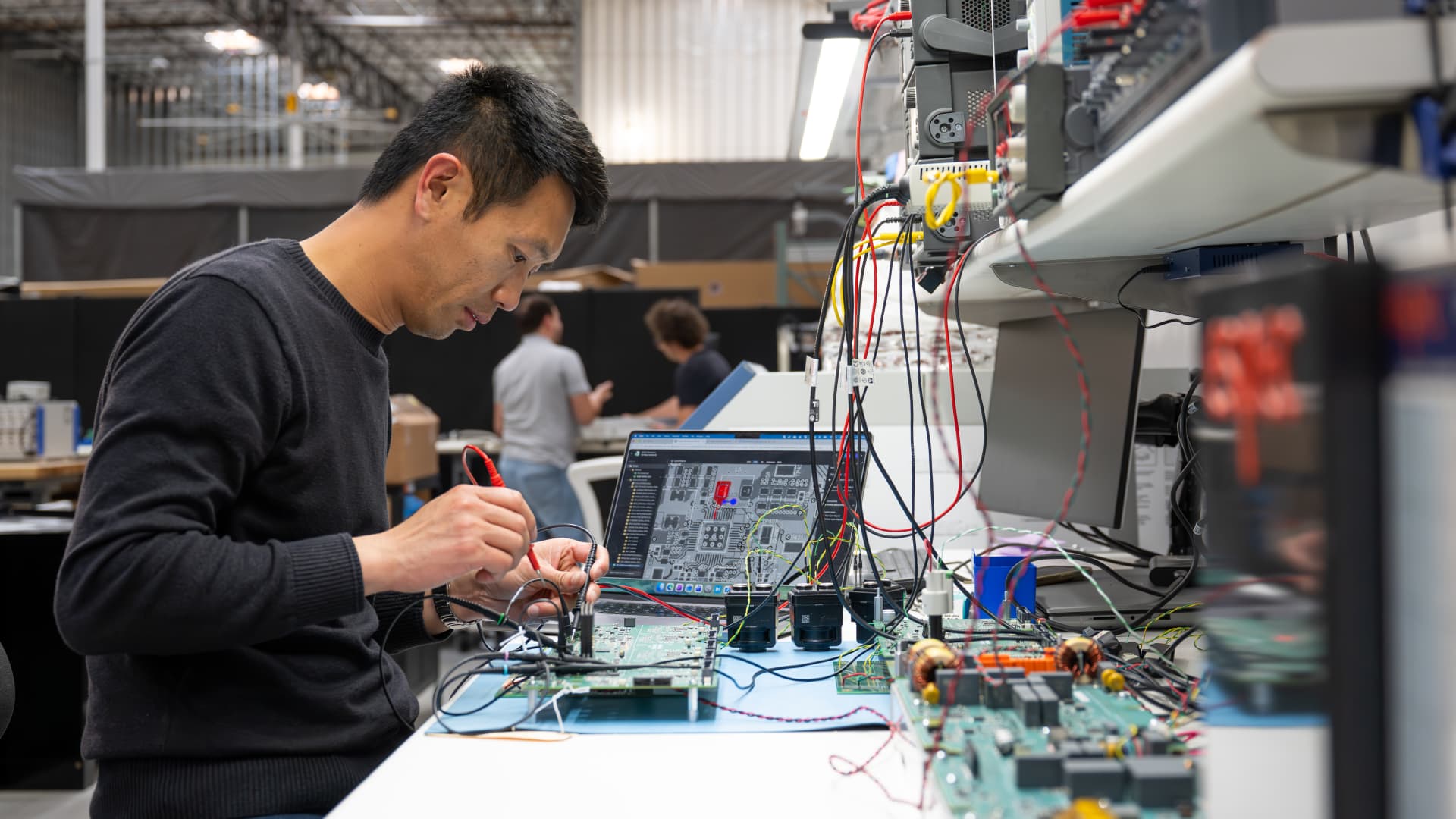
A Ford employee works inside a high voltage lab at Ford’s new Electric Vehicle Development Center in Long Beach, California.
Advertisement
Courtesy Ford
Ford’s continued confidence, albeit it at lower and slower capital rates than it previously projected, comes from its “Universal Electric Vehicle,” or UEV platform, which the company has developed from a clean-sheet design. Ford’s goal for the UEV is to be profitable and cost-competitive with global EV leaders from China and Tesla.
The UEV is expected to be critical to Ford transforming its Model e EV unit from billions of dollars in annual losses to breakeven by 2029. The company has said its future EVs will be profitable within a year of launching.
The first planned product based on the UEV is a roughly $30,000 midsize pickup truck for the U.S. market next year, followed by a family of vehicles underpinned by the platform.
Advertisement
“The midsize pickup truck, there won’t be anything that competes with it, either in price or product form, and so I think it sort of stands alone in that sense,” Clarke said.
Clarke — wearing black, red and white Nike Air Jordan 1s with an untucked blue button-down shirt under a black jacket — was employee No. 1 of the formerly secretive “skunk works” team leading the development of Ford’s UEV.
The Tesla veteran of 12½ years was recently promoted from a senior director to vice president of Advanced Development Projects. That came as Ford’s highly touted EV and technology head Doug Field last month announced his unexpected departure.
Clarke, who was recruited by Field, continues to speak highly of him. Farley has also continued to praise the Tesla and Apple veteran since he announced his departure on April 15.
Advertisement
“He’s set us up for success, as has Jim,” Clarke said. “It’s certainly not that nothing changes. I think it’s at the stage we’re in; this is the thing that’s best for Ford, and I think Doug certainly recognized that, and it was the right time for him.”
China competition
Alan Clarke, Ford’s executive director of advanced EV development, during a video presentation on Ford’s Universal Electric Vehicle platform.
Courtesy Ford
Even with Field’s departure and a less promising future for domestic electric vehicles, Ford’s UEV work continues.
Advertisement
The growth of Chinese companies — although they have yet to enter the U.S. market, for now — has been a rallying cry for the Ford UEV work. Farley has praised Chinese automakers for their ingenuity and products, while also calling for protection from them in the U.S.
“We are really fully committed to a level playing field here in the U.S. and also safeguarding our home market, because of the importance of the auto industry and our industrial base,” Farley said last week.
Outside the U.S, Ford and other automakers are attempting to defend their market shares in Europe, South America and other countries after losing to the domestic companies in China.
Global market share for Chinese brands has jumped nearly 70% in five years, according to GlobalData, and many experts see a threat to U.S. automakers, including the anticipated entrance of Chinese brands into America.
Advertisement
Clarke said he remains “pretty confident” that the UEV platform can be competitive against Chinese vehicles. But he added that the companies play by “different rules,” referring to the government support Chinese companies receive, along with their lower labor costs, among other things.
“We only win with speed, and we have to play by the rules here,” Clarke said. “We’re pretty confident that we’re going to be competitive, and we’re really hungry to be seen as competitive, and we won’t win, ultimately, unless we get down to the prices that American consumers are willing to pay for EVs like this.”
But while Ford has extensively studied and torn down Chinese vehicles, it’s a moving target. There are hundreds of Chinese automakers that are releasing new products at unprecedented rates.
Automotive consulting firm AlixPartners reports Chinese startups are developing vehicles in about 20 months. That’s half the time of traditional global automakers, leading to Chinese models being two to three years fresher than non-China brands, the firm said.
Advertisement
“It’s really not one thing, but it’s series of things that lead them to be able to get to a sub-two year, very repeatable cycle of launching a vehicle,” said Mark Wakefield, AlixPartners’ global automotive lead and executive partner, adding that Chinese companies spend a third less time on product validation. “It’s a big challenge for all the car companies.”
It’s a reason why the UEV’s first product is destined for North America, while Ford tries to partner with other automakers, such as France-based Renault, Germany-based Volkswagen and, reportedly, some Chinese companies, to better compete globally.
“Our focus in UEV right now is making a vehicle that can be sold anywhere, but our focus right now is really on the North American market,” Clarke said.
Ford Universal Electric Vehicle
Ford CEO Jim Farley speaks at the Louisville Assembly Plant as the company shares its plans to design and assemble breakthrough electric vehicles in the United States, Aug. 11, 2025.
Advertisement
Courtesy: Ford
Ford has very high expectations for the UEV, which Clarke and others have referred to as a “moon shot.”
Ford expects the new EVs to have comparable costs to gas-powered vehicles through new technologies and efficiencies. They include a smaller battery pack comprised of new, U.S.-produced lithium iron phosphate cells as well as a 48-volt electrical architecture that improves efficiency and lowers weight.
Currently, the massive batteries that power EVs have made them far more expensive to produce and have been infamously unprofitable. Ford expects its Model e EV unit to lose $4 billion to $4.5 billion this year, down from a loss of $4.8 billion last year.
Advertisement
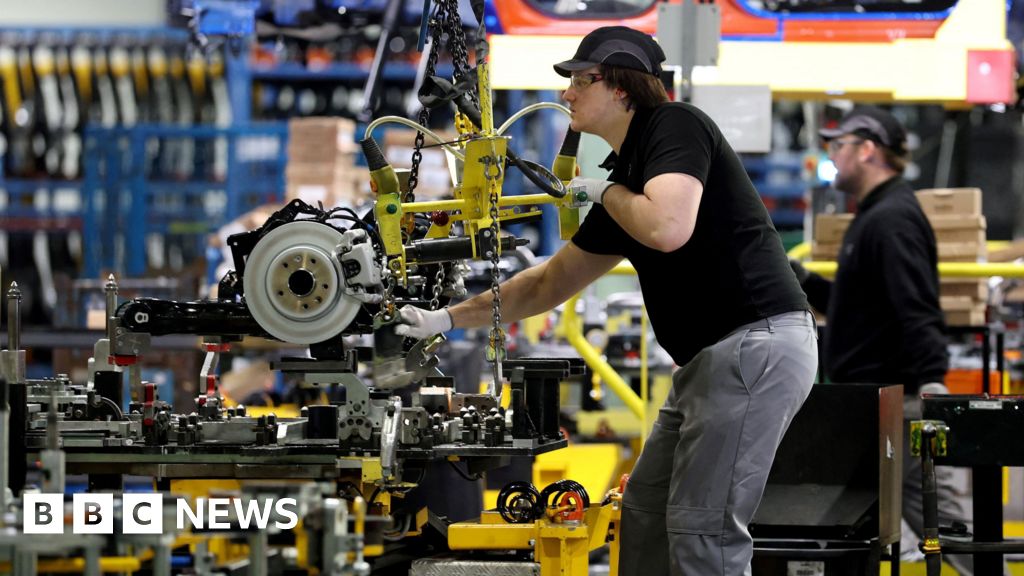
The Detroit automaker has said the new EVs will reduce parts by 20% versus a Ford Mustang Mach-E EV, with 25% fewer fasteners, 40% fewer workstations dock to dock in the plant and 15% faster assembly time.
Farley himself has compared the importance of the UEV to Ford’s historical Model T that “put the world on wheels,” and has called the U.S.-produced project a $5 billion “bet” on America for its manufacturing.
“It represents the most radical change on how we design and how we build vehicles at Ford since the Model T,” Farley said last year at Ford’s Louisville Assembly Plant in Kentucky that will be producing the electric midsize pickup.
A Ford worker inside the automaker’s fabrication shop at Ford’s new Electric Vehicle Development Center in Long Beach, California.
Advertisement
Courtesy Ford
But this isn’t the first or even second time Farley has amped up expectations about the company’s EVs that didn’t pan out.
Farley previously described the automaker’s all-electric F-150 Lightning as a “model T moment” for the company, but it failed to meet expectations and is being redesigned as a hybrid.
He also said Ford’s planned three-row EV SUV would be a “personal bullet train,” a year before the company canceled the project in 2024 after determining it wouldn’t be able to be profitable for the foreseeable future.
Advertisement
Ford executives believe they have learned from those mistakes by focusing on smaller, more affordable vehicles using the UEV platform rather than large pickups and SUVs in which the batteries cost more than the promised upcoming electric pickup.
Ford has said the new pickup will only have two structural front and rear parts, compared with 146 such components on its current gas-powered Maverick small pickup.
To do so, the company is using megacasting – pouring materials like molten aluminum into large molds to form parts – which means the automaker has fewer, larger pieces to use in assembling its vehicles.
“We like to say that the best part is no part, and the second best part is a part that serves multiple purposes,” Mitch Shinn, a thermal systems engineer on Ford’s advanced EV team, said during the media event at the facility.
Advertisement
Ford employees inside a thermal testing chamber at Ford’s new Electric Vehicle Development Center in Long Beach, California.
Courtesy Ford
Farley has more recently said the advanced EV team isn’t just about the products; the division and new facility are helping Ford rethink how it designs, develops and produces new products across its portfolio of vehicles.
The skunk works team was initially formed in California around 2022. It was meant to be a small, agile team free to work without the bureaucracy and tedious processes of a multibillion-dollar company such as Ford.
Advertisement
“We’re also leaning into the skunk works model to improve all of Ford,” Farley said last week. “They’ve done an incredible job creating the UEV platform, which represents a step change in efficiency and cost, especially for the EV market. But, at Ford, we’re now integrating these skunk work breakthroughs back into our mainstream products and processes.”
New EV development center
Ford Motor’s new Electric Vehicle Development Center in Long Beach, California.
Courtesy Ford
Walking through Ford’s new Electric Vehicle Development Center gives a glimpse into why the automaker hasn’t pulled the plug on its all-electric vehicle ambitions or skunk works team.
Advertisement
The buildings continue to be built out while roughly 350 employees from varying professional backgrounds — Tesla, aerospace, defense and Ford — work in labs, design studios and office areas.
The complex is made of two buildings that span 270,000 square feet and is located in a still-growing industrial park across from the Long Beach airport. Ford is also building out a 150,000-square-foot testing and validation facility in the space.
Clarke told CNBC that the new facility is being set up not for the development of the pickup, which was done as part of the secret skunk works team, but for future EVs.
He declined to disclose plans for future EVs but said the facility also gives it the potential to work on other vehicles for the UEV platform as well as next-generation products.
Advertisement
An inside area of Ford Motor’s new Electric Vehicle Development Center in Long Beach, California.
Courtesy Ford
That kind of thinking and mindset are more often affiliated with consumer electronics rather than the automotive industry, but that might just be the point.
“We can hit this goal of getting it out next year,” Clarke said. “What you saw here is a big investment in … future products in general. We want to go faster than we were able to go.”
The brand’s parent firm has agreed to shut the sites as part of a company voluntary arrangement process
Henry Saker-Clark, Press Association Deputy Business Editor
16:34, 05 May 2026Updated 16:40, 05 May 2026
A Franco Manca restaurant(Image: Cambridge News)
Restaurant chain Franco Manca will push ahead with the closure of 16 venues after a restructuring plan was approved by creditors. Last month, parent firm The Fulham Shore said it planned to shut the sites as part of a company voluntary arrangement (CVA) process, which will also hit around 225 jobs.
Advertisement
The pizza brand currently runs 70 restaurants prior to the closures but said it has been knocked by “disproportionately high” UK taxes and a lack of business rates relief for restaurants. The effected restaurants were “no longer sustainable” as a result.
Franco Manca’s CVA proposal received back from more than 90 per cent of voting creditors, allowing it to get the go ahead.
Last week, Fulham Shore placed its sister restaurant brand The Real Greek into administration. It was immediately snapped up by Cote owner Karali Group but announced the close of nine of its 28 restaurants.
Marcel Khan, chief executive of Fulham Shore, said: “We are grateful for the support shown by our creditors today. Franco Manca is a fantastic brand with a strong heritage and loyal customer base.
Advertisement
“With this agreement in place, we will put the business back on a firm footing and press ahead with strengthening our customer offer and performance.”
Paul Berkovi, managing director of Alvarez & Marsal, said: “Today’s vote saw a significant majority of the company’s creditors support the CVA, reflecting constructive engagement across stakeholders.
“Against a challenging backdrop for the sector, this is an important step for Franco Manca, enabling the business to complete its financial restructuring and secure the platform for its operational transformation.”
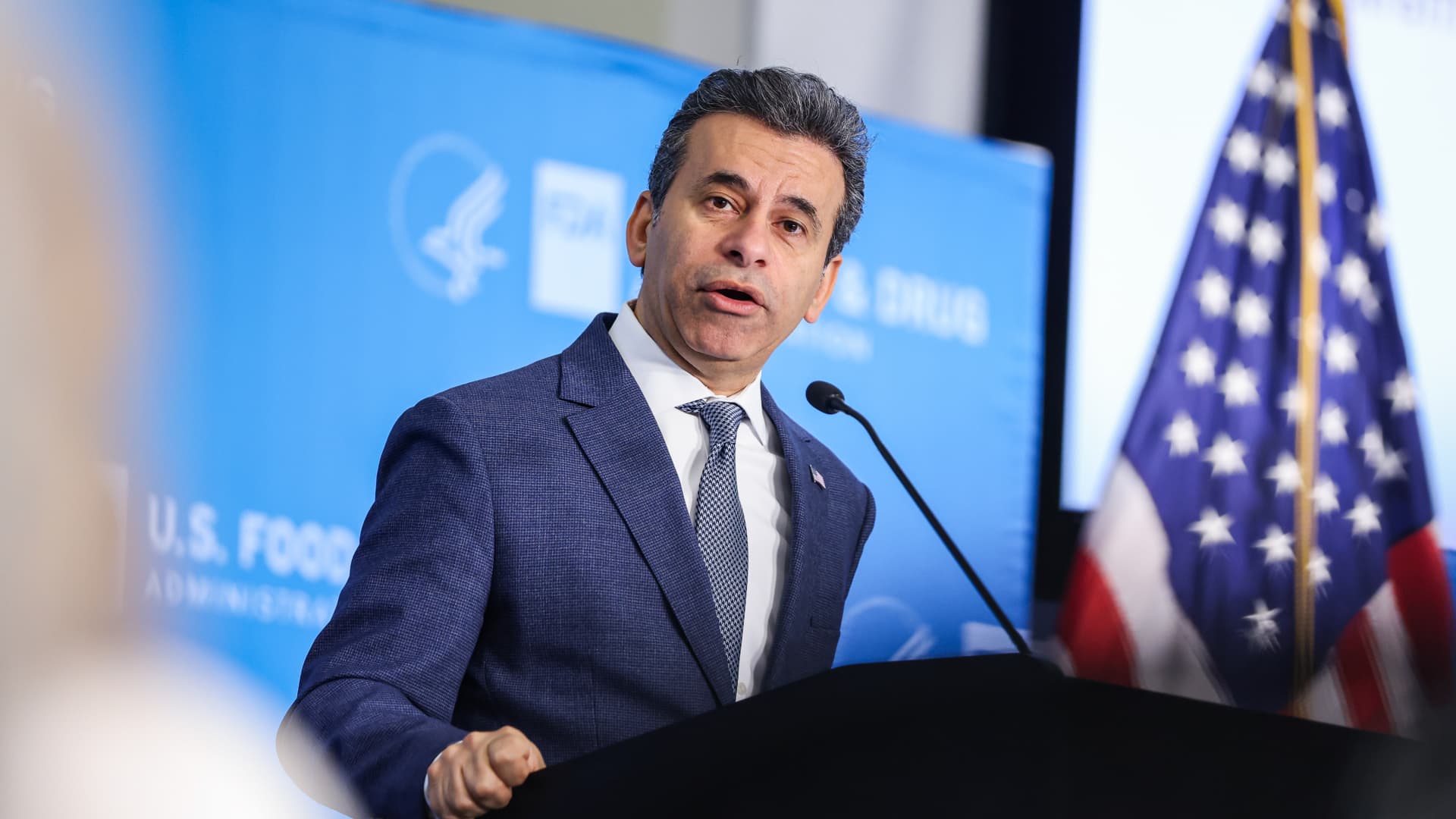
Martin Makary, commissioner of the Food and Drug Administration, during a news conference at FDA headquarters in Silver Spring, Maryland, April 28, 2026.
Valerie Plesch | Bloomberg | Getty Images
U.S. Food and Drug Administration Commissioner Marty Makary defended himself in a CNBC interview aired Tuesday after months of pressure over recent drug rejections.
Advertisement
The relentless heat reached a new fever pitch this week with a report from Bloomberg News detailing “paranoia, turmoil and backlash” at the agency under Makary’s tenure. An opinion piece from The Wall Street Journal asked if any administration official has created more headaches for President Donald Trump than Makary. The editorial specifically cited the FDA’s controversial rejection of a drug candidate for melanoma from Replimune.
“I think that article in The Wall Street Journal is the ninth article they’ve posted in that opinion section, begging for Replimune’s approval,” Makary said in an interview with CNBC’s David Faber. “I don’t work for Replimune, I work for the American people, and I stand by the scientists at the FDA.”
Makary said three independent teams have arrived at the same conclusion, adding that the FDA has not made “corrupt sweetheart deals.” Replimune representatives have said the FDA has unfairly treated the company.
Makary saidhe stands behind his review teams and that FDA commissioners overruling agency scientists has been a “disaster” every time it has happened. He cited examples like the FDA’s approval of an Alzheimer’s disease drug called Aduhelm and its clearance of a Covid-19 vaccine booster for young, healthy kids.
Seeking Alpha’s transcripts team is responsible for the development of all of our transcript-related projects. We currently publish thousands of quarterly earnings calls per quarter on our site and are continuing to grow and expand our coverage. The purpose of this profile is to allow us to share with our readers new transcript-related developments. Thanks, SA Transcripts Team



















































You must be logged in to post a comment Login