


If you’ve been paying any attention to the renewable energy space, you’ll know that generation isn’t really the problem anymore. Solar panels are cheap, and wind turbines are everywhere. The problem is matching generation with demand—sometimes there’s too much wind and sun, and sometimes there’s not enough. Ideally, you could store that energy somewhere, and deploy it when you need it.
The answer everyone keeps reaching for is lithium-ion batteries, and they work just fine. However, there’s a competing technology that’s been quietly scaling up in the background—the vanadium flow battery. It has some unique advantages that could see it rise to prominence in the world of large-scale grid storage.
The Juice That Stores Juice
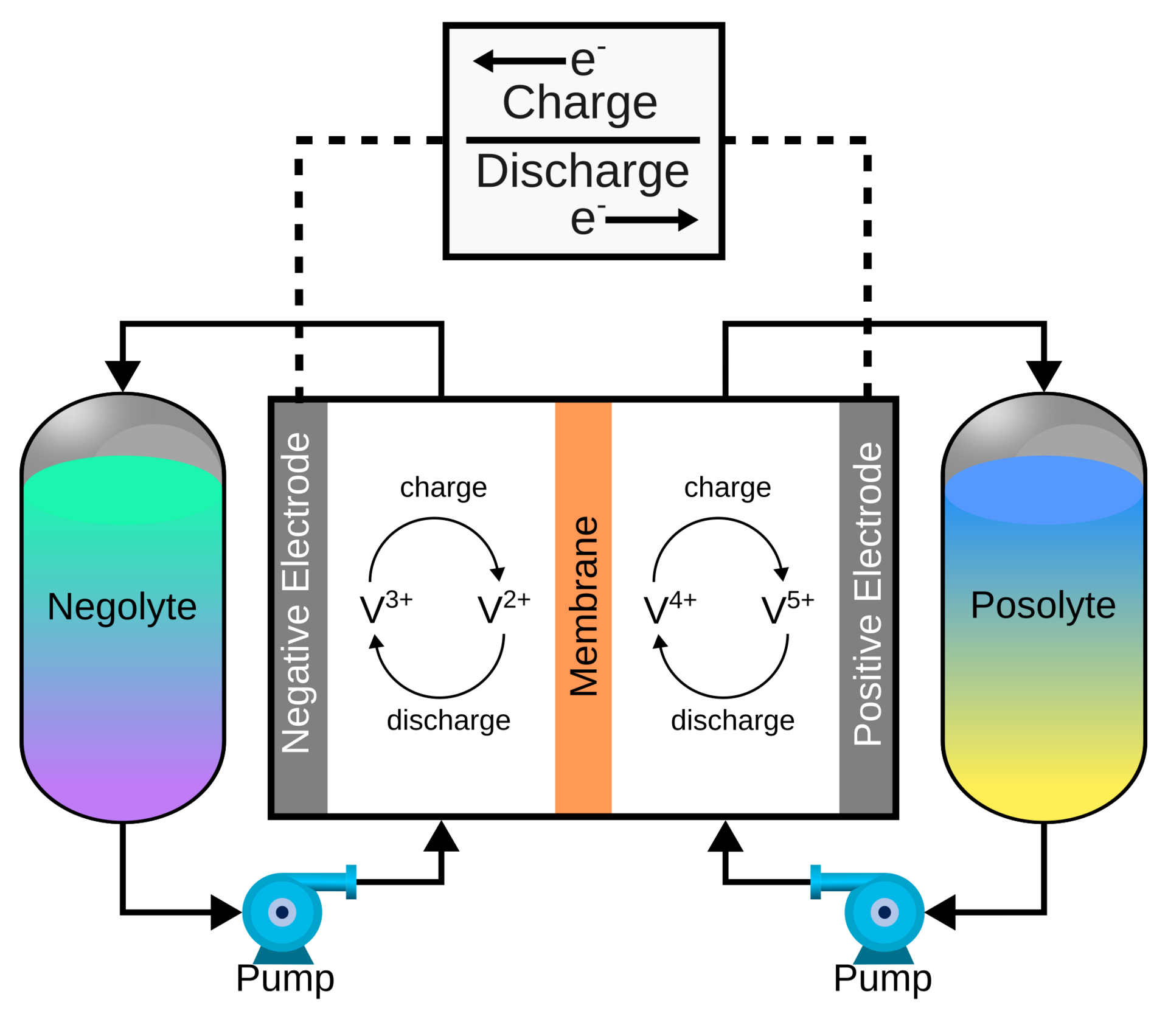
Flow batteries are beautiful in their simplicity, storing charge in huge tanks full of liquid electrolyte rather than in gel-like materials sandwiched between solid electrodes as per a regular battery. Specifically, two big tanks of vanadium ions, typically dissolved in sulfuric acid. By pumping the electrolyte through a cell stack where the electrochemical reaction happens, you generate electricity. Getting more power is as simple as adding more cell stacks, while increasing the battery’s capacity is as simple as getting bigger tanks full of more electrolyte. The two variables are almost entirely decoupled, which is an extremely elegant property for a grid-scale storage system. It makes right-sizing the system a cinch, it’s simply a matter of scale. These batteries also have the property of surviving tens of thousands of charge cycles without damage, and lifespans measured in decades.
The chemistry itself works out quite tidily. Both the positive and negative electrolyte use vanadium, just in different oxidation states. The positive side hosts VO2+ and VO2+ ions, while the negative side works with V²⁺ and V³⁺ ions. These solutions are pumped through a cell, either side of a permeable membrane that allows proton exchange. When the battery is being discharged, electrons leave the anode electrolyte and are transferred through the external load to the cathode electrolyte; this is balanced by the transfer of protons across the membrane. During charging, the opposite occurs.
A neat side-benefit of this is that because the battery uses the same element on both sides of the membrane, cross-contamination between the two tanks — an inevitable consequence of some ions sneaking through the membrane over thousands of cycles — doesn’t actually kill the battery. The electrolyte merely needs to be rebalanced and normal operation can resume. This single-element trick also means the electrolyte has a very long service life. It doesn’t degrade in the way an electrolyte in a regular battery might. A well-maintained vanadium flow battery can run for ten to twenty years with minimal capacity loss, and at end of life, that vanadium electrolyte still has value. It can be sold, recycled, or reprocessed as needed. Meanwhile, the electrodes in the cell stack and the pumps and machinery that moves the electrolyte around can be serviced or replaced as needed. It’s a very different scenario compared to lithium-ion cells, where recycling the raw materials involves great mechanical and chemical complexity.
There is a complexity gain versus traditional batteries, in that moving all the electrolyte around requires mechanical pumps that in turn draw power to operate. These batteries are also not particularly compact, nor efficient in terms of energy-to-volume ratio. However, these problems are offset with the ease of scaling and maintaining them.
Deployment
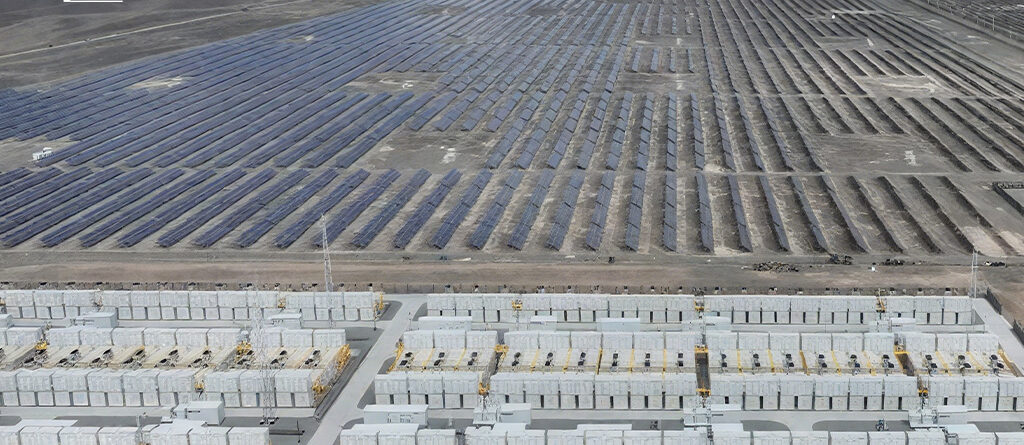
In the real world, vanadium flow batteries are starting to hit the big time. The largest example in the world is a Chinese project, consisting of a 200 MW battery in Jimusaer, with a total capacity of 1000 MWh, built by Rongke Power. The second largest installation, installed in the city of Ushi in 2024, has a capacity of 700 MWh and can discharge 175 MW to the grid, and was constructed by the same firm. These batteries are comparable in power output to the Victorian Big Battery, a lithium ion installation that outputs 300 MW at peak, but far larger in capacity, as the Australian installation tops out at just 450 MWh by comparison. These installs build upon a previous effort to install a 100 MW battery in Dalian with 400 MWh capacity, along with smaller projects in Shenyang and Zongkyang that operate at sub-10MW levels. The batteries are intended to be used to support grid stability in their local grids. They also have grid-forming capabilities, which means that the flow battery can be used to do a black start, helping to bring traditional thermal generation units online in the event of a total grid collapse.
Australia has also been leaping to adopt vanadium flow battery technology, too. The country is well known for having a huge install base of rooftop solar, which has created a difficult-to-control grid at times. The abundance of sunlight and solar generation during the day has lead to huge peaks where power prices at times turn negative, and the goal is to add storage so that this power can be stored for more effective use over longer time periods.
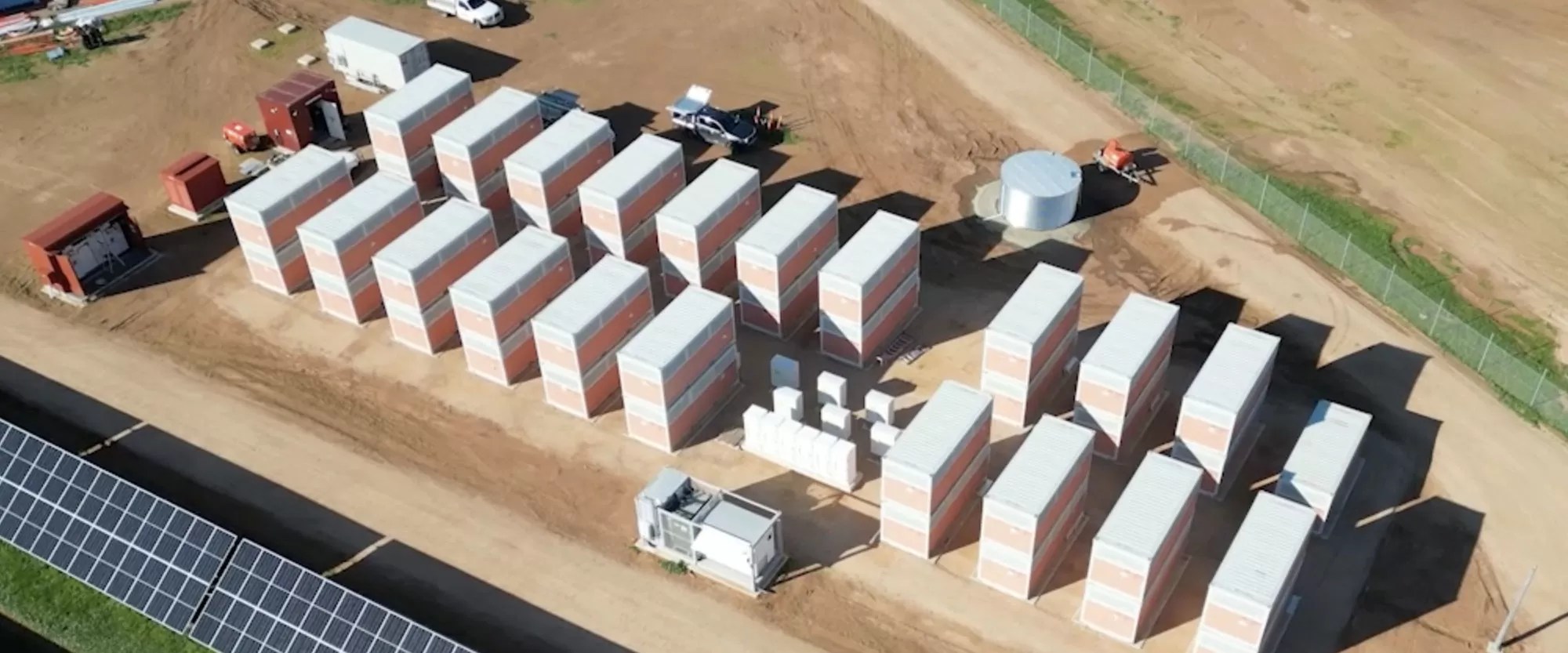
In South Australia, a small project has proven the viability of vanadium flow batteries in local conditions. The Co-Located Vanadium Flow Battery Storage and Solar project in Neuroodla was installed by Yadlamalka Energy, and combined photovoltaic generation and storage into a single site. The project’s goal was to demonstrate the value of vanadium flow batteries for providing both simple energy storage and frequency control services to the grid. It’s a relatively small installation, of just 2MW output and 8MWh capacity, paired with 6MWp of solar panels on site. The build was located adjacent to the Neuroodla substation for easy connection to the grid. The project faced some challenges in terms of power derating during the hottest local conditions, and with some limitations on power deployment and energy trading based on the inverter capabilities at the site. Ultimately, though, the project was able to generate serious revenue even with its limited capacity, thanks in part to energy price volatility in the local market as solar peaks and troughs occurred on a regular basis.
Over in Western Australia, sights are being set much higher. The state government has put out an expression of interest for a 50 MW, 500MWh vanadium flow battery to be installed in Kalgoorlie. The project is backed by $150 million in government funding, and hopes to offer a mighty 10-hour discharge capability to the grid. The project hopes to be up and running by 2029, relying on locally-produced vanadium to fill the tanks.
























































You must be logged in to post a comment Login