

Crypto World
Tennessee Bankers Association Taps Stablecore for Crypto infrastructure

The Tennessee Bankers Association (TBA), a trade group representing the state’s commercial banks, has selected Stablecore as a preferred technology provider for digital asset services, highlighting growing interest among regional lenders in crypto infrastructure.
In a Tuesday announcement, the TBA said Stablecore will provide infrastructure that enables community and regional banks to offer products such as stablecoins, tokenized deposits and digital asset-backed lending through their existing systems.
The endorsement gives Stablecore exposure to the association’s roughly 175 member institutions, potentially accelerating adoption among smaller banks that lack in-house digital asset capabilities.
The partnership reflects a broader trend among traditional financial institutions of seeking third-party providers to integrate crypto-related services rather than building the infrastructure internally.
Stablecore develops backend infrastructure that allows banks to issue and manage tokenized assets, including stablecoins and deposit tokens, while handling compliance and integration with core banking systems.
As previously reported by Cointelegraph, Stablecore recently joined the Jack Henry Integration Network, which provides digital banking technology to around 1,670 banks and credit unions across the United States.
Related: Crypto Biz: Capital has no consensus
Banks eye digital assets as US lawmakers debate market structure rules
TSA’s endorsement of Stablecore comes as more regional lenders look to roll out digital asset services, even as US lawmakers continue to debate the regulatory framework.
Tennessee’s junior US Senator Bill Hagerty, a member of the Senate Banking Committee, said last month that there is “still a lot more work to do” before Congress can advance comprehensive market structure legislation.
Meanwhile, Senator Thom Tillis told reporters last week that he plans to push the Senate Banking panel to take up crypto market-structure legislation when lawmakers return to session on May 11.
Proposed bills aim to clarify how stablecoins are issued and supervised, which could give banks a clearer path to offering tokenized deposits and related services.
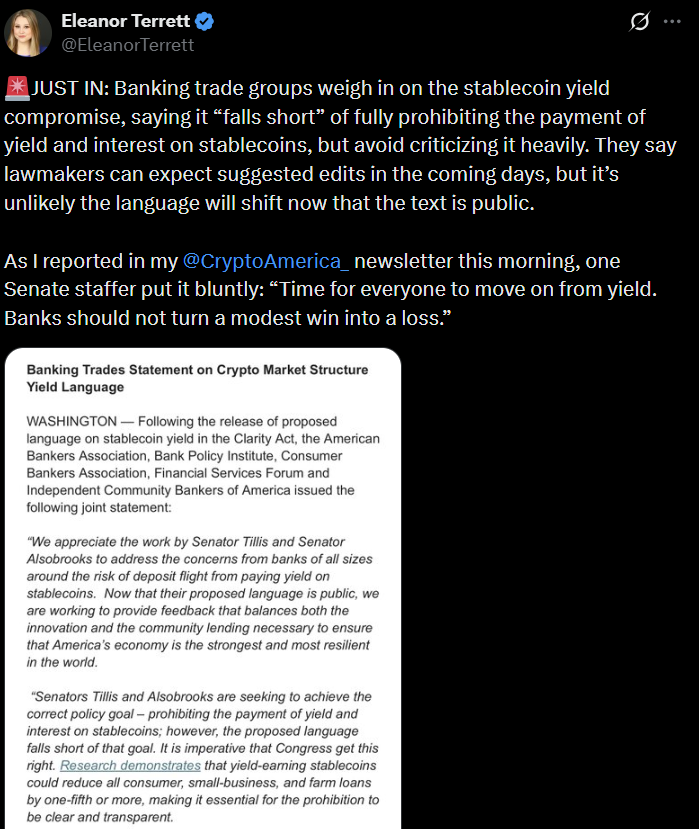
Source: Eleanor Terrett
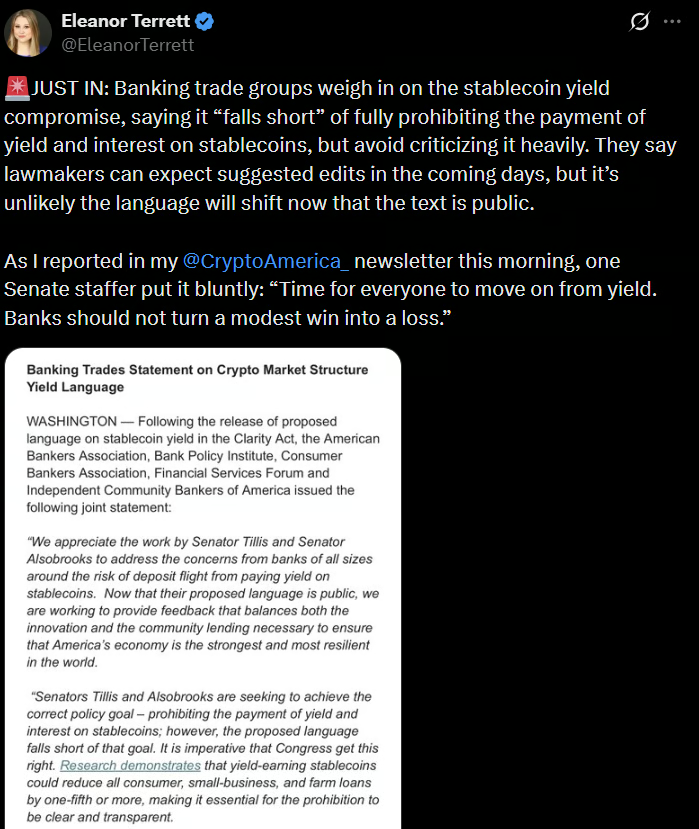
At the same time, banking groups continue to raise concerns about stablecoin design, particularly whether issuers should be allowed to offer yield or interest. Industry advocates argue that recent compromises fall short of fully restricting yield-bearing stablecoins, potentially blurring the line between bank deposits and digital assets.
The Independent Community Bankers of America last month called on Congress to ensure the measure addresses concerns with what it called “the harmful impact on local economies of allowing crypto exchanges and other intermediaries to pay interest or yield on payment stablecoins.”
Related: Key US senator lifts block on Trump’s Fed pick Kevin Warsh

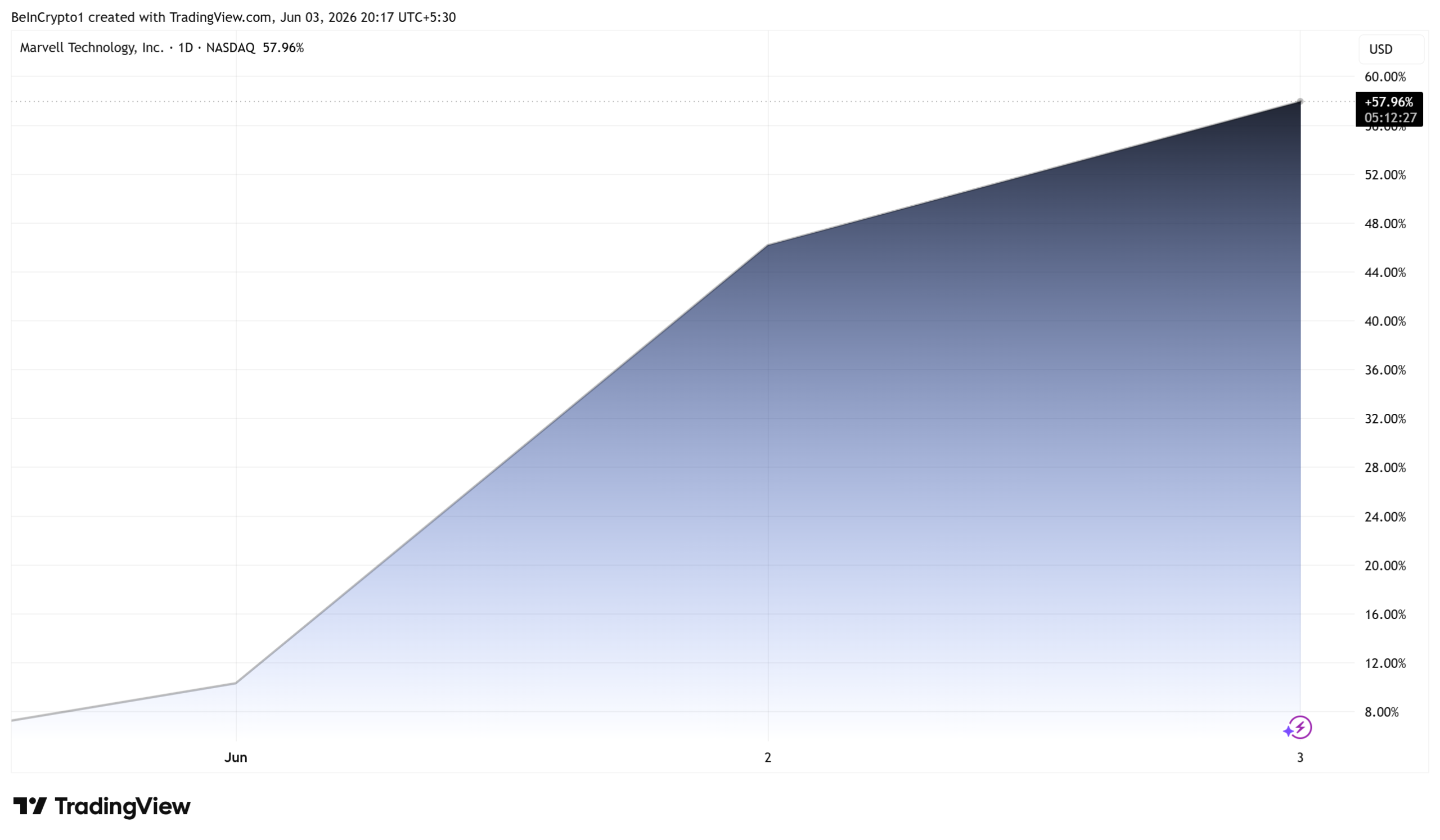
Nvidia CEO Jensen Huang called Marvell Technology the next trillion-dollar company at Computex on June 2. Marvell shares jumped about 33% in a single session, their biggest one-day gain on record. The move added roughly $56 billion in market value, pushing Marvell above $250 billion.
The endorsement landed as investor Michael Burry warned that Nvidia itself faces concentrated demand and hidden financing risk across the AI buildout.

What Jensen Huang Said About Marvell
Huang made a surprise appearance during Marvell CEO Matt Murphy’s keynote in Taipei, spending about 10 minutes on stage. He praised Marvell’s networking and connectivity chips as essential to data centers, where AI workloads run across thousands of linked processors that must share data quickly.
The remark followed Nvidia’s roughly $2 billion equity investment in Marvell, which tied the firm’s custom accelerators and optical networking to Nvidia’s AI factory architecture.
Follow us on X to get the latest news as it happens
Why the Marvell Bull Case Holds
Bulls argue connectivity is the next bottleneck in AI systems after raw compute and memory. Marvell builds the switches, optics, and custom silicon that link those clusters, and data center products now drive most of its revenue.
Skeptics counter that Marvell trades at a steep valuation. It also faces strong competition from Broadcom in networking silicon.
“…the next trillion-dollar company,” CNBC reported, citing Jensen Huang.
A single endorsement rarely changes fundamentals, yet Huang’s words carry weight with traders. Analysts have also stayed broadly bullish on Nvidia, reflecting confidence in the wider AI trade.
Michael Burry’s Warning on Nvidia
Michael Burry, known for his role in The Big Short, has taken the other side of the AI story. His firm, Scion Asset Management, bought put options (short orders) on one million Nvidia shares.
Burry flagged Nvidia’s customer concentration as a core risk. He said the top three customers now account for 64% of Nvidia’s accounts receivable, up from 56% the prior quarter and about 33% in 2020.
He also described much of today’s spending as a temporary benchmarking phase he calls a tokenmaxxing bubble. In his view, that demand looks permanent now, but could fade.
“The conditions for an aggressive fall are as strong as they have been in the history of the stock,” Burry stated.
Burry’s caution echoes other warnings he has issued about a wider market bubble. He has recently been shorting chip stocks as well.
His thesis points to leveraging hidden across the system. A Moody’s report in February found that Microsoft, Amazon, Alphabet, Meta, and Oracle have $662 billion in future data center lease commitments that are not yet reflected on their balance sheets.
That figure equals roughly 113% of the five companies’ adjusted debt, according to Moody’s. The obligations become real cash costs once the leases begin.
Other signals have added to the caution. Reports of falling H200 rental prices have raised questions about near-term GPU demand.
The post Nvidia CEO Just Crowned the “Next Trillion-Dollar” Chip Stock and It Went Up 33% appeared first on BeInCrypto.
Crypto World
Bitcoin falls to $64,000 and Crypto Liquidations Top nearly $1 Billion: More Pain ahead?
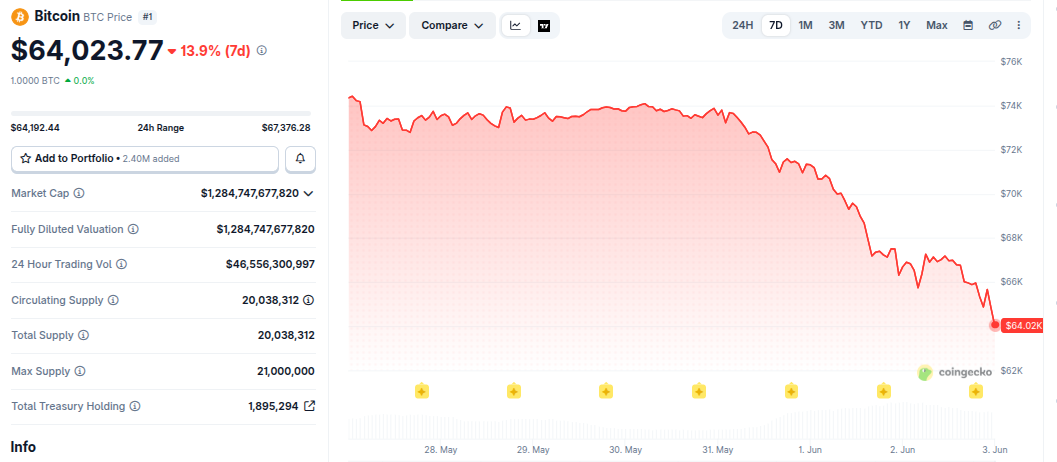
The price of Bitcoin (BTC) registered a 4% drop in the last 24 hours and is heading towards losing the psychological level of $64,000.

The post Bitcoin falls to $64,000 and Crypto Liquidations Top nearly $1 Billion: More Pain ahead? appeared first on BeInCrypto.


Premier League soccer clubs have been warned by the U.K.’s Financial Conduct Authority (FCA) about sponsorship deals with unauthorized crypto firms.
The FCA said unauthorized firms could be breaching rules on financial promotions through the high-profile sponsorship deals.
Clubs enabling such promotions could be exposed to legal liability, money laundering and reputational damage, the FCA said. Companies not listed on the FCA’s crypto register are allowed to advertise in the U.K. only if their marketing material is signed off by a company authorized to approve it.
“Millions of football fans trust their club’s badge,” Lucy Castledine, director of consumer investments at the FCA, said. “Clubs should not let unauthorised financial firms exploit that loyalty by putting potentially dodgy products in front of millions of fans.”
The most prominent crypto sponsorship deals in the Premier League to date have been OKX’s logo appearing on the sleeves of Manchester City shirts, and Kraken occupying a similar berth on Tottenham Hotspur’s.
Kraken is on the FCA’s registry of authorized crypto firms (through parent company Payward). OKX is not.
The FCA said it has written directly to Premier League clubs to warn them about unauthorized crypto companies and remind them of their responsibilities to their fans.
Neither Manchester City nor OKX had responded to a request for comment by publication time.
Crypto World
Bitcoin News: BTC Crashed 12% and $1.85 Billion Got Liquidated, But Blaming Saylor’s 32 BTC Sale Is Simply Wrong

In the latest Bitcoin news, BTC price crashed to a four-month low of $65,707 on June 3, shedding 7% in 24 hours and more than 12% across seven days, as $1.85 billion in crypto liquidations tore through derivatives markets.
The dominant narrative that followed pointed fingers at Michael Saylor and Strategy’s first Bitcoin sale in three years.

Discover: The Best Crypto to Diversify Your Portfolio
Why the Saylor Attribution News Is Wrong: 32 Bitcoin Does Not Move a $57B Market
Strategy disclosed in an SEC filing that it sold 32 Bitcoin to fund preferred stock dividend payments, the company’s first net reduction in its Bitcoin position in more than three years.
The number is not a typo. Thirty-two Bitcoin, against a liquidation event that wiped $894.5 million in BTC positions alone. The attribution collapsed under basic arithmetic the moment it spread.
The narrative traveled faster than the data for a simple reason: the timing was close, the symbolism was sharp, and traders primed for a downside catalyst accepted the first available explanation.
Market anxiety around Saylor’s positioning had been building for weeks, making the attribution feel plausible even without supporting scale.
That is how misattribution spreads in liquid markets, not through fabrication, but through pattern-matching under stress.
The Mt. Gox estate’s movement of approximately $739 million worth of Bitcoin added to the fog. On-chain monitoring flagged the transfer, and sentiment deteriorated immediately. But as this publication has noted in prior coverage of Bitcoin liquidation events tied to large on-chain movements, a wallet transfer is not a sale.
Exchange inflow metrics did not show a corresponding spike that would confirm coins reached order books before the cascade began.
The verdict is unambiguous: a 32 BTC sale and an unconfirmed wallet transfer did not generate $1.85 billion in liquidations. Excess leverage in a deteriorating technical structure did. Michael Saylor was the story crypto Twitter needed; the derivatives market was the story the data showed.
Can Bitcoin Price Recover, or Does $65,000 Mark a Deeper Structural Break
BTC is sitting at $67,057 on the daily chart, and the recent price action has been brutal, with price collapsing from the $82,000 high in early May all the way down to current levels in just a few weeks, erasing the entire recovery that built through March and April.
The most alarming thing about this move is that it has broken back below the $68,000 to $70,000 range that served as the base for the March and April recovery, meaning the higher-low structure that had been holding since February has now been violated.
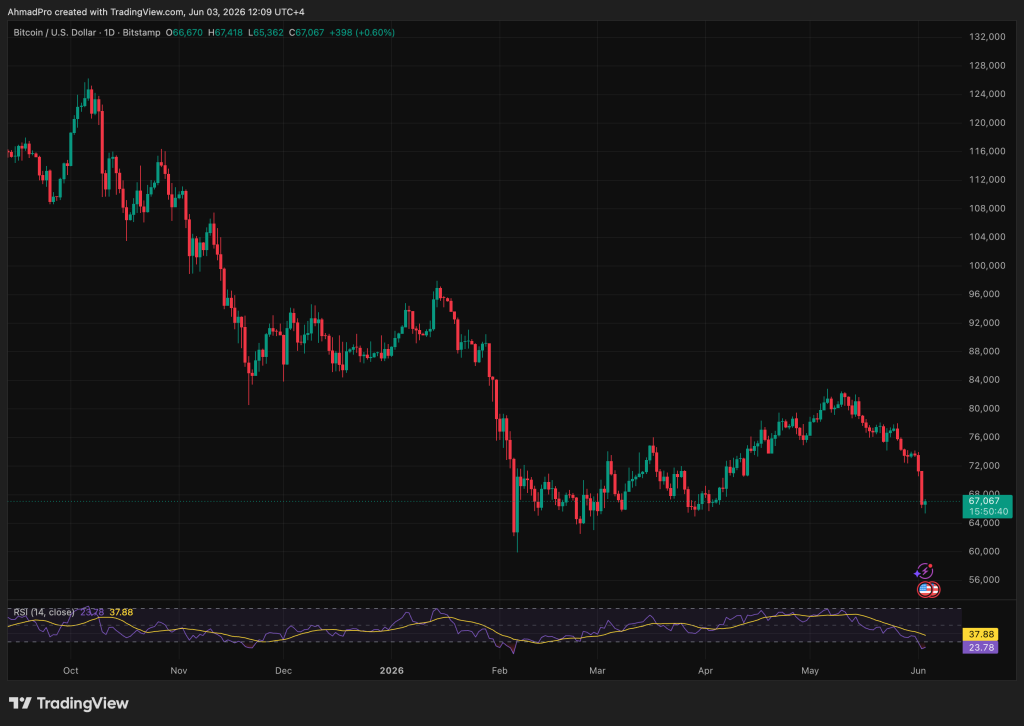
The $64,000 to $65,000 zone is the last serious support on this chart, having held twice during the February to March period as a demand floor, and that is the level price is now heading toward with very little in between.
A hold at $64,000 would be critical, giving bulls one more chance to rebuild from the same zone that launched the previous recovery attempt, but a break below it opens the path toward $60,000 and potentially lower with no meaningful support in sight.
On the upside, $72,000 is now the first resistance that needs to be reclaimed for any recovery narrative to restart, and above that, $76,000 to $78,000 is where heavier supply sits from the May distribution.
The overall picture is deteriorating fast. What looked like a recovering market a month ago has now given back almost everything, and the burden of proof is firmly on the bulls to defend $64,000 or this chart gets significantly worse before it gets better.
Discover: The Best Token Presales
The post Bitcoin News: BTC Crashed 12% and $1.85 Billion Got Liquidated, But Blaming Saylor’s 32 BTC Sale Is Simply Wrong appeared first on Cryptonews.
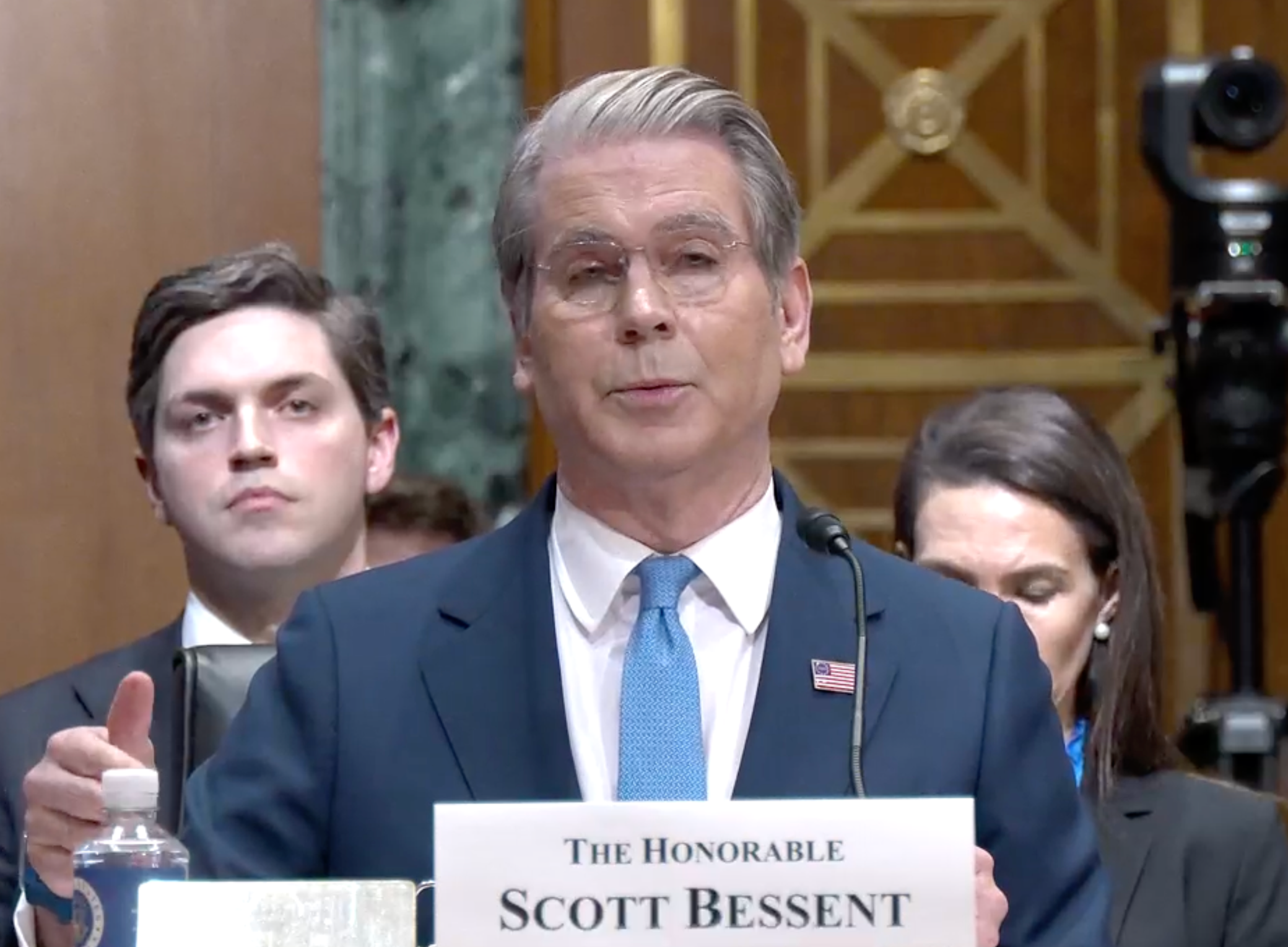
US Treasury Secretary Scott Bessent told Senate lawmakers that his department is pushing to establish a strategic Bitcoin reserve and digital asset stockpile more than a year after it was called for in an executive order from President Donald Trump.
Speaking at a Senate Finance Committee hearing on Trump’s fiscal year 2027 budget for Treasury on Wednesday, Bessent said that the department was “proceeding with all deliberate speed” on the president’s 2025 order to establish Bitcoin and digital asset reserves. Although the reserve has been filled with crypto seized by the government, Treasury officials had no additional acquisition plans as of March.
“We are moving forward very quickly on that, and part of that is our digital assets initiative, the strategic Bitcoin reserve is something, this is new technology, this is new ground, we are proceeding with all deliberate speed, and we are making sure that as we are doing this in this complicated process, that we use best practices and things will be durable for the future,” Bessent said in response to questions raised by Senator Tim Scott.
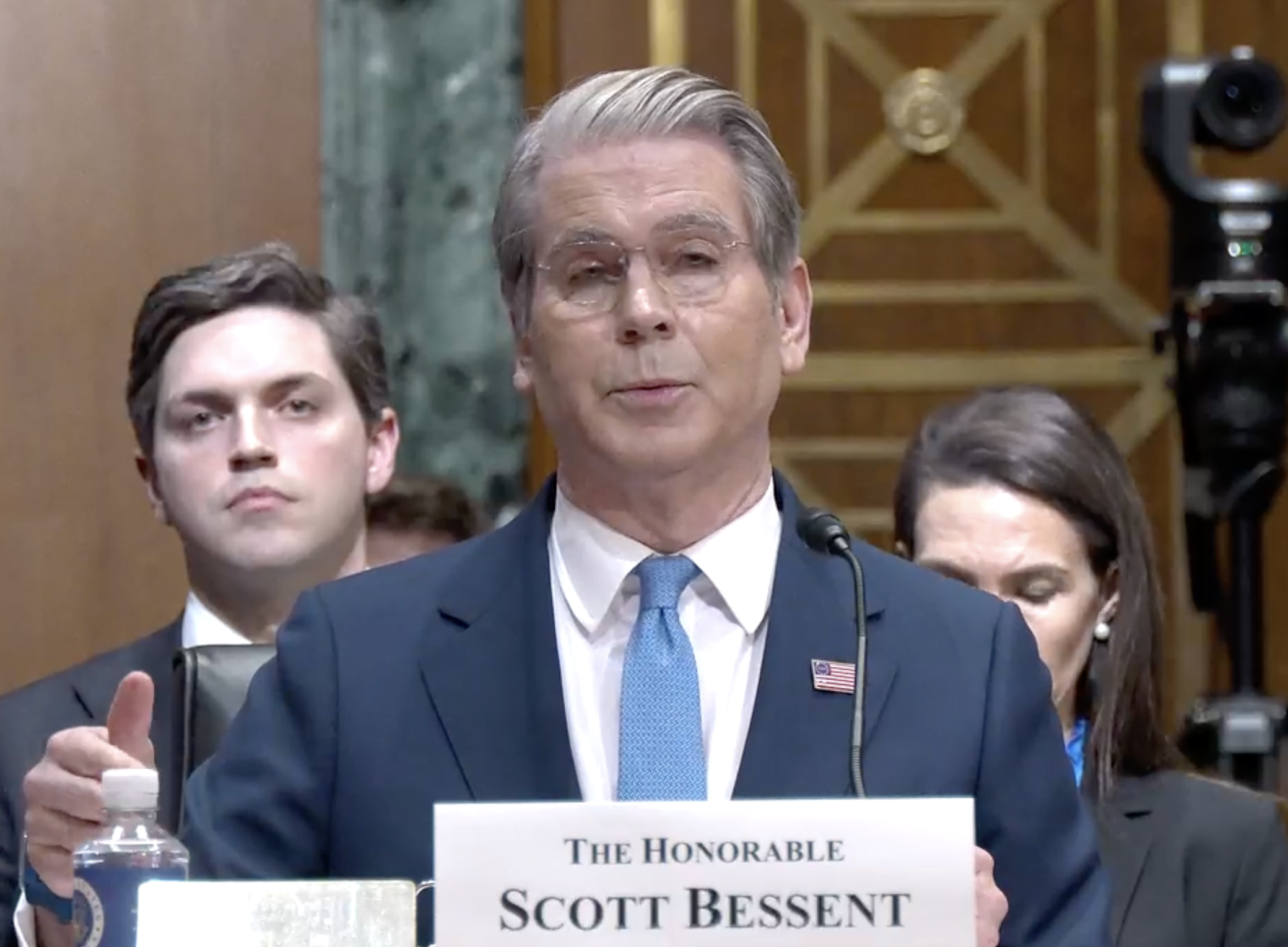
Scott Bessent testifying at Wednesday hearing. Source: US Senate Finance Committee
The US currently holds 328,372 BTC in its reserves, worth about $215 billion at the time of publication. While lawmakers have sought to codify Trump’s order into law by Congress, individual jurisdictions like Texas have already passed legislation creating state-controlled crypto reserves.
Related: US Treasury issues sanctions on Iran, targets 4 crypto exchanges
Bessent did not comment on whether the $1 billion in digital assets seized from Iran since the US-Israel war against the country began in February was included in the crypto reserves. Iran has reportedly been collecting tolls in Bitcoin from ships seeking safe passage through the Strait of Hormuz waterway.
Treasury chief expects CLARITY Act could pass this summer
Bessent also addressed questions from finance committee chair Mike Crapo on the Digital Asset Market Clarity (CLARITY) Act, under consideration in the Senate almost a year after being passed by the House of Representatives. Lawmakers on the Senate Banking and Agriculture committees have passed their versions of the bill to address securities and commodities laws and regulations, respectively, but the full chamber will need to consolidate the bills before any vote.
“We saw Congress pass stablecoin legislation, CLARITY Act, which I would encourage everyone to get behind — it’s very necessary to bring US best practices onshore — and we work tirelessly in terms of custodying these assets and keeping them,” said the Treasury Secretary.
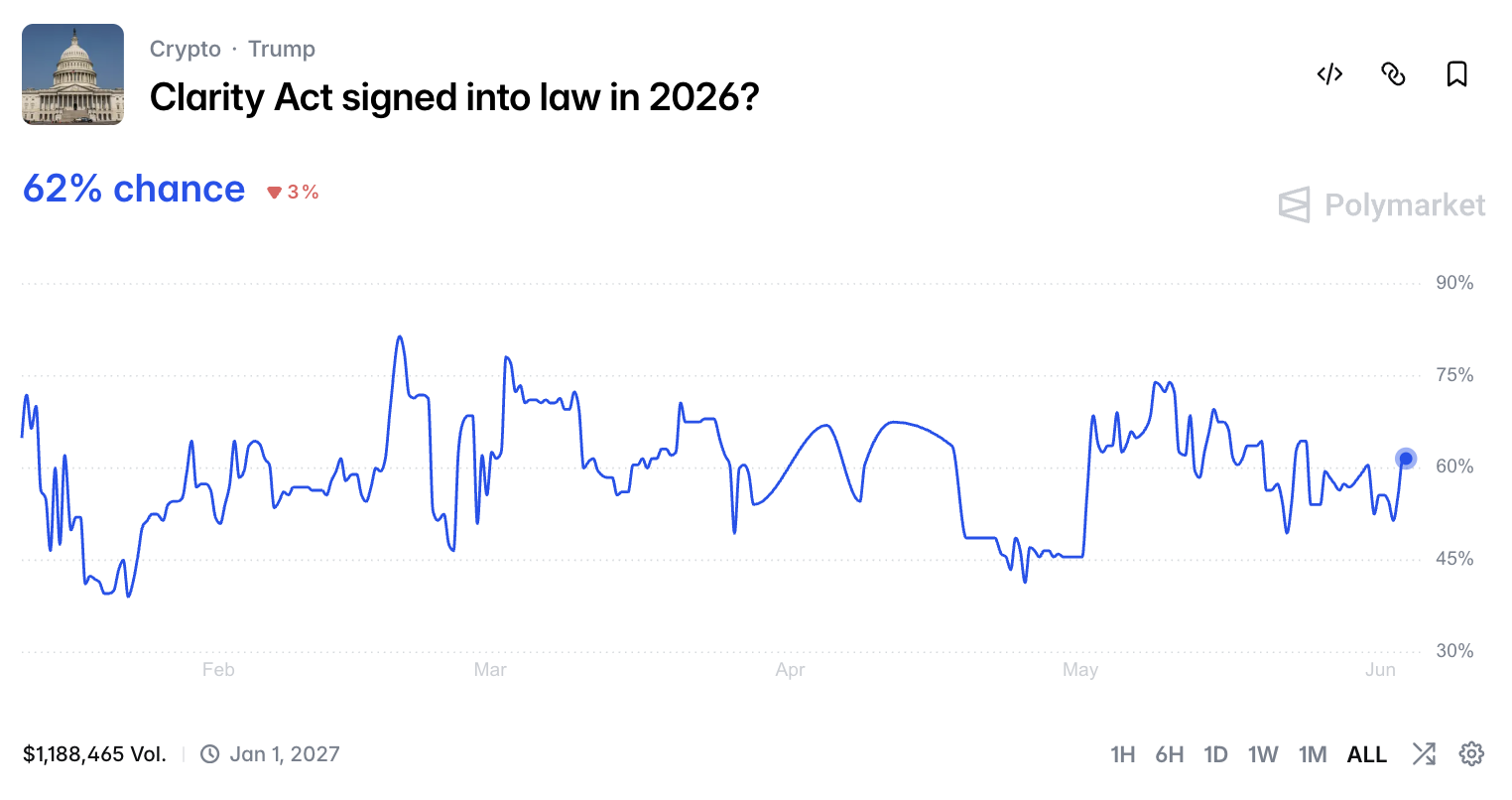
Event contract on CLARITY Act timeline. Source: Polymarket
Bessent said the administration was aiming for the bill to pass the Senate sometime this summer. White House crypto adviser Patrick Witt said in May that Trump was aiming for a July 4 signing ceremony, but some senators expect passage before August.
Magazine: NEAR price may ‘grow 20X,’ Bitcoin ETFs post 10-day outflow streak: Hodler’s Digest, May 24 – 30
Bitcoin experienced another leg down yesterday and earlier this morning, dropping to a fresh multi-month low of just over $65,000 before it staged a minor rebound.
Although there are a few altcoins with double-digit losses today, there are more with similar gains that have defied the overall market state.
BTC Rebounds From $65.3K
After it lost the $80,000 support level at the end of May, the primary cryptocurrency went on a down-only trip for several days. It first dipped to $76,000, but the bears were just getting started and drove it south to under $73,000 as the month came to a close.
It managed to rebound slightly to $74,000, where another rejection awaited. The crash that took place at the beginning of June was even more profound. This time, the bears pushed bitcoin to under $70,000 yesterday and kept the pressure on for several more hours. This culminated earlier this morning with a price drop to $65,300, which became BTC’s lowest trading level in approximately two months.
The bulls finally intervened at this point and didn’t allow another nosedive. Bitcoin has recovered roughly $2,000 since the local low and now sits around $67,000, but critics are still convinced that BTC could dump to as low as $20,000 if the $50,000 support is lost.
For now, bitcoin’s market cap has remained at $1.350 trillion, while its dominance over the alts keeps dropping to well below 56% on CG now.

These Alts Rocket
As mentioned above, red continues to dominate most alts’ charts. ETH has dropped below $1,900 after a near 5% decline on a daily scale. SOL is down to $75 following a similar decline. XRP celebrated its 14th birthday with a fresh drop yesterday to $1.20 before it rebounded to $1.24 as of now.
BNB is deep in the red, similar to BCH, DOGE, and mostly H, which has plunged by 11%. In contrast, DEXE and ENA have rocketed by over 20% daily, followed by ONDO, WLD, and VVV, all of which complete the double-digit price gainer club.
The total crypto market cap dipped below $2.350 trillion earlier today but sits at $2.4 trillion on CG now.

The post These Altcoins Defy Market Crash, Bitcoin (BTC) Bounces From 2-Month Low: Market Watch appeared first on CryptoPotato.

Wyoming is formalizing its ambition to become a home for AI infrastructure and large-scale data processing with a new executive order. Governor Mark Gordon signed a directive titled “Data Centers the Wyoming Way,” establishing a framework intended to guide the responsible development of sprawling data centers and other advanced computing facilities across the state. The move highlights Wyoming’s strategy to pair its energy abundance and business-friendly climate with growing demand for AI training, cloud services, and high-performance computing.
The order directs executive-branch agencies involved in permitting, reviewing, regulating, supporting, or facilitating large-scale data center projects to operate within a cohesive framework. At its core, the framework emphasizes water usage and environmental stewardship, workforce development, and protections for residential electricity customers as data centers scale up in the state. In short, Wyoming aims to attract digital infrastructure while addressing community and resource concerns that come with bigger power draws.
The administration framed the initiative as a measured, strategic response to a broader national push on artificial intelligence infrastructure. The timing comes as the White House has intensified its focus on AI capabilities and resilience, and as the private sector accelerates spending to train and operate large-scale models. Bloomberg data cited in coverage of U.S. tech spending shows several large players planning significant capital commitments to AI and data-center capacity this year.
Industry-backed estimates available around the same period show the so-called Magnificent 7—Microsoft, Amazon, Meta Platforms, and Alphabet among them—expected to invest well over $650 billion in AI and data-center infrastructure in 2026. The scale of that spending underscores a competitive landscape where states like Wyoming seek to carve out a role as strategic hosts for enterprise cloud, AI workloads, and next-generation computing facilities.
In a parallel development, Berkshire Hathaway has been increasing its financial alignment with Alphabet, signaling continued appetite for AI-enabled platforms and services. The move sits within a broader investment environment where corporate balance sheets are recalibrating to the AI era, even as policymakers weigh how such infrastructure should be regulated and taxed.
State of Wyoming Executive Department Executive Order 2026-03. Source: State of Wyoming
Related: Wyoming Senator revives crypto tax exemption debate amid market structure talks
Key takeaways
- The executive order establishes a centralized framework to guide permitting, regulation, and support for large-scale data center and advanced computing projects in Wyoming, with explicit attention to water use, environmental impacts, and residential electricity protections.
- The move aligns Wyoming with a broader national thrust toward AI infrastructure, occurring as major tech players plan hundreds of billions in AI and data-center investments this year.
- Wyoming’s energy profile—already a magnet for Bitcoin mining—gets woven into the AI/infrastructure narrative, potentially shaping how mining operations and data centers coexist with local grids and policy safeguards.
- Industry dynamics suggest miners and AI/HPC operators could view Wyoming as a potential hub, given policy clarity and the state’s energy resources, though implementation details and permitting timelines will matter for timelines and capital plans.
- Keep an eye on how environmental safeguards and residential electricity protections are implemented in real projects, plus how federal and state policy interactions influence tax and incentives for data-center developers and crypto miners alike.
Wyoming’s AI framework and the data-center push
The essence of the Wyoming plan is to create a predictable, accountable pathway for building and operating data centers at scale. By instructing agencies to coordinate permitting and review processes while prioritizing sustainable water use and environmental safeguards, the order seeks to reduce friction for developers who can demonstrate long-term reliability and community benefits. Workforce development is also highlighted, aiming to prepare Wyoming residents for the kinds of high-skilled jobs that accompany AI workloads and HPC services.
Officials say the framework is designed to balance growth and resilience: data centers can drive regional economies, support the enterprise cloud ecosystem, and underpin AI model training and inference, but not at the expense of water resources, local power reliability, or consumer electricity costs. The executive order therefore signals a governance model in which economic incentives and environmental responsibilities are intertwined rather than treated as separate concerns.
National momentum and the AI infrastructure race
The Wyoming initiative arrives amid a national spotlight on AI infrastructure development. As major technology groups accelerate their data-center and cloud-building plans, state policymakers are examining how to attract this capital while maintaining safeguards. A notable dimension of the current environment is the scale of private capital earmarked for AI computing and the associated energy demands. In 2026, observers expect several large tech incumbents to deploy hundreds of billions in related infrastructure, a trend that could redefine regional data-center clusters and job markets.
Media reporting has underscored how AI-driven workloads—from language model training to enterprise cloud services—will require extensive, specialized compute capacity. The resulting capital flows reinforce the strategic value of places like Wyoming that can offer stable energy prices, a permissive regulatory backdrop, and a supportive talent pipeline. The dynamic also interacts with corporate investment strategies, such as Berkshire Hathaway’s increasing stake in Alphabet, which illustrates an overarching valuation of AI-enabled platforms beyond pure mining or hardware plays.
Wyoming’s energy mix, mining heritage, and the AI horizon
Wyoming has long been associated with abundant energy resources, a factor that makes it a natural laboratory for data-center and cryptocurrency mining ambitions. In recent years, the state has attracted Bitcoin mining activity, with facilities expanding through partnerships and acquisitions tied to significant power capacity. For example, a notable miner expanded its footprint in Wyoming through the acquisition of a site tied to 75 megawatts of power capacity, illustrating how energy cheapness and reliable supply can support specialized compute operations.
Beyond pure mining, several peers in the crypto ecosystem have diversified into AI and high-performance computing services to counterbalance volatility in mining revenues. Industry tracking in the sector has highlighted moves by miners such as IREN, MARA, Cipher Digital, Hut 8, HIVE Digital, and TeraWulf to pursue AI-hosting, HPC services, and data-center partnerships. This shift signals a broader convergence between crypto infrastructure and AI-enabled compute, where operators leverage existing power links, colocation opportunities, and energy markets to broaden revenue streams.
Analysts have begun to cast a wider net on these developments, with research firms initiating coverage on companies positioned in the space as part of what they term “emerging AI infra.” The ongoing evolution will hinge on how these firms balance profitability with the capital-intensive needs of AI workloads, as well as how policy and grid management adapt to continued growth in data-center and mining operations alike.
What to watch next for investors and operators
Wyoming’s data-center framework marks a notable step in aligning state policy with the realities of AI adoption and enterprise cloud expansion. For investors and technology builders, several questions loom: How quickly will the permitting framework translate into shovel-ready projects? What specific environmental safeguards will be required for water use and energy draw, and how will residential electricity protections be enforced in rapidly expanding zones? How will federal policy and potential incentives intersect with state rules to shape project economics?
In the near term, market participants will be watching for details on project eligibility, timelines, and any incentive packages that accompany the framework. Industry observers will also monitor how mining operations coexist with AI infrastructure within the same energy ecosystems, and whether Wyoming’s approach to data centers becomes a model or a constraint for other states pursuing similar goals.
As AI infrastructure accelerates nationwide, Wyoming’s plan adds a practical blueprint for balancing growth with environmental stewardship and community protections. The next set of announcements—from permitting outcomes to specific project pipelines and workforce programs—will reveal how the “Wyoming Way” translates from policy to real-world data centers, HPC facilities, and potentially a broader ecosystem of AI-enabled services in the state.
Readers should keep an eye on updates to the state’s executive branch actions, any guidance published by the Wyoming Department of Environmental Quality or workforce agencies, and the evolving dialogue around crypto taxation and enterprise AI incentives that could interact with the new framework.


Israeli tax authorities have received far fewer crypto tax corrections than expected under a voluntary disclosure program that offers criminal immunity to eligible taxpayers.
Summary
- Israel’s crypto tax disclosure program has received only 58 filings despite expectations of up to $1 billion in revenue.
- Globes reported that disclosures have covered about $50 million in crypto capital, far below official expectations.
- The program offers criminal immunity to eligible taxpayers who correct reports and pay taxes before Aug. 31, 2026.
- A tax expert told Globes that the lack of an anonymous first stage may be discouraging crypto holders from filing.
According to a Wednesday report by Globes, the Israel Tax Authority had expected the program to generate up to $1 billion in tax revenue from undeclared cryptocurrency profits. However, the authority has so far received disclosures covering only about $50 million in crypto capital, the report said.
Crypto disclosures fall short of tax authority expectations
Globes reported that only 58 taxpayers had used the voluntary disclosure route to correct earlier crypto tax filings. The figure remains far below the level officials expected after the policy was introduced in August 2025.
Under the procedure, eligible crypto holders can avoid criminal proceedings if they correct their reports and pay the full tax owed. Globes said the protection applies only where the value of the taxpayer’s crypto holdings did not exceed the equivalent of $522,000 as of December 2024.
The report added that taxpayers must submit accurate disclosures and complete the tax payment before Aug. 31, 2026. The low response has left the authority with a small share of the revenue it had expected from undeclared digital asset gains.
Lack of anonymous route weakens incentive
Iftach Simhony, a CPA and head of the tax department at Prof. Bein Law Office, told Globes that the procedure has a major weakness for crypto taxpayers because it does not include an anonymous track at the first stage.
Simhony said the absence of anonymity becomes more serious in cryptocurrency cases. According to his comments reported by Globes, taxpayers who do not believe their enforcement risk is high may have less reason to enter a process that exposes them before they receive certainty.
The Globes report said Israeli officials still believe large sums of crypto-related profits remain outside the tax system. It said authorities see the disclosed $50 million as only a small part of possible underreported holdings.
Bank of Israel data shows large crypto holdings
According to the Bank of Israel’s financial stability report for January to June 2024, Israelis held about $1 billion worth of crypto assets. The figure gives context to the gap between expected voluntary disclosures and the amount reported so far.
The weak uptake also comes as Israeli financial authorities have been paying closer attention to digital assets. As crypto.news previously reported, Israel had moved toward tighter stablecoin regulation as the Bank of Israel examined how private digital currencies could fit into the country’s future payments system.
At a recent financial conference, Bank of Israel officials said the central bank was reassessing the role of private digital currencies in daily transactions. The officials said stablecoins were moving beyond crypto trading circles and into payment discussions.
US lawmakers weigh small crypto tax relief
Outside Israel, crypto tax reporting has also drawn attention in the United States. Members of the US Congress introduced the PARITY Act in May, which would direct the IRS to review a de minimis exemption for digital assets.
Under the proposed measure, US taxpayers would not be required to report certain small crypto transactions to the IRS. The proposal comes as governments continue to weigh tax enforcement against the practical burden of reporting routine digital asset payments.
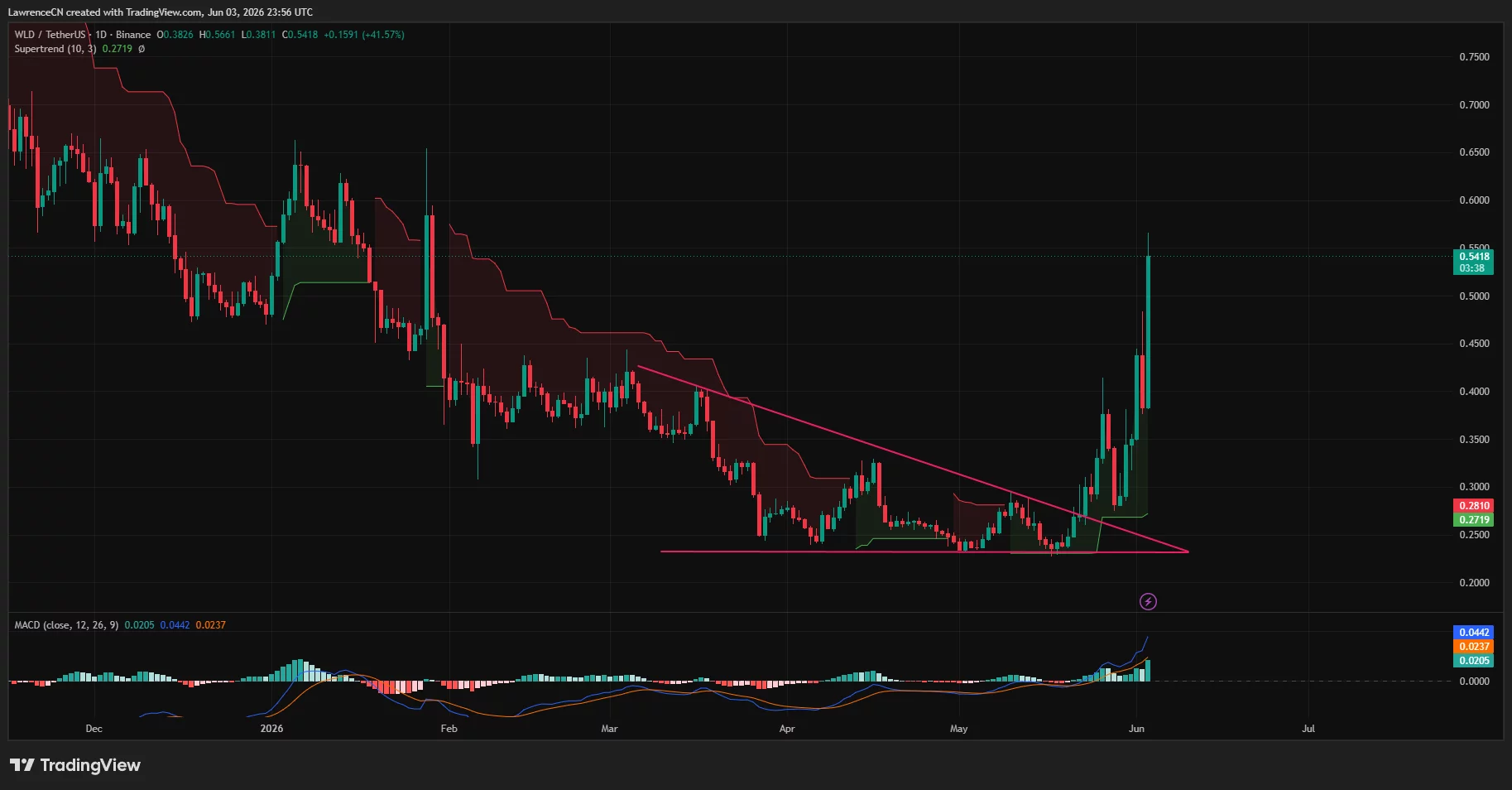
Worldcoin price has surged over 40% since late May after whale activity and network growth climbed to their highest levels of 2026, strengthening the case for a move toward the next major resistance zone near $0.65.
Summary
- Worldcoin has surged more than 40% since late May as whale transactions, active addresses, and new wallet creation climbed to 2026 highs.
- A breakout from a multi-month descending triangle has pushed WLD above $0.54 and brought the $0.65 resistance zone into focus.
- Growing World App activity and renewed interest in AI-related tokens have supported demand despite weakness across the broader crypto market.
According to data from crypto.news, Worldcoin (WLD) traded near $0.53 at press time on June 4 after rallying from roughly $0.33 just days earlier. The advance coincided with a sharp increase in whale transactions worth more than $100,000, alongside a jump in active addresses and new wallet creation across the network.
Large holders began accumulating as WLD emerged from a prolonged consolidation period that had confined prices for much of the year.
Santiment data showed daily whale transactions reaching their highest level of 2026, while active addresses climbed above 1,300. New address growth also accelerated, suggesting participation was expanding beyond existing holders.
Network activity received an additional boost from the integration of Oku Trade into the World App. The feature introduced weekly rewards of up to 100 WLD for users participating in token swaps through a leaderboard system, creating fresh transactional demand within the ecosystem.
Interest in the project’s AI-linked narrative has also remained strong. With OpenAI chief executive Sam Altman closely associated with Worldcoin, traders have increasingly treated WLD as a proxy for the intersection between artificial intelligence and crypto, particularly as AI-related tokens regain momentum across the market.
Whale activity and network growth support the rally
Worldcoin’s gains have stood out against a difficult backdrop for digital assets. On June 2, the total cryptocurrency market lost more than $40 billion in value as Bitcoin (BTC) fell toward the $70,000 region, yet WLD continued advancing while many large-cap assets moved lower.
Capital rotation appears to have played a role. Rather than exiting crypto entirely, traders shifted into tokens backed by active ecosystem developments and improving on-chain metrics. Worldcoin benefited from both trends as whale accumulation tightened available supply while network usage expanded.
Commenting on the move, crypto analyst Bitcoin Meraklisi highlighted a major technical breakout that unfolded after months of consolidation.
“Descending channel broken. First target reached. Retest completed.”
The analyst’s chart showed WLD breaking above a descending channel that had contained price action since September before successfully retesting the breakout zone.
Technical setup places $0.65 within reach
On the daily chart, Worldcoin has broken above the upper trendline of a descending triangle pattern that had constrained price action for several months. The breakout followed a prolonged base formation near the $0.24 support zone and triggered one of the token’s strongest daily advances this year, lifting WLD above $0.54.
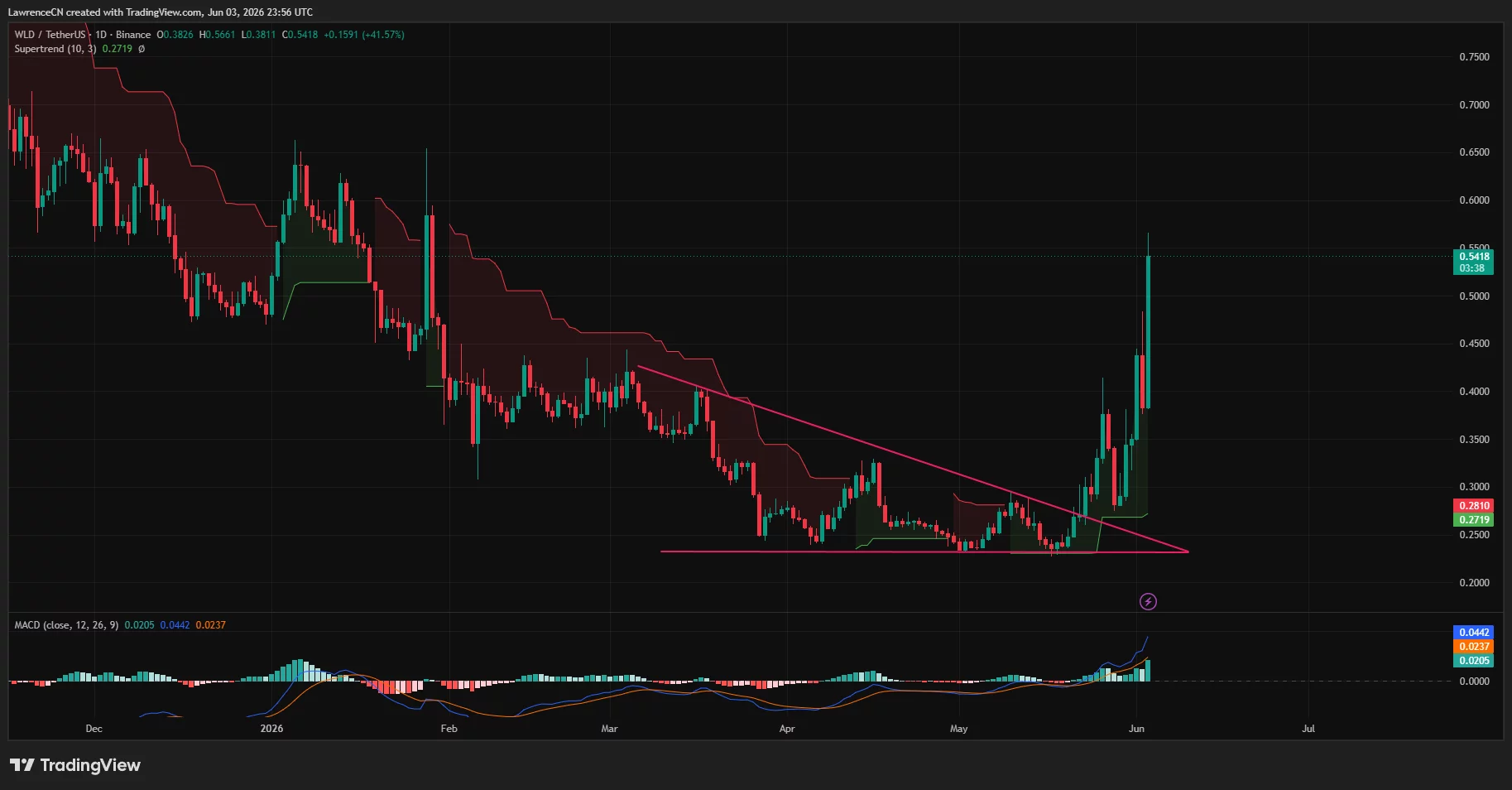
Trading activity expanded significantly during the breakout. Earlier market data showed daily volume surging more than 130% as buyers pushed WLD above its 20-day and 50-day exponential moving averages, reinforcing bullish momentum.
The measured move derived from the height of the triangle places the next major objective between $0.65 and $0.70. From the current price near $0.54, a move to $0.65 would represent roughly 20% upside. A breakout above that area could open the door to a retest of the January highs near $0.75.
Momentum indicators remain firmly bullish. The MACD has produced a fresh bullish crossover while the histogram continues to expand above the zero line. At the same time, the Supertrend indicator has flipped positive near $0.27, confirming a shift in market structure after months of persistent selling pressure.
Traders will be watching the breakout zone around $0.45 as the first key support area. Holding above that level would keep the bullish structure intact and maintain the path toward the $0.65 target. A move back below $0.45 could expose the next support levels near $0.38 and $0.32, where buyers previously stepped in during the consolidation phase.
With whale transactions, active addresses, and new wallet creation all reaching yearly highs, Worldcoin’s on-chain backdrop remains considerably stronger than it was during previous rallies. As long as those trends continue and buyers defend the breakout level, the technical setup continues to favor a test of the $0.65 area in the sessions ahead.
Disclosure: This article does not represent investment advice. The content and materials featured on this page are for educational purposes only.
A quantum computer powerful enough to break Bitcoin (BTC) would never be used to steal it, according to a new report from Swiss custody firm Taurus. The price would collapse before any theft could settle on-chain.
The finding turns the standard quantum doomsday narrative on its head. The breakthrough weapon that could break Bitcoin would destroy its own best target through the market’s reaction, shifting the real threat elsewhere.
A Quantum Attack Ultimately Defeats Itself
Most blockchains secure ownership with the elliptic curve digital signature algorithm (ECDSA). A quantum computer running Shor’s algorithm could, in theory, recover a private key from a public one and forge transactions on the owner’s behalf.
The economics, however, work against any attacker.
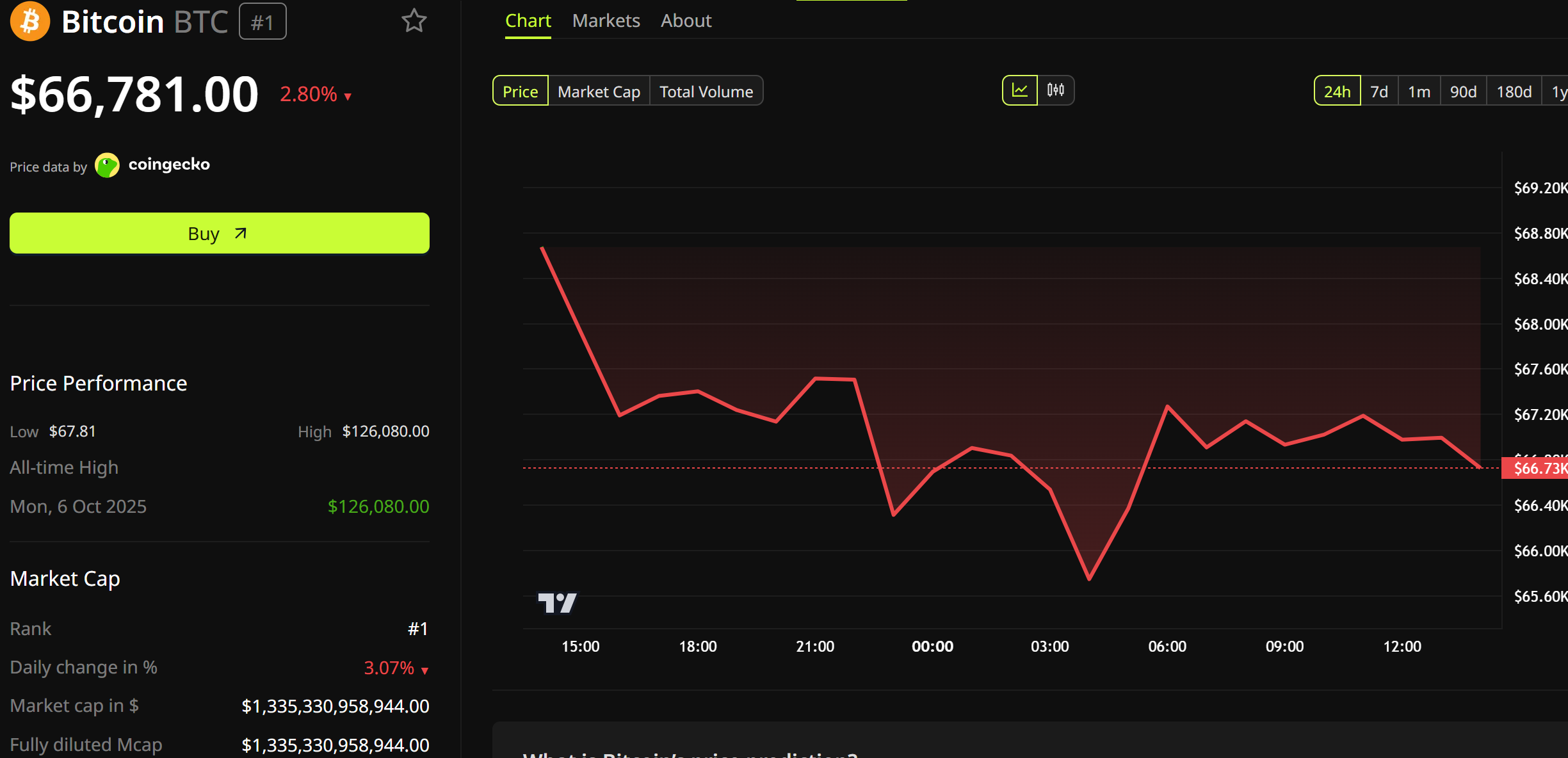
Bitcoin trades for $66,781 as of this writing, with a market value above $1.3 trillion. The volatility itself is a visible proof that if Bitcoin’s cryptography is broken, it would trigger an immediate sell-off.

The report describes this as a form of gravity, reframing familiar quantum doomsday scenarios for the asset.
“… a computer that could break Bitcoin would almost certainly not be used to steal it. If such a machine became known, prices would collapse before any theft occurred,” read an excerpt in the Taurus report.
Follow us on X to get the latest news as it happens
A nation-state holding that capability would also find more valuable targets than a falling asset. Independent assessments have called the broader threat manageable rather than imminent.
Where the Real Quantum Risk Sits
The conclusion sharpens priorities rather than easing them. The dominant near-term danger is the harvest now, decrypt later attack.
An adversary records encrypted data today and waits for a capable machine to read it later.
Public Bitcoin transactions do not suit that method well. Confidential records with a long shelf life, such as contracts and archived messages, are now at risk of exposure.
The migration clock is already moving. NIST guidance deprecates current public-key encryption after 2030 and bans it after 2035, and replacement standards already ship in major software, a point raised across recent Q-Day security takeaways.
Two papers released in late March 2026 further narrowed the hardware gap, including a Google Quantum AI estimate that cut the resources needed to break elliptic curve cryptography.
No custodian can promise full quantum protection, because the blockchain sits outside any single firm’s control.
The practical goal is crypto-agility, swapping algorithms quickly at every layer a provider does control.
“Post-quantum cryptography is not a reason to panic. It is a reason to act,” the report concluded.
Subscribe to our YouTube channel to watch leaders and journalists provide expert insights
The post The Quantum Bitcoin Paradox: Attack the Network, Kill the Prize appeared first on BeInCrypto.

Nvidia CEO Just Crowned the “Next Trillion-Dollar” Chip Stock and It Went Up 33%

Rapper’s Team Reacts Amid Sauce Walka’s Threats

When Mom Catches You Wasting Money



-

 Tech6 days ago
Waymo dominates autonomous vehicle registrations as Tesla trails behind
-

 News Videos6 days ago
This is BROKEN! INSANE 5x MONEY CAR WASH WEEK! The NEW GTA Online UPDATE Today! (GTA5 New Update)
-
 Tech5 days ago
SpaceX just won a second Golden Dome contract. This one is $4.16 billion.
-

 Business2 days ago
Jade Biosciences, Inc. (JBIO) Discusses Positive Interim Results From JADE101 Phase I Healthy Volunteer Study and Development Plans Transcript
-

 News Videos5 days ago
SHE IS KILLING XRP!!! WATCH URGENT AND ACT FAST
-
 NewsBeat5 days ago
FIRST NIGHT REVIEW: Take That bring the Circus back to life in spectacular sun-soaked style
-
 Crypto World5 days ago
CFTC Has Approved the First Regulated Bitcoin Perpetual Contract in the U.S.
-

 Business5 days ago
Is the Spurs Phenom Already Better Than Prime Diesel?
-
 NewsBeat5 days ago
Novak Djokovic v Joao Fonseca LIVE: French Open latest scores and results after Jannik Sinner’s shocking collapse
-
 Entertainment5 days ago
Weak ‘Supergirl’ Box Office Tracking Amid Milly Alcock Backlash
-
 Crypto World5 days ago
Snowflake (SNOW) Stock Rallies on Strong Q1 Results and AI Product Growth
-

 Business5 days ago
Demand Conditions Improve In Chemicals Sector In April 2026
-

 Politics5 days ago
The House | Inside Andy Burnham’s Makerfield Campaign: “Nobody Thinks This Is In The Bag”
-
 Crypto World5 days ago
MicroStrategy Moves $30 Million in BTC to Coinbase Prime: Is the Bitcoin Sell-Off Already Here?
-

 Tech5 days ago
This Week In Security: Ubiquiti Fixes, And FreeBSD Joins The Club You Don’t Want To Join
-

 Entertainment5 days ago
Maddox Jolie-Pitt Legally Requests to Drop Brad’s Surname
-
 Entertainment5 days ago
One of the Greatest Sitcoms of All Time Shoots Up Apple TV’s Charts 11 Years Later
-
 Crypto World1 day ago
Seagate (STX) Stock Surges to Record High on AI Boom and Legal Settlement
-
 NewsBeat5 days ago
Everything you need to know as Cambridge’s Strawberry Fair returns after cancelled year
-
 Entertainment5 days ago
Britney Spears Shares Troubling Update After Hard Year
You must be logged in to post a comment Login