
Crypto World
Bitcoin at $81K as Derivatives Flatten; Rally Durability in Focus


Bitcoin surged about 7% over the past week, reclaiming the $81,000 area for the first time in more than three months. The price move points to renewed risk appetite among investors, but a closer look at the derivatives market and on-chain activity suggests the rally isn’t backed by broad speculative interest. Institutional demand, however, remains visible in the wake of strong spot ETF inflows, underscoring a nuanced dynamic shaping the current cycle.
Key takeaways
- Spot Bitcoin ETFs drew about $1.16 billion in net inflows over the Friday-to-Monday window, signaling persistent institutional demand even as price pushes higher.
- Two-month Bitcoin futures are trading at roughly a 1% annualized premium versus spot, well below the neutral range of about 4% to 8%, indicating cautious leverage among traders.
- The 30-day Bitcoin delta skew for puts versus calls sat near the neutral band (around a 6% threshold) but remained slightly bearish, suggesting limited upside acceleration from hedging activity.
- On-chain activity continues to weaken: daily transfer volume has fallen about 54% from three months ago to roughly $4.1 billion, with the number of transfers near multi-year lows.
- Even with a risk-on tilt in equities, the contrast between price action and on-chain/derivative signals implies a potential for traders to push the narrative further through short-covering if momentum sustains.
Derivatives and price action diverge from on-chain activity
Bitcoin’s price breakout above $81,000 comes as macro factors exert a mixed influence on market sentiment. On the futures front, the 2-month Bitcoin futures basis sits around 1% annualized, well below the neutral range typically observed when the market is comfortable financing levered bets. This suggests that professional traders have not embraced a broad bullish tilt via escalated leverage, even as spot demand strengthens. Laevitas data shows this muted premium on futures as the market remains cautious about the sustainability of the rally.
The options market adds nuance to the picture. The delta skew for Bitcoin’s 30-day options—an indicator of demand for hedges and directional bets—has inched toward the neutral band but stays modestly bearish. In practical terms, the market isn’t pricing in a sharp, imminent downside, but traders aren’t rushing to position heavily for a swift upside either. In a period where macro catalysts loom, such as inflation dynamics and energy prices, this balance reflects a cautious crowd that is watching for a clearer signal before layering in aggressive bets.
Against this backdrop, broader macro indicators complicate the narrative. Brent crude holds elevated levels near $110 per barrel, keeping inflation concerns front and center. US inflation expectations have ticked higher, with signals suggesting a near-term persistence of elevated price pressures. Yet equities, notably the Nasdaq 100, have shown a risk-on tilt, hinting at a market that is pricing in resilience in growth and tech leadership even as inflation remains a watchful eye.
Institutional demand vs. on-chain fundamentals
One of the most striking tensions in this setup is the disconnect between price strength and on-chain activity. Bitcoin’s on-chain metrics have cooled noticeably in recent weeks. Daily transfer volume has declined by more than half from a few months ago, landing near $4.1 billion, while the total number of transfers remains near levels not seen in several years. While on-chain activity is not the sole driver of price, these metrics are often a proxy for retail participation and broader user adoption — a weaker signal at a time when price is rising.
On the institutional side, spot ETF inflows offer a counterpoint. Cointelegraph reported substantial inflows into US-listed Bitcoin spot ETFs, underscoring sustained demand from institutions that are attracted to regulated access to BTC exposure. Within this context, the market appears to be being propped up by a steady stream of capital infrastructure rather than by speculative bets from retail traders. The inflows come amid a period of tempered enthusiasm in the futures and options markets, reinforcing the view that long-hold demand is liveried in the institutionally oriented part of the market.
In a related development, MicroStrategy (Strategy) has been etched into the broader narrative as a case study of ongoing corporate BTC accrual versus earnings pragmatism. The company, led by Michael Saylor, had maintained an aggressive accumulation pace, but reports and market chatter suggest a pause in that accumulation ahead of a forthcoming earnings release. Analysts expect the quarter to show a net loss on a mark-to-market basis due to Bitcoin accounting, highlighting the friction between corporate treasury strategy and short-term earnings reporting.
Taken together, the data point to a market where institutional demand is reinforcing price strength, while retail participation via on-chain activity and leveraged derivatives remains tepid. This dichotomy underscores the importance of watching how ETF inflows evolve, as continued inflows could sustain upside even in the absence of broad-based retail engagement.
What this means for traders and investors
For market participants, the current configuration presents both opportunity and risk. The absence of thick leveraged long exposure in the derivatives market implies that a continued move higher could force short sellers to cover, potentially adding fuel to an ongoing rally. However, the lack of robust on-chain activity and the subdued appetite for risk on the derivatives side counsel caution; a disruption in ETF inflows or a shift in macro momentum could flatten the trajectory quickly.
Investors should monitor a few key developments. First, the trajectory of US-listed Bitcoin spot ETFs remains a critical barometer for institutional appetite. Sustained inflows would lend credibility to a narrative of BTC acting as a beta asset within a broader risk-on regime, particularly if equity markets maintain their uptrend. Second, on-chain metrics deserve ongoing attention as they offer a counterpoint to price action; fresh declines in transfer activity or new waves of network activity could hint at a shift in user behavior or investor base. Finally, earnings signals from major corporate holders, like MicroStrategy, and any material updates on BTC accounting could reframe risk and return expectations for the sector.
In the near term, the market seems to be balancing a constructive price move with an undercurrent of caution. For readers and builders in the space, the message is clear: price resilience is not yet mirrored by on-chain and long-tail derivative activity, so changes in ETF flow or macro momentum could be the decisive catalysts in the weeks ahead.
As the week unfolds, traders will be watching whether spot ETF flows keep pace with price, and whether on-chain activity begins to rebound in tandem with systemic risk-on cues. The path forward remains uncertain, but the ongoing divergence itself offers a meaningful lens into how capital is being allocated across regulated access, leveraged bets, and real network activity.

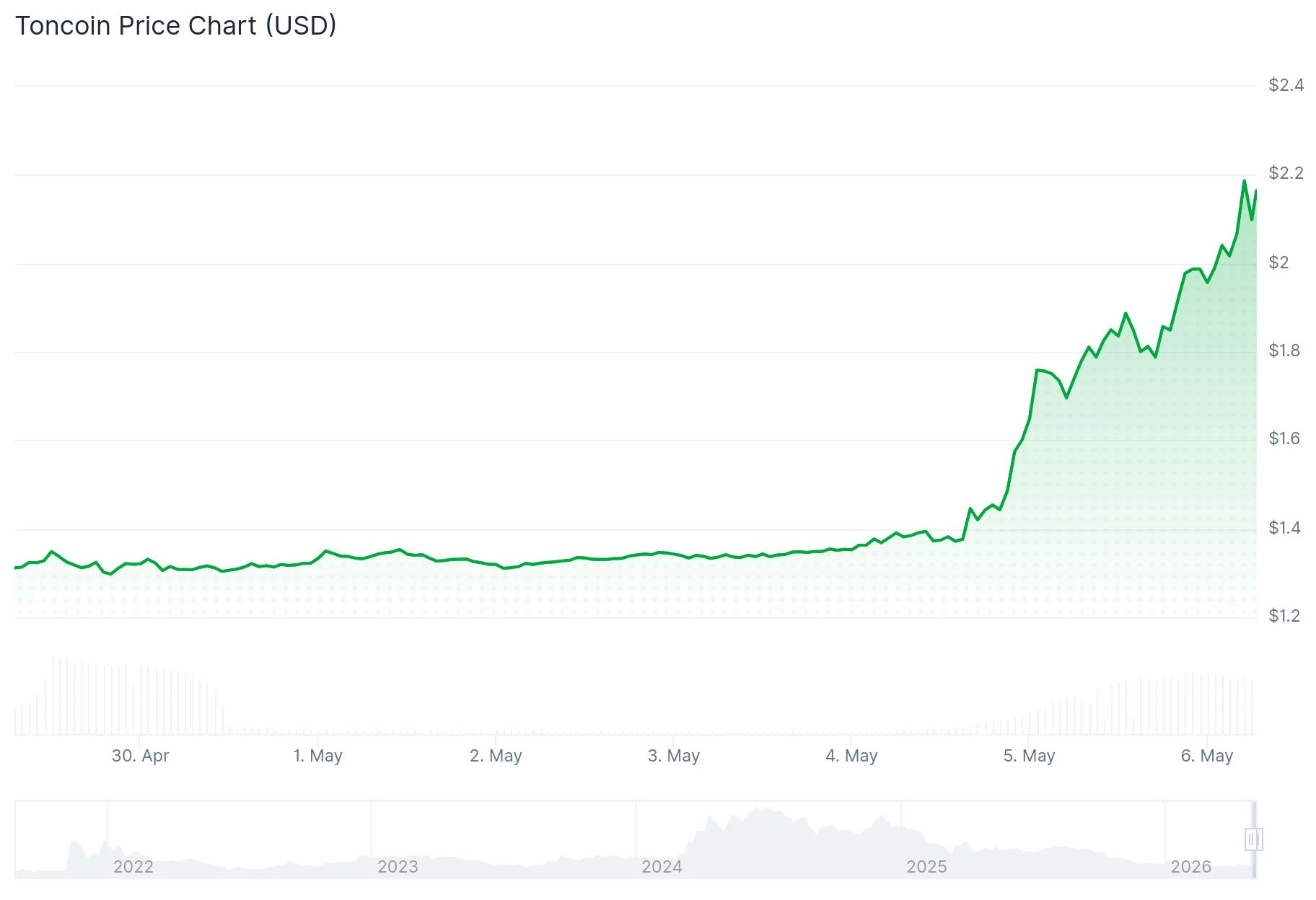
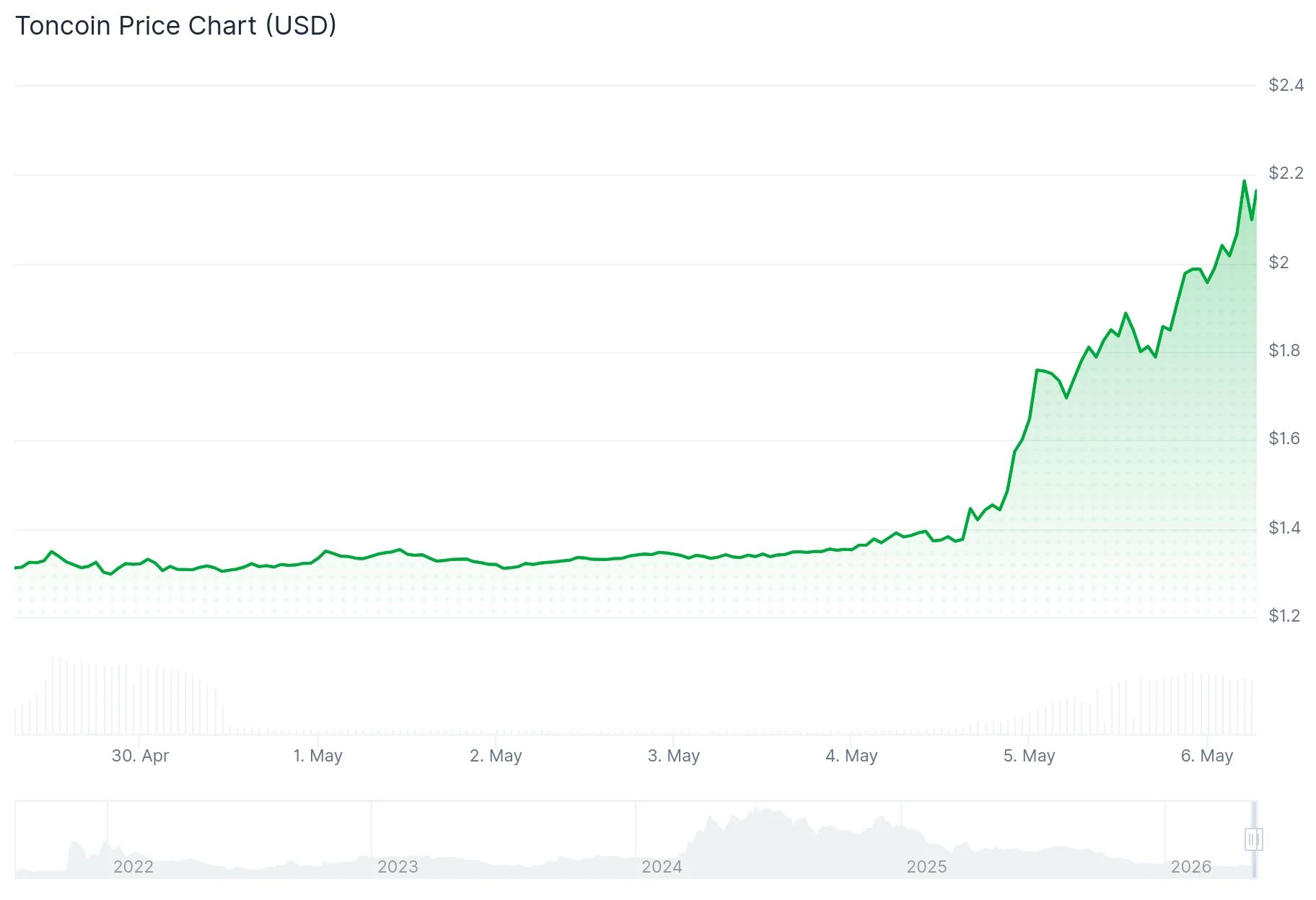
Key Points
- Telegram is set to assume the TON Foundation’s primary responsibilities and will operate as TON’s dominant validator
- The network hosts $752 million in stablecoin liquidity and generates $39.7 million in daily DEX trading volume, demonstrating genuine network usage
- Chain fees total approximately $8,086 daily, revealing poor monetization compared to the network’s overall scale
- Monthly unlocks from the TON Believers Fund release around 36.59 million TON, with the upcoming unlock valued at roughly $75 million
- Validator participation requires a minimum stake of 300,000 TON, while Telegram’s expanding influence creates centralization risks
Unlike most blockchain networks that struggle to build user bases, Toncoin benefits from an inherent distribution advantage. While competing projects allocate resources toward user acquisition campaigns, funding programs, and reward mechanisms, TON operates with a fundamentally different model.
The TON Wallet exists natively within Telegram’s ecosystem. Users maintain custody of their private keys while experiencing streamlined mobile functionality. This blend of security and ease-of-use represents an uncommon achievement in cryptocurrency.
With Telegram’s registered user count exceeding one billion, TON possesses immediate access to an audience size that remains beyond reach for nearly every other blockchain initiative.
During May 2026, Pavel Durov, Telegram’s founder, revealed plans for Telegram to succeed the TON Foundation as the network’s primary developmental authority. Additionally, Telegram will assume the position of largest network validator.
This declaration generated significant interest around TON while emphasizing the deepening integration between these two platforms.
Evaluating Network Activity Through On-Chain Metrics
Current DeFiLlama statistics indicate approximately $752 million in stablecoin deposits residing on TON infrastructure. The network processes roughly $39.7 million in daily decentralized exchange volume alongside approximately $1.48 million in perpetual futures trading volume over the same timeframe.
These figures demonstrate that both development teams and end users are actively selecting TON for their operations. Capital is flowing into the ecosystem, accompanied by legitimate trading behavior.
Nevertheless, daily network fees amount to just $8,086, while chain revenue approaches $4,043. When assessed against a market capitalization ranging from $5.6 billion to $5.7 billion, this fee production appears substantially inadequate.
Fee economics carry significance because they indicate how much value the protocol actually retains. Substantial transaction activity paired with minimal fee generation suggests users are engaging with the network without the protocol effectively capturing economic value from that engagement.
Supply Releases and Validator Centralization
CoinGecko data indicates roughly 2.7 billion TON tokens currently exist in active circulation. The project’s foundational documentation established an initial maximum supply of 5 billion tokens, with subsequent incremental expansion occurring through validator compensation mechanisms.
The TON Believers Fund presents an additional consideration. Based on Messari’s analysis, this fund distributes approximately 36.59 million TON monthly. Roughly 1.098 billion TON tokens await future distribution through approximately October 2028.
DeFiLlama’s unlock monitoring system values the forthcoming scheduled release at approximately $75 million. This persistent introduction of supply generates continuous downward market pressure.
Regarding validation infrastructure, TON network participation mandates a minimum commitment of 300,000 TON. Reports suggest practical entry requirements typically exceed this baseline threshold.
With Telegram positioned to become the dominant validator, network control is consolidating around a singular organization. While this arrangement may enhance operational coordination and system stability, it simultaneously reduces the network’s decentralized characteristics.
Telegram’s emergence as TON’s primary validator represents the latest factor influencing how market participants and builders evaluate the network’s trajectory.

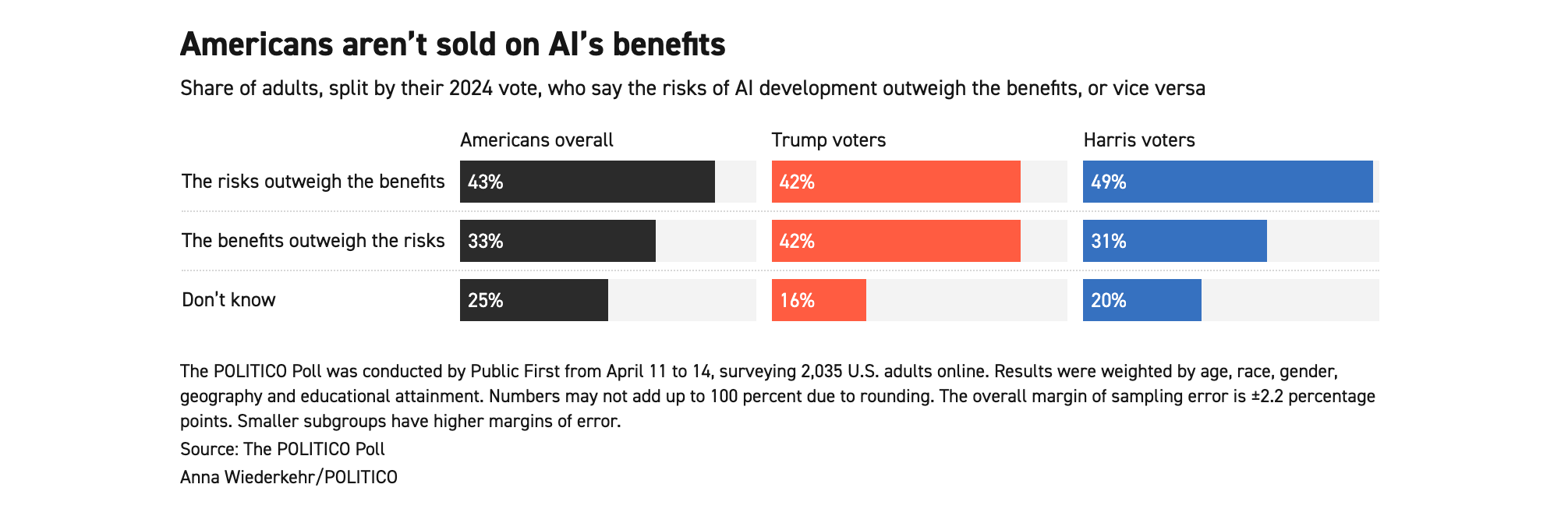
A new survey finds 45% of Americans say investing in cryptocurrency is not worth the risk, while 44% say artificial intelligence (AI) is developing too quickly.
This sentiment leaves candidates relying on crypto and AI super PAC dollars in a difficult position.
Industry Spending Meets Voter Skepticism
The poll also found that nearly 50% of respondents trust traditional banks more than crypto platforms. In addition, roughly two-thirds want lawmakers to impose strict regulations or broad oversight on AI.
Close to half of poll respondents believe AI will wipe out more jobs than it produces. A 43% plurality says its risks outweigh its rewards.
Follow us on X to get the latest news as it happens

The findings land as Fairshake, the pro-crypto super PAC primarily funded by Coinbase, Andreessen Horowitz, and Ripple Labs, has spent $28 million on competitive 2026 primaries, according to Politico. Pro-AI PAC Leading the Future has raised more than $75 million since launching last August.
“The results raise an emerging challenge for the industries as their aligned super PACs seek to translate financial might into political influence. Several of these groups are already becoming the most dominant players on the political battlefield, spending heavily for candidates on both sides of the aisle and in some cases rivaling the fundraising of long-established party groups,” the report read.
The resistance to crypto and AI super PACs may stem from a wider public mood, Politico observed. Some 41% of poll respondents view special interest groups as wielding excessive political weight. Just 23% call their role balanced, while 12% say they carry too little sway.
“Skepticism of the industries, those results suggest, could turn into voter backlash if Americans grow fed up with the heavy spending,” Politico added.
In hypothetical matchups, respondents were less likely to back candidates supported by groups pushing looser AI regulations than those backed by groups calling for tighter tech rules.
Those surveyed also showed stronger support for groups advocating climate policy. Whether voter skepticism translates into ballot-box pressure remains to be seen.
The findings come from the Politico Poll, conducted by Public First. The survey drew responses from 2,035 American adults between April 11 and 14. Its overall margin of error is ±2.2 percentage points, while smaller subgroups have larger margins.
Subscribe to our YouTube channel to watch leaders and journalists provide expert insights
The post Crypto and AI Industries Pour Millions Into Midterms as New Poll Reveals Backlash Risk appeared first on BeInCrypto.
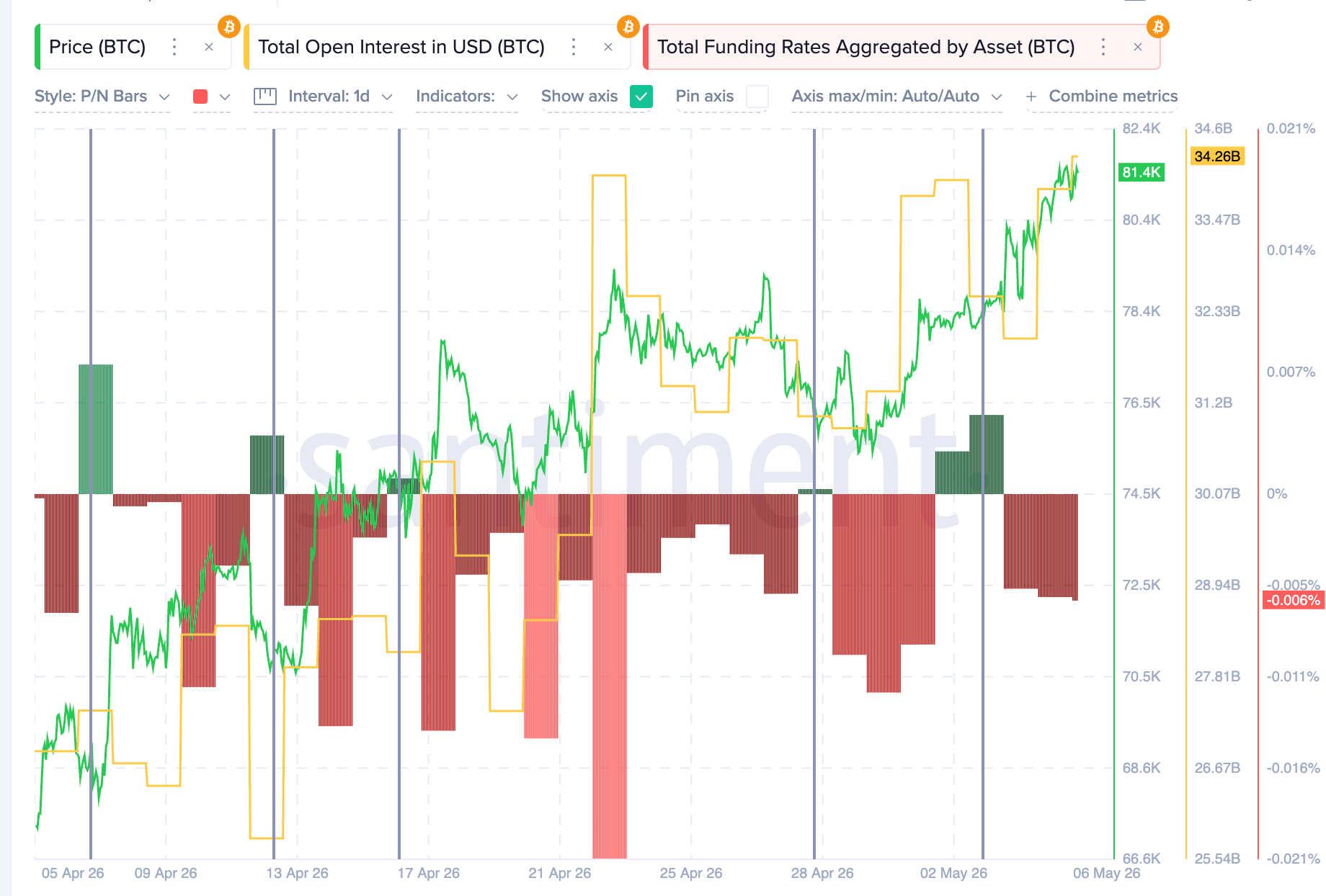
Bitcoin price is up 20%+ over the past month, but the structure underneath that rally reads differently than the price tape suggests.
Derivatives traders are positioned short. Whales are selling into the strength. The momentum profile signals a counter-trend bounce, not a new uptrend. The price tape says bullish. The structure underneath says bearish.
The Derivatives Data Reads Bearish Despite the Rally
Most rallies in recent quarters have been built on the same pattern. Long traders pile in early, leverage stretches across the perpetual futures market, funding rates flip aggressively positive, and the rally extends until a sharp wick flushes the over-leveraged longs and resets the cycle. The pattern is so familiar that most active rallies trigger immediate skepticism about the size of the long crowd waiting to be cleared.
This Bitcoin rally is not following that script as over the past month, the 20% rally phase, longs have only appeared sparingly.

Total Bitcoin open interest has climbed from $30.88 billion on April 30 to $34.26 billion by May 6, an increase of more than 11% across just six trading sessions. But the direction of those new positions is what matters for the read.
Funding rates sat at -0.011% on April 30 and remain at -0.006% as of May 6. A negative reading this persistent across a 20% rally is rare, and it confirms the rising open interest is mostly fresh shorts, not fresh longs.

The 8-hour chart adds the spot confirmation. We use the 8-hour timeframe to read short-term trend behavior, and the volume profile underneath this rally has been thinning. Between April 14 and May 6, Bitcoin price has trended steadily higher while volume has trended steadily lower. The rally is not running on spot demand. It is running on disbelief and possibly the continued liquidation of the shorts.

With no over-leveraged long crowd to flush, there is no obvious wick risk that has capped recent rallies before. But the absence of euphoric long positioning also means there is no spot bid converting through resistance. The rally is structurally fragile.
Whale Flows and RSI Divergence Confirm the Bearish Read
The lack of conviction shows up cleanly in two independent on-chain signals.
Want more token insights like this? Sign up for Editor Harsh Notariya’s Daily Crypto Newsletter here.
The cohort of smaller Bitcoin whales, the wallets holding between 1,000 and 10,000 coins, held 4.27 million Bitcoin on April 18, 2026. By May 6, that figure had dropped to 4.19 million Bitcoin. The 80,000 BTC reduction across an 18-day window matches the timing of the rally itself. Whales are not buying this move. They are using the strength to sell.

The daily chart adds the third bearish signal. The Relative Strength Index (RSI), a momentum indicator captures the divergence cleanly. Between January 5 and May 5, Bitcoin price has formed a clear lower high while the RSI over the same window has formed a higher high.
This pattern is hidden bearish divergence, which occurs when price makes a lower high but the momentum trends higher. In a broader downtrend context, hidden bearish divergence signals continuation of the existing downtrend, not reversal. The 20% rally off the February low reads as a counter-trend bounce within a broader corrective structure. The bearish divergence invalidates if the BTC price crosses $81,854.

Three signals stack consistently. Derivatives positioning says traders expect a pullback. The 80,000 BTC whale cohort drop says spot conviction is missing. RSI hidden bearish divergence says the broader trend is still down. The 20% rally is technically defensible because it lacks the long crowding that broke past rallies, but it lacks the spot demand that completes trend reversals.
The market is not euphoric.
Bitcoin Price Levels Where the Bearish Read Resolves
Bitcoin (BTC) trades at $81,326 with the immediate resistance band sitting between $81,810 and $81,854. That zone is the line that decides whether the disbelief rally extends or rolls over.
A daily close above $81,854 confirms the rally has the strength to push higher and opens the path to $90,460 as the next major technical level. The $90,460 zone aligns with the descending trendline that has capped Bitcoin since the January peak. A break above $90,460 would invalidate the broader downtrend structure and signal a true trend reversal.

The downside levels are stacked tightly. A rejection at $81,810 to $81,854 sends Bitcoin toward $76,656, the 0.236 Fibonacci level, which is the first major support and a likely zone for a retest. Below $76,656, the path opens to $73,467 (0.382 Fib), $70,891 (0.5 Fib), and $68,314 (0.618 Fib). A break below $64,645 would expose the long-term floor at $59,972.
The negative funding setup means any rejection at the resistance band would be amplified. With shorts dominant in the perp book, a failed breakout would not produce mass long liquidations to slow the drop. The path back to $76,656 could be quick.
The level math is binary. A confirmed close above $81,854 opens $90,460. A rejection sends Bitcoin back to $76,656.
The post Why Bitcoin’s 20% Price Rally Reads Bearish Underneath appeared first on BeInCrypto.
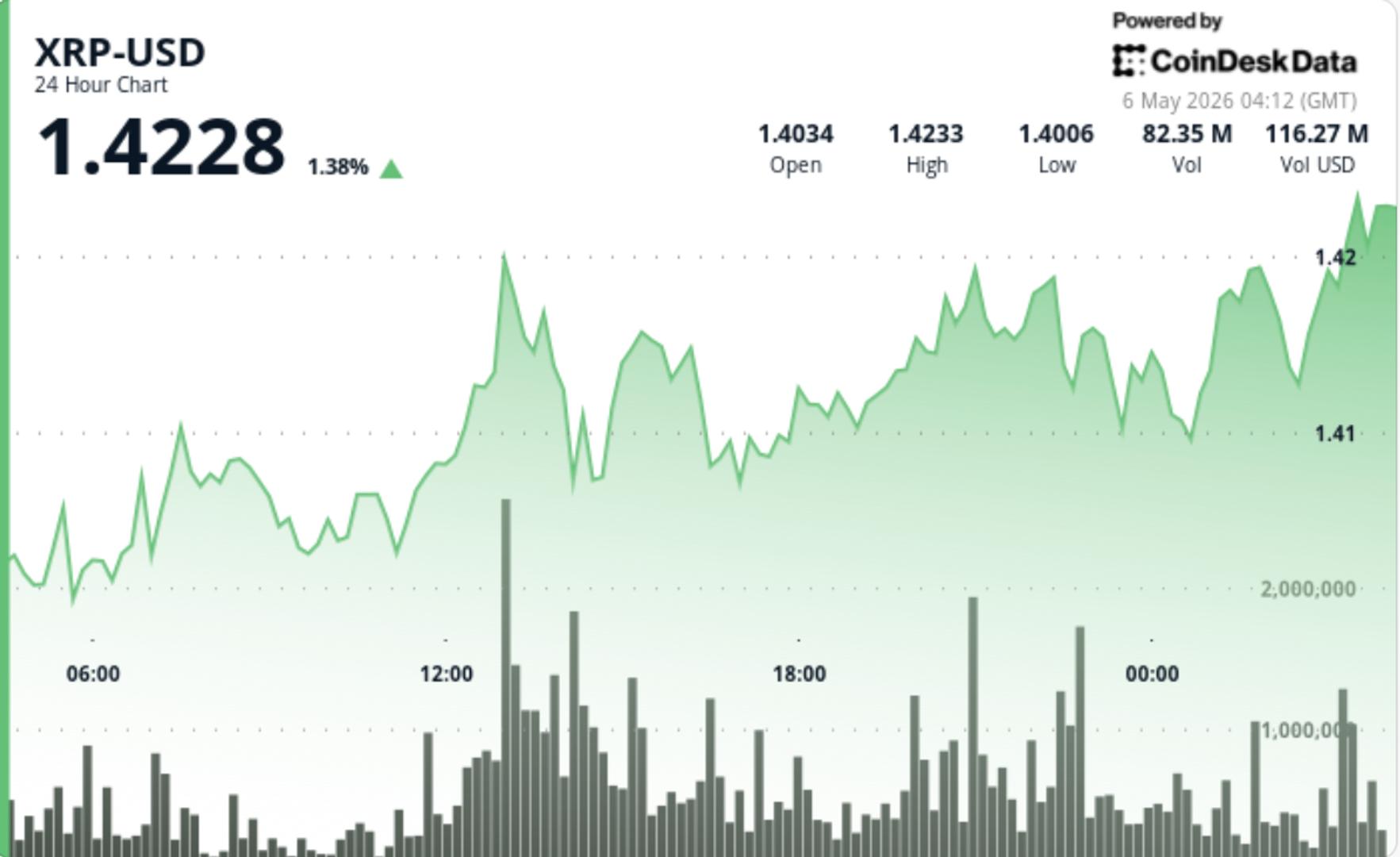
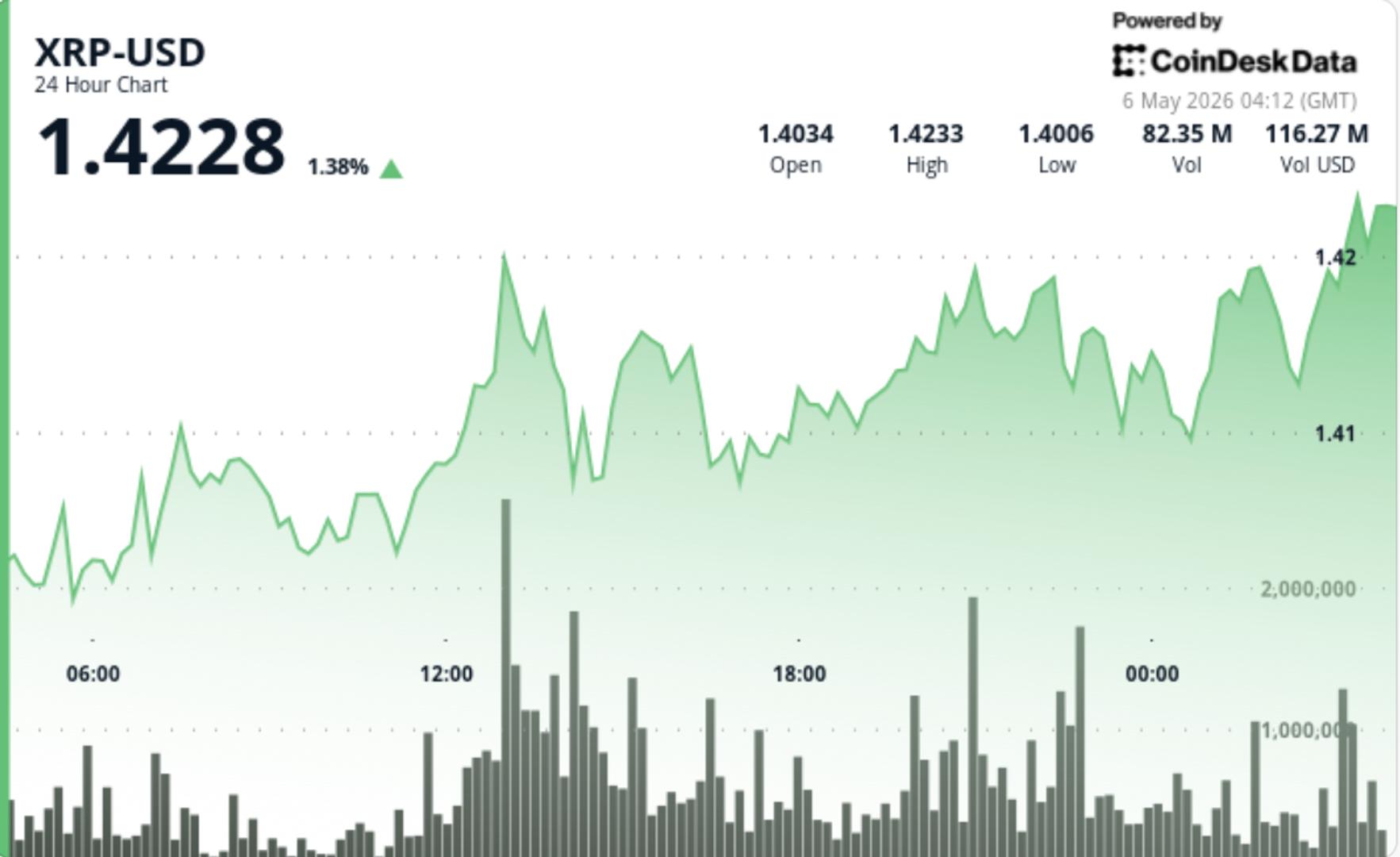
XRP is back above $1.42, and traders are starting to focus on a chart setup that sent XRP up 66% in less than two weeks when it appeared in 2025.
News Background
• Analysts flagged a repeating XRP chart fractal from 2025, when a breakout from a multi-week bull flag triggered a rally toward all-time highs above $3.
• A bull flag is a pattern where price jumps sharply, then moves sideways or slightly lower for a while before potentially breaking higher again. Traders usually see it as a pause in momentum rather than a full reversal.
• Current price action again shows XRP breaking out of a bull flag while the 20-day and 50-day moving averages approach a bullish crossover.
• Some traders now view holding above $1.40 as critical, with the level acting as both psychological support and the upper boundary of the recent flag structure.
Price Action Summary
• XRP climbed from $1.4011 to $1.4184, extending its weekly gain to nearly 9%.
• A 74.6M volume spike at 13:00 pushed price to $1.4207 before momentum cooled into consolidation.
• The token spent the final hours stabilizing between $1.417-$1.420 after repeated tests of the $1.422 resistance zone.
Technical Analysis
• XRP continues building higher lows, keeping short-term bullish structure intact above $1.40.
• The repeated tests near $1.42 matter because resistance weakens each time sellers fail to force a deeper rejection.
• Liquidity on Binance has fallen to its lowest level since 2020, which historically creates conditions for outsized moves once ranges finally break.
• The broader setup resembles the 2025 breakout structure where XRP compressed for weeks before accelerating sharply higher.
What traders should watch
• $1.42 remains the key breakout level. A clean move above it opens the path toward $1.47-$1.50.
• Holding above $1.40 is equally important because failed breakouts often turn into fast reversals once momentum fades.
• If the range finally resolves lower, $1.34-$1.37 becomes the first major support zone traders watch.


Colombian President Gustavo Petro said the country’s Caribbean coast could become a Bitcoin mining hub if it uses clean energy and brings local communities into the plan.
Summary
- Petro says Colombia’s Caribbean coast could use renewable energy to attract Bitcoin mining investment soon.
- The plan mentions Wayúu co-ownership, but no mining partner or launch date has been confirmed.
- Paraguay’s hydro-powered mining growth gives Colombia a model as political timing creates fresh doubts ahead.
Petro pointed to Barranquilla, Santa Marta, and Riohacha as possible sites. He said the region could follow countries such as Venezuela and Paraguay, where low-cost energy has attracted Bitcoin mining investment.
Petro made the comments in a post on X while responding to a discussion on Bitcoin mining in South America. He said the Caribbean region could receive “an immense boost” from mining tied to renewable energy.
The president also called for talks with the Wayúu community. He said the Indigenous group should be involved as possible co-owners of future projects. The Wayúu mainly live in La Guajira, where Colombia has strong wind and solar resources.
Paraguay model draws attention
Petro’s remarks referred to Paraguay’s growing role in Bitcoin mining. The country has used surplus hydroelectric power to attract miners, including large firms building sites near the Itaipu dam.
As featured in earlier coverage, HIVE Digital acquired Bitfarms’ 200 MW hydro-powered Yguazú site in Paraguay for $56 million. The company said the deal lifted its planned Paraguay mining infrastructure to 300 MW.
That deal shows why energy-rich countries have become more attractive to Bitcoin miners. Mining firms often seek cheap and steady power, while host countries look for ways to turn unused electricity into revenue.
Colombia’s renewable base supports the proposal
Colombia already gets a large share of its electricity from clean sources. The World Bank said the country generates as much as 75% of its power from renewable energy, more than twice the global average.
That energy mix could help Petro frame Bitcoin mining as part of a clean power plan. He has also warned that crypto mining powered by fossil fuels could worsen climate change.
The Caribbean coast may play a key role because of its wind potential. Reuters reported that state oil firm Ecopetrol bought the Windpeshi wind power project in La Guajira, with operations expected by 2028.
Election timing leaves questions
Petro’s proposal faces a tight political timeline. His presidential term ends in August, and Colombia is set to hold a presidential election on May 31. He cannot run again because of term limits.
The next government will decide whether the idea moves forward. Current leading candidates have not made clear public plans on Bitcoin mining or digital assets.

TLDR:
- Strategy reported a $12.54 billion Q1 net loss tied to a decline in bitcoin’s market price this quarter.
- Michael Saylor proposed selling bitcoin to cover $1.5 billion in annual dividend and debt obligations.
- Strategy holds 818,334 BTC at an average cost of $75,537, with roughly 18 months of dividend coverage left.
- MSTR stock fell over 4% after hours while bitcoin slipped below $81,000 following Saylor’s announcement.
Strategy, the world’s largest publicly traded corporate bitcoin holder, is considering selling a portion of its bitcoin to meet dividend obligations.
Executive Chairman Michael Saylor disclosed during the company’s Q1 2026 earnings call. The firm reported a $12.54 billion net loss for the quarter.
Strategy currently holds 818,334 BTC at an average acquisition cost of $75,537 per coin. The announcement triggered a sharp market reaction almost immediately.
Saylor Proposes Bitcoin Sales to Meet Dividend Commitments
Saylor outlined a straightforward model for managing the company’s dividend responsibilities. The approach centers on using credit to acquire bitcoin, holding it until the asset appreciates, then selling portions selectively. He explained it plainly: “You buy bitcoin with credit, you let it appreciate, and then you sell bitcoin to pay the dividend.”
Strategy carries roughly $1.5 billion in annualized dividends and debt obligations. The firm estimates it has approximately 18 months of coverage based on current USD reserves. That runway gives the company some flexibility, though the market clearly viewed the news with caution.
Saylor described the plan as both practical and symbolic. He said the company would “probably sell some bitcoin to pay a dividend just to inoculate the market.”
The goal, according to him, was to demonstrate that the model works — not to signal a retreat from its bitcoin strategy.
The preferred stock dividend structure has long been part of Strategy’s financing approach. Selling bitcoin to service those obligations would mark a notable operational shift. Still, the company framed it as a calculated move rather than a sign of financial distress.
Market Reacts Sharply to Bitcoin Sale Announcement
Following the earnings call, Strategy’s stock dropped more than 4% in after-hours trading. Bitcoin also slid below $81,000 shortly after the announcement.
Investors responded quickly to the possibility of increased selling pressure from one of bitcoin’s largest corporate holders.
The Q1 net loss of $12.54 billion reflected the decline in bitcoin’s price during the quarter. Strategy’s large BTC position means its financials are closely tied to the asset’s market performance. A drop in bitcoin’s value directly affects the company’s reported earnings.
Despite the loss, Strategy maintained its overall bitcoin acquisition strategy. The firm did not announce any immediate plans to reduce its total holdings. The proposed bitcoin sales were framed specifically around dividend obligations, not a broader exit.
The market reaction points to how sensitive bitcoin’s price is to large institutional moves. Even the suggestion of a sale from Strategy was enough to push prices lower. Traders and analysts will likely monitor the company’s next moves closely in the weeks ahead.

Binance Expands Regional Communication Channels
Binance has launched seven regional WhatsApp channels targeting users in India, Ukraine, Kazakhstan, Mexico, Peru, Colombia, and Russian-speaking regions. The channels are one-way communication tools designed to distribute verified updates and educational content related to blockchain, Web3, and cryptocurrency.
The exchange aims to improve accessibility and reduce misinformation by providing region-specific content in native languages. Each channel carries verification through Meta, which helps users identify official sources. Binance also advised users to rely only on verified channels to avoid scams and impersonation attempts that circulate on messaging platforms.
The rollout reflects Binance’s effort to strengthen engagement in markets with growing crypto adoption.
New Contracts Introduced with Limited Market Reaction
Binance has added new perpetual futures contracts, including AMD/USDT, QCOM/USDT, and USAR/USDT. These products offer leverage of up to 10x, giving traders additional tools for derivatives trading.
Despite the launch, the listed assets showed minimal price volatility following the announcement. This response contrasts with earlier cases where similar listings triggered sharp price increases. Market participants appeared to adopt a cautious approach, possibly reflecting changing sentiment toward leveraged products.
The introduction of new contracts aligns with Binance’s ongoing strategy to expand its derivatives portfolio. The exchange continues to introduce instruments that cater to both retail and institutional traders while maintaining risk controls.
Binance Confirms Removal of Selected Trading Pairs
Binance will remove 12 spot trading pairs on May 8, including AVA/BTC, ENA/BTC, and MAGIC/BTC. The action forms part of its routine review process, which evaluates liquidity, trading volume, and overall market quality.
The delisting will also affect automated trading bots tied to these pairs. Users must update or cancel such tools before the removal date to avoid disruptions. The underlying tokens will remain available through other trading pairs where applicable.
Binance conducts periodic reviews to maintain a stable trading environment. These actions aim to reduce risks linked to low-liquidity markets and improve user experience across the platform.
For more details, see the Binance Support Announcement.


Brad Garlinghouse has warned that recent Senate progress on the CLARITY Act still leaves a narrow window for the bill to move forward.
Summary
- Brad Garlinghouse said the CLARITY Act could lose momentum if the Senate does not act within the next two weeks.
- Senators Thom Tillis and Angela Alsobrooks reached a stablecoin yield compromise that removes a key hurdle in the bill’s progress.
According to Brad Garlinghouse, the next two weeks will determine whether the digital asset market structure bill can advance, as delays risk pushing the issue into the political cycle ahead of the 2026 U.S. midterm elections.
Speaking at the Consensus crypto conference, the Ripple CEO said the bill’s chances would “drop precipitously” if lawmakers fail to act within that timeframe, adding that campaign pressures could turn the legislation into “too much of a loaded issue.”
His remarks stand in contrast to his earlier timeline. At XRP Las Vegas on April 30, Garlinghouse had said he expected the CLARITY Act to reach President Donald Trump’s desk before the Memorial Day recess, after previously assigning an 80% probability of April passage during a February appearance on Fox Business.
Data tracked by crypto.news placed market expectations lower, with Polymarket pricing 2026 passage near 46%, while Galaxy Research and TD Cowen offered similar or weaker odds.
Stablecoin deal clears a key hurdle, timeline remains tight
Garlinghouse’s comments followed a compromise on stablecoin yield announced by Senators Thom Tillis and Angela Alsobrooks. The agreement restricts crypto platforms from offering interest-like returns on stablecoins that resemble bank deposits, while still allowing rewards tied to payments and platform activity.
As reported by crypto.news, the yield dispute had delayed the bill since January, with disagreements centred on whether third-party platforms could distribute returns on stablecoin balances. A White House Council of Economic Advisers report found that a full ban could cost consumers $800 million annually, a finding Garlinghouse cited as part of the path toward compromise.
Despite the breakthrough, industry voices have pointed to remaining uncertainty. According to Daniel Reis-Faria, the agreement reduces one barrier for investors but does not address concerns about how future rules will be applied. Reis-Faria said institutional players remain cautious because implementation details, expected from regulators within a year of passage, are still unclear.
The CLARITY Act has already passed the U.S. House of Representatives and cleared a Senate Agriculture Committee markup in January, but it still requires approval from the Senate Banking Committee before a full chamber vote. Crypto.news has tracked at least five remaining steps, including committee approval, a 60-vote threshold in the Senate, and reconciliation with both the Agriculture version and the House bill.
Ripple executives, including Garlinghouse, have participated in discussions between White House officials, crypto firms, and banking groups as negotiations progressed. The bill also intersects with ongoing coordination between regulators, after the U.S. Securities and Exchange Commission and Commodity Futures Trading Commission signed a memorandum of understanding in March to align oversight approaches for digital assets.
Garlinghouse acknowledged that the legislation remains imperfect but argued that regulatory clarity outweighs continued uncertainty, describing the outcome as a set of necessary compromises rather than a complete solution.

Kelp DAO is moving its restaking token, rsETH, away from LayerZero’s cross-chain framework and toward Chainlink CCIP after the April exploit that exposed a vulnerability in the DeFi infrastructure. The decision comes as the project, LayerZero and the wider ecosystem debate who bears responsibility for the breach and how best to secure fast-moving cross-chain activity. The incident—one of the largest security shocks this year—saw 116,500 rsETH stolen from a LayerZero-powered bridge and later used as collateral on Aave v3 to borrow wrapped Ether. Kelp said the migration to Chainlink CCIP is a step toward restoring trust and security for rsETH holders and users.
Key takeaways
- Kelp DAO will migrate rsETH to Chainlink CCIP following the April LayerZero exploit, citing security concerns and a desire to harden cross-chain reliability.
- The attack involved the theft of 116,500 rsETH from Kelp’s LayerZero-enabled bridge on April 18, with the tokens subsequently posted as collateral on Aave v3 to borrow wrapped Ether (WETH).
- LayerZero released a postmortem blaming Kelp’s DVN configuration (a single verifier path) for the breach, while Kelp pushes back, saying the 1/1 setup is a common default and that many protocols rely on similar configurations.
- LayerZero announced it will no longer validate cross-chain messages for apps relying on a single DVN and will migrate affected protocols to a multi-DVN model, signaling a broader shift in how cross-chain security is approached.
- The dispute has intensified ongoing concerns about DeFi security, adding fuel to conversations about accountability and best practices in cross-chain architectures, alongside other high-profile incidents such as the Drift Protocol breach.
Cross-chain architecture under scrutiny
The Kelp episode has thrust LayerZero’s cross-chain architecture into the spotlight. LayerZero’s postmortem contends that the breach occurred due to an inadequate DVN (decentralized verifier network) configuration—specifically, relying on a single DVN as the verified path for cross-chain messages instead of requiring multiple independent checks. LayerZero maintains that it advised against this setup, emphasizing that the risk lies in depending on a single chain path for critical asset transfers.
In response, Kelp DAO characterized the postmortem as incomplete and contested LayerZero’s framing of the vulnerability. The project pointed to data suggesting that a substantial portion of LayerZero users operate with a single DVN, a situation Kelp said is not unusual in practice. The DAO argued that the default configurations have historically included multi-DVN setups and that Kelp’s own changes to DVN configuration were not unusual for production environments. The exchange further argued that LayerZero had been aware of the configuration issues and did not provide timely warnings about the associated risks.
The broader debate hinges on whether a single-verification path should ever be acceptable for bridge-like functionality, even if widely used. The incident underscores how quickly a vulnerability in cross-chain messaging can translate into real value loss and liquidity disruption across DeFi protocols tied to the asset. It also highlights the tension between ease of deployment and robust security controls in a rapidly evolving cross-chain landscape.
Kelp’s pivot to Chainlink CCIP and what it means for rsETH
In the wake of the exploit, Kelp DAO said it would migrate rsETH to Chainlink CCIP to strengthen security and reduce exposure to cross-chain messaging risks. The move signals a broader appetite among DeFi projects to diversify or upgrade cross-chain infrastructure after major breaches, especially when tied to restaking mechanisms that rely on cross-chain bridges to facilitate fast, liquidity-efficient operations.
rsETH was designed to represent staked ETH that can be restaked across networks and used as collateral on lenders like Aave. The April incident saw the stolen rsETH being used to back a borrowing position on Aave v3, illustrating how compromised cross-chain liquidity can propagate through DeFi money markets. By transitioning to CCIP, Kelp aims to restore a layer of assurance around asset integrity and cross-chain message validation while maintaining the restaking utility that rsETH offers to users.
The development matters for investors and users who rely on rsETH as part of yield strategies or liquidity provisioning. It also raises questions for builders about how best to architect cross-chain flows that combine speed, security, and resilience. Chainlink CCIP’s approach—emphasizing a trusted, globally verifiable oracle network—offers an alternative that some teams may see as better aligned with enterprise-grade security standards, particularly for critical collateral and staking flows.
LayerZero’s response and the path forward
LayerZero’s leadership contest this narrative with a focus on the security architecture, stating that moving away from single-DVN configurations is a prudent, long-term step for the ecosystem. The company announced it would stop validating or approving cross-chain messages for any application relying on a single verifier and that it is actively migrating protocols using the single-DVN setup to a multi-DVN model. The aim is to reduce single points of failure and improve the integrity of cross-chain message delivery.
LayerZero’s co-founder and CEO, Bryan Pellegrino, publicly pushed back against some of Kelp’s claims, describing portions of the DAO’s narrative as inaccurate. He noted that Kelp’s rsETH had originally operated with multi-DVN defaults and that a later manual change to a 1/1 configuration was not recommended for production systems. Pellegrino argued that the defaults cited by Kelp—multi-DVN paths and, in some cases, DeadDVN configurations that are effectively non-usable—reflect the evolution of LayerZero’s recommended security posture, and he signaled that an external, independent postmortem would soon be published to shed additional light on the incident.
The disagreement has not cooled expectations that more external audits and third-party security analyses will accompany post-incident transparency. The industry has long argued that independent, external reviews are essential for validating internal postmortems and restoring user trust after major cross-chain breaches.
Broader ripple effects in DeFi
The Kelp breach has reverberated through the DeFi ecosystem, reinforcing concerns about how interconnected lending, staking, and cross-chain protocols can become fragile in the face of cross-network attacks. Cointelegraph’s coverage has described the event as a notable episode of contagion that affected the broader crypto lending market and raised the stakes for risk management across bridges and restaking mechanisms. The incident sits alongside other high-profile security events this year, including the Drift Protocol attack that was linked by investigators to North Korean-linked actors, underscoring a pattern of sophisticated cross-chain exploits targeting DeFi liquidity and collateral flows.
As the industry digests these developments, observers will be watching not only the outcomes of Kelp’s migration but also the broader adoption of CCIP versus LayerZero’s approach, and how major protocols balance ease of integration with stringent security controls. The regulatory and market implications—ranging from risk disclosures to the appetite for more end-to-end security guarantees—could shape how new cross-chain solutions are evaluated and deployed in the months ahead.
Meanwhile, Kelp has pledged that a complete external postmortem by independent security firms will be published, which could provide valuable, objective insights into the breach and the efficacy of the surrounding defenses. Until then, investors and builders alike should monitor how rsETH’s transition unfolds, how LayerZero and CCIP-scale cross-chain security strategies evolve, and what practical lessons emerge for securing restaking and collateral flows in a highly interconnected DeFi ecosystem.
As the dust settles, the core question remains: will the cross-chain security debate translate into lasting architectural changes that fortify DeFi, or will it spur a continual cycle of migrations and reconfigurations as protocols chase the latest, seemingly safer, standards? Readers should watch the upcoming security reviews and the continued evolution of cross-chain messaging standards for concrete, actionable guidance in the near term.


The Tennessee Bankers Association has named Stablecore as a preferred digital asset technology provider, giving member banks access to stablecoin, tokenized deposit, and crypto-backed lending infrastructure.
Summary
- Stablecore will help Tennessee banks add stablecoins, tokenized deposits and crypto-backed lending through existing systems.
- The endorsement opens Stablecore to 175 member institutions seeking digital asset tools without in-house builds.
- Stablecoin reward rules remain contested as banks warn yield products may pressure local deposits nationwide.
The move gives Stablecore a path to serve more than 175 member institutions in Tennessee. It also shows how regional banks are looking at digital assets through outside providers instead of building systems from scratch.
In a Tuesday announcement, Stablecore said the partnership will let Tennessee banks offer digital asset products inside their existing banking systems. The company supports stablecoin accounts, payment acceptance, digital asset accounts, on- and off-ramps, tokenized deposits, and asset-backed lending.
Tennessee Bankers Association President and CEO Colin Barrett said infrastructure partners play a role as banks adjust to new customer needs. He said customers would benefit from digital asset tools inside the “secure and trusted environment of their local bank.”
Stablecore CEO and co-founder Alex Treece said banks need a way to offer these services while staying compliant. He said “operationalizing digital asset programs” is an important step for banks this year as they try to retain customers.
Stablecore expands through banking networks
The Tennessee deal follows Stablecore’s entry into the Jack Henry Fintech Integration Network. That network gives fintech firms a faster route to connect with Jack Henry’s bank and credit union core clients.
Jack Henry said the network supports direct fintech connections to its core platforms and helps banks deploy new services faster. It also noted that membership in the network does not mean Jack Henry recommends or endorses each fintech product.
Stablecore’s earlier announcement said the Jack Henry link gives it access to about 1,670 bank and credit union core clients. It also connects to more than 1,000 institutions using the Banno Digital Platform.
Stablecoin rules remain under debate
The bank endorsement comes as U.S. lawmakers continue talks over digital asset market structure and stablecoin rules. Banks and crypto firms have focused heavily on whether stablecoin rewards could pull deposits away from traditional lenders.
In related coverage, banking groups warned that a stablecoin yield loophole could drain deposits from Main Street banks. They urged Congress to close paths that allow crypto platforms to offer yield-like rewards through third parties.
Another recent report said Coinbase opposed Senate language that could restrict stablecoin rewards. Banking groups argued that such rewards may weaken deposits, while crypto firms said rewards remain part of their business model.
For smaller banks, the Stablecore deal offers a way to test digital asset services without running separate crypto systems. That approach may appeal to community lenders that want new products but lack large internal technology teams.

Born Again’s Low Viewership Makes His Spider-Man Future Harder To Ignore

Progress made across South Lanarkshire to reduce the education attainment gap

Spirit Airlines lawyer says fuel prices left no way out of shutdown

Manchester United reach agreement with Casemiro over contract clause amid transfer speculation

US brings back mandatory military draft registration

Steven Gerrard disagrees with Gary Neville over ‘shock’ Chelsea and Arsenal claim | Football


-
 Business6 days ago
Tesla Officially Registers Elon Musk’s Stock: What Investors Need to Know
-

 NewsBeat3 days ago
Channel 5 – All Creatures Great and Small series 7 new post
-
 Tech5 days ago
Trump’s 25% EU auto tariff breaches Turnberry Agreement that also covers semiconductors and digital trade
-

 Entertainment6 days ago
Insider Claims Reason Behind Key & Peele Split
-
 Sports5 days ago
Paul Scholes issues Marcus Rashford reality check as agreement emerges over Man United star
-

 Business7 days ago
Barclay Brothers Avoid Bankruptcy: HSBC Drops High Court Petitions After IVA Deal
-

 Entertainment4 days ago
Met Gala 2026 Rumored Guest List Is Turning Heads
-

 Entertainment6 days ago
Celebrities Who Are Attending the 2026 Met Gala Event
-

 Tech7 days ago
Texas Instruments made a new flagship graphing calculator: the TI-84 Evo
-

 Crypto World6 days ago
Meta (META) starts stablecoin payout to creators in Circle’s USDC on Polygon, Solana via Stripe
-

 Business6 days ago
Strait of Hormuz Remains Heavily Restricted on April 29 Amid Iran Conflict
-
Business5 days ago
Strait of Hormuz Blockade Persists Amid US-Iran Standoff, Sending Oil Prices Soaring
-
 Sports4 days ago
David Benavidez responds to team Canelo saying the fight will never happen
-
Entertainment5 days ago
New on Prime Video in May 2026 — Full List of Movies and Shows
-

 Sports4 days ago
Cavaliers vs. Raptors Game 6 live score, updates, highlights from 2026 NBA playoffs first-round series
-

 Sports6 days ago
Saudi Arabia set to withdraw LIV Golf funding after 2026 season, per reports
-

 Entertainment4 days ago
Kylie Jenner Hit With Second Lawsuit From Ex-Housekeeper
-

 Sports4 days ago
Plane crash in Wimberley, Texas kills 5 pickleball players at tournament
-

 Sports6 days ago
Arsenal, Atletico Madrid share draw after penalty drama in Champions League semi-final
-

 Business5 days ago
Two Powerball Tickets Split $143 Million Jackpot in Indiana and Kansas
You must be logged in to post a comment Login