

Crypto World
XRP above $1.42 as traders watch 2025 breakout pattern that led to 66% rally

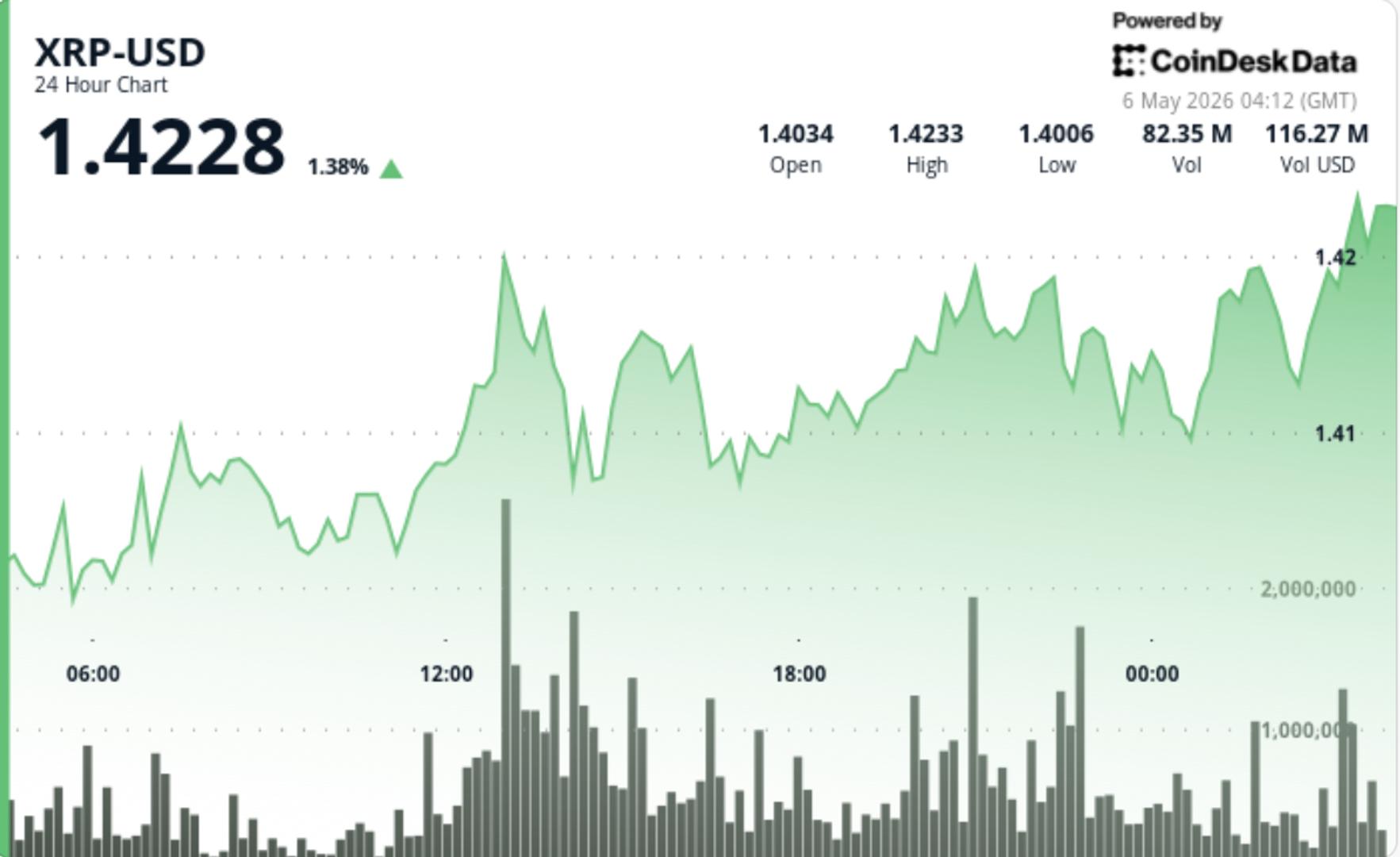
XRP is back above $1.42, and traders are starting to focus on a chart setup that sent XRP up 66% in less than two weeks when it appeared in 2025.
News Background
• Analysts flagged a repeating XRP chart fractal from 2025, when a breakout from a multi-week bull flag triggered a rally toward all-time highs above $3.
• A bull flag is a pattern where price jumps sharply, then moves sideways or slightly lower for a while before potentially breaking higher again. Traders usually see it as a pause in momentum rather than a full reversal.
• Current price action again shows XRP breaking out of a bull flag while the 20-day and 50-day moving averages approach a bullish crossover.
• Some traders now view holding above $1.40 as critical, with the level acting as both psychological support and the upper boundary of the recent flag structure.
Price Action Summary
• XRP climbed from $1.4011 to $1.4184, extending its weekly gain to nearly 9%.
• A 74.6M volume spike at 13:00 pushed price to $1.4207 before momentum cooled into consolidation.
• The token spent the final hours stabilizing between $1.417-$1.420 after repeated tests of the $1.422 resistance zone.
Technical Analysis
• XRP continues building higher lows, keeping short-term bullish structure intact above $1.40.
• The repeated tests near $1.42 matter because resistance weakens each time sellers fail to force a deeper rejection.
• Liquidity on Binance has fallen to its lowest level since 2020, which historically creates conditions for outsized moves once ranges finally break.
• The broader setup resembles the 2025 breakout structure where XRP compressed for weeks before accelerating sharply higher.
What traders should watch
• $1.42 remains the key breakout level. A clean move above it opens the path toward $1.47-$1.50.
• Holding above $1.40 is equally important because failed breakouts often turn into fast reversals once momentum fades.
• If the range finally resolves lower, $1.34-$1.37 becomes the first major support zone traders watch.

Bitwise Chief Investment Officer Matt Hougan says the CLARITY Act’s fate matters less than ending the uncertainty around it. He argues that crypto can survive the bill failing, but cannot thrive in regulatory limbo.
Hougan made the case in his CIO memo, written as major crypto assets trade sharply lower and the bill awaits a full Senate vote.
Why CLARITY Act Uncertainty Keeps Institutions Sidelined
The legislation would draw a clear line between SEC and CFTC jurisdiction and replace enforcement-led oversight with a statutory framework. The House passed it 294-134 in July 2025, with 78 Democrats in favor.
Senate Banking Chairman Tim Scott then steered the bill through a 15-9 committee vote on May 14, capping nearly a year of bipartisan talks. Committee Republicans frame it as delivering clear rules and stronger investor protections.
However, the floor math is harder. Republicans hold 53 Senate seats, and passage requires 60 votes, yet only two committee Democrats backed the bill. Remaining Senate floor hurdles range from DeFi treatment to stablecoin rules.
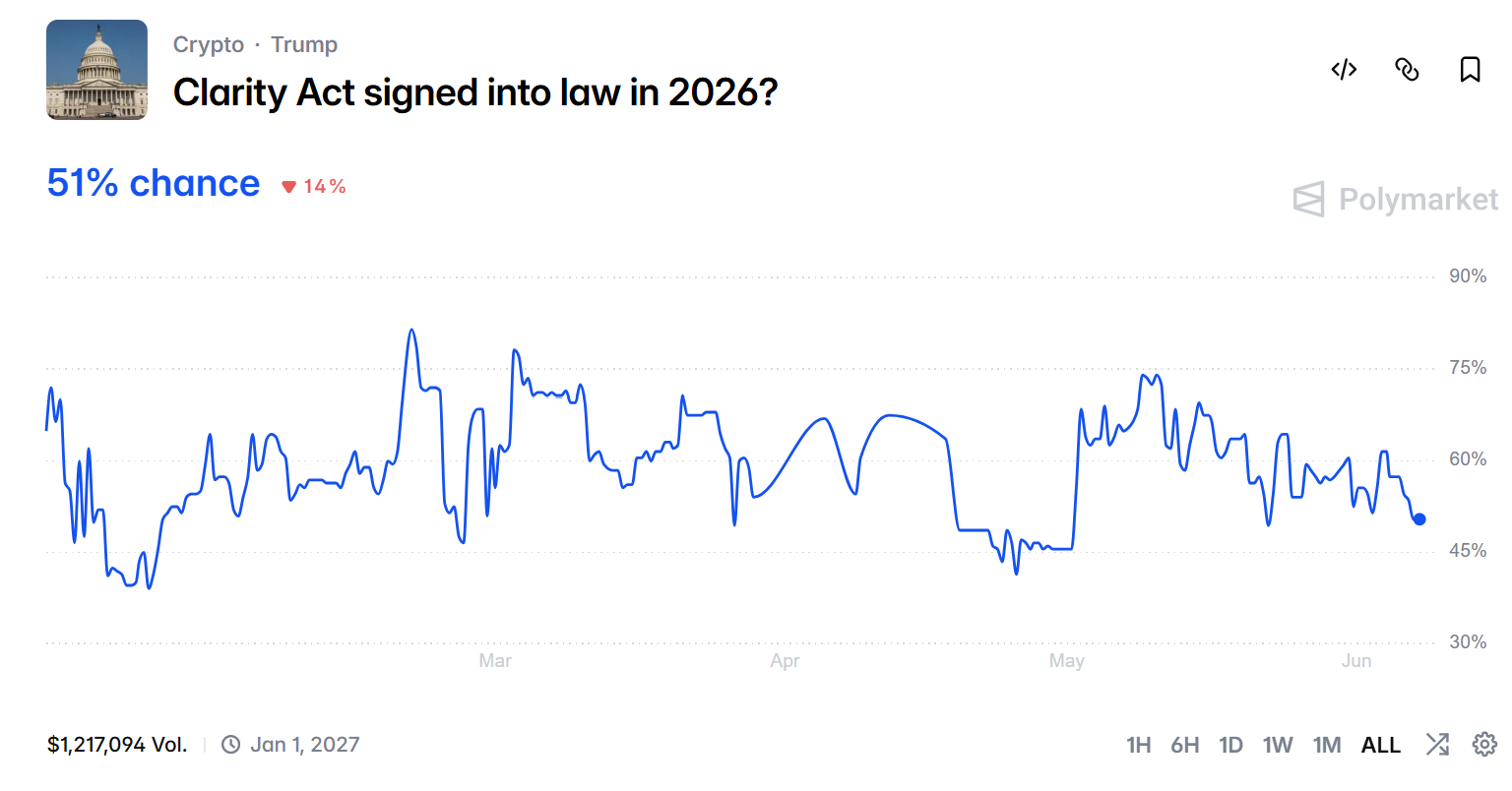
That tension explains the odds gap. Polymarket traders price year-end approval at 51%, Hougan noted in the memo. Meanwhile, his own Washington contacts place the chances between 5% and 30%.

This uncertainty keeps institutional capital on the sidelines. Investors can buy AI stocks at record highs instead of risking a regulatory setback within months, he wrote.
“Crypto can survive CLARITY failing or rally if the bill passes. But it can’t thrive in the in-between,” Hougan said in the memo.
Follow us on X to get the latest news as it happens
Crypto Builds While Washington Stalls
Hougan describes a market shifting from momentum trade to contrarian bet. Instead of chasing hype, investors increasingly reward protocols like Hyperliquid that generate real revenue.
Bitcoin (BTC) has fallen 21% this year, while Ethereum (ETH) and Solana (SOL) are down 33% and 37%, per the memo. Crypto ETFs also face outflows, and spot trading volumes sit at multi-year lows.
In contrast, Hyperliquid (HYPE) gained 72% in a month, and Zcash (ZEC) rose 50%. Neither rally tracked the macro names, a divergence Hougan attributes to idiosyncratic fundamentals.
Hougan reads that rotation as evidence that the crypto winter may end sooner than many expect. Green returns built on real growth, he argued, signal a changing season.
He has also said the CLARITY Act could reshape crypto asset valuations once it passes.
Still, he expects no sustainable large-cap rally before Congress settles the question.
The Senate’s next scheduling decisions may therefore matter more to prices than the final vote itself.
The post Crypto Can Survive CLARITY Failure, But Not the Wait: Bitwise CIO appeared first on BeInCrypto.
President Donald Trump endorsed lower interest rates and declared that growth does not cause inflation before walking out of a Meet the Press interview with NBC’s Kristen Welker.
The walkout clip now dominates social feeds. However, the policy signals buried in the exchange matter far more for Bitcoin (BTC), oil, and equities.
The Walkout Buried a Clear Message on Rates
In the interview, Welker pressed Trump on whether the Federal Reserve may need to raise rates under new Chair Kevin Warsh.
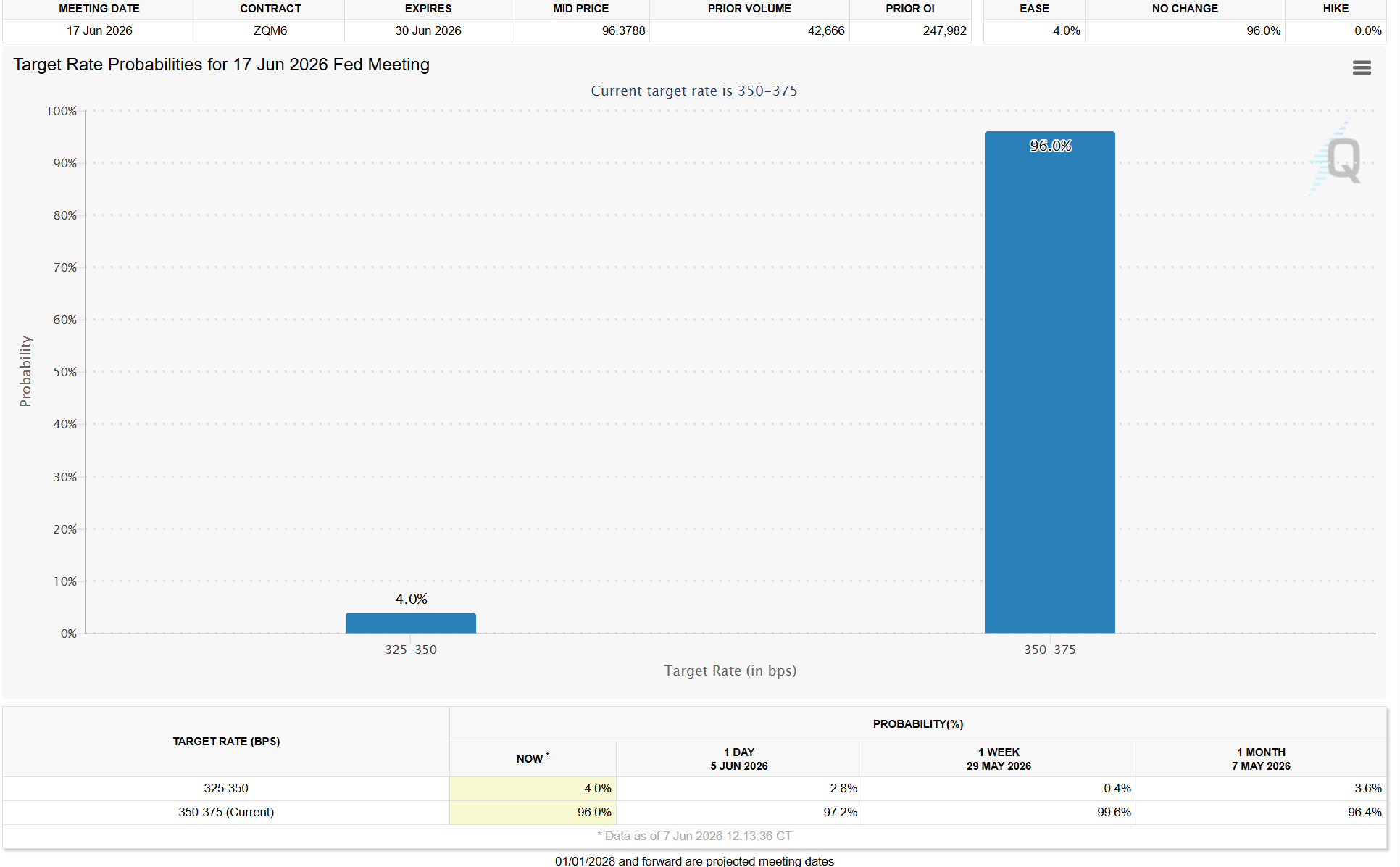
The Senate confirmed Warsh on May 13 by 54 votes to 45, the narrowest margin for any Fed chair. He chairs his first policy meeting on June 16 and 17, with rates at 3.50% to 3.75%.
Trump pushed the opposite way.
“There’s no reason to raise interest rates. The country becomes great. We built the country by doing great and having rates low.”
Fresh data gives the President his talking point. May payrolls rose by 172,000, roughly double the 85,000 consensus, while unemployment held at 4.3%.
Trump drew a conclusion that rejects decades of Phillips curve thinking, which links hot labor markets to rising prices.
“Growth is the greatest thing you can have and growth does not cause inflation.”
The stance revives a first-term pattern. Trump publicly hammered then Chair Jerome Powell through 2018 and 2019 to force cuts.
This time the pressure lands on an awkward target. Warsh built his reputation as a hawk and quit the Fed board in 2011 after opposing quantitative easing.
“I think Kevin is fantastic, and I want to do whatever he wants and I don’t want to have a big influence on him…”
Markets are not listening yet. CME FedWatch prices a 96% chance of a hold this month.

Follow us on X to get the latest news as it happens
Oil Prices Hinge on the Iran Endgame
The war has rewritten energy math since late February. Brent crude jumped from about $72 per barrel to nearly $120 before easing to about $94 on Friday.
AAA puts the national gas average at $4.17 per gallon, up $1.16 since the Iran war began.

That is the inflation pressure Warsh inherits. Asked whether gas prices have peaked, Trump refused to commit.
“It depends. It depends where the war goes. It could be after I give them a shot, and it could be if we sign an agreement it will go down now otherwise it will go down after we finish.”
Either path ends the same way, he argued, with gasoline prices set to “drop like a rock.”
A deal would also reopen the Strait of Hormuz, the corridor carrying roughly 20% of global oil supply.
Bigger Budgets, Bigger Liquidity
Trump also signaled more military spending on top of a record base.
“We have debt and other thing, we have things we want to take care of. I want to go bigger on the military. I really do.”
The FY2027 budget already requests $1.5 trillion for defense, the largest single-year total since World War II, per CSIS.
The OMB projects a $2.06 trillion deficit this fiscal year, rising to $2.17 trillion next. Funding that gap forces the Treasury to issue more than $166 billion in debt every month.
Lower rates plus heavier issuance point to expanding liquidity, the variable Bitcoin traders watch most.

However, the trade has a catch. A prolonged oil spike could push inflation higher and force a hawkish Warsh to act like one.
The June 17 decision offers the first test of whether the President’s message moves his new chair.
The post Trump’s Explosive Interview Walkout Buried a Bigger Message for Markets appeared first on BeInCrypto.
Crypto World
Total3 Chart Echoes 2022 Bear Bottom as Analysts Eye $1 Trillion Altcoin Market Recovery

TLDR:
- Total3 altcoin market cap sits near $670B–$680B, mirroring the 2022 bear market bottom structure.
- Weekly RSI on Total3 is approaching 34.66, close to the oversold zone seen at the 2022 cycle floor.
- Analysts project up to $1T in altcoin market cap expansion over the next two to three months.
- Over 83% of Binance-listed assets trade below their 200-day moving average amid broad altcoin weakness.
The Total3 altcoin market cap is drawing attention from crypto analysts after its weekly chart began resembling the structure seen at the 2022 bear market bottom.
Currently sitting in the $670B–$680B range, Total3 tracks all crypto assets excluding Bitcoin and Ethereum.
Analysts point to a familiar convergence of price compression and weakening sell-side momentum. The setup is raising questions about whether the altcoin cycle may be approaching a structural turning point.
RSI Compression Raises Early Recovery Signals
Total3’s weekly Relative Strength Index is approaching the same exhaustion zone that preceded the 2022 market floor.
The RSI on the weekly timeframe sits near 34.66, approaching but not yet at the oversold readings that accompanied the 2022–2023 bear market floor.
That level, while still below neutral, shows that selling pressure is losing its earlier intensity. Momentum is not collapsing the way it did during the sharpest legs of the previous downturn.
In the 2022 cycle, RSI spent weeks compressing inside a tight range before gradually reversing. Price did not immediately recover during that compression.
Instead, the market built a base quietly while the chart formed its floor. That same pattern of slow stabilization is what analysts are now observing across the Total3 weekly structure in 2026.
Crypto analyst account Our Crypto Talk noted on X that alts are “rhyming again,” pointing to how similar bottoms in 2022 preceded massive moves in assets like FET, KAS, SOL, TRAC, and ICP.
Those gains ranged from 300% to over 2,600% during the subsequent recovery phase. The post framed the current period as a possible dollar-cost averaging window before 2027.
Whether the compression reflects a structurally healthier altcoin market or simply an incomplete correction remains the central unresolved question. Still, the RSI trajectory alone is giving some traders reason to watch closely.
Price Structure and Altcoin Outlook for 2026
Beyond RSI, the price action on Total3 is forming a recognizable descending support structure. In 2022, that same trendline looked bearish for months before the market began building a base above it.
Once RSI turned upward from its low range, the next altcoin uptrend gradually took hold. A similar technical alignment is now visible on the 2026 weekly chart.
Nearly 83% of assets listed on Binance are currently trading below their 200-day moving average, according to CryptoQuant analyst Darkfost.
That figure captures the broad scope of the ongoing altcoin weakness. However, Darkfost also noted that the most meaningful opportunities in past cycles emerged during periods of extreme pessimism rather than during widespread strength.
Our Crypto Talk projected that the next two to three months could bring roughly $1 trillion in altcoin market cap expansion.
The post stopped short of calling a traditional altseason, instead pointing to a more selective recovery tied to specific assets with strong chart setups. That distinction matters, as not every token moved equally during the 2022-to-2023 recovery.
The current drawdown, at 44.65%, is tracking at roughly half the severity of the 2021–2023 bear market, which erased 75.11% from Total3 before recovery began.
That comparison, while not definitive, adds context to the argument that the current cycle may be less extreme and potentially closer to its floor.



Michael Saylor may have offered a clue about Strategy’s (MSTR) next move after last week’s surprise bitcoin sale.
On Sunday, the company’s executive chairman posted the chart traditionally used to track Strategy’s bitcoin purchases on X, writing: “A good time to add more dots.”
Market observers have viewed such posts as a precursor to a new acquisition, although the company has yet to officially announce any transaction and will likely broadcast any action on Monday.
Strategy CEO Phong Le appeared to reinforce that message in a reply to Saylor’s post. “Our corporate @Strategy is to increase net Bitcoin and Bitcoin per share over time,” Le wrote. “Rumors otherwise are just rumors.”
The messages came after Strategy found itself under renewed scrutiny last week. The company disclosed last Monday that it had sold 32 bitcoin, worth roughly $2.5 million, its first sale since 2022. While immaterial relative to its more than 843,000-BTC treasury, the transaction sparked debate because investors have long viewed Strategy as one of bitcoin’s most consistent sources of demand.
Some market participants interpreted the BTC sale as a potential sign that Strategy could sell more of its bitcoin holdings to support dividend payments or shore up liquidity if market conditions deteriorate further. Those concerns have only grown as bitcoin slumped below $60,000 on Friday, its weakest level since October 2024.
Adding to the spotlight, SEC filings on Friday showed two senior executives’ plans to sell a combined $15 million worth of MSTR shares.
CEO Phong Le disclosed plans to sell roughly $11.1 million of stock, while CFO Andrew Kang filed to sell about $3.9 million. The transactions were tied to recently vested stock awards.

Ethereum treasury company Bitmine has filed to launch a public offering of 3 million shares of its 9.50% Series A Perpetual Preferred Stock.
The proceeds are expected to support a range of corporate and Ethereum-focused initiatives.
Bitmine’s New Offering
According to the company’s filing with the Securities and Exchange Commission (SEC), the net funds raised may be used for general corporate purposes, including the acquisition of additional ETH and other digital assets, the expansion of its staking and validator infrastructure through its MAVAN platform, working capital requirements, strategic investments tied to the Ethereum ecosystem and broader digital asset adoption, and potential repurchases of its common stock under an existing buyback program.
The preferred shares will carry cumulative dividends at a fixed annual rate of 9.50% based on a stated value of $100 per share. The dividends are payable in cash when declared by the company’s board. If any declared dividend is not paid on schedule, additional compounded dividends will accrue weekly, and the applicable rate will gradually increase up to a maximum of 15% per year until the outstanding amount is fully settled.
Bitmine has applied to list the new preferred shares on the New York Stock Exchange under the ticker symbol “BMNP,” and trading is expected to begin within 30 days of the initial issuance if the listing receives approval.
Interestingly, Bitmine’s application is based on a model similar to Saylor-led Strategy’s STRC perpetual preferred stock, which pays an 11.5% dividend. STRC has attracted investors looking for monthly income while gaining indirect exposure to Bitcoin. After raising around $2.52 billion through its initial public offering in July 2025, the program expanded through follow-on issuances. The total notional amount of STRC is approximately $10.5 billion.
Aggressive ETH Accumulation
With its Ethereum holdings rising to 5.42 million ETH, Bitmine said it has reached roughly 90% of its target to own 5% of all ETH. The company also said 4.72 million ETH are staked, with a portion of those assets secured through its MAVAN staking platform.
As one of the sector’s most active buyers, Bitmine has built the largest ETH treasury and the second-largest overall crypto treasury after Strategy. The sharp drop in Ethereum, which is down more than 45% year to date, has created significant challenges for Ethereum treasury companies. Recent data estimates indicate that Bitmine is carrying unrealized losses of more than $10 billion.
Even so, Chairman and Fundstrat co-founder Tom Lee remains optimistic on Ethereum, as he predicted the end of the bull market and the beginning of crypto spring.
The post Bitmine Plans 9.5% Preferred Stock Plan to Fuel Its Ethereum Buying Spree appeared first on CryptoPotato.

Bitcoin’s bear-market narrative remains unsettled as on-chain data shows realized losses in the 2026 downturn have yet to surpass the peak hit during 2022, even though the market’s dollar-denominated value sits higher. Analysts warn that a fresh phase of capitulation could still materialize before bulls find a durable bottom, highlighting a complex tug-of-war between stubborn retail conviction and displaced institutional selling.
Key takeaways
- Bitcoin’s 2026 realized losses have not yet exceeded the 2022 peak of about $211 billion, despite a higher market cap in USD terms.
- Analysts suggest a new round of loss-making market exits may be needed to preserve historical bear-market patterns.
- Retail conviction remains notably high, even as macro catalysts push prices lower, complicating the conventional bear-market bottom story.
- Institutions have tended to sell into relief rallies, potentially delaying a capitulation-driven bottom and rebalancing supply-demand dynamics.
- The market may require several more months to determine whether 2023-style losses will be surpassed, signaling a clearer bottom formation.
Realized losses: a near-term signal with longer horizons
New data from on-chain analytics platform CryptoQuant indicates that investor capitulation in the current bear market has not reached the severe levels observed in 2022. Realized losses are calculated when coins move on-chain at prices lower than their previous cost basis, a classic sign that investors are selling at a loss.
Darkfost, a CryptoQuant contributor, summarized the situation by noting that, in USD terms, losses would be expected to rise as market capitalization grows during bear markets. As of October’s top, roughly $174 billion in losses have already been realized, according to the analyst’s estimates. This figure still trails the $211 billion record set in 2022, even though Bitcoin’s market cap is higher today in nominal terms.
The implication is subtle but meaningful: if losses continue to accumulate in USD as the market cap expands, the next phase of selling pressure could intensify and push prices toward a more definitive capitulation. Darkfost cautioned that while a purge could still occur, the interpretation remains subjective until more definitive loss realization surpasses prior cycle peaks.
Bitcoin bear market realized loss comparison. Source: Darkfost/X
Historically, bear-markets are marked by spikes in losses as investors liquidate positions to avoid deeper drawdowns. The current trajectory, with a higher market cap yet a still-below-peak loss tally, raises questions about whether the ultimate bottom will form sooner or later, and what that means for traders waiting on a definitive capitulation signal.
Retail conviction versus institutional behavior
Market chatter around BTC’s bottom formation continues to emphasize a striking dynamic: retail participants appear to be engaged in aggressive dip-buying, while larger players have shown a tendency to sell into relief rallies. Ardi, a well-known market observer, notes that retail traders have been “buying every dip” in a bid to catch a bottom that remains elusive, even as price trends betray a broader down cycle.
In contrast, institutions—whose participation typically lends more stability to price action—have been less inclined to hold onto relief rallies. Instead, larger investors are described as selling into bounces, exporting supply onto retail buyers who endure the market’s volatility. Ardi describes the present setup as a pattern where the least-capitalized participants absorb the supply from the most capitalized ones, which is not the typical behavior seen at major bottoms.
The upshot is a market where bullish sentiment among a broad base of retail traders complicates the bottoming process. If the demand from retail remains robust while institutions stay wary or liquidity-drained, price discovery could remain range-bound for longer, postponing a clear bottom and potentially extending the bear-market narrative beyond earlier expectations.
Ardi cautioned that persistent, high retail conviction may prevent a true capitulation from forming, a prerequisite many traders historically associate with durable bottoms. The interplay between demand from smaller traders and the exit of larger market participants will likely influence how soon and how sharply BTC can establish a firmer floor.
What to watch next in a market that’s still searching for a bottom
Looking ahead, several indicators will help gauge whether the bear-market phase is nearing a close or if the potential for further losses remains on the table. First, continued monitoring of realized losses across cycles can illuminate whether the 2022 peak remains the gold standard for capitulation or if new thresholds emerge as the market cap continues to grow. Second, the behavior gap between retail and institutions will be telling: a narrowing of this gap, or a shift in institutional sentiment toward accumulating during dips, could signal a more constructive turning point.
Market participants should also keep an eye on macro catalysts and on-chain flows that could alter supply dynamics—such as changes in mining economics, network efficiency improvements, or shifts in exchange reserve movements—that often accompany major turning points. While 2026 has already diverged from prior bear-market archetypes in terms of participation, the pace and direction of the next few months will help determine whether the bear’s endgame resembles past cycles or charts a new course.
For readers tracking the evolving BTC narrative, the next data releases and sentiment shifts will be crucial. If retail demand maintains its strength while institutions reluctantly reduce exposure, the balance of supply and demand may tilt in favor of a more decisive bottom formation—or at least a more reliable price floor—later in the year. Until then, observers should prepare for continued volatility as the market weighs whether the 2023 losses will be surpassed and what that implies for the trajectory of Bitcoin’s bear-market timeline.
Crypto World
5 Critical Stocks to Monitor Next Week: Nvidia (NVDA), Broadcom (AVGO), CrowdStrike (CRWD), UnitedHealth (UNH), and Marvell (MRVL)

Key Takeaways
- Nvidia (NVDA) continues to serve as the primary barometer for AI infrastructure investment and market confidence
- Broadcom (AVGO) confronts investor skepticism following a sharp decline despite delivering solid quarterly performance
- CrowdStrike (CRWD) experienced a post-earnings downturn even after boosting forecasts and revealing a stock split
- UnitedHealth (UNH) emerges as a preferred choice for investors seeking shelter in defensive healthcare positions
- Marvell (MRVL) experienced an AI-fueled rally before retreating, setting up a critical test in the coming sessions
Five companies—Nvidia, Broadcom, CrowdStrike, UnitedHealth, and Marvell—will command significant attention from investors during the upcoming trading week. These names represent crucial market narratives: the artificial intelligence revolution, cybersecurity expansion, healthcare stability, and evolving investor risk preferences.
Nvidia and Marvell at the Forefront of AI Momentum
Nvidia continues to hold its position as the market’s most influential equity. The stock serves as a proxy for AI infrastructure investment trends, with its price action offering insight into broader confidence levels surrounding the artificial intelligence sector. Despite a modest retreat from recent highs, Wall Street analysts maintain their bullish outlook on the company’s long-term prospects.
Marvell captured headlines recently following reports that Nvidia CEO Jensen Huang hinted the semiconductor firm could eventually achieve a trillion-dollar market capitalization. The speculation triggered a substantial rally in shares. However, Marvell subsequently retreated in tandem with the broader chip sector, creating uncertainty as the new week approaches.
A swift return of buying interest in these two names would reinforce the durability of the AI investment thesis. Conversely, continued weakness might prompt questions about valuation levels and whether expectations have outpaced fundamentals.
Nvidia’s leadership position stems from its GPU dominance, advanced networking solutions, and expanding AI software ecosystem. Meanwhile, Marvell has gained prominence through its specialized AI chip designs and cloud infrastructure offerings, establishing itself as a frequently discussed Wall Street favorite.
Broadcom and CrowdStrike Face Market Scrutiny
Broadcom delivered impressive quarterly results but stumbled when its forward guidance failed to exceed lofty market expectations. Shares tumbled in response. The upcoming week will reveal whether investors view this correction as an attractive entry point or the beginning of broader pressure on AI-adjacent equities.
CrowdStrike similarly declined following its earnings release, despite posting robust numbers, elevating guidance, and announcing a stock split. The selloff reflected valuation anxieties rather than operational concerns.
Cybersecurity investment remains on an upward trajectory. Enterprises continue allocating larger budgets toward cloud security solutions, endpoint defense systems, and AI-enhanced threat monitoring capabilities. A rebound in CrowdStrike’s stock price would indicate revived investor enthusiasm for high-growth software companies.
Broadcom maintains strategic importance in the AI landscape through its custom silicon offerings and networking infrastructure products. A recovery in its shares could generate positive spillover effects throughout the semiconductor industry.
UnitedHealth Gains Traction as a Safe Haven
UnitedHealth has captured increased investor attention following a positive analyst rating revision. As technology stocks experience heightened volatility, capital is migrating toward healthcare as a more dependable sector.
UnitedHealth benefits from predictable revenue streams and a commanding market presence. These characteristics enhance its appeal during periods of market turbulence.
Market participants will monitor whether institutional capital continues shifting into healthcare equities. Should this trend persist, UnitedHealth could emerge as a reliable outperformer amid choppy market conditions.
Collectively, these five equities encapsulate Wall Street’s dominant investment themes: AI infrastructure buildout, cybersecurity market expansion, and the pursuit of stability when facing market uncertainty.
TLDR:
- Michael Saylor posted Strategy’s Bitcoin tracker, signaling a possible new BTC purchase soon.
- Similar posts by Saylor have often preceded official disclosures of additional Bitcoin buys.
- Strategy holds over 840,000 BTC and continues treating Bitcoin as a core treasury asset.
- Investors see potential accumulation as a positive signal amid recent weakness in market sentiment.
Strategy Chairman Michael Saylor signaled a potential new Bitcoin purchase after posting the company’s holdings chart on X. On June 7, Saylor shared the tracker and wrote, “A good time to add more dots.”
The post attracted market attention because Saylor has frequently shared similar updates before announcing new Bitcoin acquisitions. Strategy has subsequently disclosed additional purchases following several of those earlier posts.
The signal arrived days after reports emerged that Strategy sold 32 Bitcoins on June 1. The sale surprised market participants and coincided with a broader digital-asset market correction. Investors focused on the fact that Strategy had sold even a small portion of its holdings.
Some market participants now view Saylor’s latest message as a sign that additional purchases could follow. They expect further accumulation by Strategy to support sentiment after recent market weakness.
Strategy remains the largest corporate holder of Bitcoin. The company currently holds more than 840,000 Bitcoin and continues to treat the asset as a central treasury reserve.
Strategy Continues Accumulating Despite Market Volatility
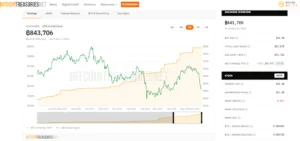
Strategy’s holdings chart shows continued accumulation through periods of price volatility. The company added roughly 171,000 Bitcoin during the year, representing a 25% increase in holdings.
Source: Bitcoin Treasury
The chart indicates that Bitcoin’s market value experienced fluctuations during early 2026. However, Strategy’s total holdings continued rising throughout the same period. The pattern suggests that the company maintained purchases regardless of short-term price movements.
The company’s reported holdings reached 843,706 Bitcoin. The average acquisition cost stood near $75,702 per Bitcoin, while the total cost basis approached $63.8 billion.
The chart also showed a market net asset value ratio of approximately 0.66. That level indicates the company’s market valuation traded below the value of its Bitcoin holdings.
Market participants have cited concerns including execution risk, leveraged exposure, and continued capital raises. Those factors may contribute to investor caution despite ongoing accumulation.
Bitcoin Treasury Model Remains Central to Corporate Strategy
Strategy has built its corporate identity around Bitcoin accumulation. The company continues raising capital through debt and equity markets to fund additional purchases.
That approach increases the amount of Bitcoin held per share over time. It also strengthens Strategy’s role as a publicly traded vehicle for Bitcoin exposure.
Each purchase removes additional Bitcoin from the available market supply. The accumulation strategy has therefore attracted attention from both investors and market observers.
The model remains dependent on continued access to capital markets. Extended weakness in Bitcoin prices could create additional challenges for financing future acquisitions.
Even so, Saylor has consistently maintained support for Bitcoin as a core corporate asset. His latest post reinforced that position and renewed expectations of further purchases.
The development comes as retail participation appears to weaken while institutional accumulation continues. If Strategy proceeds with another acquisition, it would extend a buying pattern that has defined the company’s Bitcoin strategy for years.
TLDR:
- Bitcoin spot trading volume has declined 81% from its October 2025 peak across major exchanges.
- Total CEX spot trading volume fell to $4.3 trillion in March, the lowest since October 2024.
- Binance captured 32% of spot market share as liquidity increasingly shifted to larger exchanges.
- Ethereum faces concerns over prolonged consolidation unless a fresh market narrative emerges.
Bitcoin spot trading activity has fallen sharply across centralized exchanges, reaching its lowest levels in years. Data cited by market commentator Su Hu shows Bitcoin’s spot trading volume dropped 81% from its October 2025 peak.
Binance recorded monthly spot trading volume of $198.6 billion in October 2025. That figure has since declined to approximately $36.4 billion. Across all centralized exchanges, total spot trading volume fell to $4.3 trillion in March 2026.
The March figure represented a 48% decline from the October 2025 peak. It also marked the lowest level since October 2024. Spot trading activity weakened further in April, reaching a 25-month low and continuing its downward trend.
The decline followed the November 10 market crash, when liquidations reportedly exceeded $19 billion. Since that event, spot trading volumes have decreased each month across major exchanges.
Liquidity Concentrates on Major Exchanges as Smaller Platforms Lose Activity
Trading activity has become increasingly concentrated among the largest cryptocurrency exchanges. According to the data, roughly 90% of market liquidity is now held by leading platforms.
Binance accounted for 32% of global spot market share in March 2026. During parts of 2025, the exchange controlled as much as 41% of the market. Smaller exchanges have seen declining participation as liquidity shifted toward larger venues.
The concentration of trading activity has coincided with lower overall market participation. The data suggests that market activity is increasingly centered on major exchanges and larger participants.
Observers note that spot markets typically reflect activity from everyday cryptocurrency traders. Reduced spot volume therefore indicates lower engagement from participants who commonly trade based on market narratives and short-term opportunities.
The decline in activity follows a period of choppy price movements after the 2025 market peak. Trading conditions have remained uneven, contributing to weaker participation across spot markets.
Market Participants Assess Opportunities Beyond Cryptocurrency Trading
The decline in spot activity has occurred alongside growing attention toward other asset classes. Market participants have increasingly focused on stocks, gold, and commodities during recent months.
According to the commentary, these markets currently offer clearer narratives and more consistent trends. By comparison, cryptocurrency markets have faced lower enthusiasm and reduced speculative participation.
Despite lower activity, the analysis does not characterize reduced retail participation as inherently negative. Lower-volume environments can coincide with periods when stronger market participants gradually absorb available supply.
Su Hu argued that ordinary investors face challenges obtaining the information available to larger market participants.
He advised maintaining reasonable allocations to alternative cryptocurrencies while considering other assets that provide greater confidence.
The commentary also addressed Ethereum’s market position. It stated that Ethereum’s primary challenge is not only price weakness but the possibility of an extended period of low-level consolidation.
According to the analysis, Ethereum may require a new narrative capable of attracting capital, developers, and broader market consensus.
Crypto World
Boeing (BA) Stock: FAA Green Light, Potential China Mega-Deal and Strong Q1 Spark Rally

Key Takeaways
- The FAA has granted Boeing authorization to establish an additional 737 MAX production facility in Everett, WA, with plans to reach 52 aircraft monthly by early 2027.
- Treasury Department sources indicate China may purchase 500–550 more Boeing planes, potentially coinciding with President Xi’s anticipated September U.S. visit.
- Singapore Airlines is considering acquiring at least 50 widebody aircraft, with the Boeing 777X among the options under review.
- Boeing’s first-quarter earnings exceeded Wall Street forecasts, reporting a $0.20/share loss compared to the anticipated $0.68 deficit, while revenue climbed 14% year-over-year to $22.22 billion.
- Analysts maintain a “Moderate Buy” rating with a mean price target of $259.80; shares closed Friday at $215.72.
Boeing (BA) shares closed at $215.72 on Friday, sliding 0.8% despite an accumulation of favorable news surrounding the aerospace giant.
Regulators at the FAA have given Boeing the green light to launch a second 737 MAX final assembly facility in Everett, Washington. Operations commence July 6, with the company targeting monthly production expansion from 47 aircraft to 52 units by the first quarter of 2027. CEO Kelly Ortberg emphasized a disciplined approach to ramping up output, prioritizing quality assurance throughout the process.
Regarding aircraft deliveries, Boeing completed the handover of two 787-9 Dreamliners to Riyadh Air, representing the initial portion of a commitment for as many as 72 planes. United Airlines received the inaugural higher-weight iMTOW variant of the 787-9, enabling extended range and increased payload capacity on routes departing San Francisco.
The company’s latest quarterly financial performance surpassed Wall Street expectations. Boeing recorded a per-share loss of $0.20, significantly better than the consensus estimate calling for a $0.68 deficit. Total revenue reached $22.22 billion, marginally topping projections while representing a 14% year-over-year increase.
China Opportunity Takes Center Stage
The potential China business represents the development garnering the most investor attention. An initial agreement covering approximately 200 aircraft was perceived as disappointing by market participants. However, Treasury Department officials have subsequently indicated Beijing may ultimately order between 500 and 550 additional planes. A potential trigger point could arrive with President Xi’s planned September visit to the United States.
China’s ongoing dependence on American-manufactured components for its domestic C919 commercial aircraft program provides additional negotiating dynamics to the bilateral relationship. This geopolitical and commercial context has contributed to Boeing’s stock recovery in recent trading sessions.
Separately, Singapore Airlines has acknowledged it is evaluating the acquisition of no fewer than 50 widebody jets. The carrier is weighing both the Boeing 777X and Airbus A350-1000 platforms. Discussions remain in preliminary phases.
Challenges Persist
Despite positive momentum, Boeing continues to face operational hurdles. German authorities have launched an investigation following a nose-gear failure incident involving a Boeing 787 at Frankfurt airport that resulted in worker injuries. The episode has reignited concerns regarding quality oversight within the 787 manufacturing process.
NASA has placed the Starliner spacecraft program “under review” after complications during its crewed test mission. Future missions are expected to proceed without crew, creating schedule pressure given the International Space Station’s anticipated decommissioning timeline before 2030.
The 777X program continues to present difficulties. Deliveries have been postponed until next year — approximately seven years past the original schedule. Several carriers have responded by ordering Airbus alternatives to address capacity requirements.
ING Groep NV dramatically expanded its Boeing holdings during the fourth quarter, increasing its position by more than 2,000% through the addition of 736,861 shares, bringing total ownership to 772,400 units. Vanguard and Geode Capital similarly boosted their stakes in the same reporting period. Institutional investors collectively control 64.82% of outstanding shares.
Wall Street price targets span from $250 (Wells Fargo and Morgan Stanley with equal-weight ratings) to $295 (Tigress Financial and Jefferies maintaining buy recommendations). The average analyst target stands at $259.80, suggesting approximately 20% appreciation potential from present trading levels.
Boeing’s 52-week trading band extends from $176.77 to $254.35, with the 50-day moving average positioned at $220.80.

Christian Eriksen ‘conscious and doing well’ after collapsing during Denmark friendly

Weitz Ultra Short Government Fund Q1 2026 Commentary (Mutual Fund:SAFEX)

I Worried My Daughter Loved Her Toys Too Much. Then, Another Family Lost Everything.



-

 Fashion2 days ago
Weekend Open Thread: Evereve – Corporette.com
-

 Business6 days ago
Jade Biosciences, Inc. (JBIO) Discusses Positive Interim Results From JADE101 Phase I Healthy Volunteer Study and Development Plans Transcript
-
 Crypto World2 days ago
Jensen Huang Approves Samsung, SK Hynix, and Micron for NVIDIA (NVDA) HBM4 Memory Supply
-

 Sports5 days ago
French Open 2026 results: Alexander Zverev beats Rafael Jodar and will play Jakub Mensik in semi-finals
-

 Tech5 days ago
CryZENx Releases Fresh Playable Content Deep Inside Jabu-Jabu for His Ocarina of Time Remake
-

 Business5 days ago
Trump Taps Housing Chief Bill Pulte as Acting Intelligence Director After Gabbard Exit
-
Crypto World2 days ago
LBank Surpasses 25 Million Users Worldwide as AFA Partnership Continues to Drive Global Growth
-
 Business17 hours ago
The Pain Points Taking a Fragile Tech Rally Down a Notch
-
 NewsBeat5 days ago
Republicans balk at Trump’s attempt to appoint a MAGA enforcer to lead National Intelligence
-

 Tech2 days ago
RCS Messages Between iPhone and Android Get End-to-End Encryption With iOS 26.5
-
 Crypto World5 days ago
Seagate (STX) Stock Surges to Record High on AI Boom and Legal Settlement
-

 Tech2 days ago
Microsoft launches MXC, an OS-level sandbox for AI agents, with OpenAI and Nvidia already on board
-
Crypto World5 days ago
EU AI Data Center Project Faces Delays as Funding Gaps Grow
-

 Entertainment5 days ago
Did The Mandalorian And Grogu Already Ruin The Next Star Wars Movie?
-

 Tech2 days ago
Meta steals a tactic from Tesla and builds data centers in tents
-

 Business5 days ago
Aehr Test Systems Stock Soars 17% Amid Surging AI Demand and Conference Spotlight
-
 Business5 days ago
Claude AI Down Today Reason: Why Anthropic’s AI is not working today? What’s the latest quota update
-
 Crypto World2 days ago
Merlin (MRLN) Stock Soars 32% on Major USSOCOM Autonomy Milestone
-

 Tech5 days ago
Instagram will stop bombarding teens with the same kind of obsessively unhealthy content
-

 Business5 days ago
Relay Therapeutics Shares Surge 20% on ASCO Momentum for Zovegalisib Breast Cancer Program
You must be logged in to post a comment Login