Hackers trojanized installers for the DAEMON Tools software and since April 8, delivered a backdoor to thousands of systems that downloaded the product from the official website.
The supply-chain attack led to thousands of infections in more than 100 countries. However, second-stage payloads were deployed only to a dozen machines, indicating a targeted attack aimed at high-value targets.
Among the victims receiving next-stage payloads are retail, scientific, government, and manufacturing organizations in Russia, Belarus, and Thailand.
A report today from cybersecurity company Kaspersky notes that the attack is ongoing and that trojanized software includes DAEMON Tools versions from 12.5.0.2421 through 12.5.0.2434, specifically the DTHelper.exe, DiscSoftBusServiceLite.exe, and DTShellHlp.exe binaries.
Advertisement
DAEMON Tools is a Windows utility that allows mounting disk image files as virtual drives. The software was extremely popular in the 2000s, especially among gamers and power users, but today its deployment is limited to environments where virtual drive management is required.
As of today, Kaspersky says that the attack is ongoing.
Once unsuspecting users download and execute the digitally signed trojanized installers, they trigger the malicious code embedded in the compromised binaries. The payload establishes persistence and activates a backdoor on system startup.
The server can respond with commands that instruct the system to download and execute additional payloads.
Advertisement
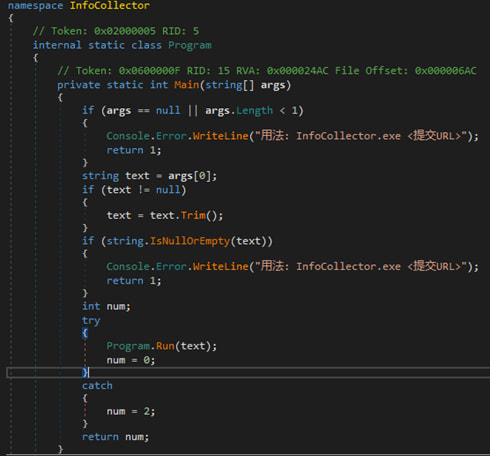
The first-stage malware is a basic information stealer that collects system data, such as hostname, MAC address, running processes, installed software, and system locale, and sends them to the attackers for victim profiling.
Basic info-stealer payload Source: Kaspersky
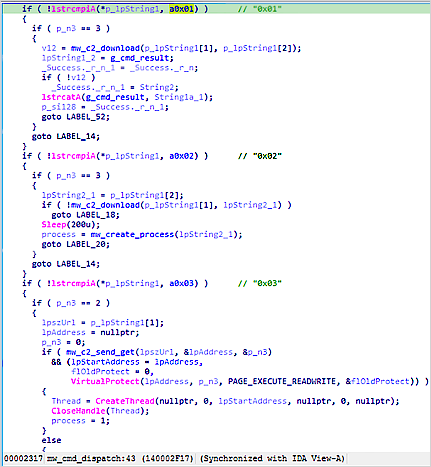
Based on the results, some systems receive a second stage, which is a lightweight backdoor that can execute commands, download files, and run code directly in memory.
Code snippet from the backdoor Source: Kaspersky
In at least one case targeting a Russian educational institute, Kaspersky observed the deployment of a more advanced malware strain dubbed QUIC RAT, which supports multiple communication protocols and can inject malicious code into legitimate processes.
BleepingComputer has contacted DAEMON Tools with a request for a comment on the supply chain attack, but we have not heard back by publication.
Kaspersky describes the DAEMON Tools supply-chain attack as a sufficiently sophisticated compromise that evaded detection for almost one month.
“Given the high complexity of the attack, it is paramount for organizations to carefully examine machines that had DAEMON Tools installed, for abnormal cybersecurity-related activities that occurred on or after April 8,” the researchers say.
Advertisement
Although Kaspersky does not attribute the attack to a particular threat actor, based on strings found in the first-stage payload, the researchers believe that the attacker is Chinese speaking.
Since the beginning of the year, software supply-chain attacks have been detected almost every month: eScan in January, Notepad++ in February, CPU-Z in April, and DAEMON Tools this month.
Similar attacks targeting code repositories, packages, and extensions have been even more prevalent this year, with Trivy, Checkmarx, and the Glassworm campaigns being among the most prominent.
AI chained four zero-days into one exploit that bypassed both renderer and OS sandboxes. A wave of new exploits is coming.
At the Autonomous Validation Summit (May 12 & 14), see how autonomous, context-rich validation finds what’s exploitable, proves controls hold, and closes the remediation loop.
Across the world, digital workflows are becoming the default, but few countries have pushed this transition as far, and as fast, as India. With platforms like DigiLocker and Aadhaar-based authentication enabling billions of transactions, entire ecosystems are now operating without physical paperwork.
Which raises a fundamental question: in a system without paper, what replaces the signature?
At first glance, this appears to be a story about efficiency—faster processes, reduced paperwork, seamless execution. But that framing is incomplete. What is unfolding is far more fundamental: a shift in how trust itself is constructed.
Advertisement
Article continues below
Because a signature, at its core, has always answered three simple questions, who agreed, what they agreed to, and whether that agreement can be proven legally later. For decades, we relied on a physical act to answer these questions. Today, we are beginning to rely on esign software.
Rakesh Dosi
Advertisement
Chief Business & Product Officer, Protean eGov Technologies Ltd.
Work Has Changed. Signatures Are Catching Up
For a long time, the signature wasn’t just a mark, it was a ritual. You procured stamp paper, printed something, signed it, scanned it, sent it back. It felt like completion. But that feeling came from a world where work moved slowly enough for these pauses to exist.
Advertisement
That world doesn’t really exist anymore.
Today, work is no longer confined to offices or even time zones. A decision can start in Mumbai, get reviewed in Singapore, and be executed in London, often within the same day. Workflows are not linear anymore; they’re layered, parallel, and embedded into the tools we use every day.
Sign up to the TechRadar Pro newsletter to get all the top news, opinion, features and guidance your business needs to succeed!
In such an environment, a physical signature is not just slow, it is misaligned. And the data is starting to reflect that shift.
Advertisement
Trust has moved from familiarity to verification
For a long time, trust was built on something deeply human recognition.
A signature worked not because it was foolproof, but because it was familiar. You saw it, you recognized it, and that recognition stood in for trust.
But familiarity, as it turns out, is a fragile proxy.
A handwritten signature can be imitated. It can be forged, scanned, copied, or lifted from one document and placed onto another.
And yet, for decades, systems continued to rely on it—not because it was secure, but because it was accepted. Trust, in that world, was based on continuity. “This looks right” was often enough.
What has changed is not just technology but the expectation of trust itself.
Advertisement
Trust is no longer about whether something looks right
Today, trust is no longer about whether something looks right. It is about whether it can be proven to be right.
E-Stamping/Digital Stamping and Electronic signatures represent that shift. They are not built on visual similarity or human memory. They are built on cryptographic verification, a system where legal document, identity, intent, and integrity are mathematically bound to the document.
When you sign electronically, several things happen simultaneously:
Advertisement
You can stamp the paper for the agreement value on the fly
Your identity is authenticated through secure digital credentials
The document is encrypted and linked to your signature
Any change to the document after signing becomes immediately detectable
A verifiable audit trail is created, timestamped, traceable, and tamper-evident
Post signing the document, get a AI based summary of the document signed and stamped.
In other words, trust is no longer implied. It is engineered.
This is a fundamental shift—from subjective trust to objective trust.
From “I recognize this” to “I can verify this” to “I can hold this document legally in any court of law”
At Scale, Systems Matter More Than Steps
Scale has a way of exposing everything we try to hide inside a process.
Advertisement
In small systems, inefficiencies are tolerable. A delayed signature, a missing page, a manual follow-up—these are inconveniences. But when the same process is required to operate across millions of transactions a day, those inconveniences don’t stay small. They compound. They multiply. They become risk.
India provides a compelling example. Whether in payments, telecom onboarding, insurance issuance, or public service delivery, systems are designed to handle millions of concurrent transactions. In such environments, consistency becomes more critical than speed.
Physical signatures introduce variability they can be illegible, misplaced, or disputed. They require additional verification layers, each adding time and cost.
Electronic signatures operate differently. They are deterministic. Every transaction follows a defined protocol. Authentication, consent, and execution happen within a structured framework, eliminating ambiguity and reducing dependency on manual intervention.
Advertisement
Because of this, e-signatures can be embedded directly into systems triggered automatically, executed instantly, and recorded seamlessly. The workflow does not pause for a signature; the signature becomes part of the workflow.
At scale, systems cannot rely on human intervention at every critical step. They need processes that are predictable, repeatable, and integrable. Electronic signatures are not just a faster alternative to physical ones they are aligned with how modern systems are designed to function.
Because when you are operating at the scale of millions, the question is no longer “Can this work?”
It is “Will this work the same way, every single time?”
Advertisement
Compliance Is Becoming Embedded, Not Enforced
Compliance used to be something you proved after the work was done.
A document moved, someone signed it, it got filed away and somewhere down the line, an auditor would come in and ask: Can you show me what happened here? Compliance, in that world, was retrospective. It relied on reconstruction piecing together intent, sequence, and authenticity from static records.
That model worked when workflows were slower, linear, and contained within physical boundaries.
Advertisement
Today, transactions occur instantly and across distributed systems. By the time an audit begins, the moment it seeks to verify has already passed. Compliance, therefore, cannot remain an afterthought.
Electronic signatures fundamentally shift this paradigm. They transform the act of signing into a compliance event. E stamping and digital stamping have further redefined what the digital signature journey looks like in practice, not as a sequence of disjointed steps, but as a single, continuous transaction.
The act of stamping, once a separate logistical exercise involving procurement, verification, and physical handling, now happens contextually now of agreement, bound directly to the document, the signer’s identity, and the transaction value. Increasingly, this journey is being enhanced by AI-driven capabilities.
Intelligent systems can now summarize executed documents instantly, highlighting key clauses, obligations, and risks—reducing the cognitive load on users and decision-makers post signing. AI can also classify documents, flag anomalies, detect missing signatures, and provide contextual insights across large volumes of agreements.
Advertisement
In this model, signing is no longer just about execution; it becomes a point of understanding, verification, and intelligence. The signature doesn’t merely conclude a process it activates a smarter one.
At the moment of execution, identity is verified, timestamps are recorded, documents are sealed against tampering, and every interaction is logged. Compliance is no longer something that needs to be proven later it is built into the transaction itself.
This reduces ambiguity and eliminates reliance on interpretation. More importantly, it shifts compliance from a periodic checkpoint to a continuous state. Organizations are no longer preparing for audits; they are operating within systems that are inherently auditable.
This is particularly significant in regulated ecosystems like finance, insurance, and government services—where trust is not just important, but foundational.
Advertisement
The Real Shift: Alignment with a Digital-First World
If you step back, the rise of electronic signatures is not about replacing paper. It is about alignment.
– Physical signatures belong to a world that was: local, linear, and dependent on human coordination
– Electronic signatures belong to a world that is: distributed, system-driven, and built on verifiable trust
Advertisement
India’s digital public infrastructure from Aadhaar to DigiLocker, is simply accelerating this transition by providing the rails on which such trust can operate at scale.
So, the question is no longer whether electronic signatures are “better.”
The more precise answer is this: They are better suited to the world we now live in.
And that, more than anything else, is why they are becoming the default.
This article was produced as part of TechRadar Pro Perspectives, our channel to feature the best and brightest minds in the technology industry today.
The views expressed here are those of the author and are not necessarily those of TechRadarPro or Future plc. If you are interested in contributing find out more here: https://www.techradar.com/pro/perspectives-how-to-submit
Sharp Consumer Electronics has struck a distribution agreement with CANAL+ that will see the streaming platform pre-installed across Sharp’s TiVo-powered smart TV range in eight European markets.
The arrangement covers France, Hungary, the Netherlands, Poland, Romania, Slovakia, Belgium, and the Czech Republic, spanning the range of territories where CANAL+ currently operates its subscription service.
Across those markets, the CANAL+ app will come pre-installed on all Sharp smart TVs that run the TiVo operating system, removing the step of manual installation from the app store that can reduce ‘discovery’ of streaming services that compete for prominence on crowded home screens.
That content catalogue spans premium sports rights, theatrical film releases, and original series, giving Sharp TV owners in the covered markets access to programming that sits closer to a traditional pay-TV bundle.
Advertisement
Alongside the pre-installation, Sharp is integrating a dedicated CANAL+ shortcut into the remote controls of supported TV models for even quicker access to the streaming app.
Advertisement
TiVo, whose operating system underpins the Sharp smart TV range in this new partnership, also forms part of the three-way arrangement, with the platform’s content-first interface offering assistance in surfacing CANAL+ content to viewers who are browsing for films, series, and live sport.
CANAL+ EVP of industrial partnerships Philippe Schwerer noted the company’s intent to strengthen its position in the smart TV market and extend access to its content catalogue to its 26.3 million subscribers across Europe, a figure that reflects the broadcaster’s scale relative to newer streaming entrants competing in the same regional markets.
Advertisement
Sharp has not confirmed which television models will carry the pre-installed app and dedicated remote button, though the partnership covers new devices running TiVo across all eight European territories where CANAL+ holds broadcast rights.
An anonymous reader quotes a report from CNBC: OpenAI President Greg Brockman concluded his testimony on Tuesday, where he largely rebutted Elon Musk’s account of the early years of the startup and negotiations that occurred at the company. Brockman testified that he never made any commitments to Musk about the company’s corporate structure, and he never heard anyone else make them. He emphasized that OpenAI is still governed by a nonprofit. “This entity remains a nonprofit,” Brockman said, referring to the OpenAI foundation. “It is the best-resourced nonprofit in the world.” […] Brockman, who spoke from the witness stand in federal court in Oakland, California, over the course of two days, also revealed that Musk had enlisted several OpenAI employees to do months of free work for him at Tesla, Musk’s electric vehicle company. That work mainly included efforts to overhaul the company’s approach to developing self-driving technology as part of the Autopilot team there in 2017. During his two days on the stand, Brockman answered questions about his personal financial ambitions, his understanding of OpenAI’s structure and Musk’s involvement at the company, which they co-founded with other executives in 2015.
In Musk’s testimony last week, the Tesla and SpaceX CEO said that the time, money and resources he poured into OpenAI had been integral to the company’s success. He repeatedly said that he helped recruit the company’s top talent. Brockman said Tuesday that while Musk was helpful in convincing some employees to take the leap to join OpenAI, he was a polarizing figure for others. “Elon had a reputation of being an extremely hard driver,” Brockman said. He added that “certain candidates were very attracted” by Musk’s involvement at OpenAI, and that “certain candidates were very turned off.” Musk testified last week that a former OpenAI researcher named Andrej Karpathy joined Tesla, but only after he had planned to leave the startup already. Brockman said that Musk, after he hired Karpathy, approached him with “an apology and a confession,” about the hire, and that neither Musk nor Karpathy had told him the researcher planned to leave OpenAI before that. Musk was generally not very available for meetings and conversations, Brockman said, so he relied on employees, including Sam Teller and former OpenAI board member Shivon Zilis, as proxies. Brockman testified that open sourcing OpenAI’s technology was “not a topic of conversation” during Musk’s time with the nonprofit, despite Musk’s claims that it was supposed to be central to the organization. He also described tense 2017 negotiations over a possible for-profit arm, saying Musk became angry when equity stakes were discussed. “He said Musk declined the proposal during an in-person meeting, then tore a painting of a Tesla Model 3 car off the wall, and began storming out of the room,” reports CNBC. He also demanded to know when the cofounders would leave the company.
Brockman further said Musk wanted control of OpenAI because he disliked situations where he lacked control, citing Zip2 and SolarCity as examples Musk had raised. He also testified that Musk partly wanted control to help fund his broader SpaceX ambition of building a “city on Mars.”
CNBC notes the trial will resume at 8:30 a.m. PT on Wednesday, with Shivon Zilis expected to testify. She is the mother of four of Musk’s children and a former OpenAI board member.
Nearly 30 years after Altec Lansing introduced the first multi-channel digital soundbar, Klipsch has just introduced another first: the first soundbar with integrated DIRAC Live room correction. Unveiled at CEDIA Expo 2024, the Klipsch Flexus Core 300 soundbar took a little longer than expected to hit the market, but it’s here now and we’re excited to put it through its paces.
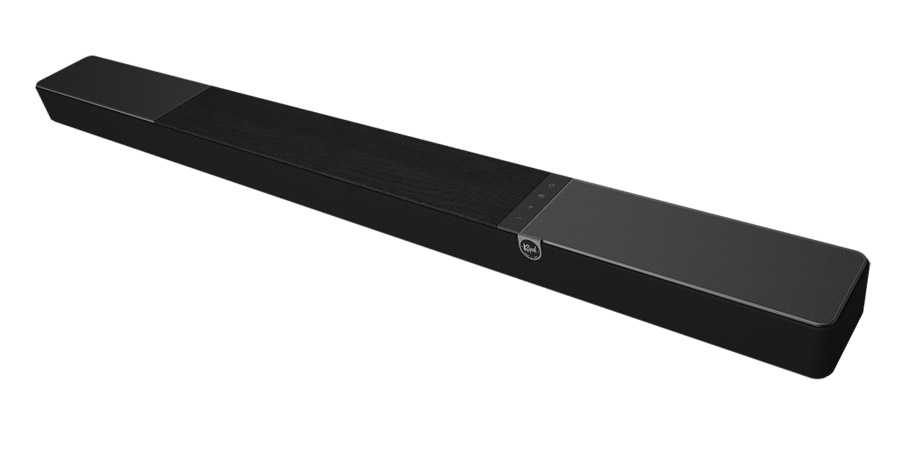
The Klipsch Flexus Core 300 is available in black (pictured) and walnut finishes.
What Is It?
The Klipsch Flexus Core 300 ($1,199.99) is the latest soundbar in the Klipsch Flexus line. The bar is described as “5.1.2-channel” as it uses both up-firing and side-firing reflective drivers to extend the soundstage above and around the listener. Amplifiers designed by sister company Onkyo are built-in, so you won’t need to add an A/V receiver or amplifier. The Flexus Core 300 supports both Dolby Atmos and DTS:X immersive surround as well as legacy audio formats like PCM, Dolby Digital and DTS surround. The company claims a frequency response of 43Hz–20kHz, though listening suggests that this is a bit optimistic, at least on the low frequency end.
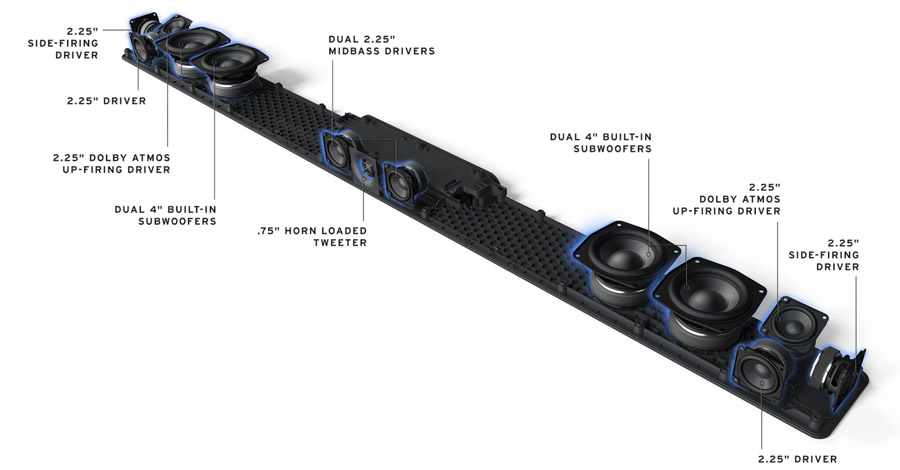
The Flexus Core 300 bar features 285 total Watts of clean Onkyo power, driving 13 speakers. This includes four front-firing, two side-firing and two up-firing drivers as well as four integrated woofers for low frequency reproduction. The 13th driver is a dedicated ¾-inch horn loaded tweeter for the center channel.
Driver layout of the Klipsch Flexus Core 300 soundbar.
At 54 inches wide, 3 inches tall and almost 5 inches deep, it’s one of the larger bars we have tested. It makes a great visual match for a 65 inch or 75 inch TV, though its depth will make wall-mounting a challenge. If you’re placing it on a credenza or console, be sure your TV’s stand or feet give you enough clearance so the bar doesn’t block the TV screen or IR sensor.
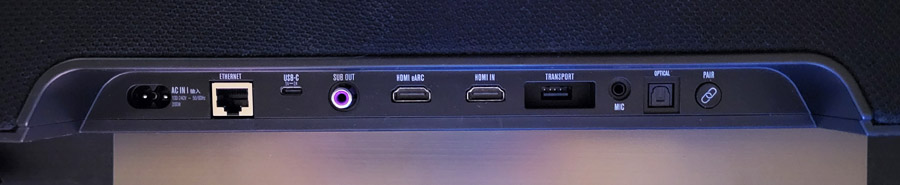
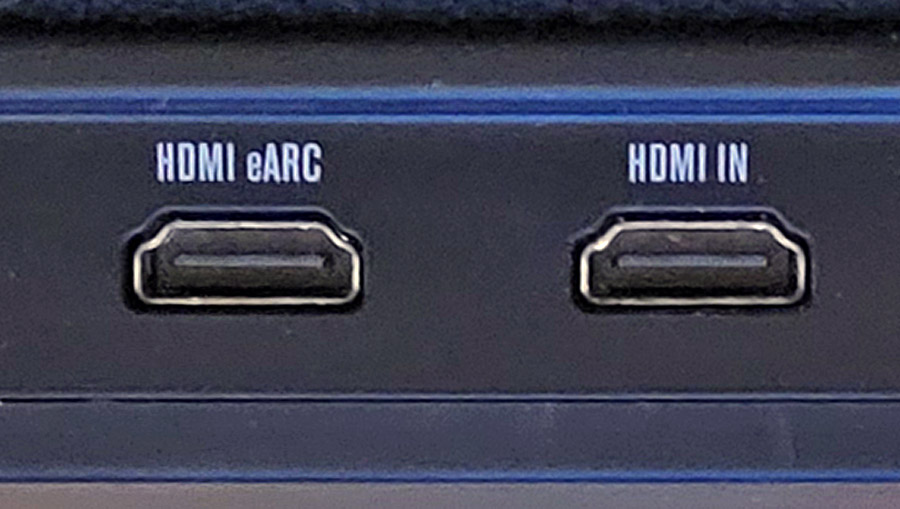
The bar includes an HDMI port with ARC/eARC for connection to a TV as well as a second HDMI port for direct source connection. This second HDMI port is particularly handy if you are using the bar with an older TV or projector without ARC/eARC support or one that is limited in its ability to pass through all audio formats.
The Flexus Core 300 also includes a fiberoptic digital audio input, an RCA output for a wired subwoofer, a USB-C port for digital music playback and firmware updates, an Ethernet jack for hard-wired network connection, as well as a mic input for the calibration microphone. The USB port marked “Transport” is for connection of a wireless transmitter dongle which enables optional rear speakers and up to two wireless subwoofers. The bar also includes Bluetooth and WiFi wireless connectivity with support for Apple AirPlay 2, Google Cast, Spotify Connect and TIDAL Connect.
Advertisement
Like most high-end soundbars, the Flexus Core 300 supports the addition of wireless rear channel speakers and a subwoofer. Actually the Core 300 can support up to two wireless subwoofers for enhanced immersion and low bass reproduction. And unlike most bars, the unit also includes a standard RCA subwoofer output so you can use it with virtually any third party powered subwoofer. In fact, you could connect two wireless subwoofers and a wired one for a prodigious amount of bass, even in a large room.
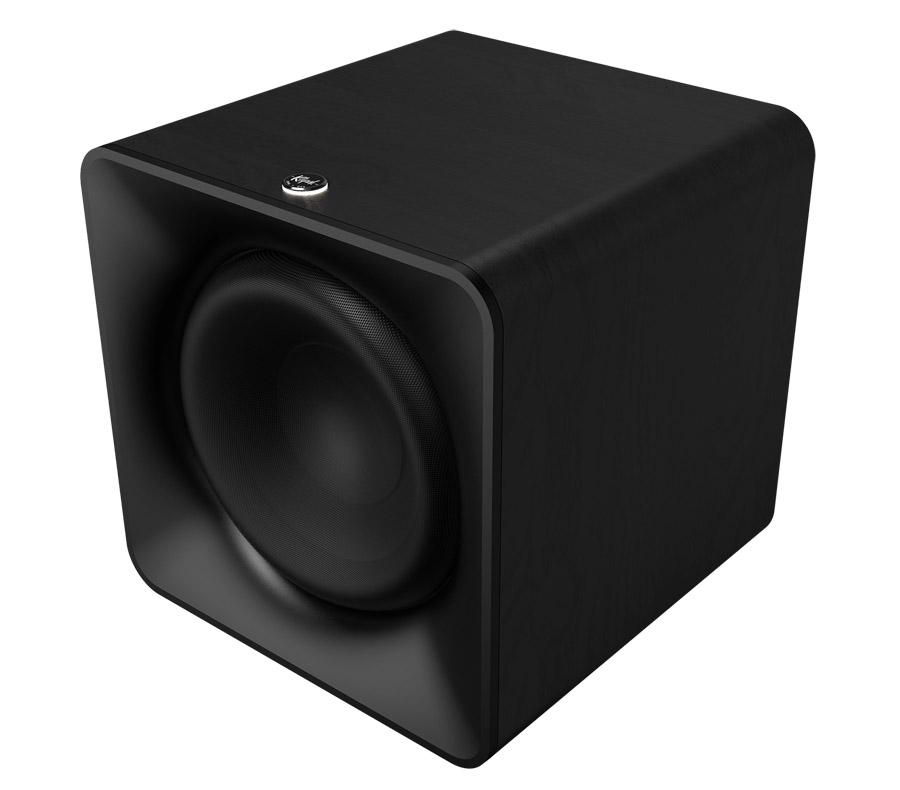
The Klipsch Flexus SUB 200 is a 15-inch cube with 200 watts of Onkyo amplification on board.
We tested the bar on its own and with the Klipsch Flexus SURR 200 rear speakers ($499/pair) and Flexus SUB 200 subwoofer ($599) for a total system price of around $2,300. A smaller SURR 100 speaker is also available which omits the up-firing driver. A smaller wireless subwoofer (SUB 100) is also available for use in smaller spaces.
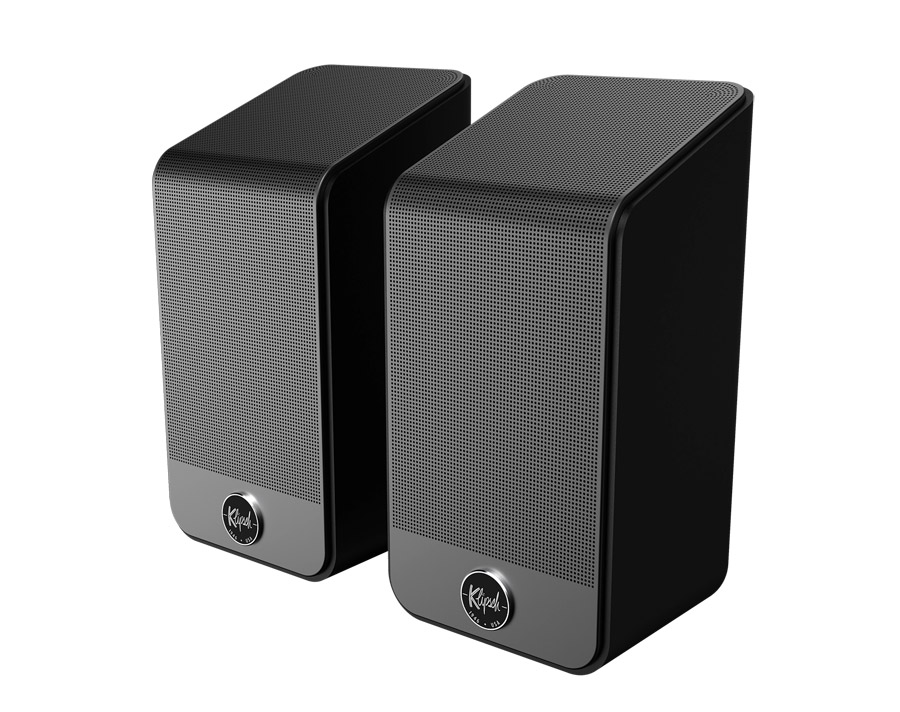
Klipsch Flexus SURR 200 speakers ($499/pair).
The SURR 200 speakers include both front-firing and up-firing drivers, expanding the bar from 5.1.2-channels to 7.1.4 channels. They include a threaded stand mount, but no keyhole mount so you’ll need a stand or bookshelf for them (be sure not to block the upfiring driver for height sounds).
All That with a Side of DIRAC
What sets the Flexus Core 300 apart from any other soundbar-based system is support for DIRAC Live room correction. As soundbars and speaker systems expand to more and more channels, the speakers interact not only with their environment (walls, furniture and ceiling) but also with each other. DIRAC Live room correction identifies and corrects for room frequency anomalies by applying digital filters, adjusting phase, EQ and levels of each speaker. This allows the system to work more coherently as a whole, with all drivers helping to compensate for idiosyncrasies in the listening room.
The DIRAC version included with the Flexus Core 300 is the limited bandwidth version, though the full bandwidth version is available from DIRAC for a nominal upgrade fee (Currently $99).
Advertisement. Scroll to continue reading.
Advertisement
Features and Functionality
In addition to DIRAC Live, the Flexus Core 300 has plenty to offer from a features standpoint. It decodes the two most popular immersive surround sound formats – Dolby Atmos and DTS:X – as well as other legacy versions of Dolby and DTS surround and PCM. It doesn’t support more obscure immersive formats like AURO-3D, Sony 360RA, MPEG-H or Eclipsa Audio, but few soundbars do. The Flexus 300 offers Night Mode for compressed dynamic range as well as a dialog boost in case you’re having trouble hearing voices over the action. Surround modes include “Movie” and “Music” which change the overall surround presentation and EQ curve. There’s even a tri-band equalizer (Bass, Midrange, Treble) in the mobile app.
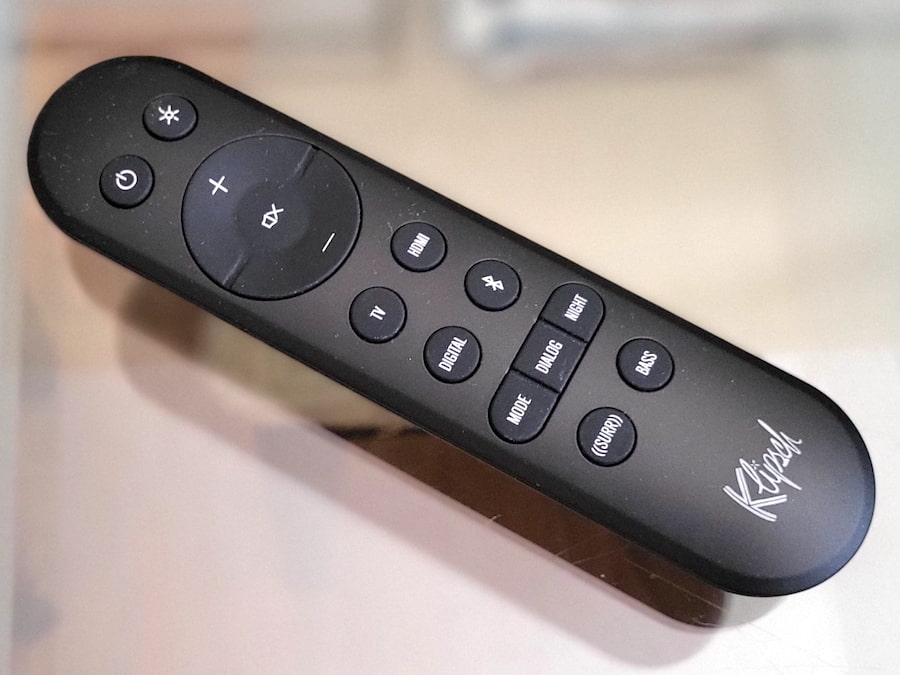
The Flexus comes with a fairly robust remote control that handles all of the essentials, including direct buttons for each input selection, volume and mute. The remote also includes access to surround modes (Movie or Music), Dialog mode and Night mode. Another nice touch is that the remote provides adjustment of the surround channel levels (side, rear and height) as well as a variable bass control. Many bars require that you dive into the app for these kinds of adjustments.
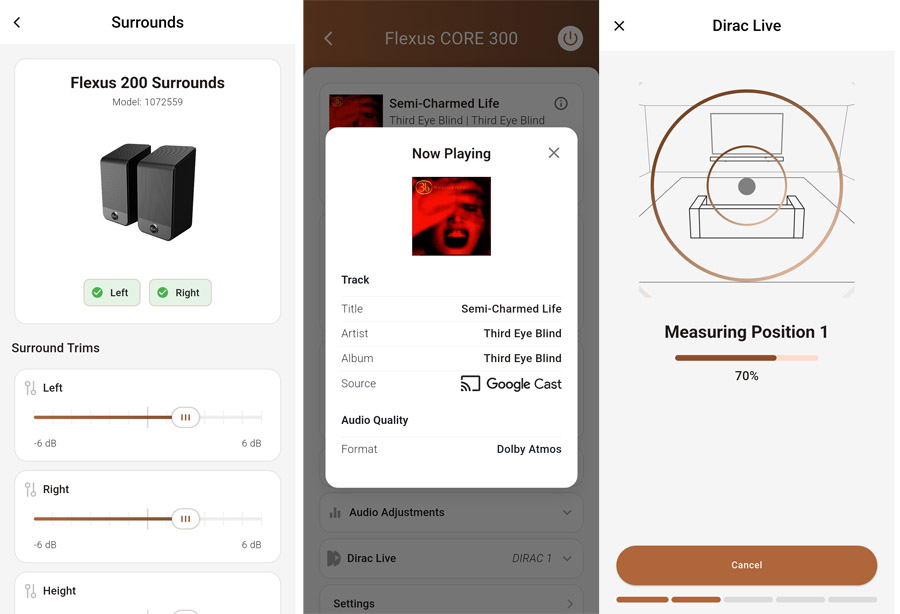
While you can get sound out of the bar without doing a full set-up, you’ll be best-served installing the Klipsch Connect app for Android and iOS. This allows you to connect the system to the internet for firmware updates, enable Google Cast, adjust options, and make direct adjustments to the levels of the various speakers from within the app. The app is also essential to perform DIRAC Live calibration using the included microphone.
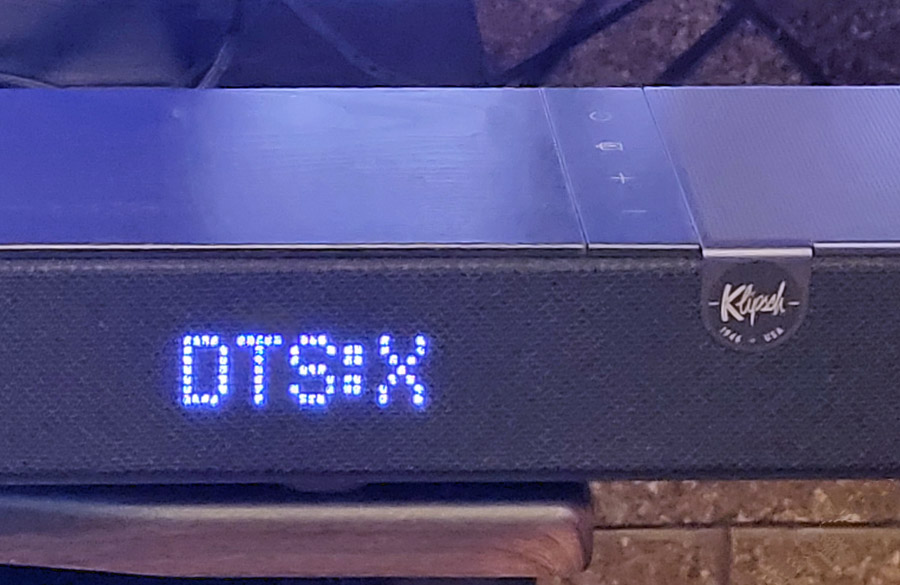
Pro Tip: If you want to see what audio format is coming into the bar, press and HOLD the LED light button on the top right of the remote control. This will display the surround format, e.g. Dolby Atmos or DTS:X on the soundbar’s LED screen.
The Set-Up
For the most part, the Flexus Core 300 is “plug and play.” If your TV has an HDMI port with ARC (Audio Return Channel) or eARC (enhanced Audio Return Channel), then this is the connection you should use. Connect an HDMI cable between the bar’s HDMI/eARC port and the TV’s HDMI/eARC port and this will get you sound from the TV, its on-board tuner, any built-in streaming apps and any devices connected to the TV. Though it should be automatic, you may need to get into your TV’s “audio output” settings menu to set the output to “external speakers” (or something similar) in order to enable the audio output over HDMI.
The HDMI eARC port may be the only one you need. But it’s nice to have a second one.
Once connected, we’d recommend installing the Klipsch Connect mobile app on your phone or tablet. Connect your phone or tablet to WiFi, load the app and click on the “+” button to add the Flexus Core 300 bar. The Klipsch Connect app will then walk you through the rest of the set-up. Be sure to enable “Google Cast” in the app if you intend to use that feature to cast audio from a phone, PC or tablet to the bar.
We listened to the bar on its own for a while, then added the optional Flexus Sub 200 wireless subwoofer and Flexus Rear 200 wireless speakers. Note that adding a wireless sub or wireless rear speakers requires connecting a wireless transmitter dongle to the rear USB port marked ”Transport” on the back of the bar. A dongle comes with the subwoofer and with the rear speakers.
Advertisement
The dongle that comes with the subwoofer is identical to the one that comes with the rear speakers, except for the pairing. If you use the dongle that came with the sub, you’ll need to manually pair the rear speakers by pressing the pairing buttons on both the speakers and the soundbar. And if you use the dongle that came with the rear speakers, then you’ll need to manually pair the subwoofer by pressing the pairing button on the sub and the bar. One dongle can support up to two wireless subwoofers and a pair of rear speakers.
After adding the rear speakers, rear channel height adjustments were automatically enabled on the remote and in the app.
I do have to mention that, after adding the rear speakers, I started hearing dropouts and other audio glitches coming from the rear right speaker. It was bad enough that I sent them back to Klipsch for a replacement pair, only to have the same problem with the new pair. Doing a bit of research, I found that the Flexus products can be subject to wireless interference from other wireless devices. Klipsch uses a proprietary low latency wireless “Transport Link” connection among its products. It transmits on the 2.4 GHz band and apparently this connection can be disrupted if your speakers are too close to a wireless router or network repeater.
After some debugging, I found the interference was not being caused by my main router, but by my TP-Link mesh network extender, which was around 5 feet from the right speaker. Fortunately I was able to move the repeater about 2 feet. And in that position it was far enough from both rear speakers not to cause any audible distortion or interference to either one.
Advertisement
DIRAC Live in Action
While I did do some listening before setting up DIRAC, most of my testing was done after running through the basic (bandwidth-limited) DIRAC Live correction and calibration process. Getting through it was simple, moving the included mic to three different positions while the app went through its test tone generation and measurements. The entire process took less than 15 minutes.
Advertisement. Scroll to continue reading.
With the DIRAC profile applied, the biggest improvements were in bass definition and imaging precision in the lower midrange. A slight boominess in the lower bass in my listening room was pretty much eliminated by DIRAC and vocals stood out more clearly after calibration. Within the app, you can toggle back and forth, with and without DIRAC. I found the sound was pretty noticeably improved with DIRAC processing applied and didn’t notice any significant artifacts.
The limited bandwidth version only measures and corrects the speakers from 20 Hz to 500 Hz, so upper midrange and treble frequencies are unaffected by the calibration. If you’ve got a highly reflective or problematic room, you might want to invest the $99 to upgrade to the full bandwidth version of DIRAC Live.
Advertisement
Listening
On its own, the Klipsch Flexus Core 300 provided a huge upgrade in sound compared to the built-in speakers in our TCL QM8K TV. And those speakers are actually pretty decent as they were designed in partnership with Bang and Olufsen. Bass was more solid and extended, soundstage width and height was improved, and dialog intelligibility was dramatically improved. On Dolby Atmos and DTS:X content, sounds extended to the sides of the room, but nothing sounded like it was coming from behind me.
On clips like the intro scene from season 1 of “Andor,” rain fell gently from vaguely above and in front of me, while dialog in the nightclub was articulate and audible above the background music. On a more complicated Dolby Atmos scene like the worm attack on the spice crawler about an hour into “Dune,” the swirling sands, music and Bene Gesserit voices were a bit less coherent and distinct, though still vastly better than the sound from the TV speakers.
Moving onto Dolby Atmos music tracks like the EDM track “Alive” by KX5/deadmau5, spatiality on this track was pretty good with a wide, tall and deep soundstage but the bass drop was not super impactful. Additional Dolby Atmos music tracks, like “Rocketman” by Elton John reinforced this opinion. Good dynamics, nice width, some height, but not truly “immersive.”
Send in the Reinforcements
Truth be told, I’ve never been that impressed with a one-piece soundbar, except maybe the $70,000 one from Steinway Lyngdorf. The cabinet of a soundbar just isn’t large enough to do deep bass, and as good as virtualization has gotten over the years, nothing can substitute for a real pair of speakers behind the listening position to create an immersive surround soundstage. So I was eager to add the SUB 200 and SURR 200 speakers to the mix. Doing so was pretty simple. Since I used the wireless dongle that came with the SURR 200 speakers, they were pre-paired with the bar, and all I had to do was plug-in the subwoofer and hit the pairing button on both the sub and the soundbar in order to establish a link.
Advertisement
Adding the subwoofer and rear speakers immediately expanded the soundstage to encompass the whole room with a dome of sound, and bass took on much more impact, heft and substance with the SUB 200 active. Tracks that were a bit thin-sounding, like EDM tracks from Kx5, now had power and substance. And, when the chorus kicked in in Elton John’s “Rocket Man” in Dolby Atmos. the room exploded in sound, with my listening seat at the epicenter.
Diving back into music listening, I queued up my Dolby Atmos playlist on Amazon Music, which includes the Dolby Atmos remix of Pink Floyd’s “Dark Side of the Moon.” The cash register sounds that open the song “Money” were spaced all around the room making me feel like I was inside the mix. The SURR 200 speakers were particularly effective at creating a full wall of sound behind the listening position. Integration from left rear to right rear was seamless. It literally sounded like there was a third rear speaker between the two actual ones.
Other favorite Dolby Atmos music tracks like Ed Sheeran, “Shape of You” and A-Ha “Take On Me” were reproduced on the Flexus system with great spatiality and seamless motion as voices and instruments moved around the room. And on mellower singer/songwriter tracks in Dolby Atmos like Aoife O’Donovan’s “Prodigal Daughter” and Freya Ridings’ “Lost Without You,” female vocals were presented naturally, without excessive stridency while the natural acoustics of the recording space were captured nicely.
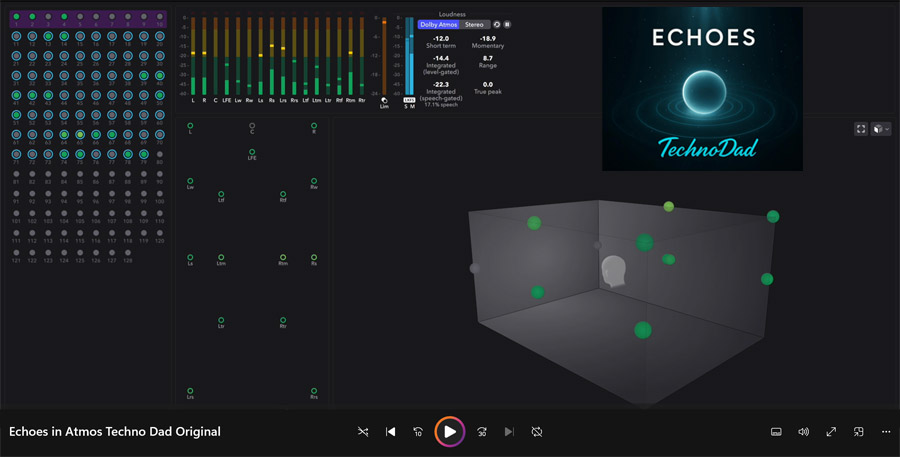
It wouldn’t be a Dolby Atmos test without some content from Channa Da Silva, a.k.a. “Technodad.” On the Flexus Core system, his original track “Echoes” (available in Dolby Atmos on Apple Music) made awesome use of the entire soundstage, front to back, side to side and top to bottom with percussion and synth tracks dancing all around the room. Technodad also offers a Dolby Atmos calibration toolkit, which is super helpful in setting up a home theater or surround sound system. You can check out at SpatialCD.com.
Advertisement
“Echoes” by Technodad, is available on Apple Music in Dolby Atmos, or as an MP4 video, complete with Dolby Atmos renderer visualization.Find out how to download it here.
For DTS:X we put on several UHD Blu-ray Discs, including “Harry Potter and the Sorcerer’s Stone.” About 20 minutes into the film, when Harry enters the magical world of Diagon Alley with Hagrid, the soundscape expands to encompass the entire room with sounds coming from above and behind the listening position. And on “Ex Machina” (also about 20 minutes in), we’re treated to a more claustrophobic sonic experience when a power failure leads to a series of warning tones and foreboding chirps.
Harry’s entrance into Diagon Alley in “Harry Potter and the Sorcerer’s Stone” on UHD Blu-ray Disc is accompanied by an eruption of immersive sound in DTS:X.
The 4K UHD Blu-ray of “Blues Brothers” also features a remixed/remastered DTS:X soundtrack, used to great effect during scenes like the mall chase, with destruction, broken glass and debris raining from all directions. The DTS:X soundtrack also captures the ambiance of a live performance when Cab Calloway takes the stage for his performance of “Minnie the Moocher” in a huge auditorium and the Blues Brothers themselves follow with their own performance. The space of the concert hall was captured nicely in DTS:X on the Flexus system.
Advertisement. Scroll to continue reading.
A Few Words About Stereo Music
Unlike some soundbars, the Klipsch Flexus Core 300 doesn’t currently offer a pure stereo mode. Any stereo content is automatically upmixed to Dolby Surround. You can choose between “movie” and “music” modes, both of which do a pretty good job keeping the stereo soundstage intact, with some air and ambiance added. Movie mode is a bit more dynamic and punchy, while music mode is more laid back, with nice clarity of male and female vocals in the center channel.
Caveats, But Not Deal Breakers
As I noted above, initial set-up of the rear speakers required me to move my mesh network repeater around to prevent interference with the rear speakers, but eventually I was able to find a suitable spot for it. Also, when casting music from my phone via Google Cast, the connection was inconsistent. Qobuz couldn’t reliably connect to the bar via Google Cast. Amazon Music could connect via Google Cast, even passing Dolby Atmos tracks to the bar, but it would sometimes randomly lose the connection, requiring a power cycle to reconnect.
I should note that this issue was device dependent – it worked better on a Google Pixel 10 Pro phone vs. Samsung Galaxy S21FE phone. But even on the Google phone, the bar would occasionally lose the plot, requiring manual disconnect and reconnect of the bar from Amazon Music. If you just access a playlist and hit “play,” you’ll probably be OK, but if you start moving around between tracks or experimenting with surround modes on the bar, you may lose the connection.
Advertisement
The Klipsch Connect app allows you to adjust speaker levels, see details of connected sources and perform DIRAC calibration.
If you enjoy listening to music encoded in Dolby Atmos, you’re probably best off using a dedicated streamer like an Apple TV 4K (for Apple Music) or a Fire TV stick (for Amazon Music), either connected through the TV or directly to the Flexus Core 300’s dedicated HDMI port. This provided a much more reliable and stable listening experience. Of course, we still can’t get gapless playback for Dolby Atmos music tracks via streaming music services (which made listening to “Dark Side of the Moon” a bit annoying), but that’s not the soundbar to blame. For gapless playback on Dolby Atmos tracks, you’ll need to get your Dolby Atmos music on physical media like the amazing “Dark Side of the Moon” 50th Anniversary Dolby Atmos remix on Blu-ray Disc (which sounded particularly sweet on the Flexus Core 300 system).
Physical specifications of all components included in this review:
Flexus Core 300 soundbar: 54 x 3.07 x 4.96 inches (WxHxD) | 18.7 lbs
Flexus Sub 200 subwoofer: 15.25 x 15.25 x 15.25 inches (WxHxD) | 36 lbs
Flexus Surr 200 rear speakers: 4.13 x 8.75 x 4.31 inches (WxHxD) | 2.5 lbs
The Bottom Line
Despite a few hiccups in the set-up process, as well as inconsistent Google Cast performance, the Flexus Core 300 soundbar put in a strong audio performance on music and movies. While I personally wouldn’t be satisfied with the bar on its own, I found that the full system – Flexus Core 300 bar, SUB 200 subwoofer and SURR 200 rear speakers provided a dynamic, expansive, almost cinematic experience at home and was equally competent with both music and movies. While the system price tag ($2,300) isn’t exactly “cheap,” it’s actually less than comparable flagship soundbar-based systems from Sonos and Sony. And with DIRAC Live room correction and calibration thrown in, the system actually provides solid value.
Pros:
Punchy dynamic sound for music and movies
Second HDMI port supports direct source connection
Can do Dolby Atmos music from Amazon Music via Google Cast
DTS:X support worked flawlessly from Kaleidescape and Blu-ray Discs
DIRAC Live optimizes sound for your specific room
Cons:
Rear channels are a bit low in the mix (but can be adjusted)
Google Cast connection was a bit unreliable
Rear speakers were subject to wireless interference from Wi-Fi router (but fine once I moved the router)
It seems fair to say that hamsters are a somewhat divisive pet, between their fluffiness, high-strung nature, short lifespan and incessant squeaking that sounds like some electronic device is trying to tell you something. With that in mind, maybe that having these fuzzy little critter take up some of the daily slack will help endear them to more people. Something like helping to charge mobile devices by converting their frantic exercise wheel time into electrical power. Cue [Flamethrower]’s hamster wheel-powered generator.
Due to the irregular pacing of the hamster on its wheel it makes sense to treat it as an energy harvesting problem, for which the common CJMCU-2557 module – featuring the TI BQ25770 – is a pretty good option. It covers a voltage input from 0.1 – 5.1 V after a cold start minimum of 0.6 V, with a maximum current of 0.1 A.
The modules come with a super capacitor to store collected energy, but you can further charge a connected battery, for which [Flamethrower] used salvaged 18650 Li-ion cells. After letting the hamster do its thing for a night in the – admittedly far too small wheel – there’s enough power in the cell to at least start charging a smartphone, though sadly it’s not mentioned how much power was harvested.
Advertisement
Hopefully the hamster in question will be overclocked with a larger wheel, along with detailed measurements of how many hamsters it takes to charge the average phone.
AI-native enterprise spending surged 94 per cent year on year as traditional SaaS growth cooled to eight per cent. The SaaSpocalypse erased 285 billion dollars from software valuations in February 2026, and every enterprise platform from Salesforce to a Hong Kong messaging startup called Omnichat is racing to pivot from per-seat pricing to agent-based delivery before the market decides they are legacy.
The enterprise software industry spent two decades selling seats. Buy a licence for every employee who needs access, multiply by the number of employees, and the revenue model was as predictable as the quarterly earnings calls that reported it. Then AI agents arrived, and the arithmetic broke. In the first quarter of 2026, AI-native spending surged 94 per cent year on year, according to market data cited by enterprise platforms repositioning themselves for the shift. Traditional SaaS grew at eight per cent. The gap is not narrowing. It is the gap between an industry that sells tools and an industry that sells outcomes, and the companies on the wrong side of it are running out of time to cross.
Advertisement
The reckoning
On 3 February 2026, a date the financial press now calls the SaaSpocalypse, approximately 285 billion dollars in market capitalisation was erased from software-as-a-service companies in a single 48-hour window. The trigger was not a single event but an accumulation of them: Anthropic’s release of open-source enterprise agent plugins, a wave of agentic AI product launches from Salesforce, ServiceNow, and Google, and a growing body of evidence that AI agents could compress the number of human users a company needed to operate its software. Wall Street looked at the per-seat pricing model that underpins most enterprise SaaS revenue and concluded that hundreds of companies were structurally overvalued. If one AI agent could do the work of ten employees, why would a company pay for ten seats?
The numbers have not recovered. Public SaaS growth rates have declined every quarter since their 2021 peak. For the first time in the modern era, software stocks trade at a discount to the S&P 500. Gartner predicts that by 2030, at least 40 per cent of enterprise SaaS spending will shift from per-seat pricing to usage-based, agent-based, or outcome-based models. Seat-based revenue’s share of enterprise software contracts has already fallen from 21 per cent to 15 per cent in twelve months. The model that built Salesforce, ServiceNow, Workday, and every enterprise software company that followed them is not dead, but it is no longer the default, and the companies that have not begun the transition are watching their valuations compress in real time.
The pivot
Into this environment, a Hong Kong-based omnichannel messaging company called Omnichat has announced its rebrand as an AI-native agentic customer experience platform, rechristened Omni AI. The company, which serves more than 5,000 enterprises across Asia-Pacific, the United Kingdom, and the United Arab Emirates, is replacing its rule-based automation tools with what it calls AI Employees: autonomous agents that can be onboarded with brand-specific knowledge, manage customer interactions across WhatsApp, LINE, Facebook Messenger, Instagram, WeChat, TikTok, and KakaoTalk, and execute marketing campaigns from concept to deployment using natural language instructions rather than manual configuration. The company claims two consecutive years of 130 per cent year-on-year growth in Southeast Asia and says its platform has processed more than three billion messages and generated over 100 million dollars in revenue for its clients in the past twelve months.
The 💜 of EU tech
Advertisement
The latest rumblings from the EU tech scene, a story from our wise ol’ founder Boris, and some questionable AI art. It’s free, every week, in your inbox. Sign up now!
Omnichat’s pivot is not unusual. It is exemplary. Across the enterprise software landscape, companies that built their businesses on workflow automation, customer relationship management, and marketing technology are racing to reposition themselves as AI-native platforms before the market decides they are legacy. The difference between the companies that survive the transition and those that do not will be determined not by the sophistication of their AI models, which are increasingly commoditised, but by the depth of their integration into customer workflows and the switching costs that integration creates.
Tencent launched ClawPro, an enterprise AI agent management platform built on OpenClaw, allowing businesses to deploy agents in as little as ten minutes with controls for template selection, model switching, and compliance. More than 200 organisations adopted the platform during its internal beta. Anthropic shipped a suite of pre-built AI agents for financial services, targeting anti-money-laundering investigations that previously took hours and compressing them into minutes. Salesforce rebuilt Slackbot around more than 30 new AI capabilities, transforming it from a conversational assistant into an agentic system that can transcribe meetings, monitor desktop activity, and execute tasks through third-party tools. The pattern is consistent: every major platform is embedding autonomous agents into its core product, and every startup that raised money in the past six months positioned itself as the infrastructure layer for the transition.
Advertisement
The economics
The shift from seats to outcomes changes the fundamental economics of enterprise software. Under per-seat pricing, revenue scaled linearly with headcount. A company with 10,000 employees paid for 10,000 licences. Growth came from expanding the customer base or increasing the price per seat. Under agent-based or outcome-based pricing, revenue scales with the value the software delivers rather than the number of humans who interact with it. A single AI agent that resolves a thousand customer service tickets generates more economic value than a thousand seats on a help desk platform, but it might be priced at a fraction of what those seats cost. The vendor captures a larger share of the value it creates, but the total addressable market shifts from the software budget to the labour budget, which is an order of magnitude larger.
This is the economic logic behind the 94 per cent surge in AI-native spending. Enterprises are not simply replacing old software with new software. They are replacing headcount-dependent processes with agent-driven ones, and the budget for that replacement comes from operational expenditure, not the IT line item. Deloitte predicts that more than 50 per cent of digital transformation budgets will be allocated to AI in 2026. Gartner forecasts that 40 per cent of enterprise applications will feature task-specific AI agents by the end of the year, up from less than five per cent in 2025. NeoCognition, which raised 40 million dollars in seed funding from investors including Intel CEO Lip-Bu Tan and Databricks, is building self-learning agents designed to improve over time within a vendor’s specific operational context, addressing the reliability gap that currently limits agent autonomy: current agents complete tasks as intended only about half the time.
The question
Omnichat’s rebrand captures the tension at the centre of the enterprise AI transition. The company is not a frontier AI lab. It did not build a foundation model. It raised 2.6 million dollars in total disclosed funding, a rounding error compared to the billions flowing into companies like Wonderful and Anthropic. What it has is 5,000 enterprise customers, integrations with the messaging platforms that dominate commerce in Asia, and a decade of data on how businesses communicate with their customers across WhatsApp, LINE, and WeChat. The bet is that those assets, the customer relationships, the workflow integration, the channel-specific knowledge, are more valuable in the AI-native era than the AI models themselves, which any company can access through an API.
It is the same bet that every enterprise SaaS company is making, and the market has not decided whether it is right. The SaaSpocalypse repriced the assumption that per-seat software companies would grow indefinitely. The question now is whether the companies that pivot fast enough can capture the new economics of agent-based value delivery, or whether the AI-native startups that were built for the new model from the start will take the market before the incumbents complete their transformation. Gartner says 35 per cent of point-product SaaS tools will be replaced by AI agents or absorbed within larger agent ecosystems by 2030. That is not a prediction about technology. It is a prediction about which companies will still exist. The 94 per cent growth rate in AI-native spending is not a trend line. It is a countdown, and every enterprise software company in the world is watching the clock.
Atmospheric carbon dioxide hit a new record in April, averaging about 431 parts per million at NOAA’s Mauna Loa Observatory. That’s up from under 320 ppm when the site began measurements in 1958. Scientific American reports: Greenhouse gases, such as carbon dioxide, are measured as a proportion of the total atmosphere. The numbers are presented as the number of molecules of a particular gas out of a million total molecules, or ppm. Climate scientist Zachary Labe of Climate Central, a nonprofit that researches climate change, says the new record is “depressing” but not unexpected. “It’s just another sign that carbon dioxide continues to increase in our atmosphere as our planet continues to warm,” he says. “For many climate scientists, this is just ‘here it is again, another record in the wrong direction.'”
Labe explains that the amount of CO2 in the atmosphere tends to peak in April each year as decaying plants release greenhouse gases after winter. Some of that CO2 gets reabsorbed by plants as they grow during the warmer months. But NOAA’s data show a worrying trend, with the average monthly amount of CO2 steadily increasing. […] Although the amount of CO2 in the atmosphere has continued to rise, there was a reduction in U.S. emissions in 2023 and 2024. That trend, however, was reversed in 2025, at least partially because of the increased electricity demand from artificial intelligence data centers. Still, Labe says there are reasons for optimism as the use of renewable energy sources such as solar and wind expands.
5G is deployed. Fiber is rolling out. AI tools are embedded in everyday professional life.
And yet millions of users still experience buffering, failed transactions, and AI assistants that stall before completing a simple query.
Fabien Renaudineau
Co-CEO and Co-Founder, Mozark.
The infrastructure promise and the user reality remain stubbornly misaligned.
Article continues below
Advertisement
The reason is not bandwidth; it is measurement. We are still evaluating 21st-century networks with 20th-century monitoring logic.
QoS vs QoE: Why the Distinction Matters
Quality of Service (QoS) reflects what the network does: download speed, latency, and packet loss. Quality of Experience (QoE) reflects what the user actually feels: did the app load? Did the payment go through? Did the video stream uninterruptedly?
Advertisement
The Telecommunication Standardization Sector (ITU-T) defines QoE as “the degree of delight or annoyance” experienced by the user, intentionally shifting measurement to the human perspective.
A network that meets every technical benchmark can still fail to deliver a usable experience if the application layer, the Content Delivery Networks (CDN) routing path, or the cloud infrastructure between operator and end user introduces degradation.
Sign up to the TechRadar Pro newsletter to get all the top news, opinion, features and guidance your business needs to succeed!
This gap between technical performance and user perception is where operators lose loyalty and where traditional monitoring provides limited visibility.
Advertisement
Recognizing the Limits of Infrastructure Alone
The mobile industry has committed to an extraordinary level of investment in the pursuit of better connectivity. GSMA Intelligence estimates that operators will invest $1.5 trillion in capital-expenditure between 2023 and 2030, of which more than 90% is directed toward 5G. As of early 2024, 261 operators had launched commercial 5G across 101 countries.
The industry is also increasingly aware that infrastructure alone does not guarantee a good customer experience. Operators are integrating AI tools into network management, deploying 5G Standalone architectures that enable network slicing and quality-on-demand, and building API frameworks.
The direction is clear: the industry is moving toward experience-aware network management. The challenge is that this movement requires measurement frameworks capable of capturing experience, not just infrastructure performance.
AI Raises the Bar and Exposes Monitoring Gaps
The mass adoption of AI assistants, copilots, and generative tools introduces new experience metrics. Time to First Token (TTFT), query completion rates, and response streaming consistency. These determine whether an AI assistant is genuinely useful in a professional context. They are currently invisible to a traditional Network Operations Center.
A connection that meets every conventional QoS threshold can still make a large language model practically unusable. As enterprises embed AI into core workflows and as operators position AI connectivity as a monetization opportunity, the inability to measure AI-level QoE becomes both a commercial and a technical blind spot.
Advertisement
The Hidden Layer: CDNs and Cloud Infrastructure
One of the most underappreciated sources of experience degradation sits between the operator and the application. CDN and cloud computing infrastructure can cause buffering, slow loading, or stalled AI responses.
According to the Ericsson Mobility Report, video represents roughly 74% of global mobile network traffic as of 2024 and most of it is delivered through CDNs that no single operator controls end-to-end.
True QoE measurement must span the full stack, from the radio access network through CDN, cloud availability, and application responsiveness. Without this visibility, troubleshooting becomes guesswork.
Advertisement
Regulators Shifting from Coverage to User Experience
Regulators worldwide are moving toward experience-based oversight.
In the US, the FCC’s Measuring Broadband America program uses crowdsourced measurements via the FCC Speed Test app to capture real-world performance across both rural and urban areas.
In India, TRAI’s MySpeed app performs a similar function, enabling citizens to submit real-device measurements that feed directly into regulatory analysis.
Advertisement
These initiatives share a common logic: the most credible measurement of network quality is what citizens actually experience, collected at scale, continuously, and independently.
Digital Inclusion: What You Cannot Measure, You Cannot Fix
The digital divide has always been a policy concern. Today, it is also a measurement challenge. According to the ITU, globally, 83% of urban residents use the internet compared to 48% of rural populations.
Critically, the urban-rural ratio has remained at 1.7 for four consecutive years, unchanged despite years of infrastructure investment.
Advertisement
Two users on the same operator, in the same city, can have radically different experiences depending on device, building, or time of connection. Without continuous and granular QoE monitoring, inclusion programs risk targeting the wrong areas.
From Measurement to Action: The Case for Full-Stack, Continuous QoE
None of this is achievable with synthetic lab-based testing. Emulators do not replicate device behavior under load, and controlled tests do not capture peak-hour congestion, CDN routing decisions made in production, or the compounding effect of multiple degradation factors across the delivery chain.
Measuring QoE credibly requires testing on real devices, live operator networks, and running actual applications continuously.
Advertisement
This methodological shift, from a “full-stack, always-on” approach, creates actionable intelligence for operators, regulators, and policymakers. It ties investment to measurable improvements in real user experience rather than theoretical performance metrics.
This article was produced as part of TechRadar Pro Perspectives, our channel to feature the best and brightest minds in the technology industry today.
The views expressed here are those of the author and are not necessarily those of TechRadarPro or Future plc. If you are interested in contributing find out more here: https://www.techradar.com/pro/perspectives-how-to-submit
Sometimes, eating makes me feel like Sisyphus. Every day, I must toil up the mountain and the rock to figure out what the heck I want to eat for breakfast, lunch, and dinner. I tested Factor meals earlier this year, and they’re a solid option if you’re the type of person that doesn’t want to fuss over your food. With expansive menus and an emphasis on tracking macros and nutrition, you can simply pick out your meals, get them delivered, and then reheat them in the microwave or oven when it’s time to eat.
Texture eaters might not love Factor’s meals, which tend to be a little mushy. They’re still tasty and very filling. I suggest accompanying them with some crisp veggies, parmesan snaps, or fresh fruit to jazz up the texture a bit. If you’re the kind of person that can meal prep a week’s worth of chicken and rice and happily eat it every day, Factor is going to be right up your alley. Right now, you can save with this Factor coupon and get up to $130 off 6 boxes. Just follow one of our links above, and enjoy your discounted meal kits.
Save With Factor Coupons and Get Meals Tailored to Your Health Goals
Not only is Factor a convenient way to make protein-packed meals in minutes, they also have tons of choices tailored to your dietary needs and preferences. Different Factor meal categories you can choose from include GLP-1 Support, Low Carb, Fiber Filled, and Calorie Smart, ensuring that whatever health goal you may have, Factor has the meals to get you to reach that goal through convenient, pre-prepared meals.
Use Factor Promo Code for Keto Diet Food Delivery
If you want to get serious about your health goals, Factor makes it easy, with prepared keto meal delivery from Factor. Whatever your health goal may be, Factor’s prepared meal delivery makes it easy to stick to a keto diet plan and lose weight, using chef-prepared keto meals that are ready to eat in just a few minutes. Whether you want to use Factor for a keto diet food delivery service, or just want a healthy meal delivery plan, Factor makes it easy (and our promo codes make it cheaper).
Advertisement
Get High Protein Meals for Less
Factor is one of the easiest ways to conveniently get high-protein, chef prepared meals that are reheatable and ready in two minutes. These meals are not only packed with protein, but are also dietitian-approved and prepared by chefs. Each has 30 to 50 grams of protein per serving, making it super easy to hit those nutrition goals without any extra work in the kitchen from you. Once you decide, you’ll pick from a new rotating menu of over 100 dietitian- and chef-designed meals, including add-on options each week that are especially tailored to a high-protein diet.
Does Factor Offer Free Shipping?
Factor wants to reward adventurous (and healthy) eaters, by offering 50% off your first subscription box, plus free shipping. The offer is only valid for new Factor customers with a qualifying auto-renewing subscription purchase (and you’ll still get an $11 shipping fee on subsequent boxes).
Discover More Ways to Save With Factor
Factor offers year-round promotions and savings, so you should always keep an eye out for an opportunity to save some cash. First responders, teachers, medical providers, nurses, doctors, military members, and veterans can take advantage of the Factor Hero Discount to save 55% on their first order and up to 15% on every box for the first year. Save the most with Factor first-order discounts, and what all the fuss is about.
I first met Robert Woo in 2011, during his third time walking in a powered exoskeleton. The architect had been paralyzed in a construction accident four years earlier, but he was determined to get back on his feet. Watching him clunk across a rehab room in an exoskeleton prototype, the technology felt astonishing. I had the same reaction when reporting on early brain-computer interfaces (BCIs), which enabled paralyzed people to move robotic arms or communicate by thought alone. Both types of bionic technology seemed to verge on magic.
But that initial sense of awe, I’ve learned over many years of reporting on these technologies, is only a starting point. What matters is not what these systems can do in a carefully staged demo but how they perform in the real world. Do they work reliably? Can people with disabilities use them for their intended purposes? And what does it actually cost—in time, effort, and trade-offs—to do so? The question isn’t whether the technology looks impressive the first time but whether it holds up on the hundredth.
The special report in this issue, “Cyborg Tech From the Inside” takes that perspective seriously. In my feature article on Woo, an exoskeleton super-user who has spent 15 years testing these systems, the story of the technology is inseparable from the story of its use. Woo’s relentless feedback has driven steady, incremental improvements. In Edd Gent’s reporting on the pioneers testing the earliest BCIs, the experience of these extraordinary technologies likewise resolves into something more complex. As one trial participant notes, these early adopters are like the first astronauts, who barely reached space before coming back down to Earth. Together, these stories reframe these individuals not as passive medical patients but as the ultimate beta testers and co-engineers of the bionic age.
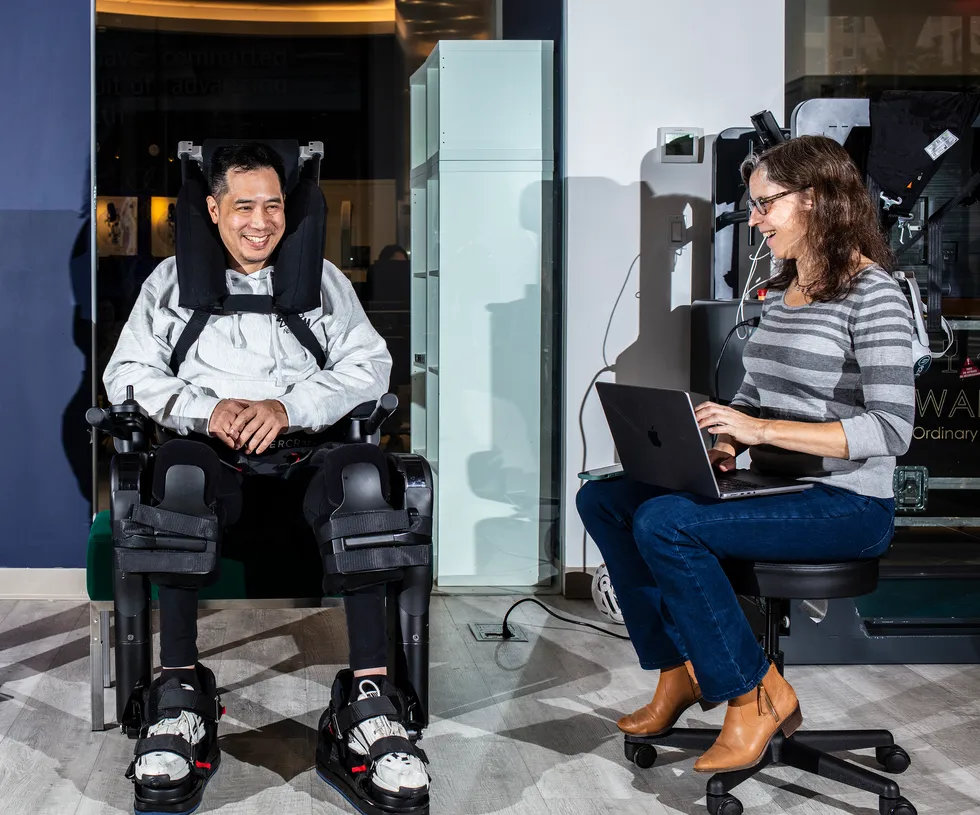
I saw the gap between demonstration and daily use firsthand when I interviewed Woo in a Manhattan showroom recently, where he was testing a new self-balancing exoskeleton from Wandercraft. The device is a striking advance that kept him upright without crutches, but it also revealed the friction of the real world. As Woo tried to walk out the door, barely an inch of slope on the Park Avenue sidewalk was enough to trigger the machine’s safety sensors and halt his progress. It was a stark reminder of how far these systems must evolve before they fit seamlessly into everyday life.
Advertisement
For the people who use them, that seamless integration is the ultimate goal. Getting there will depend not just on technical breakthroughs but on how well these systems hold up outside controlled environments, over time, and under real conditions. Looking from the inside doesn’t make these technologies any less remarkable, but it does change how we judge them—not by what they can do once for a photo but by what they can sustain over a lifetime. That’s the standard their users have been applying all along.
Our commitment to evaluating technology from the user’s perspective extends beyond this special report. To provide a necessary corrective to the “techno-solutionism” that often dominates coverage of assistive devices, IEEESpectrum created the Taenzer Fellowship for Disability-Engaged Journalism, under which six writers with disabilities are contributing articles about the devices they rely on daily. As Special Projects Director Stephen Cass notes, these journalists “aren’t afraid to ask clear-eyed questions about the tech and are deeply aware of how it impacts humans.” You can read the fellows’ work at spectrum.ieee.org/tag/taenzer-fellowship.























































You must be logged in to post a comment Login