
Tech
Microsoft made Copilot a co-author on every VS Code project, reverted after developers revolted



A recent pull request effectively turned Copilot into a “co-author” for every programming project created in Visual Studio Code – even when the programmer behind the screen did not use Copilot at all. Users informed Microsoft that they did not like the change, criticizing the company for adding more “slop”…
Read Entire Article
Source link



On the PS5, players will have access to HDR and 4K gameplay as well as PS5 Pro enhancements and support for ray tracing. HDR / 4K and ray tracing are also supported on the Xbox and Microsoft Store versions, we’re told.
Read Entire Article
Source link


[Editor’s Note: Sales consultant and former startup founder Ron Davis is a candidate for the Washington state Legislature, who has written for GeekWire previously on startup sales hiring practices. GeekWire publishes guest opinion pieces representing a range of perspectives. The views expressed are those of the author.]
If you tune into the local conversation about Washington state taxes on LinkedIn, you might think that Olympia is on the verge of snuffing out Seattle’s regional economy with extreme taxation. There are exceptions, but most of these posts are long on rhetoric, short on rigor. Given Washington’s pressing needs, we should do better. And given our community’s capacity for data-driven thinking, we can do better.
Contrary to popular myths, our taxes are relatively low, haven’t exploded skyward, and are nowhere near the point of creating serious damage to the commercial sphere.
Washington taxes are low
Let’s consider why a conservative economist recently called Washington a “tax haven, like the Cayman Islands,” when it comes to the rich. First, we only recently even reached the halfway point among states when it comes to taxes as a share of its economy, and our taxes are actually down from a few years ago. We have lower taxes than every other deep blue state, and nine red states too, including Kansas, Kentucky, Utah and West Virginia.
Second, our taxes disproportionately coddle the rich, while simultaneously stiffing working families. Until recently, Washington was the most regressively taxed state in the union, which meant that the poor pay a much bigger share of their income than the rich. Thanks to the tax on capital gains windfalls over $250,000 in a year, we are now only the second most regressively taxed — just above Florida.
Currently, the top 1% of Washington earners pay 4% of their income in state and local taxes — less than either Texas or Idaho. The national average is 7.2%, nearly twice as much as Washington. In Massachusetts, California and New York, the top 1% pay 9%, 12% and 14% of their income. On the other end of the spectrum, the bottom fifth of earners in the Evergreen State pay through the nose — 13.8% of their income. The national average is 11.4%. Low income families ARE overtaxed relative to their peers in other states, but this does not figure into the discussions on LinkedIn.
Let’s remember the national and global context as well. United States taxes, including state and local, are far lower than most rich countries — 32nd out of 38 in the OECD. We pay 25%, while the rich Danes, Dutch, Japanese and Austrians, or the fast-growing Spanish and Poles, all pay 35%-43%. No wonder our life expectancy, inequality, healthcare coverage and infrastructure are so poor! The only countries* with taxes lower than ours in the OECD are Costa Rica, Turkey, Colombia, Chile and Mexico.
In other words, the notion of a tax burden — especially for the rich, especially in Washington state — is a myth.
Washington’s budget growth is sustainable
One often hears hyperventilating claims about the growth in Washington’s budget. It is true that if Washington’s budget had grown at exactly the rate as the population and general inflation combined over the last decade, it would be 29% lower. But as any public finance economist can tell you, that information is close to useless.
Cost disease means that services inflation in both the public and private sectors is higher than overall inflation. Since government work is service-intensive, government costs go up faster than general inflation. Governments build stuff, too — so they buy lots of land and land also gets expensive faster in growing economies. This is why the cost of keeping government services flat usually increases much faster than inflation. Ergo, economists instead look at how much of our state income (GDP) taxes take up.
You might think we’ve run up spending in the last few years at an unsustainable rate. Think again. In 2019, taxes were 10.6% of our economy. Today they are 8.47%. Perhaps we should look back to the depths of recession-era austerity, in 2010? It was 9.9%. Taxes as a share of our economy have shrunk. They are flat from 25 years ago, and down from the 1970s, 1980s and 1990s.
And if you think GDP numbers are somehow distorted or are not representative of individual experiences, the same analysis holds true of personal income. Taxes are lower, and our economy boomed when our taxes were higher.
The millionaire tax won’t hurt the economy or prompt a mass exodus
In conversations online, for all the talk about tax flight and comparative disadvantage vibes, there is surprisingly little discussion in our community about the real, measured, economic impact of higher taxes on the wealthy. So what does the cold, hard, evidence say?
Well, setting aside the question of whether retaining every last wealthy person is the highest goal of public policy, the evidence is pretty darn clear that the wealthy on balance are nowhere near as price-sensitive as we are told. In fact, millionaires move less than everyone else.
Researchers estimate that eliminating all tax differences between the states would reduce national millionaire migrations by only about 250 families per year — out of roughly 12,000 total. Regions like ours are “sticky,” as the product people say.
Moreover, studies suggest that when the wealthy do move, they mostly move to other high-tax jurisdictions! Certainly some people cite taxes when they move to Wyoming and some people buy extra homes and play domiciling games to avoid taxes. But the macro, net effect appears to be pretty negligible.
Unfortunately, studies of millions of people seem to have little impact on people’s beliefs when “everyone they know” is “thinking” about moving.
So let’s put this in terms of some specific stories. New Jersey raised taxes on the rich and Massachusetts raised taxes on millionaires. New York raised taxes on the rich twice, and so did California. In every one of those cases, businesspeople predicted an economic apocalypse, and talked about how the people they knew were leaving. Then the number of rich people in all those places increased markedly. In fact, in California — where taxes went up a lot — their “market share” of U.S. millionaires even increased.
It’s almost as if “the economy” is an immensely complex emergent phenomena, instead of a simple equation where prosperity is perfectly inversely correlated with rich people’s taxes or commentator’s vibes about them.
It’s a serious problem that these kinds of facts so rarely figure into pronouncements about the imminent demise of our local economy every time we do something like raise the minimum wage, labor standards, or taxes. While there is plenty of room for discussion about the right kind and level of taxation, it is time we stopped having a discussion that is just devoid of basic empiricism.
Washington taxes aren’t high, haven’t spiked, and raising them on the wealthy doesn’t risk economic ruin. This community built world-changing companies by following evidence wherever it leads. It’s time we demand the same standard from our political discourse.
* Ireland is officially on this list, but its tax rate is seriously distorted, because GDP is massively inflated by companies shifting profits there on paper for tax purposes. Ireland has addressed this distortion with a gross national income number and this puts their true tax rate between 35% and 40%.
Note: I used these population numbers, budget history and this inflation calculator.

One of the enduring myths of audiophilia is the concept of the “end-game” system. No matter the quality of the system you have, there always seems to be a missing piece.
“If I can only add a (insert next-level piece of equipment here) to my system I will be forever content and can die a happy (wo)man.”
I have achieved what I thought was end-game several times – for a few days or several weeks – but each time a new siren song emerges. Klipsch Forté, Lenco L70 and Sansui AU-777 are calls of the past now silenced. Current objects calling with varying urgency include blue-baffle JBLs, concentric-driver Tannoys, Thorens TD-124 or 125, and the Sansui AU-111.

With a planned move back to Japan in two or three years, the question of whether any of these will be achieved is on hold. I am in an enforced end-game state, knowing I will sell everything I have before I move, and will start again when I land on the other side of the Pacific.
Upgrading my Cleaning Game
This continual desire to upgrade and improve the system is about more than just equipment. It applies also to furniture, storage, cables, accessories, and record cleaning.
Four years ago, as a fairly new vinyl collector with a few hundred records in my collection, I wrote about budget cleaning solutions that did the job and kept the wallet (and Mrs. Audiolove) happy.
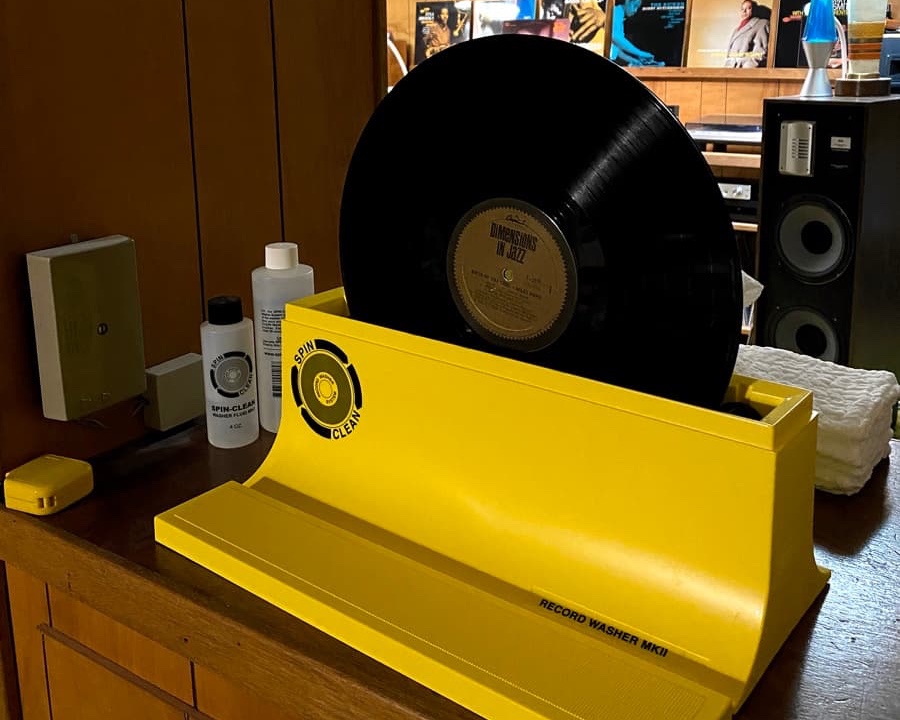
Today, with nearly 1,800 albums, I’ve become pickier about cleaning; I won’t cut corners and am more willing to drop some coin on quality. I’ve replaced records that didn’t cut the mustard (including grey-market EU “Public Domain” reissues) with modern audiophile or early pressings, and I want to show these the respect they deserve so they play clean and clear for my remaining decades.
And so ladies and gentlemen I present my 2026 cleaning arsenal, with medium-of-choice dependent on dirt levels and apparent vinyl condition.
Dust and Static – Ramar Berlin Record Brush (Red)
Ramar record brushes are made with a combination of carbon fibre (six double rows) and two rows of goat hair to penetrate every groove and remove fine dust and larger dirt particles while dissipating electrostatic charges.
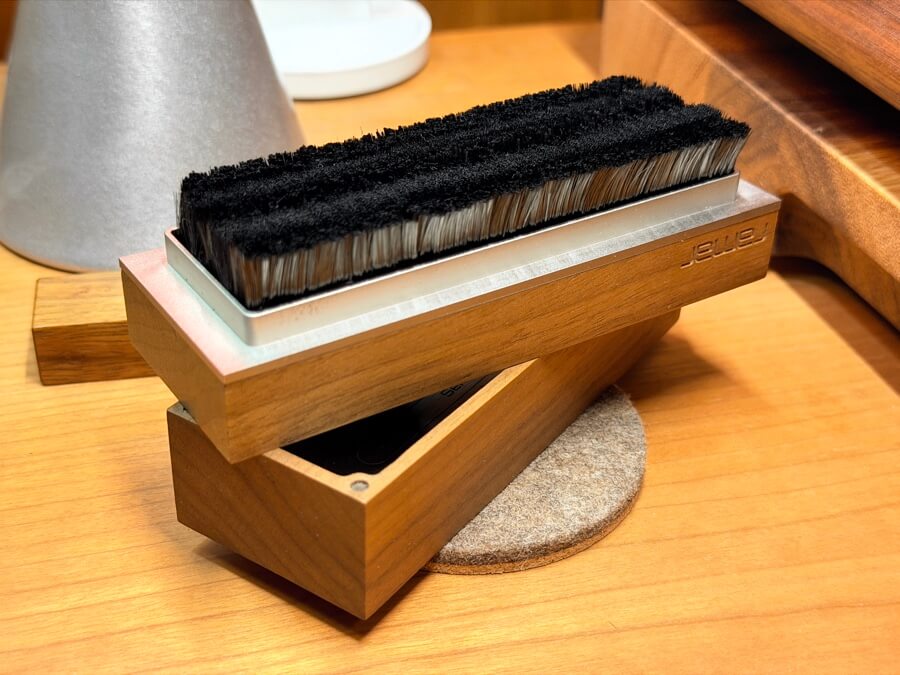
The body and protective case of my brush are made with cherry wood, fashioned from a single block. The case protects the brush fibres from damage and dirt. A range of handle and case styles are available, including other wood variants and metal finishes.
Brushes come with a natural felt cleaning pad for removing any dust or dirt caught between the fibres during use, and Ramar offers after-market renewal and repair services.

The Ramar brush replaced my $20 Audio-Technica anti-static brush, and the difference was obvious. It feels far more substantial and better made, and it delivers noticeably better dust and static removal. At €360, it had better be excellent, and it is. For most records, this is the only cleaning solution I need, which makes the expense easier to justify.
Minor Dirt – GrooveWasher Hardwood Record Cleaning Kit
GrooveWasher makes a variety of cleaning accessories and kits, including record and stylus fluids and brushes. They also make anti-static record sleeves.

This was my first cleaner “upgrade,” replacing the cheapie DiscWasher. The look and feel of the two cleaners are similar, but the heft of the GrooveWasher’s wooden handle and the cleaning performance of the black Terry microfibre pad are a step up in quality.
The Hardwood Kit costs around $50 and comes with a 4 oz spray bottle of G2 high tech record cleaning fluid. This combination effectively removes minor grime like errant fingerprints or other sticky dirt that the Ramar can’t tackle. I use this brush for a first clean of used records that look to be in very good condition, and every few plays for records I’ve had in the collection for some time.

Over time the plush terry cloth pad does wear down and flatten out, and I’m currently eyeing up a replacement pad. The cleaning pads are easily removable, and replacements adhere solidly to the wood handle by way of Velcro fasteners.
Embedded Dirt and Persistent Crackle – HumminGuru HG01 Ultrasonic
The HumminGuru HG01 ultrasonic replaced a Spin Clean Mk. II a couple of years ago. The Spin Clean manual water-and-brush system worked well initially, but for some reason had begun jamming, even after replacing the brushes. While it still did a good job of cleaning, using it became frustrating and an upgrade was called for.
I investigated various vacuum and ultrasonic systems and the HumminGuru seemed to offer a good balance between results and financial outlay (Yes, I’m willing to drop some coin, but my pockets are not bottomless).
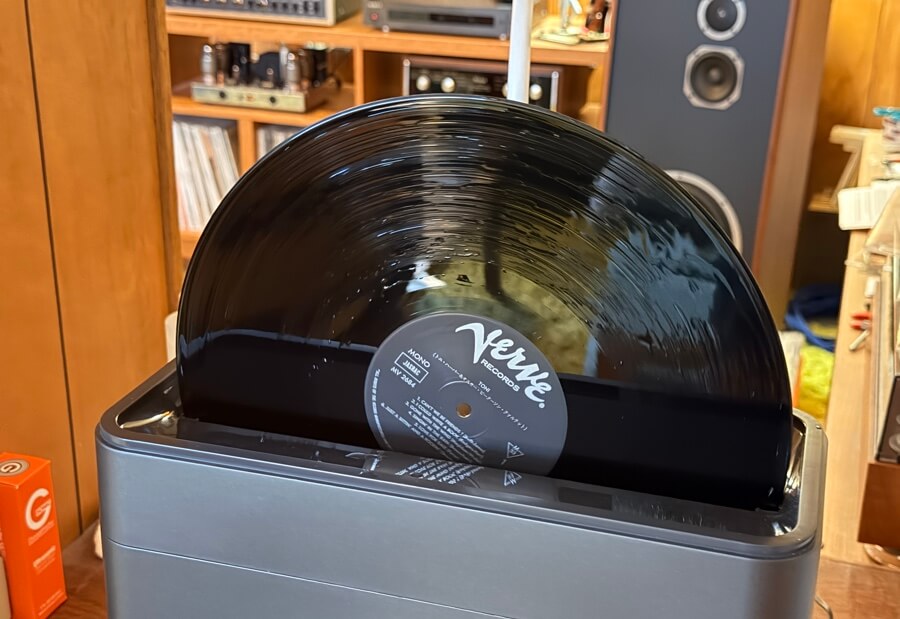
Ultrasonic cleaning uses high-frequency sound waves to create cavitation bubbles in water, requiring zero physical contact with the record. The HumminGuru automates the process of both cleaning and drying. All that’s required of the user is to add distilled water to the bath area on top, insert the record vertically into the cleaning slot, and hit a few buttons to set cleaning and drying time and start the cleaning process.
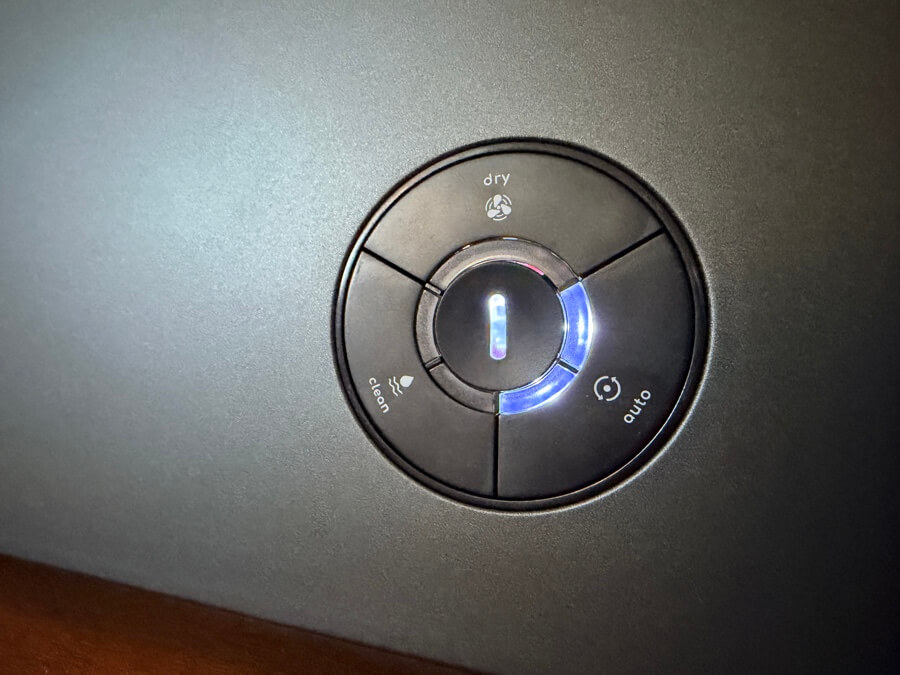
The record spins in the bath for several minutes while the ultrasonics remove dirt, the bath auto-drains into a removable water receptacle at the bottom of the machine, and then dual warm air fans dry the record. After 7-10 minutes, remove the record and it’s ready to store or play.
Water can be re-used to clean multiple records, and HumminGuru recommends using a few drops of alcohol-free cleaning formula to reduce surface tension and facilitate better penetration into the record grooves and to enhance drying in humid environments. Adaptors are available for 7” and 10” records.

I’ve been very impressed with results from the HumminGuru, with big improvements in grading quality post cleaning. I also noted improvements for records already cleaned with the old Spin Clean (which was no slouch, even with the jamming issues I experienced).
At time of writing the HumminGuru HG01 costs around $400 direct from the manufacturer, which is down significantly from my original purchase price.

Since I purchased my HG01, Humminguru has introduced an advanced model (the Nova) which features quieter cleaning, faster drying and automatic adjustment for different record sizes. The Nova runs about $700.
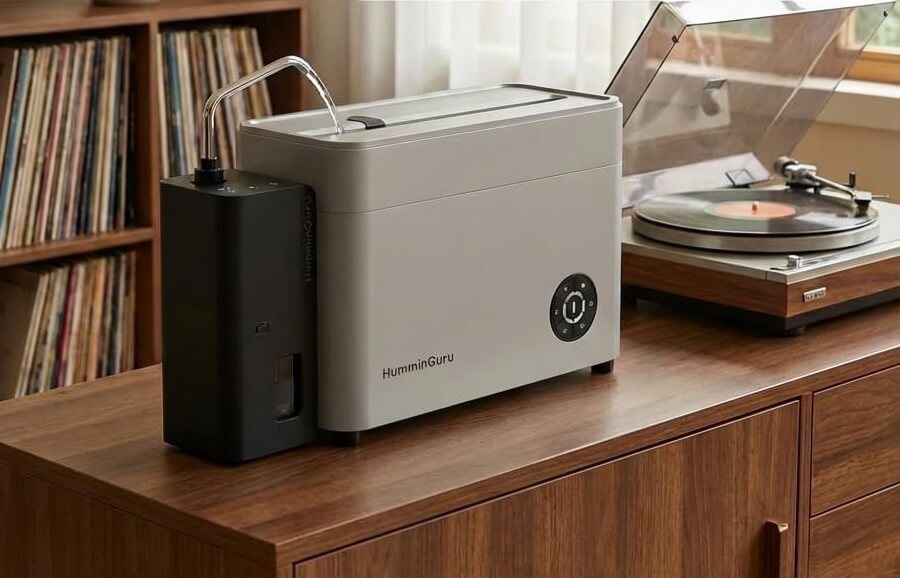
HumminGuru also introduced an Automatic Water Dispenser ($159.99 at Amazon) unit which eliminates my one gripe with the HG01 (and Nova), that being the somewhat inelegant process of removing the water receptacle to refill the water bath. The water dispenser costs around $160, and is very definitely on my to-buy list (and an exception to enforced end-game status).
The Bottom Line
And there we have the three arrows in my cleaning quiver, with all needs and bases covered. A final mention goes to the Ramar brush, which elicits frequent comments on Instagram regarding what many see as an exorbitant price (about the same as the HumminGuru).
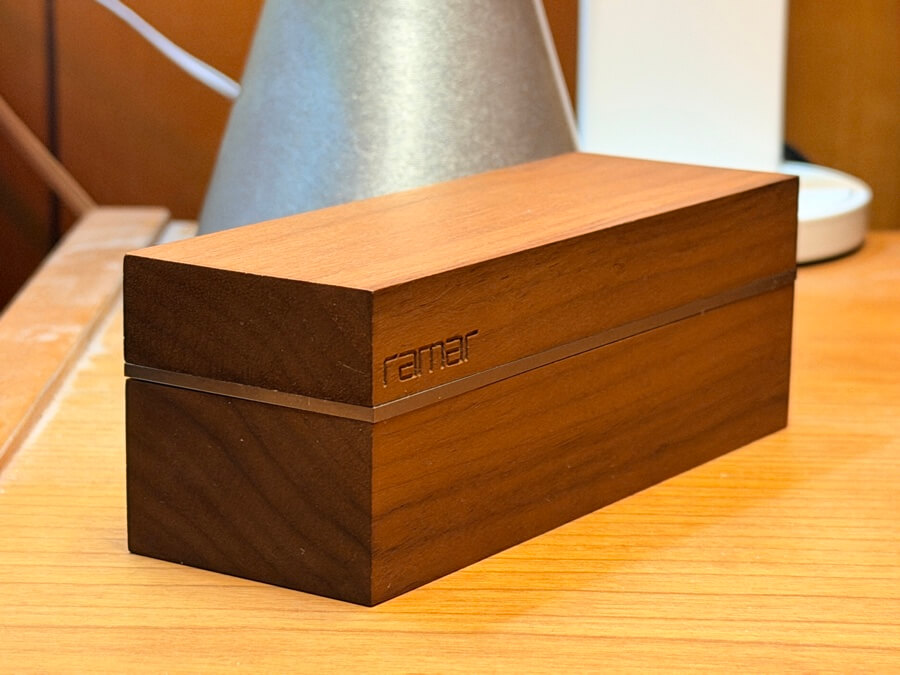
No, there are no moving parts. Yes, it’s just a brush. But what a brush! As mentioned, this is my main cleaner and so on a per-use basis the cost is not so high. Factor in craftsmanship and precision – hand crafted, grain-matched wooden handle and holder, exquisitely layered brush fibres – and an obviously time-intensive build process, and it all makes sense. In my mind the juice is worth the squeeze.
What do you think? Leave your thoughts in the comments, or message me on the ‘Gram at @audioloveyyc.
Where to buy:
Related Reading:


Nintendo held a last-minute Star Fox Direct live stream on May 6 to reveal Star Fox, a remake of the N64 classic coming exclusively to the Nintendo Switch 2. It’s due to come out on June 25, complete with new gameplay modes and online play.
Star Fox features reimagined visuals and redesigned characters, and everything seems to have a touch of Fantastic Mr. Star Fox about it. Nintendo calls it “a cinematic take” in its press release, and to that end, the game features new cutscenes with full voice acting and fresh mission briefings between levels. Star Fox offers the campaign mode with easy, normal and expert difficulties (though expert has to be unlocked by playing really well), plus a challenge mode with new objectives, and a new battle mode. Battle mode is a four-on-four dogfighting arena with three stages: There’s a control-point game on Corneria, a crystal-collection challenge on Fichina and a fetch quest against space pirates in Sector Y. You can team up in private matches or join the open queue, and Star Fox will support GameShare locally and online.
The flow and layout of the game’s stages will be just like you remember, as will the banter among Fox, Falco, Slippy, Peppy and the gang. Star Fox features local co-op across the full campaign, with one player steering as the pilot and the other as the gunner. It’ll be compatible with the revamped N64 controller and Joy-Con 2 mouse controls. Since it’s a Switch 2 special, Star Fox will also allow players to appear as any of the main crew members with interactive avatars in GameChat.
Nintendo provided a peek of the new Star Fox in action, complete with the Arwing flying, braking, boosting and barrel rolling, and the Blue-Marine submersible blasting through squids. The stream ended with a look at the game’s prologue, which featured all sorts of high-flying anthropomorphic animals, including Fox’s dad James McCloud and Pigma.

Lachy Groom, one of Silicon Valley’s most closely watched solo investors, decided to back Indian startup Pronto just 20 minutes into his first meeting with its 24-year-old founder.
The meeting, which took place in February through a mutual connection, led to Groom investing $20 million in Pronto as an extension of its Series B round, valuing the startup at $200 million after the investment — double its valuation just over two months earlier, as TechCrunch had previously reported. The deal came together within weeks, bringing the solo investor on board as the Bengaluru-based startup expands to meet growing demand for on-demand home services in India.
Groom said he was drawn to Pronto’s ambition to build what he called the world’s largest platform for organizing domestic labor, starting with India’s vast and largely unstructured workforce. “The work underneath that is genuinely hard, and most attempts in adjacent categories have struggled with the operational discipline,” he said, adding that Pronto founder Anjali Sardana (pictured above) and her team were operating “at a level I haven’t seen elsewhere in this space.”
Before founding Pronto in 2025, Sardana worked at Bain Capital and venture firm 8VC, where she gained early exposure to investing and high-growth startups. The startup connects households with workers for everyday tasks such as cleaning and basic home services.
The introduction was arranged through Paul Hudson, founder of Glade Brook Capital, who connected Groom and Sardana during her trip to San Francisco earlier this year. Glade Brook has backed startups founded by both: Pronto, which Sardana leads, and Physical Intelligence, where Groom is a co-founder. Hudson and Groom have also backed Indian quick-commerce startup Zepto.
Sardana said Groom’s investment approach is heavily founder-driven. “He indexes two things. One is the founder, and that’s 95% of it. If he loves the founder, then he will invest,” she told TechCrunch, adding that the rest comes down to the scale and potential of the business.
Groom’s bet comes as a clutch of startups in India race to build instant home services platforms, a category that is seeing rapid adoption among urban households as more consumers turn to on-demand help for everyday tasks.
Techcrunch event
San Francisco, CA
|
October 13-15, 2026
The opportunity is significant. A recent Bank of America note, reviewed by TechCrunch, estimates the instant home services market in India could grow into a $15 billion to $18 billion industry by the end of the decade, as companies including Pronto, Snabbit, and Urban Company’s InstaHelp compete for share in the fast-growing category.
Competition is intensifying, with heavy capital inflows and aggressive pricing, particularly to attract first-time users. Bank of America estimates that Snabbit and Urban Company’s InstaHelp each account for about 40% of the market, while Pronto has around a 20% share, even as it scales rapidly. The category is expected to remain “burn-heavy” over the next two to three years.
Despite trailing larger rivals, Pronto has been scaling rapidly, growing from around 18,000 bookings a day to 26,000 in just over a month. The startup is focused on driving repeat usage, betting that turning occasional demand into frequent, habit-driven usage will be key to winning the category, with its top 10% of users accounting for about 40% of bookings.
This growth has also brought challenges, particularly in building out supply. Pronto has expanded its network of service workers to 6,500, up from 1,440 in January. But Sardana said demand continues to outpace supply, making forecasting and capacity management key challenges as the startup grows.
When you purchase through links in our articles, we may earn a small commission. This doesn’t affect our editorial independence.

Longtime Slashdot reader UnknowingFool writes: Security researcher Tom Joran Sonstebyseter Ronning has found that Microsoft Edge stores passwords in plaintext in RAM. After creating a password and storing it using Edge’s password manager, Ronning found that he could dump the RAM and recover his password which was stored in plaintext. Part of the issue is Edge loads all passwords to all sites upon a single verification check, even if the user was not visiting a specific site. This is very different from Chrome, which only loads passwords for specific websites when challenged for the site’s password. Also, Chrome will delete the password from memory once the password has been filled. Edge does not delete the passwords from memory once they are used.
Microsoft downplayed the risk noting access would require control over a user’s PC like a malware infection: “Access to browser data as described in the reported scenario would require the device to already be compromised,” Microsoft said. Ronning countered that it was possible to dump passwords for multiple users using administrative privileges for one user to view the passwords for other logged-on users. “Design choices in this area involve balancing performance, usability, and security, and we continue to review it against evolving threats,” Microsoft said. “Browsers access password data in memory to help users sign in quickly and securely — this is an expected feature of the application. We recommend users install the latest security updates and antivirus software to help protect against security threats.”
Tech
Hackers used Daemon Tools' own website to silently install backdoors on thousands of PCs for nearly a month


Cybersecurity researchers at Kaspersky found that the attack compromised multiple versions of Daemon Tools, from 12.5.0.2421 through 12.5.0.2434. What made the campaign particularly difficult to detect was that the malicious installers were distributed directly from the official website and signed with legitimate digital certificates belonging to AVB Disc Soft, the…
Read Entire Article
Source link

from the MAGA-just-means-hating-American dept
The content of their character was never up for consideration. Under Donald Trump, the only thing that matters is the color of their skin. That’s why almost every single person granted asylum since Trump took office has been white. That’s why Trump has been asking (out loud!) why we keep getting migrants from “shithole” countries (like those located in South America, Africa, and Latin America) rather than blond haired, blue eyed expats from Scandinavian countries whose residents’ lives would become noticeably worse if they chose to move to the US.
The president wraps himself in the flag, delivers a lot of garbled Team USA jingoism, and routinely proclaims we have the best military in the world. But even the people most directly responsible for keeping the US on top of the military game aren’t allowed to remain here if they’re not white.
Jose Serrano, an active duty soldier who served three tours in Afghanistan, said immigration agents arrested his wife April 14 as they attended an appointment with immigration services to take steps toward her permanent residency.
“A person opened the door, escorted us through the hallway, and at the end of the hallway, my wife got arrested,” Serrano said. “Arrested without any order, any warrant … They took away my wife. They don’t tell me anything.”
On top of all this awfulness, this incident shows ICE isn’t actually shifting away from immigration court arrests despite (1) officials saying otherwise, and (2) more importantly, ICE itself supposedly letting officers know that court arrests like these are not allowed under current ICE policy.
The regular awfulness is this: the Trump administration is willing to attack its own military if it means racking up a few more arrests and deportations:
[L]ast April, DHS eliminated a 2022 policy that considered military service of an immediate family member to be a “significant mitigating factor” in deciding whether or not to pursue immigration enforcement. The administration’s new policy states that “military service alone does not exempt aliens from the consequences of violating U.S. immigration laws.”
It’s not just this nation’s relationship with its own military that’s being permanently damaged by Trump’s bigoted war on non-white people. It’s also any future relationships we might have in countries where we’re engaged in combat. When the US began its full withdrawal from Afghanistan, it promised protections to Afghans who worked with the military to provide intelligence or otherwise aided in the US in the decades-long war.
That’s all being tossed aside by Trump because he and his administration simply just don’t like non-white people.
After halting a U.S. resettlement program for Afghans who helped the American war effort, President Trump is in talks to send as many as 1,100 of them to the Democratic Republic of Congo, an aid worker briefed on the plan said Tuesday.
The group includes interpreters for the U.S. military, former members of the Afghan Special Operations forces and family members of American service members. More than 400 children are among them.
The Afghans have been living in limbo in Qatar for over a year. They were taken there after being evacuated by the United States for their own safety because they supported American forces during the war against the Taliban that began in 2001.
Thanks for your help. Now, go fuck yourselves. That’s the message the US is sending to people who aided the US during this war. It’s the kind of message that isn’t likely to score it any allies as it resumes hostilities in the Middle East.
This report says Trump is “in talks” with DRC to pursue this “resettlement” of Afghan allies — one the administration pursues despite the protests of the people who risked their own lives to assist the US during the Afghanistan war.
It’s hard to believe Trump is actually engaged in anything. DRC already has a refugee problem of its own.
More than 600,000 refugees, mostly from the Central African Republic and Rwanda, are currently in Congo, according to the United Nations. Human rights activists say that the country is not equipped to take in more in the midst of fighting with neighboring Rwanda that has displaced even more people because of attacks on refugee camps.
On top of this, many Afghan allies already have family members living in the United States due to previous efforts made by the Biden administration to protect those who aided the US. This forced resettlement in, well, pretty much any African country that agrees to take them divides even more families. It also demonstrates the United States is not to be trusted when it offers favors in return for assistance. All it takes is an election cycle to roll back guarantees and turn trusted allies into just another set of people being moved from “shithole country” to “shithole country” by a bunch of bigots who would rather destroy America than allow any more non-white people to become residents of what used the be the world’s “melting pot.”
At least for now, Trump has seemingly found a willing dumping ground for people he doesn’t want in this country:
On April 17, the U.S. government deported 15 people to the capital of the Democratic Republic of Congo, a deeply impoverished African country that’s been scarred by years of conflict.
The group—comprising men and women from Colombia, Ecuador and Peru—is the first to arrive as part of a secretive migration deal brokered with the Trump administration.
“They took us, they put us on a plane, and they chained us by our hands and feet,” said one Colombian man, sitting on a plastic chair in a shabby hotel near Kinshasa’s airport. The deportees didn’t know their final destination until they were on the plane, he added.
Like El Salvador, I’m sure the DRC is more than happy to take our money to take some people off our hands. And like El Salvador, I’m sure the DRC government doesn’t actually care what happens to any of these people being shoved out of DHS charter flights like so much human refuse. If the US can’t be bothered to care, why should some third party in a developing nation do anything more than allow planes to land so long as the checks keep clearing?
This is what America is now: a place where human rights, civil liberties, and basic human morality are no longer weaved into the fabric of the nation. America is no longer the world’s policeman. It is now the world’s corrupt, racist sheriff.
Filed Under: afghanistan, bigotry, cruelty, dhs, ice, mass deportation, pete hegseth, trump administration, us military

Looking for the most recent regular Connections answers? Click here for today’s Connections hints, as well as our daily answers and hints for The New York Times Mini Crossword, Wordle and Strands puzzles.
Today’s Connections: Sports Edition is a tough one, but fun for movie fans. If you’re struggling with the puzzle but still want to solve it, read on for hints and the answers.
Connections: Sports Edition is published by The Athletic, the subscription-based sports journalism site owned by The Times. It doesn’t appear in the NYT Games app, but it does in The Athletic’s own app. Or you can play it for free online.
Read more: NYT Connections: Sports Edition Puzzle Comes Out of Beta
Hints for today’s Connections: Sports Edition groups
Here are four hints for the groupings in today’s Connections: Sports Edition puzzle, ranked from the easiest yellow group to the tough (and sometimes bizarre) purple group.
Yellow group hint: If the shoe fits.
Green group hint: Fore!
Blue group hint: Take me out to the ball game.
Purple group hint: Cinema titles.
Answers for today’s Connections: Sports Edition groups
Yellow group: Sneaker brands.
Green group: Golf courses to host the U.S. Open.
Blue group: Famous nicknames for MLB teams.
Purple group: Movies that contain an NFL team name.
Read more: Wordle Cheat Sheet: Here Are the Most Popular Letters Used in English Words
What are today’s Connections: Sports Edition answers?
The completed NYT Connections: Sports Edition puzzle for May 7, 2026.
The yellow words in today’s Connections
The theme is sneaker brands. The four answers are Converse, New Balance, Saucony and Under Armour.
The green words in today’s Connections
The theme is golf courses to host the U.S. Open. The four answers are Pebble Beach, Shinnecock Hills, Torrey Pines and Winged Foot.
The blue words in today’s Connections
The theme is famous nicknames for MLB teams. The four answers are Amazin’ Mets, Big Red Machine, Gas House Gang and Murderers’ Row.
The purple words in today’s Connections
The theme is movies that contain an NFL team name. The four answers are Little Giants, Raiders of the Lost Ark, Remember the Titans and The Bad News Bears.
Owning a home isn’t cheap (and we’re not even talking about the cost to get the keys in the first place). Electricity prices have reached their highest levels in a decade, and many households are feeling the strain. Worse, even the most modest projections tell us energy expenses will only continue to rise going forward. Even as homes get more and more efficient with better appliances, smarter lighting, and more efficient insulation, energy bills just keep on climbing.
Today, the average U.S. household spends about $2,000 per year on energy. But that average can be much higher depending on things like climate or home size. Over a lifetime, that’s tens of thousands spent. Luckily, Consumer Reports has publiushed some good advice here over the years. When taken together, their tips show meaningful savings don’t have to come from major renovations or expensive upgrades. Instead, homeowners simply have to make smarter decisions and change small habits. With Consumer Reports’ suggestions, you just might cut your energy bills by hundreds of dollars annually.
Invest in an energy audit
Spending money to save money might not sound like the most practical suggestion, but think about it: A single energy audit can go a long way to reduce your utility costs for a lifetime of homeownership. Consumer Reports says energy auditors can help you get a better understanding of where energy is being wasted. That way, you never have to waste time or money on fixes that only scratch the surface.
Professional auditors have the tools to find air leaks, insulation gaps, poorly sealed areas, even indoor air pollutants or carbon monoxide leaks. From there, you can get to work addressing all the areas for improvement in your place… and hopefully stop overpaying for your HVAC, natural gas, and electrical usage in the process. You might have to spend an average of around $400 for the audit, depending on the size of your home, but it’ll all be worth it when you see those energy bills start dropping.
It’s not always how you use energy, it’s when
When looking for ways to lower your energy bills, plenty of households only focus on how much energy they consume. However, timing can be just as important. Some energy companies offer time-of-use pricing plans, which charge different rates depending on demand. Using electricity will cost you more during peak hours, but you’ll spend less during the off-peak periods to make up for it.
By enrolling in one of these plans and shifting your most energy-consuming tasks (like dishes or laundry) to off-peak hours, Consumer Reports says you can shave a pretty meaningful amount off the bill. That could be thousands annually. Of course, it’s important to note that signing up without adjusting your habits can actually lead to higher bills. It has to be a two-step approach. First enroll, then adjust. Otherwise, you’re adding insult to injury by eating up tons of energy during peak surge pricing.
Drafts matter more than you think
If you live in an older home or apartment, you may have gotten used to draftiness. Alternatively, if you live in a newer place, you might assume draftiness isn’t an issue for you. Neither attitude is going to help your energy bill in the long run. Consumer Reports says even the most efficient heating and cooling systems will struggle if a home isn’t properly sealed. Air leaks around windows, doors, attics, and basements let all that cool air out, meaning your HVAC system has to work harder (and consume more energy) to chill your place. If you’re closing doors, you’re hurting the HVAC even more.
Sealing drafts and improving insulation can reduce energy costs by at least $27 per month, according to Consumer Reports estimates. Over the course of a year, that adds up to more than $300 in savings. Again, that’s the least you’re likely to save. Savings can only go up from there. Don’t forget about your HVAC filters, either. Clogged filters force systems to work harder, which drives your energy bill up higher. Keeping those filters clean can save you another $11 per month on average.
Small changes that yield big savings
The little things add up when it comes to energy consumption. It might not feel like you’re doing anything when you raise your thermostat by a degree or two or turn on a fan before blasting the A/C, but you’d be surprised. Consumer Reports says these little tweaks can save you a lot more than you realize. For example, lowering the temperature setting on your water heater from 140 degrees Fahrenheit to 120 degrees can cut annual energy costs by up to 22 percent. That’s hundreds of dollars for a difference of just 20 degrees. They say adding an insulating jacket to the tank can cut energy use by another 7 to 16 percent, as well.
Nobody’s saying you have to completely overhaul your home. Instead, it’s all about understanding the common places where energy is being wasted and making the kinds of small improvements that deliver the most meaningful results. With these steps in mind, just wait and see how much you can save.
Popular WR Rumor Is Back for Vikings

Myst and Riven remakes head to PlayStation, Xbox, and Microsoft Store

Closure order granted for Langthorne Walk, Bolton house

Manchester United reach agreement with Casemiro over contract clause amid transfer speculation

US brings back mandatory military draft registration

Steven Gerrard disagrees with Gary Neville over ‘shock’ Chelsea and Arsenal claim | Football


-

 NewsBeat3 days ago
Channel 5 – All Creatures Great and Small series 7 new post
-

 Entertainment7 days ago
Insider Claims Reason Behind Key & Peele Split
-
 Tech5 days ago
Trump’s 25% EU auto tariff breaches Turnberry Agreement that also covers semiconductors and digital trade
-
 Sports5 days ago
Paul Scholes issues Marcus Rashford reality check as agreement emerges over Man United star
-

 Entertainment5 days ago
Met Gala 2026 Rumored Guest List Is Turning Heads
-

 Business6 days ago
Strait of Hormuz Blockade Persists Amid US-Iran Standoff, Sending Oil Prices Soaring
-

 Entertainment7 days ago
Celebrities Who Are Attending the 2026 Met Gala Event
-
Entertainment5 days ago
New on Prime Video in May 2026 — Full List of Movies and Shows
-

 Sports5 days ago
Cavaliers vs. Raptors Game 6 live score, updates, highlights from 2026 NBA playoffs first-round series
-
 Sports5 days ago
David Benavidez responds to team Canelo saying the fight will never happen
-

 Entertainment5 days ago
Kylie Jenner Hit With Second Lawsuit From Ex-Housekeeper
-
 Sports5 days ago
IPL 2026: ‘Love you darling’- Hardik Pandya’s reaction to MS Dhoni steals the show |Watch | Cricket News
-

 Entertainment5 days ago
Young and the Restless Next Week: Cane Arrested & Matt’s Deadly New Scheme!
-

 Sports7 days ago
Saudi Arabia set to withdraw LIV Golf funding after 2026 season, per reports
-

 Tech7 days ago
Mark Zuckerberg Says Meta Is Working On AI Agents For Personal And Business Use
-

 Tech6 days ago
Meta ends Sama contract after Kenyan workers report seeing intimate footage from Ray-Ban smart glasses users
-

 Sports7 days ago
Stalemate in Madrid as resilient Arsenal Blunt Atletico Madrid in semi-final clash – Sports
-

 Sports5 days ago
Plane crash in Wimberley, Texas kills 5 pickleball players at tournament
-
Entertainment4 days ago
New Netflix Movies in May 2026 — My Top 3 Picks to Stream
-
 Sports7 days ago
Manchester United 2025/26 squad review – keep, sell, loan, release
You must be logged in to post a comment Login