
Crypto World
The AI Jobs Panic Hits a Data Wall, Andreessen Horowitz General Partner Argues



Andreessen Horowitz general partner David George rejected fears of mass AI-driven unemployment, calling the so-called job apocalypse a “complete fantasy.”
The essay cited various working papers. So far, there’s little evidence that artificial intelligence has triggered economy-wide job losses through early 2026.
Andreessen Horowitz Partner Dismantles the AI Unemployment Narrative
George anchors his case in four key sources. The Atlanta Fed survey covered roughly 6,000 corporate executives across the United States, the United Kingdom, Germany, and Australia. Over 90% of business managers reported no AI-related impact on employment.
“Fourth, in contrast to the limited impact so far, executives anticipate much larger impacts of AI on their business over the next three years. They expect AI to reduce employment by around 0.7% over the next three years,” the paper reads.
NBER Working Paper 34984 reached a similar read. The findings show that AI adoption has not “led to meaningful changes” in overall employment.
However, it is already reshaping how tasks are divided within firms. Routine clerical and administrative work appears more “exposed to substitution.” In contrast, AI is more often used to support analytical, technical, and managerial roles.
Follow us on X to get the latest news as it happens
Another working paper found that only 5% of AI-using firms reported any headcount changes.
“In contrast, capital substitution is more prevalent, with 16% of AI-using firms replacing existing software and equipment with AI-integrated solutions. In other words, AI appears to be already altering the investment behavior of frms in terms of new capital installation and upgrades or expenditures on software,” the authors wrote.
The Yale Budget Lab’s April 2026 paper concluded that AI labor disruption “remains largely speculative” at the economy-wide level.
“Of course AI will absolutely eliminate some tasks and compress some roles,” George said. “But the claim that AI will produce economy-wide, permanent unemployment is unhelpful marketing, bad economics and worse history. To the contrary, productivity gains should increase demand for labor, because labor becomes more valuable.”
Recently, Microsoft’s 2026 workplace research found that worker readiness for AI tools outpaced organizational systems. The pattern suggests adoption friction, not displacement, defines the current AI employment story.
Subscribe to our YouTube channel to watch leaders and journalists provide expert insights
The post The AI Jobs Panic Hits a Data Wall, Andreessen Horowitz General Partner Argues appeared first on BeInCrypto.



The crypto industry may have fundamentally misunderstood the metaverse, according to Animoca Brands chairman Yat Siu, who argues that the next phase of virtual economies would arrive not through VR headsets or immersive digital worlds, but through fleets of AI agents transacting across blockchain networks behind the scenes.
Siu said the metaverse maybe coming to us rather than being a place that humans go to, during his keynote at Consensus Miami 2026.
For Animoca, this marked a distinct pivot from the pandemic-era vision of the metaverse it once championed, in which users were expected to spend increasing amounts of their social and economic lives in immersive virtual worlds.
Siu now says the more consequential shift may be AI systems operating in the physical world on behalf of humans, handling transactions, bookings, coordination and commerce in the background while blockchain networks function as the infrastructure connecting those agents.
Instead, Siu argued the next phase of the internet may revolve around AI systems operating continuously in the background of everyday life, handling tasks such as bookings, payments, scheduling, and online transactions on behalf of users.
He said consumers could eventually rely on dozens, or even hundreds, of AI agents to coordinate their digital activities, with blockchain networks serving as the financial and identity infrastructure connecting those systems.
“I think the point is that it’s going to be more agents than humans,” Siu said, predicting there could eventually be “50 to 100 billion agents roaming essentially on the internet.”
That shift, he argued, could also solve one of crypto’s longest-running problems: onboarding ordinary users.
While an estimated 700 million to 800 million people globally now own some form of cryptocurrency, Siu noted that fewer than 70 million actively use blockchain applications because crypto remains technically intimidating for mainstream consumers.
“My mom’s not going to be using MetaMask,” he said. “It’s hard for her.”
AI agents, however, may interact naturally with wallets, smart contracts, and decentralized finance systems because they operate directly through code, he argued.
Unlike humans, agents would not need traditional banking infrastructure and could transact autonomously on-chain.
“Blockchain technology is the ideal financial system for machines,” Siu said. “We, the humans, were basically the guinea pigs.”
The broader argument reflected a growing narrative within parts of the crypto industry that blockchain’s most scalable users may ultimately be autonomous software agents rather than humans.
In that framework, wallets, tokens, decentralized identity systems, and on-chain payments become machine infrastructure powering an emerging “agent economy.”
As part of that push, Animoca announced a $10 million investment initiative for developers building AI agent applications through its Animoca Minds platform.
If Siu’s vision materializes, the next major wave of blockchain adoption may not come from millions of new human users learning to navigate crypto wallets, but from billions of AI agents transacting autonomously with one another behind the scenes.
Bittrex has asked a U.S. federal court to overturn its $24 million settlement with the Securities and Exchange Commission after the regulator abandoned the crypto enforcement approach used against the exchange under the Biden administration.
Summary
- Bittrex has asked a federal judge to cancel its $24 million SEC settlement after the regulator dropped similar crypto cases.
- Court filings stated that the SEC now no longer considers most crypto tokens to be securities under its current approach.
- The bankrupt exchange has also requested that the SEC return funds before the money is transferred to former customers through the Treasury Department.
According to a motion filed this week by attorneys representing Bittrex, the bankrupt crypto exchange has requested that the court vacate the earlier judgment and direct the SEC to return the $24 million penalty paid in 2023.
The filing argues that the regulator no longer supports the legal theory used to pursue the case, after repeatedly stating under President Donald Trump’s administration that most crypto tokens do not qualify as securities.
Filed in federal court on Monday, the motion stated that the SEC has already dropped nearly all comparable enforcement actions and investigations involving crypto exchanges and token issuers. Bittrex’s legal team argued that continuing to enforce the settlement while abandoning similar cases would be unfair treatment.
“Two-and-a-half years after extracting a settlement from a bankrupt cryptocurrency exchange premised on the legal theory that the tokens that traded on the exchange were securities, the SEC has (a) conceded that its legal theory was wrong and those tokens were not securities, (b) acknowledged that its enforcement strategy was misguided from the start, and (c) dropped every similar case and investigation except this one,” Bittrex’s attorneys wrote in the filing.
SEC’s crypto reversal becomes central to Bittrex request
The SEC originally sued Bittrex during Joe Biden’s presidency, accusing the Seattle-based exchange of offering unregistered securities through crypto token trading services. Bittrex later agreed to settle the case for $24 million without admitting or denying the allegations.
Court records cited in the latest filing also pointed to a March request from the SEC seeking permission to transfer the $24 million to the U.S. Treasury Department for distribution to former Bittrex customers who allegedly suffered financial losses.
Bittrex’s attorneys have now asked the judge to stop the transfer process and return the funds before any distribution takes place.
Operations at the exchange were shut down shortly after the settlement, with Bittrex stating at the time that continuing business operations in the existing U.S. regulatory and economic environment was no longer economically viable.
Separate from the SEC case, Bittrex reached another settlement with the U.S. Treasury Department in 2022 over alleged sanctions violations involving countries including Iran, Cuba, and Syria. Treasury officials announced at the time that the exchange had agreed to pay roughly $29 million tied to what regulators described as apparent violations of sanctions and anti-money laundering rules.
Since Trump returned to office last year, SEC leadership has repeatedly pulled back from the agency’s earlier crypto enforcement campaign. The regulator has dismissed or paused several high-profile lawsuits against crypto companies, while senior officials have publicly stated that many digital assets fall outside securities laws.
Bitcoin’s price just tapped a new multi-month peak at $82,000, where it faced some resistance but continues to trade close to that level.
Almost all altcoins are in the green today, with ETH inching closer to $2,400 and XRP decisively reclaiming the $1.40 resistance. SOL is up to $90, while ZEC has stolen the show.
BTC Touched $82K
The primary cryptocurrency fell hard last week after it was rejected at $79,500, and the culmination took place on Wednesday following the third FOMC meeting for the year. Although the Fed’s decision to maintain the interest rates unchanged was highly expected, BTC still dipped below $75,000.
However, its subsequent rebound has been very impressive. The asset first neared $79,000 on Friday after Iran sent a peace proposal to the US and remained close to that level during the weekend, even though the US rejected it, and the second one, sent on Sunday.
Moreover, BTC rocketed on Monday morning to over $80,000 for the first time since late January. It slipped in the following hours after some confusing reports, but went back on the offensive and quickly reclaimed that level. The bulls kept the pressure on, and the cryptocurrency briefly tapped $82,000 minutes ago to mark a new three-month peak.
It remains close to that level now, with its market cap climbing to over $1.630 trillion and its dominance over the alts standing above 58.5% on CG.

Alts Turn Green
ZEC has reignited hopes of its massive run from several months ago when it exploded from under $80 to over $700 within weeks. Its daily surge of roughly 40% has reminded of that rally, as the asset now sits at $575. The only more notable gainer in the past day is SKYAI, which has soared by over 40% to $0.78.
TON has continued with its massive streak, posting another 25% surge on a 24-hour scale. DASH, ICP, FIL, and NEAR complete the double-digit price pump club.
A lot more modest gains are evident from XRP, BNB, ETH, and TRX, while SOL, DOGE, and ADA are up by almost 5% daily.
The total crypto market cap has added roughly $50 billion in a day and now sits at $2.8 trillion on CG.

The post Massive 40% Gains From SKYAI and ZEC as BTC Taps $82K: Market Watch appeared first on CryptoPotato.
Key Highlights
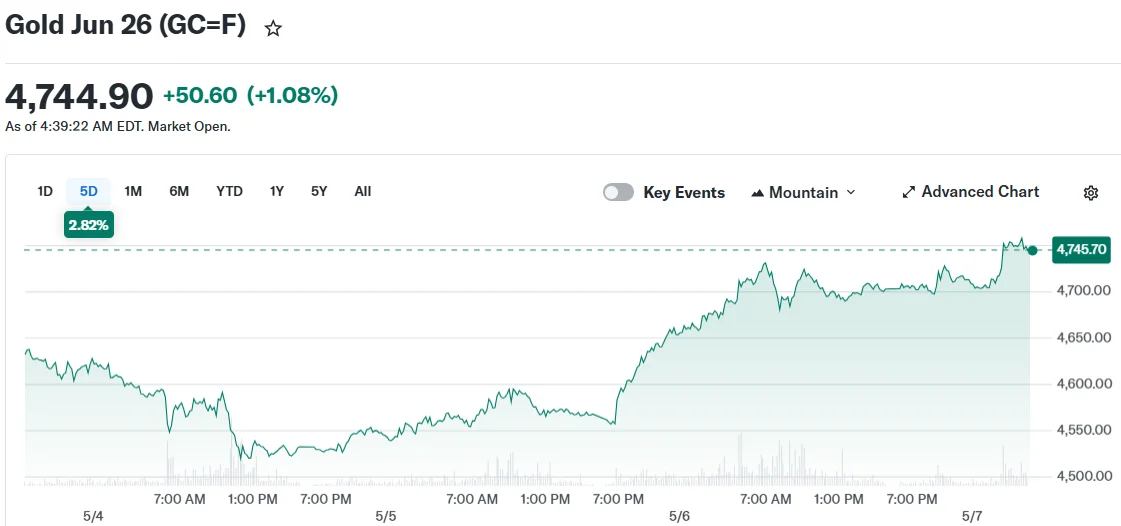
- Gold extended its rally for three consecutive sessions, holding above the $4,700 per ounce mark
- Diplomatic progress between Washington and Tehran is alleviating inflation concerns while pressuring crude prices downward
- The US dollar retreated to levels seen before the recent conflict, enhancing gold’s appeal
- Silver posted its largest single-session gain in weeks with a 6% surge on Wednesday
- Market participants are now eyeing Friday’s employment data for insights into Federal Reserve policy direction
The yellow metal has extended its upward trajectory for a third consecutive session as optimism surrounding potential diplomatic resolution between Washington and Tehran sent crude oil prices tumbling and reduced worries about persistent inflation.
Spot gold advanced 1% to reach $4,736.61 per ounce during Thursday trading. Meanwhile, US Gold Futures contracts for June delivery climbed 1.1% to settle at $4,746.86.
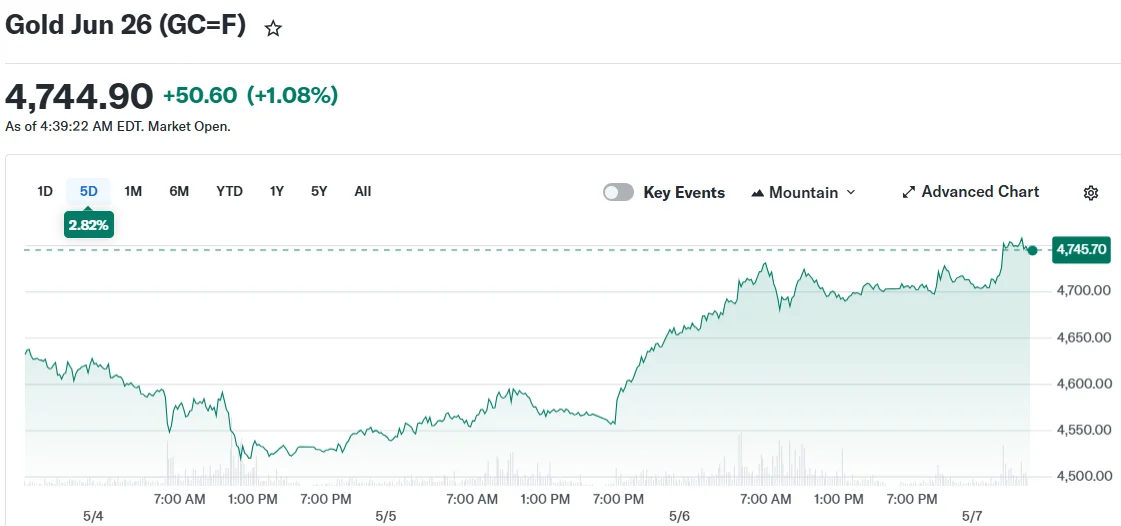
Wednesday witnessed gold’s most impressive single-session performance since the final days of March, with prices surging more than 3%. This substantial rally followed a sharp decline in crude oil prices triggered by encouraging reports of diplomatic advancement in US-Iran discussions.
According to reporting from Axios, the administration was nearing completion of a memorandum of understanding with Iranian officials to resolve the ongoing conflict. Tehran indicated it was evaluating the proposal, while President Donald Trump expressed confidence that Iranian leadership was interested in reaching an agreement.
Trump communicated via social media Wednesday that Washington would conclude its military operations and remove its blockade of the Strait of Hormuz, contingent upon Iranian compliance with specified conditions — though he acknowledged this might be “perhaps, a big assumption.”
Oil experienced a dramatic 7% decline on Wednesday before stabilizing Thursday as traders awaited additional details regarding the ongoing negotiations.
The Connection Between Energy Prices and Precious Metals
Decreasing energy costs diminish the probability of sustained inflation pressures. This development subsequently pressures US Treasury yields downward and undermines dollar strength, creating favorable conditions for gold prices.
Gold is denominated in dollars globally, meaning a softer greenback enhances affordability for international purchasers. Additionally, since gold generates no yield, declining interest rates improve its competitiveness relative to interest-bearing assets like government bonds.
“The potential easing in energy prices gives the Fed more room to cut rates, which is positive for gold,” analysts at ING said in a note.
The US Dollar Index declined 0.1% during Asian market hours Thursday, stabilizing near levels observed before the conflict erupted.
Prior to the recent rally, gold had declined 11% following the outbreak of US-Iran tensions in late February. The blockade of the Strait of Hormuz had propelled energy costs higher and intensified concerns that inflation would remain stubbornly elevated, forcing monetary policymakers to maintain restrictive interest rate policies for an extended period.
Federal Reserve Officials Maintain Vigilance on Price Pressures
Not all observers share the optimistic outlook. Chicago Federal Reserve President Austan Goolsbee and St. Louis Federal Reserve President Alberto Musalem both emphasized that inflation continues to exceed the central bank’s 2% objective.
Strategists at TD Securities cautioned that positive headlines surrounding peace negotiations are “extremely fragile to reversal” given that fundamental positions from both Washington and Tehran appear largely unchanged from previous negotiating rounds.
Silver advanced 1.9% to $78.79 per ounce Thursday, following Wednesday’s impressive 6.2% surge. Platinum registered modest gains, while copper traded relatively unchanged.
Market attention has now shifted to Friday’s US non-farm payrolls release. The employment figures could provide critical insights into whether the Federal Reserve will implement interest rate reductions during the remainder of the year.
Spot gold traded at $4,701.96 per ounce as of 1:59 p.m. Singapore time Thursday.

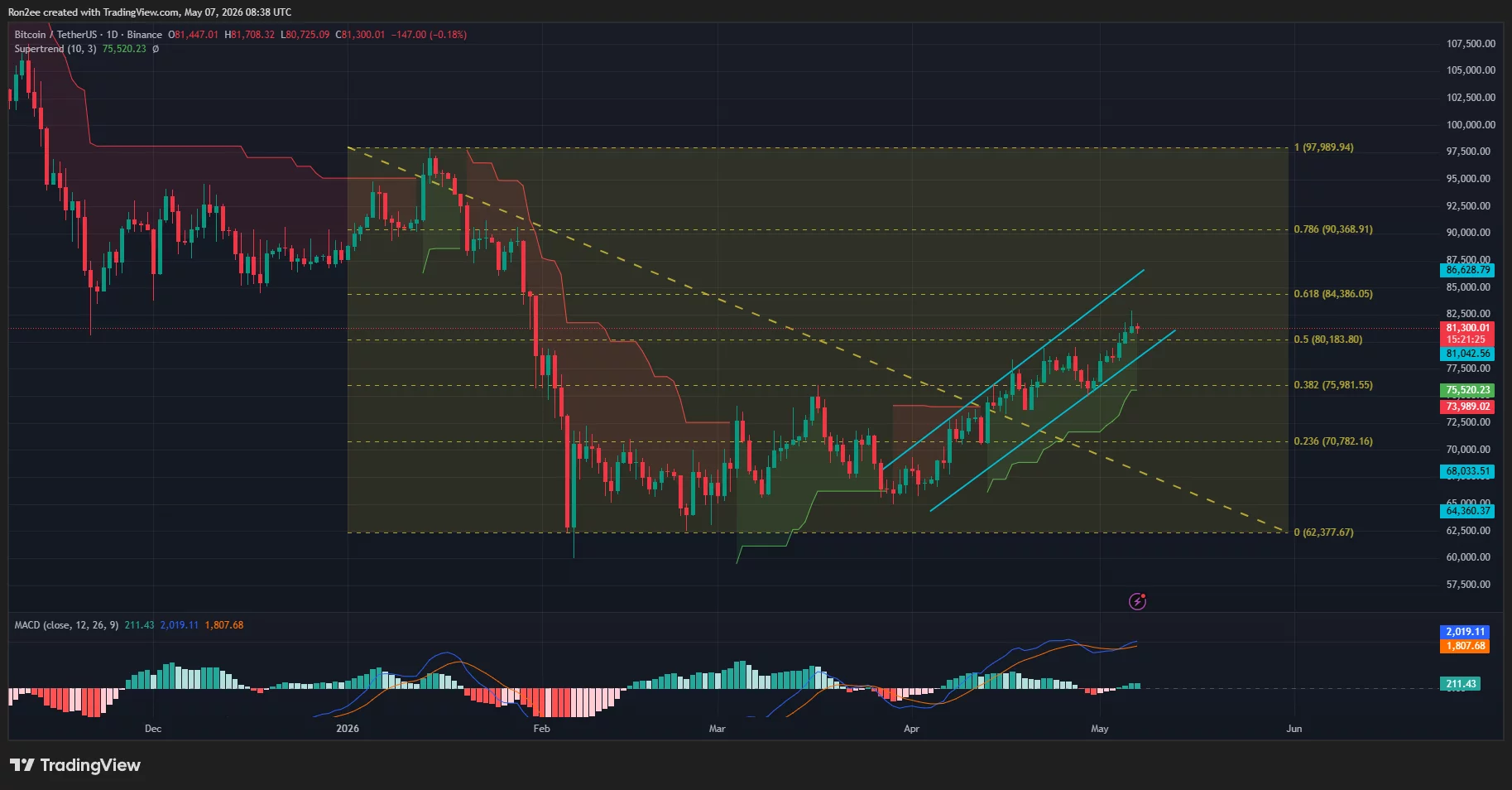
Bitcoin price rebounded back above $81,000 as investor risk-on sentiment improved after Iran signalled that it was reviewing a U.S. proposal to end the war between the two nations.
Summary
- Bitcoin price rebounded above $81,000 after Iran said it was reviewing a U.S.-backed peace proposal that could reopen the Strait of Hormuz.
- Oil prices declined for a third straight day amid optimism around a potential U.S.-Iran ceasefire, supporting renewed risk appetite across crypto markets.
- Bitcoin’s Supertrend remained green while MACD formed a bullish crossover, with traders watching the $84,000–$85,000 zone as the next resistance area.
After falling over 2.3% from a 4-month high of $82,751 on Wednesday to an intraday low of $80,771, Bitcoin (BTC) price rebounded back above $81,500 at press time.
The bellwether reclaimed the $81K figure as oil prices continued to drop for the third straight day, as the U.S. and Iran made more progress toward a peace deal currently “under review” that aims to bring a permanent end to the war between the two nations and ease disruptions at the Strait of Hormuz.
Reports indicate that Iran is mulling over the peace deal presented by the U.S. through Pakistani intermediaries and is expected to provide a formal response within the coming days. The one-page memorandum of understanding includes a comprehensive framework for a ceasefire and the restoration of trade routes. However, it excludes sensitive discussions surrounding Iran’s nuclear program, which would reportedly take place at a later date.
Despite the growing optimism, U.S. President Donald Trump clarified that a deal has not yet been finalized, adding that the U.S. would continue with its attacks on Iran if it fails to comply with the proposed terms.
Crude oil prices, which have largely been affecting global market sentiment since the war began, fell for a third straight day on Thursday, boosting investor confidence in riskier assets. Notably, WTI crude futures fell toward $93 per barrel while Brent oil had fallen 1% to $100.
Safe haven assets such as gold and silver have continued to show volatility as investors rotated capital away from traditional hedges and back into Bitcoin and other crypto assets. Gold price rose over 1.2% today, while silver gained nearly 4%.
The Coinbase premium fell to a negative reading, suggesting a slight cooling of demand from U.S. institutional buyers
Bitcoin price analysis
On the daily chart, Bitcoin price has been trading within an ascending parallel channel pattern ever since late March. It has formed higher highs and higher lows consistently over the past several weeks.
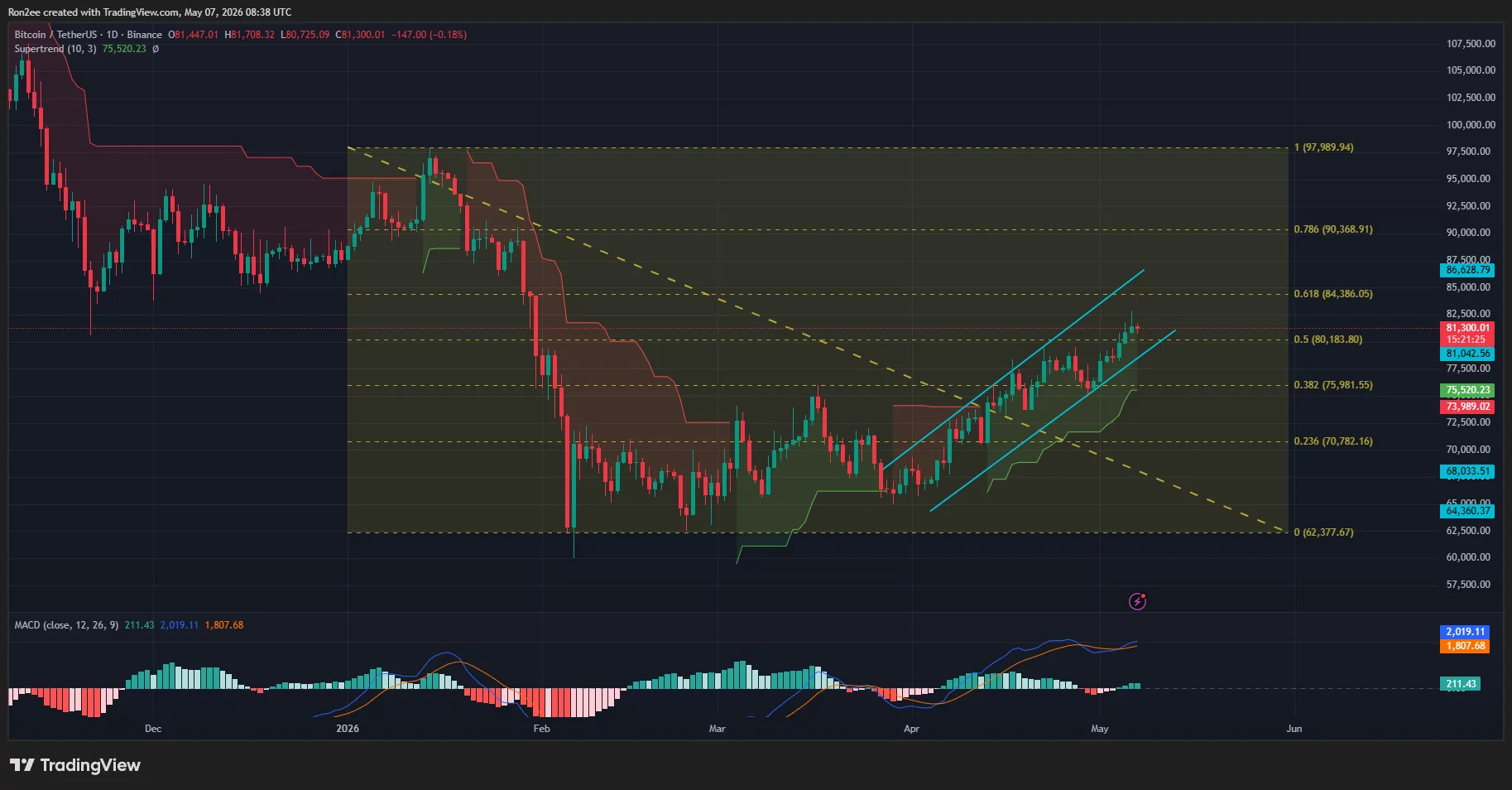
The Supertrend has continued to remain green, a sign that the overall bullish momentum is still firmly in control. At the same time, the MACD lines have formed a positive crossover, which means that buying pressure is increasing in the short term.
Hence, the path of least resistance for Bitcoin lies above the current levels with bulls eyeing the $84,000 to $85,000 range as the next major target. On the contrary, $80,000 remains the psychological floor that must hold to prevent a deeper correction.
Disclosure: This article does not represent investment advice. The content and materials featured on this page are for educational purposes only.


South Korean crypto exchange Upbit has added B3 to its Korean won market, giving local traders direct access to the Base-linked token.
Summary
- Upbit opened B3 trading against the Korean won, giving the Base token local market access.
- The exchange delayed trading to 14:00 KST and applied early order restrictions for stability.
- B3’s Base network support links the listing to growing Korean interest in OP Stack projects.
Trading was first scheduled for 13:45 KST on May 7, before Upbit moved the start time to 14:00 KST.
B3 is a layer-3 blockchain built on Base, the Ethereum layer-2 network developed with the OP Stack. The Upbit listing gives the token access to one of Asia’s most active retail crypto markets.
Exchange sets early trading limits
Upbit said deposits and withdrawals will only support B3 through the Base network. The exchange also asked users to confirm the contract address before sending funds. Deposits through unsupported networks may face a long refund process.
The exchange placed normal controls on early trading. Buy orders were restricted for about five minutes after launch. Upbit also limited low-price sell orders and restricted non-limit order types for about two hours.
Upbit warned, “If a certain level of liquidity is not secured after the commencement of deposit and withdrawal services, the start of trading support may be postponed.” The notice shows the exchange kept room to adjust trading if market depth was weak.
B3 joins recent Upbit listing wave
The listing comes after several Upbit market additions drove fresh attention to selected tokens. As crypto.news reported yesterday, Dogwifhat rose after Upbit added WIF trading pairs against KRW, BTC, and USDT on May 6. The report also noted that new listings can expose traders to fast price swings.
Earlier, crypto.news reported that Centrifuge jumped more than 180% after Upbit announced trading support. Another report said Internet Computer added about $100 million in market value after Upbit opened ICP trading against KRW, BTC, and USDT.
These cases show why new KRW pairs draw close market attention. They create direct local currency access and can bring sudden liquidity from South Korean retail traders.
OP Stack link adds market context
B3’s Base and OP Stack link also fits a wider infrastructure trend at Upbit. Crypto.news reported this week that Upbit partnered with Optimism to build GIWA Chain, an Ethereum layer-2 network using the OP Stack.
That report said GIWA Chain will let Upbit run its own infrastructure under Optimism’s self-managed enterprise setup. The exchange will operate its own sequencer, which controls transaction ordering and collects network fees.
The B3 listing is separate from GIWA Chain, but both relate to OP Stack-based blockchain activity. For traders, the listing places B3 inside South Korea’s won market while giving Base-linked layer-3 projects more visibility.
Crypto World
OpenPayd’s CCO on the Future of Payments, Stablecoins and Unified Financial Infrastructure

As financial infrastructure continues to evolve, the lines between traditional banking, payments, forex, and digital assets are becoming increasingly blurred. Businesses operating globally now need faster and more transparent ways to move money across currencies, markets, and even platforms.
To explore the ways this shift is reshaping the future of financial services, we spoke with Lux Thiagarajah, Chief Commercial Officer at OpenPayd.
With a career spanning FX trading at JP Morgan, senior roles at institutions such as HSBC, as well as leadership positions across digital-native companies such as BCB Group and FalconX, he brings a unique perspective on the convergence of legacy finance and modern fintech infrastructure.
In the following interview, he talks about how his trading background informs his view of payments, why unified financial infrastructure is becoming essential for global businesses, and where the next phase of fintech growth will be coming from.
You began your career as an FX trader at J.P. Morgan before moving into senior leadership roles across trading and payments. How has that trading background shaped the way you think about payments infrastructure and financial services today?
More than anything else, my trading background shaped how I think about efficiency and timing.
On a trading desk, you are constantly focused on execution. Speed matters, pricing matters, and small inefficiencies compound very quickly. If settlement is delayed or costs are unclear, that directly impacts profitability. That mindset carries through into how I view payments today.
When I look at payments infrastructure, I see it through that same lens. It should be fast, transparent and predictable. Too much of the legacy system still operates with delays, opaque FX spreads and multiple intermediaries. That may have been acceptable historically, but it is increasingly out of step with how businesses operate today.
It also taught me the importance of liquidity. Whether in FX markets or payments, access to liquidity at the right time, in the right currency, is what ultimately determines how efficient a system is. That is why the convergence of fiat and stablecoin liquidity is such an important development for financial services.
You’ve worked across both traditional finance institutions like HSBC and newer digital-native companies such as FalconX and BCB Group. What are the biggest structural differences you’ve observed between legacy financial systems and modern fintech infrastructure?
I believe that the biggest difference is not just technology, it is mindset.
Legacy financial systems were built for a different era. They are robust and trusted, but they are also rigid. Processes are often batch-based, infrastructure is fragmented, and change takes time because everything is layered on top of decades of existing systems.
Modern fintech infrastructure is designed with flexibility from day one. It is API-first, modular and built to scale across markets quickly. Instead of stitching together multiple providers, you are creating a single layer that orchestrates everything behind the scenes.
The other key difference is how problems are approached. Traditional institutions tend to optimise within existing frameworks rather than remove the constraints, whereas fintechs are more willing to rethink the model entirely. That is why we are now seeing infrastructure that connects payment rails, FX and digital assets in a unified way, rather than treating them as separate systems.
What has become clear over time is that neither side can do it alone. The future is not one replacing the other. It is about combining the resilience and trust of traditional finance with the flexibility and speed of modern infrastructure.
As Chief Commercial Officer at OpenPayd, you’re responsible for driving growth across both new and existing clients. What are the key capabilities that fintechs, exchanges, and digital platforms are now looking for in payments partners?
Clients are no longer looking for a single payment rail or a point solution. They want infrastructure that grows with them without constantly re-engineering their setup. That means access to accounts, payments, FX and increasingly digital assets, all through one integration. The days of stitching together multiple providers for different functions now feels outdated.
There is also a much sharper focus on reliability. When payments sit at the core of your product, there is no margin for error. It is not just about speed; it is about consistency and control at scale.
And then there is optionality. Clients do not want to be locked into one rail or one model. They want the flexibility to route transactions in the most efficient way, whether that is through traditional rails or newer settlement methods like stablecoins, without adding complexity to their operations.
Embedded finance and programmable payments are becoming central themes across fintech. How do you see these trends reshaping the relationship between platforms, financial institutions, and end users over the next few years?
Embedded finance is changing how financial capabilities are delivered. Instead of being accessed separately, they are now built directly into platforms, becoming part of the product itself. Programmable payments take that further by automating how money moves, reducing manual processes and improving efficiency at scale.
The roles are becoming clearer. Platforms own the user experience, infrastructure providers manage the complexity behind the scenes, and banks continue to provide the regulatory foundation.
For users, it feels seamless. For businesses, it means far greater control over how money flows through their ecosystem.
OpenPayd operates at the intersection of payments, banking, and digital assets. How important is a unified financial infrastructure for companies operating globally, particularly those scaling across multiple jurisdictions?
It is becoming essential. Businesses with global ambitions deal with different banks, different rails, different regulatory frameworks, and now different asset types. Each layer adds complexity, and that complexity does not scale well.
A unified infrastructure simplifies that environment. It allows businesses to access local and international payments, FX and digital assets through a single framework, rather than building separate systems for each market or use case.
The real value of a unified infrastructure is operational – consistent and standardised processes for compliance, reporting, settlement and treasury management across all regions. It unlocks scale. Without it, expansion into new markets becomes slower, more expensive and more operationally complex than it needs to be.
Strategic partnerships are a major part of your role. What makes a partnership truly valuable in today’s fintech ecosystem, and how should companies think about building long-term collaboration rather than simple integrations?
The difference comes down to alignment. Is the goal to solve a specific or short-term need, or are both sides working towards a shared objective? The most valuable partnerships I have seen are the ones where each side brings something the other cannot easily replicate, whether that is distribution, regulatory coverage or technical capability.
There is also an element of trust. Not just in terms of compliance, but in how you operate together day to day. In a fast-moving environment, things change. The partnerships that last are the ones that can adapt without constantly renegotiating the fundamentals.
Looking ahead, what do you think will define the next phase of growth for fintech infrastructure providers, and where do you see the biggest opportunities for companies like OpenPayd in the next 3–5 years?
The next phase will be defined by convergence across financial infrastructure. A lot of the core building blocks already exist. Stablecoins have proven they can operate at scale, APIs are standard, and regulatory frameworks, such as MiCA and the GENIUS Act, are becoming clearer. The challenge now is making all of these components work together in a way that feels simple to the end user.
That is where the opportunity sits – in orchestration. The underlying rails already exist, but they are fragmented. The providers that can unify those rails and abstract the complexity will become the backbone of global financial services.
For OpenPayd, that means continuing to build the universal financial infrastructure that allows businesses to move money globally, across both fiat and digital assets, without friction.
Disclaimer: The content shared in this interview is for informational purposes only and does not constitute financial advice, investment recommendation, or endorsement of any project, protocol, or asset. The cryptocurrency space involves risk and volatility. Readers are encouraged to conduct their own research and consult with qualified professionals before making any financial decisions. This interview was conducted in cooperation with OpenPayd, who generously shared their time and insights. The content has been reviewed and approved for publication in mutual understanding. Minor edits have been made for clarity and readability, while preserving the substance and tone of the original conversation.
The post OpenPayd’s CCO on the Future of Payments, Stablecoins and Unified Financial Infrastructure appeared first on CryptoPotato.
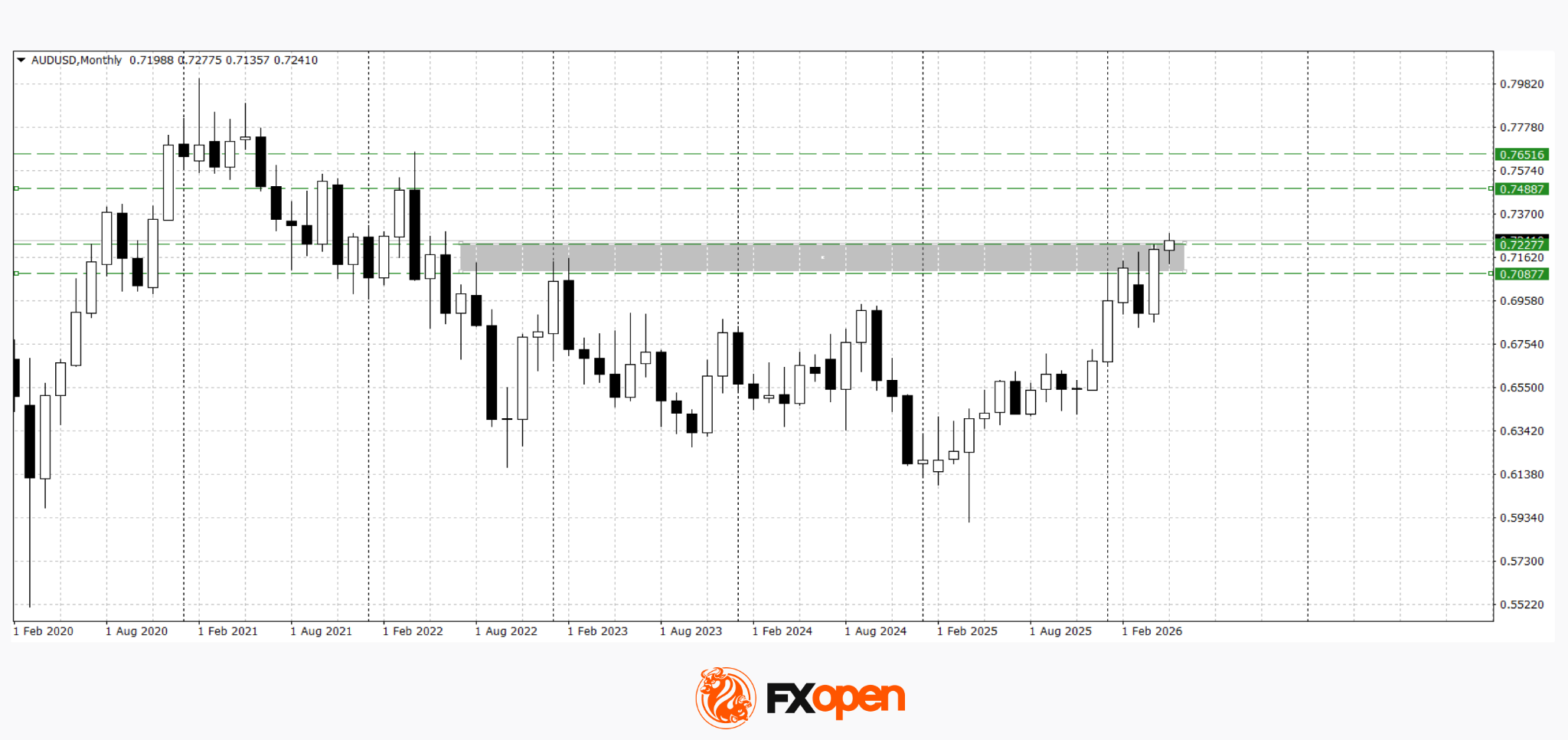
The Australian dollar continues to strengthen, pushing to fresh 2021–2022 highs, supported by a combination of the Reserve Bank of Australia’s tight monetary stance and a weaker US dollar. This week’s rate hike by the RBA has been a key driver, widening yield differentials and boosting demand for the Australian currency, which has reinforced the ongoing uptrend. Additional pressure on the US dollar came from weak labour data, including the ADP report, increasing expectations of a more accommodative Fed policy.
The current market structure suggests that both AUD/USD and AUD/CAD have broken out of recent consolidation ranges and are now advancing towards multi-year highs. Trading at these levels creates a decision zone where liquidity is being reallocated, with the market assessing whether prices can hold above extremes or fall back into prior ranges.
In the near term, the key event for markets will be the US Non-Farm Payrolls report, while other macro releases are likely to play a secondary role. The NFP reaction could significantly influence expectations for Fed policy and set the direction for the US dollar.
AUD/USD
AUD/USD is trading near yearly highs, maintaining bullish momentum after breaking out of its range. Dollar weakness combined with RBA policy support continues to favour further gains, with the current area acting as a key test for breakout confirmation.
From a technical perspective, continuation of the uptrend depends on the 0.7230 level holding as support. However, in the absence of fresh catalysts ahead of key data releases, a pullback towards 0.7130–0.7160 remains possible.
Key Events For AUD/USD:
- today at 15:30 (GMT+3): US initial jobless claims
- today at 17:00 (GMT+3): US construction spending
- today at 18:30 (GMT+3): Atlanta Fed GDPNow indicator
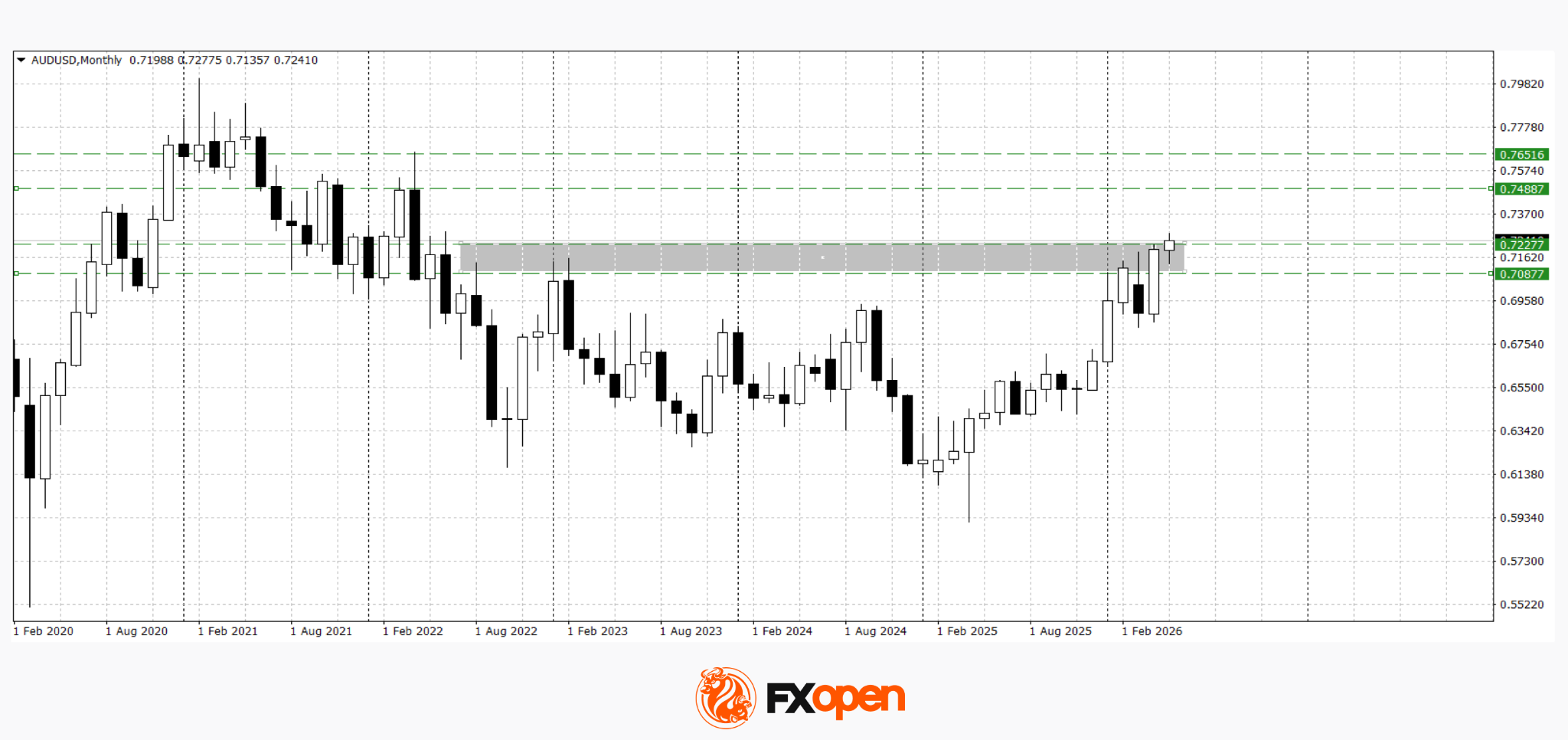
AUD/CAD
AUD/CAD reached a new yearly high yesterday at 0.9870 and still shows potential for a move towards 2021 extremes near 0.9990. If the upper boundary of the recent range turns into support, the bullish momentum could strengthen further.
At the same time, a slowdown at current levels could lead to a return back into the broken range, creating a false breakout scenario and opening the door for a corrective move.
Key Events For AUD/CAD:
- today at 13:00 (GMT+3): Canada leading economic indicators
- today at 23:30 (GMT+3): US Federal Reserve balance sheet
- tomorrow at 15:30 (GMT+3): Canada employment change
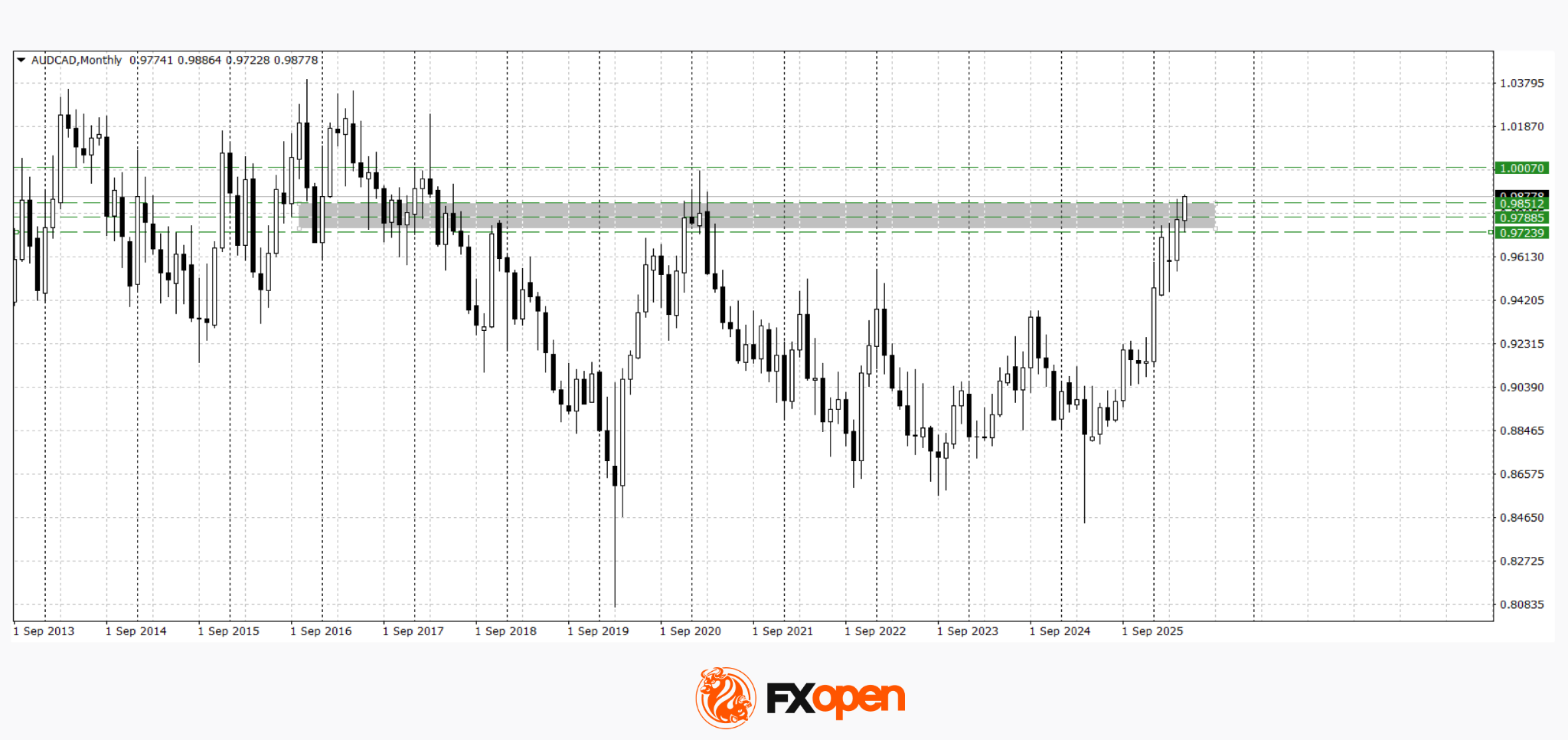
Overall, both currency pairs remain in a strong upward phase supported by fundamental drivers. The current resistance zone is a key decision area: a sustained breakout would open the way for further gains, while weak follow-through or stronger US data could trigger a return into prior ranges and a corrective pullback. Upcoming macroeconomic releases are likely to be the decisive catalyst for the next market move.
Trade over 50 forex markets 24 hours a day with FXOpen. Take advantage of low commissions, deep liquidity, and spreads from 0.0 pips (additional fees may apply). Open your FXOpen account now or learn more about trading forex with FXOpen.
This article represents the opinion of the Companies operating under the FXOpen brand only. It is not to be construed as an offer, solicitation, or recommendation with respect to products and services provided by the Companies operating under the FXOpen brand, nor is it to be considered financial advice.
Matthew Sigel, VanEck’s Head of Digital Assets Research, has projected that Bitcoin (BTC) could reach $1 million per coin.
Sigel made the comments on CNBC’s Halftime Report. He described the path as cyclical and warned of significant volatility along the way.
VanEck Sees $1 Million Bitcoin in 5 Years
During the show, Sigel compared Bitcoin’s trajectory to that of the video game industry’s, where adoption, once limited to children, now spans every age group.
“When you look at the demographic trends and the intentions of young investors to allocate to Bitcoin. It’s going to be like the video game industry, where 30 years ago it was just kids playing video games, now Elon Musk plays video games,” he said. “People don’t quit; they also don’t quit bitcoin. We have the first central bank buying bitcoin for its reserves, so this is a mega trend, but it will be very volatile along the way.”
Follow us on X to get the latest news as it happens
When asked about the timeline for Bitcoin reaching $1 million, Sigel said the milestone could be achieved within the next several years, possibly in about 5 years.
He said a continued rise in Bitcoin remains VanEck’s base-case scenario. However, Sigel added that the asset’s trajectory will remain cyclical.
“We think this asset is going to reach $1 million over the next several years, but it’s a very cyclical asset. There are no bailouts in bitcoin, so it’s going to be cycles along the way,” the executive mentioned.
Subscribe to our YouTube channel to watch leaders and journalists provide expert insights
Meanwhile, commenting on Bitcoin’s near-term price action, Sigel said the cryptocurrency’s correlation with the Nasdaq has reached its highest level in five years, suggesting the current rally is largely driven by broader macroeconomic trends.
He noted that the firm’s conviction at current levels stems from the fact that there’s no “froth in the derivatives market.” According to him, the rally still appears to be fueled primarily by short covering, indicating that overall market positioning remains relatively bearish. He added that this setup continues to support a constructive outlook for Bitcoin.
Sigel’s projection aligns VanEck with Bitwise Chief Investment Officer Matt Hougan and Jan3 CEO Samson Mow. Hougan and Mow used different analytical frameworks to reach those seven-figure scenarios.

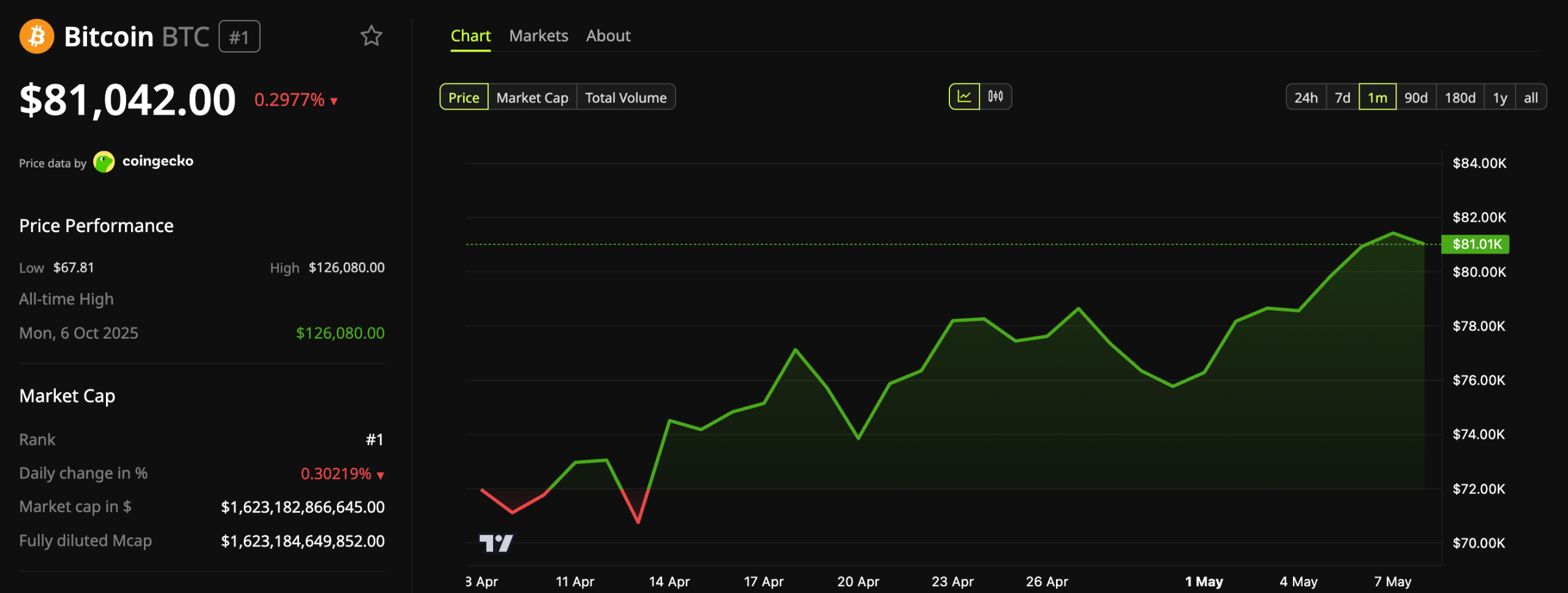
Bitcoin would need to climb more than 12-fold to validate the $1 million target. At press time, the asset traded at $81,042, down nearly 0.30% over the past day. Even reclaiming its October 2025 record of over $126,000 would cover only a fraction of that distance.
The post VanEck Joins Bitwise in Forecasting $1 Million Bitcoin Price Target appeared first on BeInCrypto.

In a case that has sharpened the ongoing debate over privacy tools in crypto, Keonne Rodriguez, a co‑founder of the Samourai Wallet project, has urged the community to help cover mounting legal costs after a federal court delivered prison sentences to him and his partner. Rodriguez received a five‑year term, while co‑founder William Lonergan Hill was sentenced to four years for their involvement in the cryptocurrency‑mixing service.
According to a filing from the U.S. attorney’s office, the pair were charged in April 2024 with conspiracy to commit money laundering and conspiracy to operate an unlicensed money transmitting business. They initially pleaded not guilty; in July 2025, they agreed to plead guilty to one count of operating an illegal money transmitter. The sentencing occurred on November 19 (the announcement did not specify a year in the filing text).
Rodriguez has since disclosed that the legal battle has financially wrecked him, estimating roughly $2 million in legal fees and a $250,000 fine levied by the sentencing judge. In a post on X, he described being “financially wiped out” and pleaded for assistance to cover debts incurred while defending himself and his project.
“We are entirely out of options. We need to pay off these legal bills and other debts accrued attempting to defend myself. We desperately need your help. Now.”
Supporters of Samourai Wallet and broader crypto‑privacy advocates have followed the case closely, arguing that founders of open‑source privacy tools should not shoulder liability for the actions of third‑party users. The prosecutions against Rodriguez, Hill, and Tornado Cash co‑founder Roman Storm have intensified the public debate over how to balance privacy rights with regulatory compliance.
Costs racked up over a long legal battle
The charges stemmed from allegations that the defendants conspired to launder money and to operate an unlicensed money‑transmitting business through their services. The defendants initially denied the charges, but in mid‑2025 they agreed to plead guilty to at least one count related to operating an illegal money transmitter. The unfolding timeline underscores the substantial legal exposure facing founders of tools designed to enable privacy and on‑chain analytics elsewhere in the ecosystem.
Industry observers note that criminal defense work in such high‑stakes cases can be profoundly costly, with defense expenses typically running into the millions depending on case complexity and the number of experts involved. Rodriguez’s fundraising appeal highlights the real financial pressures that can accompany crypto‑privacy litigation—even for developers who see their work as a public good.
Pardon prospects and political optics
The case has drawn attention beyond the courtroom. Former U.S. President Donald Trump indicated during prior discussions that he would consider reviewing Rodriguez’s case for a pardon. A petition on Change.org gathered signatures in support of a pardon, though observers caution that the political calculus around crypto‑privacy cases remains uncertain. As of the latest update, the petition had collected thousands of signatories, but Trump’s likelihood of granting a pardon remains a matter of speculation given the broader regulatory and political dynamics surrounding privacy tools and crypto enforcement.
Rodriguez has acknowledged the limited prospects for a presidential intervention, comparing his situation with other notable cases in the sector. He said that while there was some optimism during high‑profile crypto events, the reality now is that he will serve a full federal sentence without external influence or financial leverage.
The broader implication of the case continues to reverberate through the crypto community. Privacy‑preserving and open‑source tools occupy a nuanced space in the regulatory landscape, where advocacy efforts stress that developers should not be treated as accomplices for user behavior solely by virtue of releasing powerful software. As policymakers calibrate enforcement norms, readers should watch for updates on appeals, potential pardons, and any shifts in how courts handle open‑source privacy projects in the future.
What comes next could hinge on developments in the pardon discussion, potential appeals, and ongoing regulatory discourse surrounding privacy tools and compliant operation in the cryptocurrency space. Investors, users, and builders should remain attentive to how this high‑profile case shapes privacy‑tech risk, compliance expectations, and the viability of open‑source privacy initiatives in a tightening regulatory environment.

Why Animoca’s Yat Siu says the future is 100 billion AI agents

McLaughlin: UCLA’s Recruiting Rise Ruffling Trojans?

Nintendo Shuts Down Fun Faux ‘Pokemon Documentary’ YouTuber Via Copyright Strikes

Manchester United reach agreement with Casemiro over contract clause amid transfer speculation

US brings back mandatory military draft registration

Steven Gerrard disagrees with Gary Neville over ‘shock’ Chelsea and Arsenal claim | Football


-

 NewsBeat4 days ago
Channel 5 – All Creatures Great and Small series 7 new post
-
 Tech6 days ago
Trump’s 25% EU auto tariff breaches Turnberry Agreement that also covers semiconductors and digital trade
-
 Sports6 days ago
Paul Scholes issues Marcus Rashford reality check as agreement emerges over Man United star
-

 Entertainment6 days ago
Met Gala 2026 Rumored Guest List Is Turning Heads
-

 Business6 days ago
Strait of Hormuz Blockade Persists Amid US-Iran Standoff, Sending Oil Prices Soaring
-
Entertainment6 days ago
New on Prime Video in May 2026 — Full List of Movies and Shows
-

 Sports5 days ago
Cavaliers vs. Raptors Game 6 live score, updates, highlights from 2026 NBA playoffs first-round series
-
 Sports5 days ago
David Benavidez responds to team Canelo saying the fight will never happen
-

 Tech6 days ago
Meta ends Sama contract after Kenyan workers report seeing intimate footage from Ray-Ban smart glasses users
-

 Entertainment5 days ago
Kylie Jenner Hit With Second Lawsuit From Ex-Housekeeper
-

 Entertainment5 days ago
Young and the Restless Next Week: Cane Arrested & Matt’s Deadly New Scheme!
-
Entertainment4 days ago
New Netflix Movies in May 2026 — My Top 3 Picks to Stream
-
 Sports5 days ago
IPL 2026: ‘Love you darling’- Hardik Pandya’s reaction to MS Dhoni steals the show |Watch | Cricket News
-

 Business4 days ago
Luka Doncic Injury Update: Doncic’s Hamstring Recovery Slows Lakers’ Hopes Against Thunder: Can He Run Yet?
-

 Sports6 days ago
What Preity Zinta Said After Punjab Kings’ First Defeat Of IPL 2026
-

 Sports6 days ago
Bayern won’t hand bottom side Heidenheim ‘gifts’ despite PSG game
-
 Crypto World5 days ago
Pi Network Mandates Protocol 23 Upgrade for All Mainnet Nodes Before May 15 Deadline
-

 Crypto World4 days ago
Bitcoin mining equities rise in 2026 as BTC lags behind
-

 Tech6 days ago
Infinix Introduces GT 50 Pro for Gamers with Improved Cooling and Control Features
-

 Business5 days ago
Can Victor Wembanyama Bring the NBA Ring to Spurs in 2026? Historic Playoff Run Fuels Title Dreams
You must be logged in to post a comment Login