

Crypto World
How $619M Midweek Bleed Was Erased by Massive One-Day Crypto Inflow


Digital asset funds posted $117.8 million in inflows, continuing a five-week streak, though this was the smallest weekly gain in that period. The overall number indicated a late recovery.
Earlier in the week, from Monday through Thursday, the market saw $619 million in outflows over four consecutive days. A sharp reversal came on Friday, as $737 million entered in a single day, which managed to turn the weekly balance positive.
Friday Saves the Week
CoinShares stated that this is one of the largest daily inflows recorded in 2026, “likely reflecting a sharp improvement in risk appetite.” Meanwhile, total assets under management held steady at $155 billion.
Investment products tied to Bitcoin attracted over $192 million in the past week, bringing its total for the year to $4.2 billion. The figure is still below recent weekly averages of close to $1 billion.
A small group of investors still expect BTC to decline as Short Bitcoin products raked in $6 million in inflows. Multi-asset products brought in $3.6 million, while XRP recorded $3 million during the same period. Ethereum, on the other hand, saw $81.6 million exit, as it snapped a three-week streak of gains above $190 million. Solana also followed suit with over $11 million in outflows.
In its latest Digital Asset Fund Flows Weekly Report, CoinShares said,
“The narrowing in participation from nine assets to four this week is the clearest signal that sentiment softened through the working week before recovering on Friday.”
The US brought in $47.5 million, far lower than the $1.1 billion seen a week earlier amid a slowdown in the week. In contrast, Germany amassed $43.8 million, while Canada added $16 million, indicating steadier demand. Elsewhere, Switzerland and Australia recorded smaller inflows of $5.2 million and $4 million.
Choppy Trading Sessions Ahead?
Bitcoin has entered May on a strong note, after breaking above $80,000 for the first time since January 31. In a recent note to investors, Singapore-based QCP Capital observed that Bitcoin’s correlation with US stocks is rising back toward 2023 levels, in what appears to be a renewed link with broader risk assets.
Interestingly, BTC’s rally came even as Strategy paused its purchases, which can indicate “the market may be drawing strength from a wider base of support beyond that single narrative.” Institutional demand also remains steady. However, QCP noted that holding above the $82,000 to $83,000 range is important for continuation.
Implied volatility is near yearly lows, while the VIX is around 17, which essentially means that markets are largely looking past geopolitical risks. Despite this, the situation remains “fluid.” Upcoming labor data and earnings from Strategy, Coinbase, and Block could lead to choppiness over the coming sessions.
The post How $619M Midweek Bleed Was Erased by Massive One-Day Crypto Inflow appeared first on CryptoPotato.

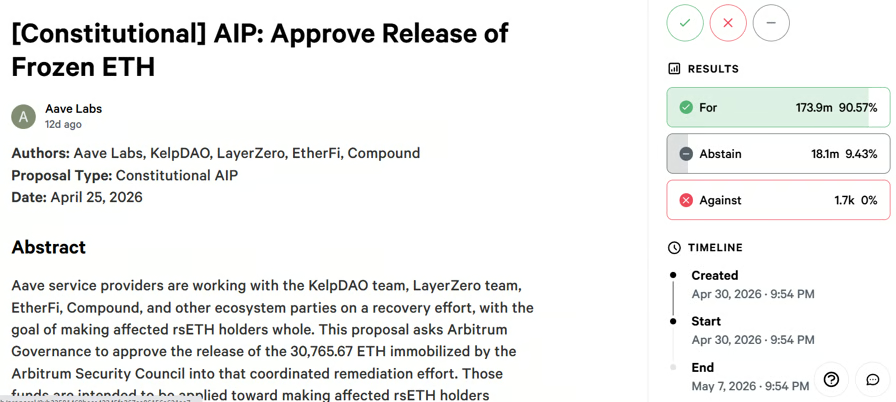
A joint proposal to release the roughly $71 million in Ether frozen after the Kelp DAO exploit is set to pass later on Thursday, moving a cross-protocol recovery effort closer to restoring part of rsETH’s backing.
Over 90.5% of the tokens were cast in favor of the motion, representing 173.9 million Arbitrum (ARB) tokens, while 9.4%, or 18.1 million tokens, abstained. Less than 1%, or 1,700 tokens, voted against the proposal before the voting period’s scheduled end at 6:54 pm UTC, according to a Snapshot at the time of writing.
Co-authored by Aave Labs, Kelp DAO, LayerZero, EtherFi and Compound, the proposal seeks to unfreeze the 30,765 Ether (ETH) that was frozen by Arbitrum’s Security Council on April 21, days after an attacker drained about 116,500 restaked Ether (rsETH) from Kelp Dao, worth between $290 million and $293 million at the time.
The proposal marks the end of the first round of voting, bringing the “DeFi United” recovery effort closer to restoring part of rsETH’s backing and moving the motion to a definitive onchain governance proposal. It comes shortly after Aave Labs liquidated the Kelp DAO hacker’s remaining rsETH positions on Ethereum and Arbitrum, moving one step closer to resolution.
“DeFi United” is a recovery effort initiated by DeFi protocols, including Mantle, EtherFi Foundation, Golem Foundation, Lido DAO, Ethena, LayerZero, Ink Foundation and Tydro, who have pledged a cumulative 43,000 Ether (worth about $101 million) to reduce the contagion effect of the Kelp DAO exploit.
As the next step, the protocols will conduct a snapshot “temperature check” to gauge delegate sentiment before the proposal is finally submitted onchain via Tally as a Constitutional Arbitrum Improvement Proposal (AIP).
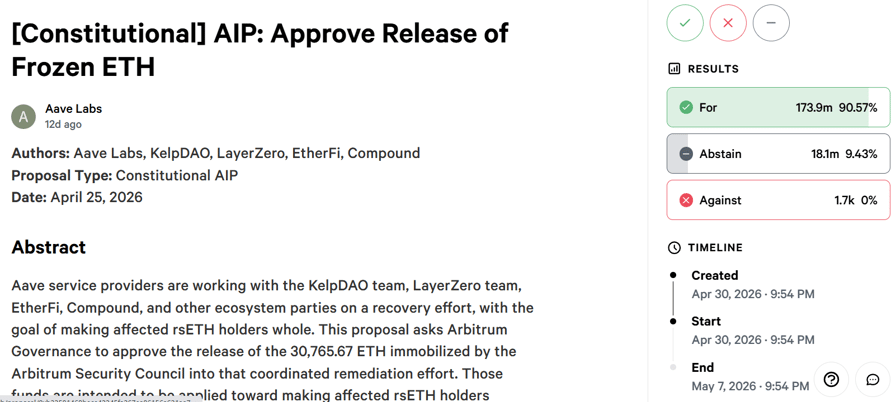
Joint proposal to release funds frozen by Arbitrum’s security council. Source: Snapshot.org
Subject to a binding onchain governance vote, the funds would be released in a designated recovery address ‘0xf22’ in a 3-of-4 Gnosis Safe (SAFE) with signers from Aave Labs, Kelp DAO, Certora and EtherFi.
However, even if the final governance proposal passes, rsETH’s backing is still facing a shortfall of about 76,127 rsETH, currently worth about $174.5 million. The proposal argued that even partially restoring rsETH’s backing will help stabilize market conditions in the broader DeFi ecosystem.
Cointelegraph reached out to Arbitrum and Aave for comment on the next steps in the governance process and the proposed timeline for restoring rsETH’s backing.
Related: Aave deposits fall by $15B as Kelp exploit sparks flight from DeFi lender
Arbitrum to pass proposal to deploy 6,000 ETH for yield
The Arbitrum DAO is also poised to approve a separate proposal to move 6,000 ETH, currently worth about $14 million, from the DAO treasury into its Treasury Management Portfolio.
The proposal increases the planned ETH allocation from 5,000 ETH to 6,000 ETH after forum feedback, according to the Arbitrum governance forum. It also seeks to transfer about $150,000 worth of idle USDC into the portfolio to generate additional yield
More than 99.9% of voting power was in favor of the proposal, representing 185.7 million ARB tokens, while 0.1%, or 266,930 ARB, abstained. The voting window is scheduled to close Friday at 2:22 pm UTC, according to Tally.
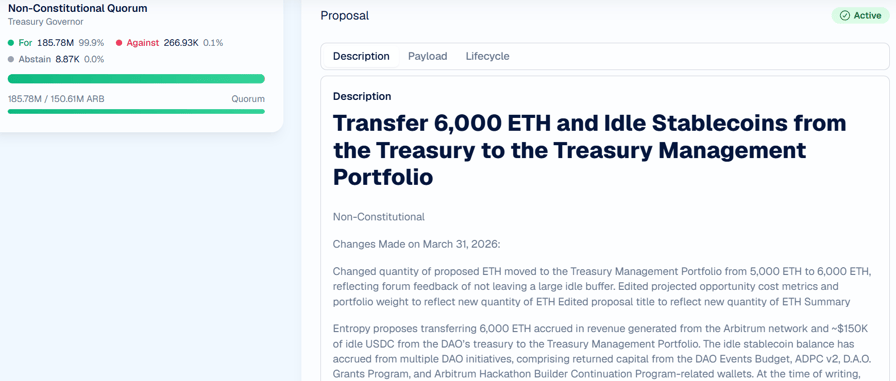
Proposal to transfer 6,000 ETH to Arbitrum DAO’s portfolio. Source: alt.gov.arbitrum.foundation.
The 6,000 ETH allocated to yield strategies is projected to generate an additional 288 ETH worth about $625,000 in the next year, assuming an ETH price of $2,200, based on the current 30-day-average annualized rate.
Magazine: 53 DeFi projects infiltrated, 50M NEO tokens could be ‘given back’: Asia Express
Circle Internet Group’s stock jumped nearly 20% on Monday after two US senators announced a bipartisan compromise on one of the most contentious issues holding up federal crypto legislation.
The deal, months in the making, drew loud opposition from the banking industry within hours of its release.
Lawmakers Push Stablecoin Compromise Despite Bank Resistance
In posts published on X on May 5, Senator Thom Tillis said he and Senator Angela Alsobrooks had reached a “consensus-based product” after working with industry stakeholders for months. According to Tillis, the agreement directly addresses one of the banking sector’s biggest concerns: deposit flight.
“Our compromise prohibits stablecoin rewards from resembling interest on bank deposits,” Tillis wrote, adding that banks had been “at the table” throughout negotiations.
At the same time, the proposal still allows crypto companies to offer alternative customer rewards, a concession that keeps parts of the existing business model intact.
The banking industry disagreed. A joint statement from the American Bankers Association, the Bank Policy Institute, the Consumer Bankers Association, the Financial Services Forum, and the Independent Community Bankers of America said the senators were “seeking to achieve the correct policy goal” but that the proposed language “falls short.”
The group cited research suggesting yield-bearing stablecoins could reduce consumer, small-business, and farm loans by one-fifth or more and pledged to send detailed suggestions to lawmakers in the coming days.
Tillis and Alsobrooks did not back down, with the pair saying the deal was locked and pointedly telling the banks that they “respectfully agree to disagree.”
Coinbase Chief Legal Officer Paul Grewal, who attended earlier White House meetings on this exact dispute back in February, was characteristically dry on X:
“I must say I feel obligated to offer my congratulations to the banking trades,” he wrote. “They’ve managed to do the impossible in our country these days: bring sensible Rs and Ds together.”
Circle Stock Rebounds
Markets responded almost immediately to the news, with Circle shares closing May 4 at around $120, up from roughly $100 the previous session. They then climbed further in after-hours trading to about $126.
That marks a sharp reversal from late March, when the stock dropped about 20% in a single day after earlier drafts of the legislation raised concerns about a blanket ban on stablecoin yield.
This time, the reaction has been different. The latest compromise still restricts interest-like payments but leaves room for other forms of rewards, which analysts have previously said match Circle’s existing model. The company already keeps the yield generated from reserves backing its USDC stablecoin rather than passing it on to users.
The post Circle Shares Jump 20% as Lawmakers Reach Stablecoin Deal appeared first on CryptoPotato.
Pictured here is the last time a sitting U.S. president made a state visit to China. President Donald Trump traveled to Beijing in November 2017 during his first term to meet with Chinese President Xi Jinping.
Pool | Getty Images
BEIJING — The Iran war is likely to take center stage in the summit between U.S. President Donald Trump and China’s Xi Jinping, leaving less scope to resolve issues like tariffs and rare earth supplies.
U.S. Treasury Secretary Scott Bessent has already said that Iran will be a topic in the meetings, which are due to take place May 14 and 15. And earlier this week, China hosted Iran’s foreign minister for the first time since the war began in late February — raising hopes for a peace deal, sending oil prices lower and fueling stock-market gains.
The U.S. government declined China’s invitation to organize industry-specific meetings between senior Chinese leaders and U.S. CEOs, thinking it could make American businesses appear too close to Beijing, according to a U.S. executive with direct knowledge of the arrangements. As of Tuesday, the White House had yet to formally invite executives to join Trump on the trip, and a proposed list of two dozen leaders could be halved, the person added.
Boeing and Citigroup CEOs are among those set to accompany Trump, two separate sources said. The U.S. aircraft giant is expected to seal its first large order from China in nearly a decade around the summit.
Xi has hosted a dozen national leaders this year, from the U.K. to South Korea — who often bring large business delegations. Still, corporations may not object to the decreased focus if it resolves a large geopolitical overhang for them.
An end to the Iran war would be a “great relief to global business,” said Hai Zhao, a director of international political studies at the Chinese Academy of Social Sciences, a state-affiliated think tank. It would “be remembered as very much the success” for the Trump-Xi summit.
However, the U.S. and Iran have traded fire in the Strait of Hormuz again, each blaming the other for initiating the attack. Just a few days earlier, a Chinese-owned oil tanker was also struck, according to Chinese media outlet Caixin. CNBC was unable to independently confirm the report.

If a smaller group of executives joins Trump’s visit to China, it would contrast with the president’s trip to Saudi Arabia last May, when more than 30 U.S. executives accompanied him. When Trump visited China during his first term in 2017, the last sitting U.S. president to do so, nearly 30 CEOs accompanied him – signing 37 major deals worth more than $250 billion.
But the expected images of Trump and Xi together may still send a signal within China that it’s more acceptable again to engage with U.S. businesses, said Michael Hart, president of the Beijing-based American Chamber of Commerce of China.
“Since U.S. military actions earlier this year, Chinese officials have been more hesitant to engage with the American business community,” he said.
China welcomes U.S. business expansion and hopes the companies can keep advancing bilateral economic relations, the foreign ministry told CNBC. China’s commerce ministry didn’t respond to a request for comment.
Meanwhile, the urgency of some business-related issues is declining. Both countries are backpedaling on recent confrontation around U.S. sanctions and tech, while eyeing cooperation on the growing security threat of AI, according to reports.
And some progress may still be made. Trump is expected to notch deals on Chinese purchases of U.S. soybeans and Boeing airplanes, according to Scott Kennedy, senior advisor and trustee chair in Chinese business and economics at the U.S.-based Center for Strategic and International Studies.
He also anticipates Trump will discuss U.S. plans to establish trade and investment organizations – called “boards” – to handle specific bilateral issues.
“The meeting most likely will solidify the advantages China has gained over the past year,” Kennedy said.
Beijing’s focus will likely be on tariffs, Taiwan’s status and U.S. restrictions on Chinese access to advanced technology, Kennedy said. China was the first major country to retaliate against tariffs announced by the Trump administration in April 2025.
Meanwhile, changes to China’s increasingly tight rare earths export controls would be felt worldwide, and they affect all countries, not just the U.S.
— CNBC’s Matthew Chin contributed to this report.
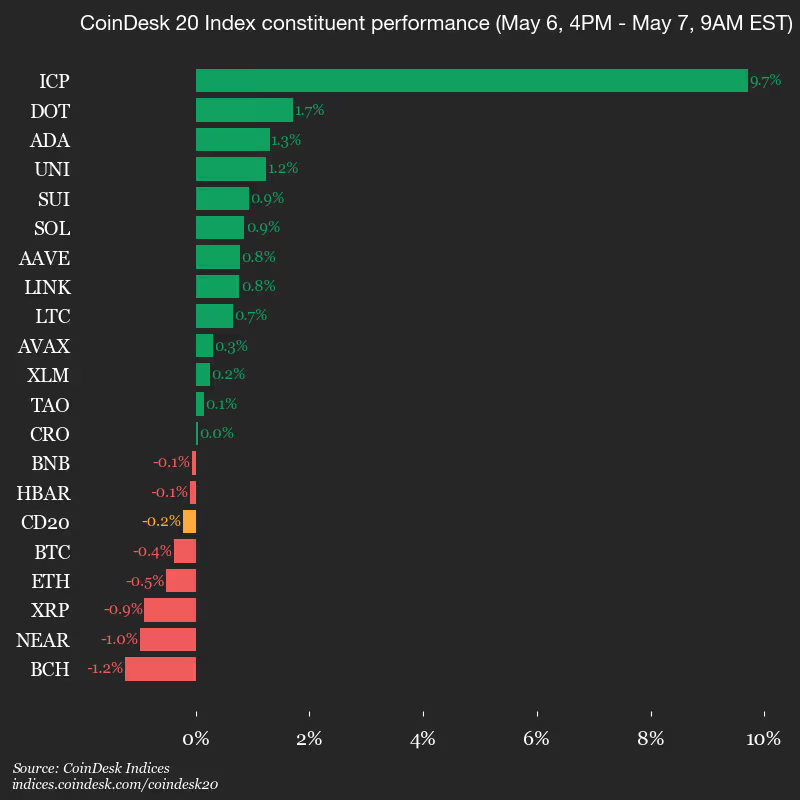
CoinDesk Indices presents its daily market update, highlighting the performance of leaders and laggards in the CoinDesk 20 Index.
The CoinDesk 20 is currently trading at 2171.96, down 0.2% (-4.96) since 4 p.m. ET on Wednesday.
Thirteen of 20 assets are trading higher.

Leaders: ICP (+9.7%) and DOT (+1.7%).
Laggards: BCH (-1.2%) and NEAR (-1.0%).
The CoinDesk 20 is a broad-based index traded on multiple platforms in several regions globally.


Mason Lynaugh, executive director of Stand With Crypto, took the Consensus Miami 2026 stage on Thursday to outline how the group’s 2.7 million advocates will engage in the November midterms.
Summary
- Stand With Crypto’s Mason Lynaugh joined Fellowship PAC’s Jesse Spiro and Sternhell Group’s Alex Sternhell at the Consensus Miami 2026 Policy Summit to discuss midterm engagement.
- Stand With Crypto has already endorsed six incumbents and is targeting races where its advocates can have a material impact on outcomes.
- The group’s polling found 59% of crypto owners do not reliably vote for one party, framing them as a decisive swing bloc.
Mason Lynaugh, executive director of Stand With Crypto, outlined the Coinbase-backed group’s 2026 midterm strategy at the Consensus Miami Policy Summit on Thursday, appearing alongside Fellowship PAC’s Jesse Spiro and Sternhell Group’s Alex Sternhell.
The session formed part of a broader Day 3 programme that put crypto’s political infrastructure on public display for the first time at Consensus.
Stand With Crypto has endorsed six congressional incumbents in its first round for 2026: Representatives Zach Nunn, Susie Lee, Mike Lawler, Don Davis, Greg Landsman, and Rob Bresnahan.
The group is simultaneously opposing Representatives Scott Perry and Marcy Kaptur. “This year crypto voters are poised to play a powerful and decisive role at the ballot box,” Lynaugh said, adding that the goal is to ensure the 120th Congress is “the most pro-crypto session in America’s history.”
Why November matters for crypto policy
The midterm context is defined by the CLARITY Act’s fate. As crypto.news reported, Senator Bernie Moreno has warned that missing the May Senate window could push comprehensive crypto legislation off the calendar until after the midterms, and potentially beyond.
The composition of the next Congress will determine whether the regulatory framework crypto companies have been pushing for gets a second chance.
Stand With Crypto’s Impact Research polling found nearly six in 10 crypto owners do not reliably vote for one party, and close to half said they would support a candidate they agree with on crypto even if they disagree on other issues.
As crypto.news reported, the broader crypto PAC ecosystem, led by Fairshake, has over $221 million in unspent funds ready to deploy across House and Senate races through November.
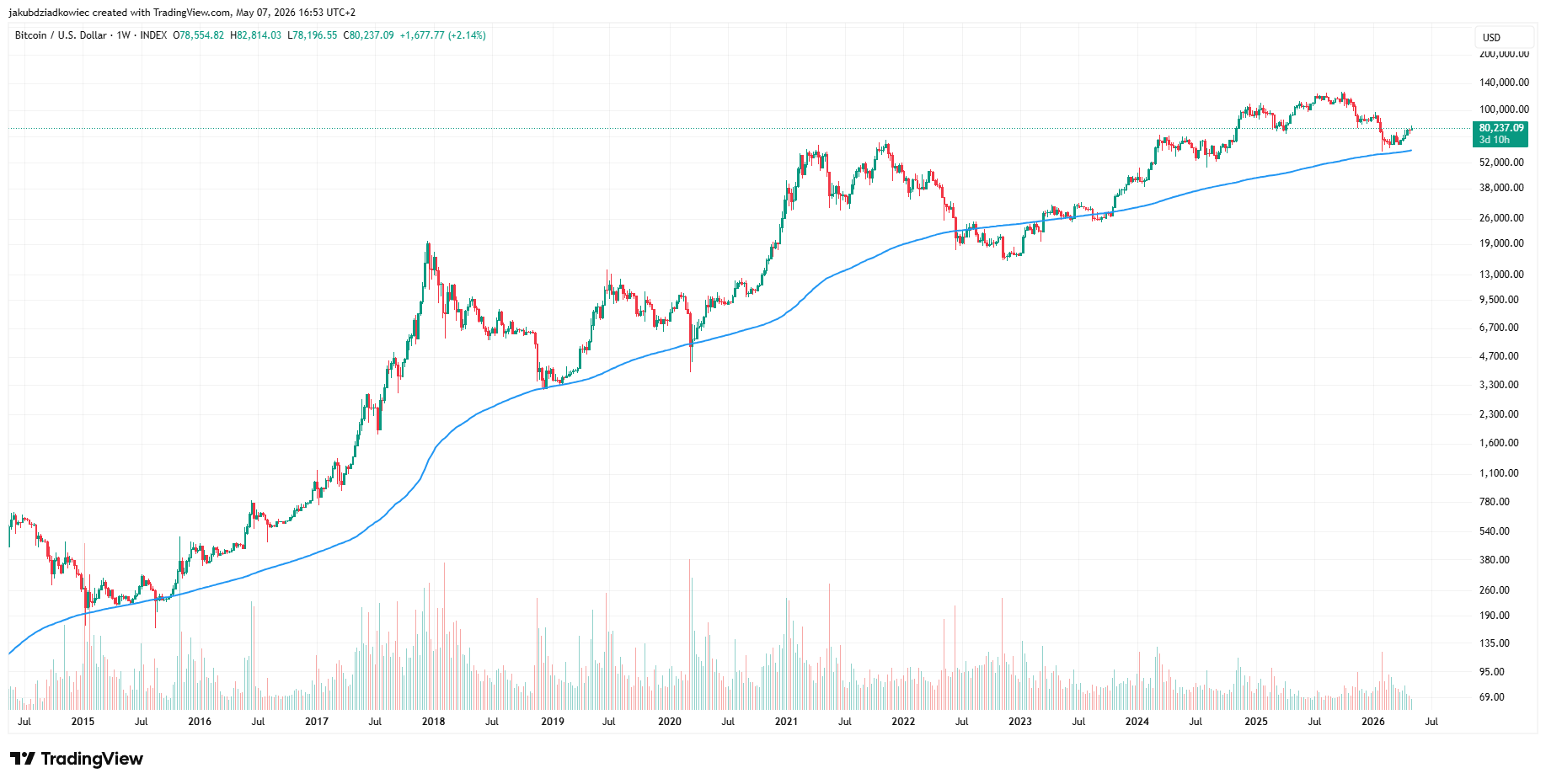
Bitcoin’s on-chain metrics have hit deep-value readings normally seen at cycle bottoms, even though price has only retraced about 40% from its all-time high. That drawdown sits far below the 75% to 85% declines that defined prior bear cycles.
Six widely tracked indicators now point in the same direction. They describe a market that reset without a euphoric top while long-term holders refused to distribute.

Bitcoin Cycle: Capitulation Without a Collapse
Three indicators measure stress in the price-versus-trend relationship, and all three agree.
The Mayer Multiple Z-Score compares Bitcoin’s (BTC) price to its 200-day moving average. The metric recently dropped to roughly -1.5 standard deviations. That zone has been printed only twice before in recent history.
The first instance came in March 2020, for around $3,000. The second arrived during the FTX collapse in late 2022, around $19,000. The current tag occurred at roughly $62,000. BTC has since recovered toward $80,000.

The Bitcoin Sharpe Ratio also confirms this condition. The metric has dropped into its “Low Risk” band. That territory previously defined the 2015, 2019, and 2022 cycle lows.
Each prior tag preceded a major upward leg, although the sample size remains small.
The percentage of supply held in loss has also climbed near 39%, per In The Cryptoverse data. That level historically appeared during the late stages of bear markets, not while the price held in six figures. The divergence between price level and holder pain stands out as the cycle’s defining anomaly.

Bitcoin’s 200-week moving average adds a fourth confirmation. The line has acted as the floor of every prior cycle. It broke briefly in 2018 and was wicked below in 2020 and 2022. This time, the 200WMA tagged and held without a clean violation.
A Bitcoin Cycle With No Top
The capitulation signals are striking in part because they lack a normal counterpart, the euphoric top.
The CBBI Bitcoin Bull Run Index combines multiple cycle metrics. The composite never tagged its red zone above 80 during this run. Every previous bull cycle, including 2013, 2017, and 2021, hit that threshold cleanly. The current chart explicitly marks the missed signal with an X.

Glassnode’s Net Unrealized Profit and Loss (NUPL) data tells a similar story. The metric uses color-coded zones that run from blue euphoria to red capitulation. The 2024 to 2026 expansion topped out in the green “belief” zone without ever crossing into blue.
By that measure, the market never reached the mass-greed reading that historically defined a cycle high. NUPL has since rolled lower into orange territory, the band associated with mid-bear or pre-bottom positioning.
That trajectory mirrors the path NUPL traced in 2018 and 2022, although the underlying price action differs sharply.

The Cohort That Refused to Sell
The most unusual signal sits in long-term holder behavior.
Glassnode defines long-term holders (LTH) as wallets that have held coins for at least 155 days. In every prior cycle, this cohort distributed heavily into the top. The LTH supply curve dropped as new buyers absorbed the available coins. That pattern repeated cleanly in 2014, 2018, and 2021.

This cycle broke that pattern. LTH supply dipped slightly in 2024, but it has since returned to record levels above 14.5 million BTC. Long-term holders now sit near peak conviction with price still well above the 200-week moving average.
The behavior carries two possible readings. The bullish interpretation suggests long-term holders are waiting for a higher peak that has yet to arrive. The structural interpretation points to a different LTH composition. The cohort now includes ETF cold storage, sovereign reserves, and corporate treasuries with non-cyclical mandates.
Both readings support the broken-cycle thesis. Neither one alone explains a continued bear case from current levels.
An Asymmetric Setup
The combined picture across six on-chain charts presents an unusual triangulation. Capitulation-grade readings appear in three price-derived metrics.
No euphoria appears in two sentiment-derived metrics. No distribution appears in the cohort that historically defines the top.
Markets rarely show all three conditions at once.
The simplest version of the thesis suggests Bitcoin just absorbed a deep on-chain reset without holding a euphoric top. Meanwhile, the holders most likely to sell have refused.
Historically, that combination has resolved to the upside.
A counterargument deserves space. If the four-year cycle model is genuinely broken, the same logic should apply to the prior cycle bottom signals.
The Mayer Z, Sharpe Ratio, and capitulation reads work as buy zones because they reflect a recurring market psychology. A structurally different cycle could mean those signals carry less predictive weight than past performance suggests.
For long-term observers, the on-chain picture nonetheless skews asymmetric. Price sits well below the cycle high yet remains above the 200-week moving average.
The Holder conviction remains intact, and historically rare buy signals have aligned. Whether the cycle delivers another leg up or settles into a longer consolidation, the current data set stands out. It is the most coherent on-chain bottom signal Bitcoin has produced in years.
The post Bitcoin Cycle Breaks Pattern as On-Chain Metrics Hit 4-Year Low appeared first on BeInCrypto.


It’s the third and final day of Consensus Miami.
To recap yesterday, ICYMI, Patrick Witt, the Executive Director of the President’s Council on Digital Assets, told the audience at day 2 of Consensus Miami that if the Senate Banking Committee holds a markup this month, it would give the Senate four weeks to merge the bill with the Senate Agriculture Committee version and June to work out issues with the House of Representatives. It’s an aggressive timeline, “but it is an achievable timeline,” he said.
Michael Saylor followed up to lay out his case for yieldcoins, laying out a vision for the potential future of the digital assets sector.
And the time is now to start working on post-quantum security, Project Eleven CEO Alex Pruden said.
Catch up on all of the coverage here.
Today will see panels addressing prediction markets and sports betting, stablecoins, banking and more. Privacy and agentic payments will again take the stage.
Tom Lee will present a keynote, while stablecoin executives will weigh in on recent regulatory advancements. World Liberty Financial’s Donald Trump, Jr. and Zach Witkoff will take the main stage right after lunch, while payments executives will lay out how crypto cards and other tools will work.
CoinDesk will host its Policy & Regulation Summit, diving deep into the key regulatory issues you should be paying attention to: DeFi regulation, the 2026 election and more. The day will end with a debate on prediction markets. Are they just gambling products dressed up in a fancy costume? Or are these contracts actually a novel financial product? And what does that all mean for you? Come through and find out.


Animoca Brands chairman Yat Siu told Consensus Miami 2026 that the metaverse is over as a consumer destination, and that 100 billion AI agents will become blockchain’s primary users.
Summary
- Yat Siu said the pandemic-era vision of humans living in virtual worlds was wrong, and that the metaverse was a proof of concept for AI agent infrastructure rather than a consumer product.
- He predicted 50 to 100 billion AI agents will eventually operate on the internet, outnumbering humans and transacting autonomously on blockchain networks.
- Animoca announced a $10 million investment initiative for developers building AI agent applications through its Animoca Minds platform.
Animoca Brands chairman Yat Siu told Consensus Miami 2026 on Thursday that the metaverse, as the crypto industry imagined it during the pandemic, was never really built for humans.
“Where we’re landing is that the metaverse, the blockchain-based one, was really the proof of concept for agents,” he said. “In other words, it was never really destined for humans as a prime consumer.”
The remarks mark a clean break from Animoca’s earlier positioning. The firm was among the most prominent advocates of the pandemic-era metaverse vision, which assumed users would spend growing amounts of their social and economic lives in immersive virtual environments.
Siu attributed that misconception to the distorting conditions of COVID lockdowns, when it seemed remote digital life would become permanent. “Everyone thought, ‘Oh, we’re going to be at home, and we’re never going to travel as much anymore,’” he said. “Which, of course, turned out to be quite the opposite.”
What comes next: the agent economy
Siu’s new thesis is that blockchain’s most scalable user base will not be humans but autonomous AI agents. “I think the point is that it’s going to be more agents than humans,” he said, estimating 50 to 100 billion agents could eventually operate on the internet.
On current population math, 10 to 20 agents per human produces between 70 and 140 billion agents globally. “Blockchain technology is the ideal financial system for machines,” Siu said. “We, the humans, were basically the guinea pigs.”
The argument centres on a practical problem that has limited crypto’s reach. Approximately 700 to 800 million people globally own some form of cryptocurrency, but as crypto.news reported, fewer than 70 million actively use blockchain applications, largely because the technology remains too complex for mainstream consumers. AI agents do not face that barrier.
They interact directly through code, require no traditional banking infrastructure, and can transact autonomously on-chain. As part of the pivot, Animoca announced a $10 million initiative for developers building AI agent applications through its Animoca Minds platform, framing agents as its next major investment category after the metaverse era closes.
The MEV gods do not discriminate.
Vitalik Buterin, Ethereum’s co-founder and a vocal advocate for fixing toxic maximal extractable value, got hit by the very kind of attack he has been campaigning against, blockchain data from earlier this week shows.
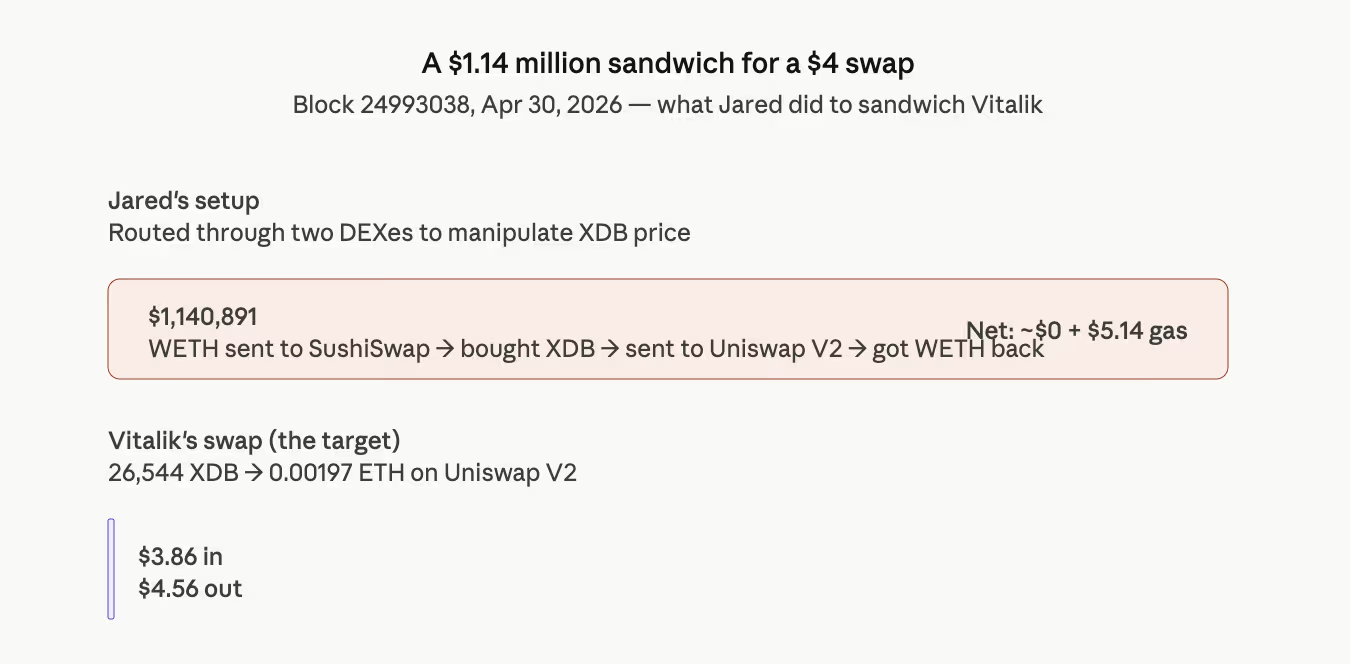
Data shows a transaction by Buterin on April 30 was sandwiched by the bot in block 24993038, per Etherscan data, resulting in a worse execution price for the Ethereum co-founder.
A sandwich attack is when a bot spots a trader’s pending transaction, places its own buy order in front to push the price up, lets the victim execute at the inflated price, then dumps the tokens immediately after to pocket the difference. The victim usually does not even notice, as they just get a slightly worse fill than they should have.
Analysis by CoinDesk shows Buterin swapped 26,544 digitalbits (XDB) tokens worth roughly $3.86 for 0.00197 ETH worth $4.56. The bot ran $1.14 million worth of WETH through SushiSwap and Uniswap V2 to manipulate the XDB price between the two pools right before Buterin’s swap landed.
After gas fees of $5.14, Jared appears to have lost money on this particular sandwich, and Buterin’s slippage was likely in a few cents.

This shows the bot is so industrialized that it scans every pending transaction in the mempool for any opportunity to insert itself, profitable or not.

Buterin has spent the past several months pitching encrypted mempools as a fix for toxic MEV in Ethereum’s 2026 roadmap.
MEV is the profit that whoever orders transactions on a blockchain can pocket by reshuffling them. Anyone running a bot that watches the public mempool, the holding pen where pending transactions sit before being added to a block, can spot opportunities to insert their own trades around someone else’s.
Sandwich attacks are the most aggressive form, with cumulative MEV extracted on Ethereum is now over $1.2 billion and these type of attacks accounting for roughly 51% of the total volume.
Buterin, among other developers, argue that MEV creates a hidden tax on regular users that can favour large, specialized operators over everyone else.
Jaredfromsubway.eth rose to prominence in 2023 as it sandwiched traders of meme coins like pepe and wojak during the then meme frenzy.
It briefly accounted for 7% of all gas fees on the network in April that year, and has reportedly extracted more than $7 million from victims across hundreds of thousands of transactions since.
The bot adapts faster than the protocols trying to stop it. It has survived contract upgrades, mempool filtering, and several attempts by builders to design exploits that drain its funds.
Key takeaways:
- Half of the $6 billion in Bitcoin options open interest is tied to long-shot strategies used for hedging and neutral price strategies.
- The 9% put (sell) options premium hints that professional traders are worried about a potential Bitcoin price drop.
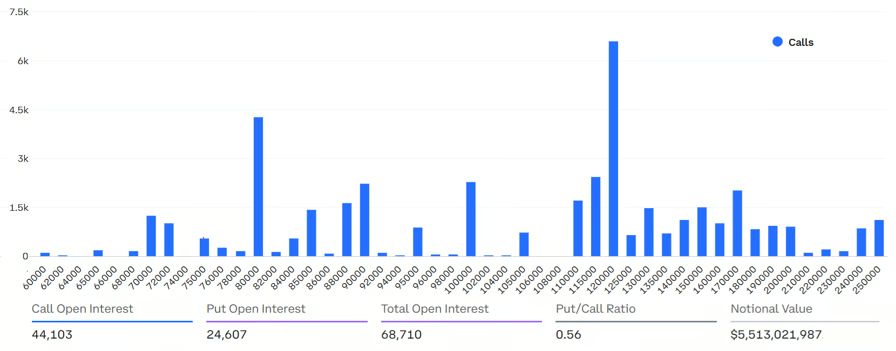
Bitcoin (BTC) bulls have high hopes for the year-end options expiry on Dec. 25, which features $6 billion at stake. The 33% price gain since the $60,130 yearly low on Feb. 6 have played a major role in bringing back bullish expectations. However, the huge amount of call (buy) options targeting $115,000 and higher for Dec. 25 raises questions about whether bulls are overconfident.
December Bitcoin call (buy) options open interest at Deribit, BTC. Source: Deribit
Deribit exchange holds a 92% market share in December’s Bitcoin options open interest at $5.5 billion. However, the actual value at expiry will be much lower. Many of these instruments were placed on unlikely outcomes as a hedge or for neutral strategies that do not require large price moves to remain profitable.
Bitcoin call options dominate, but both sides have unrealistic bets
Put (sell) options are underrepresented by 56% on Deribit compared to call options. Crypto traders are known for being bullish, so the put-to-call ratio is usually skewed. Still, the $1.85 billion in open interest in call options targeting $115,000 and higher is significant. This setup makes it worth comparing how optimistic call options are versus the puts.
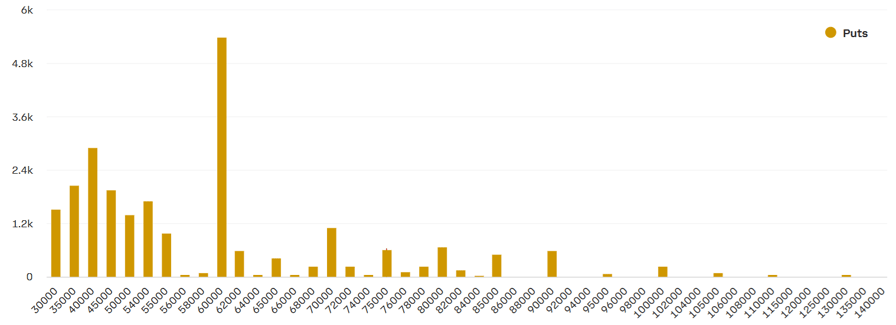
December Bitcoin put (sell) options open interest at Deribit, BTC. Source: Deribit
The high volume of put options targeting $55,000 and lower is also notable, totaling $1 billion in open interest. This means the percentage of bets considered improbable is similar for both sides, sitting at roughly 50% of the open interest in each segment. If bulls are seen as overly optimistic, then the bears appear equally extreme in their pessimism.
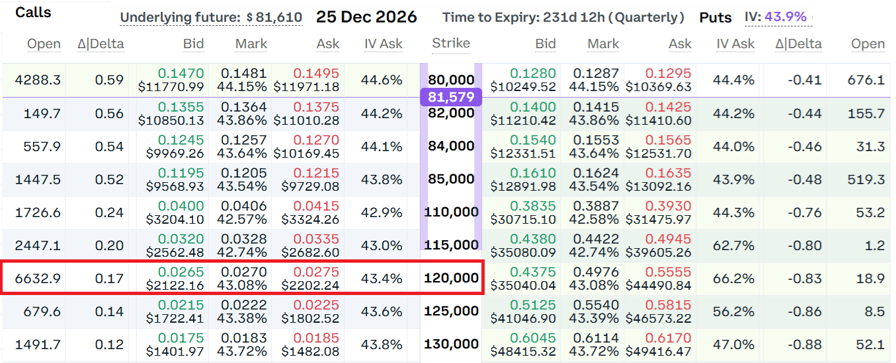
December Bitcoin options pricing at Deribit on May 7. Source: Deribit
Beyond serving as a counterbalance in strategies with different expiry dates, a call option at $120,000 offers cheap exposure to extreme upside events. Based on Deribit prices on May 7, a buyer pays $2,202 to secure unlimited upside exposure to the equivalent of one full Bitcoin at a price of $120,000 or higher on Dec. 25.
The options skew metric provides a clearer view of professional traders’ comfort levels regarding both upside and downside price risks.
Related: Bitcoin holds $81K amid flat derivatives markets–Is rally sustainable?
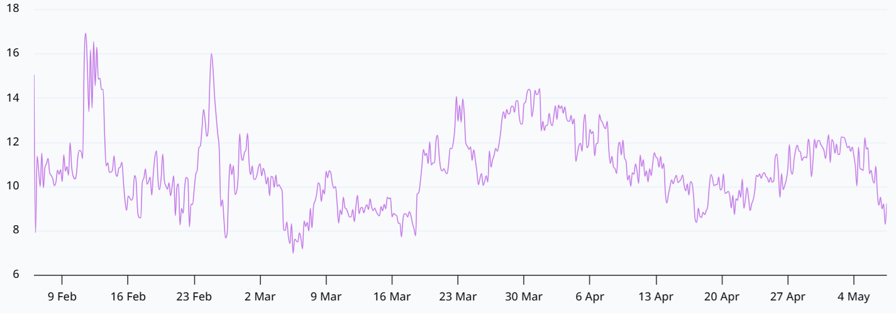
Bitcoin 6-month options delta skew (put-call) at Deribit: Source: Laevitas
Put options are trading at a 9% premium relative to equivalent calls, signaling moderate fear of downside price movements in Bitcoin. Under neutral conditions, the skew indicator should range between -6% and +6%. According to derivatives metrics, investor optimism was not substantially impacted by the rally to $80,000.
Ultimately, the $1.85 billion in December call options should not be interpreted as a sign of excessive bullish confidence.

‘I never heard misogynistic language in PSNI’, says UUP leader Jon Burrows

New Disney CEO Josh D’Amaro Gives Vision for Company in Shareholder Letter
Arbitrum Poised to Unfreeze $71M ETH Passes With 90% in Favor

Manchester United reach agreement with Casemiro over contract clause amid transfer speculation

US brings back mandatory military draft registration

Steven Gerrard disagrees with Gary Neville over ‘shock’ Chelsea and Arsenal claim | Football


-

 NewsBeat4 days ago
Channel 5 – All Creatures Great and Small series 7 new post
-

 Crypto World18 hours ago
Upbit adds B3 Korean won pair as Base token gains Korea access
-
 Tech6 days ago
Trump’s 25% EU auto tariff breaches Turnberry Agreement that also covers semiconductors and digital trade
-
 NewsBeat19 hours ago
NCP car park operator enters administration putting 340 UK sites at risk of closure
-
 Sports6 days ago
Paul Scholes issues Marcus Rashford reality check as agreement emerges over Man United star
-

 Entertainment6 days ago
Met Gala 2026 Rumored Guest List Is Turning Heads
-

 Business7 days ago
Strait of Hormuz Blockade Persists Amid US-Iran Standoff, Sending Oil Prices Soaring
-
Entertainment6 days ago
New on Prime Video in May 2026 — Full List of Movies and Shows
-

 Entertainment6 days ago
Kylie Jenner Hit With Second Lawsuit From Ex-Housekeeper
-

 Sports6 days ago
Cavaliers vs. Raptors Game 6 live score, updates, highlights from 2026 NBA playoffs first-round series
-
 Sports6 days ago
David Benavidez responds to team Canelo saying the fight will never happen
-

 Tech7 days ago
Meta ends Sama contract after Kenyan workers report seeing intimate footage from Ray-Ban smart glasses users
-
Entertainment5 days ago
New Netflix Movies in May 2026 — My Top 3 Picks to Stream
-
 Sports6 days ago
IPL 2026: ‘Love you darling’- Hardik Pandya’s reaction to MS Dhoni steals the show |Watch | Cricket News
-

 Entertainment6 days ago
Young and the Restless Next Week: Cane Arrested & Matt’s Deadly New Scheme!
-

 Entertainment5 days ago
Melissa Joan Hart and More Stars Attend 2026 Kentucky Derby
-

 Business5 days ago
Luka Doncic Injury Update: Doncic’s Hamstring Recovery Slows Lakers’ Hopes Against Thunder: Can He Run Yet?
-
 Crypto World5 days ago
Pi Network Mandates Protocol 23 Upgrade for All Mainnet Nodes Before May 15 Deadline
-

 Sports7 days ago
Bayern won’t hand bottom side Heidenheim ‘gifts’ despite PSG game
-

 Sports7 days ago
What Preity Zinta Said After Punjab Kings’ First Defeat Of IPL 2026
You must be logged in to post a comment Login