

Crypto World
XRP May Soar to $12 as Price Holds Cycle Bottom Zone for Months

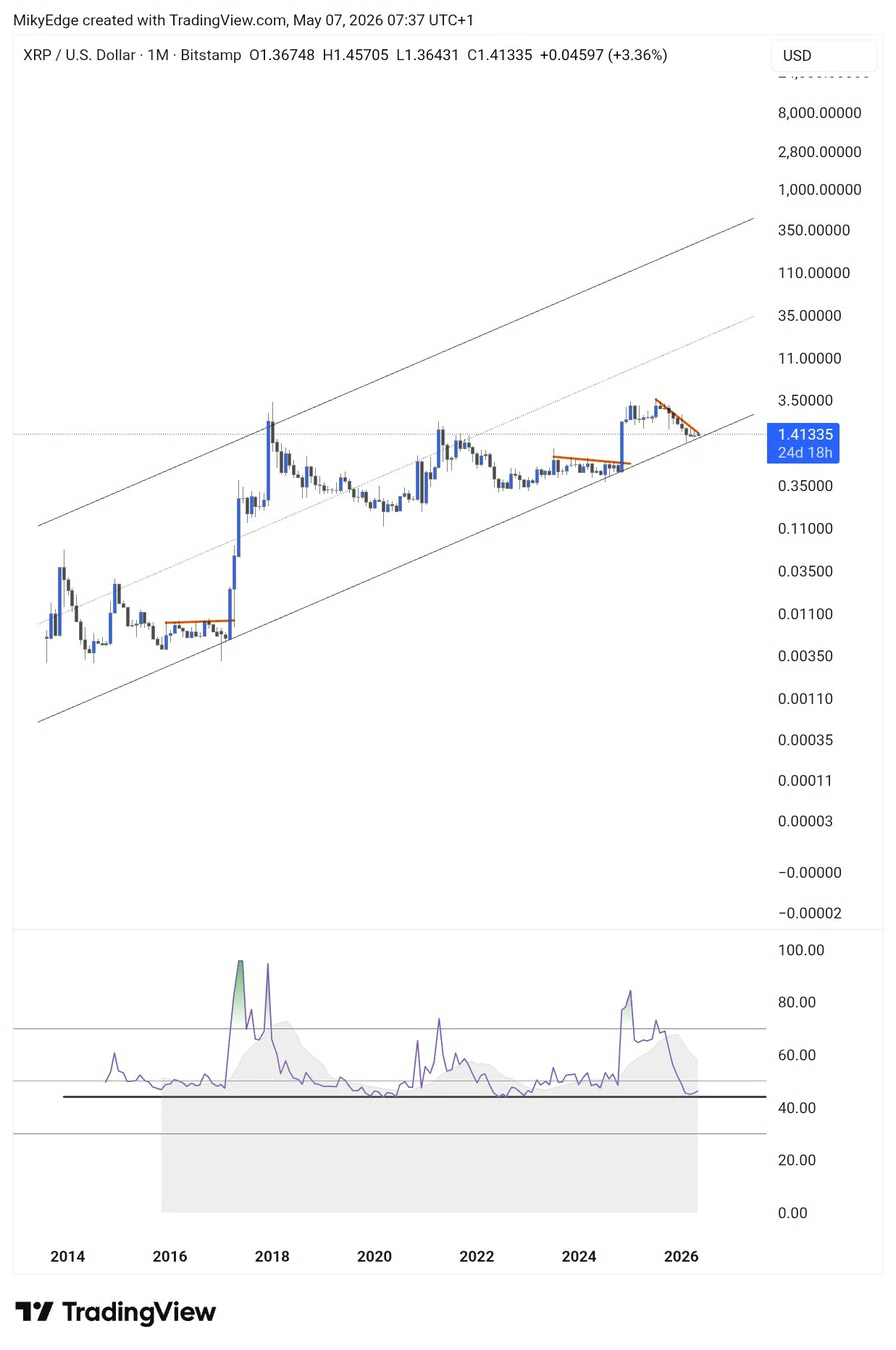
XRP (XRP) is testing a key long-term support level that has historically preceded major rebounds, according to a monthly chart shared by analyst MikybullCrypto.
Key takeaways:
- XRP has jumped by roughly 30% from its February lows.
- Multiple fractals suggest the price is bottoming out, supported by strong XRP ETF inflows.
XRP chart hints at rebound toward $12
Milkybull’s chart shows XRP trading inside a rising channel that has guided price action since 2014. XRP is now near the channel’s lower trendline around $1.30–$1.40, a zone that previously acted as a launchpad for large upside moves.
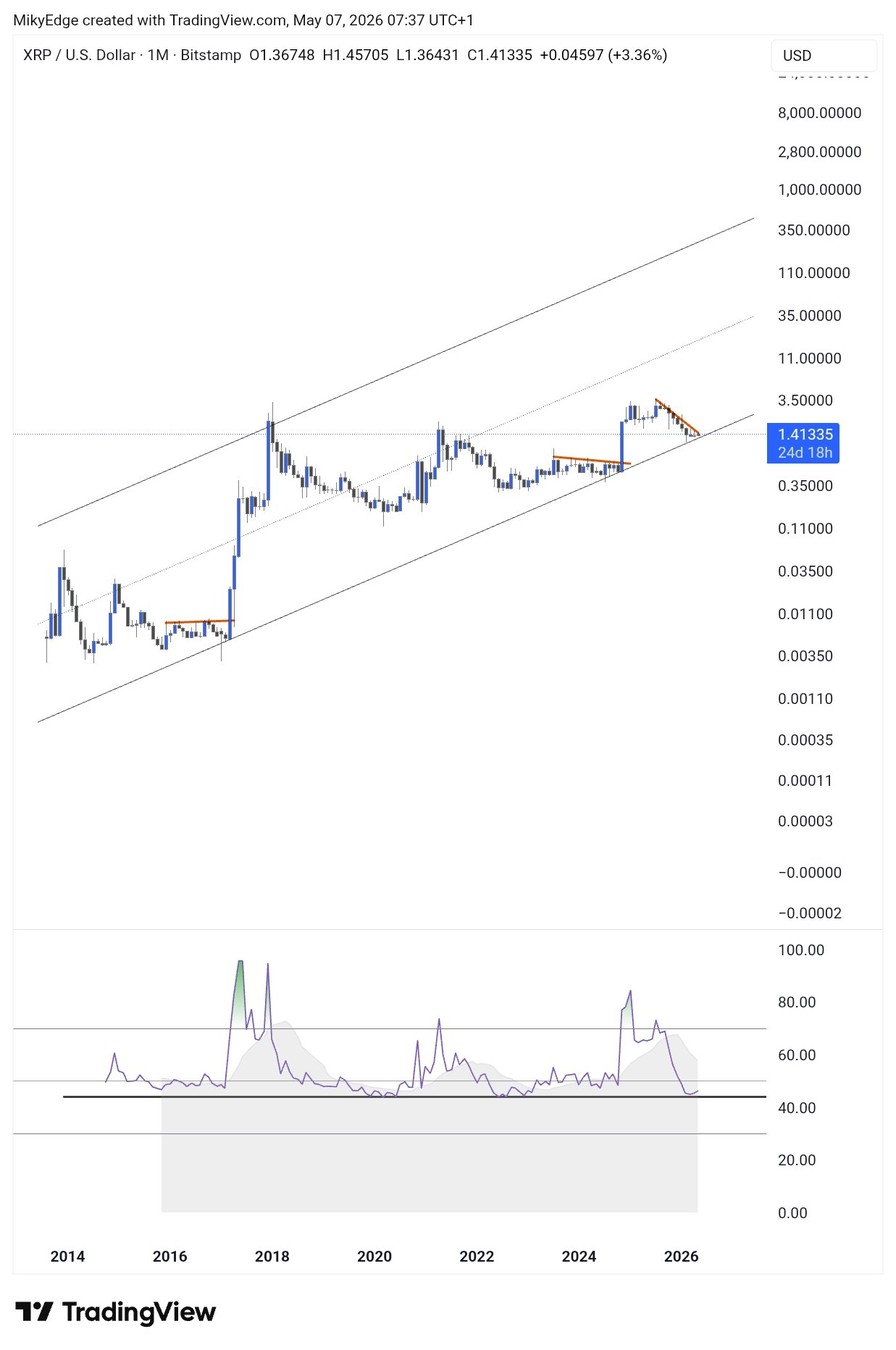
XRP/USD monthly chart. Source: TradingView/MilkybullCrypto
The analyst says XRP is “probably going to $12,” a level that roughly aligns with the channel’s midpoint.
Momentum indicators support the rebound thesis. XRP’s monthly relative strength index (RSI) has cooled toward a historical support area near 40–45, similar to levels that appeared before past rallies.
In a Thursday post, analyst JD pointed to the same RSI support zone as a potential “cycle bottom” signal for XRP.
His two-week chart shows XRP breaking out of a multi-year symmetrical triangle, then pulling back toward the breakout area.
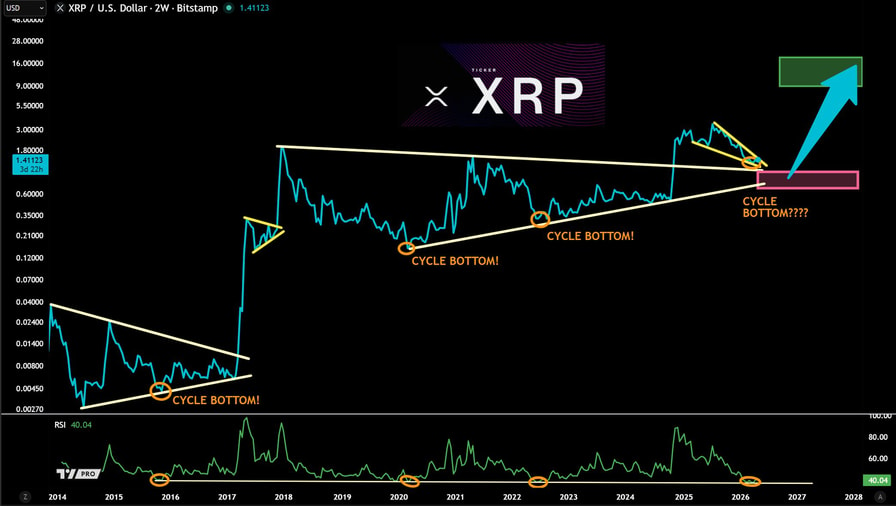
XRP/USD two-week chart. Source: TradingView/JD
The chart’s projected green target zone aligns with the $8–$14 range, implying strong upside if XRP holds the retest zone.
The bullish outlooks follow XRP’s sharp rebound in recent weeks, up by about 30% from its February lows at around $1.11.
Related: XRP price copies 2025 chart fractal that last time sparked 66% gains
In the period, XRP has largely benefited from renewed risk sentiment led by the US–Iran ceasefire, as well as market-specific fundamentals.
These include Rakuten Wallet’s XRP integration, which expanded the token’s reach in Japan, and $81.6 million in April inflows into US spot XRP ETFs, their strongest monthly total of 2026.
In the first week of May, XRP ETFs have attracted $28.17 million in inflows already.
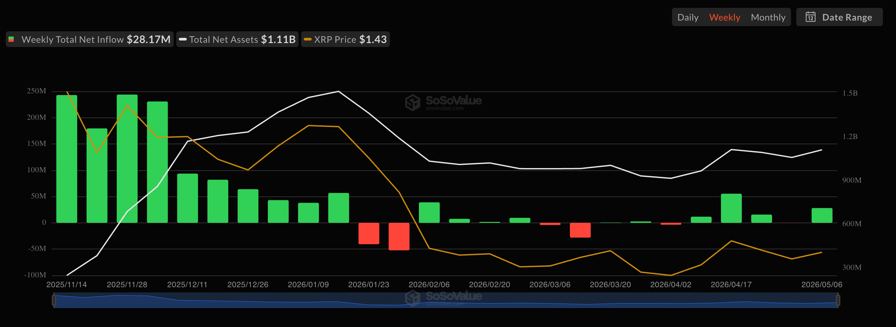
US XRP ETF net flows. Source: SoSoValue
XRP still risks 2022-style bear market repeat
However, the bullish XRP setup is not guaranteed. The bears will try to pull the price down below the channel support. This would invalidate the bullish structure and put XRP at risk of deeper losses.
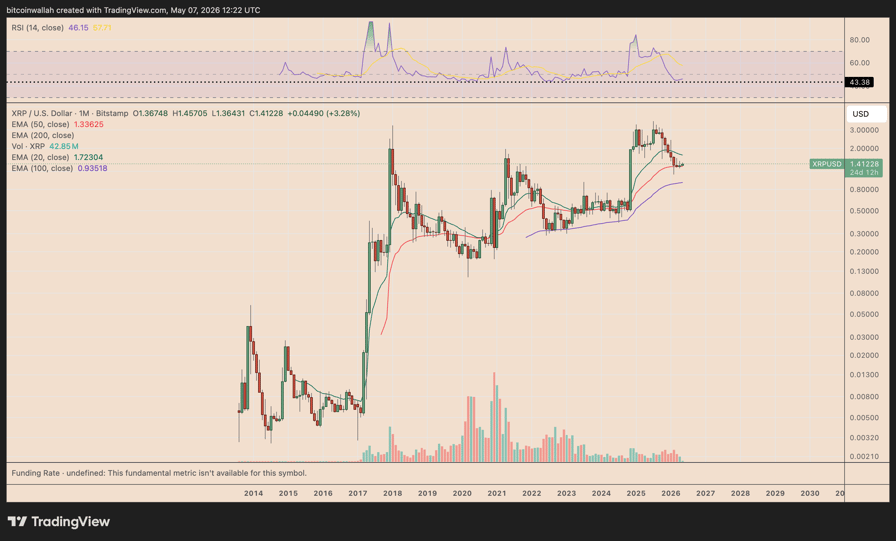
XRP/USD monthly chart. Source: TradingView
The support overlaps closely with XRP’s 50-month exponential moving average (50-month EMA, the red line) near $1.33.
Losing this support cluster shifts focus toward the 100-month EMA (the purple line) near $0.93, implying a roughly 30% drop from current levels. A similar plunge occurred during the 2022 bear market.

The Senate Banking Committee is reportedly preparing to formally schedule a markup session for the Clarity Act, according to Crypto In America host Eleanor Terrett.
The journalist reported the development on X, citing multiple industry sources familiar with the matter.
Senate Banking Committee Eyes Clarity Act Markup
Terrett revealed that the draft legislative text was shared with select industry members ahead of a possible committee vote on Thursday.
She noted that the bill’s language is reportedly still being finalized. Additional revisions are expected to incorporate priorities from Democratic lawmakers.
“One source told me the overall vibes after reviewing the bill and coordinating with other industry leaders are positive so far, though some bracketed sections are raising concerns that key provisions previously thought to be settled may still be in flux,” Terrett posted.
POLITICO separately reported that Senate Democrats at the negotiating table “are considering withholding support” unless the version the Senate Banking Committee will vote on later this month includes an ethics-related provision.
Subscribe to our YouTube channel to watch leaders and journalists provide expert insights
The Digital Asset Market Clarity Act passed the House in July. Yet, months of Senate stalemate followed.
Senators Thom Tillis and Angela Alsobrooks recently released a compromise on stablecoin yields. However, five US banking lobbies argued the text still falls short.
Bipartisan Voter Backing Adds Political Weight
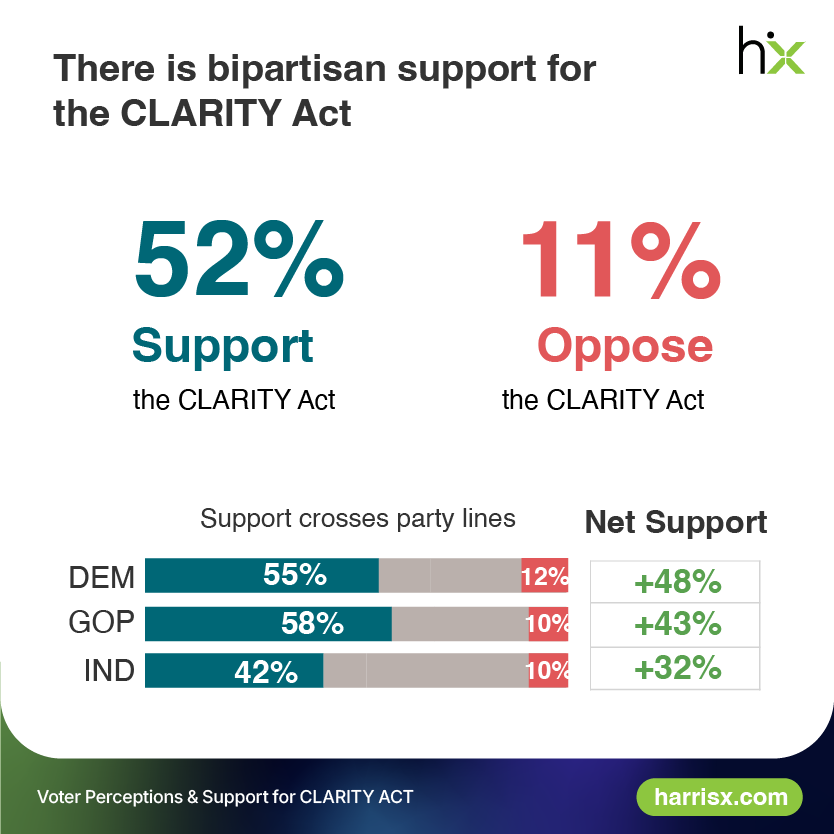
Meanwhile, a HarrisX national survey shows that 52% of voters support the bill, while 11% oppose it.
“Voters overwhelmingly favor clearer rules and consumer protections for digital assets,” the post read.
Follow us on X to get the latest news as it happens

The findings also suggest that lawmakers could gain political support by backing the legislation. Around 37% of voters said they would be more likely to support a senator who votes in favor of the bill.
Nearly 47% of respondents said they would consider voting across party lines. This figure climbs to 72% among cryptocurrency holders.
With broad, bipartisan voter support, lawmakers face growing political pressure to deliver. All eyes now turn to the markup and whether the bill can stay on course for the White House’s July 4 deadline.
The post CLARITY Act Markup Looms as 52% of Voters Back Crypto Legislation appeared first on BeInCrypto.
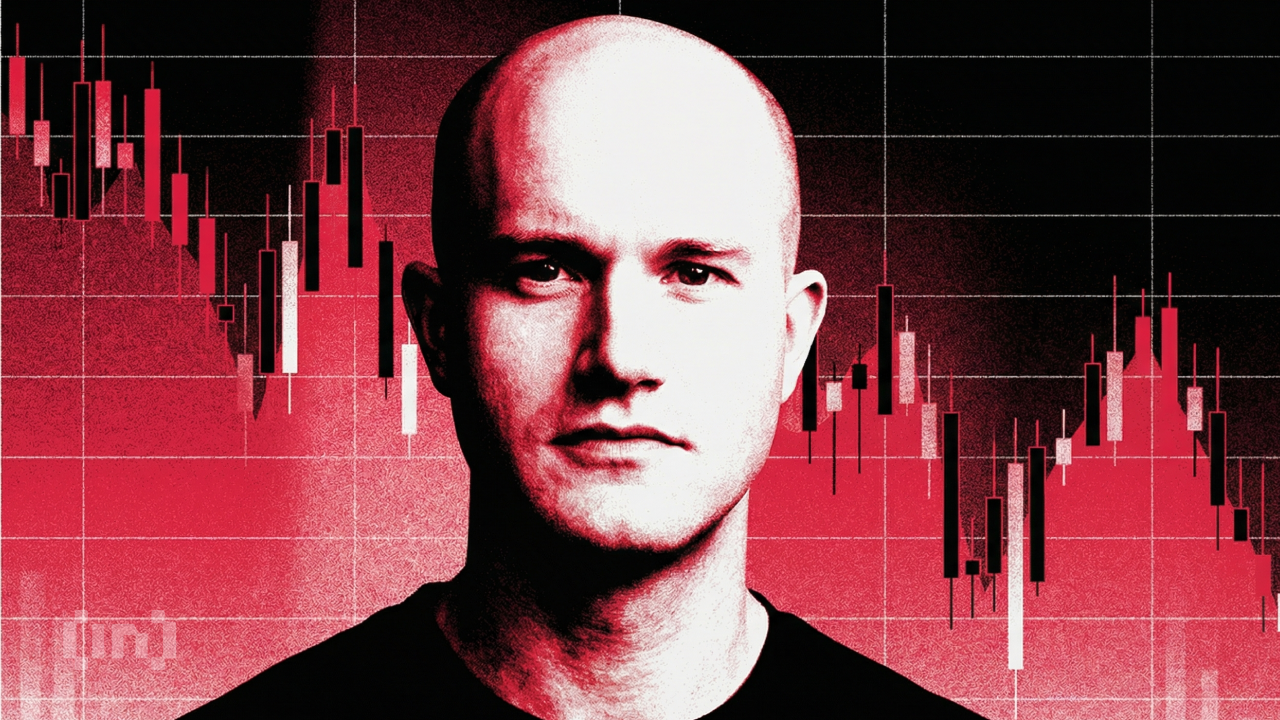
Coinbase revealed that some users are facing “degraded performance” on Thursday. The disruption follows an Amazon Web Services (AWS) data center in Northern Virginia overheating.
Follow us on X to get the latest news as it happens
The exchange flagged the issue around 6 p.m. Pacific time. Coinbase told customers their funds remained safe and pointed them to the AWS health dashboard for updates.
“This issue is related to a broader AWS outage. We’re monitoring closely and working to restore full service. We’ll continue to update. Your funds are safe,” Coinbase posted.
In a separate update, Coinbase pinpointed the disruption to a specific Availability Zone, use1-az4 in the AWS US-EAST-1 region, where temperatures had spiked. The exchange said it would re-enable trading shortly.
AWS said rising temperatures at a data centre in Northern Virginia disrupted some services. It stated that teams are continuing efforts to restore temperatures to normal levels in the Availability Zone (use1-az4) in the US-EAST-1 Region.
In a latest update, the cloud platform said it is seeing early signs of recovery, with additional cooling capacity allowing the team to recover some impacted racks. AWS added that it was working to recover the additional racks “in a controlled and safe manner.”
BeInCrypto has reached out to AWS for comment and will update this story with any response.
Subscribe to our YouTube channel to watch leaders and journalists provide expert insights
The post Coinbase Hit by Outage as AWS Issues Disrupt Trading appeared first on BeInCrypto.
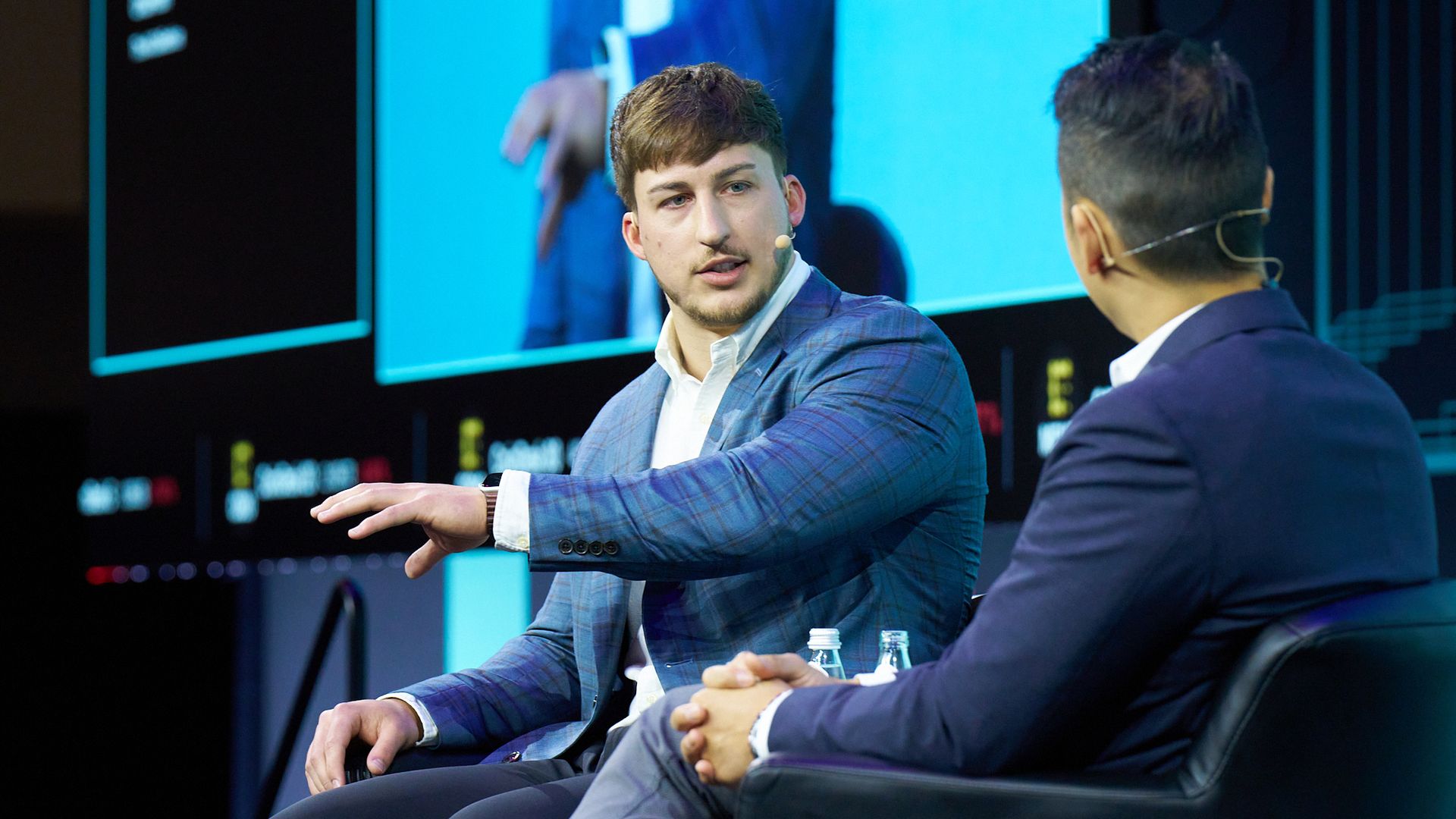
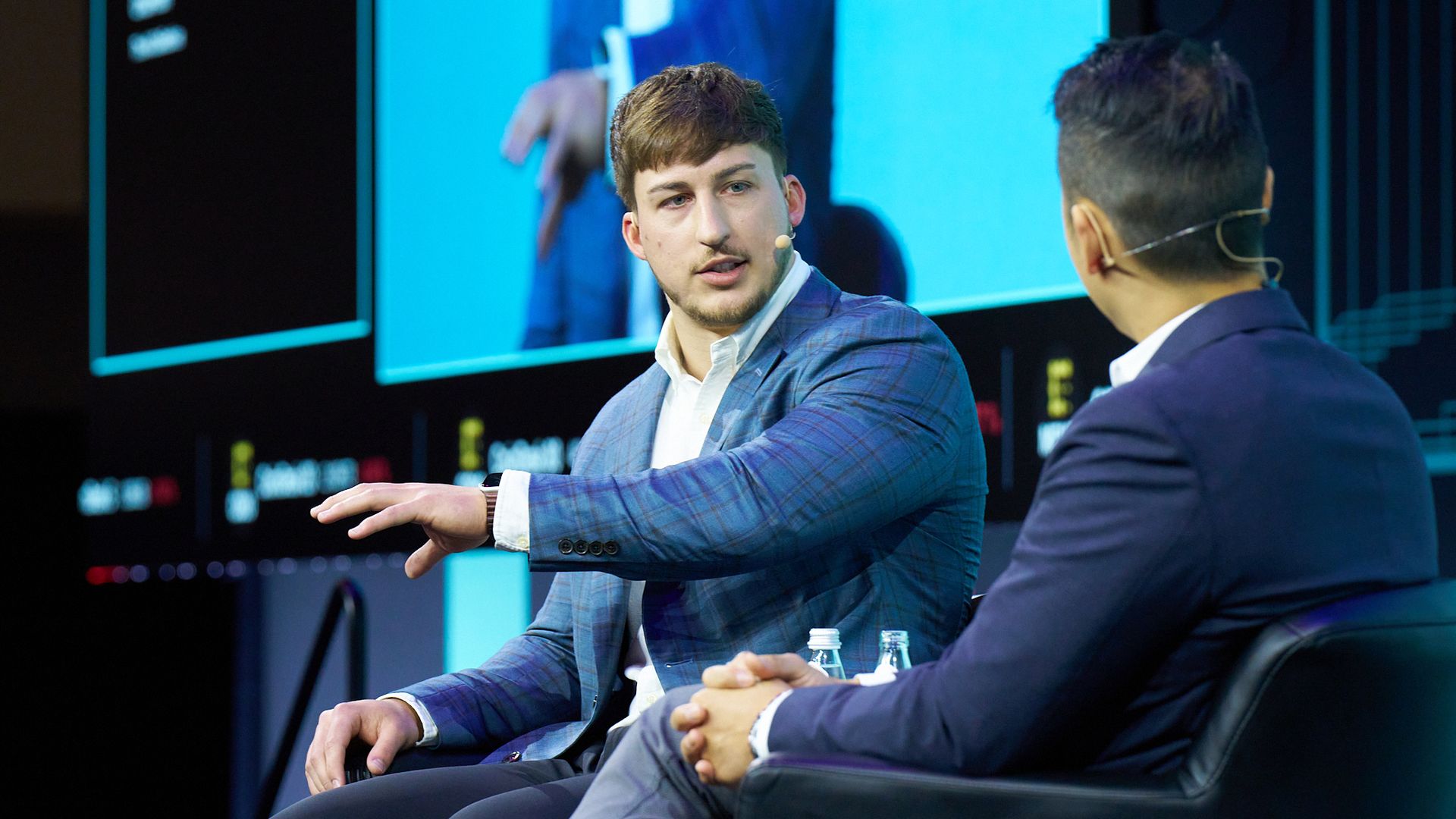
The crypto industry’s embrace of AI is less about chatbots and more about building financial infrastructure for autonomous machines, says Chappy Asel, a former Apple engineer and founder of AI nonprofit The AI Collective.
Speaking at Consensus Miami, Asel, founder of The AI Collective, a global nonprofit AI community with more than 200,000 members across 150+ chapters, argued that as software agents increasingly make economic decisions on behalf of users and businesses, they will need payment systems capable of handling low-latency, programmable transactions at scale.
“When agents make the majority of financial decisions, economic decisions, how do they transact with each other?” Asel said during the panel. “You want them to be highly systematic, mechanistic. You want very small, micro transactions. You want very low latency.”
Asel, who previously worked on Apple’s Vision Pro and early Apple Intelligence efforts before launching The AI Collective, framed the convergence of crypto and AI through a practical lens.
“The number one thing that I’ve heard kind of throughout this conference… even my friends who only know about AI, they know nothing about blockchain, is they’ve heard about agentic payments,” he said.
Stablecoins already offer 24/7 settlement and smart contracts allow programmable execution. Marrying them together is the only logical way agentic payments — without a human in the middle — can become mainstream.
Still, the thesis remains early. AI agents are still nascent, and many companies today rely on centralized APIs and conventional payment systems. Attempts to build “agentic payments” infrastructure have so far generated little meaningful commercial activity, suggesting the narrative may be developing faster than actual demand.
Even if machine-to-machine commerce takes longer to materialize, Asel argued the broader overlap between crypto and AI may emerge elsewhere first.
“A lot of people will tell you, oh, it’s the models aren’t good enough,” Asel said. “It’s none of that. It’s literally compute, data centers, energy that is driving pretty much all decision-making in AI right now.”
That framing reflects a wider shift in the AI economy, where access to chips, power, and data center capacity is becoming the defining competitive advantage.
Parts of the crypto industry are already moving to capture that opportunity. Several bitcoin miners have spent the past year repositioning toward AI hosting and high-performance computing, betting that infrastructure originally built for mining can be repurposed for AI workloads.
For Asel, the practical advice for founders navigating the uncertainty was simple: experiment.
“When the world is more uncertain than it ever has been… things will only get crazier,” he said. “That warrants that you are spending more and more time playing around with the new technology.”
Crypto’s consumer adoption problem has always been partly a usability problem.
But AI agents do not need onboarding tutorials, aren’t intimidated by MetaMask, or need help remembering seed phrases. If autonomous software becomes a meaningful economic actor, crypto may have found a user base that actually thinks in code.
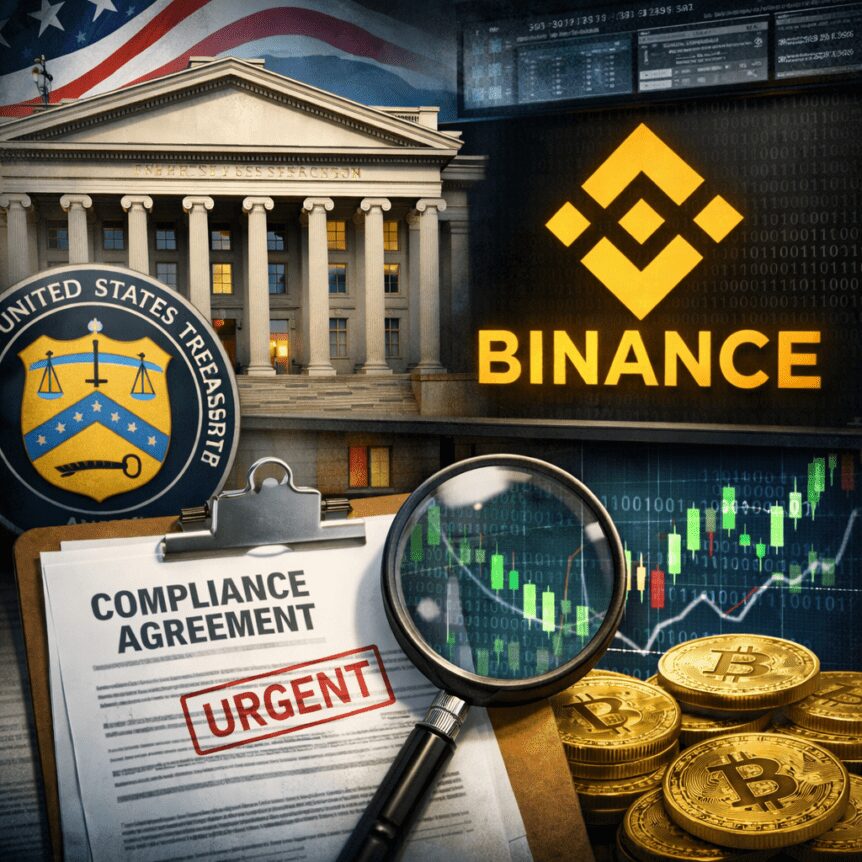
Regulatory scrutiny around Binance has intensified as reports emerge that the US Treasury privately insisted the crypto exchange adhere to an independent monitoring program established under a 2023 settlement with US authorities. The Information, citing internal communications, said the demand followed disclosures that funds potentially tied to Iran flowed through Binance, prompting renewed pressure from lawmakers and regulators to demonstrate ongoing compliance and effective controls. The episode arrives amid broader enforcement activity tied to Binance’s US and international operations and the evolving regulatory framework governing crypto firms.
Binance has publicly asserted its commitment to compliance, telling Cointelegraph it would cooperate with the independent monitor and maintain transparency as it strengthens anti-money-laundering and KYC controls. The remarks came as executive leadership faced renewed questions about governance and continued access to global liquidity for Binance.US, the firm’s U.S. affiliate, as authorities reassess cross-border oversight in the sector.
Key takeaways
- The US Treasury is reported to have privately required Binance to comply with a three-year independent monitoring program that was part of a 2023 settlement with Treasury and the Justice Department, according to The Information.
- The settlement in 2023 involved a $4.3 billion payment and established ongoing monitoring overseen by government officials; the new reporting emphasizes continued regulatory oversight even after the initial accord.
- Allegations that as much as $1 billion flowed through Binance to Iran-linked entities prompted renewed scrutiny and reports that Binance dismissed staff who flagged those transfers, underscoring enforcement focus on sanctions evasion risk.
- A group of US senators reportedly urged Treasury Secretary to detail Binance’s adherence to the 2023 settlement, reflecting legislative concern about compliance and sanctions enforcement within the industry.
- Binance’s response stressed cooperation with the monitor and ongoing collaboration with agencies, framing oversight as a mechanism to strengthen AML/KYC controls.
- Comments by former Binance CEO Changpeng Zhao at the Consensus conference in Miami highlighted his stance on leadership roles and broader liquidity considerations, while filings show legal actions related to the company’s AML regime in the 2023 settlement.
- Regulatory and geopolitical context remains volatile: Zhao’s legal exposure and the involvement of U.S. political figures intersect with cross-border policy developments, including potential implications for MiCA-era standards and cross-jurisdictional enforcement.
Regulatory oversight and monitoring obligations
According to The Information, the 2023 settlement between Binance, the US Treasury, and the US Department of Justice required Binance to operate under an independent monitoring program for a three-year period. The program was designed to assess and verify the firm’s compliance with sanctions, AML, and counter-terrorist financing obligations, with oversight to be conducted by government-appointed officials and an independent monitor. The reported private demand from the Treasury to continue strict adherence to that monitoring framework underscores the persistence of sanctions enforcement risk for large crypto platforms operating on a global scale.
The same reporting raises questions about the efficacy and reach of such monitors in a rapidly changing regulatory environment. The tied disclosures of a $4.3 billion settlement illustrate the scale of the settlement and the severity of expectations for ongoing compliance enforcement. For institutions and banks interacting with crypto entities, the situation reinforces the importance of robust due diligence, continuous monitoring, and clear line items in sanctions screening and AML/KYC programs to address cross-border risk, especially where sensitive jurisdictions are involved.
Beyond the financial penalties, the unfolding narrative includes congressional attention. A group of US senators reportedly urged Treasury Secretary to provide a formal update on Binance’s adherence to the 2023 settlement—the type of oversight activity that can influence licensing prospects, agency cooperation, and the perceived reliability of centralized exchanges in meeting U.S. regulatory standards. The reporting environment signals a tighter coupling between enforcement actions and regulatory transparency obligations for major crypto platforms.
Binance, for its part, emphasized cooperation with the monitor and with regulatory authorities. A spokesperson told Cointelegraph that the firm views oversight as an “important part of continuously strengthening our compliance and anti-money laundering controls,” and that Binance intends to provide the monitor with “full cooperation and transparency.” The emphasis on ongoing collaboration aligns with a broader regulatory expectation that major exchanges demonstrate verifiable compliance capabilities rather than relying solely on post hoc remediation.
Executive responses and leadership perspectives
The Information’s reporting on regulatory oversight coincided with Changpeng Zhao’s appearance at the Consensus conference in Miami. Zhao, who stepped down as Binance CEO in November 2023, has publicly signaled a cautious stance toward the future of leadership in the crypto sector. He told attendees that while he had been “trying to avoid” the United States, he did not rule out strategic moves to preserve user access to global liquidity, including the possibility of reviving Binance.US as a channel to maintain broader liquidity flows. He also rejected the notion of taking a leadership role at another crypto company, describing himself as a “one-trick pony.”
Legal and regulatory developments surrounding Zhao and Binance have continued to unfold through public filings and enforcement activity. Regulatory documents indicate Zhao pleaded guilty to a single felony charge related to failure to maintain an adequate anti-money-laundering regime at Binance as part of the 2023 settlement. While the specifics of the legal matter and its implications are subject to ongoing litigation and procedural developments, the admission underscores the lasting regulatory risk profile associated with major crypto exchanges and their executives.
Further complicating the public narrative is a report that Zhao’s ties to political and business developments have attracted attention beyond the U.S. regulatory sphere. In a separate thread of coverage, reports have highlighted high-profile investments and potential political entanglements that have, at times, intersected with regulatory discourse. The conversation around enforcement, leadership, and governance remains salient for institutional stakeholders evaluating exposure to exchange-level risk and compliance obligations.
Legal actions, enforcement context, and policy implications
The enforcement trajectory surrounding Binance encompasses a confluence of U.S. authorities, cross-border considerations, and internal governance decisions. The 2023 settlement’s legal framework—which included a substantial monetary penalty and the imposition of a monitoring regime—serves as a reference point for how authorities are likely to evaluate ongoing sanction compliance, AML controls, and corporate governance in the crypto sector. The reported guilty plea by Zhao, while tied to the same settlement, adds a personal accountability dimension to the broader regulatory narrative and may influence how future settlements are structured, disclosed, and monitored.
The regulatory cross-currents extend to policy conversations around market structure and licensing. In the European Union, developments tied to the Markets in Crypto-Assets Regulation (MiCA) are shaping standards for licensing, supervisory oversight, and cross-border enforcement. While the U.S. and EU frameworks differ in emphasis and approach, the underlying objective is consistent: ensure robust AML/KYC controls, transparent governance, and credible sanctions enforcement for entities operating in or with the crypto ecosystem. The Binance case thus sits at the intersection of ongoing U.S. enforcement initiatives and the broader global push toward harmonized, regulatorily coherent crypto markets.
The political dimension also factors into risk assessment. Reports of ties between Binance and high-profile political or business actors have fed scrutiny from lawmakers and regulatory observers. While investigators pursue specific regulatory obligations and sanctions compliance, the broader policy implication is clear: as enforcement actions evolve, institutions must weigh the implications for licensing trajectories, correspondent banking relationships, and the ability to provide compliant, regulated access to digital assets on a global scale.
For practitioners and compliance teams tracking regulatory developments, the key takeaway is that the Binance case illustrates a persistent demand for verifiable compliance evidence, continuous monitoring, and transparent remediation plans. The combination of a major settlement, a dedicated monitoring regime, and ongoing congressional engagement creates a framework in which crypto firms must demonstrate durable AML/KYC capabilities, rigorous sanctions screening, and governance that withstands scrutiny from multiple authorities across jurisdictions.
Closing perspective
The evolving narrative around Binance underscores the critical importance of verifiable compliance infrastructure for large crypto platforms operating on global rails. As regulatory expectations sharpen and enforcement tools expand, institutions should monitor not only the outcomes of specific investigations but also how monitoring, governance, and cross-border cooperation evolve within the broader policy environment. The next steps—clarity on monitoring outcomes, additional regulatory disclosures, and any potential licensing adjustments—will likely shape the credibility and resilience of major exchanges in a tightening regulatory landscape.
Notes and attribution: The reporting environment draws on The Information’s coverage of the Treasury’s posture toward Binance’s monitoring program, and on Cointelegraph’s reporting and coverage of Binance’s public statements and Zhao’s remarks at Consensus. For reference, The Information article is linked here, and Cointelegraph’s coverage is cited where relevant in ongoing updates.
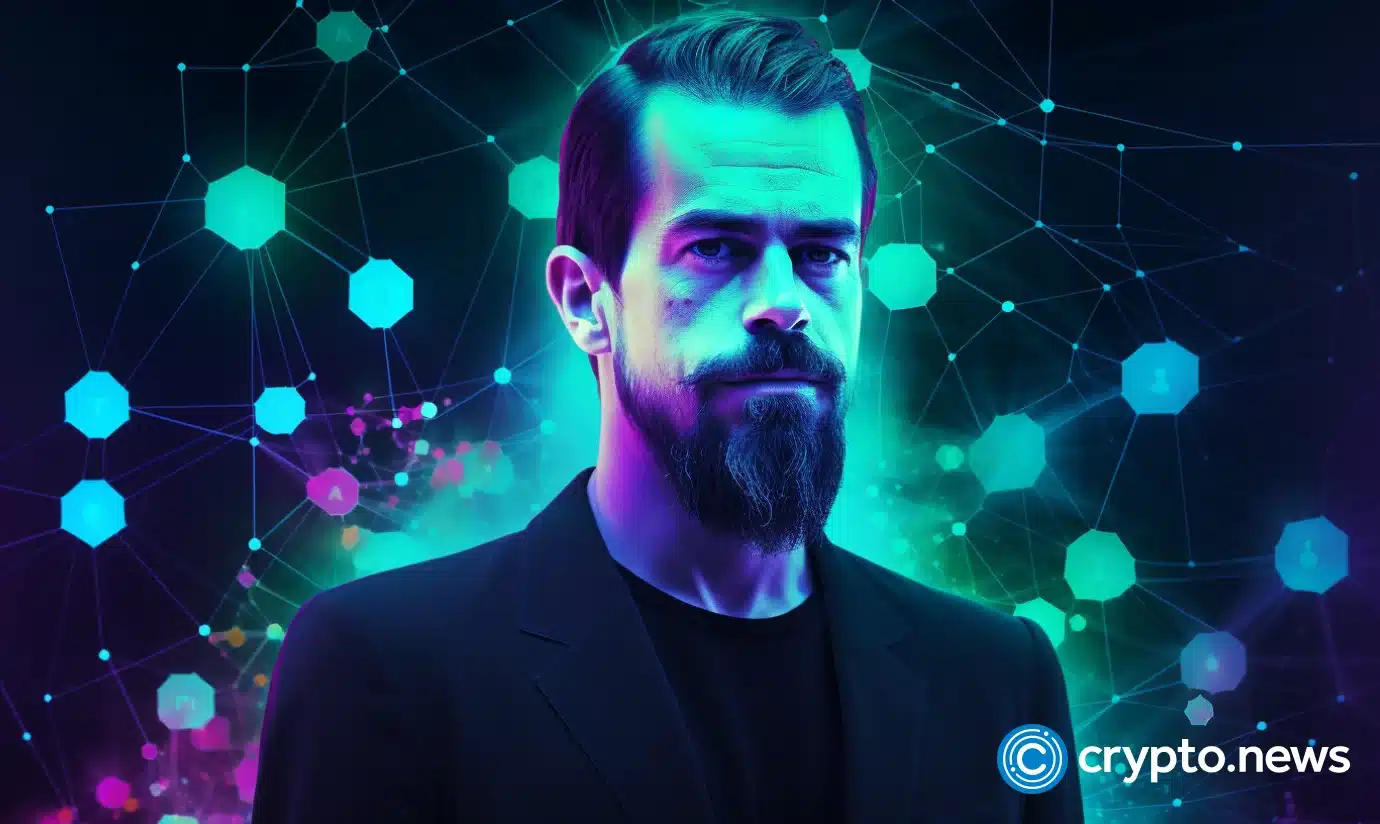
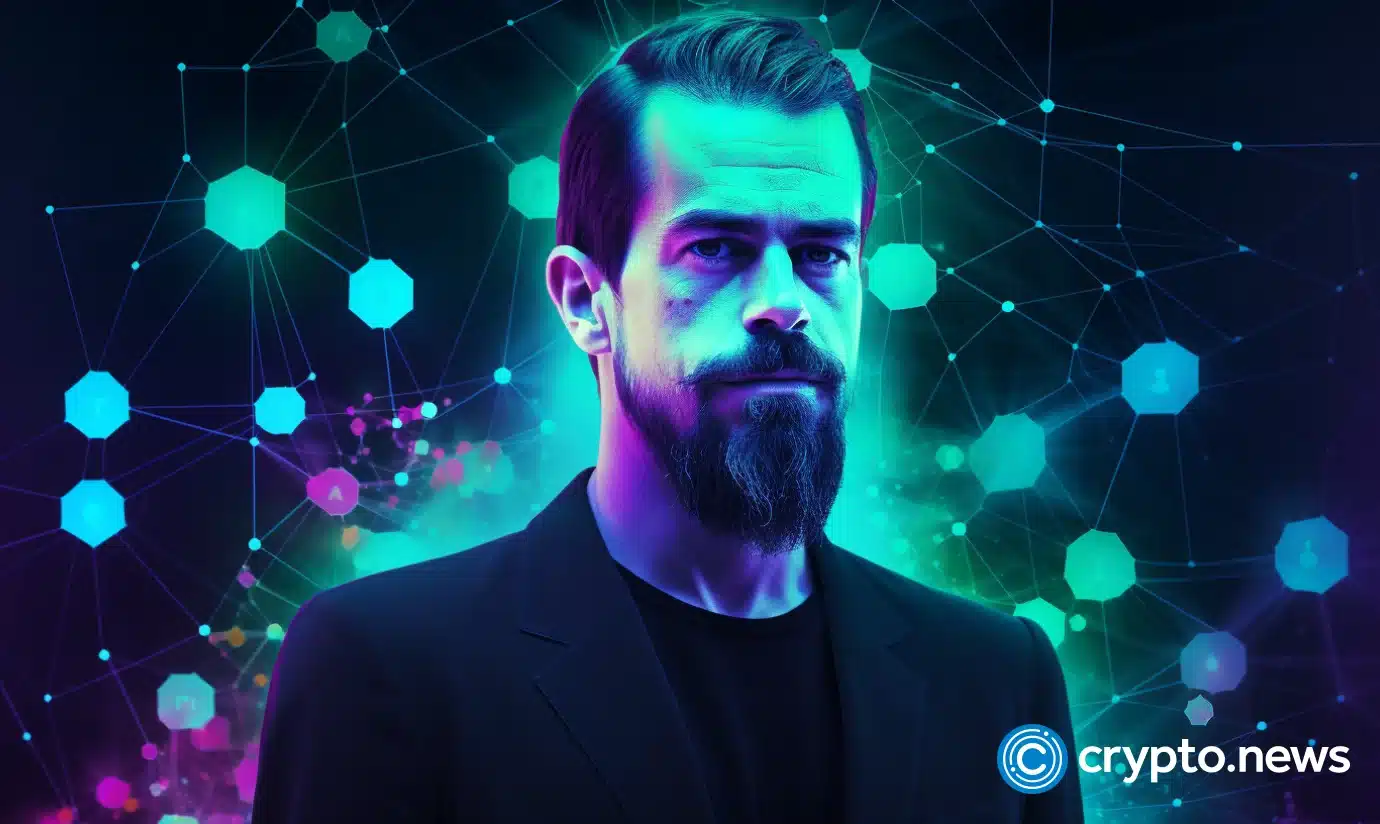
Block Inc. shares rose after the payments company reported stronger adjusted earnings for Q1 2026, even as its Bitcoin business weakened and the firm posted a net loss.
Summary
- Block stock jumped after adjusted EPS beat estimates, even as Bitcoin revenue dragged on results.
- Cash App gross profit rose sharply, while Block’s Bitcoin ecosystem revenue fell year over year.
- Proof of reserves and new Bitcoin features kept Jack Dorsey’s payments strategy in market focus.
The reaction showed investors focused more on adjusted results than the reported loss in the quarter as well.
Google Finance showed Block stock at $75.70 in after-hours trading, up 7.93%, after closing at $70.14. The move came after the company reported adjusted diluted earnings per share of $0.85, above the $0.68 estimate shown by Google Finance.
Block reported total net revenue of $6.06 billion for the quarter ended March 31, up from $5.77 billion a year earlier. Gross profit reached $2.91 billion, up 27% year over year, according to the company’s shareholder letter.
Still, the headline profit picture stayed mixed. Block reported a net loss attributable to common stockholders of $308.7 million, compared with net income of $189.9 million in the same quarter last year. Operating expenses rose to $3.08 billion from $1.96 billion.
Bitcoin revenue falls as fees change
Bitcoin remained a major part of Block’s revenue base, but it weakened in the first quarter. Bitcoin ecosystem revenue fell to $1.80 billion from $2.33 billion a year earlier. Bitcoin ecosystem gross profit dropped to $68 million from $92 million.
Block said the decline came from “bitcoin trading dynamics” and a decision to reduce fees on some Bitcoin transactions in Cash App. The company also recorded a $172.8 million Bitcoin remeasurement loss, compared with a $93.4 million loss a year earlier.
Moreover, Cash App provided the main growth engine for Block during the quarter. Its gross profit reached $1.91 billion, up 38% from a year earlier. Square gross profit rose 9% to $982 million, while Block lifted its full-year gross profit outlook to $12.33 billion.
Reuters reported that Cash App’s consumer lending originations rose 82% to $17.6 billion. It also cited Seaport Research analyst Jeff Cantwell as saying, “Cash App was the standout this quarter,” while noting that the recent workforce reduction did not appear to hurt execution.
Block expands Bitcoin push
Related crypto.news coverage noted that Block recently opened proof-of-reserves verification for 8,883 BTC across its corporate treasury, Cash App, and Square. The move allows users to check holdings through on-chain signatures.
Block also launched a touchscreen Bitkey wallet, automatic Bitcoin conversion for eligible Cash App payments, and 5% Bitcoin rewards at Square merchants. The company said users “should be able to verify” their Bitcoin, while Dorsey’s payments strategy remains tied to broader Bitcoin use.
Crypto World
Bitcoin slips to $79,000, DOGE leads majors losses as negative funding rates set 10-year record


The longer the funding rates stay red, the louder the short squeeze gets.
Bitcoin traded at $79,614 in Asian hours Friday, down 1.6% over 24 hours but still up 3.3% on the week, after pulling back from a Wednesday high of $81,500 that was the highest print since late January.
Ether dropped 2% to $2,278, dogecoin slid 3.8% to $0.1063, XRP fell 1.7% to $1.38, and BNB shed 0.7% to $638. Solana and TRON held in green territory at $88.14 and $0.3474 respectively. Dogecoin is the only major coin in the red on the seven-day tape.
The pullback came as U.S. forces fired on Iranian targets after attacks on American naval destroyers transiting the Strait of Hormuz on Thursday, per reports.
President Donald Trump described the strike as a “love tap” in an ABC News interview, said the ceasefire with Iran remains “in effect,” and threatened to hit harder if Tehran does not sign a deal soon. Brent crude climbed 1.2% to around $101 a barrel on the escalation, though oil is still down more than 6% on the week as the broader US-Iran de-escalation narrative continues to hold.
Equities took a similar pause. The MSCI All Country World Index slipped 0.3% and Asian shares fell 1.2% from a record close, though the region is still on track for a fifth straight week of gains. Wall Street futures were 0.2% higher in early trading, suggesting the pullback is profit-taking rather than a structural reversal.
Bitcoin futures funding rates have now stayed negative for 67 consecutive days, the longest stretch in 10 years per K33 Research. Funding rates are periodic payments between traders holding long and short futures positions, with negative funding meaning shorts are paying longs to keep their positions open.
A market where shorts have been paying for two-and-a-half months while price has grinded higher is the cleanest setup for a short squeeze, where a sudden price move forces those shorts to close positions and accelerates the rally.
FxPro chief market analyst Alex Kuptsikevich said in a note bitcoin’s pause this week is not a sign of buyer exhaustion.
“Bitcoin rose to $82,800 on Wednesday, approaching but not breaking through the 200-day moving average at $83,200. From its local highs, the leading cryptocurrency retreated to $81,300 at the time of writing,” he said.
Kuptsikevich added that the daily RSI hit overbought territory above 70, and that the previous three times this happened (August, October, January) were followed by sharp selloffs. “It is logical that market participants are taking a breather to assess the situation and gather strength.”
The options market is more cautious. QCP Capital said in a Telegram broadcast that monthly implied volatility remains around 41% and demand for put options persists, suggesting traders are buying bitcoin but continuing to hedge their downside.
Elsewhere, Research firm XWIN Japan flagged $93,000 as a medium-term target driven by closing the CME futures gap, though the firm cautioned the move may not be linear and could see a leg lower first.
For now, the trade sets up around two competing pressures. The negative funding extreme keeps the short squeeze on the table if bitcoin breaks $83,200. The Iran headlines and overbought RSI keep the door open for another retest of the lower range.

TLDR
- BlackRock said advisors should consider Bitcoin, gold, and liquid alternatives as portfolio diversifiers.
- The firm reported that stock and bond correlations have remained elevated since 2020.
- BlackRock found that Bitcoin had a 0.53 correlation with the S&P 500 from 2022 to early 2026.
- The report showed that gold recorded a 0.19 correlation with equities during the same period.
- BlackRock said Bitcoin and gold had a 0.10 correlation, which may support combined allocations.
BlackRock has urged financial advisors to reassess diversification strategies as stock and bond correlations remain elevated. The firm said traditional 60/40 portfolios have lost reliability since 2020 due to rising volatility and tighter asset relationships. In a May 6 report, BlackRock outlined how Bitcoin, gold, and liquid alternatives may help diversify multi-asset portfolios.
Bitcoin Emerges as Equity-funded Diversifier
BlackRock published its report titled “How to diversify with bitcoin, gold and alternative investments” on May 6. The firm stated that geopolitical and economic shocks have reduced the effectiveness of traditional diversification tools. It said bonds no longer provide the same hedge against equity drawdowns as in the 2010s.
The report showed that Bitcoin posted a 0.53 correlation with the S&P 500 from 2022 through the first quarter of 2026. By comparison, gold recorded a 0.19 correlation with equities during the same period. BlackRock said the iShares Bitcoin Trust ETF has displayed lower equity correlation than many traditional assets.
BlackRock described Bitcoin as a “unique diversifier” due to its distinct return drivers. The firm linked Bitcoin’s long-term adoption to concerns about monetary stability and US fiscal sustainability. It also connected adoption trends to geopolitical and political stability factors.
The asset manager reiterated that a 1% to 2% Bitcoin allocation may suit multi-asset investors. It said allocations above that range could sharply raise overall portfolio risk. BlackRock stated that advisors should fund Bitcoin exposure from equities due to its volatility profile.
Gold and Liquid Alternatives Strengthen Portfolio Mix
BlackRock highlighted gold as a complementary asset within diversified portfolios. The firm reported that Bitcoin and gold showed a 0.10 correlation from 2022 through early 2026. It said combining both assets could enhance diversification benefits.
The report explained that gold maintained a lower equity correlation than Bitcoin during the measured period. However, BlackRock said the two assets together may provide broader risk dispersion. It emphasized that the low correlation between them supports combined allocations.
BlackRock also promoted liquid alternative strategies within its Target Allocation with Alternatives models. The firm said these strategies aim to reduce portfolio risk without sacrificing upside potential. It stated that most alternative allocations draw funding from fixed-income positions.
However, BlackRock treated Bitcoin differently within its allocation framework. The firm said Bitcoin requires equity funding due to higher volatility compared to gold and alternatives. It added that even small allocations can influence overall portfolio characteristics.
Bitcoin traded near $79,900 at press time after falling 2% on the day. The cryptocurrency had briefly climbed above $82,000 earlier on Wednesday before losing momentum. Traditional markets also eased after posting gains over the previous month.


Blockchain protocols preparing for the quantum computing threat should also consider how to quickly verify ownership on the blockchain if funds are stolen, the development and research team behind the layer-1 NEAR Protocol said.
Concerns that quantum computers could eventually break blockchain cryptography have fueled worries about private keys and wallet security, but most of the conversation has focused on preventing such attacks.
“We won’t be able to tell if someone running a transaction is the rightful owner of the asset or not,” Near One’s chief technology officer, Anton Astafiev, said on Wednesday, adding that blockchain protocols would be forced to make tough decisions on whether to freeze compromised crypto wallets.
“Protocols will face the challenge of deciding to either block all assets at this moment, or enter a wild west,” Astafiev said.
Astafiev suggested that zero-knowledge proof technology could enable the rightful owner to demonstrate knowledge of the original seed phrase without revealing sensitive information.
“This is one example of how research across blockchain ecosystems is essential and valuable as everyone prepares for quantum unknowns.”

Source: NEAR
The push comes after researchers at Google and the California Institute of Technology said in March that functional quantum computers could arrive sooner than expected and would need far less computing power to break cryptography than previously thought.
Google claimed that quantum computers could potentially break Bitcoin’s cryptography within 10 minutes, allowing hackers to perform an “on-spend” attack.
Astafiev said Near One is researching how to solve the problem of not knowing whether a transaction is made by the owner or not.
He also noted that NEAR developers are building a post-quantum-safe signing system for the layer-1 blockchain, which secures more than $137.6 million in user funds.
One of the first quantum solutions being implemented on NEAR is “FIPS-204,” which has been approved by the US National Institute of Standards and Technology and is set to launch on testnet by the end of the second quarter.
Other crypto ecosystems are taking swift action, too.
Related: Quantum computer breaks 15-bit elliptic curve cryptographic key
The Ethereum Foundation created the Post-Quantum Ethereum team to build quantum solutions into Ethereum at the protocol level by 2029.
Two of Solana’s validator clients, Anza and Firedancer, have also implemented a test version of Falcon, a new post-quantum signature solution, to help prepare the Solana network for future quantum threats.
The Bitcoin community has also begun looking at ways to tackle the problem.
Blockstream CEO Adam Back said in April that current quantum computers are “basically lab experiments,” backing up earlier claims that quantum computers are decades away.
Still, he recommended that Bitcoin developers start looking at building quantum solutions.
Magazine: Nobody knows if quantum secure cryptography will even work

BNY has partnered with Abu Dhabi-based Finstreet and ADI Foundation to develop institutional digital asset custody services for clients in the United Arab Emirates.
The initial focus is on Bitcoin and Ether custody for Finstreet’s existing clients, with plans to later extend to ADI Foundation’s blockchain infrastructure, the world’s largest custodian said in a Thursday announcement. The companies said they intend to expand the product scope to include stablecoins, tokenized real-world assets and other regulated digital instruments, though no timeline was given.
“BNY is uniquely positioned to connect traditional and digital financial ecosystems,” Hani Kablawi, executive vice chair at BNY, said. BNY claimed it is the first US global systemically important bank to offer digital asset custody.
The three firms will offer digital asset custody services from the Abu Dhabi Global Market (ADGM), an international financial center and free zone on Al Maryah Island. The initiative remains subject to definitive agreements and regulatory approvals, according to BNY.
Related: UAE free zone launches blockchain-based business IDs for registered firms
UAE stablecoin infrastructure expands
Finstreet is a subsidiary of Sirius International Holding, which is backed by UAE conglomerate IHC. IHC recently joined other institutions in launching DDSC, a dirham-backed stablecoin regulated by the UAE central bank. The stablecoin operates on ADI Chain, an institutional layer-2 blockchain developed by ADI Foundation.
PUSD, a Shariah-compliant stablecoin backed by reserves denominated in Saudi riyals and UAE dirhams, is also expected to launch on ADI Chain.
In 2025, ADI Chain signed memoranda of understanding with BlackRock, Mastercard and Franklin Templeton tied to tokenized asset settlement and digital financial infrastructure.
The UAE has continued developing its digital asset regulatory framework and tokenization infrastructure in recent years, licensing firms including Animoca Brands, BitGo and Binance while introducing rules covering tokenized stocks, ETFs and crypto derivatives.
Cointelegraph reached out to BNY for a comment, but had not received a response by publication.
Related: UAE investors buy AI dip, keep crypto exposure despite conflict
UAE stablecoins launch regulated conversion rail
The BNY collaboration comes as Abu Dhabi firms push deeper into regulated digital asset infrastructure.
In a Thursday announcement, AE Coin and USD Universal said they are building a regulated conversion rail that allows near-instant exchange between the UAE dirham-pegged AE Coin and the US dollar-backed USDU stablecoin, targeting institutional payments and treasury management.
The system runs on Al Maryah Community Bank’s infrastructure and will initially be accessible through Aquanow and Changer.ae, two regulated digital asset service providers in the UAE.
Magazine: Guide to the top and emerging global crypto hubs: Mid-2026
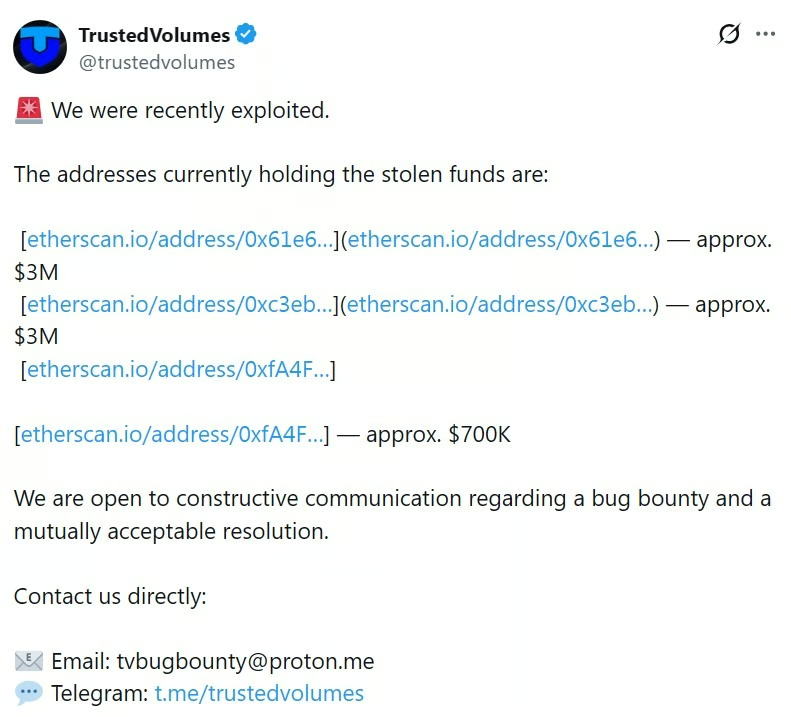
TrustedVolumes, an independent market maker and resolver used by 1inch Fusion, confirmed it was exploited and said about $6.7 million in stolen funds are being held across three Ethereum addresses.
In a Thursday X post, the market maker said the stolen funds were split across three wallets, with two addresses each holding about $3 million and a third holding about $700,000. TrustedVolumes said it was open to “constructive communication” over a bug bounty and a “mutually acceptable resolution.”
The confirmation came after Web3 security company Blockaid said its exploit detection system had identified an ongoing Ethereum exploit targeting TrustedVolumes. Blockaid said the attack involved a TrustedVolumes-controlled custom swap infrastructure. Blockaid initially estimated that about $5.87 million had been extracted, including Wrapped Ether, USDT, Wrapped Bitcoin and USDC.
Blockchain security company CertiK said the attacker registered as an allowed order signer through a public function, then used that authorization to execute orders that transferred funds from the targets.
The incident highlights the risks around third-party infrastructure used in decentralized exchange execution, where resolvers and market makers can operate their own contracts even when the core protocol and ordinary users are not directly affected. TrustedVolumes operates independently as a liquidity provider for multiple protocols, including 1inch, which said its own systems, infrastructure and user funds were not affected.
Cointelegraph reached out to TrustedVolumes for additional comment but had not received a response by publication.
Source: TrustedVolumes
1inch says none of its protocols were breached
In an X post, 1inch said reports linking it directly to the TrustedVolumes exploit were “misleading,” adding that “neither 1inch nor any of the 1inch protocols are involved.” The platform said there was “no impact on 1inch systems, infrastructure or user funds.”
1inch co-founder Sergej Kunz also said TrustedVolumes operates independently and is not exclusive to 1inch. “While it is true that 1inch uses TrustedVolumes as a resolver, we are one of many,” Kunz said.
Kunz said the framing of the exploit as a 1inch-related incident was “confusing and harmful,” adding that 1inch is monitoring the situation with security partners and will assist where appropriate.
Related: Andre Cronje says DeFi is ‘no longer DeFi’ as builders debate circuit breakers
Security researcher Vladimir Sobolev, known as Officer’s Notes on X, also told Cointelegraph there was “no risk for 1inch users,” adding that the exploit was related only to TrustedVolumes.
Sobolev said the exploit points to broader weaknesses in crypto security practices, where vulnerabilities can quickly produce immediate losses.
“We lack security in general. Blockchains just tend to have an immediate payoff,” Sobolev told Cointelegraph. “We need to pay more attention to kill switches, monitoring, circuit breakers, etc.”
Both Blockaid and Sobolev noted that the attack was carried out by the same operator responsible for the March 2025 1inch Fusion V1 resolver exploit. However, Blockaid said the latest attack involved a different vulnerability.
In March 2025, 1inch said a vulnerability affected resolvers using an outdated Fusion v1 implementation in their own contracts, while end-user funds remained safe. SlowMist later traced about $5 million in stolen assets, including USDC and Wrapped Ether.
1inch and the affected resolver negotiated with the attacker, who returned most of the stolen funds under a bug bounty agreement, according to 1inch and Decurity’s postmortem.
Magazine: North Korea denies crypto hacks, Upbit’s bank tests Ripple: Asia Express

Asian Games 2026: Vinesh Phogat cleared WADA’s retirement rule, but Asian Games dream looks out of bounds now | More sports News

The Canvas Hack Is a New Kind of Ransomware Debacle

Payment dates for some people on benefits to change this month

Manchester United reach agreement with Casemiro over contract clause amid transfer speculation

US brings back mandatory military draft registration

Steven Gerrard disagrees with Gary Neville over ‘shock’ Chelsea and Arsenal claim | Football

![BITCOIN: CRAZY!!!! THIS IS CRAZY!!!! [trades]](https://wordupnews.com/wp-content/uploads/2026/05/1778214197_maxresdefault-80x80.jpg)

-

 NewsBeat4 days ago
Channel 5 – All Creatures Great and Small series 7 new post
-

 Crypto World21 hours ago
Upbit adds B3 Korean won pair as Base token gains Korea access
-
 Tech6 days ago
Trump’s 25% EU auto tariff breaches Turnberry Agreement that also covers semiconductors and digital trade
-
 NewsBeat22 hours ago
NCP car park operator enters administration putting 340 UK sites at risk of closure
-
 Sports6 days ago
Paul Scholes issues Marcus Rashford reality check as agreement emerges over Man United star
-

 Entertainment6 days ago
Met Gala 2026 Rumored Guest List Is Turning Heads
-

 Business7 days ago
Strait of Hormuz Blockade Persists Amid US-Iran Standoff, Sending Oil Prices Soaring
-

 Entertainment6 days ago
Kylie Jenner Hit With Second Lawsuit From Ex-Housekeeper
-
Entertainment7 days ago
New on Prime Video in May 2026 — Full List of Movies and Shows
-

 Tech7 days ago
Meta ends Sama contract after Kenyan workers report seeing intimate footage from Ray-Ban smart glasses users
-

 Sports6 days ago
Cavaliers vs. Raptors Game 6 live score, updates, highlights from 2026 NBA playoffs first-round series
-
 Sports6 days ago
David Benavidez responds to team Canelo saying the fight will never happen
-
Entertainment5 days ago
New Netflix Movies in May 2026 — My Top 3 Picks to Stream
-

 Entertainment5 days ago
Melissa Joan Hart and More Stars Attend 2026 Kentucky Derby
-
 Sports6 days ago
IPL 2026: ‘Love you darling’- Hardik Pandya’s reaction to MS Dhoni steals the show |Watch | Cricket News
-

 Entertainment6 days ago
Young and the Restless Next Week: Cane Arrested & Matt’s Deadly New Scheme!
-

 Business5 days ago
Luka Doncic Injury Update: Doncic’s Hamstring Recovery Slows Lakers’ Hopes Against Thunder: Can He Run Yet?
-

 Sports7 days ago
Bayern won’t hand bottom side Heidenheim ‘gifts’ despite PSG game
-

 Sports7 days ago
What Preity Zinta Said After Punjab Kings’ First Defeat Of IPL 2026
-
Crypto World5 days ago
Pi Network Mandates Protocol 23 Upgrade for All Mainnet Nodes Before May 15 Deadline
You must be logged in to post a comment Login