

Crypto World
US Treasury Quietly Demands Binance Comply With Monitoring Deal

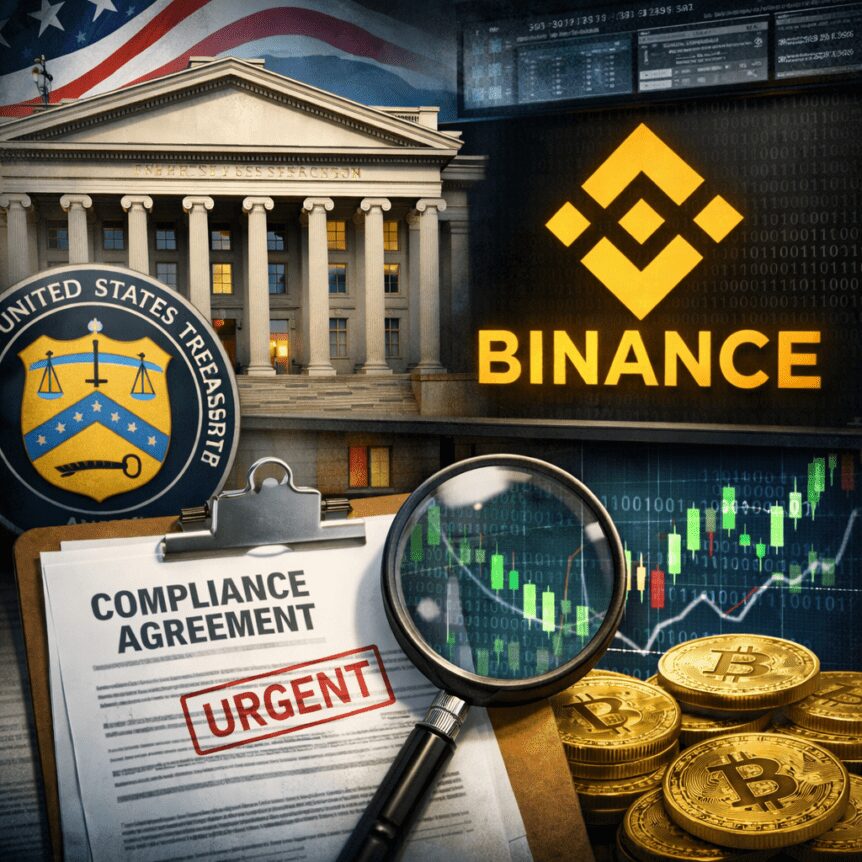
Regulatory scrutiny around Binance has intensified as reports emerge that the US Treasury privately insisted the crypto exchange adhere to an independent monitoring program established under a 2023 settlement with US authorities. The Information, citing internal communications, said the demand followed disclosures that funds potentially tied to Iran flowed through Binance, prompting renewed pressure from lawmakers and regulators to demonstrate ongoing compliance and effective controls. The episode arrives amid broader enforcement activity tied to Binance’s US and international operations and the evolving regulatory framework governing crypto firms.
Binance has publicly asserted its commitment to compliance, telling Cointelegraph it would cooperate with the independent monitor and maintain transparency as it strengthens anti-money-laundering and KYC controls. The remarks came as executive leadership faced renewed questions about governance and continued access to global liquidity for Binance.US, the firm’s U.S. affiliate, as authorities reassess cross-border oversight in the sector.
Key takeaways
- The US Treasury is reported to have privately required Binance to comply with a three-year independent monitoring program that was part of a 2023 settlement with Treasury and the Justice Department, according to The Information.
- The settlement in 2023 involved a $4.3 billion payment and established ongoing monitoring overseen by government officials; the new reporting emphasizes continued regulatory oversight even after the initial accord.
- Allegations that as much as $1 billion flowed through Binance to Iran-linked entities prompted renewed scrutiny and reports that Binance dismissed staff who flagged those transfers, underscoring enforcement focus on sanctions evasion risk.
- A group of US senators reportedly urged Treasury Secretary to detail Binance’s adherence to the 2023 settlement, reflecting legislative concern about compliance and sanctions enforcement within the industry.
- Binance’s response stressed cooperation with the monitor and ongoing collaboration with agencies, framing oversight as a mechanism to strengthen AML/KYC controls.
- Comments by former Binance CEO Changpeng Zhao at the Consensus conference in Miami highlighted his stance on leadership roles and broader liquidity considerations, while filings show legal actions related to the company’s AML regime in the 2023 settlement.
- Regulatory and geopolitical context remains volatile: Zhao’s legal exposure and the involvement of U.S. political figures intersect with cross-border policy developments, including potential implications for MiCA-era standards and cross-jurisdictional enforcement.
Regulatory oversight and monitoring obligations
According to The Information, the 2023 settlement between Binance, the US Treasury, and the US Department of Justice required Binance to operate under an independent monitoring program for a three-year period. The program was designed to assess and verify the firm’s compliance with sanctions, AML, and counter-terrorist financing obligations, with oversight to be conducted by government-appointed officials and an independent monitor. The reported private demand from the Treasury to continue strict adherence to that monitoring framework underscores the persistence of sanctions enforcement risk for large crypto platforms operating on a global scale.
The same reporting raises questions about the efficacy and reach of such monitors in a rapidly changing regulatory environment. The tied disclosures of a $4.3 billion settlement illustrate the scale of the settlement and the severity of expectations for ongoing compliance enforcement. For institutions and banks interacting with crypto entities, the situation reinforces the importance of robust due diligence, continuous monitoring, and clear line items in sanctions screening and AML/KYC programs to address cross-border risk, especially where sensitive jurisdictions are involved.
Beyond the financial penalties, the unfolding narrative includes congressional attention. A group of US senators reportedly urged Treasury Secretary to provide a formal update on Binance’s adherence to the 2023 settlement—the type of oversight activity that can influence licensing prospects, agency cooperation, and the perceived reliability of centralized exchanges in meeting U.S. regulatory standards. The reporting environment signals a tighter coupling between enforcement actions and regulatory transparency obligations for major crypto platforms.
Binance, for its part, emphasized cooperation with the monitor and with regulatory authorities. A spokesperson told Cointelegraph that the firm views oversight as an “important part of continuously strengthening our compliance and anti-money laundering controls,” and that Binance intends to provide the monitor with “full cooperation and transparency.” The emphasis on ongoing collaboration aligns with a broader regulatory expectation that major exchanges demonstrate verifiable compliance capabilities rather than relying solely on post hoc remediation.
Executive responses and leadership perspectives
The Information’s reporting on regulatory oversight coincided with Changpeng Zhao’s appearance at the Consensus conference in Miami. Zhao, who stepped down as Binance CEO in November 2023, has publicly signaled a cautious stance toward the future of leadership in the crypto sector. He told attendees that while he had been “trying to avoid” the United States, he did not rule out strategic moves to preserve user access to global liquidity, including the possibility of reviving Binance.US as a channel to maintain broader liquidity flows. He also rejected the notion of taking a leadership role at another crypto company, describing himself as a “one-trick pony.”
Legal and regulatory developments surrounding Zhao and Binance have continued to unfold through public filings and enforcement activity. Regulatory documents indicate Zhao pleaded guilty to a single felony charge related to failure to maintain an adequate anti-money-laundering regime at Binance as part of the 2023 settlement. While the specifics of the legal matter and its implications are subject to ongoing litigation and procedural developments, the admission underscores the lasting regulatory risk profile associated with major crypto exchanges and their executives.
Further complicating the public narrative is a report that Zhao’s ties to political and business developments have attracted attention beyond the U.S. regulatory sphere. In a separate thread of coverage, reports have highlighted high-profile investments and potential political entanglements that have, at times, intersected with regulatory discourse. The conversation around enforcement, leadership, and governance remains salient for institutional stakeholders evaluating exposure to exchange-level risk and compliance obligations.
Legal actions, enforcement context, and policy implications
The enforcement trajectory surrounding Binance encompasses a confluence of U.S. authorities, cross-border considerations, and internal governance decisions. The 2023 settlement’s legal framework—which included a substantial monetary penalty and the imposition of a monitoring regime—serves as a reference point for how authorities are likely to evaluate ongoing sanction compliance, AML controls, and corporate governance in the crypto sector. The reported guilty plea by Zhao, while tied to the same settlement, adds a personal accountability dimension to the broader regulatory narrative and may influence how future settlements are structured, disclosed, and monitored.
The regulatory cross-currents extend to policy conversations around market structure and licensing. In the European Union, developments tied to the Markets in Crypto-Assets Regulation (MiCA) are shaping standards for licensing, supervisory oversight, and cross-border enforcement. While the U.S. and EU frameworks differ in emphasis and approach, the underlying objective is consistent: ensure robust AML/KYC controls, transparent governance, and credible sanctions enforcement for entities operating in or with the crypto ecosystem. The Binance case thus sits at the intersection of ongoing U.S. enforcement initiatives and the broader global push toward harmonized, regulatorily coherent crypto markets.
The political dimension also factors into risk assessment. Reports of ties between Binance and high-profile political or business actors have fed scrutiny from lawmakers and regulatory observers. While investigators pursue specific regulatory obligations and sanctions compliance, the broader policy implication is clear: as enforcement actions evolve, institutions must weigh the implications for licensing trajectories, correspondent banking relationships, and the ability to provide compliant, regulated access to digital assets on a global scale.
For practitioners and compliance teams tracking regulatory developments, the key takeaway is that the Binance case illustrates a persistent demand for verifiable compliance evidence, continuous monitoring, and transparent remediation plans. The combination of a major settlement, a dedicated monitoring regime, and ongoing congressional engagement creates a framework in which crypto firms must demonstrate durable AML/KYC capabilities, rigorous sanctions screening, and governance that withstands scrutiny from multiple authorities across jurisdictions.
Closing perspective
The evolving narrative around Binance underscores the critical importance of verifiable compliance infrastructure for large crypto platforms operating on global rails. As regulatory expectations sharpen and enforcement tools expand, institutions should monitor not only the outcomes of specific investigations but also how monitoring, governance, and cross-border cooperation evolve within the broader policy environment. The next steps—clarity on monitoring outcomes, additional regulatory disclosures, and any potential licensing adjustments—will likely shape the credibility and resilience of major exchanges in a tightening regulatory landscape.
Notes and attribution: The reporting environment draws on The Information’s coverage of the Treasury’s posture toward Binance’s monitoring program, and on Cointelegraph’s reporting and coverage of Binance’s public statements and Zhao’s remarks at Consensus. For reference, The Information article is linked here, and Cointelegraph’s coverage is cited where relevant in ongoing updates.

Key Highlights
- The $H token plummeted 80-90% following a security breach on June 8-9, erasing over $1 billion in market capitalization
- Malware on a developer’s computer compromised private keys, enabling hackers to steal 141M tokens and create 200M additional ones
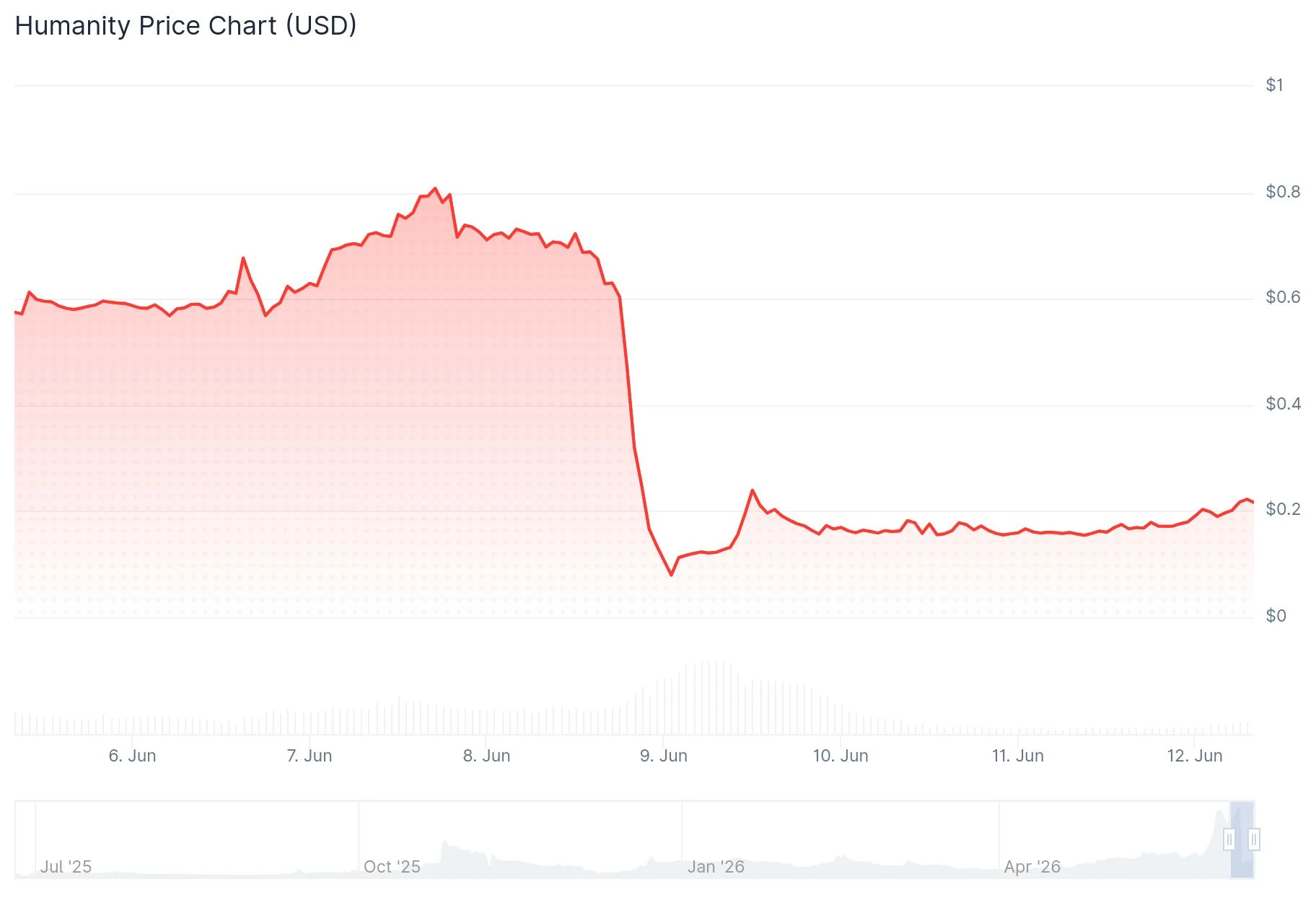
- Immediate financial damage is calculated between $30M–$36M; $H dropped to $0.05–$0.13 before recovering to approximately $0.20
- Officials suspended bridge operations, announced a $1M USDT reward, and committed recovered assets to token repurchase initiatives
- Speculation about internal complicity has emerged among researchers, with an upcoming token release on June 25 intensifying concerns
Humanity Protocol’s $H token stood out as a top-performing cryptocurrency in early 2026, delivering returns between 300–800% and climbing to a record peak of $0.8439 on June 2. Yet within mere days, more than 80% of that value evaporated.
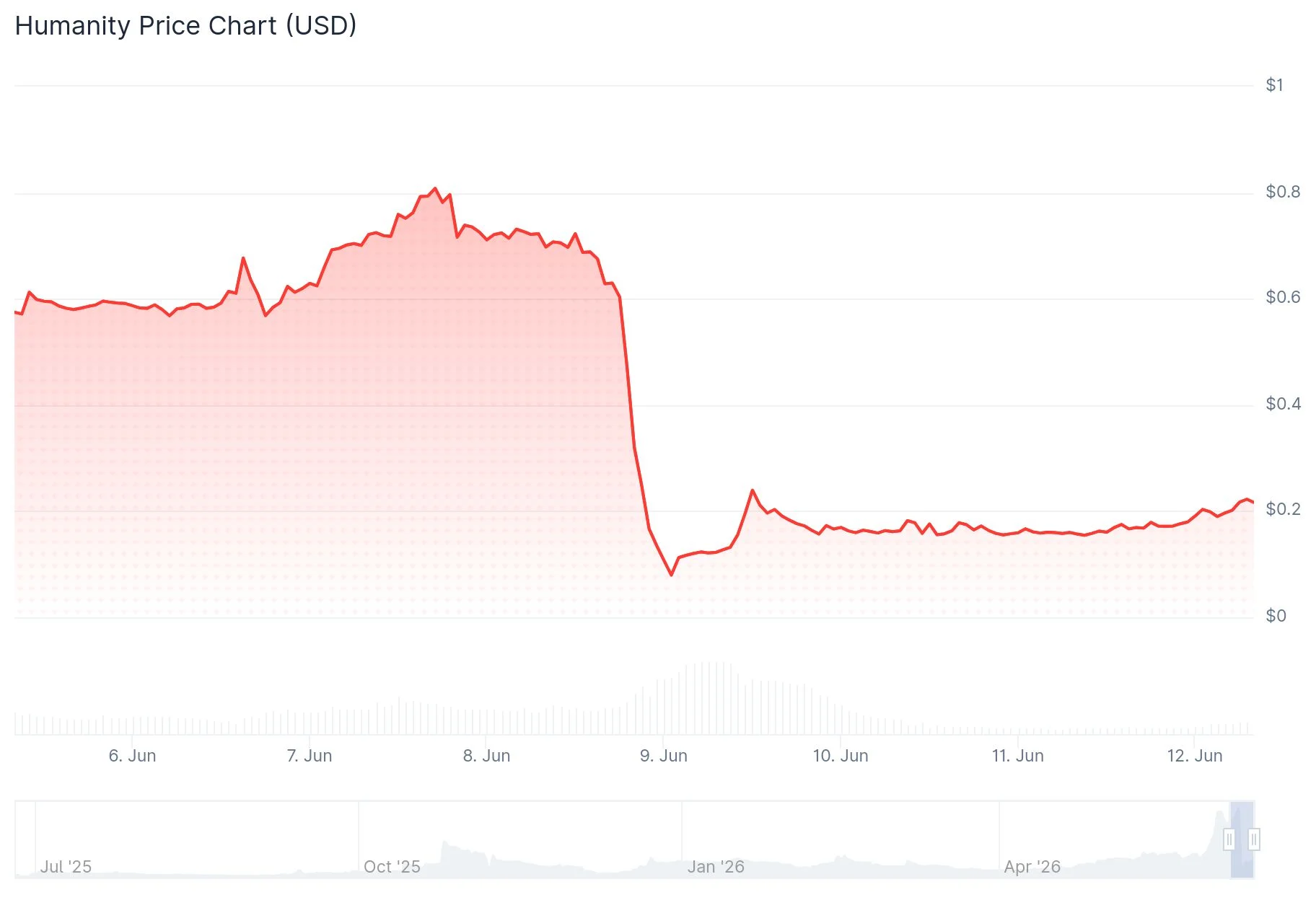
A cybersecurity incident on June 8–9 sparked the dramatic downturn. The digital asset plunged from approximately $0.67–$0.74 to depths of $0.05–$0.13. More than $1 billion in valuation disappeared within hours.
Following the crash, $H has mounted a 41% recovery and was changing hands near $0.20 as of June 10–11. The token still shows approximately 74% losses over the seven-day period.
Anatomy of the Security Breach
The vulnerability originated from an infected developer computer. Malicious software on this machine revealed private keys that controlled Humanity Protocol’s Gnosis Safe infrastructure on both Ethereum and BNB Chain.
This wasn’t a sophisticated smart contract vulnerability or an intricate DeFi protocol manipulation. It represented a fundamental operational security breakdown.
On the Ethereum network, three out of six Gnosis Safe keys were compromised. Attackers leveraged these credentials to extract approximately 141.2 million $H tokens through a single transfer.
On BNB Smart Chain, three out of five authorization keys fell into hostile hands. The perpetrators activated unrestricted minting capabilities and generated over 200 million new $H tokens through two separate operations.
Both the stolen and newly fabricated tokens flooded exchanges, destroying price stability and sparking widespread panic selling. The immediate monetary impact from extracted and manufactured tokens ranges from $30 million to $36 million.
Official Actions and Outstanding Concerns
Humanity Protocol responded swiftly following the compromise. Officials verified the incident stemmed from key exposure rather than code vulnerabilities, and immediately suspended all bridging functionality.
They deployed a public monitoring system displaying attacker addresses and transaction flows. A $1 million USDT reward was established for intelligence contributing to fund retrieval.
The organization also pledged that any reclaimed assets would support market purchases of $H tokens. No specific schedule for this buyback initiative has been revealed.
Blockchain investigator ZachXBT and fellow analysts have started reviewing transaction sequences surrounding the incident. Several researchers have floated theories regarding possible internal coordination.
The chronology has attracted attention. A planned token distribution was scheduled for June 25, approximately fourteen days following the security failure. Certain commentators have theorized the breach might represent a coordinated withdrawal ahead of that release.
Market Outlook and Community Focus
The rebound from $0.05–$0.13 to roughly $0.20–$0.21 indicates renewed purchasing interest. However, the asset remains 70–75% beneath pre-attack valuations, with transaction volumes notably subdued.
Limited market depth suggests the current uptick could reverse abruptly. The approaching June 25 distribution compounds existing uncertainty within an already shaken investor base.
Humanity Protocol manages sensitive biometric verification systems, making security lapses particularly destructive to credibility. Critical questions surrounding key custody protocols and potential insider participation await resolution.
The platform’s forthcoming actions — including potential asset recovery and the impact of the June 25 distribution — will likely determine whether this price recovery maintains momentum.


South Korea’s tax authorities are preparing to treat tokenized stocks as securities rather than virtual assets, a move that could bring the rapidly growing sector into the country’s existing taxation framework once financial regulators finalize their legal interpretation.
Summary
- South Korea’s tax authorities said tokenized stocks could face immediate taxation if financial regulators classify them as securities.
- Officials indicated that overseas tokenized stock trades may also fall under existing securities tax rules depending on their economic rights structure.
- The move comes as the global tokenized stock market has grown to nearly $1.5 billion, fueled by rising demand for blockchain-based access to equities such as Tesla and Nvidia.
According to comments from South Korea’s Ministry of Economy and Finance shared with local outlet Bloomberg Bit, the government currently views tokenized stocks as securities in substance despite their blockchain-based structure.
The ministry said that if the Financial Services Commission determines tokenized stocks qualify as securities, taxation could begin immediately under existing capital markets rules without requiring new legislation.
Officials told the publication that tokenized equities may take the form of digital assets, but their economic characteristics more closely resemble traditional securities.
The ministry also pointed to previous guidance from financial regulators, which emphasized that assets meeting the characteristics of securities should be regulated as securities regardless of the technology used to issue them.
Interest in tokenized equities has grown rapidly over the past year as investors seek blockchain-based access to publicly traded companies.
Data from RWA.xyz showed the tokenized stock market reached $1.47 billion as of June 8, up 115% since the start of the year.
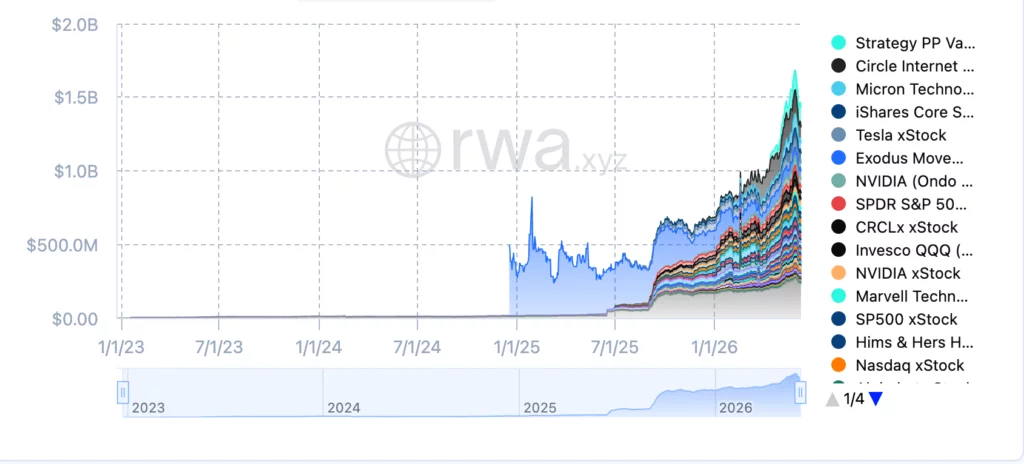
Tokenized stock market value. Source: RWA.XYZ
Demand has been particularly strong among investors seeking exposure to U.S. companies such as Tesla and Nvidia through platforms that offer around-the-clock trading and faster settlement.
Financial regulators move toward legal clarification
Attention is now turning to the Financial Services Commission, which is expected to release revisions to its token securities guidelines and related regulations in July.
Earlier, during the second meeting of a public-private token securities task force in May, the commission said it would develop a detailed roadmap for the tokenization of conventional securities, including listed stocks.
A formal interpretation classifying tokenized shares as securities could clear the way for tax collection during the second half of 2026.
South Korean regulators have already established a foundation for that approach. In its 2023 token securities guidelines, the commission stated that token securities issued in digital asset form fall under the scope of the Capital Markets Act.
However, those guidelines focused largely on fractional ownership products tied to assets such as real estate, artworks, and intellectual property, leaving uncertainty around tokenized versions of ordinary shares.
Because of that uncertainty, many market participants had assumed tokenized stocks would be treated similarly to virtual assets and remain outside the tax net until South Korea’s virtual asset taxation regime takes effect next year.
Overseas trades could also fall under tax rules
The Ministry of Economy and Finance indicated that taxation would not necessarily be limited to domestically issued products.
Officials told Bloomberg Bit that securities taxation under existing law is based on the economic rights attached to an asset rather than where it is issued.
As a result, tokenized stock transactions conducted through overseas platforms could still be subject to South Korean tax rules if the underlying rights are deemed equivalent to securities.
The ministry also noted that future classifications may depend on specific features attached to the tokens. Depending on whether voting rights are included, tokenized stocks could potentially be categorized as ordinary shares, derivative-linked securities, or investment contract securities.
At the same time, South Korea’s tax authorities and the National Tax Service are working to strengthen information-sharing arrangements with foreign tax agencies, including the U.S. Internal Revenue Service, to improve visibility into transactions conducted through overseas platforms.
The regulatory push comes as tokenized finance gains momentum globally.
According to a Binance Research report, tokenized stocks had become the fastest-growing segment of the real-world asset sector, with market value rising 422% since early 2025.
The research firm attributed much of the growth to platforms that provide blockchain-based access to traditional equities and exchange-traded funds.
Growing activity on platforms such as xStocks and Ondo Global Markets has further accelerated investor interest in blockchain-based securities, increasing pressure on regulators to clarify how existing financial and tax laws should apply to the sector.


Bitcoin and Ether options worth about $2.5 billion expire on June 12, putting the $60,000 to $62,000 Bitcoin range back in focus.
Summary
- Bitcoin options worth $2.23 billion expire today as BTC trades close to $63,000 support levels.
- GreeksLive data showed downside dealer exposure concentrated around Bitcoin’s key $60,000 to $62,000 range.
- Ether options worth about $293 million also expire, with ETH still flat near $1,650.
Around 35,000 Bitcoin options contracts expire today, with a notional value near $2.23 billion. The event is slightly larger than last week’s expiry, but still smaller than major monthly or quarterly expiries.
The current Bitcoin options batch has a put/call ratio near 0.66 to 0.68. Deribit data also placed Bitcoin’s max pain level around $66,000 to $67,000, above the current spot price near $63,000.
Max pain is the price where the largest number of options contracts expire worthless. When spot price sits far below that level, many bullish contracts lose value at expiry.
The event comes as crypto markets remain weak after a difficult week. Bitcoin has bounced slightly, but broader selling pressure remains visible across spot and derivatives markets.
Bitcoin $60K to $62K zone stays in focus
GreeksLive said Bitcoin options positioning has tightened around a narrow set of strike prices. The firm pointed to the $60,000 to $62,000 region as the main downside zone for traders.
“The largest short dealer exposure anchored is at $60K. Collectively, downside exposure is heavily concentrated within the $60K to $62K range,” GreeksLive said.
That range matters because it sits close to Bitcoin’s current support area. If BTC falls back into that band, dealer hedging and stop orders could increase short-term volatility.
Deribit also said positioning remains call-heavy despite recent market stress. That shows many traders still hold upside exposure, even as spot markets stay under pressure.
“Despite recent volatility, positioning remains skewed toward calls across both assets,” Deribit said.
Ether options add to expiry total
Ether options also expire today, adding about $293 million in notional value. Around 175,000 ETH contracts are set to expire, with max pain near $1,750.
ETH traded close to $1,650, staying below its max pain level. The token has struggled to recover after losing higher support zones during the latest crypto selloff.
The Ether options put/call ratio stood near 0.58 to 0.62, showing more call exposure than put exposure. Still, spot ETH has not shown a strong rebound yet.
The total crypto options expiry stands near $2.5 billion. That makes today’s event notable, but not large enough by itself to change the wider market trend.
Spot market remains weak
Bitcoin traded near $62,937, while Ethereum traded near $1,656, according to crypto.news market data. BTC held above the $60,000 area, while ETH stayed close to its lower support range.
Total crypto market value remains near multi-month lows after heavy selling earlier in June. The latest bounce has slowed the decline, but buyers have not yet shown strong control.
As previously reported by crypto.news, crypto spot volume fell to $679 billion in April as retail demand weakened. That report showed that the market is not only facing sellers, but also a shortage of active buyers.
SpaceX’s planned IPO has also raised questions about capital rotation from crypto into major technology listings, as previously reported. That pressure sits alongside geopolitical risk, inflation concerns, and weaker risk appetite.
For Bitcoin, the key level remains the $60,000 to $62,000 range. A clean hold above that zone could limit expiry-related pressure, while a break lower may bring the mid-$50,000 area back into discussion.
Disclosure: This article does not represent investment advice. The content and materials featured on this page are for educational purposes only.

An international law enforcement operation among 11 countries has shut down AudiA6, a money laundering ring that processed over 336 million euros ($390 million) in illicit funds between 2022 and 2025.
On Wednesday, authorities arrested two administrators, Russian and Ukrainian nationals, in Georgia, seized 25 domains and more than 30 servers and 80 vehicles and froze roughly $900,000 in cryptocurrency, the European Union Agency for Criminal Justice Cooperation (Eurojust) said Thursday.
The AudiA6 “mixer-as-a-service” was used by cybercriminals involved in ransomware attacks to cash out stolen crypto and conceal the movement of illicit funds from authorities by offering to “clean” crypto within about an hour for a 3% to 10% commission.
Since 2021, AudiA6 wallets received approximately 10,333 BTC, valued at around $389 million at the time the transactions occurred, Chainalysis reported.
The cybercrime syndicate behind the service is also reportedly running a separate marketplace forum known as “Dark2Web”, which is used to advertise illicit services and connect cybercriminals worldwide, according to Eurojust.
The investigation involved agencies from the United States, Australia, France, Poland, Georgia, Iceland, Canada, Germany, Japan, Switzerland and the United Kingdom, coordinated through Eurojust and Europol.
Fake KYC accounts used in scheme
The crypto laundering ring was facilitated by thousands of fraudulent accounts using stolen or purchased identities.
More than 6,000 Know Your Customer (KYC) records linked to “money mule accounts” were identified during the investigation, Eurojust said.
Many of those accounts were connected to Russian-speaking intermediaries recruited specifically to help move criminal proceeds through crypto exchanges, it added.
Related: Ransomware attacks surge 50% in 2025, ransom payments decline
AudiA6 also reportedly laundered part of a ransom paid by an Australian business in 2024 following a ransomware extortion attack, according to the Australian Federal Police, which was part of the investigation.
Both the regular and dark web versions of AudiA6 and Dark2Web domains have been replaced with seizure banners.

A multinational law enforcement effort led to the closure of the platforms. Source: Europol
Ransomware consolidates around a few operators
Ransomware was recorded in 97 countries during the first quarter of 2026, but the distribution of attacks is becoming increasingly concentrated, with the US accounting for 64.7% of all recorded victims, according to Emsisoft.
“The ransomware ecosystem is once again consolidating around fewer, more dominant operators,” with the top 10 ransomware groups accounting for 71% of all Q1 2026 victims, reported Check Point Research in May.
Magazine: Does ‘Paper Bitcoin’ mean there’s an unlimited supply of BTC?

TLDR:
- Michael Selig solely runs the CFTC, gaining unmatched power over crypto markets.
- CFTC approved crypto perpetual futures, triggering CME Group’s stock decline and criticism.
- Lawmakers from both parties push Trump to nominate additional CFTC commissioners.
- Staff buyouts and unrest grow as CFTC’s crypto oversight role expands rapidly.
CFTC Chair Michael Selig is consolidating regulatory control over crypto and prediction markets, drawing both industry praise and rising concern in Washington.
As the agency’s sole commissioner, Selig now holds outsized influence over digital assets, derivatives, and platforms like Kalshi and Polymarket.
Solo Chair Reshapes CFTC Agenda
Selig has served less than six months as CFTC chair, yet his impact is already substantial. He operates as the only sitting member of what should be a five-person bipartisan commission.
This unusual arrangement gives him unilateral authority over crypto products, prediction markets, and oil futures.
His approach favors faster approvals and lighter enforcement than his predecessors. Selig recently approved crypto perpetual futures, a first for U.S. markets. These products let traders bet indefinitely on asset prices without expiration dates.
The approval rattled CME Group, whose stock dropped after the decision. Speaking on CNBC, CME CEO Terry Duffy warned that the move “could be a disaster waiting to happen.” Despite the pushback, the CFTC defended the decision as part of bringing offshore activity onshore.
Selig also backed the Winklevoss twins in their effort to vacate a Biden-era settlement. The CFTC released internal documents tied to the case, unsettling some staff members.
Commenting on the disclosures, attorney Jack Baughman, who represented Gemini, said “this sort of information should be made available in every case, in my view.”
Lawmakers from both parties are now urging Trump to nominate additional commissioners. Senate Agriculture Chair John Boozman and House Agriculture Chair GT Thompson back this push.
Sen. Elissa Slotkin voiced her own concern, stating bluntly, “We’ve got one guy who has clear leanings toward the industry. I’ve got a problem with that.”
Staff Unrest Grows Amid Crypto Bill Push
Internal tension at the CFTC has intensified alongside Selig’s expanding influence. A current official described the agency as lacking the operational capacity to oversee crypto.
CFTC spokesperson Brooke Nethercott rejected that characterization, calling it “a despicable description of our dedicated civil servants.”
A fresh round of buyout offers has hit the Division of Market Oversight particularly hard. This division traditionally handles derivatives exchange oversight and trading venue rules.
Reflecting on the broader pattern, one former official summarized the mood simply: “It’s death by a thousand cuts.”
Notably, a recent prediction market rule proposal bypassed this division entirely. Instead, the general counsel’s office led the drafting process this time.
Nethercott pushed back on suggestions of dysfunction, saying it would be false to “imply anything in the CFTC is done in a vacuum.”
Congress is weighing a digital assets bill that would formally expand CFTC authority. This legislation could make Selig a central regulator for the $2 trillion crypto market. Companies ranging from Coinbase to World Liberty Financial would fall under this oversight.
Former CFTC chair Timothy Massad criticized the agency’s current trajectory sharply, comparing it to a once-reliable engine now running off the rails. Still, industry voices like Chris Perkins remain enthusiastic, declaring of Selig’s approach, “He’s doing God’s work.”
Crypto World
There’s one simple signal for whether the BTC price has bottomed. Right now, it hasn’t.


Crypto traders, having seen bitcoin , the largest cryptocurrency, bounce overnight to $64,000 from recent lows under $60,000, may be wondering whether the bottom has been hit and a fresh bull run has started.
There is a simple signal to get that confirmation. Right now, it is saying the rebound has not started.
That signal comes from the widely followed momentum gauge called the relative strength index, or RSI. The measure can range from 0 to 100. Readings above 70 indicate that an asset is running hot and potentially overbought, while readings below 30 suggest the opposite. Between those extremes, specific levels often emerge as dividing lines between bullish and bearish environments.
For the bitcoin price, the line is at 41.5, according to crypto data analytics platform Material Indicators. Above that level, BTC has historically had a stronger argument for being in a bullish macro trend. Below it, bearish pressure tends to dominate.
“Right now, Bitcoin is below it, and still trending down,” Keith Alan, an analyst at Material Indicators, said in an email. “That does not mean price has to collapse, but it does mean the burden of proof is still on the bulls.”


Federated Hermes has launched a new money market fund designed for stablecoin reserve management, introducing a product that can be used by payment stablecoin issuers operating under the GENIUS Act framework.
Summary
- Federated Hermes has launched a digital treasury money market fund designed to qualify as a reserve asset for payment stablecoin issuers under the GENIUS Act.
- The fund invests in cash, short term U.S. Treasury securities, and Treasury backed repurchase agreements while operating under money market fund regulations.
- The launch comes as stablecoin issuers prepare for new reserve and compliance requirements tied to the U.S. stablecoin framework.
According to a July 10 announcement, the newly introduced Federated Hermes Money Market Management Digital Treasury Fund, trading under the ticker OFFXX, has been structured to meet the reserve asset requirements that payment stablecoin issuers must maintain under the Guiding and Establishing National Innovation for U.S. Stablecoins Act, or GENIUS Act.
The launch comes as the stablecoin industry moves deeper into the implementation phase of the GENIUS Act, which established a federal framework for payment stablecoins in July 2025 and requires issuers to maintain 1:1 backing with high quality liquid assets.
Under details released by Federated Hermes, the fund seeks to generate income while preserving principal stability through investments in U.S. dollar cash, U.S. Treasury securities with maturities of 93 days or less, and overnight repurchase agreements backed entirely by Treasury securities.
The company said the fund intends to operate in compliance with Rule 2a-7 of the Investment Company Act of 1940, the regulatory framework that governs money market funds.
While the Reserve Shares themselves do not use blockchain technology, Federated Hermes said the product has been created primarily for participants in the digital asset sector. The shares can be purchased and held by individuals, institutional investors, and payment stablecoin issuers either directly or through intermediaries.
In some cases, those intermediaries may use blockchain systems to maintain ownership records for customers. Federated Hermes also said it could explore using blockchain technology to record ownership of Reserve Shares or future share classes.
Growing regulatory requirements are creating demand for reserve-focused products. Proposed rules issued by FinCEN and OFAC under the GENIUS Act would subject permitted payment stablecoin issuers to anti-money laundering and sanctions compliance obligations similar to those applied to other financial institutions, which cover customer verification, transaction monitoring, sanctions screening, and suspicious activity reporting.
Federated Hermes expands digital asset offering
Drawing on more than five decades of experience in liquidity management, Federated Hermes appointed Susan Hill, head of the firm’s government liquidity group, and senior portfolio manager John Wyda to oversee the fund.
As of March 31, 2026, Federated Hermes managed $684.7 billion in money market assets and $907.1 billion in total assets under management, according to company figures.
“Liquidity management is a core business of Federated Hermes and we offer one of the largest menus of targeted solutions,” said Paul A. Uhlman, president and chief executive officer of the Federated Advisory Companies.
“Federated Hermes is proud to advance strategic initiatives that bring together the strength of money market investments and our management expertise.”
He said the firm continues to evaluate opportunities tied to blockchain technology as interest in digital assets and tokenized money market products grows.
Federal agencies are still finalizing several GENIUS Act rules, with implementation deadlines continuing through 2026. As issuers prepare for reserve, compliance, and reporting obligations under the law, products built specifically around eligible reserve assets are beginning to enter the market.
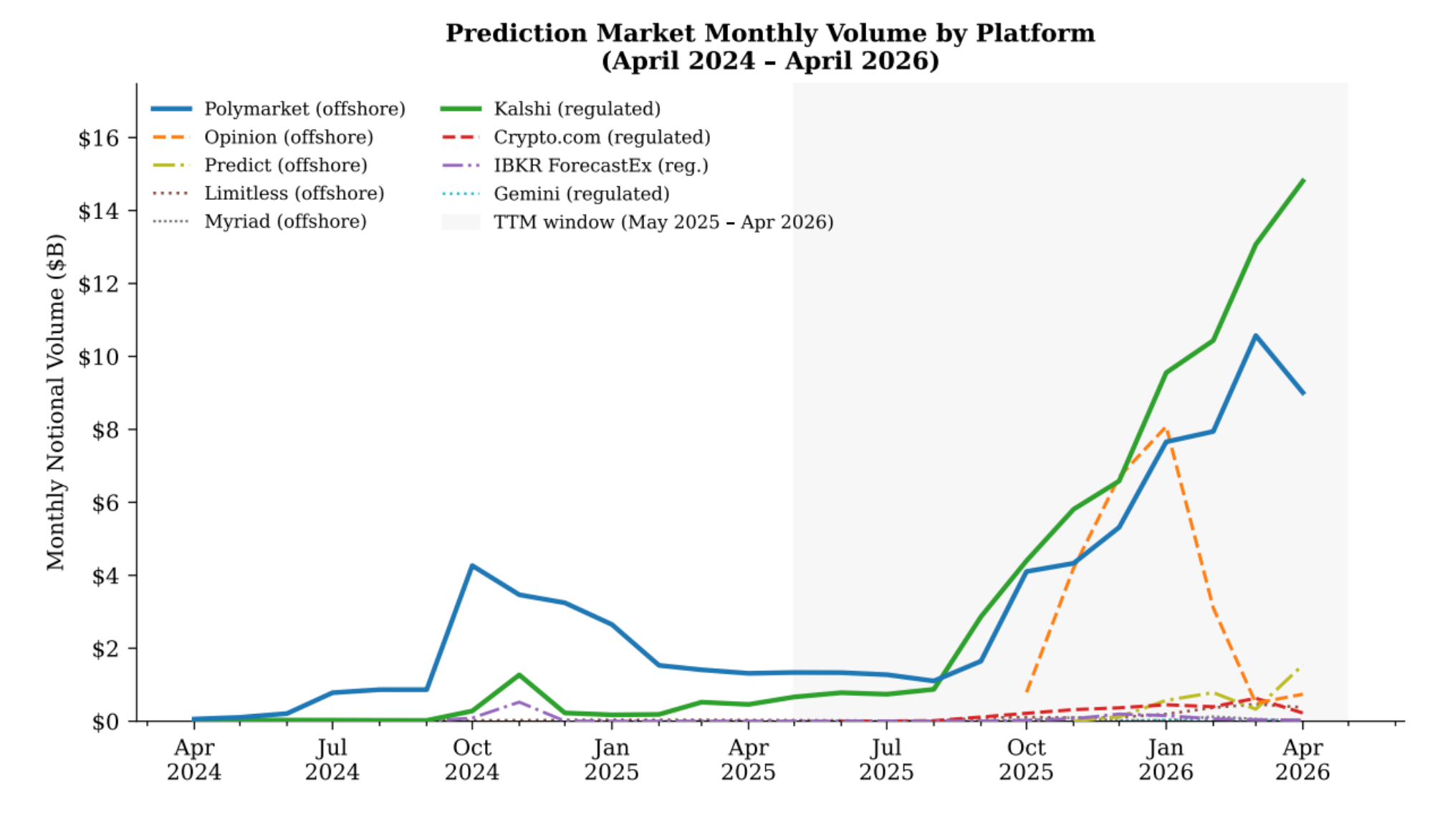
US-based users account for $11 billion to $34 billion in annual trading on offshore prediction markets, according to a new study from Crane & Zeng Consulting commissioned by the Coalition for Prediction Markets.
The estimate arrives as the Commodity Futures Trading Commission (CFTC) works on its framework and Congress weighs participation limits.
American Demand Fuels Offshore Prediction Markets Outside Regulator Reach
The study covers leading offshore venues: Polymarket, Opinion, Predict, Limitless, and Myriad. Its central estimate ties about 25% of tracked offshore volume, or $21.2 billion, to US traders.
Polymarket’s international platform geoblocks US internet addresses. Reaching it from the US requires a virtual private network (VPN), which violates the platform’s terms.
Researchers estimate that roughly 30% of Polymarket’s $55.6 billion in annual volume traces to American users. That share runs from $10.6 billion to $26.7 billion.
“At least 7% of global prediction market trading volume (regulated and offshore) during the TTM (approximately $10.6 billion of an estimated $159 billion combined total) is attributable to US users transacting on offshore venues. This estimate is intended to be conservative, with a plausible estimated range of 7–21% ($10.6B–$34B) of global (regulated and offshore) prediction market activity attributed to US users on offshore platforms,” the report read.
Follow us on X to get the latest news as it happens
A Regulated Alternative Already Exists
Polymarket US opened in December 2025 as a platform under CFTC oversight. It operates as a designated contract market (DCM) and a derivatives clearing organization (DCO).
The company removed its US waitlist in May 2026 and now serves more than 40 states. However, state regulators continue to challenge the product. A Nevada court granted a preliminary injunction against Polymarket. Moreover, Minnesota passed a ban set to begin in August 2026.
The report noted that American traders can now legally access prediction markets through CFTC-licensed venues like Kalshi. Yet, large volumes still flow through offshore platforms beyond US oversight.
Despite this, regulated venues have grown faster. Their volume jumped 866% from 2024 to 2025, against 179% offshore. Kalshi’s monthly volume rose roughly 22-fold to $14.81 billion by April 2026, while Polymarket’s climbed about sevenfold to $9.01 billion.

Analysts expect the sector to keep expanding sharply. Bernstein projected in April 2026 that total volume could approach $1 trillion by 2030, an 80% compound annual growth rate.
It sees industry revenue climbing from $0.4 billion in 2025 to $10.8 billion in 2030. The report argues that tighter rules on regulated venues could push more growth offshore, beyond US regulators’ reach.
Subscribe to our YouTube channel to watch leaders and journalists provide expert insights
The post US Traders Fuel 25% of Tracked Offshore Prediction Market Volume appeared first on BeInCrypto.
Ethereum remained under pressure on June 12 as geopolitical risk, ETF outflows, and weak technical structure kept ETH close to key support.
Summary
- Ethereum traded near $1,652 as ETF outflows and macro pressure kept buyers cautious.
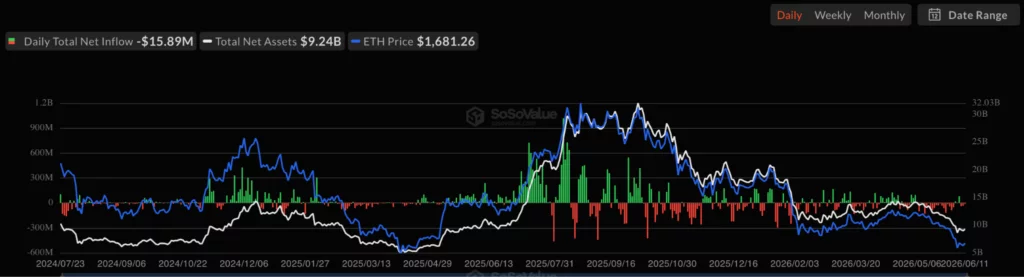
- Spot Ethereum ETFs lost $15.89 million on June 11, extending outflows for three sessions.
- Analysts remain split as MVRV bands suggest accumulation while charts show a weak downtrend.
Ethereum traded at $1,652.70, down 0.4% over 24 hours, according to crypto.news market data. The token recorded $12.28 billion in daily trading volume, while its market cap stood near $199.23 billion.
ETH traded between $1,632.77 and $1,687.85 during the latest 24-hour period. The token was also down 4.91% over seven days, showing that short-term weakness remains in place.
The current move follows a sharp June drawdown across the crypto market. Ethereum recently touched the $1,500 area after losing support near $2,000, a level that had acted as a major marker for traders.
The daily chart still shows a clear downtrend. ETH has formed lower highs since its previous highs near the $4,500 to $5,000 region, and the latest price action shows consolidation near the lower part of the range.
Iran risk and Fed pressure weigh on Ethereum
Ethereum’s latest weakness came as U.S. military action against Iran pushed traders away from higher-risk assets. The conflict has lifted demand for the U.S. dollar and safe-haven positions, while crypto markets have faced liquidations.
Higher energy prices also add pressure because they can keep inflation elevated. That matters for Ethereum because sticky inflation reduces the chance of easier Federal Reserve policy.
A hawkish Federal Reserve usually weighs on crypto. Higher rates make speculative assets less attractive because investors can earn safer yields elsewhere.
As previously reported by crypto.news, the June crypto crash came from several pressures hitting the market at once. Those included a hawkish Fed, U.S.-Iran tensions, ETF outflows, and a leverage unwind.
For Ethereum, that mix has been hard to absorb. ETH often moves with higher beta than Bitcoin, meaning it can fall faster when traders reduce risk.
Ethereum ETF outflows add market pressure
Spot Ethereum ETFs recorded $15.89 million in net outflows on June 11, marking the third straight day of withdrawals, according to SoSoValue data.
ETF outflows matter because these products can act as a source of spot demand. When flows turn negative, that demand weakens and can add sell pressure during unstable markets.
As previously reported, spot Ethereum ETFs saw $540 million in outflows in May, followed by another $168 million in early June. That removed a major source of support as ETH broke several key levels.
The outflow trend has also kept institutional demand in focus. Ethereum bulls need ETF flows to stabilize if ETH is to build a stronger recovery from the $1,500 to $1,650 range.
The latest ETF data does not mean all buyers have left. BlackRock’s ETHA still recorded inflows on June 11, but broader net flows remained negative across the full group.
Analysts split on accumulation and downside risk
Some analysts argue that Ethereum has entered a long-term accumulation zone. Ali Martinez pointed to Ethereum’s MVRV pricing band and said ETH is trading below the 0.8 MVRV band, which has often marked undervalued conditions.
“Ethereum below the 0.8 MVRV Pricing Band is a high-probability long-term accumulation zone,” said analyst Ali Charts.
Ali also noted that Ethereum’s Delta Price sits near $700. The metric compares investor cost basis with miner production cost and has historically appeared near deep cycle lows.
That view does not remove short-term risk. Daan Crypto Trades said ETH still needs to retake its range low before the structure becomes more constructive.
“Still watching for that range low retake before getting excited again,” said analyst Daan Crypto Trades.
He added that the current move still looks like another breakdown in a larger trend unless ETH reclaims the lost range. That view keeps attention on the $1,750 to $1,800 area.
Ethereum technical setup remains weak
Ethereum is trying to hold the $1,650 area. If sellers break that level, the next support zone sits near $1,550 to $1,500.
A deeper move below $1,500 could bring the $1,400 level into focus. Some analysts have warned that failure to hold that region may increase the risk of a move toward $1,000 to $1,100.
On the upside, ETH needs to reclaim $1,750 to $1,800 first. A stronger recovery would require a move back above $2,000, where the latest breakdown accelerated.
The BBP indicator remains negative near -149.38, showing that sellers still control the daily chart. However, the red bars have become smaller than the sharp bearish spike seen earlier in June, which suggests selling pressure has eased slightly.
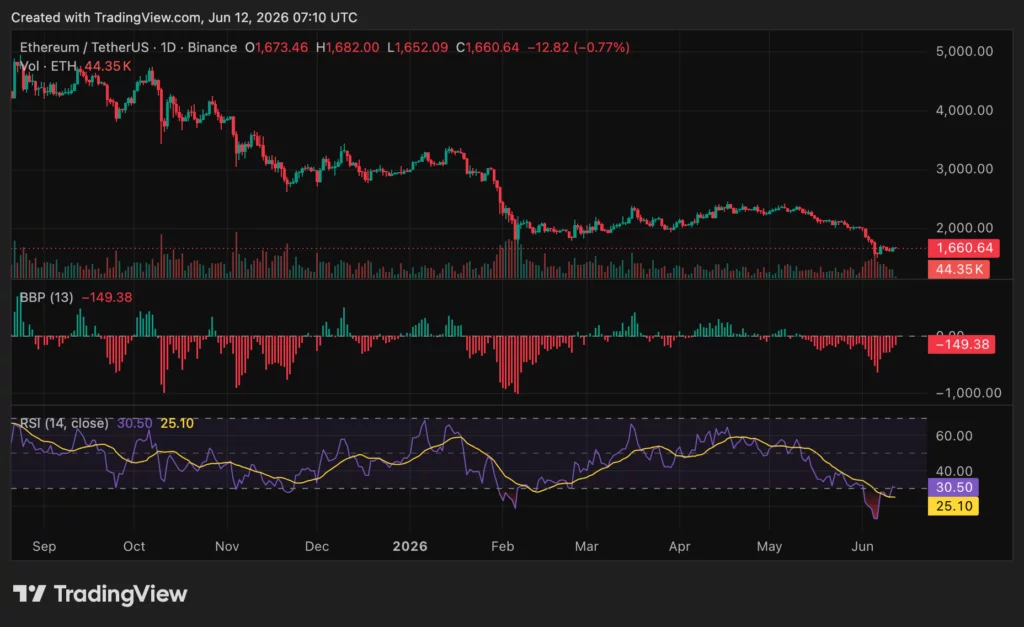
The RSI stands near 30.50, while its signal line is near 25.10. That places ETH close to oversold territory, which can support a short-term relief bounce if buyers defend support.
A stronger signal would require RSI to move back above 40 and then toward 50. Until then, momentum remains weak.
Disclosure: This article does not represent investment advice. The content and materials featured on this page are for educational purposes only.


Former U.S. Commodity Futures Trading Commission Chair Gary Gensler has joined a growing list of groups challenging sports prediction markets, arguing in a new court filing that Congress never intended federal derivatives laws to cover sports betting contracts.
Summary
- Former CFTC Chair Gary Gensler told a federal appeals court that sports prediction contracts do not qualify as swaps under U.S. derivatives law.
- Tribal groups, gaming industry organizations, and Better Markets joined court filings arguing that sports prediction markets should remain subject to state gambling regulations.
- The case adds to a growing legal fight over whether the CFTC or individual states should oversee sports related event contracts offered by platforms such as Kalshi.
According to a filing submitted Thursday to the Sixth Circuit Court of Appeals, Gensler said sports-related event contracts offered by prediction market platforms such as Kalshi do not meet the definition of swaps under the Dodd-Frank Act because they are not designed to hedge economic risk.
The filing adds another voice to an intensifying legal battle over whether sports prediction markets should be regulated by the CFTC or treated as gambling products subject to state gaming laws. Tribal organizations, the Indian Gaming Association, the American Gaming Association, and Better Markets also filed amicus briefs supporting state authority in the case.
At the center of the dispute is a lawsuit Kalshi filed against Ohio after the state challenged the company’s sports-related contracts. A federal judge ruled against Kalshi in March, and the matter is now before the appellate court.
“Congress did not include sports betting contracts within the statutory Dodd-Frank definition of swap,” Gensler wrote in the filing.
“Such contracts do not fit the CEA’s purpose or the statutory language defining swap, which focus on hedging economic risk. Sports bets are very rarely, if ever, about hedging.”
His filing argued that Congress designed swaps as tools for managing commercial and economic risks rather than for wagering on sporting outcomes.
The latest filing arrives as federal regulators continue shaping rules for prediction markets. Earlier this month, the CFTC proposed a framework that would review event contracts individually rather than banning entire categories of markets.
As previously reported by crypto.news, the proposal could subject some sports contracts, including markets tied to player injuries and in-game events, to additional scrutiny.
Courts weigh federal authority against state gaming laws
Questions over who controls prediction markets have triggered lawsuits across the country.
Several states, including Ohio, Nevada, New Jersey, Maryland, Montana, and Illinois, have challenged prediction market operators, arguing that some sports contracts function as gambling products and should comply with state licensing, tax, and consumer protection requirements.
Meanwhile, prediction market firms have maintained that their products are permitted under the Commodity Exchange Act and fall under CFTC oversight.
Challenging the regulator’s recent position, Gensler argued that the agency’s interpretation stretches beyond what Congress intended when it expanded derivatives regulation through Dodd-Frank.
“The CFTC now posits hedging theories for some sports bets that are at best only tenuously connected to reliable hedges of commercial risks,” the filing said.
“That connection, however, is crucial, as Congress included only those event contracts that hedge risks in a manner similar to a swap and are sufficiently associated with a potential financial, economic, or commercial consequence.”
The agency itself has taken the opposite position. In an amicus brief filed last month, the CFTC argued that event contracts traded on designated contract markets under its supervision should be treated as swaps and remain within federal jurisdiction.
Court decisions have so far produced mixed results. The Third Circuit Court of Appeals ruled in April that New Jersey could not stop prediction markets from operating, while judges on the Ninth Circuit appeared more receptive to arguments from state regulators in a separate case.
Legal uncertainty has persisted even as the CFTC advances a federal rulemaking process. The agency received more than 1,500 public comments by early May and later reported receiving more than 3,000 submissions covering insider trading concerns, prohibited contracts, market safeguards, and questions about regulatory authority.
Industry participants including Kalshi, Polymarket, and venture capital firm Andreessen Horowitz have urged the CFTC to retain sole oversight of prediction markets. State gaming officials from Pennsylvania and Tennessee have argued that sports event contracts resemble sports betting and should not fall under the regulator’s authority.
Tribal groups and gaming industry challenge sports contracts
Separate filings submitted Thursday focused on the impact prediction markets could have on tribal gaming operations and state gambling systems.
According to a brief filed by the Indian Gaming Association and affiliated tribal organizations, sports prediction markets interfere with tribal rights established under the Indian Gaming Regulatory Act because gaming activity on tribal lands is required to benefit tribal communities rather than private companies.
The filing accused Kalshi of operating what it described as unregulated gaming activity across state and tribal jurisdictions while diverting revenue away from governments and tribal entities.
Another brief from the American Gaming Association argued that sports prediction markets and traditional sportsbooks are functionally similar. The group cited a trademark application filed by Kalshi that referenced services related to sports betting and gambling activities.
Better Markets also urged the court to reject the classification of sports prediction markets as swaps, pointing to previous statements in which Kalshi distinguished sports markets from political event contracts.
Emphasizing what he described as Congress’ original intent, Gensler argued that lawmakers never expected federal derivatives laws to replace state sports betting frameworks.
“Senate Majority Leader Harry Reid of Nevada would never have consented to or passively accepted legislation displacing an activity so critical to his state’s economy and politics by permitting sports betting only under CFTC auspices,” the filing said.
The outcome of the case could have significant implications for the industry. If courts ultimately side with the CFTC, prediction market operators may continue offering event contracts under a federal framework.
If states prevail, platforms could face separate licensing and compliance requirements in every jurisdiction where they operate, with some states potentially pursuing civil or criminal penalties against unregistered operators.
With federal appeals courts issuing conflicting decisions and both regulators and states defending competing interpretations of the law, the dispute appears increasingly likely to reach the U.S. Supreme Court.

Three things to know about SpaceX’s stock market debut

Humanity Protocol ($H) Surges 41% Following $1B Market Cap Collapse

Russell T Davies Says Tip Toe’s HIV+ Character Was An ‘Honour’ To Portray



-

 Fashion7 days ago
Weekend Open Thread: Evereve – Corporette.com
-
 Entertainment5 days ago
The Best Mystery Series of All Time Is Surging on Streaming 30 Years After It Ended
-

 NewsBeat4 days ago
Alexander Zverev wins the French Open to finally earn a 1st Grand Slam title
-
 Crypto World7 days ago
Jensen Huang Approves Samsung, SK Hynix, and Micron for NVIDIA (NVDA) HBM4 Memory Supply
-

 Crypto World4 days ago
Anatomy of the June crypto crash: Fed, Iran, Saylor
-

 Tech6 days ago
Suspicious Polyfill login prompts pop up on Toshiba, Muji websites
-
Crypto World6 days ago
Senator Cynthia Lummis Calls CLARITY Act the Most Consequential Financial Legislation of This Generation
-

 Tech7 days ago
Microsoft launches MXC, an OS-level sandbox for AI agents, with OpenAI and Nvidia already on board
-

 Tech5 days ago
Microsoft unveils seven homegrown AI models in new bid for ‘long term self-sufficiency’
-

 Business7 days ago
(VIDEO) Justin Bieber Delivers Surprise Happy Birthday Serenade to Diners at Los Angeles Mexican Restaurant
-
 NewsBeat5 days ago
Alexander Zverev conquers demons and outlasts Flavio Cobolli to win French Open for first major title
-

 Tech6 days ago
Von der Leyen’s AI envoy pick draws conflict-of-interest fire
-

 Business4 days ago
High Stakes for Wembanyama as New York Pushes for 3-0 Lead
-

 Tech6 days ago
Hackers now exploit SolarWinds Serv-U flaw to crash servers
-
 Business5 days ago
The Pain Points Taking a Fragile Tech Rally Down a Notch
-

 Tech7 days ago
Meta steals a tactic from Tesla and builds data centers in tents
-
 Crypto World4 days ago
Eli Lilly (LLY) Stock Surges 4% Following Breakthrough Sleep Apnea Trial Results
-

 Tech4 days ago
Notion restores access to Anthropic after service disruption
-
Crypto World7 days ago
LBank Surpasses 25 Million Users Worldwide as AFA Partnership Continues to Drive Global Growth
-

 Crypto World5 days ago
Trump’s AI Ownership Plan Could Benefit Anthropic at OpenAI’s Expense
You must be logged in to post a comment Login