Connect with us
DAPA Banner
DAPA Coin
DAPA
COIN PAYMENT ASSET
PRIVACY · BLOCKDAG · HOMOMORPHIC ENCRYPTION · RUST
ElGamal Encrypted MINE DAPA
🚫 GENESIS SOLD OUT
DAPAPAY COMING

Business

Form 6K Zeta Network Group For: 8 May

Published

on

Continue Reading
Click to comment

You must be logged in to post a comment Login

Leave a Reply

Business

Kalyan Jewellers Q4 Results: Cons PAT soars 118% YoY to Rs 409 crore; revenue jumps 66%

Published

on

Kalyan Jewellers Q4 Results: Cons PAT soars 118% YoY to Rs 409 crore; revenue jumps 66%
Kalyan Jewellers India on Friday reported a net profit of Rs 409.5 crore for the March quarter of FY26, more than doubling (118.2%) from Rs 187.6 crore recorded in the corresponding period last year.

Revenue from operations rose 66.2% year-on-year (YoY) to Rs 10,274.9 crore, compared with Rs 6,181.5 crore in the year-ago quarter.

EBITDA increased 84.2% to Rs 735.7 crore versus Rs 399.4 crore reported a year earlier.

EBITDA margin also improved to 7.2% from 6.5% in the corresponding quarter last year, the company said in a regulatory filing on Friday.

Advertisement

Alongside earnings, the board has recommended a final dividend of Rs 2.50 per equity share of face value Rs 10 each, representing 25% for the financial year ended March 31, 2026.


The proposed dividend is subject to the approval of shareholders at the company’s upcoming Annual General Meeting.
The company reported revenue of Rs 1,157 crore from its international operations in Q4FY26, marking a growth of over 43% compared with Rs 807 crore in the corresponding quarter last year.Profit after tax from the international business stood at Rs 29 crore during the quarter, more than doubling from Rs 14 crore reported in the year-ago period, reflecting a growth of 105%.

The company’s lifestyle jewellery platform Candere recorded revenue of Rs 131 crore and profit of Rs 3 crore in Q4FY26.

Commenting on the performance, Ramesh Kalyanaraman, Executive Director of Kalyan Jewellers India, said the company ended the previous financial year on a strong note and has carried the momentum into the current year as well.

“We witnessed strong growth in our Akshaya Tritiya sales this year, and continue to see encouraging momentum in consumer demand, especially around wedding purchases during the current quarter,” he said.

Advertisement

Following Q4, Kalyan Jewellers India share price gained 4.3% to the day’s high of Rs 429 on the BSE.

Continue Reading

Business

States crack down on tax break for wealthy investors

Published

on

States crack down on tax break for wealthy investors

Lake Oswego in Oregon.

Bradleyhebdon | Istock Unreleased | Getty Images

A version of this article first appeared in CNBC’s Inside Wealth newsletter with Robert Frank, a weekly guide to the high-net-worth investor and consumer. Sign up to receive future editions, straight to your inbox.

Advertisement

A wave of states deciding to take aim at a tax incentive for investors and startup founders could sway some high-net-worth residents to relocate, lawyers to the wealthy told Inside Wealth.

The One Big Beautiful Bill Act turbocharged the tax breaks on qualified small business stock, better known as QSBS. However, some states, including Maine and Oregon, have targeted the tax incentive in response to federal funding cuts.

“Tax policy has consequences, both good and bad, and I think that the states need to figure out what makes the most sense for them,” said David Blum, partner and chair of Akerman’s national tax practice group. “Someone looking for a substantial exit could have multiple homes already.”

Blum noted that several billionaires have made high-profile departures from California as a state billionaire tax proposal gains steam. Google co-founder Sergey Brin, who has bought mansions in Nevada and Florida, is funding two ballot initiatives that take aim at the wealth tax measure.

Advertisement

The QSBS exemption, introduced during the Clinton administration, was designed to encourage investing and creating small companies. The federal carve-out allows investors and founders to reduce their capital gains taxes when selling stock directly acquired from a qualifying C corp.

In order to claim the full exemption, the stock must be held for more than five years. Prior to the OBBBA, the maximum exemption from capital gains taxes was $10 million or 10 times the original basis of the investment, whichever is greater. The OBBBA raised the exclusion to $15 million. The bill also raised the maximum size of qualifying “small businesses” from $50 million to $75 million in gross assets.

Last month, Maine and Oregon passed legislation to decouple from the federal QSBS exemption, meaning that taxpayers will have to pay state income taxes on startup exits. Similar efforts in New York and Washington state failed to pass. The District of Columbia Council voted to decouple from several provisions of the OBBBA, but Congress passed a resolution to block that move.

Four states already tax gains on QSBS: Alabama, Mississippi, Pennsylvania and, most notably, California, the nation’s venture-capital center.

Advertisement

Get Inside Wealth directly to your inbox

Proponents of QSBS reform argue that the regime primarily benefits the wealthy. Research by the Department of Treasury found that taxpayers who earn more than $1 million account for nearly 75% of gains excluded.

Lawyer Steve Oshins told Inside Wealth that QSBS laws and other tax proposals aimed at the wealthy encourage high earners to move to other states.

The tax burden depends on where the shareholder lives when they sell their stock, which gives clients time to plan. Oshins said it is possible in some states to use trusts to avoid state income taxes on QSBS. Delaware, Nevada and Wyoming are popular jurisdictions for establishing these trusts.

For instance, he said, a resident of Oregon could transfer stock to an incomplete non-grantor trust set up in a state that doesn’t tax trust income, like Nevada. As long as the trust is not administered in Oregon and none of the trustees live there, the trust’s capital gains would not be subject to Oregon income taxes.

Advertisement

But other states, including Maine, have more stringent rules, he said. Non-grantor trusts are subject to state income if funded by a Maine resident or created by the will of one, according to Oshins.

That said, the most straightforward course of action is to move. 

“Let’s say a client is about to hire me and says, ‘I have a summer ho me in Florida, I’m thinking of moving there,’” Oshins said. “I’ll say, ‘Let’s wait a few months. Move there. Then let’s set up your trust.’”

But changing your domicile is easier said than done, Blum said. To pass muster with state tax authorities, clients have to do more than change their voter registration and and spend at least 183 days in another state. 

Advertisement

“When it comes to changing residency and your domicile, you really have to move and uproot your life,” he said.

Choose CNBC as your preferred source on Google and never miss a moment from the most trusted name in business news.
Continue Reading

Business

Market Wrap: Sensex drops 516 points, Nifty closes below 24,200 amid fresh Iran-US escalations, smallcaps outperform

Published

on

Market Wrap: Sensex drops 516 points, Nifty closes below 24,200 amid fresh Iran-US escalations, smallcaps outperform
The Indian stock market extended losses for the second consecutive session amid fresh escalations in the war between Iran and US, with the Sensex and Nifty 50 dropping more than 0.6% each while the smallcap index closed in the green and continued to outperform benchmarks.

Sensex declined around 516 points to close at 77,328, while the Nifty 50 index dropped 150 points to end the session at 24,176. This came as India VIX, which measures market volatility, gained around 2% to 16.92.

State Bank of India (SBI) shares tumbled 7% after the lender’s Q4 earnings failed to impress markets. HDFC Bank, Bajaj Finance, Axis Bank and UltraTech Cement dropped around 2% each to follow SBI as Sensex top losers. Titan shares meanwhile surged 5% after Q4 earnings. Asian Paints shares gained 3%, while Adani Ports, Infosys, HCLTech and TechM shares gained 1-2%.

Despite the overall downturn, Nifty Smallcap 100 rose 0.2% to close in the green. Nifty Midcap 100 index however fell 0.2%. Sectorally, Nifty PSU Bank declined more than 3% to lead losses, while Nifty IT gained 1%. Around 1,783 stocks declined on the NSE, while 1,501 advanced and 101 remained unchanged.

Advertisement

What’s bothering markets?

Notably, the market downturn comes amid the seesaw political developments in the Middle East. US President Donald Trump said that three American Navy destroyers were attacked as they moved through the strait. Trump later told reporters the ceasefire was still in effect and sought to play down the exchange.


Amid these flip-flops, oil prices gained. Brent crude rose over 1% to $101 per barrel. While Brent crude prices have significantly reduced after hitting as high as $120 per barrel last week, they still remain above the crucial $100 per barrel mark, spooking investors.
“The de-escalation and escalation drama in West Asia continues, with crude prices moving down and up in response. An important market trend amid this crisis is that despite geopolitical tensions, some markets are doing extremely well while others are performing poorly. South Korea and Taiwan are the star performers this year, with 71% and 40% returns YTD. These excellent returns have been generated by a few AI stocks. In contrast, India, impacted by the energy crisis, has delivered negative returns, with Nifty posting a -6.96% return YTD,” said VK Vijayakumar, Chief Investment Strategist at Geojit Investments.An important trend in India is the outperformance of the broader market, according to the market analyst. He highlighted that the Nifty Midcap index hit a record high yesterday despite high valuations. Nifty is being weighed down by sustained FPI selling, particularly in heavyweights in banking and IT, according to the analyst.

Rupee tumbles

The rupee declined 25 paise to 94.47 against the US dollar in early trade. This came after the Indian currency recorded sharp gains over the past two sessions, recovering from an all-time low of 95.4325 hit earlier in the week.

“The broader outlook remains sensitive to crude prices and final clarity on the US–Iran proposal,” said Jateen Trivedi, VP Research Analyst of Commodity and Currency at LKP Securities.

Advertisement

FII selling

Foreign investors remained net sellers of Indian equities for the third consecutive session on Thursday, although the quantum was significantly lower than in the previous two days. FIIs net sold Indian shares worth Rs 341 crore, according to provisional data from the NSE.

Global markets, meanwhile, also remained in the red, with Hong Kong’s Hang Seng declined nearly 1% and South Korea’s Kospi closed with marginal gains on Friday, while Japan’s Nikkei dropped 0.35%.

European benchmark indices, including the UK’s FTSE and Germany’s DAX, fell up to 1%. Wall Street lost steam and closed in the red yesterday.

(With inputs from agencies)
(Disclaimer: Recommendations, suggestions, views and opinions given by experts are their own. These do not represent the views of The Economic Times)

Advertisement
Continue Reading

Business

Tata Consumer Products Q4 Results: Profit rises 21% YoY to Rs 419 crore, revenue up 18%

Published

on

Tata Consumer Products Q4 Results: Profit rises 21% YoY to Rs 419 crore, revenue up 18%
Tata Consumer Products on Friday reported that its consolidated net profit of Rs 419 crore in the fourth quarter. This was higher by 21% from Rs 345 crore posted in the previous year quarter. Revenue from operations increased 18% YoY to Rs 5,434 crore.

The Board has also recommended a dividend of Rs 10 per share for FY26. The dividend, if approved by shareholders, will be paid/dispatched (subject to deduction of tax at source) on or after June 15, 2026.

More to come…

Continue Reading

Business

Form 8K Madison Square Garden Sports Corp For: 8 May

Published

on


Form 8K Madison Square Garden Sports Corp For: 8 May

Continue Reading

Business

DeepSeek aims to raise up to $7.35 billion in funding round – Information

Published

on


DeepSeek aims to raise up to $7.35 billion in funding round – Information

Continue Reading

Business

Arm Holdings Lacks Supply to Meet Roaring Demand for New Chips

Published

on

Arm Holdings Lacks Supply to Meet Roaring Demand for New Chips

Arm Holdings ARM -10.11%decrease; red down pointing triangle said it expects higher demand for its new line of computer chips, but left its revenue guidance from the chips unchanged as it works to boost supply.

The British semiconductor company said in March that it expected to sell $1 billion worth of the chips through early 2028. On Wednesday, it said its demand forecast had doubled to $2 billion, but said that it lacked supply to meet the new order requests.

Copyright ©2026 Dow Jones & Company, Inc. All Rights Reserved. 87990cbe856818d5eddac44c7b1cdeb8

Continue Reading

Business

One of Cardiff’s best known buildings under new ownership in multi-million-pound deal

Published

on

Business Live

The office led Hodge House building has been acquired by SevenCitiesLdn

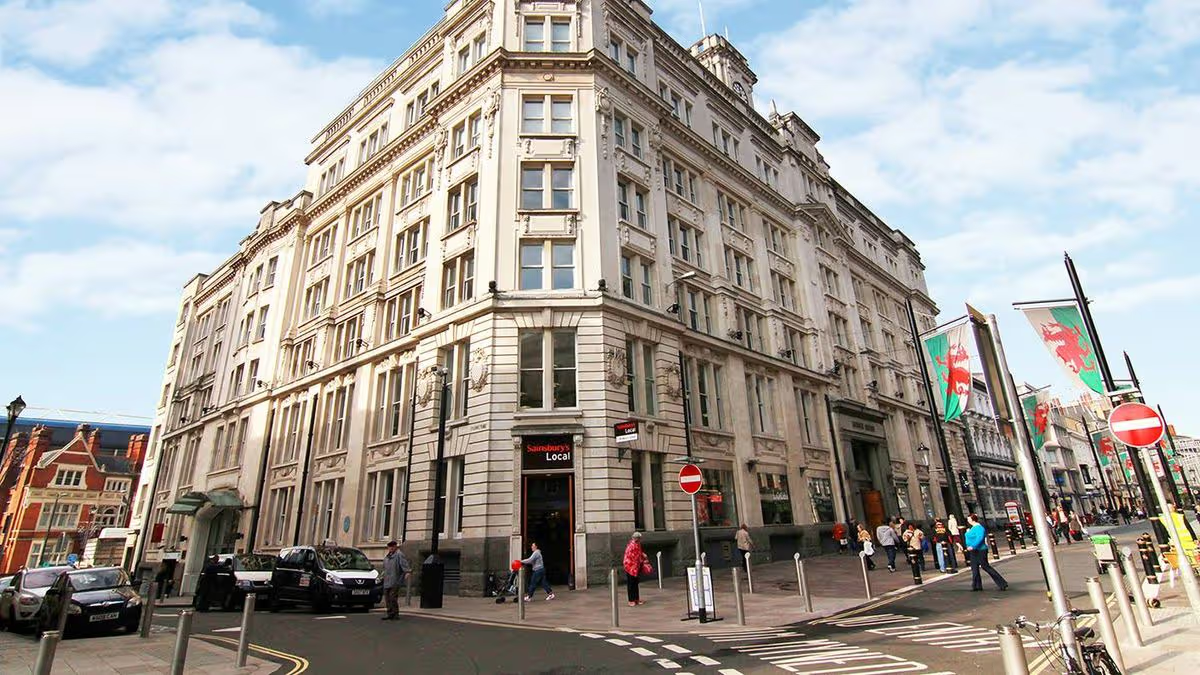
Hodge House on St Mary Street in Cardiff

Hodge House.(Image: WalesOnline)

The prime office led Hodge House building in the centre of Cardiff is under new ownership following a multi-million-pound deal.

Financial services giant L&G put its investment in the listed building up for sale last November with a £34.1m asking price. The sales process, overseen by the Cardiff office of property advisory firm Knight Frank, attracted strong interest before a deal was concluded with London-based real estate, development and asset management start-up SevenCitiesLdn.

Advertisement

The value of the deal has not been disclosed, but is understood to have been close to the asking price. The Cardiff office of Savills acted for SevenCitiesLdn, which launched last year with backing from property development and investment group SevenCapital.

READ MORE: Welsh construction sector has reported a fall in workloadsREAD MORE: British Gas owner buys Welsh gas-fired power station for £370m

The acquisition is the first for SevenCitiesLdn which is looking to drive deal flow for added value commercial property assets.

Director Giles Hoare, who previously worked for property development firm Thackeray Group where as investment director he played a key role in its acquisition of the Howells building in the centre of Cardiff, said it is well capitalised with backing from SevenCapital Group to add further property assets, including potentially in Wales.

Advertisement

Mr Hoare said: “We believe we have acquired the best building in Cardiff and see it as a hold investment over the medium-term. Over the next 12-24 months there will be big drive in the regional office play and we are currently appraising opportunities in cities such as Bristol, Manchester and Birmingham.”

The Grade II listed Hodge House building was transformed under the ownership of L&G, which invested £20m refurbishing it to provide 110,000 sq ft of Grade A modern space. The building is fully let apart from a small office suite. The investment also includes the building’s retail and restaurant element on its St Mary Street side, which includes a Sainsbury’s store.

Hodge House generates nearly £3m in annual rent. Last year it set a new record rental level for Cardiff at £37.50 per sq ft for fitted out office space. The building’s tenants include alternative broadband infrastructure venture Ogi, taxi technology company Veezu, renewables firm Bute Energy and marketing and PR consultancy Freshwater.

L&G acquired the building in 2014 from Aberdeen Asset Management in a £18.8m deal. Hodge House was originally built in 1915 for the Co-operative Wholesale Society.

Advertisement

In a LinkedIn post director SevenCitiesLdn, Cameron Mitchell, said: “One year in at SevenCitiesLdn and this is the opening move (Hodge House acquisition) in our prime office strategy, targeting best-in-class office buildings across the UK’s key cities, with London, Manchester, Birmingham, Bristol, Leeds, Edinburgh, and Glasgow firmly in our sights.

“We’re aiming to build a £300m-plus portfolio in the next two to three years. Clearly the market isn’t without its challenges, but we’re fully funded, conviction is high, the pipeline is active, and we are very much in deployment mode.”

Continue Reading

Business

Back To The Well With Variable Rate Preferred Securities

Published

on

Back To The Well With Variable Rate Preferred Securities

This article was written by

My experience stems from the hedge fund industry beginning in the mid-90’s, working as a Portfolio Manager, Domestic Equity Analyst and Trader. I was the Portfolio Manager of a domestic Long/Short Equity product with gross assets that peaked over 1 Billion dollars. I am a fundamental, bottoms up, value investor on long investments, and catalyst oriented short investor. I like to employ technical analysis as a balance to my fundamental work, and also as a risk management characteristic to my overall investment philosophy. I look to author articles concerning unconventional investments, and overlooked securities. I am also an investor and analyst in Cryptoassets.

Analyst’s Disclosure: I/we have a beneficial long position in the shares of GS.PR.C, USB.PR.A either through stock ownership, options, or other derivatives. I wrote this article myself, and it expresses my own opinions. I am not receiving compensation for it (other than from Seeking Alpha). I have no business relationship with any company whose stock is mentioned in this article.

Seeking Alpha’s Disclosure: Past performance is no guarantee of future results. No recommendation or advice is being given as to whether any investment is suitable for a particular investor. Any views or opinions expressed above may not reflect those of Seeking Alpha as a whole. Seeking Alpha is not a licensed securities dealer, broker or US investment adviser or investment bank. Our analysts are third party authors that include both professional investors and individual investors who may not be licensed or certified by any institute or regulatory body.

Advertisement
Continue Reading

Business

Why UK Employers Must Rethink Support in 2026

Published

on

Why UK Employers Must Rethink Support in 2026

For decades, British workplaces have measured employee wellbeing in days off. A bout of flu, a chest infection, a sprained ankle: a few sick notes, a fit-to-return form, and the matter is closed.

Yet a growing body of clinical evidence, and a steady drumbeat of employment tribunal cases, suggests that this tidy framework is wholly unfit to deal with the reproductive health challenges that thousands of British workers quietly navigate every day.

Fertility treatment, pregnancy loss and the menopause are, in the words of one consultant, fundamentally different beasts. They cannot be cleared by a course of antibiotics. They are not, in any meaningful sense, temporary. And, crucially for employers, the cost of getting the response wrong is no longer simply a matter of compassion, it is a matter of retention, productivity and, increasingly, legal exposure.

The conventional model of workplace illness assumes a hurdle that the body eventually clears. IVF, miscarriage and menopause do not behave that way. They are tied to identity, to the future a person had imagined for themselves, and to a biological transition that can play out over months or years rather than days.

A miscarriage is, in effect, a bereavement requiring emotional processing alongside physical recovery. IVF involves systemic hormonal shifts that are unpredictable in both timing and intensity. The menopause, increasingly recognised as a workplace issue in its own right, brings vasomotor and cognitive symptoms that can persist for the better part of a decade. None of these is a short-term medical issue, and treating them as such is the first mistake too many British employers continue to make.

Advertisement

Anyone who has sat through a difficult conversation at work knows the British instinct to reach for the silver lining. “At least you can try again.” “Everything happens for a reason.” “At least it was early on.” Said with the best of intentions, these phrases can land with extraordinary cruelty.

Clinically, “trying again” is never a guarantee. For a patient with low anti-müllerian hormone (AMH) levels, the marker used to assess ovarian reserve, each failed cycle or miscarriage represents a biological window that is closing rather than reopening. The phrase also ignores cumulative trauma: the physical and hormonal exhaustion that builds with every attempt. By looking to a hypothetical future, the colleague risks dismissing the very real grief and recovery happening in the present.

The advice from clinicians is simple. Drop the platitudes. Replace them with something direct: *”I’m sorry you are going through this. I’m here if you want to talk, or if you need anything.” Managers should go a step further, focusing on the practical: “I’m happy to adjust your workload and cover meetings so you can focus on your appointments and wellbeing.”

The principle is straightforward. Treat the situation as you would any other specialised medical need. Grant the employee the autonomy to attend appointments or take rest without making them justify themselves repeatedly. The goal is comfort and clarity, and reassurance that their career is not on the line because of their biology.

Advertisement

There is a hard-edged business case here, too, and it begins with cortisol. Sustained workplace stress and the fear of stigma trigger the chronic release of cortisol and adrenaline, the body’s fight-or-flight hormones. These are significant disruptors of an endocrine system that is already under intense pressure during IVF, miscarriage or menopause.

Elevated cortisol interferes with the body’s ability to regulate other essential hormones. For a perimenopausal employee, stress-induced inflammation can physically worsen the frequency and severity of hot flushes and night sweats. For an IVF patient, the same chemistry can sabotage the very treatment the company is, in many cases, helping to fund.

Stigma compounds the problem. When an employee feels they must conceal a miscarriage or a failed cycle to protect their professional standing, the body remains in a state of high tension. The parasympathetic nervous system, the state required for tissue repair and hormonal balancing, never gets a chance to take over. Patients delay seeking help, skip recovery days, and a standard recovery becomes a prolonged health crisis. The cost shows up later, on the absence rota and in the resignation letter.

Among the most misunderstood symptoms is so-called brain fog. During menopause or a high-intensity IVF cycle, the brain’s oestrogen receptors, which govern how the brain uses glucose for energy, are effectively starving or being overwhelmed. The result is a genuine power failure in the regions responsible for memory and executive function.

Advertisement

When a colleague undergoing fertility treatment loses a word mid-sentence or drifts in a meeting, this is not distraction or reduced effort. It is a physiological response to a hormonal storm. Managers who recognise this, and who quietly adjust expectations rather than file it under “performance concern”, will hold on to talented people that less informed competitors will lose.

Reproductive health, employers should understand, is rarely a day-of event. It takes roughly 90 days for a sperm cell to mature, and a similar window applies to the preparation of an egg for ovulation in an IVF cycle. The lifestyle, stress levels and workplace environment an employee experiences today will directly shape their clinical outcome three months from now.

This has profound implications for how SMEs structure their support. A single day of compassionate leave around an egg retrieval, while welcome, is not the point. The biological lead-in — the three months in which keeping cortisol low matters most, is the period in which the employer’s culture is doing its real work, for good or ill. True support is a sustained environment, not a one-off concession.

For UK employers, particularly those running smaller businesses where HR is often a part-time concern, the temptation has long been to handle these matters informally and on a case-by-case basis. That approach is no longer fit for purpose.

Advertisement

Workplace support should not be viewed solely as a wellbeing initiative. It is a factor that can influence treatment tolerance, recovery and overall health outcomes — and, by extension, attendance, productivity and retention. Reproductive medicine specialists routinely see how a lack of flexibility and the strain of uncertainty add to the physical and emotional burden their patients are already carrying.

The modern framework, clinicians argue, should include protected time for medical appointments and treatment cycles; appropriate leave and recovery support following pregnancy loss at any stage; and trained managers capable of handling these conversations sensitively. Confidentiality, flexible working and access to emotional support should be considered core components of an occupational health approach, not optional extras.

Above all, the policy must remain adaptable. Fertility experiences are highly individual, and a rigid model, the kind British HR departments have historically loved, will not survive contact with the variety of clinical pathways now in play.

The businesses that grasp this will retain experienced women in their thirties, forties and fifties, the very demographic most likely to be promoted out of, and lost to, less enlightened employers. Those that don’t will continue to wonder why their best people quietly disappear. In 2026, that is no longer a wellbeing question. It is a competitive one.

Advertisement

Amy Ingham

Amy is a newly qualified journalist specialising in business journalism at Business Matters with responsibility for news content for what is now the UK’s largest print and online source of current business news.

Advertisement
Continue Reading

Trending

Copyright © 2025