

Crypto World
Crypto Inflows Hit $858M as CLARITY Lifts Sentiment

Cryptocurrency investment products recorded a sixth straight week of inflows in their longest streak since April to July 2025, totaling $4.9 billion, as improving sentiment around US crypto legislation helped push Bitcoin above $80,000 and lift assets under management to their highest level since February.
Crypto exchange-traded products (ETPs) posted around $858 million in inflows last week, sharply up from $118 million in inflows the previous week, CoinShares reported Monday.
The gains were likely supported by developments around the US CLARITY Act, said CoinShares head of research James Butterfill, referring to a final compromise proposal regarding stablecoin yields released on May 1.
Amid the positive trend, Bitcoin broke above $80,000 last week, lifting total assets under management in crypto ETPs past $160 billion, the highest since February.
Bitcoin leads inflows, while short-BTC funds see the largest outflows year-to-date
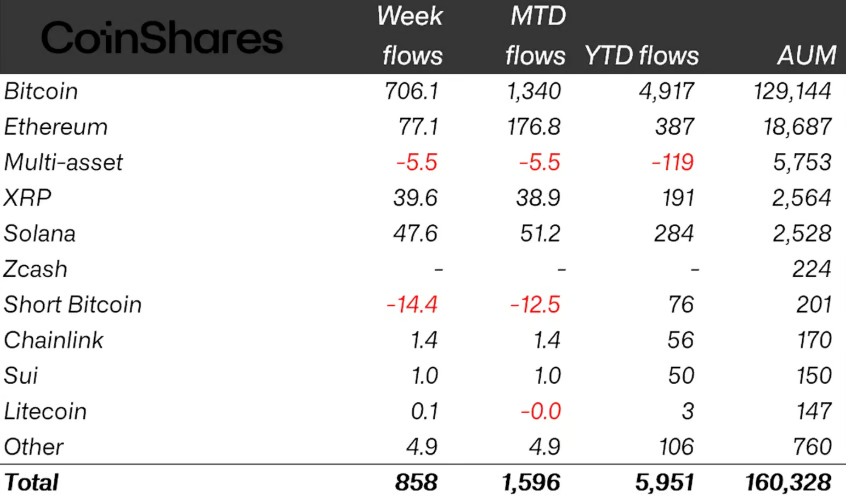
Bitcoin (BTC) investment products led the show last week, attracting $706 million in inflows and bringing year-to-date flows to $4.9 billion.
In line with the improving sentiment, short-Bitcoin ETPs saw their largest weekly outflow of the year at $14 million, suggesting investors are pulling back from bets against BTC as confidence in the rally grows.

Crypto ETP flows by asset (in millions of US dollars). Source: CoinShares
Ether (ETH) ETFs saw $77 million in inflows, reversing the $81 million in outflows recorded the previous week. Solana (SOL) and XRP (XRP) also posted notable gains, with inflows of about $48 million and $40 million, respectively.
Late-week profit-taking holds back the rally
Last week’s inflows came despite significant selling later in the week as Bitcoin briefly dipped below $80,000 on Thursday.
On Thursday and Friday, US-listed spot Bitcoin exchange-traded funds saw $423 million in outflows, reducing net weekly inflows to about $623 million, according to SoSoValue.

Bitcoin (BTC) seven-day price chart. Source: CoinGecko
Onchain analytics platform CryptoQuant pointed to realized profits totaling 14,600 BTC, or $1.1 billion, on Monday, the largest single-day profit-taking since Dec. 10, when Bitcoin was trading above $90,000. CryptoQuant’s Julio Moreno said rising realized profits could accelerate Bitcoin profit-taking as BTC climbs to three-month highs.
Related: Bitcoin rallies 2.3% after Trump calls Iran peace proposal ‘totally unacceptable’
“The rally started to stall from the middle of the week as investors quickly took profit on their positions,” Laser Digital’s derivatives trading desk said in a statement shared with Cointelegraph.
“Comments from DAT companies, whether it be selling or slowing purchases, didn’t help either. Given a lot of investors had pre-positioned for a move higher anticipating strong bid from MSTR this week, this has likely triggered some take-profit flows,” Laser Digital’s derivatives division added.
Magazine: XRP ‘probably going to $12,’ Bitcoin ETFs add $1B: Market Moves


Solana’s spot SOL exchange-traded funds are delivering their strongest weekly performance since February, drawing in roughly $39.23 million in net new money, according to SoSoValue data. The inflow surge comes as SOL futures open interest jumps by about $1.5 billion in May, signaling a broad uptick in trader positioning across the derivatives market. The price move mirrors the flow data, with SOL climbing around 15% over the past seven days to the high-$90s, as traders target a key resistance around $120.
Key takeaways
- BSOL leads ETF inflows: Bitwise’s BSOL attracted about $36 million in the latest weekly period, while Fidelity’s FSOL added roughly $1.8 million.
- BSOL’s dominance and scale: Since launch, BSOL has drawn $861 million in inflows, representing about 81% of the total cumulative inflows across all spot SOL ETFs, which stand near $1.06 billion combined.
- Derivatives activity climbs: SOL futures open interest rose to around $6.4 billion, up from about $4.94 billion on May 1, a rise of roughly 29.5% in under two weeks.
- Momentum in spot and futures delta: Aggregated spot cumulative volume delta approached $250 million from about $163 million in five days, as SOL’s price pushed toward $96; futures CVD reached approximately $593.6 million after a steady rise since May 5.
- Funding and price setup: The funding rate hovered near 0.065%, indicating continued long exposure, while the chart setup points to a possible breakout toward $120 if SOL sustains above $95 and completes a formation known as an Adam and Eve pattern.
Solana’s ETF demand aligns with rising futures positioning
SoSoValue data shows a clear tilt of capital toward SOL ETFs, led by BSOL’s notable weekly inflows of about $36 million. Fidelity’s FSOL added just over $1.8 million, contributing to the broader trend of investor appetite for spot exposure in SOL. Since its inception, BSOL has amassed roughly $861 million in net inflows, accounting for nearly four-fifths of the cumulative inflows across all spot SOL ETFs, which total around $1.06 billion.
Interest in futures markets has tracked the ETF momentum. Open interest across SOL futures climbed to roughly $6.4 billion, up from $4.94 billion on May 1, a rise of about 29.5% in less than two weeks, according to CoinGlass data. This buildup indicates traders are widening their positions and hedging activity across both spot and derivatives markets as Solana’s price moves higher.
In parallel, spot market dynamics reflected by the aggregated CVD metric showed a surge, with a five-day delta approaching $250 million, up from $163 million. Futures CVD also rose, crossing about $593.6 million as buyers absorbed liquidity on the bid and bid-ask fronts in both spot and futures markets. The funding rate maintained a modest level near 0.065%, suggesting long exposure remains prevalent among market participants.
These data points come as Solana’s price rallied roughly 15% over the past week, stabilizing near the $97 level. The near-term resistance around $120 remains the focal point for bulls, with traders monitoring the price action for a sustained breakout above recent consolidation.
For context, the broader technical backdrop has grown more constructive. Solana closed above its 100-day exponential moving average for the first time since October 2025, adding a notable bullish swing to the mix of ETF inflows and rising futures positioning. If SOL can confirm a daily close above the $95 breakout zone and maintain consolidation, the chart suggests room toward the $120 target given the lack of major resistance between these levels following the February dip.
Analysts have also highlighted improving relative strength against Bitcoin. Crypto analyst BATMAN noted that SOL recently broke above a 231-day downtrend on the SOL/BTC chart, signaling better relative performance. He pointed to the $89–$91 zone as a nearby support cluster and suggested it could become a retest area if SOL holds above the breakout zone. This assessment aligns with the broader view that a sustained move above $95 could unlock the next leg higher toward the $120 zone, albeit with the usual cautions around macro conditions and market sentiment.
Overall, Solana’s recent dynamics point to a developing balance between ETF-driven buying, rising derivatives activity, and a technical setup that could propel SOL toward a key resistance milestone. The combination of record-level ETF inflows, growing Open Interest, and constructive price action suggests a potentially meaningful shift for Solana if the current momentum persists.
Meanwhile, February’s notable drawdown—around 42%—is fresh in the market memory, underscoring the need for sustained demand and a favorable risk environment to validate the breakout path. Investors will be watching closely for follow-through in the coming sessions, particularly how SOL behaves around the $95 breakout level and whether the market can maintain the pace of inflows and higher open interest without triggering a renewed period of volatility.

Digital asset investment products posted inflows of $857.9 million, and extended six straight weeks of positive flows – the highest weekly figure since April 24.
CoinShares stated that the increase is likely tied to improving sentiment around the CLARITY Act, as Senators Thom Tillis and Angela Alsobrooks released the final compromise text related to stablecoin yield on May 1 and continued to support it despite pushback from the banking industry on May 4.
Global Crypto Investment Comeback
Bitcoin attracted over $706.1 million during the week, pushing its year-to-date total to $4.9 billion. On the other hand, products tied to short-bitcoin positions recorded $14.4 million in exits, marking the category’s biggest weekly decline this year. In the latest edition of Digital Asset Fund Flows Weekly Report, CoinShares explained that the shift indicates investors are reducing hedge positions amid strengthening market confidence.
Ethereum added $77.1 million after seeing $81.6 million leave the previous week. Solana and XRP also posted strong activity with $47.6 million and $39.6 million, respectively. Meanwhile, Chainlink, Sui, and Litecoin saw smaller gains of $1.4 million, $1 million, and $0.1 million. Multi-asset was the only major category to post losses at $5.5 million.
The US accounted for the largest regional total at $776.6 million after rebounding sharply from $47.5 million the previous week. Germany saw $50.6 million, marginally higher than before, while Switzerland recorded $21.1 million and the Netherlands $5 million, demonstrating broader European activity alongside the stronger recovery in the US.
High-Stakes Week Ahead
Analysts are now turning their focus to the important economic and geopolitical developments lined up this week. QCP Capital said macroeconomic and geopolitical developments are expected to dominate market attention as US President Donald Trump and Chinese President Xi Jinping prepare to meet in Beijing for talks covering trade, national security, rare earth supply chains, and the Middle East conflict.
The firm noted that markets will closely watch for any progress on tariffs following last week’s US trade court ruling against Trump’s 10% global tariffs.
QCP also highlighted upcoming inflation data as another major focus, as investors monitor whether price pressures are stabilizing or continuing to rise. Easing inflation could support lower real yields and improve conditions for crypto assets, while persistent inflation may keep monetary policy tighter for longer.
Bitcoin, meanwhile, has remained above $80,000. QCP added that crypto volatility remains near yearly lows, as BTC faces resistance around the $84,000 level.
The post Bitcoin Pulls In $706M as Traders Abandon Short Positions in Massive Sentiment Shift appeared first on CryptoPotato.


Ronin Ethereum is migrating to a Layer 2 on May 12 with roughly 10 hours of scheduled downtime.
Summary
- Ronin will hard fork at block 55,577,490 on May 12, transitioning from an independent sidechain to an Ethereum Layer 2 on the OP Stack.
- All transfers, swaps, and smart contract interactions will pause for roughly 10 hours during the migration window.
- RON token inflation will drop from over 20% to below 1%, with 90 million RON redirected to the treasury as marketplace fees rise to 1.25%.
Ronin, the gaming-focused blockchain behind Axie Infinity, is executing a hard fork on May 12 to complete its transition from an independent sidechain to an Ethereum Layer 2. The migration was announced in April and will trigger at block 55,577,490, expected around 15:16 UTC.
All Ronin transactions will pause for roughly 10 hours during the migration window. That covers transfers, swaps, NFT trades, and smart contract interactions. Node operators on Ronin mainnet are required to upgrade to release 1.2.2 before the hard fork.
What changes after the migration
Ronin said the move is about plugging “back into the mothership.” The new structure will link the network directly to Ethereum for settlement and data availability, replacing the older nine-validator sidechain model with OP Stack rollup infrastructure.
RON token inflation will fall sharply from over 20% annually to below 1% under a new Proof of Distribution model. Marketplace fees will also rise from 0.5% to 1.25%, with 90 million RON tokens previously allocated for staking redirected to the Ronin treasury.
Ronin will integrate EigenDA to handle data availability for transactions, storing data off-chain while keeping it verifiable and accessible to Ethereum. The migration brings Ronin into the same OP Stack ecosystem as other chains including Celo and Fraxtal.
Context: the $625 million hack that made this necessary
While operating as an independent sidechain in March 2022, Ronin suffered the largest DeFi bridge exploit in history, with $625 million in ETH and USDC drained from its bridge. The attack exposed the structural risks of the sidechain model, where only a small number of centrally-managed validators were responsible for securing the network.
The Layer 2 transition directly addresses those concerns by inheriting Ethereum’s security rather than relying on Ronin’s own validator set. The Ronin bridge previously migrated to Chainlink’s cross-chain interoperability protocol in April 2025 as an earlier step in securing its infrastructure ahead of the full L2 move.

Crypto.com announced that its Dubai entity has received a Stored Value Facilities (SVF) license from the Central Bank of the United Arab Emirates (CBUAE), authorizing crypto-funded payments for Dubai government fees through its platform. The company said customers can fund payments with digital assets, while settlements are processed in UAE dirhams or in dirham-backed stablecoins approved by the central bank under the SVF framework.
The approval, tied to Crypto.com’s local entity Foris DAX Middle East FZE (operating as Crypto.com), enables the firm to activate its partnership with Dubai’s Department of Finance and offer digital asset payment services for government fees in line with the emirate’s cashless payments strategy. The company indicated that the license could pave the way for future integrations with Emirates Airlines and Dubai Duty Free, though such services would require additional approvals from the UAE central bank.
According to Cointelegraph, Crypto.com’s UAE expansion is part of a broader strategy to strengthen its regulatory footprint in the region while pursuing a multi-jurisdictional compliance framework that includes EU licensing under MiCA and a conditional US OCC approval for a national trust bank charter to support crypto custody and related services.
Key takeaways
- The Central Bank of the UAE granted a Stored Value Facilities license to Crypto.com’s Dubai affiliate, Foris DAX Middle East FZE (Crypto.com).
- Under the SVF license, users can fund government fee payments with digital assets, with settlements settled in UAE dirhams or dirham-backed stablecoins approved by the central bank.
- The authorization supports a digital asset payment workflow with Dubai DoF and aligns with the city’s broader cashless payments initiative.
- Potential future crypto-funded payments with Emirates Airlines and Dubai Duty Free are on the horizon, subject to further regulatory sign-offs.
- Crypto.com’s UAE push complements its existing regulatory footprint (VARA VASP license) and its ongoing global licensing efforts, including MiCA in the EU and a conditional OCC approval for a national trust charter in the United States.
UAE regulatory milestone and the SVF framework
The SVF regime in the UAE is designed to govern facilities that store monetary value electronically and enable its use for payments. By granting the license to Crypto.com’s local entity, the CBUAE authorizes the firm to facilitate crypto-backed payments for government-related fees while maintaining fiat or stablecoin settlement channels approved under the framework. This move deepens Crypto.com’s regulatory standing in the UAE and reinforces the city’s strategy to integrate digital assets into government and public-facing payment rails. The license explicitly covers settlements in dirhams or in dirham-linked stablecoins that the central bank has approved for SVF participants.
Operational model: crypto funding to dirham settlement
In practical terms, residents and businesses could use Crypto.com’s platform to fund government fee payments with digital assets, with the corresponding settlement settled in local currency or in CBUAE-approved stablecoins. The arrangement is anchored to Crypto.com’s Dubai entity and its partnership with the Dubai Department of Finance, enabling a regulated pathway for cryptocurrency-influenced government payments. While the company flagged possible future integrations with Emirates Airlines and Dubai Duty Free, these initiatives remain contingent on additional regulatory clearances. The development signals a broader move toward officially sanctioned crypto-enabled payment channels within the UAE’s financial ecosystem and highlights the attention authorities are giving to digital asset settlement mechanics and AML/KYC controls in public-use cases.
Regulatory footprint and cross-border ambitions
The UAE expansion sits within a broader regulatory narrative for Crypto.com. In the emirate, the company already holds a Virtual Asset Service Provider license from the Dubai-based regulator VARA, underscoring an institutional-grade, compliance-focused posture for its regional operations. Beyond the UAE, Crypto.com has pursued licensing aligned with the EU’s Markets in Crypto Assets (MiCA) framework and has publicly pursued a national trust bank charter in the United States under an OCC program that would enable custody services for digital assets. Separately, the firm has moved into regulated event-based derivatives and prediction markets through a US affiliate, reflecting a strategy to couple enhanced regulatory oversight with a wider suite of trading and payments products tied to cryptocurrencies. This multi-jurisdictional approach is designed to reduce regulatory risk while expanding access to institutional and retail users under clear supervisory regimes.
From a policy perspective, the UAE’s SVF milestone reinforces a pattern of central-bank-backed pathways for digital assets within government services, offering a potential blueprint for other jurisdictions seeking to integrate crypto assets into public payments. It also raises questions for banks, payment processors, and crypto firms about licensing ladders, cross-border interoperability, and the balance between innovation and regulatory compliance. As authorities in different regions adjust to evolving standards around custody, stablecoins, and on/off-ramps, the UAE example illustrates how centralized oversight can enable cryptocurrency-enabled services while maintaining financial-system safeguards.
Looking ahead, observers will be watching how the DoF and central bank calibrate further integrations, especially in larger commercial payments beyond government fees. The ongoing convergence of crypto payments with mainstream financial rails depends on continued clarity around eligible stablecoins, reserve standards, and risk-management expectations for participants operating within SVF frameworks.
Closing perspective: the UAE’s SVF license for Crypto.com marks a notable step in codifying crypto-enabled payments within a sovereign cashless agenda, yet the broader regulatory journey—spanning cross-border licensing, custody standards, and government-linked deployments—will unfold as approvals are granted and new use cases are evaluated against evolving policy and enforcement considerations.

The U.S. Senate Banking Committee is poised to take up a markup on the Digital Asset Market Clarity Act (CLARITY) this week, with Democratic lawmakers signaling they may withhold support if ethics provisions remain unresolved. The bill, which the House passed in July 2025, has faced months of delay as negotiators work through language on stablecoin yields, tokenized equities, and other industry-specific concerns. According to Cointelegraph, the committee’s action comes as policymakers seek a clearer framework for crypto markets without compromising ethical standards for public officials.
Although the Senate Agriculture Committee moved its own version of CLARITY forward in January, the legislation still must clear both panels to align securities and commodities authorities and to address jurisdictional differences. “Negotiations continue to be positive, and I remain confident we can get a bipartisan bill over the finish line this Congress,” Senate Democrat Kirsten Gillibrand told Cointelegraph. “Americans deserve a well-regulated market with strong consumer protections and real ethics reforms so politicians can’t cash in on their insider status for personal gain.”
Key takeaways
- House-passed CLARITY Act dates back to July 2025, setting a bipartisan framework for a regulated crypto market.
- Senate Agriculture Committee advanced its version in January, signaling continued momentum across chambers.
- The Banking Committee markup is scheduled this week, with ethics provisions and stablecoin yield language identified as critical sticking points.
- Political dynamics show divergent views on ethics and conflicts of interest, potentially shaping whether the bill can reach the floor for a full vote.
- Any path to law requires reconciliation between House and Senate outputs and presidential action; timing remains uncertain.
Policy dynamics and the path forward
From a regulatory architecture standpoint, CLARITY represents a concerted effort to codify a market structure for digital assets that aligns with existing securities and commodities regimes. The contrast between committee positions underscores ongoing tensions between innovation, investor protection, and public accountability. As negotiations unfold, many lawmakers view ethics provisions as the gatekeeper that could determine the bill’s ultimate fate, even if other provisions enjoy broad bipartisan support. In this context, the intersection of crypto policy with congressional ethics rules is increasingly in focus, with industry stakeholders watching closely for any precedent-setting language that could influence future oversight and enforcement actions.
Democrats have pressed for robust ethics safeguards to curb conflicts of interest among members of Congress and top executive branch officials. Gillibrand’s remarks reflect a broader aim to ensure that policy debates on digital assets are insulated from personal financial considerations. Republicans, including Senate Banking Chair Tim Scott, have emphasized the need for a timely, bipartisan deal but indicate that ethics language must ultimately be resolved on the floor rather than within committee confines. Wyoming Senator Cynthia Lummis, a leading advocate for CLARITY in the Senate, has encouraged colleagues to move forward, signaling continued support for a functional regulatory framework while acknowledging the ethics concerns that lawmakers have raised.
Industry voices have framed the ethics debate as a practical hurdle that could stall otherwise constructive policy progress. Cody Carbone, CEO of the Digital Chamber, argued that while ethics matters, it should be tackled on the Senate floor and not become a fatal obstruction to markup. “Ethics has to be tackled on the floor; it’s not within the jurisdiction of the Senate Banking Committee, so I don’t expect it to hold up the markup,” he told Cointelegraph.
Stablecoins, yield, and regulatory nuance
A central flashpoint remains the treatment of stablecoins and yield mechanics within the CLARITY framework. Earlier this month, Senators Thom Tillis and Angela Alsobrooks announced a compromise on stablecoin yield that could unlock movement on the bill after months of delay. Nevertheless, Democratic leadership has signaled that even with progress on yield, ethics provisions could derail prospects for a floor vote. Gillibrand’s position underscores a broader condition: any final package must address governance integrity to satisfy lawmakers who have prioritized anti-corruption safeguards alongside market structure clarity.
Beyond ethics and yield language, the bill’s broader aim is to reconcile differences between securities and commodities laws as they apply to digital assets, including questions around tokenized equities and other complex instruments. The Senate Agriculture Committee’s earlier action indicates a willingness to pursue a comprehensive approach, but the Banking Committee’s markup will test whether a unified, bipartisan compromise can be achieved in a manner compatible with the regulatory aspirations of both chambers.
Broader implications for institutions and oversight
For crypto firms, exchanges, and financial institutions, the CLARITY process signals a tightening of regulatory expectations around market structure, disclosures, and governance. A clarified framework could influence licensing trajectories, compliance costs, and the scope of permissible activities within crypto markets. From an enforcement perspective, alignment with established prudential standards—while preserving innovation—would likely intersect with ongoing oversight by the SEC, CFTC, and DOJ, as well as corresponding AML/KYC regimes. Observers also note potential interactions with international standards, such as the European Union’s MiCA, as policymakers compare approaches to cross-border compliance and transfer of risk across jurisdictions.
As the legislative effort unfolds, market participants must remain alert to evolving guidance on tokenized assets, stablecoins, and digital yield strategies. The path to law will depend not only on the content of ethics provisions but also on the administration’s priorities and the ability of lawmakers to secure a reconciled, floor-ready bill that can withstand potential veto or political headwinds.
Closing perspective
With the markup advancing and ethics debates unresolved, CLARITY’s fate rests on a delicate balance between bipartisan agreement and robust governance safeguards. Stakeholders should monitor committee proceedings for signs of a workable compromise and assess how any final text could reshape regulatory expectations for the crypto industry, compliance programs, and cross-border policy alignment.
Crypto World
Senator Moreno Vows to ‘Break the Cartel’ as Banks Panic Over CLARITY Act Stablecoin Yields


Senator Bernie Moreno on Monday accused the U.S. banking lobby of full panic mode over CLARITY Act stablecoin yields. The American Bankers Association is urging bank CEOs to pressure senators against the provisions.
The Ohio Republican sits on the Senate Banking Committee. He published the criticism on X ahead of Thursday’s CLARITY Act markup.
ABA Letter Targets CLARITY Act Stablecoin Yield Language
ABA CEO Rob Nichols sent a Sunday letter to every bank CEO in the country. He called for “immediate engagement” on stablecoin yield policy.
Nichols warned that the current proposal would prompt deposit flight into payment stablecoins, citing risks to growth and stability. His note described what banks call a stablecoin loophole in the committee’s draft.
“we believe committee members may not be fully aware of the risks to the economy by the stablecoin loophole,” read an excerpt in the letter, citing Nicholas.
Moreno rejected that framing, saying the question was already litigated during the GENIUS Act debate led by Senator Bill Hagerty.
What’s at Stake Thursday
The Senate Banking Committee marks up the CLARITY Act on Thursday, May 14, at 10:30 a.m. ET. Polymarket bettors now give the bill a 73% chance of becoming law this year.
Senators Thom Tillis and Angela Alsobrooks brokered the disputed compromise text. It bars yield “economically or functionally equivalent” to deposit interest. The provision still permits rewards from bona fide platform activity.
Patrick Witt of the President’s Council of Advisors for Digital Assets called out the bank lobby. He said the ABA refused White House meetings on the yield issue back in February.
“I specifically requested the attendance of Mr. Nichols and other bank trade CEOs at the meetings we hosted back in February to resolve the stablecoin rewards/yield issue. They refused. I guess the White House was beneath them? In their defense, I wouldn’t want to have to defend their position in public either,” he said.
A successful markup would advance the bill toward a full Senate floor vote. A stall could sideline U.S. crypto legislation for the rest of the session.
Moreno said he plans to vote to break the cartel.
The post Senator Moreno Vows to ‘Break the Cartel’ as Banks Panic Over CLARITY Act Stablecoin Yields appeared first on BeInCrypto.
Crypto World
Crypto Lawyer Warns Anthropic Stock Crackdown Risks Litigation as Claude Launches on AWS


Crypto lawyer Gabriel Shapiro warned that Anthropic’s May 11 stock crackdown could trigger major litigation, with the AI company declaring void all secondary share trades on Forge, Hiive, and similar platforms.
His warning landed the same day Anthropic switched on Claude Platform inside Amazon Web Services (AWS), opening direct enterprise access to its first-party APIs.
Forge, Hiive and SPVs declared void
Anthropic’s transfer restrictions, lodged in its bylaws, now nullify any share movement without explicit board approval. The policy covers beneficial interests, forward contracts, special purpose vehicles, and tokenized securities.
The company’s blocklist names Open Door Partners, Unicorns Exchange, Pachamama, Lionheart Ventures, Sydecar, Upmarket, and new offerings posted on Forge and Hiive. Purported buyers receive no stockholder rights.
“Any sale or transfer of Anthropic stock… that has not been approved by our Board of Directors is void and will not be recognized on our books and records,” read an excerpt in the announcement.
Void Versus Voidable Raises Litigation Stakes
Shapiro, founder of crypto law firm MetaLeX, flagged the wording as the most aggressive stance Anthropic could have taken.
Declaring transfers void rather than voidable forecloses most equitable defenses for downstream buyers under Delaware corporate law.
He raised the prospect of original sellers keeping both the cash and the shares while downstream buyers chase upstream parties for recourse.
The wording also opens questions about whether entire chains of secondary buyers get wiped from the cap table at once.
Secondary platforms had priced Anthropic at implied valuations well above the roughly $350 billion struck in its most recent employee tender, fueling demand for indirect exposure vehicles the company now considers invalid.
Claude Platform Launches Inside AWS
The AWS rollout reached general availability hours later. Enterprise customers can authenticate through AWS Identity and Access Management, consolidate billing, and access the full Anthropic API surface without a separate contract.
The launch follows an April agreement covering up to 5 gigawatts of Trainium compute over a decade, paired with a fresh Amazon investment exceeding $5 billion. Anthropic recently joined the pre-IPO trillion-dollar club alongside OpenAI and SpaceX.
The two moves point in opposite directions yet share one logic. Anthropic wants tighter control over who owns its equity while widening the funnel for who consumes its models.
The post Crypto Lawyer Warns Anthropic Stock Crackdown Risks Litigation as Claude Launches on AWS appeared first on BeInCrypto.
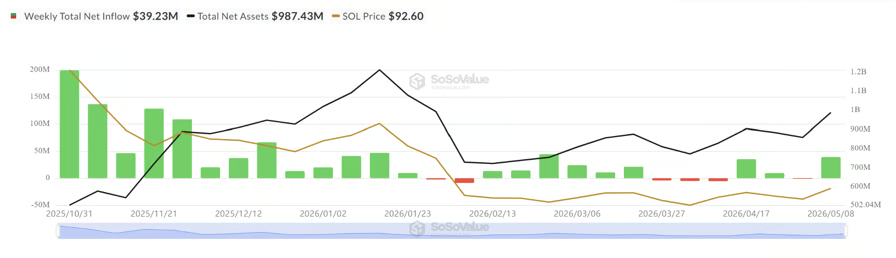
The spot Solana (SOL) exchange-traded funds (ETFs) recorded their strongest weekly performance since February, attracting $39.23 million in total net flows. The surge in capital inflows coincided with SOL futures open interest rising by $1.5 billion in May, signaling a sharp increase in trader positioning across the derivatives markets.
The rise in market activity comes alongside Solana’s 15% rally to $97 in the past seven days, with traders targeting the next major resistance level at $120.
SOL ETF demand rises with futures interest
Bitwise’s BSOL ETF led the latest inflow wave with $36 million in weekly net inflows last week, while Fidelity’s FSOL added over $1.8 million. Since its launch, BSOL has attracted $861 million, accounting for nearly 81% of cumulative inflows across all spot SOL ETFs, which now total about $1.06 billion.

Spot SOL ETF netflows. Source: SoSoValue
Futures activity rose alongside the ETF demand. Solana open interest (OI) climbed to $6.4 billion from $4.94 billion on May 1, marking a 29.5% increase in less than two weeks.
Aggregated spot cumulative volume delta (CVD), which measures the net difference between market buy and sell orders, climbed to nearly $250 million from $163 million in five days, during SOL’s push toward $96.
The futures CVD expanded to about $593.6 million after rising steadily from May 5 onward, as buyers absorbed sell-side liquidity in both the spot and futures markets.

SOL price, aggregated open interest, spot, and futures CVD and funding rate. Source: velo.chart
The funding rate held near 0.065%, indicating traders continued to pay to maintain long exposure. The buying activity has started to flatten near the $95-$96 range as spot and volume deltas have cooled over the past 24-hours.
Related: South Korea crypto holdings halve in a year as investors turn to stock market
Solana eyes a breakout: Is $120 next?
Solana is forming an Adam and Eve pattern near the $95 resistance level, with the setup’s neckline directly at the current breakout zone. A confirmed move above that level places the technical target near $120.
An Adam and Eve pattern on the higher time frame chart could signal a bottom for SOL if price successfully turns the $95 resistance level into support.

SOL/USDT, one-day chart. Source: Cointelegraph/TradingView
SOL also pushed above its 100-day exponential moving average for the first time since October 2025, adding another technical shift to the mix alongside ETF inflows and rising futures positioning.
A confirmed daily close and consolidation above $95 could open the path toward the pattern’s projected target near $120, due to a lack of resistance sitting between the two levels after the 42% dip in February.
Crypto analyst BATMAN noted that Solana recently broke above a 231-day downtrend on the SOL/BTC daily chart, signaling improving relative strength against Bitcoin. According to the analyst, the $89-$91 zone now acts as the nearest support cluster and a likely retest region if SOL holds above the breakout area.

SOL/USDT, one-chart analysis by BATMAN. Source: X
Related: XRP metrics line up bull signals for ‘full-scale rally’ to $2
21Shares said it will list its spot Hyperliquid ETF, THYP, on Nasdaq on May 12. The product gives brokerage clients regulated exposure to the native token of the Hyperliquid perpetuals trading network.
The fund is structured as a grantor trust, not a 1940 Act fund. That setup lets the sponsor stake held HYPE for yield while keeping passive price exposure.
21Shares To Launch Spot Hyperliquid ETF on Nasdaq With Built-In Staking
21Shares charges a 0.30% annual sponsor fee, paid in HYPE. Custody sits with Anchorage Digital Bank and BitGo Bank & Trust. Both providers use cold storage backed by up to $350 million in joint theft and fraud insurance.
The trust may stake between 30% and 70% of its HYPE holdings through Figment Inc. The sponsor has discretion to push that share as high as 100%.
Staking rewards are split roughly 70% to the trust and 30% to the provider.
In-kind creation and redemption baskets run in lots of 10,000 shares and are limited to authorized participants. The fund tracks the FTSE Hyperliquid Index as its pricing benchmark.

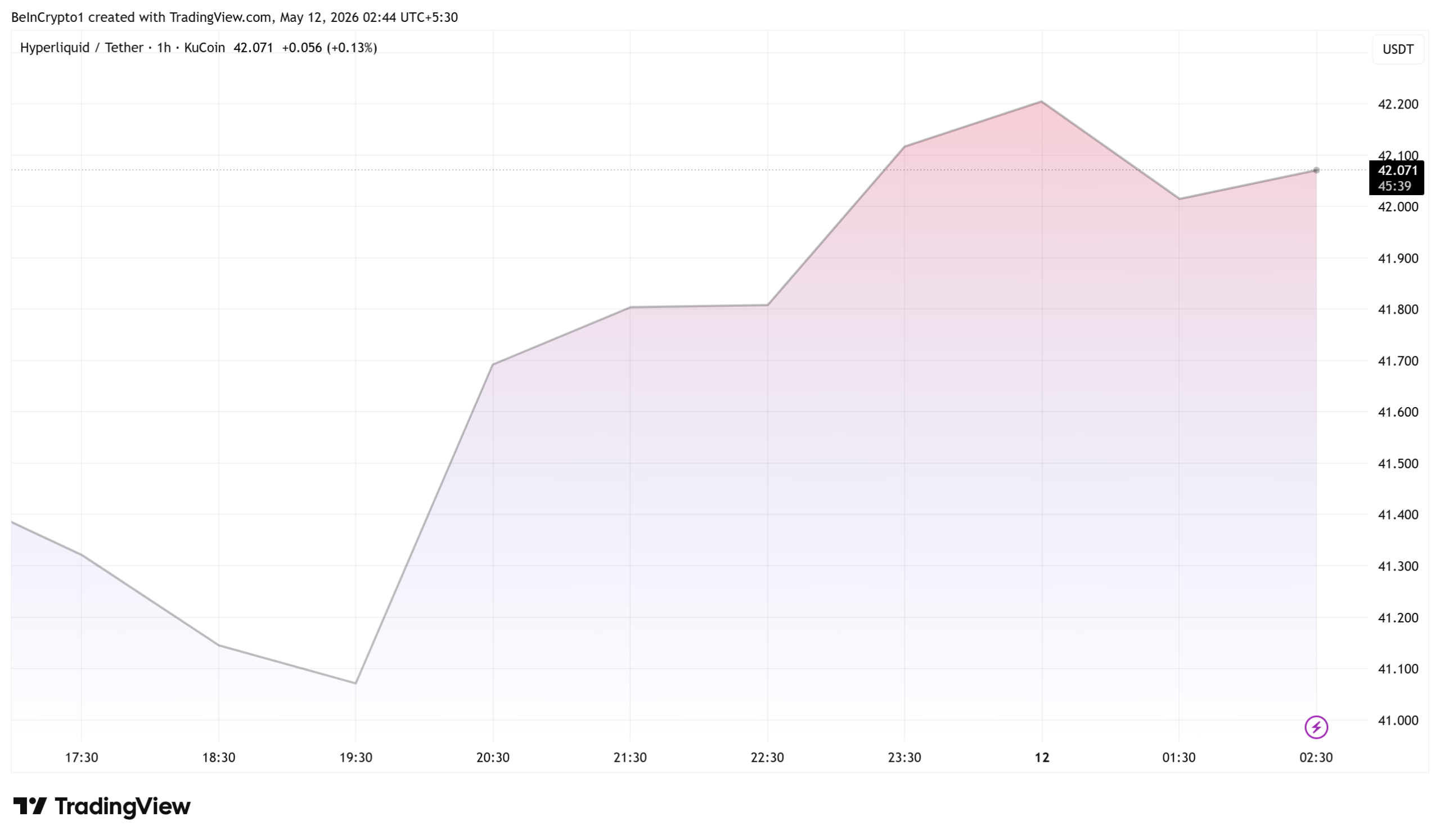
Hyperliquid’s HYPE token surged on the news, and was trading for $42.071 as of this writing.
Risks and the Spot HYPE ETF Race
The prospectus carries strong risk language. It warns that THYP is unsuitable for investors who cannot afford a total loss, citing HYPE’s annualized volatility above 126%.
Validator jailing penalties, staking lockups of one to seven days, and redemption delays are also flagged in the filing.
21Shares already runs a 2x leveraged HYPE product, TXXH, which began trading on April 30. Rivals Bitwise and Grayscale have filed competing spot HYPE ETFs under the tickers BHYP and GHYP.
The launch follows months of growth in Hyperliquid’s perpetuals volume. Early flows into THYP will signal how traditional investors price the venue.
The post HYPE Price Rises As 21Shares Unveils Groundbreaking Hyperliquid ETF appeared first on BeInCrypto.
Crypto investment products extended their streak of inflows for a sixth consecutive week, reaching $4.9 billion in total. Exchange-traded products (ETPs) gathered roughly $858 million, up sharply from the prior week’s $118 million, as improving sentiment around US crypto legislation helped push Bitcoin above $80,000 and lift assets under management to their highest level since February. The development comes as investors weigh the potential impact of regulatory clarity on the sector’s capital flows.
Key takeaways
- Six straight weeks of inflows into crypto investment products, totaling $4.9 billion year-to-date, with ETPs contributing about $858 million in the latest week.
- Bitcoin led the charge, drawing $706 million in new exposure and pushing year-to-date inflows for Bitcoin-related products to $4.9 billion; total crypto ETP assets exceeded $160 billion, the highest since February.
- Short-Bitcoin funds recorded the week’s largest outflows, totaling $14 million, signaling a cautious shift as investors reduce bets against BTC amid a rising price backdrop.
- Ether ETFs added $77 million in inflows after last week’s outflows; Solana and XRP also drew notable investor interest with inflows around $48 million and $40 million, respectively.
- Late-week profit-taking capped the rally: spot Bitcoin ETFs posted about $423 million in outflows on Thursday and Friday, leaving net weekly inflows around $623 million, per SoSoValue.
Bitcoin drives the flow as sentiment improves
Bitcoin remains the primary catalyst for the renewed wave of investor interest, with total Bitcoin-related inflows for the week lifting the year-to-date total to roughly $4.9 billion. The crypto market’s broader asset base also swelled, taking crypto ETP assets under management to more than $160 billion — a level not seen since February. The improvement in appetite appears linked to evolving policy chatter in the United States, particularly around legislative efforts that could clarify certain regulatory aspects of crypto markets.
In a note to clients, CoinShares head of research James Butterfill pointed to the final compromise proposal surrounding stablecoin yields as a supportive factor for the renewed inflows. The proposal, released on May 1, has been cited by market participants as a potential milestone toward more predictable regulatory treatment, which in turn could bolster institutional participation in crypto markets.
Broader momentum: ETH, SOL, and XRP pick up steam
Ethereum investment products posted $77 million in inflows, reversing the prior week’s outflows and underscoring sustained interest in the network’s upgrade cycle and activity. Solana and XRP complemented the broader trend with inflows of roughly $48 million and $40 million, respectively, illustrating a diversified appetite beyond Bitcoin for those exploring multi-chain exposure and liquidity profiles.
Despite the positive momentum, some segments of the market remained sensitive to the pace of gains and macro news flow. The week’s data show buyers stepping in for high-conviction assets while more tactical positions were pared back as prices fluctuated near key levels.
Profit-taking and market mechanics temper the rally
Profit-taking emerged as a notable feature toward the end of the week. After Bitcoin briefly dipped below the $80,000 mark on Thursday, US-listed spot Bitcoin ETFs recorded about $423 million in outflows on Thursday and Friday. SoSoValue estimated that this late-week selling trimmed net weekly inflows to roughly $623 million. The oscillation underscores how traders balanced the outlook for further upside with the realization of gains accumulated in the run-up.
On-chain analytics added another layer to the narrative. CryptoQuant highlighted a surge in realized profits on Monday, quantified at 14,600 BTC — about $1.1 billion at the time — marking the largest single-day profit-taking since December 10, when Bitcoin traded near $90,000. The firm noted that rising realized profits could prompt further profit-taking as BTC tests multimonth highs, especially if the market continues to rally on improving sentiment.
Industry participants offered their take on the price dynamics. Laser Digital’s derivatives desk observed that the rally began to stall midweek as traders booked profits from long positions. The desk suggested that the pace and scale of buying from institutional or large-scale participants could influence the trajectory of the move, with some investors reportedly pre-positioned ahead of anticipated bids from major players such as MicroStrategy this week. Such positioning, the note implied, can trigger additional take-profit flow if the market moves faster than anticipated.
Regulatory backdrop, adoption implications, and what to watch next
The week’s flows arrive amid a broader regulatory backdrop that could shape how investors price risk and allocate capital. The May 1 release of a compromise proposal on stablecoin yields is widely viewed as a potential signal of bipartisan movement toward clearer rules for digital assets and related products. While not a complete policy framework, the document has been cited by market participants as a sign that policymakers are closer to laying out concrete guardrails, which could unlock further institutional engagement if implemented.
Investors will be watching several development threads in the coming weeks: filings and approvals for additional ETPs and ETFs, the trajectory of the CLARITY Act conversations and its potential impact on stablecoins and custody, and any further guidance on how regulated markets will treat on-chain activity and cross-border flows. The balance between appetite for risk-on exposure and the need for regulatory clarity will likely dictate whether inflows sustain their momentum or wobble in the face of new headlines.
What this means for investors, traders, and builders
For investors, the sixth straight week of inflows signals growing confidence in crypto investment products and the potential for continued diversification beyond Bitcoin. The breadth of inflows across Bitcoin, Ether, Solana, and XRP suggests a maturing market where participants are evaluating multiple narratives — from layer-1 and smart contract platform growth to cross-chain liquidity and appeal to traditional asset allocators.
Traders will likely monitor the near-term dynamics around price levels and the rate of profit-taking. The observed outflows from spot Bitcoin ETFs late in the week highlight the importance of timing and risk management in a market characterized by volatile swings even as macro catalysts align with a constructive sentiment backdrop.
For builders and ecosystem participants, the regulatory trajectory matters. A clearer framework around stablecoins and crypto products could reduce uncertainty for custodial and fund-structure providers, potentially enabling more sophisticated product offerings and improved investor protection. The market’s next phase will hinge on how quickly policy moves translate into durable, rules-based market access and whether the optimism surrounding regulatory clarity translates into sustained capital inflows.
Looking ahead, readers should watch the progress of the CLARITY Act-related discussions and any concrete steps toward standardizing yields, as well as the continued delivery of new investment products that blend on-chain innovation with traditional fund structures. As always, the liquidity picture will adapt to both price action and policy signals, and traders should stay attentive to evolving flows data and on-chain activity that could foreshadow the next leg of the cycle.
Readers should remain attentive to the evolving regulatory landscape and the cadence of new product approvals, as these factors will shape liquidity and investor participation in the months ahead. The market seems to be moving toward greater clarity, but how and when that translates into durable inflows remains an open question worth watching closely.

Disney Adventure cruise cancelled due to mechanical fault 24 hours after boarding
Astera Labs director Stefan Dyckerhoff sells over $2.5m in stock

Solana ETF Inflows Signal Demand Returning as SOL Targets $120

Manchester United reach agreement with Casemiro over contract clause amid transfer speculation

US brings back mandatory military draft registration

Steven Gerrard disagrees with Gary Neville over ‘shock’ Chelsea and Arsenal claim | Football


-
 Crypto World4 days ago
HarrisX Poll Found 52% of Registered Voters Support the CLARITY Act
-

 Fashion3 days ago
Weekend Open Thread: Marianne Dress
-

 Crypto World5 days ago
Upbit adds B3 Korean won pair as Base token gains Korea access
-
 NewsBeat5 days ago
NCP car park operator enters administration putting 340 UK sites at risk of closure
-

 Tech2 days ago
Auto Enthusiast Carves Functional Two-Stroke Engine from Solid Metal
-

 Politics3 days ago
Politics Home Article | Starmer Enters The Danger Zone
-
 Business2 days ago
Ignore market noise, India’s long-term story intact, say D-Street bulls Ramesh Damani and Sunil Singhania
-

 Politics1 hour ago
What to expect when you’re expecting a budget
-

 Crypto World6 days ago
UAE Free Zone Deploys Blockchain IDs to Verify Registered Firms
-

 Tech17 hours ago
GM Agrees To Pay $12.75 Million To Settle California Lawsuit Over Misuse Of Customers’ Driving Data
-

 Fashion6 hours ago
Coffee Break: Travel Steam Iron
-

 Fashion21 hours ago
What to Know Before Buying a Curling Wand or Curling Iron
-

 Crypto World5 days ago
BlackRock CEO Larry Fink Discusses a New Asset Class
-

 Crypto World5 days ago
Robinhood says Wall Street is building onchain
-

 Entertainment5 days ago
Sarah Paulson Called Out For Met Gala ‘Hypocrisy’
-

 Tech6 days ago
Apple and Samsung are dominating smartphone sales so thoroughly that only one other company makes the top 10
-
Entertainment7 days ago
Serena Williams hits Met Gala in metallic dress after GLP-1 reveal
-

 Tech6 days ago
I tested the Xiaomi 17 Ultra’s camera and I don’t think I’ll ever go back to an iPhone
-
 Sports6 days ago
NBA playoff winners and losers: Austin Reaves is not loving Lakers vs. Thunder matchup, but Chet Holmgren is
-

 Fashion5 days ago
The Best Work Pants for Women in 2026
You must be logged in to post a comment Login