

Crypto World
10,000% Gains? Why One Analyst Says the Strongest Altcoin Setup in Years Is Here


A closely watched chart pattern has flipped bullish, and at least one analyst says it mirrors the setup that preceded some of the biggest altcoin rallies on record.
According to trader Mark Chadwick, the pattern has historically occurred just before rallies of between 2,000% and 10,000%.
Altcoins Flash Their Strongest Setup in Years, Analysts Say
Chadwick posted on X on May 13 that the altcoin market is showing “one of the cleanest setups we’ve seen since 2020.” In his view, alts have spent months consolidating along a long-term ascending support line, absorbing selling pressure without breaking down, and now momentum is starting to flip.
“That’s historically how Alt Season starts,” he wrote.
He pointed to the 2020-2021 cycle as the clearest comparison, saying that when similar signals appeared then, they pushed many major alts up by “2,000-10,000% within months.”
He also cited the Russell 2000 hitting all-time highs as corroborating evidence that broader risk appetite is returning, arguing that capital rotation out of safer assets and into higher-beta plays is already starting.
That view is quite similar to that shared by another analyst, Michaël van de Poppe, who said earlier in the week that altcoins are currently trailing Bitcoin by one to three weeks and that if the pattern continues, they could start posting gains between 100% and 300%, depending on liquidity conditions and market momentum.
Some on-chain data also offered backing for Chadwick’s thesis, with crypto analyst Darkfost noting that altcoin performance among tokens listed on Binance has returned to levels not seen since September 2025.
Per his data, about 21% of Binance-listed altcoins have now reclaimed their 200-day moving averages. In February, only 2% of those assets held above that level. However, he was careful not to overstate the trend.
“It is far too early to start calling an altseason; the road ahead is still long and liquidity remains constrained,” he pointed out.
Liquidity and Regulation Remain Central Concerns for Traders
Despite the improving charts, some market watchers are still pointing to weak liquidity as a major obstacle for a bigger rally.
Darkfost himself noted that the crypto market has become heavily diluted, with at least 51 million altcoins now in circulation, with 46% of those tokens on Solana, while 36% are on Base and 10% are on BNB Smart Chain.
Macroeconomic concerns are also still weighing on sentiment. Darkfost cited the ongoing US-Iran conflict and inflation worries as factors that are still putting pressure on risk assets.
At the same time, traders are closely watching developments in Washington, with Chadwick, in an earlier post, suggesting that the Digital Asset Market Clarity Act of 2025 could encourage more institutional participation in crypto markets if it paves the way for clearer market structure rules.
The bill is scheduled for markup tomorrow, but has been hit with multiple amendments as well as more than 8,000 letters from members of the American Bankers Association opposing its stablecoin yield provisions.
The post 10,000% Gains? Why One Analyst Says the Strongest Altcoin Setup in Years Is Here appeared first on CryptoPotato.


[PRESS RELEASE – London, United Kingdom, May 13th, 2026]
Following the successful completion of its private testing phase, BASIS is now officially live, with the platform publicly accessible at basis.pro as the company moves to address what industry participants increasingly describe as a structural gap in digital asset infrastructure.
The platform, developed with engineering support from Base58 Labs, has been tested under live market conditions with a select group of institutional participants. While reported metrics included sub-50 microsecond p99 execution latency, throughput exceeding 100,000 operations per second, and 100% uptime, the evaluation extended beyond peak performance benchmarks.
Testing was designed to observe how the system behaved when execution conditions became unstable. Scenarios included exchange-side latency spikes, API rate limits, liquidity fragmentation across venues, and partial execution failures. These conditions, while not constant, are representative of real trading environments where system behavior under stress determines outcome consistency.
According to BASIS CEO Helge Stadelmann, these scenarios reflect a broader limitation in current market infrastructure.
“Strategies exist. The constraint has been the infrastructure required to execute them with precision and defined risk,” Stadelmann said.
The platform operates as an arbitrage staking system powered by the Base58 Hyper-Latency Engine (BHLE), a proprietary high-frequency execution engine developed by Base58 Labs. BASIS identifies and captures pricing discrepancies across exchanges and distributes net arbitrage profits to platform participants through a staking structure designed around market-neutral execution.
In traditional markets, execution-layer infrastructure is typically embedded within institutional systems. In digital asset markets, that layer is still evolving, resulting in a dependency on external exchanges, APIs, and liquidity routing frameworks that introduce variability into execution outcomes.
Unlike conventional yield products that rely on token emissions or external reward incentives, BASIS derives user rewards exclusively from arbitrage execution profits generated across fragmented digital asset markets. Structurally, losses are absorbed by the company while users participate only in profit distributions generated through execution activity.
During testing, BASIS evaluated system behavior across a range of operational conditions. When execution parameters exceeded predefined thresholds, including projected slippage or incomplete fill conditions, the system halted execution and initiated deterministic rollback procedures. These mechanisms were designed to preserve capital and prevent forced completion under degraded conditions.
In scenarios where exchange-side instability occurred, the system adjusted outbound routing behavior and maintained allocation states without internal inconsistency. Pending executions were paused or reallocated without loss of state integrity, allowing the system to resume normal operation once conditions stabilized.
The Base58 Hyper-Latency Engine (BHLE), which underpins the platform, was developed to support these behaviors. While latency performance remains a core component, the design emphasis extends to sequencing logic, allocation tracking, and state preservation under varying execution conditions.
This approach reflects a shift in how execution performance is evaluated.
“Execution quality is determined by control under unpredictable conditions,” Stadelmann said.
The testing phase focused on verifying that the system could maintain deterministic behavior when external variables introduced uncertainty. Rather than prioritizing forced execution completion, the system was designed to priorities outcome consistency and capital preservation.
BASIS operates within a structured governance framework that includes ISO/IEC 27001:2022, ISO/IEC 20000-1:2018, AICPA SOC, and GDPR compliance standards. These certifications align the platform with established requirements for information security, service management, and operational oversight.
BASIS functions as execution-layer infrastructure supporting arbitrage deployment across exchanges rather than a conventional yield-generation platform. The underlying system is designed to maintain execution control, sequencing integrity, and deterministic risk behavior while operating across fragmented liquidity venues in real time.
With validation complete, BASIS is now officially live and publicly available through basis.pro. The platform currently supports BTC, ETH, SOL, and PAXG, each convertible into corresponding stTokens through a 1:1 structure, with reward accrual derived from arbitrage profits generated through the platform’s execution engine.
“We validated the system thoroughly before opening it to the market. BASIS is now officially live at basis.pro, and access is open,” Stadelmann said.
The launch reflects a broader shift in how infrastructure platforms are brought to market, with live validation and operational discipline completed prior to public availability.
As digital asset markets continue to mature, the role of execution-layer infrastructure is becoming more defined. While liquidity, custody, and compliance have seen rapid development, execution systems remain an area of ongoing evolution, particularly for institutional participants requiring consistent deployment frameworks.
The development of infrastructure capable of bridging the gap between proprietary trading systems and broader institutional access introduces new considerations for market structure. These include how execution control is standardized, how risk is managed across fragmented venues, and how infrastructure scales without introducing instability.
BASIS enters this stage of market development with execution discipline as a primary design principle. The platform’s architecture, testing methodology, and launch sequencing reflect an approach centered on system behavior rather than surface-level performance metrics.
As digital asset markets continue maturing, execution-layer systems capable of supporting scalable arbitrage deployment are becoming increasingly important. BASIS enters the market with a structure centered on market-neutral execution, deterministic risk management, and operational consistency across fragmented trading environments.
About BASIS
BASIS is a professional crypto arbitrage platform developed with engineering support from Base58 Labs. The platform operates through the Base58 Hyper-Latency Engine (BHLE), a proprietary high-frequency execution engine designed for sub-50 microsecond execution latency and deterministic risk management across fragmented digital asset markets.
About Base58 Labs
Base58 Labs is the engineering team behind the Base58 Hyper-Latency Engine (BHLE) and the technical infrastructure powering BASIS. The team specializes in execution-layer
development for digital asset markets, with a focus on latency optimization, sequencing integrity, and deterministic system behavior under variable market conditions.
The post BASIS.pro Is Live: Base58Labs Officially Launches Crypto Arbitrage Platform appeared first on CryptoPotato.
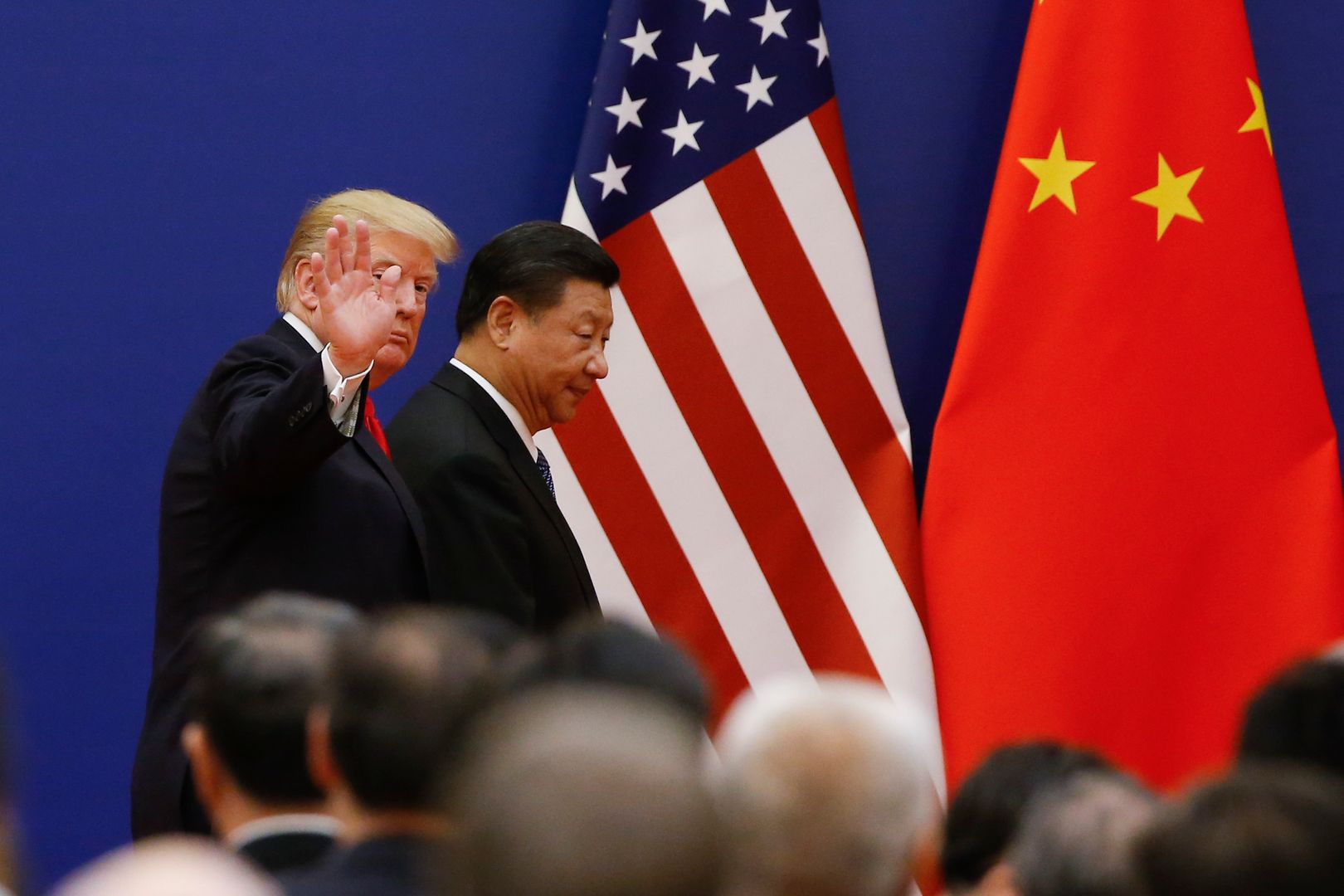
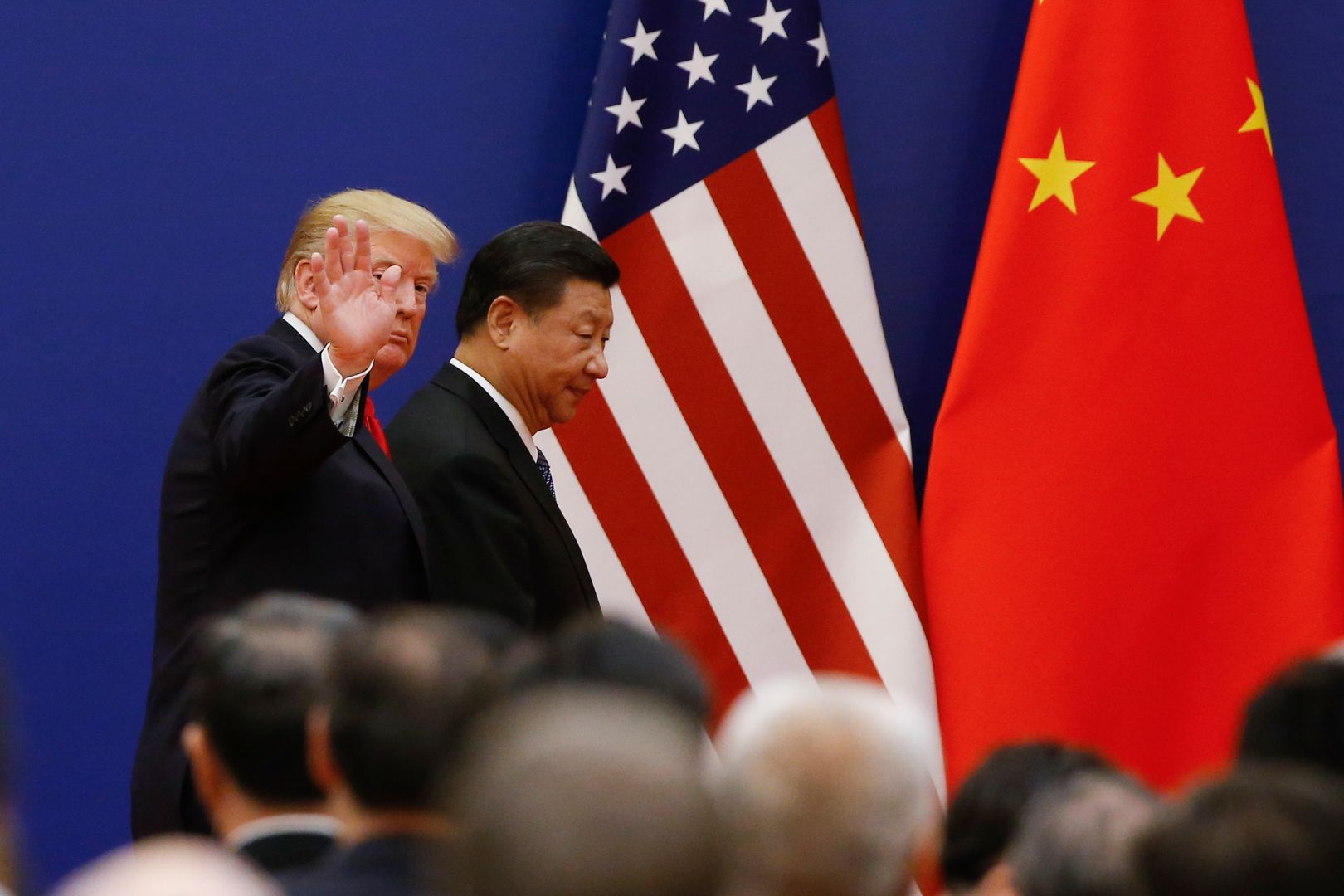
Bitcoin’s $80,000 floor cracked under back-to-back inflation shocks, and Xi Jinping’s Taiwan warning further dampened expectations of a recovery.
BTC traded at $79,200 in Asian hours Thursday, down 2.3% over 24 hours and 2.2% on the seven-day, after slipping below the $80,000 level that had served as the floor for most of the past week, per CoinGecko data.
Solana (SOL) led the cohort lower with a 5.6% drop to $90, giving back most of the weekly gains that had made it the standout altcoin for the past two weeks. Ether dropped 2.1% to $2,250 and is now down 3% on the seven-day, the second-weakest performer among the majors after BTC.
BNB shed 1.6% to $660 but held a 3.9% weekly gain, while XRP slipped 1.7% to $1.43. Dogecoin held in green territory at $0.1126, up 0.9% on the day, the only major in the cohort to post a 24-hour gain.
The sell pressure built around the Trump-Xi summit in Beijing, the first visit to China by a sitting U.S. president in nearly a decade. Xi pressed Trump on Taiwan in their first meeting at the Great Hall of the People, warning of a potential “collision or even clashes” if the issue is mishandled.
China’s readout of Xi’s remarks appeared to be released before the meeting had concluded, thrusting the self-ruled island into the spotlight and rattling risk sentiment globally.
Asian equities swung between gains and losses on the back of the friction. MSCI’s Asia Pacific index slipped 0.1% after rising as much as 0.8% in early trading.
Mainland Chinese shares fell 1.3%, having touched their highest level since 2021 ahead of the talks. The offshore yuan edged up for an 11th day, the longest winning streak since September 2017, suggesting capital is starting to position for whatever comes out of the summit.
The crypto sell-off compounded pressure from Wednesday’s producer price index print, which came in at 1.4% month-over-month against a 0.5% forecast and 6% year-over-year.
That followed Tuesday’s CPI reading of 3.8%, the hottest inflation print in almost three years. The back-to-back inflation surprises complicate the Federal Reserve’s path to easing rates later this year, removing one of the structural tailwinds crypto has been pricing in.
Not everything broke down, however. Cisco shares jumped 20% in extended trading after a stronger-than-expected sales outlook, and a gauge of Asian technology shares climbed as much as 2.3% to a record high. Nasdaq 100 futures advanced 0.2%. The AI trade is still bid even as the broader risk tape turns choppy, which is the same divergence that has been running for the past three weeks.
The next test for bitcoin sits at the $78,000 level, which marked the early-May low before the rally to $82,000. A break below that would put the late-April capitulation zone in play. Holding above keeps the structural buyers’ case intact heading into the next round of macro data and the back end of the Trump-Xi talks.

The XRP Ledger (XRPL) has reached a new all-time high of 332,230 wallets holding at least 10,000 XRP, according to on-chain data shared by crypto analytics platform Santiment.
Interestingly, the figure continues a steady growth trend that has been building since June 2024.
Confidence Behind the Scenes
Santiment said the increase in wallets holding large amounts of XRP is viewed as a significant long-term indicator, as it suggests bigger holders have continued accumulating the asset despite ongoing market volatility and uncertainty. Growth in mid-to-large XRP wallets has historically reflected stronger conviction among investors who are less influenced by short-term price movements and more focused on long-term positioning, the analytics firm explained.
The trend is notable because XRP has spent much of 2026 trading below its previous highs, which indicates that many holders have been accumulating during periods of market fear instead of chasing upward momentum. The firm also pointed to a temporary decline of more than 4,500 XRP wallets holding over 10,000 XRP between February 6 and 8, though it said there was no confirmed XRP-specific event behind the drop.
Santiment added that the decline likely coincided with the broader crypto market crash and liquidation event on February 5.
Institutional Interest
At the same time, XRP’s institutional outlook has continued drawing attention, especially amid ongoing discussions around US crypto regulation and the CLARITY Act framework. Market participants are closely watching the possibility of XRP receiving a clearer commodity classification, which some analysts believe could support the launch and growth of XRP ETFs.
These investment vehicles have already raked in a cumulative total net inflow of roughly $1.36 billion since their launch. Standard Chartered recently projected that XRP ETFs could attract between $4 billion and $8 billion in inflows by the end of 2026 under such conditions.
The growing focus on institutional XRP exposure has also increased attention on XRPFi activity, where XRP is being deployed into DeFi applications for lending, staking, collateral, and yield generation.
The post Why Ripple (XRP) Accumulation Continued Despite Market Fear and Liquidations appeared first on CryptoPotato.
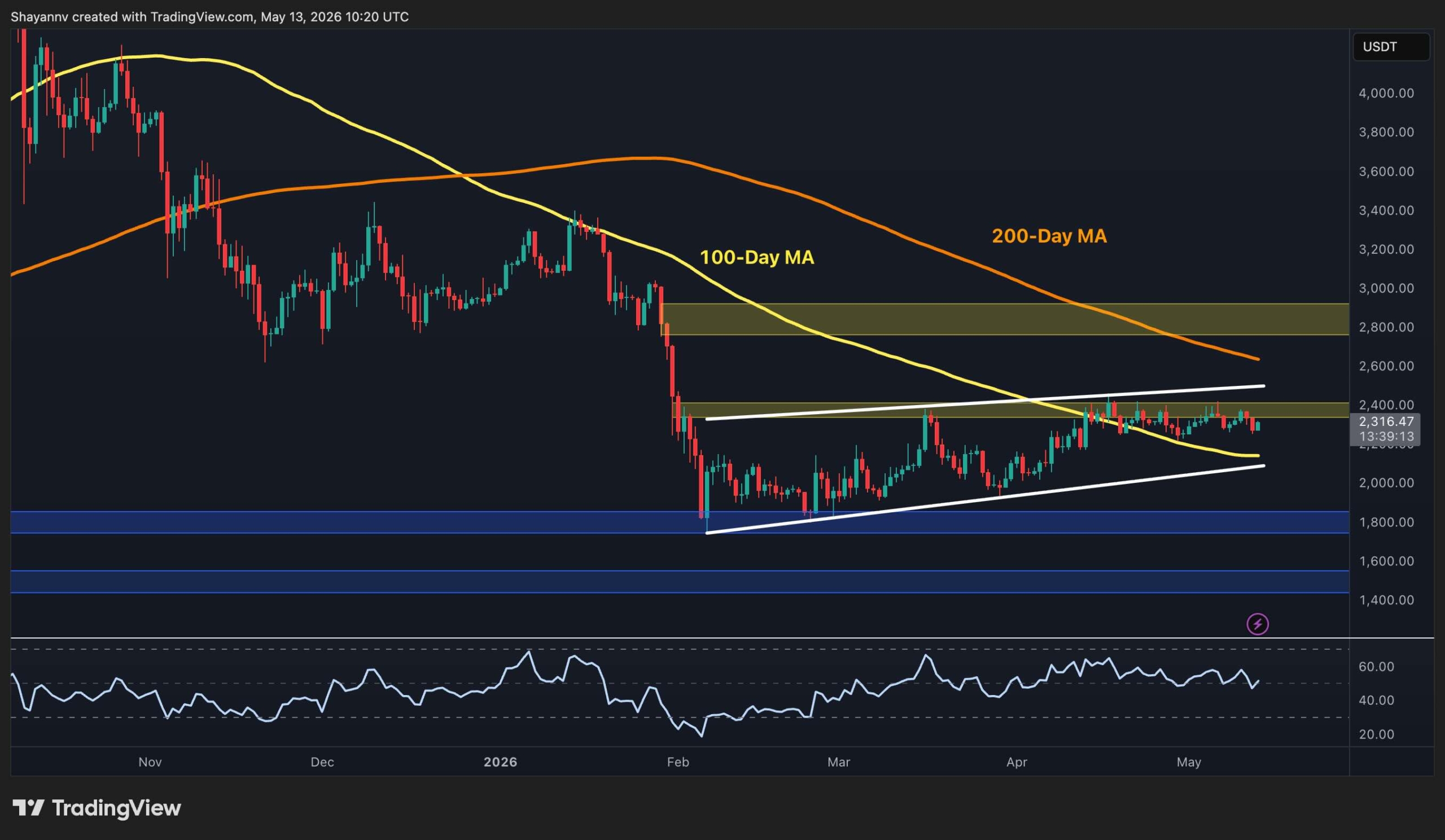
Ethereum is trading around $2.3k and is still anchored below the $2.4k resistance zone that has capped this entire consolidation over the past months. The ascending channel from February’s lows remains structurally intact, and the conditions for a breakout seem favorable.
The derivatives positioning has also changed dramatically recently, as traders are now placing their biggest long bets of the recovery on ETH, and whether that conviction is rewarded or punished in the coming days will likely define the price action in the coming months.
Ethereum Price Analysis: The Daily Chart
The ascending white channel from the February low continues to govern the macro structure on the daily timeframe. The lower boundary of the channel is rising above $2k, and the upper boundary extends to $2.5k at the moment.
The price is currently sitting just above the 100-day moving average, which is flattening near $2.2k, and could be counted on as short-term support if a pullback happens. Meanwhile, the 200-day moving average is still well above the price at $2.6k and is yet to be tested. The RSI is also hovering around 50, offering no directional edge.
Nothing about the daily picture has changed structurally in the past couple of weeks. A sustained close above $2.4k remains the sole requirement to shift the bias, opening the path toward the 200-day MA and potentially the key supply band at $2.8k. The ascending channel floor near $2.1k and the $1.8k demand zone remain the downside references if the recovery structure breaks. Until one of these levels is breached, the daily chart is still waiting for a catalyst.
ETH/USDT 4-Hour Chart
Dropping down to the 4-hour chart, the price is consolidating inside a symmetrical triangle that formed following the mid-April highs and lows. The market has recently tested and bounced from the lower boundary near $2.25k, and is likely to test the $2.4k area again, with the RSI also recovering rapidly.
A clean 4-hour above the higher boundary of the triangle and the $2.4k zone would suggest a measured continuation toward the upper boundary of the large daily channel. On the other hand, a failure to sustain the short-term bounce and a breakdown of the triangle would make a drop back to the $2.2k support zone imminent, which is a key area that has been acting as a floor since mid-April.

Sentiment Analysis
Ethereum’s funding rate has spiked to +0.0105, being the largest positive reading since February. This reading stands in sharp contrast to the more measured positioning that has characterized recent weeks. Unlike Bitcoin, whose entire recovery from $60k to $80k was driven by persistently negative funding, ETH’s derivatives market has been net long for most of the recovery period, meaning this is not a short-squeeze dynamic but genuine directional conviction from long-side traders.
That distinction cuts both ways. The aggressive long positioning reflects a genuine belief that a breakout above $2.4k is imminent, and if it materializes, those longs will amplify the move significantly. But if the price fails at this level again, a funding rate at +0.0105 means a large cohort of leveraged longs will need to be unwound, and the flush toward $2.2k and potentially $2k would happen quickly.
The funding spike has effectively raised the stakes on a level that has already been tested multiple times. So, ETH either breaks out here with conviction, or the derivatives market hands sellers the most powerful catalyst of the entire corrective cycle.

The post Ethereum Price Analysis: ETH Must Reclaim This Key Level to Restart Bull Run appeared first on CryptoPotato.
Just 4% of surveyed Americans say they would weigh a political candidate’s stance on crypto policy in deciding who to vote for.
Affordable housing, consumer fraud protection and lower bank fees were the top three issues respondents said they wanted Congress to tackle, according to a survey of 2,035 US adults released on Wednesday by POLITICO and conducted by polling firm Public First.
Just 18% of respondents considered establishing rules for the crypto market a top priority for Congress, just one percentage point ahead of regulating large banks.
The results show a divide between the average American voter’s top priorities and those of crypto industry lobbyists, who have been pushing Congress to pass crypto legislation ahead of the midterm elections.
Crypto lobbies poured more than $130 million into the 2024 elections, the most of any industry, and have already spent $320 million to influence the November midterms, according to data compiled by researcher Molly White.
Crypto lobbyists have made it clear that they will use their significant funds against any candidate who doesn’t support the industry, having spent over $5.5 million on opposing candidates in congressional races in Illinois this year.
Less than a third oppose making crypto mainstream
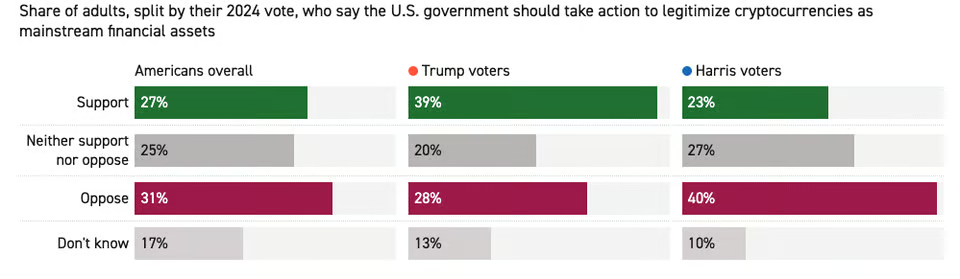
According to the survey, just 27% said they support or strongly support the US government taking action to legitimize crypto as a mainstream financial asset, while 31% said they oppose or strongly oppose it.

Poll responses to whether the US government should legitimize crypto as a mainstream asset. Source: POLITICO
Related: Crypto and AI could be dirty words on 2026 midterm campaign trail
“Most voters don’t care about digital assets,” Republican Representative Dusty Johnson told POLITICO. “But those who do care a lot. It is a high-intensity issue. And I think it’s going a little bit more mainstream. The number of people who ask me about it is still very small, but I would say growing.”
More than half of the respondents said they had not, and would not, consider trading crypto, while 19% had traded crypto. Of those who trade crypto, 7% said a political candidate’s stance on crypto would impact their vote.
The poll also found that 45% of respondents viewed investing in crypto as a risk not worth taking, even if it offered high returns, compared with 25% who said it was worth it.
The latest poll clashes with another poll of 2,008 registered voters released on Friday by HarrisX, which found 47% said they would be at least somewhat likely to consider voting for a candidate outside their preferred party if the candidate supported passing a long-awaited crypto bill that would lay out how the industry is regulated.
The Senate Banking Committee on Thursday will vote on whether to advance such a bill that has seen involvement from the White House to cut a deal with crypto and banking lobbies. A version of the bill passed the House in June as the CLARITY Act.
Magazine: Clarity Act risks repeat of Europe’s mistakes, crypto lawyer warns

A Bitcoiner’s post has gone viral on X after he claimed to use Anthropic’s AI chatbot Claude to recover 5 Bitcoin worth about $320,000 that he had been unable to access for more than a decade.
In an interview with MTS on Wednesday, pseudonymous X user Cprkrn said he made fairly “really complicated passwords” on blockchain.info and forgot one of three passwords after changing it several years ago.
Over the last eight weeks, Cprkrn said he used AI to attempt to brute force “trillions of passwords,” but to no avail.
Then, in a “last-ditch effort” earlier this week, Cprkrn said he gathered all of his old college notebooks as well as a laptop he had used into Claude, which helped him recover an old password and a crucial wallet backup file that corresponded with that password, ultimately enabling him to access the Bitcoin wallet.

Source: Cprkrn
Industry reports predict that between 2.3 million and 4 million Bitcoin (BTC) are inaccessible, representing roughly 11% to 19% of the cryptocurrency’s maximum supply because of forgotten or lost seed phrases, burned coins or other reasons. There are entire businesses dedicated to helping cryptocurrency users recover lost coins.
How Cprkrn used Claude to recover his Bitcoin
Cprkrn’s seed phrase hunt was conducted over eight weeks, with Claude helping him search two Macs, two external hard drives, an Apple Notes export, iCloud Mail, a Gmail inbox and X messages, totaling more than 1 gigabyte of data.
One of those devices was his college computer, on which Claude discovered a critical wallet backup file from December 2019.
From there, Cprkrn, with Claude’s assistance, managed to decrypt the file using a password derived from a notebook mnemonic, enabling him to find the seed phrase for the long-dormant Bitcoin wallet.
While Cprkrn didn’t provide direct evidence of Claude searching through his devices, he shared a link from Blockchain.com’s Bitcoin explorer showing that about 5 Bitcoin was transferred from wallet address “14VJy…ofuE6” across five transactions on May 13.
Prior to those transactions, the coins had been dormant since early 2015.
Over 3.5 trillion passwords were tested before succeeding
The recovery came after Claude unsuccessfully used BTCRecover — an open-source seed recovery tool — and the software program Python to test around 34 billion passwords with brute force.
Related: Bitcoin whale ‘still short’ BTC despite facing $13M in losses
Claude also used password recovery tool Hashcat to test another 3.4 trillion passwords, which also proved unsuccessful.
Just $15 in AI compute was used to conduct the searches and test passwords, according to Claude’s summary of the recovery efforts.

Source: Cprkrn
Despite the success, some members of the crypto community said Cprkrn overstated Claude’s role in retrieving the Bitcoin, arguing that it only assisted with the searching efforts and didn’t crack the wallet as Cprkrn suggested.
“Claude didn’t do anything other than search his files,” Reddit user MeteorSwarmGallifrey said in the technology subreddit, adding that Claude didn’t do anything “groundbreaking.”
Magazine: eToro founder timed Bitcoin top perfectly due to belief in 4 year cycles

Metaplanet reported a ¥114.5 billion (around $725.6 million) net loss in the first quarter of fiscal year 2026, as declining Bitcoin prices led to massive accounting valuation losses on its holdings.
The company reported an ordinary loss of ¥114.9 billion ($728 million), largely driven by ¥116.3 billion ($736 million) in Bitcoin valuation losses recorded during the quarter.
Metaplanet Quarterly Loss
Despite the losses, Metaplanet posted strong operating growth. Its net sales rose 251.1% year-over-year to ¥3.08 billion ($19 million), and its operating profit increased 282.5% to ¥2.27 billion ($14.3 million). Revenue from its Bitcoin Income Generation business, which includes option premium strategies tied to BTC derivatives, rose sharply to ¥2.54 billion.
Metaplanet’s Bitcoin holdings increased to 40,177 BTC by the end of March 2026, up from 35,102 BTC at the end of December 2025. It has managed to retain its position as the largest Bitcoin-holding listed company outside the United States, according to the filing.
During the quarter, the company continued raising capital through common share issuances, preferred shares, stock acquisition rights, and Bitcoin-backed credit facilities to support additional BTC purchases.
Metaplanet also disclosed that it secured a $500 million Bitcoin-collateralized credit facility and had drawn $302 million under the arrangement as of May 13, 2026. Total assets fell to ¥466.7 billion at the end of March from ¥505.3 billion at the end of 2025, mainly due to lower Bitcoin valuations.
“The Company will continue to accumulate Bitcoin, grow Bitcoin per share, and allocate capital with discipline. Over time, it intends to develop financing capabilities, operating businesses, and institutional relationships that make its Bitcoin position more productive and durable. This work sits inside a larger shift in how money and capital markets are organized. The Company intends to contribute to the development of Japan’s digital capital markets.”
Metaplanet’s Disclosure Practices Controversy
The results come as the company faces criticism online over its Bitcoin acquisition strategy and disclosure practices. Earlier this year, CEO Simon Gerovich defended the company’s strategy while explaining that all Bitcoin purchases, wallet addresses, and borrowing arrangements had been disclosed in real time.
Gerovich also said the company’s options strategy was aimed at acquiring BTC below spot prices through premium income rather than speculating on short-term price movements.
The post Japan’s Biggest Corporate Bitcoin Holder Reports $736 Million Valuation Loss appeared first on CryptoPotato.


The copper gold ratio has broken above its 200-day moving average for the first meaningful time since September 2020.
Summary
- The ratio now stands at 0.00142, with copper at $6.65 per pound and gold near $4,700 per ounce, up 25% from its recent lows.
- Previous surges in 2013, 2017, and 2021 aligned with the early stages of major Bitcoin price cycles.
- The correlation between Bitcoin and the ratio has rebounded sharply from near negative 1.0, suggesting the relationship is beginning to strengthen.
The copper gold ratio is a closely watched macro signal measuring the relative strength of copper, an industrial metal tied to economic expansion, against gold, which traditionally rises during risk-off conditions.
A rising ratio signals improving global risk appetite, and the current reading of 0.00142 represents a 25% climb from the ratio’s recent lows, according to market analysis tracking both assets.
The breakout above the 200-day moving average is the first of meaningful size since September 2020. That prior instance coincided with the early stages of the Bitcoin rally that carried the asset from roughly $10,000 to its then-record high. Comparable surges in 2013, 2017, and 2021 also aligned with the onset of major Bitcoin price cycles.
What the signal means for Bitcoin now
The correlation coefficient between Bitcoin and the copper gold ratio currently sits at negative 0.11 on a 20-day moving average. That number has rebounded sharply from near negative 1.0, suggesting the divergence phase is closing.
Historically, the correlation has moved toward 1.0 during Bitcoin’s strongest bull runs, with both assets trending together as macro risk appetite improves.
The ratio is also viewed as a leading indicator that has historically preceded Bitcoin price moves by several weeks to months, meaning any sustained Bitcoin response would likely unfold over the coming weeks rather than immediately.
The signal arrives alongside a separate CryptoQuant bullish reading, which flipped positive on May 12 for the first time since March 2023. That prior reading preceded a sustained run taking Bitcoin from $20,000 to above $73,000 by April 2024. Bitcoin currently tests the $79,000 to $82,000 range, with analysts flagging resistance at $82,000 to $83,000 and key support at $77,500.
Neither indicator constitutes a guarantee of further gains. Analysts consistently caution that correlation does not establish causation, and that macro signals can produce false breakouts, particularly in cycles where institutional ETF flows and regulatory dynamics shape Bitcoin’s trajectory in ways the copper gold ratio does not capture.


The US Senate confirmed Kevin Warsh as Federal Reserve Chair in a 54-45 vote. The margin was the narrowest ever recorded for a Fed chair.
Pennsylvania Senator John Fetterman was the only Democrat to vote in favor. Warsh inherits a central bank under direct pressure from President Donald Trump to cut interest rates.
Kevin Warsh Officially Confirmed to Lead the Federal Reserve
Lawmakers first signed off on Warsh’s 14-year term as a Federal Reserve governor, clearing the way for the subsequent vote that handed him a concurrent four-year stint as chair.
He still needs to be sworn into both roles, which is pending the White House’s final signatures on the paperwork forwarded by the Senate.
Warsh takes over from Jerome Powell, whom Trump has repeatedly criticized for not lowering interest rates, mocking him with the nickname “Too Late.” Powell’s run as chair wraps up Friday.
Warsh previously served on the central bank’s Board of Governors between 2006 and 2011. He chairs his first Federal Open Market Committee (FOMC) meeting on June 16 and 17. During his confirmation hearing, Warsh said he was committed to keeping monetary policy “strictly independent.”
Follow us on X to get the latest news as it happens
The new Fed Chair takes over a central bank boxed in by hot data. Headline US CPI rose 3.8% year over year in April, the highest reading since May 2023. Producer prices, measured by the PPI, climbed 6%.
The numbers have prompted Wall Street to revise its outlooks. Goldman Sachs pushed its first rate cut forecast back to December 2026, citing sticky inflation.
Pimco went further, flagging the possibility of a rate hike. Warsh’s June FOMC vote will signal whether he leans toward Trump’s preference for cuts or holds the line on inflation.
Subscribe to our YouTube channel to watch leaders and journalists provide expert insights
The post Trump’s Pick Kevin Warsh Confirmed as Fed Chair After Tight Senate Vote appeared first on BeInCrypto.
Crypto World
Can TAO Push Past $470 After Subnet Expansion While Pepeto’s Final Presale Tokens Disappear Before Listing Day?
The Bittensor price prediction crowd just stacked its third bullish catalyst this month. Opentensor doubled subnet capacity to 256 on May 3, Wormhole bridged TAO to Solana two days later, and today the Conviction Locks upgrade goes live, locking staked TAO for extended periods and compressing liquid supply further.
TAO sits at $311 while bigger wallets rotate into the next entry tier, and Pepeto is in the middle of that rotation with nearly $10 million raised, the presale 97% filled, and a Binance listing approaching that turns presale wallets into full positions before the first public trade.
Opentensor opened 128 fresh subnet slots with Robin τ on May 3, taking total capacity to 256 according to CoinMarketCap.
Wormhole bridged TAO to Solana two days later per CoinDesk, Grayscale reopened its TAO Trust on May 9, and today’s Conviction Locks upgrade compresses liquid supply by requiring extended lock periods for governance power.
Q1 revenue hit $43 million in subnet fees and Nvidia holds roughly $420 million in TAO. Capital chasing the AI rotation is already looking for the next entry that has not run yet.
Why Smart Money Is Pairing TAO With Pepeto Right Now
Pepeto: A Marketplace Already Live, A Listing Already Approaching
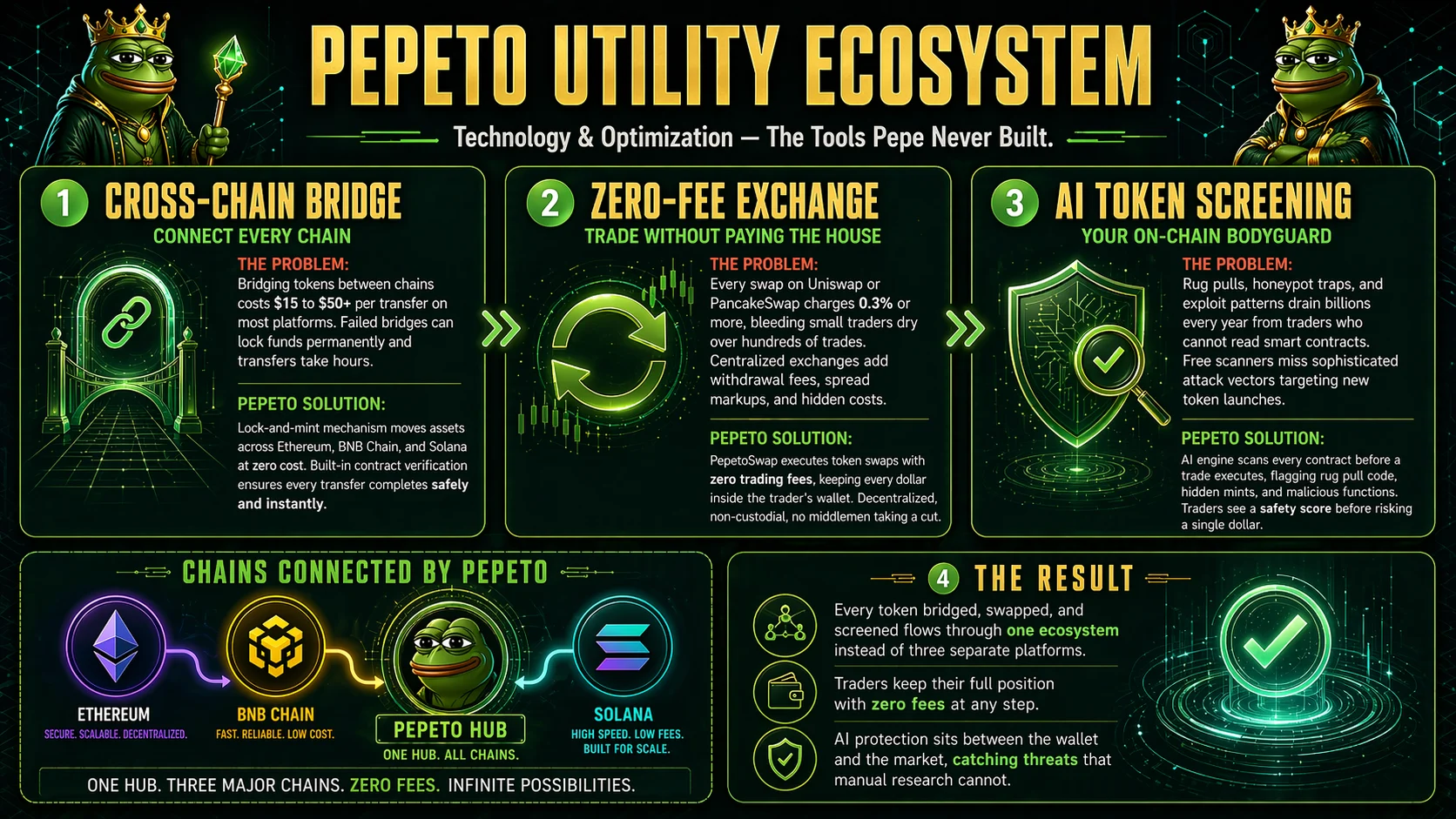
Pepeto runs a meme coin marketplace built on Ethereum for buyers who refuse to surrender tokens to bots or rug contracts, and the reason TAO holders are watching it is that the same logic applies: enter before the crowd prices you out.
The cross chain bridge transfers tokens between networks at zero cost, which feeds directly into PepetoSwap’s zero fee trading engine, so capital that enters stays fully deployed instead of leaking into fees at every step.
SolidProof audited every contract and 173% staking is compounding tokens for wallets that arrived first, which means early holders are growing their positions while the presale is still open.
Pepeto trades at $0.0000001868, the supply matches Pepe at 420 trillion, and the same builder who carried the first Pepe coin past $11 billion with no products is steering this project alongside a Binance veteran on the engineering side.
The presale is 97% filled right now, stages clear in under 48 hours, and the smart contract closes automatically the second the last token sells with no warning, just a closed window and a listing within days. The multiplier math from this entry to even a fraction of Pepe’s old cap lands in 100x territory, and that number is why wallets that missed the original frog are acting this time.
Bittensor Price Prediction: The Roadmap For TAO Through 2026
TAO trades at $311 today per CoinMarketCap with a $3 billion market cap, sitting 58% below its $760 all time high from April 2024. Changelly projects the range between $388 and $474 by December 2026, with the bull case anchored on subnet adoption and the pending Grayscale TAO spot ETF decision.
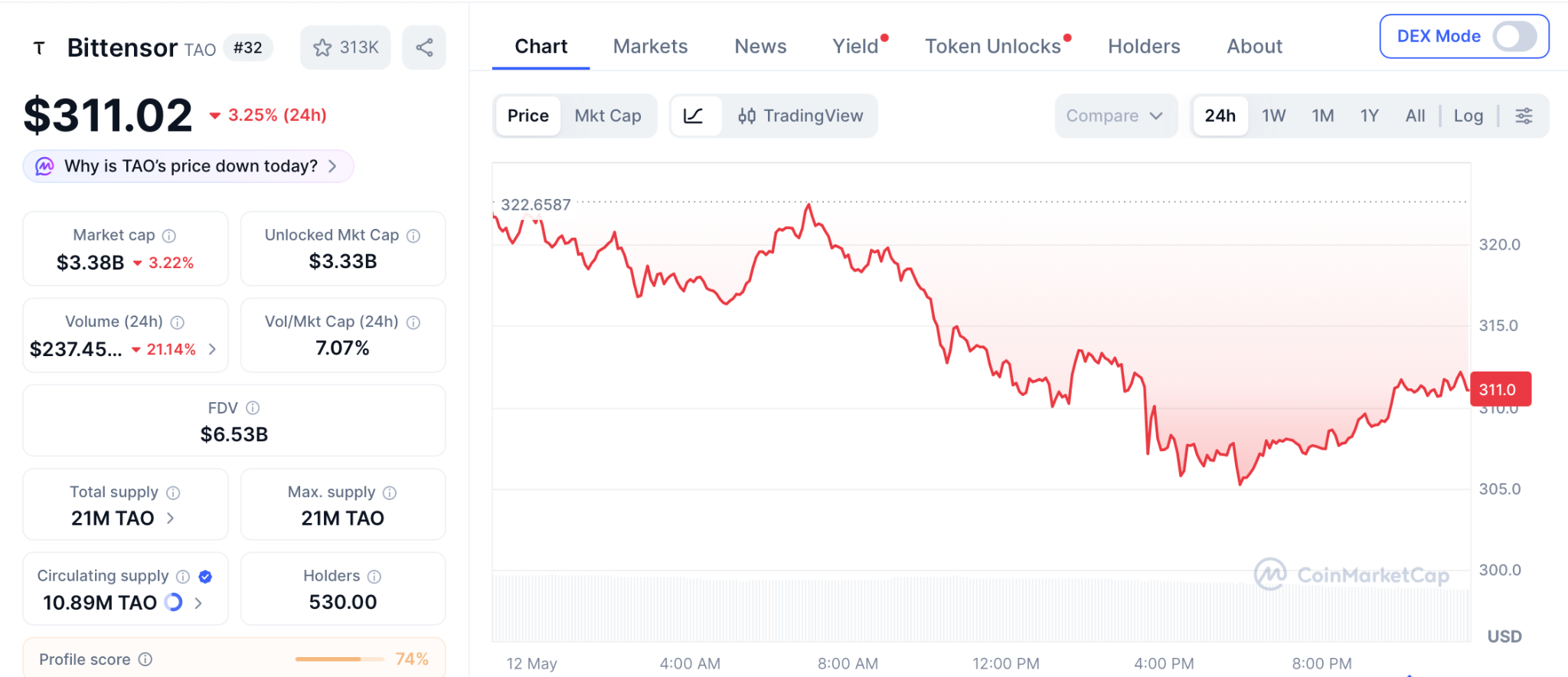
CoinCodex holds support at $260 and resistance at $350. Even the most bullish Bittensor price prediction caps the upside near 48% over months, while a presale entry into a working marketplace carries multiplier math that no $3 billion cap can match.
Conclusion:
The Bittensor expansion is real and the AI rotation is forming, but TAO upside from $311 caps near 48% over months while the Pepeto presale stages keep absorbing fresh capital with every round, and the gap between those two numbers is where life changing decisions get made.
Last cycle made millionaires out of the wallets that moved first into the right founder, not the wallets that waited for confirmation. Pepeto is that same moment with an approaching Binance listing and a working marketplace already running.
The presale is 97% filled, the smart contract closes the second the last token sells with no warning, and every day that passes is a day closer to a window that simply vanishes. The return math from $0.0000001868 to even a fraction of what the original Pepe reached is the kind of number that stays in a person’s head for years if they let it pass. The Pepeto official website carries the entry that turns into the return after the first listing day candle, and hesitating on this one could be the regret that defines the entire cycle.
Click To Visit Pepeto Website To Enter The Presale

FAQs
What is the Bittensor price prediction for the rest of 2026?
Changelly projects the Bittensor price prediction between $388 and $474 by December 2026, with TAO at $311 sitting 58% below its $760 all time high. Support holds at $260.
Why are TAO holders watching Pepeto before listing day?
Pepeto carries a live marketplace, SolidProof audited contracts, and the Pepe cofounder. The presale is 97% filled at $0.0000001868 with a Binance listing days away.
Disclaimer: This is a Press Release provided by a third party who is responsible for the content. Please conduct your own research before taking any action based on the content.


WSL highlights: Arsenal 1-0 Everton
What Will Be Running Inside the New Googlebook Laptops? What We Know So Far

President Trump: ‘I Don’t Think About Americans’ Financial Situation’ Re Iran War

Manchester United reach agreement with Casemiro over contract clause amid transfer speculation

US brings back mandatory military draft registration

Steven Gerrard disagrees with Gary Neville over ‘shock’ Chelsea and Arsenal claim | Football


-
 Crypto World6 days ago
HarrisX Poll Found 52% of Registered Voters Support the CLARITY Act
-

 Fashion5 days ago
Weekend Open Thread: Marianne Dress
-

 Crypto World7 days ago
Upbit adds B3 Korean won pair as Base token gains Korea access
-
 NewsBeat7 days ago
NCP car park operator enters administration putting 340 UK sites at risk of closure
-

 Fashion2 days ago
Coffee Break: Travel Steam Iron
-

 Tech4 days ago
Auto Enthusiast Carves Functional Two-Stroke Engine from Solid Metal
-

 Fashion3 days ago
What to Know Before Buying a Curling Wand or Curling Iron
-

 Politics2 days ago
What to expect when you’re expecting a budget
-
 Business5 days ago
Ignore market noise, India’s long-term story intact, say D-Street bulls Ramesh Damani and Sunil Singhania
-

 Politics5 days ago
Politics Home Article | Starmer Enters The Danger Zone
-

 Tech3 days ago
GM Agrees To Pay $12.75 Million To Settle California Lawsuit Over Misuse Of Customers’ Driving Data
-

 Politics6 days ago
Simon Cowell Says He Was ‘Horrible’ To Susan Boyle During BGT Audition
-

 Entertainment7 days ago
Sarah Paulson Called Out For Met Gala ‘Hypocrisy’
-

 Entertainment6 days ago
General Hospital: Ric & Ava Bombshell – Ric’s Massive Secret Exposed!
-

 Sports7 days ago
UEFA Champions League final schedule, teams, venue, live time and streaming | Football News
-

 Entertainment7 days ago
Why David Letterman Called CBS ‘Lying Weasels’
-
Entertainment7 days ago
Hayden Panettiere reveals she's estranged from mom, addresses brother Jansen's sudden death: 'I was floored'
-
 Sports7 days ago
Mike Tyson speaks out on status of Floyd Mayweather fight
-
 Entertainment7 days ago
Paramount+’s ‘Landman’ Season 3 Gets Promising New Update From Returning Director
-

 Sports6 days ago
Bayern Munich vs PSG UEFA Champions League SF2 live match time, streaming | Football News
You must be logged in to post a comment Login