The preschool has said they are “absolutely delighted” with the Ofsted report
A Cambridgeshire preschool where children “take risks” and make “rapid progress” has been praised by inspectors in its latest Ofsted report. Hardwick Pre-School has been rated ‘Strong Standard’ in all areas assessed in its report published on Tuesday, May 12.
Advertisement
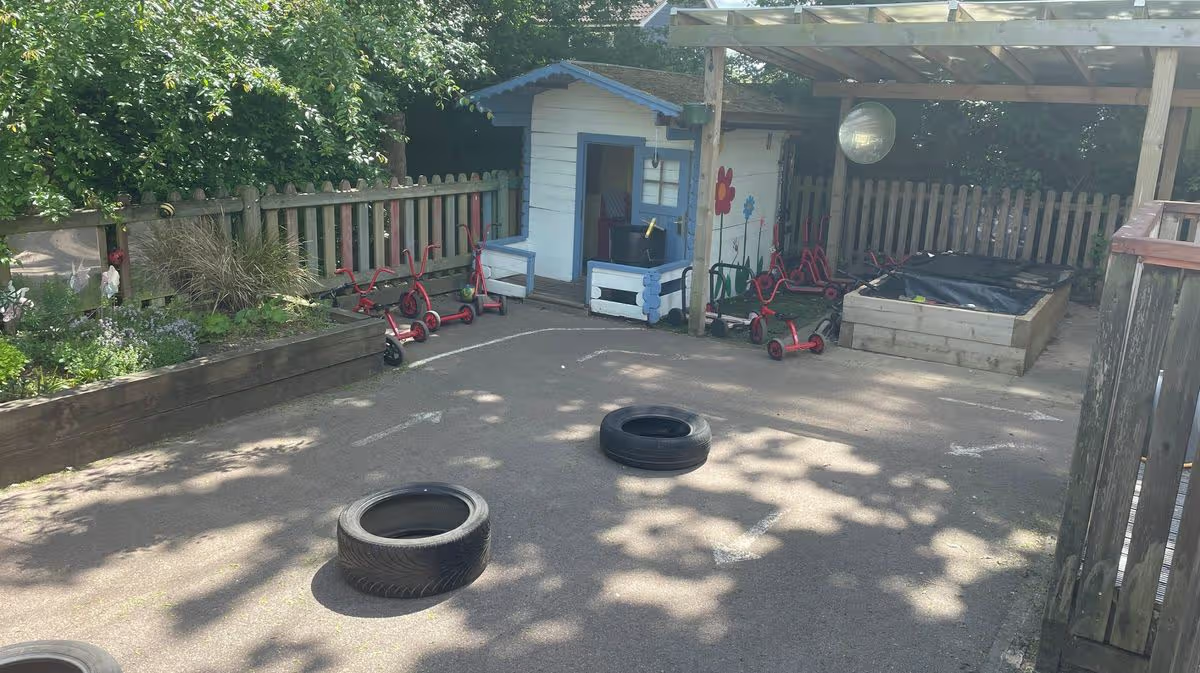
The preschool, on Limes Road is described as a “dynamic early learning experience” for children aged two to five years, said it believes that “every child is a star waiting to shine”.
Inspectors found that pupils “behave extremely well” and “thoroughly enjoy participating in group activities”. Children were found to “make rapid progress”, particularly in developing their listening and attention skills.
The report said: “They learn to concentrate and focus, listen to staff and follow instructions. Children sit and wait patiently at lunch time for their friends to finish before leaving the table.”
Inspectors also highlighted that children develop their “fine motor skills through varied activities” and that children with special educational needs “make remarkable progress in all aspects of their development and are well prepared for the next stage in their learning”.
Children were also found to be “confident to take risks” as well as “challenge themselves both physically and intellectually”. Staff help them to “think deeply to solve problems”, the inspection identified.
Staff were praised for ensuring that “every child flourishes and develops the skills and knowledge needed for the next stage in their learning”.
A spokesperson for Hardwick Pre-School said: “We are absolutely delighted with our recent Ofsted report! Staff are dedicated to ensure the children receive engaging and educational experiences and support them to be curious about their world so the can learn and reach their full potential.
Advertisement
“The report also reflects the support we receive from our lovely parents, fantastic committee and our wider community.”
The school was also praised for ensuring that “children who speak English as an additional language have their voices heard as they learn key words in their home languages”. Staff teach children to use Makaton sign language so they can all communicate and build relationships.
In its next steps, inspectors asked leaders and those responsible for governance at the school to sustain their work to ensure continued improvement and high standards. They were also asked to focus on creating a “transformational impact on the outcomes and experiences of disadvantaged children, those with SEND, those who are known (or previously known) to children’s social care, and those who may face other barriers to their learning and/or wellbeing”.
The 7-year-old died after being knocked down in April 2021
19:26, 13 May 2026
Advertisement
A witness to an accident that claimed the life of a seven-year-old girl in West Belfast five years ago told an inquest that a noise he heard at the time still “haunts” him to this day.
Deirdre Crawford left home at 5.50pm on April 3, 2021, to bring a present to a work colleague’s house for their 30th birthday. As she drove up Springhill Avenue, Mrs Crawford’s blue Renault Captur car hit Kaitlin McCoubrey-Fullerton, who sadly died at the scene. No prosecution was taken against her by the PSNI after the incident.
An inquest into the young girl’s death took place this week at Belfast Laganside Court, with the evidence focused on the circumstances before Kaitlin entered the road, what happened as she did so, and the layout and condition of Springhill Avenue.
Additionally, the inquest has examined the presence of parked vehicles and a speed ramp, as well as the driver’s control.
When the hearing resumed on Wednesday, witness Martin McGahan recalled calling to the home of his friend Gerard McGivern and his wife, Carmel for a barbecue at Springhill Avenue that evening. He said it was a “beautiful, dry and sunny” Easter Saturday, adding, “It felt like summer had arrived.”
“There were a lot of people in the street, mostly sitting in their gardens and plenty of kids in the street. The play park on Springhill Avenue was packed with children. I could smell barbecues as I walked up the street. The atmosphere was amazing, it felt really lively,” he said.
“There were cars parked on either side of the street, partly on the road and pavement, which made it very narrow for traffic. Because of all the cars and children, it meant that anyone driving on the street had to go very slow.”
Advertisement
Mr McGahan said he was sitting in the front garden and had just drunk his first couple of mouthfuls of beer when, shortly after 6pm, he saw a sky blue car pass in front of the house.
He added: “The car didn’t appear to be doing any speed as it passed. Around the same time, I remember hearing the sound of a car suddenly stopping or braking, although it wasn’t a skidding sound.
“It also sounded like something being sucked under a car. There was a gasp from the street and then silence. From the noise I heard, I knew something had been hit by a car. I thought it was possibly a child.”
Mr McGahan added that as soon as he heard the noise and saw the car pass, he jumped up and rushed out of the garden.
Advertisement
“We were all worried it was one of Gerard’s children that had been hit. I ran around a car and saw a young girl with red hair lying on the road. She was completely still. I thought she had no chance, that she was dead.
“There were two young women near the car. One of them said there’d been in an accident and that they’d just seen a flash of her hair.”
Mr McGahan then rang 999 and paramedics arrived soon after: “They didn’t seem to do much. I asked one of them if there was anything I could do to help, but they indicated she was beyond help.
“Then the parents of the child arrived. The girl’s father, who was really distressed, lifted her shoe, which had been lying on the road and threw it up the street in the direction of the Springfield Road. Both of them were shouting at the girl to wake up.”
Advertisement
He added: “The family of the driver were in a complete panic. They were asking me if the girl was OK. When I told them she had died, they were distraught.”
Under cross examination by David Reid, counsel for the coroner, Mr McGahan said he also recalled hearing a scraping noise when the car hit a speed ramp.
“That noise still haunts me to this day,” he added.
In her evidence, Carmel McGivern recalled being in her garden with Mr McGahan and others when she heard what “sounded like a wheelie bin or someone’s wing mirror being struck by a car”.
Advertisement
“I knew a vehicle had hit something. It was loud enough to make my stomach turn. When I heard voices, I knew from their tone that something serious had happened. Someone had been knocked down,” she added.
When Mrs McGivern got up and ran straight out through the garden gate onto the street, she observed a stationary car and a young girl lying in the middle of the road.
She recalled: “There was no sign of life at all. My immediate thought was that she was gone. I knelt down beside her and said, ‘I’ve got you, sweetie, I’m here for you’ – ‘you’ve been in an accident, there’s help coming’.
“I lightly stroked her back and pulled her hair back from her face to behind her ear. I held her hand and just kept whispering soothing things to her, calling her by her name and telling her she was loved”.
Advertisement
When questioned about the conditions on the road in terms of how busy it is for traffic, Mrs McGivern replied: “Springhill Avenue is a very busy street, and very active with kids and cars constantly going up and down the street. Some of them respect the speed and some don’t. A lot of people are on their mobile phones. It’s still like that today.”
She added: “I think if the drivers were made aware that maybe there was a camera watching, they might slow down and not use their phones as much. I do see a lot of people on their phones.”
Sean Dodds, who was driving behind the blue Renault Captur, after collecting his own daughter, when it hit Kaitlin recalled: “There were cars parked on either side of the road, meaning it was very tight for traffic getting through. It was Easter weekend, so there were loads of people in the area. I remarked to my partner that it was crazy how busy it was.
Advertisement
“The road is a long straight with a couple of speed bumps along it. My partner’s car had new alloy wheels, which I did not wish to damage, so I took it very slowly over the speed bumps.
“I volunteered to take my daughter home before returning to pick up my partner. I left at about 6:10pm with my daughter in a child seat in the rear of the car. I didn’t have the radio on and the windows were closed.”
Mr Dodds said the car in front driving at a constant speed and not fast: “All of a sudden there was a sharp movement towards the road. I distinctly remember a young girl with red hair running out straight across the road. I’m not sure where she was looking when she ran out.
“The car in front of me had either reached the speed bump or was just before it when the girl ran out immediately in front of the car.
Advertisement
“I don’t recall seeing the car in front brake or swerve prior to impact. It all happened very quickly. The car seemed to hit her as soon as she came out. She was struck by the front of the car in the front of the passenger side.”
He added: “I didn’t hear any noise prior to impact and don’t recall hearing the impact itself. She went straight under the car. I had a clear view of her under the car and that’s the image I can remember to this day. She was like a wee doll, not like a person.
“I could hear shouting and screaming outside. I was in shock and didn’t want my daughter to be exposed to what had happened. I reversed into a cul-de-sac and drove back up to where I’d come from. I told the people in the house what had happened and a while later, police came and took my details as a witness.”
A forensic scientist who attended the scene afterwards also gave evidence on Wednesday, saying an examination of the Renault car revealed no pre-collision defects and that the road surface was in good condition with no irregularities.
Advertisement
When questioned on driver perception-response time, he told the inquest: “I’m not aware of what the driver could have done differently, unfortunately.”
The inquest has now concluded its evidence and the coroner will deliver her findings in due course.
A passenger is sprayed after disembarking from the hantavirus-stricken cruise ship MV Hondius (Credits: AP)
A British tourist has been detained by authorities and quarantined after being caught in a Milan bar.
The Brit, in his 60s, had been on the same flight as hantavirus-stricken cruise ship passenger Mirjam Schilperoord, 69, when they travelled from Saint Helena to Johannesburg.
She was taken off her next flight when she fell ill and died in a South African hospital.
Advertisement
The unnamed British holidaymaker and his travelling companion, who was not on the flight, were apprehended in Milan before being taken to Sacco Hospital.
The pair, who were not showing symptoms, were told they must remain in quarantine until June 6, after being forced into a 42-day isolation period.
Sign up for all of the latest stories
Start your day informed with Metro’s News Updates newsletter or get Breaking Newsalerts the moment it happens.
Advertisement
It came after a French hantavirus patient was fighting for her life in hospital after being placed on an artificial lung.
Doctors described the device keeping her alive as ‘the final stage of supportive care.’
MV Hondius is seen while Spain’s Minister provide updates on the evacuation (Picture: EPA)
They added the passenger is suffering a severe form of the virus, ‘triggering life-threatening lung and heart failure’.
There are now 11 reported cases tied to the outbreak, nine of which have been confirmed. Three people who were aboard the cruise ship sailing the Atlantic Ocean have died of the rare but fatal disease.
Advertisement
One of the world’s leading health experts has warned that we can expect more hantavirus cases in the near future.
Tedros Adhanom Ghebreyesus, director general of the World Health Organisation, maintains there are ‘no signs’ a pandemic is on the cards after cases of the rodent-borne disease were identified on the MV Hondius cruise ship last month.
But he told a press conference in Madrid: ‘Of course, the situation could change.
The MV Hondius has only a few crew and medical workers onboard now (Picture: ANP/Shutterstock)
What is hantavirus?
A cabin inside the MV Hondius, during the voyage to Spain’s port of Tenerife (Picture: AP)
Hantavirus, sometimes called the ‘rat virus’, is a rare family of pathogens carried by rodents – there is no vaccine or cure.
The virus spreads through contact with the faeces, urine and saliva of infected rodents.
Early symptoms can be easily mistaken for the flu, such as fever, chills or body aches, but can escalate to heart or lung failure.
At the centre of the cruise outbreak is the Andes strain, which is endemic to South America, including Argentina, where the ship departed on April 1.
Advertisement
Dr Stathis Giotis, a lecturer in life sciences at the University of Essex, told Metro that the Andes hantavirus is the only known strain that can be spread from human to human, though cases of this are few and far between.
‘It is clearly a serious situation for those directly affected and it deserves careful public health follow-up, but there is no evidence at present that this represents a broader epidemic threat,’ he said.
People who may get in contact with rat droppings, like agricultural workers or people simply cleaning their sheds, are at high risk.
Rat droppings look like this and can carry hantavirus (Picture: Getty Images)
Advertisement
Hantavirus is still a mystery
Despite years of research, many questions have yet to be answered about the hantavirus, including exactly how it spreads, how long it can survive outside a host and why it can be mild for some people and severe for others.
There is no specific treatment or cure, but early medical attention can increase the chance of survival. The Andes virus implicated in the cruise ship outbreak can have an incubation period of up to eight weeks and a mortality rate of up to 50%, according to the World Health Organization.
The virus usually spreads from rodent droppings and is not easily transmitted between people, though the Andes virus may be able to spread between people in rare cases.
The genome of the hantavirus has been completely sequenced, the European Centre for Disease Prevention and Control said Wednesday.
Advertisement
‘There is no data to suggest that this virus is behaving differently in terms of transmissibility or severity from any of the known virus circulating in certain regions of the world,’ said Andreas Hoefer, who oversees the operational coordination of the European Union’s reference laboratories for public health.
‘Based on that data, I would say that currently we have no reason to suspect that this is a new virus’.
The Gunners had crucially wrestled back the initiative from Pep Guardiola’s domestic treble chasers in recent weeks having lost 2-1 at the Etihad Stadium in a crunch clash last month, winning all their games since then and also progressing past Atletico Madrid into the Champions League final, where they will meet reigning French champions and holders Paris Saint-Germain in Budapest on May 30.
Nervy 1-0 triumphs over Newcastle and West Ham – the latter featuring no shortage of VAR controversy – were sandwiched between a far more comfortable victory against Fulham, with Arsenal going back to the top-flight summit and opening up a five-point lead as City could only salvage a last-gasp draw in a six-goal thriller against Everton.
But that was always in the knowledge that City possessed in their pocket a game in hand at home to Crystal Palace, which was eventually rearranged for Wednesday night after their FA Cup progress.
It was must-win territory for Guardiola’s men against a Palace side sitting down in 15th place and with one eye firmly fixed on the Conference League final.
Advertisement
However, Arsenal fans appeared to be given hope of another stumble after the City boss made six changes from Saturday’s 3-0 win over Brentford amid a brutal fixture schedule to end the season ahead of Saturday’s FA Cup final showdown with Chelsea at Wembley – with the likes of Erling Haaland, Jeremy Doku and Rayan Cherki all left on the bench.
Jean-Philippe Mateta thought he had scored early on for a Palace team who made four changes during their own hectic schedule, with the visitors looking more threatening on the break to start with despite City monopolising possession and territory in trademark fashion.
Eyes on the prize: Arsenal and Manchester City will both hope to win the Premier League title next week
Getty Images
It was all too slow and ponderous for half an hour amid a subdued atmosphere at a rainy Etihad, until Phil Foden burst into life with a sensational backheel to release Antoine Semenyo, who fired beyond Dean Henderson.
Advertisement
That eased any sense of lingering tension and City doubled their lead before the break when Foden was again the provider for Omar Marmoush’s deflected strike.
An animated Guardiola was not happy at all with his side’s second-half efforts, until Savinho finished smartly after a fine run and assist from substitute Cherki to wrap up a commanding victory and put City’s goal difference marginally ahead of Arsenal’s (now +43 compared to +42 for the leaders).
When can Arsenal win Premier League title after Man City beat Crystal Palace?
City’s 3-0 defeat of Crystal Palace means that Arsenal can no longer seal the title when they host already relegated Burnley in their final home match of the season at the Emirates Stadium on Monday night, a game that was pushed back a day for television coverage.
Advertisement
Instead, the Gunners will now have to beat Burnley and hope that City do not win away against Champions League-chasing Bournemouth at the Vitality Stadium 24 hours later.
The only scenario that will now see the title decided before the final day is if Arsenal defeat Burnley and City have any kind of slip-up on the south coast. City cannot hope to win it before the final day.
In the scenario that both teams win their next games, Arsenal would carry a two-point advantage into their final-day trip to face a Palace side at Selhurst Park who may be distracted by the prospect of their first European final, which takes place only three days later against Rayo Vallecano in Leipzig.
They will no doubt hope to quickly reverse that aforementioned goal difference deficit against a managerless Burnley who were condemned to an instant return to the Championship after defeat by City last month and then sacked Scott Parker, who was replaced on an interim basis by Mike Jackson as the club search for a new full-time head coach.
Advertisement
If Arsenal were to lose against Burnley in a major upset, then City would go into the final day top of the table ahead of the visit of an Aston Villa side still battling for a top-five finish who also first contest the Europa League final against Freiburg in Istanbul, as long as they then didn’t lose to Bournemouth.
An Arsenal draw coupled with a City win would see the latter top the table on goal difference, while an Arsenal loss followed by a City victory would see Guardiola’s men take a one-point lead into the last day.
The UK State Pension is worth up to £241.30 per week but must be claimed when you reach State Pension age — or you could face a payment delay
Linda Howard Money and Consumer Writer
04:00, 14 May 2026
The State Pension age began a gradual increase from 66 to 67 in April, with the transition scheduled to be finalised for all men and women throughout the UK by 2028. The proposed adjustment to the official retirement age has been in law since 2014, with a subsequent rise from 67 to 68 planned for implementation by the mid-2040s.
The most recent figures from the Department for Work and Pensions (DWP) reveal the State Pension currently delivers regular financial assistance to 13.2 million elderly people nationwide, including more than one million pensioners residing in Scotland. This benefit is accessible to those who have attained the UK Government’s qualifying retirement age and have contributed at least 10 years’ worth of National Insurance Contributions.
Advertisement
Individuals nearing the official retirement age this year may be unaware that the State Pension is classified as a contributory benefit and is not disbursed automatically by the DWP. The benefit must be applied for, otherwise pensioners risk experiencing a delay in receiving their initial payment of up to £241.30 per week, or £965.20 for each four-week payment cycle.
The funds are not distributed automatically when someone reaches State Pension age, as certain individuals opt to postpone submitting a claim in order to continue working and accumulate more towards their pension fund, particularly if they have not contributed the complete requirement of 35 years’ worth of National Insurance Contributions, or were ‘contracted out’.
DWP guidance explains: “You do not get your State Pension automatically – you have to claim it. You should get a letter no later than two months before you reach State Pension age, telling you what to do.”
It then clarifies you can either claim your State Pension or delay (defer) claiming it. It states: “If you want to defer, you do not have to do anything. Your pension will automatically be deferred until you claim it.”
Advertisement
This means that unless you respond to the letter confirming your wish to begin receiving your State Pension, no payments will be made, as the DWP will treat any lack of response as an intention to defer, reports the Daily Record.
Postponing your State Pension could boost your weekly payments once you do decide to claim, provided you defer for a minimum of nine weeks. Your State Pension grows by the equivalent of 1% for every nine weeks you defer, amounting to just under 5.8 per cent for every 52 weeks.
The additional sum is paid alongside your regular State Pension payment. However, it is worth noting that any extra payments resulting from deferral may be subject to taxation — further details are available on GOV.UK.
It is also worth bearing in mind that deferred State Pensions rise annually in line with the September Consumer Price Index (CPI) inflation rate, rather than the highest measure of the Triple Lock policy.
Advertisement
Your initial payment will arrive within five weeks of reaching State Pension age, with full payments following every four weeks thereafter. You may receive a partial payment before your first complete one. The letter will outline what to expect.
You can also opt to receive your State Pension payments weekly or fortnightly, which will reduce the waiting time for the first payment. The day your State Pension is paid depends on your National Insurance number.
Jamie Varley, 37, is on trial over the death of 13-month-old Preston Davey on July 27, 2023 (Picture: PA)
A baby allegedly sexually abused and murdered by his adopted dad had a bite mark on his bottom weeks before he died, a court heard.
Jamie Varley, 37, is on trial over the death of 13-month-old Preston Davey on July 27, 2023.
Preston had been placed with Varley and his partner, John McGowan-Fazakerley, 32, at their home in Blackpool aged nine months with a view to him being formally adopted.
But jurors at Preston Crown Court have been told the toddler was routinely ill-treated, sexually abused and physically assaulted, suffering dozens of injuries in the final four months of his life.
Advertisement
On Wednesday, Home Office pathologist Dr Alison Armour was shown several photos and videos of the toddler found on the couple’s phones.
In one image taken on June 12, 2023, Preston was standing naked in a garden paddling pool.
Asked to comment on a darker shade of skin on his right buttock, Dr Armour said: ‘It is my view, sir, it most likely represents a human bite mark.’
She said having looked at the photo, the mark on his body was a round, circular bruise, turning slightly purple and around 3.5cm in diameter.
Advertisement
Peter Wright KC, prosecuting, asked Dr Armour why she though it was a bite mark.
‘The size, configuration, which means the shape, are all consistent with a human bite mark,’ she said.
Dr Armour was also asked her opinion on a series of seven photos recovered from Varley’s phone of Preston in his cot, along with two toy teddy bears, taken four days before his death.
Advertisement
The images span a period of three minutes and 12 seconds, during which time Preston’s head and arms remain ‘slumped’ over the top horizontal bar of his cot with his neck resting on the bar.
His body is apparently partially suspended, his legs in a ‘frog-like’ position and the child seemingly asleep or unconscious.
Advertisement
Varley, at the time a high school teacher, is accused of Preston’s murder
John McGowan-Fazakerley, 32, is accused of allowing the death of the child, with both accused of sexual abuse
‘This is very unsafe and in my view dangerous,’ Dr Armour said.
Mr Wright continued: ‘What is the risk here presented?’
Dr Armour said: ‘Partial suspension, ultimately leading to death, he’s got his neck in contact with that cot railing.
‘That’s going to inhibit your ability to breathe.’
Advertisement
In one photo, Preston’s head is in a slightly different position with fluid coming from his mouth.
Dr Armour continued: ‘Preston’s tongue is protruding, its blue and also his lips appear blue, consistent with a lack of oxygen in the blood.’
Mr Wright said: ‘In terms of a child in that position for that length of time, how safe or otherwise is such a position?’
Dr Armour said: ‘This is a very prolonged period of time for a child to be in such an unsafe position.’
Advertisement
Jamie Varley is accused of the murder and sexual assault of 13-month-old Preston Davey (Picture: Lancashire Police/PA)
Four days later, at around 6.20pm on July 27, 2023, the defendants rushed Preston unconscious from their home to Blackpool Victoria Hospital.
Medics worked for nearly an hour to resuscitate the child but could not save him.
Varley said he had left the child alone in the bath for three or four minutes before he returned and the baby was partially submerged.
Dr Armour, who carried out the post-mortem examination at Alder Hey Children’s Hospital, said people who drown often swallow water but she found no water in Preston’s stomach.
She added: ‘It is my position that drowning can be reasonably excluded as the cause of death in this case.’
Advertisement
Dr Armour concluded the cause of death was an upper airway obstruction, leading to Preston’s collapse by a deliberate act of smothering, or an object or objects inserted into his mouth.
Court artist drawing of Jamie Varley (left) in the dock at Preston Crown Court where he is accused of murder (Picture: Elizabeth Cook/PA)
The post-mortem examination also found external and internal injuries including bruises to Preston’s forehead, throat, mouth, bladder, bottom and bleeding in the lungs.
These were mostly ‘non-accidental’, she said, and could not be explained by the attempts by medics to save his life during resuscitation on hospital admission.
Many of the external injuries Dr Armour described as ‘fingertip’ bruises, consistent with gripping, prodding, poking and pinching, she said.
Preston also had severe bruising to the back of his throat which Dr Armour described as one of the ‘most unusual’ injuries she had never come across in her 39-year career as a consultant forensic pathologist.
Advertisement
‘This is an extensive bruise,’ she said.
Dr Armour said the underlying cause is ‘difficult to ascertain’.
Smothering ‘either by a hand or a soft object’ could be the cause, she said, but that ‘would be unusual’.
She added: ‘That leaves the other cause, in my view – the insertion of an object into the mouth occluding the airways.’
Advertisement
Dr Armour told jurors there were no injuries to Preston’s teeth, tongue, palette or cheeks, indicating the object did not have any ‘sharp edges’.
Asked if the injury was consistent with a sexual assault, she replied: ‘I cannot exclude that, sir.’
Dr Armour said the injuries to Preston’s throat, along with other serious injuries found on his body, were ‘very recent’.
Asked how close to death they were inflicted, she added: ‘I think I have said a matter of hours.’
Advertisement
Varley denies murder, manslaughter, two counts of assault by penetration, five counts of cruelty to a child, grievous bodily harm, sexual assault of a child, 13 counts of taking indecent photos or videos of a child, one of distributing an indecent photo of a child, to his co-accused, and one of making an indecent photo.
McGowan-Fazakerley denies allowing the death of a child, three counts of child cruelty and one count of the sexual assault of a child.
We’ve all popped in to a Home Bargains for an essential item or two, and ended up leaving with a hanging basket, solar lights or a rug that we didn’t know we needed.
Now, residents will soon be able to call in for ‘bits’ as work is underway to transform the space.
Homebase closed their doors here after a major restructure and its collapse into administration in late 2024, leaving the store space available for Home Bargains to take over.
The former Homebase store (Image: Google Maps)
The new store is set to open on August 1 and will be a significant addition to the town, especially since the current Home Bargains stores in Gateshead are relatively small.
Advertisement
Currently, these smaller branches are located in Gateshead High Street at The Precinct and in Blaydon.
Unlike these smaller stores, the new Team Valley Home Bargains store will be much bigger, giving people more options when shopping.
Once open, the new store will provide competition to other big names in Retail World, such as Smyths Toys, TK Maxx, M&S Simply Food, Asda Living, and Dunelm.
This development is anticipated to bolster the local shopping scene, with locals on social media calling the opening “another boost for local shopping”.
Here’s what the stars have in store for your day (Picture: Metro.co.uk)
The Sun and Mercury are in an alignment known as a Cazimi in practical Taurus. This allows you to wade through complex details.
Sagittarius, Scorpio and Libra, communication and creativity are on your side today. Finding solutions to sticky issues is easy, so tune into that.
Today is prime time for planning, scheming and big goals. Keep your sights set ahead of you, not behind, and all will be well.
Ahead, you’ll find all star signs’ horoscopes for today: Thursday May 14, 2026.
Advertisement
Like checking your horoscope every morning? You can now sign up to our free daily newsletter to get a personalised reading for your star sign delivered straight to your inbox.
To order your unique personal horoscope based on your time, date and place of birth, visit patrickarundell.com.
Aries
March 21 to April 20
The Sun and communicator Mercury have forged an alliance in the practical Taurus, that’s helping you to decipher and plan anything to do with resources or everyday finances with an extra crispness and acumen. Indeed, with the planet of opportunity, Jupiter, still in touch with both, this can also be a time when positive family news can arrive.
Your natural appreciation for continuity has been challenged in recent years by the restless Uranus, which has pushed you to be more experimental. And even if not everything has worked out, you’ve probably enjoyed experimenting. Today is another one that gives you an opportunity to showcase your unique talents and do so with added confidence.
Your guide planet Mercury’s closeness to the Sun in a thoughtful part of your situation, which could see you have some powerful inner realisations or decipher key events from your past. But their link together to the expansive Jupiter suggests a hunch around a business idea could prove to be lucky – if you trust your instincts and act boldly and decisively, Gemini.
You can enjoy lots of bright and breezy chats today, particularly within your group, considering an idea that you can all work on together. Then again, someone could give you valuable input on a future hope. With everyone pitching in like this, it can cheer you to know that your circle is supportive. Past connections that disappointed can start to fade away.
If you are thinking about or talking about retraining, learning new skills, or applying for another job, your mind can be super agile, but also focused on what the practical benefits may be. Mind with Jupiter, the planet much to do with faith, in an instinctive part of your situation, whatever the logic tells you, do be open to listening to your hunches too, Leo.
Whilst you may find yourself especially restless today, you can also find yourself super curious, and that’s not a bad combination. It’s just that often your preference has traditionally been for regular structures and routines in your everyday world, but currently exploring fresh horizons and new people just seems so much more stimulating – how good is that!
Cosmic messages for Cosmic messages for Virgo today
Libra
September 24 to October 23
Being one of the three air zodiac signs, you have a natural appreciation of communication and thinking carefully about situations. Some may feel that you overanalyse, but today you are going to have a fabulous opportunity to get beneath the surface. Excellent if you’re researching, seeking extra value, or even enjoying watching a TV programme on forensics.
You can be very candid in your observations of people, but what others can really appreciate about you today is the time you take to listen carefully to what they have to say. With your listening skills so sharp, this can help you to perceptively tune into their situation, even if you don’t necessarily make a comment. Planning a joint travel jaunt? Things can shape up nicely.
If you’re wanting to get to grip on your personal paperwork or catch up on the domestic chores, today can see you determined to be precise and productive in all you do. Much as your nature can find such demands a little dull, you can just take on these tasks with a great deal of application, and once you have completed all you set out to do, feel quietly content.
Encounters today can be warm, friendly, and amusing. Your dry wit is one of your great qualities and rarely gets talked about in the astrology archetypes of your sign, but it should be. Also, if there is someone that you’re getting to know that you really like, things can just flow very nicely between you. Even if this is not outright flirty, it can still be rather lovely.
If you have a home office, as many people do these days, today is an excellent opportunity to think about whether it’s working as effectively as it might. If it’s squeezed in a corner and has to compete with other domestic demands. It might be worth considering if moving things around would create a little bit more of a quiet cocoon and the chance to concentrate better.
There is little doubt that you can be one of the most intuitive of the zodiac signs, but today your mind can be as sharp as a pin, able to dextrously whirl different concepts around with ease, but also amuse people with your sharp observations and playfulness. With the weekend racing up, and a bubbly New Moon, this can see you keen to arrange fun social possibilities.
Your daily Metro.co.uk horoscope is here every morning, seven days a week (yes, including weekends!). To check your forecast, head to our dedicated horoscopes page.
As a loyal Metro reader, we want to make sure you never miss our stories when searching for your news. Whether it is the latest politics news explained, live football coverage or a showbiz scoop.
Click the button below and tick Metro.co.uk to ensure you see stories from us first in Google Search.
Hydrangeas are a popular flower but few people know you can change the colour of them.
Vita Molyneux Travel reporter
03:32, 14 May 2026
Hydrangeas are a beloved choice for British gardens. Their enormous, luxurious blooms deliver a spectacular splash of colour, and they’re comparatively straightforward to maintain.
They’re also amongst the select few garden plants capable of changing colour over time. Many gardeners purchase these shrubs assuming their hue is permanent, but specific varieties can transform as time passes. With the appropriate soil conditions, hydrangeas can shift from pink to blue or even purple. This occurs when the soil becomes more acidic, making aluminium more accessible to the plant, which can influence the pigment of the petals.
Advertisement
Jo McGarry, from Caragh Nurseries, said: “Many people are surprised to learn that hydrangea colour is directly linked to soil pH. In acidic soil, the blooms turn blue, while alkaline soil encourages pink petals. Purple shades appear when the soil is close to neutral.
“Only certain hydrangeas respond this way, particularly macrophylla and serrata varieties. White hydrangeas generally stay white regardless of soil conditions.”
If you’re hoping to alter the colour of your hydrangeas, it’s reasonably straightforward to achieve. However, some traditional techniques ought to be avoided, reports the Express.
Advertisement
One approach gardeners have attempted to modify their hydrangeas’ colour is by placing a rusty nail into the soil underneath their shrubs.
Jo said: “Burying rusty nails in the soil to turn hydrangeas blue is something gardeners have talked about for years, but it isn’t the safest or most effective option.
“Sharp metal hidden in borders can become a hazard for people and wildlife. They also provide too little soluble iron to impact petal colour.”
Instead, there are more secure alternatives to transform your garden.
Jo said: “Using ericaceous compost, coffee grounds, or aluminium sulphate is a much better approach for gardeners wanting blue hydrangeas. These methods gently increase soil acidity without creating unnecessary risks in the garden.
“For pink hydrangeas, the soil needs to be more alkaline. Adding garden lime can help raise the pH and reduce aluminium uptake. This encourages pink blooms to develop.
“A fertiliser with higher phosphorus levels can also help limit aluminium absorption and support stronger pink colouring.”
Advertisement
It typically requires at least one growing season before visible colour changes emerge.
Jo said: “Testing your soil pH first is always worthwhile because overcorrecting can stress the plant and affect nutrient uptake. Small gradual changes tend to give the healthiest and most consistent results.”
In our research in the British Library’s medieval collections, we have identified a previously unnoticed document that provides fresh insights into the survivors of the outbreak of plague known as the Black Death (1346–53).
The document – a scrap of parchment inserted into an account of the Ramsey Abbey manor of Warboys in Huntingdonshire – records how much time peasants were absent from work when struck down by the plague. It also reveals the names of those who survived and how long their employers believed recovery could take.
In our recent paper with Barney Sloane we shed new light on a group of 22 tenants who probably contracted plague, languished on their sickbeds for several weeks, and then recovered.
As one of the deadliest pandemics in recorded history, it has been estimated that between a third and two-thirds of the population of medieval Europe died during the Black Death.
Advertisement
The Triumph of Death by Pieter Bruegel the Elder (1562) shows the social upheaval that followed the plague. Museo del Prado
Given the sheer scale, many historians have focused on discovering details about those who died. Yet this has left the histories of those who contracted plague and recovered largely untold.
Despite the deadliness of the disease, it was possible to recover from plague, and medieval chroniclers mention the possibility – however unlikely – of survival. For example, Geoffrey le Baker, a clerk of Swinbrook in Oxfordshire, wrote in the following decade that he thought recovery depended on people’s symptoms:
People who one day had been full of happiness, on the next were found dead. Some were tormented by boils which broke out suddenly in various parts of the body, and were so hard and dry that when they were lanced hardly any liquid flowed out. Many of these people escaped, by lancing the boils or by long suffering. Other victims had little black pustules scattered over the skin of the whole body. Of these people very few, indeed hardly any, recovered life and health.
But who recovered? Why did so many succumb to the disease when others survived? And just how long was this “long suffering”? Unfortunately, there is remarkably little documentary evidence because most medieval sources record information about mortality rather than ill health.
Advertisement
Unique list of plague survivors
A unique inclusion in the account of the manor of Warboys details a group of people who fell ill between the end of April and the start of August 1349. The monks of Ramsey Abbey wrote a list of their tenants who had fallen sufficiently sick that they could not work on the lord’s lands and detailed the length of time that they were absent.
The newly discovered list of plague survivors, from the British Library Collection: Add. Roll 39811. Author provided (no reuse)
People were clearly affected differently by their experience of plague.
The quickest recovery was that of Henry Broun who missed just a single week of work. By contrast, John Derworth and Agnes Mold had much more protracted illnesses and were both absent for nine weeks.
The average length of illness was between three and four weeks, with three-quarters of people returning to work in under a month. The speed of their recoveries is all the more surprising given that they were entitled to up to a year and a day of sick leave from work.
Advertisement
This list of survivors includes a preponderance of tenants who occupied larger holdings on the manor. It has long been debated by historians and archaeologists whether the plague killed indiscriminately, with no regard to status, sex or age, or whether the poor and elderly were more vulnerable.
The survival of so many wealthier tenants could indicate that their higher living standards enabled them to recover more readily than their poorer neighbours, perhaps because they were able to stave off secondary infections and complications. We should not read any significance into the fact that 19 out of the 22 people were men: this reflects the gender bias of manorial landholding rather than any sex-selectivity of plague.
Although 22 people may not seem like many, in a regular year during the 1340s, only two or three absences were recorded during the summer months. It, therefore, represents a tenfold increase in regular illnesses on the manor. Put another way, these sick tenants were absent for 91 weeks’ worth of labour services during just a 13-week period.
Our understanding of the impact of the Black Death has been influenced by the appalling scale of death. Yet it is only when we add those who fell ill and recovered back into the picture that we can truly understand the seismic shock the pandemic had on society. The dead, dying and sick must have considerably outnumbered the living in villages and cities across Europe.
The consequences of this can be seen in medieval accounts and chronicles, one of which records that “there was so great a shortage of servants and labourers that there was no one who knew what needed to be done”. As a result of this combination of high mortality, unprecedented illness and abysmal weather, the two harvests of 1349 and 1350 have been described as the worst experienced in medieval England, worse even than those that caused the great famine of 1315-17.
This archival discovery allows us to write the history of sickness and recovery back into the Black Death, demonstrating that recovery was possible even during one of the worst pandemics in recorded history.
This new evidence reveals the remarkable resilience of medieval peasants. Many of them lay languishing on their sickbeds, exhibiting buboes (the painful, swollen and inflamed lymph nodes on the groin and neck that were typical of the Black Death), vomiting blood and wracked by fevers and not only survived but returned to work in just a few short weeks.
A cleaning expert shared that yellow toilet bowl stains are caused by much more than just limescale – and how to remove them in 60 minutes
Shania King-Soyza and Ellen Jenne Senior U35 Spare Time Writer
01:26, 14 May 2026
Persistent yellow stains in your toilet bowl can make even a spotless bathroom look grubby, but tackling them doesn’t have to mean reaching for harsh chemicals or splashing out on pricey products. With just two common household items, you can break down stubborn build-up and restore your toilet to its former glory in as little as 60 minutes.
A cleaning expert writing for the Martha Stewart website has revealed that vinegar and bicarbonate of soda are genuinely all you need. However, you may well be using these items in the wrong way.
The expert went on to explain exactly how to clean your toilet bowl so those yellow stains disappear — and what’s actually causing them in the first place. It turns out it’s not simply limescale.
Advertisement
More than limescale
Yellow toilet bowl stains are primarily caused by mineral deposits from hard or well water, including calcium, magnesium, and iron, which form a hardened, rock-like layer over time.
That said, urine can also play a part. The acid in urine can react with minerals from hard water to create particularly stubborn deposits. The longer stains are left untreated, the harder and darker they become — and if left unchecked, they can even lead to blockages, reports the Express.
Clorox in-house scientist Mary Gagliardi admitted to the Martha Stewart blog that: “Uric acid (present in varying concentrations in urine) can react with hard water minerals to form uric salts with low solubility that deposit on surfaces, resulting in yellow stains.”
Advertisement
How to clean
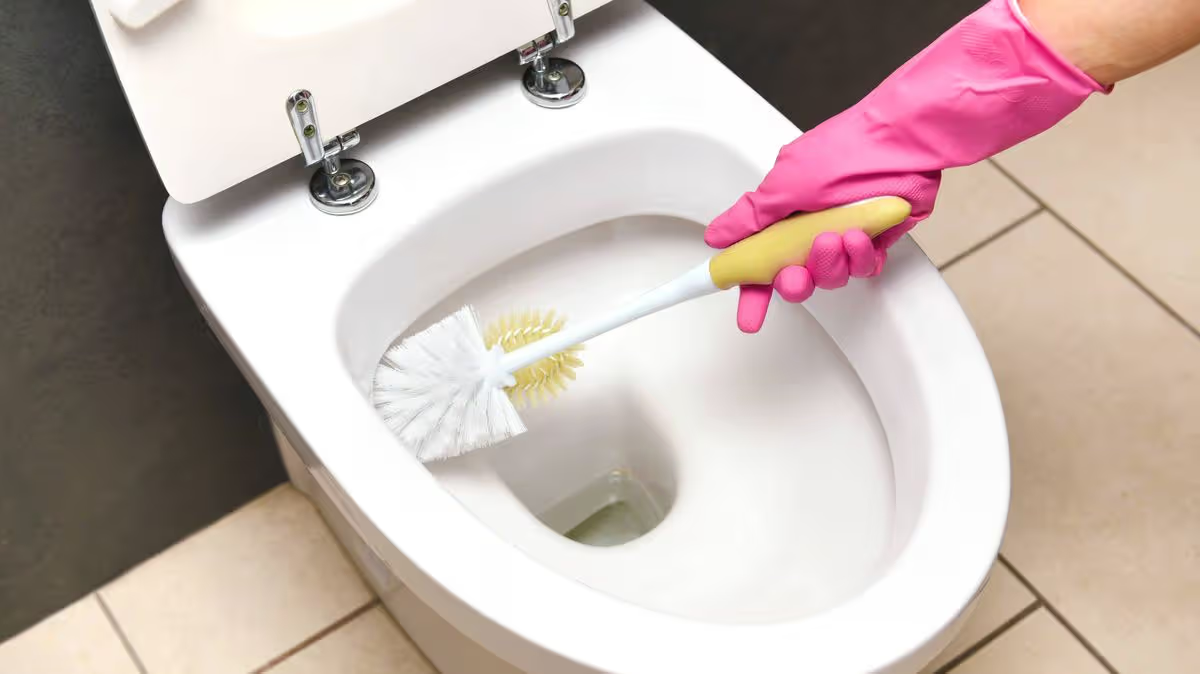
Before you get started, you’ll need white vinegar, baking soda, rubber gloves, paper towels, and a toilet brush. The first step is to lower the water level.
To do this, simply flush the toilet; for a more significant drop, switch off the water supply behind the toilet and flush once more to drain the bowl further.
Next, coat the stained areas with vinegar. For marks above the waterline, you’ll need to use vinegar-soaked paper towels. Leave this to soak for a minimum of 30 minutes — for more stubborn stains, leave it for up to an hour or even overnight.
Add one cup of baking soda to produce a fizzing reaction, leave it to sit for 15 minutes, then scrub thoroughly. Finally, turn your water supply back on and flush to rinse everything away.
Advertisement
Why you need to clean weekly
Cleaning expert Marisol Rivera recommends cleaning your toilet bowl once a week and giving all areas a thorough going-over. Rivera shared: “The jet holes under the rim of the bowl become clogged with mineral deposits over time.
“This causes the water flow to become uneven. The build-up will concentrate in specific areas of the bowl as a result.”
























































You must be logged in to post a comment Login